Construction Management Principles And Practice Alan Griffith Paul Watson
Construction Management Principles And Practice Alan Griffith Paul Watson
Construction Management Principles And Practice Alan Griffith Paul Watson
Construction Management Principles And Practice Alan Griffith Paul Watson
Construction Management Principles And Practice Alan Griffith Paul Watson
1.
Construction Management PrinciplesAnd Practice
Alan Griffith Paul Watson download
https://ebookbell.com/product/construction-management-principles-
and-practice-alan-griffith-paul-watson-4688166
Explore and download more ebooks at ebookbell.com
2.
Here are somerecommended products that we believe you will be
interested in. You can click the link to download.
Construction Management Fundamentals 2nd Edition Christine M Fiori
https://ebookbell.com/product/construction-management-
fundamentals-2nd-edition-christine-m-fiori-47257014
Construction Management 3rd Edition Daniel W Halpin
https://ebookbell.com/product/construction-management-3rd-edition-
daniel-w-halpin-48673054
Construction Management Jumpstart Second Edition The Best First Step
Toward A Career In Construction Management 2nd Edition Barbara J
Jackson
https://ebookbell.com/product/construction-management-jumpstart-
second-edition-the-best-first-step-toward-a-career-in-construction-
management-2nd-edition-barbara-j-jackson-2015898
Construction Management Jumpstart 1st Edition Barbara J Jackson
https://ebookbell.com/product/construction-management-jumpstart-1st-
edition-barbara-j-jackson-2138780
3.
Construction Management ForIndustrial Projects 1st Edition Mohamed A
Elreedy
https://ebookbell.com/product/construction-management-for-industrial-
projects-1st-edition-mohamed-a-elreedy-2378356
Construction Management Alan Griffith
https://ebookbell.com/product/construction-management-alan-
griffith-2390944
Construction Management 4th Ed Daniel W Halpin Bolivar A Senior
https://ebookbell.com/product/construction-management-4th-ed-daniel-w-
halpin-bolivar-a-senior-4079848
Construction Management Jumpstart 3rd Barbara J Jackson
https://ebookbell.com/product/construction-management-jumpstart-3rd-
barbara-j-jackson-44832664
Construction Management 1st Edition Eugenio Pellicer Vctor Yepes
https://ebookbell.com/product/construction-management-1st-edition-
eugenio-pellicer-vctor-yepes-4667940
5.
Alan Griffith andPaul Watson
Construction Management
Principles and Practice
Preface ix
List ofAbbreviations x
1 Introduction 1
Corporate and Project Management 1
Effective and Efficient Site Management 2
Planning and Programmes 3
Operations, Cost Planning and Monitoring Expenditure 3
Site Establishment 4
Plant and Materials 4
Progress and Control 5
Quality Assurance 5
Health and Safety 6
Environment 7
Post-Contract Review 7
Summary 8
References 8
2 Corporate and Project Management 9
Introduction 9
Management 9
Management Theories 10
Management Practice: Systems Theory Applied to the Principal Contracting Organisation 11
Corporate, or Company, Structure 12
Organisational Management Systems 15
Systems Documentation 17
Organisational Management Systems Effectiveness 18
Project, or Site, Structure 20
Summary 22
References 23
3 Effective and Efficient Site Management 24
Introduction 24
Efficiency 24
Effectiveness 24
Workforce Organisation and Supervision 24
Organisational Structures 25
Leadership 28
Management Styles 30
Defining Construction Site Management 31
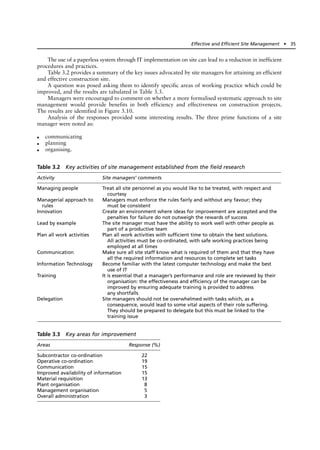
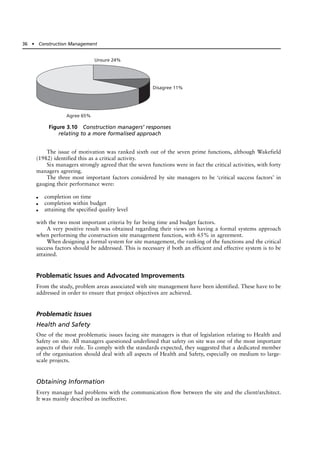
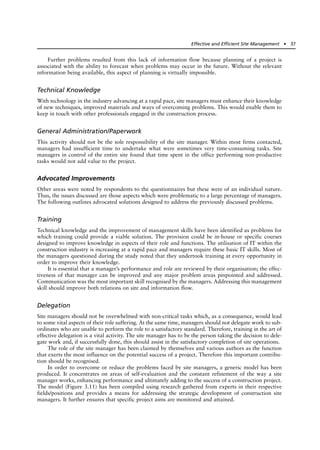
Research Conducted on the Role and Functions of Construction Site Managers 33
Contents
v
11.
Problematic Issues andAdvocated Improvements 36
Summary 39
Organisation Development 39
Best Practice Attainment 49
Requirements of Anthropocentric Production Systems (APS) 55
Management Theory 58
Unravelling the Tangle – H. Fayol (1841–1925) 58
M. Weber (1864–1920) 59
F.W. Taylor (1856–1915) 62
A. Maslow 64
F. Herzberg 65
Motivation as a Complex Process 67
Naoum (2001) 68
Company Philosophy (taken from a large Japanese company) 78
Morphostatic versus Morphogenic 80
Case Study – Motivating Site Personnel 80
Summary 83
References 83
4 Planning and Programmes 86
Introduction 86
Construction Planning 86
Construction Programmes 90
Computer Applications for Planning and Programmes 108
Case Study Planning Examples 108
Summary 114
References 114
5 Operations, Cost Planning and Monitoring Expenditure 115
Introduction 115
Operations Strategy 115
Productive Systems 116
Managing Resources 118
Business Process Re-engineering 120
Partnering 129
Future Developments 132
Field Study Results 138
Summary 140
Financial Planning and Control 141
Summary 180
References 180
6 Site Establishment 183
Introduction 183
Site Establishment 183
Preliminaries 183
Site Organisation 186
Site Layout 187
Case Study – Site Layout 192
Welfare Provision 192
Summary 200
References 200
vi ● Contents
12.
7 Plant andMaterials 201
Introduction 201
Plant Management 201
Terotechnology as a Management Technique 204
Materials Management 205
Just-In-Time Concept 206
Supply Chain Management 213
Summary 219
References 219
8 Progress and Control 221
Introduction 221
Basic Concepts of Construction Progress and Control 221
Benefits of Effective Progress Control 222
Relationship of Programming to Progressing 222
Progress Control 223
Short-Term Planning and Progress Control 223
Objectives of Short-Term Planning 223
Benefits of Short-Term Planning 224
Non-Achievement of Short-Term Plans 224
Developing Short-Term Programmes of Work 225
Drawing up the Short-Term Programme 226
Communicating Work Schedules from the Short-Term Programme 226
Impact of Subcontractors and Suppliers on Short-Term Programming 227
Progress Control 228
Progress Charts 228
Making the Progress Chart ‘Live’ 229
Measuring Work Completed 230
Reviewing Progress 232
Weekly Recording 232
Charting Progress Throughout the Contract 232
Stages in Updating the Progress Chart 232
Problems in Progress Charting 233
Altering a Programme Following Progress Monitoring 233
Progress Updating Cycle in Preparation for the Monthly Progress Meeting 233
Monthly Progress Meetings 234
Summary 235
9 Quality Assurance 236
Introduction 236
Investors in People Standard 237
Benefits of IiP Application 237
Changes 237
Summary 240
BS EN ISO 9000: 2000 Quality Management Systems (QMS) 242
The Main Clauses of the New Standard BS EN ISO 9001: 2000 244
New Philosophy 258
Summary 262
Application of BS EN ISO 9001: 2000 to Construction Related Organisations 263
European Foundation for Quality Management Business Excellence Model (EFQM) 268
EFQM Excellence Model Criteria 269
The EFQM Business Excellence Model 270
The Constituent Parts of the EFQM Business Excellence Model 271
Contents ● vii
13.
Applying the Model276
The Implementation of the EFQM Business Excellence Model within the
Construction Industry – Advocated Advantages and Related Issues 283
Summary 290
The Requirements for Attaining/Maintaining a Competitive Advantage 290
Case Study – EFQM Business Excellence Model Deployment 293
Case Study – EFQM Business Excellence Model Implementation 301
Summary 304
References 305
10 Health and Safety 306
Introduction 306
European Legislation and UK Law 306
Health and Safety Law 307
Principal Health and Safety Laws Influencing the Construction Industry 308
Health and Safety Management for Construction 312
The Company Health and Safety Management System (H&SMS) 313
Planning: The Construction-Phase Health and Safety Plan under the CDM Regulations 314
Procedures for Ensuring Safe Systems of Work 323
Establishing and Maintaining Site Safety Monitoring and Records 329
Case Study – Construction-Phase Health and Safety Plan 341
Summary 341
References 341
Principal Contractor’s Construction-Phase Health and Safety Plan 343
11 Environment 417
Introduction 417
The Construction Industry and the Environment 417
Construction Works and their Effects on the Environment 418
Statutory Environmental Legislation 419
Environmental Regulation 419
Environmental Effects of Construction 419
The Principal Contractor’s Responsibility for the Project Environment 424
Environmental Management 425
Case Study – Environmental Example 442
Summary 443
References 444
Principal Contractor’s Project Quality and Environmental Plan 446
12 Post-Contract Review 500
Introduction 500
Client’s Post-Contract Evaluation 500
Post-Contract Evaluation Meetings 500
Assessing the Principal Contractor’s Performance 501
Principal Contractor’s Post-Contract Review 501
Systems and Procedures Improvement 501
Summary 505
Select Bibliography 506
Index 507
viii ● Contents
14.
Construction Management: Principlesand Practice focuses on the activities of the principal contracting
organisation when undertaking a construction project. The aim of the book is to introduce and explain
those key management functions and processes applicable throughout the siteworks of a construction
project and consider the basic concepts, principles, systems and procedures which impact on the man-
agement functions and processes carried out. The fundamental tenet of this book is that the compre-
hensive understanding and considered undertaking of key site management functions and processes is a
prerequisite to organisational effectiveness and project success. While the book focuses on site manage-
ment aspects it must always be remembered that appropriate, efficient and effective company policies,
strategies and systems, construction technology and production methods are essential to the undertak-
ing of any project. Moreover, the contribution and management of the people who make construction
happen lie at the heart of any construction project. All of these aspects contribute to project success.
Many long-standing management functions, concepts, principles and procedures are traditionally
applied to the site management of construction works: site organisation; planning and progressing;
cost control; plant and materials procurement. These and others are well understood, recognised
and accepted. The effective undertaking of such aspects has successfully delivered many construction
projects. In more recent times, not necessarily new but evolving and reconfigured site management
functions and processes have become prominent in meeting the increasing and substantial demands
which have emerged from both within and outside the construction industry. Over the past twenty-five
years quality assurance management, for example, has evolved to become a fundamental, accepted and
significant part of construction management, with recent developments seeing the introduction of the
quality management standard BS EN ISO 9000: 2000 and the European Foundation for Quality
Management Business Excellence Model (EFQM). Moreover, quality management has served as
a driver for a more systematic approach to other management functions such as health and safety
and environmental safeguard. Site management needs to be aware of the many both traditional and
evolving concepts and practices within construction which impinge on the company and project site
organisations with which they are involved. The book seeks to assist in meeting this need.
ALAN GRIFFITH
PAUL WATSON
Preface
ix
15.
AA%RR Average AnnualPercentage Rate of Return
AAR Average Annual Return
ADR Alternative Dispute Resolution
BEP Break-even point
BPR Business Process Re-engineering
BS British Standard
BSI British Standards Institution
CDM Construction (Design and Management) Regulations 1994
CEO Chief Executive Officer
CHSWR Construction (Health, Safety and Welfare) Regulations 1996
CII Construction Industry Institute
CIOB Chartered Institute of Building
CIRIA Construction Industry Research and Information Association
COSHH Control of Substances Hazardous to Health Regulations 1999
CPR Construction Process Re-engineering
CSF Critical Success Factor
CSM Construction Site Manager
EA Environment Agency
EC European Community
EFQM European Foundation for Quality Management
EIA Environmental Impact Assessment
EMP Environmental Management Plan
EMS Environmental Management System
EPA Environmental Protection Act 1990
EU European Union
FC Fixed Costs
H&SMS Health and Safety Management System
HSE Health and Safety Executive
HSWA Health and Safety at Work, etc. Act 1974
IiP Investors in People Standard
IRR Internal Rate of Return
ISO International Organisation for Standardisation
IT Information Technology
JCT Joint Contracts Tribunal
JIT Just in Time
KF Key Factor
MD Managing Director
MHSWR Management of Health and Safety at Work Regulations 1999
MRC Market Requirements Curve
NEDO National Economic Development Council
NPV Net Present Value
PDCA Plan, Do, Check, Act Control Cycle
List of Abbreviations
x
16.
PEST Political/Legal, Economic,Social/Cultural and Technological
PPE Personal Protective Equipment at Work Regulations 1992
PV Present Value
QA Quality Assurance
QMS Quality Management System
RADAR Results, Analysis, Deployment, Assessment and Review
RIDDOR Reporting of Injuries, Diseases and Dangerous Occurrences Regulations 1995
SCM Supply Chain Management
SMEs Small and Medium Enterprises
SWOT Strengths, Weaknesses, Opportunities, Threats
TC Total Costs
TQM Total Quality Management
TR Total Revenue
VC Variable Costs
VM Value Management
List of Abbreviations ● xi
18.
The purpose ofthis chapter is to introduce the topics to be discussed in subsequent chapters of the
book. Within each chapter the aim is to provide an introduction to the relevant management concept,
principles, systems, procedures and practices that might be considered by a principal contracting organ-
isation when managing that aspect. Each management aspect presented has been the subject of many
textbooks over the years. For a comprehensive consideration and understanding of particular manage-
ment concepts the reader is directed, as a starting point, to the Bibliography at the end of this book.
Although this book focuses on the management activities of the principal contracting organisation,
reference is made, where required, to the roles, responsibilities and practices of other parties working
alongside the principal contractor in managing a construction project. As a principal contracting organ-
isation often supports a large company infrastructure in addition to its many temporary project site
infrastructures, corporate as well as project site activities are presented where appropriate. Examples
from recently completed construction projects are presented to support the text and references are
provided at the end of chapters to assist further reading. The national, European and international stan-
dards referred to in this introductory chapter are referenced within the main chapter in which they
appear. It will be evident that some topics overlap, and this is deliberate and essential in outlining the
linkages that exist between particular management concepts.
It is taken as axiomatic that any construction project is undertaken within the framework of the
form of contract being administered. It is not an objective of this book to define and describe potential
forms of contract such as the JCT 80 Standard Form of Building Contract and its derivatives or the
New Engineering Contract (NEC) branded suite of contracts. Although specific duties and responsi-
bilities are placed upon the principal contractor under various forms of contract, the management
systems and procedures used in meeting the site management of construction works are applicable
generally to all construction contracts. By entering into a contract for construction works the principal
contractor is charged with delivering the project to the client’s requirements for time, cost and quality
while ensuring that welfare, health and safety and environmental aspects are safeguarded.
It is emphasised that it is not this book’s intention to be prescriptive nor to lay down the best
practice for the activities of any principal contracting organisation. Any contracting company will have
its own best ways of approaching each management aspect of site construction works within the con-
text of its individual, and possibly unique, organisational circumstances and the particular nature of its
construction projects.
Corporate and Project Management
It will become evident from the subsequent chapters of this book that the principal contracting
organisation will utilise management concepts and principles which require application within both the
company, or corporate, organisation and the project, or site, organisation of the construction contracts
that it undertakes. A clear example of this is the holistic approach to health and safety management.
The company organisation will provide strategic vision, ethos, policies, objectives and senior manage-
ment commitment while the project organisation will provide safe working procedures in delivering the
1 Introduction
1
19.
construction product onsite. To deliver successful projects, and to enable the business of the company
to flourish, the principal contractor needs to put strong and effective links in place between the company
organisation and the construction project organisation.
Although having many elements and functions common to all projects, construction also differs
from project to project. The use of decentralised management structures across wide geographic
locations, delegation to virtually autonomous project sites, the temporary nature of project site organ-
isation and the involvement of a transient workforce all serve to illustrate that the management of
construction can be far from simple and straightforward.
For any principal contracting organisation to be managed effectively there must be a well-
conceived and recognised company structure. This is necessary to provide the foundation upon which
the formal organisation of the business activities and assignment of management responsibilities are
established. It is also a prerequisite to developing the clear business aims, objectives and policies which
guide and stabilise the business.
It must always be remembered that a principal contracting organisation, like any company,
involves people. Individuals and groups lie at the heart of organisational activities. They are central to
shaping the organisation, to getting the work done and to driving and maintaining the company. Within
the many management and operational processes and resources that combine to deliver a construction
project it is easy to forget the contribution of those people that really make it happen. Effective com-
pany organisation will establish the formal structure that is necessary to ensure that people can work
at their best and support the business of the company.
Also necessary are methods, or systems, by which the principal contracting organisation will
deliver and drive its business. Systems include management procedures which guide the undertaking of
the organisation’s business and working instructions which guide the processes, operations and tasks
that are needed to deliver the business, be it a product or a service. A system may be simple, reflected
in a schedule of tasks needed to complete a brief and routine process, or may encompass the whole
functional management aspect within the organisation, for example an environmental management sys-
tem. A system can be tailor-made to meet the requirements of part or all of a management function and
be recognised only by the intra-organisation, or it may be standards-based and have external certifica-
tion such as a quality management system meeting the international standard BS EN ISO 9000: 2000.
Whatever the management systems used by the company it is essential that they are interactive with
and mutually supportive of the project organisation on site. To facilitate the translation and applica-
tion of the management systems to its construction projects, the company will need to establish robust
site organisation. An effective project, or site, structure will provide the means for clear lines of author-
ity, responsibility, communication and feedback to be established within and around the principal
contracting organisation and its activities – all fundamentally necessary to managing the project and
achieving success.
Effective and Efficient Site Management
Both efficiency and effectiveness are vital components of the management of any construction project.
The key aspects contributing to these two components are: the role and functions of the site manager;
the management styles adopted; organisational structure and the corporate planning processes;
anthropocentric production systems; and motivation of staff and operatives. All of these can be
encapsulated under the umbrella of achieving ‘best practice’ and, in so doing, the attainment of a
‘sustainable competitive advantage’ for the principal contracting organisation.
It is important that the holistic nature of an organisation is not forgotton, and therefore although
the key aspects can be appreciated individually they are not mutually exclusive. For example, leader-
ship will have a considerable impact upon motivation and hence upon the efficiency and effectiveness
of the construction project. A further and important dimension to these key components is that they
exist to support the critical function of providing client satisfaction. In practice, this needs to be
delivered with due consideration to the utilisation of finite organisational resources. Therefore, these
aspects of the principal contracting organisation’s operation are far from simple and straightforward.
Some of these key organisational components have traditionally been problematic in practical
application by principal contracting organisations. Nevertheless, generic approaches are recognised and
2 ● Construction Management
20.
advocated as apositive way forward in accommodating some of the difficulties which prevail.
The thrust of appreciating the issues more comprehensively involves having a good understanding of
what organisational resources are available. Furthermore, there must be a full appreciation of what
strategies and management techniques need to be deployed in order to maximise resource utilisation,
or efficiency, and to attain set organisational goals, or effectiveness.
Planning and Programmes
For any construction project there is the fundamental requirement to plan, monitor and control all
activities and all resources. Planning, the process of determining, analysing, devising and organising the
resources required for a construction project, and programming, or sequencing, of those resources
using any one or more of a number of programme types are two of the most traditional of all con-
struction management functions. On almost all construction projects planning is undertaken at three
key phases within the total construction process, at the pre-tender, pre-contract and contract phase.
Each phase is an important management consideration to the principal contracting organisation, pro-
viding the tender price, outlining the strategic resourcing for the project and providing detailed
sequences for the sitework operations.
Large construction projects are complex and interdisciplinary in nature. They embrace many
independent yet interdependent items of work, many operational tasks and involve the contribution of
many participants. Effective management requires the implementation of accurate and robust planning
and programming. Moreover, the principal contracting organisation must not only ensure the efficient
and effective management of any one construction project but may need to manage many projects
simultaneously. Effective construction planning lies at the heart of good project performance and hence
company success; it can make the difference between project profit or loss for the principal contractor.
The primary objective of planning and programming is to allow site management to obtain the neces-
sary volume, speed and quality of work with the best use of resources and with the greatest economy
to the contractor. In this way, value for money is delivered to the client and the principal contracting
organisation secures a financial profit on the project.
The most important aspect of construction planning is the project’s construction technology and
the determination of the construction methods to be used for the siteworks. As a consequence of
this, a key element of planning is the preparation of method statements. These consider and depict the
crucial methods of undertaking the works and only when these are determined can sequences be
considered and programmes drawn up. Planning and programmes will be of little value unless they
accurately reflect the construction methods to be used.
While other management functions such as quality assurance, environmental safeguard and health
and safety are characterised by their standards-based, certificated systems, management approach to
construction planning is structured and systematised predominently by those particular programming
methods and tools used. The most commonly utilised methods of programming can be broadly grouped
into Gantt, or bar, charts and network analysis, although a number of other methods can be applied in
specific situations. Tools exist to aid the application of these methods and these are computer-based and
utilise a variety of software packages. These assist with producing method statements, sequences of
operational elements and also with the presentation of planning outputs in the forms of many available
construction programmes. A principal contracting organisation will probably favour particular pro-
gramming methods and tools and these will form the basis of the company approach to managing the
planning of their construction projects.
Operations, Cost Planning and Monitoring Expenditure
A fundamental activity for any principal contracting organisation is to ensure that operational
functions provide the means for achieving a sustainable competitive advantage. Therefore, strategic
decisions should not be taken without due consideration being given to their impact upon operations.
If this is not ensured, the resulting outcome could be that, far from providing a competitive advantage,
they become a corporate millstone. The core function for success is an appropriate operations strategy,
Introduction ● 3
21.
together with theimplementation of key management tools and techniques such as business process
re-engineering (BPR), partnering, and financial control and decision-making aids.
It is important to recognise the integrated rather than the separate and often disparate nature of
tools and techniques in application. Project success will depend on understanding how the various key
concepts, principles and practices are understood holistically and are translated into operational strate-
gies which through implementation underpin company strategies.
The decision-making processes used are crucial to making timely and effective determinations of
what needs to be done, when things have to be done and how things will be done. Effective decision-
making relies upon the collection, analysis and evaluation of information. In the construction siteworks
phase the focus is invariably upon the assessment of quantitative data although it should be remem-
bered that thorough and transparent decision-making also requires the assessment of qualitative data.
The key function of financial planning lies at the core of understanding data. It is vital to the
operation of the whole organisation and therefore involves both operational and corporate levels. Cash
flow provides the life-blood for any corporate enterprise and so a comprehensive understanding of
cumulative cash-flow analysis is required.
Site Establishment
Running in parallel with the pre-tender, pre-contract and contract planning stages of any large
construction project is the planning of site establishment. Almost all construction projects require the
principal contractor to operate remotely from its corporate organisation, providing a temporary
project infrastructure and organisation to support the siteworks. While site establishment may be min-
imal on small building works, it may be costly and extensive on large construction engineering proj-
ects. Site establishment on a large project could include project preliminary items, management and
supervisory organisation, site layout and temporary facilities, and personnel health and welfare provi-
sion as key elements. The careful and thorough consideration of site establishment can have a consid-
erable influence on the efficient and effective undertaking of the siteworks. Inexhaustive organisational
and project specific variables that alter from one project to another preclude the postulation of any
particular approach, although recognised common principles and practice can be considered.
Aspects of the site establishment will be intrinsic components of the contract between the client
and the principal contractor and be costed within the tender price. There are also formal responsibili-
ties placed upon the principal contractor by current legislation such as that on health and welfare. In
addition, many aspects are voluntary undertakings by the principal contractor and follow the sound
construction management practice of establishing sensible and workable site layout and clear and sim-
ple management organisation. A clear management and supervisory structure is essential to putting in
place the necessary channels of communication, responsibility, authority and control among the
members of the site team. Good site layout is essential if a safe and healthy working environment for
all persons working on and coming into contact with the operation of the site is to be provided.
Within a raft of comprehensive construction legislation, the Construction (Design and
Management) Regulations 1994 require that the principal contractor provides a planned safe working
environment while the Construction (Health, Safety and Welfare) Regulations 1996 require, among
many needs, that good welfare facilities are available to employees on site. Good site establishment
will not only satisfy such legislation but provide a comfortable and rewarding environment in which
management and operatives feel able to work positively and productively. As such, effective site estab-
lishment makes a valuable contribution to the holistic success of any construction project.
Plant and Materials
A principal contracting organisation will only remain a profitable business if it maintains a sustainable
competitive advantage over other contractors in undertaking its projects, and this relies upon the efficient
and effective procurement and use of plant and materials.
Today, with the greater propensity for subcontracting, the principal contractor may not have to carry
a large stock of plant and hiring-in can also provide considerable financial advantage. Nevertheless,
4 ● Construction Management
22.
some large principalcontractors have significant plant holdings and these must be deployed to site
through careful and comprehensive planning. Likewise, the careful planning of materials is essential to
the successful running of any project. Plant and materials planning for construction projects impinges
upon the planning processes at both corporate and project levels. The critical link between strategic
planning and operational planning must be recognised and embraced within the management
techniques and practices adopted.
Terotechnology, Just-in-Time procurement (JiT) and Supply Chain Management (SCM) are techniques
which provide the principal contracting organisation with the basis for efficient and effective manage-
ment of plant and materials on site while also forging the planning links between the corporate and
project organisations. Although terotechnology appreciates economic life-cycle costs of plant acquisi-
tion, ownership and use, JiT focuses on the precision delivery of materials and components to the
project as and when they are required to maintain production continuity, while SCM addresses the
sequences of ordering, manufacture and supply to site. All focus on providing positive, continuous and
synergistic improvements to the processes involved. This chapter focuses on these important advanced
management concepts, embracing both the advantages of application and some of the key difficulties.
The content does not address the technological aspects of materials choice and use nor the selection,
maintenance and utilisation of plant per se, as many texts on both subjects already exist.
Progress and Control
Maintaining progress throughout the siteworks and taking decisions leading to timely and constructive
action to keep the works on track with the planned programme are essential to the effective management
of any construction project. Accurate short-term planning is key to maintaining progress and control.
Short-term planning facilitates the detailed programming of specific sections of the contract
programme, allowing focused progress monitoring and closer control. Feedback from these aspects into
the contract, or master, programme allows the progress and control of the total siteworks to be pre-
sented and reviewed as required. Effective control of progress ensures that resources are allocated in
their appropriate configuration and sequence and at the right time to conduct operational tasks in line
with the programme. Both programming and progressing are therefore fundamental and significant to
the efficient and effective management of the project.
Progress and control mechanisms are only useful where timely action is taken following any depar-
ture from the works that have been planned as reflected in the contract programme. Effective moni-
toring and review together with active and on-going progress charting are necessary. These should be
commensurate with the reporting and evaluation mechanisms used on the project, which are usually
presented at the client’s formal site progress meetings. Progress monitoring, charting, evaluation and
review at appropriate and regular meetings will, as far as practicable, provide the most effective
control of progress for the project.
Quality Assurance
To any principal contracting organisation the quality of service provision to its clients is paramount.
Quality is a key performance indicator by which principal contracting organisations differentiate them-
selves from their competitors, and in today’s highly competitive marketplace it is fundamental to the
organisation’s continued operation of the enterprise and in the drive for increased profits. Construction
organisations simply cannot operate without corporate policies and strategies for quality management
and mechanisms to translate these into effective operational practice on the construction projects they
undertake.
There has been a great proliferation of principal contracting organisations who are certificated
under the BS EN ISO 9000 series quality management systems. The increase in the number of certifi-
cated construction firms reinforces the realisation and importance of quality in marketplace position-
ing within the construction industry. It is therefore crucial to appreciate that the BS EN ISO 9000 series
has, in recent times, undergone considerable change, evolving into the BS EN ISO 9000: 2000 series.
Principal contracting organisations need to be aware of such changes together with the suitable
frameworks and approaches for accommodating them.
Introduction ● 5
23.
Many organisations haveimplemented, or are considering at this time, the principles and practices
of total quality management (TQM) although this has proved to be far more involved and problematic
than application of quality assurance under the BS EN ISO 9000 series. An alternative approach
for the implementation of TQM has been established by the European Foundation for Quality
Management (EFQM) through its quality ‘Business Excellence Model’. This model is a dynamic
approach for engaging in the corporate drive for continued improvement based upon detailed
self-assessment against challenging performance indicators, including external benchmarking. Principal
contracting organisations will find that a good understanding of EFQM may assist them to extend the
boundaries of quality management achievement within their organisations. As with any corporate-
based management system the concepts and principles must be translated into practical management
procedures and working instructions for application on site. This is achieved through the implementa-
tion of project quality plans which incorporate the many generic and project specific facets of systematic
quality management.
The role and commitment of people are essential in all construction site activities together with the
contributions of those individuals and groups who support construction projects from the company, or
corporate, organisation. Investors in People (IiP) has in recent years become prominent as organisations
seek to optimise the skills, knowledge and commitment of their employees. Within the BS EN ISO
9000: 2000 series and the EFQM model the contribution of people is clearly evident and therefore there
are strong links with the concept and principles of IiP. Investing in people and creating a learning-
organisation can assist construction companies to get more from their resources, develop a culture of
improvement and become better placed to meet the increasing demands of construction both now and
in the future.
Health and Safety
In the late 1980s the Health and Safety Executive (HSE) published Blackspot Construction, a report on
the occurrence of accidents within the construction industry (HSE, 1988). Considered to be the defini-
tive report, it showed in stark and clear terms the potential hazards present on all construction sites
and the possible dangers to the health, welfare and safety of construction workers. In highlighting the
principal reasons for fatal accidents within the construction processes the overriding conclusion of the
report was that accidents within construction are avoidable. The Egan report Rethinking Construction
(DETR, 1998) stated that “the health and safety record of construction is the second worst of any
industry.” Although a declining trend in the number of fatal accidents within construction was evident
between the late 1980s and the late 1990s, future accident profiles will always be uncertain.
Over the last twenty-five years the welcome implementation of European Directives and associated
national regulations of European Community (EC) member states has led to significant developments
in UK health and safety legislation. Among many revised and new regulations augmenting the Health
and Safety at Work, etc. Act 1974, The Construction (Design and Management) Regulations 1994 are
perhaps the most significant and well recognised (HSE, 1974; 1994). Their introduction saw a departure
from the traditional and long-standing expectation for health and safety management on a construction
project to the meeting of legislative requirements by duty holders throughout a construction project.
Construction work is by its very nature hazardous. Health and safety is a paramount consideration
for all those who are involved with or come into contact with a construction project. The CDM
Regulations 1994 places the principal contracting organisation at the forefront of health and safety
management on the construction site. On almost all construction projects, following the provision of a
pre-tender health and safety plan procured by the client organisation, the principal contractor is
required to develop a construction-phase health and safety plan and moreover to ensure that health and
safety aspects are effectively managed throughout the production stage on site.
Many principal contracting organisations recognise that an appropriate way to meet their onerous
responsibilities for health and safety is to deliver the establishment of a safe and healthy working
environment and to ensure that health and safety aspects of a construction project are clearly recog-
nised, risk-assessed, planned, organised, controlled, monitored, recorded, audited and reviewed in
a systematic and robust way. One approach to achieving this is to implement a health and safety
management system (H&SMS). Moreover, it is essential that effective health and safety management
6 ● Construction Management
24.
on site iswell supported by an effective corporate organisation which provides a strong and positive
commitment to health and safety reinforced by clear company policies, plans, procedures and practice.
A health and safety management system may be configured around existing organisational manage-
ment systems or be a dedicated standards-based system following BSI-OHSAS 18001, the specification
for occupational health and safety management systems. Whatever form a management approach may
take, the focus of the principal contracting organisation is to plan, establish and maintain a safe and
healthy working environment on site throughout the duration of the construction project.
Environment
The construction industry plays a key role in shaping and developing the built environment. It also has
an undisputed and significant impact upon the environment. The industry has for some time been seri-
ously challenged to become more environmentally friendly and promote sustainability. This challenge
requires the delivery of change within the industry, with new forms of relationships being configured,
new and revised methods of working being utilised and more demanding levels of performance being
met. Along with all participants to the total construction process the principal contracting organisation
has a key and vital role to perform as a driver of change. Principal contractors must deliver timely, cost-
conscious, safe and quality performance on its projects, all within a context of effective environmental
safeguard.
Compared to industries in the manufacturing, chemicals and process engineering sectors over the
last twenty-five years, construction has perhaps been slow to respond to environmental demands.
Environmental pressure is growing however, with increasingly stringent environmental legislation being
introduced, the requirement placed by clients upon contractors for environmental prequalification
being more widely demanded and, indeed, greater interest, cogniscance and expectations being held
within the business and commercial world and also by the general public.
Within the construction industry, strong parallels have emerged over the last decade in the devel-
opment of environmental management concepts and the established concepts of quality management
and quality assurance. Quality management has given rise to performance benchmarking, contract pre-
qualification and management-systems certification widely throughout the service and supply sectors
to construction. Since the introduction of BS 7570: Specification for Environmental Management
Systems in 1992, and its international counterpart ISO 14001 in 1996, now integrated with the
European standard and known as BS EN ISO 14001, major client organisations in both the public
and private sectors have considered environmental management as an important aspect of project
evaluation and development.
In meeting the requirements of current legislation, and to provide active environmental safeguard
on construction projects, many principal contracting organisations have established formal environ-
mental management systems (EMS) within both their corporate and project site organisations. As with
health and safety management systems, an organisation can implement an EMS to meet any desired
degree of inclusiveness. A comprehensive standards-based system requires that the principal contracting
organisation should develop, implement and maintain appropriate management procedures and work-
ing instructions to ensure that its activities conform to the company environmental policy, strategy and
objectives. Furthermore, the approach must meet all the current environmental legislation that regulates
its business activities. On site, effective management of the project environment through the utilisation
of a project environmental plan (EMP) will focus on ensuring that the siteworks are considered,
planned, organised, monitored and controlled with comprehensive awareness of the environmental
impacts that those works may create.
Post-Contract Review
For reasons of both intra-organisational and inter-organisational reflection, post-contract review is
a concluding yet important part of managing any construction project. Feedback to the principal
contractor on project performance is likely to come from the client, as many carry out a formal post-
contract evaluation of their project consultants and contractors. Contract performance, measured
Introduction ● 7
25.
against pre-tender benchmarks,allows the client organisation to evaluate the effectiveness of the
contractor in satisfying the requirements of the project. The procedure may be used to consider
the principal contractor’s suitability for future work and in determining preferred-contractor status.
Intra-organisational post-contract review is an important final stage in the undertaking of any con-
struction project by the principal contractor. It affords the opportunity for the project team, together
with the corporate organisation who provided tender and pre-contract inputs to the contract, to sum-
marise and reflect on their activities and the success, or otherwise, of the project. With so many facets
of site management having to integrate and function efficiently and effectively to make a construction
project successful, post-contract review allows the principal contractor to take stock of the systems and
procedures implemented in managing the project. For example, quality assurance procedures may need
to be improved in the light of workmanship indicators while environmental management systems
might be modified in the light of difficulties experienced so that they are more effective on the next
construction project.
A further dimension is the requirement within specific construction legislation, for example, the
CDM Regulations, to provide information upon contract completion for the project’s construction
health and safety file. With regular and active auditing becoming a prominent part of systems man-
agement implementation, it is likely that inspection audits will have taken place throughout the pro-
ject’s duration. Post-contract review is a suitable way of collating and synthesising the on-going
findings from periodic auditing to identify aspects of good practice and less effective practice with a
view to systems improvement. With the generic elements of project documentation, such as health and
safety plans and environmental management plans, being used from project to project it is essential that
procedures are reviewed upon project completion and updated for subsequent application.
8 ● Construction Management
Summary
This chapter has presented a general introduction to the book and outlined the content of each
subsequent chapter. It will be evident that the management of any construction project may be far
from simple and straightforward, with a great many management concepts, principles and practices to
be incorporated. Likewise, the interaction of individuals and contractual organisations, the technology
of the works and the characteristics of the project present many variables which the principal
contracting organisation must consider in successfully delivering the project. Focusing on management
explicitly, each subsequent chapter will present an introduction to key management concepts,
principles, systems, procedures and practices that might be considered by a principal contracting
organisation when implementing construction management.
References
Department of the Environment, Transport and the Regions (DETR) (1998) Rethinking Construction. Construction
Task Force. HMSO, London.
Health and Safety Executive (HSE) (1974) The Health and Safety at Work, etc. Act 1974. HMSO, London.
Health and Safety Executive (HSE) (1988) Blackspot Construction: A Study of Five Years Fatal Accidents in the Building
and Civil Engineering Industries. HMSO, London.
Health and Safety Executive (HSE) (1994) The Construction (Design and Management) Regulations 1994. HMSO,
London.
Health and Safety Executive (HSE) (1996) The Construction (Health, Safety and Welfare) Regulations 1996. HMSO,
London.
26.
Introduction
This chapter focuseson the recognition of and the link between corporate and project management
within a principal contracting organisation. Almost all such organisations are medium to large, well
developed, may have an extensive range of business and utilise a decentralised structure serving sub-
organisations and project sites which may be dispersed widely geographically. The prime objective of
the corporate organisation is to develop company ethos, policies, aims and objectives which fuel and
drive the business and allow the company to survive and prosper. The prime objective of the project
organisation is to carry out efficiently and effectively those projects which the company undertakes,
delivering its product on time, to budget and with high quality while making a profit. Both parts of the
organisation need the support of each other, and together they must capitalise on their synergistic link
to establish holistic success. Strong and robust structure and organisation are needed to provide effec-
tive management from executive level, through directive and operational levels to supervision and
management on site. The encouragement of teamwork with integrated and holistic commitment is
absolutely essential, as construction is and will always be a ‘people’ activity. Company policies, aims
and objectives will emanate from executive level and these must be communicated throughout the
management hierarchy. Moreover, they must be translated into actions throughout the management
hierarchy, formalised and written down for clarity and direction of purpose. This will be achieved by
establishing management systems – sets of procedures and working instructions – which guide and
direct functional management activities throughout the organisation and work practices, together with
their supervision and control at the project site. To successfully deliver any construction project, a
principal contracting organisation would need to ensure that it has a sound corporate structure to pro-
vide effective organisation, carefully developed systems to provide effective planning and management
mechanisms, and a robust project structure to provide effective working practices on the project
site. This chapter looks at these important aspects, essential to framing the principal contracting organ-
isation’s approach to managing the project – the site management of construction works.
Management
Management is a fundamental aspect of all human activity and endeavour. The use of the word
‘management’ is sometimes misrepresented, often misunderstood and is sometimes perceived as an
over-used cliché. Providing a robust definition of the meaning of management can be problematic, as
each user of the word often has in mind a discrete application. It is best thought of as being a term with
broad practical application. Management can range from an individual’s handling of the most routine
and simple matter to the planning and resourcing of the most complex technological projects.
Management is not a single discipline but rather one which crosses the boundaries between many
disciplines. It can therefore, be multi-disciplinary in nature and inter-disciplinary in application.
In the context of this book, management is explicitly used to emphasise the recognised and
well-accepted application of functional management concepts, principles and practices within the
2 Corporate and Project Management
9
27.
scenario of theconstruction environment. More explicit is the focus on the activities of the principal
contracting organisation and its site activities. Management is a collection of practices for handling
concepts, principles and procedures, and these are transferable from organisation to organisation as
organisational circumstances dictate. Such practices are generic throughout the management of organ-
isations across industry sectors, yet specific in their application within their sectors as company, or
corporate, management is translated into the management of particular types of projects.
Management Theories
Modern management theories, or those emerging after World War II, made great strides from the
schools of management thought which preceded them – the scientific management school and the
human relations school. Scientific management propounded by F.W. Taylor focused on universal
principles of production and its organisation with a view to determining the best way of undertaking
tasks by simplifying its component parts. Taylor’s work was followed by a host of related contributions
from Frank Gilbreth, noted for time and motion studies, Henry Gantt, famous for the Gantt, or bar,
chart, Henry Ford, renowned for assembly line production, and Henri Fayol, the French industrialist
and propounder of the well-accepted five processes of management – forecasting, or planning, organ-
ising, commanding, or instructing, co-ordinating, or harmonising, and controlling.
The human relations school, emerging in the 1920s, focused on productivity and its link to the
welfare of workers and their motivation through positive management. The chief advocate of
the human approach was Elton Mayo, famous for the Hawthorne Experiments at the Western Electric
Hawthorne Plant in the USA. Essentially, workers with the greatest sense of belonging to a group had
the greatest motivation and work outputs. An important dimension to the work was the finding that
informal structures develop within the formal structure, and this can have immeasurable positive effects
on communication, teamworking, morale and motivation, all important aspects within the construc-
tion project situation on site.
While both the scientific management school and human relations school have many positive
aspects to offer to the management of construction projects, modern management theories are perhaps
those which have the greatest propensity to assist. Many theories have emerged in the post-1945 period,
of which two have become prominent and influential – systems theory and contingency theory.
Systems Theory
Systems theory (Checkland, 1993) is generally attributed to Hegel [1770–1831]. Concerned with
creating a systems map to help explain organic biology, he focused on the various sub-systems that
combine to create the whole. Hegel suggested that: the whole adds up to become greater than the sum
of the parts, or the product of synergy; the whole determines the characteristics of the parts, the parts
cannot be fully understood if they are seen in isolation from the whole; and the parts are interrelated
and therefore interdependent, a view commonly held about most organisations today. From this under-
standing, systems theory presents concepts to an organisation to develop their: philosophy – way of
thinking; management – design and operation of the organisation as a whole system made up of
sub-systems; analysis – use of problem-solving techniques; and systematic thinking – logical, thorough
and regular consideration (Hamilton, 1997). Essentially, systems theory suggests that an organisation
is the whole, comprising many parts, and that the organisation exists in an environment which exerts
many pressures upon its activities, indeed the very characteristics of almost all construction companies.
Contingency Theory
Contingency theory focuses upon the need for any organisation to adapt to change. It suggests that
there is no one right way to manage an organisation indefinitely and that, over time, organisations
evolve and must therefore accommodate change, both within and outside the organisation.
Contingency theory has a clear overlap with systems theory in that the organisation’s environment is
always a catalyst for change and must be managed with total flexibility if it is to be successful and to
prosper. Principal contracting organisations, like virtually all organisations in all business sectors, must
be aware of their environment and be vigilant to its changing requirements. Perhaps more than any
10 ● Construction Management
28.
other sector, constructionis susceptible to the volatility of the marketplace and so organisations must
maintain flexibility to manoeuvre their way through changing commercial climates.
Both contingency theory and systems theory are prominent in the management approach to
construction today. However, it must always be remembered that there is an assembly of different
and varied approaches to managing construction. Companies will apply their own management
approach and style to meet the individual operating characteristics of their business and given their
specific situation and circumstances. Nevertheless almost all organisations may adopt some degree of
systems approach and will recognise the need to accommodate contingency and change.
Management Practice: Systems Theory Applied to the
Principal Contracting Organisation
Organisations operating within the manufacturing or process industries will probably be businesses based
on a single and centralised corporate management infrastructure and location with perhaps one or a small
number of production or processing sites. In such situations, the management systems will be relatively
simple and straightforward. A principal contracting organisation differs through the accepted character-
istics of construction, in that there is greater decentralised management through sub-organisations, each
project is in many ways a unique temporary organisation, the parent company is usually managing
multiple projects simultaneously, and each project can have a wide range of inter-disciplinary elements.
In the construction situation, the principal contractor must establish the core corporate structure and
systems for management, which are often duplicated at other regional locations, and also translate cor-
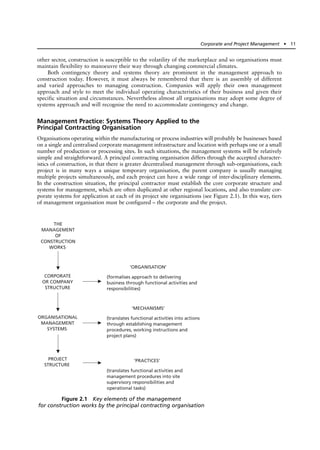
porate systems for application at each of its project site organisations (see Figure 2.1). In this way, tiers
of management organisation must be configured – the corporate and the project.
Corporate and Project Management ● 11
THE
MANAGEMENT
OF
CONSTRUCTION
WORKS
CORPORATE
OR COMPANY
STRUCTURE
ORGANISATIONAL
MANAGEMENT
SYSTEMS
PROJECT
STRUCTURE
‘ORGANISATION’
(formalises approach to delivering
business through functional activities and
responsibilities)
‘MECHANISMS’
(translates functional activities into actions
through establishing management
procedures, working instructions and
project plans)
‘PRACTICES’
(translates functional activities and
management procedures into site
supervisory responsibilities and
operational tasks)
Figure 2.1 Key elements of the management
for construction works by the principal contracting organisation
29.
Corporate, or Company,Structure
The Need for Structure
For any organisation to be managed efficiently and effectively there must be clear business
aims, objectives and policies, commensurate with the core activities of the organisation. To translate
these key elements into workable procedures throughout both corporate and project management the
company must establish a strong, recognised and accepted company structure. Within and around
this structure the company is able to put into place the necessary formal organisations and also allow
the natural development of positive informal organisations which will stabilise, drive and sustain its
business.
A company must develop, implement and maintain an overarching business structure which is
sufficiently rigid to provide the necessary formal structure yet remain sufficiently flexible to accommodate
change and adaptability to fluctuating commercial and business environmental demands. Very few, if
any, organisations would be successful if they were to remain static with an introspective disposition.
All must be morphogenic, or outward looking, with a strong perspective of their holistic business and
with a keen eye on the performance of their products, services or projects. A robust structure supported
by well-conceived organisational management systems and project management allows the company to
remain aware of its business surroundings and inter-organisational influences while also maintaining a
good sense of its intra-organisational dimension (Griffith et al., 2000).
All organisations require structure to give form and focus to their business pursuits, based
predominantly around the company’s thrust of specialisation depicted by their core business.
Specialisation forms the basis of a company’s structure, with vertical specialisation determining the
hierarchical structure of authority while horizontal specialisation gives the differentiation of manage-
ment functions within the various levels of the hierarchy. Together, these thrusts of specialisation form
the basis of the structure within which the company establishes formal organisations, processes, pro-
cedures and practices. Organisations with strong vertical specialisation and control, where policies,
processes and procedures are well documented and with defined divisions of labour and resources, are
termed mechanistic. Organisations with a flat hierarchy but strong horizontal specialisation with few
documented policies, processes and procedures and with predominantly informal control, are termed
organic (Pilcher, 1992). Almost all companies are in some ways a combination of the two, formalising
an overarching management structure through formal organisations while encouraging the all impor-
tant informal interactions of its employees, who are central to the running of its business.
It should always be remembered that people are at the core of any organisation (Harris and
McCaffer, 1995). Within construction organisations, and in particular any principal contracting organ-
isation, people form the nucleus of resources both at corporate and project levels. In addition, whereas
businesses in other commercial sectors focus on products or services, the principal contracting organi-
sation focuses on delivering a project. Central to any construction organisation therefore is the project,
or production, site (Newcombe et al., 1990). The temporary and in some ways unique characteristics
of construction projects with their individual needs, organisations and people inputs mean that the
structure developed by the company must be robust to provide the necessary stability for business oper-
ation within not only the corporate organisation but within the many site organisations that will be
established to deliver its projects.
The organisational structure must also be configured within the context of the company’s constitu-
tion and surroundings. Its constitution will be influenced by: the nature of the business; the arrangement
of labour and resources; the operational characteristics; and the people skills and abilities needed. Its sur-
roundings will impart the influences of: market, natural and physical environments; competition; and
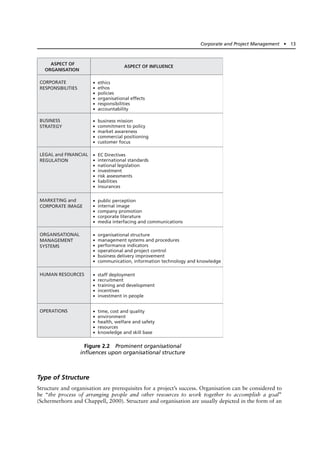
commercial, public and legal constraints (see Figure 2.2). It is essential that the principal contracting
organisation develops its organisational structure within the intra-organisational, inter-organisational
and wider environmental context and within a holistic perspective of serving its whole business which
encompasses both the corporate and project dimensions. Only in this way will it develop, survive and
prosper as a successful organisation. The organisational structure must reflect the activities of corporate
management which maintain and drive the business, the activities of site organisations which carries out
the business through the projects they undertake, and also provide a clear and workable link between
the two levels.
12 ● Construction Management
30.
Type of Structure
Structureand organisation are prerequisites for a project’s success. Organisation can be considered to
be “the process of arranging people and other resources to work together to accomplish a goal”
(Schermerhorn and Chappell, 2000). Structure and organisation are usually depicted in the form of an
Corporate and Project Management ● 13
ASPECT OF INFLUENCE
• ethics
• ethos
• policies
• organisational effects
• responsibilities
• accountability
• business mission
• commitment to policy
• market awareness
• commercial positioning
• customer focus
• EC Directives
• international standards
• national legislation
• investment
• risk assessments
• liabilities
• insurances
• public perception
• internal image
• company promotion
• corporate literature
• media interfacing and communications
• organisational structure
• management systems and procedures
• performance indicators
• operational and project control
• business delivery improvement
• communication, information technology and knowledge
HUMAN RESOURCES • staff deployment
• recruitment
• training and development
• incentives
• investment in people
OPERATIONS • time, cost and quality
• environment
• health, welfare and safety
• resources
• knowledge and skill base
ASPECT OF
ORGANISATION
CORPORATE
RESPONSIBILITIES
BUSINESS
STRATEGY
LEGAL and FINANCIAL
REGULATION
MARKETING and
CORPORATE IMAGE
ORGANISATIONAL
MANAGEMENT
SYSTEMS
Figure 2.2 Prominent organisational
influences upon organisational structure
31.
organisation chart whichidentifies functional management disciplines, responsibilities, relationships
between groups and individuals, chains of command and communication routes. Structure and organi-
sation are essential to facilitating the principal contracting organisation in setting and communicating its
corporate policies, aims and objectives and translating these into management procedures and working
practices at the project level.
A small-scale contracting organisation, of which there are many within the construction sector, is
the simplest of company organisational forms. With a centralised organisation, the manager, frequently
the owner, oversees and directs all business and project management activities utilising a small labour
force on each construction site. As a company increases its business turnover, its workload may change,
expanding in range of type, size and technical complexity. As this occurs the organisation will naturally
divide into functional management elements based on specialist skills. As further expansion occurs there
will probably be separation into divisions based on types of work or location, giving the traditional
organisation of a medium-size principal contracting organisation.
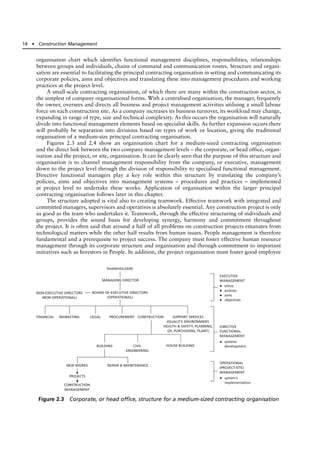
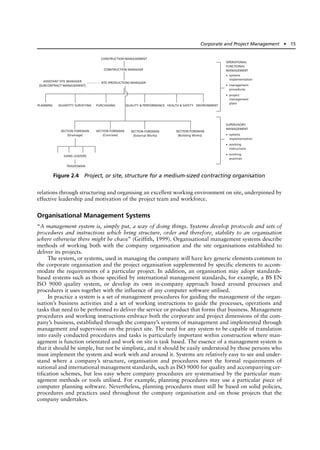
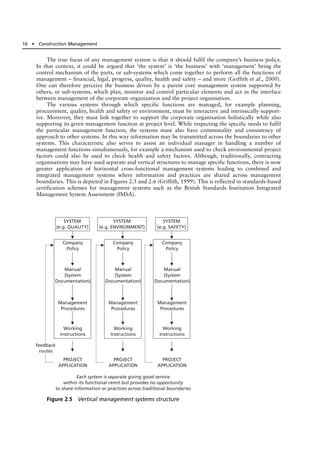
Figures 2.3 and 2.4 show an organisation chart for a medium-sized contracting organisation
and the direct link between the two company management levels – the corporate, or head office, organ-
isation and the project, or site, organisation. It can be clearly seen that the purpose of this structure and
organisation is to channel management responsibility from the company, or executive, management
down to the project level through the division of responsibility to specialised functional management.
Directive functional managers play a key role within this structure by translating the company’s
policies, aims and objectives into management systems – procedures and practices – implemented
at project level to undertake these works. Application of organisation within the larger principal
contracting organisation follows later in this chapter.
The structure adopted is vital also to creating teamwork. Effective teamwork with integrated and
committed managers, supervisors and operatives is absolutely essential. Any construction project is only
as good as the team who undertakes it. Teamwork, through the effective structuring of individuals and
groups, provides the sound basis for developing synergy, harmony and commitment throughout
the project. It is often said that around a half of all problems on construction projects emanates from
technological matters while the other half results from human issues. People management is therefore
fundamental and a prerequisite to project success. The company must foster effective human resource
management through its corporate structure and organisation and through commitment to important
initiatives such as Investors in People. In addition, the project organisation must foster good employee
14 ● Construction Management
SHAREHOLDERS
MANAGING DIRECTOR
BOARD OF EXECUTIVE DIRECTORS
(OPERATIONAL)
NON-EXECUTIVE DIRECTORS
(NON-OPERATIONAL)
NEW WORKS REPAIR & MAINTENANCE
PROJECTS
CONSTRUCTION
MANAGEMENT
EXECUTIVE
MANAGEMENT
ethos
policies
aims
objectives
•
•
•
•
•
•
DIRECTIVE
FUNCTIONAL
MANAGEMENT
systems
development
OPERATIONAL
(PROJECT-SITE)
MANAGEMENT
system's
implementation
FINANCIAL MARKETING LEGAL PROCUREMENT CONSTRUCTION SUPPORT SERVICES
(QUALITY, ENVIRONMENT,
HEALTH & SAFETY, PLANNING,
QS, PURCHASING, PLANT)
BUILDING CIVIL
ENGINEERING
HOUSE BUILDING
Figure 2.3 Corporate, or head office, structure for a medium-sized contracting organisation
32.
relations through structuringand organising an excellent working environment on site, underpinned by
effective leadership and motivation of the project team and workforce.
Organisational Management Systems
“A management system is, simply put, a way of doing things. Systems develop protocols and sets of
procedures and instructions which bring structure, order and therefore, stability to an organisation
where otherwise there might be chaos” (Griffith, 1999). Organisational management systems describe
methods of working both with the company organisation and the site organisations established to
deliver its projects.
The system, or systems, used in managing the company will have key generic elements common to
the corporate organisation and the project organisation supplemented by specific elements to accom-
modate the requirements of a particular project. In addition, an organisation may adopt standards-
based systems such as those specified by international management standards, for example, a BS EN
ISO 9000 quality system, or develop its own in-company approach based around processes and
procedures it uses together with the influence of any computer software utilised.
In practice a system is a set of management procedures for guiding the management of the organ-
isation’s business activities and a set of working instructions to guide the processes, operations and
tasks that need to be performed to deliver the service or product that forms that business. Management
procedures and working instructions embrace both the corporate and project dimensions of the com-
pany’s business, established through the company’s systems of management and implemented through
management and supervision on the project site. The need for any system to be capable of translation
into easily conducted procedures and tasks is particularly important within construction where man-
agement is function orientated and work on site is task based. The essence of a management system is
that it should be simple, but not be simplistic, and it should be easily understood by those persons who
must implement the system and work with and around it. Systems are relatively easy to see and under-
stand where a company’s structure, organisation and procedures meet the formal requirements of
national and international management standards, such as ISO 9000 for quality and accompanying cer-
tification schemes, but less easy where company procedures are systematised by the particular man-
agement methods or tools utilised. For example, planning procedures may use a particular piece of
computer planning software. Nevertheless, planning procedures must still be based on solid policies,
procedures and practices used throughout the company organisation and on those projects that the
company undertakes.
Corporate and Project Management ● 15
ASSISTANT SITE MANAGER
(SUBCONTRACT MANAGEMENT)
SECTION FOREMAN
(Drainage)
OPERATIONAL
FUNCTIONAL
MANAGEMENT
• systems
implementation
• management
procedures
• project
management
plans
SUPERVISORY
MANAGEMENT
• systems
implementation
• working
instructions
• working
practices
SECTION FOREMAN
(Concrete)
SECTION FOREMAN
(External Works)
SECTION FOREMAN
(Building Works)
GANG LEADERS
TRADESMAN
CONSTRUCTION MANAGEMENT
CONSTRUCTION MANAGER
SITE (PRODUCTION) MANAGER
PLANNING QUANTITY SURVEYING PURCHASING QUALITY & PERFORMANCE HEALTH & SAFETY ENVIRONMENT
Figure 2.4 Project, or site, structure for a medium-sized contracting organisation
33.
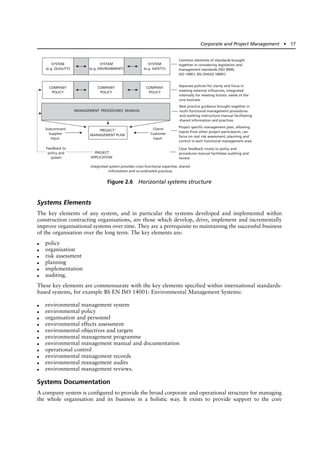
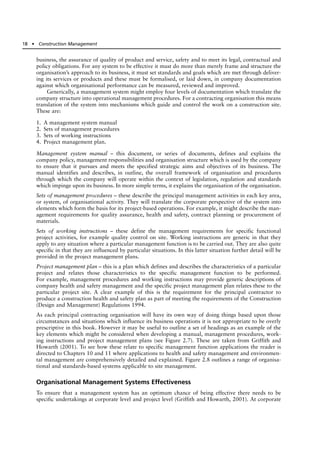
The true focusof any management system is that it should fulfil the company’s business policy.
In that context, it could be argued that ‘the system’ is ‘the business’ with ‘management’ being the
control mechanism of the parts, or sub-systems which come together to perform all the functions of
management – financial, legal, progress, quality, health and safety – and more (Griffith et al., 2000).
One can therefore perceive the business driven by a parent core management system supported by
others, or sub-systems, which plan, monitor and control particular elements and act as the interface
between management of the corporate organisation and the project organisation.
The various systems through which specific functions are managed, for example planning,
procurement, quality, health and safety or environment, must be interactive and intrinsically support-
ive. Moreover, they must link together to support the corporate organisation holistically while also
supporting its given management function at project level. While respecting the specific needs to fulfil
the particular management function, the systems must also have commonality and consistency of
approach to other systems. In this way information may be transmitted across the boundaries to other
systems. This characteristic also serves to assist an individual manager in handling a number of
management functions simultaneously, for example a mechanism used to check environmental project
factors could also be used to check health and safety factors. Although, traditionally, contracting
organisations may have used separate and vertical structures to manage specific functions, there is now
greater application of horizontal cross-functional management systems leading to combined and
integrated management systems where information and practices are shared across management
boundaries. This is depicted in Figures 2.5 and 2.6 (Griffith, 1999). This is reflected in standards-based
certification schemes for management systems such as the British Standards Institution Integrated
Management System Assessment (IMSA).
16 ● Construction Management
SYSTEM
(e.g. QUALITY)
SYSTEM
(e.g. ENVIRONMENT)
SYSTEM
(e.g. SAFETY)
feedback
routes
Company
Policy
Manual
(System
Documentation)
Management
Procedures
Working
Instructions
PROJECT
APPLICATION
Company
Policy
Manual
(System
Documentation)
Management
Procedures
Working
Instructions
Each system is separate giving good service
within its functional remit but provides no opportunity
to share information or practices across traditional boundaries
PROJECT
APPLICATION
Company
Policy
Manual
(System
Documentation)
Management
Procedures
Working
Instructions
PROJECT
APPLICATION
Figure 2.5 Vertical management systems structure
34.
Systems Elements
The keyelements of any system, and in particular the systems developed and implemented within
construction contracting organisations, are those which develop, drive, implement and incrementally
improve organisational systems over time. They are a prerequisite to maintaining the successful business
of the organisation over the long term. The key elements are:
● policy
● organisation
● risk assessment
● planning
● implementation
● auditing.
These key elements are commensurate with the key elements specified within international standards-
based systems, for example BS EN ISO 14001: Environmental Management Systems:
● environmental management system
● environmental policy
● organisation and personnel
● environmental effects assessment
● environmental objectives and targets
● environmental management programme
● environmental management manual and documentation
● operational control
● environmental management records
● environmental management audits
● environmental management reviews.
Systems Documentation
A company system is configured to provide the broad corporate and operational structure for managing
the whole organisation and its business in a holistic way. It exists to provide support to the core
Corporate and Project Management ● 17
SYSTEM
(e.g. QUALITY)
SYSTEM
(e.g. ENVIRONMENT)
SYSTEM
(e.g. SAFETY)
COMPANY
POLICY
‘PROJECT’
MANAGEMENT PLAN
Subcontract/
Supplier
Input
Client/
Customer
Input
Integrated system provides cross-functional expertise, shared
information and co-ordinated practices
Feedback to
policy and
system
PROJECT
APPLICATION
Common elements of standards brought
together in considering legislation and
management standards (ISO 9000;
ISO 14001; BSI OHSAS 18001)
Separate policies for clarity and focus in
meeting external influences, integrated
internally for meeting holistic needs of the
core business
Best practice guidance brought together in
multi-functional management procedures
and working instructions manual facilitating
shared information and practices
Project specific management plan, allowing
inputs from other project participants, can
focus on real risk assessment, planning and
control in each functional management area
Clear feedback routes to policy and
procedures manual facilitates auditing and
review
COMPANY
POLICY
COMPANY
POLICY
MANAGEMENT PROCEDURES MANUAL
Figure 2.6 Horizontal systems structure
35.
business, the assuranceof quality of product and service, safety and to meet its legal, contractual and
policy obligations. For any system to be effective it must do more than merely frame and structure the
organisation’s approach to its business, it must set standards and goals which are met through deliver-
ing its services or products and these must be formalised, or laid down, in company documentation
against which organisational performance can be measured, reviewed and improved.
Generically, a management system might employ four levels of documentation which translate the
company structure into operational management procedures. For a contracting organisation this means
translation of the system into mechanisms which guide and control the work on a construction site.
These are:
1. A management system manual
2. Sets of management procedures
3. Sets of working instructions
4. Project management plan.
Management system manual – this document, or series of documents, defines and explains the
company policy, management responsibilities and organisation structure which is used by the company
to ensure that it pursues and meets the specified strategic aims and objectives of its business. The
manual identifies and describes, in outline, the overall framework of organisation and procedures
through which the company will operate within the context of legislation, regulation and standards
which impinge upon its business. In more simple terms, it explains the organisation of the organisation.
Sets of management procedures – these describe the principal management activities in each key area,
or system, of organisational activity. They will translate the corporate perspective of the system into
elements which form the basis for its project-based operations. For example, it might describe the man-
agement requirements for quality assurance, health and safety, contract planning or procurement of
materials.
Sets of working instructions – these define the management requirements for specific functional
project activities, for example quality control on site. Working instructions are generic in that they
apply to any situation where a particular management function is to be carried out. They are also quite
specific in that they are influenced by particular situations. In this latter situation further detail will be
provided in the project management plans.
Project management plan – this is a plan which defines and describes the characteristics of a particular
project and relates those characteristics to the specific management function to be performed.
For example, management procedures and working instructions may provide generic descriptions of
company health and safety management and the specific project management plan relates these to the
particular project site. A clear example of this is the requirement for the principal contractor to
produce a construction health and safety plan as part of meeting the requirements of the Construction
(Design and Management) Regulations 1994.
As each principal contracting organisation will have its own way of doing things based upon those
circumstances and situations which influence its business operations it is not appropriate to be overly
prescriptive in this book. However it may be useful to outline a set of headings as an example of the
key elements which might be considered when developing a manual, management procedures, work-
ing instructions and project management plans (see Figure 2.7). These are taken from Griffith and
Howarth (2001). To see how these relate to specific management function applications the reader is
directed to Chapters 10 and 11 where applications to health and safety management and environmen-
tal management are comprehensively detailed and explained. Figure 2.8 outlines a range of organisa-
tional and standards-based systems applicable to site management.
Organisational Management Systems Effectiveness
To ensure that a management system has an optimum chance of being effective there needs to be
specific undertakings at corporate level and project level (Griffith and Howarth, 2001). At corporate
18 ● Construction Management
36.
level there mustbe:
● demonstrable commitment to the organisational policy and strategy
● a clear statement of the organisation’s objectives and policy, circulated throughout the organisation
● employee ownership of the system management functions through involvement in their formulation,
development and implementation
● the setting of goals and targets at both corporate and project level against which group performance
can be measured
● the availability of adequate resources to facilitate system framework and operation
● appropriate and continuing education and training for management and the workforce in opera-
tional procedures
● on-going review and improvement to applications to enhance employee experience and expertise.
Corporate and Project Management ● 19
MANAGEMENT SYSTEM MANUAL (CORPORATE LEVEL)
LEVEL 1
•
•
•
•
Policy
Organisation
Responsibilities
Management Procedure References
MANAGEMENT PROCEDURES (CORPORATE & PROJECT LEVEL)
LEVEL 2
•
•
•
•
WORKING INSTRUCTIONS (PROJECT LEVEL)
LEVEL 3
•
•
•
•
•
•
•
Induction
Risk Assessment
Control Mechanisms and Supervision
Site Meetings
Inspection Routines
Working Procedures
Record Keeping
PROJECT MANAGEMENT PLANS (PROJECT LEVEL)
LEVEL 4
•
•
•
•
•
•
•
•
•
Policy
Organisation
Responsibilities
Statutory Obligations
Method Statements
Risk Assessment
Site Rules
Record Keeping
Auditing and Review
Company Service Management
(finance, legal, marketing, public relations)
Company Support Services
(quality, environmental, health & safety, personnel, training,
materials/plant procurement)
Project Management
(professional liaison, contract establishment, project planning and
resourcing, site control and supervision)
System Documentation
(document control, auditing, reviews, improvement)
Figure 2.7 Levels of documentation for management systems
(adapted from Griffith and Howarth, 2001)
37.
At project level,a management system will be supported by:
● the identification of key issues that need to be addressed on the project site
● risk assessment by and across the boundaries of the specific management functions
● development of action plans in response to identified needs
● distribution of good practice guidelines to functional staff
● determination of audit procedures between the corporate level and the project level
● briefing all project team members on system operation
● training in the use of procedures used to plan, monitor and control the management functions
● availability of practice notes on those good management procedures to be adopted
● preparation of item checklists for the monitoring of specific procedures
● creating self-audit and review documents for the activities of system supervisors
● providing guidance notes on potential actions when problems occur to encourage proactiveness
● making clear reference to corporate management and other support services where assistance may
be needed.
Project, or Site, Structure
There are a great many contracting organisations within the construction industry, each serving their
own particular markets. Such organisations will all differ in terms of their corporate structure, man-
agement procedures and working practices. Although the principal aims and objectives of a particular
20 ● Construction Management
*
European Foundation for Quality Management.
**
Environmental Management Audit Scheme.
MANAGEMENT
FUNCTION
SYSTEM
TYPE
APPLICABLE
STANDARDS
KEY
DRIVER
PERFORMANCE
INDICATORS
Project planning
Cost planning
Human resources
Procurement
(plant/materials)
Quality
Environment
Health and Safety
company
company
company
company
standards-
based
standards-
based
standards-
based
none applicable
none applicable
Investors in
People (IiP)
none applicable
BS EN ISO 9000
EFQM*
BS EN ISO 14000
EMAS**
BSI OHSAS
18001
planning software
used
cost modelling
software used
IiP model
procurement
software/
databases used
management
system
specification
management
system
specification
management
system
specification
business
excellence
business
excellence
business
excellence
IiP certification
certification
certification
certification
Figure 2.8 Range of organisational and standards-based management
systems applicable to site management
company will determineits precise configuration and constitution and therefore, site organisational
arrangement, all generally evolve and develop as the size of their business turnover increases. The larger
the contracting organisation, the greater the tendency to decentralise operations to strategically deter-
mined geographic locations as contracts are won. The emphasis shifts from managing the works from
one centralised office to delegation to sub-organisations or regional or area administrative offices.
While a small contractor will operate within a controlled radius from its central, or head office, with
little delegation, the large principal contracting organisation will give virtually autonomous power to
each of its large project sites to effectively operate independently of, although always in liaison with,
the central, or head, office.
Although the site organisational structure for a large construction project will invariably differ
from project to project, the functions of the site team members are generally the same on each project
and reflect the functional specialist departments operated at corporate level, as seen earlier in
Figure 2.3. It is the corporate organisation’s task to ensure that its structure is configured in such a way
as to facilitate the translation of business aims and objectives into procedures and practices documented
in its systems manuals and lay the foundation for a sound site-based structure such that effective
management can operate.
Prescribing a set site structure in any situation and for any construction project is virtually impos-
sible since there is such diversity in possible organisational structure. However, there are commonly
accepted principles of organisation which should be considered when formulating any structure.
Principally, there should be a clear line of authority identified from the site manager to all functional
managers and supervisors. Everyone based on site must be clear as to their position, duties and respon-
sibilities, for whom they are responsible and to whom they are accountable. These routes of authority
and responsibility also form the key channels of formal communication and upward, downward and
lateral feedback throughout the organisation. It is absolutely essential that these channels are clearly
established at project commencement if the holistic structure is to be effective. Site management also
needs to establish good links with the supporting corporate organisation and also to other parties
involved in the project, for example, the client, consultants, subcontractors and suppliers. This is a
primary role of the site manager.
Figure 2.9 shows the project, or site, structure and organisation for a large principal contracting
organisation undertaking a major construction project. It indicates the management systems applica-
tions to functional disciplines and also the link to subcontract operations. In the figure it will be seen
that the project arrangement is extensive, requiring the appointment of an assistant site manager to
manage subcontract operations. A further assistant might be utilised as an intermediary between super-
visory management and the site manager if necessary. Functional disciplines are translated from the
corporate organisation into site-based functional activities, for example quantity surveying and man-
agement systems translated into site-based applications by, for example the project quality manager,
using ISO 9000 management procedures. These procedures will be documented in the management
procedures manual described previously. Similarly, supervisory management will invoke working
instructions and working priorities, again described within the organisation’s manual allied to the proj-
ect management plan. It is such a structure at site level that needs to be in place to provide effective
project management and lays the foundation for the management activities which follow throughout
the book.
22 ● Construction Management
40.
References
Checkland P. (1993)Systems Thinking, Systems Practice. Wiley, London.
Griffith A. (1999) Developing an Integrated Quality, Safety and Environmental Management System. Construction
Paper 108. Construction Information Quarterly, 1(3), 6–18.
Griffith A. and Howarth T.A.P. (2001) Construction Health and Safety Management. Addison Wesley Longman,
Harlow.
Griffith A., Stephenson P. and Watson P. (2000) Management Systems for Construction. Addison Wesley Longman,
Harlow.
Hamilton A. (1997) Management by Projects: Achieving Success in a Changing World. Thomas Telford, London.
Harris F. and McCaffer R. (1995) Modern Construction Management. Blackwell, Oxford.
Newcombe R., Langford D.A. and Fellows R.F. (1990) Construction Management: Organisational Systems, Vol. 1,
Mitchell.
Pilcher R. (1992) Principles of Construction Management. McGraw-Hill, London.
Schermerhorn J.R. and Chappell D.S. (2000) Introducing Management. Wiley, London.
Corporate and Project Management ● 23
Summary
A carefully conceived and robust organisational structure is a prerequisite to the provision of effective
management at corporate, directive and operational levels through to supervision of the siteworks.
The company mission, policies, aims and objectives must be successfully disseminated throughout the
organisation both at corporate and project levels. Management systems, or sets of procedures and
working instructions which guide and direct functional management activities throughout the organ-
isation, need to be clearly specified and effectively implemented. Types of organisation structure and
associated management systems will, obviously, vary from company to company and project to project.
Nevertheless, there are key elements of both which are standard, in particular with management
systems which are influenced greatly by international standard specifications for development such as
BS EN 1SO 9000, 14000, BSI OHSAS 18001 for quality, environment, and health and safety management
respectively. As with almost all systems approaches, a core element is company documentation. Within
the principal contracting organisation this is provided by a set of documents which incorporate manu-
als, procedures, working instructions and project plans. This chapter has introduced the importance of
organisational structure and management systems and these aspects will be revisited in subsequent
chapters as particular management concepts, principles and practices are examined.
41.
Introduction
A construction organisation’sperformance can be measured in many different ways. Two of the most
common ways are in terms of efficiency and effectiveness. There is a considerable difference between
these two concepts.
Efficiency
The ability to ‘get things done correctly’ is a mathematical concept – the ratio of output to input.
An efficient manager is one who achieves higher outputs (results, productivity, performance) relative to
the inputs (labour, materials, money, machines and time) needed to accomplish them. In other words, a
manager who can minimise the cost of the resources used to attain a given output is considered efficient.
Or, conversely, a manager who can maximise output for a given amount of input is considered efficient.
Effectiveness
Effectiveness is the ability to ‘do the right things’, or to get things accomplished. This includes choosing
the most appropriate objectives and the most efficient methods of achieving the stated objectives.
That is, effective managers select the ‘right’ things to do and the ‘right’ methods for getting them done.
For managers, ‘the pertinent question is not how to do things right, but how to find the right things to
do, and to concentrate resources and efforts on them’.
This chapter investigates some of the key components for Construction Managers in the attainment
of both efficient and effective methods of working towards predetermined objectives.
Within the following text, various basic principles of Construction Management are established,
commencing with some background information on types of organisational structure and site
managerial roles. However, many previous texts have details upon these topics; therefore within this
chapter new concepts have been interwoven in order to broaden the reader’s knowledge horizon. To
this end, topic areas such as anthropocentric production systems and the attainment of ‘best practice’
have been included. This mix is designed to build upon established knowledge and then further develop
it based upon lessons learned from the UK Manufacturing Industry and international research. These
new broad concepts have value for the UK Construction Industry.
A case study is incorporated for the reader to study and answer the related questions with the main
points for consideration being provided.
Workforce Organisation and Supervision
Post-World War II Historical Influences on the Construction Industry:
1945–Present Day
The ‘post-war era’ ushered in a catalyst for change, incorporating:
● society dissatisfaction with previous low standards of homes and workplaces
● start of overseas travel, experience and exchange of ideas from abroad
3 Effective and Efficient Site
Management
24
42.
● greater surgeto better and wider education for all – looking for higher expectancies
● growing workload for companies rebuilding UK after war damage
● better, more efficient building designs
● awareness of scarce water resources conservation
● growing awareness of ‘Green and Conservation’ issues in design etc.
● growing influence of professional bodies, i.e. RICS, CIOB, RIBA, ABE etc. in drawing up standards
● growing awareness of issues of quality in terms of assurance.
‘Current’ Nature and Organisation of UK Construction Industry
The Construction industry has rethought its position and long-term survival through recessions within
the broad pressures related to the following influences:
● more customer-focused – providing value for money
● increasing competition for work
● recession of the late 1980s forced willingness to become ‘flexible’ in business
● emphasis of quality assurance – seeking repeat business from satisfied clients
● new procurements for greater ‘Risk on Contractors’
● widening professional skills and knowledge required
● performance monitoring and control
● closer control of budgets
● faster project completion times yet retaining quality and cost control
● ‘joint’ venture and ‘partnering’ with complementary expertise to ‘share-risk’
● working within ‘niche’ markets with repeat business clients preferably.
UK Construction Industry Response to the above Pressures
Traditionally, in order to survive, companies were required to make higher profits by whatever means
contractors had at their disposal from each project regardless of how their relationship with the client
evolved.
Currently the Construction industry is slowly realising that to survive in a competitive market,
customer relationships, supplying or providing what the customer wants and, most of all, valuing
the potential long-term customer by retaining a good relationship throughout with the object of con-
tinuous work and reasonable profit, are paramount. This indirectly facilitates predictable long-term
company workloads, cash flow and long-term planning and changes, enabling the company to survive
in a highly competitive market. Word-of-mouth from one satisfied client to another is the best market-
ing strategy, with a slogan similar to ‘each project a successful outcome for both parties’ or, as the
Latham Report (1994) states ‘win–win!’ for both client and contractor.
Company Organisation in a Changing Market
Management theory states that ‘organisational form’ must be the servant or consequence of the
company ‘functions’, and not the other way round! This implies that organisational structures must
‘facilitate’ or ‘improve’ company output and performance and therefore they must be flexible and
easily able to change as a company’s functions, output, markets, client needs change.
Organisational Structures
Entrepreneurial Structures (Figure 3.1)
Many construction firms commence life as a sole trader (entrepreneurial) organisation. They seek to
extend the capacity and capability of the individual, who may be a bricklayer, plumber or a professional,
Effective and Efficient Site Management ● 25
43.
such as anarchitect. Owing to this individual “having had the initiative and taken the risk, gives the
entrepreneur such dominance in the evolving organisation that everything depends upon him”
(Torrington et al., 1989).
The main features of an entrepreneurial structure include:
● all activities are focused upon the owner/manager
● the entire enterprise is totally centralised with no clear demarcation of responsibility or autonomy
● this form empowers the owner/manager to control the firm during its early development until it
reaches ‘critical mass’
● the owner/manager is unlikely to possess a sufficient range of specialist knowledge to ensure the
continued survival of the company if it starts to grow
● there must come a point when the owner/manager cannot manage efficiently and effectively,
because of the many varied demands of the firm.
Thus an element of bureaucracy becomes inevitable.
Bureaucracies
These consist of levels of authority or hierarchies, where subordinates have a specifically defined role
to deal with routine issues. When they are faced with these issues, they are ‘programmed’ to respond
in a predetermined manner. Any issue facing them outside that role is referred to a superior. This
ensures that the overall organisation can predict the behaviour of the individual. Only new or novel
problems are referred to superiors who can concentrate their efforts upon them. The authority of
the superior is described as legal or rational, as it is bestowed upon the holder of a particular office.
This presumes that all participants will accept this validity.
That hierarchies are often synonymous with bureaucracies is not surprising in that a multi-layered
system will evolve to ensure compliance with organisational requirements and to deal with new problems.
Specialised ‘departments’ also evolve to deal with individual areas. The method of communication
within hierarchies is controlled by the superior levels. Hierarchies are often perceived as pyramid
shaped. This approach to organisational structures gives rise to the ‘line and staff’ type of structure,
as depicted in Figure 3.2 (see also the work of Weber later in this chapter).
26 ● Construction Management
Figure 3.1 Entrepreneurial structure
Owner/
Manager
Employee
Issues
(Personnel)
Accounts
Purchasing
Arranging
Finance
Marketing
Client
Liaison
Legal
Issues
Operations
Planning
Operations
Supervision
44.
The bureaucratic orfunctional structure’s main features are:
● the firm is organised around the required tasks to be performed to ensure that the distinctive
competence of the company is maintained
● organisational control is exerted through the Chief Executive
● it utilises the concept of ‘division of labour’, i.e. specialists develop expertise
● clearly delineated relationships exist
● it is suitable for fairly static operational environments
● there could be a loss of the entrepreneurial spirit because of a concentration on specialist functions
● the holistic nature of the company could be lost in its drive for a sustainable competitive advantage
● there could be problems in trying to co-ordinate the disparate functions
● functional specialists may seek to further their own little empires at the expense of the company
● there is a danger that specialists will concentrate on short-term profit maximisation at the expense
of long-term corporate survival.
Matrix Structures
In a matrix structure each member has a specialist function but each also has an overlapping competence
with some other group members. However, when we place people to work in groups we must have an
understanding of the effect of the group on behaviour.
A group will develop its own ‘group norms’. The matrix structure has been developed to overcome
the disadvantages of the entrepreneurial and bureaucratic structures. The system was first developed in
the US aerospace industry because of government demands for a single project leader who would be
responsible for the progress of each government contract.
A matrix structure is a combination of structures and, in construction, usually takes the form of
function and project (or geographical division). Matrix structures do not just arise in large complex
organisations but are also utilised in much smaller firms. A typical matrix structure is indicated in
Figure 3.3. In the example provided in Figure 3.3, the site team for Project 1 are allocated from the
specialist functions/departments. This group of staff then provides the team for project operations and
management. This process would be repeated for any remaining projects.
Effective and Efficient Site Management ● 27
Board of
Directors
Chief Executive
Production
Department
Marketing
and Sales
Department
Accounting
and Finance
Department
Personnel
Department
Quality
Department
Health
and Safety
Figure 3.2 Bureaucratic structure
45.
The main featuresof a matrix structure are:
● clear lines of authority and accountability when related to decision-making
● direct contact between specialists replaces bureaucracy
● development of managers via an increased involvement in the decision-making process
● optimum utilisation of skills and resources with maximisation of profit potential
● can be difficult to implement and sometimes the issue of dual responsibilities can cause some confusion.
However, this form does allow an organisation to react better to dynamic changing operational
environments, as is the case with construction.
Leadership
The theories of both motivation and groups are closely linked to that of leadership. It is the leader who
sets out to develop effective motivation for the workforce and the group, whether formal or informal,
and this will either establish or undermine a leader.
Traditional Theory
The traditional theories of leadership are almost at the level of mythology, in fact they can be traced
back to Plato. These suggest that leaders are born and not made. The characteristics of leadership are,
in fact, natural personality traits within the human make-up, neither taught nor transferable.
While there may be an element of truth in this understanding, the flaw of the proposal is that the
characteristics vary from leader to leader and have no measurable quality. Although intelligence, phys-
ical prowess, a wide breadth of interests, inner motivation etc. have all been shown as useful qualities,
a lack of any of these has not disadvantaged certain acknowledged good leaders.
Styles of Leadership
Rather than accept traditional theories, styles of leadership can be identified:
● Authoritarian leaders strictly control the amount and nature of the work of subordinates.
Information is strictly controlled which maintains the leader’s authority (see Figure 3.4).
● Democratic leaders allow the group to determine its own work schedules and amounts, but direct
the overall tasks (see Figure 3.5).
28 ● Construction Management
Departments/
Functions
Projects
Project 1 Site Team
Project 2 Site Team
Project 3 Site Team
Project 4 Site Team
Project 5 Site Team
Planning Finance Plant
Health and
Safety Labour
Contracts
Manager Quality
Quantity
Surveying
Figure 3.3 Matrix structure
46.
● Laissez-faire leadersabdicate responsibility. Decisions have to be made by subordinates and their
successes are not recognised (see Figure 3.6).
● In addition, the charismatic leader may be identified. This is an individual who attracts a personal
following, not essentially based on work, but subordinates put great faith in the quality of their
decisions.
Effective and Efficient Site Management ● 29
Authority
Exerted
MANAGERIAL STYLES
AUTHORITARIAN
dominant
control
quick to
allocate blame
avoids discussion
issues instructions without
explanation
unwilling to accept suggestions from subordinates
Figure 3.4 Authoritarian management style
D
E
M
O
C
R
A
T
I
C
consults colleagues and subordinates
encourages discussion
involves subordinates in decision-making
always willing to talk over problems
keen to take advice from other experts with specialist
skills/expertise
tries to provide appropriate training to improve subordinates’
performance
Figure 3.5 Democratic management style
47.
These characteristic typesof leadership may be easily recognisable to the reader assessing their own
leader. What is more difficult is to assess one’s own style, or the most effective style to adopt.
Management Styles
Socio-economic factors affect leaders and the old idea was that managers are born and not made.
Events of World War II placed all sorts of different types of people in leadership roles. Management
techniques suggested you could train people to be managers.
The leader who is in effect a one-man orchestra is what we shall describe as an autocrat. The auto-
crat demonstrates the following characteristics:
● gives orders which they insist shall be obeyed
● determines policies for the group without consulting it
● gives no detailed information about future plans but simply tells the group what immediate steps
it must take
● gives personal praise or criticism to each member on their own initiative
● remains aloof from the group for the greater part of the time.
Contrasted with this type of leader is the democrat who:
● gives orders only after consulting the group
● sees to it that policies are worked out with the acceptance of the group (this is critical for effective
implementation)
● never asks people to do things without sketching out the long-term plans on which they are
working
● makes it clear that praise or blame is a matter for the group
● participates in the group as a member.
The third type of leader is the laissez-faire. They do not lead but leave the group entirely to itself and
do not participate.
30 ● Construction Management
LAISSEZ-
FAIRE
no appraisal
of
performance
no
feedback leave them to
get on with it
little help
hope things
get done
little
interference little
discussion
no identification
of training
needs
Figure 3.6 Laissez-faire management style
48.
These types maybe subdivided and anyone who is acquainted with industry will be able to name
examples of each of the following types of leader in the various companies they have worked in:
A Autocratic leaders
(1) Strict autocrat
(2) Benevolent autocrat
(3) Incompetent autocrat
B Democratic leaders
(1) Genuine democrat
(2) Pseudo-democrat
C Laissez-faire leaders
These terms are largely self-explanatory. Strict autocrats are stern, strict but just, according to their
principles. They do not delegate authority and each is a one-man show.
Benevolent autocrats resemble the foregoing in many respects but are afflicted by a conscience. No
improvements in the material sense are too good or too expensive for their employees but they have to
take what they get and like it.
Incompetent autocrats are completely unscrupulous and lie, bribe and bully, or takes any measures
which they feel will help them to attain their goals.
Genuine democrats are the conductor of an orchestra rather than a one-man show and realise that
their job is to co-ordinate the willing work of their employees. Authority is delegated and all levels of
management feel sufficiently secure to consider the well-being of their subordinates.
The pseudo-democrat may aspire to be democratic but is too insecure to make a success of it and
ends up by being not very different from the benevolent autocrat.
Defining Construction Site Management
The highly competitive market of the construction industry leads to great uncertainty and variability.
Illingworth (1993) concluded that “A site manager, for example, conducts, controls, administers
and is at the head of a construction team on site.” The importance of this role was advocated by
Mustapha and Naoum (1998): “The site manager stands at the heart of the building process.” Djerbarni
(1996) demonstrated an understanding of the impact that the site manager has on the overall
construction process: “the role that a construction site manager plays is crucial to the success of their
organisations.” He further stated that “there is a consensus on the important influences site managers
exercise in ensuring the success of a project.”
For site managers to be effective and efficient, they must have certain characteristics such as a
sound knowledge of construction and the competencies to overcome daily obstacles. However, in order
to become a proficient manager, there is a requirement for them to have some key basic managerial
skills, as opined by Calvert et al. (1995): “Building managers should understand and master the prin-
ciples and methods involved in management.”
Characteristics
Construction managers have to incorporate a number of key functions into their role: these are
forecasting, planning, organising, controlling, motivating, co-ordinating and communicating. The
seven functions have been recognised by various authors in this subject area, with Calvert et al. (1995)
postulating that “planning is perhaps the most important tool of management.” The role of the site
manager has been described as one of the most demanding jobs in the construction industry. Wakefield
(1982) writes “The site manager’s job is the most arduous, demanding, responsible single function in
the building process.” This view is corroborated by Djerbarni (1996): “site management is characterised
by a high work overload, long working hours, and many conflicting parties to deal with, including the
management of the sub-contractors and liaison with the clients.”
Recent studies have highlighted that site managers have to be very dedicated individuals in order
to be successful on site. They have to be an effective link between senior management and the on-site
Effective and Efficient Site Management ● 31
49.
workforce as purportedby Gunning (1998): “the most important part of the site manager’s job is the
control of day-to-day operations using clearly defined targets to performance.”
An extremely strong character is necessary and they must be proficient in all aspects of management,
with qualities that ensure their survival and, ultimately, success on site.
Wakefield (1982) suggests that “effective site management is concerned with leading and manag-
ing men. The site manager’s job is primarily concerned with mobilising and developing human
resources effectively and motivating them.” Wakefield demonstrates his detailed knowledge of the site
management function by making specific reference to personnel management. In order to achieve the
desired outcome when dealing with personnel management, it is necessary to employ excellent com-
munication skills. The site manager must be “a skilled communicator, able to explain what is required”
(Trotter, 1982a).
The characteristics put forward are essential to good site management practice and, if any one of
these qualities is lacking in a manager, they would have problems in performing their role. Harris and
McCaffer (1995) define the personal traits that a site manager should possess: “Managers, by implica-
tion, should be people with experience, understanding and vision, and should have enough confidence
to delegate responsibility and stand by decisions.”
There exists a high positive correlation between the performance of site managers and the
productivity and ultimate success of construction projects.
It is undeniably true that the implementation of poor quality management practices results in the
failure to deliver a quality product on time and within a specified budget.
Site managers perform a similar role and function to managers in other industries. However, the
competitive nature of the construction industry adds to the pressures on the site manager. The influ-
ence that the site manager imparts is outlined by Trotter (1982a): “Site managers operate at the point
of productivity and therefore make or break the profit return.”
Sir Michael Latham’s (1994) publication was undertaken as a result of concern over the industry’s
competitiveness and the nature of its working practices. The final publication contained 30 main
recommendations and many more minor ones, which were directed at improving the industry’s
productivity and competitiveness. The aim was to reduce conflict and litigation and to show the need
for creating a long-term relationship between client and contractor, encouraging teamwork and co-
operation with the objective of overcoming adversarial attitudes. Latham set a target of 30% greater
efficiency by the end of the decade. These changes were to include quicker and more reasonable pay-
ment rights throughout the contractual chain. For the client, substantial efficiency could be achieved if
buildings and design became more standardised. In return, prompt stage payments would help cash
flow and profits which, in turn, would enable steady growth and lead to an investment in both skills
and machinery. For the principal contractor, if trading arrangements changed and there was an
increased rate of cash flow in relation to interim payments, then perceptually there could be a decrease
in profit margins as one has had a detrimental effect on the other.
As a follow-up to the publication produced by Sir Michael Latham, four years later Sir John Egan
(1998) produced a report with the Construction Task Force Team for the Deputy Prime Minister,
John Prescott, on the scope for improving the quality and efficiency of UK construction (known in the
industry as the Egan Report). The intention of this publication was to improve conditions and work-
ing principles throughout the construction field by the deployment of a set of improvement targets.
There are five key drivers of change:
● committed leadership
● a focus on the customer
● integrated processes and teams
● a quality-driven agenda
● commitment to people.
In enforcing these key drivers of change, the report aims to accomplish annual reductions of 10%
in construction costs and construction time, reduce defects and accidents in projects by 20%, increase
predictability by 20% and to improve construction firms’ turnover and profits by 10% per year.
32 ● Construction Management
50.
While the entirereport is of paramount importance to the construction industry, the review of its
educational framework, qualifications and training programmes, namely ‘more and better training’,
specifically relates to the supervisory function: “The key grade on site is the supervisor. The UK has
one of the highest levels of supervision on site internationally but one of the poorest records of train-
ing for supervisors. We invite the Construction Industry Training Board and other relevant National
Training Organisations to consider the issue as a matter of urgency” (Egan, 1998).
To try and predict the future role of site managers would be a difficult exercise but it is clear that
education is going to play a primary functional role.
Research Conducted on the Role and Functions of Construction Site Managers
The views of fifty construction site managers were obtained and the rationale for conducting the study
was to establish their opinions on the key functions performed and to assist in the identification of pos-
sible areas for improvement. All managers were asked to rank, from 1 to 7 in order of importance, the
following skills that a site manager should possess in order to be proficient at their job as defined by
Watson (2000) in “Improving the performance of construction site managers” (the seven functions of
management):
● planning
● organising
● controlling
● forecasting
● motivating
● co-ordinating
● communicating.
The results are provided in Table 3.1.
They were also asked if the seven functions ranked in Table 3.1 were in fact the critical areas of
activity for site managers. The results of the responses are provided in Figure 3.7.
Effective and Efficient Site Management ● 33
Table 3.1 Ranking of the seven
functions of management
Ranking by managers
Most important 1 Communicating
2 Planning
3 Organising
4 Co-ordinating
5 Controlling
6 Motivating
Least important 7 Forecasting
Agree
Disagree
Strongly agree
79%
14%
7%
Figure 3.7 Response to the seven critical
functions. As can be seen, 79% strongly agree
that these are the critical functions
51.
The site manageris responsible for directing and controlling all on-site activities within the
imposed limits of the organisational hierarchy. Therefore, how they spend their time is of critical
importance. Data has been collected from the fifty practising site managers upon how they spend their
time on site. The results have been tabulated in Figure 3.8.
The results are interesting, with 25% of the sampled site managers’ time being spent on adminis-
trative duties. The sampled site managers believed that there should be administrative staff on all sites
to deal with these day-to-day functions, leaving them free to concentrate on managing the site more
efficiently and effectively. They advocated the use of information technology (IT) as a means of reduc-
ing the time spent by site managers on the administrative function. From the field research on the
utilisation of IT on construction projects, it is evident that full advantage is not being taken of IT in
managing on-site activities. This is illustrated in Figure 3.9.
34 ● Construction Management
25%
19%
15%
14%
11%
9%
7%
Functions
30
%
25
15
10
5
0
Administration
Work
allocation
Meetings
Checking
finished
work/
work
in
progress
Problem-solving
Health
&
safety
Other
varied
activities
Figure 3.8 How site managers spend their time on site
(indicative only, because of the sample size)
38%
33%
Percentage Activity
10%
19%
33%
38%
Administration (paperless system)
Report writing
Valuations
Planning
19%
10%
Figure 3.9 Utilisation of IT on construction projects
52.
The use ofa paperless system through IT implementation on site can lead to a reduction in inefficient
procedures and practices.
Table 3.2 provides a summary of the key issues advocated by site managers for attaining an efficient
and effective construction site.
A question was posed asking them to identify specific areas of working practice which could be
improved, and the results are tabulated in Table 3.3.
Managers were encouraged to comment on whether a more formalised systematic approach to site
management would provide benefits in both efficiency and effectiveness on construction projects.
The results are identified in Figure 3.10.
Analysis of the responses provided some interesting results. The three prime functions of a site
manager were noted as:
● communicating
● planning
● organising.
Effective and Efficient Site Management ● 35
Table 3.2 Key activities of site management established from the field research
Activity Site managers’ comments
Managing people Treat all site personnel as you would like to be treated, with respect and
courtesy
Managerial approach to Managers must enforce the rules fairly and without any favour; they
rules must be consistent
Innovation Create an environment where ideas for improvement are accepted and the
penalties for failure do not outweigh the rewards of success
Lead by example The site manager must have the ability to work well with other people as
part of a productive team
Plan all work activities Plan all work activities with sufficient time to obtain the best solutions.
All activities must be co-ordinated, with safe working practices being
employed at all times
Communication Make sure all site staff know what is required of them and that they have
all the required information and resources to complete set tasks
Information Technology Become familiar with the latest computer technology and make the best
use of IT
Training It is essential that a manager’s performance and role are reviewed by their
organisation: the effectiveness and efficiency of the manager can be
improved by ensuring adequate training is provided to address
any shortfalls
Delegation Site managers should not be overwhelmed with tasks which, as a
consequence, would lead to some vital aspects of their role suffering.
They should be prepared to delegate but this must be linked to the
training issue
Table 3.3 Key areas for improvement
Areas Response (%)
Subcontractor co-ordination 22
Operative co-ordination 19
Communication 15
Improved availability of information 15
Material requisition 13
Plant organisation 8
Management organisation 5
Overall administration 3
53.
The issue ofmotivation was ranked sixth out of the seven prime functions, although Wakefield
(1982) identified this as a critical activity.
Six managers strongly agreed that the seven functions were in fact the critical activities, with forty
managers agreeing.
The three most important factors considered by site managers to be ‘critical success factors’ in
gauging their performance were:
● completion on time
● completion within budget
● attaining the specified quality level
with the two most important criteria by far being time and budget factors.
A very positive result was obtained regarding their views on having a formal systems approach
when performing the construction site management function, with 65% in agreement.
When designing a formal system for site management, the ranking of the functions and the critical
success factors should be addressed. This is necessary if both an efficient and effective system is to be
attained.
Problematic Issues and Advocated Improvements
From the study, problem areas associated with site management have been identified. These have to be
addressed in order to ensure that project objectives are achieved.
Problematic Issues
Health and Safety
One of the most problematic issues facing site managers is that of legislation relating to Health and
Safety on site. All managers questioned underlined that safety on site was one of the most important
aspects of their role. To comply with the standards expected, they suggested that a dedicated member
of the organisation should deal with all aspects of Health and Safety, especially on medium to large-
scale projects.
Obtaining Information
Every manager had problems with the communication flow between the site and the client/architect.
It was mainly described as ineffective.
36 ● Construction Management
Unsure 24%
Disagree 11%
Agree 65%
Figure 3.10 Construction managers’ responses
relating to a more formalised approach
54.
Further problems resultedfrom this lack of information flow because planning of a project is
associated with the ability to forecast when problems may occur in the future. Without the relevant
information being available, this aspect of planning is virtually impossible.
Technical Knowledge
With technology in the industry advancing at a rapid pace, site managers must enhance their knowledge
of new techniques, improved materials and ways of overcoming problems. This would enable them to
keep in touch with other professionals engaged in the construction process.
General Administration/Paperwork
This activity should not be the sole responsibility of the site manager. Within most firms contacted,
managers had insufficient time to undertake what were sometimes very time-consuming tasks. Site
managers in control of the entire site found that time spent in the office performing non-productive
tasks would not add value to the project.
Advocated Improvements
Other areas were noted by respondents to the questionnaires but these were of an individual nature.
Thus, the issues discussed are those aspects which were problematic to a large percentage of managers.
The following outlines advocated solutions designed to address the previously discussed problems.
Training
Technical knowledge and the improvement of management skills have been identified as problems for
which training could provide a viable solution. The provision could be in-house or specific courses
designed to improve knowledge in aspects of their role and functions. The utilisation of IT within the
construction industry is increasing at a rapid pace and managers require these basic IT skills. Most of
the managers questioned during the study noted that they undertook training at every opportunity in
order to improve their knowledge.
It is essential that a manager’s performance and role are reviewed by their organisation; the effec-
tiveness of that manager can be improved and any major problem areas pinpointed and addressed.
Communication was the most important skill recognised by the managers. Addressing this management
skill should improve both relations on site and information flow.
Delegation
Site managers should not be overwhelmed with non-critical tasks which, as a consequence, would lead
to some vital aspects of their role suffering. At the same time, managers should not delegate work to sub-
ordinates who are unable to perform the role to a satisfactory standard. Therefore, training in the art of
effective delegation is a vital activity. The site manager has to be the person taking the decision to dele-
gate work and, if successfully done, this should assist in the satisfactory completion of site operations.
The role of the site manager has been claimed by themselves and various authors as the function
that exerts the most influence on the potential success of a project. Therefore this important contribu-
tion should be recognised.
In order to overcome or reduce the problems faced by site managers, a generic model has been
produced. It concentrates on areas of self-evaluation and the constant refinement of the way a site
manager works, enhancing performance and ultimately adding to the success of a construction project.
The model (Figure 3.11) has been compiled using research gathered from experts in their respective
fields/positions and provides a means for addressing the strategic development of construction site
managers. It further ensures that specific project aims are monitored and attained.
Effective and Efficient Site Management ● 37
The absence ofthe youth from the camp could not be a guarantee
of his weal, for he might have been stricken down in the woods, but
the sign had been so favorable that Wharton felt more hopeful than
at any time since their separation.
He was quick, however, to notice a significant fact: Blazing Arrow
was also absent.
"I would give anything to know where he is and what he is doing,"
thought the youth. "It may be that he is leaning against the tree and
still studying over the yarn that is to prevent the rest knowing I
outran him, but it is more likely he is prowling through the woods
after Larry and me."
The answer to this conjecture came suddenly and startlingly.
Wharton, not forgetting his caution, kept well back in the gloom,
with his body screened behind the trunk of a tree. He was
attentively watching the group around the camp-fire, when
something moved between him and the light, partly eclipsing it.
A second look showed the form of the twelfth Shawanoe, walking
silently toward the blaze; and, as he joined the others, and stood so
the firelight revealed his features, Wharton Edwards recognized him
as Blazing Arrow.
"He has struck it," muttered the youth. "He has got the yarn in
shape at last. I wish I could hear it, and find what sort of a fancy he
has."
The great runner was without any gun, and it was evident that he
must have wrenched his inventive powers to straighten out matters
so as to retain his prestige among these warlike people. His position
as a great warrior and the real leader of the party could not fail to
help in the test to which he was subjected.
The arrival of the dusky desperado caused a sensation. Every face
was turned, and those who were seated on the tree rose to greet
him. The silence in the wood allowed Wharton to hear their gruff,
57.
jerky sentences, butsince he did not understand a word of
Shawanoe, his ears were of no service.
One of the warriors extended a rifle to Blazing Arrow, who waved it
back until he, standing in the middle of the group, gave his account
of matters.
Some years later the settlers learned the particulars of this amazing
narrative. The great runner said he allowed the youth to draw away
from him for a time in order to put forth his best efforts. When this
had taken them to the natural clearing, with which all were familiar,
he started to run him down, and would have done so before the
open space was half crossed but for the sudden appearance of five
or six white men coming from the other direction.
Of course the new comers were fully armed, but, nothing daunted,
the valiant Shawanoe assailed them. He brought down two, and
would have had the others at his mercy had not a shot broken the
lock of his gun. He then threw away the useless weapon, uttered a
defiant whoop, and strode back toward his own party, whither the
whites did not dare follow him.
It was one of the listeners to this stupendous statement who told it
to the pioneers. When asked whether he and the others believed it,
a shadowy smile lit up the dusky face, and he quaintly replied that
they tried to do so.
Having rendered his account, Blazing Arrow and several of his
comrades seated themselves on the fallen tree and engaged in an
animated talk, which lasted for a quarter of an hour or more. The
burden of it was that one of the whites was still near them, and
must not be permitted to steal along the trail in the direction of the
block-house, for if he succeeded in reaching that point he would be
safe against anything the Shawanoes could do.
The dusky prevaricator was cunning enough not to claim that he had
slain Wharton Edwards, for the youth, being alive, was liable to turn
up in a way that would throw discredit on his veracity.
58.
The lad, whowas looking on, could only conjecture the meaning of
what passed before his eyes. When he saw a couple of warriors rise
to their feet and come toward him, he supposed it was to make hunt
for him and his friends. He was made to realize, too, the delicately
dangerous position in which he stood.
When the figures plainly outlined against the illumination of the
camp-fire started, he fervently wished himself elsewhere. He dared
not stir, for, as if fate were dallying with him, a lot of wood, thrown
on the blaze within a few minutes before, threw a circle of light to
the base of the tree from behind which he was cautiously peering.
Had he started to withdraw, the two Shawanoes would have been
upon him in a twinkling. He could only wait where he was, and hope
they might pass by without detecting his presence.
He hardly breathed as he heard the rustling of their moccasins on
the leaves, and pressed his upright figure against the bark as though
he would force himself into the very structure of the tree itself.
Fortunately the suspense quickly passed. If the couple were hunting
for him and his companion, they did not expect to find either so near
headquarters, and speedily vanished in the gloom beyond, stepping
so softly that their footfalls became inaudible.
This incident gave young Edwards a good scare. He felt that he had
run an unnecessary risk, and wasted time in staying so long after
learning that Larry was not with the main party of Indians. More of
these were likely to leave the camp, and the danger of his position
must increase.
Without delay, therefore, he began his retrograde movement. This
was easy, and he soon placed himself where he could feel
comparatively safe.
His curiosity led him to pick his way back to the torrent that had
been the scene of so many moving incidents of the afternoon. He
was somewhat confused as to the points of the compass, but the
faint roar was his guide, and with little trouble he placed himself
59.
quite near thestream, which coursed between the rocks with such
impetuosity.
The youth was too prudent to advance into the moonlight, where
the prowlers were liable to see him, and so it happened that he
approached the rocks at a point that was new to him. To this fact
was due a surprise. He was just in time to see one Indian following
the other across the foot-bridge made by the prostrate tree.
"I never suspected that was there," he said to himself when he
comprehended its meaning; "I thought there was no means by
which Larry could make his way back to the trail without swimming
below the falls or fording some place farther up. I wonder whether
he knows about that?"
The action of the Indians gave Wharton a suspicion of the truth.
They had crossed the torrent with the intention of hiding somewhere
along the path leading to the block-house, so as to cut off the flight
of one or both of the boys in that direction. This, seemingly, was an
easy thing to do, provided the fugitives were unsuspicious of what
was going on.
Young Edwards saw no way of breaking through the maze of
perplexity that had closed around him. He had done his utmost
without learning where his friend was. More than that, although he
was hopeful, he could feel no certainty that he was really alive.
The occasion justified another appeal to the peculiar dove signal,
and he now made it.
60.
CHAPTER XV.
A HAILAND AN ANSWER.
Meanwhile Larry Murphy was not idle. He had never received a more
terrifying shock than that caused by the discovery that the signal
which he was confident was made by Wharton Edwards came from
the lips of Blazing Arrow.
On the first thought there was but one explanation of this: his friend
had called to him and had been overheard by the Shawanoe, who
instantly caught it up, well knowing its significance, and had
deceived Wharton by his clever imitation.
This supposition, as the reader knows, was correct; but when Larry
went further, and decided that his comrade had fallen a victim to the
treacherous red man, the reader also knows he made a mistake.
Firm in the terrible belief for the time, he was so overcome that he
sat down on a bowlder, too faint and weak to stand, until several
minutes had passed.
"This is a bad go, is this same," he mused with a deep sigh. "If the
Indians had to take one, why didn't they take mesilf? They're likely
to do the same—it's little I care if they do."
So extreme was his dejection, that had he known that a half dozen
Shawanoes were stealing upon him at that moment he would not
have stirred from his position or attempted to defend himself.
This intense depression, however, could not last. All strong, rugged
natures are quick to rebound from such pressure and soon reassert
themselves. By and by he felt a grain of hope. The rifle lying across
his knees was clasped more firmly; he raised his head and listened;
61.
had he discoveredthe approach of a foe he would now have
defended himself.
"I wish that Blazing Arrow would walk out in front of me and dare
me to tackle him," he muttered, gnashing his teeth. "I wonder
where he is?"
He rose to his feet and peeped around in the gloom. A while before
he had shunned the chief, and counted himself fortunate because he
was able to escape a meeting. Now he would have felt doubly
fortunate could he have gained a chance to attack him.
When the Shawanoe was wanted he was somewhere else.
"I wonder," continued Larry, as hope grew stronger within him,
"whether Whart wasn't sharp enough to play the trick on Blazing
Arrow that he did on mesilf? He must have heard the call, to larn
how to make the same; but Whart may have give him the slip."
It was a faint hope, but it did the lad good. He had hunted so much
in the company of his friend that they had not only acquired a good
deal of woodcraft, but were familiar with each other's ways.
Larry recalled that he had heard no gun fired since the discharge of
his weapon. It was fair to believe, therefore, that whatever the fate
of young Edwards might be, he had not been shot. There were other
methods of putting him out of the way, but the belief to which his
friend was rapidly bringing himself was that the one for whom he
was concerned was a prisoner of the Shawanoes.
The way to find out was to discover the camp of the red men, which
must be pitched somewhere in the neighborhood. It will thus be
seen that the lads were reasoning along the same lines, to the same
conclusion.
Larry had risen from the bowlder on which he had seated himself,
and decided to move farther back in the woods in search of the
camp-fire that he knew was burning there. In making the search he
62.
would have togo it blind, since there was no means of finding
guidance.
But, as in more than one previous instance, he fortunately
discovered that others were near him before he was observed. He
stood motionless, peering and listening under the trees, where the
gloom was so intense that he might have brushed by a man without
either seeing the other.
They were there, however, and a moment later were seen more
plainly in the moonlight, across which they passed to reach the
torrent whither they were making their way.
Larry was surprised when he saw two Indians walking with their
light, noiseless tread over the rocks. He had supposed there was but
a solitary warrior.
"I'm hoping that one of them is Blazing Arrow," was his thought.
He was resentful to that degree toward this particular Shawanoe
that, despite the danger from his companion, he would have shot
him down; and there can be little question that in doing so he would
have rendered a service to humanity.
But he could not identify either of the red men in the moonlight,
with their faces turned away from him. He saw them walk to the
edge of the torrent, where the tree lay, and then one followed the
other across.
"I'd like to know the meaning of that; they must be hunting for
Whart or mesilf. I'm pretty sure they won't find mesilf there, and I
don't know about Whart. If they haven't got him already, it may take
more than them to find him."
As yet he could not know whether the war party were on this or the
other side of the stream. It looked as if the couple were returning to
camp. If this was so, the youth must follow them to obtain the
information he wanted.
63.
He had reachedthis conclusion and was about to venture out in the
moonlight, when he was thrilled by the sound of the signal which he
feared he was never to hear again.
He paused and listened, afraid to reply and yet on the point of doing
so.
At the proper interval the call was repeated, and then, so certain
that everything was right was he that, instead of making the proper
answer, he called in a guarded undertone:
"Is that yersilf, Whart?"
"It is," was the reply of the delighted friend, and the next minute
they were together.
It was a joyous reunion, even though the shadow of great danger
rested upon the two youths. Wharton Edwards and Larry Murphy
had been separated, seemingly, with slight prospect of ever seeing
each other again; they had gone through many perils during the
preceding few hours, and at the moment when despair had almost
taken possession of both, they clasped hands and stood side by side.
"Are ye sure it's yersilf, Whart?" asked the elder, squeezing the
fingers of his friend, who fully reciprocated the warmth of feeling.
"I'm as sure, Larry, as you are that it's you."
"Then we'll consider it settled; and how are ye?" he asked, shaking
again the hand which he had not yet released.
"I was never better, and thankful and happy to find you alive when I
feared it was all over with you."
"The same to yersilf; and have ye suffered no harrum?"
"None at all, though matters kept moving; I dodged up the trail, and
the only Shawanoe who followed me was Blazing Arrow."
"And did he catch ye?"
64.
"Not that Iam aware of. You remember the natural clearing, a little
way out toward the block-house?"
"That I do."
"Well, when I struck that, Blazing Arrow was not far behind me. He
had my gun and I hadn't any, so that all I could do was to run, and
there he and I had the race that we missed at the settlement."
"Tell me about it," eagerly asked Larry.
"There isn't much to tell, except that I did my best, and I suppose
he did the same, Larry; I beat him badly; I must have gained fifty
yards on him."
"And is that the honest truth now, Whart?"
"It is."
"Heaven bless ye!"
And the enthusiastic fellow struck his friend a resounding whack on
the shoulder.
"Sh!" warned Wharton, "we must talk low, for some of them may be
near us."
"Why didn't ye sind word to me, so that I could have stood by ye
and cheered ye on and watched the sight? Wouldn't it have been a
treat!"
"I would have been proud if you and the rest of our friends could
have been there, for I did better than I thought I could."
The friends told the particulars of what had happened to each other
since their separation. Happy, indeed, were they in their reunion.
"Whart," said Larry a few minutes later, "I knowed there was
something I'd forgot."
"What's that?"
65.
"I'm as hungryas I can be."
"So am I, and have been for hours; I wish there was some way of
getting supper, but I know of none. There is something else,
however, that is more important than supper."
"And what is that?"
"We must get away from here at once. We ought to have left long
ago."
"I'm thinking ye're right, and I'm ready to do your bidding whenever
you are ready. I came near crossing over that tree a good while ago,
and I'm prepared to do it now if you say so."
"I'm not satisfied that that is the best course."
"Why not?"
"From what you have told me and what I have seen, the Shawanoes
seem to be using that to-night as a bridge. I don't know how many
have come and gone over it to-day. Suppose that a party of them
made up their minds to cross at the same time we do?"
"And that's what some of 'em did when I was about to try it; if me
gun hadn't wobbled behind me shoulder we'd have met on the log."
"The trees grow to the bank at each end of the log, so that if these
two hadn't slanted across that little, narrow space off there to the
left, we wouldn't have seen them until they stepped upon the foot-
bridge. What I mean to say, Larry, is this: we have had such good
fortune that we must not tempt Providence further by trying to cross
here."
"How shall we manage it?"
"Go farther up the stream till we're well away from this place, where
the Indians seem to be so plentiful."
"And maybe there isn't such a spot."
66.
"There must be;there are not enough of the Shawanoes to be
everywhere."
"Not that, but a place where we can cross; ye must bear in mind
that it's not me that can jump like yersilf."
"There must be some spot where the banks come close together. A
stream generally grows narrower the nearer you approach the
source."
"True, if it runs between the rocks all the way, as it does above the
falls."
There was logic in these words, and his friend could not deny it.
"I agree with you, Larry; but if the rocks disappear and the torrent
widens, then it must be so slow that we can either swim or wade it.
There isn't any chance of our reaching the block-house except by the
trail, and that is on the other side."
"But what about the two that wint across a little while ago?"
"We must look out for them, and for the others, too; we are not
through with them yet."
"I agree with ye now."
67.
CHAPTER XVI.
THE DETOUR.
Therecould be no denying that extraordinary fortune had attended
the boys, but they were too prudent to count on a continuance of
what might be called the run of good luck, except by the utmost
circumspection on their part.
They were together once more, with their guns, ammunition and
accoutrements intact, and without either having suffered any harm.
Nothing would have been easier for them than to cross the ravine by
the fallen tree, which had answered for a foot-bridge more than
once that evening, and in doing so it was not probable that they
would have run greater risk than they had repeatedly incurred
during the preceding few hours; but the necessity for such risk did
not exist, and consequently they did not take it. Wharton suspected
the truth. The Shawanoes, knowing that the lads, or at least one of
them, was in the vicinity, were in ambush along the trail, with the
expectation that they would walk into the trap, which is exactly what
they would have done had they taken the path opposite to where
they were standing while holding their conversation.
The evident and simple course for them to follow was to make a
detour, by which they would return to the trail at a point beyond
where the red men were awaiting them.
This was more difficult than would be supposed, for the route to the
block-house was a winding one, and they were unacquainted with
that portion of the country through which they would have to make
their way. They might lose themselves altogether, though both were
too good woodsmen not to eventually reach their destination.
68.
But having decidedon what to do, they wasted no time. Their
purpose was to cross the stream above where they had met, and
Wharton picked his way steadily through the wood, with Larry at his
heels. Conversation was dangerous, and none for a time was had,
since there was no call for it.
The roughness of the ground gave them trouble from the first. They
were forced to turn aside repeatedly and flank bowlders, rocks, and
wild, broken ravines, into which they would have fallen but for the
alertness of Wharton, who maintained his place a few paces in
advance.
This course compelled them frequently to edge away from the
stream, which still swept between such a high wall of rocks that it
was impassable, but they never lost it altogether. By listening
carefully they could locate it, and at intervals they made their way to
the margin, to learn whether the spot for which they were looking
was within sight.
"Well, I declare!"
It was Wharton Edwards who uttered the exclamation, and his
companion pushed his way to his side to learn the cause of his
excitement. As he did so, he saw they were standing on the edge of
a ravine which obtruded itself at right angles to the course they
were pursuing.
But for the fact that it contained no water, they would have believed
that it was the gorge through which ran the stream. But it was
empty, and in the shadows neither could see to the bottom of its
gloomy depths. The trees grew so near the margin that the opposite
side was indistinct.
"I didn't expect to meet anything like this," added Wharton, with a
sigh of disappointment; "it means trouble."
"You can't tell till ye find out," was the somewhat superfluous
remark of Larry. "It may not run very far to the right or left, and
69.
we've had somuch experience in walking around things that this
won't make much difference one way or t'other."
"I'm afraid we'll get so mixed up that we won't be able to find our
way from it now."
"It may be a lucky thing—maybe the same."
"What do you mean?"
"Who can say where they are waiting for us? It may be five or ten
miles away, or it may be within sight of the block-house. We can get
there without setting foot in the trail agin."
"You may be partly right, Larry, though if we can strike the path five
miles away from the falls, I won't be afraid to keep it until we reach
the block-house. The risk beyond that isn't any greater than what we
have always had to run from the time we leave the settlement till we
get back again."
"It strikes me we are not gaining much time by standing here
discussing the question."
As Larry spoke he turned to the left and moved off.
"Hold on!" interrupted his companion; "that will take us farther away
than ever, and may lead us so far that we'll lose the stream
altogether."
By going to the right they approached the current that had to be
passed before they could recover the trail. Perhaps a passable spot
was at hand, and the means of crossing the smaller ravine was as
likely to be on one hand as the other.
With the same pains and labor as before they reached the stream,
where they found themselves confronted by a peculiar condition of
affairs. The banks were somewhat farther apart, but they remained
perpendicular rocks fully twenty feet in height, between which the
torrent flowed so impetuously that they would have been as helpless
70.
as a balloonin a gale of wind. The crossing-place was still to be
sought farther up the stream.
But to reach it they must place themselves on the farther side of the
smaller ravine, which crossed their course at right angles. This
opened directly into the current, with whose surface it was nearly
even. In times of freshet or flood the dry ravine was probably a
tributary torrent of the other. At present it looked impassable, but
after studying it a few moments Wharton said:
"I believe, Larry, we can both jump that. What do you think?"
"I won't know for sartin till I try it; then I'll know, sure."
"So will we both; but the distance is less than where I made the
leap."
"So it will have to be if it's mesilf that's to sail across."
The conformation of the dry ravine near the stream allowed them to
see the other side. Wharton measured the width with his eye, and
then, without a word, drew back a single step, and with little effort
landed lightly on the opposite side.
"What do you think of that, Larry?"
"It isn't much for yersilf, but I would be proud of the same."
"I'm sure there will be no trouble. There is room for you to get a
couple of yards start, and I wouldn't advise you to try it if I wasn't
sure you would succeed."
Young Murphy was plucky, but he surveyed the task before him with
some misgiving. With a depth of about twenty feet, and nothing but
rock at the bottom, a failure to land on the other side meant death
or serious injury.
He stood on the edge, and spent a minute or two peering down into
the gloomy depths. Then he looked across at his friend, who
cheered him on.
71.
"I'll thry it,"he said, resolutely, and with a shake of his head.
"Fling over your gun to me; it will be easier for you to make the
jump without that than with it."
Larry tossed the rifle to his friend, who deftly caught the weapon.
Then, with the grim comicality of his nature, he threw his cap after
it.
"If I do make a tumble of it, I should like ye to preserve that as a
token of remembrance."
He now braced himself for the effort. With all his strength, he could
not compare with his friend in speed and rapidity. The leap, however,
was only a moderate one, and Wharton was confident he would
make it if no mishap intervened.
And, beyond question, he would have done so had no interference
taken place. He carefully backed a rod or so from the edge of the
dry ravine.
Everything was going on well, but almost on the edge he stepped on
a small pebble, unnoticed by the eye. The effect was slight, and a
spectator would hardly have seen it, but, all the same, it was just
enough to disarrange his stride, so that when the leap, which he was
forced to make, took place, it was faulty. He lost the impetus that
otherwise would have landed him on his feet on the other side with
hardly a jar to his body.
"I can't do it! I can't do it, Whart!" called the leaper at the moment
of bounding into the air, for he could not fail to know that he was
about to fall short.
The waiting friend said nothing, but braced himself for the shock, for
he, too, knew what was coming.
Larry barely missed landing, but his hands were thrown forward
where his feet should have struck, and had he received no help he
would have gone backward and down the ravine.
72.
But it wasfor this that Wharton Edwards had prepared himself. Each
hand of Larry was grasped by his own, and he almost lay on his
back as he tugged to draw him out of the gorge and up on the solid
support above.
Had not Wharton dug his heels into a projection, he would have had
to let go or be drawn downward with his friend, who could not help
drawing tremendously on him. Larry, however, gave great aid by
throwing one foot on top of the rock, and using that limb as a lever
with which to lift his body the rest of the short distance. This so
lessened the task that the next minute the danger was over, and the
two stood beside each other.
73.
CHAPTER XVII.
BY THELAKE.
The place for which the two were searching was found within a
furlong of where Larry Murphy, with the assistance of his companion,
leaped the day before. But how different from that which they had in
mind! Instead of a simple widening and shallowing of the stream, it
expanded into a small lake several miles long, with a width one-third
or one-half as great. The sheet of water discharged itself through
the narrow, canyon-like passage, eventually finding its way into the
Ohio. The placid surface gleamed in the moonlight, and was without
a ripple. The shores were shaded by overhanging limbs, and the
scene was as lonely, as beautiful and impressive as at creation's
morn. The only sign of life was themselves.
"Now," said young Edwards, after he and his friend had gazed upon
the water for some minutes in silence, "it looks as if the only way to
get back to the trail is to go round the lake."
"But that may reach a dozen miles or farther yet, and by the time
we have come round the same we'll be forty miles from the block-
house, and not knowing which way to turn to find it. Ye're aware,
Whart, how hard it is to keep our bearings whin we're in the woods
without knowing the course to take to git anywhere. We'll be sure to
go astray, and may pass within fifty yards of the block-house without
knowing the same."
"You mustn't forget that the trail which we have been following is
not the only one that leads to the place. They extend out in all
directions, and we'll strike some of them."
74.
"How can weknow which course to take? The bother of it is, one
may go farther away from it all the time."
"It isn't as bad as that, but," added Wharton, gravely, "the night is
getting far along, and we must be several miles from the path,
unless it happens to bend around toward the lake. We can't get back
to it before daylight, if we do then. What I am afraid of is that father
and mother won't wait at the block-house for us, but run right into
the very danger we have just escaped."
"Do ye mind now that they won't start before morning, and they
can't reach the falls till about noon?"
"That all sounds reasonable enough," replied Wharton, who was
considerably agitated, "but how do we know we're going back to the
trail inside of the next two or three days?"
Larry looked at his companion in surprise. The two were standing
where the moonlight fell upon them, and their countenances were
plainly visible to each other. It had been the Irish youth that,
previous to this time, had expressed the most misgiving as to the
result, but the other seemed to become, all at once, the most
despondent.
The fact was that Wharton was quite buoyant in spirits until they
came to the lake. He had been hoping that long before this they
would be able to turn back toward the trail, and the prospect of
several miles' farther detour naturally caused his discouragement.
Those were not the days when young men carried watches, but they
knew it was beyond midnight. They were ravenously hungry and
were fagged out. They had been undergoing severe exertion for
many hours, and Wharton especially had been forced to tax his
endurance to the utmost extremity during that fearful race with
Blazing Arrow.
"Larry," said he, taking a seat on a bowlder just without the fringe of
shadow cast by the trees, "I don't know whether the best thing we
75.
can do isn'tto sleep for the rest of the night. I was never so tired in
all my life."
"There is only one thing I want more than sleep."
"What's that?"
"Something to eat."
"And with the woods full of it we haven't a chance to get a
mouthful."
"And with the lake there running over with—hould!" exclaimed Larry,
pausing in the act of seating himself by his companion; "help me to
start a fire, Whart."
"I don't know about that," replied the other; "the Shawanoes are
likely to be in these parts, and we must build it back among the
trees, where there is less danger."
"That's just what we mustn't do, me boy; it must be near the water;
it's mesilf that will gather the stuff, and do ye be ready with the flint
and steel."
Wharton, understanding the plan of his friend, lent his aid. It was an
easy matter to collect some dry twigs and leaves, which were
carefully placed in a heap on one of the flat rocks close to the
water's edge. Then, while Larry busied himself in gathering more
substantial fuel, young Edwards brought his old-fashioned flint and
steel into play. He used no tinder, but there was a shower of
streaming sparks soon flying from the swiftly moving metals, and
before long one of them caught a crisp leaf, which was easily nursed
into a flame that ate its way fast into the twigs and larger sticks. In
less time than would be supposed, a vigorous fire was burning on
the rock and sending its reflection far across the gleaming water.
Then Larry had not long to wait. Stooping by the edge of the lake,
he bared his arm and leaned forward, as alert as a cat watching for
a mouse. Suddenly his hand shot below the surface, there was a
76.
splash, and aplump fish flew out beyond the expectant Wharton. He
had his hand in a twinkling on the flapping prize that gleamed in the
firelight.
"Cook him quick, Whart!" cried the delighted Larry; "there's no need
to wait till I git more; that's only a starter."
Each did his duty, the elder stopping work when he had landed a
couple more, one of which weighed fully two pounds. By that time
the younger of the two was broiling the first in the hot flames, the
appetizing odor of which made the couple almost irrestrainable.
Larry wanted to attack it before it was finished, but Wharton insisted
that the meal should be in the best style of the art. They carried no
condiment with them except that which excels others—hunger.
It was a most nourishing and toothsome repast that they made.
Nothing, indeed, could have been more enjoyable. The lake was
overflowing with edible fish, for probably no white men had ever
drawn one from the waters, and if the Indians took any they were
few in number. The light of the fire attracted many to the spot.
"Now that we've had such a good supper," said Wharton, "I think it's
best to let the fire go out."
"I'll hurry the same."
Larry scattered the embers with his shoes, so that in a few minutes
little was left of them. Then he seated himself beside his friend, and
was on the point of making some characteristic remark when
Wharton excitedly grasped his arm and whispered:
"Hark! do you hear that? What does it mean?"
"It's a ghost!" replied the awed Larry; "let's be getting out of this as
fast as we can!"
77.
CHAPTER XVIII.
THE STRANGESIGHT.
From somewhere in the gloomy solitude came a low quavering
monotone that had a most uncanny sound in the weird midnight.
The youths never before had heard anything of the kind, and the
bravest men would have been impressed by it.
Larry, in his fright, sprang to his feet, and would have fled deeper
into the woods, but his companion caught his arm and whispered:
"Wait; let's find out what it is."
"Havn't I told ye!" demanded the other with husky impatience; "it's a
ghost—it's a hobgoblin."
"But hold on, I say; keep still."
They made sure that they were well protected by shadow, while
they waited for a solution of the extraordinary occurrence.
The monotone chant resembled the lower notes of an organ played
softly, and with a rise and fall of no more than two or three notes. It
was a wild song, which came from some point not far away, though
neither could say precisely where. At times it seemed to be
overhead, and Wharton caught himself looking into the sky and
among the tree-tops for a solution of the mystery. It had a way of
ceasing at the end of a minute or two for several seconds, and then
was resumed with the same unvarying monotone.
"It's coming this way!" whispered Larry, gripping the shoulder of his
companion and attempting to rise again; but Wharton forced him
78.
back, though hefelt very much like plunging in among the trees
himself.
"If it's a ghost he can't hurt us."
"How do you know he can't? I tell ye he's coming this way!"
"What makes you say that?"
"Because I see him; look beyant, right across the lake—don't ye
obsarve him?"
Until that moment Wharton had no thought that his friend saw
anything—but he did. Directly across from where they were seated,
and under the shadow of the opposite bank, where the waters
narrowed preparatory to entering the gorge, so that the distance
was barely a hundred yards, appeared a point of light. It looked like
a star gliding along the shore and keeping in the shadow, so that the
fiery glow was all that was visible to the eye.
This of itself was not the form which ghosts are supposed to take,
but it was in keeping with the dismal monotone, which sent a cold
shiver down their backs. Wharton was more than ever inclined to
run, but with a courage that was rather unusual he resolutely held
his ground, and forced his companion to do the same.
"I'm going to find out what it is," he said in a guarded undertone,
"before I leave this spot."
"All right; when the spook jumps on us and we are dead ye'll learn
how much more I know than yersilf."
"Sh!"
Something was seen to be issuing from the wall of shadow. The
point of light was a part of the object which was moving slowly,
while the strange sound continued. The boys were straining their
eyes to learn what it was, when, at the same moment, they
79.
recognized it asthe prow of a canoe, which was leaving the bank of
shade and coming out upon the moonlit surface of the lake.
Neither spoke, and the next moment the whole boat became visible.
In the bow burned a torch, and well back toward the stern sat an
Indian. He faced the boys, and as he swung his paddle, first on one
side and then on the other, he emitted the strange chanting sounds
that had so startled the lads when first heard by them.
The proceeding was so unusual that Wharton knew that it was
produced by some extraordinary cause. It suggested that the red
man was mourning for some of his friends who had perished and
been buried in the lake. The youths had never heard an Indian
"death song," and they knew, when a warrior chanted it, it was
generally when his own death was at hand; but it would have been
nothing remarkable had this Shawanoe sung it for another.
But amid their affright one startling truth impressed itself upon the
awed spectators: the strange Indian, in heading across the narrow
space of water, was placing himself in the control of the torrent
which rushed between the rocks with prodigious impetuosity. In fact,
it looked as if it was his intention to shoot the rapids despite the
peril involved.
"That ghost is going straight for the falls," said Larry, "and whin he
reaches them he'll glide over the same without wetting a hair of his
head."
But now took place a thing worth travelling many a mile to see.
Never did the youths witness such marvellous skill in managing a
canoe as this strange Indian displayed. Combined with that was a
strength and quickness no less wonderful.
The frail boat was already moving with the sweep of waters which
only a few rods away shot between the rocks, when the slowly
swaying paddle was dipped deep into the water, and changed from
side to side in bewildering rapidity. The sensitive craft responded so
80.
promptly that theprow turned outward again, and headed toward a
point considerably above the spectators.
It was amazing work, but neither of the spectators believed he could
succeed until he did so. It was like a man paddling from the centre
of a vast whirlpool. That which seemed impossible was accomplished
before the struggle seemed fairly begun.
From the mouth of the canyon itself the warrior forced his canoe,
until the youths saw that the danger was passed and he was gaining
on the tremendous torrent. Having crossed the middle portion, he
now headed toward the other extremity of the lake, and thus fought
his way directly against the swift current.
Had this task been given to either Wharton or Larry, they could not
have succeeded, even with the most desperate exertion; but to the
warrior it seemed only a pastime. With hardly half the exertion he
had put forth a few minutes before, he moved against the rush with
an even certainty that ended all thought of danger.
"It beats all!" whispered Larry, amazed and delighted by the
exhibition. "I never observed the like. Do you think he would take it
kindly if I threw my cap in the air and gave him a hurrah?"
"I don't think he would be offended, but it is better to go down and
shake him by the hand."
No earthly inducement could have led Larry to do this, and Wharton
knew that if he indulged in a hurrah he would instantly take to the
woods. He hadn't the remotest idea of doing either.
"Whist! do ye note what the spook is at?"
The other did observe that the prow of the canoe was turned
sharply to the left, and the question was hardly uttered when it
touched the shore almost at their feet.
82.
Welcome to ourwebsite – the perfect destination for book lovers and
knowledge seekers. We believe that every book holds a new world,
offering opportunities for learning, discovery, and personal growth.
That’s why we are dedicated to bringing you a diverse collection of
books, ranging from classic literature and specialized publications to
self-development guides and children's books.
More than just a book-buying platform, we strive to be a bridge
connecting you with timeless cultural and intellectual values. With an
elegant, user-friendly interface and a smart search system, you can
quickly find the books that best suit your interests. Additionally,
our special promotions and home delivery services help you save time
and fully enjoy the joy of reading.
Join us on a journey of knowledge exploration, passion nurturing, and
personal growth every day!
ebookbell.com




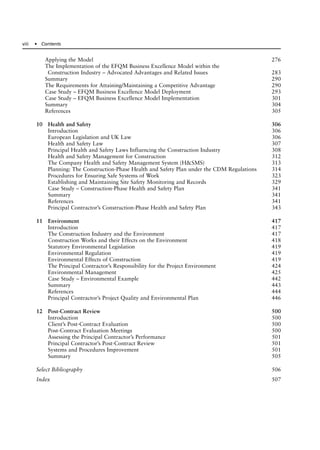
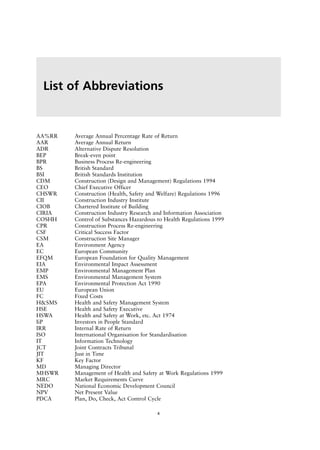
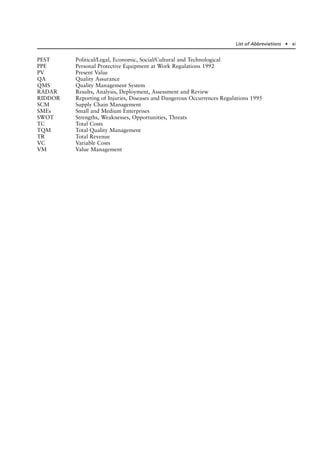

![scenario of the construction environment. More explicit is the focus on the activities of the principal
contracting organisation and its site activities. Management is a collection of practices for handling
concepts, principles and procedures, and these are transferable from organisation to organisation as
organisational circumstances dictate. Such practices are generic throughout the management of organ-
isations across industry sectors, yet specific in their application within their sectors as company, or
corporate, management is translated into the management of particular types of projects.
Management Theories
Modern management theories, or those emerging after World War II, made great strides from the
schools of management thought which preceded them – the scientific management school and the
human relations school. Scientific management propounded by F.W. Taylor focused on universal
principles of production and its organisation with a view to determining the best way of undertaking
tasks by simplifying its component parts. Taylor’s work was followed by a host of related contributions
from Frank Gilbreth, noted for time and motion studies, Henry Gantt, famous for the Gantt, or bar,
chart, Henry Ford, renowned for assembly line production, and Henri Fayol, the French industrialist
and propounder of the well-accepted five processes of management – forecasting, or planning, organ-
ising, commanding, or instructing, co-ordinating, or harmonising, and controlling.
The human relations school, emerging in the 1920s, focused on productivity and its link to the
welfare of workers and their motivation through positive management. The chief advocate of
the human approach was Elton Mayo, famous for the Hawthorne Experiments at the Western Electric
Hawthorne Plant in the USA. Essentially, workers with the greatest sense of belonging to a group had
the greatest motivation and work outputs. An important dimension to the work was the finding that
informal structures develop within the formal structure, and this can have immeasurable positive effects
on communication, teamworking, morale and motivation, all important aspects within the construc-
tion project situation on site.
While both the scientific management school and human relations school have many positive
aspects to offer to the management of construction projects, modern management theories are perhaps
those which have the greatest propensity to assist. Many theories have emerged in the post-1945 period,
of which two have become prominent and influential – systems theory and contingency theory.
Systems Theory
Systems theory (Checkland, 1993) is generally attributed to Hegel [1770–1831]. Concerned with
creating a systems map to help explain organic biology, he focused on the various sub-systems that
combine to create the whole. Hegel suggested that: the whole adds up to become greater than the sum
of the parts, or the product of synergy; the whole determines the characteristics of the parts, the parts
cannot be fully understood if they are seen in isolation from the whole; and the parts are interrelated
and therefore interdependent, a view commonly held about most organisations today. From this under-
standing, systems theory presents concepts to an organisation to develop their: philosophy – way of
thinking; management – design and operation of the organisation as a whole system made up of
sub-systems; analysis – use of problem-solving techniques; and systematic thinking – logical, thorough
and regular consideration (Hamilton, 1997). Essentially, systems theory suggests that an organisation
is the whole, comprising many parts, and that the organisation exists in an environment which exerts
many pressures upon its activities, indeed the very characteristics of almost all construction companies.
Contingency Theory
Contingency theory focuses upon the need for any organisation to adapt to change. It suggests that
there is no one right way to manage an organisation indefinitely and that, over time, organisations
evolve and must therefore accommodate change, both within and outside the organisation.
Contingency theory has a clear overlap with systems theory in that the organisation’s environment is
always a catalyst for change and must be managed with total flexibility if it is to be successful and to
prosper. Principal contracting organisations, like virtually all organisations in all business sectors, must
be aware of their environment and be vigilant to its changing requirements. Perhaps more than any
10 ● Construction Management](https://image.slidesharecdn.com/2344083-250525190454-7a32cb7c/85/Construction-Management-Principles-And-Practice-Alan-Griffith-Paul-Watson-27-320.jpg)