Lecture 3: 
LAW RELATING 
TO PAYMENT 
Group Members: Chian Chee Yong 
Hong Kok Hang 
CONSTRUCTION LAW [QSB 
4LE4C1TU4R]ER: SR. EDDIE LIM 
DATE: 23TH SEPT 2014
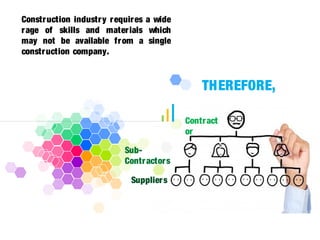
Construction industry requires a wide 
rage of skills and mater ials which 
may not be available from a single 
construction company. 
Contract 
or 
Sub- 
Contractors 
Suppliers 
THEREFORE,
Tankertanker Design 
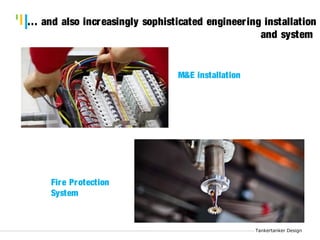
… and also increasingly sophisticated engineer ing installation 
Tankertanker Design 
Tankertanker Design 
and system 
M&E installation 
Fire Protection 
System
Tankertanker Design 
Tankertanker Design 
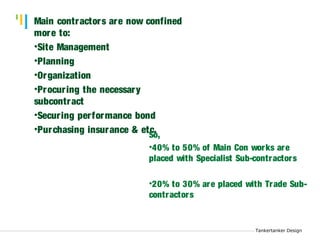
Main contractors are now confined 
more to: 
•Site Management 
•Planning 
•Organization 
•Procur ing the necessary 
subcontract 
•Securing per formance bond 
•Purchasing insurance & etSco. , 
Tankertanker Design 
•40% to 50% of Main Con works are 
placed with Specialist Sub-contractors 
•20% to 30% are placed with Trade Sub-contractors
Tankertanker Design 
Tankertanker Design 
Tankertanker Design
Tankertanker Design 
Tankertanker Design 
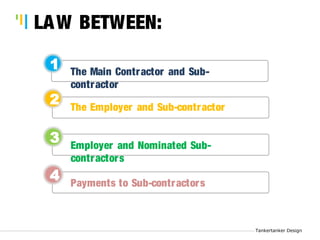
LAW BETWEEN: 
Tankertanker Design 
1 
2 
3 
4 
The Main Contractor and Sub-contractor 
The Employer and Sub-contractor 
Employer and Nominated Sub-contractors 
Payments to Sub-contractors
1. The Main Contractor and Sub-contractor 
ISSUE: Problems ar ise where the terms 
which the main contractor are required to 
observe under the main contract turn out 
to be inconsistent with his obligations to 
the subcontractor under the subcontract. 
Case: 
Chandler Brothers Ltd v Boswell 
(1936)
Tankertanker Design 
Summary 
•An engineer was empowered under the terms of the main 
contract to order the main contractor to remove a subcontractor . 
•The main contract in that case provided that, if a sub-contractor 
was guilty of delay, the employer could instruct the main 
contractor to dismiss that sub-contractor . 
•The sub-contract expressly covered many of the matters in the 
main contract, but did not specifically give the main contractor a 
power of dismissal for delay. 
•At the end, the main contractor chose to remove the 
subcontractor and committed a breach of the subcontract. 
Court Decision: 
It was held by the Court of Appeal that the main contractor was 
guilty of a breach of the sub-contract. The sub-contractor’s 
under taking to car ry out the work in accordance with the terms 
of the main contract was not enough to incorporate the power of 
dismissal for delay. 
Tankertanker Design 
Case: 
Chandler Brothers Ltd v Boswell (1936) 
Tankertanker Design
Tankertanker Design 
To avoid Inconsistencies: 
A subcontract may be drafted to expressly 
incorporate cer tain terms of the main contract. 
Where the term which is purpor ted to have been 
incorporated does not conflict with the other 
express terms of the subcontract, the cour t is 
usually disposed to rule in favour of its 
incorporation. 
Tankertanker Design 
Tankertanker Design 
•The terms are stated in Preliminary Bill
Tankertanker Design 
Case: 
Geary, Walker & Co Ltd v W Lawrence & Son 
SumLtmda r(y1906) 
•The subcontract contains a provision stipulating that the 
terms of payment for the works… shall be exactly the 
same as those set for th in clause 30 of the [main]… 
contract.” The amount of retention under the main 
contract would exceed the sum payable to the sub-contractor 
Tankertanker Design 
Tankertanker Design 
under the sub-contract by the end of the 
project. 
Court Decision: 
The Cour t of Appeal decided that the terms of the main 
contactor in respect of the payment were applicable, and 
also that retention should be withheld. However , the 
payments would be in the same proportion as the 
proportion of the sub-contract sum to the main contract 
sum. There was, therefore by implication, a pro-rata of 
the amount of retention by reference to the main contract 
payment mechanism.
Tankertanker Design 
ISSUE: A different situation may be 
encountered where the structure of the main 
contract is of a different contractual character 
from that of the subcontract. 
Eg: where a fixed pr ice subcontract (without 
quantities) attempts to incorporate the entire 
set of provisions relating to valuation and 
var iations in a main contract which is 
structured on a re-measurement basis. 
Tankertanker Design 
Tankertanker Design 
Case: 
Kian Hong Holdings v Ohbayashi Gumi 
(1984)
Tankertanker Design 
Case: 
Kian Hong Holdings v Ohbayashi Gumi 
Su(m1m9a8r4y ) 
•The main contractors were employed by a statutory author ity to 
under take reclamation works. The dispute between the par ties 
concerned the cor rect method of measur ing, for payment purpose, 
the quantity of granite aggregates used. 
•It was agreed that the subcontract was a measure and value contract 
where the granite aggregate will be measured before been discharged 
into the sea. Whereas the main contract was a lump sum contract 
under which the works were paid on the basis of design volume 
measurement on design drawings dur ing tender . 
•There was also an express provision in the subcontract which 
provides for the incorporation of the terms of the main contract into 
the subcontract and another clause which provides that in the event 
of a conflict between the terms of the main contract and those of the 
subcontract, then the subcontract should prevail. 
Cour t Decision: 
The Cour t of Appeal held that the subcontractor should be paid based 
on their subcontract conditions, i.e. pay on a unit pr ice on the 
quantity actually discharged into the sea. 
Tankertanker Design 
Tankertanker Design
2. The Employer and Sub-contractor 
ISSUE: 
•The subcontract between a main contractor and sub-contractor 
cannot give rise to any privity of contract between the main 
contractor and employer. 
•When the employer or architect instructs the contractor to appoint a 
sub-contractor on specific terms, the actual and final terms of the 
sub-contract may be revised and amended during the final negotiation 
between the Main contractor and nominated sub-contractor. 
Case: 
Davis & Co Shipfitters Ltd v William Old 
(1969)
Tankertanker Design 
Case: 
Davis & Co Shipfitters Ltd v William Old 
(1969) 
Summary 
•The project’s architect informed a sub-contractor that his tender 
was accepted and the contract will be concluded with the main 
contractor . 
•Before concluding the sub-contract, the main contractor inser ted a 
new condition to pay when paid clause. 
•The sub-contractor star ted work. 
•The question before the cour t was whether the new clause forms 
par t of the sub-contract. 
Cour t Decision: 
The cour t held that the architect did not finalise the contract with 
the sub-contractor . The terms and contract are those between the 
main contractor and sub-contractor and which the sub-contractor is 
presumed to have accepted by star ting work without protest. Thus 
main contractor is entitled to rely on the 'pay when paid' clause. 
Tankertanker Design 
Tankertanker Design
Tankertanker Design 
Tankertanker Design • Due to absence of pr ivity of contract between employer and 
sub-contractor is that neither par ty has direct recourse in 
contract against each other, eg. sub-contractor cannot sue 
employer directly for non-payment. 
• Therefore if the employer is concern over the delivery 
capability of a par ticular sub-contractor, he may provide in 
the main contract express terms which permit him to directly 
monitor the sub-contract while preserving the main 
contractor 's accountability for any sub-contractor 's default, 
eg. defective workmanship and delays. 
Tankertanker Design
Tankertanker Design 
Tankertanker Design IF employer wish to have direct 
route of recourse against a sub-contractor 
Tankertanker Design 
HOW? 
Employer may demand a 
collateral warranty 
from the subcontractor.
Tankertanker Design 
Tankertanker Design 
Tankertanker Design 
Collateral Warranty ? 
• The mechanism of this war ranty is to require the sub-contractor to 
assure the employer of the quality of the sub-contract works and 
their timely completion. 
• This war ranty is given to the employer in consideration of the 
employer instructing the main contractor to award the sub-contract 
to the par ticular sub-contractor . 
• In the event of default, the employer can proceed against the sub-contractor 
for loss or damage caused by breach of this war ranty. 
Case: 
Shanklin Pier Lt v Detel Products (1951)
Tankertanker Design 
Tankertanker Design 
Case: 
Shanklin Pier Lt v Detel Products (1951) 
Tankertanker Design 
Summary 
•A contractor was engaged to repair and paint a pier with bituminous 
paint. 
•The defendants were paint supplier and had war ranted to the 
employer that their paint would provide a life of seven to ten years. 
•Relying on this war ranty, the employer instructed the contractor to 
use the defendant paint. 
•The paint system failed. 
Cour t Decision: 
The cour t held that the employer were entitled to recover from the 
defendant in respect of the war ranty refer red to, notwithstanding 
that the contract of sale of the paint was between the contractor and 
the defendant.
Tankertanker Design 
Tankertanker Design 
Tankertanker Design 
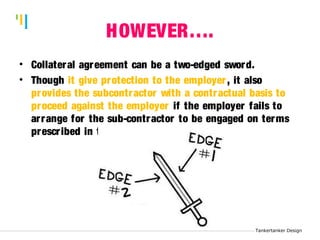
HOWEVER…. 
• Collateral agreement can be a two-edged sword. 
• Though it give protection to the employer , it also 
provides the subcontractor with a contractual basis to 
proceed against the employer if the employer fails to 
ar range for the sub-contractor to be engaged on terms 
prescr ibed in the war ranty.
3. Employer and Nominated Sub-contractors 
The rationale behind nomination are: 
a)Employer retains r ights to select sub-contractors for specialist 
inputs or capabilities. 
b)Employer exercise a degree of control of construction works 
considered to be par ticular ly impor tant, eg. granite supplied by a 
supplier with whom the architect/employer has successfully 
worked with in the past. 
c)Nomination can be used to reduce lead time elements in the 
overall construction per iod, eg. structural steel frames. 
d)Allows Architect/consultants more time for design details to be 
developed for specialist works while the main contractor 's tender 
can be called.
Tankertanker Design 
•TankeSrtiannkecr eDe signthere is no pr ivity of contract between the 
employer and sub-contractor , the employer cannot 
proceed directly against a sub-contractor in the event of 
a default by the sub-contractor . The employer can sue 
the main contractor , who may then be entitled to be 
indemnified and proceed against the sub-contractor . This 
creates a 'chain of liability’ 
• To avoid any difficulty, an employer may require the 
nominated sub-contractor to execute a collateral 
war ranty in consideration of their being nominated for 
the sub-contract works. 
Tankertanker Design
Tankertanker Design 
IF Main Contractor wants to OBJECT to the 
Tankertanker Design 
Tankertanker Design 
Nomination 
HOW??? 
12/02/14 
PAM 2006 clause 27.3 which 'state that the contractor shall 
not be required to enter into a sub-contract with any 
Nominated Sub-Contractor against whom the contractor has 
made a reasonable objection based on available known facts 
and documented evidence that the financial standing, 
solvency or technical competence of the nominated sub-contractor 
is ......' 
Case: 
Bicker ton (TA) & Sons Ltd v Nor th West 
Metropolian Regional Hospital Board (1969)
Tankertanker Design 
Case: 
Bicker ton (TA) & Sons Ltd v Nor th West Metropolian 
Regional Hospital Board (1969) 
Summary 
•The nomination procedure is dealt with by vir tue of the main 
contract and also a separate nominated sub-contract which is 
relatively complex and of course reliant upon the drafting of the 
provisions. 
Cour t Decision: 
Judge said that the contractor could object to the nomination based 
on technical competency and financial standing of the prospective 
sub-contractor but not on the sub-contractor 's pr ice and 
specifications. 
Tankertanker Design 
Tankertanker Design 
12/02/14
4. Payments to Sub-contractors 
In General Pr inciple, 
•Subcontractors are paid for their work by the main 
contractor and their r ights to payment is independent 
of any conditions or dealings between the main 
contractor and the employer . 
•In the absence of any express provisions to the 
contrary in the subcontract, therefore, the 
subcontractor is entitled to payment for their work 
done regardless as to whether the main contractor had 
himself been paid by the employer . 
•These pr inciples apply to both domestic 
subcontractors and nominated subcontractors.
Tankertanker Design 
Tankertanker Design 
Tankertanker Design H 
OW TO PROTECT THEM? 
• Provisions for direct payment to nominated 
subcontractors are stipulated in most standard form of 
contract. 
– These provisions are for the protection of nominated 
subcontractors’ r ight to payment are backed by provisions which 
entitle the employer to pay an aggr ieved nominated 
subcontractor directly and deduct the amount paid from sums 
otherwise due to the main contractor . 
• Under most contract, the employer cannot be compelled 
to exercise this r ight. The exercise of this r ight to pay 
the nominated subcontractor directly is clear ly 
discretionary.
QUESTION NO. 1 
Explain the differences between “Pay if Paid” and 
“Pay When Paid” Clauses in Construction Contracts.
Answer NO. 1 
"pay when paid" clause - (i.e., that the pr ime contractor 
will pay the subcontractor within X days of receiving 
payment from the owner ) 
Is simply a timing mechanism and generally will not 
excuse the pr ime contractor from having a payment 
obligation to the subcontractor , regardless of whether the 
owner has paid the pr ime contractor . 
"pay if paid" clause - (i.e. that the pr ime contractor only 
incurs an obligation to pay the subcontractor if, and only 
if, it is first paid by the owner ) 
May constitute a condition precedent that excuses the 
pr ime contractor from having a payment obligation to the 
subcontractor if the owner does not pay the pr ime 
contractor .
Tankertanker Design 
Under Construction Industry Payment & Adjudication Act 
(CIPAA), clauses regarding conditional payment such as “pay 
when paid” and “pay if paid” are prohibited. Why? 
Tankertanker Design 
QUESTION NO. 2 
Tankertanker Design
Tankertanker Design 
Answer NO. 2 
Such conditional payments are unfair to sub-contractors. The 
sub-contractor may not be paid due to non payment from 
employer caused by the main contractor . For example, If 
main contractor causes the delay and employer set off 
Liquidated damages against payment due, then main 
contractor may not be paid for that month. Hence, Sub-contractor 
Tankertanker Design 
Tankertanker Design 
may not receive payment although such delay is 
not his fault.
Thank You

Construction law cl3 (completed)

  • 1.
    Lecture 3: LAWRELATING TO PAYMENT Group Members: Chian Chee Yong Hong Kok Hang CONSTRUCTION LAW [QSB 4LE4C1TU4R]ER: SR. EDDIE LIM DATE: 23TH SEPT 2014
  • 2.
    Construction industry requiresa wide rage of skills and mater ials which may not be available from a single construction company. Contract or Sub- Contractors Suppliers THEREFORE,
  • 3.
    Tankertanker Design …and also increasingly sophisticated engineer ing installation Tankertanker Design Tankertanker Design and system M&E installation Fire Protection System
  • 4.
    Tankertanker Design TankertankerDesign Main contractors are now confined more to: •Site Management •Planning •Organization •Procur ing the necessary subcontract •Securing per formance bond •Purchasing insurance & etSco. , Tankertanker Design •40% to 50% of Main Con works are placed with Specialist Sub-contractors •20% to 30% are placed with Trade Sub-contractors
  • 5.
    Tankertanker Design TankertankerDesign Tankertanker Design
  • 6.
    Tankertanker Design TankertankerDesign LAW BETWEEN: Tankertanker Design 1 2 3 4 The Main Contractor and Sub-contractor The Employer and Sub-contractor Employer and Nominated Sub-contractors Payments to Sub-contractors
  • 7.
    1. The MainContractor and Sub-contractor ISSUE: Problems ar ise where the terms which the main contractor are required to observe under the main contract turn out to be inconsistent with his obligations to the subcontractor under the subcontract. Case: Chandler Brothers Ltd v Boswell (1936)
  • 8.
    Tankertanker Design Summary •An engineer was empowered under the terms of the main contract to order the main contractor to remove a subcontractor . •The main contract in that case provided that, if a sub-contractor was guilty of delay, the employer could instruct the main contractor to dismiss that sub-contractor . •The sub-contract expressly covered many of the matters in the main contract, but did not specifically give the main contractor a power of dismissal for delay. •At the end, the main contractor chose to remove the subcontractor and committed a breach of the subcontract. Court Decision: It was held by the Court of Appeal that the main contractor was guilty of a breach of the sub-contract. The sub-contractor’s under taking to car ry out the work in accordance with the terms of the main contract was not enough to incorporate the power of dismissal for delay. Tankertanker Design Case: Chandler Brothers Ltd v Boswell (1936) Tankertanker Design
  • 9.
    Tankertanker Design Toavoid Inconsistencies: A subcontract may be drafted to expressly incorporate cer tain terms of the main contract. Where the term which is purpor ted to have been incorporated does not conflict with the other express terms of the subcontract, the cour t is usually disposed to rule in favour of its incorporation. Tankertanker Design Tankertanker Design •The terms are stated in Preliminary Bill
  • 10.
    Tankertanker Design Case: Geary, Walker & Co Ltd v W Lawrence & Son SumLtmda r(y1906) •The subcontract contains a provision stipulating that the terms of payment for the works… shall be exactly the same as those set for th in clause 30 of the [main]… contract.” The amount of retention under the main contract would exceed the sum payable to the sub-contractor Tankertanker Design Tankertanker Design under the sub-contract by the end of the project. Court Decision: The Cour t of Appeal decided that the terms of the main contactor in respect of the payment were applicable, and also that retention should be withheld. However , the payments would be in the same proportion as the proportion of the sub-contract sum to the main contract sum. There was, therefore by implication, a pro-rata of the amount of retention by reference to the main contract payment mechanism.
  • 11.
    Tankertanker Design ISSUE:A different situation may be encountered where the structure of the main contract is of a different contractual character from that of the subcontract. Eg: where a fixed pr ice subcontract (without quantities) attempts to incorporate the entire set of provisions relating to valuation and var iations in a main contract which is structured on a re-measurement basis. Tankertanker Design Tankertanker Design Case: Kian Hong Holdings v Ohbayashi Gumi (1984)
  • 12.
    Tankertanker Design Case: Kian Hong Holdings v Ohbayashi Gumi Su(m1m9a8r4y ) •The main contractors were employed by a statutory author ity to under take reclamation works. The dispute between the par ties concerned the cor rect method of measur ing, for payment purpose, the quantity of granite aggregates used. •It was agreed that the subcontract was a measure and value contract where the granite aggregate will be measured before been discharged into the sea. Whereas the main contract was a lump sum contract under which the works were paid on the basis of design volume measurement on design drawings dur ing tender . •There was also an express provision in the subcontract which provides for the incorporation of the terms of the main contract into the subcontract and another clause which provides that in the event of a conflict between the terms of the main contract and those of the subcontract, then the subcontract should prevail. Cour t Decision: The Cour t of Appeal held that the subcontractor should be paid based on their subcontract conditions, i.e. pay on a unit pr ice on the quantity actually discharged into the sea. Tankertanker Design Tankertanker Design
  • 13.
    2. The Employerand Sub-contractor ISSUE: •The subcontract between a main contractor and sub-contractor cannot give rise to any privity of contract between the main contractor and employer. •When the employer or architect instructs the contractor to appoint a sub-contractor on specific terms, the actual and final terms of the sub-contract may be revised and amended during the final negotiation between the Main contractor and nominated sub-contractor. Case: Davis & Co Shipfitters Ltd v William Old (1969)
  • 14.
    Tankertanker Design Case: Davis & Co Shipfitters Ltd v William Old (1969) Summary •The project’s architect informed a sub-contractor that his tender was accepted and the contract will be concluded with the main contractor . •Before concluding the sub-contract, the main contractor inser ted a new condition to pay when paid clause. •The sub-contractor star ted work. •The question before the cour t was whether the new clause forms par t of the sub-contract. Cour t Decision: The cour t held that the architect did not finalise the contract with the sub-contractor . The terms and contract are those between the main contractor and sub-contractor and which the sub-contractor is presumed to have accepted by star ting work without protest. Thus main contractor is entitled to rely on the 'pay when paid' clause. Tankertanker Design Tankertanker Design
  • 15.
    Tankertanker Design TankertankerDesign • Due to absence of pr ivity of contract between employer and sub-contractor is that neither par ty has direct recourse in contract against each other, eg. sub-contractor cannot sue employer directly for non-payment. • Therefore if the employer is concern over the delivery capability of a par ticular sub-contractor, he may provide in the main contract express terms which permit him to directly monitor the sub-contract while preserving the main contractor 's accountability for any sub-contractor 's default, eg. defective workmanship and delays. Tankertanker Design
  • 16.
    Tankertanker Design TankertankerDesign IF employer wish to have direct route of recourse against a sub-contractor Tankertanker Design HOW? Employer may demand a collateral warranty from the subcontractor.
  • 17.
    Tankertanker Design TankertankerDesign Tankertanker Design Collateral Warranty ? • The mechanism of this war ranty is to require the sub-contractor to assure the employer of the quality of the sub-contract works and their timely completion. • This war ranty is given to the employer in consideration of the employer instructing the main contractor to award the sub-contract to the par ticular sub-contractor . • In the event of default, the employer can proceed against the sub-contractor for loss or damage caused by breach of this war ranty. Case: Shanklin Pier Lt v Detel Products (1951)
  • 18.
    Tankertanker Design TankertankerDesign Case: Shanklin Pier Lt v Detel Products (1951) Tankertanker Design Summary •A contractor was engaged to repair and paint a pier with bituminous paint. •The defendants were paint supplier and had war ranted to the employer that their paint would provide a life of seven to ten years. •Relying on this war ranty, the employer instructed the contractor to use the defendant paint. •The paint system failed. Cour t Decision: The cour t held that the employer were entitled to recover from the defendant in respect of the war ranty refer red to, notwithstanding that the contract of sale of the paint was between the contractor and the defendant.
  • 19.
    Tankertanker Design TankertankerDesign Tankertanker Design HOWEVER…. • Collateral agreement can be a two-edged sword. • Though it give protection to the employer , it also provides the subcontractor with a contractual basis to proceed against the employer if the employer fails to ar range for the sub-contractor to be engaged on terms prescr ibed in the war ranty.
  • 20.
    3. Employer andNominated Sub-contractors The rationale behind nomination are: a)Employer retains r ights to select sub-contractors for specialist inputs or capabilities. b)Employer exercise a degree of control of construction works considered to be par ticular ly impor tant, eg. granite supplied by a supplier with whom the architect/employer has successfully worked with in the past. c)Nomination can be used to reduce lead time elements in the overall construction per iod, eg. structural steel frames. d)Allows Architect/consultants more time for design details to be developed for specialist works while the main contractor 's tender can be called.
  • 21.
    Tankertanker Design •TankeSrtiannkecreDe signthere is no pr ivity of contract between the employer and sub-contractor , the employer cannot proceed directly against a sub-contractor in the event of a default by the sub-contractor . The employer can sue the main contractor , who may then be entitled to be indemnified and proceed against the sub-contractor . This creates a 'chain of liability’ • To avoid any difficulty, an employer may require the nominated sub-contractor to execute a collateral war ranty in consideration of their being nominated for the sub-contract works. Tankertanker Design
  • 22.
    Tankertanker Design IFMain Contractor wants to OBJECT to the Tankertanker Design Tankertanker Design Nomination HOW??? 12/02/14 PAM 2006 clause 27.3 which 'state that the contractor shall not be required to enter into a sub-contract with any Nominated Sub-Contractor against whom the contractor has made a reasonable objection based on available known facts and documented evidence that the financial standing, solvency or technical competence of the nominated sub-contractor is ......' Case: Bicker ton (TA) & Sons Ltd v Nor th West Metropolian Regional Hospital Board (1969)
  • 23.
    Tankertanker Design Case: Bicker ton (TA) & Sons Ltd v Nor th West Metropolian Regional Hospital Board (1969) Summary •The nomination procedure is dealt with by vir tue of the main contract and also a separate nominated sub-contract which is relatively complex and of course reliant upon the drafting of the provisions. Cour t Decision: Judge said that the contractor could object to the nomination based on technical competency and financial standing of the prospective sub-contractor but not on the sub-contractor 's pr ice and specifications. Tankertanker Design Tankertanker Design 12/02/14
  • 24.
    4. Payments toSub-contractors In General Pr inciple, •Subcontractors are paid for their work by the main contractor and their r ights to payment is independent of any conditions or dealings between the main contractor and the employer . •In the absence of any express provisions to the contrary in the subcontract, therefore, the subcontractor is entitled to payment for their work done regardless as to whether the main contractor had himself been paid by the employer . •These pr inciples apply to both domestic subcontractors and nominated subcontractors.
  • 25.
    Tankertanker Design TankertankerDesign Tankertanker Design H OW TO PROTECT THEM? • Provisions for direct payment to nominated subcontractors are stipulated in most standard form of contract. – These provisions are for the protection of nominated subcontractors’ r ight to payment are backed by provisions which entitle the employer to pay an aggr ieved nominated subcontractor directly and deduct the amount paid from sums otherwise due to the main contractor . • Under most contract, the employer cannot be compelled to exercise this r ight. The exercise of this r ight to pay the nominated subcontractor directly is clear ly discretionary.
  • 26.
    QUESTION NO. 1 Explain the differences between “Pay if Paid” and “Pay When Paid” Clauses in Construction Contracts.
  • 27.
    Answer NO. 1 "pay when paid" clause - (i.e., that the pr ime contractor will pay the subcontractor within X days of receiving payment from the owner ) Is simply a timing mechanism and generally will not excuse the pr ime contractor from having a payment obligation to the subcontractor , regardless of whether the owner has paid the pr ime contractor . "pay if paid" clause - (i.e. that the pr ime contractor only incurs an obligation to pay the subcontractor if, and only if, it is first paid by the owner ) May constitute a condition precedent that excuses the pr ime contractor from having a payment obligation to the subcontractor if the owner does not pay the pr ime contractor .
  • 28.
    Tankertanker Design UnderConstruction Industry Payment & Adjudication Act (CIPAA), clauses regarding conditional payment such as “pay when paid” and “pay if paid” are prohibited. Why? Tankertanker Design QUESTION NO. 2 Tankertanker Design
  • 29.
    Tankertanker Design AnswerNO. 2 Such conditional payments are unfair to sub-contractors. The sub-contractor may not be paid due to non payment from employer caused by the main contractor . For example, If main contractor causes the delay and employer set off Liquidated damages against payment due, then main contractor may not be paid for that month. Hence, Sub-contractor Tankertanker Design Tankertanker Design may not receive payment although such delay is not his fault.
  • 30.

Editor's Notes

  • #28 The court explained, however, that conditions precedent such as pay if paid clauses are viewed with disfavor by courts and will not be enforced if their terms are ambiguous.
  • #30 The court explained, however, that conditions precedent such as pay if paid clauses are viewed with disfavor by courts and will not be enforced if their terms are ambiguous.