TOPIC 1. 
LAND ACQUISITION ACT 1960 
Prepared by 
WAN MOHAMAD AZIM BIN WAN MUSA 
Ba. Estate Management (Hons) (Uitm)
Introduction 
to the Land Acquisition Act 1960 
 Land Acquisition was originally adapted from United 
Kingdom rules under a Commonwealth Country. 
Purpose of the provision is to vest power for the 
Government to acquire an alienated land for a 
particular purpose. 
 According to the Article 13 Federal 
Constitutions: 
 No person shall deprived of property saved in 
accordance with the law 
 No law shall provide for the compulsory acquisition 
of use of property without adequate compensation. 
 Since the land was a State matters, Land office or 
Registry office under authority of the Act to gazette 
any land within the jurisdiction area.
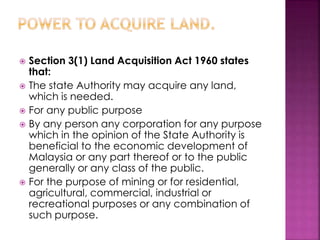
 Section 3(1) Land Acquisition Act 1960 states 
that: 
 The state Authority may acquire any land, 
which is needed. 
 For any public purpose 
 By any person any corporation for any purpose 
which in the opinion of the State Authority is 
beneficial to the economic development of 
Malaysia or any part thereof or to the public 
generally or any class of the public. 
 For the purpose of mining or for residential, 
agricultural, commercial, industrial or 
recreational purposes or any combination of 
such purpose.
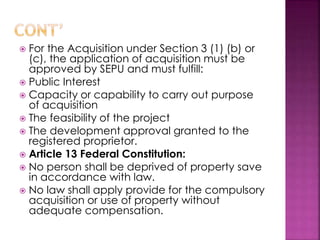
 For the Acquisition under Section 3 (1) (b) or 
(c), the application of acquisition must be 
approved by SEPU and must fulfill: 
 Public Interest 
 Capacity or capability to carry out purpose 
of acquisition 
 The feasibility of the project 
 The development approval granted to the 
registered proprietor. 
 Article 13 Federal Constitution: 
 No person shall be deprived of property save 
in accordance with law. 
 No law shall apply provide for the compulsory 
acquisition or use of property without 
adequate compensation.
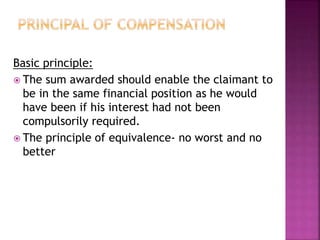
Basic principle: 
 The sum awarded should enable the claimant to 
be in the same financial position as he would 
have been if his interest had not been 
compulsorily required. 
 The principle of equivalence- no worst and no 
better
 As provided in the 1st Schedule to the Land 
Acquisition 1960 the amount of 
compensation to be awarded shall take into 
consideration the following matters: 
a) Market Value 
b) Betterment 
c) Severance 
d) Injurious affection 
e) Disturbance claims 
f) Accommodation works
 A) MARKET VALUE 
 i) Factor to be considered in the Market Value of 
gazetted land. 
 Scheduled land 
 If part of land is acquired, it is as part of the whole 
land with regards to specific features on the 
acquired portion. 
 ii) Date of valuation 
 Date publication in the Gazette, under section 4, 
provided that within 12 months it is followed by a 
declaration under section 8. 
 In other cases, the date of gazette notification 
under section 8. 
 i.e Gazette notification Section 4 is 1.10.04 
followed by Section 8 is 1.02.05 . Date of valuation 
is _______________
iii) Method of Valuation: 
(Comparison Method) 
- Based on the economic principle or substitution: 
no prudent purchase or economic goods will pay 
more than what it will cost him to purchase a 
comparable substitute Evidence of Sales: 
 Similar characteristics 
 Recent Sales ( not more than 2 years from gazette 
 Bona fide test 
 Auction sales (forced) 
 Asking price not relevant. 
 Previous awards on the same property –not suitable 
 Not arm’s length transaction. 
 Evidence after gazette date not considered
 Investment method – 
- United Temiang (FMS) Rubber Estate v. CLR Muar 
 Cost method 
– Lun Chung Yang and others v. --Superintendent of 
Land and Surveys first Division Sarawak 
 Residual Method – 
- Estate and Trust Agencies Ltd v. CLR Johor Bahru 
 Leasehold property: 
- Regards may be had to the expiry of lease 
 Malay Reservation 
 All land to be valued on the same basis i.e. ignored the 
Malay Reservation restriction, unless acquisition for the 
purposes of Malays only 
 Zoning 
- Compensation to have due regards to the use 
indicated by the Director of TCP. If gazetted as for 
public purpose, to value as such. If it is not gazetted, to 
value all its potentialities. 
 Improvement within 2 years of declaration To be ignored
 Reinstatement 
- If the property no market- cost for 
reinstatement 
 Use contrary to Law 
- Zoning, implied and express condition 
 Encumbered land 
- Squatters and controlled tenants – to be 
taken into account 
 Mining Land 
- Section 40 NLC Mineral found within parcel of 
land does not belong to the owner, therefore 
cannot compensated
B) BETTERMENT 
- Section 2(b) 1st Schedule of Land Acquisition 
Act 1960 . 
 The principle: 
- The interested party should not stand to gain 
from the acquisition. 
- The compensation payable to the owner 
whose land is acquired is reduced by the 
amount of any increase in the value of any 
land belonging to him likely to accrue due to 
the use which the land acquired will be put. 
- Enhanced by the declared purposes. 
- Enhanced by actual construction 
- Any enhancement involved shall be set off by 
the government.
C) SEVERANCE 
- Section 2(c) 1st Schedule of Land Acquisition Act 
1960. 
- For partial taking of land, the raining portion 
/other land being reduced in value. 
- Depreciation in value of remaining land caused 
by the loss of the acquired land. 
 Guidelines: 
- There must be partial taking. The land taken and 
the remaining land held under same title or 
ownership or physical location and each giving 
enhanced value to the whole. 
- There must be damage to the remaining the land 
- Caused by the loss of portion taken 
- Caused by separating one part from the other. 
- Where the damages is extensive ,acquiring body 
may acquire the remaining portion
 Guidelines: 
- There must be partial taking. The land taken 
and the remaining land held under same title 
or ownership or physical location and each 
giving enhanced value to the whole. 
- There must be damage to the remaining the 
land 
- Caused by the loss of portion taken 
- Caused by separating one part from the 
other. 
- Where the damages is extensive ,acquiring 
body may acquire the remaining portion.
D) INJURIOUS AFFECTION 
- Section 2(d) of 1st schedule of Land 
Acquisition 1960, 
- Depreciation in value of remaining land 
caused by intended use of the portion 
acquired. 
- Closely linked with concept but include: 
 His other property, movable and immovable 
 use which cause a diminution of value of other 
land 
 if it reduces the chances of continued 
profitable utilization of other land 
 include all conceivable damage that could 
arise –not allowed to claim at later date 
 e.g. loss of privacy ,construction of road 
sewerage, depreciating the value of land due 
to noise.
E) DISTURBANCE CLAIMS. 
- Sec 2(e) First Schedule of Land 
Acquisition Act 1960. 
- Loss of earning 
- Depreciation of Fixtures 
- Depreciation of Stock 
- Loss of Goodwill 
- Cost of removal and other incidental 
cost 
- Professional fees
 Basis of calculation for disturbances: 
 i) Total extinguishment of business- 
- A claimant seeking compensation for the 
extinguishment of his business conducted on 
the acquired land must establish that the 
extinguishment is due to the acquisition. 
 ii) Alternative premises – 
- A claimant is obliged to mitigate his loss 
where reasonably possible and one of the 
best ways doing this is to remove his business 
suitable alternative premises to enable him to 
carry on his business in substantially the same 
as before. Generally, cost of removal and 
damage incurred in the move
 F) ACCOMODATION WORKS 
- Sec 2(f) First Schedule of Land Acquisition 1960 
- Damages put right at the acquiring authority’s 
expense (thus reducing compensation payable) 
- Instances of accommodation works: 
- Where buildings are severed 
- Where small parcels of land are left with the 
owner 
- Intersection of land leaving small parcels on either 
side with owner. 
- Accommodation works include construction and 
maintaining of bridges, arches, culverts, passages 
or roads. 
- The undertaking for accommodation works should 
be clear and enforceable.
 The degree of urgency of the acquisition 
 Any disinclination of the person to part with 
the land 
 any damage sustained by the person 
interested which, if caused by private person, 
would not be good cause of action. 
 Any depreciation in the value of the land 
acquired likely to result from the use which it 
will be put when acquired 
 Any increase in the value of the land 
acquired likely to result from the use which it 
will be put when acquired 
 any improvement to land acquired after the 
date of publication of declaration under Sec 
8, unless for normal maintenances.
land acquisition

land acquisition

  • 1.
    TOPIC 1. LANDACQUISITION ACT 1960 Prepared by WAN MOHAMAD AZIM BIN WAN MUSA Ba. Estate Management (Hons) (Uitm)
  • 2.
    Introduction to theLand Acquisition Act 1960  Land Acquisition was originally adapted from United Kingdom rules under a Commonwealth Country. Purpose of the provision is to vest power for the Government to acquire an alienated land for a particular purpose.  According to the Article 13 Federal Constitutions:  No person shall deprived of property saved in accordance with the law  No law shall provide for the compulsory acquisition of use of property without adequate compensation.  Since the land was a State matters, Land office or Registry office under authority of the Act to gazette any land within the jurisdiction area.
  • 3.
     Section 3(1)Land Acquisition Act 1960 states that:  The state Authority may acquire any land, which is needed.  For any public purpose  By any person any corporation for any purpose which in the opinion of the State Authority is beneficial to the economic development of Malaysia or any part thereof or to the public generally or any class of the public.  For the purpose of mining or for residential, agricultural, commercial, industrial or recreational purposes or any combination of such purpose.
  • 4.
     For theAcquisition under Section 3 (1) (b) or (c), the application of acquisition must be approved by SEPU and must fulfill:  Public Interest  Capacity or capability to carry out purpose of acquisition  The feasibility of the project  The development approval granted to the registered proprietor.  Article 13 Federal Constitution:  No person shall be deprived of property save in accordance with law.  No law shall apply provide for the compulsory acquisition or use of property without adequate compensation.
  • 5.
    Basic principle: The sum awarded should enable the claimant to be in the same financial position as he would have been if his interest had not been compulsorily required.  The principle of equivalence- no worst and no better
  • 6.
     As providedin the 1st Schedule to the Land Acquisition 1960 the amount of compensation to be awarded shall take into consideration the following matters: a) Market Value b) Betterment c) Severance d) Injurious affection e) Disturbance claims f) Accommodation works
  • 7.
     A) MARKETVALUE  i) Factor to be considered in the Market Value of gazetted land.  Scheduled land  If part of land is acquired, it is as part of the whole land with regards to specific features on the acquired portion.  ii) Date of valuation  Date publication in the Gazette, under section 4, provided that within 12 months it is followed by a declaration under section 8.  In other cases, the date of gazette notification under section 8.  i.e Gazette notification Section 4 is 1.10.04 followed by Section 8 is 1.02.05 . Date of valuation is _______________
  • 8.
    iii) Method ofValuation: (Comparison Method) - Based on the economic principle or substitution: no prudent purchase or economic goods will pay more than what it will cost him to purchase a comparable substitute Evidence of Sales:  Similar characteristics  Recent Sales ( not more than 2 years from gazette  Bona fide test  Auction sales (forced)  Asking price not relevant.  Previous awards on the same property –not suitable  Not arm’s length transaction.  Evidence after gazette date not considered
  • 9.
     Investment method– - United Temiang (FMS) Rubber Estate v. CLR Muar  Cost method – Lun Chung Yang and others v. --Superintendent of Land and Surveys first Division Sarawak  Residual Method – - Estate and Trust Agencies Ltd v. CLR Johor Bahru  Leasehold property: - Regards may be had to the expiry of lease  Malay Reservation  All land to be valued on the same basis i.e. ignored the Malay Reservation restriction, unless acquisition for the purposes of Malays only  Zoning - Compensation to have due regards to the use indicated by the Director of TCP. If gazetted as for public purpose, to value as such. If it is not gazetted, to value all its potentialities.  Improvement within 2 years of declaration To be ignored
  • 10.
     Reinstatement -If the property no market- cost for reinstatement  Use contrary to Law - Zoning, implied and express condition  Encumbered land - Squatters and controlled tenants – to be taken into account  Mining Land - Section 40 NLC Mineral found within parcel of land does not belong to the owner, therefore cannot compensated
  • 11.
    B) BETTERMENT -Section 2(b) 1st Schedule of Land Acquisition Act 1960 .  The principle: - The interested party should not stand to gain from the acquisition. - The compensation payable to the owner whose land is acquired is reduced by the amount of any increase in the value of any land belonging to him likely to accrue due to the use which the land acquired will be put. - Enhanced by the declared purposes. - Enhanced by actual construction - Any enhancement involved shall be set off by the government.
  • 12.
    C) SEVERANCE -Section 2(c) 1st Schedule of Land Acquisition Act 1960. - For partial taking of land, the raining portion /other land being reduced in value. - Depreciation in value of remaining land caused by the loss of the acquired land.  Guidelines: - There must be partial taking. The land taken and the remaining land held under same title or ownership or physical location and each giving enhanced value to the whole. - There must be damage to the remaining the land - Caused by the loss of portion taken - Caused by separating one part from the other. - Where the damages is extensive ,acquiring body may acquire the remaining portion
  • 13.
     Guidelines: -There must be partial taking. The land taken and the remaining land held under same title or ownership or physical location and each giving enhanced value to the whole. - There must be damage to the remaining the land - Caused by the loss of portion taken - Caused by separating one part from the other. - Where the damages is extensive ,acquiring body may acquire the remaining portion.
  • 14.
    D) INJURIOUS AFFECTION - Section 2(d) of 1st schedule of Land Acquisition 1960, - Depreciation in value of remaining land caused by intended use of the portion acquired. - Closely linked with concept but include:  His other property, movable and immovable  use which cause a diminution of value of other land  if it reduces the chances of continued profitable utilization of other land  include all conceivable damage that could arise –not allowed to claim at later date  e.g. loss of privacy ,construction of road sewerage, depreciating the value of land due to noise.
  • 15.
    E) DISTURBANCE CLAIMS. - Sec 2(e) First Schedule of Land Acquisition Act 1960. - Loss of earning - Depreciation of Fixtures - Depreciation of Stock - Loss of Goodwill - Cost of removal and other incidental cost - Professional fees
  • 16.
     Basis ofcalculation for disturbances:  i) Total extinguishment of business- - A claimant seeking compensation for the extinguishment of his business conducted on the acquired land must establish that the extinguishment is due to the acquisition.  ii) Alternative premises – - A claimant is obliged to mitigate his loss where reasonably possible and one of the best ways doing this is to remove his business suitable alternative premises to enable him to carry on his business in substantially the same as before. Generally, cost of removal and damage incurred in the move
  • 17.
     F) ACCOMODATIONWORKS - Sec 2(f) First Schedule of Land Acquisition 1960 - Damages put right at the acquiring authority’s expense (thus reducing compensation payable) - Instances of accommodation works: - Where buildings are severed - Where small parcels of land are left with the owner - Intersection of land leaving small parcels on either side with owner. - Accommodation works include construction and maintaining of bridges, arches, culverts, passages or roads. - The undertaking for accommodation works should be clear and enforceable.
  • 18.
     The degreeof urgency of the acquisition  Any disinclination of the person to part with the land  any damage sustained by the person interested which, if caused by private person, would not be good cause of action.  Any depreciation in the value of the land acquired likely to result from the use which it will be put when acquired  Any increase in the value of the land acquired likely to result from the use which it will be put when acquired  any improvement to land acquired after the date of publication of declaration under Sec 8, unless for normal maintenances.