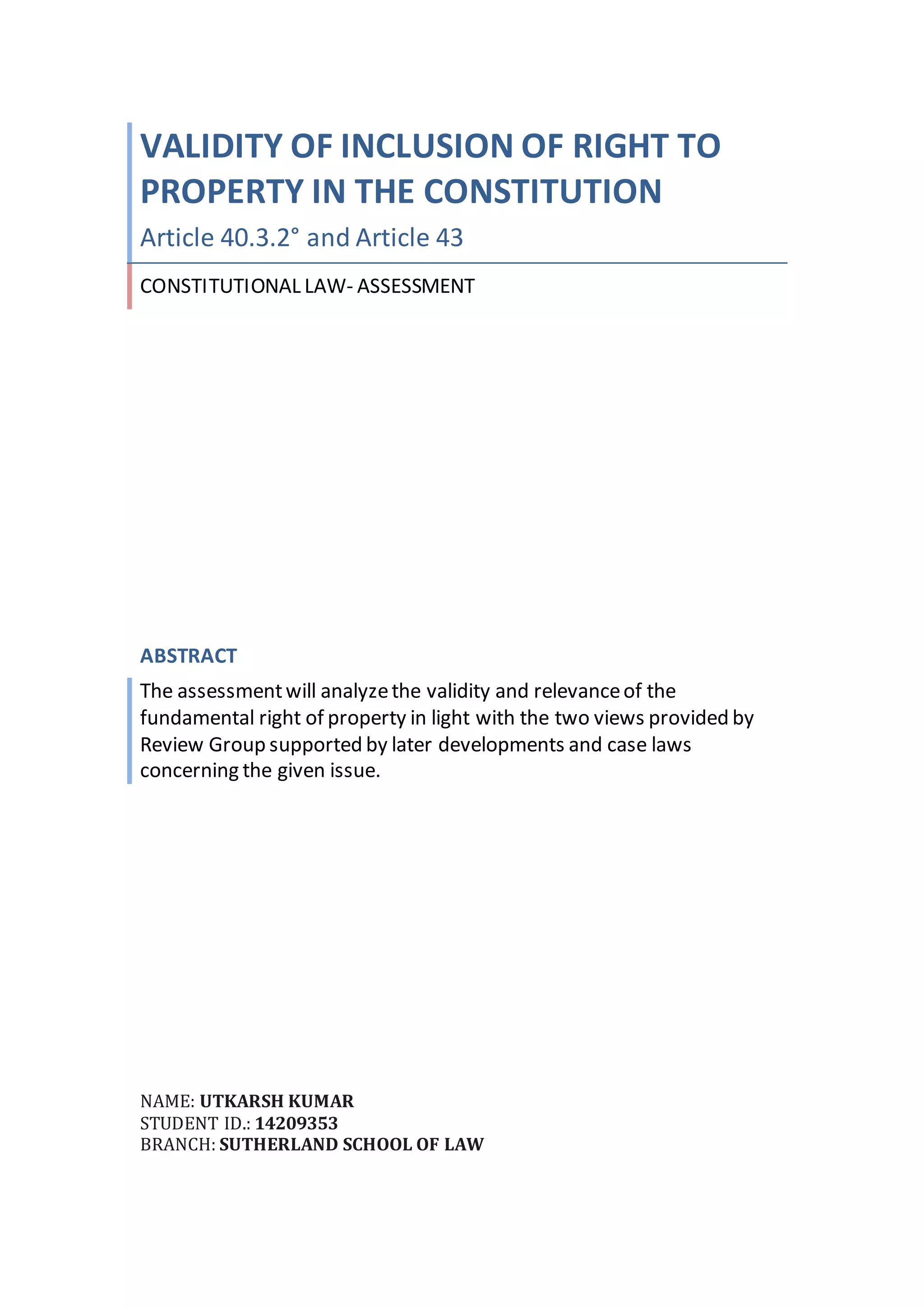
VALIDITY OF INCLUSION OF RIGHT TO
PROPERTY IN THE CONSTITUTION
Article 40.3.2° and Article 43
CONSTITUTIONAL LAW- ASSESSMENT
ABSTRACT
The assessmentwill analyzethe validity and relevanceof the
fundamental right of property in light with the two views provided by
Review Group supported by later developments and case laws
concerning the given issue.
NAME: UTKARSH KUMAR
STUDENT ID.: 14209353
BRANCH: SUTHERLAND SCHOOL OF LAW
INTRODUCTION
The fundamental right is warranted by two provisions of the Constitution − Article
40.3.2° and Article 43. generally, Article 40.3.2° could shield the individual citizen’s
property rights, whereas Article 43 deals with the establishment of property itself.
The right to own and transfer private property is guaranteed by Article 43, subject to
"the principles of social justice", and in accordance with laws passed reconciling the
right "with the exigencies of the common good"
In case Blake v Attorney General1, the Court examined the issue of the interplay
between Art. 43 and Art. 40.3 in detail, concluding that, while Art. 43 protect private
property as an institution (i.e. prohibits its complete abolition), Art. 40.3 prevent an
unjust attack on the property rights of an individual.
The right to enjoyment of private property is protected by the European Convention
on Human Rights (ECHR) in Article 1, Protocol 1 of the Convention.2
REVIEW GROUP, 1996
The Review Group perceives that, regardless of detailing may be concocted to trade
Article 40.3.2° and Article 43, it might more likely than not abstain from entrusting a
degree (even a high degree) of subjective evaluation to the legal. It is considered by
Review Group that, it may be liked to recast these procurements in an exceedingly
way that accommodated an extra organized and target system of legal investigation
1 [1982] IR 117
2 "Every natural or legal person is entitled to the peaceful enjoyment of his
possessions. No one shall be deprived of his possessions except in the public interest
and subject to the conditions provided for by law and by the general principles of
international law.
The preceding provisions shall not, however, in any way impair the right of a State to
enforce such laws as it deems necessary to control the use of property in accordance
with the general interest or to secure the payment of taxes or other contributions or
penalties."
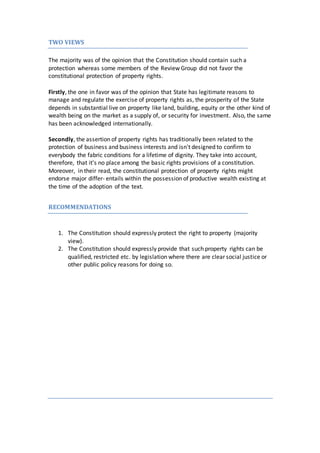
TWO VIEWS
The majority was of the opinion that the Constitution should contain such a
protection whereas some members of the Review Group did not favor the
constitutional protection of property rights.
Firstly, the one in favor was of the opinion that State has legitimate reasons to
manage and regulate the exercise of property rights as, the prosperity of the State
depends in substantial live on property like land, building, equity or the other kind of
wealth being on the market as a supply of, or security for investment. Also, the same
has been acknowledged internationally.
Secondly, the assertion of property rights has traditionally been related to the
protection of business and business interests and isn't designed to confirm to
everybody the fabric conditions for a lifetime of dignity. They take into account,
therefore, that it's no place among the basic rights provisions of a constitution.
Moreover, in their read, the constitutional protection of property rights might
endorse major differ- entails within the possession of productive wealth existing at
the time of the adoption of the text.
RECOMMENDATIONS
1. The Constitution should expressly protect the right to property (majority
view).
2. The Constitution should expressly provide that such property rights can be
qualified, restricted etc. by legislation where there are clear social justice or
other public policy reasons for doing so.
FURTHER DEVELOPMENTS/ CASE LAWS
 Major development in the issue was seen in the case-
Re Article 26 and the Health (Amendment) (No2) Bill 20043 (referred to
below as the “Health Bill Case”).
The State had been charging elderly people for medication since 1975 although
they were entitled for free treatment; thereby the charges levied were unlawful.
The administration acquainted a Bill looking for with reflectively render the
charges legitimate.4
The court perceived that patients unlawfully charged had a property right
comprising of a privilege of activity to recuperate that cash. The court found that
the patients' property rights in connection to the money would be annulled by
the bill.
“In the view of the Court, such legislation cannot be regarded as “regulating” the
exercise of property rights. It is straining the meaning of the reference in Article
43.2.1 of the Constitution to the “principles of social justice”5
“an abrogation of property rights and an unjust attack on them contrary to the
provisions of the Constitution and in particular Articles 43 and 40.3.2.”6
 Unjust Attack -Costello P. in Daly v. Revenue Commissioners7
The SC held that to claim relief under Article 40.3.2, the claimant must prove as
“unjust attack” on its right to private property
“When … an applicant claims that his constitutionally protected right to private
 property referred to in Article 40.3.2 has been infringed and that the State has
failed in the obligation imposed on it by that Article to protect his property rights,
he has to show that those rights have been subject to an unjust attack'. He can do
this by showing that the law which has restricted the exercise of his rights or
otherwise infringed them has failed to pass a proportionality test.”
 Taxation is an interference with property rights. This was recognized
in Daly v Revenue Commissioners.8
3 [2005] 1 IR 205
4 “... firstly, to examine the nature of the property rights at issue; secondly, to
consider whether the Bill consists of a regulation of those rights in accordance with
principles of social justice and whether the Bill is required so as to delimit those
rights in accordance with the exigencies of the common good; thirdly, in the light of
its conclusions on these issues, to consider whether the Bill constitutes an unjust
attack on those property rights
5 [2005] 1 IR 205 [130]
6 [2005] 1 IR 205 [134]
7 [1995] 3 I.R.
In Daly, Mr Justice Costello stated: that legislative interference in property rights
occurs every day of the week and no constitutional impropriety is involved.
When, as in this case, an applicant claims that his constitutionally protected right
to private property referred to in Article 40.3.2° has been infringed and that the
State has failed in the obligation imposed on it by that article to protect his
property rights he has to show that those rights have been subject to ‘an unjust
attack’.
 Eighth Report of the Convention on the Constitution- Economic,
Social and Cultural (ESC) Rights9 stated that:
“Finally, it should be noted that the right to property – which, while widely
accepted as a civil and political right, has important economic and social
dimensions – is protected under not one but two provisions of the Constitution:
Article 40.3.2° and Article 43, which provisions mutually inform each other.”
 In Ireland and the Attorney General v Mayo County Council10 case, the
court held that property rights, as protected by the Constitution, are not
absolute. The power of the State to regulate the use of land has been
recognized in a number of cases.
For example, In Central Dublin Development Association v. Attorney General
11Kenny J stated, the state may exercise the property right with the aim to
promote common good.12
 Compensation and property rights: Kelly in a passage approved by
Finnegan P stated that Constitutionality of property rights is not
interfered with the existence of compensation scheme
“It is submitted that it follows from Article 43.1 that compensation cannot
validate an interference with property rights that is not justified by the
exigencies of the common good. Any other view would mean that Article 43
merely guarantees a right to compensation rather than a right to property per
se.”13
 HC in the case The Central Dublin Development Association Limited.
Cecil F. Hollinshead, M. Rowan & Company Limited, Barry J. Hardy
Limited and Mary W. O'Brien v The Attorney General gave a
conclusive remark on the right to property guaranteed by constitution:
8 [1995] 3 IR
9 1March, 2014
10 [2014] IEHC 382
11 [1975] ILTR 69
12 [Article 43.2.1] does not require that the exercise of the rights of property must
in all cases be regulated by the principles of social justice. It recognizes that the
exercise of these rights ought to be regulated by these principles and that the State
accordingly may delimit (which I think means restrict) by law the exercise of the
said rights with a view to reconciling it with the exigencies of the common good.”
13 Hogan and Whyte, Kelly: The Irish Constitution, 4th Ed., 2003, Dublin
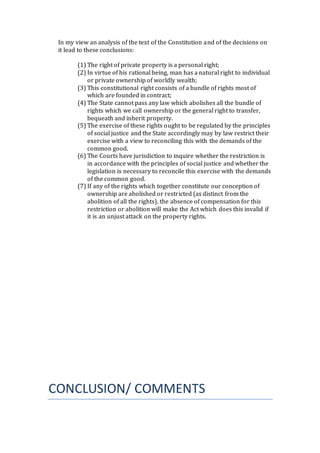
In my view an analysis of the text of the Constitution and of the decisions on
it lead to these conclusions:
(1) The right of private property is a personal right;
(2) In virtue of his rational being, man has a natural right to individual
or private ownership of worldly wealth;
(3) This constitutional right consists of a bundle of rights most of
which are founded in contract;
(4) The State cannot pass any law which abolishes all the bundle of
rights which we call ownership or the general right to transfer,
bequeath and inherit property.
(5) The exercise of these rights ought to be regulated by the principles
of social justice and the State accordingly may by law restrict their
exercise with a view to reconciling this with the demands of the
common good.
(6) The Courts have jurisdiction to inquire whether the restriction is
in accordance with the principles of social justice and whether the
legislation is necessary to reconcile this exercise with the demands
of the common good.
(7) If any of the rights which together constitute our conception of
ownership are abolished or restricted (as distinct from the
abolition of all the rights), the absence of compensation for this
restriction or abolition will make the Act which does this invalid if
it is an unjust attack on the property rights.
CONCLUSION/ COMMENTS
Considering the cases and developments in the issue in hand, the minority view
of Review Group seems more persuasive. An express provision in the
constitution provides for various issues in following cases:
 Social In-justice
 Bank Guarantee
 Austerity
 Rent/ Leases
The perspective that an arrangement of property rights needs to meet a test on
how it influences others. The rights aren't genuine unless they sufficiently profit
other individuals.
The State's obligation to ensure property rights is not total, as the wording of
Article 40.3.2 itself makes clear. This point was traditionally made by O’Higgins
CJ “It is noted that the guarantee of protection given by Article 40, s. 3, sub-s. 2, of
the Constitution is qualified by the words ‘as best it may’. This implies
circumstances in which the State may have to balance its protection of the right
as against other obligations arising from regard for the common good.”14
Rent has been one of the most common limitation of property right. The same
can be illustrated by a very local example of case of Grafton Street in Dublin. John
Corcoran, owner Korky store on Grofton street said “Over the past ten years
rents on Grafton Street have surged to a level where they are now the fifth
highest in the world. We have seen many well regarded retail businesses
fail…these companies cited rents as the primary reason for their closure.”15
All these factors, which ultimately lead to breach of property right for all, or a
class of people makes it fundamentally irrelevant to include the same in the
constitution. The Fundamental motive to include a right in the constitution is
infringed if the same if coupled by limitations or factors that ultimately leads to
shortcomings and irrelevancy.
---------------------x--------------------x--------------------
WORD COUNT: 1583 (excluding footnote & cover page)
14 Moynihan v Greensmyth [1977] IR 55
15 Last day of Korkys Grafton Street
<https://irishcommercialtenants.wordpress.com> accessed 01 March 2015

VALIDITY OF INCLUSION OF RIGHT TO PROPERTY IN THE CONSTITUTION- Article 40.3.2° and Article 43

  • 1.
    VALIDITY OF INCLUSIONOF RIGHT TO PROPERTY IN THE CONSTITUTION Article 40.3.2° and Article 43 CONSTITUTIONAL LAW- ASSESSMENT ABSTRACT The assessmentwill analyzethe validity and relevanceof the fundamental right of property in light with the two views provided by Review Group supported by later developments and case laws concerning the given issue. NAME: UTKARSH KUMAR STUDENT ID.: 14209353 BRANCH: SUTHERLAND SCHOOL OF LAW
  • 2.
    INTRODUCTION The fundamental rightis warranted by two provisions of the Constitution − Article 40.3.2° and Article 43. generally, Article 40.3.2° could shield the individual citizen’s property rights, whereas Article 43 deals with the establishment of property itself. The right to own and transfer private property is guaranteed by Article 43, subject to "the principles of social justice", and in accordance with laws passed reconciling the right "with the exigencies of the common good" In case Blake v Attorney General1, the Court examined the issue of the interplay between Art. 43 and Art. 40.3 in detail, concluding that, while Art. 43 protect private property as an institution (i.e. prohibits its complete abolition), Art. 40.3 prevent an unjust attack on the property rights of an individual. The right to enjoyment of private property is protected by the European Convention on Human Rights (ECHR) in Article 1, Protocol 1 of the Convention.2 REVIEW GROUP, 1996 The Review Group perceives that, regardless of detailing may be concocted to trade Article 40.3.2° and Article 43, it might more likely than not abstain from entrusting a degree (even a high degree) of subjective evaluation to the legal. It is considered by Review Group that, it may be liked to recast these procurements in an exceedingly way that accommodated an extra organized and target system of legal investigation 1 [1982] IR 117 2 "Every natural or legal person is entitled to the peaceful enjoyment of his possessions. No one shall be deprived of his possessions except in the public interest and subject to the conditions provided for by law and by the general principles of international law. The preceding provisions shall not, however, in any way impair the right of a State to enforce such laws as it deems necessary to control the use of property in accordance with the general interest or to secure the payment of taxes or other contributions or penalties."
  • 3.
    TWO VIEWS The majoritywas of the opinion that the Constitution should contain such a protection whereas some members of the Review Group did not favor the constitutional protection of property rights. Firstly, the one in favor was of the opinion that State has legitimate reasons to manage and regulate the exercise of property rights as, the prosperity of the State depends in substantial live on property like land, building, equity or the other kind of wealth being on the market as a supply of, or security for investment. Also, the same has been acknowledged internationally. Secondly, the assertion of property rights has traditionally been related to the protection of business and business interests and isn't designed to confirm to everybody the fabric conditions for a lifetime of dignity. They take into account, therefore, that it's no place among the basic rights provisions of a constitution. Moreover, in their read, the constitutional protection of property rights might endorse major differ- entails within the possession of productive wealth existing at the time of the adoption of the text. RECOMMENDATIONS 1. The Constitution should expressly protect the right to property (majority view). 2. The Constitution should expressly provide that such property rights can be qualified, restricted etc. by legislation where there are clear social justice or other public policy reasons for doing so.
  • 4.
    FURTHER DEVELOPMENTS/ CASELAWS  Major development in the issue was seen in the case- Re Article 26 and the Health (Amendment) (No2) Bill 20043 (referred to below as the “Health Bill Case”). The State had been charging elderly people for medication since 1975 although they were entitled for free treatment; thereby the charges levied were unlawful. The administration acquainted a Bill looking for with reflectively render the charges legitimate.4 The court perceived that patients unlawfully charged had a property right comprising of a privilege of activity to recuperate that cash. The court found that the patients' property rights in connection to the money would be annulled by the bill. “In the view of the Court, such legislation cannot be regarded as “regulating” the exercise of property rights. It is straining the meaning of the reference in Article 43.2.1 of the Constitution to the “principles of social justice”5 “an abrogation of property rights and an unjust attack on them contrary to the provisions of the Constitution and in particular Articles 43 and 40.3.2.”6  Unjust Attack -Costello P. in Daly v. Revenue Commissioners7 The SC held that to claim relief under Article 40.3.2, the claimant must prove as “unjust attack” on its right to private property “When … an applicant claims that his constitutionally protected right to private  property referred to in Article 40.3.2 has been infringed and that the State has failed in the obligation imposed on it by that Article to protect his property rights, he has to show that those rights have been subject to an unjust attack'. He can do this by showing that the law which has restricted the exercise of his rights or otherwise infringed them has failed to pass a proportionality test.”  Taxation is an interference with property rights. This was recognized in Daly v Revenue Commissioners.8 3 [2005] 1 IR 205 4 “... firstly, to examine the nature of the property rights at issue; secondly, to consider whether the Bill consists of a regulation of those rights in accordance with principles of social justice and whether the Bill is required so as to delimit those rights in accordance with the exigencies of the common good; thirdly, in the light of its conclusions on these issues, to consider whether the Bill constitutes an unjust attack on those property rights 5 [2005] 1 IR 205 [130] 6 [2005] 1 IR 205 [134] 7 [1995] 3 I.R.
  • 5.
    In Daly, MrJustice Costello stated: that legislative interference in property rights occurs every day of the week and no constitutional impropriety is involved. When, as in this case, an applicant claims that his constitutionally protected right to private property referred to in Article 40.3.2° has been infringed and that the State has failed in the obligation imposed on it by that article to protect his property rights he has to show that those rights have been subject to ‘an unjust attack’.  Eighth Report of the Convention on the Constitution- Economic, Social and Cultural (ESC) Rights9 stated that: “Finally, it should be noted that the right to property – which, while widely accepted as a civil and political right, has important economic and social dimensions – is protected under not one but two provisions of the Constitution: Article 40.3.2° and Article 43, which provisions mutually inform each other.”  In Ireland and the Attorney General v Mayo County Council10 case, the court held that property rights, as protected by the Constitution, are not absolute. The power of the State to regulate the use of land has been recognized in a number of cases. For example, In Central Dublin Development Association v. Attorney General 11Kenny J stated, the state may exercise the property right with the aim to promote common good.12  Compensation and property rights: Kelly in a passage approved by Finnegan P stated that Constitutionality of property rights is not interfered with the existence of compensation scheme “It is submitted that it follows from Article 43.1 that compensation cannot validate an interference with property rights that is not justified by the exigencies of the common good. Any other view would mean that Article 43 merely guarantees a right to compensation rather than a right to property per se.”13  HC in the case The Central Dublin Development Association Limited. Cecil F. Hollinshead, M. Rowan & Company Limited, Barry J. Hardy Limited and Mary W. O'Brien v The Attorney General gave a conclusive remark on the right to property guaranteed by constitution: 8 [1995] 3 IR 9 1March, 2014 10 [2014] IEHC 382 11 [1975] ILTR 69 12 [Article 43.2.1] does not require that the exercise of the rights of property must in all cases be regulated by the principles of social justice. It recognizes that the exercise of these rights ought to be regulated by these principles and that the State accordingly may delimit (which I think means restrict) by law the exercise of the said rights with a view to reconciling it with the exigencies of the common good.” 13 Hogan and Whyte, Kelly: The Irish Constitution, 4th Ed., 2003, Dublin
  • 6.
    In my viewan analysis of the text of the Constitution and of the decisions on it lead to these conclusions: (1) The right of private property is a personal right; (2) In virtue of his rational being, man has a natural right to individual or private ownership of worldly wealth; (3) This constitutional right consists of a bundle of rights most of which are founded in contract; (4) The State cannot pass any law which abolishes all the bundle of rights which we call ownership or the general right to transfer, bequeath and inherit property. (5) The exercise of these rights ought to be regulated by the principles of social justice and the State accordingly may by law restrict their exercise with a view to reconciling this with the demands of the common good. (6) The Courts have jurisdiction to inquire whether the restriction is in accordance with the principles of social justice and whether the legislation is necessary to reconcile this exercise with the demands of the common good. (7) If any of the rights which together constitute our conception of ownership are abolished or restricted (as distinct from the abolition of all the rights), the absence of compensation for this restriction or abolition will make the Act which does this invalid if it is an unjust attack on the property rights. CONCLUSION/ COMMENTS
  • 7.
    Considering the casesand developments in the issue in hand, the minority view of Review Group seems more persuasive. An express provision in the constitution provides for various issues in following cases:  Social In-justice  Bank Guarantee  Austerity  Rent/ Leases The perspective that an arrangement of property rights needs to meet a test on how it influences others. The rights aren't genuine unless they sufficiently profit other individuals. The State's obligation to ensure property rights is not total, as the wording of Article 40.3.2 itself makes clear. This point was traditionally made by O’Higgins CJ “It is noted that the guarantee of protection given by Article 40, s. 3, sub-s. 2, of the Constitution is qualified by the words ‘as best it may’. This implies circumstances in which the State may have to balance its protection of the right as against other obligations arising from regard for the common good.”14 Rent has been one of the most common limitation of property right. The same can be illustrated by a very local example of case of Grafton Street in Dublin. John Corcoran, owner Korky store on Grofton street said “Over the past ten years rents on Grafton Street have surged to a level where they are now the fifth highest in the world. We have seen many well regarded retail businesses fail…these companies cited rents as the primary reason for their closure.”15 All these factors, which ultimately lead to breach of property right for all, or a class of people makes it fundamentally irrelevant to include the same in the constitution. The Fundamental motive to include a right in the constitution is infringed if the same if coupled by limitations or factors that ultimately leads to shortcomings and irrelevancy. ---------------------x--------------------x-------------------- WORD COUNT: 1583 (excluding footnote & cover page) 14 Moynihan v Greensmyth [1977] IR 55 15 Last day of Korkys Grafton Street <https://irishcommercialtenants.wordpress.com> accessed 01 March 2015