Law on Obligations and Contracts – Module 1 
Gen Ephan, CPA
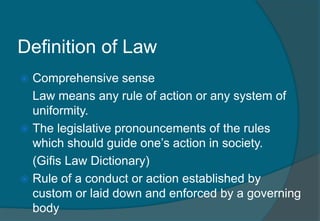
Definition of Law 
 Comprehensive sense 
Law means any rule of action or any system of 
uniformity. 
 The legislative pronouncements of the rules 
which should guide one’s action in society. 
(Gifis Law Dictionary) 
 Rule of a conduct or action established by 
custom or laid down and enforced by a governing 
body
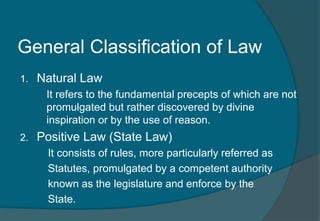
General Classification of Law 
1. Natural Law 
It refers to the fundamental precepts of which are not 
promulgated but rather discovered by divine 
inspiration or by the use of reason. 
2. Positive Law (State Law) 
It consists of rules, more particularly referred as 
Statutes, promulgated by a competent authority 
known as the legislature and enforce by the 
State.
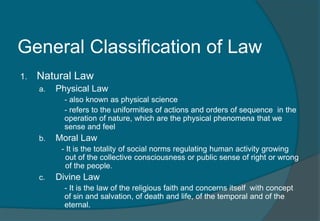
General Classification of Law 
1. Natural Law 
a. Physical Law 
- also known as physical science 
- refers to the uniformities of actions and orders of sequence in the 
operation of nature, which are the physical phenomena that we 
sense and feel 
b. Moral Law 
- It is the totality of social norms regulating human activity growing 
out of the collective consciousness or public sense of right or wrong 
of the people. 
c. Divine Law 
- It is the law of the religious faith and concerns itself with concept 
of sin and salvation, of death and life, of the temporal and of the 
eternal.
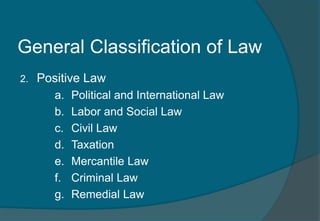
General Classification of Law 
2. Positive Law 
a. Political and International Law 
b. Labor and Social Law 
c. Civil Law 
d. Taxation 
e. Mercantile Law 
f. Criminal Law 
g. Remedial Law
Characteristics of Positive Law 
1. It is a rule of conduct; 
2. Promulgated by a competent court; 
3. Obligatory; and 
4. Of general observance.
Sources of Law 
The principal sources of law in the Phil. 
are as follows: 
1. Constitution; 
2. Legislation; 
3. Administrative or Executive Orders, 
Regulations and Rulings; 
4. Jurisprudence 
5. Custom 
6. Others sources
Classification of Law under the 
Philippine Legal System 
1. According to its purpose 
2. According to scope or content 
3. According to relationship
Classification of Law under the 
Philippine Legal System 
1. According to its purpose 
 Substantive Laws – are those that grant or 
provide privileges and duties to a person 
 Remedial/Procedural Laws – are those that 
provide for the manner of enforcing or protecting 
legal rights and claims.
Classification of Law under the 
Philippine Legal System 
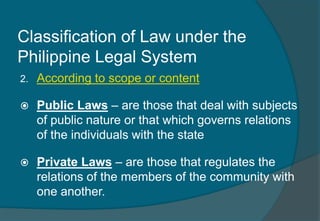
2. According to scope or content 
 Public Laws – are those that deal with subjects 
of public nature or that which governs relations 
of the individuals with the state 
 Private Laws – are those that regulates the 
relations of the members of the community with 
one another.
Classification of Law under the 
Philippine Legal System 
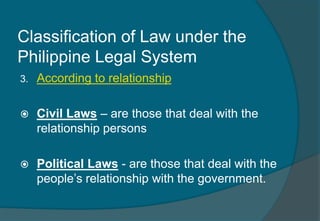
3. According to relationship 
 Civil Laws – are those that deal with the 
relationship persons 
 Political Laws - are those that deal with the 
people’s relationship with the government.
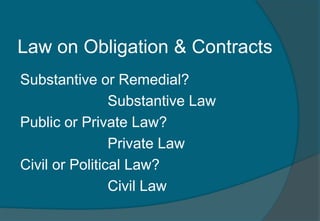
Law on Obligation & Contracts 
Substantive or Remedial? 
Substantive Law 
Public or Private Law? 
Private Law 
Civil or Political Law? 
Civil Law
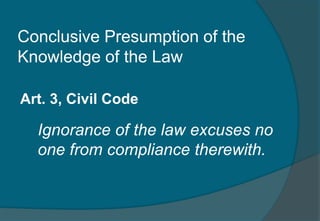
Conclusive Presumption of the 
Knowledge of the Law 
Art. 3, Civil Code 
Ignorance of the law excuses no 
one from compliance therewith.
Fin 
*** GOOD DAY***
Next Meeting 
Title I, Chapter I General Provisions 
Article 1156 - 1162

Introduction to

  • 1.
    Law on Obligationsand Contracts – Module 1 Gen Ephan, CPA
  • 2.
    Definition of Law  Comprehensive sense Law means any rule of action or any system of uniformity.  The legislative pronouncements of the rules which should guide one’s action in society. (Gifis Law Dictionary)  Rule of a conduct or action established by custom or laid down and enforced by a governing body
  • 3.
    General Classification ofLaw 1. Natural Law It refers to the fundamental precepts of which are not promulgated but rather discovered by divine inspiration or by the use of reason. 2. Positive Law (State Law) It consists of rules, more particularly referred as Statutes, promulgated by a competent authority known as the legislature and enforce by the State.
  • 4.
    General Classification ofLaw 1. Natural Law a. Physical Law - also known as physical science - refers to the uniformities of actions and orders of sequence in the operation of nature, which are the physical phenomena that we sense and feel b. Moral Law - It is the totality of social norms regulating human activity growing out of the collective consciousness or public sense of right or wrong of the people. c. Divine Law - It is the law of the religious faith and concerns itself with concept of sin and salvation, of death and life, of the temporal and of the eternal.
  • 5.
    General Classification ofLaw 2. Positive Law a. Political and International Law b. Labor and Social Law c. Civil Law d. Taxation e. Mercantile Law f. Criminal Law g. Remedial Law
  • 6.
    Characteristics of PositiveLaw 1. It is a rule of conduct; 2. Promulgated by a competent court; 3. Obligatory; and 4. Of general observance.
  • 7.
    Sources of Law The principal sources of law in the Phil. are as follows: 1. Constitution; 2. Legislation; 3. Administrative or Executive Orders, Regulations and Rulings; 4. Jurisprudence 5. Custom 6. Others sources
  • 8.
    Classification of Lawunder the Philippine Legal System 1. According to its purpose 2. According to scope or content 3. According to relationship
  • 9.
    Classification of Lawunder the Philippine Legal System 1. According to its purpose  Substantive Laws – are those that grant or provide privileges and duties to a person  Remedial/Procedural Laws – are those that provide for the manner of enforcing or protecting legal rights and claims.
  • 10.
    Classification of Lawunder the Philippine Legal System 2. According to scope or content  Public Laws – are those that deal with subjects of public nature or that which governs relations of the individuals with the state  Private Laws – are those that regulates the relations of the members of the community with one another.
  • 11.
    Classification of Lawunder the Philippine Legal System 3. According to relationship  Civil Laws – are those that deal with the relationship persons  Political Laws - are those that deal with the people’s relationship with the government.
  • 12.
    Law on Obligation& Contracts Substantive or Remedial? Substantive Law Public or Private Law? Private Law Civil or Political Law? Civil Law
  • 13.
    Conclusive Presumption ofthe Knowledge of the Law Art. 3, Civil Code Ignorance of the law excuses no one from compliance therewith.
  • 14.
  • 15.
    Next Meeting TitleI, Chapter I General Provisions Article 1156 - 1162