Constipation,
Appendicitis,
Haemorrhoids,
Fissures,
Hepatic diseases & Acute pancreas
By C Settley
Acute Constipation
 The onset of acute constipation is sudden and it lasts
for several days.
 It’s usually caused by medication, blockage,
dehydration, prolonged activity, or missing a bowel
movement.
 With women who are pregnant, it can develop when
the womb is pressed against the intestine.
 Swallowing indigestible objects and lead poisoning
are also a cause sometimes, as well as general
anaesthesia, which may affect the bowel muscles a
couple days after surgery.
2018/10/02Compiled by C Settley
2
Acute Constipation
 The medications below may slow down the faeces passage
through the intestine and provoke acute constipation:
 Epilepsy anticonvulsants
 Diuretics
 Antidepressants
 Iron supplements
 Calcium-channel blockers, and other heart medications
 Morphine, codeine, and other pain medications
 Some antacids
 Some cold and cough medications that contain dextromethorphan
2018/10/02Compiled by C Settley
3
Chronic constipation
 Chronic constipation can be defined as the instance of two
or more of the specified below inside an eight week period:
Three bowel movements each week.
One incident of faecal incontinence each week.
Big stools in the rectum or apparent upon examination of
the abdomen.
Withholding behaviour.
Defecation that is painful.
2018/10/02Compiled by C Settley
4
Chronic constipation
 Normal constipation lasts for a brief period and its symptoms resolve in a
fairly short time.
 With chronic constipation, however, the symptoms last for a longer
duration, usually around three or more months and in some cases, years.
 It is a long-term condition that can impact a person’s social and work life.
 It is generally not relieved with OTC laxatives or lifestyle changes and could
require medical attention.
 Although the occasional onset of constipation is common, in some cases,
people will experience chronic constipation, which interferes with their
ability to do daily tasks.
2018/10/02Compiled by C Settley
5
Chronic constipation
 Chronic constipation treatment will depend on the underlying cause.
 The treatment typically starts with lifestyle and diet changes which are
meant for increasing the speed of the stool moving through the intestines.
 When simple measures like this fail, laxative tablets are often the next step.
 For acute constipation, stimulant laxatives like Dulcolax® tablets are often
used.
 Other treatments for acute constipation may also include suppositories &
enemas.
2018/10/02Compiled by C Settley
6
Appendicitis
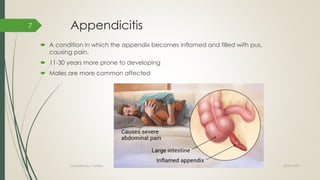
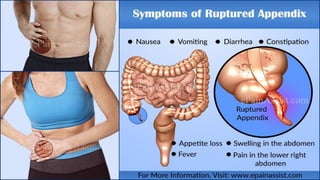
 A condition in which the appendix becomes inflamed and filled with pus,
causing pain.
 11-30 years more prone to developing
 Males are more common affected
2018/10/02Compiled by C Settley
7
The appendix
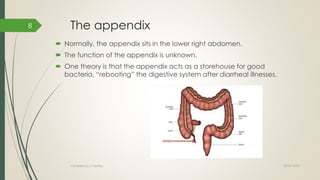
 Normally, the appendix sits in the lower right abdomen.
 The function of the appendix is unknown.
 One theory is that the appendix acts as a storehouse for good
bacteria, “rebooting” the digestive system after diarrheal illnesses.
2018/10/02Compiled by C Settley
8
Appendicitis: Causes
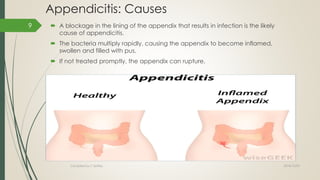
 A blockage in the lining of the appendix that results in infection is the likely
cause of appendicitis.
 The bacteria multiply rapidly, causing the appendix to become inflamed,
swollen and filled with pus.
 If not treated promptly, the appendix can rupture.
2018/10/02Compiled by C Settley
9
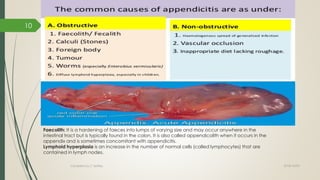
Faecolith: It is a hardening of faeces into lumps of varying size and may occur anywhere in the
intestinal tract but is typically found in the colon. It is also called appendicolith when it occurs in the
appendix and is sometimes concomitant with appendicitis.
Lymphoid hyperplasia is an increase in the number of normal cells (called lymphocytes) that are
contained in lymph nodes.
2018/10/02Compiled by C Settley
10
Appendicitis: Pathophysiology
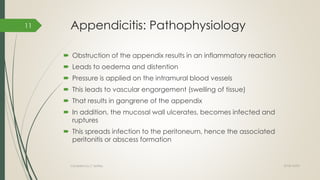
 Obstruction of the appendix results in an inflammatory reaction
 Leads to oedema and distention
 Pressure is applied on the intramural blood vessels
 This leads to vascular engorgement (swelling of tissue)
 That results in gangrene of the appendix
 In addition, the mucosal wall ulcerates, becomes infected and
ruptures
 This spreads infection to the peritoneum, hence the associated
peritonitis or abscess formation
2018/10/02Compiled by C Settley
11
2018/10/02Compiled by C Settley
12
Assessment
 Diagnostic tests
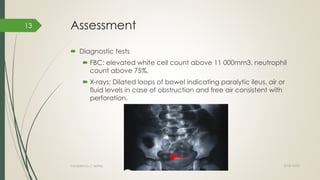
 FBC: elevated white cell count above 11 000mm3. neutrophil
count above 75%.
 X-rays: Dilated loops of bowel indicating paralytic ileus, air or
fluid levels in case of obstruction and free air consistent with
perforation.
2018/10/02Compiled by C Settley
13
Appendicitis: Medical Management
 Immediate surgical removal of the appendix through a laparotomy
 Drainage of the abscess may be indicated if the complication has
developed
 IV therapy should commence surgery to correct fluid and
electrolyte imbalance and to administer AB’s for infection
 If appendix has not perforated at the time of the surgery, the
patient’s recovery is usually smooth and the patient is discharged
within 5-7 days or earlier
2018/10/02Compiled by C Settley
14
Appendicitis: Nursing Management
 Relieve anxiety
 Relieve pain
 Prevent systematic infection
 Correct fluid and electrolyte imbalance
 Nutrition
 Prepare patient for surgery
2018/10/02Compiled by C Settley
15
Appendicitis:
Essential health information
 Advise patient not to self medicate
 See doctor as soon as they feel abdominal pain
2018/10/02Compiled by C Settley
16
Haemorrhoids
 Swollen and inflamed veins in the rectum and anus
that cause discomfort and bleeding.
2018/10/02Compiled by C Settley
17
Haemorrhoids: Symptoms
 Painless bleeding during bowel movements —small
amounts of bright red blood on toilet tissue or in the toilet
 Itching or irritation in anal region
 Pain or discomfort
 Swelling around anus
 A lump near anus, which may be sensitive or painful (may
be a thrombosed hemorrhoid)
 Hemorrhoid symptoms usually depend on the location.
2018/10/02Compiled by C Settley
18
Haemorrhoids
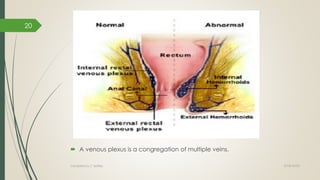
 Internal hemorrhoids.
 These lie inside the rectum. Occasionally, straining can push an internal
hemorrhoid through the anal opening. This is known as a protruding or
prolapsed hemorrhoid and can cause pain and irritation.
 External hemorrhoids.
 These are under the skin around anus. When irritated, external hemorrhoids can
itch or bleed.
 Thrombosed hemorrhoids.
 Sometimes blood may pool in an external hemorrhoid and form a clot
(thrombus) that can result in severe pain, swelling, inflammation and a hard
lump near the anus.
2018/10/02Compiled by C Settley
19
 A venous plexus is a congregation of multiple veins.
2018/10/02Compiled by C Settley
20
Haemorrhoids: Causes
 Straining during bowel movements
 Sitting for long periods of time on the toilet
 Chronic diarrhea or constipation
 Obesity
 Pregnancy
 Anal intercourse
 Low-fiber diet
 Rectal surgery
 Loss of muscle tone
 Anal intercourse
 Heavy lifting
2018/10/02Compiled by C Settley
21
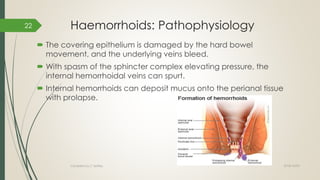
Haemorrhoids: Pathophysiology
 The covering epithelium is damaged by the hard bowel
movement, and the underlying veins bleed.
 With spasm of the sphincter complex elevating pressure, the
internal hemorrhoidal veins can spurt.
 Internal hemorrhoids can deposit mucus onto the perianal tissue
with prolapse.
2018/10/02Compiled by C Settley
22
2018/10/02Compiled by C Settley
23
2018/10/02Compiled by C Settley
24
Haemorrhoids: Complications
 Anemia. Rarely, chronic blood loss from hemorrhoids may cause
anemia, in which you don't have enough healthy red blood cells
to carry oxygen to your cells.
 Strangulated hemorrhoid. If the blood supply to an internal
hemorrhoid is cut off, the hemorrhoid may be "strangulated,"
another cause of extreme pain.
2018/10/02Compiled by C Settley
25
A: Strangulated internal hemorrhoid;
B: Acutely thrombosed external hemorrhoid.
2018/10/02Compiled by C Settley
26
Haemorrhoids: Nursing management
 Preventing constipation by eating a high fibre diet
 Avoiding prolonged periods of standing/sitting
 Warm sitz baths
 Inserting soothing anal suppositories
 Warm compresses
 Anal hygiene
 exercise
2018/10/02Compiled by C Settley
27
Haemorrhoids: Surgical management
 A hemorrhoidectomy.
Indications:
Thrombosis
Prolonged bleeding
Complicated prolapses
Intolerable itching
Discomfort
Intense pain
 Post op care:
 Support
 Pillow
 Pain meds
 Stool softener
2018/10/02Compiled by C Settley
28
Fissures, abscesses & fistulas:
Common problems developed from trauma or infection in the
anorectal area
 Fissure: A small tear in the lining of the anus.
 Anal fissure may occur when passing hard or large stools.
 An anal fissure can cause pain and bleeding during bowel movements.
 This condition usually heals on its own in four to six weeks. Common
treatments include dietary fibre and stool softeners, as well as creams to
the affected area.
2018/10/02Compiled by C Settley
29
Fissures, abscesses & fistulas:
Common problems developed from trauma or infection in the
anorectal area
 Anal abscess: An abscess causes tenderness, swelling, and pain. These
symptoms clear when the abscess is drained. The patient may also
complain of fever, chills, and general weakness or fatigue.
2018/10/02Compiled by C Settley
30
Fissures, abscesses & fistulas:
Common problems developed from trauma or infection in the
anorectal area
 Anal fistula: An infected tunnel between the skin and the anus.
 An anal fistula is an infected tunnel between the skin and the anus, the
muscular opening at the end of the digestive tract. Most anal fistulas are
the result of an infection in an anal gland that spreads to the skin.
 Symptoms include pain, swelling and discharge of blood or pus from the
anus.
 Surgery is usually required to treat anal fistula.
2018/10/02Compiled by C Settley
31
Anal fistula
2018/10/02Compiled by C Settley
32
Fissures, abscesses & fistulas:
Summary
 Bleeding, pain, or drainage from the anus can occur
with several illnesses, so a physician should always be
consulted.
 Often the diagnosis is anal fissure, abscess, or fistula.
 These are problems that are usually easy to diagnose
and correct.
 A variety of treatments, including surgery, are
available to correct these conditions.
2018/10/02Compiled by C Settley
33
Abdominal trauma
 Abdominal trauma is an injury to the abdomen.
 Signs and symptoms include abdominal pain,
tenderness, rigidity, and bruising of the external
abdomen.
 Complications may include blood loss and infection.
 Diagnosis may involve ultrasonography, computed
tomography, and peritoneal lavage, and treatment
may involve surgery.
2018/10/02Compiled by C Settley
34
Abdominal trauma: Common injuries
 Lacerated liver
 Injuries to kidney and intestines
 Ruptured spleen, liver, stomach, diaphragm & bladder
 Dangers:
 Peritonitis
 Inflammation of the membrane lining the abdominal wall and covering the
abdominal organs.
 Shock
 Cullen’s sign
 superficial oedema and bruising in the subcutaneous fatty tissue around the umbilicus
 Abdominal compartment syndrome
 A condition caused by abnormally increased pressure within the abdomen.
 Gunshots, poly-trauma, stab wounds, haemorrhage
2018/10/02Compiled by C Settley
35
Abdominal trauma:
Emergency management
 Laparotomy
 Clear airway
 High Fowlers
 Oxygen
 Control bleeding
 Replace fluid loss
 Blood transfusion
 Nasogastric tube to decompress the abdomen and stomach
 Catheter
 Vital signs
2018/10/02Compiled by C Settley
36
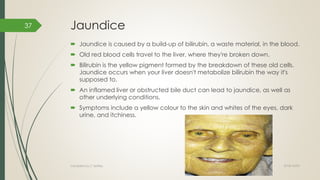
Jaundice
 Jaundice is caused by a build-up of bilirubin, a waste material, in the blood.
 Old red blood cells travel to the liver, where they're broken down.
 Bilirubin is the yellow pigment formed by the breakdown of these old cells.
Jaundice occurs when your liver doesn't metabolize bilirubin the way it's
supposed to.
 An inflamed liver or obstructed bile duct can lead to jaundice, as well as
other underlying conditions.
 Symptoms include a yellow colour to the skin and whites of the eyes, dark
urine, and itchiness.
2018/10/02Compiled by C Settley
37
Types of Jaundice
 Pre hepatic/Haemolytic
Haemolytic jaundice occurs as a result of haemolysis,
or an accelerated breakdown of red blood cells,
leading to an increase in production of bilirubin.
 Hepatic/Hepatocellular
Hepatocellular jaundice occurs as a result of liver
disease or injury.
 Post hepatic/Obstructive
Obstructive jaundice occurs as a result of an
obstruction in the bile duct.
2018/10/02Compiled by C Settley
38
Toxic hepatitis
 Toxic hepatitis is an inflammation of the liver in reaction to certain
substances exposed to.
 Toxic hepatitis can be caused by alcohol, chemicals, drugs or nutritional
supplements.
 In some cases, toxic hepatitis develops within hours or days of exposure to a
toxin.
2018/10/02Compiled by C Settley
39
Acute pancreatitis
 The pancreas is an organ in the upper abdomen that produces digestive fluids
and the hormone insulin.
 Acute pancreatitis means inflammation of the pancreas that develops quickly.
 The main symptom is abdominal pain.
 It usually settles in a few days but sometimes it becomes severe and very serious.
 The most common causes of acute pancreatitis are gallstones and drinking a lot
of alcohol.
2018/10/02Compiled by C Settley
40
Acute pancreatitis: Causes
 Gallstones
 Heavy alcohol use
 Drugs such as angiotensin-converting
enzyme (ACE) inhibitors, azathioprine,
furosemide, 6-mercaptopurine,
pentamidine, sulfa drugs, and valproate
 Estrogen use in women with high levels
of lipids in the blood
 High levels of calcium in the blood
(which may be caused by
hyperparathyroidism)
 Viruses such as mumps
 High levels of triglycerides in the blood
(hypertriglyceridemia)
 Damage to the pancreas caused by
surgery or endoscopy (such as
endoscopic retrograde
cholangiopancreatography [ERCP])
 Damage to the pancreas caused by
blunt or penetrating injuries
 Cancer of the pancreas, or other
blockages of the pancreatic duct
 Hereditary pancreatitis, including a small
percentage of people with cystic fibrosis
or cystic fibrosis genes
 Cigarette smoking
 Kidney transplantation
 Pregnancy (rare)
2018/10/02Compiled by C Settley
41
Acute pancreas: Symptoms
 Abdominal pain
 Coughing, vigorous movement, and deep breathing may worsen the pain. Sitting
upright and leaning forward may provide some relief.
 Feeling of wanting to vomit.
 Some people, especially those who develop acute pancreatitis because of
heavy alcohol use, may never develop any symptoms other than moderate to
severe pain.
 Some people feel terrible. They look sick and are sweaty and have a fast pulse
(100 to 140 beats a minute) and shallow, rapid breathing.
 At first, body temperature may be normal, but it may increase in a few hours to
between 100° F and 101° F (37.7° C and 38.3° C).
 Blood pressure is usually low and tends to fall when the person stands, causing
light-headedness.
 Occasionally, the whites of the eyes (sclera) become yellowish.
2018/10/02Compiled by C Settley
42
Poisoning and drug overdose:
Management
 Identify the poison
 Place in recovery position
 Establish or maintain open airway
 Assess for signs of breathing
 Check pulse and skin colour
 Call for help
 Transport to hospital
2018/10/02Compiled by C Settley
43
Reference list
 https://dulcolax.com.au/the-difference-between-acute-constipation-and-
chronic-constipation/
 https://www.wjgnet.com/1007-9327/full/v21/i31/9245.htm
 https://www.123rf.com/photo_32377435_stock-vector-acute-pancreatitis-is-
an-inflammation-of-the-pancreas-.html
2018/10/02Compiled by C Settley
44

Constipation and appendicitis

  • 1.
  • 2.
    Acute Constipation  Theonset of acute constipation is sudden and it lasts for several days.  It’s usually caused by medication, blockage, dehydration, prolonged activity, or missing a bowel movement.  With women who are pregnant, it can develop when the womb is pressed against the intestine.  Swallowing indigestible objects and lead poisoning are also a cause sometimes, as well as general anaesthesia, which may affect the bowel muscles a couple days after surgery. 2018/10/02Compiled by C Settley 2
  • 3.
    Acute Constipation  Themedications below may slow down the faeces passage through the intestine and provoke acute constipation:  Epilepsy anticonvulsants  Diuretics  Antidepressants  Iron supplements  Calcium-channel blockers, and other heart medications  Morphine, codeine, and other pain medications  Some antacids  Some cold and cough medications that contain dextromethorphan 2018/10/02Compiled by C Settley 3
  • 4.
    Chronic constipation  Chronicconstipation can be defined as the instance of two or more of the specified below inside an eight week period: Three bowel movements each week. One incident of faecal incontinence each week. Big stools in the rectum or apparent upon examination of the abdomen. Withholding behaviour. Defecation that is painful. 2018/10/02Compiled by C Settley 4
  • 5.
    Chronic constipation  Normalconstipation lasts for a brief period and its symptoms resolve in a fairly short time.  With chronic constipation, however, the symptoms last for a longer duration, usually around three or more months and in some cases, years.  It is a long-term condition that can impact a person’s social and work life.  It is generally not relieved with OTC laxatives or lifestyle changes and could require medical attention.  Although the occasional onset of constipation is common, in some cases, people will experience chronic constipation, which interferes with their ability to do daily tasks. 2018/10/02Compiled by C Settley 5
  • 6.
    Chronic constipation  Chronicconstipation treatment will depend on the underlying cause.  The treatment typically starts with lifestyle and diet changes which are meant for increasing the speed of the stool moving through the intestines.  When simple measures like this fail, laxative tablets are often the next step.  For acute constipation, stimulant laxatives like Dulcolax® tablets are often used.  Other treatments for acute constipation may also include suppositories & enemas. 2018/10/02Compiled by C Settley 6
  • 7.
    Appendicitis  A conditionin which the appendix becomes inflamed and filled with pus, causing pain.  11-30 years more prone to developing  Males are more common affected 2018/10/02Compiled by C Settley 7
  • 8.
    The appendix  Normally,the appendix sits in the lower right abdomen.  The function of the appendix is unknown.  One theory is that the appendix acts as a storehouse for good bacteria, “rebooting” the digestive system after diarrheal illnesses. 2018/10/02Compiled by C Settley 8
  • 9.
    Appendicitis: Causes  Ablockage in the lining of the appendix that results in infection is the likely cause of appendicitis.  The bacteria multiply rapidly, causing the appendix to become inflamed, swollen and filled with pus.  If not treated promptly, the appendix can rupture. 2018/10/02Compiled by C Settley 9
  • 10.
    Faecolith: It isa hardening of faeces into lumps of varying size and may occur anywhere in the intestinal tract but is typically found in the colon. It is also called appendicolith when it occurs in the appendix and is sometimes concomitant with appendicitis. Lymphoid hyperplasia is an increase in the number of normal cells (called lymphocytes) that are contained in lymph nodes. 2018/10/02Compiled by C Settley 10
  • 11.
    Appendicitis: Pathophysiology  Obstructionof the appendix results in an inflammatory reaction  Leads to oedema and distention  Pressure is applied on the intramural blood vessels  This leads to vascular engorgement (swelling of tissue)  That results in gangrene of the appendix  In addition, the mucosal wall ulcerates, becomes infected and ruptures  This spreads infection to the peritoneum, hence the associated peritonitis or abscess formation 2018/10/02Compiled by C Settley 11
  • 12.
  • 13.
    Assessment  Diagnostic tests FBC: elevated white cell count above 11 000mm3. neutrophil count above 75%.  X-rays: Dilated loops of bowel indicating paralytic ileus, air or fluid levels in case of obstruction and free air consistent with perforation. 2018/10/02Compiled by C Settley 13
  • 14.
    Appendicitis: Medical Management Immediate surgical removal of the appendix through a laparotomy  Drainage of the abscess may be indicated if the complication has developed  IV therapy should commence surgery to correct fluid and electrolyte imbalance and to administer AB’s for infection  If appendix has not perforated at the time of the surgery, the patient’s recovery is usually smooth and the patient is discharged within 5-7 days or earlier 2018/10/02Compiled by C Settley 14
  • 15.
    Appendicitis: Nursing Management Relieve anxiety  Relieve pain  Prevent systematic infection  Correct fluid and electrolyte imbalance  Nutrition  Prepare patient for surgery 2018/10/02Compiled by C Settley 15
  • 16.
    Appendicitis: Essential health information Advise patient not to self medicate  See doctor as soon as they feel abdominal pain 2018/10/02Compiled by C Settley 16
  • 17.
    Haemorrhoids  Swollen andinflamed veins in the rectum and anus that cause discomfort and bleeding. 2018/10/02Compiled by C Settley 17
  • 18.
    Haemorrhoids: Symptoms  Painlessbleeding during bowel movements —small amounts of bright red blood on toilet tissue or in the toilet  Itching or irritation in anal region  Pain or discomfort  Swelling around anus  A lump near anus, which may be sensitive or painful (may be a thrombosed hemorrhoid)  Hemorrhoid symptoms usually depend on the location. 2018/10/02Compiled by C Settley 18
  • 19.
    Haemorrhoids  Internal hemorrhoids. These lie inside the rectum. Occasionally, straining can push an internal hemorrhoid through the anal opening. This is known as a protruding or prolapsed hemorrhoid and can cause pain and irritation.  External hemorrhoids.  These are under the skin around anus. When irritated, external hemorrhoids can itch or bleed.  Thrombosed hemorrhoids.  Sometimes blood may pool in an external hemorrhoid and form a clot (thrombus) that can result in severe pain, swelling, inflammation and a hard lump near the anus. 2018/10/02Compiled by C Settley 19
  • 20.
     A venousplexus is a congregation of multiple veins. 2018/10/02Compiled by C Settley 20
  • 21.
    Haemorrhoids: Causes  Strainingduring bowel movements  Sitting for long periods of time on the toilet  Chronic diarrhea or constipation  Obesity  Pregnancy  Anal intercourse  Low-fiber diet  Rectal surgery  Loss of muscle tone  Anal intercourse  Heavy lifting 2018/10/02Compiled by C Settley 21
  • 22.
    Haemorrhoids: Pathophysiology  Thecovering epithelium is damaged by the hard bowel movement, and the underlying veins bleed.  With spasm of the sphincter complex elevating pressure, the internal hemorrhoidal veins can spurt.  Internal hemorrhoids can deposit mucus onto the perianal tissue with prolapse. 2018/10/02Compiled by C Settley 22
  • 23.
  • 24.
  • 25.
    Haemorrhoids: Complications  Anemia.Rarely, chronic blood loss from hemorrhoids may cause anemia, in which you don't have enough healthy red blood cells to carry oxygen to your cells.  Strangulated hemorrhoid. If the blood supply to an internal hemorrhoid is cut off, the hemorrhoid may be "strangulated," another cause of extreme pain. 2018/10/02Compiled by C Settley 25
  • 26.
    A: Strangulated internalhemorrhoid; B: Acutely thrombosed external hemorrhoid. 2018/10/02Compiled by C Settley 26
  • 27.
    Haemorrhoids: Nursing management Preventing constipation by eating a high fibre diet  Avoiding prolonged periods of standing/sitting  Warm sitz baths  Inserting soothing anal suppositories  Warm compresses  Anal hygiene  exercise 2018/10/02Compiled by C Settley 27
  • 28.
    Haemorrhoids: Surgical management A hemorrhoidectomy. Indications: Thrombosis Prolonged bleeding Complicated prolapses Intolerable itching Discomfort Intense pain  Post op care:  Support  Pillow  Pain meds  Stool softener 2018/10/02Compiled by C Settley 28
  • 29.
    Fissures, abscesses &fistulas: Common problems developed from trauma or infection in the anorectal area  Fissure: A small tear in the lining of the anus.  Anal fissure may occur when passing hard or large stools.  An anal fissure can cause pain and bleeding during bowel movements.  This condition usually heals on its own in four to six weeks. Common treatments include dietary fibre and stool softeners, as well as creams to the affected area. 2018/10/02Compiled by C Settley 29
  • 30.
    Fissures, abscesses &fistulas: Common problems developed from trauma or infection in the anorectal area  Anal abscess: An abscess causes tenderness, swelling, and pain. These symptoms clear when the abscess is drained. The patient may also complain of fever, chills, and general weakness or fatigue. 2018/10/02Compiled by C Settley 30
  • 31.
    Fissures, abscesses &fistulas: Common problems developed from trauma or infection in the anorectal area  Anal fistula: An infected tunnel between the skin and the anus.  An anal fistula is an infected tunnel between the skin and the anus, the muscular opening at the end of the digestive tract. Most anal fistulas are the result of an infection in an anal gland that spreads to the skin.  Symptoms include pain, swelling and discharge of blood or pus from the anus.  Surgery is usually required to treat anal fistula. 2018/10/02Compiled by C Settley 31
  • 32.
  • 33.
    Fissures, abscesses &fistulas: Summary  Bleeding, pain, or drainage from the anus can occur with several illnesses, so a physician should always be consulted.  Often the diagnosis is anal fissure, abscess, or fistula.  These are problems that are usually easy to diagnose and correct.  A variety of treatments, including surgery, are available to correct these conditions. 2018/10/02Compiled by C Settley 33
  • 34.
    Abdominal trauma  Abdominaltrauma is an injury to the abdomen.  Signs and symptoms include abdominal pain, tenderness, rigidity, and bruising of the external abdomen.  Complications may include blood loss and infection.  Diagnosis may involve ultrasonography, computed tomography, and peritoneal lavage, and treatment may involve surgery. 2018/10/02Compiled by C Settley 34
  • 35.
    Abdominal trauma: Commoninjuries  Lacerated liver  Injuries to kidney and intestines  Ruptured spleen, liver, stomach, diaphragm & bladder  Dangers:  Peritonitis  Inflammation of the membrane lining the abdominal wall and covering the abdominal organs.  Shock  Cullen’s sign  superficial oedema and bruising in the subcutaneous fatty tissue around the umbilicus  Abdominal compartment syndrome  A condition caused by abnormally increased pressure within the abdomen.  Gunshots, poly-trauma, stab wounds, haemorrhage 2018/10/02Compiled by C Settley 35
  • 36.
    Abdominal trauma: Emergency management Laparotomy  Clear airway  High Fowlers  Oxygen  Control bleeding  Replace fluid loss  Blood transfusion  Nasogastric tube to decompress the abdomen and stomach  Catheter  Vital signs 2018/10/02Compiled by C Settley 36
  • 37.
    Jaundice  Jaundice iscaused by a build-up of bilirubin, a waste material, in the blood.  Old red blood cells travel to the liver, where they're broken down.  Bilirubin is the yellow pigment formed by the breakdown of these old cells. Jaundice occurs when your liver doesn't metabolize bilirubin the way it's supposed to.  An inflamed liver or obstructed bile duct can lead to jaundice, as well as other underlying conditions.  Symptoms include a yellow colour to the skin and whites of the eyes, dark urine, and itchiness. 2018/10/02Compiled by C Settley 37
  • 38.
    Types of Jaundice Pre hepatic/Haemolytic Haemolytic jaundice occurs as a result of haemolysis, or an accelerated breakdown of red blood cells, leading to an increase in production of bilirubin.  Hepatic/Hepatocellular Hepatocellular jaundice occurs as a result of liver disease or injury.  Post hepatic/Obstructive Obstructive jaundice occurs as a result of an obstruction in the bile duct. 2018/10/02Compiled by C Settley 38
  • 39.
    Toxic hepatitis  Toxichepatitis is an inflammation of the liver in reaction to certain substances exposed to.  Toxic hepatitis can be caused by alcohol, chemicals, drugs or nutritional supplements.  In some cases, toxic hepatitis develops within hours or days of exposure to a toxin. 2018/10/02Compiled by C Settley 39
  • 40.
    Acute pancreatitis  Thepancreas is an organ in the upper abdomen that produces digestive fluids and the hormone insulin.  Acute pancreatitis means inflammation of the pancreas that develops quickly.  The main symptom is abdominal pain.  It usually settles in a few days but sometimes it becomes severe and very serious.  The most common causes of acute pancreatitis are gallstones and drinking a lot of alcohol. 2018/10/02Compiled by C Settley 40
  • 41.
    Acute pancreatitis: Causes Gallstones  Heavy alcohol use  Drugs such as angiotensin-converting enzyme (ACE) inhibitors, azathioprine, furosemide, 6-mercaptopurine, pentamidine, sulfa drugs, and valproate  Estrogen use in women with high levels of lipids in the blood  High levels of calcium in the blood (which may be caused by hyperparathyroidism)  Viruses such as mumps  High levels of triglycerides in the blood (hypertriglyceridemia)  Damage to the pancreas caused by surgery or endoscopy (such as endoscopic retrograde cholangiopancreatography [ERCP])  Damage to the pancreas caused by blunt or penetrating injuries  Cancer of the pancreas, or other blockages of the pancreatic duct  Hereditary pancreatitis, including a small percentage of people with cystic fibrosis or cystic fibrosis genes  Cigarette smoking  Kidney transplantation  Pregnancy (rare) 2018/10/02Compiled by C Settley 41
  • 42.
    Acute pancreas: Symptoms Abdominal pain  Coughing, vigorous movement, and deep breathing may worsen the pain. Sitting upright and leaning forward may provide some relief.  Feeling of wanting to vomit.  Some people, especially those who develop acute pancreatitis because of heavy alcohol use, may never develop any symptoms other than moderate to severe pain.  Some people feel terrible. They look sick and are sweaty and have a fast pulse (100 to 140 beats a minute) and shallow, rapid breathing.  At first, body temperature may be normal, but it may increase in a few hours to between 100° F and 101° F (37.7° C and 38.3° C).  Blood pressure is usually low and tends to fall when the person stands, causing light-headedness.  Occasionally, the whites of the eyes (sclera) become yellowish. 2018/10/02Compiled by C Settley 42
  • 43.
    Poisoning and drugoverdose: Management  Identify the poison  Place in recovery position  Establish or maintain open airway  Assess for signs of breathing  Check pulse and skin colour  Call for help  Transport to hospital 2018/10/02Compiled by C Settley 43
  • 44.
    Reference list  https://dulcolax.com.au/the-difference-between-acute-constipation-and- chronic-constipation/ https://www.wjgnet.com/1007-9327/full/v21/i31/9245.htm  https://www.123rf.com/photo_32377435_stock-vector-acute-pancreatitis-is- an-inflammation-of-the-pancreas-.html 2018/10/02Compiled by C Settley 44