Considering a career in
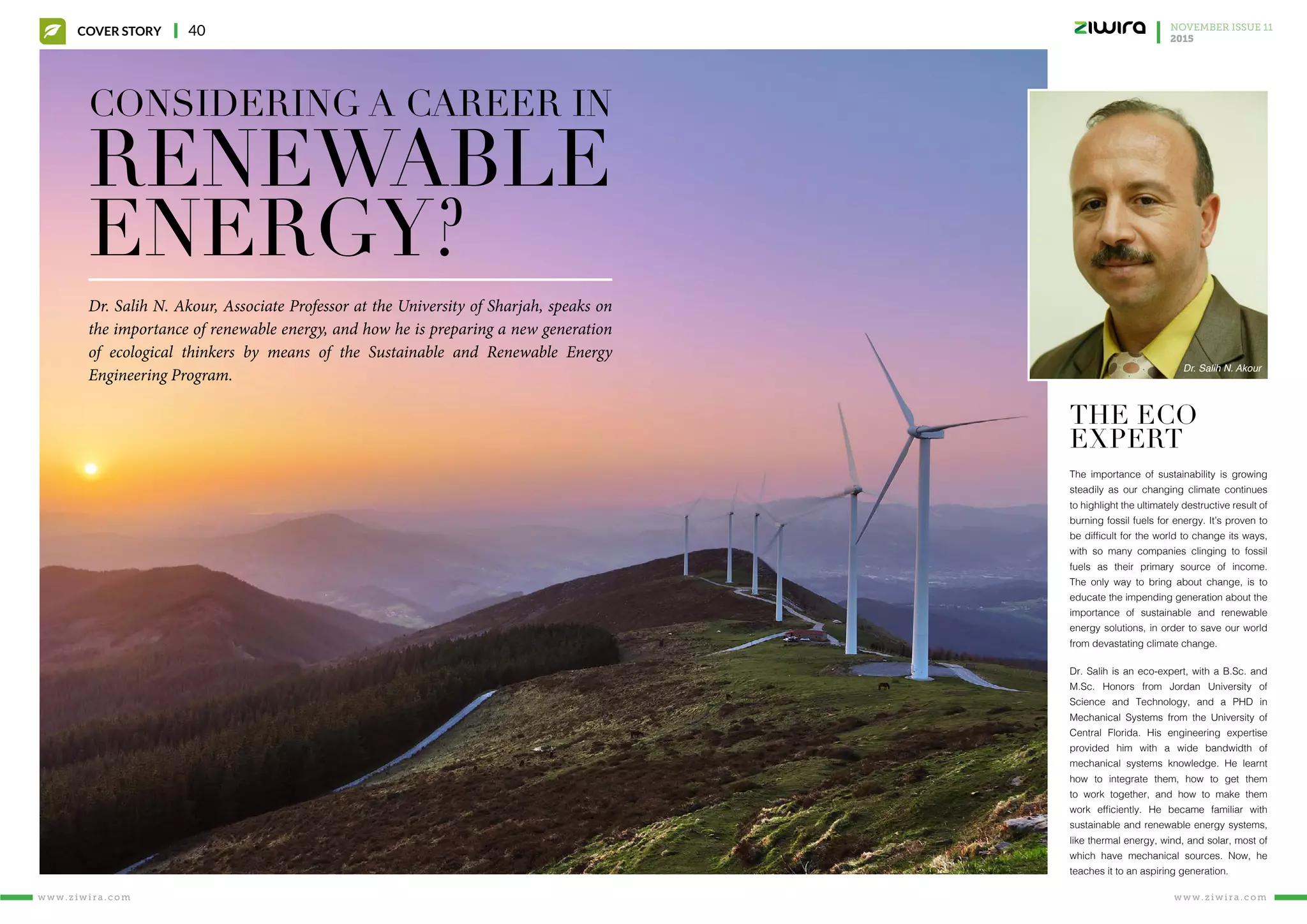
Dr. Salih N. Akour, Associate Professor at the University of Sharjah, speaks on
the importance of renewable energy, and how he is preparing a new generation
of ecological thinkers by means of the Sustainable and Renewable Energy
Engineering Program.
renewable
energy?
The importance of sustainability is growing
steadily as our changing climate continues
to highlight the ultimately destructive result of
burning fossil fuels for energy. It’s proven to
be difficult for the world to change its ways,
with so many companies clinging to fossil
fuels as their primary source of income.
The only way to bring about change, is to
educate the impending generation about the
importance of sustainable and renewable
energy solutions, in order to save our world
from devastating climate change.
Dr. Salih is an eco-expert, with a B.Sc. and
M.Sc. Honors from Jordan University of
Science and Technology, and a PHD in
Mechanical Systems from the University of
Central Florida. His engineering expertise
provided him with a wide bandwidth of
mechanical systems knowledge. He learnt
how to integrate them, how to get them
to work together, and how to make them
work efficiently. He became familiar with
sustainable and renewable energy systems,
like thermal energy, wind, and solar, most of
which have mechanical sources. Now, he
teaches it to an aspiring generation.
The Eco
Expert
Dr. Salih N. Akour
www.ziwira.com www.ziwira.com
november Issue 11
2015
40cover story
Dr. Salih’s involvement in the Sustainability
and Renewable Energy Engineering
Program at the University of Sharjah, was
inspired by what he witnessed within his
home, Jordan, a poor country in terms of
energy. Many countries in the Middle East,
excluding the Gulf region (rich in fossil
fuels), do not have extensive means to
produce enough energy.
Thankfully, natural energy does exist, and
is growing, according to Akour. Wind and
solar are types of energy that are abundant,
and have great potential in the Middle East.
This presents an opportunity to invest in
terms of education and economy in these
sectors. The only improvement that is
needed, which has progressed in countries
in Europe, is generating it. Transportation
will be taken care of by the grid itself.
“Initially, I was part of the Engineering
Faculty, then I moved here to be the first
faculty assigned in the Renewable Energy
Program. I am one of the establishers of the
Program. As far as I know, there are only
five similar programs worldwide.”
Dr. Salih started off with students in their
first year, and has recently graduated his
first group – a tremendous achievement.
Some of his students have been hired by
Masdar Institute for research in renewable
energy, and some of them join the market
in the UAE. Feedback about students from
institutions like Masdar is constructive for
the professor, a means of ensuring that
the skills he is teaching fit the market and
needs of the region.
The program he teaches is unique in the
Middle East. Introduction of the program
will have a profoundly positive effect on the
whole area, especially since the University
of Sharjah attracts students from all over the
Middle East.
Many students who have taken the
Sustainable and Renewable Energy
Engineering Program have developed
brilliant ideas, and participated in many
competitions. During the past year, the
University of Sharjah has had more than
20 teams from the College of Engineering
compete in competitions, and seven of them
have come from the Renewable Energy
Program. They have proven themselves in
the market and educational competitions.
In terms of skills that students can expect
to obtain from taking the course, Dr. Salih
primarily focuses on the main source of
energy that is available in the region: Solar
power, and also wind. In the UAE, wind
isn’t as strong as in other Gulf States, but
if you travel to the likes of Ras-Al-Khaimah
or Fujairah, the heights of the mountainous
ranges are able to produce more wind
energy because of higher altitudes.
“I’m currently working with a group of
students for senior design projects,” says
Salih. “One of them is an air-born-wind-
turbine concept, a flying wind-turbine,
which can capture more wind as it rises
in altitude. As you rise in altitude, the wind
speed increases. For example, if we have
it at a range of three meters per second,
maybe after 100 meters you will have it 5
meters per second, which is the minimum
which you can have a functioning turbine.”
Sustainable
& Renewable
Energy
Program
This presents an opportunity for different regions to use wind
turbines that are being flown by balloons. Inside it will be the wind
turbine, and as it rises, more wind energy can be produced. It
shows how a bit of ingenuity can solve the problem of low-speed
energy, by trying different methods and approaches.
The class takes scientific trips to gather practical knowledge. For
example, in the past, students have gone to the Masdar power-
plant, weather stations around the country, and also electrical
power-plants. As a part of their curriculum, students are also
required to complete a 6-8 week training period where they
spend time working for a company in their respective field.
“We just graduated our first group of students,” says Akour.
“Some of our graduates are seeking opportunities at Masdar,
and some have already received scholarships. There is also a
program at the University of Jordan where some of our students
are applying to.”
Students can also pursue careers at the Municipalities around
the UAE, which according to Akour, are steadily creating
departments specifically for sustainable and renewable energy.
Some of his students have even assisted in the creation of these
new sectors, as they are trained in how to extract energy from
different sources, contribute to green building design, and help
with energy auditing and analysis.
“I encourage sustainable designs in my classes, and projects
that are efficiently designed to last longer, using less energy,
even if it means increasing the initial price of the investment,”
says Salih. “In the long run it will save us resources. We should
not be selfish and look out for the future generations. If you build
a skillful person with a wide bandwidth of thinking, you will find
amazing ideas.”
The Sustainable and Renewable Energy Engineering Program
is one of very few qualifications available to students today
to familiarize with a combination of business practicality and
ecological awareness.
Another qualification that exists in Dubai is the Smart City
Professional Diploma at the Rochester Institute of Technology.
The diploma specializes in developing skills in various areas
of Smart Cities, such as security and safety, transportation,
communication, energy, water and environment, economic
services, infrastructure, and urban planning.
Opportunities to excel in sustainability expertise are certainly
out there, and steadily increasing as climate change awareness
grows, and young people recognize it as an important issue.
The sooner the impending generation adapts to the need for a
sustainable world, the sooner they will be able to stabilize it.
Future Prospects
““If you build a skillful person with
a wide bandwidth of thinking,
you will find amazing ideas.
Dr. Salih N. Akour
Sharjah university
www.ziwira.com www.ziwira.com
november Issue 11
2015
cover story 42

Considering a career in renewable energy?

  • 1.
    Considering a careerin Dr. Salih N. Akour, Associate Professor at the University of Sharjah, speaks on the importance of renewable energy, and how he is preparing a new generation of ecological thinkers by means of the Sustainable and Renewable Energy Engineering Program. renewable energy? The importance of sustainability is growing steadily as our changing climate continues to highlight the ultimately destructive result of burning fossil fuels for energy. It’s proven to be difficult for the world to change its ways, with so many companies clinging to fossil fuels as their primary source of income. The only way to bring about change, is to educate the impending generation about the importance of sustainable and renewable energy solutions, in order to save our world from devastating climate change. Dr. Salih is an eco-expert, with a B.Sc. and M.Sc. Honors from Jordan University of Science and Technology, and a PHD in Mechanical Systems from the University of Central Florida. His engineering expertise provided him with a wide bandwidth of mechanical systems knowledge. He learnt how to integrate them, how to get them to work together, and how to make them work efficiently. He became familiar with sustainable and renewable energy systems, like thermal energy, wind, and solar, most of which have mechanical sources. Now, he teaches it to an aspiring generation. The Eco Expert Dr. Salih N. Akour www.ziwira.com www.ziwira.com november Issue 11 2015 40cover story
  • 2.
    Dr. Salih’s involvementin the Sustainability and Renewable Energy Engineering Program at the University of Sharjah, was inspired by what he witnessed within his home, Jordan, a poor country in terms of energy. Many countries in the Middle East, excluding the Gulf region (rich in fossil fuels), do not have extensive means to produce enough energy. Thankfully, natural energy does exist, and is growing, according to Akour. Wind and solar are types of energy that are abundant, and have great potential in the Middle East. This presents an opportunity to invest in terms of education and economy in these sectors. The only improvement that is needed, which has progressed in countries in Europe, is generating it. Transportation will be taken care of by the grid itself. “Initially, I was part of the Engineering Faculty, then I moved here to be the first faculty assigned in the Renewable Energy Program. I am one of the establishers of the Program. As far as I know, there are only five similar programs worldwide.” Dr. Salih started off with students in their first year, and has recently graduated his first group – a tremendous achievement. Some of his students have been hired by Masdar Institute for research in renewable energy, and some of them join the market in the UAE. Feedback about students from institutions like Masdar is constructive for the professor, a means of ensuring that the skills he is teaching fit the market and needs of the region. The program he teaches is unique in the Middle East. Introduction of the program will have a profoundly positive effect on the whole area, especially since the University of Sharjah attracts students from all over the Middle East. Many students who have taken the Sustainable and Renewable Energy Engineering Program have developed brilliant ideas, and participated in many competitions. During the past year, the University of Sharjah has had more than 20 teams from the College of Engineering compete in competitions, and seven of them have come from the Renewable Energy Program. They have proven themselves in the market and educational competitions. In terms of skills that students can expect to obtain from taking the course, Dr. Salih primarily focuses on the main source of energy that is available in the region: Solar power, and also wind. In the UAE, wind isn’t as strong as in other Gulf States, but if you travel to the likes of Ras-Al-Khaimah or Fujairah, the heights of the mountainous ranges are able to produce more wind energy because of higher altitudes. “I’m currently working with a group of students for senior design projects,” says Salih. “One of them is an air-born-wind- turbine concept, a flying wind-turbine, which can capture more wind as it rises in altitude. As you rise in altitude, the wind speed increases. For example, if we have it at a range of three meters per second, maybe after 100 meters you will have it 5 meters per second, which is the minimum which you can have a functioning turbine.” Sustainable & Renewable Energy Program This presents an opportunity for different regions to use wind turbines that are being flown by balloons. Inside it will be the wind turbine, and as it rises, more wind energy can be produced. It shows how a bit of ingenuity can solve the problem of low-speed energy, by trying different methods and approaches. The class takes scientific trips to gather practical knowledge. For example, in the past, students have gone to the Masdar power- plant, weather stations around the country, and also electrical power-plants. As a part of their curriculum, students are also required to complete a 6-8 week training period where they spend time working for a company in their respective field. “We just graduated our first group of students,” says Akour. “Some of our graduates are seeking opportunities at Masdar, and some have already received scholarships. There is also a program at the University of Jordan where some of our students are applying to.” Students can also pursue careers at the Municipalities around the UAE, which according to Akour, are steadily creating departments specifically for sustainable and renewable energy. Some of his students have even assisted in the creation of these new sectors, as they are trained in how to extract energy from different sources, contribute to green building design, and help with energy auditing and analysis. “I encourage sustainable designs in my classes, and projects that are efficiently designed to last longer, using less energy, even if it means increasing the initial price of the investment,” says Salih. “In the long run it will save us resources. We should not be selfish and look out for the future generations. If you build a skillful person with a wide bandwidth of thinking, you will find amazing ideas.” The Sustainable and Renewable Energy Engineering Program is one of very few qualifications available to students today to familiarize with a combination of business practicality and ecological awareness. Another qualification that exists in Dubai is the Smart City Professional Diploma at the Rochester Institute of Technology. The diploma specializes in developing skills in various areas of Smart Cities, such as security and safety, transportation, communication, energy, water and environment, economic services, infrastructure, and urban planning. Opportunities to excel in sustainability expertise are certainly out there, and steadily increasing as climate change awareness grows, and young people recognize it as an important issue. The sooner the impending generation adapts to the need for a sustainable world, the sooner they will be able to stabilize it. Future Prospects ““If you build a skillful person with a wide bandwidth of thinking, you will find amazing ideas. Dr. Salih N. Akour Sharjah university www.ziwira.com www.ziwira.com november Issue 11 2015 cover story 42