“work with
your head,
mind,& heart.”HEALTH EDUCATOR,
SANTA FE, NEW MEXICO
Youcanusethispagetomarkyourplace.
Founded in 1984, AIDS Action is a national nonprofit organization, based in Washington,
D.C., which conducts educational and advocacy activities in support of sound and effective HIV
policies and funding. AIDS Action addresses the needs of people who are at risk for and
living with HIV infection and the organizations that serve them.
AIDS Action has two components: AIDS Action Foundation [501(c)(3)], which develops
and disseminates educational materials on the latest public policies and programs, the
demographic impact of HIV, and medical research. AIDS Action Council [501(c)(4)] serves
as a national voice for community-based organizations, local health departments and
clinics, service providers, and health educators by advocating for effective legislative and
social policies and programs for HIV prevention, treatment, and care.
.
WORDS USED IN THE UNITED
STATES THAT MEAN OR EXPRESS
AN IDEA OF “CONNECTION”
Uskuq....................Yup’ik (Alaska)
......Gwich’in (Alaska)
Ata.........................Inupiaq (Alaska)
aw naatavi.............Hopi
conectar................Spanish
.................. Mandarin
Connect.................English
.....Navajo
T A B L E O F C O N T E N T S
INTRODUCTION . . . . . . . . . . . . . . . . . . . . . . . . .1
TIMELINE INSERT . . . . . . . . . . . . . . . . . . . . . . . .10
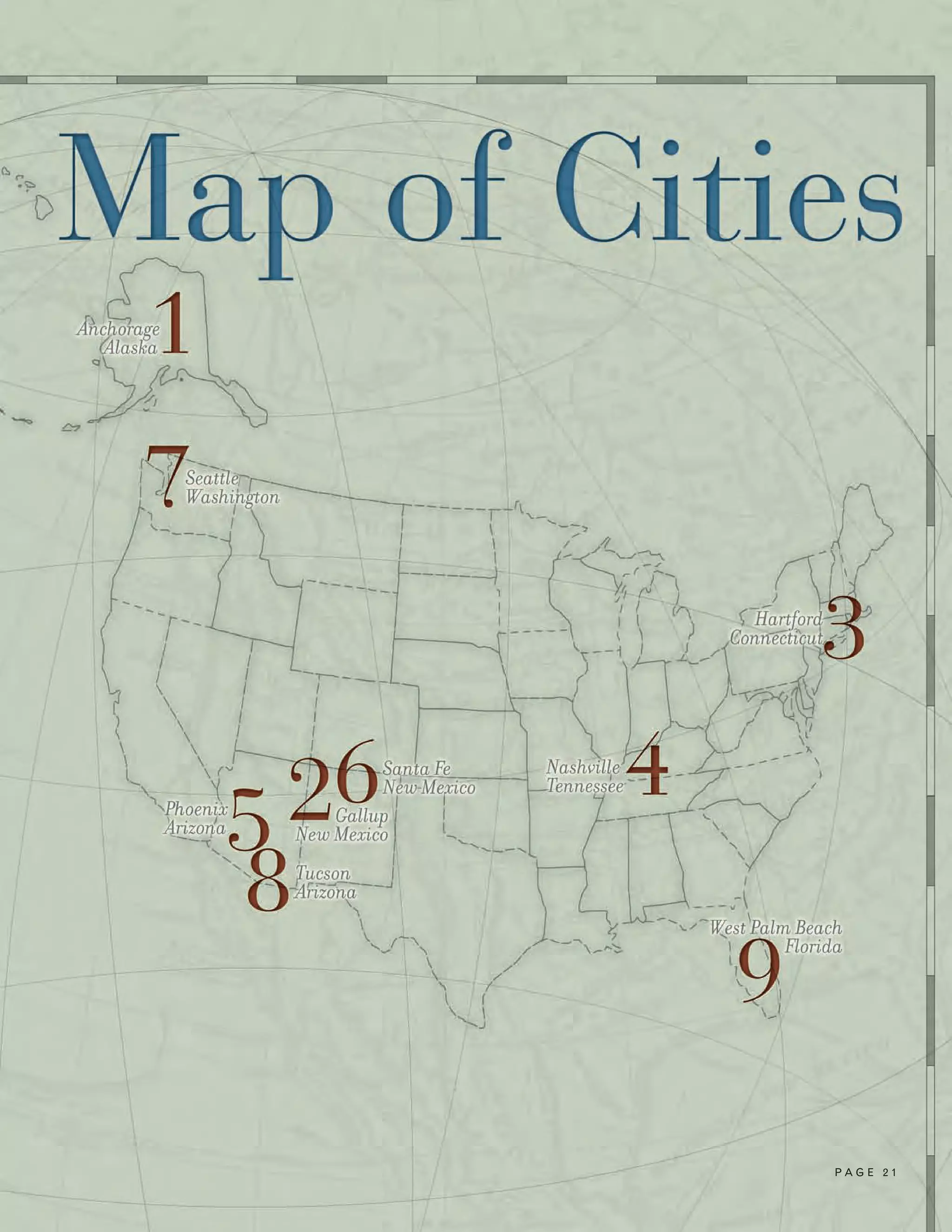
MAP OF CITIES . . . . . . . . . . . . . . . . . . . . . . . . .21
INDEX BY CITIES & ACTIVITIES . . . . . . . . . .23
9 CITIES AT A GLANCE . . . . . . . . . . . . . . . . . .27
17 ACTIVITIES . . . . . . . . . . . . . . . . . . . . . . . . . .49
AGENCY CONTACT LIST . . . . . . . . . . . . . . .154
FEEDBACK FORM . . . . . . . . . . . . . . . . . . . . . .155
ACKNOWLEDGMENTS . . . . . . . . . . . . . . . . .157
ENDNOTES . . . . . . . . . . . . . . . . . . . . . . . . . . . . .158
Spanish version of theWorkbook available at www.aidsaction.org
I N T R O D U C T I O N
T
his workbook is about connecting people to
medical care. It is about outreach workers,
support group facilitators, health educators,
nurses, clinicians, therapists, housing counselors,
hotline operators, and case managers. It is about the
ideas, efforts, attitudes, methodologies, interventions,
and approaches that bring together the knowledge
and technology necessary to keep people healthy. It is
about the activities designed to express the act of caring.
Connecting to health care can mean different things
for different people. For some people it means
survival, or having access to information needed to
make vital decisions; for other people, it means
transportation to an appointment, or having a safe
environment to express fear; and for still others, it
means receiving a laboratory test result in a language
that is understood. Above all, connections to health
care are about people. A connection to care is made
between two people—on one end, there is a person
with a need, and on the other end, there is a person
with the skills to cover that need. Both must have a
conscious desire and ability to connect.
ConnectingT O C A R E
Connect:Tobringorcometogetherinto
somemannerofunion;alooseorexternal
attachmentwithlittleornolossof
identity.(Merriam-Webster)
P A G E 1
U N M E T N E E D :
Individuals who are living with
HIV, are aware of their status, and
are not receiving regular primary
medical care. (HRSA)
17 activities from 9 different cities are described in this workbook. Within the general
descriptions, all of the activities address a central question: How does the activity help
connect HIV+ people that know their status to health care? The workbook’s aim is to
inspire people working in HIV services to explore this question.
The activity descriptions in this workbook are the result of three to four hour
interviews conducted with service providers in nine diverse settings, ranging from
Nashville, Tennessee to Anchorage, Alaska, as a part of a research project on
“unmet need.” The people interviewed did not receive the questionnaire beforehand.
The research team scribed the information during the course of the interview and
much of the content of the activity descriptions came directly from the interview
transcripts. The information about each activity is divided into sections and attempts
wherever possible to maintain the language and flavor of the provider’s responses.
Through a series of questions, the service providers were asked to describe the
activities that help connect HIV+ people who know their status to care, and what
part of the activities could be identified as a key “connecting” element. None of the
service providers had asked themselves those exact questions before. During the
interviews, discoveries were made. On many occasions, elements of a particular
intervention or program were brought into focus for the first time as significant in
connecting people to care. In several interviews, the provider discovered that an
activity which did not have a formal programmatic title was actually playing a key
role in connecting people to care. These “invisible” activities were then given a name
so they could be documented in the workbook.
The questions posed to the service providers about the activity elements that help
connect people to care stimulated thought, discovery, and creation. With this in
mind, the “Connecting to Care” workbook has been designed to be used as a
I N T R O D U C T I O N
P A G E 2
creative tool to help make three principal connections: to connect to the experiences of other service providers; to
connect to the elements in a specific activity that help engage a person in care services; and to connect the lessons
in this workbook to your particular service setting.
“ U N M E T N E E D ” – A N E W PAR AD I G M
HIV service providers are facing an increasing lack of high-level engagement by HIV+ people in need of care. Many
of the reasons for the “lack of engagement” are structural in nature, overreaching the capacity of a single activity
or program to resolve. Therefore, a realistic agenda for this project is to concentrate purposefully on the individual,
group, and community-based activities implemented in HIV service settings that successfully help connect HIV+
people to care. The workbook is an effort to actively and practically address the new definition that the Health
Resources and Services Administration (HRSA) has given to “unmet need” within the context of Ryan White Care
Act legislation. “Unmet need” is defined as “individuals who are living with HIV, are aware of their HIV+ status,
but are not engaged in regular medical care.”
If we understand a person’s relationship with health care services as a “continuum of engagement,” then the commonly
used lexicon of “in care” or “not in care” does not provide us with the vision or depth of thinking to see the dynamic
spectrum of people’s real relationships with the public or private health care systems. The dichotomy of “in” or
“out” of care is far too simple. The lessons learned from the research carried out for this workbook clearly indicate
that many HIV+ individuals have a precarious, inconsistent, unsuccessful, or non-existent relationship with HIV
health care services.
The premise of the new programmatic language of “unmet need,” which is shaping a national effort to bring into
care HIV+ people who know their status and are not in regular medical care, is clear: health care systems are not
meeting the medical and support service needs of people diagnosed with a potentially fatal and transmittable virus.
And further, many people living with this virus are outside the range of the web of services—“invisible” members of
C O N N E C T I N G T O C A R E
P A G E 3
P A G E 4
the community—overlooked by health care client registers. If “unmet need” is becoming a focus for work in HIV,
guided by current and future federal legislation, our common starting point is clear: formulaic approaches and
population-generic programming of services have not and will not reach all of the individuals targeted in this
new definition.
This moment marks the beginning of a turning point which occurs when new questions are asked. This is only a
beginning step in the process; the questions must be made even clearer, louder, and in different languages so
that everyone can hear. It will be the strength of the questions that will help carry all of us—government, science,
community, and the private sector—toward important answers. The questions asked of the service providers
interviewed for this workbook arepartofthenewparadigmorframework:whatactivities/methodologies are helping
to connect HIV+ people to care services and which specific element, quality, orphilosophy of the activity permits
that connection to happen.
R E AD I N G T H E WO R K B O O K
The “Connecting to Care” workbook offers a dynamic reading experience; it is structured so that you can travel in
and out of the different sections, drawing your own picture and creating your own story. No two people will read
the book in the same way. For example, you can begin reading an activity that interests you, go from there to the
text about the city in which the activity occurs, turn to the index to search for another activity that interests you,
read that activity, then scroll down the timeline to look for the history of what you’ve just read. As you move
through the workbook, you may begin to see your own agency’s work reflected in some of the activity descriptions.
You may identify with a characteristic in the description of one of the cities or you may identify past events from
the timeline that have shaped your work.
I N T R O D U C T I O N
P A G E 5
Tohelpyou“connect”to the material that interests you the most, the workbook includes suggested pathways from
one section to another. When you start reading the workbook, you’ll see how it helps you to chart a course.
T H E T I M E L I N E
As the workbook was being developed, it became clear that if we are going to include “unmet need” as a new
definition in the policy and intervention vernacular of HIV to signify changes in how we work, we need to
understand how we arrived at this concept and what historical events paved the road. If we are going to participate
together—public health, public policy and HIV communities—in a shared response, we need to see the events in
history that have defined how we work; how funding is organized; and what we are trying to achieve. For that
reason, a timeline is included in the workbook. The timeline highlights significant events that have shaped our
thinking and our work over the years.
It is useful to picture the historical timeline of HIV in the United States as archeological in nature with layers of
theories, events, statistics, errors, and goals that need to be excavated and studied. The early theories about what
HIV was and how people acquired it were incomplete and riddled with incorrect assumptions. That history is still
with us today, underneath the layers of new information and new assumptions. The way the epidemic was framed
from the very first years is still very much a part of our current language and thinking.
It is important, therefore, to stop for a moment to look squarely at the history of HIV; at the way the language
about HIV has been shaped; at the social and governmental responses to HIV over time; and, with this in mind,
to look squarely at what the epidemic looks like today.
If read carefully, the timeline can be used to chart the historical course of legislation and policy that is steering
the current conversation about “unmet need.” The evolution of federally organized intervention strategies can
be followed, as well as the non-governmental origins of every one of the activities featured in the workbook.
C O N N E C T I N G T O C A R E
P A G E 6
Responding to unmet needs of people who know their HIV+ status but are not in regular medical care will be an
increasingly significant part of our work. Looking at our history, however, it is clear that this has always been a
fundamental part of our work from the very beginning. The first formal interventions, responding to people who
were dying quickly from an unidentified virus, were about helping people receive the support and medical care
they needed. This part of the response to the epidemic has not changed. The timeline is designed to give the
reader a sense of history of the seventeen activities. Their basic methodologies are not new. The origins of all of
the activities can be traced on the timeline to the first services that were developed to respond to the emerging
needs of people living with HIV.
T H E C IT I E S “AT A G L AN C E ”
All of the activities presented in this workbook are nestled within the context of a city or town. The particular
characteristics of the place where a person resides significantly mark the path of their health and their health care
options. The United States’ response to the HIV epidemic is anchored to the statistics of its geographic areas – of
city, state, and country. Most of the epidemiological data are reported within this context. However, there is much
more to know about a city or state than its reported HIV or AIDS case numbers. The beauty, culture, and history
blend with the economics, age, ethnicity, race, and languages of its inhabitants painting a picture of an often
complex reality that composes the identity of a single city. The “At a Glance” section of the workbook offers a
glimpse of each of the cities that house the featured activities. You are invited to use this information to draw your
own picture, as you craft the story between people, place, and care. Perhaps you will identify with a description
of a city that will lead you to read the description of an activity that has made its home there. Or perhaps after
reading about an activity, you will want to sketch a broader picture and place it within the description of a city.
You will probably find yourself creating your own path through the workbook, from a city to an activity and onto
another city again.
I N T R O D U C T I O N
P A G E 7
C O N N E C T I N G T O C A R E
T H E 1 7 AC T I V IT I E S
The activity descriptions are broken down into four main categories:
Description, Logistics, Strengths and Difficulties, and Outcomes.
The first page of each activity begins with a brief description of the activity, followed by a box that includes the
current activity setting and three different statements about how close people get to regular medical care through
the activity. The purpose of these references is to quickly orient the reader about the type of intervention—individual,
group, or community—and the key characteristics of the activity. This information may help you to make an initial
selection of the activities you would like to read about. Once you begin to fully read the activities, they speak
for themselves.
S E L E C T I O N O F WO R K B O O K C O N T E N T
AIDS Action, in collaboration with the HIV/AIDS Bureau (HAB) of the Health Resources and Services Administration
(HRSA), researched interventions and methodologies executed by different types of service providers in nine
different cities within six geographic regions of the United States. The selection of city and agency sites was
done collaboratively with divisional directors of HAB. An effort was made to research the interventions and
methodologies (referred to as ’activities’ in the workbook) from an array of service provider settings: health
departments, AIDS service organizations, housing services, community based organizations, faith based organizations,
clinics, hospitals, and therapeutic communities for substance abuse. The cities were chosen to offer cultural
representation from different parts of the country, as well as reflect diversity of HIV epidemiological and funding
characteristics. The research could have been done in many agencies in many cities across the country, and the
results would have been just as rich. The nine cities and the seventeen activities featured have been selected to
offer a wide-ranging collection of intervention methodologies.
P A G E 8
You will note variations in the number of activities linked to the nine cities. These differences are due to nothing
more than limitations in time and human resources for both AIDS Action and the agencies. Several very good
activities were also not included because of simple limitations of space.
The names of the agencies and individual professionals are purposefully absent from the activity descriptions
in an effort to keep the focus true to the intent of the project. If your agency would like to know more about an
activity, you can consult the list at the end of the workbook which provides you with the contact information for
all the agencies and the activities they implement. In contacting an agency, it is important to remember that several
of the names of the activities used in the workbook were assigned during the interview and used solely for the
purpose of this project. It would be helpful to mention the AIDS Action research project when inquiring about a
particular activity to ensure that you are connected to the correct person within the agency and that he/she fully
understands your request.
B E F O R E YO U B E G I N
The workbook’s objective is to help people working in HIV services to explore the idea of “unmet need,” as
newly defined by HRSA, and to become acquainted with the experiences of agencies implementing activities
that help clients connect to care services. This exploration could lead to new insight about the components of
your existing activities or stimulate the desire to develop new activities in your agency. Even though the workbook
links the activities to a particular type of agency setting and city, it is an interesting exercise to envision how the
activities would work in different types of agency settings and in different city environments.
We should all give ourselves permission to ask questions—of ourselves and of others—and to search for common
answers. Some of the answers might have been right next to us all along, but they now come into the light because
I N T R O D U C T I O N
P A G E 9
the questions we are asking are different than those of the past. What are the qualities that need to be present
in an activity or intervention that will be the key to truly helping a person connect to health care for HIV infection
and stay connected? The activities presented in this workbook will hopefully begin to answer that question.
Every one of the activities has a part that is essential to successfully connecting HIV+ people who were not
in regular care to health care services or to successfully beginning the process about making decisions that
will lead to that connection to care.
As you read this workbook, it is important to keep in mind a truth that all of us have in common: we are
all clients of health care services at one time or another, and we all have an idea of what makes us feel
welcomed into our particular health care system. We all have a notion of what “good health” is and
“bad health” is, and most of us, the readers of this workbook, hold as a fundamental personal value, a
continued state of good health. If we find ourselves ill, we want to be able to connect to care and to benefit
from health care in a way that feels safe and meaningful. Every one of us can understand that need.
Enjoy the workbook, and please take a moment to respond to the feedback form at the back of the book,
so that this can indeed be the beginning of a continued process of looking, seeing, questioning, and
taking action. As we say in Spanish, “a tu salud”—to your good health.
Jenifer L. Johnson
Associate Executive Director
AIDS Action
The Community Research Group report “Sliding Back” July, 2003, prepared for AIDS Action, was used in the development
of key concepts for the introduction text.
C O N N E C T I N G T O C A R E
P A G E 2 1
P A G E 2 3
Cities1. Anchorage, Alaska . . . . . . . . . . . . . . . . . . . . . . . .27
2. Gallup, New Mexico . . . . . . . . . . . . . . . . . . . .29
3. Hartford, Connecticut . . . . . . . . . . . . . . . . . . . . .31
4. Nashville, Tennessee . . . . . . . . . . . . . . . . . . . . . .33
5. Phoenix, Arizona . . . . . . . . . . . . . . . . . . . . . . .35
6. Santa Fe, New Mexico . . . . . . . . . . . . . . . . . . . . .37
7. Seattle, Washington . . . . . . . . . . . . . . . . . . . . .39
8. Tucson, Arizona . . . . . . . . . . . . . . . . . . . . . . . . . .41
9. West Palm Beach, Florida . . . . . . . . . . . . . . . . .43
Activities
1. Adherence Protocol . . . . . . . . . . . . . . . . . . . . . . . . . . .49
2. Inter-Agency Networking . . . . . . . . . . . . . . . . . . . . . .55
3. Support Retreat . . . . . . . . . . . . . . . . . . . . . . . . . . . . . . .61
4. Teen Peer Outreach . . . . . . . . . . . . . . . . . . . . . . . . . . .67
5. Primary Care Liaison . . . . . . . . . . . . . . . . . . . . . . . . . .73
6. Zip Code Mapping . . . . . . . . . . . . . . . . . . . . . . . . . . . .79
7. “Snapshot” Viral Load Testing . . . . . . . . . . . . . . . . . .85
8. Deployed Case Management . . . . . . . . . . . . . . . . . . . .91
9. “Heartline” Hotline . . . . . . . . . . . . . . . . . . . . . . . . . . .97
10. After Care Plan . . . . . . . . . . . . . . . . . . . . . . . . . . . . .103
11. Support Group . . . . . . . . . . . . . . . . . . . . . . . . . . . . .109
12. Early Intervention Nurse . . . . . . . . . . . . . . . . . . . .115
13. WomantoWomanSupport-“ApoyoMujeraMujer” . . .121
14. Financial Advocacy . . . . . . . . . . . . . . . . . . . . . . . . .127
15. Clinicians Reaching Out . . . . . . . . . . . . . . . . . . . . .133
16. Intake Housing Referral – “Link to Care”. . . . . . . . .139
17. HIV Care Coordinator . . . . . . . . . . . . . . . . . . . . . . .145
INDEX BY CITIES & ACTIVITIES
99 C I T I E S A T A G L A N C E
ACTIVITIES - ANCHORAGE, ALASKA
• ADHERENCE PROTOCOL: P. 49
• INTER-AGENCY NETWORKING: P. 55
INDEX BY CITIES AND ACTIVITIES P. 23
State name: LAST FRONTIER
Population: ALASKA- 626,932
ANCHORAGE- 260,283
State Ethnic/Racial composition:
74%WHITE/NON-HISPANIC
3% AFRICAN-AMERICAN
4% HISPANIC/LATINO
14% AMERICAN INDIAN/ALASKAN NATIVE
4% ASIAN
1% NATIVE HAWAIIAN/PACIFIC ISLANDER
State median income: $56,536
Cumulative AIDS Cases: 512i
1
Anchorage has had a rich and varied history, beginning with the
migration of Alaska’s first residents across the Bering Sea
land bridge from Asia more than 30,000 years ago. Today,
Anchorage is home to 41.5% of the state’s residents. In total,
Alaska occupies 570,374 square miles, with approximately one
person per square mile of land.ii
Anchorage alone encompasses
1,955 square miles, making the city roughly the size of the
state of Delaware.iii
In addition to size, one of the most dominant
characteristics of the state of Alaska is its unique natural
beauty.The geography features prominently inAlaska’s visitor
attractions, which consist primarily of outdoor activities such
as fishing, hiking, skiing, glacier watching, and dog sledding.
Alaska has a vital indigenous population. Alaskan natives
belong to one of twenty language and culture groups, and within
those, there are particular village and tribal affiliations.The
Native cultures are: Aleut, Alutiiq, Yup´ik, Siberian Yup´ik,
Inupiat, Athabaskan, Eyak,Tlingit,Tsimshian, and Haida.iv
In terms of HIV and AIDS,
Alaska?s significant size, remo
and rural geography, and sparse
population density are conditio
that have combined to create an
environment in which there are
relatively few reported cases o
HIV/AIDS.The cultural diversity and the geographic
isolation of Alaska play a role in the distinct way HIV is expe-
rienced there. Since Alaska
began reporting HIV and AIDS data, the state has reported a
cumulative total of 512 AIDS cases, with 449 cases among
those who were Alaska residents at time of diagnosis. Of the
512 cases of AIDS and the 205 cases of HIV in Alaska, 446
(62%) were reported as the result of unprotected male to
male sexual contact, sharing of injection drug equipment,
or a combination of both. The state’s three largest cities
(Anchorage, Fairbanks, and Juneau) account for 358 (80%)
of the resident cases.v
Although comparison of these data with
the distribution of population in Alaska shows that Anchorage
has the highest rates of AIDS cases, no region of this state has
remained free of AIDS. Today, 20% of the reported cases are
among Native Alaskans.vi
In Alaska, HIV is one illness among
many that requires creative public health programming to
meet the demands of a place and a people separated from
care by culture, geography, and ways of tradition. P A G E 2 7
AT A GLANCE:
Anchorage
2
ACTIVITIES - GALLUP, NEW MEXICO
• SUPPORT RETREAT: P. 61
INDEX BY CITIES AND ACTIVITIES P. 23
AT A GLANCE:
Gallup
State name: LAND OF ENCHANTMENT
Population: NEW MEXICO- 1,819,046
GALLUP- 20,209
State Ethnic/Racial composition:
44%WHITE/NON-HISPANIC
2% AFRICAN-AMERICAN
43% HISPANIC/LATINO
9% AMERICAN INDIAN/ALASKAN NATIVE
1% ASIAN
1% NATIVE HAWAIIAN/PACIFIC ISLANDER
State median income: $36,019
Cumulative AIDS Cases: 2,963i
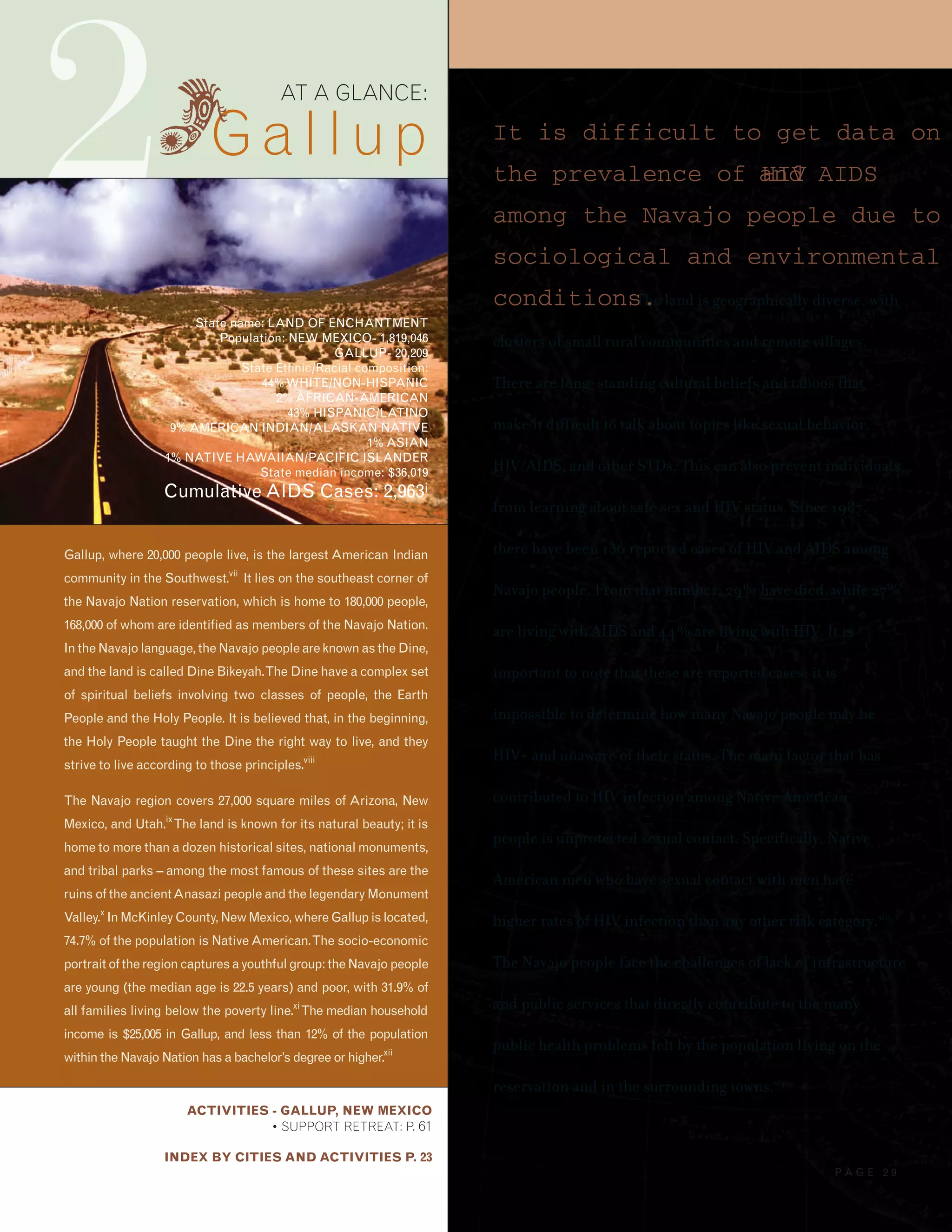
Gallup, where 20,000 people live, is the largest American Indian
community in the Southwest.vii
It lies on the southeast corner of
the Navajo Nation reservation, which is home to 180,000 people,
168,000 of whom are identified as members of the Navajo Nation.
In the Navajo language, the Navajo people are known as the Dine,
and the land is called Dine Bikeyah.The Dine have a complex set
of spiritual beliefs involving two classes of people, the Earth
People and the Holy People. It is believed that, in the beginning,
the Holy People taught the Dine the right way to live, and they
strive to live according to those principles.viii
The Navajo region covers 27,000 square miles of Arizona, New
Mexico, and Utah.ix
The land is known for its natural beauty; it is
home to more than a dozen historical sites, national monuments,
and tribal parks – among the most famous of these sites are the
ruins of the ancientAnasazi people and the legendary Monument
Valley.x
InMcKinleyCounty,NewMexico,whereGallupislocated,
74.7% of the population is NativeAmerican.The socio-economic
portrait of the region captures a youthful group: the Navajo people
are young (the median age is 22.5 years) and poor, with 31.9% of
all families living below the poverty line.xi
The median household
income is $25,005 in Gallup, and less than 12% of the population
within the Navajo Nation has a bachelor’s degree or higher.xii
It is difficult to get data on
the prevalence of HIVand AIDS
among the Navajo people due to
sociological and environmental
conditions.The land is geographically diverse, with
clusters of small rural communities and remote villages.
There are long-standing cultural beliefs and taboos that
make it difficult to talk about topics like sexual behavior,
HIV/AIDS, and other STDs. This can also prevent individuals
from learning about safe sex and HIV status. Since 1987,
there have been 136 reported cases of HIV and AIDS among
Navajo people. From that number, 29% have died, while 27%
are living with AIDS and 44% are living with HIV. It is
important to note that these are reported cases; it is
impossible to determine how many Navajo people may be
HIV+ and unaware of their status. The main factor that has
contributed to HIV infection among Native American
people is unprotected sexual contact. Specifically, Native
American men who have sexual contact with men have
higher rates of HIV infection than any other risk category.xiii
The Navajo people face the challenges of lack of infrastructure
and public services that directly contribute to the many
public health problems felt by the population living on the
reservation and in the surrounding towns.xiv
P A G E 2 9
3
ACTIVITIES - HARTFORD, CONNECTICUT
•TEEN PEER OUTREACH: P. 67
• PRIMARY CARE LIAISON: P. 73
INDEX BY CITIES AND ACTIVITIES P. 23
AT A GLANCE:
Har t f ord
State name: CONSTITUTION STATE
Population: CONNECTICUT- 3,405,565
HARTFORD- 121,578
State Ethnic/Racial composition:
77%WHITE/NON-HISPANIC
9% AFRICAN-AMERICAN
10% HISPANIC/LATINO
3% ASIAN
0.5% AMERICAN INDIAN/ALASKAN NATIVE
0.5% NATIVE HAWAIIAN/PACIFIC ISLANDER
State median income: $56,543
Cumulative AIDS Cases: 12,148i
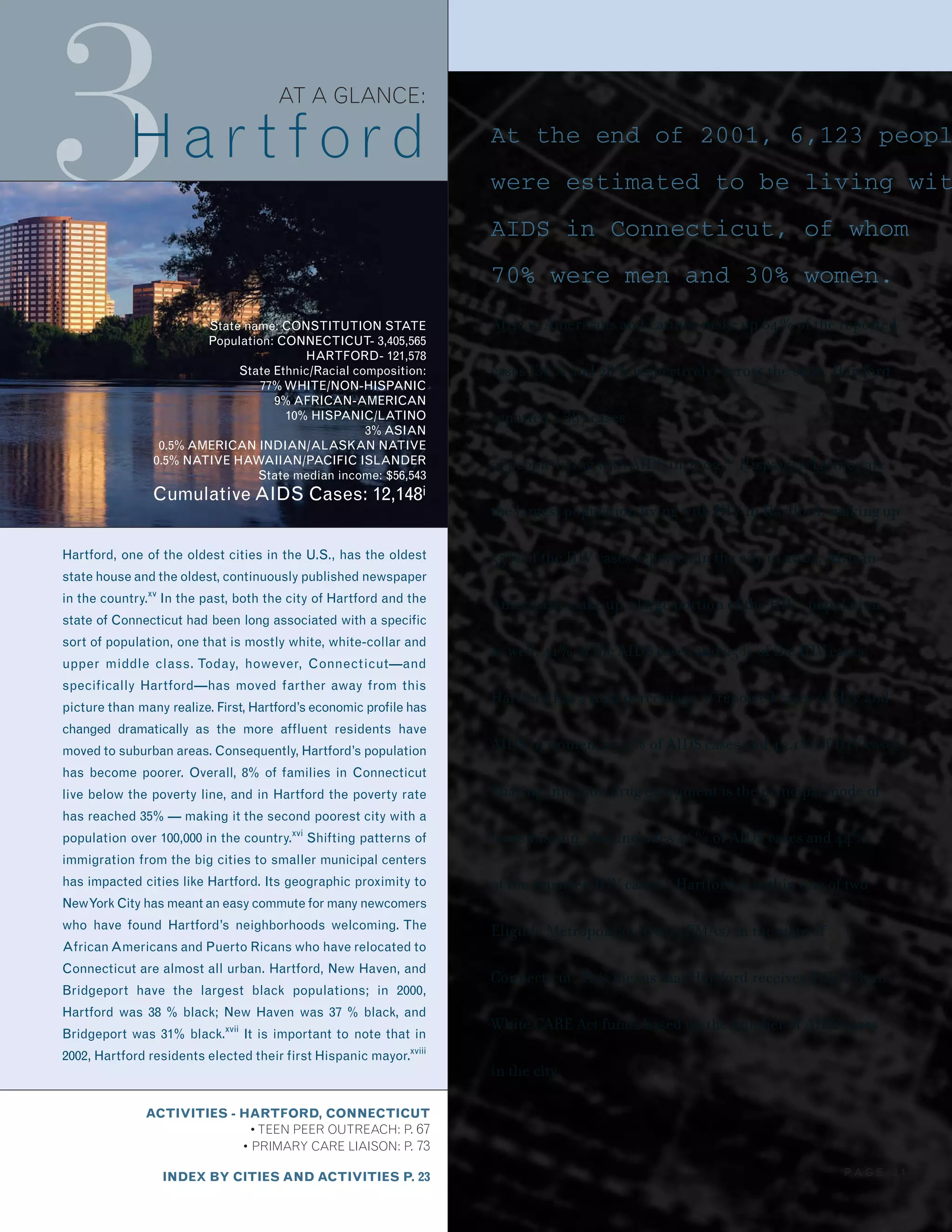
Hartford, one of the oldest cities in the U.S., has the oldest
state house and the oldest, continuously published newspaper
in the country.xv
In the past, both the city of Hartford and the
state of Connecticut had been long associated with a specific
sort of population, one that is mostly white, white-collar and
upper middle class. Today, however, Connecticut—and
specifically Hartford—has moved farther away from this
picture than many realize. First, Hartford’s economic profile has
changed dramatically as the more affluent residents have
moved to suburban areas. Consequently, Hartford’s population
has become poorer. Overall, 8% of families in Connecticut
live below the poverty line, and in Hartford the poverty rate
has reached 35% — making it the second poorest city with a
population over 100,000 in the country.xvi
Shifting patterns of
immigration from the big cities to smaller municipal centers
has impacted cities like Hartford. Its geographic proximity to
NewYork City has meant an easy commute for many newcomers
who have found Hartford’s neighborhoods welcoming. The
AfricanAmericans and Puerto Ricans who have relocated to
Connecticut are almost all urban. Hartford, New Haven, and
Bridgeport have the largest black populations; in 2000,
Hartford was 38 % black; New Haven was 37 % black, and
Bridgeport was 31% black.xvii
It is important to note that in
2002, Hartford residents elected their first Hispanic mayor.xviii
At the end of 2001, 6,123 peopl
were estimated to be living wit
AIDS in Connecticut, of whom
70% were men and 30% women.
African Americans and Latinos make up 64% of the reported
cases (36% and 28% respectively) across the state. Hartford
reported 1,387 cases
of people living with AIDS in 2002.xix
Hispanics/Latinos are
the largest population living with HIV in Hartford, making up
55% of the HIV cases reported in the city in 2002. African
Americans make up a large portion of the HIV+ population
as well; 41% of the AIDS cases and 25% of the HIV cases.
Hartford has a high percentage of reported cases of HIV and
AIDS in women, 25.2% of AIDS cases and 42.1% of HIV cases.
Sharing injection drug equipment is the principal mode of
transmission, that includes 46% of AIDS cases and 44%
of the reported HIV cases.xx
Hartford is within one of two
Eligible Metropolitan Areas (EMAs) in the state of
Connecticut. This means that Hartford receives Title I Ryan
White CARE Act funds based on the number of AIDS cases
in the city.
P A G E 3 1
4
ACTIVITIES - NASHVILLE, TENNESSEE
• ZIP CODE MAPPING: P. 79
• “SNAPSHOT” VIRAL LOADTESTING: P. 85
• DEPLOYED CASE MANAGEMENT: P. 91
• “HEARTLINE” HOTLINE: P. 97
• AFTER CARE PLAN: P. 103
INDEX BY CITIES AND ACTIVITIES P. 23
AT A GLANCE:
Na shville
State name:VOLUNTEER STATE
Population:TENNESSEE- 5,689,283
NASHVILLE- 545,524
State Ethnic/Racial composition:
79%WHITE/NON-HISPANIC
17% AFRICAN-AMERICAN
2% HISPANIC/LATINO
0.5% AMERICAN INDIAN/ALASKAN NATIVE
1% ASIAN
0.5% NATIVE HAWAIIAN/PACIFIC ISLANDER
State median income: $37,821
Cumulative AIDS Cases: 9,166i
Nashville is well known for its Grand Ole Opry, but it has
much more—as approximately ten million visitors and tourists
discover each year.Apart from being the buckle of “The Bible
Belt,” it is known to many as “Music City, USA,” home of the
American country music scene.xxi
Visitors to Nashville enjoy
its Black Heritage tours which offer a rich portrait of African
American life in the mid-South, including black churches,
schools, and historic sites such as Fisk University, Meharry
Medical College (the first medical school in the South for the
education of black physicians), and Fort Negley. Some of the
most famous cultural attractions include the Aaron Douglas
Gallery, named after the most famous African American visual
artist of the Harlem Renaissance: and Hadley Park, the first
public park where African Americans were permitted access.
Nashville was recently rated as one of the 15 best cities for work
and family by Fortunemagazine, and Forbeshas ranked it among
the 25 cities likely to see the country’s highest rate of job growth in
the next five years.xxii
However, despite the area’s prominence as a
cultural and economic capital, 13.5% of families and 27.2% of
children under the age of 18 were living in poverty in Davidson
County in 2001.xxiii
Tennessee has reported more
than 9,100 cases of AIDS since
the beginning of the epidemic.By
the end of 2001, 5,021 people across the state were living with
AIDS.xxiv
In Nashville/Davidson County, there are 2,471 people living
with AIDS, and HIV cases for this area reached nearly 3,400.xxv
The ethnic and racial breakdown of AIDS cases and HIV
show that AIDS cases are 54.7% white; 43.4% African
American; and 1.8% Hispanic/Latino. For reported HIV
cases, 54.8% were among African American men and women;
43.2% among white men and women; and 1.8% among
Hispanic/Latino men and women.xxvi
As a medium-sized
American city, Nashville’s cumulative AIDS case total has
made the city eligible for a relatively new category of federal
assistance: emerging communities. This designation was
added to Title II of the Ryan White CARE Act as part of the
reauthorization of 2000 in order to provide moderate-sized
cities, such as Nashville, with the resources necessary to
respond to their increasing share of the epidemic.
P A G E 3 3
P A G E 3
5
ACTIVITIES - PHOENIX, ARIZONA
• SUPPORT GROUP: P. 109
INDEX BY CITIES AND ACTIVITIES P. 23
AT A GLANCE:
Pho enix
State name: GRAND CANYON STATE
Population: ARIZONA- 5,130,632
PHOENIX- 1,321,045
State Ethnic/Racial composition:
62%WHITE/NON-HISPANIC
3% AFRICAN-AMERICAN
27% HISPANIC/LATINO
2% ASIAN
5% AMERICAN INDIAN/ALASKAN NATIVE
1% NATIVE HAWAIIAN/PACIFIC ISLANDER
State median income: $41,172
Cumulative AIDS Cases: 8,086i
Phoenix is the sixth most populous city in the country.xxvii
Surrounded by the Sonoran desert, Phoenix is famously hot
and sunny with an average annual rainfall of only 7.66 inches.
More than 300,000 part-time residents, “snowbirds,” flock to
the heat during its dry hot winter to enjoy the blue skies and
the sun which shines more than 325 days each year.xxviii
Phoenix is situated at the intersection of several highways
and international airways, which helps make it accessible to the
roughly 12 million visitors who pass through the city annual-
ly.xxix
Rising out of the desert, Phoenix’s vibrant downtown lists
among its hot spots a number of world class museums, gal-
leries, theaters, and restaurants.The city is the center of pro-
fessional sports in the Southwest, with the Arizona Cardinals
(football), the Arizona Diamondbacks (baseball), and is the
spring training center for seven major league baseball teams,
who become resident favorites each year.While tourism plays
a major role in the economic life of the city, high-tech
manufacturing is the region’s top industry.The city’s median
household income is $52,949.xxx
Thirteen percent of the people
living in Arizona were born outside the U.S. and 17% of
the households in Arizona receive public assistance or
non-cash benefits.xxxi
Since 1981, there have been a
total of 8,086 cases of AIDS an
5,320 of HIV reported in Arizon
Seventy-one percent of all AIDS cases have been in the white
population, but recent trends show increasing numbers of
AIDS and HIV cases
within Arizona’s different ethnic and racial communities.
Today, 26% of the households in Arizona speak English as a
second language, and 77% of those individuals speak Spanish
as a first language.xxxii
Prior to 1990, 10% of the AIDS cases
were Hispanic/Latino, while from 1990 to the present, the
percentage rose to 18%, almost a doubling in ten years.
HIV is disproportionately distributed across the state.
Phoenix/Maricopa County has 59% of the state’s population,
70% of the reported AIDS cases (5,459), and 72% of the
reported HIV cases (3,538). Unprotected male to male sexual
contact is the reported category of transmission route for 61%
of the AIDS cases and 49% of the HIV cases. Unprotected
heterosexual contact as a risk factor for HIV accounts for
a small but increasing proportion of Arizona’s cases
(6% of AIDS cases and 8% of HIV cases), particularly
among women.xxxiii
P A G E 3 5
6
ACTIVITIES - SANTA FE, MEXICO
•EARLY INTERVENTION NURSE: P. 115
• WOMANTO WOMAN SUPPORT: P. 121
INDEX BY CITIES AND ACTIVITIES P. 23
AT A GLANCE:
Sant a Fe
State name: LAND OF ENCHANTMENT
Population: NEW MEXICO- 1,819,046
SANTA FE- 62,203
State Ethnic/Racial composition:
44%WHITE/NON-HISPANIC
2% AFRICAN-AMERICAN
43% HISPANIC/LATINO
9% AMERICAN INDIAN/ALASKAN NATIVE
1% ASIAN
1% NATIVE HAWAIIAN/PACIFIC ISLANDER
State median income: $36,019
Cumulative AIDS Cases: 2,963i
Santa Fe is renowned for its world-famous opera, the third
largest art market in the U.S., and the Georgia O’Keefe
Museum, as well as numerous other examples of southwestern
culture, art, and tradition.xxxiv
Named the capital city of “New
Mexico” by Spanish explorers in 1607, Santa Fe has, at various
times, been claimed by the Pueblo peoples, Spain, Mexico
and the Confederacy. In 1846, Mexico ceded the region to the
United States, and in 1912, it officially became New Mexico,
the 47th
state.The geopolitical influences of Hispanic/Latino
and Native American cultures can be seen in the region’s
pueblo-style villages, arts, cuisine, and architecture – including
the distinctive brown adobe buildings that for many have
come to symbolize Santa Fe. Outside the city, visitors are
invited to sample a different kind of historical texture in the
surrounding communities of Taos, Los Alamos, Angelfire,
and Blue Mountain Lake, each rich with life woven of ancient
fabric, spirits, and tales.
Today, Santa Fe’s rich and varied traditions and history live
on in its population. In 2001, the 130,915 people of Santa Fe
County were 49% Hispanic/Latino, 45.5% white, 4.1%
American Indian/Alaska Native, and 0.9%AfricanAmerican,
making the landscape of Santa Fe ethnically textured and the
voices of its people diverse.xxxv
In 2002, 34% of the residents
of New Mexico spoke a language other than English at home.
Of those individuals, 82% spoke Spanish and 18% spoke
some other language; 30% reported not speaking English
“very well.”xxxvi
New Mexico reported 2,963
cumulative cases of AIDS in
2002. There are 1,707 people living with AIDS in New
Mexico, 91% male and 9% female. Santa Fe has reported 532
cumulative cases of people with AIDS, and in 2002, 304 peo-
ple were reported as living with AIDS.xxxvii
Although the major-
ity of
reported cases (53%) have been in whites, the region’s
demographic trends suggest an increase in AIDS case rates
among the emerging ethnic majority: in New Mexico,
37% of the reported cases are Hispanic/Latino, 6% African
American, and 5% Native American. Language and culture
are cornerstones in shaping the comprehensive response
to HIV infection for the populations living in
“the land of enchantment.”
P A G E 3 7
7
ACTIVITIES - SEATTLE, WASHINGTON
• FINANCIAL ADVOCACY: P. 127
INDEX BY CITIES AND ACTIVITIES P. 23
AT A GLANCE:
Se a t t le
State name: EVERGREEN STATE
Population:WASHINGTON- 5,894,121
SEATTLE- 563,374
State Ethnic/Racial composition:
81%WHITE/NON-HISPANIC
3% AFRICAN-AMERICAN
8% HISPANIC/LATINO
1% AMERICAN INDIAN/ALASKAN NATIVE
6% ASIAN
1% NATIVE HAWAIIAN/PACIFIC ISLANDER
State median income: $46,041
Cumulative AIDS Cases: 10,005i
Seattle is home to theAmerican mainland port closest toAsia
and has been known since its beginnings as a major export
and import center. In the twentieth century, Seattle became
known for its high tech industries and it became a leader in
electronics, computer software, aerospace, and biotechnology.
Not surprisingly, the residents of the city are well-educated
(48% of the city’s population has a bachelor’s degree or higher)
and have a median income of $44,453.xxxviii
Culturally, Seattle is
recognized for its coffee, its music, its diversity, and its
progressivepolitics—including gay rights and gay representation.
Additionally, it is recognized as the “Emerald City” because
of its mild climate, which leaves the city green all year round,
and its scenic location between the Cascade and Olympic
mountain ranges along the Puget Sound. According to the
2000 census, the metropolitan population is 70% white, 8%
African American, 13% Asian, 5% Hispanic/Latino, 1%
American Indian/Alaska Native, and 3% other.xxxix
Since the beginning of the AIDS
epidemic, 10,000 men, women
and children living in the stat
Washington have been diagnosed
with AIDS.In 2001, a total of 4,400 people were liv-
ing with AIDS in Washington. The majority of the state’s HIV
and AIDS cases is in Seattle, where 2,975 people are living
with AIDS and another 2,313 individuals are HIV+. What is
distinguishable about AIDS and HIV in Seattle is the reported
demographics. People living with AIDS are 73% white, 15%
black, 9% Hispanic, and are mostly male (92%). People
living with HIV are 74% white, 15% African American, 7%
Hispanic/Latino, and are also predominantly male (89%).
These demographics are reflected in the most commonly
reported exposure categories of those living with HIV and
AIDS: unprotected male to male sexual contact (70% of AIDS
cases and 71% of HIV cases) and unprotected male to male
sexual contact combined with sharing injection drug use
equipment (9% of AIDS cases and 8% of HIV cases). Taken
together, the data suggest that, in Seattle, HIV is greatly
affecting the gay, white, male population.xl
P A G E 3 9
8
ACTIVITIES - TUCSON, ARIZONA
• CLINICIANS REACHING OUT: P. 133
INDEX BY CITIES AND ACTIVITIES P. 23
AT A GLANCE:
Tucs on
State name: GRAND CANYON STATE
Population: ARIZONA- 5,130,,632
TUCSON- 486,699
State Ethnic/Racial composition:
62%WHITE/NON-HISPANIC
3% AFRICAN-AMERICAN
27% HISPANIC/LATINO
5% AMERICAN INDIAN/ALASKAN NATIVE
2% ASIAN
1% NATIVE HAWAIIAN/PACIFIC ISLANDER
State median income: $41,172
Cumulative AIDS Cases: 8,086i
Tucson, best known for the breathtaking natural scenery that
characterizes theAmerican Southwest, enjoys more than 350
sunny and warm days a year — more than any other city in the
U.S. The city sits 2,389 feet above sea level and covers an
expansive 500 square miles. The landscape of Tucson
includes mountain peaks, riverbed valleys, desert vistas, and
deep canyons.The city is surrounded by five mountain ranges
– the Rincons, the Tucsons, the Santa Catalinas, the Santa
Ritas, and the Tortolitas.xli
Mixed among this impressive
scenery is a city with a long and rich history, which includes
a continued close cultural and historical connection to its
southern neighbor, Mexico.xlii
Tucson has a large Hispanic/Latino population, 36.8% of the
city’s residents.Today, 26% of the households inArizona speak
English as a second language, and 77% of those individuals
speak Spanish as a first language.xliii
In 2003, Tucson was
ranked seventh on Hispanic Magazine?sannual list of the top
ten cities for Hispanics—the only city in Arizona to make the
list. It is home to the University of Arizona, renowned for both
its research facilities and its athletics programs, and the Kitt
Peak National Observatory, one of the premier astronomical
research facilities in the world.xlv
In 2001, the city of Tucson
appeared on Entrepreneur magazine’s list of the “Best Cities
for Entrepreneurship.”
Since 1981, there have been
8,086 cases of AIDS and 5,320 o
HIV reported in Arizona.Seventy-one
percent of
all AIDS cases have been in the white population, but recent
trends show increasing numbers of AIDS and HIV cases in
Arizona’s Hispanic/Latino communities. In 2000 and 2001,
25% of the AIDS cases and 18% of the HIV cases in Arizona
were reported among Hispanics/Latinos. HIV/AIDS is also
disproportionately distributed across the state. Tucson/Pima
County has 17% of the state’s population, yet it has 21% of
the reported AIDS cases (1,627) and 20% of the reported
HIV cases (1,010). Twelve percent of the AIDS cases
and 13% of the HIV cases have been linked to sharing
injection drug use equipment. Heterosexual unprotected
sex as a risk factor for HIV accounts for a small but
increasing percentage of Arizona’s cases (6% of AIDS
cases and 8% of HIV cases), particularly among women.xlvi
P A G E 4 1
9
ACTIVITIES - WEST PALM BEACH, FLORIDA
• INTAKE HOUSING REFERRAL: P. 139
• HIV CARE COORDINATOR: P. 145
INDEX BY CITIES AND ACTIVITIES P. 23
State name: SUNSHINE STATE
Population: FLORIDA- 15,982,378
PHOENIX- 82,103
State Ethnic/Racial composition:
64%WHITE/NON-HISPANIC
15% AFRICAN-AMERICAN
18% HISPANIC/LATINO
2% ASIAN
0.5% AMERICAN INDIAN/ALASKAN NATIVE
0.5% NATIVE HAWAIIAN/PACIFIC ISLANDER
State median income: $39,265
Cumulative AIDS Cases: 85,324i
West Palm Beach is home to beautiful beaches, expansive
golf courses, numerous cultural and artistic attractions, and
luxurious neighborhoods with some of the most architecturally
sophisticated private homes and mansions found anywhere in
the United States. A relatively small geographic area, West
Palm Beach has three distinct retail districts, miles of beach,
and almost non-ending stretches of sunny days. For many, the
city represents the best of Florida, an island in paradise. Yet,
West Palm Beach, which lies within Palm Beach County, is
also a place of contradictions. On the one hand, the region is
known for economic prosperity, manifested by beach front
homes and more than 150 golf courses that make it “Florida’s
golf capital.”xlvii
On the other hand, the majority of the region’s
residents are not equally privileged to enjoy these luxuries. In
fact, in 2000, 9.9% of families in Palm Beach County were living
in poverty, and in West Palm Beach the rate was even higher,
with 14.5% of families living below the poverty line.The disparity
between West Palm Beach and the rest of the county can be
seen in other economic and social areas as well. In 2000, the
median household income in West Palm Beach was $36,744,
compared to $45,062 in the county as a whole.xlviii
West Palm
Beach is also racially more diverse than the rest of Palm
Beach County. The 82,103 residents of West Palm Beach are
46% white, 34% African American, 18% Hispanic/Latino, and
2% other races. The 1,131,184 inhabitants of Palm Beach
County are 70.6% white, 13.8% African American, 12.4%
Hispanic/Latino, 1.5% Asian, and 2% other races.xlix
By 2001, the state of Florida h
reported 85,324 cumulative AIDS
cases.l An estimated 8,142 AIDS
cases and 1,881 HIV cases were
reported
in Palm Beach County.At the end of 2001,
an estimated 3,942 people were reported to be living with
AIDS and 2,913 with HIV in Palm Beach County. Non-whites,
especially African Americans, make up the majority of both
the reported HIV and AIDS cases; African Americans make up
66% of the people living with AIDS and 70% of the people
living with HIV.li
Women make up a large portion of both the
HIV and AIDS cases, 34% and 45% respectively, significantly
higher than both the national rate and the overall rate within
the state of Florida.lii
For the 1,359 women living with AIDS in
West Palm Beach, unprotected heterosexual contact was the
primary mode of transmission at 65%. For the 2,583 men
living with AIDS, unprotected male to male sexual
contact was the highest risk category at 38%.
P A G E 4 3
AT A GLANCE:
West Palm Beach
10
INDIVIDUAL ACTIVITY P. _______
GROUP ACTIVITY P. _______
COMMUNITY ACTIVITY P. _______
YOUR CITY PHOTO HERE
ABOUTYOUR CITY...
How are HIV & AIDS affecting
your city and state?
Choose activities from
the workbook that fit
your city/community.
YOUR CITY AT A GLANCE:
P A G E 4 5
171 7 A C T I V I T I E S
P A G E 4 9
The Adherence Protocolis an individual intervention designed to actively engage a person living with HIV
and his or her HIV treatmentspecialistinaclinicalrelationshipbasedonaclientcentered/patient centered
treatmentapproach.ThekeycharacteristicsoftheAdherence Protocolare:thepersonlivingwithHIVmanagesthe
treatmentprocessthroughanoralandwrittenagreement; the clinician and patient learn to work together adhering
to the patient’s treatment choices; and the treatment planning process teaches the patient to be fully in charge
of his or her care and teaches the HIV specialist the true meaning of client-centered/patient-centered care.
Directly links the client to medical care
Gets the client in a conversation about starting medical care
Brings the agency closer to where HIV+ people are so that the conversation can begin
QUICK NOTES:
ADHERENCE PROTOCOL
1
CURRENT ACTIVITY SETTING
Neighborhood Health Clinic. HIV
Program.
I. Description
OBJECTIVES
To improve the adherence to medications, making therapy more successful
To encourage self-management of medications
To foster honest communication between patient and provider
To respect the patient’s choices and decision-making related to their HIV related medical care
TARGET AUDIENCE
Any HIV+ person who is taking or contemplating HIV related medications
HIV+ people from the Hispanic/Latino, African American, Alaska Native, Asian/Pacific Islander, and white communities
HIV+ people with high “mobility” or transient living patterns who move back and forth between “active” to
“inactive” patient status
ACTIVITY DESCRIPTION
An “adherence protocol” is an HIV treatment relationship tool based on honest communication between HIV+ clients and their
health care providers. It can be an important ingredient for establishing the trust necessary in a relationship to help patients
navigate the situations in their lives when faced with the complexity of HIV therapy. Through the use of an adherence protocol,
the patients participate in HIV related medical services at their own pace. The patients feel welcome at the clinic and are able to
reconnect with care even after a lapse in treatment.
A d h e r e n c e P r o t o c o l
P A G E 5 0
The adherence protocol is both oral and written and follows a series of steps:
The clinician meets with the patients and recommends a treatment regimen. Then patients make an appointment with the
case manager for the first steps in the “adherence protocol” process.
The case manager reviews the patient’s case with the clinician to gain a clinical perspective before the patient returns for
the appointment.
The case manager meets with the patient for an intake session. From the very beginning, the case manager, dedicated to
the adherence protocol, clearly affirms that the patients are at the “center of their treatment regimen,” and that the health
care professionals are there to help them make a choice that will positively affect their health.
After a thorough discussion about treatment options, the case manager communicates support for the patient’s decision
even if they do not “agree” with it based on health care criteria.
The case manager gives patients a pre-treatment questionnaire to ascertain their “readiness” to begin therapy. This gives
patients the option to say they are “not ready.” If patients say they are not ready, the case manager encourages patients to
discuss fears or concerns about taking the medications.
When patients are not ready to begin medications, the case manager respects their decision and offers to “revisit the
medication question in the future.” Before finishing the session, the provider offers additional services, including testing
and lab work.
Each patient’s decision is recorded in the electronic medical records system and is flagged for review in 3 months to
continue the conversation with the patient.
If the patients choose to start medications, the case manager provides both oral and written educational material to prepare
the patients for taking them. The pharmacist also spends time explaining the details of treatment when patients
first pick up medications.
The case manager follows up with patients who elect to undergo therapy by telephoning a few days after their scheduled
start date. The case manager inquires after them, asks if they have begun taking the medication, and asks how the first few
days have gone. The case manager may use language like: “what is the ‘real’ situation now that you are at home with the
pills?” Often, the situation of being at home with the medication is more difficult than expected, and the case manager can
offer assistance negotiating treatment and strategizing the practical realities of their care. Questions like: “What would
work for you?” and “Can I call you back to talk about this?” foster respect for patients, who are then more likely to share
frankly the difficulties of integrating their health care needs into their lifestyle.
With patient consent, the case manager repeats the follow-up phone call in a few weeks and again at one month from the
start of treatment, encouraging the patient to call with any questions.
Patients complete an adherence questionnaire every 6 months following the initiation of treatment.
As part of monitoring adherence, the clinic pharmacist reports if patients are not picking up their medications to the
case manager.
If patients miss appointments or drop out of treatment, the case manager calls to ascertain the situation. The case
manager tries to keep in touch with the patients.
If there is a change in medication, the adherence protocol process starts over from the beginning.
PROMOTION OF ACTIVITY
None
“Patients don’t want to disappoint their provider. The challenge is: how do you make it okay to say ‘no’
to an authority figure, or make it okay to say ‘I can’t do this.’” — PROGRAM MANAGER, ANCHORAGE, ALASKA
A d h e r e n c e P r o t o c o l
II. Logistics
STAFF REQUIRED
Two case managers
Quality improvement coordinators (nurse) – to track patient appointments and follow-up time
HIV clinician/primary care doctor
TRAINING & SKILLS
Registered nurse with good communication and listening skills who understands case management
Case manager with HIV counseling skills
PLACE OF ACTIVITY
Primarily in the office or exam room; occasionally at patients’ homes or other off-site locations
FREQUENCY OF ACTIVITY
Every six months or upon change in medications
OUTSIDE CONSULTANTS
None
SUPPORT SERVICES
Taxi vouchers, bus passes, translation service by staff member (Spanish to English)
CONDITIONS NECESSARY FOR IMPLEMENTATION
Discussed within the description
III. Strengths and Difficulties
STRENGTHS
The staff
WEAKNESSES
Lack of racial diversity in the current staff
DIFFICULTIES FOR CLIENTS
Patients do not want to disappoint their provider. The challenge is to make it okay for them to say “no” or “I can’t do this”
to an authority figure.
Often the patients who have been at the clinic longest get more staff time while much less time is spent developing
the relationships with newer patients.
DIFFICULTIES FOR STAFF
Limited time to do home visits
“Someone can still ‘adhere to care’ even if they don’t want to take medications.”— CASE MANAGER, ANCHORAGE, ALASKA
P A G E 5 1A d h e r e n c e P r o t o c o l
P A G E 5 2
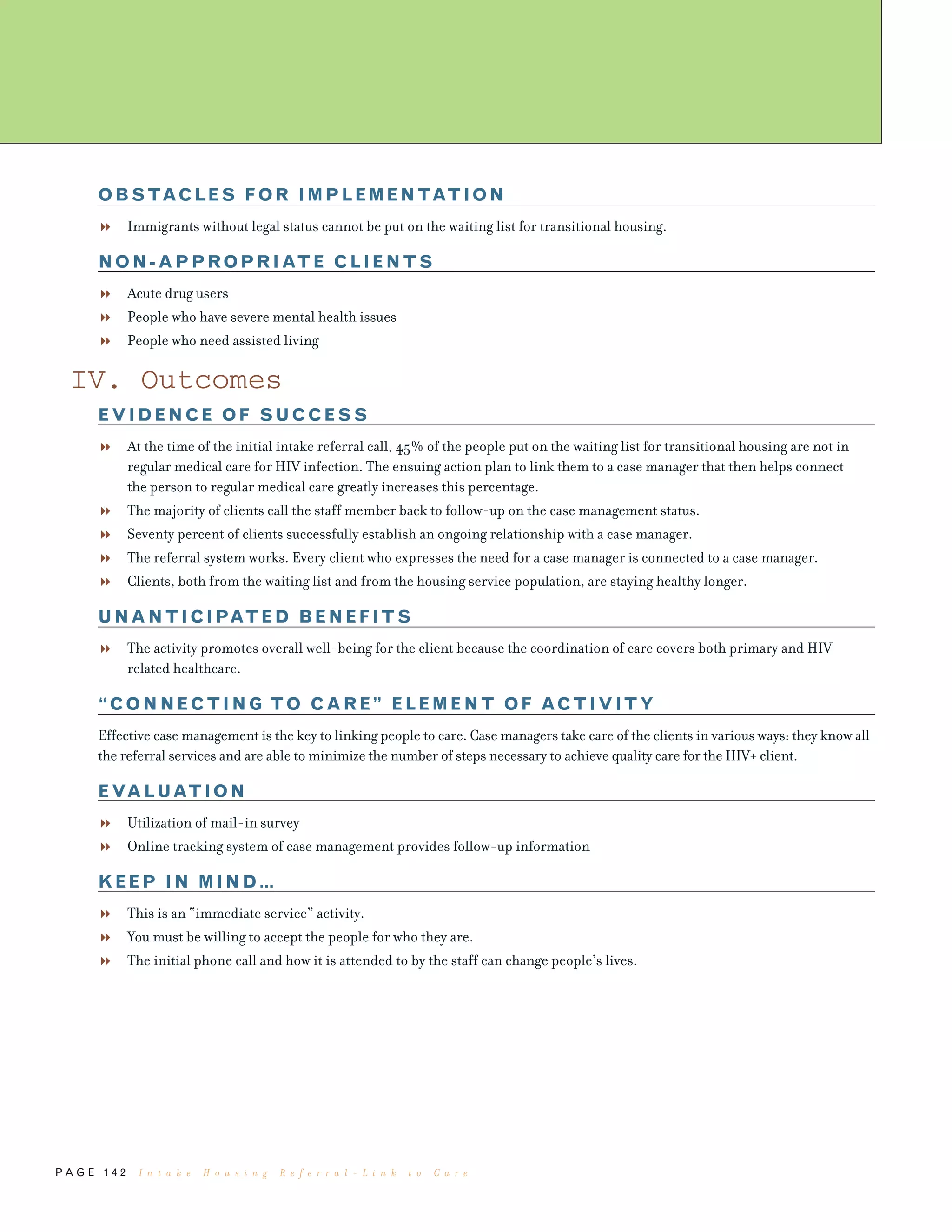
OBSTACLES FOR IMPLEMENTATION
None
NON-APPROPRIATE CLIENTS
None
IV. Outcomes
EVIDENCE OF SUCCESS
The program monitors lab results to evaluate the success of the self-management goals.
The program consults a consumer advisory board for input. Patients rate the adherence protocol program as very good.
Patients do return to the clinic to resume treatment after becoming “inactive.”
UNANTICIPATED BENEFITS
For everyone, staff and clients, the adherence protocol keeps the communication open, both inside the clinic and within
the community.
“CONNECTING TO CARE” ELEMENT OF ACTIVITY
Patients really know they have choices: to engage or not engage, to adhere or not adhere, to come to the clinic and remain in
care or not, to take medications or not.
EVALUATION
Yearly report to HRSA
The activity receives input from consumers
KEEP IN MIND…
Structure the schedule to facilitate more one-on-one interaction.
Pay attention to the fact that the issues around care and adherence extend beyond the therapy itself.
A d h e r e n c e P r o t o c o l
CONNECT TO:
• ANCHORAGE AT A GLANCE: P. 27
• OTHER INDIVIDUAL ACTIVITIES: PP. 85, 97,
103, 115, 121, 127, 139, 145
INDEX BY CITIES AND ACTIVITIES P. 23
Notes page
CONNECT TO:
• ANCHORAGE AT A GLANCE: P. 27
• OTHER INDIVIDUAL ACTIVITIES: PP. 85, 97,
103, 115, 121, 127, 139, 145
INDEX BY CITIES AND ACTIVITIES P. 23
Notes page
P A G E 5 5
Inter-Agency Networkingis a community level intervention designed to establish a community services
“safety net” for people living with HIV who fall through the cracks of HIV medical care and community support
systems. The key characteristics of the Inter-Agency Network are: the exchange of information and the sharing of
community resources between agencies; the informal structure of the network which supports rotating leadership;
the opportunity for key agency personnel to meet and discuss community service options; and the capacity of the
network to serve all persons living with HIV within the service area of the network members.
Directly links the client to medical care
Gets the client in a conversation about starting medical care
Brings the agency closer to where HIV+ people are so that the conversation can begin
QUICK NOTES:
INTER-AGENCY NETWORKING
2
CURRENT ACTIVITY SETTING
AIDS Service Organization. General Program.
I. Description
OBJECTIVES
To facilitate the exchange of information between agencies about client needs and available services
To minimize the frequency of individuals “falling out” of care services by establishing an interagency safety net.
To foster the sharing of community resources among agencies
To nourish the collaboration between agencies and the access to a network of resources within
the community
To generate professional peer support among health service providers
TARGET AUDIENCE
HIV+ females and males, 20 to 45 years of age who know their HIV status and are not in treatment.
People with high risk for HIV exposure, dually diagnosed individuals, substance users, people with unstable housing.
ACTIVITY DESCRIPTION
The inter-agency network is a vehicle by which executive directors can facilitate increased understanding across multiple
agencies about individual agency, client, and community needs. As an informal network, where agencies commit what resources
they can offer, the inter-agency network provides a forum to raise and discuss issues among community agencies and staff.
I n t e r - A g e n c y N e t w o r k i n g
P A G E 5 6
Development and implementation:
Create the basic objective for the network and communicate this to the greater community of agencies. It is important to start
at the executive director level to get their support and agency participation. It is a good idea to begin with providers
who are already a part of the lead agency’s current network.
Identify 5 to 10 key agencies and bring them together to start discussing how the different professionals and programs
within their agencies could meet and interact.
The executive directors who take a leadership role should help facilitate the first meetings with the objective of outlining the
purpose of the network. The group should decide how often the meetings should take place, the times, and the length
of the meetings.
Eachmeetingneedsafacilitator(whoshouldbe selectedforaspecifiedterm-oneyear,forexample)tomanagethemeetings.
The facilitator should help to empower the group by determining what type of information would be useful for the members of
the group. This helps to identify the needs that can be addressed in the meetings.
In the first meeting, each agency briefly describes what it does and what it provides to the community.
At every subsequent meeting, each agency takes turns describing in detail what their agency or program does to inform or
remind attendees about that agency.
The theme selectionandfrequency canbeorganizedaccordingtogroupinformationneeds(e.g.,domesticviolence—
quarterly;substanceabuse—quarterly;healthcareproviders—monthly;RotaryClub —every6months;homeless—quarterly.
In order for the network to be successful, the meetings must balance seriousness with informality. For instance, no
minute-taking or formal agendas. If the format is too formal or bureaucratic then people will not want to do it.
Attendance at a network meeting must not generate homework. Participants should get the feeling that it is a “gathering” and
learning space.
The environment and feel of the group is very important. Cultivate a relaxed, open environment where the group works together
to identify areas for collaboration. The group defines its own purpose and goals and creates the rules for how the group functions.
Establishing a community services safety net should be a purposefully stated objective of the group. This common goal gives
group members a tangible reason to attend the meetings and support the network. The purpose of the network is also to identify
and share information and common experiences. The members of the initial network might have other networks to which they
can link members of the group as well; this opens the door to additional resources. It will take the network time to develop; it’s
important to be patient and let the other agencies have the time they need to learn about HIV and to learn about each other.
PROMOTION OF ACTIVITY
Participants communicate meeting times and places via an internet mailing listserv. Agencies also hear about the network
meetings by word of mouth.
II. Logistics
STAFF REQUIRED
The appropriate staff related to the topic of the meeting. It is important to have all levels of staff at the meetings, not just
executive directors.
TRAINING & SKILLS
The skills required by the staff positions
PLACE OF ACTIVITY
The group decides where the meetings can take place: coffee house, agency office, lunch venues.
“Give the process time to develop. Give the other agencies the time to learn about HIV and each other.”
— PROGRAM COORDINATOR, ANCHORAGE, ALASKA
I n t e r - A g e n c y N e t w o r k i n g
P A G E 5 7
FREQUENCY OF ACTIVITY
The frequency is determined by group
OUTSIDE CONSULTANTS
Bring outside experts who are topic specific to individual meetings
SUPPORT SERVICES
If there are any support services necessary, the group can share in providing those services.
CONDITIONS NECESSARY FOR IMPLEMENTATION
The executive directors of agencies should get together and commit to starting this network. Professionals with
leadership vision must put it together initially.
III. Strengths and Difficulties
STRENGTHS
The shared goal of establishing a community services safety net gives people a tangible reason to attend the meetings and
support the network. People won’t collaborate just for the sake of collaboration.
Creating a relaxed, non-bureaucratic environment keeps people involved without the pressure of “added work.”
Peer support and mentoring: seasoned veterans train and prepare unseasoned staff.
The exchange of information: the network can become a wonderful referral system for all professionals.
WEAKNESSES
The lack of a formal structure can be difficult; the network is dependent on humans collaborating together, which doesn’t always
work smoothly.
DIFFICULTIES FOR CLIENTS
The participating agency’s clients can begin to feel like the networking between service providers breaks confidentiality and
invades their privacy. Clients could begin to feel that all their service providers know too much and put too much pressure on
them to act in a certain way. The clients could feel like there is “no escape” when they want to be left alone to live their life as
they see fit.
DIFFICULTIES FOR STAFF
Professionals have yet another meeting to attend.
The network may involve working with an agency that another agency doesn’t support or disagrees with their mission
and philosophy.
Meetings that are not well facilitated may feel a little loose and chaotic.
OBSTACLES FOR IMPLEMENTATION
Generating support for the network and securing the different agencies’ participation can be an obstacle for the
smooth development of the network.
The hardest part of this network is keeping the promotion of its existence circulating within the service provider community.
I n t e r - A g e n c y N e t w o r k i n g
P A G E 5 8
NON-APPROPRIATE CLIENTS
None
IV. Outcomes
EVIDENCE OF SUCCESS
Filling the cracks in the service community can be seen and felt, and the safety net expansion is noticed by the different
agencies. Clients do not find themselves without the appropriate services as much as they did before the network started.
The clients’ needs are better addressed and access to the clients is increased.
Due to the sharing of resources, materials and information, some agencies can actually begin to save money in their
resource budgets; for some programs there is a general decrease in overhead spending.
Because people are working together there is a more positive attitude within the entire service community.
UNANTICIPATED BENEFITS
The collaboration creates an enjoyable work environment both in the office and in the meeting spaces.
The knowledge of other agency’s portfolios provides informal training opportunities for staff.
The sharing of resources can save overhead costs of some program budgets.
The network can generate grant writing collaborations as well as the possibility of new funding sources.
“CONNECTING TO CARE” ELEMENTS OF ACTIVITY
If a person (client) needing health services falls through the cracks in the service community there will be an agency
or provider in the right place at the right time to help connect them back to services; this is the idea of the safety net.
The more agencies connect to the network, the bigger the net becomes to help connect people to the care they need.
The network is a great referral system; it is very effective in getting the word out about all the available health services
to the target client populations.
EVALUATION
The network meetings are evaluated based on attendance, participation, and feedback from members.
KEEP IN MIND…
It’s not necessary to make the network bureaucratic. The meetings need to be conducted in a professional manner,
but the network should stay informal.
The network should be driven by all levels of staff, not just the executive directors.
The participants of the meetings need to connect with their counterparts in the other agencies: directors to directors,
case managers to case managers, outreach workers to outreach workers, etc.
Turnover in membership is a normal part of the process.
Ask along the way if it is working for each participating agency.
Flexibility and open-mindedness are important attitudes to maintain in the development and implementation of the network.
Not everyone in the service community has to be a member of the network; some people can present topics.
It is important that all participants understand the common goal of the network. It gives people a tangible reason to attend
the meetings. As new members come into the network, repeat the objectives so that people remember the reason for the
group’s existence.
“There are just not enough doctors who understand HIV treatment.”— PROGRAM COORDINATOR, ANCHORAGE, ALASKA
I n t e r - A g e n c y N e t w o r k i n g
CONNECT TO:
• ANCHORAGE AT A GLANCE: P. 27
• OTHER COMMUNITYACTIVITIES: PP. 67, 73,
79, 91, 133
INDEX BY CITIES AND ACTIVITIES P. 23
Notes page
CONNECT TO:
• ANCHORAGE AT A GLANCE: P. 27
• OTHER COMMUNITYACTIVITIES: PP. 67, 73,
79, 91, 133
INDEX BY CITIES AND ACTIVITIES P. 23
Notes page
P A G E 6 1
The Support Retreatis a group level intervention designed for Native American people living with HIV
that aims to establish a safe environment for people to share experiences and learn about living with HIV. The key
characteristics of the Support Retreat are: the opportunity for staff and clients to meet outside of the agency
setting; the creation of peer to peer HIV education which continues after the retreat has ended; the development
of support and healing networks for the participants around common cultural issues; and the ability of the group
to alleviate the isolation experienced from living with HIV.
Directly links the client to medical care
Gets the client in a conversation about starting medical care
Brings the agency closer to where HIV+ people are so that the conversation can begin
QUICK NOTES:
SUPPORT RETREAT
3
CURRENT ACTIVITY SETTING
AIDS Service Organization
Case Management Program
I. Description
OBJECTIVES
To offer a safe space for intensive group learning, sharing, and healing related to HIV infection
To improve the lives of HIV+ people by providing supportive activities
To help establish networks of support, information, and care among HIV+ people
TARGET AUDIENCE
HIV+ Native American and non-Native American men and women and their partners residing on
the Navajo reservation and in surrounding border towns
ACTIVITY DESCRIPTION
The support retreat is an outreach and engagement activity held during a two to four day period, designed to provide opportunities to
learn, rest, and relax in a natural, outdoor or hotel setting. The retreat fosters trust among groups of people living with HIV. It also
builds trust between HIV+ people and the care providers who come in to educate on a particular theme. It is an important vehicle for
reaching and supporting people living with HIV and the local HIV affected community.
S u p p o r t R e t r e a t
P A G E 6 2
Development and implementation:
The support retreat can be hosted in different settings, indoors or outdoors, and throughout different seasons.
Complete the financial and logistical planning as far in advance as possible so that the staff will have time to develop a
rich and useful program, select the facilitators, prepare the staff, invite guest speakers or traditional healers, and
communicate the complete retreat agenda to potential participants.
First steps:
Identify funding sources including tribal, federal, state, and private grants.
Determine the logistics for the retreat: the number of days, the options of camping or hotel accommodations, and the
number of paid facilitators and speakers. Note: clients can help select a location and plan the event. They may provide
a variety of interesting options.
Determine the number of participants. An ideal number of participants is 20-25 people. Since clients often drop out
at the last minute, the staff may plan for fewer people than have actually signed up for the retreat.
If camping is to be the setting for the retreat, obtain all of the gear necessary as soon as possible, since this can take time.
If a hotel is to be the setting, arrange transportation logistics for the participants such as bus rental, private cars,
public transportation, etc.
Plan program material for each day of the retreat.
Example of a four day program -Thursday through Sunday:
DAY 1
Travel time, arrival, and settling in
Prepare and meet for dinner
Organize a “talking circle” to enable participants to meet each other, get acquainted, share feelings, and discuss thoughts
on the support retreat. Allow time for clients to air any fears or concerns.
End of day, down time
DAY 2
Prepare and meet for breakfast (if camping, clients do the cooking)
Hold an icebreaker group activity
Discuss rules and policies, program overview
Introduce the staff, give emergency information
Hear any special needs from the clients
First presentation: medical update from a local HIV doctor
Question and answer session (oral or written)

Prepare and break for lunch
If camping in a natural setting, tour the area
Second presentation: Living with HIV (might also be outdoors in natural setting)

Break for rest and relaxation time
Prepare and meet for dinner outside, if possible (plan a BBQ or picnic, conditions permitting)

Informal gathering: evening chat
End of day, down time
“It takes a whole hour to explain HIV; there is no word for it in Navajo.”— PROGRAM DIRECTOR, GALLUP, NEW MEXICO
S u p p o r t R e t r e a t
P A G E 6 3
DAY 3
Prepare and meet for breakfast
Team building exercise: physical “helping activity,” an important activity for inspiring trust
Discuss the team building activity
Third presentation (possible themes): nutrition, stress, how to tell one’s family about being HIV+ or gay, etc.
Down time and individual meetings with staff
Lunch
Fourth presentation (choose another theme previously selected and presented by an invited speaker from community)
Free time, clients spend time together and get to know each other and the staff
Evening sweatlodge with tribal medicine man or woman
Clients work on their own hobbies such as painting, drawing, sewing, etc.
End of day, down time
DAY 4
Prepare and meet for breakfast
Two-hour closing ceremony
Discuss what clients will take away from this retreat experience
Clients and staff share thoughts and feelings
“Give away” ritual: prepare special gifts for each client. It is a very important and meaningful ritual for participants to
receive something tangible to take home from the retreat.
Provide transportation to participants who need it. Distribute evaluation forms to collect from participants on the last day.
Mail a form to the clients who do not complete and turn one in. Inform the clients by mail of the date and location for the
next retreat.
PROMOTION OF ACTIVITY
Each client receives a letter of invitation from his or her case manager
II. Logistics
STAFF REQUIRED
Executive director or HIV care coordinator to secure funding
Two case managers to organize entire retreat, put the agenda together, get clients to the retreat location
Group support facilitator
TRAINING & SKILLS
Staff training on how to deal with non-cooperative or aggressive clients
PLACE OF ACTIVITY
Holding the retreat outdoors is preferable, but it can be held indoors if it is cold. In the summer when temperatures permit,
camping is a more economical and desirable option. Retreat events can be split between indoor and outdoor activities. If indoors,
make certain that the space will accommodate the needs of the retreat program and function.
FREQUENCY OF ACTIVITY
“Our clients live 2-3 hours apart and many have no income or no transportation, our case
managers have to go and get them. It might take 3 hours, but it’s worth it.”— PROGRAM COORDINATOR, GALLUP, NEW MEXICO
S u p p o r t R e t r e a t
P A G E 6 4
The activity is conducted 2 times a year, in August and December. A four-day retreat takes place from Thursday to Sunday.
If many of the clients are employed, the retreat can take place from Friday evening to Sunday.
OUTSIDE CONSULTANTS
Group facilitator
Native medicine person or healers
Psychologist, nutritionist, and HIV specialists as guest speakers
SUPPORT SERVICES
Transportation (to and from the retreat)
Rented audio equipment (microphone with speakers)
Translation between Navajo and English if necessary (by a staff member)
CONDITIONS NECESSARY FOR IMPLEMENTATION
Caring staff wanting to make a difference
Respect for clients, their partners, and families
Professional mindfulness, i.e., if you don’t feel capable of participating in the retreat, don’t do it.
III. Strengths and Difficulties
STRENGTHS
Camaraderie and friendliness among the clients, and between staff and clients.
The retreat format and environment break the ice for clients giving them the opportunity to open up.
Clients learn more about HIV from the group and speakers; they learn what is available in HIV related healthcare.
WEAKNESSES
No funding to do the activity on a more frequent and consistent basis. This is one of the most effective ways to get people into
care within the Navajo community. Infrequent retreats are not sufficient to bring in everyone who needs care.
DIFFICULTIES FOR CLIENTS
Transportation issues; clients live far away from each other and from the office, the drive from the agency to one client’s
house can take up to three hours. Often there are no paved roads to a client’s house.
Scheduling too many activities can be tiresome for clients if the agenda does not include enough free time.
DIFFICULTIES FOR STAFF
Sometimes heterosexual men feel reluctant to participate fully and share with the group when many gay identified men are
present. In those cases, good group facilitation can pull everyone together, but it is very delicate work requiring sensitivity.
Insufficient funding prevents the agency from doing all parts of the activity.
Transportation issues; staff often must drive several hours to transport a client home from the retreat.
OBSTACLES FOR IMPLEMENTATION
“For the young Navajo population 24 years old and under, HIV infection ‘happens somewhere else.’”— SUPPORT GROUP FACILITATOR, NEW MEXICO
S u p p o r t R e t r e a t
P A G E 6 5
HIV and testing is not a priority for most healthcare workers in the service network of the community.
STD and HIV health educators don’t communicate with each other; meetings are miles away, there is nothing in this area.
NON-APPROPRIATE CLIENTS
None
IV. Outcomes
EVIDENCE OF SUCCESS
After a retreat, clients communicate that they feel revived, rejuvenated, and more trusting.
Clients begin to seek care that they had previously refused because of not trusting the health care system.
Clients begin to use the new or different community health care resources they learned about during the retreat.
UNANTICIPATED BENEFITS
Clients begin to feel that there are providers who really care about their health.
Clients are thankful to the case manager.
The staff feels they can make a difference in the clients’ lives.
The off-site support retreats seem to work better for the Navajo community than on-site support groups.
“CONNECTING TO CARE” ELEMENTS OF ACTIVITY
Clients learn from other clients that confidentiality can be maintained while receiving care.
People identify with the stories told by other people; it helps to deepen the understanding about the importance of
receiving the correct health care for HIV infection.
Word-of-mouth transference of practical information: knowing what others do for their health care expands perceived
options allowing clients to begin to engage or re-engage in care.
EVALUATION
Clients complete an evaluation on the last day of the retreat or have the option of completing it at home and mailing it
to the agency.
If there is no time to do the evaluation during the retreat, it is mailed to each client’s home. In some cases, the case
manager can personally retrieve the evaluation during a home visit.
KEEP IN MIND…
It is vital to find the “right” group facilitator sensitive to cultural issues as well as HIV related health care.
If there is a positive retreat experience at a particular hotel, it’s a good idea to use it again. Clients feel safe in spaces that
are familiar; the agency may be eligible for discounts.
It can be difficult to integrate heterosexual and homosexual clients; skillful facilitation is very important for a smooth retreat.
It is not a good idea to invite people who are completely unknown by the participants (especially people associated with
the government) to the retreat; participants might not feel like it is a confidential and trustworthy space.
During the physical retreat activities, it’s important to move as slow as the slowest person and be aware of people’s
physical limitations.
S u p p o r t R e t r e a t
CONNECT TO:
• GALLUP AT A GLANCE: P. 29
• OTHER GROUP ACTIVITIES: P. 109
INDEX BY CITIES AND ACTIVITIES P. 23
Notes page
P A G E 6 7
Teen Peer Outreach is a community level intervention that seeks to engage young people in providing
outreach services to youth at risk for and living with HIV. The key characteristics of Teen Peer Outreach are: the
recruitment and utilization of young people as outreach workers and mentors to other youth; the age-appropriate
training program designed to educate young people about HIV infection and community services; and the
development of a non-judgmental, youth-centered communication model.
Directly links the client to medical care
Gets the client in a conversation about starting medical care
Brings the agency closer to where HIV+ people are so that the conversation can begin
QUICK NOTES:
TEEN PEER OUTREACH
4
CURRENT ACTIVITY SETTING
Primary Health Association.University
Children?s Medical Center Program
I. Description
OBJECTIVES
To educate the young people of a community about HIV transmission, prevention, and health care services
To offer information to the young people of a community about HIV in a vocabulary and style that they will be
receptive to and understand
To provide health care professionals the perspective and insight from the youth of a community
TARGET AUDIENCE
Young people, 13 to 24 years old, from the populations with the highest incidence of STDs, including HIV
ACTIVITY DESCRIPTION
The teen peer outreach activity educates the youth of a community about HIV and responds to their HIV related health questions
and concerns through a hotline, speaker’s bureau, and outreach program.
T e e n P e e r O u t r e a c h
P A G E 6 8
Development and implementation:
The first step is the identification, selection, and training of capable young people to become peer educators. Each year,
following the same calendar as the school year, 8 to 13 teens participate in the program.
Referrals for program participants come from the schools in the target areas, patients in the HIV related healthcare
system (who often recommended family members), case managers (who see large numbers of HIV infected and
affected clients), and by members of the community who have learned of the program through word of mouth.
The selected teens go through an extensive training process designed specifically for this program. The training session
is based on materials from the Centers for Disease Control and Prevention, agencies specializing in outreach training,
as well as original course curriculum.
The peer educator training teaches basic information about HIV infection, prevention, and care, and provides information
about the different health services in the community. The training also includes sections on sexuality and sexual choice,
as well as discussion on the theme of abstinence.
After the training, the teen peer educators are then eligible to work within the programs’ three main components: a
teen HIV hotline, a youth speaker’s bureau, and general outreach activities. A teen educator can specialize in one of
the program’s components, or participate in all three.
The teen HIV hotline is run by the teen educators during the school year and the summer months. The teen peer
educators answer all of the hotline calls and provide general information to callers about HIV prevention, transmission,
and infection, and offer information about the related local health services that are available. Callers are generally
referred to other service providers for further information and help.
The speaker’s bureau gives teen educators an opportunity to speak about HIV in a number of different venues.
Organizations or events (including conferences, schools, churches, health fairs, service organizations) looking for
someone to speak about HIV can contact the speaker’s bureau, which then refers the requests to the teen educators.
The staff and teens working at the speaker’s bureau decide who will speak at a particular venue and develop the
appropriate message for the event.
General outreach activities are planned and executed by the teen educators under the supervision of one program
staff member. There is no formal outreach schedule. Rather, it is done on an as-needed basis, determined by the teens
themselves. (For example, on National Testing Day, the teens can plan an outreach day in the community where they
will be talking to community members about getting tested, as well as providing general information about HIV.) All
outreach activities target youth in the areas that have been most affected by HIV.
The program activities are structured and supervised by the program staff.
The teen peer educators receive a stipend for their activities: $25 per outreach event and $8 - $9 per hour of work on
the hotline.
The entire group of teen educators meets a minimum of two times a month to discuss current activities, plan for future
events, and participate in ongoing training. In addition, the teens often meet on their own time to do informal outreach
within their community. Although this is not an official part of the program, the participants are encouraged to educate
their peers and their community whenever possible.
Although the program’s primary goal is not specifically to reach people who know their status and are not in care, the teen
educators do encounter such individuals regularly in the course of their outreach work.
In these situations, the teen educators use their training to provide information on the benefits of getting into care and
to assist with linking these individuals to the appropriate health services within the community.
The teen educators’ ultimate goal is always to work with their peers on meeting their needs, and thus to get them into
HIV related care if that is in fact one of their needs.
“One must leave the egos at the door and become part of the team.
You have to blend different talents to satisfy the group.”— PROGRAM MANAGER, HARTFORD, CT
T e e n P e e r O u t r e a c h
P A G E 6 9
PROMOTION OF ACTIVITY
Promotion is through word-of-mouth, traditional promotion through the schools’ publications (especially for the hotline),
and through the agency Web site.
II. Logistics
STAFF REQUIRED
For the training and coordination, there are two staff members who split their time as primary care case managers and
youth outreach specialists.
Other providers or health professionals work with the group as they are needed.
The hotline is staffed by one adult staff member (case manager or youth outreach specialist) who works together with the
teen educators.
TRAINING & SKILLS
The program uses Centers for Disease Control and Prevention, AIDS Alliance for Children, Youth and Families and
National Minority AIDS Council training curricula and also provides customized training for all participants.
PLACE OF ACTIVITY
Meetings and trainings take place at the Medical Center.
The teen HIV hotline is run out of an office of one of the local service providers.
Speaking events can be at local and regional conferences, schools, churches, health fairs, and community and
service organizations.
The outreach is conducted where it’s needed, including outside of the immediate community within the state.
FREQUENCY OF ACTIVITY
There are formal teen educator trainings and supervision meetings two times a month as well as 2 to 3 teen peer educator
group encounters a month.
The hotline is open from 5 to 7 p.m. on weekdays during the school year and from 3 to 5 p.m. in the summer.
The speaking engagements are scheduled on demand.
There is a formal outreach event two times a month.
OUTSIDE CONSULTANTS
Outside consultants are used as training resources
SUPPORT SERVICES
Bus tokens are given for transportation and state vehicles are used for car pooling when necessary.
CONDITIONS NECESSARY FOR IMPLEMENTATION
There has to be a high level of logistical support.
There has to be a youth-relevant meeting space.
It is crucially important to have the right organizational staff with the right blend of skills and personalities.
T e e n P e e r O u t r e a c h
P A G E 7 0
III. Strengths and Difficulties
STRENGTHS
The greatest strength is youth interacting with other youth in a non-judgmental manner, discussing real issues of concern to
this age group. The interaction with the teen educators is a welcoming voice to youth who are questioning or confused. The teen
peer educators develop a good sense of how far to go with people, which is one of the hardest skills to teach.
WEAKNESSES
Some teens start getting involved as educators when they are 16 years-old, and the program can only take up so much of their
time. The fact that they are young and have a lot of competing interests can present a challenge to the consistency of the program.
DIFFICULTIES FOR CLIENTS
This program isn’t the right fit for everybody; sometimes it’s not the right message or the right messenger.
DIFFICULTIES FOR STAFF
The fact that staff members split their professional time as case managers and youth outreach workers might result in a
disproportionate allocation of their time. It is an intense work environment and there can be burnout caused by poor time
management and the demanding nature of the community health work.
OBSTACLES FOR IMPLEMENTATION
There are many potential youth clients who cannot be reached or are unaware of the program despite the community
promotion efforts.
Some organizations still don’t understand or support the interventions through peer outreach and don’t take advantage
of the resources.
NON-APPROPRIATE CLIENTS
The program does not work with a teen educator under 16 years of age. It is inappropriate for children under 13 to
be the target of teen educator interventions.
It can be difficult to integrate HIV+ youth into the program.
IV. Outcomes
EVIDENCE OF SUCCESS
It works because the model can be easily modified to meet the different needs within the community; it is not a rigid model.
The program has multiple providers to call upon and can address various issues as needed.
UNANTICIPATED BENEFITS
Teens get good life-skills training when they become involved in positive mentoring relationships.
The activity creates awareness about general health issues; it helps the target audience explore issues other than HIV.
“It is not the right fit for everybody; it may not be the right message or the right messenger.”— PROGRAM DIRECTOR, HARTFORD, CT
T e e n P e e r O u t r e a c h
P A G E 7 1
“CONNECTING TO CARE” ELEMENTS OF ACTIVITY
The young people of a community receive information about HIV related healthcare for themselves or for other members
of their family in a vocabulary and style that they will be receptive to and understand.
The teen educators, who are from the community where they do the outreach, serve as a bridge of information about the
services for HIV related healthcare in that community for people who are not making a connection to those services.
EVALUATION
The supervisory staff evaluates the type of learning and retention the educators experience and the particular skills that
are developed in each of the teens.
The activity is evaluated by how often the program is contacted to do outreach in the community.
The staff uses a basic outreach tracking form.
KEEP IN MIND…
Don’t underestimate the necessity of comprehensive training and do the training on the teens’ level.
Having the right leadership and support system are important; don’t expect that the teen educators can do everything.
Work to get the right people in the program, it’s not a job that everyone can do.
T e e n P e e r O u t r e a c h
CONNECT TO:
• HARTFORD AT A GLANCE: P. 31
• OTHER COMMUNITY ACTIVITIES: PP. 55, 73,
79, 91, 133
INDEX BY CITIES AND ACTIVITIES P. 23
Notes page
QUICK NOTES:
P A G E 7 3
Primary Care Liaisonis a community level intervention designed to address the problem of clients who
have difficult relationships with the health care system or have “fallen out” of the system. The key characteristics
of the Primary Care Liaison are: the role in the management of difficult relationships with the health care system
on behalf of people living with HIV; the peer, mentoring, and trusting relationship established with the clients;
and the word-of-mouth promotion of the service within the community.
Directly links the client to medical care
Gets the client in a conversation about starting medical care
Brings the agency closer to where HIV+ people are so that the conversation can begin
PRIMARY CARE LIAISON
5
CURRENT ACTIVITY SETTING
City Health Department
Community Health Center
I. Description
OBJECTIVES
To establish a voice within the health care system that advocates on behalf of clients
To connect HIV+ people to HIV related care by helping them locate and utilize the services available to them
To help establish rapport and trust between clients and the health care system
To further engage clients in their own health care
TARGET AUDIENCE
Men and women over the age of 21, with a particular focus on women, African-Americans, and Latino populations
ACTIVITY DESCRIPTION
The primary care liaison role is intended to go beyond the first stage of merely “identifying” a client toactively offering concrete care
options. The care liaison should be someone who is a member of the targeted community, is very familiar with the health service
network, feels comfortable working in the office and in different community gathering places and venues, and health agencies,
and establishes a peer based interaction with the client that is generated from trust, easy communication, and comfort.
P r i m a r y C a r e L i a i s o n
P A G E 7 4
Development and implementation:
The first step in establishing a primary care liaison program is to identify the need within the community.
In order for the primary care liaison to be effective, the agency must first identify the existing gaps in care as well as
which of its clients are falling through these gaps.
Although the primary care liaison works primarily out of one agency, it is advantageous for that agency to establish a
working relationship with other service providers so that the primary care liaison will be able to draw upon the resources
of the entire community as needed for their clients.
After the need is determined and the primary care liaison’s concrete role and responsibilities are defined, a person is
recruited to fill the staff position.
Ideally the primary care liaison is a person who is already familiar with the community and the HIV service network.
However, if this is not possible, the individual should be trained and familiarized with these elements before they begin
their work.
It is important that the clients are able to interact with the primary care liaison as a peer rather than as an “official”
member of the health care establishment.
The primary care liaison begins working at the agency by strategizing how to meet the position’s goals most effectively.
He/she works through an office in the agency and must be readily available to clients on a walk-in, as-needed basis.
The primary care liaison’s principal role within the agency is to find clients who are in danger of dropping out of the
system and help smooth out their difficult relationship with health care services, as well as to identify HIV+ people who
are not in care and help them to begin to access the services they need.
Clients having difficulties with primary care and other services are referred to the primary care liaison for assistance and
are encouraged to refer people they know who may have a precarious relationship with the health care system. Most of the
liaison’s clients will come by word-of-mouth promotion from within the community and referrals by other clients.
Among the different services the primary care liaison can provide for their clients are: helping to connect a client to housing;
connecting a client to a specialized doctor; accompanying clients to appointments with doctors, case managers, and other
providers; and even running small support groups for people who have particular difficulties connecting to different health
care services.
In addition, the primary care liaison engages in outreach activities whenever possible, doing both direct outreach within
the community and formal presentations to schools and community groups. These outreach activities help the primary
care liaison to reach and identify individuals who may know their HIV status but have never accessed care.
If a client drops out of the system, the primary care liaison can use the network of resources to locate the individual and
connect them back to care. If there are needs to address before the client feels ready to re-connect to care, the primary
care liaison addresses those needs.
To be effective, primary care liaisons must establish good connections with organizations and service providers throughout
the community.
Clients from other agencies can be referred to the primary care liaison, and the care liaison can refer their clients to
other agencies as appropriate. This ensures that the client gets the most effective care and not just the care that is most
readily available.
PROMOTION OF ACTIVITY
People find out about the primary care liaison through word of mouth promotion from within the community, referrals from
the home agencies and other agencies, referrals from clients, and from publicity on a public access cable show that features
HIV related programming highlighting local services.
“I am just letting you know that I am here.”— PRIMARY CARE LIAISON, HARTFORD, CT
P r i m a r y C a r e L i a i s o n
P A G E 7 5
II. Logistics
STAFF REQUIRED
Two primary care liaisons
Infectious disease doctor
Case manager
TRAINING & SKILLS
In addition to general knowledge about HIV, the staff person has OraSure rapid test training and TB training.
PLACE OF ACTIVITY
The primary care liaison works out of an office at the clinic. In addition, they do outreach on the street, in shelters, through
home visits, and at drop-in centers.
FREQUENCY OF ACTIVITY
Ongoing
OUTSIDE CONSULTANTS
None
SUPPORT SERVICES
The primary care liaison has access to the support services provided for clients by the clinic, which include access to meals, bus
tokens and cards, medical deliveries, transportation vans, and translation services to Spanish from English.
CONDITIONS NECESSARY FOR IMPLEMENTATION
In order for this activity to be successful there needs to be an existing active HIV service community that is either already
communicating and working together, or is committed to doing so in the future. There also needs to be good supervision
within the liaison’s agency to keep activities focused.
III. Strengths and Difficulties
STRENGTHS
The clients see the staff person as a peer and are therefore more comfortable interacting in an open and honest manner.
The primary care liaison serves as a kind of “mentor” to clients as they work together to identify, understand, and meet the
client’s HIV related healthcare needs.
WEAKNESSES
When the clients view the primary care liaison as a peer rather than a provider, it becomes challenging for the staff member
to maintain professional boundaries with the client.
While the primary care liaison maintains informal relationships with many local service providers and clinics and their
clients, it is not always a smooth connection.
P r i m a r y C a r e L i a i s o n
P A G E 7 6
DIFFICULTIES FOR CLIENTS
Clients sometimes have unrealistic expectation of what the staff will be able to provide for them and want or expect services
that they cannot get.
There are limits to what the liaison can achieve for client’s life situations. Realities of poverty and drug use don’t change
just because a connection to care is established.
DIFFICULTIES FOR STAFF
There is not enough funding to adequately meet all the current needs of clients.
The staff members can get drawn into the internal dynamics of the clinic and find themselves doing things that are not
part of their job.
OBSTACLES FOR IMPLEMENTATION
Administrators may be resistant to bringing in a person from the “community” to work with their clients and the clients
of other organizations.
Issues of territoriality with other agencies may be an obstacle to creating a smooth work environment.
Difficulties with the referral network may prevent clients from getting services.
Other social, economic, and political problems within the general community such as violence and active drug turf wars,
may prevent people from accessing the services of the primary care liaison.
Language barriers prevent the staff from working with certain client populations.
NON-APPROPRIATE CLIENTS
Economically affluent populations; however, the staff will serve anyone who asks for help.
IV. Outcomes
EVIDENCE OF SUCCESS
Clients actively seek out the primary care liaison to help solve problems with health care services.
Clients who had dropped out of the system are re-engaging due to the assistance of the primary care liaison.
Clients come in for care earlier, rather than waiting until they are seriously ill.
Clients have actually turned their lives around with this help, including people who would have died without a timely
and effective intervention.
UNANTICIPATED BENEFITS
Working close to the community with the targeted populations provides a unique and fulfilling personal education for the
staff and gives them a new perspective on HIV related services and care.
“CONNECTING TO CARE” ELEMENTS OF ACTIVITY
P r i m a r y C a r e L i a i s o n
P A G E 7 7
The primary care liaison becomes an active part of the client’s health care plan.
The clients see the care liaison as a peer and feel more comfortable interacting in an open and honest manner about
their real situation, and their real health needs.
The relationship with the care liaison makes it easier to engage or re-engage in care.
Working directly with the community, or as part of the community, enables the primary care liaison to locate individuals
who know their status but are not in care and engage them by addressing their real problems with the healthcare system.
EVALUATION
As part of their job description, the staff is expected to record certain process indicators (examples include: how many
clients are seen and how many times) on a regular basis.
There are regular client-services audits funded by Ryan White entitlements.
The program monitors client charts for eligibility for services, referrals to other programs, and collects relevant
outcome data.
KEEP IN MIND…
Reliable and strong supervision is necessary.
Flexibility is critical, both on the part of the agency and the primary care liaison.
Funding the position with 50% non-Ryan White dollars would allow the staff person greater flexibility in what they can
do for clients.
It is important to collaborate with non-HIV specific agencies as much as possible.
It is helpful to work with other groups within the community who may be concerned about HIV (such as research groups)
on developing ideas and strategies.
P r i m a r y C a r e L i a i s o n
CONNECT TO:
• HARTFORD AT A GLANCE: P. 31
• OTHER COMMUNITY ACTIVITIES: PP. 55, 67,
79, 91, 133
INDEX BY CITIES AND ACTIVITIES P. 23
Notes page
P A G E 7 9
Zip Code Mappingis a community level intervention that utilizes public records and health department
statistical data to create a ‘map’ of HIV hot spots within a specific geographic area. By collecting and mapping
STD, arrest, housing, pregnancy, and school drop-out data, outreach programs are able to estimate needs for
services and identify specific locations for services. The key characteristics of Zip Code Mapping are: the
documentation of needs for services across broad communities and populations; the establishment of
relationships with key community stakeholders; and the ability to target HIV outreach, prevention education,
counseling, testing, and referral services to specific areas where HIV+ people live and gather.
Directly links the client to medical care
Gets the client in a conversation about starting medical care
Brings the agency closer to where HIV+ people are so that the conversation can begin
QUICK NOTES:
ZIP CODE MAPPING
6
CURRENT ACTIVITY SETTING
Nondenominational Community Church. Outreach Center
Prevention services program for HIV+ people
I. Description
OBJECTIVES
To collect and review current census tract data to identify “pockets” of unmet service needs within the community
To identify specific neighborhoods where people living with or at risk for HIV reside and gather
To provide HIV+ people outside of the health care service system with information about HIV related services
and bring them into the community service networks to receive the health care they need
To connect community service providers with HIV+ people who are not in regular HIV related health care
TARGET AUDIENCE
Individuals participating in high-risk behaviors for HIV infection
Families residing in areas with low service provision
Neighborhoods statistically shown to have high rates of HIV infection, such as low-income neighborhoods
ACTIVITY DESCRIPTION
By using zip code mapping, agencies can geographically locate “hot spots” or high risk areas and cross-tabulate STD infection,
HIV infection, AIDS diagnoses, arrest records, and school drop-out rates by demographic characteristics.
Z i p C o d e M a p p i n g
P A G E 8 0
To begin this activity, the outreach staff contacts the local health department and police department in order to collect and
review current data about their identified program area.
The most useful data for strategic planning purposes include specific information about STDs, teenage pregnancy, HIV
infection, school districts with high drop-out rates, drug-related arrests, drug trafficking, and commercial sex. Usually
the epidemiological data is available by specific geographic boundaries, such as neighborhoods, counties, boroughs, or
metropolitan areas.
Additional information is gathered from the local public records office which includes ethnic and racial breakdowns,
income and educational levels, and other demographic information about the residents of the different communities within
the geographical scope of the program. Sometimes a nominal fee is charged for the requested information.
After the data is collected, reviewed, and aggregated, it is integrated into a computer mapping program and plotted on a map
of the agency’s service area by postal zip codes. Each data set is plotted on a separate map and the maps are overlaid to find
the concentrations of at-risk behavior and activity.
This information is reviewed by the outreach staff and program director in order to verify pockets and hot spots within
program service area.
Once the zip code areas are identified and determined appropriate for the outreach staff to include on the map for high
density risk behavior and activity, these areas are acknowledged to have “unmet service needs.”
The staff then looks for locations like public housing, commercial strips, public parks, public transportation thoroughfares,
etc., to determine where it is possible to target services and their “walks.” “Walks” are the paths that the individual outreach
workers take as part of their “outreach” in an attempt to reach as many HIV+ and at-risk individuals as possible.
The targeted area and “walks” are then identified as possible areas for outreach, HIV and risk reduction education, condom
distribution, HIV testing (using rapid HIV tests), and referral to clinical services.
The outreach staff walks the area, making note of “pockets” and “hot spots” on the combined unmet need service area map
in order to determine the accuracy of the mapping strategy.
The outreach staff maintains a record of all interactions with individuals and families encountered during the outreach
walks in order to provide referral and follow-up services.
On-going monitoring of effectiveness and successful service intervention is reviewed during weekly outreach program
staff team meetings and case conferences.
The mapping activity can be used to document and execute specific population-based assessment of recent immigrant,
African American, white, and Latino communities. It can also be used for geographically based assessments such as concentrated
commercial districts, public housing projects, and entire jurisdictions.
The data collection steps, similar to the previous steps, include: collecting the most recent census data by zip codes for the
entire county or densely clustered geographic areas where culturally similar people (e.g. Latinos, gays and lesbians, African
Americans, recent immigrants, parolees, and new arrivals) may live. The specific information can include location,
population density, average household income, educational level, labor market trends, etc.
Next, the project staff collects health information, specifically looking at HIV and STD data for the geographic area or
specific population (from the county health department). The staff also collects arrest rate data (gathered from the local
police office), specifically examining it for drug trafficking, drug possession, drug paraphernalia possession, and drug usage
by zip codes. In some jurisdictions, it is necessary to purchase all of the arrest data and extract the specific drug arrest data.
The staff overlays the detailed zip-code maps containing all of the selected data on the specific population or area to form
a single map. The zip code areas that have high concentrations of STD infection, drug use and arrest, and HIV infection are
then identified as potential target community level service intervention areas.
After the outreach program staff has reviewed the community level data, the program director invites all of the agencies who
work within the targeted geographic area to a meeting to review the map and discuss the community level service needs.
“We target mothers, grandmothers, elder members of the community because of their respected place within
that community, and because they then give the condoms to their kids and grandkids.”— OUTREACH PROGRAM DIRECTOR, NASHVILLE,TENNESSEE
Z i p C o d e M a p p i n g
P A G E 8 1
During this meeting, they identify the sub-areas with high levels of service needs and discuss individual agency strategies
to respond to these needs. The meeting also serves as an update about what services are being offered by the participant
agencies and what areas those services cover.
Participants then identify possible community level strategies (e.g., multi-agency HIV education fair, monthly community
testing day) that can be developed and coordinated together.
Follow-up community level, service intervention meetings are scheduled on a quarterly basis. This is an informal
community level meeting.
Through this activity and the follow-up community level meetings, the areas with the greatest need are put on the social
and health service need map.
Zip code mapping can help an agency and a community “map out” strategies to address unmet needs. Over time, zip code
mapping can be utilized as an evaluation process to determine if the outreach, education, and referral strategies are effective.
PROMOTION OF ACTIVITY
This is an internal planning activity; it is not “promoted” outside of the agency.
When the staff completes the zip code mapping of the area, all local social and health services agencies with the relevant zip
codes are invited to participate in planning for unmet needs.
The outreach team continues to work closely with the chief of police and with the head of each relevant health department
to form relationships and ensure that the data can be obtained in a timely fashion.
II. Logistics
STAFF REQUIRED
Eight staff members required: project director, administrative support person, data and evaluation team.
TRAINING & SKILLS
It is important to have staff with data manipulation skills and a very strong understanding of the local service area. The staff
needs to be comfortable working with public records, have a keen understanding of census tract information, epidemiological
profiles, and surveillance data. It is useful to have prior knowledge of geo-mapping software.
PLACE OF ACTIVITY
The zip code mapping of HIV risk target areas takes place in an office at the agency; however, the data is gathered from the local
health department, local and county records office, and police department.
FREQUENCY OF ACTIVITY
The staff completes a review of this information every six months to update the data and re-evaluate target service areas.
OUTSIDE CONSULTANTS
Health department staff and police force staff liaisons
Local university to provide initial review of methodology
SUPPORT SERVICES
None
Z i p C o d e M a p p i n g
P A G E 8 2
NECESSARY CONDITIONS
The staff must have working relationships with the chief of police, the director of the local health department, and
with community partners to target outreach and other service provider workers.
Staff must be willing to gather the data first hand or find out how to get the data from secondary sources.
Prior experience with handling data sets and geo-mapping software is critical.
III. Strengths and Difficulties
STRENGTHS
Zip code mapping draws an HIV picture of the community.
It also establishes a method to target services and reach those individuals in the community who are generally from
underserved and disenfranchised populations.
The activity serves as an indicator and allows service providers to know where to target and focus their outreach services.
WEAKNESSES
Data can be hard to analyze in a timely fashion. (Data can be outdated quickly, even if it is only a year old.) Sex workers and
drug traffickers can change locations very rapidly based upon arrest activities. Even if the data is analyzed quickly, it may be
too late to reach mobile targets with outreach efforts.
There is a danger of stigmatizing local residents. If people take the data as fact, it can impact populations and residents
unjustly. Staff members have to be careful with this type of analysis and discreet about sharing the data.
There is a risk of missing individuals in need of services because the targeted outreach areas (with zip code mapping)
do not find all areas where HIV affected people live.
DIFFICULTIES FOR CLIENTS
None
DIFFICULTIES FOR STAFF
It is labor intensive to analyze multiple sets of data and compose each map.
The staff has to know local trends, new drugs that are entering into the community, and new sex oriented activities.
The agency cannot rely on data and mapping alone to target services or it will miss other high risk activities.
OBSTACLES FOR IMPLEMENTATION
If there is a lack of current and clean data from the health department or there are difficulties in obtaining confidential or
non-identifying data from the police department, it can stall the whole process.
An agency cannot successfully work alone in isolation; it is important to collaborate. Mapping is only effective if an agency
can see many parts of the picture and fully collaborate with other agencies.
NON-APPROPRIATE CLIENTS
None
“You have to be prepared to serve whoever, whenever, whatever.”— REVEREND, NASHVILLE,TENNESSEE
Z i p C o d e M a p p i n g
P A G E 8 3
IV. Outcomes
EVIDENCE OF SUCCESS
Over the past few years the agency has seen HIV rates decrease in the targeted outreach areas.
The mapping allows outreach staff to direct time and resources to areas most impacted by HIV.
Doing an analysis every six months helps to keep the program staff updated about substance abuse, drug trafficking,
and sex work. This raises the likelihood of having current information about new “hot zones.”
The information gathered draws the HIV picture of a city and can help shape a clearer and more textured picture of
“the real” HIV epidemic.
UNANTICIPATED BENEFITS
This activity provides documentation for grant writing and needs assessments.
It helps to create community rapport between police, health department, substance abuse prevention workers, and
HIV prevention workers.
Zip code mapping is helpful in identifying areas where there is a high concentration of community HIV services.
“CONNECTING TO CARE” ELEMENT OF ACTIVITY
The mapping activities actually “reach” people who are not connected to the health care system and gets closer to them and
to their community. It is the direct human contact that helps people come into care.
EVALUATION
The staff uses timely completion of the data analysis to allow for program planning activities.
KEEP IN MIND…
The Ryan White planning consortia, as well as other service providers and funding sources might be interested in this activity.
If there are areas of the city or specific zip codes with low HIV incidence, there is a potential for confidentiality breaches.
(Local laws sometimes prevent an agency from obtaining data that is under a specific prevalence rate for this exact reason.)
It is important to identify factors that affect HIV transmission. This agency chose drug arrest data and syphilis incidence,
but it could have chosen heroin use or gonorrhea infection for other communities. It is important to select data that affect
HIV transmission in the specific local areas selected.
It is important to be open to using new data sources as new information about the service delivery area appears. No agency
should always rely on the same information because people change their behaviors.
Z i p C o d e M a p p i n g
CONNECT TO:
• NASHVILLE AT A GLANCE: P. 33
• OTHER COMMUNITY ACTIVITIES: PP. 55, 67, 73,
91, 133
INDEX BY CITIES AND ACTIVITIES P. 23
Notes page
P A G E 8 5
“Snapshot” Viral Load Testingis an individual level intervention that permits a person living with HIV to
“get a picture” of his or her HIV status and participate in managing their health through monitoring HIV viral load.
The key characteristics of “Snapshot” Viral Load Testing are: to help make living with HIV a tangible reality; to help
the client “see” the relationship between treatment and health status; and to provide a common
language for both the clinician and client to use when discussing treatment needs.
Directly links the client to medical care
Gets the client in a conversation about starting medical care
Brings the agency closer to where HIV+ people are so that the conversation can begin
QUICK NOTES:
SNAPSHOT VIRAL LOADTESTING
7
CURRENT ACTIVITY SETTING
Health Department. Clinic for the
Homeless. Patient Education Program.
I. Description
OBJECTIVES
To acquire a “snapshot” understanding of where a client is in the progression of their HIV infection
To help a client understand HIV infection and how it affects the body
To help the client set goals and have meaningful objectives for getting into care and treatment using the
viral load test as a concrete marker
To encourage HIV+ homeless individuals to begin HIV medical care
To help the staff make recommendations to the patient about how soon to begin treatment
TARGET AUDIENCE
HIV+ homeless individuals who know their status
ACTIVITY DESCRIPTION
When clients receiving general medical care at the homeless clinic disclose that they are HIV+, they are offered a viral load test
during one of their general medical visits. This test is part of the patient education component of their appointment. The viral
load test result is then used to develop a plan for next steps with the client. This plan may include, but is not limited to, HIV
medical care and services at the client’s request.
“ S n a p s h o t ” V i r a l L o a d T e s t i n g
P A G E 8 6
Patient education and viral load testing:
The HIV+ client and the nurse practitioner have a lengthy discussion about HIV. The client is asked about their treatment
history, if they are currently in medical care for HIV infection, if they have had a viral load test before, if they know what
their general state of health is, and how they are feeling. Transmission routes and prevention strategies are also discussed
throughout the course of the conversation.
Usually the nurse practitioner repeats specific pieces of information several times to emphasize their importance to the client.
The staff person conducting the appointment explains to the patient what viral load testing is and what it means in terms of their
HIV diagnosis. The patient is urged to ask questions and talk about anything they do not understand or would like to know.
If the patient consents to a test, blood is drawn during the current visit and a follow-up visit is scheduled for a week later.
The blood sample is sent to the laboratory and the results are sent back to the clinic; the process takes seven days.
At the follow-up visit the doctor or nurse practitioner goes over the results of the viral load test with the patient and
explains what the numbers mean in terms of HIV infection and progression.
After the explanation of the test results and answering questions from the client, the nurse links the new understanding of HIV
infection and the language of “high viral load” and “low viral load” to the usefulness of medical care to treat HIV infection.
This “new” way of seeing and talking about HIV transforms the infection to something tangible for the client. In many
cases, it becomes easier to set objectives, using the viral load test as a concrete marker, “marking” the goals to better health
that can be measured, and “marking” a new understanding of HIV infection.
The client is often able to incorporate this new way of seeing HIV into their language and health care decisions.
If the patient decides to begin HIV specific medical care, the nurse helps to schedule an appointment at another center
(the homeless clinic does not offer HIV specific medical care). The clinic also offers transportation options for helping
patients get to their outside appointments.
If the patient is undecided about beginning or re-connecting with HIV medical care, the client’s education continues at
every general medical visit he or she has at the clinic.
For the client who has scheduled appointments, a verbal follow-up with the client is done during their visits to the homeless
clinic to make sure that they keep their appointments and that they are receiving HIV specific medical care.
The client continues to receive educational sessions on HIV every time he or she visits the clinic. If the person is receiving
HIV specific medical care from another provider, the clinic staff person encourages the client to keep the clinic staff up to date
the about their total health care process.
PROMOTION OF ACTIVITY
Patients are made aware of this service on an individual basis. The viral load test is offered when the doctor senses that it is
necessary, observes noticeable changes in the patient’s health, or determines the patient has never had this test before.
II. Logistics
STAFF REQUIRED
This test is primarily given by the clinic physician. Follow up is done by either the physician or nurse practitioner.
TRAINING AND SKILLS
The staff person has to know how to generate and nourish easy conversation and feel comfortable talking about a wide range
of health and life issues with the client.
“You have to do the one thing they told you not to do in nursing school - give of self.”— NURSE PRACTITIONER, NASHVILLE,TENNESSEE
“ S n a p s h o t ” V i r a l L o a d T e s t i n g
P A G E 8 7
PLACE OF ACTIVITY
Clinic exam room
FREQUENCY OF ACTIVITY
Due to the costs associated with the activity, the viral load testing is done once for each patient.
OUTSIDE CONSULTANTS
Laboratory work
SUPPORT SERVICES
None
CONDITIONS NECESSARY FOR IMPLEMENTATION
The patient must feel comfortable and trustful of the environment.
There has to be a good rapport between the patient and the doctor or nurse practitioner conducting the education session.
The patient needs to be comfortable with hearing the information provided; he or she must want to be educated.
The staff person needs to be persistent and must keep trying to educate the patient on HIV treatment and the importance of
good medical care.
III. Strengths and Difficulties
STRENGTHS
The test result gives the staff and the patient new information about the health of the patient.
It makes HIV infection more understandable for the patient.
WEAKNESSES
Even if a patient wants to get into care they may not be able to do so if they do not meet certain eligibility requirements.
HIV+ patients who have some sort of support system are more likely to get help and thus get into care. People with no such
support often don’t find their way into a care setting.
People who live alone, have a mental illness, or have no family are the least likely to respond to the education interventions
and are sometimes found very sick or dying on the streets.
DIFFICULTIES FOR CLIENTS
For some clients, seven days is too long to wait for test results.
If a client returns to the primary care provider and finds that it is not the time to begin antiretroviral treatment, the
client could feel “discouraged” and feel like there is no reason to continue going to the appointments, thereby breaking
the connection to the care setting.
If a client seeks medical care in another setting and is treated with less respect than he or she is used to in the homeless
clinic setting, this could jeopardize further connections with that center.
“ S n a p s h o t ” V i r a l L o a d T e s t i n g
P A G E 8 8
DIFFICULTIES FOR STAFF
The length of time it takes to get the test results back.
Lack of patient interest in beginning HIV related healthcare.
In some cases, clients have tried to connect with HIV medical care providers and have not liked the way they have been
treated and have ended the relationship with the provider. This leaves the staff at the homeless clinic without any options
to offer the client.
OBSTACLES FOR IMPLEMENTATION
Lack of funding. Laboratory costs are high.
If a clinic does not provide HIV specific care, giving the viral load test in an environment that cannot offer HIV related
treatment might not be helpful.
Some patients will not consent to HIV specific care until they have reached a certain point of illness or physical debilitation.
NON-APPROPRIATE CLIENTS
None
IV. Outcomes
EVIDENCE OF SUCCESS
Clinic staff believes that 100% of those who opt for viral load testing ultimately return and get their results, if not at their
scheduled follow-up, then at a later time.
Patients go into care more frequently after the viral load testing.
UNANTICIPATED BENEFITS
None
“CONNECTING TO CARE” ELEMENTS OF ACTIVITY
Helps to make HIV infection concrete so that people can really “see” and understand the process.
Clients begin to set goals based on the information learned from the viral load test. Some people start talking about getting
on medication to “get their numbers down.” The test helps transform the meaning of HIV from a hopeless and inevitable
progression towards death to a hopeful state of “longevity.”
EVALUATION
“ S n a p s h o t ” V i r a l L o a d T e s t i n g
P A G E 8 9
There is no formal evaluation of the actual viral load test experience. The staff evaluates the activity based on the reactions
they see and hear through their conversations with the client.
The clients recount their full medical process at each visit to the clinic, and their charts are changed accordingly. If someone
has gotten into care or is taking antiretroviral treatment, it will be noted on their medical chart.
KEEP IN MIND…
Organizations that want to implement this activity should work closely with a laboratory and negotiate the cost of the test.
They should seek an economically viable arrangement, as well as discuss the options for the shortest turnaround time
for the results.
Good patient education requires “giving of one’s self” from the staff. It is sometimes helpful to share a little bit of personal
information with the client to strengthen the human relationship between provider and client.
“If people don’t have anything meaningful in their life, why start HIV treatment?
The act of being loved makes a difference when it comes to seeking out health care.”— NURSE PRACTITIONER, NASHVILLE,TENNESSEE
“ S n a p s h o t ” V i r a l L o a d T e s t i n g
CONNECT TO:
• NASHVILLE AT A GLANCE: P. 33
• OTHER INDIVIDUAL ACTIVITIES: PP. 49, 97, 103,
115, 121, 127, 139, 145
INDEX BY CITIES AND ACTIVITIES P. 23
Notes page
P A G E 9 1
Deployed Case Managementis a community level intervention which aims to provide supportive services
to area organizations in order to address the needs of people with HIV who are currently clients of their programs.
The key characteristics of Deployed Case Management are: the outplacement of case managers to assess and refer
HIV+ people to medical and community services; the use of case management in both rural and urban settings;
and the placement of case managers in non-HIV service agencies in order to cover a wide spectrum of client
and agency needs.
Directly links the client to medical care
Gets the client in a conversation about starting medical care
Brings the agency closer to where HIV+ people are so that the conversation can begin
QUICK NOTES:
DEPLOYED CASE MANAGEMENT
8
CURRENT ACTIVITY SETTING
AIDS Service Organization
Case Management Program
I. Description
OBJECTIVES
To identify HIV+ people who are not in care in rural and urban settings and connect them to services that will
help them live a healthier life with HIV infection
To improve the delivery of services through relationships with other agencies in the greater community.
To increase access to services provided by different agencies in the community
To increase awareness of HIV among the multi-disciplined professionals in the agency network throughout
the community
To decrease HIV related stigma in different agencies and therefore in the community
To create a model that works for external agencies and individuals doing rural community work
To serve both as an outreach and service delivery mechanism
TARGET AUDIENCE
The target population is two-fold: “external agencies” or “host agencies,” and individuals within the community with unmet
service and information needs.
Agencies within the greater community that are not specifically working with HIV+ clients but have HIV+ people accessing their
particular services
Agencies that do not have specific HIV services or staff that can inform and educate clients about HIV infection and the medical
care necessary to address their specific health needs
D e p l o y e d C a s e M a n a g e m e n t
P A G E 9 2
HIV+ clients of “external agencies” in urban settings or rural settings
People who are aware of their HIV status and those who are not aware of their HIV+ status
ACTIVITY DESCRIPTION
The deployed case management program outstations case managers who target those persons living with HIV who have been
linked to care in the past and are no longer in care and those who have never been linked to any type of primary medical care
for HIV infection. The project started as a rural initiative and then was adapted to include other groups who might have
unmet needs.
The staff begins the process by internally identifying the settings (rural communities and agencies within urban jurisdiction)
where there is a need to do more outreach and service delivery. Geographic locations and HIV+ populations are two
variables that are calculated in the needs assessment.
A list of agencies or rural areas that may have populations of persons with unmet HIV needs is generated (examples
include, VA Health Departments, Housing Authority, and local medical clinics and non-HIV health related organizations).
The staff then looks at their own resources to determine what the home agency can offer and what it might need to acquire.
After the internal assessment, the program’s staff begins the outreach intervention by making contact with staff at the
agencies they’ve identified. This outreach may include education about HIV. They find out who the gatekeepers are in
these locations and establish relationships with them.
Then, through talking with the determined agencies, a second level of needs assessment is executed to determine the exact
characteristics of the unmet needs in that setting.
After this, negotiations with the agency representatives begin to define the ongoing contact that will be established, as well
as the logistics of the deployment of case managers to meet the HIV information and support needs identified in their
agency setting. The services offered by the home agency are promoted as an intervention that will make the agency’s
lives easier.
If the external agency is interested in “housing” the home agency’s case manager, the terms of the relationship are established:
office space, the days the service is offered, how home service is going to be set up, etc. The case managers begin to
provide services. The services offered vary depending on the external agency.
The establishment of client contact varies by agency; the most common methods are by disseminating cards that promote
the service or by direct referral.
When the case manager begins their “deployment” at the agency, the first step is to provide an in-service training session
to the staff about what services will be offered.
The case manager is introduced to all agency case managers or client services staff and together they develop a mechanism
to access the clients.
The home agency’s case manager can offer immediate attention to a client with medical or support needs related to HIV;
how often and where they meet depends on the client. For clients who live in rural settings, it is common to meet in the
clients’ homes.
The case manager tries to connect the new client to the wider HIV related healthcare or medical care network.
After the initial contact with the client, the case manager maintains communication on an as-needed basis.
There is an ongoing maintenance of the relationship with the host agency that is hosting the deployed case management activity.
“You have to have time to do an activity, creativity to brainstorm, and space to think –in order to do it well.”— PROGRAM DIRECTOR, NASHVILLE,TENNESSEE
D e p l o y e d C a s e M a n a g e m e n t
P A G E 9 3
PROMOTION OF ACTIVITY
FOR HOST AGENCIES
The deployed case management is promoted through individual initial outreach initiatives executed by staff of the home agency
and is marketed as a model of cooperative intervention that will “make their lives easier”:
It enables the host agencies to offer HIV case management without increasing their budget, without new infrastructure,
within their existing system.
The host agencies can offer more services to their clients, they can cover more needs of their clients, and they can become
more active in a larger network of service providers in their community by sharing resources.
The host agencies can become more educated about HIV.
FOR THE CLIENTS
The service is promoted through the host agency’s existing promotion and communication systems: word of mouth,
brochures, and newsletters.
The service can be promoted through the informational materials produced by the home agency.
II. Logistics
STAFF REQUIRED
Director of case management is responsible for coordination and supervision.
Sixteen case managers with a clinical and social services background are needed.
Volunteers work with case managers to deliver services and support the staff.
Other client services staff offer support as needed.
Prevention education staff is available for training and education as needed.
TRAINING & SKILLS
Case managers must have a clinical or social services background.
PLACE OF ACTIVITY
Host service agencies, usually in a private office space
Private homes in rural settings
FREQUENCY OF ACTIVITY
The frequency of the activity depends on the negotiation with the host agency. It can be anywhere from once a week to an “on
call” basis. The deployed case manager is usually on site at the host agency four days during the work week and on site at the
home agency one day per week.
OUTSIDE CONSULTANTS
None
D e p l o y e d C a s e M a n a g e m e n t
P A G E 9 4
SUPPORT SERVICES
The necessary support services are part of the objectives of the activity: to link the client to the necessary services he
or she needs. Therefore, if someone needs transportation or child care, they can be linked to these services by the
deployed case manager.
In a rural setting, transportation to medical and support care services for the client is often provided by the case manager.
CONDITIONS NECESSARY FOR IMPLEMENTATION
Home agencies must accept that they cannot wait for clients to come to their offices; they must strategize to find new and
innovative programs to go where the potential clients are and bring them into care.
The host agency must have a desire to help people beyond their capacity.
The participating case managers need to be experienced, independent, and intuitive professionals who are comfortable
working with different client profiles.
III. Strengths and Difficulties
STRENGTHS
The activity is centered on the client.
It offers “relief” to the host organization.
It allows a home agency to expand it’s circumference of intervention.
The model lends itself to adaptation.
WEAKNESSES
The activity is very time intensive.
It can be “distance intensive” for the rural case managers.
It is difficult to supervise and manage from an organizational standpoint. For example, one case manager working in a
rural setting sees 20 clients in one month and travels a total of 1,500 miles to connect with these clients.
DIFFICULTIES FOR CLIENTS
In the rural framework, the clients may feel that there is an “invasive” quality to the case management because the staff
member goes into their homes.
DIFFICULTIES FOR STAFF
The time and distance involved in traveling. Often, the rural case managers can only see two people in an 8 hour day since
it could take 3 hours to get from one client to another.
Logistical difficulties in the supervision of staff
OBSTACLES FOR IMPLEMENTATION
Turnover of the staff at the host agencies means that the home agency staff may have to repeat the entire initial process
to maintain an existing relationship.
HIV may not be an important focus or issue at the hosting agencies.
The host agencies may not have the space and time to work with you, even if they want to.
D e p l o y e d C a s e M a n a g e m e n t
P A G E 9 5
NON-APPROPRIATE CLIENTS
There are still agencies that stigmatize people who are HIV+. They do not want to acknowledge that someone who is
HIV+ is or could be accessing their services.
Some agencies and organizations from the faith community have been slow in accepting HIV education.
IV. Outcomes
EVIDENCE OF SUCCESS
The agency connects a person to a volunteer who accompanies them to a medical clinic and therefore connects them to
HIV related healthcare. Case managers often solicit volunteers to drive clients to their doctors’ appointments.
Case managers keep records on the clients who have accessed new health care services.
The number of people being served increases.
UNANTICIPATED BENEFITS
There is a “spillover effect.” The clients and case managers become linked with other community institutions, changing
the way the community works and thinks about HIV.
New locations for the delivery of services are generated, stimulating indigenous service development.
The home agency staff can find out about grant opportunities that are not HIV related by being in other service
provider environments.
Support groups have been formed at local churches in both the rural and urban communities.
“CONNECTING TO CARE” ELEMENTS OF ACTIVITY
Clients don’t have to change from their “familiar” organizations to receive HIV support and health care connection services.
A client does not have to be identified as receiving HIV services in an HIV service organization; they can receive services
and information within a familiar and safe environment.
EVALUATION
Outcome evaluation is based on the goals within the clients’ care plan.
Quantitative evaluation is based on the number of referrals to the home agency, hospitals, or clinics completed by the
clients from the host agencies.
In the rural settings, the case manager often takes the client to receive care or organizes transportation and can therefore
closely follow the health outcomes of the intervention efforts.
KEEP IN MIND…
Implementing this service makes sense; it is not that difficult.
It is particularly useful in places where transportation is a challenge due to a lack of public transportation infrastructure.
Funding is an issue; there is specific funding available for rural case management through Title II, so agencies should
look for it.
The case managers should live in the area where the rural outreach is conducted.
“The staff needs to be seasoned, independent, and not hung up on power and images.”— CASE MANAGER, NASHVILLE,TENNESSEE
D e p l o y e d C a s e M a n a g e m e n t
CONNECT TO:
• NASHVILLE AT A GLANCE: P. 33
• OTHER COMMUNITY ACTIVITIES: PP. 55, 67, 73
79, 133
INDEX BY CITIES AND ACTIVITIES P. 23
Notes page
P A G E 9 7
“Heartline” Hotlineis an individual level intervention established to provide easy access to information
about HIV and medical and community support services. The key characteristics of the “Heartline” Hotline are: it
provides an anonymous caller with confidential information about HIV infection and care services; it allows a caller
the opportunity to have frank and honest conversations about HIV and risk situations; it offers immediate assistance
to callers living with HIV in crisis situations; and it helps the caller develop next steps and action plans.
Directly links the client to medical care
Gets the client in a conversation about starting medical care
Brings the agency closer to where HIV+ people are so that the conversation can begin
QUICK NOTES:
HEARTLINE HOTLINE
9
CURRENT ACTIVITY SETTING
AIDS Service Organization
Case Management
I. Description
OBJECTIVES
To link people to HIV support and care services, solve problems for active clients of the agency, and connect
HIV+ people to health care
To respond to the identified needs during the hotline telephone call with a concrete plan of action by the
end of the conversation
TARGET AUDIENCE
The general population, specifically targeting HIV+ individuals and family members, caregivers, other service
providers, and populations who are statistically at risk for HIV infection
ACTIVITY DESCRIPTION
The hotline is intended to “open the door” for people who are looking for information about HIV and related health and support
services but are hesitant or unable to access this information more directly.
H e a r t l i n e H o t l i n e
P A G E 9 8
The hotline logistics:
The first step in establishing a hotline is to set-up the necessary logistics for its operation. A space should be identified for
receiving hotline calls. Since the nature of the service requires confidentiality, the hotline should be run from a space that
ensures privacy.
The hotline should be run out of a room at the main office of the organization whose exclusive function should be to house
the hotline service.
The organization must then determine how callers reach the hotline and who responds to calls.
A local or toll-free number should be used since callers are unlikely to pay for this service.
It is important to arrange to have more than one operator per shift (2 to 3 people is ideal) available to answer calls and more
than one line available. This allows the service to respond to multiple calls and not lose a client because of a long waiting period.
A possible schedule for a hotline is twelve hours a day (e.g. 8:00 a.m. – 8:00 p.m.) but the hotline can operate 24 hours a day.
When a caller reaches the hotline during its “live” time period, the call is answered by staff members or volunteers working
4-hour shifts.
When a caller reaches the hotline after-hours they are connected to a voice mail system which instructs them to leave a
message and a phone number so that a staff member can call them back as soon as possible. During the twelve hours that
the hotline is not “live” a staff member carries a pager which alerts them to messages left on the hotline voicemail. Staff
members can then access messages and return calls as soon as possible.
The hotline “response”:
The response to an individual call depends on the caller’s individual needs.
A client calling the hotline usually volunteers information regarding their reason for calling. If they are hesitant to do so,
the staff member or volunteer asks questions to determine the nature of the individual’s needs.
If the client has general questions about HIV infection, the hotline staffer answers their questions to the best of their
ability and possibly refers them to other resources for more information.
Often the calls that come in to the hotline are from people looking for information about HIV related services. In many
instances, people who know their HIV status but are not ready to access care or support services contact the hotline to
explore what is available that could meet their particular needs. The staff member attending the call informs the caller
about the HIV related healthcare services that are available and discusses the possibility of accessing primary care or other
HIV related services. Hotline staffers encourage these callers to make an appointment with an agency case manager to help
determine the best course of action.
Although there is no standard intake process for someone who calls the hotline, if a caller indicates that they would like to
come in for services at the agency, the hotline staff collects their contact information and sets up an appointment for them
with a case manager, who then determines what their specific needs are.
If a caller makes an appointment with a case manager, their information is then passed on to one of two client advocates
(agency staff members who follow-up with clients on an as-needed basis).
If the caller does not come in for their appointment, the client advocate contacts the client, determines the causes of the
missed appointment, and helps them to reschedule if they desire to do so.
PROMOTION OF ACTIVITY
The use and effectiveness of a hotline telephone service depends on the knowledge of its existence by the general public.
The agency uses a number of different ways to market the activity:
Listings in community resource directories (examples: United Way, Black and Hispanic Chamber of Commerce). List
under different categories “AIDS,” “housing,” or “emergency.” Many of these listings are free.
Promotion through the agency Web site. More and more people are accessing the Web for information and services.
“We must value the wealth of the individual.”— OUTREACH WORKER, NASHVILLE,TENNESSEE
H e a r t l i n e H o t l i n e
P A G E 9 9
The city’s 211 telephone service (the social service counterpart to 911)
The agency is established as a resource for local media coverage of news, relevant issues, and human interest stories –
“30 second blurbs.” The hotline number is always included in any media coverage of the agency.
The volunteer system is used as a marketing tool for the general services of the agency.
Ads and public service announcements about the hotline in local newspapers such as gay, African-American, and other
community newspapers.
Monitor relevant feature stories in the media; do cause-related marketing. Even if the agency doesn’t initiate them, the stories
prove helpful since they may cause people to seek out services. Call volume increases after a relevant story is featured in the
local news, and clients inform the agency that they chose to look for services because of the featured story in the media.
II. Logistics
STAFF REQUIRED
Full time coordinator
Five part time paid staff
Ten volunteers
TRAINING & SKILLS
HIV hotline listening and counseling skills.
Detailed and updated knowledge of available multidisciplinary community health and support services.
All volunteers must complete a four-hour training on basic information about HIV and the social service standards
regarding confidentiality. The agency-designed curriculum is also offered to volunteers once a month.
PLACE OF ACTIVITY
A private office space within the agency
FREQUENCY OF ACTIVITY
“Live” services: 12 hours a day, 8:00 am to 8:00 pm, Monday through Friday.
After hours automated answering service: 12 hours a day, 8:00 pm to 8:00 am, Monday through Friday, and all day Saturday
and Sunday.
OUTSIDE CONSULTANTS
None
SUPPORT SERVICES
None
CONDITIONS NECESSARY FOR IMPLEMENTATION
Competent training for staff
An accessible and useable resource directory with a mechanism for frequent updates
The staff must be aware of HIV issues and stories covered by the media because that is what leads many people to call.
Any marketing efforts undertaken by the agency should be linked to the hotline so that hotline staff is prepared to respond
confidently and knowledgeably.
H e a r t l i n e H o t l i n e
P A G E 1 0 0
III. Strengths and Difficulties
STRENGTHS
Callers get a prompt response from the hotline. Callers can begin a process of action; they are not “put on hold.”
The hotline:
- increases smooth access to services in general;
- overcomes barriers of cost for both clients and the agency;
- provides anonymity; and
- is personal
WEAKNESSES
There is high staff turnover due to the fact that many staff members are part time and some staff members who are HIV+
have their own health-related needs.
The limitations of community resources can be problematic for the hotline.
DIFFICULTIES FOR CLIENTS
The lines are sometimes busy.
Clients don’t always get the answer they want, or the immediacy that they want.
DIFFICULTIES FOR STAFF
The hotline is limited by the agency’s ability to keep the HIV theme “hot” in the community; “HIV complacency” in the
community affects people’s use of the hotline.
A high level of training and supervision is needed for the hotline to be effective.
OBSTACLES FOR IMPLEMENTATION
Language barriers are a serious challenge.
Complacency and apathy in the greater community about HIV discourages people from taking advantage of the hotline.
NON-APPROPRIATE CLIENTS
Certain calls are directly referred to other services (for example, suicide-related calls).
The hotline’s ability to handle callers with hearing and speech disabilities are limited.
Clients who do not speak English cannot be attended; currently the hotline is only staffed by English speakers.
IV. Outcomes
EVIDENCE OF SUCCESS
The hotline receives 12,000 calls a year.
Over 90% of total calls meet the goal of the hotline: to result in a concrete plan of action for the caller.
Each year, 200-250 calls link someone to HIV medical care services. This represents 5% of the 4,800 calls the agency
receives regarding general HIV services.
H e a r t l i n e H o t l i n e
P A G E 1 0 1
UNANTICIPATED BENEFITS
The hotline undertakes some of the “immediate problem solving” for the agency; it often takes some of the burden off the
case managers by providing short-term phone-based case management.
As the agency grew over the years, there was a vast amount of backlog for services and contacts. The hotline helped resolve
this backlog.
“CONNECTING TO CARE” ELEMENTS OF ACTIVITY
A concrete plan of action generated for the caller who needs to establish or re-establish a medical-care connection.
The accurate knowledge of and ability to navigate the community’s health care and support system by the hotline staff.
The hotline is free of the possible prejudice and judgment that comes from one-on-one physical interaction. The caller
can be comfortable in their anonymity, which makes it easier to ask questions and hear the answers.
The caller does not feel like they have to “please” the staff member by doing or saying the right thing, which gives the caller
more freedom to decide how and when to connect to the health care system. The caller can use the information offered by
the hotline staffer as needed.
EVALUATION
There is an outcome-based evaluation that is recorded on the hotline intake form.
KEEP IN MIND…
Make sure the hotline is truly functioning during all the hours advertised.
Ensure that the staff is properly trained before promoting the activity.
Provide support and supervision to staff and do periodic evaluations.
H e a r t l i n e H o t l i n e
CONNECT TO:
• NASHVILLE AT A GLANCE: P. 33
• OTHER INDIVIDUAL ACTIVITIES: PP. 49, 85, 103,
115, 121, 127, 139, 145
INDEX BY CITIES AND ACTIVITIES P. 23
Notes page
P A G E 1 0 3
The After Care Planis an individual level intervention designed to assist people living with HIV who are
receiving substance abuse services within a therapeutic community setting with planning for their HIV needs upon
discharge. The key characteristics of the After Care Plan are: the inclusion of after care planning for a person living
with HIV from the beginning of his or her stay in the residential treatment center; the role of the patient in creating
his or her after care plan; the non-judgmental and non-discriminatory attitude of the staff; and the follow-up
services provided by the center.
Directly links the client to medical care
Gets the client in a conversation about starting medical care
Brings the agency closer to where HIV+ people are so that the conversation can begin
QUICK NOTES:
AFTER CARE PLAN
10
CURRENT ACTIVITY SETTING
Therapeutic Community
Discharge Planning
I. Description
OBJECTIVES
To actively involve the patient in the planning of their own health care
To help develop a personal map that includes the necessary services that meet the patients’ individual needs:
the right doctor, the right support group, the best connections to help the patients continue the process of
recovery, and optimum health care after their stay in the therapeutic community
TARGET AUDIENCE
Everyone who successfully completes a single phase of the therapeutic program (7 day, 14 day, or 28 day terms)
People over the age of 13
ACTIVITY DESCRIPTION
The “after care planning” process begins as soon as the person enters the therapeutic community. The person (identified as HIV+
or tests positive during their stay) develops a concrete plan that includes their HIV infection needs, as well as any other health
care needs, for implementation once they have left the community. The development of the plan begins from the onset of this
recovery process; the key element is that the patient is actively involved in his/her plan from the very beginning.
A f t e r C a r e P l a n
P A G E 1 0 4
A discharge planner or counselor begins to work with the person on the initial steps of the after care plan.
The process begins with identifying the client’s primary care needs and HIV health care needs, including physical, spiritual,
emotional, and practical concerns; together, the patient and staff member address the client’s basic life needs.
The recovery needs are addressed and recovery related support environments are identified. The individual’s circumstances,
such as where the patient feels most comfortable and what timetables fit best, are pivotal to the design of this plan.
Then, the physical and psycho-social needs are addressed: primary health care, specialty care, housing, and emotional and
spiritual support. The staff member assists in identifying counseling or therapy if appropriate.
The staff member helps set up appointments with primary care providers and charts with the patient the follow-up
mechanisms. If there is a need to establish an initial relationship with a primary health care setting or with a specialty
care clinician, the staff member facilitates the connection.
The planning process takes place over a series of two to four meetings allowing time to unfold the different health care or
HIV related needs of the client as well as the options for covering those needs.
Appointments with different agencies are set up before the patient leaves the therapeutic community; this is a key part of
the plan. These appointments can be for primary care, HIV follow-up, or the initial visits.
The planner helps make service connections for patients: referrals to organizations that include agencies from the community’s
HIV service organization network, therapy groups, and outside counseling services.
The patient is encouraged to keep in touch with the staff by coming back periodically and participating in the groups,
seminars, and courses offered at the center.
The patient leaves the therapeutic community with a written plan that outlines their support network and health
care appointments, including a schedule of visits, doctor appointments, or an appointment with a person at an HIV
service organization.
Both the patient and the discharge planner keep a copy of the plan.
The staff follows up with the patient after they are discharged from the therapeutic community by calling the patient and
the referral services where appointments have been made.
Following up on the plan can be conducted in person if the patient returns to the center to attend after care group activities.
PROMOTION OF ACTIVITY
None
II. Logistics
STAFF REQUIRED
The after care coordinator
The discharge planner
TRAINING & SKILLS
It is necessary for the staff to know about, and have a working relationship with, other organizations and services
within the community.
All involved staff need to have a clear understanding of the basic concepts of HIV infection and health care.
“You need to have the right people around to do the interventions.”— PROGRAM DIRECTOR, NASHVILLE,TENNESSEE
A f t e r C a r e P l a n
P A G E 1 0 5
PLACE OF ACTIVITY
The plans are developed in the offices in a private setting with the discharge planner or counselor.
FREQUENCY OF ACTIVITY
The first meeting occurs during the admission process on the person’s arrival day; there are 2 to 4 subsequent meetings.
OUTSIDE CONSULTANTS
None
SUPPORT SERVICES
None
CONDITIONS NECESSARY FOR IMPLEMENTATION
The staff must be knowledgeable about community resources, including mental health, financial assistance, housing,
nutrition, and legal referrals.
The staff must be willing to seek outside consultation if they don’t know something about HIV, treatments, or resources.
The staff must demonstrate an attitude of non-discrimination and acceptance.
The patient must want the plan to work.
The plan must be realistic for the client.
III. Strengths and Difficulties
STRENGTHS
A good after care plan is a realistic map charted by the real needs of the patient.
The after care plan takes into consideration the real life circumstances of the patient and the possibilities and limitations;
it “meets the patient where they are.”
WEAKNESSES
A plan can be weak when it is not started at the very beginning of the therapeutic community process.
The plan is only as strong as the patient’s desire; if the patient does not put positive direction into the planning, the plan
will not be strong or effective.
DIFFICULTIES FOR CLIENTS
Transportation to the appointments and scheduled meetings
Lack of insurance coverage
Sometimes there is too much to do and not enough time to do it.
The patients feel vulnerable when they meet with the “reality” outside of the community. They can feel a lack of support
and suffer a loss of important coping mechanisms.
DIFFICULTIES FOR STAFF
The staff may feel powerless when realizing that a patient feels vulnerable when leaving the center and transitioning to real life
situations that could impede the smooth execution of the plan.
“People have fear about accessing care.”
— MEDICAL SERVICES DIRECTOR, NASHVILLE,TENNESSEE
A f t e r C a r e P l a n
P A G E 1 0 6
OBSTACLES FOR IMPLEMENTATION
A heavy case load for the discharge planner or counselor that results in insufficient time dedicated to each patient.
Finding the correct resources available in the community can be a challenge.
The patient is not ready to develop or participate in their after care plan.
NON-APPROPRIATE CLIENTS
None
IV. Outcome
EVIDENCE OF SUCCESS
The after care plan has generated real and workable plans for the patient to use when their stay at the center is over.
The clients generally feel good about the plan and actively participate in it.
Through the follow-up mechanisms, the center sees that appointments are kept and that concrete efforts are made for
recovery, for the care of HIV infection, and other health matters.
UNANTICIPATED BENEFITS
The plan helps to stabilize the recovery process in general. If the plan can help to get some of the patient’s healthcare needs
met, then the recovery process will be smoother as well.
The patients often want to give something positive back to other patients and help them out with their after care plan.
“CONNECTING TO CARE” ELEMENTS OF ACTIVITY
The fact that the patient is involved in the development of the plan from the very beginning encourages a high level of
involvement and learning about making health care choices, specifically those choices related to HIV infection.
The existence of support and therapeutic activities gives the HIV+ patient a set of tools to address the often confusing
and daunting processes involved in HIV primary health care: new information, laboratory tests, treatment regimens,
prevention, and disclosure situations.
EVALUATION
In the after care support groups, the clients talk about their plans and the activities included in the plans. The facilitator
of the group monitors the success or difficulties of the plan.
The discharge planner follows up with the plan by calling the referral service to see if appointments have been kept.
The staff member calls the client to follow-up on the concrete steps of the plan.
KEEP IN MIND…
It takes time to develop the plan.
The plans work because they are individualized; uniform, standardized plans won’t work.
Patients must be involved in the development of their plan from beginning to end.
It is very important for the staff to develop relationships with community providers through visits and collaboration
so staff can offer good referral services.
Do not refer patients to professionals or services that you do not know.
A f t e r C a r e P l a n
CONNECT TO:
• NASHVILLE AT A GLANCE: P. 33
• OTHER INDIVIDUAL ACTIVITIES: PP. 49, 85, 97,
115, 121, 127, 139, 145
INDEX BY CITIES AND ACTIVITIES P. 23
Notes page
CONNECT TO:
• NASHVILLE AT A GLANCE: P. 33
• OTHER INDIVIDUAL ACTIVITIES: PP. 49, 85, 97,
115, 121, 127, 139, 145
INDEX BY CITIES AND ACTIVITIES P. 23
Notes page
P A G E 1 0 9
The Support Groupis a group level intervention developed in order to help people who are HIV+ understand
and learn to live with HIV. The key characteristics of the Support Group are: the creation of a confidential
space for people to share their experience of living with HIV; the use of a focus group style first meeting to
determine the needs for the support group; the use of facilitators who are members of the target population;
the active role of the group participants in the development of the support group and selection of topics; and
the experience of “ownership” felt by the support group members.
Directly links the client to medical care
Gets the client in a conversation about starting medical care
Brings the agency closer to where HIV+ people are so that the conversation can begin
QUICK NOTES:
SUPPORT GROUP
11
CURRENT ACTIVITY SETTING
Medical Center
HIV Center of Excellence
I. Description
OBJECTIVES
To educate and provide community support to people living with HIV
To provide the space that brings together HIV+ people to know each other and end the sense of isolation
some people feel
To facilitate general information exchange about problems and questions relating to HIV, medication,
sexuality, family, and community resources
To connect the content of the support group work with the needs of the participants
TARGET AUDIENCE
Native American (seven different tribal nations) and Alaskan Native HIV+ men and women
Children of adults living with HIV
ACTIVITY DESCRIPTION
The support group with a focus group is a unique approach to developing a support group for persons living with HIV. Through
the use of a pre-support group focus group, agency staff is able to collaborate with persons living with HIV and facilitate the
development of a group which addresses very real needs of persons living with HIV.
S u p p o r t G r o u p
P A G E 1 1 0
Before the support group is formally organized, an initial meeting serves as a “focus group” to chart the real needs the HIV+
community has for a support group. This initial meeting determines the organizational structure and content framework
of the support group.
First phase leading to first “focus group meeting”:
Case manager receives requests from different clients to start a support project.
Staff asks other HIV+ clients if they would be interested in participating in a support group and receives affirmative responses.
Staff asks other departments logistical and developmental questions about their support groups.
Staff researches internet sources on “starting support groups” and “focus groups” and sets a date, time, and location.
A location is identified (e.g., a residential or transitional living center). A date and time for the first meeting are set. A
space outside of the medical clinic is often desired by the clients for purposes of confidentiality.
Flyers announce the first meeting of the focus group. “Anyone interested may attend. RSVP. There will be food and
refreshments.” The flyer can be posted on bulletin boards in the medical center; case managers can invite their clients to
participate in the focus group. Staff can announce the first focus group at planning council meetings and network
service providers meetings.
During the initial focus group meeting, a document is created that outlines the objectives of the support group and the
ground rules of confidentiality.
The objectives are read aloud at the first meeting, which takes place in a conference room around a central table.
Participants establish a formal name for the group, the frequency of meetings (monthly meetings work well), topics and
themes for the group, and how the food provision will be organized (potluck is a popular choice). Usually the group
eats first to socialize and then starts the discussion.
A sign-in sheet for the meeting is helpful to create a confidential internal registry of names and e-mail addresses for
sending reminders about future meetings and for quantitative evaluation purposes.
Support group meetings:
Case managers select a speaker based on input about needs and interests from the previous meetings.
A date is chosen (generally the same date each month, e.g., fourth Tuesday of the month from 3p.m. to 4:30 p.m.).
The speaker, room, and location are all confirmed.
Notice of the meeting is given orally to clients who have contact with the staff throughout the month and, at one week prior
to the meeting, via mail to all active participants.
This mailing also announces the next support group topic.
The support group meeting starts with a sign-in and informal introductions while the food is being set out. Participants
eat before the meeting “officially” starts. During this social time, the rules of confidentiality are read or stated and the
staff is introduced before mingling with participants.
After eating, there are formal introductions of all of the participants and the invited speaker. Introductions generally
include no more than the participant’s name and where they live.
The speaker presents his or her topic in under 30 minutes leaving time for discussion and questions.
After the topic discussion, the speaker leaves and the “support group” dynamic begins.
There is no agenda; the sharing and listening flows naturally. This informal discussion and sharing time is a good opportunity
to note potential topics for next month’s meeting. Examples of topics are spirituality, cultural and Native American traditions,
nutrition, the HIV lifecycle, “medications in my life,” living with HIV+ and HIV negative partners, and children and HIV.
Participants may bring family and friends, and with the permission of the group, their adolescent or grown children.
“When others hear that people are doing well on their medications
they give the medications a second chance.”— SUPPORT GROUP COORDINATOR, PHOENIX, ARIZONA
S u p p o r t G r o u p
P A G E 1 1 1
The natural process and evolution of the group may lead it to redefine itself, change courses, or splinter into groups that
address the needs of specific populations: teenagers, women, men, etc.
An oral feedback evaluation is used to close the meeting.
After the support group meeting is over, the staff conducts an informal discussion about how the group went and
discusses the possible content for the next meeting.
PROMOTION OF ACTIVITY
First meeting focus group:
Flyers are made to announce the first meeting of the focus group/support group to clients.
Case managers orally ask clients to participate in the focus group. They also ask other HIV/AIDS service providers to promote it.
The staff announces the first focus group at planning council meetings and network service providers meetings.
Support group meetings:
The meeting, time, date, location, agenda, and speaker are posted on notice boards in the medical center, announced orally
to regular clients, and sent by e-mail to the clients who signed the registry from the focus group or a previous meeting.
II. Logistics
STAFF REQUIRED
Two case managers
TRAINING & SKILLS
The staff must have excellent listening skills, a nonjudgmental attitude, and the time and attention to give to their clients.
PLACE OF ACTIVITY
A conference room with space and chairs enough for a group of 7 to 20 people
FREQUENCY OF ACTIVITY
Once a month
OUTSIDE CONSULTANTS
Guest speakers, or people who come to the meeting to present on a particular topic are often from other AIDS service organizations.
SUPPORT SERVICES
Bus tickets, if necessary
Participant’s children are welcome at this particular group.
CONDITIONS NECESSARY FOR IMPLEMENTATION
The agency needs to be known and trusted by the community.
The staff must network with other agencies to identify topics and speakers.
The support group just “has to be there.” It has to be consistent to build trust among the participants.
III. Strengths and Difficulties
“It is difficult for many Native Americans to trust in the health care system.”— GROUP FACILITATOR, PHOENIX, ARIZONA
S u p p o r t G r o u p
P A G E 1 1 2
STRENGTHS
The quality of verbal feedback and sharing among the participants
Many participants in the support group greatly appreciate having and participating in a group to share with people from
the same culture. Support groups for non-Native American people have low attendance.
The participants get a good mental outlook from the group; the program lets the clients know that there are others out
there just like them.
Clients feel like it is their support group.
WEAKNESSES
Sometimes clients are not willing to open up and participate in the group.
The negative attitude of some clients can affect other members of the group.
DIFFICULTIES FOR CLIENTS
Summer is not the best time to plan meetings; heat affects the clients’ desire to participate in support groups.
Most clients do not have their own means of transportation.
Sometimes a client’s medical appointment(s) conflict with meeting times.
DIFFICULTIES FOR STAFF
Unforeseen conflicts or crises sometimes arise that call for immediate creative problem solving by the staff.
OBSTACLES FOR IMPLEMENTATION
If the program had more funding, it would be easier to provide transportation, which would lead to a better turnout.
NON-APPROPRIATE CLIENTS
People under the influence of substances, including alcohol. (The group has the right to exclude a person from the meetings.)
IV. Outcomes
EVIDENCE OF SUCCESS
According to the feedback from the doctors who have reported back to the case managers, patients keep appointments with
case managers more and ask more questions of their doctors as a result of the support groups.
The participants review and discuss the themes and information presented by the invited speakers during the meetings.
They earnestly discuss the particular aspects of HIV issues that can be incorporated into their lives: information on
treatments, nutritional information, family dynamics and disclosure, and spirituality are only a few of the vital themes
addressed in the meetings.
Clients generally start out as listeners at first, but quickly become very willing to share.
The fact that people come back to the meetings is a clear indicator of success.
UNANTICIPATED BENEFITS
The clients network with each other and share knowledge about resources. People meet in the group and discover that they
“Cultural competency for Native Americans means to know the way of the tribes
and be sensitive to the traditions.” — SUPPORT GROUP COORDINATOR, PHOENIX, ARIZONA
S u p p o r t G r o u p
P A G E 1 1 3
live on the same reservation or in the same rural community.
Clients sometimes begin a natural “mentoring” relationship with one another.
“CONNECTING TO CARE” ELEMENTS OF ACTIVITY
When patients hear that others are doing well on medications and hear that other people are okay, they understand in a
new way that their health is important and that they have other care options. This can also lead them to give the medications
another chance.
Support group participation makes the client proactive and improves the client-doctor relationship. Staff can facilitate
medical case discussions with doctors.
Identifying common needs and feelings related to HIV infection with other Native Americans can enable a person to
make difficult decisions about making appointments at health clinics or beginning treatment.
EVALUATION
Using the verbal feedback from the participants, the case managers (facilitators) get a feeling for how their clients feel
about the support group, the themes, and the general structure. This feedback dynamic can also reflect the client’s
relationship with the larger program: the HIV Center of Excellence and its services.
The fact that participants bring in friends and family members is an indicator that the meeting space is useful and safe.
KEEP IN MIND…
Keeping the groups Native American-specific (or culturally specific) is very important.
It is important that case managers look like the participants, i.e., the case managers who run the support group should
be Native American.
It’s good to socialize over food and then have a support group discussion.
The staff has to be very willing to run groups.
Be consistent and reliable for meeting times and days.
It could be a good idea to have gender specific groups.
S u p p o r t G r o u p
CONNECT TO:
• PHOENIX AT A GLANCE: P. 35
• OTHER GROUP ACTIVITY: PP. 61
INDEX BY CITIES AND ACTIVITIES P. 23
Notes page
P A G E 1 1 5
The Early Intervention Nurse is an individual level intervention which provides a formal clinical link
between a newly diagnosed person with HIV and HIV medical care. The key characteristics the Early Intervention
Nurse are: the development of a one-to-one relationship between a recently diagnosed client and a skilled
clinician; the mobility of the nurse to travel to any location to meet the client; and the utilization of a skilled
HIV nurse to provide education about HIV infection and direct access to clinical care and services.
Directly links the client to medical care
Gets the client in a conversation about starting medical care
Brings the agency closer to where HIV+ people are so that the conversation can begin
QUICK NOTES:
EARLY INTERVENTION NURSE
12
CURRENT ACTIVITY SETTING
Health Department. HIV/AIDS Section
of Infectious Disease Bureau.
I. Description
OBJECTIVES
To identify newly diagnosed people early in the infection and link them to health care services
To educate the client population on therapy, adherence, the value of partner notification,
and other health related services
To provide intensive, early case management for the newly diagnosed HIV+ client
TARGET AUDIENCE
White gay men, Hispanic/Latino gay men
ACTIVITY DESCRIPTION
The early intervention nurse is a seasoned nursing professional who introduces a newly diagnosed person living with HIV
into the HIV medical care system. The early intervention nurse provides patients with basic information about their diagnosis,
accompanies the individual through the initial stages of care, and helps the newly diagnosed patient transition into regular
HIV medical services.
To initiate this activity, it is necessary for the agency to work with highly skilled nurses with HIV experience who are residents
in both the urban and rural geographic communities that make up the target population for services. These nurses serve as the
principal actors in the early intervention nurse development. The program’s staff must have a good relationship with the care
and treatment centers of the target community.
E a r l y I n t e r v e n t i o n N u r s e
P A G E 1 1 6
Often, the provider responsible for giving a positive test result facilitates the first encounter between an Early Intervention
(EI) nurse and newly diagnosed client.
When a positive HIV test result is given, the agency calls the Early Intervention Nurse to offer the post-test counseling
to the client. This will most likely be the first contact with the EI nurse for the client.
The EI nurse can go to any testing site for a post-test counseling and information session.
In a rural community, the EI nurse can go to the person’s home after a positive HIV test and explain the result, HIV
infection, and the health care process.
The EI nurse can also be on the street, if there is no residence to go to or if the situation calls for an intervention on
the street. The EI Nurse can answer questions, give information on HIV infection and prevention, and draw blood for
laboratory tests, if necessary.
At the first encounter between nurse and client, independent of the setting, the EI nurse does an assessment of the
client’s needs. The nurse and client then begin to set up their communication dynamic and rhythm.
The nurse gives information on HIV infection, T-cell counts, viral load testing, transmission, prevention, and describes
the process of beginning HIV specific health care.
The EI nurse helps schedule the first doctor’s appointment at the closest clinic and works to set up an appointment
within 24 to 48 hours that fits into the client’s schedule.
The nurse helps the client fill out the central application access form to the AIDS Drug Assistance Program which is
then sent to the state office to determine the eligibility of the client.
The EI nurse provides the client with an orientation to the health system and possible benefits including an introduction
to the state’s benefits. The nurse also can provide information about the nearest health maintenance organization.
The nurse takes the client to the first medical appointment using a state car, their own car, or accompanying the client
on foot.
If the client wishes, the EI nurse can begin to work with the partner of the HIV+ client, offering education around HIV
infection, transmission, prevention, and testing as well as the active listening and counseling skills.
In most cases, after the first visit with the doctor, the health care staff of that particular clinic supplants the need for
the EI nurse.
The EI nurse, however, can continue the relationship with a client if the circumstances require it. The nurse uses his
or her professional judgment to decide how long to work with a particular client.
The rhythm of the relationship can change over time; the client and nurse can see each other at “key” moments in the
client’s process or after several months for a friendly check-in.
PROMOTION OF ACTIVITY
Every agency or testing site offers information and access to the EI nurse as part of their standard intervention.
The EI nurses tend to promote themselves. Their existence is known throughout the community by word-of-mouth.
The testing site or clinic or agency can give the client an Early Intervention nurse brochure if there is no way to
contact the EI nurse directly.
II. Logistics
STAFF REQUIRED
There are 6 nurses in 4 health districts
Support staff in disease prevention management
“There has to be a genuine desire to see people in care.”— PREVENTION WORKER, SANTA FE, NEW MEXICO
E a r l y I n t e r v e n t i o n N u r s e
P A G E 1 1 7
TRAINING & SKILLS
Registered nurses with a background of at least 5 years of experience with HIV
Annual HIV training
LOCATION OF ACTIVITY
HIV testing sites, wherever HIV test results are given, or where a client wants to meet after receiving a positive test result:
a public health office, a private physician’s office, private homes, bars, homeless shelters.
FREQUENCY
Ongoing. The nurses decide how long they will follow a particular client.
OUTSIDE CONSULTANTS
None
SUPPORT SERVICES
None
NECESSARY CONDITIONS
Health care providers must be willing to collaborate and work with nurses.
Nurses need to have diverse client experience and strong experience in HIV.
The EI staff must have an operative collaboration with state, federal, and county agencies. It is very difficult to work
if there are sentiments of territoriality within the different agencies.
III. Strengths and Difficulties
STRENGTHS
Dedication of the nurses and belief in what they are doing. They have a genuine desire to get HIV+ people in care.
Nurses meet with clients who do not want to be in care (a client is not obliged to enter into medical care to receive
the services of the EI nurse).
Respect for the clients
The service provides fast, direct access to expert clinical physicians.
The service works well where there are few or no infectious disease doctors, and few health care providers (typically in
rural areas).
The service works well in communities that have health care providers with no HIV expertise.
WEAKNESSES
The client can become too dependent on the EI nurse.
The EI nurse would not be the appropriate model for some urban settings with a complete continuum of care service package
for HIV+ clients. It could even outdate itself as the health care setting in a particular city or jurisdiction evolves over time.
DIFFICULTIES FOR CLIENTS
E a r l y I n t e r v e n t i o n N u r s e
P A G E 1 1 8
None
DIFFICULTIES FOR STAFF
There are not enough nurses, for the large numbers of cases.
It is often difficult to cover all of the potential sites in locations that are widely dispersed.
Patients can become so “dependent” and adamant about not leaving their EI nurse that the state government has had to
establish a three-tiered system of classification to determine how much investment of time the EI nurses can have in
their clients prior to their discharge from the program or service.
OBSTACLES FOR IMPLEMENTATION
None
NON-APPROPRIATE CLIENTS
None
IV. Outcomes
EVIDENCE OF SUCCESS
The number of newly diagnosed people getting into care and the number of EI nurse to client encounters, which cover
important HIV and health related issues (education about therapy, CD4 cell and viral load testing, psychosocial support
opportunities, homeless connections, assisted living, substance abuse treatment referrals), show that these activities
are working in the communities.
UNANTICIPATED BENEFITS
The EI staff may take on a much bigger role in HIV prevention activities.
The nurses do a lot of work with Hepatitis C and take on the additional role of educator, which other HIV related healthcare
providers do not have the time or expertise to do.
Some nurses may also run support groups for Hepatitis and HIV co-infection.
“CONNECTING TO CARE” ELEMENTS OF ACTIVITY
The EI nurse provides a “welcome” into the system in a skilled, knowledgeable, and empathetic manner.
The nurses are well known and established in rural communities.
The EI nurse wins the clients’ trust with a nonjudgmental attitude along with listening and counseling skills.
The nurse’s excellent HIV knowledge and experience are key to connecting with the client and then connecting the client
to medical care.
EVALUATION
EI nurses take part in “care team” meetings: monthly meetings with clinicians, the case manager, and nursing team to
“This is a closed city.”— OUTREACH WORKER,
SANTA FE, NEW MEXICO
“This is an open minded town.”— HEALTH WORKER,
SANTA FE, NEW MEXICO
E a r l y I n t e r v e n t i o n N u r s e
coordinate the care of their clients.
Supervision by district health office managers
Independent patient satisfaction surveys on activity
Quality assurance assessments at site visits to talk about EI nurses
The state receives “utilization evaluation” reports.
The health department has observed the service over the years and has seen it grow into a very successful and useful program.
KEEP IN MIND…
Don’t implement the model without dedicated planning time; the process of development is always an “evolution”
where people have to collaborate and come to the table together.
It takes a lot of hard work to establish a friendly working relationship with the districts.
Establish common respect with districts, jurisdictions, and providers.
In the district health offices, it is very important to locate registered nurses who live in the community.
P A G E 1 1 9E a r l y I n t e r v e n t i o n N u r s e
CONNECT TO:
• SANTA FE AT A GLANCE: P. 37
• OTHER INDIVIDUAL ACTIVITIES: PP. 49, 85, 97,
103, 121, 127, 139, 145
INDEX BY CITIES AND ACTIVITIES P. 23
Notes page
P A G E 1 2 1
Woman to Woman Supportis an individual level intervention which aims to offer safe, confidential, and
culturallyappropriatesupportservicesforwomenwhoareatriskforHIVinfectionorareHIV+.Thekeycharacteristics
of the Woman to Woman Support are: the trust that is developed between the health educator and a particular
community; the “safe to talk,” nonjudgmental environment created by the health educator in support of individual
female clients; and the ongoing support offered and provided to each woman as she learns about and understands
her HIV status.
Directly links the client to medical care
Gets the client in a conversation about starting medical care
Brings the agency closer to where HIV+ people are so that the conversation can begin
QUICK NOTES:
WOMAN TO WOMAN SUPPORT
13
CURRENT ACTIVITY SETTING
AIDS Service Organization
General Program
I. Description
OBJECTIVES
To offer women in the community a confidential, safe, and language-appropriate environment to discuss
difficult themes relating to sexuality and health
To educate the women in the community about the importance of taking care of their health, as well as
the health of their family and partners
To give women in the community access to information on HIV, STDs, and health matters in general
To help women at risk for HIV infection decide to test for HIV and connect to health care services
TARGET AUDIENCE
Latina women with or without legal status (most Latina clients have a family member who is not a legal resident) and Native
American women who speak Spanish (some Native American women do not identify as Native American because they have
married into a Hispanic/Latino family although they have Native American cultural histories and physical characteristics)
ACTIVITY DESCRIPTION
The woman to woman support is an outreach effort targeting women who are HIV+ and are unaware of their status or are at
risk for HIV.
Apoyo Mujer a Mujer
W o m a n t o W o m a n S u p p o r t - “ A p o y o M u j e r a M u j e r ”
P A G E 1 2 2
Development and implementation:
The ground work for this individual activity is first done through outreach in the Latino community at a health fair, a local
business establishment, a park, or a cultural celebration event where outreach staff and volunteers converse with as many
people as they can. At a health fair, for example, it is common to make contact with 100 community members. All of the
outreach conversations and individual interventions are conducted in Spanish.
After this initial outreach, through which the health educator establishes herself as a “trustworthy” and “visible” member
of the community, a woman from the community who is looking for information contacts the health educator.
This first contact is always done by phone and initiates the process that leads to the individual meeting and counseling
intervention that characterizes this activity.
An example of an intervention process in the Woman to Woman support activity:
After an outreach event, a woman who attended it or who encountered the organization’s information through an
acquaintance contacts the health educator.
Often the client begins the conversation by saying, “I have a friend who thinks she’s infected with HIV.”
The female health educator offers to meet with the client who usually declines the offer the first few times.
The staff member receives several calls in the following days or weeks from the same woman who continues to refer to
her “friend” with HIV.
The process can take many weeks until the client is ready to confide in the health educator that she is the person with
questions about HIV and agrees to meet individually with the health educator, usually at a private home, restaurant, or bar.
At the meeting place, the health educator begins to slowly explore the questions the woman has about HIV. This process
could take several encounters over the next few weeks.
The health educator asks the woman to talk about her family, and this opens the woman up to begin to talk about herself.
The woman usually knows that she has been in situations of risk, but is afraid to talk openly about it.
The client may begin the conversation about her risk of HIV infection by saying: “I think I got something from my husband,
but am afraid to take the test.”
The health educator begins to explain to the woman the basic information about HIV transmission and infection. This
education process takes place in informal settings without books, in an agreed upon meeting space outside of the
agency. As time goes by, the woman can begin to feel safe enough with the health educator to have a “platicar” session
(conversation) at the agency.
After trust is established and the client acquires more knowledge about HIV, she usually wants to be tested. This happens
only after she fully recognizes that her husband’s sexual activities are a likely risk factor for her being infected by HIV or
another STD.
The health educator schedules an HIV test and is usually present at the testing site to receive the results with the client.
If the results are negative, the client and health educator keep meeting to work on risk reduction of the “high risk
behavior” within her marriage. This is very difficult work that entails empowering the woman to discuss sex with her
husband, perhaps for the first time ever. This is a very delicate moment since discussing sex with her husband could
possibly lead to violence.
If the results are positive, the meetings continue to cover several vital issues: HIV infection, HIV medical care, her
children (if any), and her husband’s health.
The health educator then spends several sessions listening to the woman speak about her life, family, and children and
how the situation will affect them. This helps motivate the woman to seek care for herself.
W o m a n t o W o m a n S u p p o r t - “ A p o y o M u j e r a M u j e r ”
P A G E 1 2 3
When the woman is ready, the health educator starts to elicit specific health information from the client and to provide
her with information and options for her HIV related healthcare needs.
The client then discusses her particular need to find an environment where she feels safe and not judged; a place where
her culture and beliefs will be respected. She needs to feel sure that the family member living with her, who does not
have legal residency, will not be negatively affected by her contact with health services.
If there is Spanish-speaking staff at the local community health clinic, some women begin care there.
Some women do not feel safe using the local services and travel back and forth to other cities to receive “anonymous”
health care at large clinics where there are Spanish-speaking health care workers. Some women move their families to
another city while others move back to their country of origin to receive medical care in a culturally safer environment.
Many families affected by HIV feel the need to move to a new city or country to obtain “culturally and linguistically
competent” health care services.
While the client is making a decision about clinical health care, she might begin using “home remedies” and traditional
medicines, e.g., herbs and medicinal plants.
In some cases, after the woman begins to seek out health care and has established a “conversation” in her house around
HIV and health care, her husband may then consider getting tested and accessing health care for himself.
If the woman stays in the same city’s community, the health educator continues to be a trusted resource for support and information.
PROMOTION OF ACTIVITY
High visibility of health educators in community: health fairs, parks, Latino-run business establishments, HIV/AIDS
presentation sessions in homes, high schools, English as a Second Language (ESL) classes.
Teenagers encourage their peers to talk about HIV and STDs and make it easier for the health educator to connect with the
adult women of the families, clear the path for open communication, and introduce the Health Educator as a “safe” person.
II. Logistics
STAFF REQUIRED
A health educator from the targeted community with HIV knowledge
Volunteers for outreach events: teenagers and married women of the community
TRAINING & SKILLS
The staff and volunteers must speak Spanish.
The staff needs continuous training in HIV, STDs, and health related socio-cultural issues (tattooing, different drug types,
ways of using drugs, etc.)
The staff and volunteers must know how to listen and must respect every person’s point of view and belief system.
LOCATION OF ACTIVITY
Outreach: It can be done in different venues within the community.
Counseling: It depends on what location the client chooses; it should be a space conducive to intimate conversation. If the
meeting takes place in the agency, it will be in a private office or meeting space.
FREQUENCY
Outreach: 3 days a week (reaching 50 individuals)
Counseling: 1 to 6 months for a single client; 12 to 14 individual sessions
“The perception that women talk with men about HIV prevention, or even sex, is wrong.”— OUTREACH WORKER, SANTA FE, NEW MEXICO
W o m a n t o W o m a n S u p p o r t - “ A p o y o M u j e r a M u j e r ”
P A G E 1 2 4
OUTSIDE CONSULTANTS
None
SUPPORT SERVICES
Translation services from member of the community: Spanish to English to specific Native American language, depending
on the needs of the client.
NECESSARY CONDITIONS
Cultural competency, respect, trust, open communication, listening skills
III. Strengths and Difficulties
STRENGTHS
The clients begin to gather information that helps them decide to act.
WEAKNESSES
There are not enough resources; cannot reach everyone in the community who needs services.
When the agency has to refer a client to other agencies, the individual is taken out of an already established and trusted
relationship and introduced into a new relationship that is potentially not a culturally and linguistically “safe” place for
the client.
DIFFICULTIES FOR CLIENTS
Social taboos stemming from religion, personal and cultural values, and family upbringing impede smooth and open
conversation about HIV and sexual activity.
Sometimes the client cannot understand the information within the context of her reality because the Spanish version
spoken by the educator or counselor is simply a “replica” of the English version and does not make sense within the
different context of her Latino or Native American culture.
DIFFICULTIES FOR STAFF
Not being able to reach out to people due to legal and cultural restrictions, i.e., the health educators cannot reach
children because schools won’t allow it.
There are several autonomous “Spanish speaking” communities within the larger community that have different cultural
and socio-economic situations that call for specific outreach and health intervention work: Mexican immigrants, Cuban
immigrants, long-established Hispanic communities, and native Latinos. There are too few resources to outreach to all
of these Hispanic/Latino communities.
OBSTACLES FOR IMPLEMENTATION
Insufficient financial resources
Language barriers and poor translation services in health care settings
Lack of cultural competency in other agencies and health care settings (40% of the community is Hispanic/Latino)
Ideological, religious, and political constraints within the community and certain institutions about the use of condoms
“To work on risk reduction with Latina women, we are talking about changing
behaviors since Christopher Columbus came to America.”— OUTREACH WORKER, SANTA FE, NEW MEXICO
W o m a n t o W o m a n S u p p o r t - “ A p o y o M u j e r a M u j e r ”
P A G E 1 2 5
NON-APPROPRIATE CLIENTS
None
IV. Outcomes
EVIDENCE OF SUCCESS
In most cases, the woman-to-woman support leads to educational conversations about HIV transmission and infection, HIV
testing, and decisions about HIV specific health care for the women and their families.
UNANTICIPATED BENEFITS
The health educators get closer to the broader community
“CONNECTING TO CARE” ELEMENTS OF ACTIVITY
The trust established in the connection between the client and the health educator, and the respect the health educator
has towards the woman’s life, beliefs, fears, and needs.
The development of this individual relationship between client and health educator creates the space from which the
woman can begin to consider testing and getting into care on her own terms.
EVALUATION
Evaluation is completed through using surveys in the community.
Quantitative evaluations are conducted with the audience reached during outreach activities.
KEEP IN MIND…
It is very important to simply be a human being with another human.
Don’t treat people as a “job to do.”
Work with your head, mind, and heart.
W o m a n t o W o m a n S u p p o r t - “ A p o y o M u j e r a M u j e r ”
CONNECT TO:
• SANTA FE AT A GLANCE: P. 37
• OTHER INDIVIDUAL ACTIVITIES: PP. 49, 85, 97,
103, 115, 127, 139, 145
INDEX BY CITIES AND ACTIVITIES P. 23
Notes page
P A G E 1 2 7
Financial AdvocacyisanindividuallevelinterventionwhichaimstoassistapersonlivingwithHIV tomeethis
orherfinancialobligationswhileremainingengagedinregularHIV medicalcare andservices.Thekeycharacteristics
of FinancialAdvocacyare:thededicationofafull-timestaffpersonto assisttheclientswithnavigatingthehealth
carefinancingsystem;thecommitmentoftheclinicalstafftomakecertaintheHIV+ personisnotoverburdenedby
medicalbillsanddropsout ofcare;andthecommitmentof the clienttocollaborate withthe staff tocoordinatehis
orhercareandcoverageofmedicalexpenses.
Directly links the client to medical care
Gets the client in a conversation about starting medical care
Brings the agency closer to where HIV+ people are so that the conversation can begin
QUICK NOTES:
FINANCIAL ADVOCACY
14
CURRENT ACTIVITY SETTING
University Medical Center, Virology Clinic
Social Work Services Program
I. Description
OBJECTIVES
To keep patients connected to care by addressing and alleviating the anxiety that clients may have
about whether or not they can afford HIV medical care and treatment
TARGET AUDIENCE
Men and women living with HIV or diagnosed with AIDS who are white, black, Hispanic/Latino, Asian
and Pacific Islanders, Alaskan Natives, Native Americans, and Native Africans and who do not have insurance
or medical benefits
ACTIVITY DESCRIPTION
The financial advocate is a full-time member of the social services team with the sole responsibility of coordinating and
facilitating payment for medical services provided by the virology clinical team.
F i n a n c i a l A d v o c a c y
P A G E 1 2 8
When a new client enters the virology clinic for a medical appointment, they are referred by any member of the
clinical team to the financial advocate who conducts an initial financial assessment. This assessment includes a
comprehensive review of their income and source(s) of income and insurance (including what is covered and what
is the client’s responsibility), willingness to follow through with appointments, and willingness to complete and
manage financial assistance applications.
After the initial financial assessment, if it is necessary, the financial advocate informs the new client about the
insurance support programs and eligibility requirements.
The financial advocate helps disabled clients apply for financial support and benefits through one of the following
sources: Supplemental Security Income (SSI), Social Security Disability Insurance (SSDI), Veterans Benefits (VA),
General Assistance for Unemployable (GA-U), Temporary Assistance for Needy Families (TANF), drug and alcohol
treatment through Alcoholism and Drug Addiction Treatment and Support Act (ADATSA), or private disability
insurance programs through employment.
Clients can be informed about the medical and dental benefits through Medicaid and Medicare programs that are
associated with disability, veterans’ medical coverage, privately financed basic health plans, and high risk insurance pools.
Additional help is provided to clients by explaining the above programs and eligibility requirements, referring clients
to the appropriate agencies, supplying applications and helping clients to complete and submit forms, gathering
documentation, contacting relevant agencies to determine the status of a client’s application, meeting with the client
to review and interpret correspondence from relevant agencies, assisting clients to appeal when applications are
denied, referring clients to legal assistance for appeals, advocating with agencies by sending additional information,
and working with medical providers to write supportive documentation.
The financial advocate encourages clients to bring in their medical bills and insurance forms to ensure proper billing
and payment from the hospital prior to seeking additional resources or charity payments. Clients at the virology clinic
often get medical bills that are incorrect, are not covered by insurance, are partially covered, or that the client cannot
afford to pay.
The financial advocate assists clients by explaining benefits of an insurance plan, explaining how insurance spend
down programs work and what they cover, by exploring options for payment arrangements or for charity write-offs,
and assisting clients to work with hospitals or providers to ensure that third party payers are billed correctly.
The financial advocate also assists clients in identifying and applying for emergency financial assistance through
programs such as local emergency grants from AIDS service organizations, churches, and social service agencies.
These emergency grants can be used to pay rent, utilities, etc.
The financial advocate can also assist clients with utility bill payments by educating them about the utility assistance
programs and how to apply for them.
The financial advocate assists immigrant clients by providing information on how immigration status affects
program eligibility.
The financial advocate can also familiarize the U.S. Department of Health and Human Services and the Social Security
Administration staff about program eligibility issues related to immigration if these staff members are unfamiliar
with these issues.
The financial advocate re-assesses and assists clients on an ongoing basis as long as clients are active patients of
the clinic.
PROMOTION OF ACTIVITY
There is no promotion of this activity. The financial advocacy service is offered as part of the case management program
which is offered to all clients on an “as needed” basis.
“Federal funds have gotten so specific, it is too hard to meet the true needs of the people we work with.”— CASE MANAGER, SEATTLE, WASHINGTON
F i n a n c i a l A d v o c a c y
P A G E 1 2 9
II. Logistics
STAFF REQUIRED
Three full time social workers
Social Work supervisor
TRAINING & SKILLS
Knowledge of local entitlement programs and HIV specific programs, and case management process
Dedicated professionals who believe in advocacy
PLACE OF ACTIVITY
Client services office
Financial advocate visit clients in the hospital, at residential care facilities, or in clients’ private homes.
FREQUENCY OF ACTIVITY
The service is available to all clients for whatever length of time their particular situation warrants.
OUTSIDE CONSULTANTS
None
SUPPORT SERVICES
Translation services for non-English speakers
CONDITIONS NECESSARY FOR IMPLEMENTATION
The client has to be willing to do their part of completing the paperwork and applications.
III. Strengths and Difficulties
STRENGTHS
The activity helps to reduce anxiety around the ability to afford medical care.
The knowledge, dedication, and commitment of the financial advocate
WEAKNESSES
The paperwork and red tape that some individuals have to go through to get HIV related healthcare; the bureaucracy takes
time and causes stress for the client.
DIFFICULTIES FOR CLIENTS
Many clients have fears about being removed from a particular program for economic reasons or shrinking budgets
that produce restrictions on eligibility.
For some clients managing financial obligations and their treatment regimens at the same time it is very difficult and
may result in missed appointments and missed opportunities for financial assistance.
F i n a n c i a l A d v o c a c y
P A G E 1 3 0
DIFFICULTIES FOR STAFF
Many clients are not always willing to take part in the management of their financial paperwork.
The follow-up with patients can be extremely time consuming. Staff sometimes experiences exasperation and frustration.
OBSTACLES FOR IMPLEMENTATION
People often fall out of the application process because of the complexity of the Medicaid and AIDS insurance systems.
The financial advocate must make sure the accounting department does the right thing.
The financial advocacy activity is not advertised other than being offered to clients as part of case management. If more
people were aware of this type of available help, more individuals would be more likely to come into care.
NON-APPROPRIATE CLIENTS
None
IV. Outcomes
EVIDENCE OF SUCCESS
The annual outcome evaluations find that the financial advocacy component is successful in facilitating access to care
for more individuals.
Approximately 75% of the total client population uses the financial advocacy service.
Some clients with chemical dependencies or mental illnesses have acute difficulty with paperwork management. The
financial advocacy staff works diligently with these patients to ensure follow through. The outcome is usually positive: the
patients receive the medical care and prescriptions needed and the anxiety related to their ability to pay is greatly alleviated.
UNANTICIPATED BENEFITS
The work for the different staff members in the case management team is more streamlined; they are all able to dedicate more
time to focus on a particular patient.
“CONNECTING TO CARE” ELEMENTS OF ACTIVITY
The patient begins to understand that he or she is truly eligible for medical coverage. This translates into knowing that
they are truly going to get proper medical care and the costly medications necessary for that care.
The process of receiving medical coverage frees the patient from having to prioritize survival needs such as having to
choose between food, housing, or medical care. This allows the patient to participate more fully and consistently in
health outcome goals.
EVALUATION
Annual outcome evaluation focused on risk reduction and adherence to medical plans by patients.
KEEP IN MIND…
Non-medical organizations can do financial advocacy for clients, and it helps to have familiarity with health insurance,
medical, and financial assistance programs.
Incorporating deadlines for reapplication and recertification of financial eligibility into individual client files helps the
clients prepare their paperwork in advance.
“If a patient knows that he/she has medical coverage, then they don’t have
to choose between medical needs or food and housing.”— SOCIAL WORKER, SEATTLE, WASHINGTON
F i n a n c i a l A d v o c a c y
CONNECT TO:
• SEATTLE AT A GLANCE: P. 39
• OTHER INDIVIDUAL ACTIVITIES: PP. 49, 85, 97,
103, 115, 121, 139, 145
INDEX BY CITIES AND ACTIVITIES P. 23
Notes page
CONNECT TO:
• SEATTLE AT A GLANCE: P. 39
• OTHER INDIVIDUAL ACTIVITIES: PP. 49, 85, 97,
103, 115, 121, 139, 145
INDEX BY CITIES AND ACTIVITIES P. 23
Notes page
P A G E 1 3 3
Clinicians Reaching Outis a community level intervention which develops the capacity of and places HIV
clinicians in the community as HIV health educators. The key characteristics of Clinicians Reaching Out are: the
active participation of HIV specialists as community members; the demystification of the role of the clinician; the
development of community partnerships with HIV clinical staff; and the outreach to organizations and institutions
as partners in building a shared response to HIV.
Directly links the client to medical care
Gets the client in a conversation about starting medical care
Brings the agency closer to where HIV+ people are so that the conversation can begin
QUICK NOTES:
CLINICIANS REACHING OUT
15
CURRENT ACTIVITY SETTING
Community Hospital. HIV Clinic.
I. Description
OBJECTIVES
To achieve visibility for the clinicians within the general community
To create a positive presence of clinicians within the general community
To increase comfort levels of patients and potential patients with HIV doctors
To demystify the persona of the doctor or clinician and help to humanize the clinical institutional setting
To help educate HIV+ members of a community on HIV treatment
To enable clinicians to participate fully in the health of a community
TARGET AUDIENCE
HIV+ clients of AIDS service organizations
HIV+ patients in clinical care and HIV+ people not in care
Health professionals
The general public
ACTIVITY DESCRIPTION
Clinicians reaching out seeks to place HIV clinical specialists within the community they serve as HIV educators and non-rigid
health care professionals with a stake in the general health of the community.
C l i n i c i a n s R e a c h i n g O u t
P A G E 1 3 4
A clinician should be able to see himself or herself as part of the community’s health and be available to respond to different
community needs. It is important that the members of the community feel that the clinician enjoys being a part of the
community and believes in his or her role as a person interested in the true health needs of the people. The activity of
“clinicians reaching out” begins with these primary assumptions.
Assessment and targeting of outreach locations:
Before the clinical team begins “reaching out” with their educational presentations, they must be clear that the model
of the clinician-patient relationship will permeate their interventions and interactions with the community at large. The
philosophical framework for effective outreach to the HIV+ community is the “empowerment model,” which implies
treating and respecting all clients as individuals, listening to their needs, and responding with flexibility and honesty.
Identify and discuss with the full HIV clinical staff the primary reasons that HIV+ people who know their status do not
get into care.
Identify geographic HIV incidence in the community through zip code assessment.
Identify with staff the different entities and agencies that could be targeted to do HIV education outreach; identify places
to become more “visible” for “clinicians reaching out.”
Contact organizations involved in HIV work, e.g. drug abuse clinics, mental health agencies, homeless agencies,
women’s groups, and churches. Offer the staff as a resource for education on HIV, staff development training, community
event speakers, prevention initiatives, nutrition and HIV, antiretroviral treatment, conference speakers, roundtable
participants, back-to-school event participant, etc.
Become very familiar with the health resources of the greater community.
Contact different media sources (local radio, local television, local newspapers, and newsletters) offering members of the
staff as an HIV education and information resource.
Accompany the case manager to client service meetings to inform the participants about the hospital’s HIV clinical services.
Accept invitations to address different groups in the community.
Suggestions for clinicians implementing outreach in community settings:
Once at a particular setting in the community, (e.g. an AIDS service organization) give a presentation on the clinical
management of HIV that speaks to the individuals in the audience. If the HIV+ person hears a “soft sell” for treatment,
a respectful communication of the difficulties involved in antiretroviral treatment, or an explanation of the different
options the hospital provides, he or she might make a new connection to care or reestablish a broken connection to
HIV medical care.
Offer HIV 101 educational sessions to different people and agencies in the community. Don’t assume that people understand
the basics of HIV. Be careful to use common language during all presentations. Don’t be overly technical.
Listen to what the people in the community are saying. Listen to the questions the public asks, hear their concerns.
Communicate the philosophy that the clinical management of HIV is a personal issue that depends on the particular needs
and circumstances of each individual.
Ask for feedback at all community outreach events. Communicate the desire to learn from the community as well as educate.
Take some time to talk to people after the presentation, let people know that you are more than a clinician in a white coat.
PROMOTION OF ACTIVITY
The individual outreach events are promoted through community calendars, newsletters, organizational mailings to
members, word of mouth, inter-agency meetings, flyers, Title II consortia meetings, etc.
The health educator of the hospital or program can do active promotion in their public relations with other providers.
“Not being in a white coat makes you more accessible and that establishes trust
and familiarity that leads to long-term care with patients.”— HIV NUTRITIONIST,TUCSON, ARIZONA
C l i n i c i a n s R e a c h i n g O u t
P A G E 1 3 5
II. Logistics
STAFF REQUIRED
One staff member from each discipline within the HIV clinical team who is willing to be a public speaker: health educator,
pharmacist, dietitian, social service coordinator, HIV specialist, mental health services staff member, psychologist,
nutritionist, health educator.
Program coordinator
TRAINING & SKILLS
The staff must communicate cultural sensitivity and understand different ways to effectively communicate with
different populations.
The staff must feel comfortable being in public without a “lab coat.”
The staff needs to feel comfortable discussing HIV outside of a clinical setting.
PLACE OF ACTIVITY
Off site, not at the hospital
Community centers, health service organizations, population specific agencies, churches, public and private schools,
community luncheons and dinners, cultural and community events
FREQUENCY OF ACTIVITY
One team member does community outreach once per week. Once a month, the whole team goes to an outreach event together.
OUTSIDE CONSULTANTS
None
SUPPORT SERVICES
Translation services from English to Spanish
CONDITIONS NECESSARY FOR IMPLEMENTATION
The administrator of the hospital needs to be supportive of the outreach efforts.
The city/community has to want this.
The staff involved must want to work in HIV and must care about people living with HIV.
The staff must be willing to do work outside of the hospital and be willing to use their own time after office hours.
The staff must be open to learning.
III. Strengths and Difficulties
STRENGTHS
The diversity of personalities that make up the multidisciplinary staff of a hospital.
The clinicians see themselves as part of community, as part of a community’s health.
“It’s the empowerment model versus the dictator model; you must treat clients as individuals.”— MEDICAL PROGRAM DIRECTOR,TUCSON, ARIZONA
C l i n i c i a n s R e a c h i n g O u t
The staff communicates a flexible attitude.
The staff is available to clients all the time.
The staff supports and learns from each other.
The staff likes the populations they work with.
The “doctor figure” is demystified and made more human.
WEAKNESSES
The staff can become too available for clients and begin to lose sense of boundaries.
Doing outreach in the community does not bring any revenue to the hospital. It can be hard to justify the expenditure
of the hospital’s human resources.
It is difficult to reach some populations: young people, and particularly young women, are among the most challenging to reach.
Sometimes clients need too much from the clinician, and make too many demands.
DIFFICULTIES FOR CLIENTS
The clinician must maintain the confidential nature of their client/clinician relationship when an encounter with a
patient occurs at a public event.
The client may need to have a one-to-one discussion with the clinician in a public setting, which is not usually possible.
DIFFICULTIES FOR STAFF
Events outside the office can be very time consuming.
Each staff member wears many hats. It is important to be able to switch roles in different settings. If the program has
different funding sources, it can be confusing at times.
Sometimes clients need too much from the staff.
OBSTACLES FOR IMPLEMENTATION
Conveying to the hospital administration what the needs are in order to secure financial and institutional support
Insufficient funds
Limited time
Competition between agencies
Problems can occur if members of a particular community are not receptive to HIV education or/are hostile to HIV+ people.
NON-APPROPRIATE CLIENTS
None
“It’s rewarding to see yourself, a clinician, as part of the community’s health.”— HIV SPECIALIST,TUCSON, ARIZONA
C l i n i c i a n s R e a c h i n g O u tP A G E 1 3 6
P A G E 1 3 7
IV. Outcomes
EVIDENCE OF SUCCESS
People come into care for HIV because they want to; this is directly related to the staff’s visibility in the community and
the philosophy the staff communicates such as respect toward the individual, flexible professional attitudes, non-rigid care
models, and availability to the patient.
At presentations, people generally stay afterwards to ask questions and converse with the staff.
UNANTICIPATED BENEFITS
Contact with the community helps the clinicians feel grounded.
Clinicians enjoy the presentations.
Clinicians receive important feedback and new insights from patients.
The staff feels strengthened and positively challenged by the patients in the community.
The outreach events establish credibility for the clinicians among peers and other professionals.
Clinicians learn from the community how to improve the way they do their job.
“CONNECTING TO CARE” ELEMENTS OF ACTIVITY
Clinicians become more accessible to patients and to the community in general, since they are not in their “white coats.”
The outreach establishes trust and familiarity in the HIV+ population that can lead to long-term care. The clients feel
safer coming into care and staying in care.
The road connecting to long term health care is for the individual patient to decide on. If people feel safe, respected and
treated as individuals, they will come into care more easily and feel the freedom to stay there.
EVALUATION
Patient satisfaction surveys lead to understanding community barriers.
Through identification of new patients that have used the outreach as a point of decision making about their health care
needs and verbally communicated this to staff members during the intake process.
Through identification of “drop in” clients who made a connection during an outreach event.
KEEP IN MIND…
Learn from mistakes and do not be afraid.
Ask for pharmaceutical company support to provide food and beverages for some of the events.
For Latino populations, it seems to work better to have more intimate meetings with about 10 to 15 people.
Listen to clients and be open to their lessons.
C l i n i c i a n s R e a c h i n g O u t
CONNECT TO:
•TUCSON AT A GLANCE: P. 41
• OTHER COMMUNITY ACTIVITIES: PP. 55, 67, 73
79, 91
INDEX BY CITIES AND ACTIVITIES P. 23
Notes page
P A G E 1 3 9
The Intake Housing Referral “Link to Care” is an individual level telephone intervention that
provides information and support to persons living with HIV experiencing a housing crisis. The key characteristics
of Intake Housing Referral “Link to Care” are: linking HIV+ people to case managers while on the waiting list
for housing; minimizing the steps necessary for HIV+ clients to achieve quality care; and developing strong
collaboration between housing agencies and community health services.
Directly links the client to medical care
Gets the client in a conversation about starting medical care
Brings the agency closer to where HIV+ people are so that the conversation can begin
QUICK NOTES:
INTAKE HOUSING REFERRAL
16
CURRENT ACTIVITY SETTING
Transitional Housing Services Organization
I. Description
OBJECTIVES
To provide housing support services to people living with HIV
To link each client to a case manager, if they are on the waiting list for transitional housing services
To facilitate a stable relationship with the health care system for the client so they can receive the HIV related
healthcare necessary for their particular health needs
TARGET AUDIENCE
Adults ages 18 to 70, women and children who are HIV+, intravenous drug users, substance drug users, homeless
individuals, single males, single females, small families, individuals formerly incarcerated, and those recently released
ACTIVITY DESCRIPTION
The intake housing referral is a key part of the core services provided by the transitional housing program. It is a telephone service
which provides persons living with HIV up-to-date information and assistance in response to their housing and health needs.
This activity occurs over the phone, in one conversation, during an initial toll-free telephone call the client makes to the transitional
housing services organization. If the staff person who receives the call identifies the call as a “crisis” call for housing or health
services intervention, the person is immediately transferred to a staff member with counseling skills to attend the call.
Link to Care
I n t a k e H o u s i n g R e f e r r a l - L i n k t o C a r e
P A G E 1 4 0
The counselor or staff member attending the call will determine:
- if the person is HIV+;
- how many people require the service;
- if it is a family situation;
- the status of care for the client (is the person receiving medical care for HIV infection?);
- if the client has a case manager or has had a case manager in the past; and
- other personal data required for the intake housing referral.
The client is put on the waiting list for transitional housing.
The next steps of the phone call are taken to help link the client to a case manager or reestablish his or her former relationship
with a case manager to either begin HIV medical care or re-connect to HIV medical care.
The staff member explains what case management is, if the client has not had a previous relationship with a case manager,
or if the client has had a precarious relationship in the past with a case manager, or if the client has general questions.
The staff member offers to contact the past or present case manager if the client is interested in re-establishing a
relationship with a case manager.
The staff member offers a telephone number for the client to call and set up their own case management.
A follow-up telephone call with the client and staff member is established to keep contact with the client, know the status of
the case management “hook-up,” and ensure that the client feels that they are receiving support services even while being
on a waiting list for the housing services.
The agreed upon action is taken. Either the staff member contacts the past or present case manager who then can reestablish
contact with the client or they wait for the follow-up call from the client to inquire about the case management status.
If the client calls from an incarceration center, they are not likely to be linked to a case manager. The staff member begins the
process of establishing an initial contact with a case manager specializing in HIV related healthcare.
PROMOTION OF ACTIVITY
The housing services and toll free telephone are promoted through:
Education department of the VA hospital;
“Red Book” of services for the city;
The County Care Council’s Directory of HIV/AIDS Services;
Case management agency referrals;
Hospitals;
Housing authorities; and
Information booths at health fairs.
II. Logistics
STAFF REQUIRED
Housing officer
Housing counselor
Housing specialist
TRAINING & SKILLS
“The hard part is keeping personal emotions out - not being
able to keep human and professional lives separate.”
— COUNSELOR, WEST PALM BEACH, FLORIDA
I n t a k e H o u s i n g R e f e r r a l - L i n k t o C a r e
P A G E 1 4 1
The staff must be trained in counseling.
There must be a sound knowledge of the community’s health service network.
Continued training and education on HIV infection for staff is required.
It is necessary to have a staff that understands and feels comfortable working with the target client population.
PLACE OF ACTIVITY
The activity takes place on the telephone in an office or a private space within the agency.
FREQUENCY OF ACTIVITY
The staff responds to 20 calls per day
OUTSIDE CONSULTANTS
None
SUPPORT SERVICES
None
CONDITIONS NECESSARY FOR IMPLEMENTATION
Agency infrastructure to develop and implement the program and activity
Staff who understand housing trends and social services
A working relationship with the agencies within the community that provide HIV related healthcare for the purpose of
connecting clients with appropriate case managers
III. Strengths and Difficulties
STRENGTHS
The client that makes an initial phone call receives immediate attention.
The client is received with competent listening skills.
The staff is willing to accept people for who they are.
The staff shows a resiliency to continue to provide quality service in difficult circumstances.
WEAKNESSES
It is often difficult to keep emotions out of the professional relationship with the clients, who are often in very serious,
dangerous, or crisis situations.
The difficult and contradictory nature of putting someone on a long waiting list for housing when immediate housing
is required.
DIFFICULTIES FOR CLIENTS
Being put on a waiting list when there is an immediate need.
DIFFICULTIES FOR STAFF
Not being able to provide the immediate housing services or other health services that the client expresses as a need.
I n t a k e H o u s i n g R e f e r r a l - L i n k t o C a r e
P A G E 1 4 2
OBSTACLES FOR IMPLEMENTATION
Immigrants without legal status cannot be put on the waiting list for transitional housing.
NON-APPROPRIATE CLIENTS
Acute drug users
People who have severe mental health issues
People who need assisted living
IV. Outcomes
EVIDENCE OF SUCCESS
At the time of the initial intake referral call, 45% of the people put on the waiting list for transitional housing are not in
regular medical care for HIV infection. The ensuing action plan to link them to a case manager that then helps connect
the person to regular medical care greatly increases this percentage.
The majority of clients call the staff member back to follow-up on the case management status.
Seventy percent of clients successfully establish an ongoing relationship with a case manager.
The referral system works. Every client who expresses the need for a case manager is connected to a case manager.
Clients, both from the waiting list and from the housing service population, are staying healthy longer.
UNANTICIPATED BENEFITS
The activity promotes overall well-being for the client because the coordination of care covers both primary and HIV
related healthcare.
“CONNECTING TO CARE” ELEMENT OF ACTIVITY
Effective case management is the key to linking people to care. Case managers take care of the clients in various ways: they know all
the referral services and are able to minimize the number of steps necessary to achieve quality care for the HIV+ client.
EVALUATION
Utilization of mail-in survey
Online tracking system of case management provides follow-up information
KEEP IN MIND…
This is an “immediate service” activity.
You must be willing to accept the people for who they are.
The initial phone call and how it is attended to by the staff can change people’s lives.
I n t a k e H o u s i n g R e f e r r a l - L i n k t o C a r e
CONNECT TO:
•WEST PALM BEACH AT A GLANCE: P. 43
• OTHER INDIVIDUAL ACTIVITIES: PP. 49, 85, 97,
103, 115, 121, 127, 145
INDEX BY CITIES AND ACTIVITIES P. 23
Notes page
CONNECT TO:
•WEST PALM BEACH AT A GLANCE: P. 43
• OTHER INDIVIDUAL ACTIVITIES: PP. 49, 85, 97,
103, 115, 121, 127, 145
INDEX BY CITIES AND ACTIVITIES P. 23
Notes page
P A G E 1 4 5
The HIV Care Coordinatoris an individual level intervention designed to maintain a coordinated care plan
for all persons living with HIV who are clients of the medical center. The key characteristics of the HIV Care
Coordinator are: the ability to maintain and coordinate communication between the person living with HIV and
the clinical treatment team; and the HIV+ person’s on-going, easy access to the HIV Care Coordinator for crisis
services and routine assistance in addressing HIV related medical care needs.
Directly links the client to medical care
Gets the client in a conversation about starting medical care
Brings the agency closer to where HIV+ people are so that the conversation can begin
QUICK NOTES:
HIV CARE COORDINATOR
17
CURRENT ACTIVITY SETTING
Veterans Affairs Medical Center
Infectious Disease Clinic
I. Description
OBJECTIVES
To provide and sustain comprehensive and extensive care to the HIV+ patient
To coordinate the health care for the HIV+ patient between sections/units of the hospital and
between the disciplines of professional staff
TARGET AUDIENCE
HIV+ male or female veterans who are receiving HIV specific medical care
Male or female veterans recently diagnosed with HIV
ACTIVITY DESCRIPTION
The HIV care coordinator is responsible for managing the HIV+ patient’s primary and HIV related medical care plan, offering
the possibility for the client to have the best, most consistent, and non-fragmented medical care possible within the hospital care
system. The HIV care coordinator also plays an important role with the general hospital staff by helping to educate them about
HIV infection and helping to understand their important role in an HIV+ patient’s global health care. The HIV care coordinator
is the “central figure” for the HIV+ patient.
H I V C a r e C o o r d i n a t o r
P A G E 1 4 6
How a person first contacts the HIV care coordinator:
Every day, the HIV care coordinator runs a report from the database of all the positive HIV test results given within all
departments of the medical center.
When a positive result is spotted, the coordinator contacts the staff person within the center who ran the HIV test.
The post-test counselor is contacted within 24 hours from the respective department to ensure that the patient knows their
test results, and then a call is made to the infectious disease clinic to convey the results.
During the post-test counseling session, the counselor asks permission from the patient to make an appointment that
same day to see the HIV care coordinator in the infectious disease clinic. (The coordinator always leaves “open time” in
his or her daily agenda for possible “walk in” cases.)
If the patient arranges to see the HIV care coordinator, the coordinator performs a half-hour prescreening: history of
risk activities and former diagnosis of HIV, demographic information, and vital statistics. All the data about the patient
are housed in a computer program located in the HIV care coordinator’s office.
The HIV nurse practitioner then sees the patient and completes all parts of the formal intake process. The formal intake
process consists of doing a full sexual history, a full drug history, a test for Hepatitis A, B, and C, and an explanation of
viral load and CD4 cell counts, and an explanation of the basic concepts of antiretroviral treatment.
The HIV care coordinator does the basic blood work and schedules a follow-up appointment to see the patient in 3 to 4
weeks after the initial appointment.
The patient is given a print out of the appointment date, the phone number of the coordinator, and other support
service numbers.
A letter is sent out from the coordinator to the patient two weeks before the appointment. A telephone call reminder is
also placed 48 hours before the appointment.
During this follow-up appointment, the coordinator reinforces the educational information and goes over the therapy
regimen, if required.
For the follow-up, or second appointment, the HIV nurse takes the patient’s vital signs and asks what observations the
patient may have about his or her health.
The patient then spends time with the HIV clinician to discuss, among other issues, the potential need to begin an
antiretroviral regimen.
If the patient needs to begin antiretroviral medication, they are asked to come back in 3 weeks for a follow-up visit.
The HIV care coordinator begins to be available to answer questions, schedule the patient’s appointments, send reminder
letters, and coordinate with any other hospital service necessary according to the needs of the individual patient.
The HIV care coordinator runs “lost follow-up” reports every month to track patients who are “lost” in their follow-up
schedules. The clinic has a tracking system which allows the coordinator to know when 3 and 6 months have gone by
without seeing a particular patient.
The HIV care coordinator will be actively involved in the person’s HIV related healthcare as long as they are clients of
the hospital.
PROMOTION OF ACTIVITY
For patients, this is promoted through the education department’s materials of the hospital.
For health professionals, promotion and education about this activity is given during the employee orientation at the time
of hiring, or during the "annual update" session on the hospital’s programs and services.
“The target population for our service is also the rest of the staff at the hospital.
Having a coordinated staff can influence the care of a patient.”
— NURSE PRACTITIONER, WEST PALM BEACH, FLORIDA
H I V C a r e C o o r d i n a t o r
P A G E 1 4 7
II. Logistics
STAFF REQUIRED
HIV care coordinator (a registered nurse)
HIV nurse practitioner
Social Worker
Case Manager
Clinician
TRAINING & SKILLS
The staff needs to have experience working with HIV and HIV specialized medical training.
PLACE OF ACTIVITY
Private office or exam room (There is not always a closed door, since some veterans cannot be in small closed places.)
FREQUENCY OF ACTIVITY
The frequency could range from every 2 weeks to every 3 months depending on the patient’s health care needs.
OUTSIDE CONSULTANTS
None
SUPPORT SERVICES
Transportation services
Translation services
CONDITIONS NECESSARY FOR IMPLEMENTATION
A caring staff
The coordinator has to demonstrate commitment and responsibility to go beyond what is written in the job description.
III. Strengths and Difficulties
STRENGTHS
A commitment to the patient
Kindness towards the patient
Consistent and non-fragmented health care
Good relationships among staff (The office is closed from 12 to 1 for staff to eat lunch together.)
WEAKNESSES
A lack of support groups for the patients
H I V C a r e C o o r d i n a t o r
P A G E 1 4 8
DIFFICULTIES FOR CLIENTS
There is sometimes an inability on the patient’s part to follow through on their care because of the emotional impact the HIV
diagnosis has had on their life.
DIFFICULTIES FOR STAFF
The patient’s reluctance to follow through on their health care
OBSTACLES FOR IMPLEMENTATION
Lack of coordination within the greater community’s health network for other HIV related services
NON-APPROPRIATE CLIENTS
None
IV. Outcomes
EVIDENCE OF SUCCESS
There is a 90% success rate of completion of scheduled appointments. Before the HIV care coordinator position was created,
only 65 to 70% of patients followed through on their appointment schedules.
UNANTICIPATED BENEFITS
The activity promotes overall well-being because the coordination of the care program manages both primary and
HIV related healthcare.
The activity incorporates comprehensive care; clients are monitored for diabetes, high blood pressure, and other
diseases, if applicable.
It creates a very caring environment for both patients and staff.
“CONNECTING TO CARE” ELEMENT OF ACTIVITY
A key part of activity is minimizing the number of steps necessary to achieve the quality of care for the HIV+ patient.
There is a strong belief in the non-fragmentation of health care.
EVALUATION
Weekly, sometimes bi-weekly, staff meetings
Quality assurance reports
Monthly meeting discussing the current reports
KEEP IN MIND…
Put your activity plan on paper.
Set up a timeline of how you expect the patient’s care to “flow” over a course of time.
Educate patients on what they can expect from the clinic in the coordination of their care.
Try to create a very relaxed atmosphere for the patient’s first visit, no “rushing and bustling;” try to offer calm and peace.
H I V C a r e C o o r d i n a t o r
CONNECT TO:
•WEST PALM BEACH AT A GLANCE: P. 43
• OTHER INDIVIDUAL ACTIVITIES: PP. 49, 85, 97,
103, 115, 121, 127, 139
INDEX BY CITIES AND ACTIVITIES P. 23
Notes page
CONNECT TO:
•WEST PALM BEACH AT A GLANCE: P. 43
• OTHER INDIVIDUAL ACTIVITIES: PP. 49, 85, 97,
103, 115, 121, 127, 139
INDEX BY CITIES AND ACTIVITIES P. 23
Notes page
Directly links the client to medical care
Gets the client in a conversation about starting medical care
Brings the agency closer to where HIV+ people are so that the conversation can begin
NAME OF YOUR ACTIVITY:
CURRENT ACTIVITY SETTING
.
I. Description
OBJECTIVES
__________________________________________________________________________________________________________
__________________________________________________________________________________________________________
__________________________________________________________________________________________________________
TARGET AUDIENCE
___________________________________________________________________________________________________________________
___________________________________________________________________________________________________________________
ACTIVITY DESCRIPTION
PICTURE OF
YOUR ACTIVITY
SETTING
18
P A G E 1 5 1
“_____________________________________________________________________________________________________
_________________________________________” — _________________________________________________
PLACE A QUOTE FROMYOU ORYOUR COLLEAGUE HERE:
PROMOTION OF ACTIVITY
___________________________________________________________________________________________________________________
___________________________________________________________________________________________________________________
II. Logistics
STAFF REQUIRED
___________________________________________________________________________________________________________________
___________________________________________________________________________________________________________________
TRAINING
___________________________________________________________________________________________________________________
___________________________________________________________________________________________________________________
SKILLS
___________________________________________________________________________________________________________________
___________________________________________________________________________________________________________________
___________________________________________________________________________________________________________________
PLACE OF ACTIVITY
___________________________________________________________________________________________________________________
___________________________________________________________________________________________________________________
FREQUENCY OF ACTIVITY
___________________________________________________________________________________________________________________
___________________________________________________________________________________________________________________
OUTSIDE CONSULTANTS
___________________________________________________________________________________________________________________
___________________________________________________________________________________________________________________
SUPPORT SERVICES
___________________________________________________________________________________________________________________
___________________________________________________________________________________________________________________
CONDITIONS NECESSARY FOR IMPLEMENTATION
___________________________________________________________________________________________________________________
___________________________________________________________________________________________________________________
___________________________________________________________________________________________________________________
___________________________________________________________________________________________________________________
P A G E 1 5 2
III. Strengths and Difficulties
STRENGTHS
___________________________________________________________________________________________________________________
___________________________________________________________________________________________________________________
WEAKNESSES
___________________________________________________________________________________________________________________
___________________________________________________________________________________________________________________
DIFFICULTIES FOR CLIENTS
___________________________________________________________________________________________________________________
___________________________________________________________________________________________________________________
DIFFICULTIES FOR STAFF
___________________________________________________________________________________________________________________
___________________________________________________________________________________________________________________
OBSTACLES FOR IMPLEMENTATION
___________________________________________________________________________________________________________________
___________________________________________________________________________________________________________________
IV. Outcomes
EVIDENCE OF SUCCESS
___________________________________________________________________________________________________________________
___________________________________________________________________________________________________________________
UNANTICIPATED BENEFITS
___________________________________________________________________________________________________________________
___________________________________________________________________________________________________________________
“CONNECTING TO CARE” ELEMENTS OF ACTIVITY
___________________________________________________________________________________________________________________
___________________________________________________________________________________________________________________
EVALUATION
___________________________________________________________________________________________________________________
___________________________________________________________________________________________________________________
___________________________________________________________________________________________________________________
P A G E 1 5 3
P A G E 1 5 4
Anchorage
Alaska AIDS Assistance
Association, Anchorage, AK
Inter-Agency Networking
1057 W. Fireweed Lane, Suite 102
Anchorage, AK 99503
Telephone: 907-263-2052
http://www.alaskanaids.org
Anchorage Neighborhood Health
Center, Anchorage, AK
Adherence Protocol
217 E. 10th Avenue
Anchorage, AK 99501
Telephone: 907-257-4637
http://www.anhc.org
Gallup/Santa Fe
Navajo AIDS Network, Inc.,
Gallup, AZ (main office Chinle)
Support Retreat
P.O. Box 1313
Chinle, AZ 86503
Telephone: Chinle 928-674-5676
Telephone: Gallup 505-863-9929
http://www.navajoaidsnetwork.org
New Mexico Department
of Health, Santa Fe, NM
Early Intervention Nurse
1190 St. Francis Drive
Santa Fe, NM 87501
Telephone: 505-476-3624
http://www.health.state.nm.us
People of Color AIDS
Foundation, Santa Fe, NM
Woman to Woman Support –
“Apoyo Mujer a Mujer”
P.O. Box 5720
Santa Fe, NM 87501
Telephone: 505-474-7602
http://internet.roadrunner.com/
~pocafofnm/pocafofnm.html
Hartford
Connecticut Primary Care
Association, Inc., Hartford, CT
Teen Peer Outreach
90 Brainard Road
Hartford, CT 06114
Telephone: 860-727-0004
http://www.ctpca.org
Hartford Health Department,
Hartford, CT
Primary Care Liaison
Burgdorf/Fleet Health Center
131 Coventry Street
Hartford, CT 06112
Telephone: 860-543-8806
Nashville
Metropolitan Interdenominational
Church, Nashville,TN
Zip Code Mapping
2128 11th Avenue North
Nashville,TN 37208
Telephone: 615-321-9791
mic1981@aol.com
http://www.metropolitanfrc.com/
Nashville Cares, Nashville,TN
Deployed Case Management
“Heartline” Hotline
209 10th Avenue
Nashville,TN 37203
Telephone: 615-259-4866
http://www.nashvillecares.org/
Cumberland Heights, Nashville,TN
Aftercare Plan
P.O. Box 90727
Nashville,TN 37209
Telephone: 615-352-1757
www.cumberlandheights.org
Metropolitan Public Health
Department of Nashville County,
Downtown Clinic, Nashville,TN
“Snapshot” Viral LoadTesting
526 8th Avenue South
NashvilleTN 37311
Telephone: 615-862-7900
Phoenix/Tucson
Kino Community
Hospital,Tucson, AZ
Clinicians Reaching Out
2800 E. Ajo Way
Tucson, AZ 85713
Telephone: 520-294-4471
http://www.kinohospital.org/
Phoenix Indian Medical Center
/HIV Center of Excellence,
Phoenix, AZ
Support Group
4212 North 16th Street
Phoenix, AZ 85016
Telephone: 602-263-1541
http://www.ihs.gov/medicalPrograms/AIDS/
Seattle
University of Washington
Virology Clinic, Seattle, WA
Financial Advocacy
4245 Roosevelt Way NE
Seattle, WA 98105
Telephone: 206-598-4394
http://www.washington.edu/medical/uwmc/
uwmc_clinics/virology/
West Palm Beach
Hope House of the Palm Beaches,
Inc.,West Palm Beach, FL
Intake Housing Referral “Link to Care”
2001 Palm Beach Lakes Boulevard
West Palm Beach, FL 33409
Telephone: 561-697-2600
http://www.hopehouse-pbc.org
Veterans Affairs Medical
Center, West Palm Beach, FL
HIV Care Coordinator
7305 North MilitaryTrail
West Palm Beach, FL 33410
Telephone: 561-882-8262 ext.8467
http://www.appc1.va.gov/visn8/WestPalm/
facilities/WestPalmBeach.asp
A G E N C Y C O N T A C T L I S T
P A G E 1 5 5
TYPE OF ORGANIZATION: _______________________________________________ YOUR POSITION: __________________________________________________________
CITY: _______________________________________ STATE: ________ YOUR PROGRAM: _____________________________________________________________________
YOUR NAME (OPTIONAL): _______________________________________ YOUR E-MAIL (OPTIONAL): _________________________________________________________
WE HOPE YOU BENEFITED FROM THIS WORKBOOK!
Please fill out the form and send it to AIDS Action as soon as possible. Tear out and fold – no postage necessary.
1. How helpful could this workbook be in achieving your programmatic goals related to HIV?
very helpful
somewhat helpful
not sure
a little helpful
not at all
2. In what ways can this workbook be helpful to you? (Please select all that apply.)
in rethinking our organization/agency’s HIV related activities
in restructuring our organization/agency’s HIV related activities
in creating/replicating an activity or activities covered in this workbook
other (Please explain in detail.) _____________________________________________________________________________
___________________________________________________________________________________________________________________
___________________________________________________________________________________________________________________
___________________________________________________________________________________________________________________
___________________________________________________________________________________________________________________
3. Would you like to see a continuation of this workbook in the future?
Yes
Maybe
No
Don’t know
4. What other types of “technical assistance” (e.g., meetings, training, written material, etc.) on “connecting to care”
would you like to be a part of in the further stages of this project?
___________________________________________________________________________________________________________________
___________________________________________________________________________________________________________________
___________________________________________________________________________________________________________________
5. Please explain how you might use the information presented in this workbook.
___________________________________________________________________________________________________________________
___________________________________________________________________________________________________________________
___________________________________________________________________________________________________________________
___________________________________________________________________________________________________________________
F E E D B A C K F O R M
AIDS ACTION FOUNDATION
1906 SUNDERLAND PL NW
WASHINGTON DC 20077-5769
NO POSTAGE
NECESSARY
IF MAILED
IN THE
UNITED STATES
BUSINESS REPLY MAIL
FIRST-CLASS MAIL WASHINGTON, DCPERMIT NO. 19359
POSTAGE WILL BE PAID BY ADDRESSEE
IMPORTANT: DO NOT ENLARGE OR REDUCE - the Postal barcodes are only valid as printed!
Special care also must be taken to ensure that the FIM and Postnet barcodes are placed properly
on the mail piece. Improper size or placement ensures the mail piece will not meet USPS
regulations and defeat their purpose of automation compatibility.
FOLD HERE
IMPORTANT:
CONNECTING TO CARE
SURVEY ENCLOSED!
USE TAPE. DO NOT USE STAPLES
P A G E 1 5 7
To those who participated in the telephone and site surveys of this project:
• Alaska AIDS Assistance Association, Anchorage, Alaska
• Alaska Human Services, Anchorage, Alaska
• Alaska Regional Hospital, Anchorage, Alaska
• Alaska Women’s Resource Center, Anchorage, Alaska
• Anchorage Health & Human Services, Anchorage, Alaska
• Anchorage Neighborhood Health Center, Anchorage, Alaska
• Municipality of Anchorage/STD Clinic, Anchorage, Alaska
• AIDS Outreach of Northern Arizona, Inc., Flagstaff, Arizona
• Health Care for the Homeless, Phoenix, Arizona
• Kino Community Hospital, Tucson, Arizona
• Maricopa Integrated Health System, Phoenix, Arizona
• Navajo AIDS Network, Inc., Chinle, Arizona
• Phoenix Indian Medical Center /HIV Center of Excellence, Phoenix, Arizona
• Southern Arizona AIDS Foundation, Tucson, Arizona
• Connecticut Primary Care Association, Inc., Hartford, Connecticut
• Salvation Army AIDS Ministries Program, Hartford, Connecticut
• Hartford Health Department, Hartford, Connecticut
• Compass, Inc., West Palm Beach, Florida
• Comprehensive AIDS Program of Palm Beach County, Inc., West Palm Beach, Florida
• Drug Abuse Treatment Association (DATA), West Palm Beach, Florida
• Florida Housing Corporation, West Palm Beach, Florida
• Gratitude Guild, Inc./Gratitude House, West Palm Beach, Florida
• Health Department, Palm Beach County, Broadway Health Clinic, Riviera Beach, Florida
• Hope House of the Palm Beaches, Inc., West Palm Beach, Florida
• Hospice of Palm Beach County, Inc., West Palm Beach, Florida
• The Children's Place At Home Safe, Inc., West Palm Beach, Florida
• Veterans Affairs Medical Center, West Palm Beach, Florida
• Albuquerque Area Indian Health Board, Albuquerque, New Mexico
• New Mexico Department of Health, Santa Fe, New Mexico
• People of Color AIDS Foundation, Santa Fe, New Mexico
• Southwest CARE Center, Santa Fe, New Mexico
• University of New Mexico Sciences Center/Truman Street Health Services, Albuquerque, New Mexico
• Cumberland Heights, Nashville, Tennessee
• Metropolitan Interdenominational Church, Nashville, Tennessee
• Metropolitan Public Health Department of Nashville County, Downtown Clinic, Nashville, Tennessee
• Nashville Cares, Nashville, Tennessee
• New Life Lodge, Nashville, Tennessee
• Project C.A.R.E, Nashville, Tennessee
• Vanderbilt Psychiatric Hospital, Nashville, Tennessee
• Women Maintaining Education and Nutrition, Nashville, Tennessee
• Lifelong AIDS Alliance, Seattle, Washington
• Multifaith Works, Seattle, Washington
• Seattle AIDS Support Group, Seattle, Washington
• Seattle Counseling Services for Sexual Minorities, Seattle, Washington
• University of Washington Virology Clinic, Seattle, Washington
• And a special thanks to Team AIDS Action HRSA Unmet Needs Workgroup: G. Bellinger, Jr., A. Bogger, S. Brawley, D. Crews, J. Johnson,
M.Martin, J. Tytel and AIDS Action staff: I. Ovadiya and A. Santagati. Spanish Translation: E. Gomez
T H A N K Y O U
P A G E 1 5 8
i Rand McNally. Atlas 2002; United States Census Bureau.2002 American Community Survey Profile<http://www.census.gov/acs/www/Products/Profiles/Single/2002/ACS/index.htm>
[retrieved September 25, 2003] ; Kaiser Family Foundation.State HIV Facts.
<http://www.statehealthfacts.kff.org/cgi-bin/healthfacts.cgi?action=compare&category=HIV%2fAIDS&subcategory=Cumulative+AIDS+Cases&topic=All+Ages> [retrieved September 25, 2003]
ii U.S. Census Bureau. Anchorage Borough QuickFacts, 2001, <http://quickfacts.census.gov/qfd/states/02/02020.html> [retrieved April 25, 2003].
iii Anchorage Convention & Visitors Bureau.Anchorage Facts and Figures, 2003, <http://www.anchorage.net/11.cfm> [retrieved April 25, 2003].
iv Alaska Geographic, Volume 23, Number 2, p. 4. 1996
v Department of Health and Social services, State of Alaska.Health Status in Alaska, 2001, <http://health.hss.state.ak.us/dph/deu/publications/PDFs/hs2000b.pdf>
[retrieved August 29, 2002].
vi Alaska Department of Health and Social Services.HIV infection in Alaska, 2001, 2001, <http://www.epi.hss.state.ak.us/bulletins/docs/b2002_06.pdf.> [Retrieved May 30, 2003].
vii Gallup Convention & Visitors Bureau.About Gallup, 2003, <http://www.gallupnm.org/index.cfm?fuseaction=about.home> [retrieved September 11, 2002].
viii Discover Navajo – People of the Fourth World.Navajo Culture, 2003, <http://www.discovernavajo.com/culture.php> [retrieved April 25, 2003].
ix Navajo Nation Washington Office.Navajo Nation Profile, 2003, <http://www.nnwo.org/nnprofile.htm> [retrieved June 4, 2003].
x Navajo Nation Hospitality Enterprise.Navajo Attractions, 2002, <http;//www.explorenavajo.com/attractions.aspx> [retrieved April 25, 2003].
xi Navajo Nation Washington Office.Navajo Nation Profile, 2003, <http://www.nnwo.org/nnprofile.htm> [retrieved June 4, 2003].
xii U.S. Census Bureau. American FactFinder, 2001, <http://factfinder.census.gov/bf/_lang=en_vt_name=DEC_2000_SF3_U_DP3_geo_id=05000US35031.html> [retrieved May 28, 2003];
U.S. Census Bureau. McKinley County QuickFacts, 2001, <http://quickfacts.census.gov/qfd/states/35/35031lk.html > [retrieved May 28, 2003].
xiii Hall, Phil. “Profile of the Navajo AIDS Network,”Newtopia Magazine, December 2002, <http://www.newtopiamagazine.net/features/issue6/navajo.htm> [retrieved September 10, 2003].
xiv Navajo Nation Washington Office.Navajo Nation Profile, 2003, <http://www.nnwo.org/nnprofile.htm> [retrieved June 4, 2003].
xv Greater Hartford Tourism District and Convention & Visitors Bureau.Visitor Facts, 2003, <http://www.enjoyhartford.com/page.cfm?id=25> [retrieved April 25, 2003].
xvi U.S. Census Bureau. American FactFinder, 2001, <http://quickfacts.census.gov/qfd/states/09000.html> [retrieved April 25, 2003]; Connecticut Voices for Children.
Little Progress in Reducing Child Poverty Despite Decade of Prosperity(Press Release), 5 August 2002.
xvii Encarta. Connecticut. Chapter IV: The People of Connecticut, <http://encarta.msn.com/encnet/refpages/RefArticle.aspx?refid=761558334&pn=4&s=63#s63 [retrieved September 24, 2003]
xviii Von Zielbauer, Paul. “Hartford Bids a Bilingual Goodbye to a White-Collar Past”The NewYorkTimes, 5 May 2003, <http://www.nytimes.com/2003/05/05/nyregion/05HART.html>
[retrieved May 5, 2003].
xix Connecticut Department of Public Health, HIV/AIDS Surveillance Program.People Living with AIDS (Prevalent Cases) by City of Residence at Diagnosis, Risk/Mode of
Transmission Race, and Sex in Percent ofTotal for the Category through June 30, 2003,2003, <http://www.dph.state.ct.us/BCH/infectiousdise/2003/data/table10.htm>
[retrieved April 25, 2003].
xx Connecticut Department of Public Health, HIV/AIDS Surveillance Program.Hartford AIDS Cases byYear of Report, Sex, Race, and Risk/Mode ofTransmission,2003,
<http://www.dph.state.ct.us/BCH/infectiousdise/2003/data/h_test3.htm> [retrieved April 25, 2003].
xxi Nashville Convention and Visitors Bureau.Nashville Fact Sheet 2002, 2002, < http://www.nashvillecvb.com/fusebox.cfm?method=displaypage&pagename=nashville_facts>
[retrieved September 8, 2003].
xxii Nashville Convention and Visitors Bureau.Nashville Fact Sheet 2002, 2002, <http://www.nashvillecvb.com/fusebox.cfm?method=displaypage&pagename=nashville_facts>
[retrieved September 8, 2003].
xxiii U.S. Census Bureau. State and County QuickFacts, 2001, <http://quickfacts.census.gov/qfd/states/47/47037.html> [retrieved September 8, 2003]; U.S. Census Bureau.2001
Supplementary Survey Profile Davidson County,<http://www.census.gov/acs/www/Products/Profiles/Single/2001/SS01/Tabular/050/05000US470373.htm>
[retrieved September 8, 2003].
xiv The Henry J. Kaiser Family Foundation. “Connecticut,”State Health Facts Online, 2002,
<http://www.statehealthfacts.kff.org/cgi-bin/healthfacts.cgi?action=profile&area=Tennessee&welcome=1&category=HIV%2fAIDS > [retrieved August 29, 2003].
xxv Tennessee Department of Health,Reported HIV and AIDS Cases, April 30, 2001,<http://www2.state.tn.us/health/Downloads/HIVAIDScaserpt.pdf> [retrieved September 8, 2003].
xxvi Ibid.
xxvii Greater Phoenix Chamber of Commerce.Relocation,Travel andTourism, 2003, <http://www.phoenixchamber.com/out_Relocate.cfm> [retrieved September 9, 2003].
E N D N O T E S : A T A G L A N C E
P A G E 1 5 9
xxviii Greater Phoenix Convention and Visitor’s Bureau.Fun Facts About Phoenix, 2002, <http://www.visitphoenix.com/visitor/index.cfm?action=funFacts&subSection=1>
[retrieved September 8, 2003].
xxix Ibid.
xxx U.S. Census Bureau. 2001 Supplementary Survey Profile, Phoenix City,2001,
<http://www.census.gov/acs/www/Products/Profiles/Single/2001/SS01/Tabular/155/15500US04550000133.htm> [retrieved May 28, 2003].
xxxi U.S. Census Bureau. 2002 American Community Survey Profile <http://www.census.gov/acs/www/Products/Profiles/Single/2002/ACS/Narrative/040/NP04000US04.htm>
[retrieved September 25, 2003]
xxxii Ibid.
xxxiiiArizona Department of Health Services, Office of HIV/AIDS.Arizona Statewide Semi-Annual Report,2002, <http://www.hs.state.az.us/phs/hiv/az_hiv_semi_rpt.htm>
[retrieved September 10, 2003].
xxxiv City of Santa Fe. City of Santa Fe, 2003, <http://sfweb.ci.santa-fe.nm.us/> [retrieved September 9, 2003].
xxxv U.S. Census Bureau. Santa Fe County QuickFacts, 2001, <http://quickfacts.census.gov/qfd/states/35/35049.html> [retrieved May 28, 2003].
xxxvi U.S. Census Bureau. 2002 American Community Survey Profile<http://www.census.gov/acs/www/Products/Profiles/Single/2002/ACS/Narrative/040/NP04000US35.htm>
[retrieved September 25, 2003]
xxxvii New Mexico Department of Health.HIV/AIDS Epidemiology in New Mexico,2003, <http://www.aidsinfonet.org/epi/epi0212.html> [retrieved May 28, 2003].
xxxviii U.S. Census Bureau. Supplementary Survey 2001 Profile,2001, <http://www.census.gov/acs/www/Products/Profiles/Single/2001/SS01/Narrative/155/NP15500US5363000033.htm>
[retrieved September 8, 2003].
xxxix City of Seattle. Demographics, 2002, <http://www.cityofseattle.net/oir/datasheet/demographics.htm> [retrieved September 8, 2003].
xl Seattle/KingCountyPublicHealth.HIV/AIDS Monthly Surveillance Report,2003,<http://www.metrokc.gov/health/apu/epi/epimonthly.PDF>[retrievedSeptember11,2003].
xli Metropolitan Tucson Convention and Visitors Bureau.Geography, 2003, <http://www.visittucson.org/About/index.cfm?action=Geography> [retrieved September 8, 2003].
xlii Metropolitan Tucson Convention and Visitors Bureau.History, 2003, <http://www.visittucson.org/About/index.cfm?action=History> [retrieved September 8, 2003].
xliii U.S. Census Bureau. 2002 American Community Survey Profile <http://www.census.gov/acs/www/Products/Profiles/Single/2002/ACS/Narrative/040/NP04000US04.htm>
[retrieved September 25, 2003]
xliv U.S. Census Bureau. 2001 Supplementary Survey Profile, Tuscon City, 2001, <http://www.census.gov/acs/www/Products/Profiles/Single/2001/SS01/Tabular/160/16000US04770001.htm>
[retrieved May 28, 2003]; City of Tucson.Tucson 7th Best City for Hispanics,2003, <http://www.cityoftucson.org/hottopics/hisp7.html> [retrieved September 9, 2003].
xlv City of Tucson. Old Pueblo, NewTucson, 2003, <http://www.cityoftucson.org/about.html> [retrieved September 8, 2002]; National Optical Astronomy Observatory.
Kitt Peak National Observatory, 2003 <http://www.noao.edu/kpno/> [retrieved September 9, 2003].
xlvi Arizona Department of Health Services, Office of HIV/AIDS.Arizona Statewide Semi-Annual Report,2002, <http://www.hs.state.az.us/phs/hiv/az_hiv_semi_rpt.htm>
[retrieved September 10, 2003].
xlvii Ibid.
xlviii U.S. Census Bureau. American Fact Finder, 2000, <http://factfinder.census.gov/bf/_lang=en_vt_name=DEC_2000_SF3_U_DP3_geo_id=05000US12099.html> [retrieved September 8, 2003];
U.S. Census Bureau. American Fact Finder, 2000, <http://factfinder.census.gov/bf/_lang=en_vt_name=DEC_2000_SF3_U_DP3_geo_id=16000US1276600.html> [retrieved September 8, 2003].
xlix U.S. Census Bureau.American Fact Finder,2000, <http://factfinder.census.gov/bf/_lang=en_vt_name=DEC_2000_SF1_U_DP1_geo_id=16000US1276600.html> [retrieved September 8, 2003];
U.S. Census Bureau.American Fact Finder, 2000, <http://factfinder.census.gov/bf/_lang=en_vt_name=DEC_2000_SF1_U_DP1_geo_id=05000US12099.html> [retrieved September 8, 2003].
l The Henry J. Kaiser Family Foundation. “Florida,”State Health Facts Online, 2002,
<http://www.statehealthfacts.kff.org/cgi-bin/healthfacts.cgi?action=profile&area=Florida&category=HIV%2fAIDS> [retrieved August 29, 2003].
li Ibid.
lii Ibid.
Additional Notes
page
©2003designedbyn2design,inc.www.ntwodesign.com703-779-0199
This publication is supported by grant number 5U69HA00035-06 from the Health Resources and Services Administration (HRSA), HIV/AIDS Bureau (HAB).
The publication's contents are solely the responsibility of the authors and do not necessarily represent the official view of HRSA, HAB.
1906 Sunderland Place N.W., Washington, DC 20036
Ph/ 202-530-8030 Fax/ 202-530-8031 E-mail/ connectingtocare@aidsaction.org Web/ www.aidsaction.org

ConnectingtoCare_2008

  • 2.
    “work with your head, mind,&heart.”HEALTH EDUCATOR, SANTA FE, NEW MEXICO Youcanusethispagetomarkyourplace.
  • 3.
    Founded in 1984,AIDS Action is a national nonprofit organization, based in Washington, D.C., which conducts educational and advocacy activities in support of sound and effective HIV policies and funding. AIDS Action addresses the needs of people who are at risk for and living with HIV infection and the organizations that serve them. AIDS Action has two components: AIDS Action Foundation [501(c)(3)], which develops and disseminates educational materials on the latest public policies and programs, the demographic impact of HIV, and medical research. AIDS Action Council [501(c)(4)] serves as a national voice for community-based organizations, local health departments and clinics, service providers, and health educators by advocating for effective legislative and social policies and programs for HIV prevention, treatment, and care. .
  • 4.
    WORDS USED INTHE UNITED STATES THAT MEAN OR EXPRESS AN IDEA OF “CONNECTION” Uskuq....................Yup’ik (Alaska) ......Gwich’in (Alaska) Ata.........................Inupiaq (Alaska) aw naatavi.............Hopi conectar................Spanish .................. Mandarin Connect.................English .....Navajo T A B L E O F C O N T E N T S INTRODUCTION . . . . . . . . . . . . . . . . . . . . . . . . .1 TIMELINE INSERT . . . . . . . . . . . . . . . . . . . . . . . .10 MAP OF CITIES . . . . . . . . . . . . . . . . . . . . . . . . .21 INDEX BY CITIES & ACTIVITIES . . . . . . . . . .23 9 CITIES AT A GLANCE . . . . . . . . . . . . . . . . . .27 17 ACTIVITIES . . . . . . . . . . . . . . . . . . . . . . . . . .49 AGENCY CONTACT LIST . . . . . . . . . . . . . . .154 FEEDBACK FORM . . . . . . . . . . . . . . . . . . . . . .155 ACKNOWLEDGMENTS . . . . . . . . . . . . . . . . .157 ENDNOTES . . . . . . . . . . . . . . . . . . . . . . . . . . . . .158 Spanish version of theWorkbook available at www.aidsaction.org
  • 5.
    I N TR O D U C T I O N T his workbook is about connecting people to medical care. It is about outreach workers, support group facilitators, health educators, nurses, clinicians, therapists, housing counselors, hotline operators, and case managers. It is about the ideas, efforts, attitudes, methodologies, interventions, and approaches that bring together the knowledge and technology necessary to keep people healthy. It is about the activities designed to express the act of caring. Connecting to health care can mean different things for different people. For some people it means survival, or having access to information needed to make vital decisions; for other people, it means transportation to an appointment, or having a safe environment to express fear; and for still others, it means receiving a laboratory test result in a language that is understood. Above all, connections to health care are about people. A connection to care is made between two people—on one end, there is a person with a need, and on the other end, there is a person with the skills to cover that need. Both must have a conscious desire and ability to connect. ConnectingT O C A R E Connect:Tobringorcometogetherinto somemannerofunion;alooseorexternal attachmentwithlittleornolossof identity.(Merriam-Webster) P A G E 1 U N M E T N E E D : Individuals who are living with HIV, are aware of their status, and are not receiving regular primary medical care. (HRSA)
  • 6.
    17 activities from9 different cities are described in this workbook. Within the general descriptions, all of the activities address a central question: How does the activity help connect HIV+ people that know their status to health care? The workbook’s aim is to inspire people working in HIV services to explore this question. The activity descriptions in this workbook are the result of three to four hour interviews conducted with service providers in nine diverse settings, ranging from Nashville, Tennessee to Anchorage, Alaska, as a part of a research project on “unmet need.” The people interviewed did not receive the questionnaire beforehand. The research team scribed the information during the course of the interview and much of the content of the activity descriptions came directly from the interview transcripts. The information about each activity is divided into sections and attempts wherever possible to maintain the language and flavor of the provider’s responses. Through a series of questions, the service providers were asked to describe the activities that help connect HIV+ people who know their status to care, and what part of the activities could be identified as a key “connecting” element. None of the service providers had asked themselves those exact questions before. During the interviews, discoveries were made. On many occasions, elements of a particular intervention or program were brought into focus for the first time as significant in connecting people to care. In several interviews, the provider discovered that an activity which did not have a formal programmatic title was actually playing a key role in connecting people to care. These “invisible” activities were then given a name so they could be documented in the workbook. The questions posed to the service providers about the activity elements that help connect people to care stimulated thought, discovery, and creation. With this in mind, the “Connecting to Care” workbook has been designed to be used as a I N T R O D U C T I O N P A G E 2
  • 7.
    creative tool tohelp make three principal connections: to connect to the experiences of other service providers; to connect to the elements in a specific activity that help engage a person in care services; and to connect the lessons in this workbook to your particular service setting. “ U N M E T N E E D ” – A N E W PAR AD I G M HIV service providers are facing an increasing lack of high-level engagement by HIV+ people in need of care. Many of the reasons for the “lack of engagement” are structural in nature, overreaching the capacity of a single activity or program to resolve. Therefore, a realistic agenda for this project is to concentrate purposefully on the individual, group, and community-based activities implemented in HIV service settings that successfully help connect HIV+ people to care. The workbook is an effort to actively and practically address the new definition that the Health Resources and Services Administration (HRSA) has given to “unmet need” within the context of Ryan White Care Act legislation. “Unmet need” is defined as “individuals who are living with HIV, are aware of their HIV+ status, but are not engaged in regular medical care.” If we understand a person’s relationship with health care services as a “continuum of engagement,” then the commonly used lexicon of “in care” or “not in care” does not provide us with the vision or depth of thinking to see the dynamic spectrum of people’s real relationships with the public or private health care systems. The dichotomy of “in” or “out” of care is far too simple. The lessons learned from the research carried out for this workbook clearly indicate that many HIV+ individuals have a precarious, inconsistent, unsuccessful, or non-existent relationship with HIV health care services. The premise of the new programmatic language of “unmet need,” which is shaping a national effort to bring into care HIV+ people who know their status and are not in regular medical care, is clear: health care systems are not meeting the medical and support service needs of people diagnosed with a potentially fatal and transmittable virus. And further, many people living with this virus are outside the range of the web of services—“invisible” members of C O N N E C T I N G T O C A R E P A G E 3
  • 8.
    P A GE 4 the community—overlooked by health care client registers. If “unmet need” is becoming a focus for work in HIV, guided by current and future federal legislation, our common starting point is clear: formulaic approaches and population-generic programming of services have not and will not reach all of the individuals targeted in this new definition. This moment marks the beginning of a turning point which occurs when new questions are asked. This is only a beginning step in the process; the questions must be made even clearer, louder, and in different languages so that everyone can hear. It will be the strength of the questions that will help carry all of us—government, science, community, and the private sector—toward important answers. The questions asked of the service providers interviewed for this workbook arepartofthenewparadigmorframework:whatactivities/methodologies are helping to connect HIV+ people to care services and which specific element, quality, orphilosophy of the activity permits that connection to happen. R E AD I N G T H E WO R K B O O K The “Connecting to Care” workbook offers a dynamic reading experience; it is structured so that you can travel in and out of the different sections, drawing your own picture and creating your own story. No two people will read the book in the same way. For example, you can begin reading an activity that interests you, go from there to the text about the city in which the activity occurs, turn to the index to search for another activity that interests you, read that activity, then scroll down the timeline to look for the history of what you’ve just read. As you move through the workbook, you may begin to see your own agency’s work reflected in some of the activity descriptions. You may identify with a characteristic in the description of one of the cities or you may identify past events from the timeline that have shaped your work. I N T R O D U C T I O N
  • 9.
    P A GE 5 Tohelpyou“connect”to the material that interests you the most, the workbook includes suggested pathways from one section to another. When you start reading the workbook, you’ll see how it helps you to chart a course. T H E T I M E L I N E As the workbook was being developed, it became clear that if we are going to include “unmet need” as a new definition in the policy and intervention vernacular of HIV to signify changes in how we work, we need to understand how we arrived at this concept and what historical events paved the road. If we are going to participate together—public health, public policy and HIV communities—in a shared response, we need to see the events in history that have defined how we work; how funding is organized; and what we are trying to achieve. For that reason, a timeline is included in the workbook. The timeline highlights significant events that have shaped our thinking and our work over the years. It is useful to picture the historical timeline of HIV in the United States as archeological in nature with layers of theories, events, statistics, errors, and goals that need to be excavated and studied. The early theories about what HIV was and how people acquired it were incomplete and riddled with incorrect assumptions. That history is still with us today, underneath the layers of new information and new assumptions. The way the epidemic was framed from the very first years is still very much a part of our current language and thinking. It is important, therefore, to stop for a moment to look squarely at the history of HIV; at the way the language about HIV has been shaped; at the social and governmental responses to HIV over time; and, with this in mind, to look squarely at what the epidemic looks like today. If read carefully, the timeline can be used to chart the historical course of legislation and policy that is steering the current conversation about “unmet need.” The evolution of federally organized intervention strategies can be followed, as well as the non-governmental origins of every one of the activities featured in the workbook. C O N N E C T I N G T O C A R E
  • 10.
    P A GE 6 Responding to unmet needs of people who know their HIV+ status but are not in regular medical care will be an increasingly significant part of our work. Looking at our history, however, it is clear that this has always been a fundamental part of our work from the very beginning. The first formal interventions, responding to people who were dying quickly from an unidentified virus, were about helping people receive the support and medical care they needed. This part of the response to the epidemic has not changed. The timeline is designed to give the reader a sense of history of the seventeen activities. Their basic methodologies are not new. The origins of all of the activities can be traced on the timeline to the first services that were developed to respond to the emerging needs of people living with HIV. T H E C IT I E S “AT A G L AN C E ” All of the activities presented in this workbook are nestled within the context of a city or town. The particular characteristics of the place where a person resides significantly mark the path of their health and their health care options. The United States’ response to the HIV epidemic is anchored to the statistics of its geographic areas – of city, state, and country. Most of the epidemiological data are reported within this context. However, there is much more to know about a city or state than its reported HIV or AIDS case numbers. The beauty, culture, and history blend with the economics, age, ethnicity, race, and languages of its inhabitants painting a picture of an often complex reality that composes the identity of a single city. The “At a Glance” section of the workbook offers a glimpse of each of the cities that house the featured activities. You are invited to use this information to draw your own picture, as you craft the story between people, place, and care. Perhaps you will identify with a description of a city that will lead you to read the description of an activity that has made its home there. Or perhaps after reading about an activity, you will want to sketch a broader picture and place it within the description of a city. You will probably find yourself creating your own path through the workbook, from a city to an activity and onto another city again. I N T R O D U C T I O N
  • 11.
    P A GE 7 C O N N E C T I N G T O C A R E T H E 1 7 AC T I V IT I E S The activity descriptions are broken down into four main categories: Description, Logistics, Strengths and Difficulties, and Outcomes. The first page of each activity begins with a brief description of the activity, followed by a box that includes the current activity setting and three different statements about how close people get to regular medical care through the activity. The purpose of these references is to quickly orient the reader about the type of intervention—individual, group, or community—and the key characteristics of the activity. This information may help you to make an initial selection of the activities you would like to read about. Once you begin to fully read the activities, they speak for themselves. S E L E C T I O N O F WO R K B O O K C O N T E N T AIDS Action, in collaboration with the HIV/AIDS Bureau (HAB) of the Health Resources and Services Administration (HRSA), researched interventions and methodologies executed by different types of service providers in nine different cities within six geographic regions of the United States. The selection of city and agency sites was done collaboratively with divisional directors of HAB. An effort was made to research the interventions and methodologies (referred to as ’activities’ in the workbook) from an array of service provider settings: health departments, AIDS service organizations, housing services, community based organizations, faith based organizations, clinics, hospitals, and therapeutic communities for substance abuse. The cities were chosen to offer cultural representation from different parts of the country, as well as reflect diversity of HIV epidemiological and funding characteristics. The research could have been done in many agencies in many cities across the country, and the results would have been just as rich. The nine cities and the seventeen activities featured have been selected to offer a wide-ranging collection of intervention methodologies.
  • 12.
    P A GE 8 You will note variations in the number of activities linked to the nine cities. These differences are due to nothing more than limitations in time and human resources for both AIDS Action and the agencies. Several very good activities were also not included because of simple limitations of space. The names of the agencies and individual professionals are purposefully absent from the activity descriptions in an effort to keep the focus true to the intent of the project. If your agency would like to know more about an activity, you can consult the list at the end of the workbook which provides you with the contact information for all the agencies and the activities they implement. In contacting an agency, it is important to remember that several of the names of the activities used in the workbook were assigned during the interview and used solely for the purpose of this project. It would be helpful to mention the AIDS Action research project when inquiring about a particular activity to ensure that you are connected to the correct person within the agency and that he/she fully understands your request. B E F O R E YO U B E G I N The workbook’s objective is to help people working in HIV services to explore the idea of “unmet need,” as newly defined by HRSA, and to become acquainted with the experiences of agencies implementing activities that help clients connect to care services. This exploration could lead to new insight about the components of your existing activities or stimulate the desire to develop new activities in your agency. Even though the workbook links the activities to a particular type of agency setting and city, it is an interesting exercise to envision how the activities would work in different types of agency settings and in different city environments. We should all give ourselves permission to ask questions—of ourselves and of others—and to search for common answers. Some of the answers might have been right next to us all along, but they now come into the light because I N T R O D U C T I O N
  • 13.
    P A GE 9 the questions we are asking are different than those of the past. What are the qualities that need to be present in an activity or intervention that will be the key to truly helping a person connect to health care for HIV infection and stay connected? The activities presented in this workbook will hopefully begin to answer that question. Every one of the activities has a part that is essential to successfully connecting HIV+ people who were not in regular care to health care services or to successfully beginning the process about making decisions that will lead to that connection to care. As you read this workbook, it is important to keep in mind a truth that all of us have in common: we are all clients of health care services at one time or another, and we all have an idea of what makes us feel welcomed into our particular health care system. We all have a notion of what “good health” is and “bad health” is, and most of us, the readers of this workbook, hold as a fundamental personal value, a continued state of good health. If we find ourselves ill, we want to be able to connect to care and to benefit from health care in a way that feels safe and meaningful. Every one of us can understand that need. Enjoy the workbook, and please take a moment to respond to the feedback form at the back of the book, so that this can indeed be the beginning of a continued process of looking, seeing, questioning, and taking action. As we say in Spanish, “a tu salud”—to your good health. Jenifer L. Johnson Associate Executive Director AIDS Action The Community Research Group report “Sliding Back” July, 2003, prepared for AIDS Action, was used in the development of key concepts for the introduction text. C O N N E C T I N G T O C A R E
  • 15.
    P A GE 2 1
  • 17.
    P A GE 2 3 Cities1. Anchorage, Alaska . . . . . . . . . . . . . . . . . . . . . . . .27 2. Gallup, New Mexico . . . . . . . . . . . . . . . . . . . .29 3. Hartford, Connecticut . . . . . . . . . . . . . . . . . . . . .31 4. Nashville, Tennessee . . . . . . . . . . . . . . . . . . . . . .33 5. Phoenix, Arizona . . . . . . . . . . . . . . . . . . . . . . .35 6. Santa Fe, New Mexico . . . . . . . . . . . . . . . . . . . . .37 7. Seattle, Washington . . . . . . . . . . . . . . . . . . . . .39 8. Tucson, Arizona . . . . . . . . . . . . . . . . . . . . . . . . . .41 9. West Palm Beach, Florida . . . . . . . . . . . . . . . . .43 Activities 1. Adherence Protocol . . . . . . . . . . . . . . . . . . . . . . . . . . .49 2. Inter-Agency Networking . . . . . . . . . . . . . . . . . . . . . .55 3. Support Retreat . . . . . . . . . . . . . . . . . . . . . . . . . . . . . . .61 4. Teen Peer Outreach . . . . . . . . . . . . . . . . . . . . . . . . . . .67 5. Primary Care Liaison . . . . . . . . . . . . . . . . . . . . . . . . . .73 6. Zip Code Mapping . . . . . . . . . . . . . . . . . . . . . . . . . . . .79 7. “Snapshot” Viral Load Testing . . . . . . . . . . . . . . . . . .85 8. Deployed Case Management . . . . . . . . . . . . . . . . . . . .91 9. “Heartline” Hotline . . . . . . . . . . . . . . . . . . . . . . . . . . .97 10. After Care Plan . . . . . . . . . . . . . . . . . . . . . . . . . . . . .103 11. Support Group . . . . . . . . . . . . . . . . . . . . . . . . . . . . .109 12. Early Intervention Nurse . . . . . . . . . . . . . . . . . . . .115 13. WomantoWomanSupport-“ApoyoMujeraMujer” . . .121 14. Financial Advocacy . . . . . . . . . . . . . . . . . . . . . . . . .127 15. Clinicians Reaching Out . . . . . . . . . . . . . . . . . . . . .133 16. Intake Housing Referral – “Link to Care”. . . . . . . . .139 17. HIV Care Coordinator . . . . . . . . . . . . . . . . . . . . . . .145 INDEX BY CITIES & ACTIVITIES
  • 19.
    99 C IT I E S A T A G L A N C E
  • 21.
    ACTIVITIES - ANCHORAGE,ALASKA • ADHERENCE PROTOCOL: P. 49 • INTER-AGENCY NETWORKING: P. 55 INDEX BY CITIES AND ACTIVITIES P. 23 State name: LAST FRONTIER Population: ALASKA- 626,932 ANCHORAGE- 260,283 State Ethnic/Racial composition: 74%WHITE/NON-HISPANIC 3% AFRICAN-AMERICAN 4% HISPANIC/LATINO 14% AMERICAN INDIAN/ALASKAN NATIVE 4% ASIAN 1% NATIVE HAWAIIAN/PACIFIC ISLANDER State median income: $56,536 Cumulative AIDS Cases: 512i 1 Anchorage has had a rich and varied history, beginning with the migration of Alaska’s first residents across the Bering Sea land bridge from Asia more than 30,000 years ago. Today, Anchorage is home to 41.5% of the state’s residents. In total, Alaska occupies 570,374 square miles, with approximately one person per square mile of land.ii Anchorage alone encompasses 1,955 square miles, making the city roughly the size of the state of Delaware.iii In addition to size, one of the most dominant characteristics of the state of Alaska is its unique natural beauty.The geography features prominently inAlaska’s visitor attractions, which consist primarily of outdoor activities such as fishing, hiking, skiing, glacier watching, and dog sledding. Alaska has a vital indigenous population. Alaskan natives belong to one of twenty language and culture groups, and within those, there are particular village and tribal affiliations.The Native cultures are: Aleut, Alutiiq, Yup´ik, Siberian Yup´ik, Inupiat, Athabaskan, Eyak,Tlingit,Tsimshian, and Haida.iv In terms of HIV and AIDS, Alaska?s significant size, remo and rural geography, and sparse population density are conditio that have combined to create an environment in which there are relatively few reported cases o HIV/AIDS.The cultural diversity and the geographic isolation of Alaska play a role in the distinct way HIV is expe- rienced there. Since Alaska began reporting HIV and AIDS data, the state has reported a cumulative total of 512 AIDS cases, with 449 cases among those who were Alaska residents at time of diagnosis. Of the 512 cases of AIDS and the 205 cases of HIV in Alaska, 446 (62%) were reported as the result of unprotected male to male sexual contact, sharing of injection drug equipment, or a combination of both. The state’s three largest cities (Anchorage, Fairbanks, and Juneau) account for 358 (80%) of the resident cases.v Although comparison of these data with the distribution of population in Alaska shows that Anchorage has the highest rates of AIDS cases, no region of this state has remained free of AIDS. Today, 20% of the reported cases are among Native Alaskans.vi In Alaska, HIV is one illness among many that requires creative public health programming to meet the demands of a place and a people separated from care by culture, geography, and ways of tradition. P A G E 2 7 AT A GLANCE: Anchorage
  • 23.
    2 ACTIVITIES - GALLUP,NEW MEXICO • SUPPORT RETREAT: P. 61 INDEX BY CITIES AND ACTIVITIES P. 23 AT A GLANCE: Gallup State name: LAND OF ENCHANTMENT Population: NEW MEXICO- 1,819,046 GALLUP- 20,209 State Ethnic/Racial composition: 44%WHITE/NON-HISPANIC 2% AFRICAN-AMERICAN 43% HISPANIC/LATINO 9% AMERICAN INDIAN/ALASKAN NATIVE 1% ASIAN 1% NATIVE HAWAIIAN/PACIFIC ISLANDER State median income: $36,019 Cumulative AIDS Cases: 2,963i Gallup, where 20,000 people live, is the largest American Indian community in the Southwest.vii It lies on the southeast corner of the Navajo Nation reservation, which is home to 180,000 people, 168,000 of whom are identified as members of the Navajo Nation. In the Navajo language, the Navajo people are known as the Dine, and the land is called Dine Bikeyah.The Dine have a complex set of spiritual beliefs involving two classes of people, the Earth People and the Holy People. It is believed that, in the beginning, the Holy People taught the Dine the right way to live, and they strive to live according to those principles.viii The Navajo region covers 27,000 square miles of Arizona, New Mexico, and Utah.ix The land is known for its natural beauty; it is home to more than a dozen historical sites, national monuments, and tribal parks – among the most famous of these sites are the ruins of the ancientAnasazi people and the legendary Monument Valley.x InMcKinleyCounty,NewMexico,whereGallupislocated, 74.7% of the population is NativeAmerican.The socio-economic portrait of the region captures a youthful group: the Navajo people are young (the median age is 22.5 years) and poor, with 31.9% of all families living below the poverty line.xi The median household income is $25,005 in Gallup, and less than 12% of the population within the Navajo Nation has a bachelor’s degree or higher.xii It is difficult to get data on the prevalence of HIVand AIDS among the Navajo people due to sociological and environmental conditions.The land is geographically diverse, with clusters of small rural communities and remote villages. There are long-standing cultural beliefs and taboos that make it difficult to talk about topics like sexual behavior, HIV/AIDS, and other STDs. This can also prevent individuals from learning about safe sex and HIV status. Since 1987, there have been 136 reported cases of HIV and AIDS among Navajo people. From that number, 29% have died, while 27% are living with AIDS and 44% are living with HIV. It is important to note that these are reported cases; it is impossible to determine how many Navajo people may be HIV+ and unaware of their status. The main factor that has contributed to HIV infection among Native American people is unprotected sexual contact. Specifically, Native American men who have sexual contact with men have higher rates of HIV infection than any other risk category.xiii The Navajo people face the challenges of lack of infrastructure and public services that directly contribute to the many public health problems felt by the population living on the reservation and in the surrounding towns.xiv P A G E 2 9
  • 25.
    3 ACTIVITIES - HARTFORD,CONNECTICUT •TEEN PEER OUTREACH: P. 67 • PRIMARY CARE LIAISON: P. 73 INDEX BY CITIES AND ACTIVITIES P. 23 AT A GLANCE: Har t f ord State name: CONSTITUTION STATE Population: CONNECTICUT- 3,405,565 HARTFORD- 121,578 State Ethnic/Racial composition: 77%WHITE/NON-HISPANIC 9% AFRICAN-AMERICAN 10% HISPANIC/LATINO 3% ASIAN 0.5% AMERICAN INDIAN/ALASKAN NATIVE 0.5% NATIVE HAWAIIAN/PACIFIC ISLANDER State median income: $56,543 Cumulative AIDS Cases: 12,148i Hartford, one of the oldest cities in the U.S., has the oldest state house and the oldest, continuously published newspaper in the country.xv In the past, both the city of Hartford and the state of Connecticut had been long associated with a specific sort of population, one that is mostly white, white-collar and upper middle class. Today, however, Connecticut—and specifically Hartford—has moved farther away from this picture than many realize. First, Hartford’s economic profile has changed dramatically as the more affluent residents have moved to suburban areas. Consequently, Hartford’s population has become poorer. Overall, 8% of families in Connecticut live below the poverty line, and in Hartford the poverty rate has reached 35% — making it the second poorest city with a population over 100,000 in the country.xvi Shifting patterns of immigration from the big cities to smaller municipal centers has impacted cities like Hartford. Its geographic proximity to NewYork City has meant an easy commute for many newcomers who have found Hartford’s neighborhoods welcoming. The AfricanAmericans and Puerto Ricans who have relocated to Connecticut are almost all urban. Hartford, New Haven, and Bridgeport have the largest black populations; in 2000, Hartford was 38 % black; New Haven was 37 % black, and Bridgeport was 31% black.xvii It is important to note that in 2002, Hartford residents elected their first Hispanic mayor.xviii At the end of 2001, 6,123 peopl were estimated to be living wit AIDS in Connecticut, of whom 70% were men and 30% women. African Americans and Latinos make up 64% of the reported cases (36% and 28% respectively) across the state. Hartford reported 1,387 cases of people living with AIDS in 2002.xix Hispanics/Latinos are the largest population living with HIV in Hartford, making up 55% of the HIV cases reported in the city in 2002. African Americans make up a large portion of the HIV+ population as well; 41% of the AIDS cases and 25% of the HIV cases. Hartford has a high percentage of reported cases of HIV and AIDS in women, 25.2% of AIDS cases and 42.1% of HIV cases. Sharing injection drug equipment is the principal mode of transmission, that includes 46% of AIDS cases and 44% of the reported HIV cases.xx Hartford is within one of two Eligible Metropolitan Areas (EMAs) in the state of Connecticut. This means that Hartford receives Title I Ryan White CARE Act funds based on the number of AIDS cases in the city. P A G E 3 1
  • 27.
    4 ACTIVITIES - NASHVILLE,TENNESSEE • ZIP CODE MAPPING: P. 79 • “SNAPSHOT” VIRAL LOADTESTING: P. 85 • DEPLOYED CASE MANAGEMENT: P. 91 • “HEARTLINE” HOTLINE: P. 97 • AFTER CARE PLAN: P. 103 INDEX BY CITIES AND ACTIVITIES P. 23 AT A GLANCE: Na shville State name:VOLUNTEER STATE Population:TENNESSEE- 5,689,283 NASHVILLE- 545,524 State Ethnic/Racial composition: 79%WHITE/NON-HISPANIC 17% AFRICAN-AMERICAN 2% HISPANIC/LATINO 0.5% AMERICAN INDIAN/ALASKAN NATIVE 1% ASIAN 0.5% NATIVE HAWAIIAN/PACIFIC ISLANDER State median income: $37,821 Cumulative AIDS Cases: 9,166i Nashville is well known for its Grand Ole Opry, but it has much more—as approximately ten million visitors and tourists discover each year.Apart from being the buckle of “The Bible Belt,” it is known to many as “Music City, USA,” home of the American country music scene.xxi Visitors to Nashville enjoy its Black Heritage tours which offer a rich portrait of African American life in the mid-South, including black churches, schools, and historic sites such as Fisk University, Meharry Medical College (the first medical school in the South for the education of black physicians), and Fort Negley. Some of the most famous cultural attractions include the Aaron Douglas Gallery, named after the most famous African American visual artist of the Harlem Renaissance: and Hadley Park, the first public park where African Americans were permitted access. Nashville was recently rated as one of the 15 best cities for work and family by Fortunemagazine, and Forbeshas ranked it among the 25 cities likely to see the country’s highest rate of job growth in the next five years.xxii However, despite the area’s prominence as a cultural and economic capital, 13.5% of families and 27.2% of children under the age of 18 were living in poverty in Davidson County in 2001.xxiii Tennessee has reported more than 9,100 cases of AIDS since the beginning of the epidemic.By the end of 2001, 5,021 people across the state were living with AIDS.xxiv In Nashville/Davidson County, there are 2,471 people living with AIDS, and HIV cases for this area reached nearly 3,400.xxv The ethnic and racial breakdown of AIDS cases and HIV show that AIDS cases are 54.7% white; 43.4% African American; and 1.8% Hispanic/Latino. For reported HIV cases, 54.8% were among African American men and women; 43.2% among white men and women; and 1.8% among Hispanic/Latino men and women.xxvi As a medium-sized American city, Nashville’s cumulative AIDS case total has made the city eligible for a relatively new category of federal assistance: emerging communities. This designation was added to Title II of the Ryan White CARE Act as part of the reauthorization of 2000 in order to provide moderate-sized cities, such as Nashville, with the resources necessary to respond to their increasing share of the epidemic. P A G E 3 3
  • 29.
    P A GE 3 5 ACTIVITIES - PHOENIX, ARIZONA • SUPPORT GROUP: P. 109 INDEX BY CITIES AND ACTIVITIES P. 23 AT A GLANCE: Pho enix State name: GRAND CANYON STATE Population: ARIZONA- 5,130,632 PHOENIX- 1,321,045 State Ethnic/Racial composition: 62%WHITE/NON-HISPANIC 3% AFRICAN-AMERICAN 27% HISPANIC/LATINO 2% ASIAN 5% AMERICAN INDIAN/ALASKAN NATIVE 1% NATIVE HAWAIIAN/PACIFIC ISLANDER State median income: $41,172 Cumulative AIDS Cases: 8,086i Phoenix is the sixth most populous city in the country.xxvii Surrounded by the Sonoran desert, Phoenix is famously hot and sunny with an average annual rainfall of only 7.66 inches. More than 300,000 part-time residents, “snowbirds,” flock to the heat during its dry hot winter to enjoy the blue skies and the sun which shines more than 325 days each year.xxviii Phoenix is situated at the intersection of several highways and international airways, which helps make it accessible to the roughly 12 million visitors who pass through the city annual- ly.xxix Rising out of the desert, Phoenix’s vibrant downtown lists among its hot spots a number of world class museums, gal- leries, theaters, and restaurants.The city is the center of pro- fessional sports in the Southwest, with the Arizona Cardinals (football), the Arizona Diamondbacks (baseball), and is the spring training center for seven major league baseball teams, who become resident favorites each year.While tourism plays a major role in the economic life of the city, high-tech manufacturing is the region’s top industry.The city’s median household income is $52,949.xxx Thirteen percent of the people living in Arizona were born outside the U.S. and 17% of the households in Arizona receive public assistance or non-cash benefits.xxxi Since 1981, there have been a total of 8,086 cases of AIDS an 5,320 of HIV reported in Arizon Seventy-one percent of all AIDS cases have been in the white population, but recent trends show increasing numbers of AIDS and HIV cases within Arizona’s different ethnic and racial communities. Today, 26% of the households in Arizona speak English as a second language, and 77% of those individuals speak Spanish as a first language.xxxii Prior to 1990, 10% of the AIDS cases were Hispanic/Latino, while from 1990 to the present, the percentage rose to 18%, almost a doubling in ten years. HIV is disproportionately distributed across the state. Phoenix/Maricopa County has 59% of the state’s population, 70% of the reported AIDS cases (5,459), and 72% of the reported HIV cases (3,538). Unprotected male to male sexual contact is the reported category of transmission route for 61% of the AIDS cases and 49% of the HIV cases. Unprotected heterosexual contact as a risk factor for HIV accounts for a small but increasing proportion of Arizona’s cases (6% of AIDS cases and 8% of HIV cases), particularly among women.xxxiii P A G E 3 5
  • 31.
    6 ACTIVITIES - SANTAFE, MEXICO •EARLY INTERVENTION NURSE: P. 115 • WOMANTO WOMAN SUPPORT: P. 121 INDEX BY CITIES AND ACTIVITIES P. 23 AT A GLANCE: Sant a Fe State name: LAND OF ENCHANTMENT Population: NEW MEXICO- 1,819,046 SANTA FE- 62,203 State Ethnic/Racial composition: 44%WHITE/NON-HISPANIC 2% AFRICAN-AMERICAN 43% HISPANIC/LATINO 9% AMERICAN INDIAN/ALASKAN NATIVE 1% ASIAN 1% NATIVE HAWAIIAN/PACIFIC ISLANDER State median income: $36,019 Cumulative AIDS Cases: 2,963i Santa Fe is renowned for its world-famous opera, the third largest art market in the U.S., and the Georgia O’Keefe Museum, as well as numerous other examples of southwestern culture, art, and tradition.xxxiv Named the capital city of “New Mexico” by Spanish explorers in 1607, Santa Fe has, at various times, been claimed by the Pueblo peoples, Spain, Mexico and the Confederacy. In 1846, Mexico ceded the region to the United States, and in 1912, it officially became New Mexico, the 47th state.The geopolitical influences of Hispanic/Latino and Native American cultures can be seen in the region’s pueblo-style villages, arts, cuisine, and architecture – including the distinctive brown adobe buildings that for many have come to symbolize Santa Fe. Outside the city, visitors are invited to sample a different kind of historical texture in the surrounding communities of Taos, Los Alamos, Angelfire, and Blue Mountain Lake, each rich with life woven of ancient fabric, spirits, and tales. Today, Santa Fe’s rich and varied traditions and history live on in its population. In 2001, the 130,915 people of Santa Fe County were 49% Hispanic/Latino, 45.5% white, 4.1% American Indian/Alaska Native, and 0.9%AfricanAmerican, making the landscape of Santa Fe ethnically textured and the voices of its people diverse.xxxv In 2002, 34% of the residents of New Mexico spoke a language other than English at home. Of those individuals, 82% spoke Spanish and 18% spoke some other language; 30% reported not speaking English “very well.”xxxvi New Mexico reported 2,963 cumulative cases of AIDS in 2002. There are 1,707 people living with AIDS in New Mexico, 91% male and 9% female. Santa Fe has reported 532 cumulative cases of people with AIDS, and in 2002, 304 peo- ple were reported as living with AIDS.xxxvii Although the major- ity of reported cases (53%) have been in whites, the region’s demographic trends suggest an increase in AIDS case rates among the emerging ethnic majority: in New Mexico, 37% of the reported cases are Hispanic/Latino, 6% African American, and 5% Native American. Language and culture are cornerstones in shaping the comprehensive response to HIV infection for the populations living in “the land of enchantment.” P A G E 3 7
  • 33.
    7 ACTIVITIES - SEATTLE,WASHINGTON • FINANCIAL ADVOCACY: P. 127 INDEX BY CITIES AND ACTIVITIES P. 23 AT A GLANCE: Se a t t le State name: EVERGREEN STATE Population:WASHINGTON- 5,894,121 SEATTLE- 563,374 State Ethnic/Racial composition: 81%WHITE/NON-HISPANIC 3% AFRICAN-AMERICAN 8% HISPANIC/LATINO 1% AMERICAN INDIAN/ALASKAN NATIVE 6% ASIAN 1% NATIVE HAWAIIAN/PACIFIC ISLANDER State median income: $46,041 Cumulative AIDS Cases: 10,005i Seattle is home to theAmerican mainland port closest toAsia and has been known since its beginnings as a major export and import center. In the twentieth century, Seattle became known for its high tech industries and it became a leader in electronics, computer software, aerospace, and biotechnology. Not surprisingly, the residents of the city are well-educated (48% of the city’s population has a bachelor’s degree or higher) and have a median income of $44,453.xxxviii Culturally, Seattle is recognized for its coffee, its music, its diversity, and its progressivepolitics—including gay rights and gay representation. Additionally, it is recognized as the “Emerald City” because of its mild climate, which leaves the city green all year round, and its scenic location between the Cascade and Olympic mountain ranges along the Puget Sound. According to the 2000 census, the metropolitan population is 70% white, 8% African American, 13% Asian, 5% Hispanic/Latino, 1% American Indian/Alaska Native, and 3% other.xxxix Since the beginning of the AIDS epidemic, 10,000 men, women and children living in the stat Washington have been diagnosed with AIDS.In 2001, a total of 4,400 people were liv- ing with AIDS in Washington. The majority of the state’s HIV and AIDS cases is in Seattle, where 2,975 people are living with AIDS and another 2,313 individuals are HIV+. What is distinguishable about AIDS and HIV in Seattle is the reported demographics. People living with AIDS are 73% white, 15% black, 9% Hispanic, and are mostly male (92%). People living with HIV are 74% white, 15% African American, 7% Hispanic/Latino, and are also predominantly male (89%). These demographics are reflected in the most commonly reported exposure categories of those living with HIV and AIDS: unprotected male to male sexual contact (70% of AIDS cases and 71% of HIV cases) and unprotected male to male sexual contact combined with sharing injection drug use equipment (9% of AIDS cases and 8% of HIV cases). Taken together, the data suggest that, in Seattle, HIV is greatly affecting the gay, white, male population.xl P A G E 3 9
  • 35.
    8 ACTIVITIES - TUCSON,ARIZONA • CLINICIANS REACHING OUT: P. 133 INDEX BY CITIES AND ACTIVITIES P. 23 AT A GLANCE: Tucs on State name: GRAND CANYON STATE Population: ARIZONA- 5,130,,632 TUCSON- 486,699 State Ethnic/Racial composition: 62%WHITE/NON-HISPANIC 3% AFRICAN-AMERICAN 27% HISPANIC/LATINO 5% AMERICAN INDIAN/ALASKAN NATIVE 2% ASIAN 1% NATIVE HAWAIIAN/PACIFIC ISLANDER State median income: $41,172 Cumulative AIDS Cases: 8,086i Tucson, best known for the breathtaking natural scenery that characterizes theAmerican Southwest, enjoys more than 350 sunny and warm days a year — more than any other city in the U.S. The city sits 2,389 feet above sea level and covers an expansive 500 square miles. The landscape of Tucson includes mountain peaks, riverbed valleys, desert vistas, and deep canyons.The city is surrounded by five mountain ranges – the Rincons, the Tucsons, the Santa Catalinas, the Santa Ritas, and the Tortolitas.xli Mixed among this impressive scenery is a city with a long and rich history, which includes a continued close cultural and historical connection to its southern neighbor, Mexico.xlii Tucson has a large Hispanic/Latino population, 36.8% of the city’s residents.Today, 26% of the households inArizona speak English as a second language, and 77% of those individuals speak Spanish as a first language.xliii In 2003, Tucson was ranked seventh on Hispanic Magazine?sannual list of the top ten cities for Hispanics—the only city in Arizona to make the list. It is home to the University of Arizona, renowned for both its research facilities and its athletics programs, and the Kitt Peak National Observatory, one of the premier astronomical research facilities in the world.xlv In 2001, the city of Tucson appeared on Entrepreneur magazine’s list of the “Best Cities for Entrepreneurship.” Since 1981, there have been 8,086 cases of AIDS and 5,320 o HIV reported in Arizona.Seventy-one percent of all AIDS cases have been in the white population, but recent trends show increasing numbers of AIDS and HIV cases in Arizona’s Hispanic/Latino communities. In 2000 and 2001, 25% of the AIDS cases and 18% of the HIV cases in Arizona were reported among Hispanics/Latinos. HIV/AIDS is also disproportionately distributed across the state. Tucson/Pima County has 17% of the state’s population, yet it has 21% of the reported AIDS cases (1,627) and 20% of the reported HIV cases (1,010). Twelve percent of the AIDS cases and 13% of the HIV cases have been linked to sharing injection drug use equipment. Heterosexual unprotected sex as a risk factor for HIV accounts for a small but increasing percentage of Arizona’s cases (6% of AIDS cases and 8% of HIV cases), particularly among women.xlvi P A G E 4 1
  • 37.
    9 ACTIVITIES - WESTPALM BEACH, FLORIDA • INTAKE HOUSING REFERRAL: P. 139 • HIV CARE COORDINATOR: P. 145 INDEX BY CITIES AND ACTIVITIES P. 23 State name: SUNSHINE STATE Population: FLORIDA- 15,982,378 PHOENIX- 82,103 State Ethnic/Racial composition: 64%WHITE/NON-HISPANIC 15% AFRICAN-AMERICAN 18% HISPANIC/LATINO 2% ASIAN 0.5% AMERICAN INDIAN/ALASKAN NATIVE 0.5% NATIVE HAWAIIAN/PACIFIC ISLANDER State median income: $39,265 Cumulative AIDS Cases: 85,324i West Palm Beach is home to beautiful beaches, expansive golf courses, numerous cultural and artistic attractions, and luxurious neighborhoods with some of the most architecturally sophisticated private homes and mansions found anywhere in the United States. A relatively small geographic area, West Palm Beach has three distinct retail districts, miles of beach, and almost non-ending stretches of sunny days. For many, the city represents the best of Florida, an island in paradise. Yet, West Palm Beach, which lies within Palm Beach County, is also a place of contradictions. On the one hand, the region is known for economic prosperity, manifested by beach front homes and more than 150 golf courses that make it “Florida’s golf capital.”xlvii On the other hand, the majority of the region’s residents are not equally privileged to enjoy these luxuries. In fact, in 2000, 9.9% of families in Palm Beach County were living in poverty, and in West Palm Beach the rate was even higher, with 14.5% of families living below the poverty line.The disparity between West Palm Beach and the rest of the county can be seen in other economic and social areas as well. In 2000, the median household income in West Palm Beach was $36,744, compared to $45,062 in the county as a whole.xlviii West Palm Beach is also racially more diverse than the rest of Palm Beach County. The 82,103 residents of West Palm Beach are 46% white, 34% African American, 18% Hispanic/Latino, and 2% other races. The 1,131,184 inhabitants of Palm Beach County are 70.6% white, 13.8% African American, 12.4% Hispanic/Latino, 1.5% Asian, and 2% other races.xlix By 2001, the state of Florida h reported 85,324 cumulative AIDS cases.l An estimated 8,142 AIDS cases and 1,881 HIV cases were reported in Palm Beach County.At the end of 2001, an estimated 3,942 people were reported to be living with AIDS and 2,913 with HIV in Palm Beach County. Non-whites, especially African Americans, make up the majority of both the reported HIV and AIDS cases; African Americans make up 66% of the people living with AIDS and 70% of the people living with HIV.li Women make up a large portion of both the HIV and AIDS cases, 34% and 45% respectively, significantly higher than both the national rate and the overall rate within the state of Florida.lii For the 1,359 women living with AIDS in West Palm Beach, unprotected heterosexual contact was the primary mode of transmission at 65%. For the 2,583 men living with AIDS, unprotected male to male sexual contact was the highest risk category at 38%. P A G E 4 3 AT A GLANCE: West Palm Beach
  • 39.
    10 INDIVIDUAL ACTIVITY P._______ GROUP ACTIVITY P. _______ COMMUNITY ACTIVITY P. _______ YOUR CITY PHOTO HERE ABOUTYOUR CITY... How are HIV & AIDS affecting your city and state? Choose activities from the workbook that fit your city/community. YOUR CITY AT A GLANCE: P A G E 4 5
  • 41.
    171 7 AC T I V I T I E S
  • 43.
    P A GE 4 9 The Adherence Protocolis an individual intervention designed to actively engage a person living with HIV and his or her HIV treatmentspecialistinaclinicalrelationshipbasedonaclientcentered/patient centered treatmentapproach.ThekeycharacteristicsoftheAdherence Protocolare:thepersonlivingwithHIVmanagesthe treatmentprocessthroughanoralandwrittenagreement; the clinician and patient learn to work together adhering to the patient’s treatment choices; and the treatment planning process teaches the patient to be fully in charge of his or her care and teaches the HIV specialist the true meaning of client-centered/patient-centered care. Directly links the client to medical care Gets the client in a conversation about starting medical care Brings the agency closer to where HIV+ people are so that the conversation can begin QUICK NOTES: ADHERENCE PROTOCOL 1 CURRENT ACTIVITY SETTING Neighborhood Health Clinic. HIV Program. I. Description OBJECTIVES To improve the adherence to medications, making therapy more successful To encourage self-management of medications To foster honest communication between patient and provider To respect the patient’s choices and decision-making related to their HIV related medical care TARGET AUDIENCE Any HIV+ person who is taking or contemplating HIV related medications HIV+ people from the Hispanic/Latino, African American, Alaska Native, Asian/Pacific Islander, and white communities HIV+ people with high “mobility” or transient living patterns who move back and forth between “active” to “inactive” patient status ACTIVITY DESCRIPTION An “adherence protocol” is an HIV treatment relationship tool based on honest communication between HIV+ clients and their health care providers. It can be an important ingredient for establishing the trust necessary in a relationship to help patients navigate the situations in their lives when faced with the complexity of HIV therapy. Through the use of an adherence protocol, the patients participate in HIV related medical services at their own pace. The patients feel welcome at the clinic and are able to reconnect with care even after a lapse in treatment. A d h e r e n c e P r o t o c o l
  • 44.
    P A GE 5 0 The adherence protocol is both oral and written and follows a series of steps: The clinician meets with the patients and recommends a treatment regimen. Then patients make an appointment with the case manager for the first steps in the “adherence protocol” process. The case manager reviews the patient’s case with the clinician to gain a clinical perspective before the patient returns for the appointment. The case manager meets with the patient for an intake session. From the very beginning, the case manager, dedicated to the adherence protocol, clearly affirms that the patients are at the “center of their treatment regimen,” and that the health care professionals are there to help them make a choice that will positively affect their health. After a thorough discussion about treatment options, the case manager communicates support for the patient’s decision even if they do not “agree” with it based on health care criteria. The case manager gives patients a pre-treatment questionnaire to ascertain their “readiness” to begin therapy. This gives patients the option to say they are “not ready.” If patients say they are not ready, the case manager encourages patients to discuss fears or concerns about taking the medications. When patients are not ready to begin medications, the case manager respects their decision and offers to “revisit the medication question in the future.” Before finishing the session, the provider offers additional services, including testing and lab work. Each patient’s decision is recorded in the electronic medical records system and is flagged for review in 3 months to continue the conversation with the patient. If the patients choose to start medications, the case manager provides both oral and written educational material to prepare the patients for taking them. The pharmacist also spends time explaining the details of treatment when patients first pick up medications. The case manager follows up with patients who elect to undergo therapy by telephoning a few days after their scheduled start date. The case manager inquires after them, asks if they have begun taking the medication, and asks how the first few days have gone. The case manager may use language like: “what is the ‘real’ situation now that you are at home with the pills?” Often, the situation of being at home with the medication is more difficult than expected, and the case manager can offer assistance negotiating treatment and strategizing the practical realities of their care. Questions like: “What would work for you?” and “Can I call you back to talk about this?” foster respect for patients, who are then more likely to share frankly the difficulties of integrating their health care needs into their lifestyle. With patient consent, the case manager repeats the follow-up phone call in a few weeks and again at one month from the start of treatment, encouraging the patient to call with any questions. Patients complete an adherence questionnaire every 6 months following the initiation of treatment. As part of monitoring adherence, the clinic pharmacist reports if patients are not picking up their medications to the case manager. If patients miss appointments or drop out of treatment, the case manager calls to ascertain the situation. The case manager tries to keep in touch with the patients. If there is a change in medication, the adherence protocol process starts over from the beginning. PROMOTION OF ACTIVITY None “Patients don’t want to disappoint their provider. The challenge is: how do you make it okay to say ‘no’ to an authority figure, or make it okay to say ‘I can’t do this.’” — PROGRAM MANAGER, ANCHORAGE, ALASKA A d h e r e n c e P r o t o c o l
  • 45.
    II. Logistics STAFF REQUIRED Twocase managers Quality improvement coordinators (nurse) – to track patient appointments and follow-up time HIV clinician/primary care doctor TRAINING & SKILLS Registered nurse with good communication and listening skills who understands case management Case manager with HIV counseling skills PLACE OF ACTIVITY Primarily in the office or exam room; occasionally at patients’ homes or other off-site locations FREQUENCY OF ACTIVITY Every six months or upon change in medications OUTSIDE CONSULTANTS None SUPPORT SERVICES Taxi vouchers, bus passes, translation service by staff member (Spanish to English) CONDITIONS NECESSARY FOR IMPLEMENTATION Discussed within the description III. Strengths and Difficulties STRENGTHS The staff WEAKNESSES Lack of racial diversity in the current staff DIFFICULTIES FOR CLIENTS Patients do not want to disappoint their provider. The challenge is to make it okay for them to say “no” or “I can’t do this” to an authority figure. Often the patients who have been at the clinic longest get more staff time while much less time is spent developing the relationships with newer patients. DIFFICULTIES FOR STAFF Limited time to do home visits “Someone can still ‘adhere to care’ even if they don’t want to take medications.”— CASE MANAGER, ANCHORAGE, ALASKA P A G E 5 1A d h e r e n c e P r o t o c o l
  • 46.
    P A GE 5 2 OBSTACLES FOR IMPLEMENTATION None NON-APPROPRIATE CLIENTS None IV. Outcomes EVIDENCE OF SUCCESS The program monitors lab results to evaluate the success of the self-management goals. The program consults a consumer advisory board for input. Patients rate the adherence protocol program as very good. Patients do return to the clinic to resume treatment after becoming “inactive.” UNANTICIPATED BENEFITS For everyone, staff and clients, the adherence protocol keeps the communication open, both inside the clinic and within the community. “CONNECTING TO CARE” ELEMENT OF ACTIVITY Patients really know they have choices: to engage or not engage, to adhere or not adhere, to come to the clinic and remain in care or not, to take medications or not. EVALUATION Yearly report to HRSA The activity receives input from consumers KEEP IN MIND… Structure the schedule to facilitate more one-on-one interaction. Pay attention to the fact that the issues around care and adherence extend beyond the therapy itself. A d h e r e n c e P r o t o c o l
  • 47.
    CONNECT TO: • ANCHORAGEAT A GLANCE: P. 27 • OTHER INDIVIDUAL ACTIVITIES: PP. 85, 97, 103, 115, 121, 127, 139, 145 INDEX BY CITIES AND ACTIVITIES P. 23 Notes page
  • 48.
    CONNECT TO: • ANCHORAGEAT A GLANCE: P. 27 • OTHER INDIVIDUAL ACTIVITIES: PP. 85, 97, 103, 115, 121, 127, 139, 145 INDEX BY CITIES AND ACTIVITIES P. 23 Notes page
  • 49.
    P A GE 5 5 Inter-Agency Networkingis a community level intervention designed to establish a community services “safety net” for people living with HIV who fall through the cracks of HIV medical care and community support systems. The key characteristics of the Inter-Agency Network are: the exchange of information and the sharing of community resources between agencies; the informal structure of the network which supports rotating leadership; the opportunity for key agency personnel to meet and discuss community service options; and the capacity of the network to serve all persons living with HIV within the service area of the network members. Directly links the client to medical care Gets the client in a conversation about starting medical care Brings the agency closer to where HIV+ people are so that the conversation can begin QUICK NOTES: INTER-AGENCY NETWORKING 2 CURRENT ACTIVITY SETTING AIDS Service Organization. General Program. I. Description OBJECTIVES To facilitate the exchange of information between agencies about client needs and available services To minimize the frequency of individuals “falling out” of care services by establishing an interagency safety net. To foster the sharing of community resources among agencies To nourish the collaboration between agencies and the access to a network of resources within the community To generate professional peer support among health service providers TARGET AUDIENCE HIV+ females and males, 20 to 45 years of age who know their HIV status and are not in treatment. People with high risk for HIV exposure, dually diagnosed individuals, substance users, people with unstable housing. ACTIVITY DESCRIPTION The inter-agency network is a vehicle by which executive directors can facilitate increased understanding across multiple agencies about individual agency, client, and community needs. As an informal network, where agencies commit what resources they can offer, the inter-agency network provides a forum to raise and discuss issues among community agencies and staff. I n t e r - A g e n c y N e t w o r k i n g
  • 50.
    P A GE 5 6 Development and implementation: Create the basic objective for the network and communicate this to the greater community of agencies. It is important to start at the executive director level to get their support and agency participation. It is a good idea to begin with providers who are already a part of the lead agency’s current network. Identify 5 to 10 key agencies and bring them together to start discussing how the different professionals and programs within their agencies could meet and interact. The executive directors who take a leadership role should help facilitate the first meetings with the objective of outlining the purpose of the network. The group should decide how often the meetings should take place, the times, and the length of the meetings. Eachmeetingneedsafacilitator(whoshouldbe selectedforaspecifiedterm-oneyear,forexample)tomanagethemeetings. The facilitator should help to empower the group by determining what type of information would be useful for the members of the group. This helps to identify the needs that can be addressed in the meetings. In the first meeting, each agency briefly describes what it does and what it provides to the community. At every subsequent meeting, each agency takes turns describing in detail what their agency or program does to inform or remind attendees about that agency. The theme selectionandfrequency canbeorganizedaccordingtogroupinformationneeds(e.g.,domesticviolence— quarterly;substanceabuse—quarterly;healthcareproviders—monthly;RotaryClub —every6months;homeless—quarterly. In order for the network to be successful, the meetings must balance seriousness with informality. For instance, no minute-taking or formal agendas. If the format is too formal or bureaucratic then people will not want to do it. Attendance at a network meeting must not generate homework. Participants should get the feeling that it is a “gathering” and learning space. The environment and feel of the group is very important. Cultivate a relaxed, open environment where the group works together to identify areas for collaboration. The group defines its own purpose and goals and creates the rules for how the group functions. Establishing a community services safety net should be a purposefully stated objective of the group. This common goal gives group members a tangible reason to attend the meetings and support the network. The purpose of the network is also to identify and share information and common experiences. The members of the initial network might have other networks to which they can link members of the group as well; this opens the door to additional resources. It will take the network time to develop; it’s important to be patient and let the other agencies have the time they need to learn about HIV and to learn about each other. PROMOTION OF ACTIVITY Participants communicate meeting times and places via an internet mailing listserv. Agencies also hear about the network meetings by word of mouth. II. Logistics STAFF REQUIRED The appropriate staff related to the topic of the meeting. It is important to have all levels of staff at the meetings, not just executive directors. TRAINING & SKILLS The skills required by the staff positions PLACE OF ACTIVITY The group decides where the meetings can take place: coffee house, agency office, lunch venues. “Give the process time to develop. Give the other agencies the time to learn about HIV and each other.” — PROGRAM COORDINATOR, ANCHORAGE, ALASKA I n t e r - A g e n c y N e t w o r k i n g
  • 51.
    P A GE 5 7 FREQUENCY OF ACTIVITY The frequency is determined by group OUTSIDE CONSULTANTS Bring outside experts who are topic specific to individual meetings SUPPORT SERVICES If there are any support services necessary, the group can share in providing those services. CONDITIONS NECESSARY FOR IMPLEMENTATION The executive directors of agencies should get together and commit to starting this network. Professionals with leadership vision must put it together initially. III. Strengths and Difficulties STRENGTHS The shared goal of establishing a community services safety net gives people a tangible reason to attend the meetings and support the network. People won’t collaborate just for the sake of collaboration. Creating a relaxed, non-bureaucratic environment keeps people involved without the pressure of “added work.” Peer support and mentoring: seasoned veterans train and prepare unseasoned staff. The exchange of information: the network can become a wonderful referral system for all professionals. WEAKNESSES The lack of a formal structure can be difficult; the network is dependent on humans collaborating together, which doesn’t always work smoothly. DIFFICULTIES FOR CLIENTS The participating agency’s clients can begin to feel like the networking between service providers breaks confidentiality and invades their privacy. Clients could begin to feel that all their service providers know too much and put too much pressure on them to act in a certain way. The clients could feel like there is “no escape” when they want to be left alone to live their life as they see fit. DIFFICULTIES FOR STAFF Professionals have yet another meeting to attend. The network may involve working with an agency that another agency doesn’t support or disagrees with their mission and philosophy. Meetings that are not well facilitated may feel a little loose and chaotic. OBSTACLES FOR IMPLEMENTATION Generating support for the network and securing the different agencies’ participation can be an obstacle for the smooth development of the network. The hardest part of this network is keeping the promotion of its existence circulating within the service provider community. I n t e r - A g e n c y N e t w o r k i n g
  • 52.
    P A GE 5 8 NON-APPROPRIATE CLIENTS None IV. Outcomes EVIDENCE OF SUCCESS Filling the cracks in the service community can be seen and felt, and the safety net expansion is noticed by the different agencies. Clients do not find themselves without the appropriate services as much as they did before the network started. The clients’ needs are better addressed and access to the clients is increased. Due to the sharing of resources, materials and information, some agencies can actually begin to save money in their resource budgets; for some programs there is a general decrease in overhead spending. Because people are working together there is a more positive attitude within the entire service community. UNANTICIPATED BENEFITS The collaboration creates an enjoyable work environment both in the office and in the meeting spaces. The knowledge of other agency’s portfolios provides informal training opportunities for staff. The sharing of resources can save overhead costs of some program budgets. The network can generate grant writing collaborations as well as the possibility of new funding sources. “CONNECTING TO CARE” ELEMENTS OF ACTIVITY If a person (client) needing health services falls through the cracks in the service community there will be an agency or provider in the right place at the right time to help connect them back to services; this is the idea of the safety net. The more agencies connect to the network, the bigger the net becomes to help connect people to the care they need. The network is a great referral system; it is very effective in getting the word out about all the available health services to the target client populations. EVALUATION The network meetings are evaluated based on attendance, participation, and feedback from members. KEEP IN MIND… It’s not necessary to make the network bureaucratic. The meetings need to be conducted in a professional manner, but the network should stay informal. The network should be driven by all levels of staff, not just the executive directors. The participants of the meetings need to connect with their counterparts in the other agencies: directors to directors, case managers to case managers, outreach workers to outreach workers, etc. Turnover in membership is a normal part of the process. Ask along the way if it is working for each participating agency. Flexibility and open-mindedness are important attitudes to maintain in the development and implementation of the network. Not everyone in the service community has to be a member of the network; some people can present topics. It is important that all participants understand the common goal of the network. It gives people a tangible reason to attend the meetings. As new members come into the network, repeat the objectives so that people remember the reason for the group’s existence. “There are just not enough doctors who understand HIV treatment.”— PROGRAM COORDINATOR, ANCHORAGE, ALASKA I n t e r - A g e n c y N e t w o r k i n g
  • 53.
    CONNECT TO: • ANCHORAGEAT A GLANCE: P. 27 • OTHER COMMUNITYACTIVITIES: PP. 67, 73, 79, 91, 133 INDEX BY CITIES AND ACTIVITIES P. 23 Notes page
  • 54.
    CONNECT TO: • ANCHORAGEAT A GLANCE: P. 27 • OTHER COMMUNITYACTIVITIES: PP. 67, 73, 79, 91, 133 INDEX BY CITIES AND ACTIVITIES P. 23 Notes page
  • 55.
    P A GE 6 1 The Support Retreatis a group level intervention designed for Native American people living with HIV that aims to establish a safe environment for people to share experiences and learn about living with HIV. The key characteristics of the Support Retreat are: the opportunity for staff and clients to meet outside of the agency setting; the creation of peer to peer HIV education which continues after the retreat has ended; the development of support and healing networks for the participants around common cultural issues; and the ability of the group to alleviate the isolation experienced from living with HIV. Directly links the client to medical care Gets the client in a conversation about starting medical care Brings the agency closer to where HIV+ people are so that the conversation can begin QUICK NOTES: SUPPORT RETREAT 3 CURRENT ACTIVITY SETTING AIDS Service Organization Case Management Program I. Description OBJECTIVES To offer a safe space for intensive group learning, sharing, and healing related to HIV infection To improve the lives of HIV+ people by providing supportive activities To help establish networks of support, information, and care among HIV+ people TARGET AUDIENCE HIV+ Native American and non-Native American men and women and their partners residing on the Navajo reservation and in surrounding border towns ACTIVITY DESCRIPTION The support retreat is an outreach and engagement activity held during a two to four day period, designed to provide opportunities to learn, rest, and relax in a natural, outdoor or hotel setting. The retreat fosters trust among groups of people living with HIV. It also builds trust between HIV+ people and the care providers who come in to educate on a particular theme. It is an important vehicle for reaching and supporting people living with HIV and the local HIV affected community. S u p p o r t R e t r e a t
  • 56.
    P A GE 6 2 Development and implementation: The support retreat can be hosted in different settings, indoors or outdoors, and throughout different seasons. Complete the financial and logistical planning as far in advance as possible so that the staff will have time to develop a rich and useful program, select the facilitators, prepare the staff, invite guest speakers or traditional healers, and communicate the complete retreat agenda to potential participants. First steps: Identify funding sources including tribal, federal, state, and private grants. Determine the logistics for the retreat: the number of days, the options of camping or hotel accommodations, and the number of paid facilitators and speakers. Note: clients can help select a location and plan the event. They may provide a variety of interesting options. Determine the number of participants. An ideal number of participants is 20-25 people. Since clients often drop out at the last minute, the staff may plan for fewer people than have actually signed up for the retreat. If camping is to be the setting for the retreat, obtain all of the gear necessary as soon as possible, since this can take time. If a hotel is to be the setting, arrange transportation logistics for the participants such as bus rental, private cars, public transportation, etc. Plan program material for each day of the retreat. Example of a four day program -Thursday through Sunday: DAY 1 Travel time, arrival, and settling in Prepare and meet for dinner Organize a “talking circle” to enable participants to meet each other, get acquainted, share feelings, and discuss thoughts on the support retreat. Allow time for clients to air any fears or concerns. End of day, down time DAY 2 Prepare and meet for breakfast (if camping, clients do the cooking) Hold an icebreaker group activity Discuss rules and policies, program overview Introduce the staff, give emergency information Hear any special needs from the clients First presentation: medical update from a local HIV doctor Question and answer session (oral or written) Prepare and break for lunch If camping in a natural setting, tour the area Second presentation: Living with HIV (might also be outdoors in natural setting) Break for rest and relaxation time Prepare and meet for dinner outside, if possible (plan a BBQ or picnic, conditions permitting) Informal gathering: evening chat End of day, down time “It takes a whole hour to explain HIV; there is no word for it in Navajo.”— PROGRAM DIRECTOR, GALLUP, NEW MEXICO S u p p o r t R e t r e a t
  • 57.
    P A GE 6 3 DAY 3 Prepare and meet for breakfast Team building exercise: physical “helping activity,” an important activity for inspiring trust Discuss the team building activity Third presentation (possible themes): nutrition, stress, how to tell one’s family about being HIV+ or gay, etc. Down time and individual meetings with staff Lunch Fourth presentation (choose another theme previously selected and presented by an invited speaker from community) Free time, clients spend time together and get to know each other and the staff Evening sweatlodge with tribal medicine man or woman Clients work on their own hobbies such as painting, drawing, sewing, etc. End of day, down time DAY 4 Prepare and meet for breakfast Two-hour closing ceremony Discuss what clients will take away from this retreat experience Clients and staff share thoughts and feelings “Give away” ritual: prepare special gifts for each client. It is a very important and meaningful ritual for participants to receive something tangible to take home from the retreat. Provide transportation to participants who need it. Distribute evaluation forms to collect from participants on the last day. Mail a form to the clients who do not complete and turn one in. Inform the clients by mail of the date and location for the next retreat. PROMOTION OF ACTIVITY Each client receives a letter of invitation from his or her case manager II. Logistics STAFF REQUIRED Executive director or HIV care coordinator to secure funding Two case managers to organize entire retreat, put the agenda together, get clients to the retreat location Group support facilitator TRAINING & SKILLS Staff training on how to deal with non-cooperative or aggressive clients PLACE OF ACTIVITY Holding the retreat outdoors is preferable, but it can be held indoors if it is cold. In the summer when temperatures permit, camping is a more economical and desirable option. Retreat events can be split between indoor and outdoor activities. If indoors, make certain that the space will accommodate the needs of the retreat program and function. FREQUENCY OF ACTIVITY “Our clients live 2-3 hours apart and many have no income or no transportation, our case managers have to go and get them. It might take 3 hours, but it’s worth it.”— PROGRAM COORDINATOR, GALLUP, NEW MEXICO S u p p o r t R e t r e a t
  • 58.
    P A GE 6 4 The activity is conducted 2 times a year, in August and December. A four-day retreat takes place from Thursday to Sunday. If many of the clients are employed, the retreat can take place from Friday evening to Sunday. OUTSIDE CONSULTANTS Group facilitator Native medicine person or healers Psychologist, nutritionist, and HIV specialists as guest speakers SUPPORT SERVICES Transportation (to and from the retreat) Rented audio equipment (microphone with speakers) Translation between Navajo and English if necessary (by a staff member) CONDITIONS NECESSARY FOR IMPLEMENTATION Caring staff wanting to make a difference Respect for clients, their partners, and families Professional mindfulness, i.e., if you don’t feel capable of participating in the retreat, don’t do it. III. Strengths and Difficulties STRENGTHS Camaraderie and friendliness among the clients, and between staff and clients. The retreat format and environment break the ice for clients giving them the opportunity to open up. Clients learn more about HIV from the group and speakers; they learn what is available in HIV related healthcare. WEAKNESSES No funding to do the activity on a more frequent and consistent basis. This is one of the most effective ways to get people into care within the Navajo community. Infrequent retreats are not sufficient to bring in everyone who needs care. DIFFICULTIES FOR CLIENTS Transportation issues; clients live far away from each other and from the office, the drive from the agency to one client’s house can take up to three hours. Often there are no paved roads to a client’s house. Scheduling too many activities can be tiresome for clients if the agenda does not include enough free time. DIFFICULTIES FOR STAFF Sometimes heterosexual men feel reluctant to participate fully and share with the group when many gay identified men are present. In those cases, good group facilitation can pull everyone together, but it is very delicate work requiring sensitivity. Insufficient funding prevents the agency from doing all parts of the activity. Transportation issues; staff often must drive several hours to transport a client home from the retreat. OBSTACLES FOR IMPLEMENTATION “For the young Navajo population 24 years old and under, HIV infection ‘happens somewhere else.’”— SUPPORT GROUP FACILITATOR, NEW MEXICO S u p p o r t R e t r e a t
  • 59.
    P A GE 6 5 HIV and testing is not a priority for most healthcare workers in the service network of the community. STD and HIV health educators don’t communicate with each other; meetings are miles away, there is nothing in this area. NON-APPROPRIATE CLIENTS None IV. Outcomes EVIDENCE OF SUCCESS After a retreat, clients communicate that they feel revived, rejuvenated, and more trusting. Clients begin to seek care that they had previously refused because of not trusting the health care system. Clients begin to use the new or different community health care resources they learned about during the retreat. UNANTICIPATED BENEFITS Clients begin to feel that there are providers who really care about their health. Clients are thankful to the case manager. The staff feels they can make a difference in the clients’ lives. The off-site support retreats seem to work better for the Navajo community than on-site support groups. “CONNECTING TO CARE” ELEMENTS OF ACTIVITY Clients learn from other clients that confidentiality can be maintained while receiving care. People identify with the stories told by other people; it helps to deepen the understanding about the importance of receiving the correct health care for HIV infection. Word-of-mouth transference of practical information: knowing what others do for their health care expands perceived options allowing clients to begin to engage or re-engage in care. EVALUATION Clients complete an evaluation on the last day of the retreat or have the option of completing it at home and mailing it to the agency. If there is no time to do the evaluation during the retreat, it is mailed to each client’s home. In some cases, the case manager can personally retrieve the evaluation during a home visit. KEEP IN MIND… It is vital to find the “right” group facilitator sensitive to cultural issues as well as HIV related health care. If there is a positive retreat experience at a particular hotel, it’s a good idea to use it again. Clients feel safe in spaces that are familiar; the agency may be eligible for discounts. It can be difficult to integrate heterosexual and homosexual clients; skillful facilitation is very important for a smooth retreat. It is not a good idea to invite people who are completely unknown by the participants (especially people associated with the government) to the retreat; participants might not feel like it is a confidential and trustworthy space. During the physical retreat activities, it’s important to move as slow as the slowest person and be aware of people’s physical limitations. S u p p o r t R e t r e a t
  • 60.
    CONNECT TO: • GALLUPAT A GLANCE: P. 29 • OTHER GROUP ACTIVITIES: P. 109 INDEX BY CITIES AND ACTIVITIES P. 23 Notes page
  • 61.
    P A GE 6 7 Teen Peer Outreach is a community level intervention that seeks to engage young people in providing outreach services to youth at risk for and living with HIV. The key characteristics of Teen Peer Outreach are: the recruitment and utilization of young people as outreach workers and mentors to other youth; the age-appropriate training program designed to educate young people about HIV infection and community services; and the development of a non-judgmental, youth-centered communication model. Directly links the client to medical care Gets the client in a conversation about starting medical care Brings the agency closer to where HIV+ people are so that the conversation can begin QUICK NOTES: TEEN PEER OUTREACH 4 CURRENT ACTIVITY SETTING Primary Health Association.University Children?s Medical Center Program I. Description OBJECTIVES To educate the young people of a community about HIV transmission, prevention, and health care services To offer information to the young people of a community about HIV in a vocabulary and style that they will be receptive to and understand To provide health care professionals the perspective and insight from the youth of a community TARGET AUDIENCE Young people, 13 to 24 years old, from the populations with the highest incidence of STDs, including HIV ACTIVITY DESCRIPTION The teen peer outreach activity educates the youth of a community about HIV and responds to their HIV related health questions and concerns through a hotline, speaker’s bureau, and outreach program. T e e n P e e r O u t r e a c h
  • 62.
    P A GE 6 8 Development and implementation: The first step is the identification, selection, and training of capable young people to become peer educators. Each year, following the same calendar as the school year, 8 to 13 teens participate in the program. Referrals for program participants come from the schools in the target areas, patients in the HIV related healthcare system (who often recommended family members), case managers (who see large numbers of HIV infected and affected clients), and by members of the community who have learned of the program through word of mouth. The selected teens go through an extensive training process designed specifically for this program. The training session is based on materials from the Centers for Disease Control and Prevention, agencies specializing in outreach training, as well as original course curriculum. The peer educator training teaches basic information about HIV infection, prevention, and care, and provides information about the different health services in the community. The training also includes sections on sexuality and sexual choice, as well as discussion on the theme of abstinence. After the training, the teen peer educators are then eligible to work within the programs’ three main components: a teen HIV hotline, a youth speaker’s bureau, and general outreach activities. A teen educator can specialize in one of the program’s components, or participate in all three. The teen HIV hotline is run by the teen educators during the school year and the summer months. The teen peer educators answer all of the hotline calls and provide general information to callers about HIV prevention, transmission, and infection, and offer information about the related local health services that are available. Callers are generally referred to other service providers for further information and help. The speaker’s bureau gives teen educators an opportunity to speak about HIV in a number of different venues. Organizations or events (including conferences, schools, churches, health fairs, service organizations) looking for someone to speak about HIV can contact the speaker’s bureau, which then refers the requests to the teen educators. The staff and teens working at the speaker’s bureau decide who will speak at a particular venue and develop the appropriate message for the event. General outreach activities are planned and executed by the teen educators under the supervision of one program staff member. There is no formal outreach schedule. Rather, it is done on an as-needed basis, determined by the teens themselves. (For example, on National Testing Day, the teens can plan an outreach day in the community where they will be talking to community members about getting tested, as well as providing general information about HIV.) All outreach activities target youth in the areas that have been most affected by HIV. The program activities are structured and supervised by the program staff. The teen peer educators receive a stipend for their activities: $25 per outreach event and $8 - $9 per hour of work on the hotline. The entire group of teen educators meets a minimum of two times a month to discuss current activities, plan for future events, and participate in ongoing training. In addition, the teens often meet on their own time to do informal outreach within their community. Although this is not an official part of the program, the participants are encouraged to educate their peers and their community whenever possible. Although the program’s primary goal is not specifically to reach people who know their status and are not in care, the teen educators do encounter such individuals regularly in the course of their outreach work. In these situations, the teen educators use their training to provide information on the benefits of getting into care and to assist with linking these individuals to the appropriate health services within the community. The teen educators’ ultimate goal is always to work with their peers on meeting their needs, and thus to get them into HIV related care if that is in fact one of their needs. “One must leave the egos at the door and become part of the team. You have to blend different talents to satisfy the group.”— PROGRAM MANAGER, HARTFORD, CT T e e n P e e r O u t r e a c h
  • 63.
    P A GE 6 9 PROMOTION OF ACTIVITY Promotion is through word-of-mouth, traditional promotion through the schools’ publications (especially for the hotline), and through the agency Web site. II. Logistics STAFF REQUIRED For the training and coordination, there are two staff members who split their time as primary care case managers and youth outreach specialists. Other providers or health professionals work with the group as they are needed. The hotline is staffed by one adult staff member (case manager or youth outreach specialist) who works together with the teen educators. TRAINING & SKILLS The program uses Centers for Disease Control and Prevention, AIDS Alliance for Children, Youth and Families and National Minority AIDS Council training curricula and also provides customized training for all participants. PLACE OF ACTIVITY Meetings and trainings take place at the Medical Center. The teen HIV hotline is run out of an office of one of the local service providers. Speaking events can be at local and regional conferences, schools, churches, health fairs, and community and service organizations. The outreach is conducted where it’s needed, including outside of the immediate community within the state. FREQUENCY OF ACTIVITY There are formal teen educator trainings and supervision meetings two times a month as well as 2 to 3 teen peer educator group encounters a month. The hotline is open from 5 to 7 p.m. on weekdays during the school year and from 3 to 5 p.m. in the summer. The speaking engagements are scheduled on demand. There is a formal outreach event two times a month. OUTSIDE CONSULTANTS Outside consultants are used as training resources SUPPORT SERVICES Bus tokens are given for transportation and state vehicles are used for car pooling when necessary. CONDITIONS NECESSARY FOR IMPLEMENTATION There has to be a high level of logistical support. There has to be a youth-relevant meeting space. It is crucially important to have the right organizational staff with the right blend of skills and personalities. T e e n P e e r O u t r e a c h
  • 64.
    P A GE 7 0 III. Strengths and Difficulties STRENGTHS The greatest strength is youth interacting with other youth in a non-judgmental manner, discussing real issues of concern to this age group. The interaction with the teen educators is a welcoming voice to youth who are questioning or confused. The teen peer educators develop a good sense of how far to go with people, which is one of the hardest skills to teach. WEAKNESSES Some teens start getting involved as educators when they are 16 years-old, and the program can only take up so much of their time. The fact that they are young and have a lot of competing interests can present a challenge to the consistency of the program. DIFFICULTIES FOR CLIENTS This program isn’t the right fit for everybody; sometimes it’s not the right message or the right messenger. DIFFICULTIES FOR STAFF The fact that staff members split their professional time as case managers and youth outreach workers might result in a disproportionate allocation of their time. It is an intense work environment and there can be burnout caused by poor time management and the demanding nature of the community health work. OBSTACLES FOR IMPLEMENTATION There are many potential youth clients who cannot be reached or are unaware of the program despite the community promotion efforts. Some organizations still don’t understand or support the interventions through peer outreach and don’t take advantage of the resources. NON-APPROPRIATE CLIENTS The program does not work with a teen educator under 16 years of age. It is inappropriate for children under 13 to be the target of teen educator interventions. It can be difficult to integrate HIV+ youth into the program. IV. Outcomes EVIDENCE OF SUCCESS It works because the model can be easily modified to meet the different needs within the community; it is not a rigid model. The program has multiple providers to call upon and can address various issues as needed. UNANTICIPATED BENEFITS Teens get good life-skills training when they become involved in positive mentoring relationships. The activity creates awareness about general health issues; it helps the target audience explore issues other than HIV. “It is not the right fit for everybody; it may not be the right message or the right messenger.”— PROGRAM DIRECTOR, HARTFORD, CT T e e n P e e r O u t r e a c h
  • 65.
    P A GE 7 1 “CONNECTING TO CARE” ELEMENTS OF ACTIVITY The young people of a community receive information about HIV related healthcare for themselves or for other members of their family in a vocabulary and style that they will be receptive to and understand. The teen educators, who are from the community where they do the outreach, serve as a bridge of information about the services for HIV related healthcare in that community for people who are not making a connection to those services. EVALUATION The supervisory staff evaluates the type of learning and retention the educators experience and the particular skills that are developed in each of the teens. The activity is evaluated by how often the program is contacted to do outreach in the community. The staff uses a basic outreach tracking form. KEEP IN MIND… Don’t underestimate the necessity of comprehensive training and do the training on the teens’ level. Having the right leadership and support system are important; don’t expect that the teen educators can do everything. Work to get the right people in the program, it’s not a job that everyone can do. T e e n P e e r O u t r e a c h
  • 66.
    CONNECT TO: • HARTFORDAT A GLANCE: P. 31 • OTHER COMMUNITY ACTIVITIES: PP. 55, 73, 79, 91, 133 INDEX BY CITIES AND ACTIVITIES P. 23 Notes page
  • 67.
    QUICK NOTES: P AG E 7 3 Primary Care Liaisonis a community level intervention designed to address the problem of clients who have difficult relationships with the health care system or have “fallen out” of the system. The key characteristics of the Primary Care Liaison are: the role in the management of difficult relationships with the health care system on behalf of people living with HIV; the peer, mentoring, and trusting relationship established with the clients; and the word-of-mouth promotion of the service within the community. Directly links the client to medical care Gets the client in a conversation about starting medical care Brings the agency closer to where HIV+ people are so that the conversation can begin PRIMARY CARE LIAISON 5 CURRENT ACTIVITY SETTING City Health Department Community Health Center I. Description OBJECTIVES To establish a voice within the health care system that advocates on behalf of clients To connect HIV+ people to HIV related care by helping them locate and utilize the services available to them To help establish rapport and trust between clients and the health care system To further engage clients in their own health care TARGET AUDIENCE Men and women over the age of 21, with a particular focus on women, African-Americans, and Latino populations ACTIVITY DESCRIPTION The primary care liaison role is intended to go beyond the first stage of merely “identifying” a client toactively offering concrete care options. The care liaison should be someone who is a member of the targeted community, is very familiar with the health service network, feels comfortable working in the office and in different community gathering places and venues, and health agencies, and establishes a peer based interaction with the client that is generated from trust, easy communication, and comfort. P r i m a r y C a r e L i a i s o n
  • 68.
    P A GE 7 4 Development and implementation: The first step in establishing a primary care liaison program is to identify the need within the community. In order for the primary care liaison to be effective, the agency must first identify the existing gaps in care as well as which of its clients are falling through these gaps. Although the primary care liaison works primarily out of one agency, it is advantageous for that agency to establish a working relationship with other service providers so that the primary care liaison will be able to draw upon the resources of the entire community as needed for their clients. After the need is determined and the primary care liaison’s concrete role and responsibilities are defined, a person is recruited to fill the staff position. Ideally the primary care liaison is a person who is already familiar with the community and the HIV service network. However, if this is not possible, the individual should be trained and familiarized with these elements before they begin their work. It is important that the clients are able to interact with the primary care liaison as a peer rather than as an “official” member of the health care establishment. The primary care liaison begins working at the agency by strategizing how to meet the position’s goals most effectively. He/she works through an office in the agency and must be readily available to clients on a walk-in, as-needed basis. The primary care liaison’s principal role within the agency is to find clients who are in danger of dropping out of the system and help smooth out their difficult relationship with health care services, as well as to identify HIV+ people who are not in care and help them to begin to access the services they need. Clients having difficulties with primary care and other services are referred to the primary care liaison for assistance and are encouraged to refer people they know who may have a precarious relationship with the health care system. Most of the liaison’s clients will come by word-of-mouth promotion from within the community and referrals by other clients. Among the different services the primary care liaison can provide for their clients are: helping to connect a client to housing; connecting a client to a specialized doctor; accompanying clients to appointments with doctors, case managers, and other providers; and even running small support groups for people who have particular difficulties connecting to different health care services. In addition, the primary care liaison engages in outreach activities whenever possible, doing both direct outreach within the community and formal presentations to schools and community groups. These outreach activities help the primary care liaison to reach and identify individuals who may know their HIV status but have never accessed care. If a client drops out of the system, the primary care liaison can use the network of resources to locate the individual and connect them back to care. If there are needs to address before the client feels ready to re-connect to care, the primary care liaison addresses those needs. To be effective, primary care liaisons must establish good connections with organizations and service providers throughout the community. Clients from other agencies can be referred to the primary care liaison, and the care liaison can refer their clients to other agencies as appropriate. This ensures that the client gets the most effective care and not just the care that is most readily available. PROMOTION OF ACTIVITY People find out about the primary care liaison through word of mouth promotion from within the community, referrals from the home agencies and other agencies, referrals from clients, and from publicity on a public access cable show that features HIV related programming highlighting local services. “I am just letting you know that I am here.”— PRIMARY CARE LIAISON, HARTFORD, CT P r i m a r y C a r e L i a i s o n
  • 69.
    P A GE 7 5 II. Logistics STAFF REQUIRED Two primary care liaisons Infectious disease doctor Case manager TRAINING & SKILLS In addition to general knowledge about HIV, the staff person has OraSure rapid test training and TB training. PLACE OF ACTIVITY The primary care liaison works out of an office at the clinic. In addition, they do outreach on the street, in shelters, through home visits, and at drop-in centers. FREQUENCY OF ACTIVITY Ongoing OUTSIDE CONSULTANTS None SUPPORT SERVICES The primary care liaison has access to the support services provided for clients by the clinic, which include access to meals, bus tokens and cards, medical deliveries, transportation vans, and translation services to Spanish from English. CONDITIONS NECESSARY FOR IMPLEMENTATION In order for this activity to be successful there needs to be an existing active HIV service community that is either already communicating and working together, or is committed to doing so in the future. There also needs to be good supervision within the liaison’s agency to keep activities focused. III. Strengths and Difficulties STRENGTHS The clients see the staff person as a peer and are therefore more comfortable interacting in an open and honest manner. The primary care liaison serves as a kind of “mentor” to clients as they work together to identify, understand, and meet the client’s HIV related healthcare needs. WEAKNESSES When the clients view the primary care liaison as a peer rather than a provider, it becomes challenging for the staff member to maintain professional boundaries with the client. While the primary care liaison maintains informal relationships with many local service providers and clinics and their clients, it is not always a smooth connection. P r i m a r y C a r e L i a i s o n
  • 70.
    P A GE 7 6 DIFFICULTIES FOR CLIENTS Clients sometimes have unrealistic expectation of what the staff will be able to provide for them and want or expect services that they cannot get. There are limits to what the liaison can achieve for client’s life situations. Realities of poverty and drug use don’t change just because a connection to care is established. DIFFICULTIES FOR STAFF There is not enough funding to adequately meet all the current needs of clients. The staff members can get drawn into the internal dynamics of the clinic and find themselves doing things that are not part of their job. OBSTACLES FOR IMPLEMENTATION Administrators may be resistant to bringing in a person from the “community” to work with their clients and the clients of other organizations. Issues of territoriality with other agencies may be an obstacle to creating a smooth work environment. Difficulties with the referral network may prevent clients from getting services. Other social, economic, and political problems within the general community such as violence and active drug turf wars, may prevent people from accessing the services of the primary care liaison. Language barriers prevent the staff from working with certain client populations. NON-APPROPRIATE CLIENTS Economically affluent populations; however, the staff will serve anyone who asks for help. IV. Outcomes EVIDENCE OF SUCCESS Clients actively seek out the primary care liaison to help solve problems with health care services. Clients who had dropped out of the system are re-engaging due to the assistance of the primary care liaison. Clients come in for care earlier, rather than waiting until they are seriously ill. Clients have actually turned their lives around with this help, including people who would have died without a timely and effective intervention. UNANTICIPATED BENEFITS Working close to the community with the targeted populations provides a unique and fulfilling personal education for the staff and gives them a new perspective on HIV related services and care. “CONNECTING TO CARE” ELEMENTS OF ACTIVITY P r i m a r y C a r e L i a i s o n
  • 71.
    P A GE 7 7 The primary care liaison becomes an active part of the client’s health care plan. The clients see the care liaison as a peer and feel more comfortable interacting in an open and honest manner about their real situation, and their real health needs. The relationship with the care liaison makes it easier to engage or re-engage in care. Working directly with the community, or as part of the community, enables the primary care liaison to locate individuals who know their status but are not in care and engage them by addressing their real problems with the healthcare system. EVALUATION As part of their job description, the staff is expected to record certain process indicators (examples include: how many clients are seen and how many times) on a regular basis. There are regular client-services audits funded by Ryan White entitlements. The program monitors client charts for eligibility for services, referrals to other programs, and collects relevant outcome data. KEEP IN MIND… Reliable and strong supervision is necessary. Flexibility is critical, both on the part of the agency and the primary care liaison. Funding the position with 50% non-Ryan White dollars would allow the staff person greater flexibility in what they can do for clients. It is important to collaborate with non-HIV specific agencies as much as possible. It is helpful to work with other groups within the community who may be concerned about HIV (such as research groups) on developing ideas and strategies. P r i m a r y C a r e L i a i s o n
  • 72.
    CONNECT TO: • HARTFORDAT A GLANCE: P. 31 • OTHER COMMUNITY ACTIVITIES: PP. 55, 67, 79, 91, 133 INDEX BY CITIES AND ACTIVITIES P. 23 Notes page
  • 73.
    P A GE 7 9 Zip Code Mappingis a community level intervention that utilizes public records and health department statistical data to create a ‘map’ of HIV hot spots within a specific geographic area. By collecting and mapping STD, arrest, housing, pregnancy, and school drop-out data, outreach programs are able to estimate needs for services and identify specific locations for services. The key characteristics of Zip Code Mapping are: the documentation of needs for services across broad communities and populations; the establishment of relationships with key community stakeholders; and the ability to target HIV outreach, prevention education, counseling, testing, and referral services to specific areas where HIV+ people live and gather. Directly links the client to medical care Gets the client in a conversation about starting medical care Brings the agency closer to where HIV+ people are so that the conversation can begin QUICK NOTES: ZIP CODE MAPPING 6 CURRENT ACTIVITY SETTING Nondenominational Community Church. Outreach Center Prevention services program for HIV+ people I. Description OBJECTIVES To collect and review current census tract data to identify “pockets” of unmet service needs within the community To identify specific neighborhoods where people living with or at risk for HIV reside and gather To provide HIV+ people outside of the health care service system with information about HIV related services and bring them into the community service networks to receive the health care they need To connect community service providers with HIV+ people who are not in regular HIV related health care TARGET AUDIENCE Individuals participating in high-risk behaviors for HIV infection Families residing in areas with low service provision Neighborhoods statistically shown to have high rates of HIV infection, such as low-income neighborhoods ACTIVITY DESCRIPTION By using zip code mapping, agencies can geographically locate “hot spots” or high risk areas and cross-tabulate STD infection, HIV infection, AIDS diagnoses, arrest records, and school drop-out rates by demographic characteristics. Z i p C o d e M a p p i n g
  • 74.
    P A GE 8 0 To begin this activity, the outreach staff contacts the local health department and police department in order to collect and review current data about their identified program area. The most useful data for strategic planning purposes include specific information about STDs, teenage pregnancy, HIV infection, school districts with high drop-out rates, drug-related arrests, drug trafficking, and commercial sex. Usually the epidemiological data is available by specific geographic boundaries, such as neighborhoods, counties, boroughs, or metropolitan areas. Additional information is gathered from the local public records office which includes ethnic and racial breakdowns, income and educational levels, and other demographic information about the residents of the different communities within the geographical scope of the program. Sometimes a nominal fee is charged for the requested information. After the data is collected, reviewed, and aggregated, it is integrated into a computer mapping program and plotted on a map of the agency’s service area by postal zip codes. Each data set is plotted on a separate map and the maps are overlaid to find the concentrations of at-risk behavior and activity. This information is reviewed by the outreach staff and program director in order to verify pockets and hot spots within program service area. Once the zip code areas are identified and determined appropriate for the outreach staff to include on the map for high density risk behavior and activity, these areas are acknowledged to have “unmet service needs.” The staff then looks for locations like public housing, commercial strips, public parks, public transportation thoroughfares, etc., to determine where it is possible to target services and their “walks.” “Walks” are the paths that the individual outreach workers take as part of their “outreach” in an attempt to reach as many HIV+ and at-risk individuals as possible. The targeted area and “walks” are then identified as possible areas for outreach, HIV and risk reduction education, condom distribution, HIV testing (using rapid HIV tests), and referral to clinical services. The outreach staff walks the area, making note of “pockets” and “hot spots” on the combined unmet need service area map in order to determine the accuracy of the mapping strategy. The outreach staff maintains a record of all interactions with individuals and families encountered during the outreach walks in order to provide referral and follow-up services. On-going monitoring of effectiveness and successful service intervention is reviewed during weekly outreach program staff team meetings and case conferences. The mapping activity can be used to document and execute specific population-based assessment of recent immigrant, African American, white, and Latino communities. It can also be used for geographically based assessments such as concentrated commercial districts, public housing projects, and entire jurisdictions. The data collection steps, similar to the previous steps, include: collecting the most recent census data by zip codes for the entire county or densely clustered geographic areas where culturally similar people (e.g. Latinos, gays and lesbians, African Americans, recent immigrants, parolees, and new arrivals) may live. The specific information can include location, population density, average household income, educational level, labor market trends, etc. Next, the project staff collects health information, specifically looking at HIV and STD data for the geographic area or specific population (from the county health department). The staff also collects arrest rate data (gathered from the local police office), specifically examining it for drug trafficking, drug possession, drug paraphernalia possession, and drug usage by zip codes. In some jurisdictions, it is necessary to purchase all of the arrest data and extract the specific drug arrest data. The staff overlays the detailed zip-code maps containing all of the selected data on the specific population or area to form a single map. The zip code areas that have high concentrations of STD infection, drug use and arrest, and HIV infection are then identified as potential target community level service intervention areas. After the outreach program staff has reviewed the community level data, the program director invites all of the agencies who work within the targeted geographic area to a meeting to review the map and discuss the community level service needs. “We target mothers, grandmothers, elder members of the community because of their respected place within that community, and because they then give the condoms to their kids and grandkids.”— OUTREACH PROGRAM DIRECTOR, NASHVILLE,TENNESSEE Z i p C o d e M a p p i n g
  • 75.
    P A GE 8 1 During this meeting, they identify the sub-areas with high levels of service needs and discuss individual agency strategies to respond to these needs. The meeting also serves as an update about what services are being offered by the participant agencies and what areas those services cover. Participants then identify possible community level strategies (e.g., multi-agency HIV education fair, monthly community testing day) that can be developed and coordinated together. Follow-up community level, service intervention meetings are scheduled on a quarterly basis. This is an informal community level meeting. Through this activity and the follow-up community level meetings, the areas with the greatest need are put on the social and health service need map. Zip code mapping can help an agency and a community “map out” strategies to address unmet needs. Over time, zip code mapping can be utilized as an evaluation process to determine if the outreach, education, and referral strategies are effective. PROMOTION OF ACTIVITY This is an internal planning activity; it is not “promoted” outside of the agency. When the staff completes the zip code mapping of the area, all local social and health services agencies with the relevant zip codes are invited to participate in planning for unmet needs. The outreach team continues to work closely with the chief of police and with the head of each relevant health department to form relationships and ensure that the data can be obtained in a timely fashion. II. Logistics STAFF REQUIRED Eight staff members required: project director, administrative support person, data and evaluation team. TRAINING & SKILLS It is important to have staff with data manipulation skills and a very strong understanding of the local service area. The staff needs to be comfortable working with public records, have a keen understanding of census tract information, epidemiological profiles, and surveillance data. It is useful to have prior knowledge of geo-mapping software. PLACE OF ACTIVITY The zip code mapping of HIV risk target areas takes place in an office at the agency; however, the data is gathered from the local health department, local and county records office, and police department. FREQUENCY OF ACTIVITY The staff completes a review of this information every six months to update the data and re-evaluate target service areas. OUTSIDE CONSULTANTS Health department staff and police force staff liaisons Local university to provide initial review of methodology SUPPORT SERVICES None Z i p C o d e M a p p i n g
  • 76.
    P A GE 8 2 NECESSARY CONDITIONS The staff must have working relationships with the chief of police, the director of the local health department, and with community partners to target outreach and other service provider workers. Staff must be willing to gather the data first hand or find out how to get the data from secondary sources. Prior experience with handling data sets and geo-mapping software is critical. III. Strengths and Difficulties STRENGTHS Zip code mapping draws an HIV picture of the community. It also establishes a method to target services and reach those individuals in the community who are generally from underserved and disenfranchised populations. The activity serves as an indicator and allows service providers to know where to target and focus their outreach services. WEAKNESSES Data can be hard to analyze in a timely fashion. (Data can be outdated quickly, even if it is only a year old.) Sex workers and drug traffickers can change locations very rapidly based upon arrest activities. Even if the data is analyzed quickly, it may be too late to reach mobile targets with outreach efforts. There is a danger of stigmatizing local residents. If people take the data as fact, it can impact populations and residents unjustly. Staff members have to be careful with this type of analysis and discreet about sharing the data. There is a risk of missing individuals in need of services because the targeted outreach areas (with zip code mapping) do not find all areas where HIV affected people live. DIFFICULTIES FOR CLIENTS None DIFFICULTIES FOR STAFF It is labor intensive to analyze multiple sets of data and compose each map. The staff has to know local trends, new drugs that are entering into the community, and new sex oriented activities. The agency cannot rely on data and mapping alone to target services or it will miss other high risk activities. OBSTACLES FOR IMPLEMENTATION If there is a lack of current and clean data from the health department or there are difficulties in obtaining confidential or non-identifying data from the police department, it can stall the whole process. An agency cannot successfully work alone in isolation; it is important to collaborate. Mapping is only effective if an agency can see many parts of the picture and fully collaborate with other agencies. NON-APPROPRIATE CLIENTS None “You have to be prepared to serve whoever, whenever, whatever.”— REVEREND, NASHVILLE,TENNESSEE Z i p C o d e M a p p i n g
  • 77.
    P A GE 8 3 IV. Outcomes EVIDENCE OF SUCCESS Over the past few years the agency has seen HIV rates decrease in the targeted outreach areas. The mapping allows outreach staff to direct time and resources to areas most impacted by HIV. Doing an analysis every six months helps to keep the program staff updated about substance abuse, drug trafficking, and sex work. This raises the likelihood of having current information about new “hot zones.” The information gathered draws the HIV picture of a city and can help shape a clearer and more textured picture of “the real” HIV epidemic. UNANTICIPATED BENEFITS This activity provides documentation for grant writing and needs assessments. It helps to create community rapport between police, health department, substance abuse prevention workers, and HIV prevention workers. Zip code mapping is helpful in identifying areas where there is a high concentration of community HIV services. “CONNECTING TO CARE” ELEMENT OF ACTIVITY The mapping activities actually “reach” people who are not connected to the health care system and gets closer to them and to their community. It is the direct human contact that helps people come into care. EVALUATION The staff uses timely completion of the data analysis to allow for program planning activities. KEEP IN MIND… The Ryan White planning consortia, as well as other service providers and funding sources might be interested in this activity. If there are areas of the city or specific zip codes with low HIV incidence, there is a potential for confidentiality breaches. (Local laws sometimes prevent an agency from obtaining data that is under a specific prevalence rate for this exact reason.) It is important to identify factors that affect HIV transmission. This agency chose drug arrest data and syphilis incidence, but it could have chosen heroin use or gonorrhea infection for other communities. It is important to select data that affect HIV transmission in the specific local areas selected. It is important to be open to using new data sources as new information about the service delivery area appears. No agency should always rely on the same information because people change their behaviors. Z i p C o d e M a p p i n g
  • 78.
    CONNECT TO: • NASHVILLEAT A GLANCE: P. 33 • OTHER COMMUNITY ACTIVITIES: PP. 55, 67, 73, 91, 133 INDEX BY CITIES AND ACTIVITIES P. 23 Notes page
  • 79.
    P A GE 8 5 “Snapshot” Viral Load Testingis an individual level intervention that permits a person living with HIV to “get a picture” of his or her HIV status and participate in managing their health through monitoring HIV viral load. The key characteristics of “Snapshot” Viral Load Testing are: to help make living with HIV a tangible reality; to help the client “see” the relationship between treatment and health status; and to provide a common language for both the clinician and client to use when discussing treatment needs. Directly links the client to medical care Gets the client in a conversation about starting medical care Brings the agency closer to where HIV+ people are so that the conversation can begin QUICK NOTES: SNAPSHOT VIRAL LOADTESTING 7 CURRENT ACTIVITY SETTING Health Department. Clinic for the Homeless. Patient Education Program. I. Description OBJECTIVES To acquire a “snapshot” understanding of where a client is in the progression of their HIV infection To help a client understand HIV infection and how it affects the body To help the client set goals and have meaningful objectives for getting into care and treatment using the viral load test as a concrete marker To encourage HIV+ homeless individuals to begin HIV medical care To help the staff make recommendations to the patient about how soon to begin treatment TARGET AUDIENCE HIV+ homeless individuals who know their status ACTIVITY DESCRIPTION When clients receiving general medical care at the homeless clinic disclose that they are HIV+, they are offered a viral load test during one of their general medical visits. This test is part of the patient education component of their appointment. The viral load test result is then used to develop a plan for next steps with the client. This plan may include, but is not limited to, HIV medical care and services at the client’s request. “ S n a p s h o t ” V i r a l L o a d T e s t i n g
  • 80.
    P A GE 8 6 Patient education and viral load testing: The HIV+ client and the nurse practitioner have a lengthy discussion about HIV. The client is asked about their treatment history, if they are currently in medical care for HIV infection, if they have had a viral load test before, if they know what their general state of health is, and how they are feeling. Transmission routes and prevention strategies are also discussed throughout the course of the conversation. Usually the nurse practitioner repeats specific pieces of information several times to emphasize their importance to the client. The staff person conducting the appointment explains to the patient what viral load testing is and what it means in terms of their HIV diagnosis. The patient is urged to ask questions and talk about anything they do not understand or would like to know. If the patient consents to a test, blood is drawn during the current visit and a follow-up visit is scheduled for a week later. The blood sample is sent to the laboratory and the results are sent back to the clinic; the process takes seven days. At the follow-up visit the doctor or nurse practitioner goes over the results of the viral load test with the patient and explains what the numbers mean in terms of HIV infection and progression. After the explanation of the test results and answering questions from the client, the nurse links the new understanding of HIV infection and the language of “high viral load” and “low viral load” to the usefulness of medical care to treat HIV infection. This “new” way of seeing and talking about HIV transforms the infection to something tangible for the client. In many cases, it becomes easier to set objectives, using the viral load test as a concrete marker, “marking” the goals to better health that can be measured, and “marking” a new understanding of HIV infection. The client is often able to incorporate this new way of seeing HIV into their language and health care decisions. If the patient decides to begin HIV specific medical care, the nurse helps to schedule an appointment at another center (the homeless clinic does not offer HIV specific medical care). The clinic also offers transportation options for helping patients get to their outside appointments. If the patient is undecided about beginning or re-connecting with HIV medical care, the client’s education continues at every general medical visit he or she has at the clinic. For the client who has scheduled appointments, a verbal follow-up with the client is done during their visits to the homeless clinic to make sure that they keep their appointments and that they are receiving HIV specific medical care. The client continues to receive educational sessions on HIV every time he or she visits the clinic. If the person is receiving HIV specific medical care from another provider, the clinic staff person encourages the client to keep the clinic staff up to date the about their total health care process. PROMOTION OF ACTIVITY Patients are made aware of this service on an individual basis. The viral load test is offered when the doctor senses that it is necessary, observes noticeable changes in the patient’s health, or determines the patient has never had this test before. II. Logistics STAFF REQUIRED This test is primarily given by the clinic physician. Follow up is done by either the physician or nurse practitioner. TRAINING AND SKILLS The staff person has to know how to generate and nourish easy conversation and feel comfortable talking about a wide range of health and life issues with the client. “You have to do the one thing they told you not to do in nursing school - give of self.”— NURSE PRACTITIONER, NASHVILLE,TENNESSEE “ S n a p s h o t ” V i r a l L o a d T e s t i n g
  • 81.
    P A GE 8 7 PLACE OF ACTIVITY Clinic exam room FREQUENCY OF ACTIVITY Due to the costs associated with the activity, the viral load testing is done once for each patient. OUTSIDE CONSULTANTS Laboratory work SUPPORT SERVICES None CONDITIONS NECESSARY FOR IMPLEMENTATION The patient must feel comfortable and trustful of the environment. There has to be a good rapport between the patient and the doctor or nurse practitioner conducting the education session. The patient needs to be comfortable with hearing the information provided; he or she must want to be educated. The staff person needs to be persistent and must keep trying to educate the patient on HIV treatment and the importance of good medical care. III. Strengths and Difficulties STRENGTHS The test result gives the staff and the patient new information about the health of the patient. It makes HIV infection more understandable for the patient. WEAKNESSES Even if a patient wants to get into care they may not be able to do so if they do not meet certain eligibility requirements. HIV+ patients who have some sort of support system are more likely to get help and thus get into care. People with no such support often don’t find their way into a care setting. People who live alone, have a mental illness, or have no family are the least likely to respond to the education interventions and are sometimes found very sick or dying on the streets. DIFFICULTIES FOR CLIENTS For some clients, seven days is too long to wait for test results. If a client returns to the primary care provider and finds that it is not the time to begin antiretroviral treatment, the client could feel “discouraged” and feel like there is no reason to continue going to the appointments, thereby breaking the connection to the care setting. If a client seeks medical care in another setting and is treated with less respect than he or she is used to in the homeless clinic setting, this could jeopardize further connections with that center. “ S n a p s h o t ” V i r a l L o a d T e s t i n g
  • 82.
    P A GE 8 8 DIFFICULTIES FOR STAFF The length of time it takes to get the test results back. Lack of patient interest in beginning HIV related healthcare. In some cases, clients have tried to connect with HIV medical care providers and have not liked the way they have been treated and have ended the relationship with the provider. This leaves the staff at the homeless clinic without any options to offer the client. OBSTACLES FOR IMPLEMENTATION Lack of funding. Laboratory costs are high. If a clinic does not provide HIV specific care, giving the viral load test in an environment that cannot offer HIV related treatment might not be helpful. Some patients will not consent to HIV specific care until they have reached a certain point of illness or physical debilitation. NON-APPROPRIATE CLIENTS None IV. Outcomes EVIDENCE OF SUCCESS Clinic staff believes that 100% of those who opt for viral load testing ultimately return and get their results, if not at their scheduled follow-up, then at a later time. Patients go into care more frequently after the viral load testing. UNANTICIPATED BENEFITS None “CONNECTING TO CARE” ELEMENTS OF ACTIVITY Helps to make HIV infection concrete so that people can really “see” and understand the process. Clients begin to set goals based on the information learned from the viral load test. Some people start talking about getting on medication to “get their numbers down.” The test helps transform the meaning of HIV from a hopeless and inevitable progression towards death to a hopeful state of “longevity.” EVALUATION “ S n a p s h o t ” V i r a l L o a d T e s t i n g
  • 83.
    P A GE 8 9 There is no formal evaluation of the actual viral load test experience. The staff evaluates the activity based on the reactions they see and hear through their conversations with the client. The clients recount their full medical process at each visit to the clinic, and their charts are changed accordingly. If someone has gotten into care or is taking antiretroviral treatment, it will be noted on their medical chart. KEEP IN MIND… Organizations that want to implement this activity should work closely with a laboratory and negotiate the cost of the test. They should seek an economically viable arrangement, as well as discuss the options for the shortest turnaround time for the results. Good patient education requires “giving of one’s self” from the staff. It is sometimes helpful to share a little bit of personal information with the client to strengthen the human relationship between provider and client. “If people don’t have anything meaningful in their life, why start HIV treatment? The act of being loved makes a difference when it comes to seeking out health care.”— NURSE PRACTITIONER, NASHVILLE,TENNESSEE “ S n a p s h o t ” V i r a l L o a d T e s t i n g
  • 84.
    CONNECT TO: • NASHVILLEAT A GLANCE: P. 33 • OTHER INDIVIDUAL ACTIVITIES: PP. 49, 97, 103, 115, 121, 127, 139, 145 INDEX BY CITIES AND ACTIVITIES P. 23 Notes page
  • 85.
    P A GE 9 1 Deployed Case Managementis a community level intervention which aims to provide supportive services to area organizations in order to address the needs of people with HIV who are currently clients of their programs. The key characteristics of Deployed Case Management are: the outplacement of case managers to assess and refer HIV+ people to medical and community services; the use of case management in both rural and urban settings; and the placement of case managers in non-HIV service agencies in order to cover a wide spectrum of client and agency needs. Directly links the client to medical care Gets the client in a conversation about starting medical care Brings the agency closer to where HIV+ people are so that the conversation can begin QUICK NOTES: DEPLOYED CASE MANAGEMENT 8 CURRENT ACTIVITY SETTING AIDS Service Organization Case Management Program I. Description OBJECTIVES To identify HIV+ people who are not in care in rural and urban settings and connect them to services that will help them live a healthier life with HIV infection To improve the delivery of services through relationships with other agencies in the greater community. To increase access to services provided by different agencies in the community To increase awareness of HIV among the multi-disciplined professionals in the agency network throughout the community To decrease HIV related stigma in different agencies and therefore in the community To create a model that works for external agencies and individuals doing rural community work To serve both as an outreach and service delivery mechanism TARGET AUDIENCE The target population is two-fold: “external agencies” or “host agencies,” and individuals within the community with unmet service and information needs. Agencies within the greater community that are not specifically working with HIV+ clients but have HIV+ people accessing their particular services Agencies that do not have specific HIV services or staff that can inform and educate clients about HIV infection and the medical care necessary to address their specific health needs D e p l o y e d C a s e M a n a g e m e n t
  • 86.
    P A GE 9 2 HIV+ clients of “external agencies” in urban settings or rural settings People who are aware of their HIV status and those who are not aware of their HIV+ status ACTIVITY DESCRIPTION The deployed case management program outstations case managers who target those persons living with HIV who have been linked to care in the past and are no longer in care and those who have never been linked to any type of primary medical care for HIV infection. The project started as a rural initiative and then was adapted to include other groups who might have unmet needs. The staff begins the process by internally identifying the settings (rural communities and agencies within urban jurisdiction) where there is a need to do more outreach and service delivery. Geographic locations and HIV+ populations are two variables that are calculated in the needs assessment. A list of agencies or rural areas that may have populations of persons with unmet HIV needs is generated (examples include, VA Health Departments, Housing Authority, and local medical clinics and non-HIV health related organizations). The staff then looks at their own resources to determine what the home agency can offer and what it might need to acquire. After the internal assessment, the program’s staff begins the outreach intervention by making contact with staff at the agencies they’ve identified. This outreach may include education about HIV. They find out who the gatekeepers are in these locations and establish relationships with them. Then, through talking with the determined agencies, a second level of needs assessment is executed to determine the exact characteristics of the unmet needs in that setting. After this, negotiations with the agency representatives begin to define the ongoing contact that will be established, as well as the logistics of the deployment of case managers to meet the HIV information and support needs identified in their agency setting. The services offered by the home agency are promoted as an intervention that will make the agency’s lives easier. If the external agency is interested in “housing” the home agency’s case manager, the terms of the relationship are established: office space, the days the service is offered, how home service is going to be set up, etc. The case managers begin to provide services. The services offered vary depending on the external agency. The establishment of client contact varies by agency; the most common methods are by disseminating cards that promote the service or by direct referral. When the case manager begins their “deployment” at the agency, the first step is to provide an in-service training session to the staff about what services will be offered. The case manager is introduced to all agency case managers or client services staff and together they develop a mechanism to access the clients. The home agency’s case manager can offer immediate attention to a client with medical or support needs related to HIV; how often and where they meet depends on the client. For clients who live in rural settings, it is common to meet in the clients’ homes. The case manager tries to connect the new client to the wider HIV related healthcare or medical care network. After the initial contact with the client, the case manager maintains communication on an as-needed basis. There is an ongoing maintenance of the relationship with the host agency that is hosting the deployed case management activity. “You have to have time to do an activity, creativity to brainstorm, and space to think –in order to do it well.”— PROGRAM DIRECTOR, NASHVILLE,TENNESSEE D e p l o y e d C a s e M a n a g e m e n t
  • 87.
    P A GE 9 3 PROMOTION OF ACTIVITY FOR HOST AGENCIES The deployed case management is promoted through individual initial outreach initiatives executed by staff of the home agency and is marketed as a model of cooperative intervention that will “make their lives easier”: It enables the host agencies to offer HIV case management without increasing their budget, without new infrastructure, within their existing system. The host agencies can offer more services to their clients, they can cover more needs of their clients, and they can become more active in a larger network of service providers in their community by sharing resources. The host agencies can become more educated about HIV. FOR THE CLIENTS The service is promoted through the host agency’s existing promotion and communication systems: word of mouth, brochures, and newsletters. The service can be promoted through the informational materials produced by the home agency. II. Logistics STAFF REQUIRED Director of case management is responsible for coordination and supervision. Sixteen case managers with a clinical and social services background are needed. Volunteers work with case managers to deliver services and support the staff. Other client services staff offer support as needed. Prevention education staff is available for training and education as needed. TRAINING & SKILLS Case managers must have a clinical or social services background. PLACE OF ACTIVITY Host service agencies, usually in a private office space Private homes in rural settings FREQUENCY OF ACTIVITY The frequency of the activity depends on the negotiation with the host agency. It can be anywhere from once a week to an “on call” basis. The deployed case manager is usually on site at the host agency four days during the work week and on site at the home agency one day per week. OUTSIDE CONSULTANTS None D e p l o y e d C a s e M a n a g e m e n t
  • 88.
    P A GE 9 4 SUPPORT SERVICES The necessary support services are part of the objectives of the activity: to link the client to the necessary services he or she needs. Therefore, if someone needs transportation or child care, they can be linked to these services by the deployed case manager. In a rural setting, transportation to medical and support care services for the client is often provided by the case manager. CONDITIONS NECESSARY FOR IMPLEMENTATION Home agencies must accept that they cannot wait for clients to come to their offices; they must strategize to find new and innovative programs to go where the potential clients are and bring them into care. The host agency must have a desire to help people beyond their capacity. The participating case managers need to be experienced, independent, and intuitive professionals who are comfortable working with different client profiles. III. Strengths and Difficulties STRENGTHS The activity is centered on the client. It offers “relief” to the host organization. It allows a home agency to expand it’s circumference of intervention. The model lends itself to adaptation. WEAKNESSES The activity is very time intensive. It can be “distance intensive” for the rural case managers. It is difficult to supervise and manage from an organizational standpoint. For example, one case manager working in a rural setting sees 20 clients in one month and travels a total of 1,500 miles to connect with these clients. DIFFICULTIES FOR CLIENTS In the rural framework, the clients may feel that there is an “invasive” quality to the case management because the staff member goes into their homes. DIFFICULTIES FOR STAFF The time and distance involved in traveling. Often, the rural case managers can only see two people in an 8 hour day since it could take 3 hours to get from one client to another. Logistical difficulties in the supervision of staff OBSTACLES FOR IMPLEMENTATION Turnover of the staff at the host agencies means that the home agency staff may have to repeat the entire initial process to maintain an existing relationship. HIV may not be an important focus or issue at the hosting agencies. The host agencies may not have the space and time to work with you, even if they want to. D e p l o y e d C a s e M a n a g e m e n t
  • 89.
    P A GE 9 5 NON-APPROPRIATE CLIENTS There are still agencies that stigmatize people who are HIV+. They do not want to acknowledge that someone who is HIV+ is or could be accessing their services. Some agencies and organizations from the faith community have been slow in accepting HIV education. IV. Outcomes EVIDENCE OF SUCCESS The agency connects a person to a volunteer who accompanies them to a medical clinic and therefore connects them to HIV related healthcare. Case managers often solicit volunteers to drive clients to their doctors’ appointments. Case managers keep records on the clients who have accessed new health care services. The number of people being served increases. UNANTICIPATED BENEFITS There is a “spillover effect.” The clients and case managers become linked with other community institutions, changing the way the community works and thinks about HIV. New locations for the delivery of services are generated, stimulating indigenous service development. The home agency staff can find out about grant opportunities that are not HIV related by being in other service provider environments. Support groups have been formed at local churches in both the rural and urban communities. “CONNECTING TO CARE” ELEMENTS OF ACTIVITY Clients don’t have to change from their “familiar” organizations to receive HIV support and health care connection services. A client does not have to be identified as receiving HIV services in an HIV service organization; they can receive services and information within a familiar and safe environment. EVALUATION Outcome evaluation is based on the goals within the clients’ care plan. Quantitative evaluation is based on the number of referrals to the home agency, hospitals, or clinics completed by the clients from the host agencies. In the rural settings, the case manager often takes the client to receive care or organizes transportation and can therefore closely follow the health outcomes of the intervention efforts. KEEP IN MIND… Implementing this service makes sense; it is not that difficult. It is particularly useful in places where transportation is a challenge due to a lack of public transportation infrastructure. Funding is an issue; there is specific funding available for rural case management through Title II, so agencies should look for it. The case managers should live in the area where the rural outreach is conducted. “The staff needs to be seasoned, independent, and not hung up on power and images.”— CASE MANAGER, NASHVILLE,TENNESSEE D e p l o y e d C a s e M a n a g e m e n t
  • 90.
    CONNECT TO: • NASHVILLEAT A GLANCE: P. 33 • OTHER COMMUNITY ACTIVITIES: PP. 55, 67, 73 79, 133 INDEX BY CITIES AND ACTIVITIES P. 23 Notes page
  • 91.
    P A GE 9 7 “Heartline” Hotlineis an individual level intervention established to provide easy access to information about HIV and medical and community support services. The key characteristics of the “Heartline” Hotline are: it provides an anonymous caller with confidential information about HIV infection and care services; it allows a caller the opportunity to have frank and honest conversations about HIV and risk situations; it offers immediate assistance to callers living with HIV in crisis situations; and it helps the caller develop next steps and action plans. Directly links the client to medical care Gets the client in a conversation about starting medical care Brings the agency closer to where HIV+ people are so that the conversation can begin QUICK NOTES: HEARTLINE HOTLINE 9 CURRENT ACTIVITY SETTING AIDS Service Organization Case Management I. Description OBJECTIVES To link people to HIV support and care services, solve problems for active clients of the agency, and connect HIV+ people to health care To respond to the identified needs during the hotline telephone call with a concrete plan of action by the end of the conversation TARGET AUDIENCE The general population, specifically targeting HIV+ individuals and family members, caregivers, other service providers, and populations who are statistically at risk for HIV infection ACTIVITY DESCRIPTION The hotline is intended to “open the door” for people who are looking for information about HIV and related health and support services but are hesitant or unable to access this information more directly. H e a r t l i n e H o t l i n e
  • 92.
    P A GE 9 8 The hotline logistics: The first step in establishing a hotline is to set-up the necessary logistics for its operation. A space should be identified for receiving hotline calls. Since the nature of the service requires confidentiality, the hotline should be run from a space that ensures privacy. The hotline should be run out of a room at the main office of the organization whose exclusive function should be to house the hotline service. The organization must then determine how callers reach the hotline and who responds to calls. A local or toll-free number should be used since callers are unlikely to pay for this service. It is important to arrange to have more than one operator per shift (2 to 3 people is ideal) available to answer calls and more than one line available. This allows the service to respond to multiple calls and not lose a client because of a long waiting period. A possible schedule for a hotline is twelve hours a day (e.g. 8:00 a.m. – 8:00 p.m.) but the hotline can operate 24 hours a day. When a caller reaches the hotline during its “live” time period, the call is answered by staff members or volunteers working 4-hour shifts. When a caller reaches the hotline after-hours they are connected to a voice mail system which instructs them to leave a message and a phone number so that a staff member can call them back as soon as possible. During the twelve hours that the hotline is not “live” a staff member carries a pager which alerts them to messages left on the hotline voicemail. Staff members can then access messages and return calls as soon as possible. The hotline “response”: The response to an individual call depends on the caller’s individual needs. A client calling the hotline usually volunteers information regarding their reason for calling. If they are hesitant to do so, the staff member or volunteer asks questions to determine the nature of the individual’s needs. If the client has general questions about HIV infection, the hotline staffer answers their questions to the best of their ability and possibly refers them to other resources for more information. Often the calls that come in to the hotline are from people looking for information about HIV related services. In many instances, people who know their HIV status but are not ready to access care or support services contact the hotline to explore what is available that could meet their particular needs. The staff member attending the call informs the caller about the HIV related healthcare services that are available and discusses the possibility of accessing primary care or other HIV related services. Hotline staffers encourage these callers to make an appointment with an agency case manager to help determine the best course of action. Although there is no standard intake process for someone who calls the hotline, if a caller indicates that they would like to come in for services at the agency, the hotline staff collects their contact information and sets up an appointment for them with a case manager, who then determines what their specific needs are. If a caller makes an appointment with a case manager, their information is then passed on to one of two client advocates (agency staff members who follow-up with clients on an as-needed basis). If the caller does not come in for their appointment, the client advocate contacts the client, determines the causes of the missed appointment, and helps them to reschedule if they desire to do so. PROMOTION OF ACTIVITY The use and effectiveness of a hotline telephone service depends on the knowledge of its existence by the general public. The agency uses a number of different ways to market the activity: Listings in community resource directories (examples: United Way, Black and Hispanic Chamber of Commerce). List under different categories “AIDS,” “housing,” or “emergency.” Many of these listings are free. Promotion through the agency Web site. More and more people are accessing the Web for information and services. “We must value the wealth of the individual.”— OUTREACH WORKER, NASHVILLE,TENNESSEE H e a r t l i n e H o t l i n e
  • 93.
    P A GE 9 9 The city’s 211 telephone service (the social service counterpart to 911) The agency is established as a resource for local media coverage of news, relevant issues, and human interest stories – “30 second blurbs.” The hotline number is always included in any media coverage of the agency. The volunteer system is used as a marketing tool for the general services of the agency. Ads and public service announcements about the hotline in local newspapers such as gay, African-American, and other community newspapers. Monitor relevant feature stories in the media; do cause-related marketing. Even if the agency doesn’t initiate them, the stories prove helpful since they may cause people to seek out services. Call volume increases after a relevant story is featured in the local news, and clients inform the agency that they chose to look for services because of the featured story in the media. II. Logistics STAFF REQUIRED Full time coordinator Five part time paid staff Ten volunteers TRAINING & SKILLS HIV hotline listening and counseling skills. Detailed and updated knowledge of available multidisciplinary community health and support services. All volunteers must complete a four-hour training on basic information about HIV and the social service standards regarding confidentiality. The agency-designed curriculum is also offered to volunteers once a month. PLACE OF ACTIVITY A private office space within the agency FREQUENCY OF ACTIVITY “Live” services: 12 hours a day, 8:00 am to 8:00 pm, Monday through Friday. After hours automated answering service: 12 hours a day, 8:00 pm to 8:00 am, Monday through Friday, and all day Saturday and Sunday. OUTSIDE CONSULTANTS None SUPPORT SERVICES None CONDITIONS NECESSARY FOR IMPLEMENTATION Competent training for staff An accessible and useable resource directory with a mechanism for frequent updates The staff must be aware of HIV issues and stories covered by the media because that is what leads many people to call. Any marketing efforts undertaken by the agency should be linked to the hotline so that hotline staff is prepared to respond confidently and knowledgeably. H e a r t l i n e H o t l i n e
  • 94.
    P A GE 1 0 0 III. Strengths and Difficulties STRENGTHS Callers get a prompt response from the hotline. Callers can begin a process of action; they are not “put on hold.” The hotline: - increases smooth access to services in general; - overcomes barriers of cost for both clients and the agency; - provides anonymity; and - is personal WEAKNESSES There is high staff turnover due to the fact that many staff members are part time and some staff members who are HIV+ have their own health-related needs. The limitations of community resources can be problematic for the hotline. DIFFICULTIES FOR CLIENTS The lines are sometimes busy. Clients don’t always get the answer they want, or the immediacy that they want. DIFFICULTIES FOR STAFF The hotline is limited by the agency’s ability to keep the HIV theme “hot” in the community; “HIV complacency” in the community affects people’s use of the hotline. A high level of training and supervision is needed for the hotline to be effective. OBSTACLES FOR IMPLEMENTATION Language barriers are a serious challenge. Complacency and apathy in the greater community about HIV discourages people from taking advantage of the hotline. NON-APPROPRIATE CLIENTS Certain calls are directly referred to other services (for example, suicide-related calls). The hotline’s ability to handle callers with hearing and speech disabilities are limited. Clients who do not speak English cannot be attended; currently the hotline is only staffed by English speakers. IV. Outcomes EVIDENCE OF SUCCESS The hotline receives 12,000 calls a year. Over 90% of total calls meet the goal of the hotline: to result in a concrete plan of action for the caller. Each year, 200-250 calls link someone to HIV medical care services. This represents 5% of the 4,800 calls the agency receives regarding general HIV services. H e a r t l i n e H o t l i n e
  • 95.
    P A GE 1 0 1 UNANTICIPATED BENEFITS The hotline undertakes some of the “immediate problem solving” for the agency; it often takes some of the burden off the case managers by providing short-term phone-based case management. As the agency grew over the years, there was a vast amount of backlog for services and contacts. The hotline helped resolve this backlog. “CONNECTING TO CARE” ELEMENTS OF ACTIVITY A concrete plan of action generated for the caller who needs to establish or re-establish a medical-care connection. The accurate knowledge of and ability to navigate the community’s health care and support system by the hotline staff. The hotline is free of the possible prejudice and judgment that comes from one-on-one physical interaction. The caller can be comfortable in their anonymity, which makes it easier to ask questions and hear the answers. The caller does not feel like they have to “please” the staff member by doing or saying the right thing, which gives the caller more freedom to decide how and when to connect to the health care system. The caller can use the information offered by the hotline staffer as needed. EVALUATION There is an outcome-based evaluation that is recorded on the hotline intake form. KEEP IN MIND… Make sure the hotline is truly functioning during all the hours advertised. Ensure that the staff is properly trained before promoting the activity. Provide support and supervision to staff and do periodic evaluations. H e a r t l i n e H o t l i n e
  • 96.
    CONNECT TO: • NASHVILLEAT A GLANCE: P. 33 • OTHER INDIVIDUAL ACTIVITIES: PP. 49, 85, 103, 115, 121, 127, 139, 145 INDEX BY CITIES AND ACTIVITIES P. 23 Notes page
  • 97.
    P A GE 1 0 3 The After Care Planis an individual level intervention designed to assist people living with HIV who are receiving substance abuse services within a therapeutic community setting with planning for their HIV needs upon discharge. The key characteristics of the After Care Plan are: the inclusion of after care planning for a person living with HIV from the beginning of his or her stay in the residential treatment center; the role of the patient in creating his or her after care plan; the non-judgmental and non-discriminatory attitude of the staff; and the follow-up services provided by the center. Directly links the client to medical care Gets the client in a conversation about starting medical care Brings the agency closer to where HIV+ people are so that the conversation can begin QUICK NOTES: AFTER CARE PLAN 10 CURRENT ACTIVITY SETTING Therapeutic Community Discharge Planning I. Description OBJECTIVES To actively involve the patient in the planning of their own health care To help develop a personal map that includes the necessary services that meet the patients’ individual needs: the right doctor, the right support group, the best connections to help the patients continue the process of recovery, and optimum health care after their stay in the therapeutic community TARGET AUDIENCE Everyone who successfully completes a single phase of the therapeutic program (7 day, 14 day, or 28 day terms) People over the age of 13 ACTIVITY DESCRIPTION The “after care planning” process begins as soon as the person enters the therapeutic community. The person (identified as HIV+ or tests positive during their stay) develops a concrete plan that includes their HIV infection needs, as well as any other health care needs, for implementation once they have left the community. The development of the plan begins from the onset of this recovery process; the key element is that the patient is actively involved in his/her plan from the very beginning. A f t e r C a r e P l a n
  • 98.
    P A GE 1 0 4 A discharge planner or counselor begins to work with the person on the initial steps of the after care plan. The process begins with identifying the client’s primary care needs and HIV health care needs, including physical, spiritual, emotional, and practical concerns; together, the patient and staff member address the client’s basic life needs. The recovery needs are addressed and recovery related support environments are identified. The individual’s circumstances, such as where the patient feels most comfortable and what timetables fit best, are pivotal to the design of this plan. Then, the physical and psycho-social needs are addressed: primary health care, specialty care, housing, and emotional and spiritual support. The staff member assists in identifying counseling or therapy if appropriate. The staff member helps set up appointments with primary care providers and charts with the patient the follow-up mechanisms. If there is a need to establish an initial relationship with a primary health care setting or with a specialty care clinician, the staff member facilitates the connection. The planning process takes place over a series of two to four meetings allowing time to unfold the different health care or HIV related needs of the client as well as the options for covering those needs. Appointments with different agencies are set up before the patient leaves the therapeutic community; this is a key part of the plan. These appointments can be for primary care, HIV follow-up, or the initial visits. The planner helps make service connections for patients: referrals to organizations that include agencies from the community’s HIV service organization network, therapy groups, and outside counseling services. The patient is encouraged to keep in touch with the staff by coming back periodically and participating in the groups, seminars, and courses offered at the center. The patient leaves the therapeutic community with a written plan that outlines their support network and health care appointments, including a schedule of visits, doctor appointments, or an appointment with a person at an HIV service organization. Both the patient and the discharge planner keep a copy of the plan. The staff follows up with the patient after they are discharged from the therapeutic community by calling the patient and the referral services where appointments have been made. Following up on the plan can be conducted in person if the patient returns to the center to attend after care group activities. PROMOTION OF ACTIVITY None II. Logistics STAFF REQUIRED The after care coordinator The discharge planner TRAINING & SKILLS It is necessary for the staff to know about, and have a working relationship with, other organizations and services within the community. All involved staff need to have a clear understanding of the basic concepts of HIV infection and health care. “You need to have the right people around to do the interventions.”— PROGRAM DIRECTOR, NASHVILLE,TENNESSEE A f t e r C a r e P l a n
  • 99.
    P A GE 1 0 5 PLACE OF ACTIVITY The plans are developed in the offices in a private setting with the discharge planner or counselor. FREQUENCY OF ACTIVITY The first meeting occurs during the admission process on the person’s arrival day; there are 2 to 4 subsequent meetings. OUTSIDE CONSULTANTS None SUPPORT SERVICES None CONDITIONS NECESSARY FOR IMPLEMENTATION The staff must be knowledgeable about community resources, including mental health, financial assistance, housing, nutrition, and legal referrals. The staff must be willing to seek outside consultation if they don’t know something about HIV, treatments, or resources. The staff must demonstrate an attitude of non-discrimination and acceptance. The patient must want the plan to work. The plan must be realistic for the client. III. Strengths and Difficulties STRENGTHS A good after care plan is a realistic map charted by the real needs of the patient. The after care plan takes into consideration the real life circumstances of the patient and the possibilities and limitations; it “meets the patient where they are.” WEAKNESSES A plan can be weak when it is not started at the very beginning of the therapeutic community process. The plan is only as strong as the patient’s desire; if the patient does not put positive direction into the planning, the plan will not be strong or effective. DIFFICULTIES FOR CLIENTS Transportation to the appointments and scheduled meetings Lack of insurance coverage Sometimes there is too much to do and not enough time to do it. The patients feel vulnerable when they meet with the “reality” outside of the community. They can feel a lack of support and suffer a loss of important coping mechanisms. DIFFICULTIES FOR STAFF The staff may feel powerless when realizing that a patient feels vulnerable when leaving the center and transitioning to real life situations that could impede the smooth execution of the plan. “People have fear about accessing care.” — MEDICAL SERVICES DIRECTOR, NASHVILLE,TENNESSEE A f t e r C a r e P l a n
  • 100.
    P A GE 1 0 6 OBSTACLES FOR IMPLEMENTATION A heavy case load for the discharge planner or counselor that results in insufficient time dedicated to each patient. Finding the correct resources available in the community can be a challenge. The patient is not ready to develop or participate in their after care plan. NON-APPROPRIATE CLIENTS None IV. Outcome EVIDENCE OF SUCCESS The after care plan has generated real and workable plans for the patient to use when their stay at the center is over. The clients generally feel good about the plan and actively participate in it. Through the follow-up mechanisms, the center sees that appointments are kept and that concrete efforts are made for recovery, for the care of HIV infection, and other health matters. UNANTICIPATED BENEFITS The plan helps to stabilize the recovery process in general. If the plan can help to get some of the patient’s healthcare needs met, then the recovery process will be smoother as well. The patients often want to give something positive back to other patients and help them out with their after care plan. “CONNECTING TO CARE” ELEMENTS OF ACTIVITY The fact that the patient is involved in the development of the plan from the very beginning encourages a high level of involvement and learning about making health care choices, specifically those choices related to HIV infection. The existence of support and therapeutic activities gives the HIV+ patient a set of tools to address the often confusing and daunting processes involved in HIV primary health care: new information, laboratory tests, treatment regimens, prevention, and disclosure situations. EVALUATION In the after care support groups, the clients talk about their plans and the activities included in the plans. The facilitator of the group monitors the success or difficulties of the plan. The discharge planner follows up with the plan by calling the referral service to see if appointments have been kept. The staff member calls the client to follow-up on the concrete steps of the plan. KEEP IN MIND… It takes time to develop the plan. The plans work because they are individualized; uniform, standardized plans won’t work. Patients must be involved in the development of their plan from beginning to end. It is very important for the staff to develop relationships with community providers through visits and collaboration so staff can offer good referral services. Do not refer patients to professionals or services that you do not know. A f t e r C a r e P l a n
  • 101.
    CONNECT TO: • NASHVILLEAT A GLANCE: P. 33 • OTHER INDIVIDUAL ACTIVITIES: PP. 49, 85, 97, 115, 121, 127, 139, 145 INDEX BY CITIES AND ACTIVITIES P. 23 Notes page
  • 102.
    CONNECT TO: • NASHVILLEAT A GLANCE: P. 33 • OTHER INDIVIDUAL ACTIVITIES: PP. 49, 85, 97, 115, 121, 127, 139, 145 INDEX BY CITIES AND ACTIVITIES P. 23 Notes page
  • 103.
    P A GE 1 0 9 The Support Groupis a group level intervention developed in order to help people who are HIV+ understand and learn to live with HIV. The key characteristics of the Support Group are: the creation of a confidential space for people to share their experience of living with HIV; the use of a focus group style first meeting to determine the needs for the support group; the use of facilitators who are members of the target population; the active role of the group participants in the development of the support group and selection of topics; and the experience of “ownership” felt by the support group members. Directly links the client to medical care Gets the client in a conversation about starting medical care Brings the agency closer to where HIV+ people are so that the conversation can begin QUICK NOTES: SUPPORT GROUP 11 CURRENT ACTIVITY SETTING Medical Center HIV Center of Excellence I. Description OBJECTIVES To educate and provide community support to people living with HIV To provide the space that brings together HIV+ people to know each other and end the sense of isolation some people feel To facilitate general information exchange about problems and questions relating to HIV, medication, sexuality, family, and community resources To connect the content of the support group work with the needs of the participants TARGET AUDIENCE Native American (seven different tribal nations) and Alaskan Native HIV+ men and women Children of adults living with HIV ACTIVITY DESCRIPTION The support group with a focus group is a unique approach to developing a support group for persons living with HIV. Through the use of a pre-support group focus group, agency staff is able to collaborate with persons living with HIV and facilitate the development of a group which addresses very real needs of persons living with HIV. S u p p o r t G r o u p
  • 104.
    P A GE 1 1 0 Before the support group is formally organized, an initial meeting serves as a “focus group” to chart the real needs the HIV+ community has for a support group. This initial meeting determines the organizational structure and content framework of the support group. First phase leading to first “focus group meeting”: Case manager receives requests from different clients to start a support project. Staff asks other HIV+ clients if they would be interested in participating in a support group and receives affirmative responses. Staff asks other departments logistical and developmental questions about their support groups. Staff researches internet sources on “starting support groups” and “focus groups” and sets a date, time, and location. A location is identified (e.g., a residential or transitional living center). A date and time for the first meeting are set. A space outside of the medical clinic is often desired by the clients for purposes of confidentiality. Flyers announce the first meeting of the focus group. “Anyone interested may attend. RSVP. There will be food and refreshments.” The flyer can be posted on bulletin boards in the medical center; case managers can invite their clients to participate in the focus group. Staff can announce the first focus group at planning council meetings and network service providers meetings. During the initial focus group meeting, a document is created that outlines the objectives of the support group and the ground rules of confidentiality. The objectives are read aloud at the first meeting, which takes place in a conference room around a central table. Participants establish a formal name for the group, the frequency of meetings (monthly meetings work well), topics and themes for the group, and how the food provision will be organized (potluck is a popular choice). Usually the group eats first to socialize and then starts the discussion. A sign-in sheet for the meeting is helpful to create a confidential internal registry of names and e-mail addresses for sending reminders about future meetings and for quantitative evaluation purposes. Support group meetings: Case managers select a speaker based on input about needs and interests from the previous meetings. A date is chosen (generally the same date each month, e.g., fourth Tuesday of the month from 3p.m. to 4:30 p.m.). The speaker, room, and location are all confirmed. Notice of the meeting is given orally to clients who have contact with the staff throughout the month and, at one week prior to the meeting, via mail to all active participants. This mailing also announces the next support group topic. The support group meeting starts with a sign-in and informal introductions while the food is being set out. Participants eat before the meeting “officially” starts. During this social time, the rules of confidentiality are read or stated and the staff is introduced before mingling with participants. After eating, there are formal introductions of all of the participants and the invited speaker. Introductions generally include no more than the participant’s name and where they live. The speaker presents his or her topic in under 30 minutes leaving time for discussion and questions. After the topic discussion, the speaker leaves and the “support group” dynamic begins. There is no agenda; the sharing and listening flows naturally. This informal discussion and sharing time is a good opportunity to note potential topics for next month’s meeting. Examples of topics are spirituality, cultural and Native American traditions, nutrition, the HIV lifecycle, “medications in my life,” living with HIV+ and HIV negative partners, and children and HIV. Participants may bring family and friends, and with the permission of the group, their adolescent or grown children. “When others hear that people are doing well on their medications they give the medications a second chance.”— SUPPORT GROUP COORDINATOR, PHOENIX, ARIZONA S u p p o r t G r o u p
  • 105.
    P A GE 1 1 1 The natural process and evolution of the group may lead it to redefine itself, change courses, or splinter into groups that address the needs of specific populations: teenagers, women, men, etc. An oral feedback evaluation is used to close the meeting. After the support group meeting is over, the staff conducts an informal discussion about how the group went and discusses the possible content for the next meeting. PROMOTION OF ACTIVITY First meeting focus group: Flyers are made to announce the first meeting of the focus group/support group to clients. Case managers orally ask clients to participate in the focus group. They also ask other HIV/AIDS service providers to promote it. The staff announces the first focus group at planning council meetings and network service providers meetings. Support group meetings: The meeting, time, date, location, agenda, and speaker are posted on notice boards in the medical center, announced orally to regular clients, and sent by e-mail to the clients who signed the registry from the focus group or a previous meeting. II. Logistics STAFF REQUIRED Two case managers TRAINING & SKILLS The staff must have excellent listening skills, a nonjudgmental attitude, and the time and attention to give to their clients. PLACE OF ACTIVITY A conference room with space and chairs enough for a group of 7 to 20 people FREQUENCY OF ACTIVITY Once a month OUTSIDE CONSULTANTS Guest speakers, or people who come to the meeting to present on a particular topic are often from other AIDS service organizations. SUPPORT SERVICES Bus tickets, if necessary Participant’s children are welcome at this particular group. CONDITIONS NECESSARY FOR IMPLEMENTATION The agency needs to be known and trusted by the community. The staff must network with other agencies to identify topics and speakers. The support group just “has to be there.” It has to be consistent to build trust among the participants. III. Strengths and Difficulties “It is difficult for many Native Americans to trust in the health care system.”— GROUP FACILITATOR, PHOENIX, ARIZONA S u p p o r t G r o u p
  • 106.
    P A GE 1 1 2 STRENGTHS The quality of verbal feedback and sharing among the participants Many participants in the support group greatly appreciate having and participating in a group to share with people from the same culture. Support groups for non-Native American people have low attendance. The participants get a good mental outlook from the group; the program lets the clients know that there are others out there just like them. Clients feel like it is their support group. WEAKNESSES Sometimes clients are not willing to open up and participate in the group. The negative attitude of some clients can affect other members of the group. DIFFICULTIES FOR CLIENTS Summer is not the best time to plan meetings; heat affects the clients’ desire to participate in support groups. Most clients do not have their own means of transportation. Sometimes a client’s medical appointment(s) conflict with meeting times. DIFFICULTIES FOR STAFF Unforeseen conflicts or crises sometimes arise that call for immediate creative problem solving by the staff. OBSTACLES FOR IMPLEMENTATION If the program had more funding, it would be easier to provide transportation, which would lead to a better turnout. NON-APPROPRIATE CLIENTS People under the influence of substances, including alcohol. (The group has the right to exclude a person from the meetings.) IV. Outcomes EVIDENCE OF SUCCESS According to the feedback from the doctors who have reported back to the case managers, patients keep appointments with case managers more and ask more questions of their doctors as a result of the support groups. The participants review and discuss the themes and information presented by the invited speakers during the meetings. They earnestly discuss the particular aspects of HIV issues that can be incorporated into their lives: information on treatments, nutritional information, family dynamics and disclosure, and spirituality are only a few of the vital themes addressed in the meetings. Clients generally start out as listeners at first, but quickly become very willing to share. The fact that people come back to the meetings is a clear indicator of success. UNANTICIPATED BENEFITS The clients network with each other and share knowledge about resources. People meet in the group and discover that they “Cultural competency for Native Americans means to know the way of the tribes and be sensitive to the traditions.” — SUPPORT GROUP COORDINATOR, PHOENIX, ARIZONA S u p p o r t G r o u p
  • 107.
    P A GE 1 1 3 live on the same reservation or in the same rural community. Clients sometimes begin a natural “mentoring” relationship with one another. “CONNECTING TO CARE” ELEMENTS OF ACTIVITY When patients hear that others are doing well on medications and hear that other people are okay, they understand in a new way that their health is important and that they have other care options. This can also lead them to give the medications another chance. Support group participation makes the client proactive and improves the client-doctor relationship. Staff can facilitate medical case discussions with doctors. Identifying common needs and feelings related to HIV infection with other Native Americans can enable a person to make difficult decisions about making appointments at health clinics or beginning treatment. EVALUATION Using the verbal feedback from the participants, the case managers (facilitators) get a feeling for how their clients feel about the support group, the themes, and the general structure. This feedback dynamic can also reflect the client’s relationship with the larger program: the HIV Center of Excellence and its services. The fact that participants bring in friends and family members is an indicator that the meeting space is useful and safe. KEEP IN MIND… Keeping the groups Native American-specific (or culturally specific) is very important. It is important that case managers look like the participants, i.e., the case managers who run the support group should be Native American. It’s good to socialize over food and then have a support group discussion. The staff has to be very willing to run groups. Be consistent and reliable for meeting times and days. It could be a good idea to have gender specific groups. S u p p o r t G r o u p
  • 108.
    CONNECT TO: • PHOENIXAT A GLANCE: P. 35 • OTHER GROUP ACTIVITY: PP. 61 INDEX BY CITIES AND ACTIVITIES P. 23 Notes page
  • 109.
    P A GE 1 1 5 The Early Intervention Nurse is an individual level intervention which provides a formal clinical link between a newly diagnosed person with HIV and HIV medical care. The key characteristics the Early Intervention Nurse are: the development of a one-to-one relationship between a recently diagnosed client and a skilled clinician; the mobility of the nurse to travel to any location to meet the client; and the utilization of a skilled HIV nurse to provide education about HIV infection and direct access to clinical care and services. Directly links the client to medical care Gets the client in a conversation about starting medical care Brings the agency closer to where HIV+ people are so that the conversation can begin QUICK NOTES: EARLY INTERVENTION NURSE 12 CURRENT ACTIVITY SETTING Health Department. HIV/AIDS Section of Infectious Disease Bureau. I. Description OBJECTIVES To identify newly diagnosed people early in the infection and link them to health care services To educate the client population on therapy, adherence, the value of partner notification, and other health related services To provide intensive, early case management for the newly diagnosed HIV+ client TARGET AUDIENCE White gay men, Hispanic/Latino gay men ACTIVITY DESCRIPTION The early intervention nurse is a seasoned nursing professional who introduces a newly diagnosed person living with HIV into the HIV medical care system. The early intervention nurse provides patients with basic information about their diagnosis, accompanies the individual through the initial stages of care, and helps the newly diagnosed patient transition into regular HIV medical services. To initiate this activity, it is necessary for the agency to work with highly skilled nurses with HIV experience who are residents in both the urban and rural geographic communities that make up the target population for services. These nurses serve as the principal actors in the early intervention nurse development. The program’s staff must have a good relationship with the care and treatment centers of the target community. E a r l y I n t e r v e n t i o n N u r s e
  • 110.
    P A GE 1 1 6 Often, the provider responsible for giving a positive test result facilitates the first encounter between an Early Intervention (EI) nurse and newly diagnosed client. When a positive HIV test result is given, the agency calls the Early Intervention Nurse to offer the post-test counseling to the client. This will most likely be the first contact with the EI nurse for the client. The EI nurse can go to any testing site for a post-test counseling and information session. In a rural community, the EI nurse can go to the person’s home after a positive HIV test and explain the result, HIV infection, and the health care process. The EI nurse can also be on the street, if there is no residence to go to or if the situation calls for an intervention on the street. The EI Nurse can answer questions, give information on HIV infection and prevention, and draw blood for laboratory tests, if necessary. At the first encounter between nurse and client, independent of the setting, the EI nurse does an assessment of the client’s needs. The nurse and client then begin to set up their communication dynamic and rhythm. The nurse gives information on HIV infection, T-cell counts, viral load testing, transmission, prevention, and describes the process of beginning HIV specific health care. The EI nurse helps schedule the first doctor’s appointment at the closest clinic and works to set up an appointment within 24 to 48 hours that fits into the client’s schedule. The nurse helps the client fill out the central application access form to the AIDS Drug Assistance Program which is then sent to the state office to determine the eligibility of the client. The EI nurse provides the client with an orientation to the health system and possible benefits including an introduction to the state’s benefits. The nurse also can provide information about the nearest health maintenance organization. The nurse takes the client to the first medical appointment using a state car, their own car, or accompanying the client on foot. If the client wishes, the EI nurse can begin to work with the partner of the HIV+ client, offering education around HIV infection, transmission, prevention, and testing as well as the active listening and counseling skills. In most cases, after the first visit with the doctor, the health care staff of that particular clinic supplants the need for the EI nurse. The EI nurse, however, can continue the relationship with a client if the circumstances require it. The nurse uses his or her professional judgment to decide how long to work with a particular client. The rhythm of the relationship can change over time; the client and nurse can see each other at “key” moments in the client’s process or after several months for a friendly check-in. PROMOTION OF ACTIVITY Every agency or testing site offers information and access to the EI nurse as part of their standard intervention. The EI nurses tend to promote themselves. Their existence is known throughout the community by word-of-mouth. The testing site or clinic or agency can give the client an Early Intervention nurse brochure if there is no way to contact the EI nurse directly. II. Logistics STAFF REQUIRED There are 6 nurses in 4 health districts Support staff in disease prevention management “There has to be a genuine desire to see people in care.”— PREVENTION WORKER, SANTA FE, NEW MEXICO E a r l y I n t e r v e n t i o n N u r s e
  • 111.
    P A GE 1 1 7 TRAINING & SKILLS Registered nurses with a background of at least 5 years of experience with HIV Annual HIV training LOCATION OF ACTIVITY HIV testing sites, wherever HIV test results are given, or where a client wants to meet after receiving a positive test result: a public health office, a private physician’s office, private homes, bars, homeless shelters. FREQUENCY Ongoing. The nurses decide how long they will follow a particular client. OUTSIDE CONSULTANTS None SUPPORT SERVICES None NECESSARY CONDITIONS Health care providers must be willing to collaborate and work with nurses. Nurses need to have diverse client experience and strong experience in HIV. The EI staff must have an operative collaboration with state, federal, and county agencies. It is very difficult to work if there are sentiments of territoriality within the different agencies. III. Strengths and Difficulties STRENGTHS Dedication of the nurses and belief in what they are doing. They have a genuine desire to get HIV+ people in care. Nurses meet with clients who do not want to be in care (a client is not obliged to enter into medical care to receive the services of the EI nurse). Respect for the clients The service provides fast, direct access to expert clinical physicians. The service works well where there are few or no infectious disease doctors, and few health care providers (typically in rural areas). The service works well in communities that have health care providers with no HIV expertise. WEAKNESSES The client can become too dependent on the EI nurse. The EI nurse would not be the appropriate model for some urban settings with a complete continuum of care service package for HIV+ clients. It could even outdate itself as the health care setting in a particular city or jurisdiction evolves over time. DIFFICULTIES FOR CLIENTS E a r l y I n t e r v e n t i o n N u r s e
  • 112.
    P A GE 1 1 8 None DIFFICULTIES FOR STAFF There are not enough nurses, for the large numbers of cases. It is often difficult to cover all of the potential sites in locations that are widely dispersed. Patients can become so “dependent” and adamant about not leaving their EI nurse that the state government has had to establish a three-tiered system of classification to determine how much investment of time the EI nurses can have in their clients prior to their discharge from the program or service. OBSTACLES FOR IMPLEMENTATION None NON-APPROPRIATE CLIENTS None IV. Outcomes EVIDENCE OF SUCCESS The number of newly diagnosed people getting into care and the number of EI nurse to client encounters, which cover important HIV and health related issues (education about therapy, CD4 cell and viral load testing, psychosocial support opportunities, homeless connections, assisted living, substance abuse treatment referrals), show that these activities are working in the communities. UNANTICIPATED BENEFITS The EI staff may take on a much bigger role in HIV prevention activities. The nurses do a lot of work with Hepatitis C and take on the additional role of educator, which other HIV related healthcare providers do not have the time or expertise to do. Some nurses may also run support groups for Hepatitis and HIV co-infection. “CONNECTING TO CARE” ELEMENTS OF ACTIVITY The EI nurse provides a “welcome” into the system in a skilled, knowledgeable, and empathetic manner. The nurses are well known and established in rural communities. The EI nurse wins the clients’ trust with a nonjudgmental attitude along with listening and counseling skills. The nurse’s excellent HIV knowledge and experience are key to connecting with the client and then connecting the client to medical care. EVALUATION EI nurses take part in “care team” meetings: monthly meetings with clinicians, the case manager, and nursing team to “This is a closed city.”— OUTREACH WORKER, SANTA FE, NEW MEXICO “This is an open minded town.”— HEALTH WORKER, SANTA FE, NEW MEXICO E a r l y I n t e r v e n t i o n N u r s e
  • 113.
    coordinate the careof their clients. Supervision by district health office managers Independent patient satisfaction surveys on activity Quality assurance assessments at site visits to talk about EI nurses The state receives “utilization evaluation” reports. The health department has observed the service over the years and has seen it grow into a very successful and useful program. KEEP IN MIND… Don’t implement the model without dedicated planning time; the process of development is always an “evolution” where people have to collaborate and come to the table together. It takes a lot of hard work to establish a friendly working relationship with the districts. Establish common respect with districts, jurisdictions, and providers. In the district health offices, it is very important to locate registered nurses who live in the community. P A G E 1 1 9E a r l y I n t e r v e n t i o n N u r s e
  • 114.
    CONNECT TO: • SANTAFE AT A GLANCE: P. 37 • OTHER INDIVIDUAL ACTIVITIES: PP. 49, 85, 97, 103, 121, 127, 139, 145 INDEX BY CITIES AND ACTIVITIES P. 23 Notes page
  • 115.
    P A GE 1 2 1 Woman to Woman Supportis an individual level intervention which aims to offer safe, confidential, and culturallyappropriatesupportservicesforwomenwhoareatriskforHIVinfectionorareHIV+.Thekeycharacteristics of the Woman to Woman Support are: the trust that is developed between the health educator and a particular community; the “safe to talk,” nonjudgmental environment created by the health educator in support of individual female clients; and the ongoing support offered and provided to each woman as she learns about and understands her HIV status. Directly links the client to medical care Gets the client in a conversation about starting medical care Brings the agency closer to where HIV+ people are so that the conversation can begin QUICK NOTES: WOMAN TO WOMAN SUPPORT 13 CURRENT ACTIVITY SETTING AIDS Service Organization General Program I. Description OBJECTIVES To offer women in the community a confidential, safe, and language-appropriate environment to discuss difficult themes relating to sexuality and health To educate the women in the community about the importance of taking care of their health, as well as the health of their family and partners To give women in the community access to information on HIV, STDs, and health matters in general To help women at risk for HIV infection decide to test for HIV and connect to health care services TARGET AUDIENCE Latina women with or without legal status (most Latina clients have a family member who is not a legal resident) and Native American women who speak Spanish (some Native American women do not identify as Native American because they have married into a Hispanic/Latino family although they have Native American cultural histories and physical characteristics) ACTIVITY DESCRIPTION The woman to woman support is an outreach effort targeting women who are HIV+ and are unaware of their status or are at risk for HIV. Apoyo Mujer a Mujer W o m a n t o W o m a n S u p p o r t - “ A p o y o M u j e r a M u j e r ”
  • 116.
    P A GE 1 2 2 Development and implementation: The ground work for this individual activity is first done through outreach in the Latino community at a health fair, a local business establishment, a park, or a cultural celebration event where outreach staff and volunteers converse with as many people as they can. At a health fair, for example, it is common to make contact with 100 community members. All of the outreach conversations and individual interventions are conducted in Spanish. After this initial outreach, through which the health educator establishes herself as a “trustworthy” and “visible” member of the community, a woman from the community who is looking for information contacts the health educator. This first contact is always done by phone and initiates the process that leads to the individual meeting and counseling intervention that characterizes this activity. An example of an intervention process in the Woman to Woman support activity: After an outreach event, a woman who attended it or who encountered the organization’s information through an acquaintance contacts the health educator. Often the client begins the conversation by saying, “I have a friend who thinks she’s infected with HIV.” The female health educator offers to meet with the client who usually declines the offer the first few times. The staff member receives several calls in the following days or weeks from the same woman who continues to refer to her “friend” with HIV. The process can take many weeks until the client is ready to confide in the health educator that she is the person with questions about HIV and agrees to meet individually with the health educator, usually at a private home, restaurant, or bar. At the meeting place, the health educator begins to slowly explore the questions the woman has about HIV. This process could take several encounters over the next few weeks. The health educator asks the woman to talk about her family, and this opens the woman up to begin to talk about herself. The woman usually knows that she has been in situations of risk, but is afraid to talk openly about it. The client may begin the conversation about her risk of HIV infection by saying: “I think I got something from my husband, but am afraid to take the test.” The health educator begins to explain to the woman the basic information about HIV transmission and infection. This education process takes place in informal settings without books, in an agreed upon meeting space outside of the agency. As time goes by, the woman can begin to feel safe enough with the health educator to have a “platicar” session (conversation) at the agency. After trust is established and the client acquires more knowledge about HIV, she usually wants to be tested. This happens only after she fully recognizes that her husband’s sexual activities are a likely risk factor for her being infected by HIV or another STD. The health educator schedules an HIV test and is usually present at the testing site to receive the results with the client. If the results are negative, the client and health educator keep meeting to work on risk reduction of the “high risk behavior” within her marriage. This is very difficult work that entails empowering the woman to discuss sex with her husband, perhaps for the first time ever. This is a very delicate moment since discussing sex with her husband could possibly lead to violence. If the results are positive, the meetings continue to cover several vital issues: HIV infection, HIV medical care, her children (if any), and her husband’s health. The health educator then spends several sessions listening to the woman speak about her life, family, and children and how the situation will affect them. This helps motivate the woman to seek care for herself. W o m a n t o W o m a n S u p p o r t - “ A p o y o M u j e r a M u j e r ”
  • 117.
    P A GE 1 2 3 When the woman is ready, the health educator starts to elicit specific health information from the client and to provide her with information and options for her HIV related healthcare needs. The client then discusses her particular need to find an environment where she feels safe and not judged; a place where her culture and beliefs will be respected. She needs to feel sure that the family member living with her, who does not have legal residency, will not be negatively affected by her contact with health services. If there is Spanish-speaking staff at the local community health clinic, some women begin care there. Some women do not feel safe using the local services and travel back and forth to other cities to receive “anonymous” health care at large clinics where there are Spanish-speaking health care workers. Some women move their families to another city while others move back to their country of origin to receive medical care in a culturally safer environment. Many families affected by HIV feel the need to move to a new city or country to obtain “culturally and linguistically competent” health care services. While the client is making a decision about clinical health care, she might begin using “home remedies” and traditional medicines, e.g., herbs and medicinal plants. In some cases, after the woman begins to seek out health care and has established a “conversation” in her house around HIV and health care, her husband may then consider getting tested and accessing health care for himself. If the woman stays in the same city’s community, the health educator continues to be a trusted resource for support and information. PROMOTION OF ACTIVITY High visibility of health educators in community: health fairs, parks, Latino-run business establishments, HIV/AIDS presentation sessions in homes, high schools, English as a Second Language (ESL) classes. Teenagers encourage their peers to talk about HIV and STDs and make it easier for the health educator to connect with the adult women of the families, clear the path for open communication, and introduce the Health Educator as a “safe” person. II. Logistics STAFF REQUIRED A health educator from the targeted community with HIV knowledge Volunteers for outreach events: teenagers and married women of the community TRAINING & SKILLS The staff and volunteers must speak Spanish. The staff needs continuous training in HIV, STDs, and health related socio-cultural issues (tattooing, different drug types, ways of using drugs, etc.) The staff and volunteers must know how to listen and must respect every person’s point of view and belief system. LOCATION OF ACTIVITY Outreach: It can be done in different venues within the community. Counseling: It depends on what location the client chooses; it should be a space conducive to intimate conversation. If the meeting takes place in the agency, it will be in a private office or meeting space. FREQUENCY Outreach: 3 days a week (reaching 50 individuals) Counseling: 1 to 6 months for a single client; 12 to 14 individual sessions “The perception that women talk with men about HIV prevention, or even sex, is wrong.”— OUTREACH WORKER, SANTA FE, NEW MEXICO W o m a n t o W o m a n S u p p o r t - “ A p o y o M u j e r a M u j e r ”
  • 118.
    P A GE 1 2 4 OUTSIDE CONSULTANTS None SUPPORT SERVICES Translation services from member of the community: Spanish to English to specific Native American language, depending on the needs of the client. NECESSARY CONDITIONS Cultural competency, respect, trust, open communication, listening skills III. Strengths and Difficulties STRENGTHS The clients begin to gather information that helps them decide to act. WEAKNESSES There are not enough resources; cannot reach everyone in the community who needs services. When the agency has to refer a client to other agencies, the individual is taken out of an already established and trusted relationship and introduced into a new relationship that is potentially not a culturally and linguistically “safe” place for the client. DIFFICULTIES FOR CLIENTS Social taboos stemming from religion, personal and cultural values, and family upbringing impede smooth and open conversation about HIV and sexual activity. Sometimes the client cannot understand the information within the context of her reality because the Spanish version spoken by the educator or counselor is simply a “replica” of the English version and does not make sense within the different context of her Latino or Native American culture. DIFFICULTIES FOR STAFF Not being able to reach out to people due to legal and cultural restrictions, i.e., the health educators cannot reach children because schools won’t allow it. There are several autonomous “Spanish speaking” communities within the larger community that have different cultural and socio-economic situations that call for specific outreach and health intervention work: Mexican immigrants, Cuban immigrants, long-established Hispanic communities, and native Latinos. There are too few resources to outreach to all of these Hispanic/Latino communities. OBSTACLES FOR IMPLEMENTATION Insufficient financial resources Language barriers and poor translation services in health care settings Lack of cultural competency in other agencies and health care settings (40% of the community is Hispanic/Latino) Ideological, religious, and political constraints within the community and certain institutions about the use of condoms “To work on risk reduction with Latina women, we are talking about changing behaviors since Christopher Columbus came to America.”— OUTREACH WORKER, SANTA FE, NEW MEXICO W o m a n t o W o m a n S u p p o r t - “ A p o y o M u j e r a M u j e r ”
  • 119.
    P A GE 1 2 5 NON-APPROPRIATE CLIENTS None IV. Outcomes EVIDENCE OF SUCCESS In most cases, the woman-to-woman support leads to educational conversations about HIV transmission and infection, HIV testing, and decisions about HIV specific health care for the women and their families. UNANTICIPATED BENEFITS The health educators get closer to the broader community “CONNECTING TO CARE” ELEMENTS OF ACTIVITY The trust established in the connection between the client and the health educator, and the respect the health educator has towards the woman’s life, beliefs, fears, and needs. The development of this individual relationship between client and health educator creates the space from which the woman can begin to consider testing and getting into care on her own terms. EVALUATION Evaluation is completed through using surveys in the community. Quantitative evaluations are conducted with the audience reached during outreach activities. KEEP IN MIND… It is very important to simply be a human being with another human. Don’t treat people as a “job to do.” Work with your head, mind, and heart. W o m a n t o W o m a n S u p p o r t - “ A p o y o M u j e r a M u j e r ”
  • 120.
    CONNECT TO: • SANTAFE AT A GLANCE: P. 37 • OTHER INDIVIDUAL ACTIVITIES: PP. 49, 85, 97, 103, 115, 127, 139, 145 INDEX BY CITIES AND ACTIVITIES P. 23 Notes page
  • 121.
    P A GE 1 2 7 Financial AdvocacyisanindividuallevelinterventionwhichaimstoassistapersonlivingwithHIV tomeethis orherfinancialobligationswhileremainingengagedinregularHIV medicalcare andservices.Thekeycharacteristics of FinancialAdvocacyare:thededicationofafull-timestaffpersonto assisttheclientswithnavigatingthehealth carefinancingsystem;thecommitmentoftheclinicalstafftomakecertaintheHIV+ personisnotoverburdenedby medicalbillsanddropsout ofcare;andthecommitmentof the clienttocollaborate withthe staff tocoordinatehis orhercareandcoverageofmedicalexpenses. Directly links the client to medical care Gets the client in a conversation about starting medical care Brings the agency closer to where HIV+ people are so that the conversation can begin QUICK NOTES: FINANCIAL ADVOCACY 14 CURRENT ACTIVITY SETTING University Medical Center, Virology Clinic Social Work Services Program I. Description OBJECTIVES To keep patients connected to care by addressing and alleviating the anxiety that clients may have about whether or not they can afford HIV medical care and treatment TARGET AUDIENCE Men and women living with HIV or diagnosed with AIDS who are white, black, Hispanic/Latino, Asian and Pacific Islanders, Alaskan Natives, Native Americans, and Native Africans and who do not have insurance or medical benefits ACTIVITY DESCRIPTION The financial advocate is a full-time member of the social services team with the sole responsibility of coordinating and facilitating payment for medical services provided by the virology clinical team. F i n a n c i a l A d v o c a c y
  • 122.
    P A GE 1 2 8 When a new client enters the virology clinic for a medical appointment, they are referred by any member of the clinical team to the financial advocate who conducts an initial financial assessment. This assessment includes a comprehensive review of their income and source(s) of income and insurance (including what is covered and what is the client’s responsibility), willingness to follow through with appointments, and willingness to complete and manage financial assistance applications. After the initial financial assessment, if it is necessary, the financial advocate informs the new client about the insurance support programs and eligibility requirements. The financial advocate helps disabled clients apply for financial support and benefits through one of the following sources: Supplemental Security Income (SSI), Social Security Disability Insurance (SSDI), Veterans Benefits (VA), General Assistance for Unemployable (GA-U), Temporary Assistance for Needy Families (TANF), drug and alcohol treatment through Alcoholism and Drug Addiction Treatment and Support Act (ADATSA), or private disability insurance programs through employment. Clients can be informed about the medical and dental benefits through Medicaid and Medicare programs that are associated with disability, veterans’ medical coverage, privately financed basic health plans, and high risk insurance pools. Additional help is provided to clients by explaining the above programs and eligibility requirements, referring clients to the appropriate agencies, supplying applications and helping clients to complete and submit forms, gathering documentation, contacting relevant agencies to determine the status of a client’s application, meeting with the client to review and interpret correspondence from relevant agencies, assisting clients to appeal when applications are denied, referring clients to legal assistance for appeals, advocating with agencies by sending additional information, and working with medical providers to write supportive documentation. The financial advocate encourages clients to bring in their medical bills and insurance forms to ensure proper billing and payment from the hospital prior to seeking additional resources or charity payments. Clients at the virology clinic often get medical bills that are incorrect, are not covered by insurance, are partially covered, or that the client cannot afford to pay. The financial advocate assists clients by explaining benefits of an insurance plan, explaining how insurance spend down programs work and what they cover, by exploring options for payment arrangements or for charity write-offs, and assisting clients to work with hospitals or providers to ensure that third party payers are billed correctly. The financial advocate also assists clients in identifying and applying for emergency financial assistance through programs such as local emergency grants from AIDS service organizations, churches, and social service agencies. These emergency grants can be used to pay rent, utilities, etc. The financial advocate can also assist clients with utility bill payments by educating them about the utility assistance programs and how to apply for them. The financial advocate assists immigrant clients by providing information on how immigration status affects program eligibility. The financial advocate can also familiarize the U.S. Department of Health and Human Services and the Social Security Administration staff about program eligibility issues related to immigration if these staff members are unfamiliar with these issues. The financial advocate re-assesses and assists clients on an ongoing basis as long as clients are active patients of the clinic. PROMOTION OF ACTIVITY There is no promotion of this activity. The financial advocacy service is offered as part of the case management program which is offered to all clients on an “as needed” basis. “Federal funds have gotten so specific, it is too hard to meet the true needs of the people we work with.”— CASE MANAGER, SEATTLE, WASHINGTON F i n a n c i a l A d v o c a c y
  • 123.
    P A GE 1 2 9 II. Logistics STAFF REQUIRED Three full time social workers Social Work supervisor TRAINING & SKILLS Knowledge of local entitlement programs and HIV specific programs, and case management process Dedicated professionals who believe in advocacy PLACE OF ACTIVITY Client services office Financial advocate visit clients in the hospital, at residential care facilities, or in clients’ private homes. FREQUENCY OF ACTIVITY The service is available to all clients for whatever length of time their particular situation warrants. OUTSIDE CONSULTANTS None SUPPORT SERVICES Translation services for non-English speakers CONDITIONS NECESSARY FOR IMPLEMENTATION The client has to be willing to do their part of completing the paperwork and applications. III. Strengths and Difficulties STRENGTHS The activity helps to reduce anxiety around the ability to afford medical care. The knowledge, dedication, and commitment of the financial advocate WEAKNESSES The paperwork and red tape that some individuals have to go through to get HIV related healthcare; the bureaucracy takes time and causes stress for the client. DIFFICULTIES FOR CLIENTS Many clients have fears about being removed from a particular program for economic reasons or shrinking budgets that produce restrictions on eligibility. For some clients managing financial obligations and their treatment regimens at the same time it is very difficult and may result in missed appointments and missed opportunities for financial assistance. F i n a n c i a l A d v o c a c y
  • 124.
    P A GE 1 3 0 DIFFICULTIES FOR STAFF Many clients are not always willing to take part in the management of their financial paperwork. The follow-up with patients can be extremely time consuming. Staff sometimes experiences exasperation and frustration. OBSTACLES FOR IMPLEMENTATION People often fall out of the application process because of the complexity of the Medicaid and AIDS insurance systems. The financial advocate must make sure the accounting department does the right thing. The financial advocacy activity is not advertised other than being offered to clients as part of case management. If more people were aware of this type of available help, more individuals would be more likely to come into care. NON-APPROPRIATE CLIENTS None IV. Outcomes EVIDENCE OF SUCCESS The annual outcome evaluations find that the financial advocacy component is successful in facilitating access to care for more individuals. Approximately 75% of the total client population uses the financial advocacy service. Some clients with chemical dependencies or mental illnesses have acute difficulty with paperwork management. The financial advocacy staff works diligently with these patients to ensure follow through. The outcome is usually positive: the patients receive the medical care and prescriptions needed and the anxiety related to their ability to pay is greatly alleviated. UNANTICIPATED BENEFITS The work for the different staff members in the case management team is more streamlined; they are all able to dedicate more time to focus on a particular patient. “CONNECTING TO CARE” ELEMENTS OF ACTIVITY The patient begins to understand that he or she is truly eligible for medical coverage. This translates into knowing that they are truly going to get proper medical care and the costly medications necessary for that care. The process of receiving medical coverage frees the patient from having to prioritize survival needs such as having to choose between food, housing, or medical care. This allows the patient to participate more fully and consistently in health outcome goals. EVALUATION Annual outcome evaluation focused on risk reduction and adherence to medical plans by patients. KEEP IN MIND… Non-medical organizations can do financial advocacy for clients, and it helps to have familiarity with health insurance, medical, and financial assistance programs. Incorporating deadlines for reapplication and recertification of financial eligibility into individual client files helps the clients prepare their paperwork in advance. “If a patient knows that he/she has medical coverage, then they don’t have to choose between medical needs or food and housing.”— SOCIAL WORKER, SEATTLE, WASHINGTON F i n a n c i a l A d v o c a c y
  • 125.
    CONNECT TO: • SEATTLEAT A GLANCE: P. 39 • OTHER INDIVIDUAL ACTIVITIES: PP. 49, 85, 97, 103, 115, 121, 139, 145 INDEX BY CITIES AND ACTIVITIES P. 23 Notes page
  • 126.
    CONNECT TO: • SEATTLEAT A GLANCE: P. 39 • OTHER INDIVIDUAL ACTIVITIES: PP. 49, 85, 97, 103, 115, 121, 139, 145 INDEX BY CITIES AND ACTIVITIES P. 23 Notes page
  • 127.
    P A GE 1 3 3 Clinicians Reaching Outis a community level intervention which develops the capacity of and places HIV clinicians in the community as HIV health educators. The key characteristics of Clinicians Reaching Out are: the active participation of HIV specialists as community members; the demystification of the role of the clinician; the development of community partnerships with HIV clinical staff; and the outreach to organizations and institutions as partners in building a shared response to HIV. Directly links the client to medical care Gets the client in a conversation about starting medical care Brings the agency closer to where HIV+ people are so that the conversation can begin QUICK NOTES: CLINICIANS REACHING OUT 15 CURRENT ACTIVITY SETTING Community Hospital. HIV Clinic. I. Description OBJECTIVES To achieve visibility for the clinicians within the general community To create a positive presence of clinicians within the general community To increase comfort levels of patients and potential patients with HIV doctors To demystify the persona of the doctor or clinician and help to humanize the clinical institutional setting To help educate HIV+ members of a community on HIV treatment To enable clinicians to participate fully in the health of a community TARGET AUDIENCE HIV+ clients of AIDS service organizations HIV+ patients in clinical care and HIV+ people not in care Health professionals The general public ACTIVITY DESCRIPTION Clinicians reaching out seeks to place HIV clinical specialists within the community they serve as HIV educators and non-rigid health care professionals with a stake in the general health of the community. C l i n i c i a n s R e a c h i n g O u t
  • 128.
    P A GE 1 3 4 A clinician should be able to see himself or herself as part of the community’s health and be available to respond to different community needs. It is important that the members of the community feel that the clinician enjoys being a part of the community and believes in his or her role as a person interested in the true health needs of the people. The activity of “clinicians reaching out” begins with these primary assumptions. Assessment and targeting of outreach locations: Before the clinical team begins “reaching out” with their educational presentations, they must be clear that the model of the clinician-patient relationship will permeate their interventions and interactions with the community at large. The philosophical framework for effective outreach to the HIV+ community is the “empowerment model,” which implies treating and respecting all clients as individuals, listening to their needs, and responding with flexibility and honesty. Identify and discuss with the full HIV clinical staff the primary reasons that HIV+ people who know their status do not get into care. Identify geographic HIV incidence in the community through zip code assessment. Identify with staff the different entities and agencies that could be targeted to do HIV education outreach; identify places to become more “visible” for “clinicians reaching out.” Contact organizations involved in HIV work, e.g. drug abuse clinics, mental health agencies, homeless agencies, women’s groups, and churches. Offer the staff as a resource for education on HIV, staff development training, community event speakers, prevention initiatives, nutrition and HIV, antiretroviral treatment, conference speakers, roundtable participants, back-to-school event participant, etc. Become very familiar with the health resources of the greater community. Contact different media sources (local radio, local television, local newspapers, and newsletters) offering members of the staff as an HIV education and information resource. Accompany the case manager to client service meetings to inform the participants about the hospital’s HIV clinical services. Accept invitations to address different groups in the community. Suggestions for clinicians implementing outreach in community settings: Once at a particular setting in the community, (e.g. an AIDS service organization) give a presentation on the clinical management of HIV that speaks to the individuals in the audience. If the HIV+ person hears a “soft sell” for treatment, a respectful communication of the difficulties involved in antiretroviral treatment, or an explanation of the different options the hospital provides, he or she might make a new connection to care or reestablish a broken connection to HIV medical care. Offer HIV 101 educational sessions to different people and agencies in the community. Don’t assume that people understand the basics of HIV. Be careful to use common language during all presentations. Don’t be overly technical. Listen to what the people in the community are saying. Listen to the questions the public asks, hear their concerns. Communicate the philosophy that the clinical management of HIV is a personal issue that depends on the particular needs and circumstances of each individual. Ask for feedback at all community outreach events. Communicate the desire to learn from the community as well as educate. Take some time to talk to people after the presentation, let people know that you are more than a clinician in a white coat. PROMOTION OF ACTIVITY The individual outreach events are promoted through community calendars, newsletters, organizational mailings to members, word of mouth, inter-agency meetings, flyers, Title II consortia meetings, etc. The health educator of the hospital or program can do active promotion in their public relations with other providers. “Not being in a white coat makes you more accessible and that establishes trust and familiarity that leads to long-term care with patients.”— HIV NUTRITIONIST,TUCSON, ARIZONA C l i n i c i a n s R e a c h i n g O u t
  • 129.
    P A GE 1 3 5 II. Logistics STAFF REQUIRED One staff member from each discipline within the HIV clinical team who is willing to be a public speaker: health educator, pharmacist, dietitian, social service coordinator, HIV specialist, mental health services staff member, psychologist, nutritionist, health educator. Program coordinator TRAINING & SKILLS The staff must communicate cultural sensitivity and understand different ways to effectively communicate with different populations. The staff must feel comfortable being in public without a “lab coat.” The staff needs to feel comfortable discussing HIV outside of a clinical setting. PLACE OF ACTIVITY Off site, not at the hospital Community centers, health service organizations, population specific agencies, churches, public and private schools, community luncheons and dinners, cultural and community events FREQUENCY OF ACTIVITY One team member does community outreach once per week. Once a month, the whole team goes to an outreach event together. OUTSIDE CONSULTANTS None SUPPORT SERVICES Translation services from English to Spanish CONDITIONS NECESSARY FOR IMPLEMENTATION The administrator of the hospital needs to be supportive of the outreach efforts. The city/community has to want this. The staff involved must want to work in HIV and must care about people living with HIV. The staff must be willing to do work outside of the hospital and be willing to use their own time after office hours. The staff must be open to learning. III. Strengths and Difficulties STRENGTHS The diversity of personalities that make up the multidisciplinary staff of a hospital. The clinicians see themselves as part of community, as part of a community’s health. “It’s the empowerment model versus the dictator model; you must treat clients as individuals.”— MEDICAL PROGRAM DIRECTOR,TUCSON, ARIZONA C l i n i c i a n s R e a c h i n g O u t
  • 130.
    The staff communicatesa flexible attitude. The staff is available to clients all the time. The staff supports and learns from each other. The staff likes the populations they work with. The “doctor figure” is demystified and made more human. WEAKNESSES The staff can become too available for clients and begin to lose sense of boundaries. Doing outreach in the community does not bring any revenue to the hospital. It can be hard to justify the expenditure of the hospital’s human resources. It is difficult to reach some populations: young people, and particularly young women, are among the most challenging to reach. Sometimes clients need too much from the clinician, and make too many demands. DIFFICULTIES FOR CLIENTS The clinician must maintain the confidential nature of their client/clinician relationship when an encounter with a patient occurs at a public event. The client may need to have a one-to-one discussion with the clinician in a public setting, which is not usually possible. DIFFICULTIES FOR STAFF Events outside the office can be very time consuming. Each staff member wears many hats. It is important to be able to switch roles in different settings. If the program has different funding sources, it can be confusing at times. Sometimes clients need too much from the staff. OBSTACLES FOR IMPLEMENTATION Conveying to the hospital administration what the needs are in order to secure financial and institutional support Insufficient funds Limited time Competition between agencies Problems can occur if members of a particular community are not receptive to HIV education or/are hostile to HIV+ people. NON-APPROPRIATE CLIENTS None “It’s rewarding to see yourself, a clinician, as part of the community’s health.”— HIV SPECIALIST,TUCSON, ARIZONA C l i n i c i a n s R e a c h i n g O u tP A G E 1 3 6
  • 131.
    P A GE 1 3 7 IV. Outcomes EVIDENCE OF SUCCESS People come into care for HIV because they want to; this is directly related to the staff’s visibility in the community and the philosophy the staff communicates such as respect toward the individual, flexible professional attitudes, non-rigid care models, and availability to the patient. At presentations, people generally stay afterwards to ask questions and converse with the staff. UNANTICIPATED BENEFITS Contact with the community helps the clinicians feel grounded. Clinicians enjoy the presentations. Clinicians receive important feedback and new insights from patients. The staff feels strengthened and positively challenged by the patients in the community. The outreach events establish credibility for the clinicians among peers and other professionals. Clinicians learn from the community how to improve the way they do their job. “CONNECTING TO CARE” ELEMENTS OF ACTIVITY Clinicians become more accessible to patients and to the community in general, since they are not in their “white coats.” The outreach establishes trust and familiarity in the HIV+ population that can lead to long-term care. The clients feel safer coming into care and staying in care. The road connecting to long term health care is for the individual patient to decide on. If people feel safe, respected and treated as individuals, they will come into care more easily and feel the freedom to stay there. EVALUATION Patient satisfaction surveys lead to understanding community barriers. Through identification of new patients that have used the outreach as a point of decision making about their health care needs and verbally communicated this to staff members during the intake process. Through identification of “drop in” clients who made a connection during an outreach event. KEEP IN MIND… Learn from mistakes and do not be afraid. Ask for pharmaceutical company support to provide food and beverages for some of the events. For Latino populations, it seems to work better to have more intimate meetings with about 10 to 15 people. Listen to clients and be open to their lessons. C l i n i c i a n s R e a c h i n g O u t
  • 132.
    CONNECT TO: •TUCSON ATA GLANCE: P. 41 • OTHER COMMUNITY ACTIVITIES: PP. 55, 67, 73 79, 91 INDEX BY CITIES AND ACTIVITIES P. 23 Notes page
  • 133.
    P A GE 1 3 9 The Intake Housing Referral “Link to Care” is an individual level telephone intervention that provides information and support to persons living with HIV experiencing a housing crisis. The key characteristics of Intake Housing Referral “Link to Care” are: linking HIV+ people to case managers while on the waiting list for housing; minimizing the steps necessary for HIV+ clients to achieve quality care; and developing strong collaboration between housing agencies and community health services. Directly links the client to medical care Gets the client in a conversation about starting medical care Brings the agency closer to where HIV+ people are so that the conversation can begin QUICK NOTES: INTAKE HOUSING REFERRAL 16 CURRENT ACTIVITY SETTING Transitional Housing Services Organization I. Description OBJECTIVES To provide housing support services to people living with HIV To link each client to a case manager, if they are on the waiting list for transitional housing services To facilitate a stable relationship with the health care system for the client so they can receive the HIV related healthcare necessary for their particular health needs TARGET AUDIENCE Adults ages 18 to 70, women and children who are HIV+, intravenous drug users, substance drug users, homeless individuals, single males, single females, small families, individuals formerly incarcerated, and those recently released ACTIVITY DESCRIPTION The intake housing referral is a key part of the core services provided by the transitional housing program. It is a telephone service which provides persons living with HIV up-to-date information and assistance in response to their housing and health needs. This activity occurs over the phone, in one conversation, during an initial toll-free telephone call the client makes to the transitional housing services organization. If the staff person who receives the call identifies the call as a “crisis” call for housing or health services intervention, the person is immediately transferred to a staff member with counseling skills to attend the call. Link to Care I n t a k e H o u s i n g R e f e r r a l - L i n k t o C a r e
  • 134.
    P A GE 1 4 0 The counselor or staff member attending the call will determine: - if the person is HIV+; - how many people require the service; - if it is a family situation; - the status of care for the client (is the person receiving medical care for HIV infection?); - if the client has a case manager or has had a case manager in the past; and - other personal data required for the intake housing referral. The client is put on the waiting list for transitional housing. The next steps of the phone call are taken to help link the client to a case manager or reestablish his or her former relationship with a case manager to either begin HIV medical care or re-connect to HIV medical care. The staff member explains what case management is, if the client has not had a previous relationship with a case manager, or if the client has had a precarious relationship in the past with a case manager, or if the client has general questions. The staff member offers to contact the past or present case manager if the client is interested in re-establishing a relationship with a case manager. The staff member offers a telephone number for the client to call and set up their own case management. A follow-up telephone call with the client and staff member is established to keep contact with the client, know the status of the case management “hook-up,” and ensure that the client feels that they are receiving support services even while being on a waiting list for the housing services. The agreed upon action is taken. Either the staff member contacts the past or present case manager who then can reestablish contact with the client or they wait for the follow-up call from the client to inquire about the case management status. If the client calls from an incarceration center, they are not likely to be linked to a case manager. The staff member begins the process of establishing an initial contact with a case manager specializing in HIV related healthcare. PROMOTION OF ACTIVITY The housing services and toll free telephone are promoted through: Education department of the VA hospital; “Red Book” of services for the city; The County Care Council’s Directory of HIV/AIDS Services; Case management agency referrals; Hospitals; Housing authorities; and Information booths at health fairs. II. Logistics STAFF REQUIRED Housing officer Housing counselor Housing specialist TRAINING & SKILLS “The hard part is keeping personal emotions out - not being able to keep human and professional lives separate.” — COUNSELOR, WEST PALM BEACH, FLORIDA I n t a k e H o u s i n g R e f e r r a l - L i n k t o C a r e
  • 135.
    P A GE 1 4 1 The staff must be trained in counseling. There must be a sound knowledge of the community’s health service network. Continued training and education on HIV infection for staff is required. It is necessary to have a staff that understands and feels comfortable working with the target client population. PLACE OF ACTIVITY The activity takes place on the telephone in an office or a private space within the agency. FREQUENCY OF ACTIVITY The staff responds to 20 calls per day OUTSIDE CONSULTANTS None SUPPORT SERVICES None CONDITIONS NECESSARY FOR IMPLEMENTATION Agency infrastructure to develop and implement the program and activity Staff who understand housing trends and social services A working relationship with the agencies within the community that provide HIV related healthcare for the purpose of connecting clients with appropriate case managers III. Strengths and Difficulties STRENGTHS The client that makes an initial phone call receives immediate attention. The client is received with competent listening skills. The staff is willing to accept people for who they are. The staff shows a resiliency to continue to provide quality service in difficult circumstances. WEAKNESSES It is often difficult to keep emotions out of the professional relationship with the clients, who are often in very serious, dangerous, or crisis situations. The difficult and contradictory nature of putting someone on a long waiting list for housing when immediate housing is required. DIFFICULTIES FOR CLIENTS Being put on a waiting list when there is an immediate need. DIFFICULTIES FOR STAFF Not being able to provide the immediate housing services or other health services that the client expresses as a need. I n t a k e H o u s i n g R e f e r r a l - L i n k t o C a r e
  • 136.
    P A GE 1 4 2 OBSTACLES FOR IMPLEMENTATION Immigrants without legal status cannot be put on the waiting list for transitional housing. NON-APPROPRIATE CLIENTS Acute drug users People who have severe mental health issues People who need assisted living IV. Outcomes EVIDENCE OF SUCCESS At the time of the initial intake referral call, 45% of the people put on the waiting list for transitional housing are not in regular medical care for HIV infection. The ensuing action plan to link them to a case manager that then helps connect the person to regular medical care greatly increases this percentage. The majority of clients call the staff member back to follow-up on the case management status. Seventy percent of clients successfully establish an ongoing relationship with a case manager. The referral system works. Every client who expresses the need for a case manager is connected to a case manager. Clients, both from the waiting list and from the housing service population, are staying healthy longer. UNANTICIPATED BENEFITS The activity promotes overall well-being for the client because the coordination of care covers both primary and HIV related healthcare. “CONNECTING TO CARE” ELEMENT OF ACTIVITY Effective case management is the key to linking people to care. Case managers take care of the clients in various ways: they know all the referral services and are able to minimize the number of steps necessary to achieve quality care for the HIV+ client. EVALUATION Utilization of mail-in survey Online tracking system of case management provides follow-up information KEEP IN MIND… This is an “immediate service” activity. You must be willing to accept the people for who they are. The initial phone call and how it is attended to by the staff can change people’s lives. I n t a k e H o u s i n g R e f e r r a l - L i n k t o C a r e
  • 137.
    CONNECT TO: •WEST PALMBEACH AT A GLANCE: P. 43 • OTHER INDIVIDUAL ACTIVITIES: PP. 49, 85, 97, 103, 115, 121, 127, 145 INDEX BY CITIES AND ACTIVITIES P. 23 Notes page
  • 138.
    CONNECT TO: •WEST PALMBEACH AT A GLANCE: P. 43 • OTHER INDIVIDUAL ACTIVITIES: PP. 49, 85, 97, 103, 115, 121, 127, 145 INDEX BY CITIES AND ACTIVITIES P. 23 Notes page
  • 139.
    P A GE 1 4 5 The HIV Care Coordinatoris an individual level intervention designed to maintain a coordinated care plan for all persons living with HIV who are clients of the medical center. The key characteristics of the HIV Care Coordinator are: the ability to maintain and coordinate communication between the person living with HIV and the clinical treatment team; and the HIV+ person’s on-going, easy access to the HIV Care Coordinator for crisis services and routine assistance in addressing HIV related medical care needs. Directly links the client to medical care Gets the client in a conversation about starting medical care Brings the agency closer to where HIV+ people are so that the conversation can begin QUICK NOTES: HIV CARE COORDINATOR 17 CURRENT ACTIVITY SETTING Veterans Affairs Medical Center Infectious Disease Clinic I. Description OBJECTIVES To provide and sustain comprehensive and extensive care to the HIV+ patient To coordinate the health care for the HIV+ patient between sections/units of the hospital and between the disciplines of professional staff TARGET AUDIENCE HIV+ male or female veterans who are receiving HIV specific medical care Male or female veterans recently diagnosed with HIV ACTIVITY DESCRIPTION The HIV care coordinator is responsible for managing the HIV+ patient’s primary and HIV related medical care plan, offering the possibility for the client to have the best, most consistent, and non-fragmented medical care possible within the hospital care system. The HIV care coordinator also plays an important role with the general hospital staff by helping to educate them about HIV infection and helping to understand their important role in an HIV+ patient’s global health care. The HIV care coordinator is the “central figure” for the HIV+ patient. H I V C a r e C o o r d i n a t o r
  • 140.
    P A GE 1 4 6 How a person first contacts the HIV care coordinator: Every day, the HIV care coordinator runs a report from the database of all the positive HIV test results given within all departments of the medical center. When a positive result is spotted, the coordinator contacts the staff person within the center who ran the HIV test. The post-test counselor is contacted within 24 hours from the respective department to ensure that the patient knows their test results, and then a call is made to the infectious disease clinic to convey the results. During the post-test counseling session, the counselor asks permission from the patient to make an appointment that same day to see the HIV care coordinator in the infectious disease clinic. (The coordinator always leaves “open time” in his or her daily agenda for possible “walk in” cases.) If the patient arranges to see the HIV care coordinator, the coordinator performs a half-hour prescreening: history of risk activities and former diagnosis of HIV, demographic information, and vital statistics. All the data about the patient are housed in a computer program located in the HIV care coordinator’s office. The HIV nurse practitioner then sees the patient and completes all parts of the formal intake process. The formal intake process consists of doing a full sexual history, a full drug history, a test for Hepatitis A, B, and C, and an explanation of viral load and CD4 cell counts, and an explanation of the basic concepts of antiretroviral treatment. The HIV care coordinator does the basic blood work and schedules a follow-up appointment to see the patient in 3 to 4 weeks after the initial appointment. The patient is given a print out of the appointment date, the phone number of the coordinator, and other support service numbers. A letter is sent out from the coordinator to the patient two weeks before the appointment. A telephone call reminder is also placed 48 hours before the appointment. During this follow-up appointment, the coordinator reinforces the educational information and goes over the therapy regimen, if required. For the follow-up, or second appointment, the HIV nurse takes the patient’s vital signs and asks what observations the patient may have about his or her health. The patient then spends time with the HIV clinician to discuss, among other issues, the potential need to begin an antiretroviral regimen. If the patient needs to begin antiretroviral medication, they are asked to come back in 3 weeks for a follow-up visit. The HIV care coordinator begins to be available to answer questions, schedule the patient’s appointments, send reminder letters, and coordinate with any other hospital service necessary according to the needs of the individual patient. The HIV care coordinator runs “lost follow-up” reports every month to track patients who are “lost” in their follow-up schedules. The clinic has a tracking system which allows the coordinator to know when 3 and 6 months have gone by without seeing a particular patient. The HIV care coordinator will be actively involved in the person’s HIV related healthcare as long as they are clients of the hospital. PROMOTION OF ACTIVITY For patients, this is promoted through the education department’s materials of the hospital. For health professionals, promotion and education about this activity is given during the employee orientation at the time of hiring, or during the "annual update" session on the hospital’s programs and services. “The target population for our service is also the rest of the staff at the hospital. Having a coordinated staff can influence the care of a patient.” — NURSE PRACTITIONER, WEST PALM BEACH, FLORIDA H I V C a r e C o o r d i n a t o r
  • 141.
    P A GE 1 4 7 II. Logistics STAFF REQUIRED HIV care coordinator (a registered nurse) HIV nurse practitioner Social Worker Case Manager Clinician TRAINING & SKILLS The staff needs to have experience working with HIV and HIV specialized medical training. PLACE OF ACTIVITY Private office or exam room (There is not always a closed door, since some veterans cannot be in small closed places.) FREQUENCY OF ACTIVITY The frequency could range from every 2 weeks to every 3 months depending on the patient’s health care needs. OUTSIDE CONSULTANTS None SUPPORT SERVICES Transportation services Translation services CONDITIONS NECESSARY FOR IMPLEMENTATION A caring staff The coordinator has to demonstrate commitment and responsibility to go beyond what is written in the job description. III. Strengths and Difficulties STRENGTHS A commitment to the patient Kindness towards the patient Consistent and non-fragmented health care Good relationships among staff (The office is closed from 12 to 1 for staff to eat lunch together.) WEAKNESSES A lack of support groups for the patients H I V C a r e C o o r d i n a t o r
  • 142.
    P A GE 1 4 8 DIFFICULTIES FOR CLIENTS There is sometimes an inability on the patient’s part to follow through on their care because of the emotional impact the HIV diagnosis has had on their life. DIFFICULTIES FOR STAFF The patient’s reluctance to follow through on their health care OBSTACLES FOR IMPLEMENTATION Lack of coordination within the greater community’s health network for other HIV related services NON-APPROPRIATE CLIENTS None IV. Outcomes EVIDENCE OF SUCCESS There is a 90% success rate of completion of scheduled appointments. Before the HIV care coordinator position was created, only 65 to 70% of patients followed through on their appointment schedules. UNANTICIPATED BENEFITS The activity promotes overall well-being because the coordination of the care program manages both primary and HIV related healthcare. The activity incorporates comprehensive care; clients are monitored for diabetes, high blood pressure, and other diseases, if applicable. It creates a very caring environment for both patients and staff. “CONNECTING TO CARE” ELEMENT OF ACTIVITY A key part of activity is minimizing the number of steps necessary to achieve the quality of care for the HIV+ patient. There is a strong belief in the non-fragmentation of health care. EVALUATION Weekly, sometimes bi-weekly, staff meetings Quality assurance reports Monthly meeting discussing the current reports KEEP IN MIND… Put your activity plan on paper. Set up a timeline of how you expect the patient’s care to “flow” over a course of time. Educate patients on what they can expect from the clinic in the coordination of their care. Try to create a very relaxed atmosphere for the patient’s first visit, no “rushing and bustling;” try to offer calm and peace. H I V C a r e C o o r d i n a t o r
  • 143.
    CONNECT TO: •WEST PALMBEACH AT A GLANCE: P. 43 • OTHER INDIVIDUAL ACTIVITIES: PP. 49, 85, 97, 103, 115, 121, 127, 139 INDEX BY CITIES AND ACTIVITIES P. 23 Notes page
  • 144.
    CONNECT TO: •WEST PALMBEACH AT A GLANCE: P. 43 • OTHER INDIVIDUAL ACTIVITIES: PP. 49, 85, 97, 103, 115, 121, 127, 139 INDEX BY CITIES AND ACTIVITIES P. 23 Notes page
  • 145.
    Directly links theclient to medical care Gets the client in a conversation about starting medical care Brings the agency closer to where HIV+ people are so that the conversation can begin NAME OF YOUR ACTIVITY: CURRENT ACTIVITY SETTING . I. Description OBJECTIVES __________________________________________________________________________________________________________ __________________________________________________________________________________________________________ __________________________________________________________________________________________________________ TARGET AUDIENCE ___________________________________________________________________________________________________________________ ___________________________________________________________________________________________________________________ ACTIVITY DESCRIPTION PICTURE OF YOUR ACTIVITY SETTING 18 P A G E 1 5 1
  • 146.
    “_____________________________________________________________________________________________________ _________________________________________” — _________________________________________________ PLACEA QUOTE FROMYOU ORYOUR COLLEAGUE HERE: PROMOTION OF ACTIVITY ___________________________________________________________________________________________________________________ ___________________________________________________________________________________________________________________ II. Logistics STAFF REQUIRED ___________________________________________________________________________________________________________________ ___________________________________________________________________________________________________________________ TRAINING ___________________________________________________________________________________________________________________ ___________________________________________________________________________________________________________________ SKILLS ___________________________________________________________________________________________________________________ ___________________________________________________________________________________________________________________ ___________________________________________________________________________________________________________________ PLACE OF ACTIVITY ___________________________________________________________________________________________________________________ ___________________________________________________________________________________________________________________ FREQUENCY OF ACTIVITY ___________________________________________________________________________________________________________________ ___________________________________________________________________________________________________________________ OUTSIDE CONSULTANTS ___________________________________________________________________________________________________________________ ___________________________________________________________________________________________________________________ SUPPORT SERVICES ___________________________________________________________________________________________________________________ ___________________________________________________________________________________________________________________ CONDITIONS NECESSARY FOR IMPLEMENTATION ___________________________________________________________________________________________________________________ ___________________________________________________________________________________________________________________ ___________________________________________________________________________________________________________________ ___________________________________________________________________________________________________________________ P A G E 1 5 2
  • 147.
    III. Strengths andDifficulties STRENGTHS ___________________________________________________________________________________________________________________ ___________________________________________________________________________________________________________________ WEAKNESSES ___________________________________________________________________________________________________________________ ___________________________________________________________________________________________________________________ DIFFICULTIES FOR CLIENTS ___________________________________________________________________________________________________________________ ___________________________________________________________________________________________________________________ DIFFICULTIES FOR STAFF ___________________________________________________________________________________________________________________ ___________________________________________________________________________________________________________________ OBSTACLES FOR IMPLEMENTATION ___________________________________________________________________________________________________________________ ___________________________________________________________________________________________________________________ IV. Outcomes EVIDENCE OF SUCCESS ___________________________________________________________________________________________________________________ ___________________________________________________________________________________________________________________ UNANTICIPATED BENEFITS ___________________________________________________________________________________________________________________ ___________________________________________________________________________________________________________________ “CONNECTING TO CARE” ELEMENTS OF ACTIVITY ___________________________________________________________________________________________________________________ ___________________________________________________________________________________________________________________ EVALUATION ___________________________________________________________________________________________________________________ ___________________________________________________________________________________________________________________ ___________________________________________________________________________________________________________________ P A G E 1 5 3
  • 148.
    P A GE 1 5 4 Anchorage Alaska AIDS Assistance Association, Anchorage, AK Inter-Agency Networking 1057 W. Fireweed Lane, Suite 102 Anchorage, AK 99503 Telephone: 907-263-2052 http://www.alaskanaids.org Anchorage Neighborhood Health Center, Anchorage, AK Adherence Protocol 217 E. 10th Avenue Anchorage, AK 99501 Telephone: 907-257-4637 http://www.anhc.org Gallup/Santa Fe Navajo AIDS Network, Inc., Gallup, AZ (main office Chinle) Support Retreat P.O. Box 1313 Chinle, AZ 86503 Telephone: Chinle 928-674-5676 Telephone: Gallup 505-863-9929 http://www.navajoaidsnetwork.org New Mexico Department of Health, Santa Fe, NM Early Intervention Nurse 1190 St. Francis Drive Santa Fe, NM 87501 Telephone: 505-476-3624 http://www.health.state.nm.us People of Color AIDS Foundation, Santa Fe, NM Woman to Woman Support – “Apoyo Mujer a Mujer” P.O. Box 5720 Santa Fe, NM 87501 Telephone: 505-474-7602 http://internet.roadrunner.com/ ~pocafofnm/pocafofnm.html Hartford Connecticut Primary Care Association, Inc., Hartford, CT Teen Peer Outreach 90 Brainard Road Hartford, CT 06114 Telephone: 860-727-0004 http://www.ctpca.org Hartford Health Department, Hartford, CT Primary Care Liaison Burgdorf/Fleet Health Center 131 Coventry Street Hartford, CT 06112 Telephone: 860-543-8806 Nashville Metropolitan Interdenominational Church, Nashville,TN Zip Code Mapping 2128 11th Avenue North Nashville,TN 37208 Telephone: 615-321-9791 mic1981@aol.com http://www.metropolitanfrc.com/ Nashville Cares, Nashville,TN Deployed Case Management “Heartline” Hotline 209 10th Avenue Nashville,TN 37203 Telephone: 615-259-4866 http://www.nashvillecares.org/ Cumberland Heights, Nashville,TN Aftercare Plan P.O. Box 90727 Nashville,TN 37209 Telephone: 615-352-1757 www.cumberlandheights.org Metropolitan Public Health Department of Nashville County, Downtown Clinic, Nashville,TN “Snapshot” Viral LoadTesting 526 8th Avenue South NashvilleTN 37311 Telephone: 615-862-7900 Phoenix/Tucson Kino Community Hospital,Tucson, AZ Clinicians Reaching Out 2800 E. Ajo Way Tucson, AZ 85713 Telephone: 520-294-4471 http://www.kinohospital.org/ Phoenix Indian Medical Center /HIV Center of Excellence, Phoenix, AZ Support Group 4212 North 16th Street Phoenix, AZ 85016 Telephone: 602-263-1541 http://www.ihs.gov/medicalPrograms/AIDS/ Seattle University of Washington Virology Clinic, Seattle, WA Financial Advocacy 4245 Roosevelt Way NE Seattle, WA 98105 Telephone: 206-598-4394 http://www.washington.edu/medical/uwmc/ uwmc_clinics/virology/ West Palm Beach Hope House of the Palm Beaches, Inc.,West Palm Beach, FL Intake Housing Referral “Link to Care” 2001 Palm Beach Lakes Boulevard West Palm Beach, FL 33409 Telephone: 561-697-2600 http://www.hopehouse-pbc.org Veterans Affairs Medical Center, West Palm Beach, FL HIV Care Coordinator 7305 North MilitaryTrail West Palm Beach, FL 33410 Telephone: 561-882-8262 ext.8467 http://www.appc1.va.gov/visn8/WestPalm/ facilities/WestPalmBeach.asp A G E N C Y C O N T A C T L I S T
  • 149.
    P A GE 1 5 5 TYPE OF ORGANIZATION: _______________________________________________ YOUR POSITION: __________________________________________________________ CITY: _______________________________________ STATE: ________ YOUR PROGRAM: _____________________________________________________________________ YOUR NAME (OPTIONAL): _______________________________________ YOUR E-MAIL (OPTIONAL): _________________________________________________________ WE HOPE YOU BENEFITED FROM THIS WORKBOOK! Please fill out the form and send it to AIDS Action as soon as possible. Tear out and fold – no postage necessary. 1. How helpful could this workbook be in achieving your programmatic goals related to HIV? very helpful somewhat helpful not sure a little helpful not at all 2. In what ways can this workbook be helpful to you? (Please select all that apply.) in rethinking our organization/agency’s HIV related activities in restructuring our organization/agency’s HIV related activities in creating/replicating an activity or activities covered in this workbook other (Please explain in detail.) _____________________________________________________________________________ ___________________________________________________________________________________________________________________ ___________________________________________________________________________________________________________________ ___________________________________________________________________________________________________________________ ___________________________________________________________________________________________________________________ 3. Would you like to see a continuation of this workbook in the future? Yes Maybe No Don’t know 4. What other types of “technical assistance” (e.g., meetings, training, written material, etc.) on “connecting to care” would you like to be a part of in the further stages of this project? ___________________________________________________________________________________________________________________ ___________________________________________________________________________________________________________________ ___________________________________________________________________________________________________________________ 5. Please explain how you might use the information presented in this workbook. ___________________________________________________________________________________________________________________ ___________________________________________________________________________________________________________________ ___________________________________________________________________________________________________________________ ___________________________________________________________________________________________________________________ F E E D B A C K F O R M
  • 150.
    AIDS ACTION FOUNDATION 1906SUNDERLAND PL NW WASHINGTON DC 20077-5769 NO POSTAGE NECESSARY IF MAILED IN THE UNITED STATES BUSINESS REPLY MAIL FIRST-CLASS MAIL WASHINGTON, DCPERMIT NO. 19359 POSTAGE WILL BE PAID BY ADDRESSEE IMPORTANT: DO NOT ENLARGE OR REDUCE - the Postal barcodes are only valid as printed! Special care also must be taken to ensure that the FIM and Postnet barcodes are placed properly on the mail piece. Improper size or placement ensures the mail piece will not meet USPS regulations and defeat their purpose of automation compatibility. FOLD HERE IMPORTANT: CONNECTING TO CARE SURVEY ENCLOSED! USE TAPE. DO NOT USE STAPLES
  • 151.
    P A GE 1 5 7 To those who participated in the telephone and site surveys of this project: • Alaska AIDS Assistance Association, Anchorage, Alaska • Alaska Human Services, Anchorage, Alaska • Alaska Regional Hospital, Anchorage, Alaska • Alaska Women’s Resource Center, Anchorage, Alaska • Anchorage Health & Human Services, Anchorage, Alaska • Anchorage Neighborhood Health Center, Anchorage, Alaska • Municipality of Anchorage/STD Clinic, Anchorage, Alaska • AIDS Outreach of Northern Arizona, Inc., Flagstaff, Arizona • Health Care for the Homeless, Phoenix, Arizona • Kino Community Hospital, Tucson, Arizona • Maricopa Integrated Health System, Phoenix, Arizona • Navajo AIDS Network, Inc., Chinle, Arizona • Phoenix Indian Medical Center /HIV Center of Excellence, Phoenix, Arizona • Southern Arizona AIDS Foundation, Tucson, Arizona • Connecticut Primary Care Association, Inc., Hartford, Connecticut • Salvation Army AIDS Ministries Program, Hartford, Connecticut • Hartford Health Department, Hartford, Connecticut • Compass, Inc., West Palm Beach, Florida • Comprehensive AIDS Program of Palm Beach County, Inc., West Palm Beach, Florida • Drug Abuse Treatment Association (DATA), West Palm Beach, Florida • Florida Housing Corporation, West Palm Beach, Florida • Gratitude Guild, Inc./Gratitude House, West Palm Beach, Florida • Health Department, Palm Beach County, Broadway Health Clinic, Riviera Beach, Florida • Hope House of the Palm Beaches, Inc., West Palm Beach, Florida • Hospice of Palm Beach County, Inc., West Palm Beach, Florida • The Children's Place At Home Safe, Inc., West Palm Beach, Florida • Veterans Affairs Medical Center, West Palm Beach, Florida • Albuquerque Area Indian Health Board, Albuquerque, New Mexico • New Mexico Department of Health, Santa Fe, New Mexico • People of Color AIDS Foundation, Santa Fe, New Mexico • Southwest CARE Center, Santa Fe, New Mexico • University of New Mexico Sciences Center/Truman Street Health Services, Albuquerque, New Mexico • Cumberland Heights, Nashville, Tennessee • Metropolitan Interdenominational Church, Nashville, Tennessee • Metropolitan Public Health Department of Nashville County, Downtown Clinic, Nashville, Tennessee • Nashville Cares, Nashville, Tennessee • New Life Lodge, Nashville, Tennessee • Project C.A.R.E, Nashville, Tennessee • Vanderbilt Psychiatric Hospital, Nashville, Tennessee • Women Maintaining Education and Nutrition, Nashville, Tennessee • Lifelong AIDS Alliance, Seattle, Washington • Multifaith Works, Seattle, Washington • Seattle AIDS Support Group, Seattle, Washington • Seattle Counseling Services for Sexual Minorities, Seattle, Washington • University of Washington Virology Clinic, Seattle, Washington • And a special thanks to Team AIDS Action HRSA Unmet Needs Workgroup: G. Bellinger, Jr., A. Bogger, S. Brawley, D. Crews, J. Johnson, M.Martin, J. Tytel and AIDS Action staff: I. Ovadiya and A. Santagati. Spanish Translation: E. Gomez T H A N K Y O U
  • 152.
    P A GE 1 5 8 i Rand McNally. Atlas 2002; United States Census Bureau.2002 American Community Survey Profile<http://www.census.gov/acs/www/Products/Profiles/Single/2002/ACS/index.htm> [retrieved September 25, 2003] ; Kaiser Family Foundation.State HIV Facts. <http://www.statehealthfacts.kff.org/cgi-bin/healthfacts.cgi?action=compare&category=HIV%2fAIDS&subcategory=Cumulative+AIDS+Cases&topic=All+Ages> [retrieved September 25, 2003] ii U.S. Census Bureau. Anchorage Borough QuickFacts, 2001, <http://quickfacts.census.gov/qfd/states/02/02020.html> [retrieved April 25, 2003]. iii Anchorage Convention & Visitors Bureau.Anchorage Facts and Figures, 2003, <http://www.anchorage.net/11.cfm> [retrieved April 25, 2003]. iv Alaska Geographic, Volume 23, Number 2, p. 4. 1996 v Department of Health and Social services, State of Alaska.Health Status in Alaska, 2001, <http://health.hss.state.ak.us/dph/deu/publications/PDFs/hs2000b.pdf> [retrieved August 29, 2002]. vi Alaska Department of Health and Social Services.HIV infection in Alaska, 2001, 2001, <http://www.epi.hss.state.ak.us/bulletins/docs/b2002_06.pdf.> [Retrieved May 30, 2003]. vii Gallup Convention & Visitors Bureau.About Gallup, 2003, <http://www.gallupnm.org/index.cfm?fuseaction=about.home> [retrieved September 11, 2002]. viii Discover Navajo – People of the Fourth World.Navajo Culture, 2003, <http://www.discovernavajo.com/culture.php> [retrieved April 25, 2003]. ix Navajo Nation Washington Office.Navajo Nation Profile, 2003, <http://www.nnwo.org/nnprofile.htm> [retrieved June 4, 2003]. x Navajo Nation Hospitality Enterprise.Navajo Attractions, 2002, <http;//www.explorenavajo.com/attractions.aspx> [retrieved April 25, 2003]. xi Navajo Nation Washington Office.Navajo Nation Profile, 2003, <http://www.nnwo.org/nnprofile.htm> [retrieved June 4, 2003]. xii U.S. Census Bureau. American FactFinder, 2001, <http://factfinder.census.gov/bf/_lang=en_vt_name=DEC_2000_SF3_U_DP3_geo_id=05000US35031.html> [retrieved May 28, 2003]; U.S. Census Bureau. McKinley County QuickFacts, 2001, <http://quickfacts.census.gov/qfd/states/35/35031lk.html > [retrieved May 28, 2003]. xiii Hall, Phil. “Profile of the Navajo AIDS Network,”Newtopia Magazine, December 2002, <http://www.newtopiamagazine.net/features/issue6/navajo.htm> [retrieved September 10, 2003]. xiv Navajo Nation Washington Office.Navajo Nation Profile, 2003, <http://www.nnwo.org/nnprofile.htm> [retrieved June 4, 2003]. xv Greater Hartford Tourism District and Convention & Visitors Bureau.Visitor Facts, 2003, <http://www.enjoyhartford.com/page.cfm?id=25> [retrieved April 25, 2003]. xvi U.S. Census Bureau. American FactFinder, 2001, <http://quickfacts.census.gov/qfd/states/09000.html> [retrieved April 25, 2003]; Connecticut Voices for Children. Little Progress in Reducing Child Poverty Despite Decade of Prosperity(Press Release), 5 August 2002. xvii Encarta. Connecticut. Chapter IV: The People of Connecticut, <http://encarta.msn.com/encnet/refpages/RefArticle.aspx?refid=761558334&pn=4&s=63#s63 [retrieved September 24, 2003] xviii Von Zielbauer, Paul. “Hartford Bids a Bilingual Goodbye to a White-Collar Past”The NewYorkTimes, 5 May 2003, <http://www.nytimes.com/2003/05/05/nyregion/05HART.html> [retrieved May 5, 2003]. xix Connecticut Department of Public Health, HIV/AIDS Surveillance Program.People Living with AIDS (Prevalent Cases) by City of Residence at Diagnosis, Risk/Mode of Transmission Race, and Sex in Percent ofTotal for the Category through June 30, 2003,2003, <http://www.dph.state.ct.us/BCH/infectiousdise/2003/data/table10.htm> [retrieved April 25, 2003]. xx Connecticut Department of Public Health, HIV/AIDS Surveillance Program.Hartford AIDS Cases byYear of Report, Sex, Race, and Risk/Mode ofTransmission,2003, <http://www.dph.state.ct.us/BCH/infectiousdise/2003/data/h_test3.htm> [retrieved April 25, 2003]. xxi Nashville Convention and Visitors Bureau.Nashville Fact Sheet 2002, 2002, < http://www.nashvillecvb.com/fusebox.cfm?method=displaypage&pagename=nashville_facts> [retrieved September 8, 2003]. xxii Nashville Convention and Visitors Bureau.Nashville Fact Sheet 2002, 2002, <http://www.nashvillecvb.com/fusebox.cfm?method=displaypage&pagename=nashville_facts> [retrieved September 8, 2003]. xxiii U.S. Census Bureau. State and County QuickFacts, 2001, <http://quickfacts.census.gov/qfd/states/47/47037.html> [retrieved September 8, 2003]; U.S. Census Bureau.2001 Supplementary Survey Profile Davidson County,<http://www.census.gov/acs/www/Products/Profiles/Single/2001/SS01/Tabular/050/05000US470373.htm> [retrieved September 8, 2003]. xiv The Henry J. Kaiser Family Foundation. “Connecticut,”State Health Facts Online, 2002, <http://www.statehealthfacts.kff.org/cgi-bin/healthfacts.cgi?action=profile&area=Tennessee&welcome=1&category=HIV%2fAIDS > [retrieved August 29, 2003]. xxv Tennessee Department of Health,Reported HIV and AIDS Cases, April 30, 2001,<http://www2.state.tn.us/health/Downloads/HIVAIDScaserpt.pdf> [retrieved September 8, 2003]. xxvi Ibid. xxvii Greater Phoenix Chamber of Commerce.Relocation,Travel andTourism, 2003, <http://www.phoenixchamber.com/out_Relocate.cfm> [retrieved September 9, 2003]. E N D N O T E S : A T A G L A N C E
  • 153.
    P A GE 1 5 9 xxviii Greater Phoenix Convention and Visitor’s Bureau.Fun Facts About Phoenix, 2002, <http://www.visitphoenix.com/visitor/index.cfm?action=funFacts&subSection=1> [retrieved September 8, 2003]. xxix Ibid. xxx U.S. Census Bureau. 2001 Supplementary Survey Profile, Phoenix City,2001, <http://www.census.gov/acs/www/Products/Profiles/Single/2001/SS01/Tabular/155/15500US04550000133.htm> [retrieved May 28, 2003]. xxxi U.S. Census Bureau. 2002 American Community Survey Profile <http://www.census.gov/acs/www/Products/Profiles/Single/2002/ACS/Narrative/040/NP04000US04.htm> [retrieved September 25, 2003] xxxii Ibid. xxxiiiArizona Department of Health Services, Office of HIV/AIDS.Arizona Statewide Semi-Annual Report,2002, <http://www.hs.state.az.us/phs/hiv/az_hiv_semi_rpt.htm> [retrieved September 10, 2003]. xxxiv City of Santa Fe. City of Santa Fe, 2003, <http://sfweb.ci.santa-fe.nm.us/> [retrieved September 9, 2003]. xxxv U.S. Census Bureau. Santa Fe County QuickFacts, 2001, <http://quickfacts.census.gov/qfd/states/35/35049.html> [retrieved May 28, 2003]. xxxvi U.S. Census Bureau. 2002 American Community Survey Profile<http://www.census.gov/acs/www/Products/Profiles/Single/2002/ACS/Narrative/040/NP04000US35.htm> [retrieved September 25, 2003] xxxvii New Mexico Department of Health.HIV/AIDS Epidemiology in New Mexico,2003, <http://www.aidsinfonet.org/epi/epi0212.html> [retrieved May 28, 2003]. xxxviii U.S. Census Bureau. Supplementary Survey 2001 Profile,2001, <http://www.census.gov/acs/www/Products/Profiles/Single/2001/SS01/Narrative/155/NP15500US5363000033.htm> [retrieved September 8, 2003]. xxxix City of Seattle. Demographics, 2002, <http://www.cityofseattle.net/oir/datasheet/demographics.htm> [retrieved September 8, 2003]. xl Seattle/KingCountyPublicHealth.HIV/AIDS Monthly Surveillance Report,2003,<http://www.metrokc.gov/health/apu/epi/epimonthly.PDF>[retrievedSeptember11,2003]. xli Metropolitan Tucson Convention and Visitors Bureau.Geography, 2003, <http://www.visittucson.org/About/index.cfm?action=Geography> [retrieved September 8, 2003]. xlii Metropolitan Tucson Convention and Visitors Bureau.History, 2003, <http://www.visittucson.org/About/index.cfm?action=History> [retrieved September 8, 2003]. xliii U.S. Census Bureau. 2002 American Community Survey Profile <http://www.census.gov/acs/www/Products/Profiles/Single/2002/ACS/Narrative/040/NP04000US04.htm> [retrieved September 25, 2003] xliv U.S. Census Bureau. 2001 Supplementary Survey Profile, Tuscon City, 2001, <http://www.census.gov/acs/www/Products/Profiles/Single/2001/SS01/Tabular/160/16000US04770001.htm> [retrieved May 28, 2003]; City of Tucson.Tucson 7th Best City for Hispanics,2003, <http://www.cityoftucson.org/hottopics/hisp7.html> [retrieved September 9, 2003]. xlv City of Tucson. Old Pueblo, NewTucson, 2003, <http://www.cityoftucson.org/about.html> [retrieved September 8, 2002]; National Optical Astronomy Observatory. Kitt Peak National Observatory, 2003 <http://www.noao.edu/kpno/> [retrieved September 9, 2003]. xlvi Arizona Department of Health Services, Office of HIV/AIDS.Arizona Statewide Semi-Annual Report,2002, <http://www.hs.state.az.us/phs/hiv/az_hiv_semi_rpt.htm> [retrieved September 10, 2003]. xlvii Ibid. xlviii U.S. Census Bureau. American Fact Finder, 2000, <http://factfinder.census.gov/bf/_lang=en_vt_name=DEC_2000_SF3_U_DP3_geo_id=05000US12099.html> [retrieved September 8, 2003]; U.S. Census Bureau. American Fact Finder, 2000, <http://factfinder.census.gov/bf/_lang=en_vt_name=DEC_2000_SF3_U_DP3_geo_id=16000US1276600.html> [retrieved September 8, 2003]. xlix U.S. Census Bureau.American Fact Finder,2000, <http://factfinder.census.gov/bf/_lang=en_vt_name=DEC_2000_SF1_U_DP1_geo_id=16000US1276600.html> [retrieved September 8, 2003]; U.S. Census Bureau.American Fact Finder, 2000, <http://factfinder.census.gov/bf/_lang=en_vt_name=DEC_2000_SF1_U_DP1_geo_id=05000US12099.html> [retrieved September 8, 2003]. l The Henry J. Kaiser Family Foundation. “Florida,”State Health Facts Online, 2002, <http://www.statehealthfacts.kff.org/cgi-bin/healthfacts.cgi?action=profile&area=Florida&category=HIV%2fAIDS> [retrieved August 29, 2003]. li Ibid. lii Ibid.
  • 154.
  • 155.
  • 156.
    This publication issupported by grant number 5U69HA00035-06 from the Health Resources and Services Administration (HRSA), HIV/AIDS Bureau (HAB). The publication's contents are solely the responsibility of the authors and do not necessarily represent the official view of HRSA, HAB. 1906 Sunderland Place N.W., Washington, DC 20036 Ph/ 202-530-8030 Fax/ 202-530-8031 E-mail/ connectingtocare@aidsaction.org Web/ www.aidsaction.org