David W. Covington, LPC, MBA
Michael F. Hogan, PhD
Crisis Now:
Transforming Services is
Within Our Reach
Webinar/Policy Briefing
March 23, 2016
The Task Force
In 2015, the National Action Alliance for Suicide Prevention
launched the Crisis Services Task Force, with 30 consensus
national experts on crisis, representing a diverse background:
 Pioneering Crisis Care Organizations/Programs
 Health Plans and State Authorities
 Lived Experience of Peers, Families
 Consultants and Policy Makers
 First Responders and Medical Leadership
Five Compelling Reasons for Change
 Thousands of Americans dying alone and in desperation
from suicide
 Unspeakable family pain for those whose children have
serious mental illness
 Inhuman treatment of individuals who sometimes wait for
days in EDs
 The wrong care in the wrong place, compromising other
medical urgent care
 Tying up valuable law enforcement resources to substitute
for viable crisis mental health systems
Creating the Infrastructure
We found solutions already exist some states and
communities…but much of the U.S. lacks adequate crisis care
 National and state leadership is needed to provide the basic
infrastructure of crisis care.
 This step is necessary in order to have adequate capacity for
crisis care and for efficiency.
 Building on this infrastructure, health payers should use and
reimburse crisis services provided to their members by
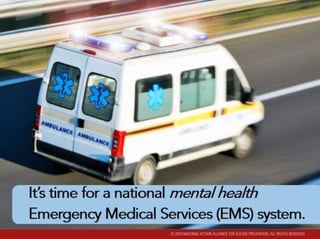
comprehensive crisis systems…as they do for EMT services
 Leadership will be needed from SAMHSA, CMS
(Medicare/Medicaid), the Department of Labor, and state
Insurance Commissioners.
Effective Crisis Care
Effective crisis care must be comprehensive. It must include
core elements and practices:
 “Air Traffic Control capable central coordination, using
technology for real time care coordination while providing
high touch support meeting NSPL standards;
 Availability of Mobile Crisis Services, deployed centrally on
a 24/7 basis,
 Residential crisis stabilization programs, and
 Conformance with essential crisis care principles and
practices.
Big data and basic principles of coordination lead
to an extraordinary level of safety for air travelers.
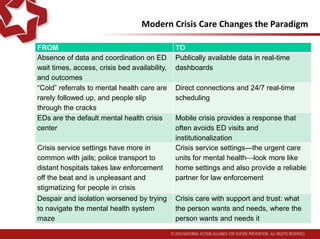
Modern Crisis Care Changes the Paradigm
FROM TO
Absence of data and coordination on ED
wait times, access, crisis bed availability,
and outcomes
Publicly available data in real-time
dashboards
“Cold” referrals to mental health care are
rarely followed up, and people slip
through the cracks
Direct connections and 24/7 real-time
scheduling
EDs are the default mental health crisis
center
Mobile crisis provides a response that
often avoids ED visits and
institutionalization
Jails are a de facto crisis alternative;
police transport to distant hospitals takes
law enforcement off the beat and is
unpleasant and stigmatizing for people in
crisis
Crisis service settings—the urgent care
units for mental healthlook more like
home settings and also provide a reliable
partner for law enforcement
Despair and isolation worsened by trying
to navigate the mental health system
maze
Crisis care with support and trust: what
the person wants and needs, where the
person wants and needs it
Learning from ATC Safety
Crisis Services frequently have two critical gaps:
 Real-time coordination of crisis and outgoing services
 Linked, flexible services specific to crisis response, namely
mobile teams and crisis stabilization facilities
By contrast, advancements in ATC that have helped transform
aviation safety are two vitally important objectives:
 Objective #1: Always know where the aircraft is (in time and
space) and never lose contact.
 Objective #2: Verify the hand-off has occurred and the
airplane is safely in the hands of another controller.
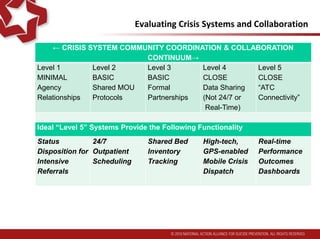
Evaluating Crisis Systems and Collaboration
← CRISIS SYSTEM COMMUNITY COORDINATION & COLLABORATION
CONTINUUM→
Level 1
MINIMAL
Agency
Relationships
Level 2
BASIC
Shared MOU
Protocols
Level 3
BASIC
Formal
Partnerships
Level 4
CLOSE
Data Sharing
(Not 24/7 or
Real-Time)
Level 5
CLOSE
“ATC
Connectivity”
Ideal “Level 5” Systems Provide the Following Functionality
Status
Disposition for
Intensive
Referrals
24/7
Outpatient
Scheduling
Shared Bed
Inventory
Tracking
High-tech,
GPS-enabled
Mobile Crisis
Dispatch
Real-time
Performance
Outcomes
Dashboards
Ubiquitous and inexpensive technology is
changing nearly every other industry.
Community-based Mobile Crisis
Colorado and Georgia have developed statewide coverage.
While terms describing mobile crisis care differ, these programs
share common goals to:
 Help individuals experiencing a crisis event to experience
relief quickly and to resolve the crisis situation when possible
 Meet individuals in an environment where they are
comfortable
 Provide appropriate care/support while avoiding unnecessary
law enforcement involvement, ED use, and hospitalization
Crisis Stabilization Facilities/Settings
Usually small (e.g., 6 to 16 beds), and often more home-like
than institutional. They are staffed with a mix of professionals
and peers. They may operate as part of a community mental
health center or in affiliation with a hospital.
 Function as an integral part of a regional crisis system serving
a whole population rather than as an offering of a single
provider
 Operate in a home-like environment
 Utilize peers as integral staff members
 Have 24/7 access to psychiatrists or advanced mental health
clinicians
Core Principles and Practices of
Modern Crisis Care
Additional elements that must be systematically “baked in” to
excellent crisis systems are:
 Embracing recovery
 Significant role for peers
 Trauma-informed care
 Suicide safer care
 Safety/security for staff and consumers
 Crisis response partnerships with law enforcement
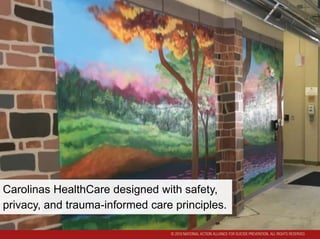
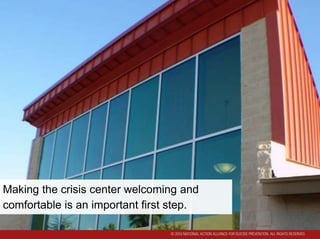
Carolinas HealthCare designed with safety,
privacy, and trauma-informed care principles.
Making the crisis center welcoming and
comfortable is an important first step.
Summary of Task Force Recommendations
Recommendation 1: National-and state-level recognition that
effective crisis care must be comprehensive and include these
core elements and practices:
 ATC-capable central coordination, using technology for real-
time care coordination while providing high-touch support
meeting NSPL standards;
 Availability of centrally deployed, 24/7 Mobile Crisis Services
and residential crisis stabilization programs; and
 Conformance with essential crisis care principles and
practices.
Summary of Task Force Recommendations
Recommendation 2: Crisis call services should participate in and
meet the standards of the NSPL, and crisis intervention systems
should adopt and implement Zero Suicide/Suicide Safer Care
across all program elements.
Recommendation 3: State and national authorities should
review elements of ATC-qualified crisis systems, apply them to
crisis care in their jurisdictions, and commit to achieving these
capabilities within 5 years, so that each region of the United
States has a qualified hub for crisis care.
Summary of Task Force Recommendations
Recommendation 4: State and national authorities should work
to ensure that mobile crisis teams are available to each part of
every state.
Recommendation 5: Residential crisis stabilization alternatives
to hospitalization should be made available as a core
component of comprehensive crisis systems in every state.
Recommendation 6: National and state authorities (and where
relevant, accrediting organizations and payers such as health
plans) commit to ensuring that the core principles and practices
discussed in this report are addressed in existing and to-be-
developed comprehensive crisis systems.
Summary of Task Force Recommendations
Recommendation 7: Federal support for crisis call centers is
necessary to allow for, at a minimum, the development of crisis
call centers in areas where one does not exist. Ideally, funding
would come from an expansion of the Mental Health Block
Grant, coupled with a requirement that states ensure the
presence of qualified call centers covering their population. Call
centers should be part of comprehensive crisis systems that
have all the core requirements we have discussed: 24/7 clinical
coverage with ATC capabilities, adequate mobile crisis teams,
and sufficient crisis respite alternatives.
Summary of Task Force Recommendations
Recommendation 8: All major health payers should recognize
and reimburse crisis services provided to their members by
comprehensive crisis systems. An analogy for this is payment for
EMT by health providers. This step is necessary in order to have
adequate capacity for crisis care and for efficiency. In order to
achieve this step, leadership will be needed from CMS
(Medicare/Medicaid), the Department of Labor, and state
Insurance Commissioners.
Download the report at http://crisisnow.com
Crisis Services Task Force

Crisis Now Webinar Policy Briefing 2016

  • 1.
    David W. Covington,LPC, MBA Michael F. Hogan, PhD Crisis Now: Transforming Services is Within Our Reach Webinar/Policy Briefing March 23, 2016
  • 2.
    The Task Force In2015, the National Action Alliance for Suicide Prevention launched the Crisis Services Task Force, with 30 consensus national experts on crisis, representing a diverse background:  Pioneering Crisis Care Organizations/Programs  Health Plans and State Authorities  Lived Experience of Peers, Families  Consultants and Policy Makers  First Responders and Medical Leadership
  • 3.
    Five Compelling Reasonsfor Change  Thousands of Americans dying alone and in desperation from suicide  Unspeakable family pain for those whose children have serious mental illness  Inhuman treatment of individuals who sometimes wait for days in EDs  The wrong care in the wrong place, compromising other medical urgent care  Tying up valuable law enforcement resources to substitute for viable crisis mental health systems
  • 5.
    Creating the Infrastructure Wefound solutions already exist some states and communities…but much of the U.S. lacks adequate crisis care  National and state leadership is needed to provide the basic infrastructure of crisis care.  This step is necessary in order to have adequate capacity for crisis care and for efficiency.  Building on this infrastructure, health payers should use and reimburse crisis services provided to their members by comprehensive crisis systems…as they do for EMT services  Leadership will be needed from SAMHSA, CMS (Medicare/Medicaid), the Department of Labor, and state Insurance Commissioners.
  • 6.
    Effective Crisis Care Effectivecrisis care must be comprehensive. It must include core elements and practices:  “Air Traffic Control capable central coordination, using technology for real time care coordination while providing high touch support meeting NSPL standards;  Availability of Mobile Crisis Services, deployed centrally on a 24/7 basis,  Residential crisis stabilization programs, and  Conformance with essential crisis care principles and practices.
  • 7.
    Big data andbasic principles of coordination lead to an extraordinary level of safety for air travelers.
  • 8.
    Modern Crisis CareChanges the Paradigm FROM TO Absence of data and coordination on ED wait times, access, crisis bed availability, and outcomes Publicly available data in real-time dashboards “Cold” referrals to mental health care are rarely followed up, and people slip through the cracks Direct connections and 24/7 real-time scheduling EDs are the default mental health crisis center Mobile crisis provides a response that often avoids ED visits and institutionalization Jails are a de facto crisis alternative; police transport to distant hospitals takes law enforcement off the beat and is unpleasant and stigmatizing for people in crisis Crisis service settings—the urgent care units for mental healthlook more like home settings and also provide a reliable partner for law enforcement Despair and isolation worsened by trying to navigate the mental health system maze Crisis care with support and trust: what the person wants and needs, where the person wants and needs it
  • 9.
    Learning from ATCSafety Crisis Services frequently have two critical gaps:  Real-time coordination of crisis and outgoing services  Linked, flexible services specific to crisis response, namely mobile teams and crisis stabilization facilities By contrast, advancements in ATC that have helped transform aviation safety are two vitally important objectives:  Objective #1: Always know where the aircraft is (in time and space) and never lose contact.  Objective #2: Verify the hand-off has occurred and the airplane is safely in the hands of another controller.
  • 10.
    Evaluating Crisis Systemsand Collaboration ← CRISIS SYSTEM COMMUNITY COORDINATION & COLLABORATION CONTINUUM→ Level 1 MINIMAL Agency Relationships Level 2 BASIC Shared MOU Protocols Level 3 BASIC Formal Partnerships Level 4 CLOSE Data Sharing (Not 24/7 or Real-Time) Level 5 CLOSE “ATC Connectivity” Ideal “Level 5” Systems Provide the Following Functionality Status Disposition for Intensive Referrals 24/7 Outpatient Scheduling Shared Bed Inventory Tracking High-tech, GPS-enabled Mobile Crisis Dispatch Real-time Performance Outcomes Dashboards
  • 11.
    Ubiquitous and inexpensivetechnology is changing nearly every other industry.
  • 12.
    Community-based Mobile Crisis Coloradoand Georgia have developed statewide coverage. While terms describing mobile crisis care differ, these programs share common goals to:  Help individuals experiencing a crisis event to experience relief quickly and to resolve the crisis situation when possible  Meet individuals in an environment where they are comfortable  Provide appropriate care/support while avoiding unnecessary law enforcement involvement, ED use, and hospitalization
  • 13.
    Crisis Stabilization Facilities/Settings Usuallysmall (e.g., 6 to 16 beds), and often more home-like than institutional. They are staffed with a mix of professionals and peers. They may operate as part of a community mental health center or in affiliation with a hospital.  Function as an integral part of a regional crisis system serving a whole population rather than as an offering of a single provider  Operate in a home-like environment  Utilize peers as integral staff members  Have 24/7 access to psychiatrists or advanced mental health clinicians
  • 14.
    Core Principles andPractices of Modern Crisis Care Additional elements that must be systematically “baked in” to excellent crisis systems are:  Embracing recovery  Significant role for peers  Trauma-informed care  Suicide safer care  Safety/security for staff and consumers  Crisis response partnerships with law enforcement
  • 15.
    Carolinas HealthCare designedwith safety, privacy, and trauma-informed care principles.
  • 16.
    Making the crisiscenter welcoming and comfortable is an important first step.
  • 17.
    Summary of TaskForce Recommendations Recommendation 1: National-and state-level recognition that effective crisis care must be comprehensive and include these core elements and practices:  ATC-capable central coordination, using technology for real- time care coordination while providing high-touch support meeting NSPL standards;  Availability of centrally deployed, 24/7 Mobile Crisis Services and residential crisis stabilization programs; and  Conformance with essential crisis care principles and practices.
  • 18.
    Summary of TaskForce Recommendations Recommendation 2: Crisis call services should participate in and meet the standards of the NSPL, and crisis intervention systems should adopt and implement Zero Suicide/Suicide Safer Care across all program elements. Recommendation 3: State and national authorities should review elements of ATC-qualified crisis systems, apply them to crisis care in their jurisdictions, and commit to achieving these capabilities within 5 years, so that each region of the United States has a qualified hub for crisis care.
  • 19.
    Summary of TaskForce Recommendations Recommendation 4: State and national authorities should work to ensure that mobile crisis teams are available to each part of every state. Recommendation 5: Residential crisis stabilization alternatives to hospitalization should be made available as a core component of comprehensive crisis systems in every state. Recommendation 6: National and state authorities (and where relevant, accrediting organizations and payers such as health plans) commit to ensuring that the core principles and practices discussed in this report are addressed in existing and to-be- developed comprehensive crisis systems.
  • 20.
    Summary of TaskForce Recommendations Recommendation 7: Federal support for crisis call centers is necessary to allow for, at a minimum, the development of crisis call centers in areas where one does not exist. Ideally, funding would come from an expansion of the Mental Health Block Grant, coupled with a requirement that states ensure the presence of qualified call centers covering their population. Call centers should be part of comprehensive crisis systems that have all the core requirements we have discussed: 24/7 clinical coverage with ATC capabilities, adequate mobile crisis teams, and sufficient crisis respite alternatives.
  • 21.
    Summary of TaskForce Recommendations Recommendation 8: All major health payers should recognize and reimburse crisis services provided to their members by comprehensive crisis systems. An analogy for this is payment for EMT by health providers. This step is necessary in order to have adequate capacity for crisis care and for efficiency. In order to achieve this step, leadership will be needed from CMS (Medicare/Medicaid), the Department of Labor, and state Insurance Commissioners.
  • 22.
    Download the reportat http://crisisnow.com Crisis Services Task Force