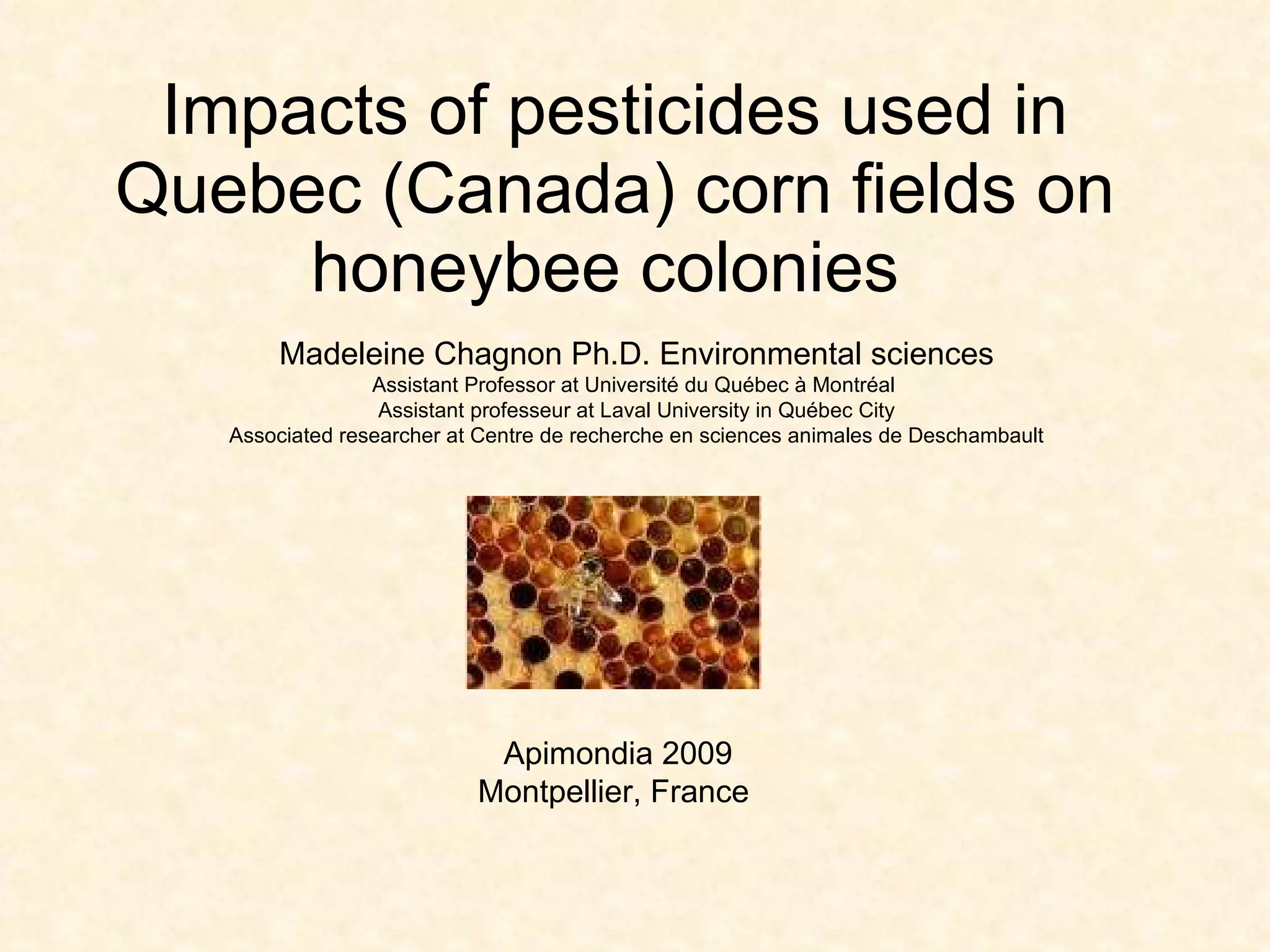

Impacts of pesticides used in Quebec (Canada) corn fields on honeybee colonies   Apimondia 2009 Montpellier, France  Madeleine Chagnon Ph.D. Environmental sciences Assistant Professor at Université du Québec à Montréal  Assistant professeur at Laval University in Québec City Associated researcher  at Centre de recherche en sciences animales de Deschambault
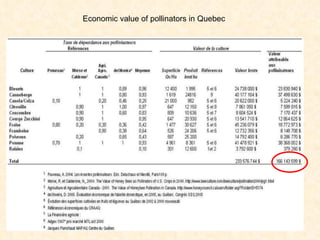
Economic value of pollinators in Quebec
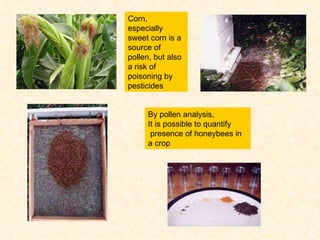
By pollen analysis,  It is possible to quantify   presence of honeybees in a crop Corn, especially sweet corn is a source of pollen, but also a risk of poisoning by pesticides
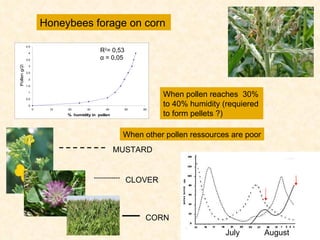
When other pollen ressources are poor CORN CLOVER MUSTARD When pollen reaches  30% to 40% humidity (requiered to form pellets ?) Honeybees forage on corn   R 2 = 0,53 α  = 0,05 July  August
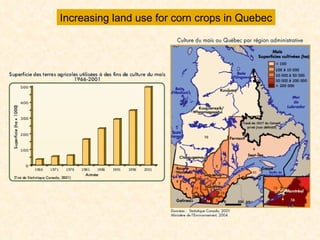
Increasing land use for corn crops in Quebec
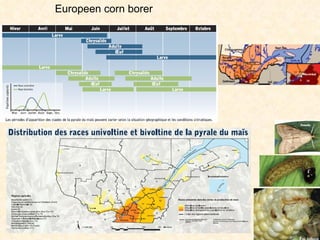
Europeen corn borer
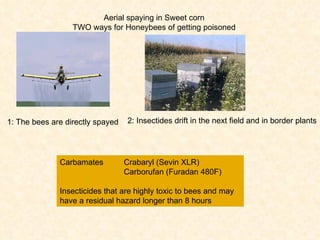
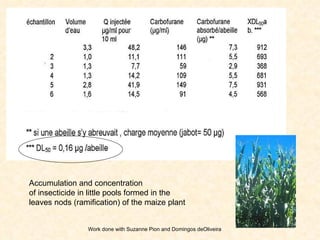
2:  Insectides drift in the next field and in border plants Aerial spaying in Sweet corn TWO ways for Honeybees of getting poisoned 1: The bees are directly spayed Carbamates  Crabaryl (Sevin XLR) Carborufan (Furadan 480F) Insecticides that are highly toxic to bees and may have a residual hazard longer than 8 hours
Accumulation and concentration  of insecticide in little pools formed in the  leaves nods (ramification) of the maize plant Work done with Suzanne Pion and Domingos deOliveira
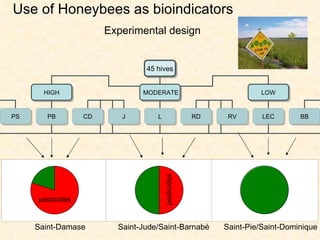
Experimental design Saint-Damase Saint-Jude/Saint-Barnabé Saint-Pie/Saint-Dominique pesticides pesticides Use of Honeybees as bioindicators 45 hives HIGH MODERATE LOW RV LEC J L RD BB PS PB CD
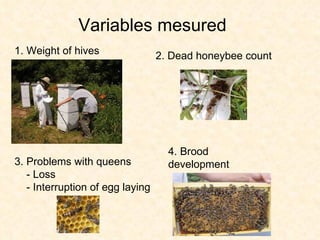
Variables mesured Weight of hives 2. Dead honeybee count 3.  Problems with queens - Loss - Interruption of egg laying 4 . Brood development
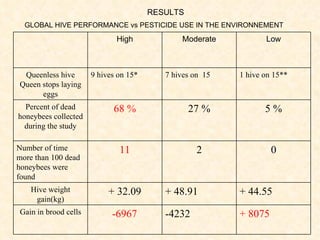
GLOBAL HIVE PERFORMANCE vs PESTICIDE USE IN THE ENVIRONNEMENT RESULTS + 8075 -4232 -6967 Gain in brood cells + 44.55 + 48.91 + 32.09 Hive weight  gain(kg) 0 2 11 Number of time more than 100 dead honeybees were found 5 % 27 % 68 % Percent of dead honeybees collected during the study 1 hive on 15** 7 hives on  15 9 hives on 15* Queenless hive Queen stops laying eggs Low Moderate High
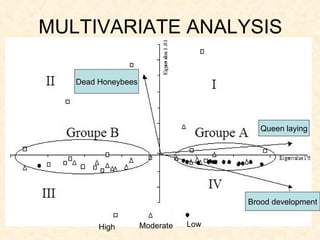
MULTIVARIATE ANALYSIS Dead Honeybees Brood development Queen laying High Moderate Low
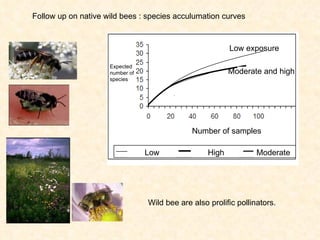
Follow up on n ative  wild bees : species acculumation curves Wild bee are also prolific pollinators.  Expected number of species Number of samples Moderate and high Low exposure Low High Moderate Cs et Cm confondus
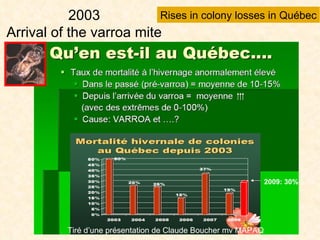
Rises in colony losses in Québec 2003 Arrival of the varroa mite Tiré d’une présentation de Claude Boucher mv MAPAQ 2009: 30%
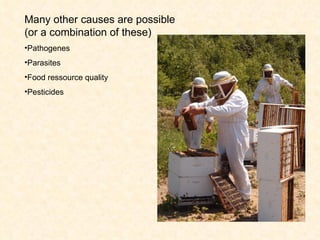
Many other causes are possible (or a combination of these) Pathogenes Parasites Food ressource quality  Pesticides
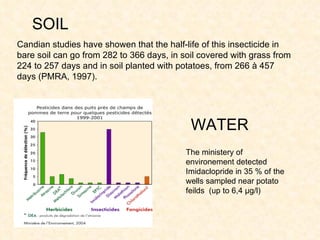
Candian studies have showen that the half-life of this insecticide in bare soil can go from 282 to 366 days, in soil covered with grass from 224 to 257 days and in soil planted with potatoes, from 266 à 457 days (PMRA, 1997).  SOIL WATER The ministery of environement detected Imidaclopride in 35 % of the wells sampled near potato feilds  (up to 6,4 µg/l)
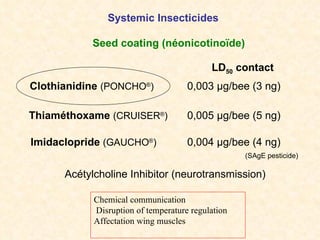
Systemic Insecticides Thiaméthoxame  (CRUISER ® ) Seed coating (néonicotinoïde) Clothianidine  (PONCHO ® ) Acétylcholine Inhibitor (neurotransmission) 0,005  μ g/bee (5 ng) LD 50   contact 0,003  μ g/bee (3 ng) (SAgE pesticide) Imidaclopride  (GAUCHO ® ) 0,004  μ g/bee (4 ng) Chemical communication Disruption of temperature regulation Affectation wing muscles
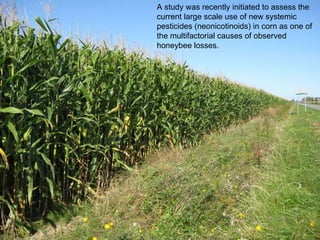
A study was recently initiated to assess the current large scale use of new systemic pesticides (neonicotinoids) in corn as one of the multifactorial causes of observed honeybee losses.
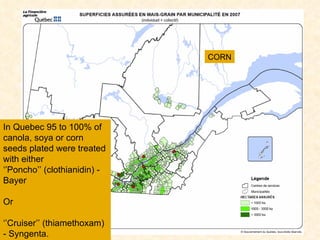
In Quebec 95 to 100% of canola, soya or corn seeds plated were treated with either  ‘’ Poncho’’ (clothianidin) -  Bayer  Or  ‘’ Cruiser’’ (thiamethoxam) - Syngenta.  CORN
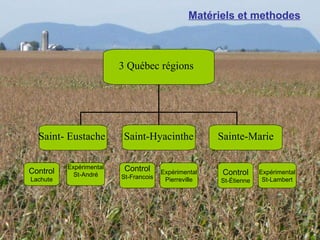
Matériels et methodes 3 Québec régions  Sainte-Marie Saint- Eustache Saint-Hyacinthe Control Lachute Control St-Francois Control St-Étienne Expérimental St-André Expérimental Pierreville Expérimental St-Lambert
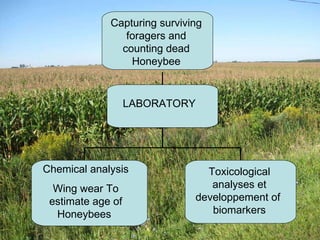
LABORATORY Capturing surviving foragers and counting dead Honeybee Chemical analysis Wing wear To estimate age of Honeybees  Toxicological analyses et developpement of  biomarkers
 
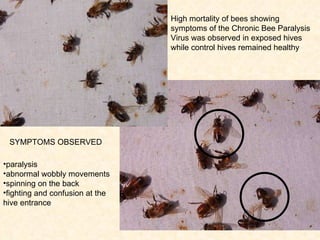
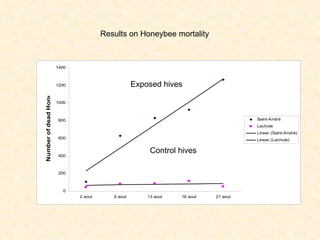
paralysis abnormal wobbly movements  spinning on the back  fighting and confusion at the hive entrance  SYMPTOMS OBSERVED High mortality of bees showing symptoms of the Chronic Bee Paralysis Virus was observed in exposed hives while control hives remained healthy
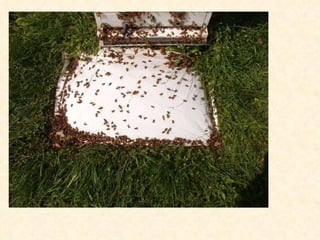
Results on Honeybee mortality Control hives Exposed hives
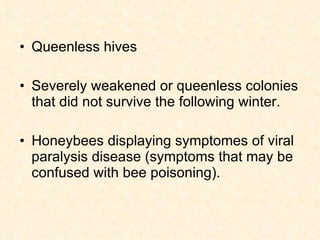
Queenless hives  Severely weakened or queenless colonies that did not survive the following winter.  Honeybees displaying symptomes of viral paralysis disease (symptoms that may be confused with bee poisoning).
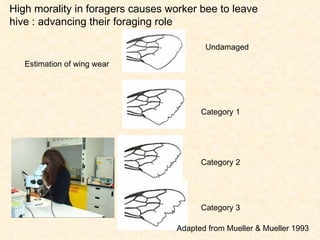
Category 1 Category 2 Category 3 Undamaged Estimation of wing wear High morality in foragers causes worker bee to leave hive : advancing their foraging role Adapted from Mueller & Mueller 1993
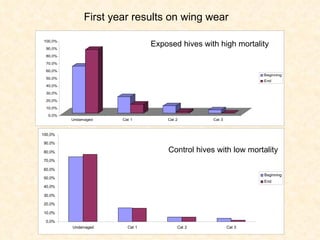
First year results on wing wear Exposed hives with high mortality Control hives with low mortality
Ectoxicology  –  UQAM/TOXEN (Madeleine Chagnon, Monique Boily et Geneviève Beaunoyer) Developement of biomarkers to evaluatate the impacts of Honeybee ( Apis mellifera)exposition to pesticides used in large corn field environnements   Dosage of bee head  acetylcholinesterase (AChE) using microplate spectrofluorometry   Expected results: a decrese in  acetylcholinesterase as an  indicator of exposure to an anti holinesterase pesticide ( This enzymatic essay is not capable of distinguishing between diffrent pesticides) First results :  The AChE increase in surviving Honeybees showed that AChE activity might be used as biomarker to reveal an exposure to pesticides (overcompensation).
Ectoxicology laboartory UQAM/TOXEN
The pesticides used are constantly changing as well as their mode of action: Example - Movento   We are now working on the developement of certain tests that can help us to judge Honeybee health, including its  immune system ectoxicology laboartory UQAM/TOXEN Weakened immune systems can facilitate the spreading viral infections. This hypothysis has been largely suggested for the varroa mite
Ongoing work  Dosage of vitamine A and enzymes playing a  rôle in the immune system of the Honeybee  The enzymes phénol oxydase (PO) and  glucose déshydrogénase (GLD)  play a critical role in cellulare response  (Xiaolong et al., 2005)  These  levels of the immunity-related enzymes   are thus priorised ectoxicology laboartory UQAM/TOXEN
 

Conférence Apimondia

  • 1.
    Impacts of pesticidesused in Quebec (Canada) corn fields on honeybee colonies Apimondia 2009 Montpellier, France Madeleine Chagnon Ph.D. Environmental sciences Assistant Professor at Université du Québec à Montréal Assistant professeur at Laval University in Québec City Associated researcher at Centre de recherche en sciences animales de Deschambault
  • 2.
    Economic value ofpollinators in Quebec
  • 3.
    By pollen analysis, It is possible to quantify  presence of honeybees in a crop Corn, especially sweet corn is a source of pollen, but also a risk of poisoning by pesticides
  • 4.
    When other pollenressources are poor CORN CLOVER MUSTARD When pollen reaches 30% to 40% humidity (requiered to form pellets ?) Honeybees forage on corn R 2 = 0,53 α = 0,05 July August
  • 5.
    Increasing land usefor corn crops in Quebec
  • 6.
  • 7.
    2: Insectidesdrift in the next field and in border plants Aerial spaying in Sweet corn TWO ways for Honeybees of getting poisoned 1: The bees are directly spayed Carbamates Crabaryl (Sevin XLR) Carborufan (Furadan 480F) Insecticides that are highly toxic to bees and may have a residual hazard longer than 8 hours
  • 8.
    Accumulation and concentration of insecticide in little pools formed in the leaves nods (ramification) of the maize plant Work done with Suzanne Pion and Domingos deOliveira
  • 9.
    Experimental design Saint-DamaseSaint-Jude/Saint-Barnabé Saint-Pie/Saint-Dominique pesticides pesticides Use of Honeybees as bioindicators 45 hives HIGH MODERATE LOW RV LEC J L RD BB PS PB CD
  • 10.
    Variables mesured Weightof hives 2. Dead honeybee count 3. Problems with queens - Loss - Interruption of egg laying 4 . Brood development
  • 11.
    GLOBAL HIVE PERFORMANCEvs PESTICIDE USE IN THE ENVIRONNEMENT RESULTS + 8075 -4232 -6967 Gain in brood cells + 44.55 + 48.91 + 32.09 Hive weight gain(kg) 0 2 11 Number of time more than 100 dead honeybees were found 5 % 27 % 68 % Percent of dead honeybees collected during the study 1 hive on 15** 7 hives on 15 9 hives on 15* Queenless hive Queen stops laying eggs Low Moderate High
  • 12.
    MULTIVARIATE ANALYSIS DeadHoneybees Brood development Queen laying High Moderate Low
  • 13.
    Follow up onn ative wild bees : species acculumation curves Wild bee are also prolific pollinators. Expected number of species Number of samples Moderate and high Low exposure Low High Moderate Cs et Cm confondus
  • 14.
    Rises in colonylosses in Québec 2003 Arrival of the varroa mite Tiré d’une présentation de Claude Boucher mv MAPAQ 2009: 30%
  • 15.
    Many other causesare possible (or a combination of these) Pathogenes Parasites Food ressource quality Pesticides
  • 16.
    Candian studies haveshowen that the half-life of this insecticide in bare soil can go from 282 to 366 days, in soil covered with grass from 224 to 257 days and in soil planted with potatoes, from 266 à 457 days (PMRA, 1997). SOIL WATER The ministery of environement detected Imidaclopride in 35 % of the wells sampled near potato feilds (up to 6,4 µg/l)
  • 17.
    Systemic Insecticides Thiaméthoxame (CRUISER ® ) Seed coating (néonicotinoïde) Clothianidine (PONCHO ® ) Acétylcholine Inhibitor (neurotransmission) 0,005 μ g/bee (5 ng) LD 50 contact 0,003 μ g/bee (3 ng) (SAgE pesticide) Imidaclopride (GAUCHO ® ) 0,004 μ g/bee (4 ng) Chemical communication Disruption of temperature regulation Affectation wing muscles
  • 18.
    A study wasrecently initiated to assess the current large scale use of new systemic pesticides (neonicotinoids) in corn as one of the multifactorial causes of observed honeybee losses.
  • 19.
    In Quebec 95to 100% of canola, soya or corn seeds plated were treated with either ‘’ Poncho’’ (clothianidin) - Bayer Or ‘’ Cruiser’’ (thiamethoxam) - Syngenta. CORN
  • 20.
    Matériels et methodes3 Québec régions Sainte-Marie Saint- Eustache Saint-Hyacinthe Control Lachute Control St-Francois Control St-Étienne Expérimental St-André Expérimental Pierreville Expérimental St-Lambert
  • 21.
    LABORATORY Capturing survivingforagers and counting dead Honeybee Chemical analysis Wing wear To estimate age of Honeybees Toxicological analyses et developpement of biomarkers
  • 22.
  • 23.
    paralysis abnormal wobblymovements spinning on the back fighting and confusion at the hive entrance SYMPTOMS OBSERVED High mortality of bees showing symptoms of the Chronic Bee Paralysis Virus was observed in exposed hives while control hives remained healthy
  • 24.
    Results on Honeybeemortality Control hives Exposed hives
  • 25.
    Queenless hives Severely weakened or queenless colonies that did not survive the following winter. Honeybees displaying symptomes of viral paralysis disease (symptoms that may be confused with bee poisoning).
  • 26.
    Category 1 Category2 Category 3 Undamaged Estimation of wing wear High morality in foragers causes worker bee to leave hive : advancing their foraging role Adapted from Mueller & Mueller 1993
  • 27.
    First year resultson wing wear Exposed hives with high mortality Control hives with low mortality
  • 28.
    Ectoxicology – UQAM/TOXEN (Madeleine Chagnon, Monique Boily et Geneviève Beaunoyer) Developement of biomarkers to evaluatate the impacts of Honeybee ( Apis mellifera)exposition to pesticides used in large corn field environnements Dosage of bee head acetylcholinesterase (AChE) using microplate spectrofluorometry Expected results: a decrese in acetylcholinesterase as an indicator of exposure to an anti holinesterase pesticide ( This enzymatic essay is not capable of distinguishing between diffrent pesticides) First results : The AChE increase in surviving Honeybees showed that AChE activity might be used as biomarker to reveal an exposure to pesticides (overcompensation).
  • 29.
  • 30.
    The pesticides usedare constantly changing as well as their mode of action: Example - Movento We are now working on the developement of certain tests that can help us to judge Honeybee health, including its immune system ectoxicology laboartory UQAM/TOXEN Weakened immune systems can facilitate the spreading viral infections. This hypothysis has been largely suggested for the varroa mite
  • 31.
    Ongoing work Dosage of vitamine A and enzymes playing a rôle in the immune system of the Honeybee The enzymes phénol oxydase (PO) and glucose déshydrogénase (GLD) play a critical role in cellulare response (Xiaolong et al., 2005) These levels of the immunity-related enzymes are thus priorised ectoxicology laboartory UQAM/TOXEN
  • 32.

Editor's Notes

  • #21 We confirmed that there is a problem because for the beekeepers the acceptable mortality rate is 10%.