Conflict In MedicalPractice
PRESENTED BY:
1. Hoicha Rangjang( Roll no 1)
2. Pooja Kumari (Roll no 2)
2.
DEFINITION
Disagreement withinoneself or between people that
cause harm or have the potential to cause harm.
Disagreement can be of ideas, perspectives, priorities,
preferences, beliefs, values and goals.
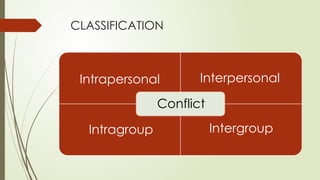
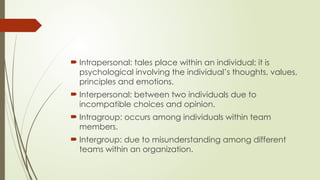
Intrapersonal: talesplace within an individual; it is
psychological involving the individual’s thoughts, values,
principles and emotions.
Interpersonal: between two individuals due to
incompatible choices and opinion.
Intragroup: occurs among individuals within team
members.
Intergroup: due to misunderstanding among different
teams within an organization.
5.
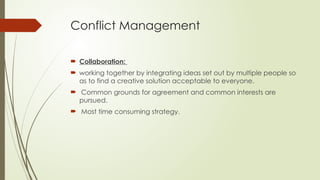
Conflict Management
Collaboration:
working together by integrating ideas set out by multiple people so
as to find a creative solution acceptable to everyone.
Common grounds for agreement and common interests are
pursued.
Most time consuming strategy.
6.
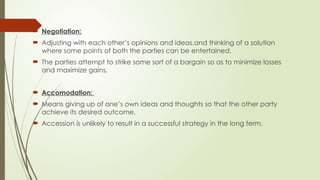
Negotiation:
Adjustingwith each other’s opinions and ideas,and thinking of a solution
where some points of both the parties can be entertained.
The parties attempt to strike some sort of a bargain so as to minimize losses
and maximize gains.
Accomodation:
Means giving up of one’s own ideas and thoughts so that the other party
achieve its desired outcome.
Accession is unlikely to result in a successful strategy in the long term.
7.
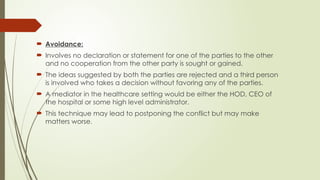
Avoidance:
Involvesno declaration or statement for one of the parties to the other
and no cooperation from the other party is sought or gained.
The ideas suggested by both the parties are rejected and a third person
is involved who takes a decision without favoring any of the parties.
A mediator in the healthcare setting would be either the HOD, CEO of
the hospital or some high level administrator.
This technique may lead to postponing the conflict but may make
matters worse.
8.
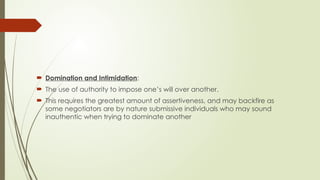
Domination andIntimidation:
The use of authority to impose one’s will over another.
This requires the greatest amount of assertiveness, and may backfire as
some negotiators are by nature submissive individuals who may sound
inauthentic when trying to dominate another
9.
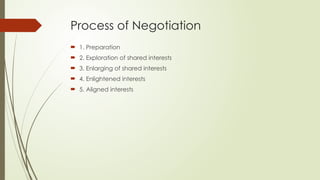
Process of Negotiation
1. Preparation
2. Exploration of shared interests
3. Enlarging of shared interests
4. Enlightened interests
5. Aligned interests
10.
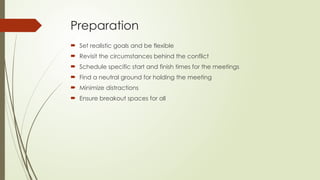
Preparation
Set realisticgoals and be flexible
Revisit the circumstances behind the conflict
Schedule specific start and finish times for the meetings
Find a neutral ground for holding the meeting
Minimize distractions
Ensure breakout spaces for all
11.
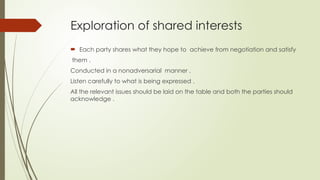
Exploration of sharedinterests
Each party shares what they hope to achieve from negotiation and satisfy
them .
Conducted in a nonadversarial manner .
Listen carefully to what is being expressed .
All the relevant issues should be laid on the table and both the parties should
acknowledge .
12.
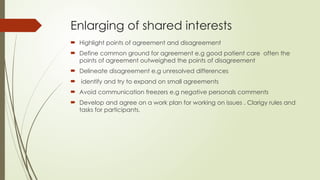
Enlarging of sharedinterests
Highlight points of agreement and disagreement
Define common ground for agreement e.g good patient care often the
points of agreement outweighed the points of disagreement
Delineate disagreement e.g unresolved differences
identify and try to expand on small agreements
Avoid communication freezers e.g negative personals comments
Develop and agree on a work plan for working on issues . Clarigy rules and
tasks for participants.
13.
Enlightened interests
Theparties are encouraged to come up with creative solutions to the
remaining points of disagreement .
A zone of no obligation is set up and creativity can flourish without either
side needing to commit to anything .
14.
Aligned interests
Withmultiple solutions available , each party can now debate what
combination of solutions results in maximal recognizable gain for the parties
Whatever disagreement remains after this process can be deferred until a
future round of negotiations .
The negotiation over solutions will require each party to make some
concessions .




![[Behav. sci] conflict resolution by SIMS Lahore](https://cdn.slidesharecdn.com/ss_thumbnails/8dtiyjkztvyanla8hnop-signature-413e8c33574c21294a6dc95e37151f54f981375d6b0f4695b85074f597ea60c2-poli-150813085608-lva1-app6891-thumbnail.jpg?width=640&height=640&fit=bounds)


![EXTRACRANIAL COMPLICATIONS OF OTITIS MEDIA [Autosaved].pptx](https://cdn.slidesharecdn.com/ss_thumbnails/extracranialcomplicationsofotitismediaautosaved-250922194437-495a40c8-thumbnail.jpg?width=640&height=640&fit=bounds)


