2
DISCLAIMER
This material wasproduced under grant
number SH-22248-1 from the Occupational
Safety and Health Administration, U.S.
Department of Labor. It does not
necessarily reflect the views or policies of
the U.S. Department of Labor, nor does
mention of trade names, commercial
products, or organizations imply
endorsement by the U.S. Government.
3.
3
Objectives
• After thismodule you should be able to
– identify the most common confined space
hazards
– take the necessary steps to avoid those
hazards
4.
4
What is aConfined Space?
• A confined space is a space that
– is large enough for a person to enter and
work
– has limited or restricted means of entry and
exit
– is not designed for continuous occupancy
5.
5
Permit-Required Confined Space
•A permit-required confined space has at
least one of the following characteristics
– contains or has the potential to contain a
hazardous atmosphere
– contains a material that has the potential to
engulf an entrant
– has an internal configuration such that an
entrant could be trapped or asphyxiated
– contains any other recognized serious safety
and health hazard
6.
6
Confined Space Hazards
•Oxygen deficiency
• Flammable/combustible gases and vapors
• Toxic gases
• Engulfment in solid or liquid
• High noise levels
• Grinding, crushing, or mixing mechanisms
• Configuration
• Extreme temperatures
• Chemicals
• Lack of lighting
7.
7
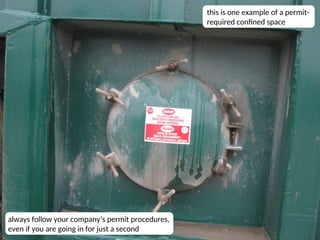
this is oneexample of a permit-
required confined space
always follow your company’s permit procedures,
even if you are going in for just a second
8.
8
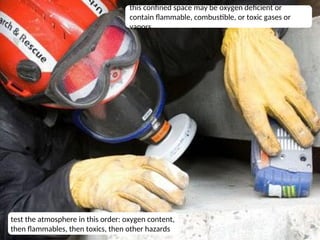
this confined spacemay be oxygen deficient or
contain flammable, combustible, or toxic gases or
vapors
test the atmosphere in this order: oxygen content,
then flammables, then toxics, then other hazards
9.
9
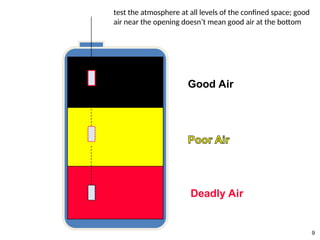
test the atmosphereat all levels of the confined space; good
air near the opening doesn’t mean good air at the bottom
Good Air
Deadly Air
10.
10
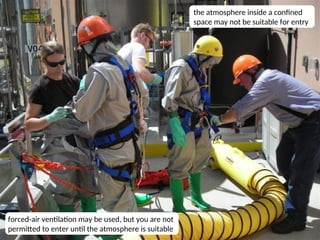
the atmosphere insidea confined
space may not be suitable for entry
forced-air ventilation may be used, but you are not
permitted to enter until the atmosphere is suitable
11.
11
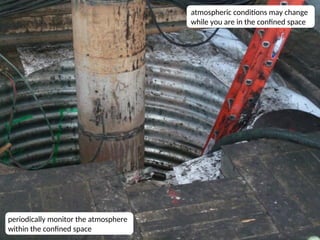
atmospheric conditions maychange
while you are in the confined space
periodically monitor the atmosphere
within the confined space
12.
12
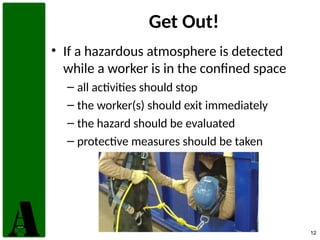
Get Out!
• Ifa hazardous atmosphere is detected
while a worker is in the confined space
– all activities should stop
– the worker(s) should exit immediately
– the hazard should be evaluated
– protective measures should be taken
13.
13
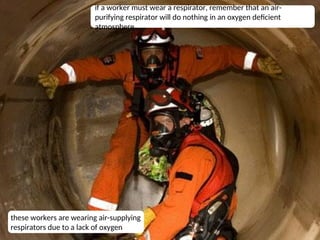
if a workermust wear a respirator, remember that an air-
purifying respirator will do nothing in an oxygen deficient
atmosphere
these workers are wearing air-supplying
respirators due to a lack of oxygen
14.
14
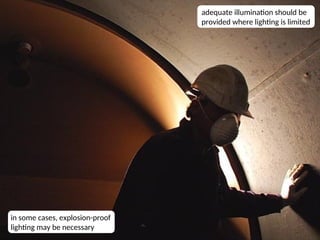
adequate illumination shouldbe
provided where lighting is limited
in some cases, explosion-proof
lighting may be necessary
15.
15
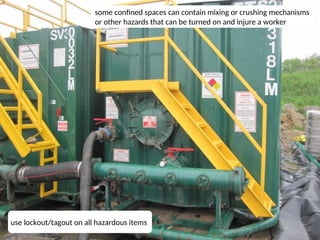
some confined spacescan contain mixing or crushing mechanisms
or other hazards that can be turned on and injure a worker
use lockout/tagout on all hazardous items
16.
16
Duties of Attendants
•Knows the hazards
• Maintains an accurate count of entrants
• Remains outside the permit space until
relieved by another attendant
• Maintains regular communication with
entrants
• Monitors conditions inside and outside of
the permit space
17.
17
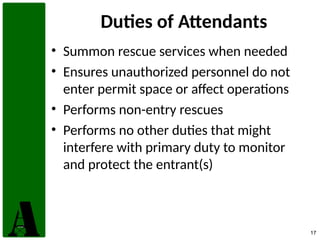
Duties of Attendants
•Summon rescue services when needed
• Ensures unauthorized personnel do not
enter permit space or affect operations
• Performs non-entry rescues
• Performs no other duties that might
interfere with primary duty to monitor
and protect the entrant(s)
18.
18
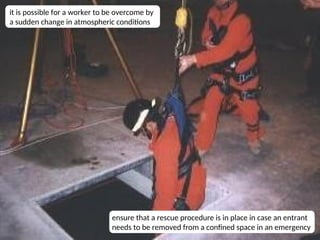
it is possiblefor a worker to be overcome by
a sudden change in atmospheric conditions
ensure that a rescue procedure is in place in case an entrant
needs to be removed from a confined space in an emergency
19.
19
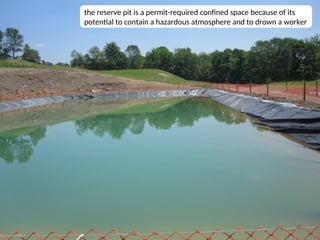
the reserve pitis a permit-required confined space because of its
potential to contain a hazardous atmosphere and to drown a worker
20.
20
Additional Concerns
• Noise
–amplified due to acoustics of the space
– damages hearing and affects communication
• Slippery or wet surfaces
– increased risk of falls and electrical shock
• Personal protective equipment
– more common ppe such as hard hat, hard-
toed boots, safety glasses, face shield, gloves,
and overalls must be worn when needed
• Hot work
22
Your Employer IsResponsible For
• Providing atmospheric testing equipment
• If necessary, providing ventilation
equipment and/or respiratory protection
• Providing and training on confined space
permits and the written program
• Developing and training on emergency
action and rescue plans
23.
23
You Are ResponsibleFor
• Testing the atmosphere prior to entry
• Periodically monitoring the atmosphere
for possible changes
• Following permit procedures
• Ensuring that there is at least one
authorized attendant present at all times
24.
24
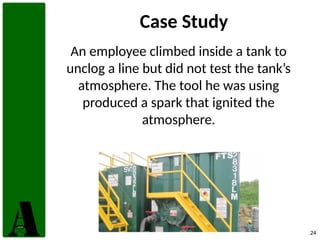
Case Study
An employeeclimbed inside a tank to
unclog a line but did not test the tank’s
atmosphere. The tool he was using
produced a spark that ignited the
atmosphere.
25.
25
Always Remember
• Testthe atmosphere prior to entry and
periodically
• Never enter a confined space if the
atmospheric conditions are not suitable
• Ensure an attendant is outside the
confined space at all times
• Follow your company’s confined space
permit
26.
26
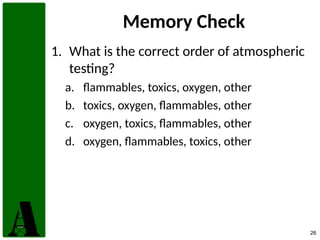
Memory Check
1. Whatis the correct order of atmospheric
testing?
a. flammables, toxics, oxygen, other
b. toxics, oxygen, flammables, other
c. oxygen, toxics, flammables, other
d. oxygen, flammables, toxics, other
27.
27
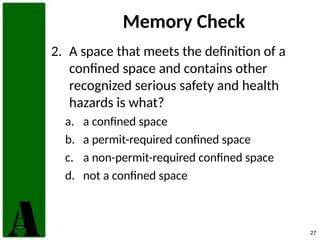
Memory Check
2. Aspace that meets the definition of a
confined space and contains other
recognized serious safety and health
hazards is what?
a. a confined space
b. a permit-required confined space
c. a non-permit-required confined space
d. not a confined space
Editor's Notes
#7 This is a permit-required confined space because it contains one of the hazardous conditions listed back on slide 4.
#8 [1910.146(d)(5)(iii)] In atmospheres that are oxygen-deficient, an air-supplying respirator must be used. This type of respirator is a full-face respirator that supplies air from a cylinder you wear on your back or a line runs to your respirator from an fresh air source. In atmospheres that have enough oxygen, but contain air contaminants.,
an air-purifying respirator could be worn. This is generally either a full- or half-face respirator that includes a filter cartridge to clean the air before you breath it in (such as the one pictured).
#10 [1910.146(c)(5)(ii)[E]] Be sure that the source of air for your forced-air ventilation is fresh (i.e. – not near a diesel exhaust source, etc.).
#13 This photograph shows a rescue team wearing air-supplying respirators inside a confined space, in this case a tank.
If a hazardous atmosphere exists in the confined space such as toxic gases, an appropriate air-purifying respirator may be used. However, if the confined space has a lack of oxygen, an air-purifying respirator will do no good – there is no supply of oxygen to breath in the first place. In this situation, an entrant would need to wear an air-supplying respirator, like the ones shown in this photograph. These will supply breathable air and will protect the entrant from breathing in hazardous air from the atmosphere of the confined space.
#15 This photograph shows a tank on a site that has a couple of lines connected to it. One or more of these lines could be a supply line and, if not properly locked and tagged out, could turn on while an entrant is in the tank blowing hot liquid onto the entrant or drown the entrant, for example. Also, the tank may be fitted with a mixing or compacting mechanism inside that could turn on while the entrant is in the tank.
Always lock and tag out any item on or in the confined space that can cause harm to an entrant.
#16 [1910.146(i)] The authorized attendant should know information on the mode, signs or symptoms, and consequences of the exposure and be aware of possible behavioral effects of hazard exposure in authorized entrants. The attendant should order entrants to evacuate the permit space immediately under the following conditions:
if the attendant detects a prohibited condition
if the attendant detects the behavioral effects of hazard exposure in an authorized entrant
if the attendant detects a situation outside of the space that could endanger the authorized entrant
if the attendant cannot effectively and safely perform all the duties required
#18 OSHA says that the employer must develop and implement procedures for summoning rescue and emergency services, for rescuing entrants from permit spaces, for providing necessary emergency services to rescued employees, and for preventing unauthorized personnel from attempting a rescue [1910.146(d)(9)].
#19 This photograph shows the reserve pit on a drilling site. Just like with every other confined space, a harness and tag line should be worn by the entrant. In this case, the entrant could fall into the pit and never be able to make it back out. However, if the entrant is wearing a harness and a tag line attached to it, the worker that is monitoring the entrant can pull the entrant out of the pit by the tag line attached to the entrant’s harness.
#20 Any noise that is produced in or around the confined space is most likely going to be amplified due to the configuration and small size of the space. This will temporarily or permanently damage hearing and will affect the communication between the entrant and the monitor.
Hot work within a confined space compounds the problem and there would be a need for continuous atmospheric monitoring.
#24 A 23-year-old worker died when he entered a permit-required confined space. The mechanic was assigned to unclog a line. The tank had been purged with an inert nitrogen atmosphere. He was told to wait for the entry supervisor to arrive, he entered the tank for an unknown reason, apparently without first testing the atmosphere, and died of asphyxiation. When the victim was discovered about an hour later, a coworker jumped into the tank, again without testing the atmosphere first, and lifted the victim up to others standing on top of the tank. Testing by fire department responders showed the atmosphere at the bottom of the tank to be about 12% oxygen, below the minimum safe level of 19.5% oxygen.
Ask the class for 3-4 things that may have contributed to this worker losing his life.
Possible Answers: Not waiting. Entering without a permit. Not testing air. Not obeying sign. Any others?
As the class for 3-4 recommendations for preventing a similar incident.
Possible Answers: Allows follow instructions, company policy and signage. Never enter a permit required confined space with first testing the air. Any others?
#26 The correct answer is d. oxygen, flammables, toxics, other.
#27 The correct answer is b. a permit-required confined space.