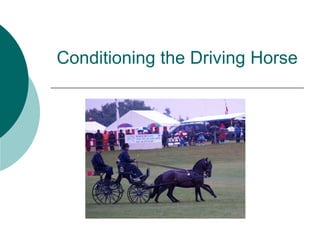
Conditioning the Driving Horse
Ri
     Richard J. Forfa, DVM, DipABVP
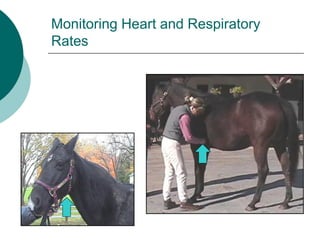
Monitoring Heart and Respiratory
Rates
Respiration/Heart Rate

   Stethoscope
   Heart Rate Monitor -- $$
       (Polar Company)
Objective: Long slow distance
   60 minutes of work at average speed of
    8kph
   Aerobic endurance = exercise for a
    prolonged period at low to moderate
    intensity.
   Resting HR = 28-40 bpm
   Measure a distance 1-3 kilometers then
    calculate average speed with a Stopwatch.
   Measure pulse or heart rate, 100-160 bpm
Start your distance component first
   For example: Start long slow distances
    three times per week at a walk and trot.
   As the work gets easier for the horse do
    one long work at the full distance
   Then 2-6 shorter conditioning drives at
    faster speed.
   HR may rise to 70-180 bpm.
   This work should be accomplished over a
    minimum of a two week period.
Conditioning

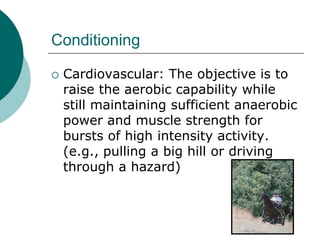
   Cardiovascular: The objective is to
    raise the aerobic capability while
    still maintaining sufficient anaerobic
    power and muscle strength for
    bursts of high intensity activity.
    (e.g., pulling a big hill or driving
    through a hazard)
Anaerobic conditioning

   Later stage of conditioning
   Heart rates 170 – 200 bpm
   Working horse at fast speeds, on a
    steep hill, through a hazard or on
    sandy ground.
Questions?
Duration of High Speed or Intense Work
   Controlled to Minimize Risk or Injury
    Due to Fatigue or Overloading
   Uphill gradients are best at the trot
   Load cardiovascular and respiratory
    systems without high stress to
    bones and joints
Respiratory Conditioning

   Rate and depth of breathing
    controlled in part by
    chemoreceptors which respond to
    levels of blood O2, CO2, and arterial
    pH.
   Increased respiratory rate-
    decreased O2, increased CO2,
    decreased pH
Respiratory Conditioning
   Normal Breaths per minute 12-20
   Can go as high as 180 bpm
   When exercise stops, horse’s respiration
    rate will settle to 60-100 bpm
   And breaths will be deep until O2 debt is
    repaired/replaced.
   One factor in determining the speed of
    recovery is the ambient temperature.
Respiratory Conditioning

   If overheating is a problem, the
    horse will pant.
   Panting = Fast and Shallow Breaths
   Panting is a heat exchange
    mechanism.
   Panting does NOT provide adequate
    O2 to lung tissue.
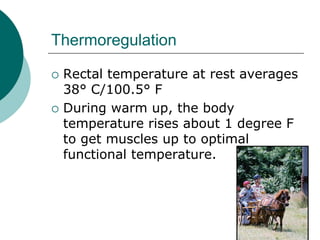
Thermoregulation

   Rectal temperature at rest averages
    38° C/100.5° F
   During warm up, the body
    temperature rises about 1 degree F
    to get muscles up to optimal
    functional temperature.
Thermoregulation
   The rate of heat build up depends on:
       Duration of exercise
       Intensity of exercise
       Environmental temperature, humidity and wind
        velocity.
       Hydration status of horse
       Hair coat and body mass
   Body temperature peaks 10 minutes after
    heavy exercise and should drop to normal
    within 10-20 minutes.
Questions?
Strength Training

   Pull up hills
   Add weight (gradually!) to carriage
    to 30-50% over competition weight
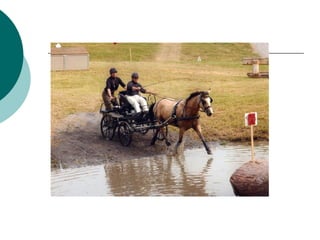
   Vary traveling surfaces (in
    moderation)
       Deep ground (sand)
       Water (provides drag)
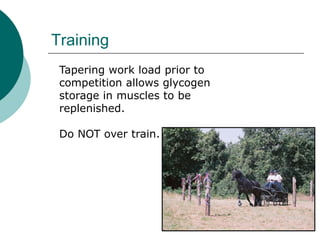
Training
 Tapering work load prior to
 competition allows glycogen
 storage in muscles to be
 replenished.

 Do NOT over train.
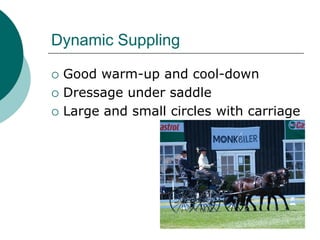
Dynamic Suppling

   Good warm-up and cool-down
   Dressage under saddle
   Large and small circles with carriage
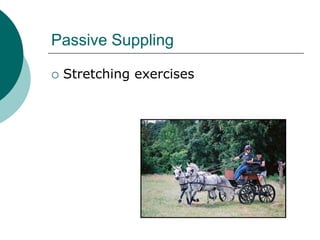
Passive Suppling

   Stretching exercises
Peaking and Tapering
   Low level horses 5 days prior to
    competition
   Upper level horses decrease long slow
    work and add more speed work two (2)
    weeks before the competition
   Allow the horse’s body to be fully
    hydrated
   Allow the horse’s body to have a high
    storage of glycogen
   Feed well prior to competition
Peaking and Tapering

   Exercise daily but decrease level
       Allows any minor tissue damage to heal
   After a fitness peak, let the horse
    down slowly over a 2-3 week
    period.
   Stay at a low workload until about
    halfway to your next fitness peak,
    then increase work again.
Questions?
Heat Dissipation


   Exercise = heat production
   Dissipation - Most important
    Evaporation
   Sweat facilitates evaporation which
    leads to high Water and electrolyte
    losses
Water

   Idle horse, cool day: 28 L/day (4-5
    gallons minimum)
   Idle horse, hot day: 80 L/day (9-10
    gallons minimum)
   Exercise increases consumption,
    need for water
Fluid losses

   Hard to estimate

   Weight loss during exercise is about 90% water

   Horses body 65% water

   Foxhunter 3 hrs of steady going (24-100lbs)
   Endurance horse at 50 mi.(22-88lbs)

   Thoroughbred after a good gallop(10-15lbs)
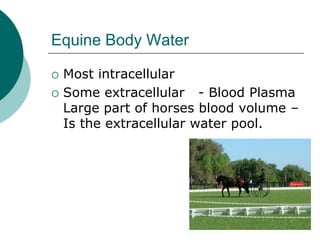
Equine Body Water

   Most intracellular
   Some extracellular - Blood Plasma
    Large part of horses blood volume –
    Is the extracellular water pool.
Plasma Volume Depletion

    Occurs if sweat losses are large
   Horse has less blood flow to the
    muscles
   Dehydration has occurred
   Less sweating
   > body temperature
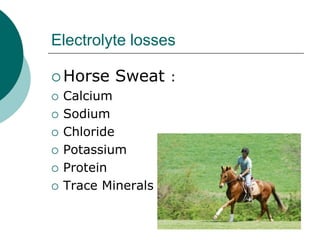
Electrolyte losses

 Horse     Sweat :
   Calcium
   Sodium
   Chloride
   Potassium
   Protein
   Trace Minerals
Electrolyte losses with activity
   Fox Hunter - 3 hours of going (33-148g
    sodium) (12-51g potassium) (63_284g
    chloride)
   Thoroughbred – good gallop (16-23g
    sodium)(12-51g potassium(31-44g
    chloride)
   Endurance Horse at 50 mi.(13-132g
    sodium)(12-48g potassium)(63-252g
    chloride)
   Heavy sweat leads to both electrolyte
    and water loss
Results of electrolyte imbalances

   Acid – Base Imbalance in body
   Muscle cramping, Tying up ,
    Thumps
   Less sweating > body heat
Thirst Response and Desire to Drink

   High sodium loss in horse causes
    less response to drink > plasma
    sodium causes the drinking
    response
    In humans we lose < sodium but
    more water so we want to drink
Questions?
How do we get horses to drink well

   Access to forage – hay = MOST
    IMPORTANT
   Adapt them to drinking strange
    water by flavoring the water at
    home .
   Let them see other horses drinking
   Hold a bucket up for them
Pre-event feeding practices

    Diets that maximize water intake
    and retention
    > dry feed > water consumption
    good Hay
   Mineral block availability
   Electrolyte supplementation in feed

   Water and electrolytes can be
    retained in the large intestine
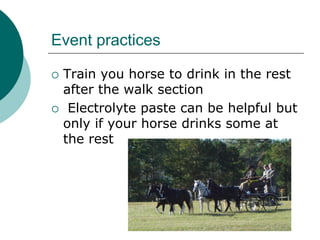
Event practices

   Train you horse to drink in the rest
    after the walk section
    Electrolyte paste can be helpful but
    only if your horse drinks some at
    the rest
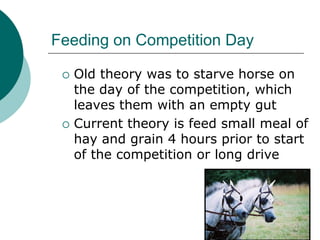
Feeding on Competition Day

    Old theory was to starve horse on
     the day of the competition, which
     leaves them with an empty gut
    Current theory is feed small meal of
     hay and grain 4 hours prior to start
     of the competition or long drive
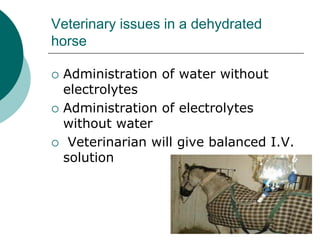
Veterinary issues in a dehydrated
horse

   Administration of water without
    electrolytes
   Administration of electrolytes
    without water
    Veterinarian will give balanced I.V.
    solution
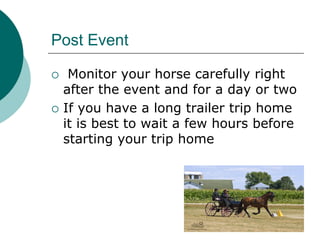
Post Event

    Monitor your horse carefully right
    after the event and for a day or two
   If you have a long trailer trip home
    it is best to wait a few hours before
    starting your trip home
Post Event

    Transportation can be a
    dehydrating experience on its own
    and transporting a dehydrated
    horse may lead to another problem
    like colic
Prevention of overheating

   How much work will the horse do
    and how strenuous will it be above
    and beyond what he has done in the
    past?
   How hot will it be and has your
    horse been trained to acclimate to
    the heat ( do you have an idea of
    his pre work and post work body
    temperatures) Heat Load ?
   How fit is your horse ?
Cooling a Hot Horse

    Apply copious amounts of water
    and scrape it off with a sweat
    scraper
    Use ice cooled water in large
    volumes
   Alcohol is also beneficial
   Get the horse in the shade in the
    breeze or in front of a fan
   Monitor his temperature
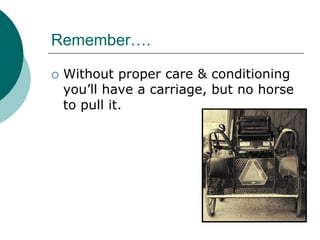
Remember….

   Without proper care & conditioning
    you’ll have a carriage, but no horse
    to pull it.
Thank You!!

Conditioning the driving horse

  • 1.
  • 2.
    Ri Richard J. Forfa, DVM, DipABVP
  • 5.
    Monitoring Heart andRespiratory Rates
  • 6.
    Respiration/Heart Rate  Stethoscope  Heart Rate Monitor -- $$  (Polar Company)
  • 7.
    Objective: Long slowdistance  60 minutes of work at average speed of 8kph  Aerobic endurance = exercise for a prolonged period at low to moderate intensity.  Resting HR = 28-40 bpm  Measure a distance 1-3 kilometers then calculate average speed with a Stopwatch.  Measure pulse or heart rate, 100-160 bpm
  • 8.
    Start your distancecomponent first  For example: Start long slow distances three times per week at a walk and trot.  As the work gets easier for the horse do one long work at the full distance  Then 2-6 shorter conditioning drives at faster speed.  HR may rise to 70-180 bpm.  This work should be accomplished over a minimum of a two week period.
  • 9.
    Conditioning  Cardiovascular: The objective is to raise the aerobic capability while still maintaining sufficient anaerobic power and muscle strength for bursts of high intensity activity. (e.g., pulling a big hill or driving through a hazard)
  • 10.
    Anaerobic conditioning  Later stage of conditioning  Heart rates 170 – 200 bpm  Working horse at fast speeds, on a steep hill, through a hazard or on sandy ground.
  • 11.
  • 12.
    Duration of HighSpeed or Intense Work  Controlled to Minimize Risk or Injury Due to Fatigue or Overloading  Uphill gradients are best at the trot  Load cardiovascular and respiratory systems without high stress to bones and joints
  • 13.
    Respiratory Conditioning  Rate and depth of breathing controlled in part by chemoreceptors which respond to levels of blood O2, CO2, and arterial pH.  Increased respiratory rate- decreased O2, increased CO2, decreased pH
  • 14.
    Respiratory Conditioning  Normal Breaths per minute 12-20  Can go as high as 180 bpm  When exercise stops, horse’s respiration rate will settle to 60-100 bpm  And breaths will be deep until O2 debt is repaired/replaced.  One factor in determining the speed of recovery is the ambient temperature.
  • 15.
    Respiratory Conditioning  If overheating is a problem, the horse will pant.  Panting = Fast and Shallow Breaths  Panting is a heat exchange mechanism.  Panting does NOT provide adequate O2 to lung tissue.
  • 16.
    Thermoregulation  Rectal temperature at rest averages 38° C/100.5° F  During warm up, the body temperature rises about 1 degree F to get muscles up to optimal functional temperature.
  • 17.
    Thermoregulation  The rate of heat build up depends on:  Duration of exercise  Intensity of exercise  Environmental temperature, humidity and wind velocity.  Hydration status of horse  Hair coat and body mass  Body temperature peaks 10 minutes after heavy exercise and should drop to normal within 10-20 minutes.
  • 18.
  • 19.
    Strength Training  Pull up hills  Add weight (gradually!) to carriage to 30-50% over competition weight  Vary traveling surfaces (in moderation)  Deep ground (sand)  Water (provides drag)
  • 20.
    Training Tapering workload prior to competition allows glycogen storage in muscles to be replenished. Do NOT over train.
  • 21.
    Dynamic Suppling  Good warm-up and cool-down  Dressage under saddle  Large and small circles with carriage
  • 22.
    Passive Suppling  Stretching exercises
  • 23.
    Peaking and Tapering  Low level horses 5 days prior to competition  Upper level horses decrease long slow work and add more speed work two (2) weeks before the competition  Allow the horse’s body to be fully hydrated  Allow the horse’s body to have a high storage of glycogen  Feed well prior to competition
  • 24.
    Peaking and Tapering  Exercise daily but decrease level  Allows any minor tissue damage to heal  After a fitness peak, let the horse down slowly over a 2-3 week period.  Stay at a low workload until about halfway to your next fitness peak, then increase work again.
  • 25.
  • 26.
    Heat Dissipation  Exercise = heat production  Dissipation - Most important Evaporation  Sweat facilitates evaporation which leads to high Water and electrolyte losses
  • 27.
    Water  Idle horse, cool day: 28 L/day (4-5 gallons minimum)  Idle horse, hot day: 80 L/day (9-10 gallons minimum)  Exercise increases consumption, need for water
  • 28.
    Fluid losses  Hard to estimate  Weight loss during exercise is about 90% water  Horses body 65% water  Foxhunter 3 hrs of steady going (24-100lbs)  Endurance horse at 50 mi.(22-88lbs)  Thoroughbred after a good gallop(10-15lbs)
  • 29.
    Equine Body Water  Most intracellular  Some extracellular - Blood Plasma Large part of horses blood volume – Is the extracellular water pool.
  • 30.
    Plasma Volume Depletion  Occurs if sweat losses are large  Horse has less blood flow to the muscles  Dehydration has occurred  Less sweating  > body temperature
  • 31.
    Electrolyte losses  Horse Sweat :  Calcium  Sodium  Chloride  Potassium  Protein  Trace Minerals
  • 32.
    Electrolyte losses withactivity  Fox Hunter - 3 hours of going (33-148g sodium) (12-51g potassium) (63_284g chloride)  Thoroughbred – good gallop (16-23g sodium)(12-51g potassium(31-44g chloride)  Endurance Horse at 50 mi.(13-132g sodium)(12-48g potassium)(63-252g chloride)  Heavy sweat leads to both electrolyte and water loss
  • 33.
    Results of electrolyteimbalances  Acid – Base Imbalance in body  Muscle cramping, Tying up , Thumps  Less sweating > body heat
  • 34.
    Thirst Response andDesire to Drink  High sodium loss in horse causes less response to drink > plasma sodium causes the drinking response  In humans we lose < sodium but more water so we want to drink
  • 35.
  • 36.
    How do weget horses to drink well  Access to forage – hay = MOST IMPORTANT  Adapt them to drinking strange water by flavoring the water at home .  Let them see other horses drinking  Hold a bucket up for them
  • 37.
    Pre-event feeding practices  Diets that maximize water intake and retention  > dry feed > water consumption good Hay  Mineral block availability  Electrolyte supplementation in feed  Water and electrolytes can be retained in the large intestine
  • 38.
    Event practices  Train you horse to drink in the rest after the walk section  Electrolyte paste can be helpful but only if your horse drinks some at the rest
  • 39.
    Feeding on CompetitionDay  Old theory was to starve horse on the day of the competition, which leaves them with an empty gut  Current theory is feed small meal of hay and grain 4 hours prior to start of the competition or long drive
  • 40.
    Veterinary issues ina dehydrated horse  Administration of water without electrolytes  Administration of electrolytes without water  Veterinarian will give balanced I.V. solution
  • 41.
    Post Event  Monitor your horse carefully right after the event and for a day or two  If you have a long trailer trip home it is best to wait a few hours before starting your trip home
  • 42.
    Post Event  Transportation can be a dehydrating experience on its own and transporting a dehydrated horse may lead to another problem like colic
  • 43.
    Prevention of overheating  How much work will the horse do and how strenuous will it be above and beyond what he has done in the past?  How hot will it be and has your horse been trained to acclimate to the heat ( do you have an idea of his pre work and post work body temperatures) Heat Load ?  How fit is your horse ?
  • 44.
    Cooling a HotHorse  Apply copious amounts of water and scrape it off with a sweat scraper  Use ice cooled water in large volumes  Alcohol is also beneficial  Get the horse in the shade in the breeze or in front of a fan  Monitor his temperature
  • 45.
    Remember….  Without proper care & conditioning you’ll have a carriage, but no horse to pull it.
  • 46.