Conditionals
Conditionals
• What are conditional sentences?
• How many parts are there in a conditional sentence?
• What form of the verb is used in the main clause if
the if clause is in simple present?
• What structure of conditional sentences should be
used if we want to express an unlikely situation?
• What form of the verb is used in the main clause if
the if clause is in past perfect tense?
Conditionals
• A sentence that contains a condition is called
a conditional sentence. There are two parts in
a conditional sentence: the main clause and the if
clause.
• if clause main clause
simple present will/shall/ can/ may + verb
• We may also use unless in place of if (unless =
if…not).
Sometimes, it’s possible to use the simple present
tense in both the clauses.
Type 1 conditional
• The type 1 conditional is used to refer to the present or
future where the situation is real. The type 1 conditional
refers to a possible condition and its probable result. In these
sentences the if clause is in the simple present, and the main
clause is in the simple future.
If clause Main clause
If + simple present simple future
If this thing happens that thing will happen.
If you don't hurry you will miss the train.
If it rains today you will get wet.
Type 2 conditional
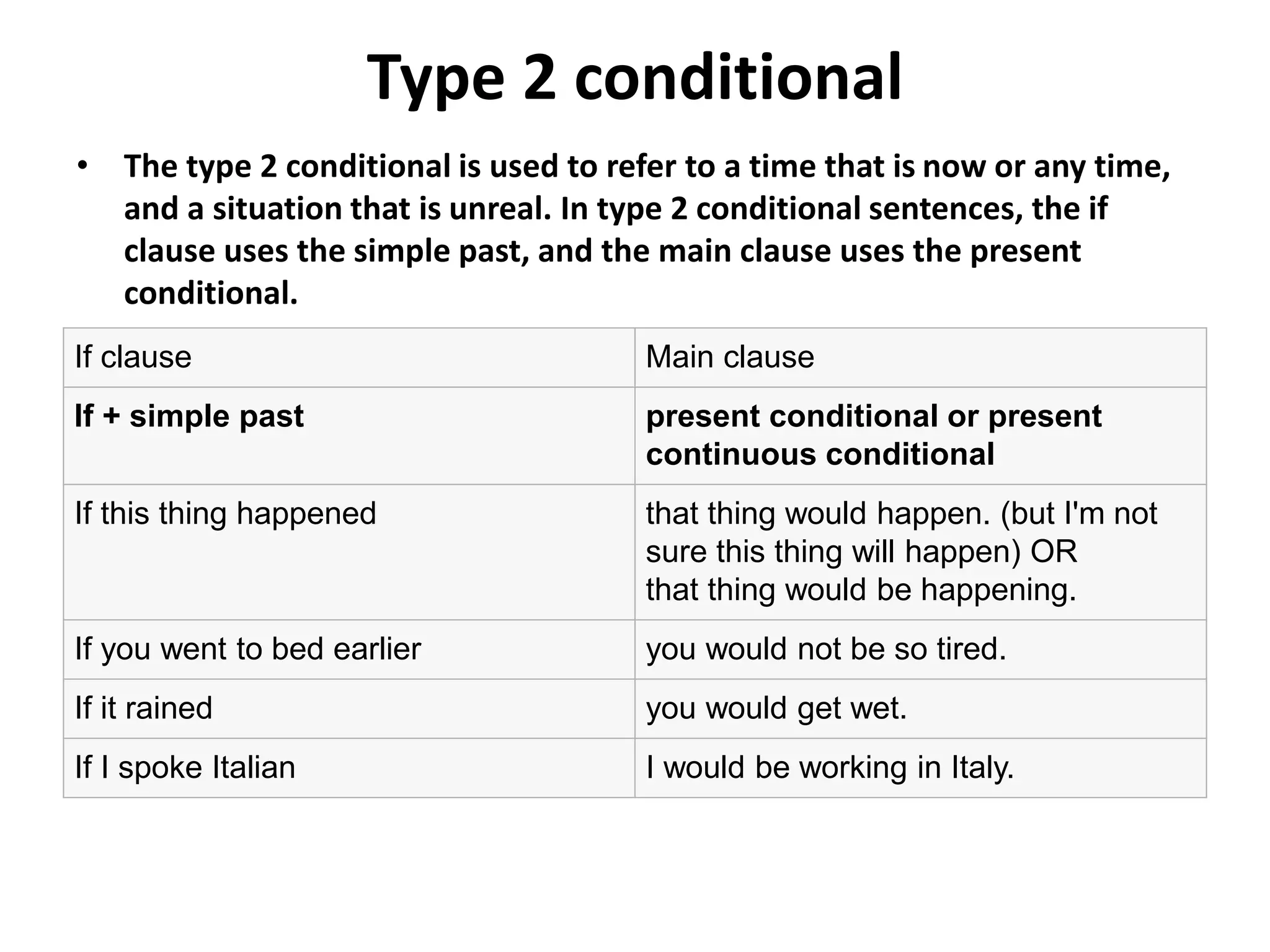
• The type 2 conditional is used to refer to a time that is now or any time,
and a situation that is unreal. In type 2 conditional sentences, the if
clause uses the simple past, and the main clause uses the present
conditional.
If clause Main clause
If + simple past present conditional or present
continuous conditional
If this thing happened that thing would happen. (but I'm not
sure this thing will happen) OR
that thing would be happening.
If you went to bed earlier you would not be so tired.
If it rained you would get wet.
If I spoke Italian I would be working in Italy.
Type 3 conditional
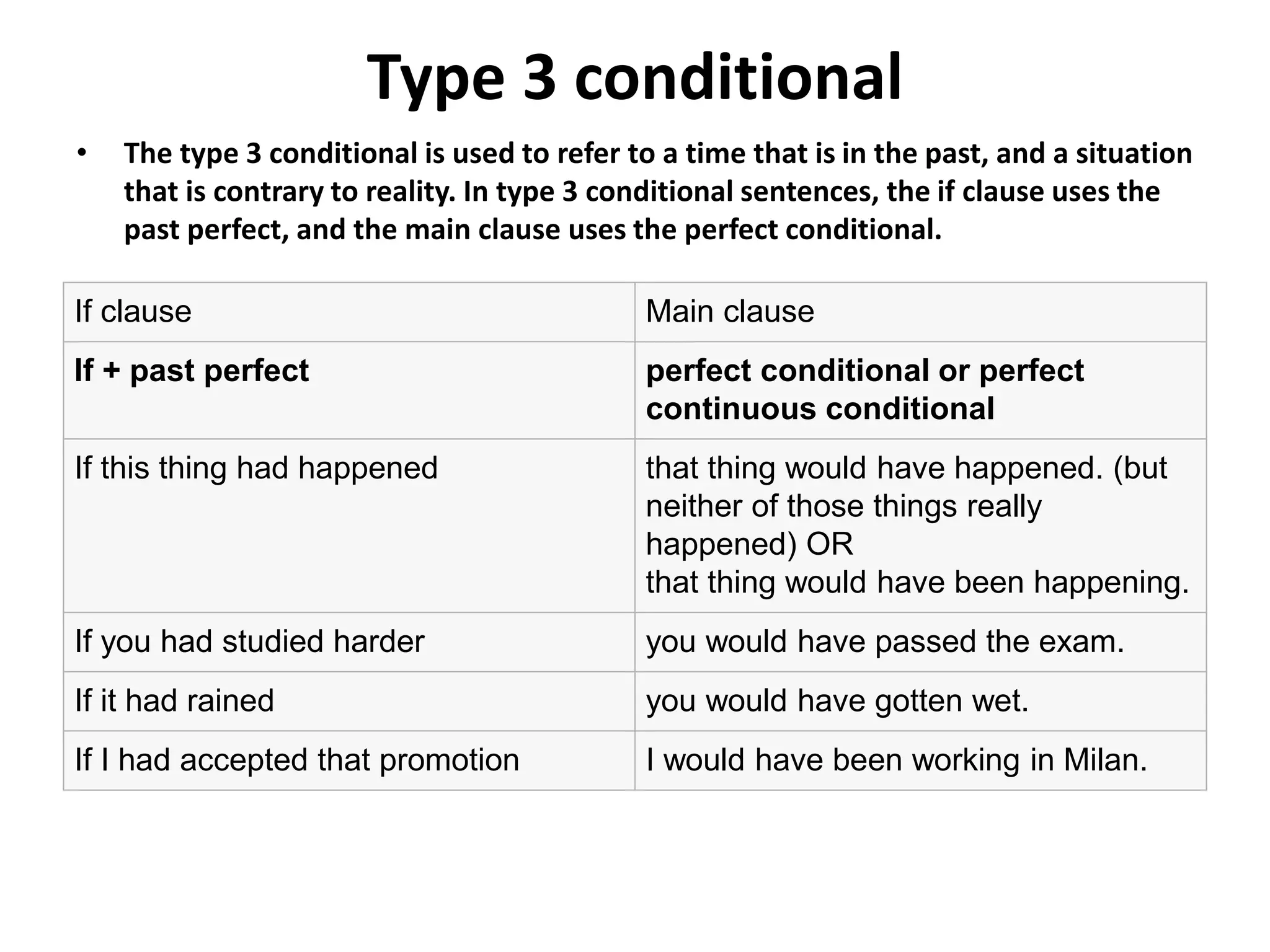
• The type 3 conditional is used to refer to a time that is in the past, and a situation
that is contrary to reality. In type 3 conditional sentences, the if clause uses the
past perfect, and the main clause uses the perfect conditional.
If clause Main clause
If + past perfect perfect conditional or perfect
continuous conditional
If this thing had happened that thing would have happened. (but
neither of those things really
happened) OR
that thing would have been happening.
If you had studied harder you would have passed the exam.
If it had rained you would have gotten wet.
If I had accepted that promotion I would have been working in Milan.
Complete the sentence with a verb in the correct form.
1. (First conditional) If we __________________ (not / work) harder, we __________________
(not pass) the exam.
2. (Third conditional) If the students __________________ (not be) late for the exam, they
__________________ (pass).
3. (Third conditional) If the weather __________________ (not be) so cold, we
__________________ (go) to the beach.
4. (Second conditional) If she __________________ (have) her laptop with her, she
__________________ (email) me.
5. (First conditional) If she __________________ (not go) to the meeting, I
__________________ (not go) either.
6. (Third conditional) If the baby __________________ (sleep) better last night, I
__________________ (not be) so tired.
7. (First conditional) If the teacher __________________ (give) us lots of homework this
weekend, I __________________ (not be) happy.
8. (Second conditional) If Lucy __________________ (have) enough time, she
__________________ (travel) more.
9. (First conditional) If the children __________________ (not eat) soon, they
__________________ (be) grumpy.
10. (First conditional) If I __________________ (not go) to bed soon, I __________________
(be) tired in the morning.

Conditionals.pptx

  • 1.
  • 2.
    Conditionals • What areconditional sentences? • How many parts are there in a conditional sentence? • What form of the verb is used in the main clause if the if clause is in simple present? • What structure of conditional sentences should be used if we want to express an unlikely situation? • What form of the verb is used in the main clause if the if clause is in past perfect tense?
  • 3.
    Conditionals • A sentencethat contains a condition is called a conditional sentence. There are two parts in a conditional sentence: the main clause and the if clause. • if clause main clause simple present will/shall/ can/ may + verb • We may also use unless in place of if (unless = if…not). Sometimes, it’s possible to use the simple present tense in both the clauses.
  • 4.
    Type 1 conditional •The type 1 conditional is used to refer to the present or future where the situation is real. The type 1 conditional refers to a possible condition and its probable result. In these sentences the if clause is in the simple present, and the main clause is in the simple future. If clause Main clause If + simple present simple future If this thing happens that thing will happen. If you don't hurry you will miss the train. If it rains today you will get wet.
  • 5.
    Type 2 conditional •The type 2 conditional is used to refer to a time that is now or any time, and a situation that is unreal. In type 2 conditional sentences, the if clause uses the simple past, and the main clause uses the present conditional. If clause Main clause If + simple past present conditional or present continuous conditional If this thing happened that thing would happen. (but I'm not sure this thing will happen) OR that thing would be happening. If you went to bed earlier you would not be so tired. If it rained you would get wet. If I spoke Italian I would be working in Italy.
  • 6.
    Type 3 conditional •The type 3 conditional is used to refer to a time that is in the past, and a situation that is contrary to reality. In type 3 conditional sentences, the if clause uses the past perfect, and the main clause uses the perfect conditional. If clause Main clause If + past perfect perfect conditional or perfect continuous conditional If this thing had happened that thing would have happened. (but neither of those things really happened) OR that thing would have been happening. If you had studied harder you would have passed the exam. If it had rained you would have gotten wet. If I had accepted that promotion I would have been working in Milan.
  • 7.
    Complete the sentencewith a verb in the correct form. 1. (First conditional) If we __________________ (not / work) harder, we __________________ (not pass) the exam. 2. (Third conditional) If the students __________________ (not be) late for the exam, they __________________ (pass). 3. (Third conditional) If the weather __________________ (not be) so cold, we __________________ (go) to the beach. 4. (Second conditional) If she __________________ (have) her laptop with her, she __________________ (email) me. 5. (First conditional) If she __________________ (not go) to the meeting, I __________________ (not go) either. 6. (Third conditional) If the baby __________________ (sleep) better last night, I __________________ (not be) so tired. 7. (First conditional) If the teacher __________________ (give) us lots of homework this weekend, I __________________ (not be) happy. 8. (Second conditional) If Lucy __________________ (have) enough time, she __________________ (travel) more. 9. (First conditional) If the children __________________ (not eat) soon, they __________________ (be) grumpy. 10. (First conditional) If I __________________ (not go) to bed soon, I __________________ (be) tired in the morning.