ConditionalConditional
sentencessentences
Teacher Marilene dos Santos
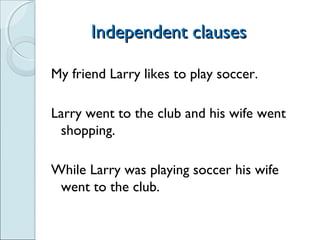
Independent clausesIndependent clauses
My friend Larry likes to play soccer.
Larry went to the club and his wife went
shopping.
While Larry was playing soccer his wife
went to the club.
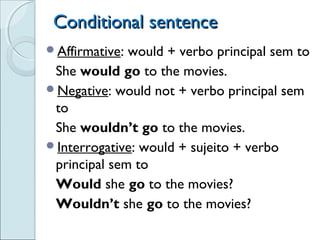
Conditional sentenceConditional sentence
Affirmative: would + verbo principal sem to
She would go to the movies.
Negative: would not + verbo principal sem
to
She wouldn’t go to the movies.
Interrogative: would + sujeito + verbo
principal sem to
Would she go to the movies?
Wouldn’t she go to the movies?
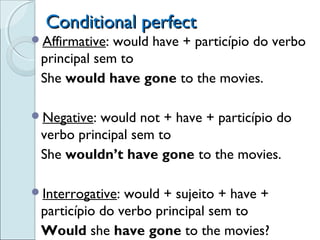
Conditional perfectConditional perfect
Affirmative: would have + particípio do verbo
principal sem to
She would have gone to the movies.
Negative: would not + have + particípio do
verbo principal sem to
She wouldn’t have gone to the movies.
Interrogative: would + sujeito + have +
particípio do verbo principal sem to
Would she have gone to the movies?
CONDITIONALCONDITIONAL
SENTENCES –SENTENCES –
IF-CLAUSESIF-CLAUSES
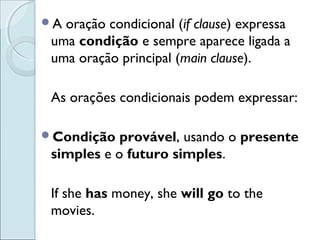
A oração condicional (if clause) expressa
uma condição e sempre aparece ligada a
uma oração principal (main clause).
As orações condicionais podem expressar:
Condição provável, usando o presente
simples e o futuro simples.
If she has money, she will go to the
movies.
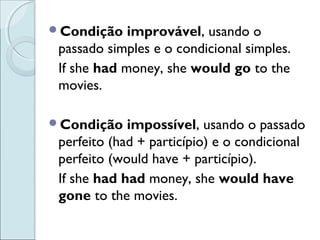
Condição improvável, usando o
passado simples e o condicional simples.
If she had money, she would go to the
movies.
Condição impossível, usando o passado
perfeito (had + particípio) e o condicional
perfeito (would have + particípio).
If she had had money, she would have
gone to the movies.
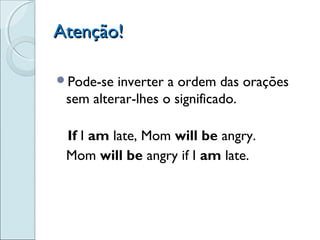
Atenção!Atenção!
Pode-se inverter a ordem das orações
sem alterar-lhes o significado.
If I am late, Mom will be angry.
Mom will be angry if I am late.
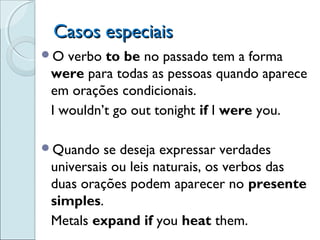
Casos especiaisCasos especiais
O verbo to be no passado tem a forma
were para todas as pessoas quando aparece
em orações condicionais.
I wouldn’t go out tonight if I were you.
Quando se deseja expressar verdades
universais ou leis naturais, os verbos das
duas orações podem aparecer no presente
simples.
Metals expand if you heat them.
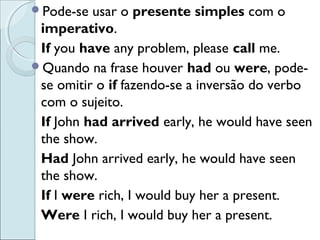
Pode-se usar o presente simples com o
imperativo.
If you have any problem, please call me.
Quando na frase houver had ou were, pode-
se omitir o if fazendo-se a inversão do verbo
com o sujeito.
If John had arrived early, he would have seen
the show.
Had John arrived early, he would have seen
the show.
If I were rich, I would buy her a present.
Were I rich, I would buy her a present.
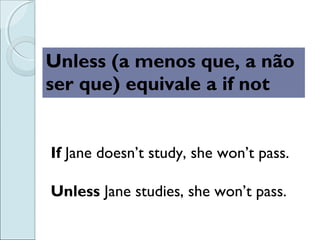
Unless (a menos que, a não
ser que) equivale a if not
If Jane doesn’t study, she won’t pass.
Unless Jane studies, she won’t pass.
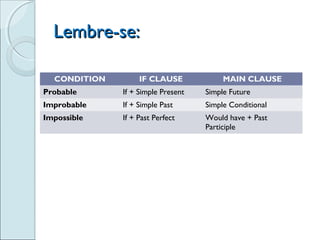
Lembre-se:Lembre-se:
CONDITION IF CLAUSE MAIN CLAUSE
Probable If + Simple Present Simple Future
Improbable If + Simple Past Simple Conditional
Impossible If + Past Perfect Would have + Past
Participle
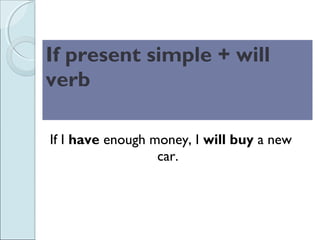
If I have enough money, I will buy a new
car.
If present simple + will
verb
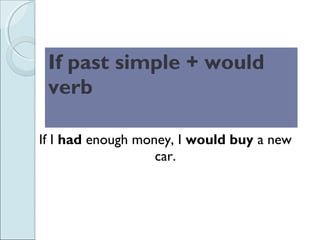
If I had enough money, I would buy a new
car.
If past simple + would
verb
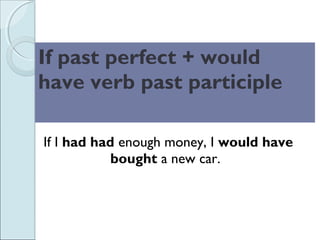
If I had had enough money, I would have
bought a new car.
If past perfect + would
have verb past participle
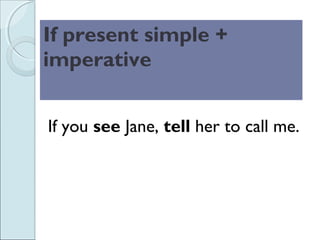
If present simple +
imperative
If you see Jane, tell her to call me.
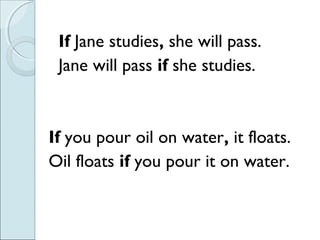
If Jane studies, she will pass.
Jane will pass if she studies.
If you pour oil on water, it floats.
Oil floats if you pour it on water.
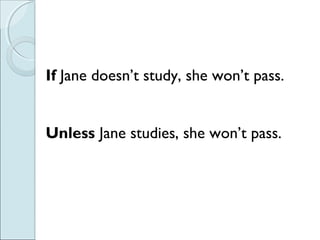
If Jane doesn’t study, she won’t pass.
Unless Jane studies, she won’t pass.

Conditional sentenses if clauses

  • 1.
  • 2.
    Independent clausesIndependent clauses Myfriend Larry likes to play soccer. Larry went to the club and his wife went shopping. While Larry was playing soccer his wife went to the club.
  • 3.
    Conditional sentenceConditional sentence Affirmative:would + verbo principal sem to She would go to the movies. Negative: would not + verbo principal sem to She wouldn’t go to the movies. Interrogative: would + sujeito + verbo principal sem to Would she go to the movies? Wouldn’t she go to the movies?
  • 4.
    Conditional perfectConditional perfect Affirmative:would have + particípio do verbo principal sem to She would have gone to the movies. Negative: would not + have + particípio do verbo principal sem to She wouldn’t have gone to the movies. Interrogative: would + sujeito + have + particípio do verbo principal sem to Would she have gone to the movies?
  • 5.
  • 6.
    A oração condicional(if clause) expressa uma condição e sempre aparece ligada a uma oração principal (main clause). As orações condicionais podem expressar: Condição provável, usando o presente simples e o futuro simples. If she has money, she will go to the movies.
  • 7.
    Condição improvável, usandoo passado simples e o condicional simples. If she had money, she would go to the movies. Condição impossível, usando o passado perfeito (had + particípio) e o condicional perfeito (would have + particípio). If she had had money, she would have gone to the movies.
  • 8.
    Atenção!Atenção! Pode-se inverter aordem das orações sem alterar-lhes o significado. If I am late, Mom will be angry. Mom will be angry if I am late.
  • 9.
    Casos especiaisCasos especiais Overbo to be no passado tem a forma were para todas as pessoas quando aparece em orações condicionais. I wouldn’t go out tonight if I were you. Quando se deseja expressar verdades universais ou leis naturais, os verbos das duas orações podem aparecer no presente simples. Metals expand if you heat them.
  • 10.
    Pode-se usar opresente simples com o imperativo. If you have any problem, please call me. Quando na frase houver had ou were, pode- se omitir o if fazendo-se a inversão do verbo com o sujeito. If John had arrived early, he would have seen the show. Had John arrived early, he would have seen the show. If I were rich, I would buy her a present. Were I rich, I would buy her a present.
  • 11.
    Unless (a menosque, a não ser que) equivale a if not If Jane doesn’t study, she won’t pass. Unless Jane studies, she won’t pass.
  • 12.
    Lembre-se:Lembre-se: CONDITION IF CLAUSEMAIN CLAUSE Probable If + Simple Present Simple Future Improbable If + Simple Past Simple Conditional Impossible If + Past Perfect Would have + Past Participle
  • 13.
    If I haveenough money, I will buy a new car. If present simple + will verb
  • 14.
    If I hadenough money, I would buy a new car. If past simple + would verb
  • 15.
    If I hadhad enough money, I would have bought a new car. If past perfect + would have verb past participle
  • 16.
    If present simple+ imperative If you see Jane, tell her to call me.
  • 17.
    If Jane studies,she will pass. Jane will pass if she studies. If you pour oil on water, it floats. Oil floats if you pour it on water.
  • 18.
    If Jane doesn’tstudy, she won’t pass. Unless Jane studies, she won’t pass.