DIRECTDIRECT
ANDAND
INDIRECTINDIRECT
SPEECHSPEECH
Teacher Marilene dos Santos
Há duas formas de relatar o que alguém disse:
pelo discurso direto, quando repetimos o que foi
dito usando as mesmas palavras da pessoa, e
pelo discurso indireto, quando contamos com
nossas próprias palavras o que foi dito.
John said: “I work every day.”
(discurso direto)
John said that he worked every day.
(discurso indireto)
SAY / TELL
São os verbos mais comuns que introduzem o
discurso indireto.
 Se disser com quem está falando, usa-se tell.
He told her he was feeling worn out.
(Ele disse que estava se sentido exausto.)
 Se quer mencionar com quem está falando e
estiver usando o verbo say, deve se acrescentar
to.
He said to Ana…
(Ele disse para Ana…)
TEMPO VERBAL
Simple Present
He said: “I have a test today.”
Simple Past
He said that he had a test that
day.
Simple Past
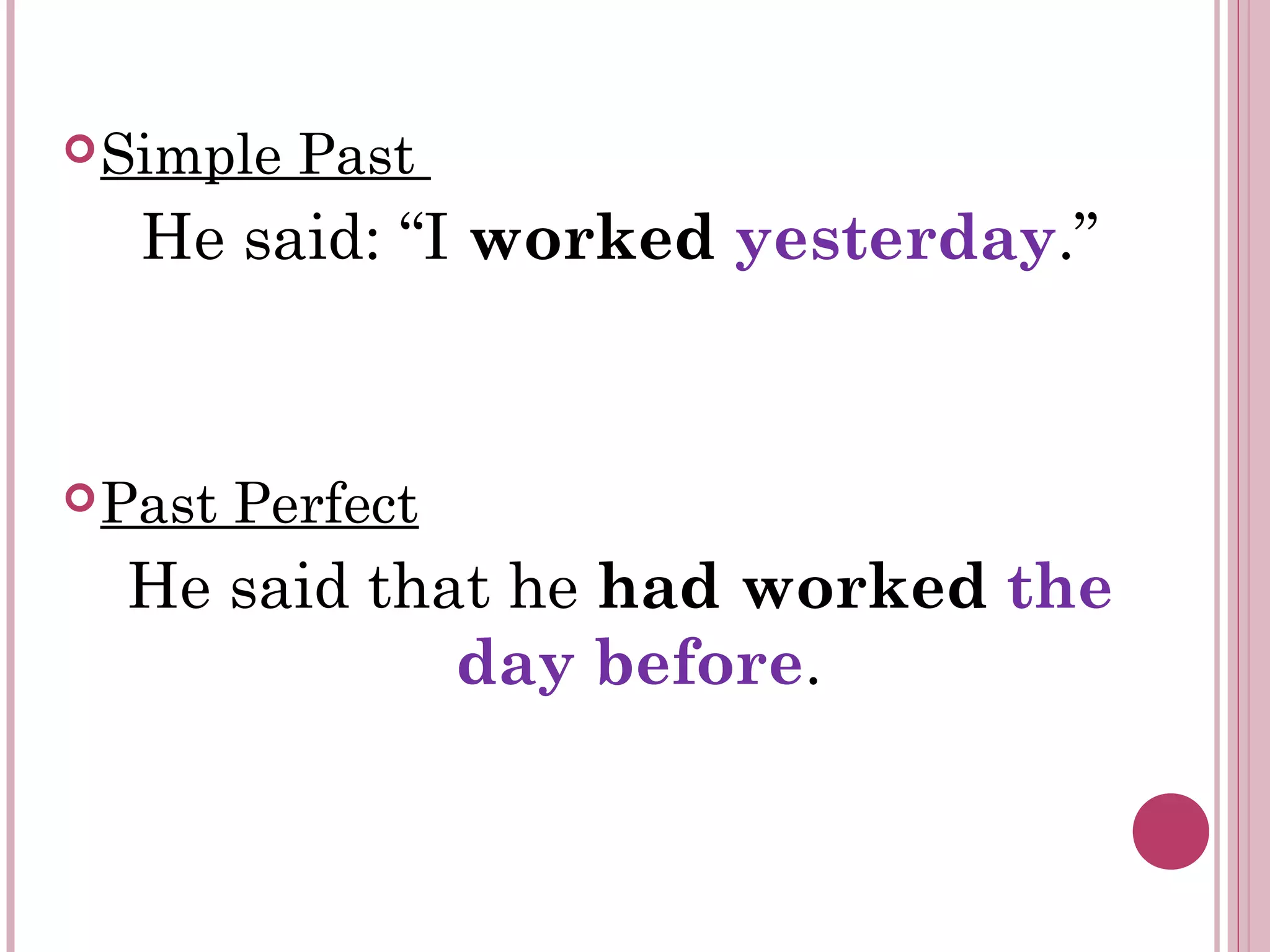
He said: “I worked yesterday.”
Past Perfect
He said that he had worked the
day before.
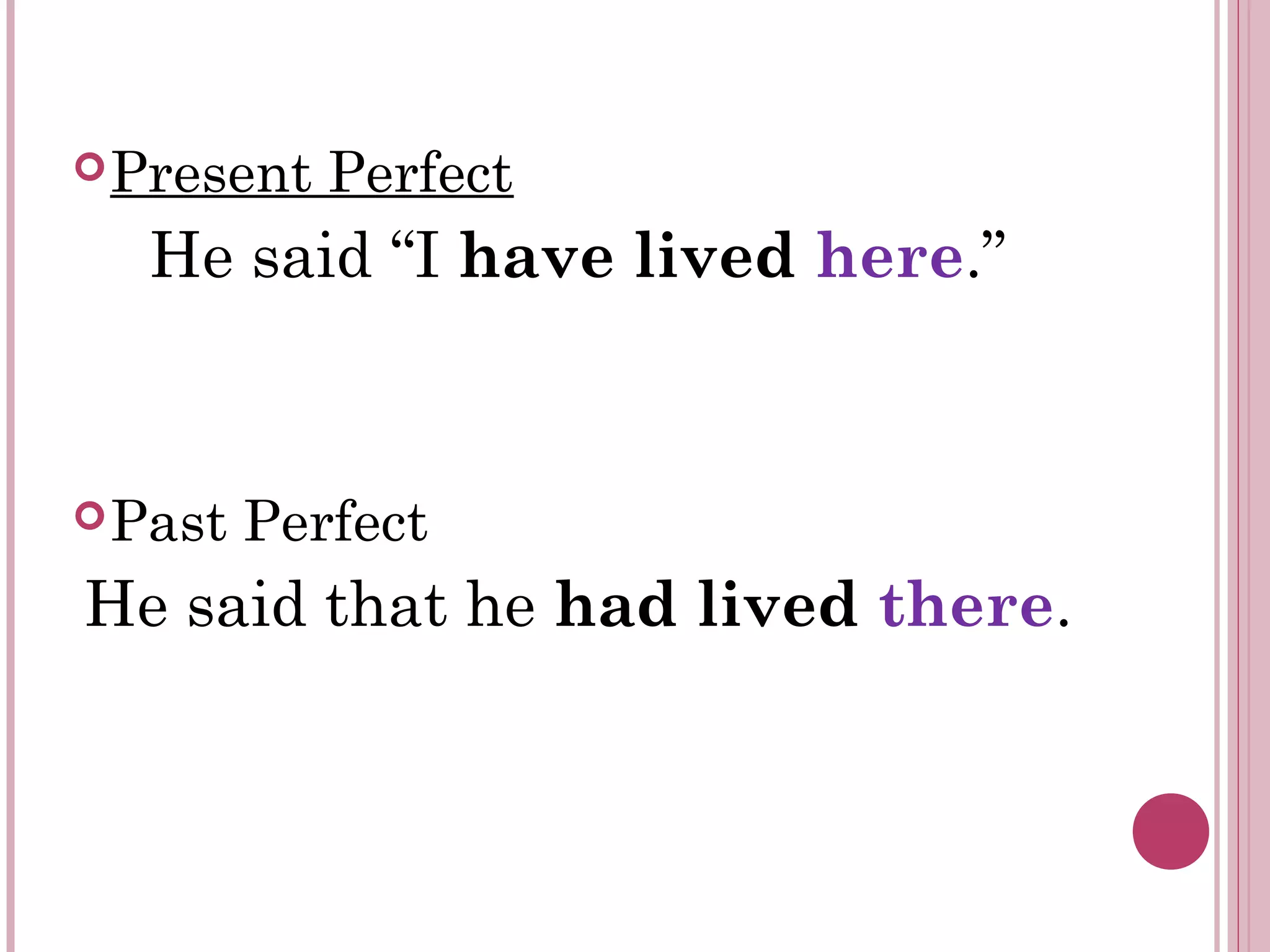
Present Perfect
He said “I have lived here.”
Past Perfect
He said that he had lived there.
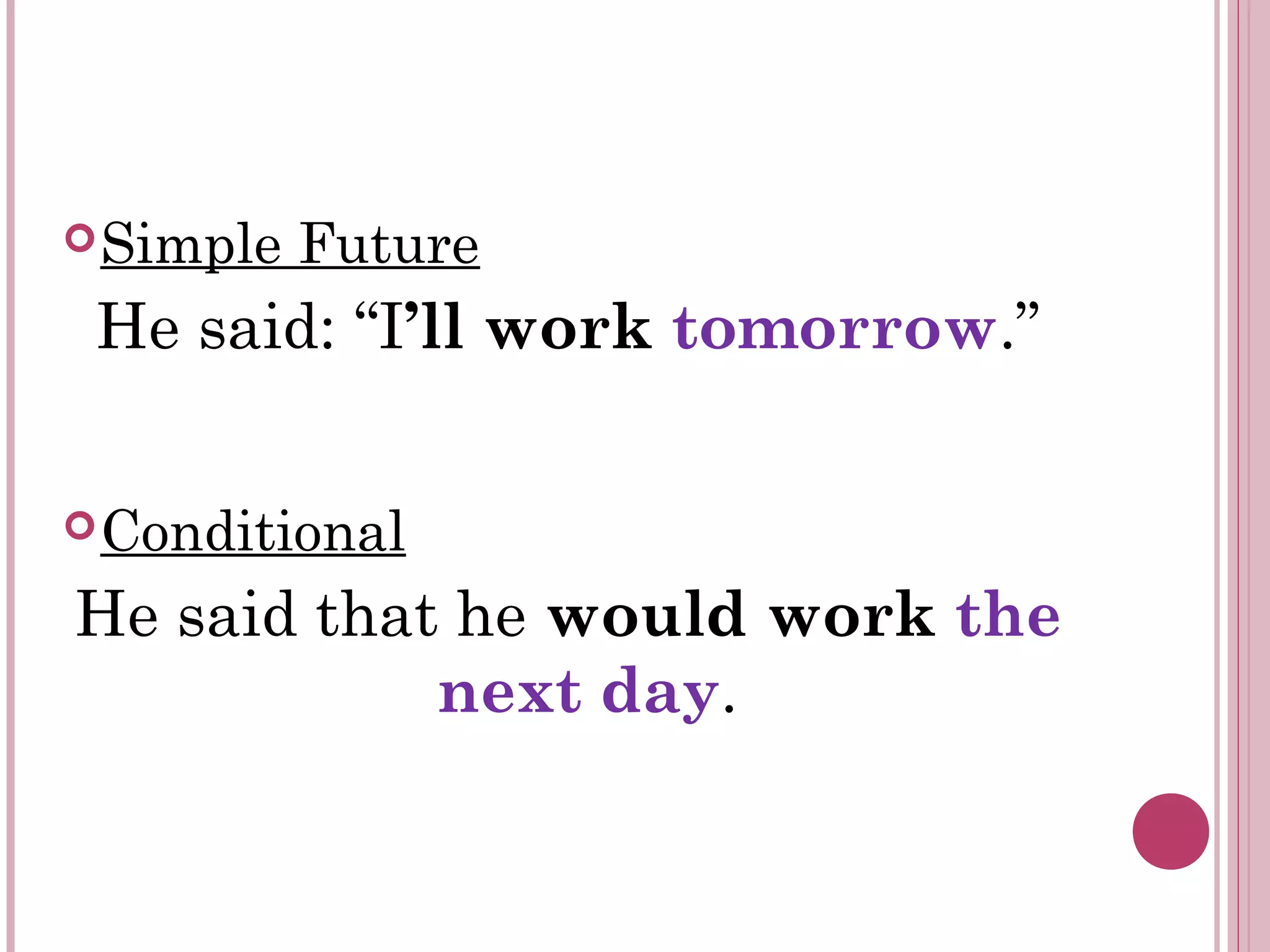
Simple Future
He said: “I’ll work tomorrow.”
Conditional
He said that he would work the
next day.
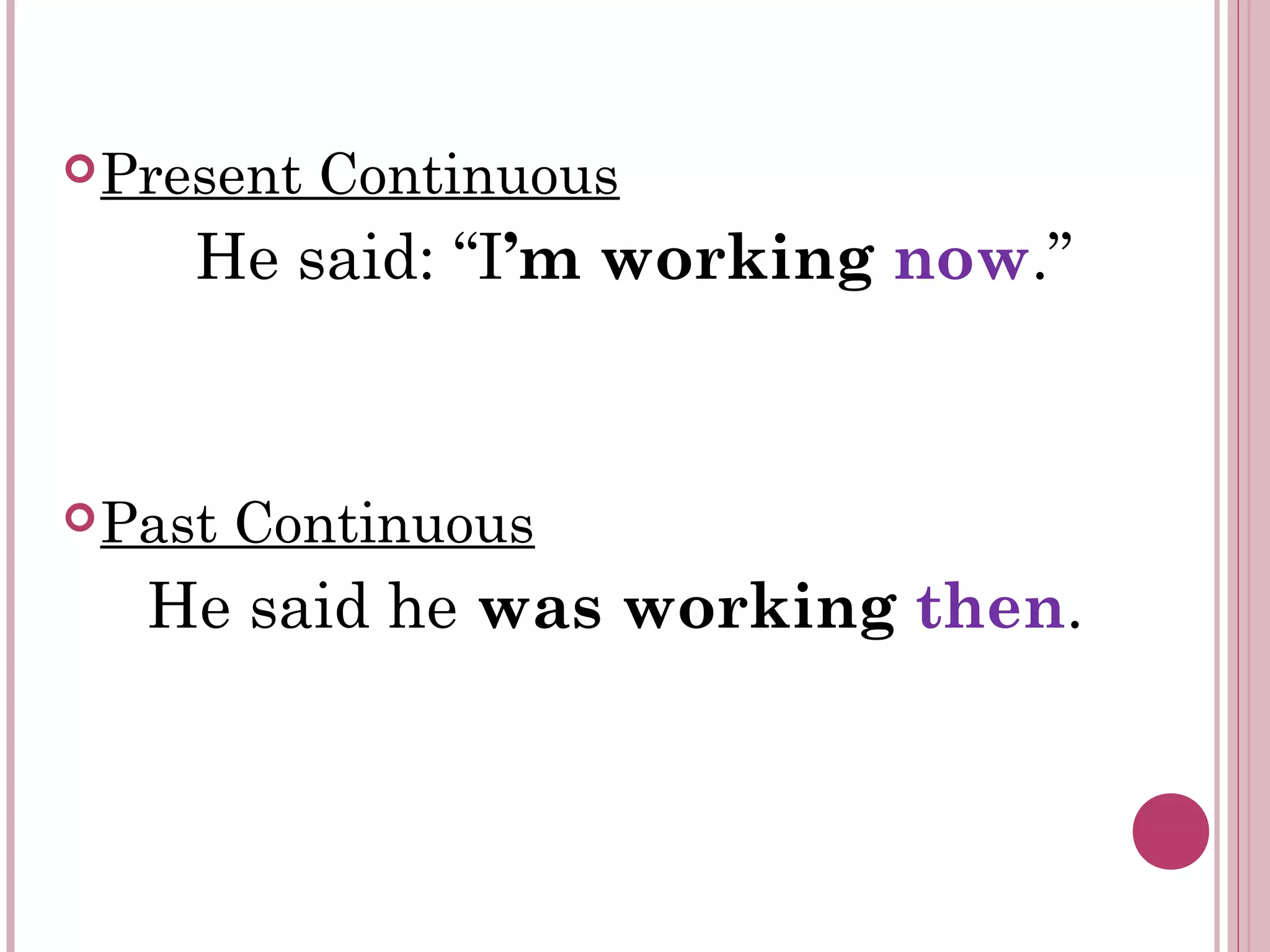
Present Continuous
He said: “I’m working now.”
Past Continuous
He said he was working then.
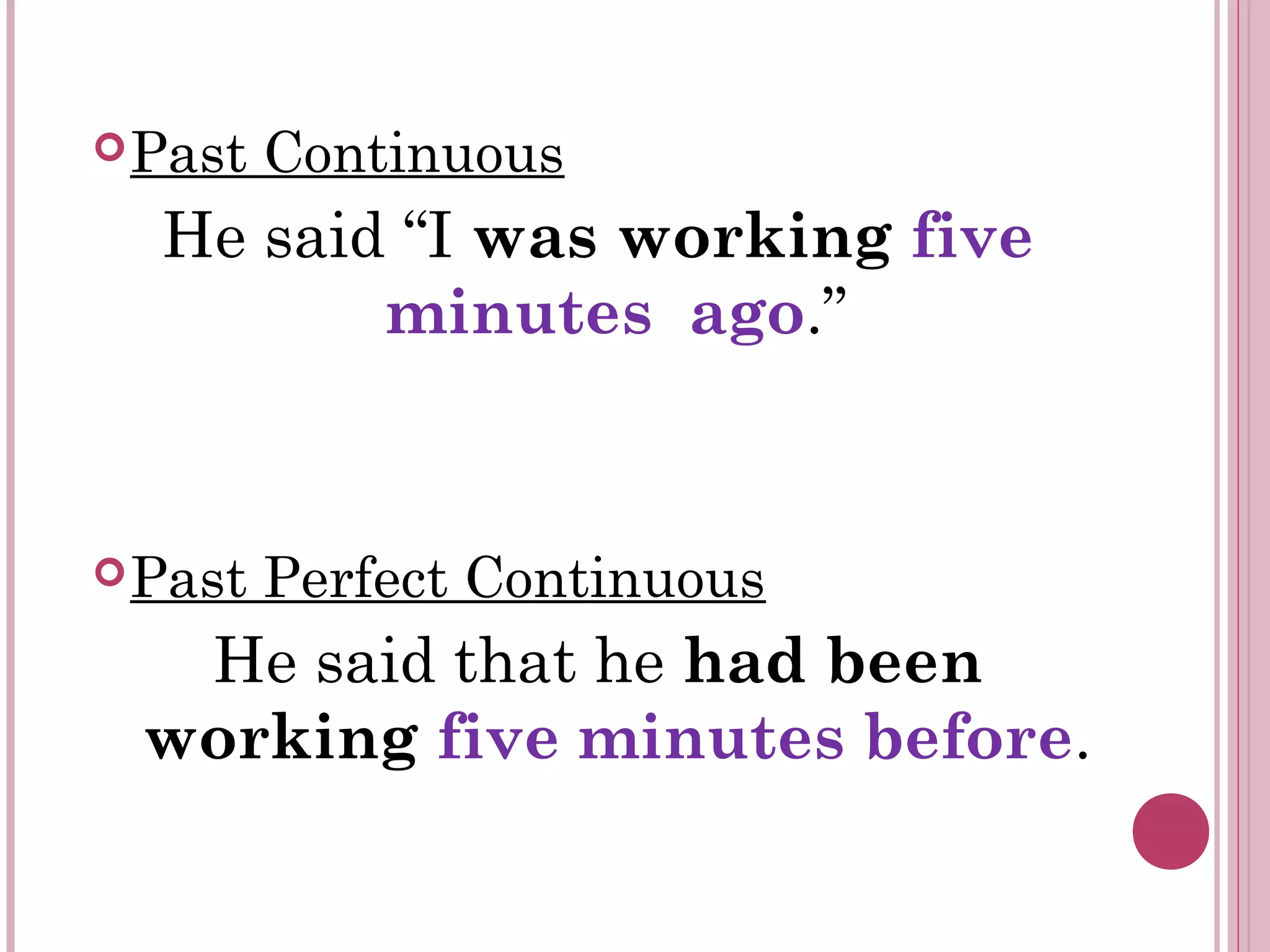
Past Continuous
He said “I was working five
minutes ago.”
Past Perfect Continuous
He said that he had been
working five minutes before.
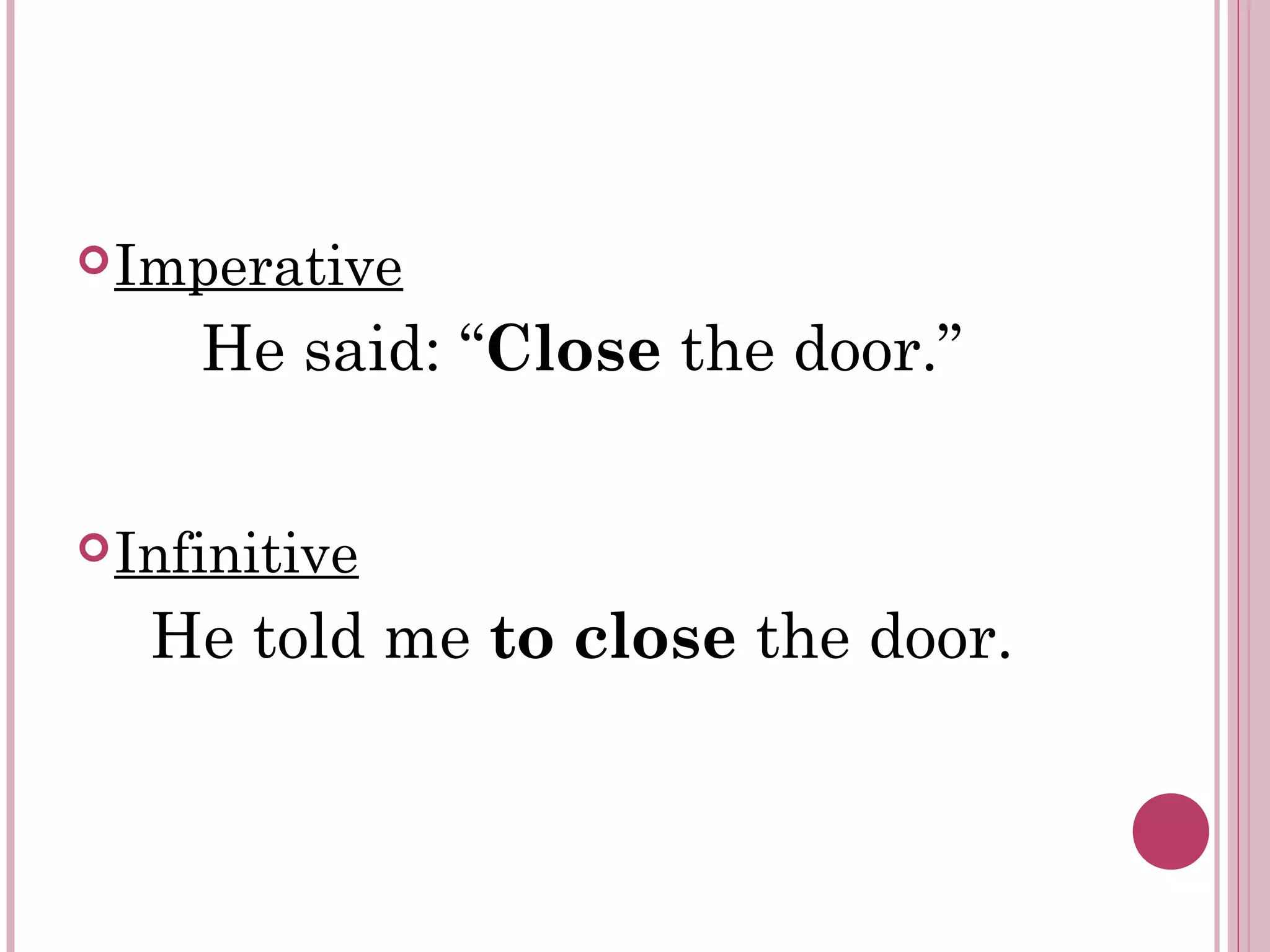
Imperative
He said: “Close the door.”
Infinitive
He told me to close the door.
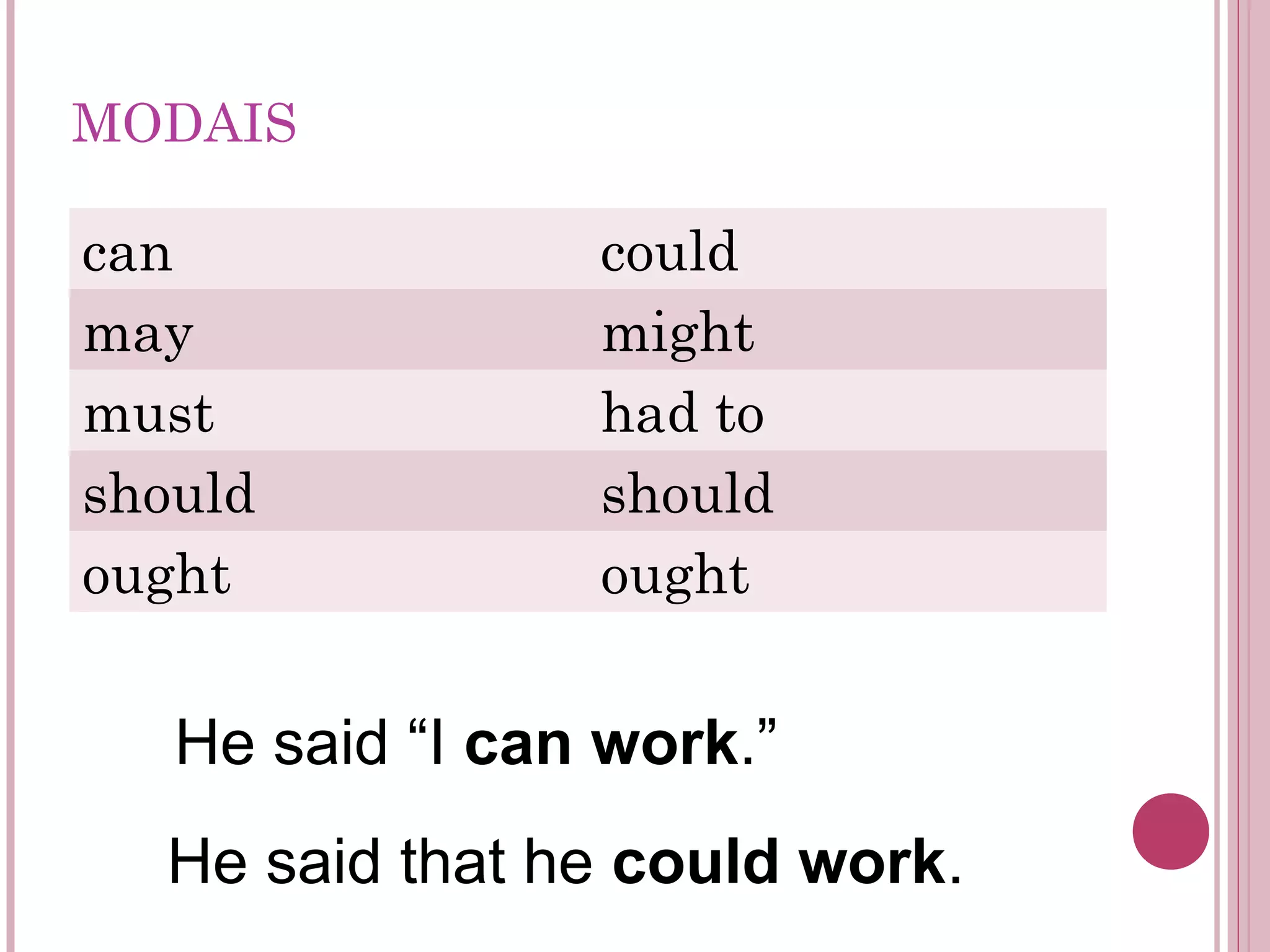
MODAIS
can could
may might
must had to
should should
ought ought
He said “I can work.”
He said that he could work.
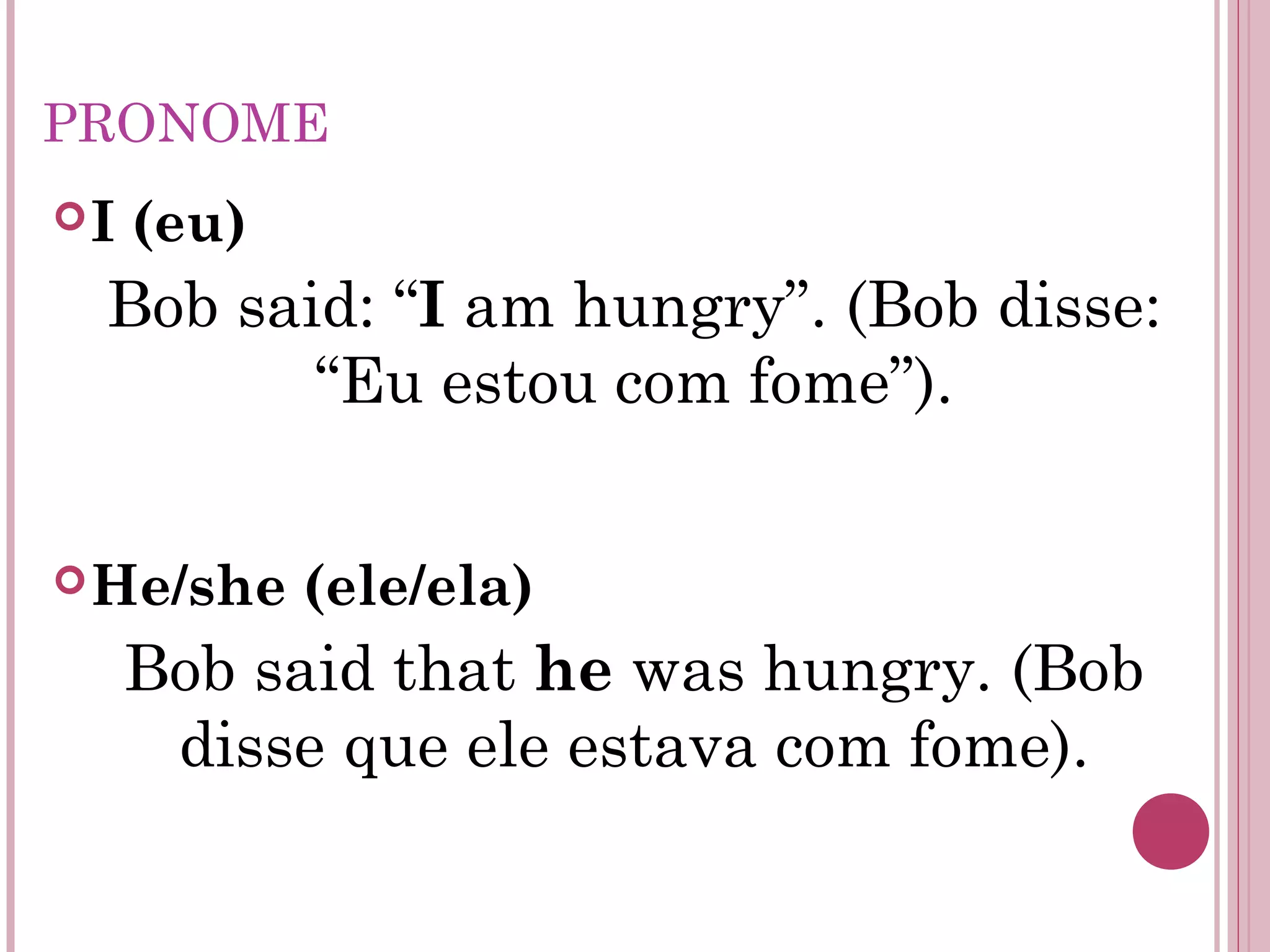
PRONOME
I (eu)
Bob said: “I am hungry”. (Bob disse:
“Eu estou com fome”).
He/she (ele/ela)
Bob said that he was hungry. (Bob
disse que ele estava com fome).
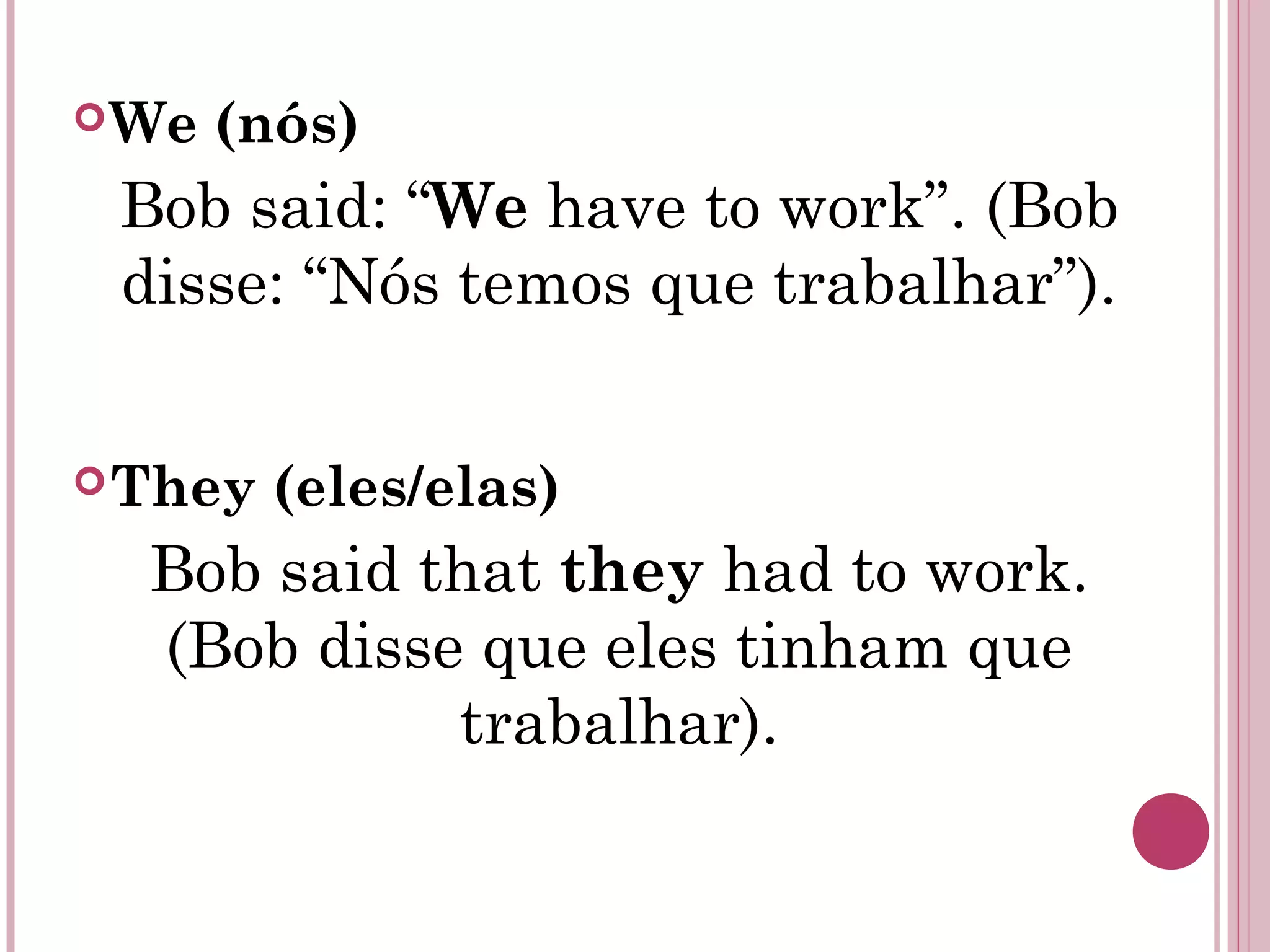
We (nós)
Bob said: “We have to work”. (Bob
disse: “Nós temos que trabalhar”).
They (eles/elas)
Bob said that they had to work.
(Bob disse que eles tinham que
trabalhar).
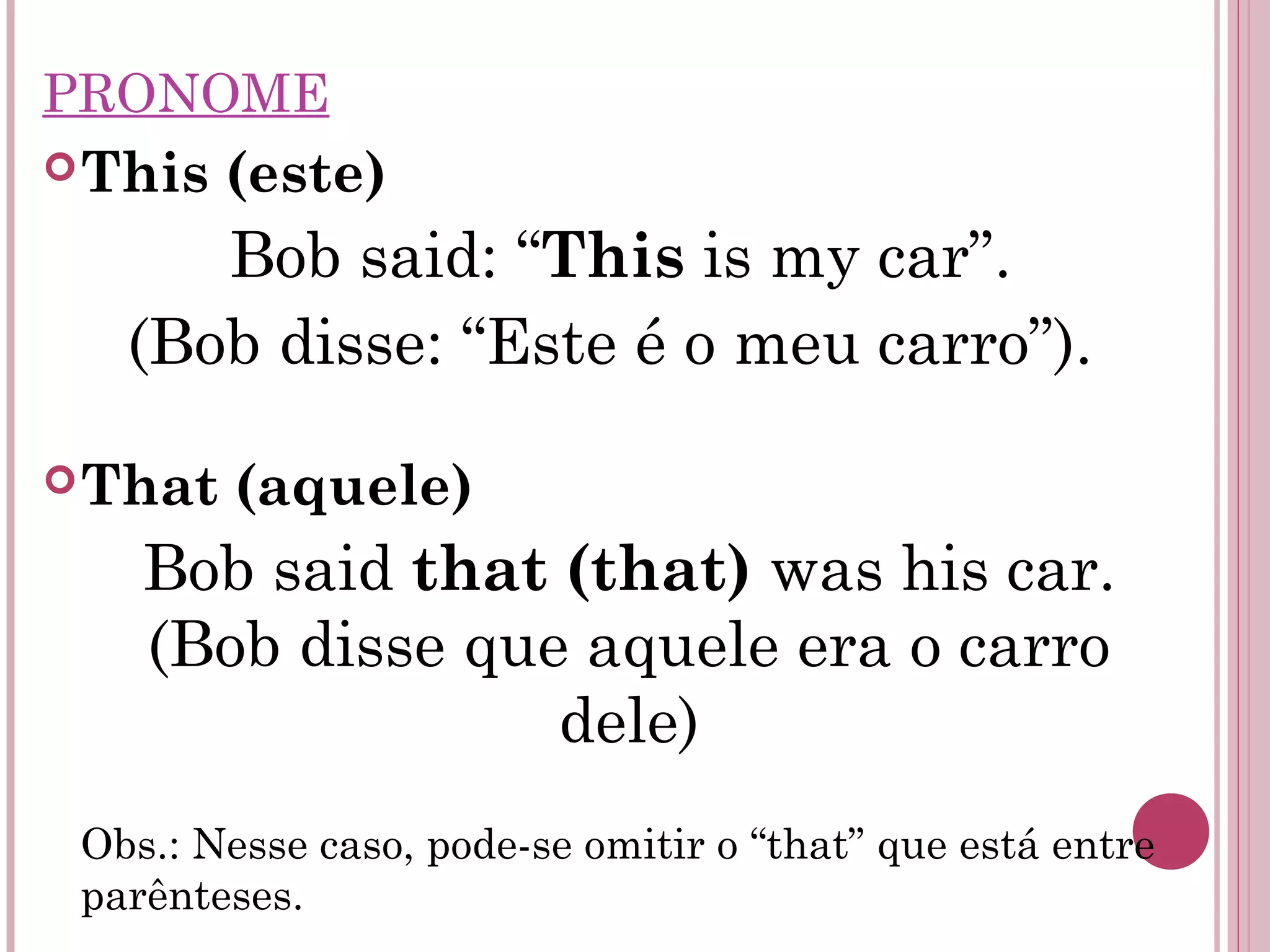
PRONOME
This (este)
Bob said: “This is my car”.
(Bob disse: “Este é o meu carro”).
That (aquele)
Bob said that (that) was his car.
(Bob disse que aquele era o carro
dele)
Obs.: Nesse caso, pode-se omitir o “that” que está entre
parênteses.
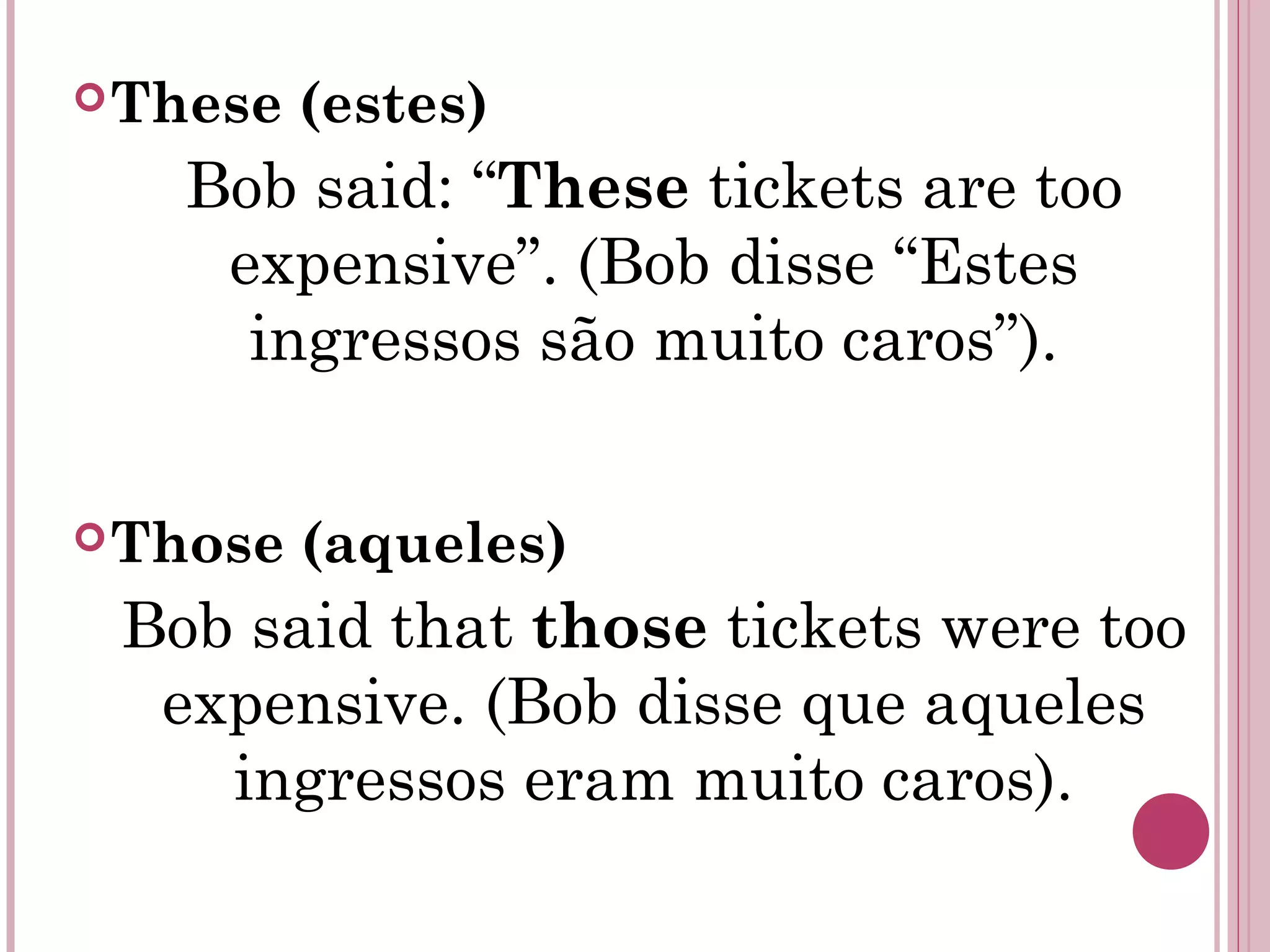
These (estes)
Bob said: “These tickets are too
expensive”. (Bob disse “Estes
ingressos são muito caros”).
Those (aqueles)
Bob said that those tickets were too
expensive. (Bob disse que aqueles
ingressos eram muito caros).
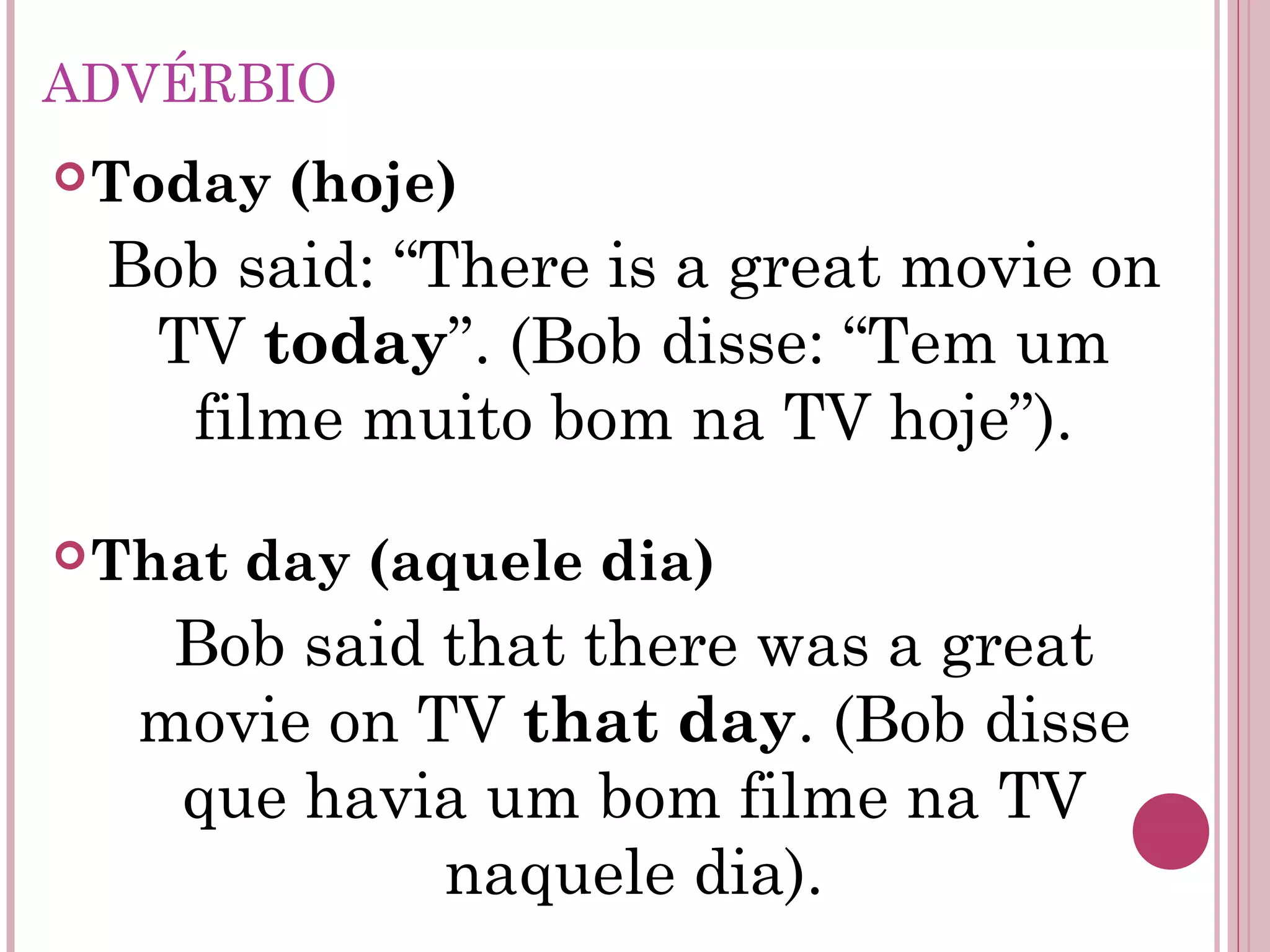
ADVÉRBIO
Today (hoje)
Bob said: “There is a great movie on
TV today”. (Bob disse: “Tem um
filme muito bom na TV hoje”).
That day (aquele dia)
Bob said that there was a great
movie on TV that day. (Bob disse
que havia um bom filme na TV
naquele dia).
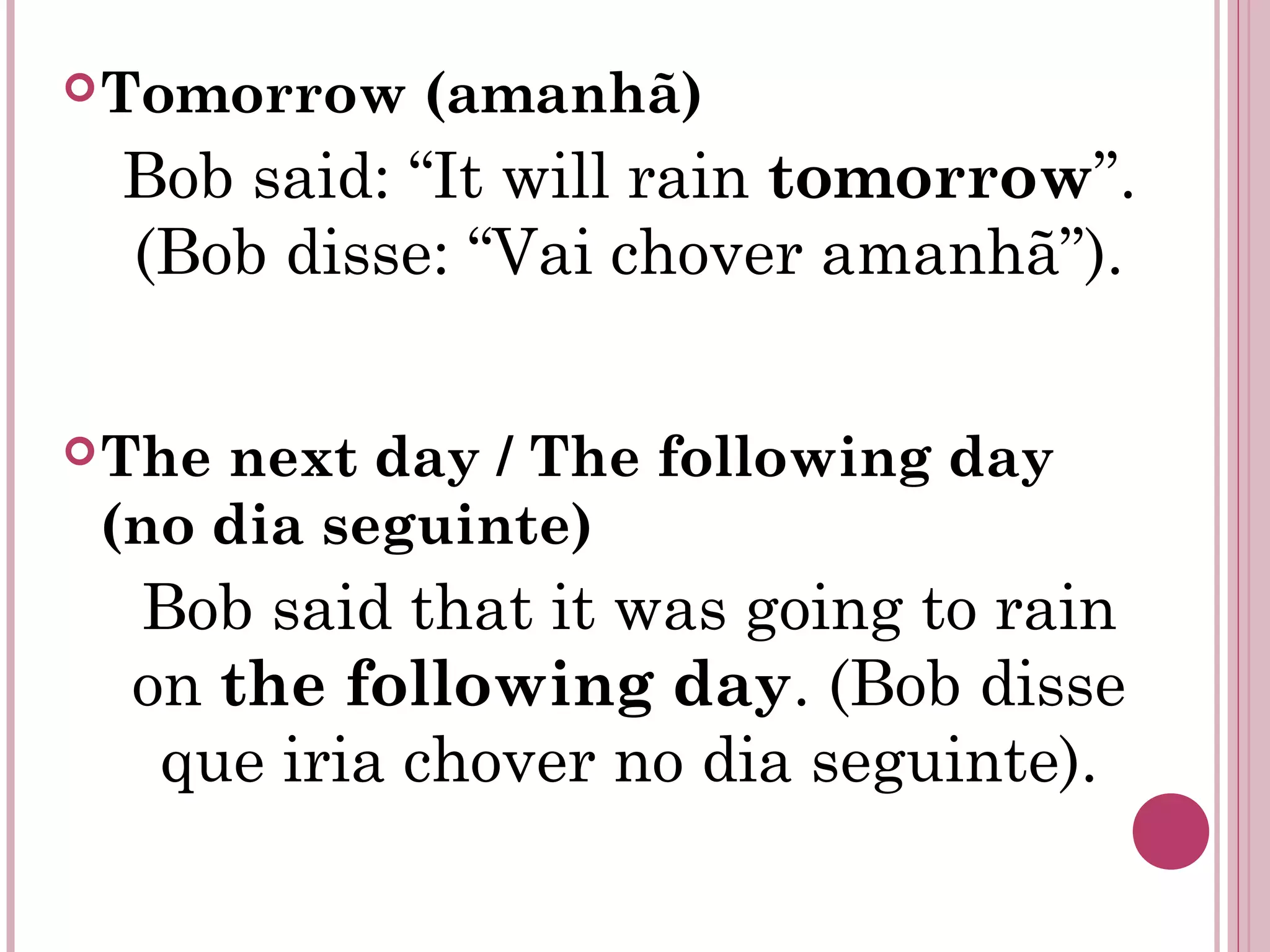
Tomorrow (amanhã)
Bob said: “It will rain tomorrow”.
(Bob disse: “Vai chover amanhã”).
The next day / The following day
(no dia seguinte)
Bob said that it was going to rain
on the following day. (Bob disse
que iria chover no dia seguinte).
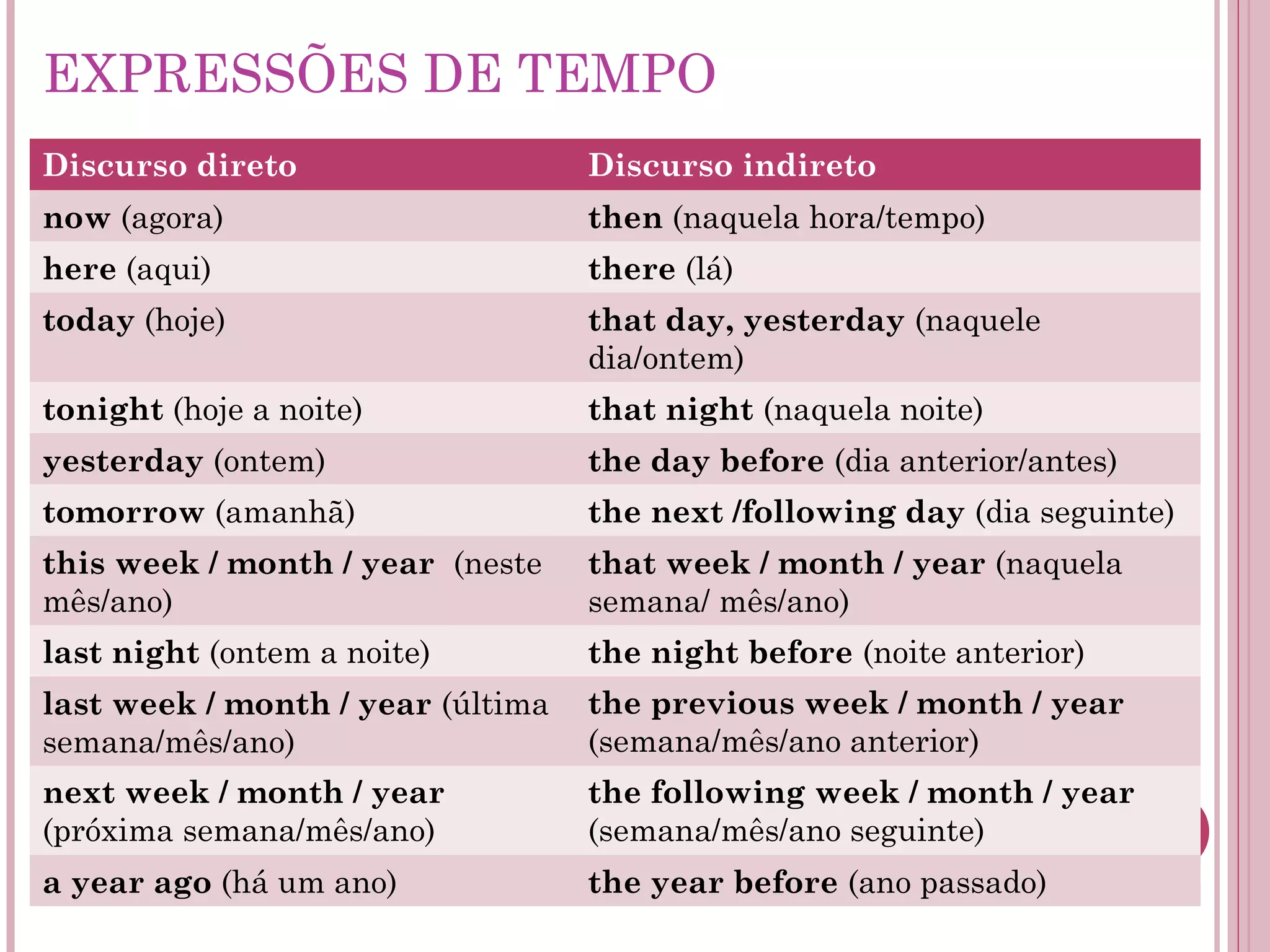
EXPRESSÕES DE TEMPO
Discurso direto Discurso indireto
now (agora) then (naquela hora/tempo)
here (aqui) there (lá)
today (hoje) that day, yesterday (naquele
dia/ontem)
tonight (hoje a noite) that night (naquela noite)
yesterday (ontem) the day before (dia anterior/antes)
tomorrow (amanhã) the next /following day (dia seguinte)
this week / month / year (neste
mês/ano)
that week / month / year (naquela
semana/ mês/ano)
last night (ontem a noite) the night before (noite anterior)
last week / month / year (última
semana/mês/ano)
the previous week / month / year
(semana/mês/ano anterior)
next week / month / year
(próxima semana/mês/ano)
the following week / month / year
(semana/mês/ano seguinte)
a year ago (há um ano) the year before (ano passado)
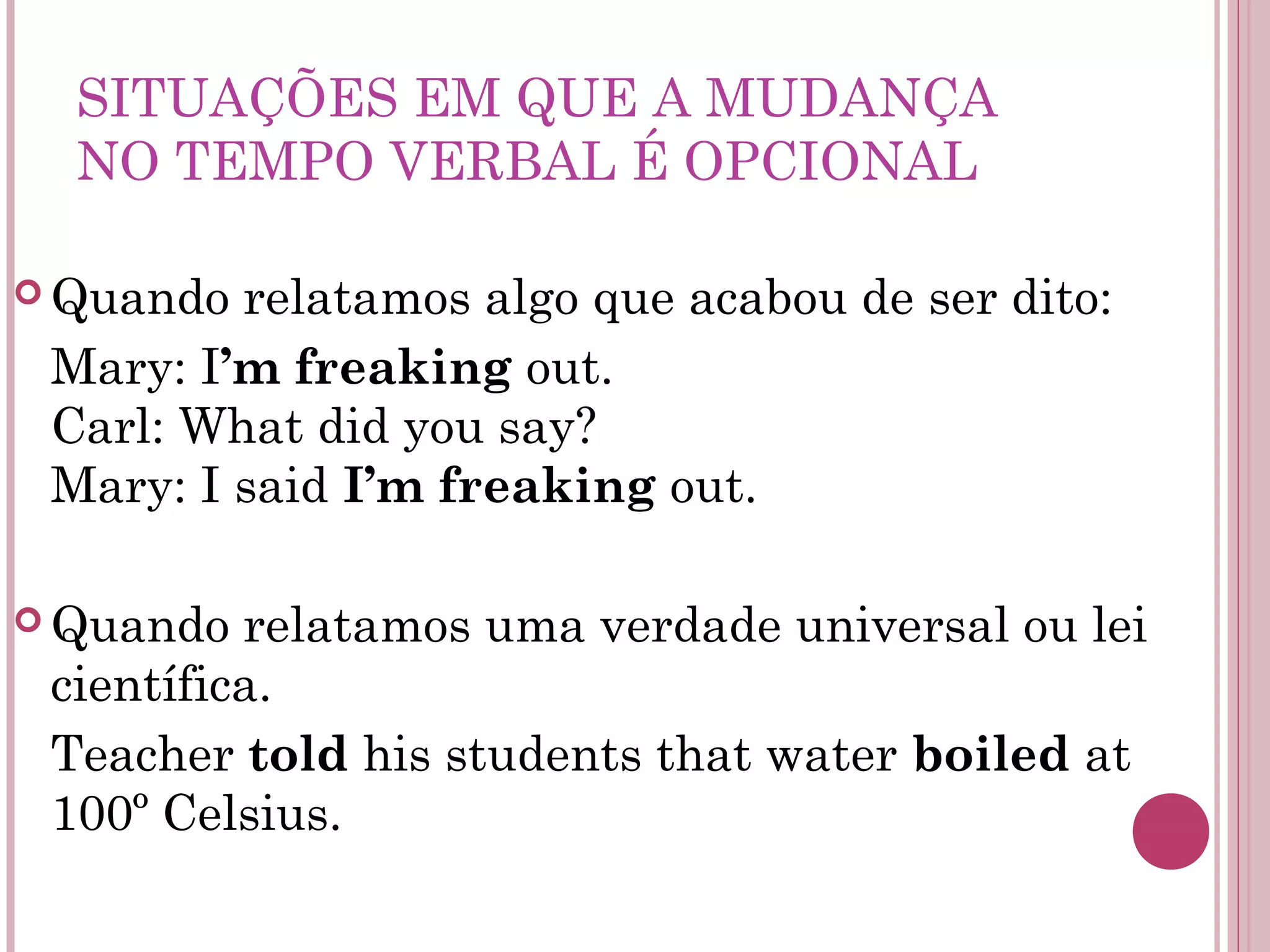
SITUAÇÕES EM QUE A MUDANÇA
NO TEMPO VERBAL É OPCIONAL
 Quando relatamos algo que acabou de ser dito:
Mary: I’m freaking out.
Carl: What did you say?
Mary: I said I’m freaking out.
 Quando relatamos uma verdade universal ou lei
científica.
Teacher told his students that water boiled at
100º Celsius.
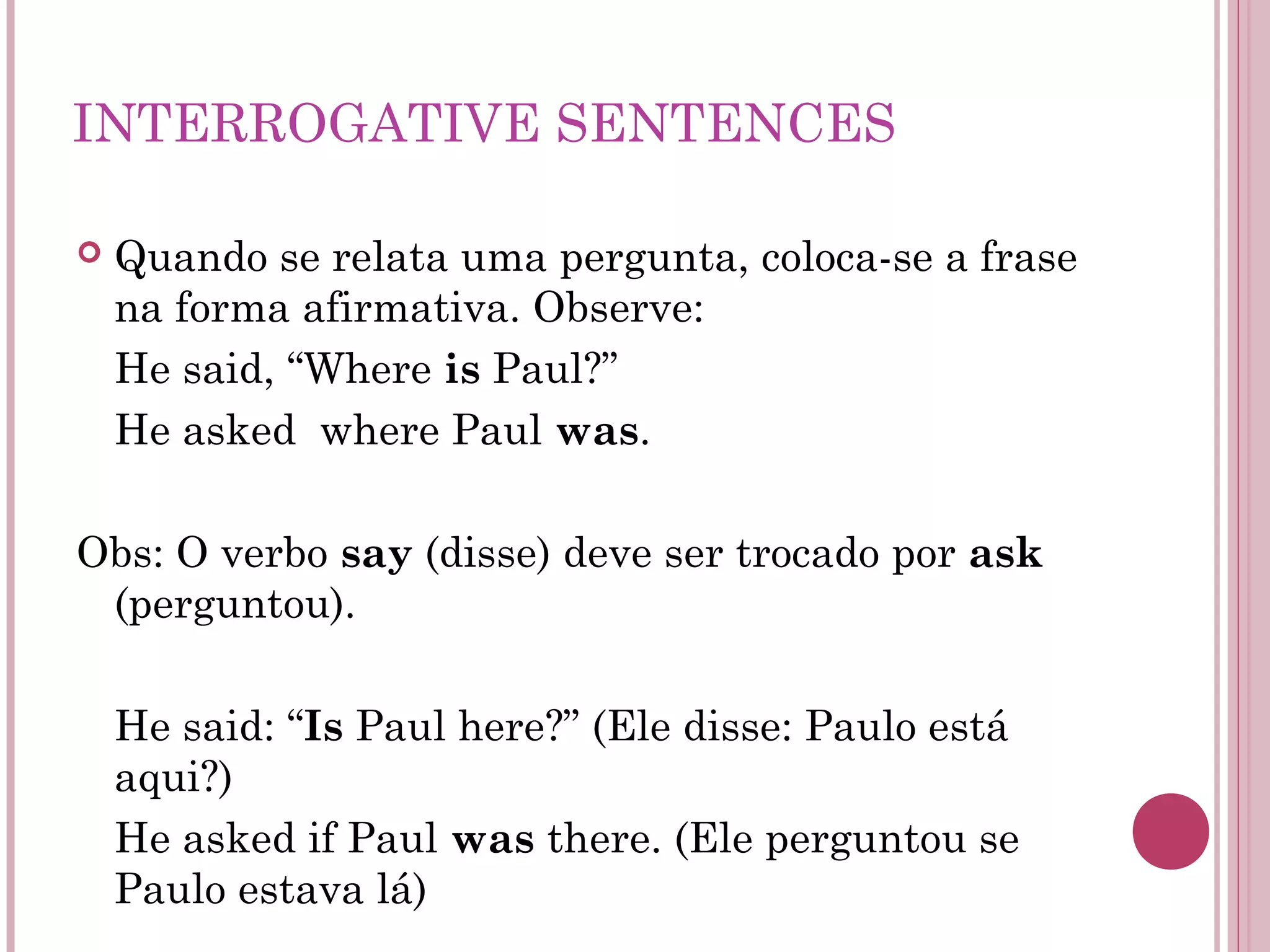
INTERROGATIVE SENTENCES
 Quando se relata uma pergunta, coloca-se a frase
na forma afirmativa. Observe:
He said, “Where is Paul?”
He asked where Paul was.
Obs: O verbo say (disse) deve ser trocado por ask
(perguntou).
He said: “Is Paul here?” (Ele disse: Paulo está
aqui?)
He asked if Paul was there. (Ele perguntou se
Paulo estava lá)
PRACTICE
The kid and the wolfThe kid and the wolf
A little boy, walking along a path, was
followed by a Wolf. As we a realized he
could not escape, he turned round, and
said: “My friend Wolf, I know I must be
your prey, but before I die I will ask of
you one favor. You will play me some
music and I may dance”.
The wolf agreed, and while he was
playing his flute and the kid was
dancing, some hounds, as they heard the
music ran up and began chasing the
wolf.
Turning to the child, the wolf said, “I
deserve that, for I am a butcher, not a
musician.”
Be smarter than your enemy and save
your skin.
Esopo

Direct and Indirect Speech

  • 1.
  • 2.
    Há duas formasde relatar o que alguém disse: pelo discurso direto, quando repetimos o que foi dito usando as mesmas palavras da pessoa, e pelo discurso indireto, quando contamos com nossas próprias palavras o que foi dito. John said: “I work every day.” (discurso direto) John said that he worked every day. (discurso indireto)
  • 3.
    SAY / TELL Sãoos verbos mais comuns que introduzem o discurso indireto.  Se disser com quem está falando, usa-se tell. He told her he was feeling worn out. (Ele disse que estava se sentido exausto.)  Se quer mencionar com quem está falando e estiver usando o verbo say, deve se acrescentar to. He said to Ana… (Ele disse para Ana…)
  • 4.
    TEMPO VERBAL Simple Present Hesaid: “I have a test today.” Simple Past He said that he had a test that day.
  • 5.
    Simple Past He said:“I worked yesterday.” Past Perfect He said that he had worked the day before.
  • 6.
    Present Perfect He said“I have lived here.” Past Perfect He said that he had lived there.
  • 7.
    Simple Future He said:“I’ll work tomorrow.” Conditional He said that he would work the next day.
  • 8.
    Present Continuous He said:“I’m working now.” Past Continuous He said he was working then.
  • 9.
    Past Continuous He said“I was working five minutes ago.” Past Perfect Continuous He said that he had been working five minutes before.
  • 10.
    Imperative He said: “Closethe door.” Infinitive He told me to close the door.
  • 11.
    MODAIS can could may might musthad to should should ought ought He said “I can work.” He said that he could work.
  • 12.
    PRONOME I (eu) Bob said:“I am hungry”. (Bob disse: “Eu estou com fome”). He/she (ele/ela) Bob said that he was hungry. (Bob disse que ele estava com fome).
  • 13.
    We (nós) Bob said:“We have to work”. (Bob disse: “Nós temos que trabalhar”). They (eles/elas) Bob said that they had to work. (Bob disse que eles tinham que trabalhar).
  • 14.
    PRONOME This (este) Bob said:“This is my car”. (Bob disse: “Este é o meu carro”). That (aquele) Bob said that (that) was his car. (Bob disse que aquele era o carro dele) Obs.: Nesse caso, pode-se omitir o “that” que está entre parênteses.
  • 15.
    These (estes) Bob said:“These tickets are too expensive”. (Bob disse “Estes ingressos são muito caros”). Those (aqueles) Bob said that those tickets were too expensive. (Bob disse que aqueles ingressos eram muito caros).
  • 16.
    ADVÉRBIO Today (hoje) Bob said:“There is a great movie on TV today”. (Bob disse: “Tem um filme muito bom na TV hoje”). That day (aquele dia) Bob said that there was a great movie on TV that day. (Bob disse que havia um bom filme na TV naquele dia).
  • 17.
    Tomorrow (amanhã) Bob said:“It will rain tomorrow”. (Bob disse: “Vai chover amanhã”). The next day / The following day (no dia seguinte) Bob said that it was going to rain on the following day. (Bob disse que iria chover no dia seguinte).
  • 18.
    EXPRESSÕES DE TEMPO Discursodireto Discurso indireto now (agora) then (naquela hora/tempo) here (aqui) there (lá) today (hoje) that day, yesterday (naquele dia/ontem) tonight (hoje a noite) that night (naquela noite) yesterday (ontem) the day before (dia anterior/antes) tomorrow (amanhã) the next /following day (dia seguinte) this week / month / year (neste mês/ano) that week / month / year (naquela semana/ mês/ano) last night (ontem a noite) the night before (noite anterior) last week / month / year (última semana/mês/ano) the previous week / month / year (semana/mês/ano anterior) next week / month / year (próxima semana/mês/ano) the following week / month / year (semana/mês/ano seguinte) a year ago (há um ano) the year before (ano passado)
  • 19.
    SITUAÇÕES EM QUEA MUDANÇA NO TEMPO VERBAL É OPCIONAL  Quando relatamos algo que acabou de ser dito: Mary: I’m freaking out. Carl: What did you say? Mary: I said I’m freaking out.  Quando relatamos uma verdade universal ou lei científica. Teacher told his students that water boiled at 100º Celsius.
  • 20.
    INTERROGATIVE SENTENCES  Quandose relata uma pergunta, coloca-se a frase na forma afirmativa. Observe: He said, “Where is Paul?” He asked where Paul was. Obs: O verbo say (disse) deve ser trocado por ask (perguntou). He said: “Is Paul here?” (Ele disse: Paulo está aqui?) He asked if Paul was there. (Ele perguntou se Paulo estava lá)
  • 21.
    PRACTICE The kid andthe wolfThe kid and the wolf A little boy, walking along a path, was followed by a Wolf. As we a realized he could not escape, he turned round, and said: “My friend Wolf, I know I must be your prey, but before I die I will ask of you one favor. You will play me some music and I may dance”.
  • 22.
    The wolf agreed,and while he was playing his flute and the kid was dancing, some hounds, as they heard the music ran up and began chasing the wolf. Turning to the child, the wolf said, “I deserve that, for I am a butcher, not a musician.” Be smarter than your enemy and save your skin. Esopo