College Readiness/Concretized
          Outcomes
          in TAL 2.0

        January 9th, 2012
Big Picture: How Our This Inquiry Relates to
     Other “Ultimate Aims” Workstreams
    What are we ultimately aiming for with our students?
[i.e., what should it say at the top of the TAL Impact model?]


                                    What degree of
          What breadth/array     clarity/actionability
          of outcomes is truly       of outcomes
            aligned with our        maximizes our
             ultimate aims?      progress toward our
                 (Jenee)            ultimate aims?
                                         (Ned)
The Central Question

In terms of articulating our ultimate aims (the
“top” of the TAL Impact Model), what degree of
clarity and actionability do we need and
want, and is some form of “college readiness”
the right direction?
Sub-Questions

• How do our most transformational teachers
  define the transformational impact (with what
  level of specificity and in what relation to college
  readiness) they envision for their kids?
• What are benefits and risks associated with the
  level of specificity/generality in how we currently
  define transformational impact?
• What are benefits and risks of defining
  transformational impact in terms of “college
  readiness”?
Ultimate Objective
We seek to arrive at a new articulation of the ultimate
aims that:
     – respects the diversity of perspectives on the Central and Sub
       questions
     – but is increasingly actionable and useable by corps members
     – assists in solving, with the rest of TAL 2.0, the reasons for
       TAL’s elusiveness.
•*Note – these objectives differ slightly from our original conception of having a shared,
organizational perspective on the topic of college readiness, given A) college readiness is a
sub-question under the broader question of how we best concretize our outcomes, and B)
the high level of emotion/passion and wide range of divergent views on the question of
college readiness that we have encountered thus far.
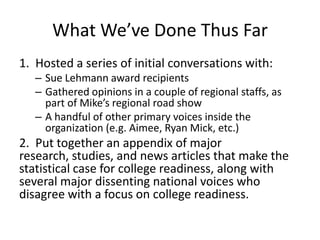
What We’ve Done Thus Far
1. Hosted a series of initial conversations with:
   – Sue Lehmann award recipients
   – Gathered opinions in a couple of regional staffs, as
     part of Mike’s regional road show
   – A handful of other primary voices inside the
     organization (e.g. Aimee, Ryan Mick, etc.)
2. Put together an appendix of major
research, studies, and news articles that make the
statistical case for college readiness, along with
several major dissenting national voices who
disagree with a focus on college readiness.
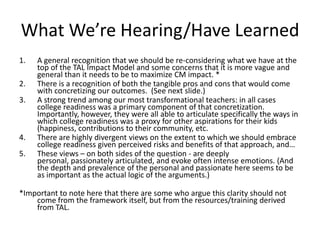
What We’re Hearing/Have Learned
1.   A general recognition that we should be re-considering what we have at the
     top of the TAL Impact Model and some concerns that it is more vague and
     general than it needs to be to maximize CM impact. *
2.   There is a recognition of both the tangible pros and cons that would come
     with concretizing our outcomes. (See next slide.)
3.   A strong trend among our most transformational teachers: in all cases
     college readiness was a primary component of that concretization.
     Importantly, however, they were all able to articulate specifically the ways in
     which college readiness was a proxy for other aspirations for their kids
     (happiness, contributions to their community, etc.
4.   There are highly divergent views on the extent to which we should embrace
     college readiness given perceived risks and benefits of that approach, and…
5.   These views – on both sides of the question - are deeply
     personal, passionately articulated, and evoke often intense emotions. (And
     the depth and prevalence of the personal and passionate here seems to be
     as important as the actual logic of the arguments.)

*Important to note here that there are some who argue this clarity should not
    come from the framework itself, but from the resources/training derived
    from TAL.
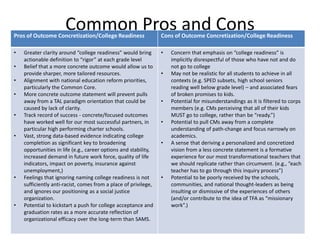
Common Pros and Cons
Pros of Outcome Concretization/College Readiness                 Cons of Outcome Concretization/College Readiness

•   Greater clarity around “college readiness” would bring       •   Concern that emphasis on “college readiness” is
    actionable definition to “rigor” at each grade level             implicitly disrespectful of those who have not and do
•   Belief that a more concrete outcome would allow us to            not go to college
    provide sharper, more tailored resources.                    •   May not be realistic for all students to achieve in all
•   Alignment with national education reform priorities,             contexts (e.g. SPED subsets, high school seniors
    particularly the Common Core.                                    reading well below grade level) – and associated fears
•   More concrete outcome statement will prevent pulls               of broken promises to kids.
    away from a TAL paradigm orientation that could be           •   Potential for misunderstandings as it is filtered to corps
    caused by lack of clarity.                                       members (e.g. CMs perceiving that all of their kids
•   Track record of success - concrete/focused outcomes              MUST go to college, rather than be “ready.”)
    have worked well for our most successful partners, in        •   Potential to pull CMs away from a complete
    particular high performing charter schools.                      understanding of path-change and focus narrowly on
•   Vast, strong data-based evidence indicating college              academics.
    completion as significant key to broadening                  •   A sense that deriving a personalized and concretized
    opportunities in life (e.g., career options and stability,       vision from a less concrete statement is a formative
    increased demand in future work force, quality of life           experience for our most transformational teachers that
    indicators, impact on poverty, insurance against                 we should replicate rather than circumvent. (e.g., “each
    unemployment,)                                                   teacher has to go through this inquiry process”)
•   Feelings that ignoring naming college readiness is not       •   Potential to be poorly received by the schools,
    sufficiently anti-racist, comes from a place of privilege,       communities, and national thought-leaders as being
    and ignores our positioning as a social justice                  insulting or dismissive of the experiences of others
    organization.                                                    (and/or contribute to the idea of TFA as “missionary
•   Potential to kickstart a push for college acceptance and         work”.)
    graduation rates as a more accurate reflection of
    organizational efficacy over the long-term than SAMS.
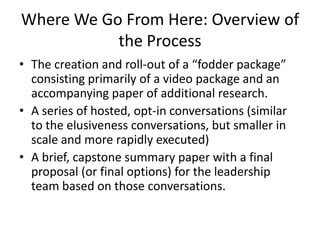
Where We Go From Here: Overview of
           the Process
• The creation and roll-out of a “fodder package”
  consisting primarily of a video package and an
  accompanying paper of additional research.
• A series of hosted, opt-in conversations (similar
  to the elusiveness conversations, but smaller in
  scale and more rapidly executed)
• A brief, capstone summary paper with a final
  proposal (or final options) for the leadership
  team based on those conversations.
Where We’re Going: 1. Fodder
• A 10-20 minute video package that puts together
  a variety of diverse and provocative perspectives
  (including transformational teachers, some staff
  members who have concerns over outcome-
  concretization and college readiness in
  particular, student and parent
  voices, etc.), coupled with reflection questions
• A supporting paper that provides additional
  research and articles that are high in relevance
  but cannot be communicated well in video-form.
Where We’re Going: 2. Hosted
              Conversations
A series of opt-in conversations to collect perspectives
after participants have experienced the fodder
package, potentially including:
   – A Chat With Matt (and/or Blank Show) panel discussion
    with relevant voices (Jay, Aimee, etc.)
   – A conference or ROVP-cluster based conversation with EDs.
   – Webinar/input conversations with TPSD Design teams.
   – Webinar/input conversations with smaller groups of
    M(D)TLDs/regions.
Where We’re Going: 3. Culminating
             Summary
The final summary will be a succinct
document, similar to the final elusiveness
results, that will present trends in
conversations, the potential options for new
language and the likely implications of that
language, and a recommendation.
[Our intention is that this summary paper will sit alongside and
be gradually folded into Jay’s work on the breadth and definition
of indicators of success.]

Concretizing Outcomes

  • 1.
    College Readiness/Concretized Outcomes in TAL 2.0 January 9th, 2012
  • 2.
    Big Picture: HowOur This Inquiry Relates to Other “Ultimate Aims” Workstreams What are we ultimately aiming for with our students? [i.e., what should it say at the top of the TAL Impact model?] What degree of What breadth/array clarity/actionability of outcomes is truly of outcomes aligned with our maximizes our ultimate aims? progress toward our (Jenee) ultimate aims? (Ned)
  • 3.
    The Central Question Interms of articulating our ultimate aims (the “top” of the TAL Impact Model), what degree of clarity and actionability do we need and want, and is some form of “college readiness” the right direction?
  • 4.
    Sub-Questions • How doour most transformational teachers define the transformational impact (with what level of specificity and in what relation to college readiness) they envision for their kids? • What are benefits and risks associated with the level of specificity/generality in how we currently define transformational impact? • What are benefits and risks of defining transformational impact in terms of “college readiness”?
  • 5.
    Ultimate Objective We seekto arrive at a new articulation of the ultimate aims that: – respects the diversity of perspectives on the Central and Sub questions – but is increasingly actionable and useable by corps members – assists in solving, with the rest of TAL 2.0, the reasons for TAL’s elusiveness. •*Note – these objectives differ slightly from our original conception of having a shared, organizational perspective on the topic of college readiness, given A) college readiness is a sub-question under the broader question of how we best concretize our outcomes, and B) the high level of emotion/passion and wide range of divergent views on the question of college readiness that we have encountered thus far.
  • 6.
    What We’ve DoneThus Far 1. Hosted a series of initial conversations with: – Sue Lehmann award recipients – Gathered opinions in a couple of regional staffs, as part of Mike’s regional road show – A handful of other primary voices inside the organization (e.g. Aimee, Ryan Mick, etc.) 2. Put together an appendix of major research, studies, and news articles that make the statistical case for college readiness, along with several major dissenting national voices who disagree with a focus on college readiness.
  • 7.
    What We’re Hearing/HaveLearned 1. A general recognition that we should be re-considering what we have at the top of the TAL Impact Model and some concerns that it is more vague and general than it needs to be to maximize CM impact. * 2. There is a recognition of both the tangible pros and cons that would come with concretizing our outcomes. (See next slide.) 3. A strong trend among our most transformational teachers: in all cases college readiness was a primary component of that concretization. Importantly, however, they were all able to articulate specifically the ways in which college readiness was a proxy for other aspirations for their kids (happiness, contributions to their community, etc. 4. There are highly divergent views on the extent to which we should embrace college readiness given perceived risks and benefits of that approach, and… 5. These views – on both sides of the question - are deeply personal, passionately articulated, and evoke often intense emotions. (And the depth and prevalence of the personal and passionate here seems to be as important as the actual logic of the arguments.) *Important to note here that there are some who argue this clarity should not come from the framework itself, but from the resources/training derived from TAL.
  • 8.
    Common Pros andCons Pros of Outcome Concretization/College Readiness Cons of Outcome Concretization/College Readiness • Greater clarity around “college readiness” would bring • Concern that emphasis on “college readiness” is actionable definition to “rigor” at each grade level implicitly disrespectful of those who have not and do • Belief that a more concrete outcome would allow us to not go to college provide sharper, more tailored resources. • May not be realistic for all students to achieve in all • Alignment with national education reform priorities, contexts (e.g. SPED subsets, high school seniors particularly the Common Core. reading well below grade level) – and associated fears • More concrete outcome statement will prevent pulls of broken promises to kids. away from a TAL paradigm orientation that could be • Potential for misunderstandings as it is filtered to corps caused by lack of clarity. members (e.g. CMs perceiving that all of their kids • Track record of success - concrete/focused outcomes MUST go to college, rather than be “ready.”) have worked well for our most successful partners, in • Potential to pull CMs away from a complete particular high performing charter schools. understanding of path-change and focus narrowly on • Vast, strong data-based evidence indicating college academics. completion as significant key to broadening • A sense that deriving a personalized and concretized opportunities in life (e.g., career options and stability, vision from a less concrete statement is a formative increased demand in future work force, quality of life experience for our most transformational teachers that indicators, impact on poverty, insurance against we should replicate rather than circumvent. (e.g., “each unemployment,) teacher has to go through this inquiry process”) • Feelings that ignoring naming college readiness is not • Potential to be poorly received by the schools, sufficiently anti-racist, comes from a place of privilege, communities, and national thought-leaders as being and ignores our positioning as a social justice insulting or dismissive of the experiences of others organization. (and/or contribute to the idea of TFA as “missionary • Potential to kickstart a push for college acceptance and work”.) graduation rates as a more accurate reflection of organizational efficacy over the long-term than SAMS.
  • 9.
    Where We GoFrom Here: Overview of the Process • The creation and roll-out of a “fodder package” consisting primarily of a video package and an accompanying paper of additional research. • A series of hosted, opt-in conversations (similar to the elusiveness conversations, but smaller in scale and more rapidly executed) • A brief, capstone summary paper with a final proposal (or final options) for the leadership team based on those conversations.
  • 10.
    Where We’re Going:1. Fodder • A 10-20 minute video package that puts together a variety of diverse and provocative perspectives (including transformational teachers, some staff members who have concerns over outcome- concretization and college readiness in particular, student and parent voices, etc.), coupled with reflection questions • A supporting paper that provides additional research and articles that are high in relevance but cannot be communicated well in video-form.
  • 11.
    Where We’re Going:2. Hosted Conversations A series of opt-in conversations to collect perspectives after participants have experienced the fodder package, potentially including: – A Chat With Matt (and/or Blank Show) panel discussion with relevant voices (Jay, Aimee, etc.) – A conference or ROVP-cluster based conversation with EDs. – Webinar/input conversations with TPSD Design teams. – Webinar/input conversations with smaller groups of M(D)TLDs/regions.
  • 12.
    Where We’re Going:3. Culminating Summary The final summary will be a succinct document, similar to the final elusiveness results, that will present trends in conversations, the potential options for new language and the likely implications of that language, and a recommendation. [Our intention is that this summary paper will sit alongside and be gradually folded into Jay’s work on the breadth and definition of indicators of success.]