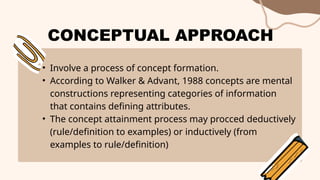
• Involve aprocess of concept formation.
• According to Walker & Advant, 1988 concepts are mental
constructions representing categories of information
that contains defining attributes.
• The concept attainment process may procced deductively
(rule/definition to examples) or inductively (from
examples to rule/definition)
CONCEPTUAL APPROACH
3.
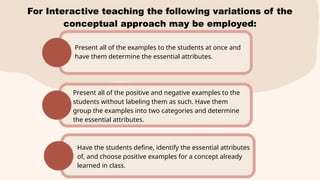
For Interactive teachingthe following variations of the
conceptual approach may be employed:
Present all of the examples to the students at once and
have them determine the essential attributes.
Present all of the positive and negative examples to the
students without labeling them as such. Have them
group the examples into two categories and determine
the essential attributes.
Have the students define, identify the essential attributes
of, and choose positive examples for a concept already
learned in class.
4.
Reisman perspective
In Reisman'sperspective, conceptual teaching approaches
prioritize understanding overarching concepts over rote
memorization of facts. This method emphasizes critical
thinking and problem-solving skills, aiming to deepen
comprehension rather than just surface-level knowledge
retention. It focuses on fostering a deeper understanding of
the subject matter, allowing students to apply concepts
across various contexts and scenarios.
5.
Example
s
Grade 7 Grade8
Students explore the underlying concepts of
colonization, such as power dynamics,
cultural exchange, and resistance. They
engage in activities that foster critical
thinking, such as analyzing primary sources
and considering multiple perspectives. This
approach encourages students to
understand the complexities of colonization
and its impact on Philippine society.
Students delve into the underlying
concepts of globalization, including
interconnectedness, cultural diffusion, and
economic interdependence. They analyze
case studies to understand globalization's
effects on different regions and cultures,
fostering critical thinking and global
awareness.
6.
Result
Grade 9 Grade10
Students explore the fundamental
concepts of democracy, such as
representation, participation, and
accountability. They engage in activities like
simulations and debates to deepen their
understanding of democratic principles
and their application in Philippine society.
Students examine the underlying
concepts of nationalism, such as identity,
sovereignty, and self-determination. They
analyze historical events and primary
sources to understand how nationalist
movements have shaped Philippine
history and identity, fostering critical
thinking and historical empathy.
7.
GROUP MEMBER
KHEN ZAINAVILLANO TUSCANO
JAIKA SACLAG
MA. SHEERAH BORRES SALALIMA
ANGELICA DACARA
GERAMS PARONE
KATLEEN ROCO



![Strategy for instruction[2]](https://cdn.slidesharecdn.com/ss_thumbnails/strategyforinstruction2-130208002424-phpapp02-thumbnail.jpg?width=640&height=640&fit=bounds)


