Collective Defined Contribution
Pensions
Con Keating
August 2021
con.keating@brightonrockgroup.co.uk
What is a CDC scheme?
• Pension – an income in retirement
• Individual DC is a tax-advantaged savings scheme
• It lacks decumulation or pension arrangements
• It lacks any/all risk-pooling and risk-sharing arrangements
• Defined benefit – is a pension.
• Has sponsor guarantees -These guarantees are costly
• CDC is collective and offers pensions as aspirations
• Not guaranteed – has only its own resources
• PSA 2021 permits single/connected employer offering
• Multi-employer and much more should follow
• Designs seek to minimise frequency and magnitude of cuts to pensions in
payment
Risk-Pooling and Risk-Sharing
• As a collective, there is pooling of longevity risk
• Well-known from Life Insurance.
• Pooling of investment horizon – overlapping generations
• Scheme life greater than individual lives
• Results in greater risk tolerance and total investment income
• Risk-sharing – mutual insurance in contribution allocation
• Risk-sharing – smoothing to avoid transient market volatility effects
Sustainability
• Fairness – Equity among members
• Leads to some simple rules
• Cuts when applied equal for all
• Cuts to be immediate to the current position or for all future
• No intermediate term – though Regulations admit this
• No use of new contributions to subsidise prior deficits
• Or distribute surpluses
• Distinguish transient from trend (signal from noise)
• Contractual Accrual Rate – Discount Rates
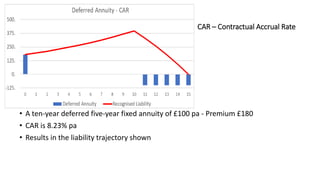
CAR – Contractual Accrual Rate
• A ten-year deferred five-year fixed annuity of £100 pa - Premium £180
• CAR is 8.23% pa
• Results in the liability trajectory shown
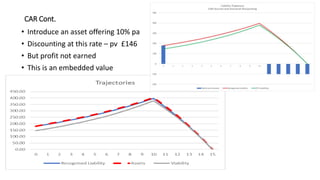
CAR Cont.
• Introduce an asset offering 10% pa
• Discounting at this rate – pv £146
• But profit not earned
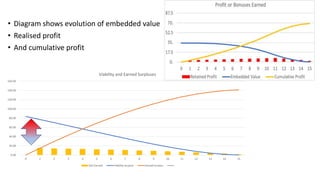
• This is an embedded value
• Diagram shows evolution of embedded value
• Realised profit
• And cumulative profit
0.00
20.00
40.00
60.00
80.00
100.00
120.00
140.00
160.00
0 1 2 3 4 5 6 7 8 9 10 11 12 13 14 15
Viability and Earned Surpluses
Dist Earned Viability Surplus Earned Surplus
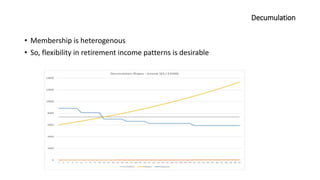
Decumulation
• Membership is heterogenous
• So, flexibility in retirement income patterns is desirable
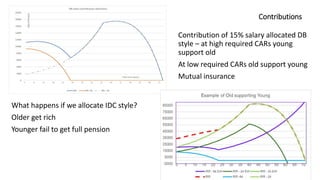
Contributions
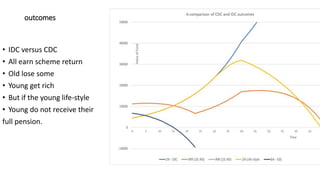
What happens if we allocate IDC style?
Older get rich
Younger fail to get full pension
Contribution of 15% salary allocated DB
style – at high required CARs young
support old
At low required CARs old support young
Mutual insurance
outcomes
• IDC versus CDC
• All earn scheme return
• Old lose some
• Young get rich
• But if the young life-style
• Young do not receive their
full pension.
Risk-sharing Rules
• These are a form of fair smoothing
• Can help to reduce transient volatility and sequencing risk
• It is the actives and deferreds who support pensioners when scheme is in deficit
• Two rules: If scheme is in deficit (on car basis) – set time for recovery – 1/deficit
in years
• Set maximum amount (10% of active/deferred beneficial interest)
• When a pension is paid in full in deficit, the beneficial interest of
actives/deferreds are increased
• Rebalances beneficial interests and maintains fairness.
Valuation
• Regulations require an annual viability valuation
• This is forward looking and relies on the expected return on assets as its discount rate for
projected benefits
• If in deficit cuts to benefits must be made
• This needs to be complemented by consideration of the status quo
• Has the scheme progressed to date in accordance with the promises made?
• This valuation compares assets held with the accrued value of projected benefits
• Calculated using the CAR
• This is where risk-sharing rules would apply
• In simulation, cuts occur less than 0.5% of the time
• And are small, limited to less than 5% of current pension.

Con Keating's presentation on CDC - August 25th 2021

  • 1.
    Collective Defined Contribution Pensions ConKeating August 2021 con.keating@brightonrockgroup.co.uk
  • 2.
    What is aCDC scheme? • Pension – an income in retirement • Individual DC is a tax-advantaged savings scheme • It lacks decumulation or pension arrangements • It lacks any/all risk-pooling and risk-sharing arrangements • Defined benefit – is a pension. • Has sponsor guarantees -These guarantees are costly • CDC is collective and offers pensions as aspirations • Not guaranteed – has only its own resources • PSA 2021 permits single/connected employer offering • Multi-employer and much more should follow • Designs seek to minimise frequency and magnitude of cuts to pensions in payment
  • 3.
    Risk-Pooling and Risk-Sharing •As a collective, there is pooling of longevity risk • Well-known from Life Insurance. • Pooling of investment horizon – overlapping generations • Scheme life greater than individual lives • Results in greater risk tolerance and total investment income • Risk-sharing – mutual insurance in contribution allocation • Risk-sharing – smoothing to avoid transient market volatility effects
  • 4.
    Sustainability • Fairness –Equity among members • Leads to some simple rules • Cuts when applied equal for all • Cuts to be immediate to the current position or for all future • No intermediate term – though Regulations admit this • No use of new contributions to subsidise prior deficits • Or distribute surpluses • Distinguish transient from trend (signal from noise) • Contractual Accrual Rate – Discount Rates
  • 5.
    CAR – ContractualAccrual Rate • A ten-year deferred five-year fixed annuity of £100 pa - Premium £180 • CAR is 8.23% pa • Results in the liability trajectory shown
  • 6.
    CAR Cont. • Introducean asset offering 10% pa • Discounting at this rate – pv £146 • But profit not earned • This is an embedded value
  • 7.
    • Diagram showsevolution of embedded value • Realised profit • And cumulative profit 0.00 20.00 40.00 60.00 80.00 100.00 120.00 140.00 160.00 0 1 2 3 4 5 6 7 8 9 10 11 12 13 14 15 Viability and Earned Surpluses Dist Earned Viability Surplus Earned Surplus
  • 8.
    Decumulation • Membership isheterogenous • So, flexibility in retirement income patterns is desirable
  • 9.
    Contributions What happens ifwe allocate IDC style? Older get rich Younger fail to get full pension Contribution of 15% salary allocated DB style – at high required CARs young support old At low required CARs old support young Mutual insurance
  • 10.
    outcomes • IDC versusCDC • All earn scheme return • Old lose some • Young get rich • But if the young life-style • Young do not receive their full pension.
  • 11.
    Risk-sharing Rules • Theseare a form of fair smoothing • Can help to reduce transient volatility and sequencing risk • It is the actives and deferreds who support pensioners when scheme is in deficit • Two rules: If scheme is in deficit (on car basis) – set time for recovery – 1/deficit in years • Set maximum amount (10% of active/deferred beneficial interest) • When a pension is paid in full in deficit, the beneficial interest of actives/deferreds are increased • Rebalances beneficial interests and maintains fairness.
  • 12.
    Valuation • Regulations requirean annual viability valuation • This is forward looking and relies on the expected return on assets as its discount rate for projected benefits • If in deficit cuts to benefits must be made • This needs to be complemented by consideration of the status quo • Has the scheme progressed to date in accordance with the promises made? • This valuation compares assets held with the accrued value of projected benefits • Calculated using the CAR • This is where risk-sharing rules would apply • In simulation, cuts occur less than 0.5% of the time • And are small, limited to less than 5% of current pension.