Intergenerational risk
sharing: it’s dynamite!
Dynamiteispowerfulstuff.Sopowerful,andsouseful,itamasseda
fortuneforitsinventor,AlbertNobel.Butalso sopowerful,thathandled
carelesslyitcanliterallyblowupinyourhands.Intergenerationalrisk,
andcost,sharinginCollectiveDefinedContribution(CDC)hassimilar
propertiesandthefinancialimpactsonmembersplayoutover
generations.Trustees,providers,legislatorsandadvisersneedtobealive
tothepotentialconsequencesofbenefitdesigndecisionsbecausethe
effectsonindividualsandtheirretirementoutcomescanbelifechanging.
There’s no one-size fits all benefit design
that’s best for everyone. Compared to other
options that could potentially get support
from UK businesses, CDC may offer:
Income security for life
Higher incomes for most people
It can also potentially breathe new life into
the intergenerational contract, or gift
between generations, that any pension
really represents. Fundamentally, future
generations of economically active people
are needed to support the generations that
retired before them.
Later in our report, we explore the
conditions where people may not receive a
higher income.
1
with a single contribution rate and constant accrual rate at all ages
2
Based on a 20 year old earning £15,000 and accepting a 1 in 4 risk of
ruin (ie a 25% chance of running out of money in retirement)
This paper focuses on CDC / risk pooling, other non-risk sharing options
such as drawdown/cash/annuity are available. See our risk sharing report
for more details.
But with intergenerational risk transfer comes some
potentially very sizeable intergenerational wealth
transfers. There’s a lot of devil in the detail and so the
illustrative analysis in this paper is sensitive to the specific
assumptions made by us here, or anyone else in their
modelling. Having said all that:
• A 20 year old with a lifetime saving in DC, and using
income drawdown in retirement while part of a
longevity pool, could have around double the
pension compared to a whole of life CDC scheme1
.
Yes, double!
• Yet, on a like for like high growth investment strategy,
a whole of life CDC scheme might offer 20% more
income, and income security for life, relative to
typical DC with a drawdown strategy2
. So CDC can
comfortably outperform DC through certain lenses.
• Intergenerational risk sharing, at least with sufficiently
large investment scale, could allow trustees to be
comfortable taking more investment risk in CDC than
DC. Allowing for that could boost the 20% CDC
expected income outperformance on DC on a like
for like basis, to nearer 50% outperformance.
• Investment markets will move. They always do. If
yields were to drop 2% pa and stay there for a while,
active members would be earning 50% more
benefits than the expected ‘cost’ of their benefits.
This extra cost would be spread over all members in
the form of benefit reductions – including deferred
members and pensioners. And vice versa if yields
were to rise 2% pa. Some would argue that’s exactly
the point of risk sharing – but an important question is
– who might win and lose, and by how much?
1
2
The upcoming multi-employer regulations offer the new
Government a genuine chance to let the pension industry
do more. But we need to be bold. Much bolder than
we’ve been so far with CDC. We’ve got nearly £1.2tn tied
up in DC, growing at over £100bn a year this decade. The
current single employer CDC regulations tie together:
A framework for trustees to offer and run a
default pension payment approach – this is
vital.
A route for longevity pooling in retirement
which, in combination with point 1, allows
schemes to offer regular incomes that will
last a lifetime. What many people are
looking for from their pension!
Intergenerational value transfers. While this
might be right for some schemes, and the
scheme design will allow flexibility in
balancing the trade-offs between simplicity
and the scale of intergenerational value
transfers, it shouldn’t be imposed on all
CDC schemes.
Kathryn Fleming
Partner and Head of DC At-retirement
kathryn.fleming@hymans.co.uk
Paul Waters
Partner & Head of DC Markets
paul.waters@hymans.co.uk
1
2
3
Jon Hatchett
Senior Partner
jon.hatchett@hymans.co.uk
3
IncomparingCDCto DC, therearethreekeyfactorsdrivingdifferencesinoutcomes:
We examine these different designs and risk sharing drivers through the lens of members saving 8% of salary into their
pension and retiring at age 67. Details of the other key assumptions are set out in the appendix.
Ourapproachtothispaper
• Longevity pooling. This means CDC delivers regular
incomes for life (alongside trustee control of default
retirement pensions) compared to DC members “self-
insuring” their own longevity risk and potentially running
out of money.
• Intergenerational risk transfer. The pooled nature of
CDC and long duration allows greater investment risk to
be taken with the expectation of potentially higher returns.
• Intergenerational value transfer. Less well
recognised, the value a given member builds up in
benefits for the contributions they pay, relative to
other members of different ages in the scheme.
When assessing intergenerational risk and value transfer,
we considered the following scheme designs:
Scheme design Description
DC and income drawdown in retirement
DC scheme with the member entering drawdown
at retirement and withdrawing a constant,
inflation-proofed, income based on their chance
of ruin not exceeding a threshold amount.
DC and income drawdown while in a
longevity pool
As 1) except, at retirement, the member joins a
longevity pool of 1,000 members in which the
unspent pots of members who die are shared
with the surviving pool.
DC and decumulation only CDC
As 1) except the member is in a CDC scheme
through retirement where investment risk and
longevity risk are pooled.
Whole of life CDC
Single employer CDC scheme following the
current regulations and with the design features
set out in the appendix.
1
2
3
4
1 3
2
4
Beforewegetinto thedetails of benefitdesign,wewantedtotakeadetourtoexplain,atahigh
level,howintergenerational risksharingworks.
How intergenerationalrisk sharing
works
Existing benefits
The mechanism for risk sharing in CDC in the UK, is that a
scheme is brought back to full funding each year by
adjusting all future increases, up or down, for all members
equally. Members share investment risk across
generations in exchange for a smoother escalation of their
accrued pension benefits.
There’s a lot to be said for this. It focuses everyone’s
minds on pension income, not capital amounts. For most
people, a pension is primarily for drawing a pension (the
clue might be in the name!) and that’s about an income for
life.
Open schemes will have a long “duration” – broadly the
average weighted time until pensions are paid. That could
easily be 30 years or more in the early years of a new
CDC scheme. Even after a major downside funding
shock, such as a 30% drop in assets relative to liabilities,
the impact on future benefit increases would be limited
to “only” 1% pa. If the scheme were targeting CPI
increases on pensions before and after retirement and
CPI was at 2%, then pensions would still increase by 1%.
The younger the member, the more future years they’d
have that “1% reduction” built into their benefit promise.
Someone in their 20s might effectively have “lost” 50% of
the value of their future benefits, while someone in their
80s might have lost 5% of their future benefits. So the 20
something has 10 times the risk exposure of the 80 year
old – this is the intergenerational investment risk transfer.
The quid pro quo is that we anticipate that the 20
something may well be an 80 something one day, and
another generation of 20 somethings will be absorbing the
risks for them. For this to work in practice, CDC schemes
need to stay open and maintain a stable “shape” or
membership profile, so that enough young members
remain to absorb the risks. If not, the scheme will mature,
and the sensitivity to risks will increase.
As a concrete example, decumulation only CDC
schemes might have two or three times the sensitivity to
investment markets as whole of life CDC schemes. So for
any given market shock, the decumulation only members
will experience three times the impact on their pension
increases – both up and down – each year.
New benefits
There may or may not be value transfer in relation to new
benefits being earned in a CDC scheme. It’s a design
choice.
The cost of every new unit of pension promise will vary
across members, and over time. In the simplest case,
members share that cost uncertainty in exchange for a
clear and constant rate of benefit accrual. But that
simplicity can create winners and losers.
For decumulation only CDC, it feels hard to set up a
design under which a member might suffer a material gain
or loss at the point of transfer into the scheme. Because, if
it were a loss, it would be hard for an adviser or trustee to
allow a member to transfer into the scheme, compared to
an alternative arrangement.
For whole of life, it’s a more involved question. To avoid
value transfer (ie the creation of winners and losers), you
would need to adjust the pension for each pound of
contributions in line with a member’s age, longevity
trends, and market conditions. So members would earn
different amounts of pension for the same contribution
amount over time. It’s an open question as to whether we
can do that in a way that doesn’t disengage members.
The funding cost of earning benefits for a younger
member in a CDC scheme is much less than for older
members – it might be around ten times as costly to fund
each pound of annual pension for a 60 something
compared to someone in their early 20s. You can adjust
for this by having a cost that goes up with age, but that
risks adding complexity and you’d need to navigate
potential age discrimination challenges.
Even if you went as far as having age related cost of
benefits, investment markets will go up and down,
longevity trends will evolve, and societal changes will lead
to more or fewer people having financial dependants. All
of this means that, over time, there will be a flow of value
to or from members earning new pensions. And the flows
can be sizeable, easily 50% or more of the value of
pensions being earned each year.
5
Benefitdesignsandimpacton
members
Longevity pool
Research on pension scheme members by Hymans
Robertson shows that the majority want a secure income
for life. This isn’t a surprise. What’s important to many is that
the income doesn’t run out, not that it continues at a very
precise level (whether that’s fixed or inflation-linked). Or at
least the cost of those guarantees (eg annuities) is
acceptable to some but not all.
The neat trick of longevity pooling for pensions in payment
is that it allows CDC to provide a regular income for life.
Once you have around 1,000 members, you’ve removed
around 90% of the longevity risk to which people are
exposed. And through adjusting incomes, you can remove
the risk of ruin although you’ll still have the risk of changing
pension increases, including some risk of reductions. The
downside is that those who die early, before their pot runs
out, forgo the opportunity to pass that remaining pot on to
their estate. Basically, the people who die sooner cover the
additional pension income of those who live longer. It’s a
collective approach to sharing risk that lets everyone draw
higher incomes in the confidence they won’t run out.
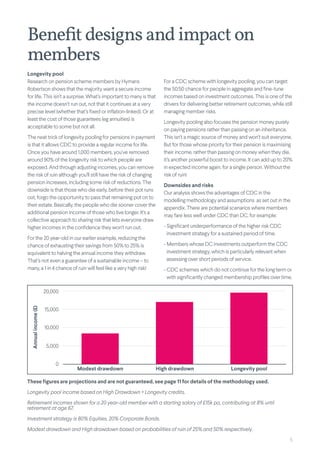
For the 20 year-old in our earlier example, reducing the
chance of exhausting their savings from 50% to 25% is
equivalent to halving the annual income they withdraw.
That’s not even a guarantee of a sustainable income – to
many, a 1 in 4 chance of ruin will feel like a very high risk!
For a CDC scheme with longevity pooling, you can target
the 50:50 chance for people in aggregate and fine-tune
incomes based on investment outcomes. This is one of the
drivers for delivering better retirement outcomes, while still
managing member risks.
Longevity pooling also focuses the pension money purely
on paying pensions rather than passing on an inheritance.
This isn’t a magic source of money and won’t suit everyone.
But for those whose priority for their pension is maximising
their income, rather than passing on money when they die,
it’s another powerful boost to income. It can add up to 20%
in expected income again, for a single person. Without the
risk of ruin!
Downsides and risks
Our analysis shows the advantages of CDC in the
modelling methodology and assumptions as set out in the
appendix. There are potential scenarios where members
may fare less well under CDC than DC, for example:
- Significant underperformance of the higher risk CDC
investment strategy for a sustained period of time.
- Members whose DC investments outperform the CDC
investment strategy, which is particularly relevant when
assessing over short periods of service.
- CDC schemes which do not continue for the long term or
with significantly changed membership profiles over time.
These figures are projections and are not guaranteed, see page 11 for details of the methodology used.
Longevity pool income based on High Drawdown + Longevity credits.
Retirement incomes shown for a 20 year-old member with a starting salary of £15k pa, contributing at 8% until
retirement at age 67.
Investment strategy is 80% Equities, 20% Corporate Bonds.
Modest drawdown and High drawdown based on probabilities of ruin of 25% and 50% respectively.
0
5,000
10,000
15,000
20,000
Modest drawdown High drawdown Longevity pool
Annual
income
(£)
6
CDC with intergenerational risk transfer
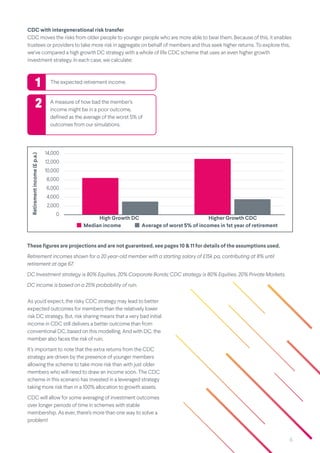
CDC moves the risks from older people to younger people who are more able to bear them. Because of this, it enables
trustees or providers to take more risk in aggregate on behalf of members and thus seek higher returns. To explore this,
we’ve compared a high growth DC strategy with a whole of life CDC scheme that uses an even higher growth
investment strategy. In each case, we calculate:
As you’d expect, the risky CDC strategy may lead to better
expected outcomes for members than the relatively lower
risk DC strategy. But, risk sharing means that a very bad initial
income in CDC still delivers a better outcome than from
conventional DC, based on this modelling. And with DC, the
member also faces the risk of ruin.
It’s important to note that the extra returns from the CDC
strategy are driven by the presence of younger members
allowing the scheme to take more risk than with just older
members who will need to draw an income soon. The CDC
scheme in this scenario has invested in a leveraged strategy
taking more risk than in a 100% allocation to growth assets.
CDC will allow for some averaging of investment outcomes
over longer periods of time in schemes with stable
membership. As ever, there’s more than one way to solve a
problem!
The expected retirement income.
These figures are projections and are not guaranteed, see pages 10 & 11 for details of the assumptions used.
Retirement incomes shown for a 20 year-old member with a starting salary of £15k pa, contributing at 8% until
retirement at age 67.
DC Investment strategy is 80% Equities, 20% Corporate Bonds; CDC strategy is 80% Equities, 20% Private Markets.
DC income is based on a 25% probability of ruin.
1
2
0
2,000
4,000
6,000
8,000
10,000
12,000
14,000
High Growth DC Higher Growth CDC
Retirement
income
(£
p.a.)
Median income Average of worst 5% of incomes in 1st year of retirement
A measure of how bad the member’s
income might be in a poor outcome,
defined as the average of the worst 5% of
outcomes from our simulations.
7
CDC with intergenerational value transfers
The “simplest”, or at least most familiar, form of benefit
design awards a fixed proportion of salary in pension
income for a given contribution rate – eg 1/80ths of salary
for each year of saving. That has a reassuring familiarity
and will resonate with many in the UK. The flipside is that
what the member is paying might be very different to
what they are getting at a given point in time. Someone in
their mid-60s might receive 10 times the value for each
pound of contribution that someone in their early 20s gets
in a scheme with this design. The implicit assumption is
that the 20 year old will be in the same (or similar) scheme
when they are in their 60s – if not, there is a sizeable value
transfer. If someone joins in their later years, they only get
the benefit of this value transfer.
The effect of this value transfer can be quite dramatic on
member outcomes. Older members joining a scheme in
their 50s and 60s, will be “subsidised” by younger
members. And for a scheme with a stable membership,
the relative generosity to the first generation of older
members means that you have a smaller pot for younger
members and this effect persists over time – there is no
catch up.
In practice this can mean a 20 year old joining a CDC
scheme with a single rate of accrual might earn half the
benefits they would earn in a DC scheme with a longevity
pool in retirement. If you’re ‘glass half-full’, you’d note:
• the money hasn’t disappeared, it’s gone to some of
the 40, 50 and 60 year-olds; and
• that 20 year-old will still have 20% more income than
if they’d just joined a DC scheme (no longevity pool
in retirement) and had a cautious approach to
spending in drawdown.
The scenarios grow if you also allow for market conditions
changing over time. But we’d simply note periods of
relatively high, or low, yields tend to persist for decades,
not months. And so ‘averaging out’ these periods can take
a long time, and the relative flows of value can be sizeable
in that time.
There’s no right and wrong to these benefit designs.
Decision-makers need to consider the trade-offs
between ease of communication and member
understanding, actual economic outcomes, and scale of
winners and losers over time.
For whole of life CDC schemes associated to
employment, it feels like most people will simply join the
scheme into which they are auto-enrolled. To a large
degree, they will be oblivious to the actuarial mechanics,
and that could well be a good thing for society overall.
People can focus on the income they’ll get, and that can
be boosted by CDC. But for commercial decumulation
only solutions, it’s hard to imagine a market in which
someone would (or indeed should, given the number of
fiduciaries involved and Consumer Duty etc) join a
scheme from which they got materially less in value on
day 2 than the money they transferred in on day 1.
This suggests a strong need for a market based “accrual”
of pension at the point of transfer. Assuming they come
from a DC scheme, and so do not have a particular
income in mind, that should not be problematic. Stringent
rules over how income levels are set and marketed feels
important to protect members and ensure they make
good decisions in their own best interests.
8
Ourmodelling suggests CDCcan deliverupto50%highersecureincomeforlifethana
typicalDCscheme.But not for all members.
Conclusion
For a typical whole of life CDC scheme with flat accrual,
intergenerational risk and value transfer mean younger
members subsidise older members, and the value flowing
to the early cohorts is not necessarily replicated to future
generations.
For younger members, DC followed by longevity pool in
retirement can deliver the most value, consistently for
successive generations.
CDC carries a trade-off between simplicity, such as
single contribution rate and uniform benefit accrual,
and fairness considerations like intergenerational risk
and value transfer. While simpler designs are easier to
manage, sophisticated design features like age related
contribution rates and life expectancy adjusted benefit
awards aim to share benefits equitably across
generations, addressing intergenerational risk and value
transfer.
With multi-employer CDC schemes, the risk and value
transfer considerations become even more important.
Long term success of the scheme is contingent on each
group of members who join or leave the scheme being
treated fairly.
The key to unlocking the retirement adequacy challenge
can be found in CDC. Designed well, all members benefit
with higher and more secure retirement incomes.
To make this a success:
The government must legislate to enable the
broadest range of CDC design structures to
be put in place.
The industry needs to take care in CDC plan
design, recognising and addressing the
intergenerational risk and value transfer issues
at play.
Communication strategy with stakeholders
and scheme members must reflect the
intergenerational risk and value transfer
considerations for that scheme.
1
2
3
There will be a trade-off between simplicity and fairness.
The objective should be to deliver the greatest good for
the greatest number. Don’t let perfect be the enemy of
the good, but ensure all generations benefit from CDC in
a fair and transparent way.
9
Stochastic projections
Technicalappendix
Our projections of member outcomes depend
significantly on the Economic Scenario Service (ESS), our
(proprietary) stochastic asset model. This type of model
is known as an economic scenario generator and uses
probability distributions to project a range of possible
outcomes for the future behaviour of asset returns and
economic variables. Some of the parameters of the
model are dependent on the current state of financial
markets and can be updated each month (for example,
the current level of equity market volatility) while other
more subjective parameters do not change with different
calibrations of the model. The results in this paper have
been based on market conditions as at 31 May 2024.
Key subjective assumptions are the average excess
equity return over the risk-free asset (tending to
approximately 3.5% pa as the investment horizon is
increased), the volatility of equity returns (approximately
18% pa over the long term) and the level and volatility of
yields, low risk spreads, inflation and projected
(breakeven) inflation, which affect projected bond
returns. The output of the model is also affected by other
more subtle effects, such as the correlations between
economic and financial variables.
While the model allows for the possibility of scenarios
that would be extreme by historical standards, including
very significant downturns in equity markets, large
systemic and structural dislocations are not captured by
the model. Such events are unknowable in effect,
magnitude and nature, meaning that the most extreme
possibilities are not necessarily captured within the
distributions of results.
We’ve not undertaken any sensitivity analysis to assess
how different the results might be with alternative
calibrations of the economic scenario generator.
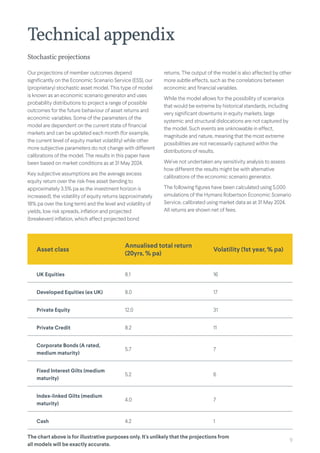
The following figures have been calculated using 5,000
simulations of the Hymans Robertson Economic Scenario
Service, calibrated using market data as at 31 May 2024.
All returns are shown net of fees.
Asset class
Annualised total return
(20yrs, % pa)
Volatility (1st year, % pa)
UK Equities 8.1 16
Developed Equities (ex UK) 8.0 17
Private Equity 12.0 31
Private Credit 8.2 11
Corporate Bonds (A rated,
medium maturity)
5.7 7
Fixed Interest Gilts (medium
maturity)
5.2 6
Index-linked Gilts (medium
maturity)
4.0 7
Cash 4.2 1
The chart above is for illustrative purposes only. It's unlikely that the projections from
all models will be exactly accurate.
The current calibration of the model indicates that a
period of inward nominal yield movement is expected.
For example, over the next 20 years our model expects
the 17-year maturity annualised nominal interest rate to fall
from 4.77% to 3.56%. The corresponding market implied
forward rate is 4.54% over 20 years.
The current calibration of the model indicates that a
period of outward real yield movement is expected. For
example, over the next 20 years our model expects the
17-year maturity annualised real interest rate to rise from
1.08% to 1.19%. The corresponding market implied
forward rate is 1.47% over 20 years.
Drawdown modelling
We’ve modelled ‘Modest’ and ‘High’ drawdown scenarios
under which the member withdraws a constant (real)
annual retirement income, estimated to give them a
chance of their fund not being exhausted before death of
75% and 50% respectively. The sustainable incomes are
calculated based on the simulated outcomes from our
stochastic model which cover the member’s years of
retirement.
We’ve modelled drawdown outcomes based on an
investment strategy of 80% Equities + 20% Corporate
Bonds to allow a comparison of outcomes with other
benefit structures under the same strategy.
We’ve also modelled drawdown outcomes based on a
typical drawdown lifestyle strategy, which is invested
80% in Equities until 10yrs from retirement, and then
derisking to 50% Equities at the member’s retirement
date. We assume the 50% Equity strategy remains in
place throughout retirement.
Longevity pool
We assume that the member joins a longevity pool of
1,000 members at their retirement date and is guided
towards a sustainable income each year based on
changes in market conditions. As members of the pool
die, their remaining savings are redistributed across the
surviving members of the pool. We have assumed a
constant investment strategy of 80% Equities + 20%
Corporate Bonds to allow a comparison of outcomes
with other benefit structures under the same strategy.
CDC Scheme
We’ve modelled a whole of life CDC scheme with the
following characteristics:
• At the start of the projection, the scheme has 1,000
members, ranging from age 20 to 66. The average age
of the membership is 41 and the average salary is
£30k pa.
• All members retire at age 67.
• We assume that the number of active members
remains constant at 1,000. Retiring members are
replaced by same number of 20-year-olds.
• Target benefits are based on CARE accrual, with a
constant accrual rate of 1.55% (joint life) or 1.85%
(single life).
• All members have contributions of 8% pa until their
retirement date.
• Investment strategy of 80% Equities + 20% Corporate
Bonds, as well as a higher risk strategy of 80%
Equities + 20% Private Markets (equity and credit).
• Liabilities are valued on a best estimate basis, relative
to gilt yields. For an investment strategy of 80%
Equities, 20% Corporate Bonds, the valuation basis is
gilt yields + 3.5%.
This report has been compiled by Hymans Robertson LLP. It is designed to be a general summary of topical
investment issues; it does not constitute investment advice and is not specific to the circumstances of any
particular employer or pension scheme. Please note where reference is made to legal matters, Hymans Robertson
LLP is not qualified to provide legal opinions and you may wish to seek independent legal advice. Hymans
Robertson LLP accepts no liability for errors or omissions. Projections used in this report are not guaranteed.
Please note the value of investments, and income from them, may fall as well as rise and you should not make any
assumptions about the future performance of your investments based on information contained in this document.
Further, investments in developing or emerging markets may be more volatile and less marketable than in mature
markets. Exchange rates may also affect the value of an investment.'
Hymans Robertson LLP (registered in England and Wales - One London Wall, London EC2Y 5EA - OC310282) is
authorised and regulated by the Financial Conduct Authority and licensed by the Institute and Faculty of Actuaries
for a range of investment business activities. A member of Abelica Global.
© Hymans Robertson LLP.
London | Birmingham | Glasgow | Edinburgh		 T 020 7082 6000 | www.hymans.co.uk

Intergenerational_risk_sharing_-_its_dynamite.pdf

  • 1.
  • 2.
    Dynamiteispowerfulstuff.Sopowerful,andsouseful,itamasseda fortuneforitsinventor,AlbertNobel.Butalso sopowerful,thathandled carelesslyitcanliterallyblowupinyourhands.Intergenerationalrisk, andcost,sharinginCollectiveDefinedContribution(CDC)hassimilar propertiesandthefinancialimpactsonmembersplayoutover generations.Trustees,providers,legislatorsandadvisersneedtobealive tothepotentialconsequencesofbenefitdesigndecisionsbecausethe effectsonindividualsandtheirretirementoutcomescanbelifechanging. There’s noone-size fits all benefit design that’s best for everyone. Compared to other options that could potentially get support from UK businesses, CDC may offer: Income security for life Higher incomes for most people It can also potentially breathe new life into the intergenerational contract, or gift between generations, that any pension really represents. Fundamentally, future generations of economically active people are needed to support the generations that retired before them. Later in our report, we explore the conditions where people may not receive a higher income. 1 with a single contribution rate and constant accrual rate at all ages 2 Based on a 20 year old earning £15,000 and accepting a 1 in 4 risk of ruin (ie a 25% chance of running out of money in retirement) This paper focuses on CDC / risk pooling, other non-risk sharing options such as drawdown/cash/annuity are available. See our risk sharing report for more details. But with intergenerational risk transfer comes some potentially very sizeable intergenerational wealth transfers. There’s a lot of devil in the detail and so the illustrative analysis in this paper is sensitive to the specific assumptions made by us here, or anyone else in their modelling. Having said all that: • A 20 year old with a lifetime saving in DC, and using income drawdown in retirement while part of a longevity pool, could have around double the pension compared to a whole of life CDC scheme1 . Yes, double! • Yet, on a like for like high growth investment strategy, a whole of life CDC scheme might offer 20% more income, and income security for life, relative to typical DC with a drawdown strategy2 . So CDC can comfortably outperform DC through certain lenses. • Intergenerational risk sharing, at least with sufficiently large investment scale, could allow trustees to be comfortable taking more investment risk in CDC than DC. Allowing for that could boost the 20% CDC expected income outperformance on DC on a like for like basis, to nearer 50% outperformance. • Investment markets will move. They always do. If yields were to drop 2% pa and stay there for a while, active members would be earning 50% more benefits than the expected ‘cost’ of their benefits. This extra cost would be spread over all members in the form of benefit reductions – including deferred members and pensioners. And vice versa if yields were to rise 2% pa. Some would argue that’s exactly the point of risk sharing – but an important question is – who might win and lose, and by how much? 1
  • 3.
    2 The upcoming multi-employerregulations offer the new Government a genuine chance to let the pension industry do more. But we need to be bold. Much bolder than we’ve been so far with CDC. We’ve got nearly £1.2tn tied up in DC, growing at over £100bn a year this decade. The current single employer CDC regulations tie together: A framework for trustees to offer and run a default pension payment approach – this is vital. A route for longevity pooling in retirement which, in combination with point 1, allows schemes to offer regular incomes that will last a lifetime. What many people are looking for from their pension! Intergenerational value transfers. While this might be right for some schemes, and the scheme design will allow flexibility in balancing the trade-offs between simplicity and the scale of intergenerational value transfers, it shouldn’t be imposed on all CDC schemes. Kathryn Fleming Partner and Head of DC At-retirement kathryn.fleming@hymans.co.uk Paul Waters Partner & Head of DC Markets paul.waters@hymans.co.uk 1 2 3 Jon Hatchett Senior Partner jon.hatchett@hymans.co.uk
  • 4.
    3 IncomparingCDCto DC, therearethreekeyfactorsdrivingdifferencesinoutcomes: Weexamine these different designs and risk sharing drivers through the lens of members saving 8% of salary into their pension and retiring at age 67. Details of the other key assumptions are set out in the appendix. Ourapproachtothispaper • Longevity pooling. This means CDC delivers regular incomes for life (alongside trustee control of default retirement pensions) compared to DC members “self- insuring” their own longevity risk and potentially running out of money. • Intergenerational risk transfer. The pooled nature of CDC and long duration allows greater investment risk to be taken with the expectation of potentially higher returns. • Intergenerational value transfer. Less well recognised, the value a given member builds up in benefits for the contributions they pay, relative to other members of different ages in the scheme. When assessing intergenerational risk and value transfer, we considered the following scheme designs: Scheme design Description DC and income drawdown in retirement DC scheme with the member entering drawdown at retirement and withdrawing a constant, inflation-proofed, income based on their chance of ruin not exceeding a threshold amount. DC and income drawdown while in a longevity pool As 1) except, at retirement, the member joins a longevity pool of 1,000 members in which the unspent pots of members who die are shared with the surviving pool. DC and decumulation only CDC As 1) except the member is in a CDC scheme through retirement where investment risk and longevity risk are pooled. Whole of life CDC Single employer CDC scheme following the current regulations and with the design features set out in the appendix. 1 2 3 4 1 3 2
  • 5.
    4 Beforewegetinto thedetails ofbenefitdesign,wewantedtotakeadetourtoexplain,atahigh level,howintergenerational risksharingworks. How intergenerationalrisk sharing works Existing benefits The mechanism for risk sharing in CDC in the UK, is that a scheme is brought back to full funding each year by adjusting all future increases, up or down, for all members equally. Members share investment risk across generations in exchange for a smoother escalation of their accrued pension benefits. There’s a lot to be said for this. It focuses everyone’s minds on pension income, not capital amounts. For most people, a pension is primarily for drawing a pension (the clue might be in the name!) and that’s about an income for life. Open schemes will have a long “duration” – broadly the average weighted time until pensions are paid. That could easily be 30 years or more in the early years of a new CDC scheme. Even after a major downside funding shock, such as a 30% drop in assets relative to liabilities, the impact on future benefit increases would be limited to “only” 1% pa. If the scheme were targeting CPI increases on pensions before and after retirement and CPI was at 2%, then pensions would still increase by 1%. The younger the member, the more future years they’d have that “1% reduction” built into their benefit promise. Someone in their 20s might effectively have “lost” 50% of the value of their future benefits, while someone in their 80s might have lost 5% of their future benefits. So the 20 something has 10 times the risk exposure of the 80 year old – this is the intergenerational investment risk transfer. The quid pro quo is that we anticipate that the 20 something may well be an 80 something one day, and another generation of 20 somethings will be absorbing the risks for them. For this to work in practice, CDC schemes need to stay open and maintain a stable “shape” or membership profile, so that enough young members remain to absorb the risks. If not, the scheme will mature, and the sensitivity to risks will increase. As a concrete example, decumulation only CDC schemes might have two or three times the sensitivity to investment markets as whole of life CDC schemes. So for any given market shock, the decumulation only members will experience three times the impact on their pension increases – both up and down – each year. New benefits There may or may not be value transfer in relation to new benefits being earned in a CDC scheme. It’s a design choice. The cost of every new unit of pension promise will vary across members, and over time. In the simplest case, members share that cost uncertainty in exchange for a clear and constant rate of benefit accrual. But that simplicity can create winners and losers. For decumulation only CDC, it feels hard to set up a design under which a member might suffer a material gain or loss at the point of transfer into the scheme. Because, if it were a loss, it would be hard for an adviser or trustee to allow a member to transfer into the scheme, compared to an alternative arrangement. For whole of life, it’s a more involved question. To avoid value transfer (ie the creation of winners and losers), you would need to adjust the pension for each pound of contributions in line with a member’s age, longevity trends, and market conditions. So members would earn different amounts of pension for the same contribution amount over time. It’s an open question as to whether we can do that in a way that doesn’t disengage members. The funding cost of earning benefits for a younger member in a CDC scheme is much less than for older members – it might be around ten times as costly to fund each pound of annual pension for a 60 something compared to someone in their early 20s. You can adjust for this by having a cost that goes up with age, but that risks adding complexity and you’d need to navigate potential age discrimination challenges. Even if you went as far as having age related cost of benefits, investment markets will go up and down, longevity trends will evolve, and societal changes will lead to more or fewer people having financial dependants. All of this means that, over time, there will be a flow of value to or from members earning new pensions. And the flows can be sizeable, easily 50% or more of the value of pensions being earned each year.
  • 6.
    5 Benefitdesignsandimpacton members Longevity pool Research onpension scheme members by Hymans Robertson shows that the majority want a secure income for life. This isn’t a surprise. What’s important to many is that the income doesn’t run out, not that it continues at a very precise level (whether that’s fixed or inflation-linked). Or at least the cost of those guarantees (eg annuities) is acceptable to some but not all. The neat trick of longevity pooling for pensions in payment is that it allows CDC to provide a regular income for life. Once you have around 1,000 members, you’ve removed around 90% of the longevity risk to which people are exposed. And through adjusting incomes, you can remove the risk of ruin although you’ll still have the risk of changing pension increases, including some risk of reductions. The downside is that those who die early, before their pot runs out, forgo the opportunity to pass that remaining pot on to their estate. Basically, the people who die sooner cover the additional pension income of those who live longer. It’s a collective approach to sharing risk that lets everyone draw higher incomes in the confidence they won’t run out. For the 20 year-old in our earlier example, reducing the chance of exhausting their savings from 50% to 25% is equivalent to halving the annual income they withdraw. That’s not even a guarantee of a sustainable income – to many, a 1 in 4 chance of ruin will feel like a very high risk! For a CDC scheme with longevity pooling, you can target the 50:50 chance for people in aggregate and fine-tune incomes based on investment outcomes. This is one of the drivers for delivering better retirement outcomes, while still managing member risks. Longevity pooling also focuses the pension money purely on paying pensions rather than passing on an inheritance. This isn’t a magic source of money and won’t suit everyone. But for those whose priority for their pension is maximising their income, rather than passing on money when they die, it’s another powerful boost to income. It can add up to 20% in expected income again, for a single person. Without the risk of ruin! Downsides and risks Our analysis shows the advantages of CDC in the modelling methodology and assumptions as set out in the appendix. There are potential scenarios where members may fare less well under CDC than DC, for example: - Significant underperformance of the higher risk CDC investment strategy for a sustained period of time. - Members whose DC investments outperform the CDC investment strategy, which is particularly relevant when assessing over short periods of service. - CDC schemes which do not continue for the long term or with significantly changed membership profiles over time. These figures are projections and are not guaranteed, see page 11 for details of the methodology used. Longevity pool income based on High Drawdown + Longevity credits. Retirement incomes shown for a 20 year-old member with a starting salary of £15k pa, contributing at 8% until retirement at age 67. Investment strategy is 80% Equities, 20% Corporate Bonds. Modest drawdown and High drawdown based on probabilities of ruin of 25% and 50% respectively. 0 5,000 10,000 15,000 20,000 Modest drawdown High drawdown Longevity pool Annual income (£)
  • 7.
    6 CDC with intergenerationalrisk transfer CDC moves the risks from older people to younger people who are more able to bear them. Because of this, it enables trustees or providers to take more risk in aggregate on behalf of members and thus seek higher returns. To explore this, we’ve compared a high growth DC strategy with a whole of life CDC scheme that uses an even higher growth investment strategy. In each case, we calculate: As you’d expect, the risky CDC strategy may lead to better expected outcomes for members than the relatively lower risk DC strategy. But, risk sharing means that a very bad initial income in CDC still delivers a better outcome than from conventional DC, based on this modelling. And with DC, the member also faces the risk of ruin. It’s important to note that the extra returns from the CDC strategy are driven by the presence of younger members allowing the scheme to take more risk than with just older members who will need to draw an income soon. The CDC scheme in this scenario has invested in a leveraged strategy taking more risk than in a 100% allocation to growth assets. CDC will allow for some averaging of investment outcomes over longer periods of time in schemes with stable membership. As ever, there’s more than one way to solve a problem! The expected retirement income. These figures are projections and are not guaranteed, see pages 10 & 11 for details of the assumptions used. Retirement incomes shown for a 20 year-old member with a starting salary of £15k pa, contributing at 8% until retirement at age 67. DC Investment strategy is 80% Equities, 20% Corporate Bonds; CDC strategy is 80% Equities, 20% Private Markets. DC income is based on a 25% probability of ruin. 1 2 0 2,000 4,000 6,000 8,000 10,000 12,000 14,000 High Growth DC Higher Growth CDC Retirement income (£ p.a.) Median income Average of worst 5% of incomes in 1st year of retirement A measure of how bad the member’s income might be in a poor outcome, defined as the average of the worst 5% of outcomes from our simulations.
  • 8.
    7 CDC with intergenerationalvalue transfers The “simplest”, or at least most familiar, form of benefit design awards a fixed proportion of salary in pension income for a given contribution rate – eg 1/80ths of salary for each year of saving. That has a reassuring familiarity and will resonate with many in the UK. The flipside is that what the member is paying might be very different to what they are getting at a given point in time. Someone in their mid-60s might receive 10 times the value for each pound of contribution that someone in their early 20s gets in a scheme with this design. The implicit assumption is that the 20 year old will be in the same (or similar) scheme when they are in their 60s – if not, there is a sizeable value transfer. If someone joins in their later years, they only get the benefit of this value transfer. The effect of this value transfer can be quite dramatic on member outcomes. Older members joining a scheme in their 50s and 60s, will be “subsidised” by younger members. And for a scheme with a stable membership, the relative generosity to the first generation of older members means that you have a smaller pot for younger members and this effect persists over time – there is no catch up. In practice this can mean a 20 year old joining a CDC scheme with a single rate of accrual might earn half the benefits they would earn in a DC scheme with a longevity pool in retirement. If you’re ‘glass half-full’, you’d note: • the money hasn’t disappeared, it’s gone to some of the 40, 50 and 60 year-olds; and • that 20 year-old will still have 20% more income than if they’d just joined a DC scheme (no longevity pool in retirement) and had a cautious approach to spending in drawdown. The scenarios grow if you also allow for market conditions changing over time. But we’d simply note periods of relatively high, or low, yields tend to persist for decades, not months. And so ‘averaging out’ these periods can take a long time, and the relative flows of value can be sizeable in that time. There’s no right and wrong to these benefit designs. Decision-makers need to consider the trade-offs between ease of communication and member understanding, actual economic outcomes, and scale of winners and losers over time. For whole of life CDC schemes associated to employment, it feels like most people will simply join the scheme into which they are auto-enrolled. To a large degree, they will be oblivious to the actuarial mechanics, and that could well be a good thing for society overall. People can focus on the income they’ll get, and that can be boosted by CDC. But for commercial decumulation only solutions, it’s hard to imagine a market in which someone would (or indeed should, given the number of fiduciaries involved and Consumer Duty etc) join a scheme from which they got materially less in value on day 2 than the money they transferred in on day 1. This suggests a strong need for a market based “accrual” of pension at the point of transfer. Assuming they come from a DC scheme, and so do not have a particular income in mind, that should not be problematic. Stringent rules over how income levels are set and marketed feels important to protect members and ensure they make good decisions in their own best interests.
  • 9.
    8 Ourmodelling suggests CDCcandeliverupto50%highersecureincomeforlifethana typicalDCscheme.But not for all members. Conclusion For a typical whole of life CDC scheme with flat accrual, intergenerational risk and value transfer mean younger members subsidise older members, and the value flowing to the early cohorts is not necessarily replicated to future generations. For younger members, DC followed by longevity pool in retirement can deliver the most value, consistently for successive generations. CDC carries a trade-off between simplicity, such as single contribution rate and uniform benefit accrual, and fairness considerations like intergenerational risk and value transfer. While simpler designs are easier to manage, sophisticated design features like age related contribution rates and life expectancy adjusted benefit awards aim to share benefits equitably across generations, addressing intergenerational risk and value transfer. With multi-employer CDC schemes, the risk and value transfer considerations become even more important. Long term success of the scheme is contingent on each group of members who join or leave the scheme being treated fairly. The key to unlocking the retirement adequacy challenge can be found in CDC. Designed well, all members benefit with higher and more secure retirement incomes. To make this a success: The government must legislate to enable the broadest range of CDC design structures to be put in place. The industry needs to take care in CDC plan design, recognising and addressing the intergenerational risk and value transfer issues at play. Communication strategy with stakeholders and scheme members must reflect the intergenerational risk and value transfer considerations for that scheme. 1 2 3 There will be a trade-off between simplicity and fairness. The objective should be to deliver the greatest good for the greatest number. Don’t let perfect be the enemy of the good, but ensure all generations benefit from CDC in a fair and transparent way.
  • 10.
    9 Stochastic projections Technicalappendix Our projectionsof member outcomes depend significantly on the Economic Scenario Service (ESS), our (proprietary) stochastic asset model. This type of model is known as an economic scenario generator and uses probability distributions to project a range of possible outcomes for the future behaviour of asset returns and economic variables. Some of the parameters of the model are dependent on the current state of financial markets and can be updated each month (for example, the current level of equity market volatility) while other more subjective parameters do not change with different calibrations of the model. The results in this paper have been based on market conditions as at 31 May 2024. Key subjective assumptions are the average excess equity return over the risk-free asset (tending to approximately 3.5% pa as the investment horizon is increased), the volatility of equity returns (approximately 18% pa over the long term) and the level and volatility of yields, low risk spreads, inflation and projected (breakeven) inflation, which affect projected bond returns. The output of the model is also affected by other more subtle effects, such as the correlations between economic and financial variables. While the model allows for the possibility of scenarios that would be extreme by historical standards, including very significant downturns in equity markets, large systemic and structural dislocations are not captured by the model. Such events are unknowable in effect, magnitude and nature, meaning that the most extreme possibilities are not necessarily captured within the distributions of results. We’ve not undertaken any sensitivity analysis to assess how different the results might be with alternative calibrations of the economic scenario generator. The following figures have been calculated using 5,000 simulations of the Hymans Robertson Economic Scenario Service, calibrated using market data as at 31 May 2024. All returns are shown net of fees. Asset class Annualised total return (20yrs, % pa) Volatility (1st year, % pa) UK Equities 8.1 16 Developed Equities (ex UK) 8.0 17 Private Equity 12.0 31 Private Credit 8.2 11 Corporate Bonds (A rated, medium maturity) 5.7 7 Fixed Interest Gilts (medium maturity) 5.2 6 Index-linked Gilts (medium maturity) 4.0 7 Cash 4.2 1 The chart above is for illustrative purposes only. It's unlikely that the projections from all models will be exactly accurate.
  • 11.
    The current calibrationof the model indicates that a period of inward nominal yield movement is expected. For example, over the next 20 years our model expects the 17-year maturity annualised nominal interest rate to fall from 4.77% to 3.56%. The corresponding market implied forward rate is 4.54% over 20 years. The current calibration of the model indicates that a period of outward real yield movement is expected. For example, over the next 20 years our model expects the 17-year maturity annualised real interest rate to rise from 1.08% to 1.19%. The corresponding market implied forward rate is 1.47% over 20 years. Drawdown modelling We’ve modelled ‘Modest’ and ‘High’ drawdown scenarios under which the member withdraws a constant (real) annual retirement income, estimated to give them a chance of their fund not being exhausted before death of 75% and 50% respectively. The sustainable incomes are calculated based on the simulated outcomes from our stochastic model which cover the member’s years of retirement. We’ve modelled drawdown outcomes based on an investment strategy of 80% Equities + 20% Corporate Bonds to allow a comparison of outcomes with other benefit structures under the same strategy. We’ve also modelled drawdown outcomes based on a typical drawdown lifestyle strategy, which is invested 80% in Equities until 10yrs from retirement, and then derisking to 50% Equities at the member’s retirement date. We assume the 50% Equity strategy remains in place throughout retirement. Longevity pool We assume that the member joins a longevity pool of 1,000 members at their retirement date and is guided towards a sustainable income each year based on changes in market conditions. As members of the pool die, their remaining savings are redistributed across the surviving members of the pool. We have assumed a constant investment strategy of 80% Equities + 20% Corporate Bonds to allow a comparison of outcomes with other benefit structures under the same strategy. CDC Scheme We’ve modelled a whole of life CDC scheme with the following characteristics: • At the start of the projection, the scheme has 1,000 members, ranging from age 20 to 66. The average age of the membership is 41 and the average salary is £30k pa. • All members retire at age 67. • We assume that the number of active members remains constant at 1,000. Retiring members are replaced by same number of 20-year-olds. • Target benefits are based on CARE accrual, with a constant accrual rate of 1.55% (joint life) or 1.85% (single life). • All members have contributions of 8% pa until their retirement date. • Investment strategy of 80% Equities + 20% Corporate Bonds, as well as a higher risk strategy of 80% Equities + 20% Private Markets (equity and credit). • Liabilities are valued on a best estimate basis, relative to gilt yields. For an investment strategy of 80% Equities, 20% Corporate Bonds, the valuation basis is gilt yields + 3.5%. This report has been compiled by Hymans Robertson LLP. It is designed to be a general summary of topical investment issues; it does not constitute investment advice and is not specific to the circumstances of any particular employer or pension scheme. Please note where reference is made to legal matters, Hymans Robertson LLP is not qualified to provide legal opinions and you may wish to seek independent legal advice. Hymans Robertson LLP accepts no liability for errors or omissions. Projections used in this report are not guaranteed. Please note the value of investments, and income from them, may fall as well as rise and you should not make any assumptions about the future performance of your investments based on information contained in this document. Further, investments in developing or emerging markets may be more volatile and less marketable than in mature markets. Exchange rates may also affect the value of an investment.' Hymans Robertson LLP (registered in England and Wales - One London Wall, London EC2Y 5EA - OC310282) is authorised and regulated by the Financial Conduct Authority and licensed by the Institute and Faculty of Actuaries for a range of investment business activities. A member of Abelica Global. © Hymans Robertson LLP. London | Birmingham | Glasgow | Edinburgh T 020 7082 6000 | www.hymans.co.uk