1
Morehead State University
Caudill College of Arts, Humanities and Social Sciences
Department of Communication, Media and Languages
Spring 2016
COMS 420.001: Analysis of Persuasion
9:00 a.m. MWF
318 Breckinridge Hall
Instructor: Mr. Randy L. Manis, M.A.
Office: 303B Breckinridge Hall
Phone: (606) 783.5399
E-mail: r.manis@moreheadstate.edu
Office Hours: MWF: 11:00 a.m.-1:00 p.m.
TTh: 9:30-11:00 a.m.
Other office hours by appointment only
Textbook:
Foss, S.K. (2009). Rhetorical criticism: Exploration and practice. (4th
ed.). Long Grove, IL: Waveland Press,
Inc.
ISBN 10: 1-57766-586-4 ISBN 13: 978-1-57766-586-1
Course Description:
COMS 420. Analysis of Persuasion. (3-0-3). This course examines the foundations of persuasion
through theory and practice in multiple contexts: interpersonal relationships, politics, advertising and
speaking in diverse contexts. Students will observe, analyze, and write about persuasive events as they
happen in their everyday lives. This class will help students be better consumers of persuasion as they
participate in the communities where they live and work, thus making them better engaged citizens.
Prerequisites: COMS 108 and ENG 100. (MSU Undergraduate Catalog, 2015-16)
Course Objectives:
In COMS 420: Analysis of Persuasion, the specific learning objectives to achieve the course goals are:
1. Apply key concepts of rhetorical theories to significant persuasive events.
2. Explain the significance of persuasive events through written and verbal means.
3. Assess the impact of ethical and unethical decision making on persuaders in diverse situations.
4. Assess the impact of singular and group persuasive events on the course of history and laws.
5. Compare and contrast the outcome of persuasive events when mediation and negotiation were
used effectively and non-effectively.
6. Demonstrate critical thinking skills through the research and analysis of a significant persuasive
event/artifact that changed or altered history, resulting in a term paper and presentation.
2
Attendance Policy (Revised 12/28/15):
It is my expectation that you will be present each time the class meets because you learn from one
another, as well as from the instructor. Ultimately, this is your education and as an adult, you are
responsible for the choices you make. Know that an attendance sheet will be passed around during
each class session; please only sign in yourself.
If a student is absent from class because of a University excused absence, as identified below, I will allow
you an opportunity to make up work missed without any reduction in the your final grade as a direct
result of such absence. Refer to University Administrative Regulation 131.02 for more information
(http://www2.moreheadstate.edu/files/units/daa/uar/UAR%20131.02%20Excused%20Absence.pdf?n=9
731).
University excused absences fall into five categories; documentation is REQUIRED for each!
 University sponsored activities  Student/family illness/death
 Military obligations  Jury duty or subpoena for court appearances
 Major religious holidays
For students who miss fewer than four (4) class meetings, a 5% bonus will be added to the final grade.
You must attend the final exam session; failure to do so will result in a 50 point deduction off your final
grade!
Electronics and E-mail Policy:
1. Cell Phones
I will have a cell phone with me during class but I will have it turned to “vibrate.” This will
allow me to receive text message notifications from MSU about any emergency
situations on campus or in town. You are welcome to follow this procedure as well to ensure
your comfort and safety while in your classroom. You can sign up to receive these alerts at
the following website: http://www.moreheadstate.edu/emergency.
Please do not abuse this policy by texting family, friends, significant others, etc. and allowing
this to become a distraction to your classmates and/or academic progress in this course.
2. E-mail
You MUST activate your MSU e-mail account. Class materials and announcements will be sent
directly to this account so please make sure that you check it regularly. Please remember to use
proper e-mail etiquette for any messages sent to the instructor.
Grading Scale:
The following grading scale will be used in this course:
A 720-800 points (90-100%)
B 640-719 points (80-89%)
C 560-639 points (70-79%)
D 480-559 points (60-69%)
E 479 points and below (59% and below)
3
Final grades are due in the Registrar’s office on Tuesday, May 17 at 10:30 a.m. Grades will be calculated
based on your performance on the assignments listed below in addition to your attendance (as outlined
in the policy above). Under the Family Educational Rights and Privacy Act (FERPA), I am not permitted to
discuss grades with you via e-mail or telephone. I am also not permitted to discuss grades with any of
your family members unless you have given your consent; you may do so by completing an official
consent form available in the Registrar’s office (201 Ginger Hall). If you have questions regarding your
final grade, please wait to speak with me during my office hours in the first few weeks of the subsequent
semester.
Assignments:
Assignment Points Possible
Method Outlines (8 @ 25 points each) 200 points
Quizzes (8 @ 25 points each) 200 points
Short Paper #1 50 points
Midterm Exam 100 points
Short Paper #2 50 points
Research Paper 100 points
Presentation of Research Paper 100 points
Total: 800 points
Description of Assignments:
 Method Outlines
Students will outline eight (8) different methods of criticism: Cluster, Fantasy-Theme, Generic,
Ideological, Metaphor, Narrative, Pentadic, and Generative. Outlines must be detailed,
resembling the template provided in class. Four (4) outlines will be completed individually; the
remaining outlines will be completed in groups of four (4).
 Quizzes
Quizzes will be posted weekly on Blackboard; each quiz will cover a particular method of
criticism. Quizzes will consist of multiple choice and true/false questions.
 Short Papers
Two (2) short paper prompts will be posted on Blackboard. Each short paper will be 2-4 pages in
length (typed, double-spaced, 12 pt. font, 1” margins) using standard APA conventions (6-8
credible sources).
 Midterm Exam
The midterm exam will consist of five (5) essay questions. Each student will complete his or her
own exam during class in a blue book; these may be purchased at the University Bookstore.
 Research Paper
Students will analyze an artifact of their choice using a method of criticism. The paper will be 6-
8 pages in length (typed, double-spaced, 12 pt. font, 1” margins) using standard APA
conventions (10-15 credible sources). Further assignment details will be posted on Blackboard.
4
 Presentation of Research Paper
Students will explain the findings of their research paper in individual 5-8 minute presentations.
Further assignment details will be posted on Blackboard.
Academic Honesty Statement:
Cheating, fabrication, plagiarism, or helping others to commit these acts will not be tolerated. Academic
dishonesty will result in severe disciplinary action including, but not limited to, failure of the student
assessment item or course, and/or dismissal from MSU. If you are not sure what constitutes academic
dishonesty, read The Eagle: Student Handbook or ask your instructor. The policy can be located by
visiting the following website: http://www2.moreheadstate.edu/dsl/eaglehandbook.
For example: Copying information from the Internet is plagiarism if appropriate credit is not given.
Policy for Accommodating Students with Disabilities:
In compliance with the ADA, all students with a documented disability are entitled to reasonable
accommodations and services to support their academic success and safety. Though a request for
services may be made at any time, services are best applied when they are requested at or before the
start of the semester. To receive accommodations and services the student should immediately contact
the Disability Services Coordinator at: 204-E ADUC, 606-783-5188, or e.day@moreheadstate.edu.
Campus Safety Statement:
Emergency response information will be discussed in class. Students should familiarize themselves with
the nearest exit routes in the event evacuation becomes necessary. You should notify your instructor at
the beginning of the semester if you have special needs or will require assistance during an emergency
evacuation. Students should familiarize themselves with emergency response protocols at:
http://www2.moreheadstate.edu/emergency.
Inclement Weather and Catastrophe Policy (REVISED 1/20/16):
Morehead State University has established a policy for announcing delays and cancellations. The
University will select from one of the following options when dealing with inclement weather that may
affect the daily schedule of faculty, staff and students or visitors to the main campus.
 Plan A. MSU is closed.
All administrative offices will be closed and classes will not meet.
 Plan B. MSU will operate on a two-hour delay.
Offices will open at 10 a.m. MWF classes will begin with the 10:00 a.m. class.
TTh classes will begin with the 11 a.m. class.
In the event that class is cancelled (due to weather or instructor illness), I will send an e-mail and post an
announcement on Blackboard. An alternate assignment will be available for you to complete prior to
our next scheduled class session. If you commute, please check the travel conditions before venturing
out to campus. If roads are too hazardous and you cannot make it to class, please let me know
immediately via e-mail.
Right of Revision Statement:
As instructor of the course, I reserve the right to alter the syllabus at any time during the semester. Any
changes made to the syllabus will be announced in class, through e-mail, and on Blackboard.
5
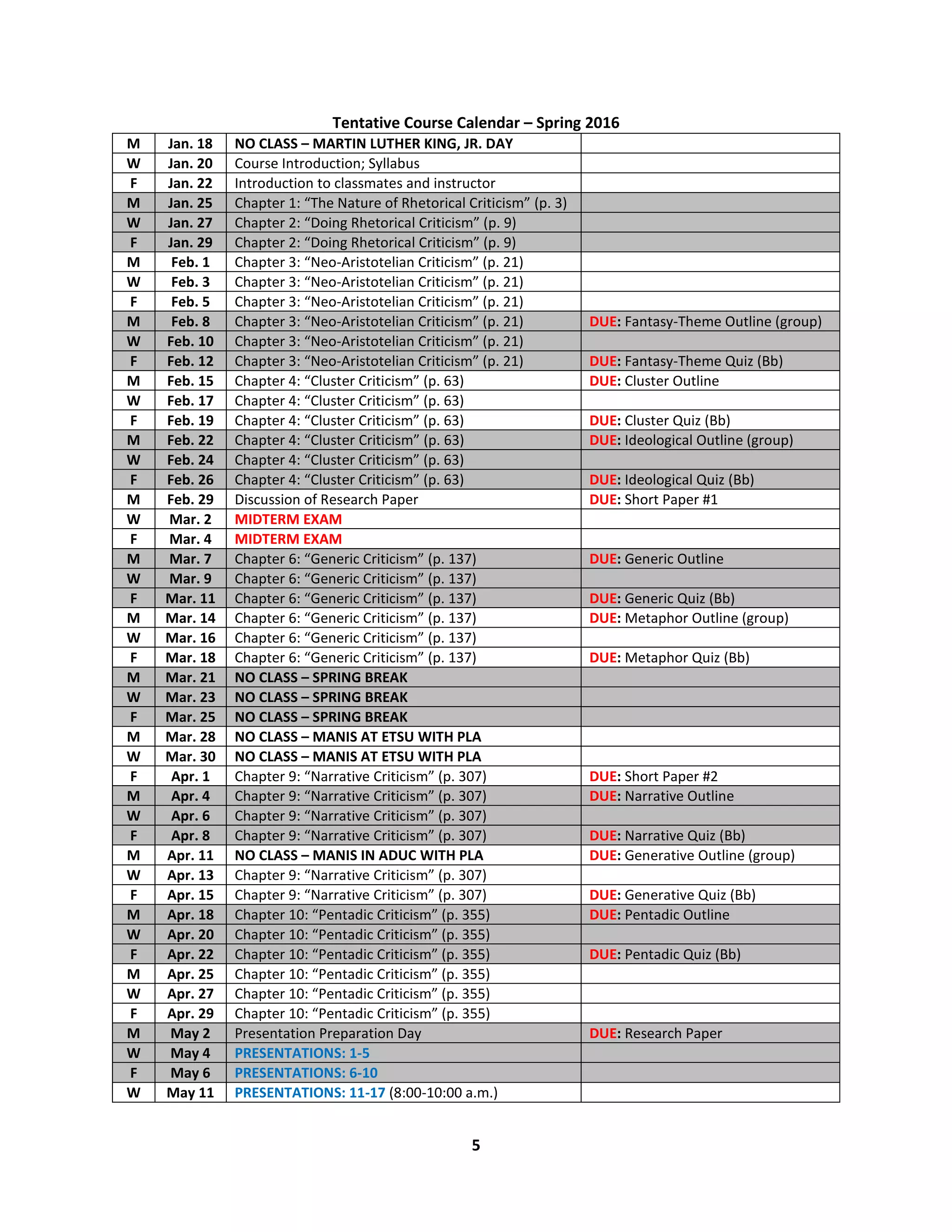
Tentative Course Calendar – Spring 2016
M Jan. 18 NO CLASS – MARTIN LUTHER KING, JR. DAY
W Jan. 20 Course Introduction; Syllabus
F Jan. 22 Introduction to classmates and instructor
M Jan. 25 Chapter 1: “The Nature of Rhetorical Criticism” (p. 3)
W Jan. 27 Chapter 2: “Doing Rhetorical Criticism” (p. 9)
F Jan. 29 Chapter 2: “Doing Rhetorical Criticism” (p. 9)
M Feb. 1 Chapter 3: “Neo-Aristotelian Criticism” (p. 21)
W Feb. 3 Chapter 3: “Neo-Aristotelian Criticism” (p. 21)
F Feb. 5 Chapter 3: “Neo-Aristotelian Criticism” (p. 21)
M Feb. 8 Chapter 3: “Neo-Aristotelian Criticism” (p. 21) DUE: Fantasy-Theme Outline (group)
W Feb. 10 Chapter 3: “Neo-Aristotelian Criticism” (p. 21)
F Feb. 12 Chapter 3: “Neo-Aristotelian Criticism” (p. 21) DUE: Fantasy-Theme Quiz (Bb)
M Feb. 15 Chapter 4: “Cluster Criticism” (p. 63) DUE: Cluster Outline
W Feb. 17 Chapter 4: “Cluster Criticism” (p. 63)
F Feb. 19 Chapter 4: “Cluster Criticism” (p. 63) DUE: Cluster Quiz (Bb)
M Feb. 22 Chapter 4: “Cluster Criticism” (p. 63) DUE: Ideological Outline (group)
W Feb. 24 Chapter 4: “Cluster Criticism” (p. 63)
F Feb. 26 Chapter 4: “Cluster Criticism” (p. 63) DUE: Ideological Quiz (Bb)
M Feb. 29 Discussion of Research Paper DUE: Short Paper #1
W Mar. 2 MIDTERM EXAM
F Mar. 4 MIDTERM EXAM
M Mar. 7 Chapter 6: “Generic Criticism” (p. 137) DUE: Generic Outline
W Mar. 9 Chapter 6: “Generic Criticism” (p. 137)
F Mar. 11 Chapter 6: “Generic Criticism” (p. 137) DUE: Generic Quiz (Bb)
M Mar. 14 Chapter 6: “Generic Criticism” (p. 137) DUE: Metaphor Outline (group)
W Mar. 16 Chapter 6: “Generic Criticism” (p. 137)
F Mar. 18 Chapter 6: “Generic Criticism” (p. 137) DUE: Metaphor Quiz (Bb)
M Mar. 21 NO CLASS – SPRING BREAK
W Mar. 23 NO CLASS – SPRING BREAK
F Mar. 25 NO CLASS – SPRING BREAK
M Mar. 28 NO CLASS – MANIS AT ETSU WITH PLA
W Mar. 30 NO CLASS – MANIS AT ETSU WITH PLA
F Apr. 1 Chapter 9: “Narrative Criticism” (p. 307) DUE: Short Paper #2
M Apr. 4 Chapter 9: “Narrative Criticism” (p. 307) DUE: Narrative Outline
W Apr. 6 Chapter 9: “Narrative Criticism” (p. 307)
F Apr. 8 Chapter 9: “Narrative Criticism” (p. 307) DUE: Narrative Quiz (Bb)
M Apr. 11 NO CLASS – MANIS IN ADUC WITH PLA DUE: Generative Outline (group)
W Apr. 13 Chapter 9: “Narrative Criticism” (p. 307)
F Apr. 15 Chapter 9: “Narrative Criticism” (p. 307) DUE: Generative Quiz (Bb)
M Apr. 18 Chapter 10: “Pentadic Criticism” (p. 355) DUE: Pentadic Outline
W Apr. 20 Chapter 10: “Pentadic Criticism” (p. 355)
F Apr. 22 Chapter 10: “Pentadic Criticism” (p. 355) DUE: Pentadic Quiz (Bb)
M Apr. 25 Chapter 10: “Pentadic Criticism” (p. 355)
W Apr. 27 Chapter 10: “Pentadic Criticism” (p. 355)
F Apr. 29 Chapter 10: “Pentadic Criticism” (p. 355)
M May 2 Presentation Preparation Day DUE: Research Paper
W May 4 PRESENTATIONS: 1-5
F May 6 PRESENTATIONS: 6-10
W May 11 PRESENTATIONS: 11-17 (8:00-10:00 a.m.)

COMS 420.001 900 MWF SP16 Syllabus

  • 1.
    1 Morehead State University CaudillCollege of Arts, Humanities and Social Sciences Department of Communication, Media and Languages Spring 2016 COMS 420.001: Analysis of Persuasion 9:00 a.m. MWF 318 Breckinridge Hall Instructor: Mr. Randy L. Manis, M.A. Office: 303B Breckinridge Hall Phone: (606) 783.5399 E-mail: r.manis@moreheadstate.edu Office Hours: MWF: 11:00 a.m.-1:00 p.m. TTh: 9:30-11:00 a.m. Other office hours by appointment only Textbook: Foss, S.K. (2009). Rhetorical criticism: Exploration and practice. (4th ed.). Long Grove, IL: Waveland Press, Inc. ISBN 10: 1-57766-586-4 ISBN 13: 978-1-57766-586-1 Course Description: COMS 420. Analysis of Persuasion. (3-0-3). This course examines the foundations of persuasion through theory and practice in multiple contexts: interpersonal relationships, politics, advertising and speaking in diverse contexts. Students will observe, analyze, and write about persuasive events as they happen in their everyday lives. This class will help students be better consumers of persuasion as they participate in the communities where they live and work, thus making them better engaged citizens. Prerequisites: COMS 108 and ENG 100. (MSU Undergraduate Catalog, 2015-16) Course Objectives: In COMS 420: Analysis of Persuasion, the specific learning objectives to achieve the course goals are: 1. Apply key concepts of rhetorical theories to significant persuasive events. 2. Explain the significance of persuasive events through written and verbal means. 3. Assess the impact of ethical and unethical decision making on persuaders in diverse situations. 4. Assess the impact of singular and group persuasive events on the course of history and laws. 5. Compare and contrast the outcome of persuasive events when mediation and negotiation were used effectively and non-effectively. 6. Demonstrate critical thinking skills through the research and analysis of a significant persuasive event/artifact that changed or altered history, resulting in a term paper and presentation.
  • 2.
    2 Attendance Policy (Revised12/28/15): It is my expectation that you will be present each time the class meets because you learn from one another, as well as from the instructor. Ultimately, this is your education and as an adult, you are responsible for the choices you make. Know that an attendance sheet will be passed around during each class session; please only sign in yourself. If a student is absent from class because of a University excused absence, as identified below, I will allow you an opportunity to make up work missed without any reduction in the your final grade as a direct result of such absence. Refer to University Administrative Regulation 131.02 for more information (http://www2.moreheadstate.edu/files/units/daa/uar/UAR%20131.02%20Excused%20Absence.pdf?n=9 731). University excused absences fall into five categories; documentation is REQUIRED for each!  University sponsored activities  Student/family illness/death  Military obligations  Jury duty or subpoena for court appearances  Major religious holidays For students who miss fewer than four (4) class meetings, a 5% bonus will be added to the final grade. You must attend the final exam session; failure to do so will result in a 50 point deduction off your final grade! Electronics and E-mail Policy: 1. Cell Phones I will have a cell phone with me during class but I will have it turned to “vibrate.” This will allow me to receive text message notifications from MSU about any emergency situations on campus or in town. You are welcome to follow this procedure as well to ensure your comfort and safety while in your classroom. You can sign up to receive these alerts at the following website: http://www.moreheadstate.edu/emergency. Please do not abuse this policy by texting family, friends, significant others, etc. and allowing this to become a distraction to your classmates and/or academic progress in this course. 2. E-mail You MUST activate your MSU e-mail account. Class materials and announcements will be sent directly to this account so please make sure that you check it regularly. Please remember to use proper e-mail etiquette for any messages sent to the instructor. Grading Scale: The following grading scale will be used in this course: A 720-800 points (90-100%) B 640-719 points (80-89%) C 560-639 points (70-79%) D 480-559 points (60-69%) E 479 points and below (59% and below)
  • 3.
    3 Final grades aredue in the Registrar’s office on Tuesday, May 17 at 10:30 a.m. Grades will be calculated based on your performance on the assignments listed below in addition to your attendance (as outlined in the policy above). Under the Family Educational Rights and Privacy Act (FERPA), I am not permitted to discuss grades with you via e-mail or telephone. I am also not permitted to discuss grades with any of your family members unless you have given your consent; you may do so by completing an official consent form available in the Registrar’s office (201 Ginger Hall). If you have questions regarding your final grade, please wait to speak with me during my office hours in the first few weeks of the subsequent semester. Assignments: Assignment Points Possible Method Outlines (8 @ 25 points each) 200 points Quizzes (8 @ 25 points each) 200 points Short Paper #1 50 points Midterm Exam 100 points Short Paper #2 50 points Research Paper 100 points Presentation of Research Paper 100 points Total: 800 points Description of Assignments:  Method Outlines Students will outline eight (8) different methods of criticism: Cluster, Fantasy-Theme, Generic, Ideological, Metaphor, Narrative, Pentadic, and Generative. Outlines must be detailed, resembling the template provided in class. Four (4) outlines will be completed individually; the remaining outlines will be completed in groups of four (4).  Quizzes Quizzes will be posted weekly on Blackboard; each quiz will cover a particular method of criticism. Quizzes will consist of multiple choice and true/false questions.  Short Papers Two (2) short paper prompts will be posted on Blackboard. Each short paper will be 2-4 pages in length (typed, double-spaced, 12 pt. font, 1” margins) using standard APA conventions (6-8 credible sources).  Midterm Exam The midterm exam will consist of five (5) essay questions. Each student will complete his or her own exam during class in a blue book; these may be purchased at the University Bookstore.  Research Paper Students will analyze an artifact of their choice using a method of criticism. The paper will be 6- 8 pages in length (typed, double-spaced, 12 pt. font, 1” margins) using standard APA conventions (10-15 credible sources). Further assignment details will be posted on Blackboard.
  • 4.
    4  Presentation ofResearch Paper Students will explain the findings of their research paper in individual 5-8 minute presentations. Further assignment details will be posted on Blackboard. Academic Honesty Statement: Cheating, fabrication, plagiarism, or helping others to commit these acts will not be tolerated. Academic dishonesty will result in severe disciplinary action including, but not limited to, failure of the student assessment item or course, and/or dismissal from MSU. If you are not sure what constitutes academic dishonesty, read The Eagle: Student Handbook or ask your instructor. The policy can be located by visiting the following website: http://www2.moreheadstate.edu/dsl/eaglehandbook. For example: Copying information from the Internet is plagiarism if appropriate credit is not given. Policy for Accommodating Students with Disabilities: In compliance with the ADA, all students with a documented disability are entitled to reasonable accommodations and services to support their academic success and safety. Though a request for services may be made at any time, services are best applied when they are requested at or before the start of the semester. To receive accommodations and services the student should immediately contact the Disability Services Coordinator at: 204-E ADUC, 606-783-5188, or e.day@moreheadstate.edu. Campus Safety Statement: Emergency response information will be discussed in class. Students should familiarize themselves with the nearest exit routes in the event evacuation becomes necessary. You should notify your instructor at the beginning of the semester if you have special needs or will require assistance during an emergency evacuation. Students should familiarize themselves with emergency response protocols at: http://www2.moreheadstate.edu/emergency. Inclement Weather and Catastrophe Policy (REVISED 1/20/16): Morehead State University has established a policy for announcing delays and cancellations. The University will select from one of the following options when dealing with inclement weather that may affect the daily schedule of faculty, staff and students or visitors to the main campus.  Plan A. MSU is closed. All administrative offices will be closed and classes will not meet.  Plan B. MSU will operate on a two-hour delay. Offices will open at 10 a.m. MWF classes will begin with the 10:00 a.m. class. TTh classes will begin with the 11 a.m. class. In the event that class is cancelled (due to weather or instructor illness), I will send an e-mail and post an announcement on Blackboard. An alternate assignment will be available for you to complete prior to our next scheduled class session. If you commute, please check the travel conditions before venturing out to campus. If roads are too hazardous and you cannot make it to class, please let me know immediately via e-mail. Right of Revision Statement: As instructor of the course, I reserve the right to alter the syllabus at any time during the semester. Any changes made to the syllabus will be announced in class, through e-mail, and on Blackboard.
  • 5.
    5 Tentative Course Calendar– Spring 2016 M Jan. 18 NO CLASS – MARTIN LUTHER KING, JR. DAY W Jan. 20 Course Introduction; Syllabus F Jan. 22 Introduction to classmates and instructor M Jan. 25 Chapter 1: “The Nature of Rhetorical Criticism” (p. 3) W Jan. 27 Chapter 2: “Doing Rhetorical Criticism” (p. 9) F Jan. 29 Chapter 2: “Doing Rhetorical Criticism” (p. 9) M Feb. 1 Chapter 3: “Neo-Aristotelian Criticism” (p. 21) W Feb. 3 Chapter 3: “Neo-Aristotelian Criticism” (p. 21) F Feb. 5 Chapter 3: “Neo-Aristotelian Criticism” (p. 21) M Feb. 8 Chapter 3: “Neo-Aristotelian Criticism” (p. 21) DUE: Fantasy-Theme Outline (group) W Feb. 10 Chapter 3: “Neo-Aristotelian Criticism” (p. 21) F Feb. 12 Chapter 3: “Neo-Aristotelian Criticism” (p. 21) DUE: Fantasy-Theme Quiz (Bb) M Feb. 15 Chapter 4: “Cluster Criticism” (p. 63) DUE: Cluster Outline W Feb. 17 Chapter 4: “Cluster Criticism” (p. 63) F Feb. 19 Chapter 4: “Cluster Criticism” (p. 63) DUE: Cluster Quiz (Bb) M Feb. 22 Chapter 4: “Cluster Criticism” (p. 63) DUE: Ideological Outline (group) W Feb. 24 Chapter 4: “Cluster Criticism” (p. 63) F Feb. 26 Chapter 4: “Cluster Criticism” (p. 63) DUE: Ideological Quiz (Bb) M Feb. 29 Discussion of Research Paper DUE: Short Paper #1 W Mar. 2 MIDTERM EXAM F Mar. 4 MIDTERM EXAM M Mar. 7 Chapter 6: “Generic Criticism” (p. 137) DUE: Generic Outline W Mar. 9 Chapter 6: “Generic Criticism” (p. 137) F Mar. 11 Chapter 6: “Generic Criticism” (p. 137) DUE: Generic Quiz (Bb) M Mar. 14 Chapter 6: “Generic Criticism” (p. 137) DUE: Metaphor Outline (group) W Mar. 16 Chapter 6: “Generic Criticism” (p. 137) F Mar. 18 Chapter 6: “Generic Criticism” (p. 137) DUE: Metaphor Quiz (Bb) M Mar. 21 NO CLASS – SPRING BREAK W Mar. 23 NO CLASS – SPRING BREAK F Mar. 25 NO CLASS – SPRING BREAK M Mar. 28 NO CLASS – MANIS AT ETSU WITH PLA W Mar. 30 NO CLASS – MANIS AT ETSU WITH PLA F Apr. 1 Chapter 9: “Narrative Criticism” (p. 307) DUE: Short Paper #2 M Apr. 4 Chapter 9: “Narrative Criticism” (p. 307) DUE: Narrative Outline W Apr. 6 Chapter 9: “Narrative Criticism” (p. 307) F Apr. 8 Chapter 9: “Narrative Criticism” (p. 307) DUE: Narrative Quiz (Bb) M Apr. 11 NO CLASS – MANIS IN ADUC WITH PLA DUE: Generative Outline (group) W Apr. 13 Chapter 9: “Narrative Criticism” (p. 307) F Apr. 15 Chapter 9: “Narrative Criticism” (p. 307) DUE: Generative Quiz (Bb) M Apr. 18 Chapter 10: “Pentadic Criticism” (p. 355) DUE: Pentadic Outline W Apr. 20 Chapter 10: “Pentadic Criticism” (p. 355) F Apr. 22 Chapter 10: “Pentadic Criticism” (p. 355) DUE: Pentadic Quiz (Bb) M Apr. 25 Chapter 10: “Pentadic Criticism” (p. 355) W Apr. 27 Chapter 10: “Pentadic Criticism” (p. 355) F Apr. 29 Chapter 10: “Pentadic Criticism” (p. 355) M May 2 Presentation Preparation Day DUE: Research Paper W May 4 PRESENTATIONS: 1-5 F May 6 PRESENTATIONS: 6-10 W May 11 PRESENTATIONS: 11-17 (8:00-10:00 a.m.)