


New Media Scholarship Taxonomies, Heuristics, & Strategies  to Connect (?) Authors, Editors, Departments, & Tenure Committees
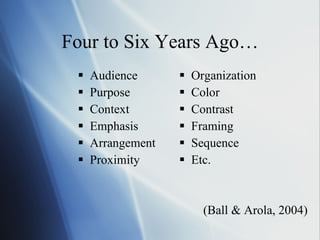
Four to Six Years Ago… Audience Purpose Context Emphasis Arrangement Proximity Organization Color Contrast Framing Sequence Etc. (Ball & Arola, 2004)
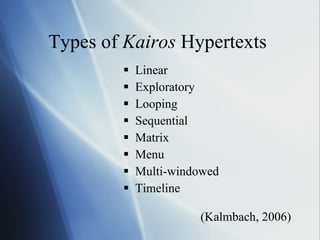
Types of  Kairos  Hypertexts  Linear Exploratory Looping Sequential Matrix Menu Multi-windowed Timeline (Kalmbach, 2006)
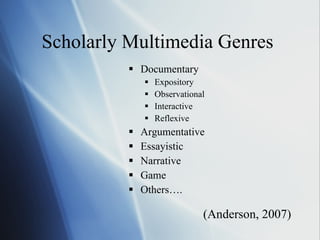
Scholarly Multimedia Genres  Documentary Expository Observational Interactive Reflexive Argumentative Essayistic Narrative Game Others…. (Anderson, 2007)
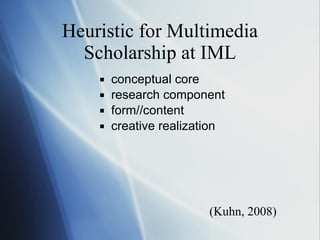
Heuristic  for Multimedia Scholarship at IML conceptual core research component form//content creative realization (Kuhn, 2008)
Heuristic for Manifesto Issue  Readership Form Media Response (DeWitt & Ball, 2007)
Heuristic for Online  Scholarly Texts  Content Web-based allowances Emerging conventions (Warner, 2007)
CELJ Suggested Guidelines for Online Publications Peer Review, Editorial Staff, and Editorial Board Affiliations Mission Statement, Submission Guidelines, Timely Review Contract or Publication Agreement Style Editing Web Design Timeliness and Regularity of Publication Accessibility Availability Indexing and Abstracting ISSN Archiving Advertising
Boyer’s Framework from  Scholarship Reconsidered  (1990) discovery application integration teaching (SoTL)
Some department’s criteria for scholarship originality lucidity intellectual depth significant contribution (Braun, today)
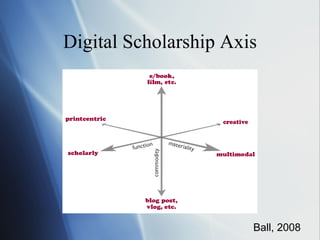
Digital Scholarship Axis Ball, 2008
Strategies for Understanding Digital Scholarship textual performances  seminars/colloquia in-text reading/analysis guides extra-textual T&P binder narratives co-articles in print journals CommentPress-type pre-production commentary/review post-production review and commentary senior (?) scholars writing reviews (print & T&P)
Strategies for Understanding Digital Scholarship What would you suggest???
References Anderson, Steve. (2007). Regeneration: Multimedia Genres and Emerging Scholarship. Institute for Multimedia Literacy. http://iml.usc.edu/?page_id=12 Ball, Cheryl. (2008). CCCC 2008 Presentation. See www.ceball.com. Ball, Cheryl, & Arola, Kristin. (2004).  ix: visual exercises . Bedford. DeWitt, Scott Lloyd, & Ball, Cheryl E. (2008). Logging On [Special issue: Manifestos!]. Kairos: Rhetoric, Technology, Pedagogy, 12(3). http://kairos.technorhetoric.net/12.3 Kalmbach, James. (2006). Reading the Kairos archives: Ten years of nonlinear history. Kairos 11(1). Kuhn, Virginia. (2008). The Components of Digital Scholarship. In From Gallery to Webtext. Kairos, 12(3). Warner, Allison. (2007). Constructing a tool for assessing scholarly webtexts. Kairos 12(1).

Computers & Writing 2008 talk by Cheryl E. Ball

  • 1.
    New Media ScholarshipTaxonomies, Heuristics, & Strategies to Connect (?) Authors, Editors, Departments, & Tenure Committees
  • 2.
    Four to SixYears Ago… Audience Purpose Context Emphasis Arrangement Proximity Organization Color Contrast Framing Sequence Etc. (Ball & Arola, 2004)
  • 3.
    Types of Kairos Hypertexts Linear Exploratory Looping Sequential Matrix Menu Multi-windowed Timeline (Kalmbach, 2006)
  • 4.
    Scholarly Multimedia Genres Documentary Expository Observational Interactive Reflexive Argumentative Essayistic Narrative Game Others…. (Anderson, 2007)
  • 5.
    Heuristic forMultimedia Scholarship at IML conceptual core research component form//content creative realization (Kuhn, 2008)
  • 6.
    Heuristic for ManifestoIssue Readership Form Media Response (DeWitt & Ball, 2007)
  • 7.
    Heuristic for Online Scholarly Texts Content Web-based allowances Emerging conventions (Warner, 2007)
  • 8.
    CELJ Suggested Guidelinesfor Online Publications Peer Review, Editorial Staff, and Editorial Board Affiliations Mission Statement, Submission Guidelines, Timely Review Contract or Publication Agreement Style Editing Web Design Timeliness and Regularity of Publication Accessibility Availability Indexing and Abstracting ISSN Archiving Advertising
  • 9.
    Boyer’s Framework from Scholarship Reconsidered (1990) discovery application integration teaching (SoTL)
  • 10.
    Some department’s criteriafor scholarship originality lucidity intellectual depth significant contribution (Braun, today)
  • 11.
  • 12.
    Strategies for UnderstandingDigital Scholarship textual performances seminars/colloquia in-text reading/analysis guides extra-textual T&P binder narratives co-articles in print journals CommentPress-type pre-production commentary/review post-production review and commentary senior (?) scholars writing reviews (print & T&P)
  • 13.
    Strategies for UnderstandingDigital Scholarship What would you suggest???
  • 14.
    References Anderson, Steve.(2007). Regeneration: Multimedia Genres and Emerging Scholarship. Institute for Multimedia Literacy. http://iml.usc.edu/?page_id=12 Ball, Cheryl. (2008). CCCC 2008 Presentation. See www.ceball.com. Ball, Cheryl, & Arola, Kristin. (2004). ix: visual exercises . Bedford. DeWitt, Scott Lloyd, & Ball, Cheryl E. (2008). Logging On [Special issue: Manifestos!]. Kairos: Rhetoric, Technology, Pedagogy, 12(3). http://kairos.technorhetoric.net/12.3 Kalmbach, James. (2006). Reading the Kairos archives: Ten years of nonlinear history. Kairos 11(1). Kuhn, Virginia. (2008). The Components of Digital Scholarship. In From Gallery to Webtext. Kairos, 12(3). Warner, Allison. (2007). Constructing a tool for assessing scholarly webtexts. Kairos 12(1).

Editor's Notes

  • #2 several research projects over the next year, examining the Perspective of AUTHOR tenure portfolio interviewing authors of new media work Want your feedback… -- multiple heuristics and taxonomies for defining that work
  • #3 Heuristic for READER to use to understand NM Where I started, but not really meant for Digital scholarship Since then….
  • #4 Heuristic for authors to use when designing and/or explaining DS -- based on NAVIGATION
  • #5 Heuristic for authors based on GENRES (these are what IML students produce -- “DS across the Curriculum”,they call “Multimedia in the Core” OTHERS… Experiential Encyclopedic Multi-perspectival Multi-layered Comparative Interactive Networked Mobile Visualization Annotation Open Architecture
  • #6 Heuristic based on DIGITAL SCHOLARSHIP
  • #7 Heuristic based on PEER_REVIEW CRITERIA of MANIFESTO WEBTEXTS, based on call and checked against submissions: Readership: Is the manifesto timely and relevant to the readership of Kairos? Could the manifesto bring a new readership to Kairos? Form: Does the author understand “manifesto” as a text form? Does it call to action? Media: Is the medium in which webtext is produced appropriate for Kairos? Does the chosen medium make sense in terms of the piece’s argument? Respnose: Is the webtext provocative? Info not usually made available.
  • #8 Heuristic based on bridging PRINT and DIGITAL SCHOLARSHIP Content arrangement documentation tone Web-Based Allowances form/content relationship navigation design multimedia incorporation Emerging conventions navigation instructions design rationale
  • #9 Council of Editors of Learned Journals Heuristic for ADMINISTRATORS and EDITORS to affirm the standards and legitimacy of online journals (Only useful for authors to ask themselves which online journals they might want to publish in…)
  • #10 Heuristic for TENURE stakeholders. Categories in which digital scholarship can more easily fit YET: individuals and institutions….
  • #11 SUCH AS!!! (from co-presenter’s talk today)
  • #12 How I ended up with this graphic….still uncertain it does what it needs to do (problem of junior faculty who do DS) -- Where are publication venues placed on this semantic map? -- How does their placement (of venue) relate to the kinds of work published in that venue? -- Where are individual texts placed on the map? -- Where do readers position their expertise on the map? -- What is the distance between a reader (of the text, the journal, or a T&P member) as audience and a particular text?-- What strategies can authors use to shorten the distance between reader and text? -- Should authors be the sole ones responsible for this bridge? CONTEXT!!!!
  • #13 If the heuristics seem confusing and multitudenous, it’s because they are. DO WE KNOW WHAT OUR DEPT”s CRITERIA IS??? So what can we do to prepare ourselves (and help others prepare for making their DS “count”?) Consider these strategies…. But, still, individual contexts of institutions will always be the end-most factor/limitation in what strategies should be used -- or *whether*-- DS will be valued.
  • #14 Feedback???