Computers In Accountancy
• Computers , today , are being extensively used for
office administration and accounting to supply
reliable and accurate information [relating to the
company’s financial performance] to various
users.
• This is made possible through sophisticated
computerized accounting systems .
• They handle large volumes of data , process
information and data, present them graphically
and constantly Update the data .
• Finally , this data is presented to the decision
makers.
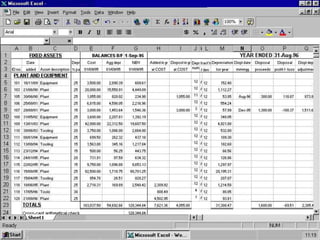
• Spreadsheets
Electronic Spreadsheets allow you to
do anything that you would normally
do with a calculator, pencil and
columnar scratch pad. A typical
integrated double entry accounting
spreadsheet system will contain some
of the following components: general
ledger, inventory levels, order entry,
payroll, time, and billing .
• Payroll records
The calculation of wages and salaries involves a number of variables which
relate to personal details of the employees ,such as gross pay, individual
deductions, tax liabilities of the employee and so on. These facts can be
retained in the computers and processed every month to produce pay slips
 Stock Control Inventory Control
Electronic Inventory Control module has multiple functions,
which includes tracking inventory for both costing and tax
purposes, aid managers in controlling purchasing (and the
overall level of expenditure) and minimizing the investment in
inventory (and subsequent loss of cash flow).
It updates sales and purchases records , determines optimum
re-order levels for different items and prints out the stock lists .
The system can be designed that it triggers orders when
required ; tests those items which are slow moving or give lists
for over-stock items
 Sale accounts records
Programming can be done for any sales accounting system . The
computer will pin-point defaulting debtors, determine right limit of
credit towards each debtor .
 Costing, Budget control and planning
Costing and budgetary control can de done through computer systems .
The computer will point out variations from the planned performance.
 Production Control
The computer helps greatly in production planning and control . It is
possible that scheduling of work may become necessary due to
breakdowns and such unforeseen events. A new critical path may have to
be worked out . A critical path is the shortest path to be followed in
production to achieve production objectives . The computer helps
management lay down this new critical path.
 Accounts Receivable And Accounts Payable
Accounts Payable : are amounts a company owes because it purchased
goods or services on credit from a supplier or vender.
Accounts Receivable: are amounts a company has a right to collect
because it sold goods or services on credit to a customer.
 Adjusting Entries
The computers can be programmed to accommodate adjustments
[Depreciation , Prepaid expenses ,Outstanding items]in the
financial statements and Final Accounts.
 Financial Accounting is the system of Recording,
Classifying, summarizing, Interpretation and Communicating
accounting information to different users.
 Uses of computers in Financial accounting
 Recording Transactions: The computer can be
programmed to record and update both accounts affected in
a transaction.
 Classifying : Excel Spreadsheets act as an aid to
prepare ledgers for various accounts of a business
enterprise. Balancing of accounts can be done accurately
and in a shorter period of time.
 Preparing Trial Balance: The computer will prepare
the trial balance and total it immediately [when needed].
Thereby, the arithmetical accuracy of the books can be
ascertained.
 Final Accounts: The computer can be programmed to
transfer the information contained in the Trial Balance relating to
various accounts into the TRADING a/c, PROFIT AND LOSS
a/c and finally the BALANCE SHEET
 Bank Reconciliation Statement: The computer can
quickly locate errors on comparison between the Cash Book And
the Bank Book and aid in correcting them .
 Interpretation And Presentation of data : The
computer can analyze and draw several inferences to ascertain
the performance levels . Comparisons can also be made .
Furthermore, the computer can present the data graphically for
enhanced understanding .
 Management Accounting Is the application of
appropriate techniques and concepts in
processing historical and projected data of an
organization to assist the management in
establishing plans for reasonable economic
objectives and taking rational decisions with a
view of achieving them.
 Computerization of Financial Accounting is a
must for computerized Management Accounting.
 Financial Statement Analysis
Financial statement is essentially historical document which provides
organized data according to logical and consistent accounting procedure and
conveys an understanding of some financial aspects of a business firm.
Careful analysis of financial statements can help decision makers to evaluate
an organization’s past performance and predict its future financial health. The
computers can be programmed to draw conclusions and preset the data
graphically.
 Cash Flow Analysis
A statement of cash flows reports the cash receipts and cash payments of
an organization during a particular period. It is widely used as a tool for
assessing the financial health of an organization. Other important purposes
of maintaining this statement are to predict future cash flows, to evaluate
management’s generation and use of cash and to determine a company’s
ability to pay interest, dividends, and to pay debts when they are due.
 Inter-firm Comparison
IFC is another technique of Management Accounting which is made by some
inter-firm comparison ratios based on the financial and other records of the
business. Top management can make decision by applying this technique
and comparing the performance of two or more similar types of industry.
 Differential Costing
Differential cost (revenue) is the difference in total cost (revenue) between
two alternatives . Making or buying decision, accepting or rejecting certain
orders, deciding whether to discontinue an existing product or launce new
one, expanding the existing business are the decisions required to be taken
by the management.
 Budgetary Control
Budgetary control is the system of management control in which all the
operations, as sales, purchase, production etc. are forecasted in advance
and the results, when known, are compared with the planned targets. The
difference between the planned targets and actual results are analyzed and
corrective steps are taken according to the original causes
 Share Accounting is concerned with maintaining
the updated list of shareholder. For each
shareholder, the information held by the company
is name , number of shares held, address, details
of bank account.
 Applications of computers in Share
Accounting
1.Share Transfer And Transmission
The computer keeps track of the movement of
shares between individuals. This makes it
easier to know the current as well as past
shareholders.
2.Splitting of share certificates
A person might want to transfer a portion of the total number of
shares held by him . The computer will accurately maintain
records of the newly added shareholders also updating certain
information relating to the other shareholder.
3.Consolidation of shares
The process by which a company changes the structure of its
share capital by reducing the number of shares it has in issue
and increasing the par value of each. For instance, a company
with 100,000,000 shares in issue having a nominal value of
Rs.10 , can undertake to reduce the number of shares to
10,000,000 and changing the nominal value to 100. A
computer can provide reliable, accurate information regarding
this in a very short period.
4.Providing and mailing list of shareholders and
annual reports periodically to each shareholder.

Computerized applications in accounting

  • 2.
    Computers In Accountancy •Computers , today , are being extensively used for office administration and accounting to supply reliable and accurate information [relating to the company’s financial performance] to various users. • This is made possible through sophisticated computerized accounting systems . • They handle large volumes of data , process information and data, present them graphically and constantly Update the data . • Finally , this data is presented to the decision makers.
  • 3.
    • Spreadsheets Electronic Spreadsheetsallow you to do anything that you would normally do with a calculator, pencil and columnar scratch pad. A typical integrated double entry accounting spreadsheet system will contain some of the following components: general ledger, inventory levels, order entry, payroll, time, and billing . • Payroll records The calculation of wages and salaries involves a number of variables which relate to personal details of the employees ,such as gross pay, individual deductions, tax liabilities of the employee and so on. These facts can be retained in the computers and processed every month to produce pay slips
  • 5.
     Stock ControlInventory Control Electronic Inventory Control module has multiple functions, which includes tracking inventory for both costing and tax purposes, aid managers in controlling purchasing (and the overall level of expenditure) and minimizing the investment in inventory (and subsequent loss of cash flow). It updates sales and purchases records , determines optimum re-order levels for different items and prints out the stock lists . The system can be designed that it triggers orders when required ; tests those items which are slow moving or give lists for over-stock items  Sale accounts records Programming can be done for any sales accounting system . The computer will pin-point defaulting debtors, determine right limit of credit towards each debtor .
  • 6.
     Costing, Budgetcontrol and planning Costing and budgetary control can de done through computer systems . The computer will point out variations from the planned performance.  Production Control The computer helps greatly in production planning and control . It is possible that scheduling of work may become necessary due to breakdowns and such unforeseen events. A new critical path may have to be worked out . A critical path is the shortest path to be followed in production to achieve production objectives . The computer helps management lay down this new critical path.  Accounts Receivable And Accounts Payable Accounts Payable : are amounts a company owes because it purchased goods or services on credit from a supplier or vender. Accounts Receivable: are amounts a company has a right to collect because it sold goods or services on credit to a customer.  Adjusting Entries The computers can be programmed to accommodate adjustments [Depreciation , Prepaid expenses ,Outstanding items]in the financial statements and Final Accounts.
  • 8.
     Financial Accountingis the system of Recording, Classifying, summarizing, Interpretation and Communicating accounting information to different users.  Uses of computers in Financial accounting  Recording Transactions: The computer can be programmed to record and update both accounts affected in a transaction.  Classifying : Excel Spreadsheets act as an aid to prepare ledgers for various accounts of a business enterprise. Balancing of accounts can be done accurately and in a shorter period of time.  Preparing Trial Balance: The computer will prepare the trial balance and total it immediately [when needed]. Thereby, the arithmetical accuracy of the books can be ascertained.
  • 9.
     Final Accounts:The computer can be programmed to transfer the information contained in the Trial Balance relating to various accounts into the TRADING a/c, PROFIT AND LOSS a/c and finally the BALANCE SHEET  Bank Reconciliation Statement: The computer can quickly locate errors on comparison between the Cash Book And the Bank Book and aid in correcting them .  Interpretation And Presentation of data : The computer can analyze and draw several inferences to ascertain the performance levels . Comparisons can also be made . Furthermore, the computer can present the data graphically for enhanced understanding .
  • 10.
     Management AccountingIs the application of appropriate techniques and concepts in processing historical and projected data of an organization to assist the management in establishing plans for reasonable economic objectives and taking rational decisions with a view of achieving them.  Computerization of Financial Accounting is a must for computerized Management Accounting.
  • 11.
     Financial StatementAnalysis Financial statement is essentially historical document which provides organized data according to logical and consistent accounting procedure and conveys an understanding of some financial aspects of a business firm. Careful analysis of financial statements can help decision makers to evaluate an organization’s past performance and predict its future financial health. The computers can be programmed to draw conclusions and preset the data graphically.  Cash Flow Analysis A statement of cash flows reports the cash receipts and cash payments of an organization during a particular period. It is widely used as a tool for assessing the financial health of an organization. Other important purposes of maintaining this statement are to predict future cash flows, to evaluate management’s generation and use of cash and to determine a company’s ability to pay interest, dividends, and to pay debts when they are due.
  • 12.
     Inter-firm Comparison IFCis another technique of Management Accounting which is made by some inter-firm comparison ratios based on the financial and other records of the business. Top management can make decision by applying this technique and comparing the performance of two or more similar types of industry.  Differential Costing Differential cost (revenue) is the difference in total cost (revenue) between two alternatives . Making or buying decision, accepting or rejecting certain orders, deciding whether to discontinue an existing product or launce new one, expanding the existing business are the decisions required to be taken by the management.  Budgetary Control Budgetary control is the system of management control in which all the operations, as sales, purchase, production etc. are forecasted in advance and the results, when known, are compared with the planned targets. The difference between the planned targets and actual results are analyzed and corrective steps are taken according to the original causes
  • 14.
     Share Accountingis concerned with maintaining the updated list of shareholder. For each shareholder, the information held by the company is name , number of shares held, address, details of bank account.  Applications of computers in Share Accounting 1.Share Transfer And Transmission The computer keeps track of the movement of shares between individuals. This makes it easier to know the current as well as past shareholders.
  • 15.
    2.Splitting of sharecertificates A person might want to transfer a portion of the total number of shares held by him . The computer will accurately maintain records of the newly added shareholders also updating certain information relating to the other shareholder. 3.Consolidation of shares The process by which a company changes the structure of its share capital by reducing the number of shares it has in issue and increasing the par value of each. For instance, a company with 100,000,000 shares in issue having a nominal value of Rs.10 , can undertake to reduce the number of shares to 10,000,000 and changing the nominal value to 100. A computer can provide reliable, accurate information regarding this in a very short period. 4.Providing and mailing list of shareholders and annual reports periodically to each shareholder.