COMPREHENSIVE STUDY OF ACCOUNTING
ACCORDING TO AICPA ACCOUNTING IS DEFINED
AS:
“the art of recording, classifying, and summarizing in a significant manner
and in terms of money, transactions and events which are, in part at least,
of financial character, and interpreting the results thereof”.
{NOTE: AICPA :-The American Institute Of Certified Public Accountants}
 INTRODUCTION:
Art of recording , classifying and summarizing of financial transactions.
The American Accounting Association (AAA) defines Accounting as,
‘the process of identifying, measuring and communicating economic
information to permit informed judgments and decisions by users of
information’.
Aspects of the definition:
• Economic Events
• Identification, Measurement, Recording and Communication
• Organization
• Interested Users of Information
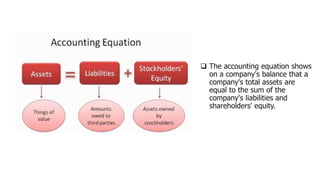
 The accounting equation shows
on a company's balance that a
company's total assets are
equal to the sum of the
company's liabilities and
shareholders' equity.
 OBJECTIVES OF ACCOUNTING:
o CONTROL OVER ASSETS AND LIABILITIES:
*Control over business resides with businessman.
*Actual position pf debt, liabilities etc. can be
ascertained through proper book keeping.
o PROVIDING ECONOMIC DATA:
*Provides economic datas required for financial
reports.
oASCERTAINMENT OF FINANCIAL AFFAIRS:
*Preparing of income statement.
*Ascertain surplus and deficit
oIDENTIFICATION AND RECORDING OF TRANSACTIONS:
. *Primary objective.
*Shows true nature of transactions.
 T account is an important
part of accounting.
QUALITATIVE CHARACTERISTICS OF ACCOUNTING
INFORMATION:
oReliability:
*Users must be able to depend on the information.
*Reliable information should be free from errors and bias.
oRelevance:
*Makes a difference in decision making.
o Understandability:
*Information helps to compare between different entities.
o Comparability:
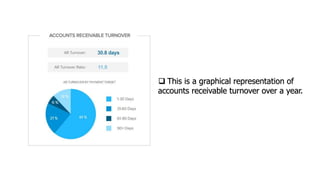
*It allows comparison of single entity from one accounting
period to the next.
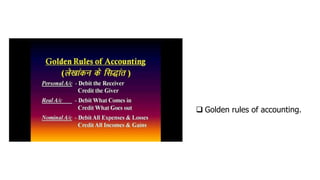
 Golden rules of accounting.
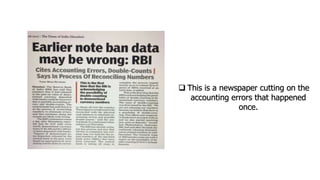
BOOK KEEPING
 Process of recording financial transactions of a company on a regular
basis.
Process of managing all the financial data of a company.
Make companies aware of their current financial position, as well as the
transactions that occur within the company.
 IMPORTANCE OF BOOK KEEPING:
Gives companies a reliable measure of their performance.
Essential function for both legal and financial management purposes.
 Helps to respond to potential IRS inquiries or audits.
Provides recommendations to ensure accuracy and improve spending.
 The Golden rules define the treatment of all
transactions conducted by the business.
 BRANCHES OF ACCOUNTING
 There are 8 different branches of accounting:
BRANCHES OF
ACCOUNITNG
5)Accounting
Information
System
6)Tax
Accounting
7)Forensic
Accounting
8)Fiduciary
Accounting
1)Financial
Accounting
2)Cost
Accounting
3)Auditing
4)Managerial
Accounting
1)FINANCIAL ACCOUNTING:
 Involves recording and categorizing of financial transactions in the
business.
 Recording of transactions according to the accounting principles.
 Original form of accounting process.
 To calculate profit and loss of the firm and to ascertain financial position.
2)COST ACCOUNTING:
A type of managerial accounting.
Deals with the evaluation of the cost of product or services offered.
Internally used to assess company’s operations.
It deals with company’s fixed assets and variable costs.
3)AUDITING:
Two types: (A)INTERNAL AUDITING : A third party who reviews a
financial statement with respect
to GAAP.
(B)EXTERNAL AUDITING : Helps to reduce frauds,
mismanagement etc.
4)MANAGERIAL ACCOUNTING:
 Also known as MANAGEMENT ACCOUNTING.
 Provides information to the management for better administration.
 Helps to make important decisions.
 Includes budgeting, forecasting, cost analysis, financial analysis, reviewing
past business decisions ETC.
5)ACCOUNTING INFORMATION SYSTEMS:
• Also known as AIS.
• Collection , storage, processing etc. of financial and accounting data used
by internal users.
• A computerized method for tracking accounting activity in relation with
information technology resources.
• Includes accounting software management , the management of
bookkeeping , accounting employees etc.
6)TAX ACCOUNTING:
o Involves planning for tax time and the preparation of tax returns.
o Deals with the preparation of tax returns and tax payments.
o Mainly used by individuals, businesses, corporations and other entities.
o Focuses on taxes rather than the appearance of public financial
statements.
7)FORENSIC ACCOUNTING:
• A blend of accounting and investigative techniques which are used to
identify financial crimes.
• Helps to narrate the nature of financial crimes committed, to the
courts.
• Mainly used by Insurance industries to set up damages from the
claims.
8)FIDUCIARY ACCOUNTING:
o Deals and manages any account and activities related to the
administration and wardenship of property.
o Works on Cash basis.
o Deals with the management of property for another person or business.
 INFLATION ACCOUNTING:
Two methods are used:
(A)CURRENT PURCHASING POWER [CPP]:
Monetary and non-monetary
items are separated.
(B)CURRENT COST ACCOUNTING [CCA] :
Values assets at fair market
value rather than historical cost.
 Process and practice of
adjusting financial
statements according to
its price indexes.
 This is an image of an accounting
worksheet prepared on behalf of ENGLAND
TOURS COMPANY
 GENERALLY ACCEPTED ACCOUNTING
PRINCIPLES [GAAP]:
 (GAAP) refer to a common set of accounting principles, standards, and
procedures issued by the Financial Accounting Standard Board(FASB).
1) PRINCIPLE OF REGULARITY: Accountants has to obey all the rules and
regulations of GAAP.
2) PRINCIPLE OF CONSISTENCY: Accountants should enter all the items as
in the same way , which has been fixed.
3) PRINCIPLE OF SINCERITY :Accountants should provide correct depiction
of financial statement.
4) PRINCIPLE OF
PERMANENCE OF
METHOD : There
must be
6) PRINCIPLE OF
PRUDENCE :
Financial data
representation
9) PRINCIPLE OF FULL DISCLOSURE : While creating the financial reports,
the accountants must strive aim full
disclosure.
10) PRINCIPLE OF UTMOST GOOD FAITH : This states that the parties must
remain honest in the financial
transactions.
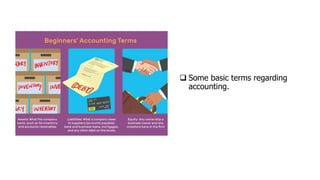
 Some basic terms regarding
accounting.
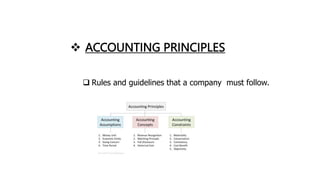
 ACCOUNTING PRINCIPLES
 Rules and guidelines that a company must follow.
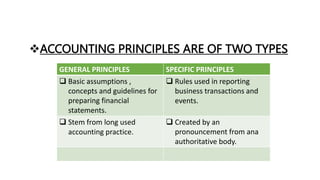
ACCOUNTING PRINCIPLES ARE OF TWO TYPES
GENERAL PRINCIPLES SPECIFIC PRINCIPLES
 Basic assumptions ,
concepts and guidelines for
preparing financial
statements.
 Rules used in reporting
business transactions and
events.
 Stem from long used
accounting practice.
 Created by an
pronouncement from ana
authoritative body.
ACCOUNTING
PRINCIPLES
REVENUE
RECOGNI-
TION
GOING
CONCERN
CONSISTE-
NCY
ACCRUAL
COST
MATERIALI-
TY
MATCHING
CONSERVA
-TION
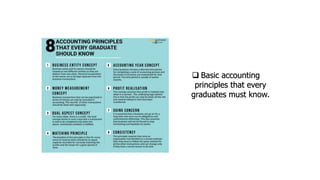
 Basic accounting
principles that every
graduates must know.
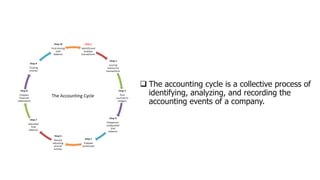
 The accounting cycle is a collective process of
identifying, analyzing, and recording the
accounting events of a company.
 Accounting ratio is the comparison of two
or more financial data which are used for
analyzing the financial statements of
companies.
 COMPUTERIZED ACCOUNTING
• Accounts that are stored on a company's computer,
Processing of accounting information with respect to GAAP.
Software program which is stored on a company’s computer, network
server etc.
Accessed via internet.
Minimize errors.
 These are some of the advantages of
COMPUTERIZED ACCOUNTING.
 Components of Accounting worksheet.
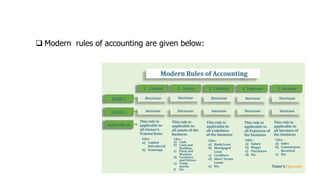
 Modern rules of accounting are given below:
 DIFFERENCE BETWEEN INTERNATIONAL
FINANCIAL STANDARDS (IFRS) AND INDIAN
ACCOUNTING STANDARDS (Ind-AS):
Ind-AS IFRS
*Balance Sheet *Statement of profit and loss.
*Profit and loss account. *Statement of cash flows.
*Statement of changes in equity. *Statement of changes in equity.
*Disclosure of significant
accounting policies.
*Statement of financial position.
 Classification of accounts are shown in the following chart:
 Types of ratio analysis
methods.
CONSISTENCY
PRUDENCE
DISCLOSURE
MATERIALITY
ACCOUNTING
CONVENTIONS
 This is a graphical depiction of
accounts payable turnover over
a year.
 This is a graphical representation of
accounts receivable turnover over a year.
 CLOUD ACCOUNTING
 is accounting software that is hosted on a remote server
BENEFITS OF
CLOUD
ACCOUNTING
RELIABILITY
PAPERLESS SECURITY
USER FRIENDLINESS
EASE OF ACCESS
AFFORDABILITY
 This is a newspaper cutting on the
accounting errors that happened
once.
 This graph depicts the picture of
environment management accounting
systems.
 This image shows the
various modern accounting
systems.
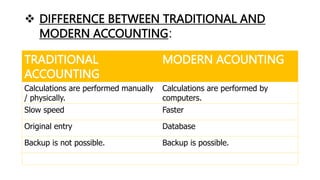
 DIFFERENCE BETWEEN TRADITIONAL AND
MODERN ACCOUNTING:
TRADITIONAL
ACCOUNTING
MODERN ACOUNTING
Calculations are performed manually
/ physically.
Calculations are performed by
computers.
Slow speed Faster
Original entry Database
Backup is not possible. Backup is possible.
 This image shows the view of
an accounting journal entry.
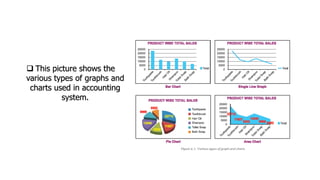
 This picture shows the
various types of graphs and
charts used in accounting
system.
 CONCLUSION:
• Accounting has the character of users’ acceptability for decision making.
• It influences the behavior of its users. SO it is a behavioral process.
• It is an integrated part of behavioral sciences.
• There is always the scope for research and development in accounting.
Comprehensive study of accounting

Comprehensive study of accounting

  • 1.
  • 2.
    ACCORDING TO AICPAACCOUNTING IS DEFINED AS: “the art of recording, classifying, and summarizing in a significant manner and in terms of money, transactions and events which are, in part at least, of financial character, and interpreting the results thereof”. {NOTE: AICPA :-The American Institute Of Certified Public Accountants}
  • 3.
     INTRODUCTION: Art ofrecording , classifying and summarizing of financial transactions. The American Accounting Association (AAA) defines Accounting as, ‘the process of identifying, measuring and communicating economic information to permit informed judgments and decisions by users of information’.
  • 4.
    Aspects of thedefinition: • Economic Events • Identification, Measurement, Recording and Communication • Organization • Interested Users of Information
  • 5.
     The accountingequation shows on a company's balance that a company's total assets are equal to the sum of the company's liabilities and shareholders' equity.
  • 6.
     OBJECTIVES OFACCOUNTING: o CONTROL OVER ASSETS AND LIABILITIES: *Control over business resides with businessman. *Actual position pf debt, liabilities etc. can be ascertained through proper book keeping. o PROVIDING ECONOMIC DATA: *Provides economic datas required for financial reports.
  • 7.
    oASCERTAINMENT OF FINANCIALAFFAIRS: *Preparing of income statement. *Ascertain surplus and deficit oIDENTIFICATION AND RECORDING OF TRANSACTIONS: . *Primary objective. *Shows true nature of transactions.
  • 8.
     T accountis an important part of accounting.
  • 9.
    QUALITATIVE CHARACTERISTICS OFACCOUNTING INFORMATION: oReliability: *Users must be able to depend on the information. *Reliable information should be free from errors and bias. oRelevance: *Makes a difference in decision making.
  • 10.
    o Understandability: *Information helpsto compare between different entities. o Comparability: *It allows comparison of single entity from one accounting period to the next.
  • 11.
     Golden rulesof accounting.
  • 12.
  • 13.
     Process ofrecording financial transactions of a company on a regular basis. Process of managing all the financial data of a company. Make companies aware of their current financial position, as well as the transactions that occur within the company.
  • 14.
     IMPORTANCE OFBOOK KEEPING: Gives companies a reliable measure of their performance. Essential function for both legal and financial management purposes.  Helps to respond to potential IRS inquiries or audits. Provides recommendations to ensure accuracy and improve spending.
  • 15.
     The Goldenrules define the treatment of all transactions conducted by the business.
  • 16.
     BRANCHES OFACCOUNTING  There are 8 different branches of accounting:
  • 17.
  • 18.
    1)FINANCIAL ACCOUNTING:  Involvesrecording and categorizing of financial transactions in the business.  Recording of transactions according to the accounting principles.  Original form of accounting process.  To calculate profit and loss of the firm and to ascertain financial position.
  • 19.
    2)COST ACCOUNTING: A typeof managerial accounting. Deals with the evaluation of the cost of product or services offered. Internally used to assess company’s operations. It deals with company’s fixed assets and variable costs.
  • 20.
    3)AUDITING: Two types: (A)INTERNALAUDITING : A third party who reviews a financial statement with respect to GAAP. (B)EXTERNAL AUDITING : Helps to reduce frauds, mismanagement etc.
  • 21.
    4)MANAGERIAL ACCOUNTING:  Alsoknown as MANAGEMENT ACCOUNTING.  Provides information to the management for better administration.  Helps to make important decisions.  Includes budgeting, forecasting, cost analysis, financial analysis, reviewing past business decisions ETC.
  • 22.
    5)ACCOUNTING INFORMATION SYSTEMS: •Also known as AIS. • Collection , storage, processing etc. of financial and accounting data used by internal users. • A computerized method for tracking accounting activity in relation with information technology resources. • Includes accounting software management , the management of bookkeeping , accounting employees etc.
  • 23.
    6)TAX ACCOUNTING: o Involvesplanning for tax time and the preparation of tax returns. o Deals with the preparation of tax returns and tax payments. o Mainly used by individuals, businesses, corporations and other entities. o Focuses on taxes rather than the appearance of public financial statements.
  • 24.
    7)FORENSIC ACCOUNTING: • Ablend of accounting and investigative techniques which are used to identify financial crimes. • Helps to narrate the nature of financial crimes committed, to the courts. • Mainly used by Insurance industries to set up damages from the claims.
  • 25.
    8)FIDUCIARY ACCOUNTING: o Dealsand manages any account and activities related to the administration and wardenship of property. o Works on Cash basis. o Deals with the management of property for another person or business.
  • 26.
     INFLATION ACCOUNTING: Twomethods are used: (A)CURRENT PURCHASING POWER [CPP]: Monetary and non-monetary items are separated. (B)CURRENT COST ACCOUNTING [CCA] : Values assets at fair market value rather than historical cost.  Process and practice of adjusting financial statements according to its price indexes.
  • 27.
     This isan image of an accounting worksheet prepared on behalf of ENGLAND TOURS COMPANY
  • 28.
     GENERALLY ACCEPTEDACCOUNTING PRINCIPLES [GAAP]:  (GAAP) refer to a common set of accounting principles, standards, and procedures issued by the Financial Accounting Standard Board(FASB).
  • 29.
    1) PRINCIPLE OFREGULARITY: Accountants has to obey all the rules and regulations of GAAP. 2) PRINCIPLE OF CONSISTENCY: Accountants should enter all the items as in the same way , which has been fixed. 3) PRINCIPLE OF SINCERITY :Accountants should provide correct depiction of financial statement.
  • 30.
    4) PRINCIPLE OF PERMANENCEOF METHOD : There must be
  • 31.
    6) PRINCIPLE OF PRUDENCE: Financial data representation
  • 32.
    9) PRINCIPLE OFFULL DISCLOSURE : While creating the financial reports, the accountants must strive aim full disclosure. 10) PRINCIPLE OF UTMOST GOOD FAITH : This states that the parties must remain honest in the financial transactions.
  • 33.
     Some basicterms regarding accounting.
  • 34.
     ACCOUNTING PRINCIPLES Rules and guidelines that a company must follow.
  • 35.
    ACCOUNTING PRINCIPLES AREOF TWO TYPES GENERAL PRINCIPLES SPECIFIC PRINCIPLES  Basic assumptions , concepts and guidelines for preparing financial statements.  Rules used in reporting business transactions and events.  Stem from long used accounting practice.  Created by an pronouncement from ana authoritative body.
  • 36.
  • 37.
     Basic accounting principlesthat every graduates must know.
  • 38.
     The accountingcycle is a collective process of identifying, analyzing, and recording the accounting events of a company.
  • 39.
     Accounting ratiois the comparison of two or more financial data which are used for analyzing the financial statements of companies.
  • 40.
     COMPUTERIZED ACCOUNTING •Accounts that are stored on a company's computer,
  • 41.
    Processing of accountinginformation with respect to GAAP. Software program which is stored on a company’s computer, network server etc. Accessed via internet. Minimize errors.
  • 42.
     These aresome of the advantages of COMPUTERIZED ACCOUNTING.
  • 43.
     Components ofAccounting worksheet.
  • 44.
     Modern rulesof accounting are given below:
  • 45.
     DIFFERENCE BETWEENINTERNATIONAL FINANCIAL STANDARDS (IFRS) AND INDIAN ACCOUNTING STANDARDS (Ind-AS): Ind-AS IFRS *Balance Sheet *Statement of profit and loss. *Profit and loss account. *Statement of cash flows. *Statement of changes in equity. *Statement of changes in equity. *Disclosure of significant accounting policies. *Statement of financial position.
  • 46.
     Classification ofaccounts are shown in the following chart:
  • 47.
     Types ofratio analysis methods.
  • 48.
  • 49.
     This isa graphical depiction of accounts payable turnover over a year.
  • 50.
     This isa graphical representation of accounts receivable turnover over a year.
  • 51.
     CLOUD ACCOUNTING is accounting software that is hosted on a remote server
  • 52.
  • 53.
     This isa newspaper cutting on the accounting errors that happened once.
  • 54.
     This graphdepicts the picture of environment management accounting systems.
  • 55.
     This imageshows the various modern accounting systems.
  • 56.
     DIFFERENCE BETWEENTRADITIONAL AND MODERN ACCOUNTING: TRADITIONAL ACCOUNTING MODERN ACOUNTING Calculations are performed manually / physically. Calculations are performed by computers. Slow speed Faster Original entry Database Backup is not possible. Backup is possible.
  • 57.
     This imageshows the view of an accounting journal entry.
  • 58.
     This pictureshows the various types of graphs and charts used in accounting system.
  • 59.
     CONCLUSION: • Accountinghas the character of users’ acceptability for decision making. • It influences the behavior of its users. SO it is a behavioral process. • It is an integrated part of behavioral sciences. • There is always the scope for research and development in accounting.