Computer Organization &
Architecture
CPUOrganization, Control Units,
Instruction Formats & Sets
S.Y. B.Tech IT - PCCoE Pune
References: Stallings, Mano,
Tanenbaum, Hayes
2.
Introduction
• Understanding howcomputer hardware
executes instructions
• Relationship between CPU, Memory, and I/O
• Focus: CPU Organization, Control Unit Design,
Instruction Formats and Sets
3.
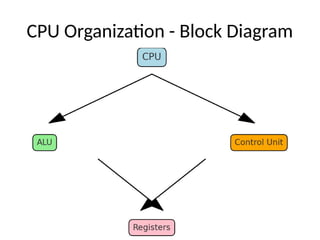
CPU Organization
• MajorComponents: ALU, Control Unit,
Registers, Buses
• General Purpose vs Special Purpose Registers
• Performance Factors: Clock speed, CPI,
Pipelining
4.
Hardwired Control
• Controlsignals generated by combinational
logic
• Fast operation but inflexible
• Difficult to modify once implemented
5.
Micro-programmed Control
• Usescontrol memory (ROM) to store
microinstructions
• Easier to modify, slower than hardwired
• Horizontal vs Vertical Microprogramming
6.
Instruction Formats
• Components:Opcode, Operand(s), Addressing
Mode
• Fixed-length and Variable-length formats
• Examples from M. Morris Mano
7.
Instruction Sets
• Definition:Complete set of instructions CPU
can execute
• CISC vs RISC architectures
• Addressing modes: Immediate, Direct,
Indirect, Register
8.
Types of Operations
•Data Transfer: MOV, LOAD, STORE
• Arithmetic: ADD, SUB, MUL
• Logical: AND, OR, XOR
• Control Flow: BRANCH, JUMP
• I/O Instructions
9.
RISC vs CISC
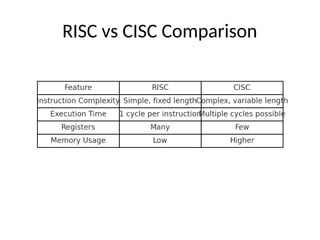
•RISC: Simple instructions, one per cycle, large
register set
• CISC: Complex instructions, multiple cycles,
fewer registers
• Trade-offs in performance, power, and
complexity
10.
Summary
• CPU designimpacts performance and
flexibility
• Control units can be hardwired or
microprogrammed
• Instruction formats and sets determine
capabilities
• RISC vs CISC is a major architectural choice
11.
References
• William Stallings,Computer Organization and
Architecture, 10th Ed., Pearson
• M. Morris Mano, Computer System
Architecture, 3rd Ed., Pearson/PHI
• Andrew S. Tanenbaum, Structured Computer
Organization, 5th Ed., Pearson Education
• John P. Hayes, Computer Architecture and
Organization, 3rd Ed., Tata McGraw-Hill