Introduction
Computer virus have become today’s headline
 news
With the increasing use of the Internet, it has
 become easier for virus to spread
Virus show us loopholes in software
Most virus are targeted at the MS Windows OS
Definition
 Virus : A true virus is capable of self replication
 on a machine. It may spread between files or
 disks, but the defining character is that it can
 recreate itself on it’s own with out traveling to a
 new host
Overview
Background
Symptoms
Classifying Viruses
Examples
Protection/Prevention
Conclusion
Background
There are estimated 30,000 computer
 viruses in existence
Over 300 new ones are created each
 month
First virus was created to show loopholes
 in software
Virus Languages
ANSI COBOL
C/C++
Pascal
VBA
Unix Shell Scripts
JavaScript
Basically any language that works on the system
 that is the target
Symptoms of Virus Attack
 Computer runs slower then usual
 Computer no longer boots up
 Screen sometimes flicker
 PC speaker beeps periodically
 System crashes for no reason
 Files/directories sometimes disappear
 Denial of Service (DoS)
Virus through the Internet
Today almost 87% of all viruses are spread
 through the internet (source: ZDNet)
Transmission time to a new host is relatively low,
 on the order of hours to days
“Latent virus”
Classifying Virus - General
Virus Information
     Discovery Date:
     Origin:
     Length:
     Type:
     SubType:
     Risk Assessment:
     Category:
Classifying Virus - Categories

Stealth
Polymorphic
Companion
Armored
Classifying Virus - Types
Trojan Horse
Worm
Macro
Trojan Horse
Covert
Leaks information
Usually does not reproduce
Trojan Horse
Back Orifice
    Discovery Date:      10/15/1998
    Origin:        Pro-hacker Website
    Length:        124,928
    Type: Trojan
    SubType:       Remote Access
    Risk Assessment: Low
    Category:      Stealth
Trojan Horse
About Back Orifice
  requires Windows to work
  distributed by “Cult of the Dead Cow”
  similar to PC Anywhere, Carbon Copy software
  allows remote access and control of other computers
  install a reference in the registry
  once infected, runs in the background
  by default uses UDP port 54320
                  TCP port 54321
  In Australia 72% of 92 ISP surveyed were infected with
   Back Orifice
Trojan Horse
 Features of Back Orifice
  pings and query servers
  reboot or lock up the system
  list cached and screen saver password
  display system information
  logs keystrokes
  edit registry
  server control
  receive and send files
  display a message box
Worms
Spread over network connection
Worms replicate
First worm released on the Internet was called
 Morris worm, it was released on Nov 2, 1988.
Worms
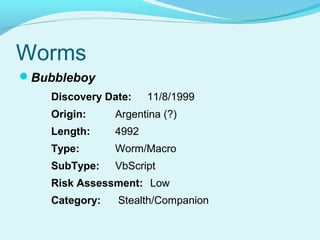
Bubbleboy
    Discovery Date:    11/8/1999
    Origin:     Argentina (?)
    Length:     4992
    Type:       Worm/Macro
    SubType:    VbScript
    Risk Assessment: Low
    Category:   Stealth/Companion
Worms
Bubbleboy
 requires WSL (windows scripting language), Outlook
   or Outlook Express, and IE5
 Does not work in Windows NT
 Effects Spanish and English version of Windows
 2 variants have been identified
 Is a “latent virus” on a Unix or Linux system
 May cause DoS
Worms
How Bubbleboy works
  Bubbleboy is embedded within an email message of
   HTML format.
  a VbScript while the user views a HTML page
  a file named “Update.hta” is placed in the start up
   directory
  upon reboot Bubbleboy executes
Worms
How Bubbleboy works
  changes the registered owner/organization
    HKEY_LOCAL_MACHINESoftwareMicrosoftWindowsCurrentV
     ersionRegisteredOwner = “Bubble Boy”
    HKEY_LOCAL_MACHINESoftwareMicrosoftWindowsCurrentV
     ersionRegisteredOrganization = “Vandalay Industry”
  using the Outlook MAPI address book it sends itself to
   each entry
  marks itself in the registry
       HKEY_LOCAL_MACHINESoftwareOutlook.bubbleboy =
        “OUTLOOK.Bubbleboy1.0 by Zulu”
Macro
Specific to certain applications
Comprise a high percentage of the viruses
Usually made in WordBasic and Visual
 Basic for Applications (VBA)
Microsoft shipped “Concept”, the first
 macro virus, on a CD ROM called "Windows
 95 Software Compatibility Test" in 1995
Macro
Melissa
    Discovery Date: 3/26/1999
    Origin:    Newsgroup Posting
    Length:     varies depending on variant
    Type:       Macro/Worm
    Subtype:    Macro
    Risk Assessment: High
    Category:   Companion
Macro
Melissa
  requires WSL, Outlook or Outlook Express Word
   97 SR1 or Office 2000
  105 lines of code (original variant)
  received either as an infected template or email
   attachment
  lowers computer defenses to future macro virus
   attacks
  may cause DoS
  infects template files with it’s own macro code
  80% of of the 150 Fortune 1000 companies
   were affected
Macro
How Melissa works
  the virus is activated through a MS word document
  document displays reference to pornographic websites
   while macro runs
  1st lowers the macro protection security setting for
   future attacks
  checks to see is it has run in current session before
       HKEY_LOCAL_MACHINESoftwareMicrosoftOfficeMelissa =
        “by Kwyjibo”
  propagates itself using the Outlook MAPI address
   book (emails sent to the first 50 addresses)
Macro
How Melissa works
  infects the Normal.dot template file with it’s own code
  Lastly if the minutes of the hour match up to the date
   the macro inserts a quote by Bart Simpson into the
   current document
       “Twenty two points, plus triple word score, plus fifty points for
        using all my letters. Game’s over. I’m outta here.”
Protection/Prevention
Knowledge
Proper configurations
Run only necessary programs
Anti-virus software
Conclusion
You know know more about virus and how:
  viruses work through your system
  to make a better virus
Have seen how viruses show us a loophole in
 popular software
Most viruses show that they can cause great
 damage due to loopholes in programming

Computer virus

  • 2.
    Introduction Computer virus havebecome today’s headline news With the increasing use of the Internet, it has become easier for virus to spread Virus show us loopholes in software Most virus are targeted at the MS Windows OS
  • 3.
    Definition Virus :A true virus is capable of self replication on a machine. It may spread between files or disks, but the defining character is that it can recreate itself on it’s own with out traveling to a new host
  • 4.
  • 5.
    Background There are estimated30,000 computer viruses in existence Over 300 new ones are created each month First virus was created to show loopholes in software
  • 6.
    Virus Languages ANSI COBOL C/C++ Pascal VBA UnixShell Scripts JavaScript Basically any language that works on the system that is the target
  • 7.
    Symptoms of VirusAttack  Computer runs slower then usual  Computer no longer boots up  Screen sometimes flicker  PC speaker beeps periodically  System crashes for no reason  Files/directories sometimes disappear  Denial of Service (DoS)
  • 8.
    Virus through theInternet Today almost 87% of all viruses are spread through the internet (source: ZDNet) Transmission time to a new host is relatively low, on the order of hours to days “Latent virus”
  • 9.
    Classifying Virus -General Virus Information Discovery Date: Origin: Length: Type: SubType: Risk Assessment: Category:
  • 10.
    Classifying Virus -Categories Stealth Polymorphic Companion Armored
  • 11.
    Classifying Virus -Types Trojan Horse Worm Macro
  • 12.
  • 13.
    Trojan Horse Back Orifice Discovery Date: 10/15/1998 Origin: Pro-hacker Website Length: 124,928 Type: Trojan SubType: Remote Access Risk Assessment: Low Category: Stealth
  • 14.
    Trojan Horse About BackOrifice requires Windows to work distributed by “Cult of the Dead Cow” similar to PC Anywhere, Carbon Copy software allows remote access and control of other computers install a reference in the registry once infected, runs in the background by default uses UDP port 54320 TCP port 54321 In Australia 72% of 92 ISP surveyed were infected with Back Orifice
  • 15.
    Trojan Horse  Featuresof Back Orifice pings and query servers reboot or lock up the system list cached and screen saver password display system information logs keystrokes edit registry server control receive and send files display a message box
  • 16.
    Worms Spread over networkconnection Worms replicate First worm released on the Internet was called Morris worm, it was released on Nov 2, 1988.
  • 17.
    Worms Bubbleboy Discovery Date: 11/8/1999 Origin: Argentina (?) Length: 4992 Type: Worm/Macro SubType: VbScript Risk Assessment: Low Category: Stealth/Companion
  • 18.
    Worms Bubbleboy requires WSL(windows scripting language), Outlook or Outlook Express, and IE5 Does not work in Windows NT Effects Spanish and English version of Windows 2 variants have been identified Is a “latent virus” on a Unix or Linux system May cause DoS
  • 19.
    Worms How Bubbleboy works Bubbleboy is embedded within an email message of HTML format. a VbScript while the user views a HTML page a file named “Update.hta” is placed in the start up directory upon reboot Bubbleboy executes
  • 20.
    Worms How Bubbleboy works changes the registered owner/organization  HKEY_LOCAL_MACHINESoftwareMicrosoftWindowsCurrentV ersionRegisteredOwner = “Bubble Boy”  HKEY_LOCAL_MACHINESoftwareMicrosoftWindowsCurrentV ersionRegisteredOrganization = “Vandalay Industry” using the Outlook MAPI address book it sends itself to each entry marks itself in the registry  HKEY_LOCAL_MACHINESoftwareOutlook.bubbleboy = “OUTLOOK.Bubbleboy1.0 by Zulu”
  • 21.
    Macro Specific to certainapplications Comprise a high percentage of the viruses Usually made in WordBasic and Visual Basic for Applications (VBA) Microsoft shipped “Concept”, the first macro virus, on a CD ROM called "Windows 95 Software Compatibility Test" in 1995
  • 22.
    Macro Melissa Discovery Date: 3/26/1999 Origin: Newsgroup Posting Length: varies depending on variant Type: Macro/Worm Subtype: Macro Risk Assessment: High Category: Companion
  • 23.
    Macro Melissa requiresWSL, Outlook or Outlook Express Word 97 SR1 or Office 2000 105 lines of code (original variant) received either as an infected template or email attachment lowers computer defenses to future macro virus attacks may cause DoS infects template files with it’s own macro code 80% of of the 150 Fortune 1000 companies were affected
  • 24.
    Macro How Melissa works the virus is activated through a MS word document document displays reference to pornographic websites while macro runs 1st lowers the macro protection security setting for future attacks checks to see is it has run in current session before  HKEY_LOCAL_MACHINESoftwareMicrosoftOfficeMelissa = “by Kwyjibo” propagates itself using the Outlook MAPI address book (emails sent to the first 50 addresses)
  • 25.
    Macro How Melissa works infects the Normal.dot template file with it’s own code Lastly if the minutes of the hour match up to the date the macro inserts a quote by Bart Simpson into the current document  “Twenty two points, plus triple word score, plus fifty points for using all my letters. Game’s over. I’m outta here.”
  • 26.
  • 27.
    Conclusion You know knowmore about virus and how: viruses work through your system to make a better virus Have seen how viruses show us a loophole in popular software Most viruses show that they can cause great damage due to loopholes in programming