Computer Viewing
1
Objectives
• Introduce the mathematics of projection
• Introduce OpenGL viewing functions
• Look at alternate viewing APIs
2
Computer Viewing
• There are three aspects of the viewing process, all of which are
implemented in the pipeline,
• Positioning the camera
• Setting the model-view matrix
• Selecting a lens
• Setting the projection matrix
• Clipping
• Setting the view volume
3
The OpenGL Camera
• In OpenGL, initially the object and camera frames are the same
• Default model-view matrix is an identity
• The camera is located at origin and points in the negative z direction
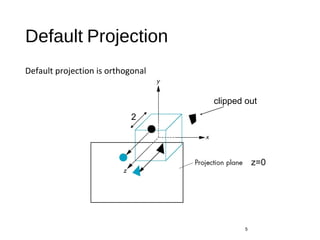
• OpenGL also specifies a default view volume that is a cube with sides
of length 2 centered at the origin
• Default projection matrix is an identity
4
Default Projection
Default projection is orthogonal
5
clipped out
z=0
2
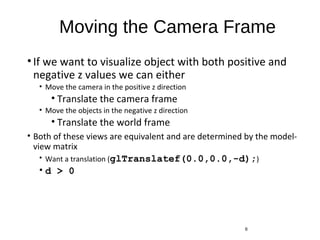
Moving the Camera Frame
•If we want to visualize object with both positive and
negative z values we can either
• Move the camera in the positive z direction
• Translate the camera frame
• Move the objects in the negative z direction
• Translate the world frame
• Both of these views are equivalent and are determined by the model-
view matrix
• Want a translation (glTranslatef(0.0,0.0,-d);)
• d > 0
6
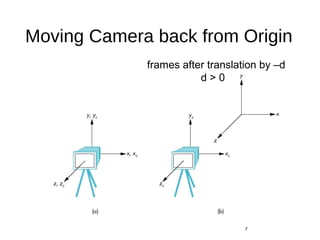
Moving Camera back from Origin
default frames
7
frames after translation by –d
d > 0
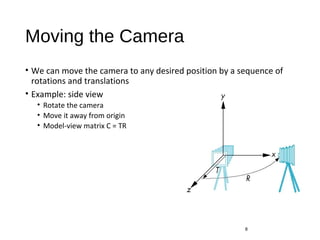
Moving the Camera
• We can move the camera to any desired position by a sequence of
rotations and translations
• Example: side view
• Rotate the camera
• Move it away from origin
• Model-view matrix C = TR
8
OpenGL code
• Remember that last transformation specified is first to be applied
9
glMatrixMode(GL_MODELVIEW)
glLoadIdentity();
glTranslatef(0.0, 0.0, -d);
glRotatef(90.0, 0.0, 1.0, 0.0);
The LookAt Function
•The GLU library contains the function gluLookAt to
form the required modelview matrix through a simple
interface
•Note the need for setting an up direction
•Still need to initialize
• Can concatenate with modeling transformations
•Example: isometric view of cube aligned with axes
10
glMatrixMode(GL_MODELVIEW):
glLoadIdentity();
gluLookAt(1.0, 1.0, 1.0, 0.0, 0.0, 0.0, 0., 1.0. 0.0);
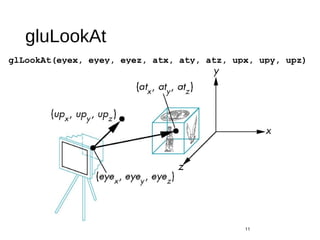
gluLookAt
glLookAt(eyex, eyey, eyez, atx, aty, atz, upx, upy, upz)
11
Other Viewing APIs
• The LookAt function is only one possible API for positioning the
camera
• Others include
• View reference point, view plane normal, view up (PHIGS, GKS-3D)
• Yaw, pitch, roll
• Elevation, azimuth, twist
• Direction angles
12
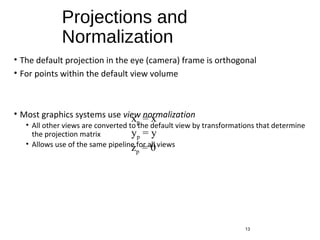
Projections and
Normalization
• The default projection in the eye (camera) frame is orthogonal
• For points within the default view volume
• Most graphics systems use view normalization
• All other views are converted to the default view by transformations that determine
the projection matrix
• Allows use of the same pipeline for all views
13
xp = x
yp = y
zp = 0
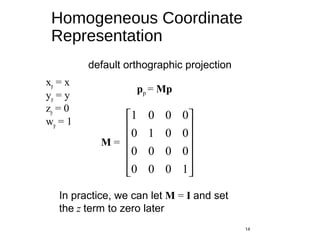
Homogeneous Coordinate
Representation
xp = x
yp = y
zp = 0
wp = 1
14
pp = Mp
M =












1000
0000
0010
0001
In practice, we can let M = I and set
the z term to zero later
default orthographic projection
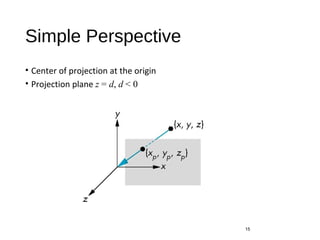
Simple Perspective
• Center of projection at the origin
• Projection plane z = d, d < 0
15
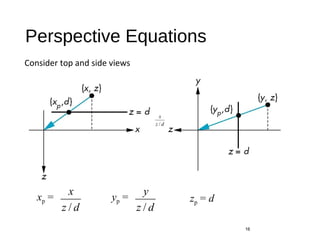
Perspective Equations
Consider top and side views
16
xp =
dz
x
/
dz
x
/
yp =
dz
y
/
zp = d
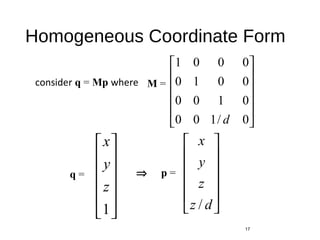
Homogeneous Coordinate Form
consider q = Mp where
17
M =












0/100
0100
0010
0001
d












1
z
y
x












dz
z
y
x
/
q = ⇒ p =
Perspective Division
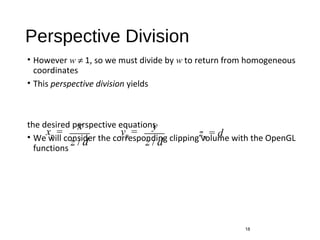
• However w ≠ 1, so we must divide by w to return from homogeneous
coordinates
• This perspective division yields
the desired perspective equations
• We will consider the corresponding clipping volume with the OpenGL
functions
18
xp =
dz
x
/
yp =
dz
y
/
zp = d
OpenGL Orthogonal Viewing
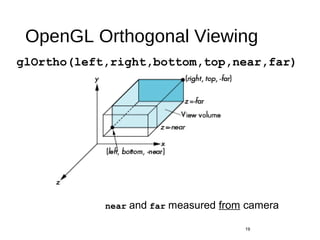
glOrtho(left,right,bottom,top,near,far)
19
near and far measured from camera
OpenGL Perspective
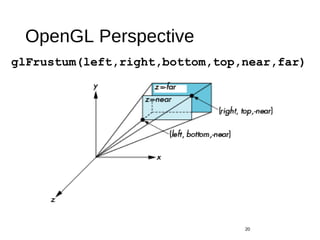
glFrustum(left,right,bottom,top,near,far)
20
Using Field of View
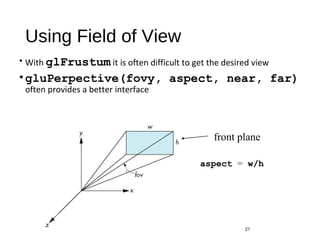
• With glFrustum it is often difficult to get the desired view
•gluPerpective(fovy, aspect, near, far)
often provides a better interface
21
aspect = w/h
front plane

Computer Viewing

  • 1.
  • 2.
    Objectives • Introduce themathematics of projection • Introduce OpenGL viewing functions • Look at alternate viewing APIs 2
  • 3.
    Computer Viewing • Thereare three aspects of the viewing process, all of which are implemented in the pipeline, • Positioning the camera • Setting the model-view matrix • Selecting a lens • Setting the projection matrix • Clipping • Setting the view volume 3
  • 4.
    The OpenGL Camera •In OpenGL, initially the object and camera frames are the same • Default model-view matrix is an identity • The camera is located at origin and points in the negative z direction • OpenGL also specifies a default view volume that is a cube with sides of length 2 centered at the origin • Default projection matrix is an identity 4
  • 5.
    Default Projection Default projectionis orthogonal 5 clipped out z=0 2
  • 6.
    Moving the CameraFrame •If we want to visualize object with both positive and negative z values we can either • Move the camera in the positive z direction • Translate the camera frame • Move the objects in the negative z direction • Translate the world frame • Both of these views are equivalent and are determined by the model- view matrix • Want a translation (glTranslatef(0.0,0.0,-d);) • d > 0 6
  • 7.
    Moving Camera backfrom Origin default frames 7 frames after translation by –d d > 0
  • 8.
    Moving the Camera •We can move the camera to any desired position by a sequence of rotations and translations • Example: side view • Rotate the camera • Move it away from origin • Model-view matrix C = TR 8
  • 9.
    OpenGL code • Rememberthat last transformation specified is first to be applied 9 glMatrixMode(GL_MODELVIEW) glLoadIdentity(); glTranslatef(0.0, 0.0, -d); glRotatef(90.0, 0.0, 1.0, 0.0);
  • 10.
    The LookAt Function •TheGLU library contains the function gluLookAt to form the required modelview matrix through a simple interface •Note the need for setting an up direction •Still need to initialize • Can concatenate with modeling transformations •Example: isometric view of cube aligned with axes 10 glMatrixMode(GL_MODELVIEW): glLoadIdentity(); gluLookAt(1.0, 1.0, 1.0, 0.0, 0.0, 0.0, 0., 1.0. 0.0);
  • 11.
    gluLookAt glLookAt(eyex, eyey, eyez,atx, aty, atz, upx, upy, upz) 11
  • 12.
    Other Viewing APIs •The LookAt function is only one possible API for positioning the camera • Others include • View reference point, view plane normal, view up (PHIGS, GKS-3D) • Yaw, pitch, roll • Elevation, azimuth, twist • Direction angles 12
  • 13.
    Projections and Normalization • Thedefault projection in the eye (camera) frame is orthogonal • For points within the default view volume • Most graphics systems use view normalization • All other views are converted to the default view by transformations that determine the projection matrix • Allows use of the same pipeline for all views 13 xp = x yp = y zp = 0
  • 14.
    Homogeneous Coordinate Representation xp =x yp = y zp = 0 wp = 1 14 pp = Mp M =             1000 0000 0010 0001 In practice, we can let M = I and set the z term to zero later default orthographic projection
  • 15.
    Simple Perspective • Centerof projection at the origin • Projection plane z = d, d < 0 15
  • 16.
    Perspective Equations Consider topand side views 16 xp = dz x / dz x / yp = dz y / zp = d
  • 17.
    Homogeneous Coordinate Form considerq = Mp where 17 M =             0/100 0100 0010 0001 d             1 z y x             dz z y x / q = ⇒ p =
  • 18.
    Perspective Division • Howeverw ≠ 1, so we must divide by w to return from homogeneous coordinates • This perspective division yields the desired perspective equations • We will consider the corresponding clipping volume with the OpenGL functions 18 xp = dz x / yp = dz y / zp = d
  • 19.
  • 20.
  • 21.
    Using Field ofView • With glFrustum it is often difficult to get the desired view •gluPerpective(fovy, aspect, near, far) often provides a better interface 21 aspect = w/h front plane