NAME- SHADAB ALI
M.TECH/BIOTECHONOLOGY
REG:161442101004
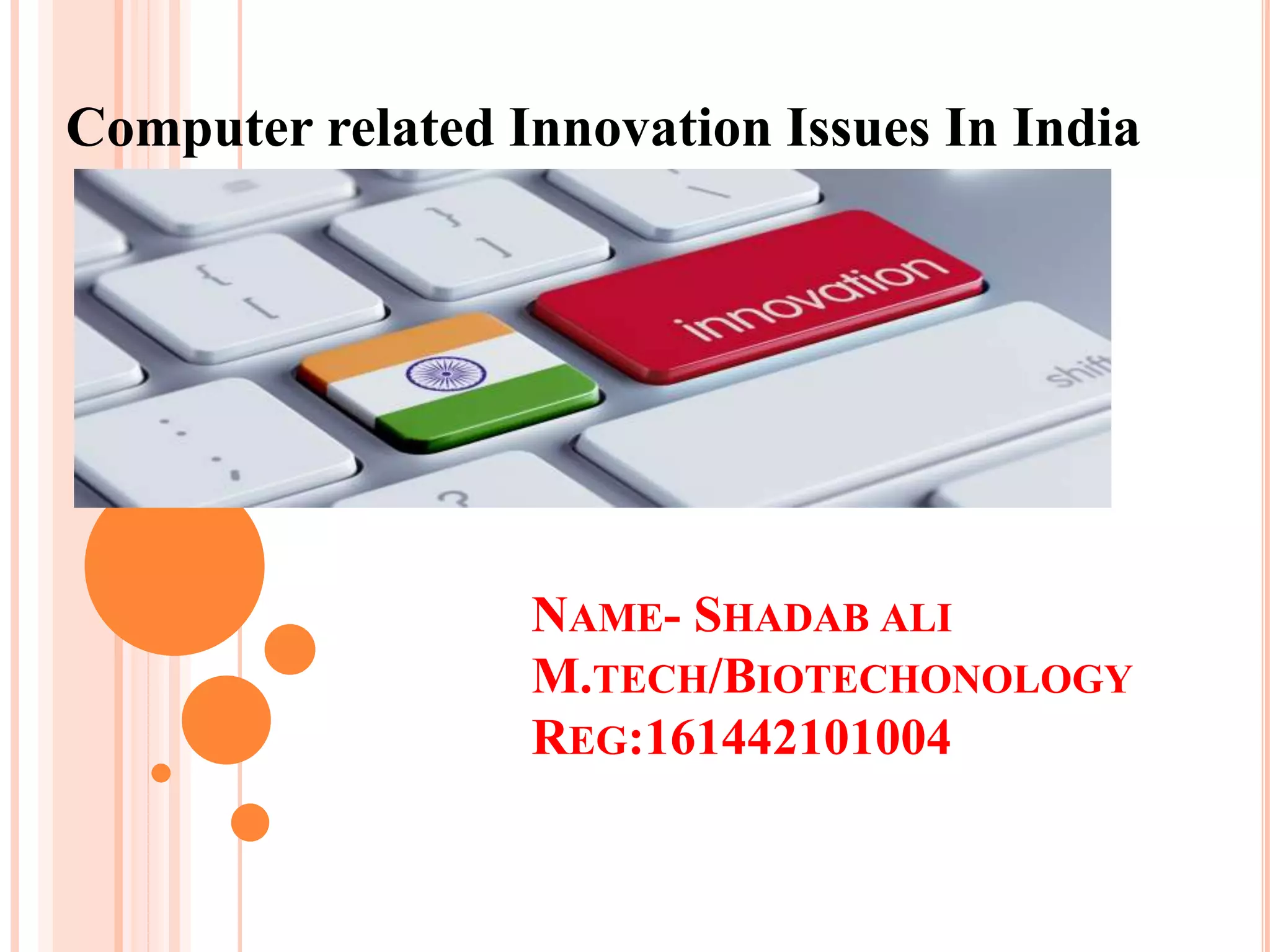
Computer related Innovation Issues In India
INTRODUCTION
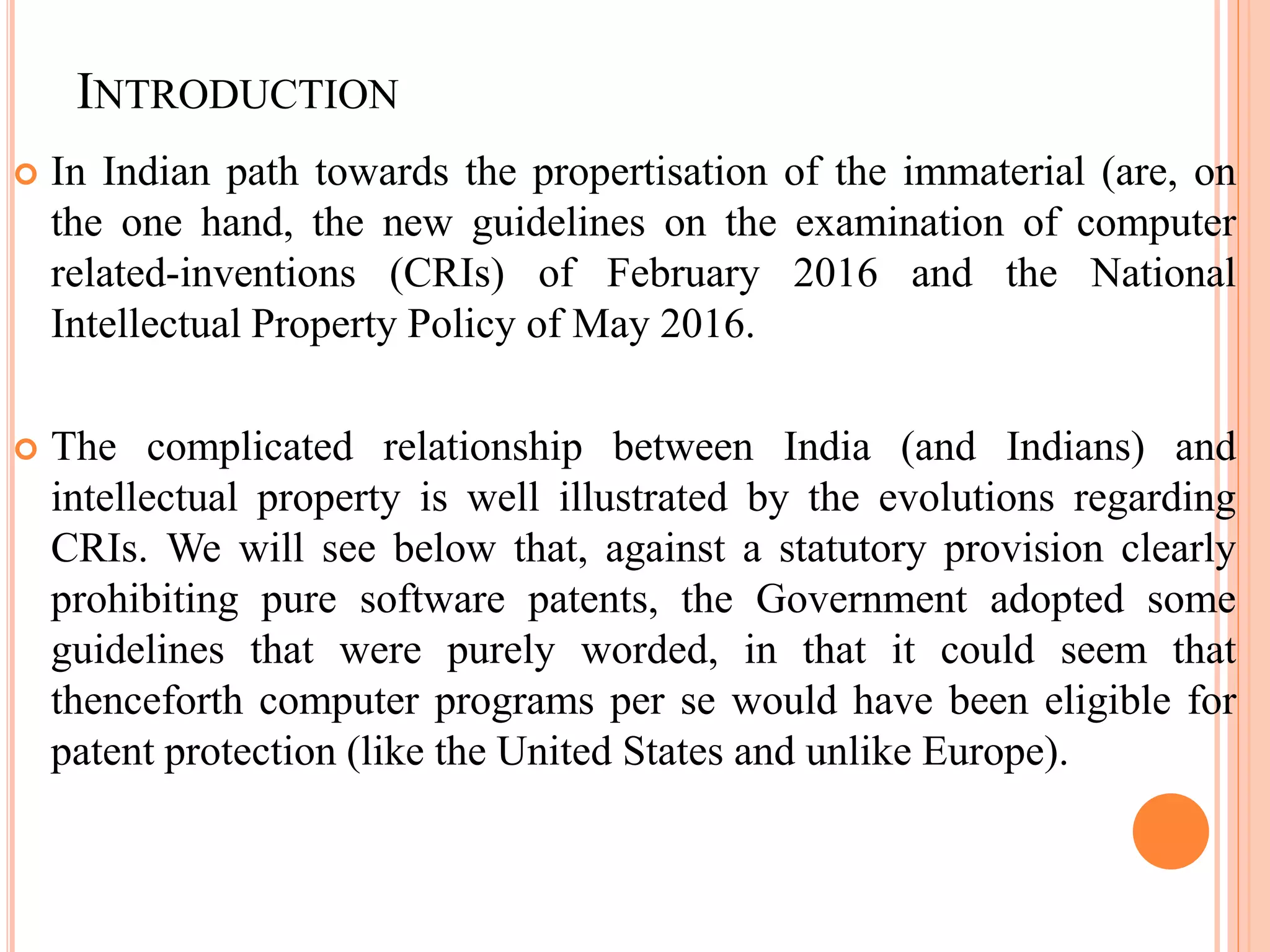
 In Indian path towards the propertisation of the immaterial (are, on
the one hand, the new guidelines on the examination of computer
related-inventions (CRIs) of February 2016 and the National
Intellectual Property Policy of May 2016.
 The complicated relationship between India (and Indians) and
intellectual property is well illustrated by the evolutions regarding
CRIs. We will see below that, against a statutory provision clearly
prohibiting pure software patents, the Government adopted some
guidelines that were purely worded, in that it could seem that
thenceforth computer programs per se would have been eligible for
patent protection (like the United States and unlike Europe).
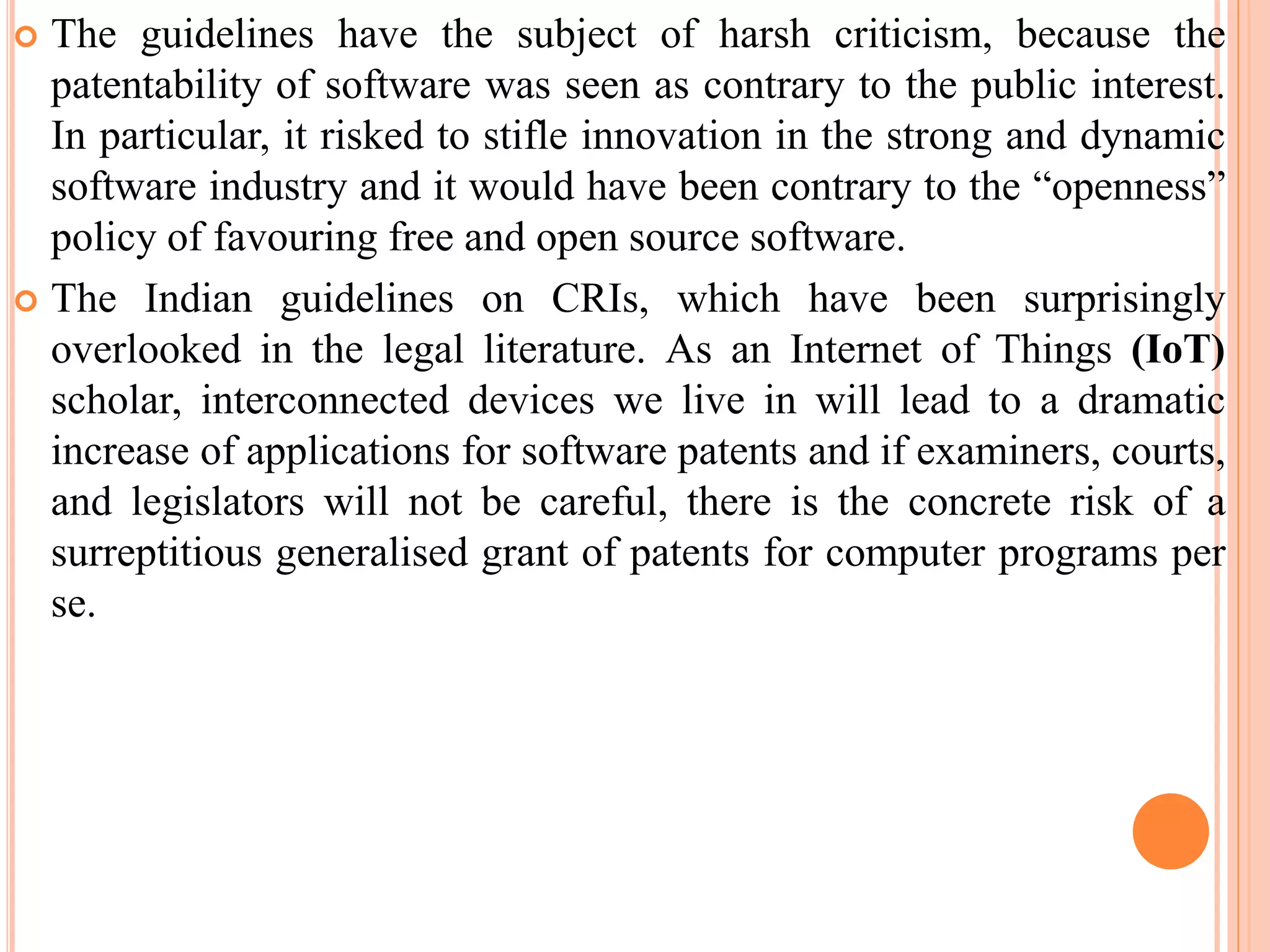
 The guidelines have the subject of harsh criticism, because the
patentability of software was seen as contrary to the public interest.
In particular, it risked to stifle innovation in the strong and dynamic
software industry and it would have been contrary to the “openness”
policy of favouring free and open source software.
 The Indian guidelines on CRIs, which have been surprisingly
overlooked in the legal literature. As an Internet of Things (IoT)
scholar, interconnected devices we live in will lead to a dramatic
increase of applications for software patents and if examiners, courts,
and legislators will not be careful, there is the concrete risk of a
surreptitious generalised grant of patents for computer programs per
se.
DELVING INTO COMPUTER-RELATED INVENTIONS
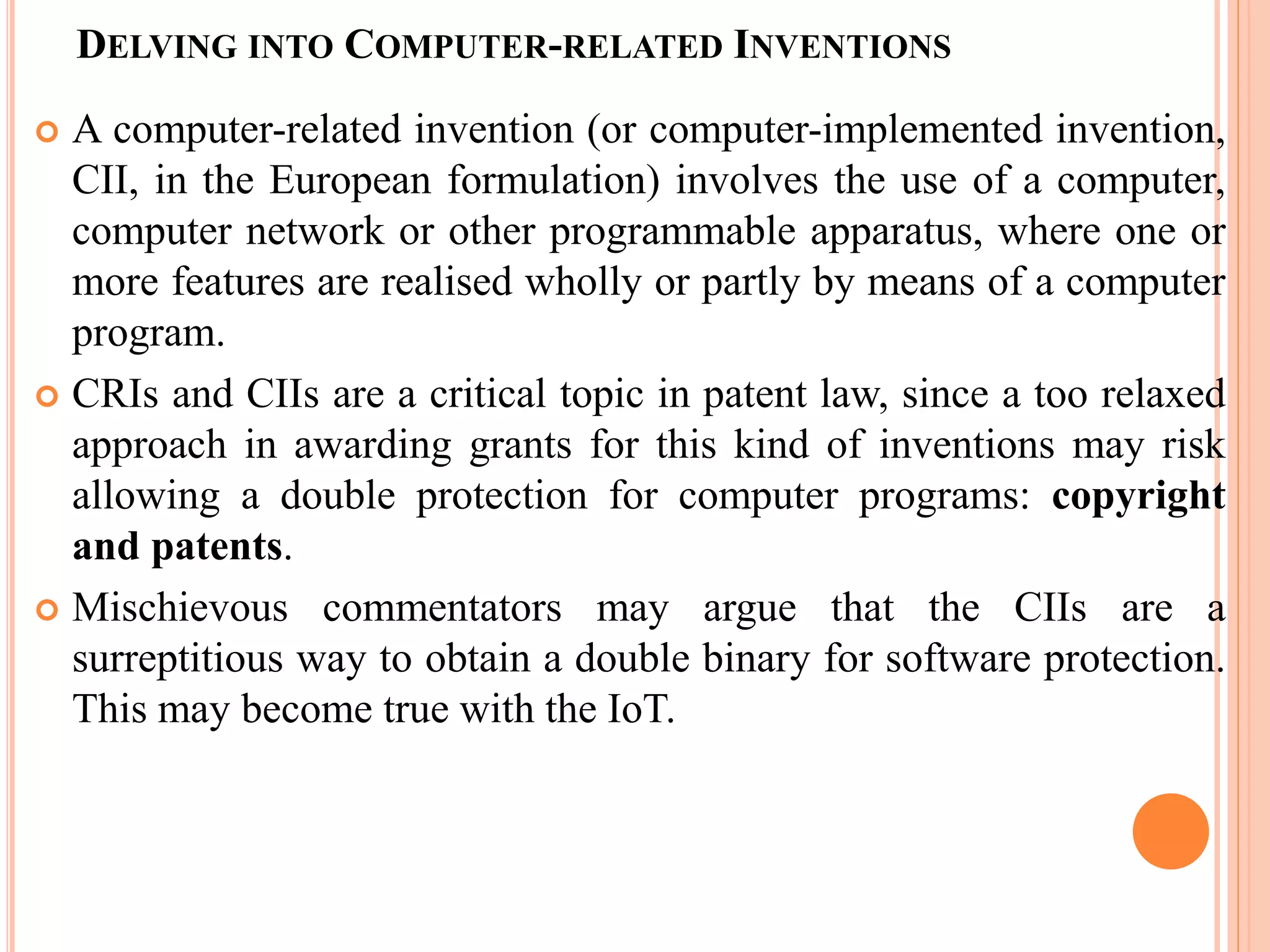
 A computer-related invention (or computer-implemented invention,
CII, in the European formulation) involves the use of a computer,
computer network or other programmable apparatus, where one or
more features are realised wholly or partly by means of a computer
program.
 CRIs and CIIs are a critical topic in patent law, since a too relaxed
approach in awarding grants for this kind of inventions may risk
allowing a double protection for computer programs: copyright
and patents.
 Mischievous commentators may argue that the CIIs are a
surreptitious way to obtain a double binary for software protection.
This may become true with the IoT.
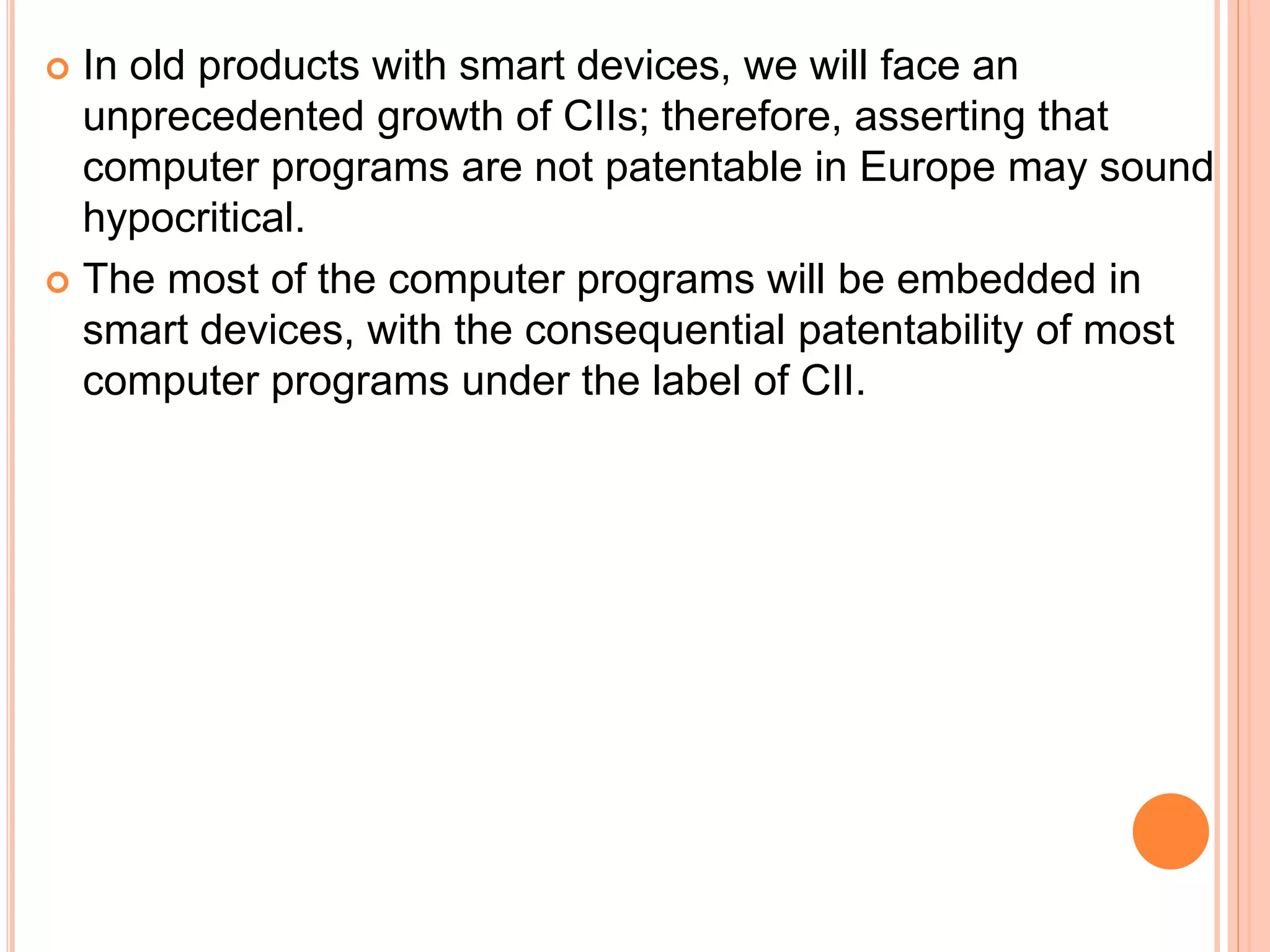
 In old products with smart devices, we will face an
unprecedented growth of CIIs; therefore, asserting that
computer programs are not patentable in Europe may sound
hypocritical.
 The most of the computer programs will be embedded in
smart devices, with the consequential patentability of most
computer programs under the label of CII.
INDIA AT THE FOREFRONT OF INNOVATION IN ASIA
 It is not sufficiently known that India has a pioneering role in the
development of new technologies and new approaches to the
concept itself of innovation.
 A notable example is Ministry of Electronics & Information
Technology which builds on the ‘Digital India Programme.’ In
issuing it, the Department of Electronics and Information
Technology (‘DeitY’) pursued four goals.
 Firstly, to create an IoT industry in India of USD 15 billion by 2020
(with a share of 5-6% of global IoT industry.)
 Secondly, to undertake capacity development for IoT specific skill-
sets for domestic and international markets.
 Thirdly, to undertake R&D for all the assisting technologies. Lastly,
to develop smart devices specific to Indian needs in all possible
domains.
THE GUIDELINES ON THE EXAMINATION OF COMPUTER RELATED
INVENTIONS.
 India, unlike the US, is following the double-binary European
approach. Indeed, s.3(k) of the Patents Act 1970 states that a
“computer programme per se” is not patentable, but until
recently it was not clear whether CRIs were excluded from the
subject matter or not.
 The silence kept on CRIs will not surprise who knows that the
Patents Act, notwithstanding its amendments, remains an old act, as
shown inter alia by the several provisions on floppy disks.
 The path towards the introduction of software patents had been
gradual and Brownian
 In 2002, the Patents (Amendments) Act, 2002 introduced the words
‘per se’ in s.3(k) of the Patents Act. This was explained by the Joint
Parliamentary Committee by saying that “sometimes the computer
program may include certain other things, ancillary thereto or
developed thereon.
 The new guidelines reaffirm the exclusion of the software
patents and introduces a three-step test to determine the
applicability of s.3(k) of the Patents Act to CRIs. Indeed,
“[e]xaminers may rely on the
 The following three stage test in examining CRI
applications:
 (1) Properly construe the claim and identify the actual
contribution.
 (2) If the contribution lies only in mathematical method,
business method or algorithm, deny the claim.
 (3) If the contribution lies in the field of computer program,
check whether it is claimed in conjunction with a novel
hardware and proceed to other steps to determine
patentability with respect to the invention.
CONCLUSIONS
 With the advent of the IoT, applications for software patents
disguised as CIIs will increase substantially in India. A too strong
patent regime for computer programs, in a moment when software
is being embedded in most traditional devices, risks not to take into
account the trade-off between remuneration of the investments and
public good.
 There are some good practices to be followed and India’s example
is to be taken into account, even though the United States do not
seem to appreciate it. Indeed, it has been commented that the
analysed guidelines would introduce unpredictability for patent
applicants and that they have been issued “following an opaque
process for soliciting comments” I beg to differ, for the reasons
pointed out above. After the civil society has (maybe too) harshly
criticised the first version of the guidelines on the CRIs, the
Government has revised them in order to make clear
REFERENCES
1. Ministry of Commerce and Industry Department of Industrial Policy & Promotion
(2016) National Intellectual Property Rights Policy.
2. Medecins Sans F (2015) A timeline of U.S. attacks on India’s patent law &
generic competition.
3. Office of the United States Trade Representative (2016) 2016 Special 301
Report.
4. Noto L, Diega G (2016) Software patents and the Internet of Things in Europe,
the United States, and India. European Intellectual Property Review.
5. Noto L, Diega G (2016) Clouds of Things: Data Protection and Consumer Law
at the Intersection of Cloud Computing and the Internet of Things in the United
Kingdom. Journal of Law & Economic Regulation 9: 69-93.
6. Ministry of Electronics & Information Technology (2015) Draft Policy on Internet
of Things.
7. Aggarwal V (2015) India’s first Internet of Things policy to focus on Zero Defect,
Zero Effect. The Economic Times India.
8. Modi N (2014) Prime Minister Narendra Modi’s speech on 68th Independence Day.
9. Ministry of Urban Development (2015) Smart cities. Statement and Guidelines
Computer related innovation issues in india

Computer related innovation issues in india

  • 1.
  • 5.
    INTRODUCTION  In Indianpath towards the propertisation of the immaterial (are, on the one hand, the new guidelines on the examination of computer related-inventions (CRIs) of February 2016 and the National Intellectual Property Policy of May 2016.  The complicated relationship between India (and Indians) and intellectual property is well illustrated by the evolutions regarding CRIs. We will see below that, against a statutory provision clearly prohibiting pure software patents, the Government adopted some guidelines that were purely worded, in that it could seem that thenceforth computer programs per se would have been eligible for patent protection (like the United States and unlike Europe).
  • 6.
     The guidelineshave the subject of harsh criticism, because the patentability of software was seen as contrary to the public interest. In particular, it risked to stifle innovation in the strong and dynamic software industry and it would have been contrary to the “openness” policy of favouring free and open source software.  The Indian guidelines on CRIs, which have been surprisingly overlooked in the legal literature. As an Internet of Things (IoT) scholar, interconnected devices we live in will lead to a dramatic increase of applications for software patents and if examiners, courts, and legislators will not be careful, there is the concrete risk of a surreptitious generalised grant of patents for computer programs per se.
  • 7.
    DELVING INTO COMPUTER-RELATEDINVENTIONS  A computer-related invention (or computer-implemented invention, CII, in the European formulation) involves the use of a computer, computer network or other programmable apparatus, where one or more features are realised wholly or partly by means of a computer program.  CRIs and CIIs are a critical topic in patent law, since a too relaxed approach in awarding grants for this kind of inventions may risk allowing a double protection for computer programs: copyright and patents.  Mischievous commentators may argue that the CIIs are a surreptitious way to obtain a double binary for software protection. This may become true with the IoT.
  • 8.
     In oldproducts with smart devices, we will face an unprecedented growth of CIIs; therefore, asserting that computer programs are not patentable in Europe may sound hypocritical.  The most of the computer programs will be embedded in smart devices, with the consequential patentability of most computer programs under the label of CII.
  • 9.
    INDIA AT THEFOREFRONT OF INNOVATION IN ASIA  It is not sufficiently known that India has a pioneering role in the development of new technologies and new approaches to the concept itself of innovation.  A notable example is Ministry of Electronics & Information Technology which builds on the ‘Digital India Programme.’ In issuing it, the Department of Electronics and Information Technology (‘DeitY’) pursued four goals.  Firstly, to create an IoT industry in India of USD 15 billion by 2020 (with a share of 5-6% of global IoT industry.)  Secondly, to undertake capacity development for IoT specific skill- sets for domestic and international markets.  Thirdly, to undertake R&D for all the assisting technologies. Lastly, to develop smart devices specific to Indian needs in all possible domains.
  • 10.
    THE GUIDELINES ONTHE EXAMINATION OF COMPUTER RELATED INVENTIONS.  India, unlike the US, is following the double-binary European approach. Indeed, s.3(k) of the Patents Act 1970 states that a “computer programme per se” is not patentable, but until recently it was not clear whether CRIs were excluded from the subject matter or not.  The silence kept on CRIs will not surprise who knows that the Patents Act, notwithstanding its amendments, remains an old act, as shown inter alia by the several provisions on floppy disks.  The path towards the introduction of software patents had been gradual and Brownian  In 2002, the Patents (Amendments) Act, 2002 introduced the words ‘per se’ in s.3(k) of the Patents Act. This was explained by the Joint Parliamentary Committee by saying that “sometimes the computer program may include certain other things, ancillary thereto or developed thereon.
  • 11.
     The newguidelines reaffirm the exclusion of the software patents and introduces a three-step test to determine the applicability of s.3(k) of the Patents Act to CRIs. Indeed, “[e]xaminers may rely on the  The following three stage test in examining CRI applications:  (1) Properly construe the claim and identify the actual contribution.  (2) If the contribution lies only in mathematical method, business method or algorithm, deny the claim.  (3) If the contribution lies in the field of computer program, check whether it is claimed in conjunction with a novel hardware and proceed to other steps to determine patentability with respect to the invention.
  • 12.
    CONCLUSIONS  With theadvent of the IoT, applications for software patents disguised as CIIs will increase substantially in India. A too strong patent regime for computer programs, in a moment when software is being embedded in most traditional devices, risks not to take into account the trade-off between remuneration of the investments and public good.  There are some good practices to be followed and India’s example is to be taken into account, even though the United States do not seem to appreciate it. Indeed, it has been commented that the analysed guidelines would introduce unpredictability for patent applicants and that they have been issued “following an opaque process for soliciting comments” I beg to differ, for the reasons pointed out above. After the civil society has (maybe too) harshly criticised the first version of the guidelines on the CRIs, the Government has revised them in order to make clear
  • 13.
    REFERENCES 1. Ministry ofCommerce and Industry Department of Industrial Policy & Promotion (2016) National Intellectual Property Rights Policy. 2. Medecins Sans F (2015) A timeline of U.S. attacks on India’s patent law & generic competition. 3. Office of the United States Trade Representative (2016) 2016 Special 301 Report. 4. Noto L, Diega G (2016) Software patents and the Internet of Things in Europe, the United States, and India. European Intellectual Property Review. 5. Noto L, Diega G (2016) Clouds of Things: Data Protection and Consumer Law at the Intersection of Cloud Computing and the Internet of Things in the United Kingdom. Journal of Law & Economic Regulation 9: 69-93. 6. Ministry of Electronics & Information Technology (2015) Draft Policy on Internet of Things. 7. Aggarwal V (2015) India’s first Internet of Things policy to focus on Zero Defect, Zero Effect. The Economic Times India. 8. Modi N (2014) Prime Minister Narendra Modi’s speech on 68th Independence Day. 9. Ministry of Urban Development (2015) Smart cities. Statement and Guidelines