Computer Organization And Design The Hardware
Software Interface Riscv Edition Solution Manual
1st David A Patterson download
https://ebookbell.com/product/computer-organization-and-design-
the-hardware-software-interface-riscv-edition-solution-
manual-1st-david-a-patterson-10428618
Explore and download more ebooks at ebookbell.com
Here are some recommended products that we believe you will be
interested in. You can click the link to download.
Computer Organization And Design The Hardware Software Interface Riscv
Edition 1st David A Patterson
https://ebookbell.com/product/computer-organization-and-design-the-
hardware-software-interface-riscv-edition-1st-david-a-
patterson-6700800
Solution Manual Computer Organization And Design Riscv Edition The
Hardware Software Interface 2nd Edition David A Patterson
https://ebookbell.com/product/solution-manual-computer-organization-
and-design-riscv-edition-the-hardware-software-interface-2nd-edition-
david-a-patterson-48983658
Computer Organization And Design The Hardwaresoftware Interface David
A Patterson John L Hennessy
https://ebookbell.com/product/computer-organization-and-design-the-
hardwaresoftware-interface-david-a-patterson-john-l-hennessy-47685906
Computer Organization And Design The Hardwaresoftware Interface
Patterson D
https://ebookbell.com/product/computer-organization-and-design-the-
hardwaresoftware-interface-patterson-d-58311996
Computer Organization And Design The Hardwaresoftware Interface Arm
Edition David A Patterson John L Hennessy
https://ebookbell.com/product/computer-organization-and-design-the-
hardwaresoftware-interface-arm-edition-david-a-patterson-john-l-
hennessy-58312004
Computer Organization And Design The Hardwaresoftware Interface Arm
Edition David A Patterson John L Hennessy
https://ebookbell.com/product/computer-organization-and-design-the-
hardwaresoftware-interface-arm-edition-david-a-patterson-john-l-
hennessy-38623618
Computer Organization And Design The Hardware Software Interface John
L Hennessy David A Patterson
https://ebookbell.com/product/computer-organization-and-design-the-
hardware-software-interface-john-l-hennessy-david-a-patterson-11261976
Computer Organization And Design The Hardwaresoftware Interface David
A Patterson John L Hennessy
https://ebookbell.com/product/computer-organization-and-design-the-
hardwaresoftware-interface-david-a-patterson-john-l-hennessy-42052480
Computer Organization And Design The Hardware Software Interface 4th
Edition 4th Edition David A Patterson And John L Hennessy
https://ebookbell.com/product/computer-organization-and-design-the-
hardware-software-interface-4th-edition-4th-edition-david-a-patterson-
and-john-l-hennessy-2365940
Solutions
1
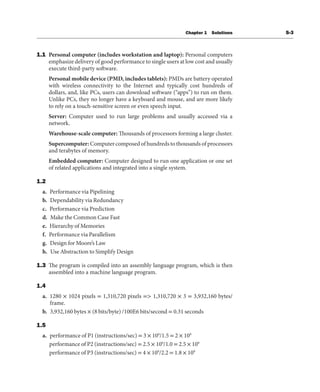
Chapter 1 Solutions S-3
1.1 Personal computer (includes workstation and laptop): Personal computers
emphasize delivery of good performance to single users at low cost and usually
execute third-party software.
Personal mobile device (PMD, includes tablets): PMDs are battery operated
with wireless connectivity to the Internet and typically cost hundreds of
dollars, and, like PCs, users can download software (“apps”) to run on them.
Unlike PCs, they no longer have a keyboard and mouse, and are more likely
to rely on a touch-sensitive screen or even speech input.
Server: Computer used to run large problems and usually accessed via a
network.
Warehouse-scale computer: Thousands of processors forming a large cluster.
Supercomputer: Computer composed of hundreds to thousands of processors
and terabytes of memory.
Embedded computer: Computer designed to run one application or one set
of related applications and integrated into a single system.
1.2
a. Performance via Pipelining
b. Dependability via Redundancy
c. Performance via Prediction
d. Make the Common Case Fast
e. Hierarchy of Memories
f. Performance via Parallelism
g. Design for Moore’s Law
h. Use Abstraction to Simplify Design
1.3 The program is compiled into an assembly language program, which is then
assembled into a machine language program.
1.4
a. 1280 × 1024 pixels = 1,310,720 pixels => 1,310,720 × 3 = 3,932,160 bytes/
frame.
b. 3,932,160 bytes × (8 bits/byte) /100E6 bits/second = 0.31 seconds
1.5
a. performance of P1 (instructions/sec) = 3 × 10⁹
/1.5 = 2 × 10⁹
performance of P2 (instructions/sec) = 2.5 × 10⁹
/1.0 = 2.5 × 10⁹
performance of P3 (instructions/sec) = 4 × 10⁹
/2.2 = 1.8 × 10⁹
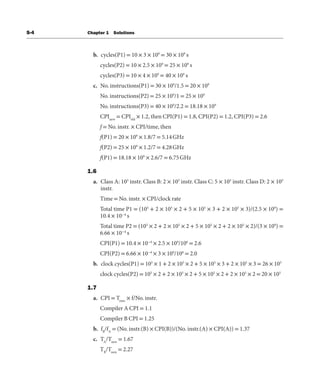
S-4 Chapter 1 Solutions
b. cycles(P1) = 10 × 3 × 109
= 30 × 109
s
cycles(P2) = 10 × 2.5 × 109
= 25 × 109
s
cycles(P3) = 10 × 4 × 109
= 40 × 109
s
c. No. instructions(P1) = 30 × 109
/1.5 = 20 × 109
No. instructions(P2) = 25 × 109
/1 = 25 × 109
No. instructions(P3) = 40 × 109
/2.2 = 18.18 × 10⁹
CPInew
= CPIold
× 1.2, then CPI(P1) = 1.8, CPI(P2) = 1.2, CPI(P3) = 2.6
f = No. instr. × CPI/time, then
f(P1) = 20 × 109
× 1.8/7 = 5.14GHz
f(P2) = 25 × 109
× 1.2/7 = 4.28GHz
f(P1) = 18.18 × 109
× 2.6/7 = 6.75GHz
1.6
a. Class A: 105
instr. Class B: 2 × 10⁵
instr. Class C: 5 × 10⁵
instr. Class D: 2 × 10⁵
instr.
Time = No. instr. × CPI/clock rate
Total time P1 = (105
+ 2 × 105
× 2 + 5 × 105
× 3 + 2 × 105
× 3)/(2.5 × 109
) =
10.4 × 10⁻⁴
s
Total time P2 = (105
× 2 + 2 × 105
× 2 + 5 × 105
× 2 + 2 × 105
× 2)/(3 × 109
) =
6.66 × 10⁻⁴
s
CPI(P1) = 10.4 × 10−4
× 2.5 × 109
/106
= 2.6
CPI(P2) = 6.66 × 10−4
× 3 × 109
/106
= 2.0
b. clock cycles(P1) = 105
× 1 + 2 × 105
× 2 + 5 × 105
× 3 + 2 × 105
× 3 = 26 × 105
clock cycles(P2) = 105
× 2 + 2 × 105
× 2 + 5 × 105
× 2 + 2 × 105
× 2 = 20 × 105
1.7
a. CPI = Texec
× f/No. instr.
Compiler A CPI = 1.1
Compiler B CPI = 1.25
b. fB
/fA
= (No. instr.(B) × CPI(B))/(No. instr.(A) × CPI(A)) = 1.37
c. TA
/Tnew
= 1.67
TB
/Tnew
= 2.27
Chapter 1 Solutions S-5
1.8
1.8.1 C = 2 × DP/(V2
× F)
Pentium 4: C = 3.2E–8F
Core i5 Ivy Bridge: C = 2.9E–8F
1.8.2 Pentium 4: 10/100 = 10%
Core i5 Ivy Bridge: 30/70 = 42.9%
1.8.3 (Snew
+ Dnew
)/(Sold
+ Dold
) = 0.90
Dnew
= C × Vnew
2 × F
Sold
= Vold
× I
Snew
= Vnew
× I
Therefore:
Vnew
= [Dnew
/(C × F)]1/2
Dnew
= 0.90 × (Sold
+ Dold
) − Snew
Snew
= Vnew
× (Sold
/Vold
)
Pentium 4:
Snew
= Vnew
× (10/1.25) = Vnew
× 8
Dnew
= 0.90 × 100 − Vnew
× 8 = 90 − Vnew
× 8
Vnew
= [(90 − Vnew
× 8)/(3.2E8 × 3.6E9)]1/2
Vnew
= 0.85V
Core i5:
Snew
= Vnew
× (30/0.9) = Vnew
× 33.3
Dnew
= 0.90 × 70 − Vnew
× 33.3 = 63 − Vnew
× 33.3
Vnew
= [(63 − Vnew
× 33.3)/(2.9E8 × 3.4E9)]1/2
Vnew
= 0.64V
1.9
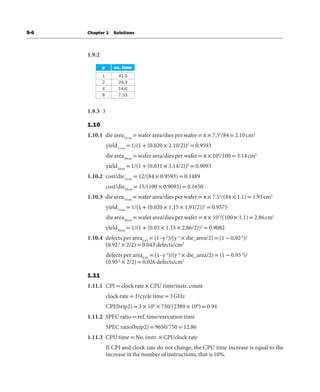
1.9.1
S-6 Chapter 1 Solutions
1.9.2
1.9.3 3
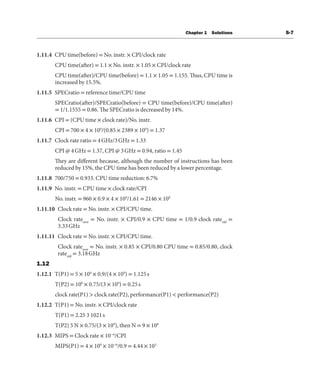
1.10
1.10.1 die area15cm
= wafer area/dies per wafer = π × 7.52
/84 = 2.10cm2
yield15cm
= 1/(1 + (0.020 × 2.10/2))2
= 0.9593
die area20cm
= wafer area/dies per wafer = π × 102
/100 = 3.14cm2
yield20cm
= 1/(1 + (0.031 × 3.14/2))2
= 0.9093
1.10.2 cost/die15cm
= 12/(84 × 0.9593) = 0.1489
cost/die20cm
= 15/(100 × 0.9093) = 0.1650
1.10.3 die area15cm
= wafer area/dies per wafer = π × 7.52
/(84 × 1.1) = 1.91cm2
yield15cm
= 1/(1 + (0.020 × 1.15 × 1.91/2))2
= 0.9575
die area20cm
= wafer area/dies per wafer = π × 102
/(100 × 1.1) = 2.86cm2
yield20cm
= 1/(1 + (0.03 × 1.15 × 2.86/2))2
= 0.9082
1.10.4 defects per area0.92
= (1–y.5
)/(y.5
× die_area/2) = (1 − 0.92.5
)/
(0.92.5
× 2/2) = 0.043 defects/cm2
defects per area0.95
= (1–y.5
)/(y.5
× die_area/2) = (1 − 0.95.5
)/
(0.95.5
× 2/2) = 0.026 defects/cm2
1.11
1.11.1 CPI = clock rate × CPU time/instr. count
clock rate = 1/cycle time = 3GHz
CPI(bzip2) = 3 × 109
× 750/(2389 × 109
) = 0.94
1.11.2 SPEC ratio = ref. time/execution time
SPEC ratio(bzip2) = 9650/750 = 12.86
1.11.3 CPU time = No. instr. × CPI/clock rate
If CPI and clock rate do not change, the CPU time increase is equal to the
increase in the number of instructions, that is 10%.
Chapter 1 Solutions S-7
1.11.4 CPU time(before) = No. instr. × CPI/clock rate
CPU time(after) = 1.1 × No. instr. × 1.05 × CPI/clock rate
CPU time(after)/CPU time(before) = 1.1 × 1.05 = 1.155. Thus, CPU time is
increased by 15.5%.
1.11.5 SPECratio = reference time/CPU time
SPECratio(after)/SPECratio(before) = CPU time(before)/CPU time(after)
= 1/1.1555 = 0.86. The SPECratio is decreased by 14%.
1.11.6 CPI = (CPU time × clock rate)/No. instr.
CPI = 700 × 4 × 109
/(0.85 × 2389 × 109
) = 1.37
1.11.7 Clock rate ratio = 4GHz/3GHz = 1.33
CPI @ 4GHz = 1.37, CPI @ 3GHz = 0.94, ratio = 1.45
They are different because, although the number of instructions has been
reduced by 15%, the CPU time has been reduced by a lower percentage.
1.11.8 700/750 = 0.933. CPU time reduction: 6.7%
1.11.9 No. instr. = CPU time × clock rate/CPI
No. instr. = 960 × 0.9 × 4 × 109
/1.61 = 2146 × 109
1.11.10 Clock rate = No. instr. × CPI/CPU time.
Clock ratenew
= No. instr. × CPI/0.9 × CPU time = 1/0.9 clock rateold
=
3.33GHz
1.11.11 Clock rate = No. instr. × CPI/CPU time.
Clock ratenew
= No. instr. × 0.85 × CPI/0.80 CPU time = 0.85/0.80, clock
rateold
= 3.18GHz
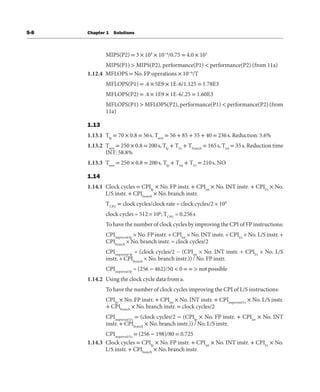
1.12
1.12.1 T(P1) = 5 × 109
× 0.9/(4 × 109
) = 1.125s
T(P2) = 109
× 0.75/(3 × 109
) = 0.25s
clock rate(P1) > clock rate(P2), performance(P1) < performance(P2)
1.12.2 T(P1) = No. instr. × CPI/clock rate
T(P1) = 2.25 3 1021s
T(P2) 5 N × 0.75/(3 × 109
), then N = 9 × 10⁸
1.12.3 MIPS = Clock rate × 10−6
/CPI
MIPS(P1) = 4 × 109
× 10−6
/0.9 = 4.44 × 10³
S-8 Chapter 1 Solutions
MIPS(P2) = 3 × 109
× 10−6
/0.75 = 4.0 × 10³
MIPS(P1) > MIPS(P2), performance(P1) < performance(P2) (from 11a)
1.12.4 MFLOPS = No. FP operations × 10−6
/T
MFLOPS(P1) = .4 × 5E9 × 1E-6/1.125 = 1.78E3
MFLOPS(P2) = .4 × 1E9 × 1E-6/.25 = 1.60E3
MFLOPS(P1) > MFLOPS(P2), performance(P1) < performance(P2) (from
11a)
1.13
1.13.1 Tfp
= 70 × 0.8 = 56s. Tnew
= 56 + 85 + 55 + 40 = 236s. Reduction: 5.6%
1.13.2 Tnew
= 250 × 0.8 = 200s, Tfp
+ Tl/s
+ Tbranch
= 165s, Tint
= 35s. Reduction time
INT: 58.8%
1.13.3 Tnew
= 250 × 0.8 = 200s, Tfp
+ Tint
+ Tl/s
= 210s. NO
1.14
1.14.1 Clock cycles = CPIfp
× No. FP instr. + CPIint
× No. INT instr. + CPIl/s
× No.
L/S instr. + CPIbranch
× No. branch instr.
TCPU
= clock cycles/clock rate = clock cycles/2 × 109
clock cycles = 512 × 106
; TCPU
= 0.256s
To have the number of clock cycles by improving the CPI of FP instructions:
CPIimproved fp
× No. FP instr. + CPIint
× No. INT instr. + CPIl/s
× No. L/S instr. +
CPIbranch
× No. branch instr. = clock cycles/2
CPIimproved fp
= (clock cycles/2 − (CPIint
× No. INT instr. + CPIl/s
× No. L/S
instr. + CPIbranch
× No. branch instr.)) / No. FP instr.
CPIimproved fp
= (256 − 462)/50 < 0 = = > not possible
1.14.2 Using the clock cycle data from a.
To have the number of clock cycles improving the CPI of L/S instructions:
CPIfp
× No. FP instr. + CPIint
× No. INT instr. + CPIimproved l/s
× No. L/S instr.
+ CPIbranch
× No. branch instr. = clock cycles/2
CPIimproved l/s
= (clock cycles/2 − (CPIfp
× No. FP instr. + CPIint
× No. INT
instr. + CPIbranch
× No. branch instr.)) / No. L/S instr.
CPIimproved l/s
= (256 − 198)/80 = 0.725
1.14.3 Clock cycles = CPIfp
× No. FP instr. + CPIint
× No. INT instr. + CPIl/s
× No.
L/S instr. + CPIbranch
× No. branch instr.
Chapter 1 Solutions S-9
TCPU
= clock cycles/clock rate = clock cycles/2 × 109
CPIint
= 0.6 × 1 = 0.6; CPIfp
= 0.6 × 1 = 0.6; CPIl/s
= 0.7 × 4 = 2.8; CPIbranch
=
0.7 × 2 = 1.4
TCPU
(before improv.) = 0.256s; TCPU
(after improv.) = 0.171s
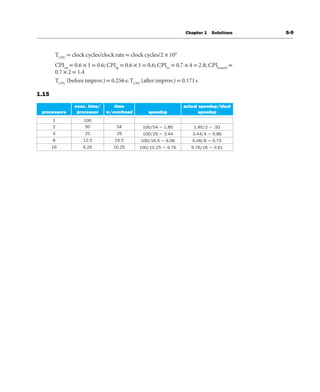
1.15
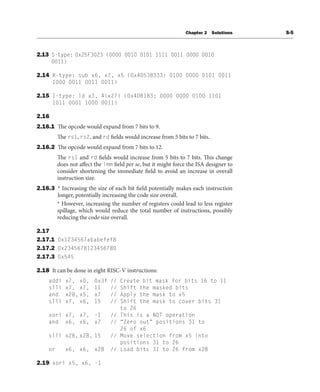
Solutions
2
Chapter 2 Solutions S-3
2.1 addi x5, x7,-5
add x5, x5, x6
[addi f,h,-5 (note, no subi) add f,f,g]
2.2 f = g+h+i
2.3 sub x30, x28, x29 // compute i-j
slli x30, x30, 3 // multiply by 8 to convert the
word offset to a byte offset
ld x30, 0(x3) // load A[i-j]
sd x30, 64(x11) // store in B[8]
2.4 B[g]= A[f] + A[f+1]
slli x30, x5, 3 // x30 = f*8
add x30, x10, x30 // x30 = &A[f]
slli x31, x6, 3 // x31 = g*8
add x31, x11, x31 // x31 = &B[g]
ld x5, 0(x30) // f = A[f]
addi x12, x30, 8 // x12 = &A[f]+8 (i.e. &A[f+1])
ld x30, 0(x12) // x30 = A[f+1]
add x30, x30, x5 // x30 = A[f+1] + A[f]
sd x30, 0(x31) // B[g] = x30 (i.e. A[f+1] + A[f])
2.5
2.6 2882400018
2.7 slli x28, x28, 3 // x28 = i*8
ld x28, 0(x10) // x28 = A[i]
slli x29, x29, 3 // x29 = j*8
ld x29, 0(x11) // x29 = B[j]
add x29, x28, x29 // Compute x29 = A[i] + B[j]
sd x29, 64(x11) // Store result in B[8]
S-4 Chapter 2 Solutions
2.8 f = 2*(&A)
addi x30, x10, 8 // x30 = &A[1]
addi x31, x10, 0 // x31 = &A
sd x31, 0(x30) // A[1] = &A
ld x30, 0(x30) // x30 = A[1] = &A
add x5, x30, x31 // f = &A + &A = 2*(&A)
2.9
addi x30,x10,8
addi x31,x10,0
sd x31,0(x30)
ld x30,0(x30)
add x5, x30, x31
I-type 0x13, 0x0, --
0x13, 0x0, --
0x23, 0x3, --
0x3, 0x3, --
0x33, 0x0, 0x0
R-type
R-type
S-type
I-type
10 -- 30
30
5
31 0
8
0
0
--
--
--
--
30
31
10
31
30
30
opcode,
funct3,7 imm
type rs1 rs2 rd
2.10
2.10.1 0x5000000000000000
2.10.2 overflow
2.10.3 0xB000000000000000
2.10.4 no overflow
2.10.5 0xD000000000000000
2.10.6 overflow
2.11
2.11.1 There is an overflow if 128 + x6 > 263
− 1.
In other words, if x6 > 263
− 129.
There is also an overflow if 128 + x6 < −263
.
In other words, if x6 < −263
− 128 (which is impossible given the
range of x6).
2.11.2 There is an overflow if 128 – x6 > 263
− 1.
In other words, if x6 < −263
+ 129.
There is also an overflow if 128 – x6 < −263
.
In other words, if x6 > 263
+ 128 (which is impossible given the
range of x6).
2.11.3 There is an overflow if x6 − 128 > 263
− 1.
In other words, if x6 < 263
+ 127 (which is impossible given the
range of x6).
There is also an overflow if x6 − 128 < −263
.
In other words, if x6 < −263
+ 128.
2.12 R-type: add x1, x1, x1
Chapter 2 Solutions S-5
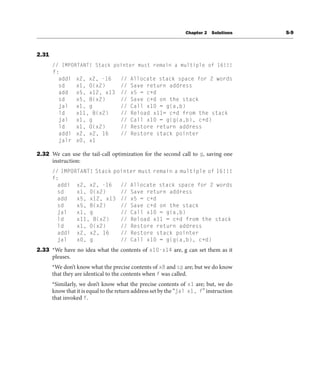
2.13 S-type: 0x25F3023 (0000 0010 0101 1111 0011 0000 0010
0011)
2.14 R-type: sub x6, x7, x5 (0x40538333: 0100 0000 0101 0011
1000 0011 0011 0011)
2.15 I-type: ld x3, 4(x27) (0x4DB183: 0000 0000 0100 1101
1011 0001 1000 0011)
2.16
2.16.1 The opcode would expand from 7 bits to 9.
The rs1, rs2, and rd fields would increase from 5 bits to 7 bits.
2.16.2 The opcode would expand from 7 bits to 12.
The rs1 and rd fields would increase from 5 bits to 7 bits. This change
does not affect the imm field per se, but it might force the ISA designer to
consider shortening the immediate field to avoid an increase in overall
instruction size.
2.16.3 * Increasing the size of each bit field potentially makes each instruction
longer, potentially increasing the code size overall.
* However, increasing the number of registers could lead to less register
spillage, which would reduce the total number of instructions, possibly
reducing the code size overall.
2.17
2.17.1 0x1234567ababefef8
2.17.2 0x2345678123456780
2.17.3 0x545
2.18 It can be done in eight RISC-V instructions:
addi x7, x0, 0x3f // Create bit mask for bits 16 to 11
slli x7, x7, 11 // Shift the masked bits
and x28, x5, x7 // Apply the mask to x5
slli x7, x6, 15 // Shift the mask to cover bits 31
to 26
xori x7, x7, -1 // This is a NOT operation
and x6, x6, x7 // “Zero out” positions 31 to
26 of x6
slli x28, x28, 15 // Move selection from x5 into
positions 31 to 26
or x6, x6, x28 // Load bits 31 to 26 from x28
2.19 xori x5, x6, -1
S-6 Chapter 2 Solutions
2.20 ld x6, 0(x17)
slli x6, x6, 4
2.21 x6 = 2
2.22
2.22.1 [0x1ff00000, 0x200FFFFE]
2.22.2 [0x1FFFF000, 0x20000ffe]
2.23
2.23.1 The UJ instruction format would be most appropriate because it would
allow the maximum number of bits possible for the “loop” parameter,
thereby maximizing the utility of the instruction.
2.23.2 It can be done in three instructions:
loop:
addi x29, x29, -1 // Subtract 1 from x29
bgt x29, x0, loop // Continue if x29 not
negative
addi x29, x29, 1 // Add back 1 that shouldn’t
have been subtracted.
2.24
2.24.1 The final value of xs is 20.
2.24.2 acc = 0;
i = 10;
while (i ! = 0) {
acc += 2;
i--;
}
2.24.3 4*N + 1 instructions.
2.24.4 (Note: change condition ! = to > = in the while loop)
acc = 0;
i = 10;
while (i >= 0) {
acc += 2;
i--;
}
Chapter 2 Solutions S-7
2.25 The C code can be implemented in RISC-V assembly as follows.
LOOPI:
addi x7, x0, 0 // Init i = 0
bge x7, x5, ENDI // While i < a
addi x30, x10, 0 // x30 = &D
addi x29, x0, 0 // Init j = 0
LOOPJ:
bge x29, x6, ENDJ // While j < b
add x31, x7, x29 // x31 = i+j
sd x31, 0(x30) // D[4*j] = x31
addi x30, x30, 32 // x30 = &D[4*(j+1)]
addi x29, x29, 1 // j++
jal x0, LOOPJ
ENDJ:
addi x7, x7, 1 // i++;
jal x0, LOOPI
ENDI:
2.26 The code requires 13 RISC-V instructions. When a = 10 and b = 1, this
results in 123 instructions being executed.
2.27 // This C code corresponds most directly to the given
assembly.
int i;
for (i = 0; i < 100; i++) {
result += *MemArray;
MemArray++;
}
return result;
// However, many people would write the code this way:
int i;
for (i = 0; i < 100; i++) {
result += MemArray[i];
}
return result;
S-8 Chapter 2 Solutions
2.28 The address of the last element of MemArray can be
used to terminate the loop:
add x29, x10, 800 // x29 = &MemArray[101]
LOOP:
ld x7, 0(x10)
add x5, x5, x7
addi x10, x10, 8
blt x10, x29, LOOP // Loop until MemArray points
to one-past the last element
2.29
// IMPORTANT! Stack pointer must reamin a multiple
of 16!!!!
fib:
beq x10, x0, done // If n==0, return 0
addi x5, x0, 1
beq x10, x5, done // If n==1, return 1
addi x2, x2, -16 // Allocate 2 words of stack
space
sd x1, 0(x2) // Save the return address
sd x10, 8(x2) // Save the current n
addi x10, x10, -1 // x10 = n-1
jal x1, fib // fib(n-1)
ld x5, 8(x2) // Load old n from the stack
sd x10, 8(x2) // Push fib(n-1) onto the stack
addi x10, x5, -2 // x10 = n-2
jal x1, fib // Call fib(n-2)
ld x5, 8(x2) // x5 = fib(n-1)
add x10, x10, x5 // x10 = fib(n-1)+fib(n-2)
// Clean up:
ld x1, 0(x2) // Load saved return address
addi x2, x2, 16 // Pop two words from the stack
done:
jalr x0, x1
2.30 [answers will vary]
Chapter 2 Solutions S-9
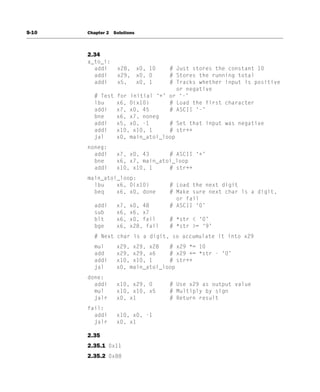
2.31
// IMPORTANT! Stack pointer must remain a multiple of 16!!!
f:
addi x2, x2, -16 // Allocate stack space for 2 words
sd x1, 0(x2) // Save return address
add x5, x12, x13 // x5 = c+d
sd x5, 8(x2) // Save c+d on the stack
jal x1, g // Call x10 = g(a,b)
ld x11, 8(x2) // Reload x11= c+d from the stack
jal x1, g // Call x10 = g(g(a,b), c+d)
ld x1, 0(x2) // Restore return address
addi x2, x2, 16 // Restore stack pointer
jalr x0, x1
2.32 We can use the tail-call optimization for the second call to g, saving one
instruction:
// IMPORTANT! Stack pointer must remain a multiple of 16!!!
f:
addi x2, x2, -16 // Allocate stack space for 2 words
sd x1, 0(x2) // Save return address
add x5, x12, x13 // x5 = c+d
sd x5, 8(x2) // Save c+d on the stack
jal x1, g // Call x10 = g(a,b)
ld x11, 8(x2) // Reload x11 = c+d from the stack
ld x1, 0(x2) // Restore return address
addi x2, x2, 16 // Restore stack pointer
jal x0, g // Call x10 = g(g(a,b), c+d)
2.33 *We have no idea what the contents of x10-x14 are, g can set them as it
pleases.
*We don’t know what the precise contents of x8 and sp are; but we do know
that they are identical to the contents when f was called.
*Similarly, we don’t know what the precise contents of x1 are; but, we do
know that it is equal to the return address set by the “jal x1, f” instruction
that invoked f.
S-10 Chapter 2 Solutions
2.34
a_to_i:
addi x28, x0, 10 # Just stores the constant 10
addi x29, x0, 0 # Stores the running total
addi x5, x0, 1 # Tracks whether input is positive
or negative
# Test for initial ‘+’ or ‘-’
lbu x6, 0(x10) # Load the first character
addi x7, x0, 45 # ASCII ‘-’
bne x6, x7, noneg
addi x5, x0, -1 # Set that input was negative
addi x10, x10, 1 # str++
jal x0, main_atoi_loop
noneg:
addi x7, x0, 43 # ASCII ‘+’
bne x6, x7, main_atoi_loop
addi x10, x10, 1 # str++
main_atoi_loop:
lbu x6, 0(x10) # Load the next digit
beq x6, x0, done # Make sure next char is a digit,
or fail
addi x7, x0, 48 # ASCII ‘0’
sub x6, x6, x7
blt x6, x0, fail # *str < ‘0’
bge x6, x28, fail # *str >= ‘9’
# Next char is a digit, so accumulate it into x29
mul x29, x29, x28 # x29 *= 10
add x29, x29, x6 # x29 += *str - ‘0’
addi x10, x10, 1 # str++
jal x0, main_atoi_loop
done:
addi x10, x29, 0 # Use x29 as output value
mul x10, x10, x5 # Multiply by sign
jalr x0, x1 # Return result
fail:
addi x10, x0, -1
jalr x0, x1
2.35
2.35.1 0x11
2.35.2 0x88
Chapter 2 Solutions S-11
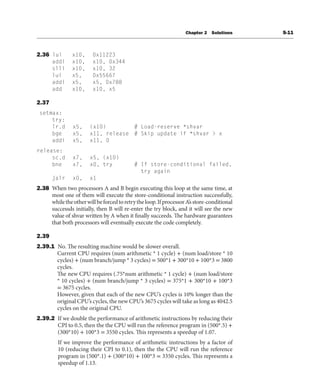
2.36 lui x10, 0x11223
addi x10, x10, 0x344
slli x10, x10, 32
lui x5, 0x55667
addi x5, x5, 0x788
add x10, x10, x5
2.37
setmax:
try:
lr.d x5, (x10) # Load-reserve *shvar
bge x5, x11, release # Skip update if *shvar > x
addi x5, x11, 0
release:
sc.d x7, x5, (x10)
bne x7, x0, try # If store-conditional failed,
try again
jalr x0, x1
2.38 When two processors A and B begin executing this loop at the same time, at
most one of them will execute the store-conditional instruction successfully,
whiletheotherwillbeforcedtoretrytheloop.IfprocessorA’sstore-conditional
successds initially, then B will re-enter the try block, and it will see the new
value of shvar written by A when it finally succeeds. The hardware guarantees
that both processors will eventually execute the code completely.
2.39
2.39.1 No. The resulting machine would be slower overall.
Current CPU requires (num arithmetic * 1 cycle) + (num load/store * 10
cycles) + (num branch/jump * 3 cycles) = 500*1 + 300*10 + 100*3 = 3800
cycles.
The new CPU requires (.75*num arithmetic * 1 cycle) + (num load/store
* 10 cycles) + (num branch/jump * 3 cycles) = 375*1 + 300*10 + 100*3
= 3675 cycles.
However, given that each of the new CPU’s cycles is 10% longer than the
original CPU’s cycles, the new CPU’s 3675 cycles will take as long as 4042.5
cycles on the original CPU.
2.39.2 If we double the performance of arithmetic instructions by reducing their
CPI to 0.5, then the the CPU will run the reference program in (500*.5) +
(300*10) + 100*3 = 3550 cycles. This represents a speedup of 1.07.
If we improve the performance of arithmetic instructions by a factor of
10 (reducing their CPI to 0.1), then the the CPU will run the reference
program in (500*.1) + (300*10) + 100*3 = 3350 cycles. This represents a
speedup of 1.13.
S-12 Chapter 2 Solutions
2.40
2.40.1 Take the weighted average: 0.7*2 + 0.1*6 + 0.2*3 = 2.6
2.40.2 For a 25% improvement, we must reduce the CPU to 2.6*.75 = 1.95. Thus,
we want 0.7*x + 0.1*6 + 0.2*3 < = 1.95. Solving for x shows that the
arithmetic instructions must have a CPI of at most 1.07.
2.40.3 For a 50% improvement, we must reduce the CPU to 2.6*.5 = 1.3. Thus, we
want 0.7*x + 0.1*6 + 0.2*3 < = 1.3. Solving for x shows that the arithmetic
instructions must have a CPI of at most 0.14
2.41
ldr x28, x5(x10), 3 // Load x28=A[f]
addi x5, x5, 1 // f++
ldr x29, x5(x10), 3 // Load x29=A[f+1]
add x29, x29, x28 // Add x29 = A[f] + A[f+1]
sdr x12, x6(x11), 3 // Store B[g] = x29
2.42 ldr x28, x28, (x10), 3 // Load x28=A[i]
ldr x29, x29, (x11), 3 // Load x29=B[j]
add x29, x28, x29
sd x29, 64(x11) // Store B[8]=x29 (don’t
need scaled store here)
Exploring the Variety of Random
Documents with Different Content
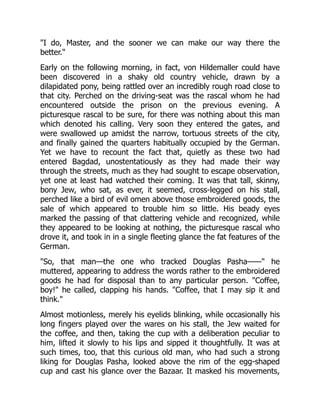
"I do, Master, and the sooner we can make our way there the
better."
Early on the following morning, in fact, von Hildemaller could have
been discovered in a shaky old country vehicle, drawn by a
dilapidated pony, being rattled over an incredibly rough road close to
that city. Perched on the driving-seat was the rascal whom he had
encountered outside the prison on the previous evening. A
picturesque rascal to be sure, for there was nothing about this man
which denoted his calling. Very soon they entered the gates, and
were swallowed up amidst the narrow, tortuous streets of the city,
and finally gained the quarters habitually occupied by the German.
Yet we have to recount the fact that, quietly as these two had
entered Bagdad, unostentatiously as they had made their way
through the streets, much as they had sought to escape observation,
yet one at least had watched their coming. It was that tall, skinny,
bony Jew, who sat, as ever, it seemed, cross-legged on his stall,
perched like a bird of evil omen above those embroidered goods, the
sale of which appeared to trouble him so little. His beady eyes
marked the passing of that clattering vehicle and recognized, while
they appeared to be looking at nothing, the picturesque rascal who
drove it, and took in in a single fleeting glance the fat features of the
German.
"So, that man—the one who tracked Douglas Pasha——" he
muttered, appearing to address the words rather to the embroidered
goods he had for disposal than to any particular person. "Coffee,
boy!" he called, clapping his hands. "Coffee, that I may sip it and
think."
Almost motionless, merely his eyelids blinking, while occasionally his
long fingers played over the wares on his stall, the Jew waited for
the coffee, and then, taking the cup with a deliberation peculiar to
him, lifted it slowly to his lips and sipped it thoughtfully. It was at
such times, too, that this curious old man, who had such a strong
liking for Douglas Pasha, looked above the rim of the egg-shaped
cup and cast his glance over the Bazaar. It masked his movements,
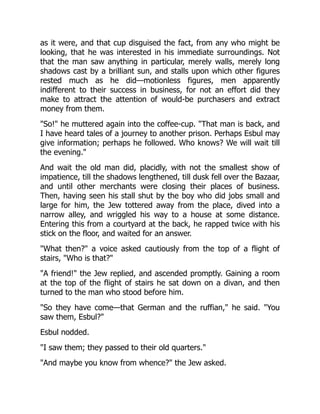
as it were, and that cup disguised the fact, from any who might be
looking, that he was interested in his immediate surroundings. Not
that the man saw anything in particular, merely walls, merely long
shadows cast by a brilliant sun, and stalls upon which other figures
rested much as he did—motionless figures, men apparently
indifferent to their success in business, for not an effort did they
make to attract the attention of would-be purchasers and extract
money from them.
"So!" he muttered again into the coffee-cup. "That man is back, and
I have heard tales of a journey to another prison. Perhaps Esbul may
give information; perhaps he followed. Who knows? We will wait till
the evening."
And wait the old man did, placidly, with not the smallest show of
impatience, till the shadows lengthened, till dusk fell over the Bazaar,
and until other merchants were closing their places of business.
Then, having seen his stall shut by the boy who did jobs small and
large for him, the Jew tottered away from the place, dived into a
narrow alley, and wriggled his way to a house at some distance.
Entering this from a courtyard at the back, he rapped twice with his
stick on the floor, and waited for an answer.
"What then?" a voice asked cautiously from the top of a flight of
stairs, "Who is that?"
"A friend!" the Jew replied, and ascended promptly. Gaining a room
at the top of the flight of stairs he sat down on a divan, and then
turned to the man who stood before him.
"So they have come—that German and the ruffian," he said. "You
saw them, Esbul?"
Esbul nodded.
"I saw them; they passed to their old quarters."
"And maybe you know from whence?" the Jew asked.
"Not so," Esbul told him. "They slipped from the city unbeknown to
me, and were gone while I was sleeping. But—but—I have a feeling
that they were bent on business which concerned my master, or
which concerned those two who were captured with me at
Nasiriyeh."
There was silence for some long while in that room, for the Jew was
not given to much talking. Instead, he ate his humble evening meal
slowly and thoughtfully, gazing at the opposite wall as if he could
read there the mystery of Douglas Pasha's whereabouts, of the
prison in fact where von Hildemaller had caused him to be sent. Let
it be remembered, too, that though this Jew had means of learning
much of what was happening, had learned, indeed, that Geoff and
Phil had been incarcerated somewhere outside the city, yet he had
no knowledge of the German's movements, did not dream, in fact,
that von Hildemaller had so recently visited the place where they
were held, and did not suspect his mission. But he guessed that the
Teuton's exit from the city and return had something to do with
Douglas Pasha, though it might not be directly. He hated this
German—hated all Germans in fact—for, Armenian Jew though he
was, Turkey was his country, and, as a wise man, he realized that
Germany's interest in it was not disinterested. But the subject of
Douglas Pasha touched him even more deeply, for he was devoted
to the Englishman, had received much kindness from him, had, in
days past, to thank him for an act which saved his life—a deed of
bravery which might have cost Douglas Pasha his own quite easily.
That was the secret of the Jew's attachment to this British officer,
the secret of his solicitude for his safety, and part of the reason for
his detestation of von Hildemaller. He turned after a while, solemnly
and slowly, upon Esbul, who meantime had waited for him to speak,
with too great a respect for the aged Jew to disturb him.
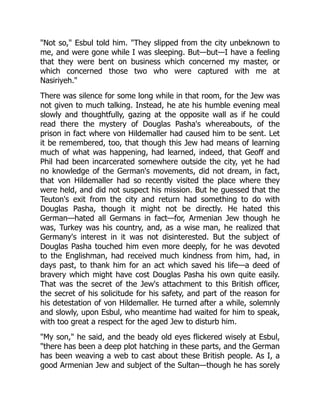
"My son," he said, and the beady old eyes flickered wisely at Esbul,
"there has been a deep plot hatching in these parts, and the German
has been weaving a web to cast about these British people. As I, a
good Armenian Jew and subject of the Sultan—though he has sorely
ill-treated us Armenians—as I hate this German, so he loathes all
those British. He fears the influence of Douglas Pasha amongst the
Turks; when there was no war he feared him, for even against their
will our Turkish pashas could not help having a liking for the Briton,
while for this Teuton they had nothing but contempt. Thus von
Hildemaller was jealous of Douglas Pasha, feared his strength, and
made plans to rid Bagdad and Mesopotamia of him. The chance
came when war burst over the land, and the German seized it. Yet,
surrounded by enemies as he was, Douglas Pasha evaded the
danger for a while, evaded it till the hirelings of von Hildemaller
tracked him down and cast their net about him. Then, but for those
Turkish friends of our master, but for the news of Douglas Pasha's
capture which I sent swiftly to them, the German would have killed
him. Against the wishes of the Turks he could do no such thing, and
therefore had to be content with his imprisonment. Now see what
follows: the ward of Douglas Pasha is captured also, and with him a
companion. The news comes to the ears of this scheming German.
He can do no worse, for the time being at any rate, to Douglas
Pasha himself, but he can hurt him through this young soldier—this
young officer who is dear to him. Who knows? It may be that his
journey outside the city was to secure the person of young Geoffrey
Keith. Who knows? But it is likely."
"More than likely," Esbul told him respectfully.
"That we shall learn in time," the Jew answered. "I have ways of
gathering news unknown to you—unknown to anyone, in fact. We
shall learn. But you, Esbul, in the meantime you will set a watch
upon these people, will disguise yourself and hover about the streets
of the city, and perchance it may be that information will come to
you sooner than to me, in which case you will be lucky."
Esbul, indeed, might consider himself an extremely well-favoured
individual if it turned out that he was more successful in unearthing
the secret doings of von Hildemaller than was Benshi, this aged Jew,
this extraordinarily silent man who hovered the day long over his
embroidered wares, and seemed to take no interest in things outside
his narrow stall, and to possess no energy for doing so; for, indeed,
Benshi was a deep, discreet, and clever individual—one to whom
tales came in the most uncanny manner, to whom reports of doings
outside the city of Bagdad were sent almost before they reached the
Governor's palace. And yet the exact whereabouts of Douglas Pasha
was hidden from him; while beyond the fact that Geoff and Philip
had been imprisoned—a fact communicated by Esbul—he had no
knowledge of them.
Donning a garb which was calculated to deceive easily any who
might meet him, Esbul slipped out of the house that evening and
plunged into the intricacies of the thoroughfares of the city. No need
for him to seek for the quarters of von Hildemaller, for they were
already known to him, and no need, therefore, to ask questions. But
arrived at the house—one detached from its fellows, standing aloof
and alone in a compound—there was little to encourage him to wait,
nothing to prove that the German and the arch-scoundrel he
employed were in residence. Not a light flickered from the windows,
not a gleam came through a crack in the shutters; the place was
clad in darkness, while not a sound came from it.
"But yet it may be that they are there, these crafty fellows," thought
Esbul; "we'll see, we'll investigate the premises carefully."
To clamber over the containing wall was an easy matter, while the
drop on the far side was nothing. With stealthy steps the Armenian
passed round the house, squinting in through keyholes, staring at
the shutters, seeking for something which might prove of interest.
Yet, though he spent a good half-hour in the compound, not a sound
reached his ears, and nothing rewarded his efforts.
Meanwhile, one may wonder what had happened to Geoff and Philip
after their adventurous escape from the Governor's quarters of the
prison.
"Where now, then?" asked Philip, darkness having fallen completely.
"I say, Geoff, I'm sorry about that fall of yours and the fruit, for the
supply I've brought is precious scanty; let's finish it now, and then
consider matters."
It was, indeed, rather an unfortunate thing that the breaking of the
rope and Geoff's fall upon the cushions—which they had had
forethought enough to drop out of the Governor's window—had
resulted in the pulping of the supply of fruit he was carrying on his
person. Yet, if they were deprived of that, they had gained
something immeasurably greater, for they had gained their liberty.
"And mean to keep it now," Geoff was whispering to himself, as they
crouched beside the wall of the prison. "But what to do, where to
go, and how to fare now that we are free?"
It was, indeed, rather a problem, and yet not so difficult after all; for,
consider, Bagdad, they knew—they had learned from their jailer—
was within a day's march of them, and Bagdad was just as much a
magnet to these two young subalterns as it was to any Arab or any
Turk in Mesopotamia—just as much a magnet, indeed, as it was to
the British Expeditionary Force then fighting its way towards the city
from Kut-el-Amara.
"Of course it's got to be done; we've got to get to Bagdad," Geoff
exclaimed, when they had finished their small supply of fruit. "Next
question is—in what direction?"
Philip scratched his head; it was, indeed, a problem which floored
him.
"Which direction, eh?" he muttered. "Yes, that does want deciding,
for I've no notion."
"But here's an idea—a good idea, too," said Geoff. "Naturally enough
the prison must be on some road, else how would one get to it?
How could we have been driven here?"
"Brilliant! Of course, naturally enough—on a road. We look for it."
"Quite so; we look for it, and then——"
"Then we march along it, eh?" Philip told him cheerfully.
"Which direction?" asked Geoff satirically. "Supposing it runs west
and east, do we turn west or east? And if north and south, which
way, please, Philip?"
It was Philip's turn again to cogitate, to scratch his head even
harder, and to wonder. It made him quite irritable and angry when
he discovered how hopeless the situation really was; and then,
seizing upon a brilliant idea, he almost gave vent to a shout of
triumph.
"Of course; easy as smoking; we just get on to the road and wait for
folks to come along it."
"Brilliant!" Geoff scoffed at him. "People don't travel so often during
the night in these parts, but at any rate it's the only solution of our
difficulties. We'll get on to the road and see what happens."
What actually happened was that, after a while, voices were heard
in the neighbourhood of the prison; for by then Geoff and his friend
had passed round the place, had found the road, and had sat down
beside it. They heard the rattle of wheels somewhere on the road,
and the ring of horses' hoofs. Creeping nearer, they heard those
voices more distinctly, and after a little while, getting nearer still,
Geoff was convinced that it was von Hildemaller himself who was
talking.
"Go easy," he told Philip; "keep as far away as we can and listen to
them. Von Hildemaller's in a nasty temper, I expect, and is quitting
the prison. There! He's mounting into some sort of Turkish vehicle,
and he's about to drive off. What's that he's saying? To Bagdad?"
"To Bagdad!" exclaimed Philip in an excited and eager whisper.
"That's where we're going."
"I hope so, certainly," agreed Geoff.
"Then why not accompany our dear friend Hildemaller?" asked
Philip, starting forward.
"Accompany him!" exclaimed Geoff; "you're fooling."
"Never hung on the back of a trap before?" said Philip immediately.
"I have. Come along; let's get this German fellow to give us a lift to
our destination."
The young subaltern had never given expression to a more brilliant
proposal. Geoff seized upon it on the instant, and the two, running
swiftly across the road in their stockinged feet—for they still kept
their boots tucked close to their bodies—were within a few feet of
the rickety chaise in which the German was riding. As it drove off,
clattering heavily over the rough road, they raced up behind it, and,
unknown to the German, clung on behind and accompanied him
towards Bagdad.
CHAPTER XVIII
News of Douglas Pasha
"Bagdad! See it in the distance; watch the rising sun glint on the
roofs and minarets!"
It was in a cautious whisper that Geoff drew the attention of his
chum to a point some long distance in advance of the spot over
which the rickety chaise in which von Hildemaller was riding bore
them. Very craftily he had thrust his head out beyond the side of the
vehicle, and though all was still dusk about them, though the night
had not altogether faded, yet, happening to be on a considerable
elevation, and looking down into the distant basin of the Tigris, he
had caught just that faint gleam of the city for which they were
making. Balancing unevenly, uncomfortably, and with many a
suppressed groan, on the axle and spring of the other side, Phil shot
his head out like a jack-in-the-box after Geoff had spoken, and
stared ahead hard until he too saw flashes from the roofs of Bagdad.
Then he gave vent to quite a loud "Jingo!" and instantly ducked his
head low behind the back of the chaise, for von Hildemaller moved.
Up to that moment, during weary hours, he had sat in his seat
almost without movement, and undoubtedly had lapsed into sleep,
for his snores, like his breathing, shook the air about him. Now he
woke up with a start, stared about him in a frightened manner, and
then called to the driver:
"Stop! I heard something. Someone speaking, and close at hand."
Obediently the driver pulled up his tired pony, and, looking back,
stared sleepily at his master.
"A voice? Someone speaking? You heard something, master?" he
grumbled. "No, no, surely; for we have been on the road alone, and
not a soul has been near us—not a soul. You have been asleep,
Master."
And yet von Hildemaller, the ever-suspicious von Hildemaller, was not
satisfied. He stood up stiffly and with difficulty, gripping the rail
behind the driver's seat to steady himself, and causing the light
chaise to rock on its springs. He stared to either side of him, trying
to penetrate the dusk of early morning; he even peered over the
back of the carriage, whereat Geoff and Phil ducked even lower,
while the former, gripping the axle with those strong fingers of his,
made ready to reach up and grapple with the German. But the
Teuton's eyes were still heavy with sleep, and, failing to see those
two who had clung like limpets to his chaise throughout the night,
he turned, setting the vehicle rocking again, and stared out before
him. A guttural exclamation escaped from those broad lips of his:
"Ach! but Bagdad at last. And there, some comfort, some ease, after
a terrible experience. But wait, wait! I have been thinking, I have
been dreaming. Yes, he who strikes von Hildemaller strikes one who
never forgets, never forgives; and who will repay, however long the
interval, however long the debt may be owing."
He sighed deeply, yawned till his jaws threatened to crack, and until
he displayed a cavity even bigger than that which Geoff had
compelled and into which Philip had thrust the gag with such
delight. Then the German sank back into his seat again, and bade
the driver, peremptorily, to drive onwards. Soon, too, heavy
breathing just in front of them told the two young subalterns that
von Hildemaller was sleeping again.
"Rather a near thing that, eh?" grinned Philip, his head now close to
his chum's, and displaying just a little more common sense and
caution. "What would we have done if he had spotted us that time
when he looked round?"
It was Geoff's turn to smile, a meaning smile, while he stretched out
one hand, balancing himself in that uncomfortable position which he
had maintained throughout the night, and slowly doubled up the
fingers of the other hand—fingers bursting with muscle and with
tendons as strong and as elastic as steel—doubled them up slowly,
in a manner which seemed to emphasize the power within them,
whereat Philip sniffed and sniggered. In a moment, in fact, he
realized how much Geoff had longed for another tussle with the
German, how he would have almost welcomed discovery at that
moment.
"I know," he whispered. "I know what you'd have done, and the
beggar deserves it. You'd have taken him by the neck, you'd have
remembered Douglas Pasha, and you'd have squeezed the life out of
his body."
Of a sudden he gripped the powerful hand held out before him,
gripped it and shook it with energy, while he stared hard at his
chum.
"Why not?" he asked. "Good idea! Why not? Why not squeeze the
life out of him now that we've got him, that is, almost squeeze it out
of him. There's nothing to fear, we ain't surrounded by a prison, and
we'd soon clear that driver off, or, for the matter of that, force him to
do our bidding. Why not grab this brutal German and squeeze him
till his eyes bulge out of his head, till he's choking, till he'll be glad to
give away that secret of his, till he'll beg and beg and whine to us
that he'll release Douglas Pasha? Why not?"
He could feel Geoff's powerful hand suddenly compressed under his
grip, could feel the fingers clench even tighter, while Geoff himself
dropped from the axle to the road, as if the words had stung him to
energy. It was what he had done, and Philip too, many a time
throughout the night; on many an occasion, when meeting some
long rise, they had been glad, in fact, to drop from the somewhat
uncomfortable perches they had found, and to trudge along behind
the carriage. Unbeknown to the German, unsuspected by the driver,
yet doubtless to the knowledge of the animal which dragged it, they
had even helped to propel the carriage up some of the risings,
accelerating its progress to such an extent that the sleepy driver was
amazed at the powers displayed by the animal he drove, and at
length was so struck by its prowess that he wakened sufficiently to
think the matter over and to weigh its value.
"Allah, but this is a strange thing!" he had said to himself more than
once, at first very sleepily, and then with a little more spirit. "Allah,
but the beast is possessed! For see, ever before when we have
made this journey and have come to these hills I have had to use
the whip with vigour, even I have had to dismount and walk beside
the carriage. It is wonderful; for see how thin the beast is and old,
and now he pulls like a giant, like a thoroughbred, like an Arab."
It entirely defeated him; the phenomenon was one he could not
understand however much he puzzled; and puzzling and wondering
made him even more sleepy. Thus the long hours of darkness had
passed, if not comfortably for Geoff and his chum, yet cheerfully
enough. Above all, their thoughts were filled with the engrossing
subject of their liberty. They felt like birds entrapped who had
broken from a cage after weeks and weeks of imprisonment. They
were filled with a feeling of wonderful exhilaration, while the
knowledge that, though free, they were in the midst of an enemy
country, with enemies all about them, added rather a zest to the
whole business.
And now Philip had made a proposition—a proposition of such
importance and so momentous in its results—if the plan were carried
out, that Geoff had felt compelled to leap to his feet and run along
behind the carriage. It was perhaps five minutes later when he
plumped himself down on the axle again, trailing his stockinged feet
along the dusty surface of the road, while he stared out into the
rising dusk behind them.
"Eh?" asked Philip, returning eagerly to the subject, knowing well
from his experience of his chum that no decision was to be expected
until sufficient time had elapsed for our hero to consider the
proposition. Perhaps it was that Geoff was possessed of a certain
sort of canny instinct, perhaps even it was those journeys with
Douglas Pasha, those travels amongst Arabs and other peoples,
which had taught him caution, which had in a certain measure
taught him to smother his thoughts, and to hide his feelings from
other people. Inscrutable his face never was, nor ever would be, for
it shone with healthy, youthful frankness; but the eyes were
thoughtful eyes, eyes which told those who looked into them that
the owner was possessed of some degree of caution, while, as we
have said, Philip, his best and most intimate chum, knew that Geoff
was one not to be hurried.
"Eh?" he asked again impulsively. "You'd strangle the beast easily. I
could with the fingers of one hand. Wait a moment. If we slip out
here and hang on to these back springs we can pull up that old
horse in a moment; then we tip the show over, and throw our
German friend into the gutter. How's that? I'd love to see him roll."
And so would Geoff, very much indeed, and yet what would be the
object?
"Let's just think the matter out, and chat it over quietly," he told the
impulsive Phil, restraining him with a grip of his strong fingers.
"Supposing we'd settled with the scoundrel—now I'd just love to."
"And I'd dote on it," Phil chimed in readily.
"We both would," said Geoff soberly; "and as to our being able to do
so, pooh! there's no doubt about it. Single-handed I think we could
easily handle both those beggars, so that we can put that question
aside and take it for granted that we are easily the victors, but—and
here comes the rub—supposing we've cornered the driver, and have
squeezed this German's neck till his eyes are bulging, and until, in
fact, he's whining and begging for his life, and ready to do anything
for us—supposing we've got to that stage, eh?"
"Yes, supposing we have," Phil grinned, for the very mention of
squeezing von Hildemaller till his eyes bulged reminded him of that
scene in the cell, when Geoff had gripped the German across the
mouth, while Philip stood in front of him. Those cunning eyes had
bulged with a vengeance then, had bulged horribly, had bulged in a
manner which showed the Teuton's terror. Oh yes, it would be
pleasant enough to witness such a thing again, knowing well how
much they owed to this treacherous German; but then—"Let's
suppose he's collared then," agreed Phil at length. "Now then?"
"Well, he's collared, he's shouting for mercy, he's perspiring and
blowing worse than ever," said Geoff. "He's ready to take us right off
to this prison, and ready to hand over his captive. But where are
we? We have got the German and his driver, and we have got this
carriage and the sorry animal that pulls it, but please remember we
are still in what remains of our khaki. We are obviously aliens and
enemies, the first passer-by would recognize us and give an alarm, a
crowd would collect in no time, even far out in the desert, and long
before we could get to the place where my guardian is imprisoned
we should be captured—possibly shot—at any rate foiled altogether."
It was with difficulty that Phil suppressed a whistle—a whistle of
astonishment, of amazement, and of pride in his comrade. He had
always known Geoff to be a strangely long-headed, logical sort of
fellow, but now, hearing him talk so quietly and on such an occasion,
he could not help but admire him.
"Spoken like a lawyer," he said at last, and quite seriously, "a fellow
can see that there's nothing but solid reason behind what you're
saying. We could, as you tell me, easily do for this German and
make him howl—how I'd jolly well like to hear him—but where's the
advantage gained, as you say? Lost altogether by premature action.
Only, if we don't take advantage of the fellow now that he is, as you
may say, in our power, what are we to do? for it's getting lighter
every minute, and in a little while any passers-by there may be—and
people will be beginning to move once daylight comes—will stop us,
and will give the very warning of which you have spoken."
No doubt the problem was a knotty one, and one requiring a great
deal of consideration. That Geoff and Philip could remain much
longer on their unsteady and uncomfortable perches was out of the
question, and yet, where were they to go? which way were they to
turn? and, above all, where could they get refreshment? The sight of
a collection of palms to the right of the road, and almost abreast of
them, seemed to decide Geoff of a sudden, for he turned to Phil on
the instant.
"Let's drop off here," he said; "those palms up there may give us
some sort of shelter, and possibly we may discover food also. Later
on we'll go on into Bagdad, and there I shall be able to find at least
one friend who will give us assistance."
Dropping from the carriage at once, they stood in the centre of the
road in a cloud of whirling dust, listening to the carriage as it rattled
onward towards the city; and, as the dust subsided and allowed
them to see farther, they caught once more those gleams of light
from the roofs of Bagdad—flashes which seemed to signal them
onward. For the rest, the country-side all about them was still half-
hidden in mist, above which the tops of that grove of palm-trees
which had attracted Geoff's attention could be seen. Turning towards
them without a word, they scrambled their way uphill, till presently
they had left the hard gravelly surface over which they had been
travelling and entered upon an area clad in green, over which grass
and bushes grew profusely; and, after a little while, found
themselves in a thick grove of trees, which, if they promised nothing
else, promised shelter once the sun had risen. There, standing
beneath the palms, they waited until the morning mist had been
dispersed by the rays of the rising sun, and until they could see far
and wide over that portion of Mesopotamia, and even as far as the
city of Bagdad. Then they turned, and, striding on amongst the
palms, were soon far within them, and in little danger of being
discovered by travellers on the high road.
"Hold on a moment," said Phil of a sudden; "I can smell something."
He sniffed the air like a dog, turning in all directions.
"It's over here, behind us, deeper in the palms; there's a fire
burning, I'm sure; and, Jingo! I'm positive there's meat cooking."
The aroma came to their nostrils more strongly as the minutes
passed, and attracted them like a magnet. Slowly and cautiously
they crept between the palms, until they gained the edge of a
clearing in the midst of which stood a somewhat curious dwelling. It
was neither tent nor house nor cottage, but a combination of all
three, a domicile constructed partly of mud walls, partly of palm-
leaves, and here and there finished off, as it were, with stretches of
camel-hair material. In front of it a wood fire smouldered, while a
thin wisp of smoke rose above it and was blown into the trees. A
rough, iron tripod stood over it, and from it depended an iron pot, in
which, doubtless, meat was stewing. The aroma made Philip's mouth
water, and made Geoff quite irritable and impatient.
"Looks like the habitation of some nomad shepherd," he told Philip;
"wonder who it can be, and how many there are in the family? In
ordinary times I'd have gone straight up to the house and asked for
food and shelter, but a fellow can't do that now, and it's more than
likely that whoever owns the place carries arms with him always."
They stood under the shade of those palm-trees for perhaps half an
hour, watching the hut, watching the smouldering fire, and sniffing
enviously at the steam which blew over towards them. If they had
never known before what it was to be really hungry, they knew it
well that bright morning when so close to food, so eagerly desirous
of it, and so far, it seemed, from the likelihood of being able to
secure it. It made them almost desperate at last, till they were ready
to risk anything; but then, again, common sense—that fund of
caution possessed by both of them—held them back, kept them out
of sight, and restrained their impatience. A man came out of the hut
at last—a tall, bronzed Arab, over whose shoulders was slung an
ancient rifle, and in whose hand was borne a long stick which he
used to support himself whilst walking. Calling over his shoulder and
whistling for a dog, which came bounding out of the hut, he set off
along a path which led through the trees within some twenty yards
of our heroes, so close, in fact, that it was a wonder that the dog did
not discover them; and when he was gone, and they could no longer
hear his steps, a woman emerged from the hut—an Arab like her
lord and master. Throwing logs on the fire, and replenishing the
contents of the iron pot with something she carried in a basket, she
closed the door of the somewhat dilapidated house, and took the
same path as the man.
"THE ARAB SET OFF ALONG A PATH WITHIN
SOME TWENTY YARDS OF OUR HEROES"
"Better see where she goes," said Geoff. "We'll slink through the
trees and make quite sure that they are both out of sight. Shouldn't
wonder if he's a simple shepherd, and has gone to visit his flock
somewhere about in this oasis; and it's more than likely that she has
gone into Bagdad to buy things for the household. Sounds curious,
doesn't it? But you've got to remember that people here are very
much the same in many ways as people back in old England.
Commodities of every kind don't grow in houses; they have to be
bought. And stores and shops don't exist in the country, so Turkish
and Arab women, like the folks at home, have to go off on shopping
expeditions."
Whatever it was that had taken the woman off, it proved, indeed, to
be a godsend to these two wandering and hungry subalterns, for the
woman disappeared finally down the road leading towards Bagdad,
while careful investigation proved that the man had gone off to the
left, where he could be seen trudging over the grass-covered land
quite a mile distant. As for the hut, it looked lonely enough when
they went back, and uninhabited, though the fire still smouldered in
front, and that delightful aroma still reached their nostrils.
"Well, do we stop here in the shade of the trees, and just satisfy
ourselves with a sniff of that stew cooking in the pot we're looking
at?" exclaimed Philip in somewhat injured, if not impatient, tones, as
he looked out into the sunlit arena in which the dilapidated hut was
situated. "Um!" he sighed; "it's mutton, or—or—or perhaps goat."
He snuffed at the air and projected his head beyond a leafy stem,
his eyes attracted far more by the fire and the cooking-pot above it
than by the hut, and his thoughts occupied with a possible chance of
a meal rather than with the possibility of the hut harbouring further
inhabitants. But the cautious Geoff, even then—his mouth watering
at the appetizing odour of the cooking food, and his hunger made
twofold by it—even then was not to be led into a position which
might be harmful to them. Cautious by nature—as we have inferred
already—possessed, that is to say, of a certain amount of discretion,
which stood him and his subaltern chum in good stead on many an
occasion, he was yet not altogether deficient in that dash and go
which are so common in our subalterns, which, indeed, make all of
them such a valuable asset to the British army.
"You hang on here," he told his chum. "I'll skirmish round a little and
see what's doing. Perhaps there's someone else in the hut, and if so
we should look silly, shouldn't we, if we tackled the food and had a
fellow firing into us with a blunderbuss when least expected?"
Rapid strides took him along the edge of the palm-trees, the grass
rustling at his feet as he trudged through it, and in a little while he
was behind the hut, to find it rather less prepossessing in rear than
it was in front, dilapidated, broken, and presenting many a ragged
opening. Squinting through more than one of these, Geoff could see
the interior quite plainly, for the sunlight was streaming in through
the open door on the farther side. Then he boldly went round one
end and entered, to find, as he had expected, that the place was
entirely empty. Turning about, he and Philip met above the fire, their
noses thrust over the cooking-pot, sniffing hungrily.
"Jingo! Mutton, I'll swear!"
"Goat'll taste just as good, just the same, no doubt," Geoff laughed
heartily. "Hook it off, Phil, while I go and look for some sort of
plates," he cried, "and let's be slippy, or else the owners will be
coming back to dispute our right to make use of their property."
Hook it off Philip did, with a swish, and conveyed the steaming pot
close to the door of the hut, into which Geoff had meanwhile
plunged and luckily found a few articles of crockery. Not that the
owners of the hut were possessed of a very elaborate suite of
furniture, or a very complete equipment of other things usually
found in houses in Europe and elsewhere; but the needs of your
nomad shepherd in Asiatic Turkey are simple enough—humble
enough if you will—and this man and his wife were no exceptions
whatever. A couple of plates there were to be found, both
scrupulously clean, so that in a matter of two minutes those two
escaping subalterns might have been found, seated in the sunlight,
careless of their surroundings, making use of their fingers as forks,
and eating rapidly and heartily.
"Of course one's sorry to go and eat another fellow's dinner,"
grinned Philip in the midst of the meal, as though the thought had
only just then struck him; "but, don't you know, dear boy, a fellow
must eat, mustn't he?"
"Looks like it," grunted Geoff, helping himself a second time; "and
mighty good this stuff is too. Let's get finished with it."
It took very little time indeed for these two hungry mortals to empty
the steaming pot, whereat Geoff poured some water into it from an
earthen vessel which stood outside the hut, and once more slung it
over the fire. A deep draught from the same vessel refreshed them
both wonderfully, when they were again able to look about them and
take some interest in their immediate surroundings.
"'Pon my word, I was so hungry that I couldn't bother about caution
any longer," said Geoff, "but now that that's been put all right I'm
going to get moving—to do all that is possible so that we shall not
again be captured."
"Hear, hear!" came from Philip.
"Then you get off into the trees again and watch for that shepherd
returning. I'm going to look round the hut to see if I can discover
something which will help us. For look at the two of us; we ain't
exactly the sort of people who could march into Bagdad and escape
notice now, are we?" asked Geoff, standing in front of Philip.
"Speaking for yourself, I presume?" came the merry answer. "Well,
now, to be quite frank, you know, with you, and with every wish to
avoid the suspicion of being personal, or rude, or what-not, don't
you know, my dear Geoff, one couldn't describe your appearance as
Welcome to our website – the perfect destination for book lovers and
knowledge seekers. We believe that every book holds a new world,
offering opportunities for learning, discovery, and personal growth.
That’s why we are dedicated to bringing you a diverse collection of
books, ranging from classic literature and specialized publications to
self-development guides and children's books.
More than just a book-buying platform, we strive to be a bridge
connecting you with timeless cultural and intellectual values. With an
elegant, user-friendly interface and a smart search system, you can
quickly find the books that best suit your interests. Additionally,
our special promotions and home delivery services help you save time
and fully enjoy the joy of reading.
Join us on a journey of knowledge exploration, passion nurturing, and
personal growth every day!
ebookbell.com

Computer Organization And Design The Hardware Software Interface Riscv Edition Solution Manual 1st David A Patterson


  • 1.
    Computer Organization AndDesign The Hardware Software Interface Riscv Edition Solution Manual 1st David A Patterson download https://ebookbell.com/product/computer-organization-and-design- the-hardware-software-interface-riscv-edition-solution- manual-1st-david-a-patterson-10428618 Explore and download more ebooks at ebookbell.com

  • 2.
    Here are somerecommended products that we believe you will be interested in. You can click the link to download. Computer Organization And Design The Hardware Software Interface Riscv Edition 1st David A Patterson https://ebookbell.com/product/computer-organization-and-design-the- hardware-software-interface-riscv-edition-1st-david-a- patterson-6700800 Solution Manual Computer Organization And Design Riscv Edition The Hardware Software Interface 2nd Edition David A Patterson https://ebookbell.com/product/solution-manual-computer-organization- and-design-riscv-edition-the-hardware-software-interface-2nd-edition- david-a-patterson-48983658 Computer Organization And Design The Hardwaresoftware Interface David A Patterson John L Hennessy https://ebookbell.com/product/computer-organization-and-design-the- hardwaresoftware-interface-david-a-patterson-john-l-hennessy-47685906 Computer Organization And Design The Hardwaresoftware Interface Patterson D https://ebookbell.com/product/computer-organization-and-design-the- hardwaresoftware-interface-patterson-d-58311996
  • 3.
    Computer Organization AndDesign The Hardwaresoftware Interface Arm Edition David A Patterson John L Hennessy https://ebookbell.com/product/computer-organization-and-design-the- hardwaresoftware-interface-arm-edition-david-a-patterson-john-l- hennessy-58312004 Computer Organization And Design The Hardwaresoftware Interface Arm Edition David A Patterson John L Hennessy https://ebookbell.com/product/computer-organization-and-design-the- hardwaresoftware-interface-arm-edition-david-a-patterson-john-l- hennessy-38623618 Computer Organization And Design The Hardware Software Interface John L Hennessy David A Patterson https://ebookbell.com/product/computer-organization-and-design-the- hardware-software-interface-john-l-hennessy-david-a-patterson-11261976 Computer Organization And Design The Hardwaresoftware Interface David A Patterson John L Hennessy https://ebookbell.com/product/computer-organization-and-design-the- hardwaresoftware-interface-david-a-patterson-john-l-hennessy-42052480 Computer Organization And Design The Hardware Software Interface 4th Edition 4th Edition David A Patterson And John L Hennessy https://ebookbell.com/product/computer-organization-and-design-the- hardware-software-interface-4th-edition-4th-edition-david-a-patterson- and-john-l-hennessy-2365940
  • 5.
  • 6.
    Chapter 1 SolutionsS-3 1.1 Personal computer (includes workstation and laptop): Personal computers emphasize delivery of good performance to single users at low cost and usually execute third-party software. Personal mobile device (PMD, includes tablets): PMDs are battery operated with wireless connectivity to the Internet and typically cost hundreds of dollars, and, like PCs, users can download software (“apps”) to run on them. Unlike PCs, they no longer have a keyboard and mouse, and are more likely to rely on a touch-sensitive screen or even speech input. Server: Computer used to run large problems and usually accessed via a network. Warehouse-scale computer: Thousands of processors forming a large cluster. Supercomputer: Computer composed of hundreds to thousands of processors and terabytes of memory. Embedded computer: Computer designed to run one application or one set of related applications and integrated into a single system. 1.2 a. Performance via Pipelining b. Dependability via Redundancy c. Performance via Prediction d. Make the Common Case Fast e. Hierarchy of Memories f. Performance via Parallelism g. Design for Moore’s Law h. Use Abstraction to Simplify Design 1.3 The program is compiled into an assembly language program, which is then assembled into a machine language program. 1.4 a. 1280 × 1024 pixels = 1,310,720 pixels => 1,310,720 × 3 = 3,932,160 bytes/ frame. b. 3,932,160 bytes × (8 bits/byte) /100E6 bits/second = 0.31 seconds 1.5 a. performance of P1 (instructions/sec) = 3 × 10⁹ /1.5 = 2 × 10⁹ performance of P2 (instructions/sec) = 2.5 × 10⁹ /1.0 = 2.5 × 10⁹ performance of P3 (instructions/sec) = 4 × 10⁹ /2.2 = 1.8 × 10⁹
  • 7.
    S-4 Chapter 1Solutions b. cycles(P1) = 10 × 3 × 109 = 30 × 109 s cycles(P2) = 10 × 2.5 × 109 = 25 × 109 s cycles(P3) = 10 × 4 × 109 = 40 × 109 s c. No. instructions(P1) = 30 × 109 /1.5 = 20 × 109 No. instructions(P2) = 25 × 109 /1 = 25 × 109 No. instructions(P3) = 40 × 109 /2.2 = 18.18 × 10⁹ CPInew = CPIold × 1.2, then CPI(P1) = 1.8, CPI(P2) = 1.2, CPI(P3) = 2.6 f = No. instr. × CPI/time, then f(P1) = 20 × 109 × 1.8/7 = 5.14GHz f(P2) = 25 × 109 × 1.2/7 = 4.28GHz f(P1) = 18.18 × 109 × 2.6/7 = 6.75GHz 1.6 a. Class A: 105 instr. Class B: 2 × 10⁵ instr. Class C: 5 × 10⁵ instr. Class D: 2 × 10⁵ instr. Time = No. instr. × CPI/clock rate Total time P1 = (105 + 2 × 105 × 2 + 5 × 105 × 3 + 2 × 105 × 3)/(2.5 × 109 ) = 10.4 × 10⁻⁴ s Total time P2 = (105 × 2 + 2 × 105 × 2 + 5 × 105 × 2 + 2 × 105 × 2)/(3 × 109 ) = 6.66 × 10⁻⁴ s CPI(P1) = 10.4 × 10−4 × 2.5 × 109 /106 = 2.6 CPI(P2) = 6.66 × 10−4 × 3 × 109 /106 = 2.0 b. clock cycles(P1) = 105 × 1 + 2 × 105 × 2 + 5 × 105 × 3 + 2 × 105 × 3 = 26 × 105 clock cycles(P2) = 105 × 2 + 2 × 105 × 2 + 5 × 105 × 2 + 2 × 105 × 2 = 20 × 105 1.7 a. CPI = Texec × f/No. instr. Compiler A CPI = 1.1 Compiler B CPI = 1.25 b. fB /fA = (No. instr.(B) × CPI(B))/(No. instr.(A) × CPI(A)) = 1.37 c. TA /Tnew = 1.67 TB /Tnew = 2.27
  • 8.
    Chapter 1 SolutionsS-5 1.8 1.8.1 C = 2 × DP/(V2 × F) Pentium 4: C = 3.2E–8F Core i5 Ivy Bridge: C = 2.9E–8F 1.8.2 Pentium 4: 10/100 = 10% Core i5 Ivy Bridge: 30/70 = 42.9% 1.8.3 (Snew + Dnew )/(Sold + Dold ) = 0.90 Dnew = C × Vnew 2 × F Sold = Vold × I Snew = Vnew × I Therefore: Vnew = [Dnew /(C × F)]1/2 Dnew = 0.90 × (Sold + Dold ) − Snew Snew = Vnew × (Sold /Vold ) Pentium 4: Snew = Vnew × (10/1.25) = Vnew × 8 Dnew = 0.90 × 100 − Vnew × 8 = 90 − Vnew × 8 Vnew = [(90 − Vnew × 8)/(3.2E8 × 3.6E9)]1/2 Vnew = 0.85V Core i5: Snew = Vnew × (30/0.9) = Vnew × 33.3 Dnew = 0.90 × 70 − Vnew × 33.3 = 63 − Vnew × 33.3 Vnew = [(63 − Vnew × 33.3)/(2.9E8 × 3.4E9)]1/2 Vnew = 0.64V 1.9 1.9.1
  • 9.
    S-6 Chapter 1Solutions 1.9.2 1.9.3 3 1.10 1.10.1 die area15cm = wafer area/dies per wafer = π × 7.52 /84 = 2.10cm2 yield15cm = 1/(1 + (0.020 × 2.10/2))2 = 0.9593 die area20cm = wafer area/dies per wafer = π × 102 /100 = 3.14cm2 yield20cm = 1/(1 + (0.031 × 3.14/2))2 = 0.9093 1.10.2 cost/die15cm = 12/(84 × 0.9593) = 0.1489 cost/die20cm = 15/(100 × 0.9093) = 0.1650 1.10.3 die area15cm = wafer area/dies per wafer = π × 7.52 /(84 × 1.1) = 1.91cm2 yield15cm = 1/(1 + (0.020 × 1.15 × 1.91/2))2 = 0.9575 die area20cm = wafer area/dies per wafer = π × 102 /(100 × 1.1) = 2.86cm2 yield20cm = 1/(1 + (0.03 × 1.15 × 2.86/2))2 = 0.9082 1.10.4 defects per area0.92 = (1–y.5 )/(y.5 × die_area/2) = (1 − 0.92.5 )/ (0.92.5 × 2/2) = 0.043 defects/cm2 defects per area0.95 = (1–y.5 )/(y.5 × die_area/2) = (1 − 0.95.5 )/ (0.95.5 × 2/2) = 0.026 defects/cm2 1.11 1.11.1 CPI = clock rate × CPU time/instr. count clock rate = 1/cycle time = 3GHz CPI(bzip2) = 3 × 109 × 750/(2389 × 109 ) = 0.94 1.11.2 SPEC ratio = ref. time/execution time SPEC ratio(bzip2) = 9650/750 = 12.86 1.11.3 CPU time = No. instr. × CPI/clock rate If CPI and clock rate do not change, the CPU time increase is equal to the increase in the number of instructions, that is 10%.
  • 10.
    Chapter 1 SolutionsS-7 1.11.4 CPU time(before) = No. instr. × CPI/clock rate CPU time(after) = 1.1 × No. instr. × 1.05 × CPI/clock rate CPU time(after)/CPU time(before) = 1.1 × 1.05 = 1.155. Thus, CPU time is increased by 15.5%. 1.11.5 SPECratio = reference time/CPU time SPECratio(after)/SPECratio(before) = CPU time(before)/CPU time(after) = 1/1.1555 = 0.86. The SPECratio is decreased by 14%. 1.11.6 CPI = (CPU time × clock rate)/No. instr. CPI = 700 × 4 × 109 /(0.85 × 2389 × 109 ) = 1.37 1.11.7 Clock rate ratio = 4GHz/3GHz = 1.33 CPI @ 4GHz = 1.37, CPI @ 3GHz = 0.94, ratio = 1.45 They are different because, although the number of instructions has been reduced by 15%, the CPU time has been reduced by a lower percentage. 1.11.8 700/750 = 0.933. CPU time reduction: 6.7% 1.11.9 No. instr. = CPU time × clock rate/CPI No. instr. = 960 × 0.9 × 4 × 109 /1.61 = 2146 × 109 1.11.10 Clock rate = No. instr. × CPI/CPU time. Clock ratenew = No. instr. × CPI/0.9 × CPU time = 1/0.9 clock rateold = 3.33GHz 1.11.11 Clock rate = No. instr. × CPI/CPU time. Clock ratenew = No. instr. × 0.85 × CPI/0.80 CPU time = 0.85/0.80, clock rateold = 3.18GHz 1.12 1.12.1 T(P1) = 5 × 109 × 0.9/(4 × 109 ) = 1.125s T(P2) = 109 × 0.75/(3 × 109 ) = 0.25s clock rate(P1) > clock rate(P2), performance(P1) < performance(P2) 1.12.2 T(P1) = No. instr. × CPI/clock rate T(P1) = 2.25 3 1021s T(P2) 5 N × 0.75/(3 × 109 ), then N = 9 × 10⁸ 1.12.3 MIPS = Clock rate × 10−6 /CPI MIPS(P1) = 4 × 109 × 10−6 /0.9 = 4.44 × 10³
  • 11.
    S-8 Chapter 1Solutions MIPS(P2) = 3 × 109 × 10−6 /0.75 = 4.0 × 10³ MIPS(P1) > MIPS(P2), performance(P1) < performance(P2) (from 11a) 1.12.4 MFLOPS = No. FP operations × 10−6 /T MFLOPS(P1) = .4 × 5E9 × 1E-6/1.125 = 1.78E3 MFLOPS(P2) = .4 × 1E9 × 1E-6/.25 = 1.60E3 MFLOPS(P1) > MFLOPS(P2), performance(P1) < performance(P2) (from 11a) 1.13 1.13.1 Tfp = 70 × 0.8 = 56s. Tnew = 56 + 85 + 55 + 40 = 236s. Reduction: 5.6% 1.13.2 Tnew = 250 × 0.8 = 200s, Tfp + Tl/s + Tbranch = 165s, Tint = 35s. Reduction time INT: 58.8% 1.13.3 Tnew = 250 × 0.8 = 200s, Tfp + Tint + Tl/s = 210s. NO 1.14 1.14.1 Clock cycles = CPIfp × No. FP instr. + CPIint × No. INT instr. + CPIl/s × No. L/S instr. + CPIbranch × No. branch instr. TCPU = clock cycles/clock rate = clock cycles/2 × 109 clock cycles = 512 × 106 ; TCPU = 0.256s To have the number of clock cycles by improving the CPI of FP instructions: CPIimproved fp × No. FP instr. + CPIint × No. INT instr. + CPIl/s × No. L/S instr. + CPIbranch × No. branch instr. = clock cycles/2 CPIimproved fp = (clock cycles/2 − (CPIint × No. INT instr. + CPIl/s × No. L/S instr. + CPIbranch × No. branch instr.)) / No. FP instr. CPIimproved fp = (256 − 462)/50 < 0 = = > not possible 1.14.2 Using the clock cycle data from a. To have the number of clock cycles improving the CPI of L/S instructions: CPIfp × No. FP instr. + CPIint × No. INT instr. + CPIimproved l/s × No. L/S instr. + CPIbranch × No. branch instr. = clock cycles/2 CPIimproved l/s = (clock cycles/2 − (CPIfp × No. FP instr. + CPIint × No. INT instr. + CPIbranch × No. branch instr.)) / No. L/S instr. CPIimproved l/s = (256 − 198)/80 = 0.725 1.14.3 Clock cycles = CPIfp × No. FP instr. + CPIint × No. INT instr. + CPIl/s × No. L/S instr. + CPIbranch × No. branch instr.
  • 12.
    Chapter 1 SolutionsS-9 TCPU = clock cycles/clock rate = clock cycles/2 × 109 CPIint = 0.6 × 1 = 0.6; CPIfp = 0.6 × 1 = 0.6; CPIl/s = 0.7 × 4 = 2.8; CPIbranch = 0.7 × 2 = 1.4 TCPU (before improv.) = 0.256s; TCPU (after improv.) = 0.171s 1.15
  • 13.
  • 14.
    Chapter 2 SolutionsS-3 2.1 addi x5, x7,-5 add x5, x5, x6 [addi f,h,-5 (note, no subi) add f,f,g] 2.2 f = g+h+i 2.3 sub x30, x28, x29 // compute i-j slli x30, x30, 3 // multiply by 8 to convert the word offset to a byte offset ld x30, 0(x3) // load A[i-j] sd x30, 64(x11) // store in B[8] 2.4 B[g]= A[f] + A[f+1] slli x30, x5, 3 // x30 = f*8 add x30, x10, x30 // x30 = &A[f] slli x31, x6, 3 // x31 = g*8 add x31, x11, x31 // x31 = &B[g] ld x5, 0(x30) // f = A[f] addi x12, x30, 8 // x12 = &A[f]+8 (i.e. &A[f+1]) ld x30, 0(x12) // x30 = A[f+1] add x30, x30, x5 // x30 = A[f+1] + A[f] sd x30, 0(x31) // B[g] = x30 (i.e. A[f+1] + A[f]) 2.5 2.6 2882400018 2.7 slli x28, x28, 3 // x28 = i*8 ld x28, 0(x10) // x28 = A[i] slli x29, x29, 3 // x29 = j*8 ld x29, 0(x11) // x29 = B[j] add x29, x28, x29 // Compute x29 = A[i] + B[j] sd x29, 64(x11) // Store result in B[8]
  • 15.
    S-4 Chapter 2Solutions 2.8 f = 2*(&A) addi x30, x10, 8 // x30 = &A[1] addi x31, x10, 0 // x31 = &A sd x31, 0(x30) // A[1] = &A ld x30, 0(x30) // x30 = A[1] = &A add x5, x30, x31 // f = &A + &A = 2*(&A) 2.9 addi x30,x10,8 addi x31,x10,0 sd x31,0(x30) ld x30,0(x30) add x5, x30, x31 I-type 0x13, 0x0, -- 0x13, 0x0, -- 0x23, 0x3, -- 0x3, 0x3, -- 0x33, 0x0, 0x0 R-type R-type S-type I-type 10 -- 30 30 5 31 0 8 0 0 -- -- -- -- 30 31 10 31 30 30 opcode, funct3,7 imm type rs1 rs2 rd 2.10 2.10.1 0x5000000000000000 2.10.2 overflow 2.10.3 0xB000000000000000 2.10.4 no overflow 2.10.5 0xD000000000000000 2.10.6 overflow 2.11 2.11.1 There is an overflow if 128 + x6 > 263 − 1. In other words, if x6 > 263 − 129. There is also an overflow if 128 + x6 < −263 . In other words, if x6 < −263 − 128 (which is impossible given the range of x6). 2.11.2 There is an overflow if 128 – x6 > 263 − 1. In other words, if x6 < −263 + 129. There is also an overflow if 128 – x6 < −263 . In other words, if x6 > 263 + 128 (which is impossible given the range of x6). 2.11.3 There is an overflow if x6 − 128 > 263 − 1. In other words, if x6 < 263 + 127 (which is impossible given the range of x6). There is also an overflow if x6 − 128 < −263 . In other words, if x6 < −263 + 128. 2.12 R-type: add x1, x1, x1
  • 16.
    Chapter 2 SolutionsS-5 2.13 S-type: 0x25F3023 (0000 0010 0101 1111 0011 0000 0010 0011) 2.14 R-type: sub x6, x7, x5 (0x40538333: 0100 0000 0101 0011 1000 0011 0011 0011) 2.15 I-type: ld x3, 4(x27) (0x4DB183: 0000 0000 0100 1101 1011 0001 1000 0011) 2.16 2.16.1 The opcode would expand from 7 bits to 9. The rs1, rs2, and rd fields would increase from 5 bits to 7 bits. 2.16.2 The opcode would expand from 7 bits to 12. The rs1 and rd fields would increase from 5 bits to 7 bits. This change does not affect the imm field per se, but it might force the ISA designer to consider shortening the immediate field to avoid an increase in overall instruction size. 2.16.3 * Increasing the size of each bit field potentially makes each instruction longer, potentially increasing the code size overall. * However, increasing the number of registers could lead to less register spillage, which would reduce the total number of instructions, possibly reducing the code size overall. 2.17 2.17.1 0x1234567ababefef8 2.17.2 0x2345678123456780 2.17.3 0x545 2.18 It can be done in eight RISC-V instructions: addi x7, x0, 0x3f // Create bit mask for bits 16 to 11 slli x7, x7, 11 // Shift the masked bits and x28, x5, x7 // Apply the mask to x5 slli x7, x6, 15 // Shift the mask to cover bits 31 to 26 xori x7, x7, -1 // This is a NOT operation and x6, x6, x7 // “Zero out” positions 31 to 26 of x6 slli x28, x28, 15 // Move selection from x5 into positions 31 to 26 or x6, x6, x28 // Load bits 31 to 26 from x28 2.19 xori x5, x6, -1
  • 17.
    S-6 Chapter 2Solutions 2.20 ld x6, 0(x17) slli x6, x6, 4 2.21 x6 = 2 2.22 2.22.1 [0x1ff00000, 0x200FFFFE] 2.22.2 [0x1FFFF000, 0x20000ffe] 2.23 2.23.1 The UJ instruction format would be most appropriate because it would allow the maximum number of bits possible for the “loop” parameter, thereby maximizing the utility of the instruction. 2.23.2 It can be done in three instructions: loop: addi x29, x29, -1 // Subtract 1 from x29 bgt x29, x0, loop // Continue if x29 not negative addi x29, x29, 1 // Add back 1 that shouldn’t have been subtracted. 2.24 2.24.1 The final value of xs is 20. 2.24.2 acc = 0; i = 10; while (i ! = 0) { acc += 2; i--; } 2.24.3 4*N + 1 instructions. 2.24.4 (Note: change condition ! = to > = in the while loop) acc = 0; i = 10; while (i >= 0) { acc += 2; i--; }
  • 18.
    Chapter 2 SolutionsS-7 2.25 The C code can be implemented in RISC-V assembly as follows. LOOPI: addi x7, x0, 0 // Init i = 0 bge x7, x5, ENDI // While i < a addi x30, x10, 0 // x30 = &D addi x29, x0, 0 // Init j = 0 LOOPJ: bge x29, x6, ENDJ // While j < b add x31, x7, x29 // x31 = i+j sd x31, 0(x30) // D[4*j] = x31 addi x30, x30, 32 // x30 = &D[4*(j+1)] addi x29, x29, 1 // j++ jal x0, LOOPJ ENDJ: addi x7, x7, 1 // i++; jal x0, LOOPI ENDI: 2.26 The code requires 13 RISC-V instructions. When a = 10 and b = 1, this results in 123 instructions being executed. 2.27 // This C code corresponds most directly to the given assembly. int i; for (i = 0; i < 100; i++) { result += *MemArray; MemArray++; } return result; // However, many people would write the code this way: int i; for (i = 0; i < 100; i++) { result += MemArray[i]; } return result;
  • 19.
    S-8 Chapter 2Solutions 2.28 The address of the last element of MemArray can be used to terminate the loop: add x29, x10, 800 // x29 = &MemArray[101] LOOP: ld x7, 0(x10) add x5, x5, x7 addi x10, x10, 8 blt x10, x29, LOOP // Loop until MemArray points to one-past the last element 2.29 // IMPORTANT! Stack pointer must reamin a multiple of 16!!!! fib: beq x10, x0, done // If n==0, return 0 addi x5, x0, 1 beq x10, x5, done // If n==1, return 1 addi x2, x2, -16 // Allocate 2 words of stack space sd x1, 0(x2) // Save the return address sd x10, 8(x2) // Save the current n addi x10, x10, -1 // x10 = n-1 jal x1, fib // fib(n-1) ld x5, 8(x2) // Load old n from the stack sd x10, 8(x2) // Push fib(n-1) onto the stack addi x10, x5, -2 // x10 = n-2 jal x1, fib // Call fib(n-2) ld x5, 8(x2) // x5 = fib(n-1) add x10, x10, x5 // x10 = fib(n-1)+fib(n-2) // Clean up: ld x1, 0(x2) // Load saved return address addi x2, x2, 16 // Pop two words from the stack done: jalr x0, x1 2.30 [answers will vary]
  • 20.
    Chapter 2 SolutionsS-9 2.31 // IMPORTANT! Stack pointer must remain a multiple of 16!!! f: addi x2, x2, -16 // Allocate stack space for 2 words sd x1, 0(x2) // Save return address add x5, x12, x13 // x5 = c+d sd x5, 8(x2) // Save c+d on the stack jal x1, g // Call x10 = g(a,b) ld x11, 8(x2) // Reload x11= c+d from the stack jal x1, g // Call x10 = g(g(a,b), c+d) ld x1, 0(x2) // Restore return address addi x2, x2, 16 // Restore stack pointer jalr x0, x1 2.32 We can use the tail-call optimization for the second call to g, saving one instruction: // IMPORTANT! Stack pointer must remain a multiple of 16!!! f: addi x2, x2, -16 // Allocate stack space for 2 words sd x1, 0(x2) // Save return address add x5, x12, x13 // x5 = c+d sd x5, 8(x2) // Save c+d on the stack jal x1, g // Call x10 = g(a,b) ld x11, 8(x2) // Reload x11 = c+d from the stack ld x1, 0(x2) // Restore return address addi x2, x2, 16 // Restore stack pointer jal x0, g // Call x10 = g(g(a,b), c+d) 2.33 *We have no idea what the contents of x10-x14 are, g can set them as it pleases. *We don’t know what the precise contents of x8 and sp are; but we do know that they are identical to the contents when f was called. *Similarly, we don’t know what the precise contents of x1 are; but, we do know that it is equal to the return address set by the “jal x1, f” instruction that invoked f.
  • 21.
    S-10 Chapter 2Solutions 2.34 a_to_i: addi x28, x0, 10 # Just stores the constant 10 addi x29, x0, 0 # Stores the running total addi x5, x0, 1 # Tracks whether input is positive or negative # Test for initial ‘+’ or ‘-’ lbu x6, 0(x10) # Load the first character addi x7, x0, 45 # ASCII ‘-’ bne x6, x7, noneg addi x5, x0, -1 # Set that input was negative addi x10, x10, 1 # str++ jal x0, main_atoi_loop noneg: addi x7, x0, 43 # ASCII ‘+’ bne x6, x7, main_atoi_loop addi x10, x10, 1 # str++ main_atoi_loop: lbu x6, 0(x10) # Load the next digit beq x6, x0, done # Make sure next char is a digit, or fail addi x7, x0, 48 # ASCII ‘0’ sub x6, x6, x7 blt x6, x0, fail # *str < ‘0’ bge x6, x28, fail # *str >= ‘9’ # Next char is a digit, so accumulate it into x29 mul x29, x29, x28 # x29 *= 10 add x29, x29, x6 # x29 += *str - ‘0’ addi x10, x10, 1 # str++ jal x0, main_atoi_loop done: addi x10, x29, 0 # Use x29 as output value mul x10, x10, x5 # Multiply by sign jalr x0, x1 # Return result fail: addi x10, x0, -1 jalr x0, x1 2.35 2.35.1 0x11 2.35.2 0x88
  • 22.
    Chapter 2 SolutionsS-11 2.36 lui x10, 0x11223 addi x10, x10, 0x344 slli x10, x10, 32 lui x5, 0x55667 addi x5, x5, 0x788 add x10, x10, x5 2.37 setmax: try: lr.d x5, (x10) # Load-reserve *shvar bge x5, x11, release # Skip update if *shvar > x addi x5, x11, 0 release: sc.d x7, x5, (x10) bne x7, x0, try # If store-conditional failed, try again jalr x0, x1 2.38 When two processors A and B begin executing this loop at the same time, at most one of them will execute the store-conditional instruction successfully, whiletheotherwillbeforcedtoretrytheloop.IfprocessorA’sstore-conditional successds initially, then B will re-enter the try block, and it will see the new value of shvar written by A when it finally succeeds. The hardware guarantees that both processors will eventually execute the code completely. 2.39 2.39.1 No. The resulting machine would be slower overall. Current CPU requires (num arithmetic * 1 cycle) + (num load/store * 10 cycles) + (num branch/jump * 3 cycles) = 500*1 + 300*10 + 100*3 = 3800 cycles. The new CPU requires (.75*num arithmetic * 1 cycle) + (num load/store * 10 cycles) + (num branch/jump * 3 cycles) = 375*1 + 300*10 + 100*3 = 3675 cycles. However, given that each of the new CPU’s cycles is 10% longer than the original CPU’s cycles, the new CPU’s 3675 cycles will take as long as 4042.5 cycles on the original CPU. 2.39.2 If we double the performance of arithmetic instructions by reducing their CPI to 0.5, then the the CPU will run the reference program in (500*.5) + (300*10) + 100*3 = 3550 cycles. This represents a speedup of 1.07. If we improve the performance of arithmetic instructions by a factor of 10 (reducing their CPI to 0.1), then the the CPU will run the reference program in (500*.1) + (300*10) + 100*3 = 3350 cycles. This represents a speedup of 1.13.
  • 23.
    S-12 Chapter 2Solutions 2.40 2.40.1 Take the weighted average: 0.7*2 + 0.1*6 + 0.2*3 = 2.6 2.40.2 For a 25% improvement, we must reduce the CPU to 2.6*.75 = 1.95. Thus, we want 0.7*x + 0.1*6 + 0.2*3 < = 1.95. Solving for x shows that the arithmetic instructions must have a CPI of at most 1.07. 2.40.3 For a 50% improvement, we must reduce the CPU to 2.6*.5 = 1.3. Thus, we want 0.7*x + 0.1*6 + 0.2*3 < = 1.3. Solving for x shows that the arithmetic instructions must have a CPI of at most 0.14 2.41 ldr x28, x5(x10), 3 // Load x28=A[f] addi x5, x5, 1 // f++ ldr x29, x5(x10), 3 // Load x29=A[f+1] add x29, x29, x28 // Add x29 = A[f] + A[f+1] sdr x12, x6(x11), 3 // Store B[g] = x29 2.42 ldr x28, x28, (x10), 3 // Load x28=A[i] ldr x29, x29, (x11), 3 // Load x29=B[j] add x29, x28, x29 sd x29, 64(x11) // Store B[8]=x29 (don’t need scaled store here)
  • 24.
    Exploring the Varietyof Random Documents with Different Content
  • 25.
    "I do, Master,and the sooner we can make our way there the better." Early on the following morning, in fact, von Hildemaller could have been discovered in a shaky old country vehicle, drawn by a dilapidated pony, being rattled over an incredibly rough road close to that city. Perched on the driving-seat was the rascal whom he had encountered outside the prison on the previous evening. A picturesque rascal to be sure, for there was nothing about this man which denoted his calling. Very soon they entered the gates, and were swallowed up amidst the narrow, tortuous streets of the city, and finally gained the quarters habitually occupied by the German. Yet we have to recount the fact that, quietly as these two had entered Bagdad, unostentatiously as they had made their way through the streets, much as they had sought to escape observation, yet one at least had watched their coming. It was that tall, skinny, bony Jew, who sat, as ever, it seemed, cross-legged on his stall, perched like a bird of evil omen above those embroidered goods, the sale of which appeared to trouble him so little. His beady eyes marked the passing of that clattering vehicle and recognized, while they appeared to be looking at nothing, the picturesque rascal who drove it, and took in in a single fleeting glance the fat features of the German. "So, that man—the one who tracked Douglas Pasha——" he muttered, appearing to address the words rather to the embroidered goods he had for disposal than to any particular person. "Coffee, boy!" he called, clapping his hands. "Coffee, that I may sip it and think." Almost motionless, merely his eyelids blinking, while occasionally his long fingers played over the wares on his stall, the Jew waited for the coffee, and then, taking the cup with a deliberation peculiar to him, lifted it slowly to his lips and sipped it thoughtfully. It was at such times, too, that this curious old man, who had such a strong liking for Douglas Pasha, looked above the rim of the egg-shaped cup and cast his glance over the Bazaar. It masked his movements,
  • 26.
    as it were,and that cup disguised the fact, from any who might be looking, that he was interested in his immediate surroundings. Not that the man saw anything in particular, merely walls, merely long shadows cast by a brilliant sun, and stalls upon which other figures rested much as he did—motionless figures, men apparently indifferent to their success in business, for not an effort did they make to attract the attention of would-be purchasers and extract money from them. "So!" he muttered again into the coffee-cup. "That man is back, and I have heard tales of a journey to another prison. Perhaps Esbul may give information; perhaps he followed. Who knows? We will wait till the evening." And wait the old man did, placidly, with not the smallest show of impatience, till the shadows lengthened, till dusk fell over the Bazaar, and until other merchants were closing their places of business. Then, having seen his stall shut by the boy who did jobs small and large for him, the Jew tottered away from the place, dived into a narrow alley, and wriggled his way to a house at some distance. Entering this from a courtyard at the back, he rapped twice with his stick on the floor, and waited for an answer. "What then?" a voice asked cautiously from the top of a flight of stairs, "Who is that?" "A friend!" the Jew replied, and ascended promptly. Gaining a room at the top of the flight of stairs he sat down on a divan, and then turned to the man who stood before him. "So they have come—that German and the ruffian," he said. "You saw them, Esbul?" Esbul nodded. "I saw them; they passed to their old quarters." "And maybe you know from whence?" the Jew asked.
  • 27.
    "Not so," Esbultold him. "They slipped from the city unbeknown to me, and were gone while I was sleeping. But—but—I have a feeling that they were bent on business which concerned my master, or which concerned those two who were captured with me at Nasiriyeh." There was silence for some long while in that room, for the Jew was not given to much talking. Instead, he ate his humble evening meal slowly and thoughtfully, gazing at the opposite wall as if he could read there the mystery of Douglas Pasha's whereabouts, of the prison in fact where von Hildemaller had caused him to be sent. Let it be remembered, too, that though this Jew had means of learning much of what was happening, had learned, indeed, that Geoff and Phil had been incarcerated somewhere outside the city, yet he had no knowledge of the German's movements, did not dream, in fact, that von Hildemaller had so recently visited the place where they were held, and did not suspect his mission. But he guessed that the Teuton's exit from the city and return had something to do with Douglas Pasha, though it might not be directly. He hated this German—hated all Germans in fact—for, Armenian Jew though he was, Turkey was his country, and, as a wise man, he realized that Germany's interest in it was not disinterested. But the subject of Douglas Pasha touched him even more deeply, for he was devoted to the Englishman, had received much kindness from him, had, in days past, to thank him for an act which saved his life—a deed of bravery which might have cost Douglas Pasha his own quite easily. That was the secret of the Jew's attachment to this British officer, the secret of his solicitude for his safety, and part of the reason for his detestation of von Hildemaller. He turned after a while, solemnly and slowly, upon Esbul, who meantime had waited for him to speak, with too great a respect for the aged Jew to disturb him. "My son," he said, and the beady old eyes flickered wisely at Esbul, "there has been a deep plot hatching in these parts, and the German has been weaving a web to cast about these British people. As I, a good Armenian Jew and subject of the Sultan—though he has sorely
  • 28.
    ill-treated us Armenians—asI hate this German, so he loathes all those British. He fears the influence of Douglas Pasha amongst the Turks; when there was no war he feared him, for even against their will our Turkish pashas could not help having a liking for the Briton, while for this Teuton they had nothing but contempt. Thus von Hildemaller was jealous of Douglas Pasha, feared his strength, and made plans to rid Bagdad and Mesopotamia of him. The chance came when war burst over the land, and the German seized it. Yet, surrounded by enemies as he was, Douglas Pasha evaded the danger for a while, evaded it till the hirelings of von Hildemaller tracked him down and cast their net about him. Then, but for those Turkish friends of our master, but for the news of Douglas Pasha's capture which I sent swiftly to them, the German would have killed him. Against the wishes of the Turks he could do no such thing, and therefore had to be content with his imprisonment. Now see what follows: the ward of Douglas Pasha is captured also, and with him a companion. The news comes to the ears of this scheming German. He can do no worse, for the time being at any rate, to Douglas Pasha himself, but he can hurt him through this young soldier—this young officer who is dear to him. Who knows? It may be that his journey outside the city was to secure the person of young Geoffrey Keith. Who knows? But it is likely." "More than likely," Esbul told him respectfully. "That we shall learn in time," the Jew answered. "I have ways of gathering news unknown to you—unknown to anyone, in fact. We shall learn. But you, Esbul, in the meantime you will set a watch upon these people, will disguise yourself and hover about the streets of the city, and perchance it may be that information will come to you sooner than to me, in which case you will be lucky." Esbul, indeed, might consider himself an extremely well-favoured individual if it turned out that he was more successful in unearthing the secret doings of von Hildemaller than was Benshi, this aged Jew, this extraordinarily silent man who hovered the day long over his embroidered wares, and seemed to take no interest in things outside
  • 29.
    his narrow stall,and to possess no energy for doing so; for, indeed, Benshi was a deep, discreet, and clever individual—one to whom tales came in the most uncanny manner, to whom reports of doings outside the city of Bagdad were sent almost before they reached the Governor's palace. And yet the exact whereabouts of Douglas Pasha was hidden from him; while beyond the fact that Geoff and Philip had been imprisoned—a fact communicated by Esbul—he had no knowledge of them. Donning a garb which was calculated to deceive easily any who might meet him, Esbul slipped out of the house that evening and plunged into the intricacies of the thoroughfares of the city. No need for him to seek for the quarters of von Hildemaller, for they were already known to him, and no need, therefore, to ask questions. But arrived at the house—one detached from its fellows, standing aloof and alone in a compound—there was little to encourage him to wait, nothing to prove that the German and the arch-scoundrel he employed were in residence. Not a light flickered from the windows, not a gleam came through a crack in the shutters; the place was clad in darkness, while not a sound came from it. "But yet it may be that they are there, these crafty fellows," thought Esbul; "we'll see, we'll investigate the premises carefully." To clamber over the containing wall was an easy matter, while the drop on the far side was nothing. With stealthy steps the Armenian passed round the house, squinting in through keyholes, staring at the shutters, seeking for something which might prove of interest. Yet, though he spent a good half-hour in the compound, not a sound reached his ears, and nothing rewarded his efforts. Meanwhile, one may wonder what had happened to Geoff and Philip after their adventurous escape from the Governor's quarters of the prison. "Where now, then?" asked Philip, darkness having fallen completely. "I say, Geoff, I'm sorry about that fall of yours and the fruit, for the
  • 30.
    supply I've broughtis precious scanty; let's finish it now, and then consider matters." It was, indeed, rather an unfortunate thing that the breaking of the rope and Geoff's fall upon the cushions—which they had had forethought enough to drop out of the Governor's window—had resulted in the pulping of the supply of fruit he was carrying on his person. Yet, if they were deprived of that, they had gained something immeasurably greater, for they had gained their liberty. "And mean to keep it now," Geoff was whispering to himself, as they crouched beside the wall of the prison. "But what to do, where to go, and how to fare now that we are free?" It was, indeed, rather a problem, and yet not so difficult after all; for, consider, Bagdad, they knew—they had learned from their jailer— was within a day's march of them, and Bagdad was just as much a magnet to these two young subalterns as it was to any Arab or any Turk in Mesopotamia—just as much a magnet, indeed, as it was to the British Expeditionary Force then fighting its way towards the city from Kut-el-Amara. "Of course it's got to be done; we've got to get to Bagdad," Geoff exclaimed, when they had finished their small supply of fruit. "Next question is—in what direction?" Philip scratched his head; it was, indeed, a problem which floored him. "Which direction, eh?" he muttered. "Yes, that does want deciding, for I've no notion." "But here's an idea—a good idea, too," said Geoff. "Naturally enough the prison must be on some road, else how would one get to it? How could we have been driven here?" "Brilliant! Of course, naturally enough—on a road. We look for it." "Quite so; we look for it, and then——"
  • 31.
    "Then we marchalong it, eh?" Philip told him cheerfully. "Which direction?" asked Geoff satirically. "Supposing it runs west and east, do we turn west or east? And if north and south, which way, please, Philip?" It was Philip's turn again to cogitate, to scratch his head even harder, and to wonder. It made him quite irritable and angry when he discovered how hopeless the situation really was; and then, seizing upon a brilliant idea, he almost gave vent to a shout of triumph. "Of course; easy as smoking; we just get on to the road and wait for folks to come along it." "Brilliant!" Geoff scoffed at him. "People don't travel so often during the night in these parts, but at any rate it's the only solution of our difficulties. We'll get on to the road and see what happens." What actually happened was that, after a while, voices were heard in the neighbourhood of the prison; for by then Geoff and his friend had passed round the place, had found the road, and had sat down beside it. They heard the rattle of wheels somewhere on the road, and the ring of horses' hoofs. Creeping nearer, they heard those voices more distinctly, and after a little while, getting nearer still, Geoff was convinced that it was von Hildemaller himself who was talking. "Go easy," he told Philip; "keep as far away as we can and listen to them. Von Hildemaller's in a nasty temper, I expect, and is quitting the prison. There! He's mounting into some sort of Turkish vehicle, and he's about to drive off. What's that he's saying? To Bagdad?" "To Bagdad!" exclaimed Philip in an excited and eager whisper. "That's where we're going." "I hope so, certainly," agreed Geoff.
  • 32.
    "Then why notaccompany our dear friend Hildemaller?" asked Philip, starting forward. "Accompany him!" exclaimed Geoff; "you're fooling." "Never hung on the back of a trap before?" said Philip immediately. "I have. Come along; let's get this German fellow to give us a lift to our destination." The young subaltern had never given expression to a more brilliant proposal. Geoff seized upon it on the instant, and the two, running swiftly across the road in their stockinged feet—for they still kept their boots tucked close to their bodies—were within a few feet of the rickety chaise in which the German was riding. As it drove off, clattering heavily over the rough road, they raced up behind it, and, unknown to the German, clung on behind and accompanied him towards Bagdad.
  • 33.
    CHAPTER XVIII News ofDouglas Pasha "Bagdad! See it in the distance; watch the rising sun glint on the roofs and minarets!" It was in a cautious whisper that Geoff drew the attention of his chum to a point some long distance in advance of the spot over which the rickety chaise in which von Hildemaller was riding bore them. Very craftily he had thrust his head out beyond the side of the vehicle, and though all was still dusk about them, though the night had not altogether faded, yet, happening to be on a considerable elevation, and looking down into the distant basin of the Tigris, he had caught just that faint gleam of the city for which they were making. Balancing unevenly, uncomfortably, and with many a suppressed groan, on the axle and spring of the other side, Phil shot his head out like a jack-in-the-box after Geoff had spoken, and stared ahead hard until he too saw flashes from the roofs of Bagdad. Then he gave vent to quite a loud "Jingo!" and instantly ducked his head low behind the back of the chaise, for von Hildemaller moved. Up to that moment, during weary hours, he had sat in his seat almost without movement, and undoubtedly had lapsed into sleep, for his snores, like his breathing, shook the air about him. Now he woke up with a start, stared about him in a frightened manner, and then called to the driver: "Stop! I heard something. Someone speaking, and close at hand." Obediently the driver pulled up his tired pony, and, looking back, stared sleepily at his master.
  • 34.
    "A voice? Someonespeaking? You heard something, master?" he grumbled. "No, no, surely; for we have been on the road alone, and not a soul has been near us—not a soul. You have been asleep, Master." And yet von Hildemaller, the ever-suspicious von Hildemaller, was not satisfied. He stood up stiffly and with difficulty, gripping the rail behind the driver's seat to steady himself, and causing the light chaise to rock on its springs. He stared to either side of him, trying to penetrate the dusk of early morning; he even peered over the back of the carriage, whereat Geoff and Phil ducked even lower, while the former, gripping the axle with those strong fingers of his, made ready to reach up and grapple with the German. But the Teuton's eyes were still heavy with sleep, and, failing to see those two who had clung like limpets to his chaise throughout the night, he turned, setting the vehicle rocking again, and stared out before him. A guttural exclamation escaped from those broad lips of his: "Ach! but Bagdad at last. And there, some comfort, some ease, after a terrible experience. But wait, wait! I have been thinking, I have been dreaming. Yes, he who strikes von Hildemaller strikes one who never forgets, never forgives; and who will repay, however long the interval, however long the debt may be owing." He sighed deeply, yawned till his jaws threatened to crack, and until he displayed a cavity even bigger than that which Geoff had compelled and into which Philip had thrust the gag with such delight. Then the German sank back into his seat again, and bade the driver, peremptorily, to drive onwards. Soon, too, heavy breathing just in front of them told the two young subalterns that von Hildemaller was sleeping again. "Rather a near thing that, eh?" grinned Philip, his head now close to his chum's, and displaying just a little more common sense and caution. "What would we have done if he had spotted us that time when he looked round?"
  • 35.
    It was Geoff'sturn to smile, a meaning smile, while he stretched out one hand, balancing himself in that uncomfortable position which he had maintained throughout the night, and slowly doubled up the fingers of the other hand—fingers bursting with muscle and with tendons as strong and as elastic as steel—doubled them up slowly, in a manner which seemed to emphasize the power within them, whereat Philip sniffed and sniggered. In a moment, in fact, he realized how much Geoff had longed for another tussle with the German, how he would have almost welcomed discovery at that moment. "I know," he whispered. "I know what you'd have done, and the beggar deserves it. You'd have taken him by the neck, you'd have remembered Douglas Pasha, and you'd have squeezed the life out of his body." Of a sudden he gripped the powerful hand held out before him, gripped it and shook it with energy, while he stared hard at his chum. "Why not?" he asked. "Good idea! Why not? Why not squeeze the life out of him now that we've got him, that is, almost squeeze it out of him. There's nothing to fear, we ain't surrounded by a prison, and we'd soon clear that driver off, or, for the matter of that, force him to do our bidding. Why not grab this brutal German and squeeze him till his eyes bulge out of his head, till he's choking, till he'll be glad to give away that secret of his, till he'll beg and beg and whine to us that he'll release Douglas Pasha? Why not?" He could feel Geoff's powerful hand suddenly compressed under his grip, could feel the fingers clench even tighter, while Geoff himself dropped from the axle to the road, as if the words had stung him to energy. It was what he had done, and Philip too, many a time throughout the night; on many an occasion, when meeting some long rise, they had been glad, in fact, to drop from the somewhat uncomfortable perches they had found, and to trudge along behind the carriage. Unbeknown to the German, unsuspected by the driver,
  • 36.
    yet doubtless tothe knowledge of the animal which dragged it, they had even helped to propel the carriage up some of the risings, accelerating its progress to such an extent that the sleepy driver was amazed at the powers displayed by the animal he drove, and at length was so struck by its prowess that he wakened sufficiently to think the matter over and to weigh its value. "Allah, but this is a strange thing!" he had said to himself more than once, at first very sleepily, and then with a little more spirit. "Allah, but the beast is possessed! For see, ever before when we have made this journey and have come to these hills I have had to use the whip with vigour, even I have had to dismount and walk beside the carriage. It is wonderful; for see how thin the beast is and old, and now he pulls like a giant, like a thoroughbred, like an Arab." It entirely defeated him; the phenomenon was one he could not understand however much he puzzled; and puzzling and wondering made him even more sleepy. Thus the long hours of darkness had passed, if not comfortably for Geoff and his chum, yet cheerfully enough. Above all, their thoughts were filled with the engrossing subject of their liberty. They felt like birds entrapped who had broken from a cage after weeks and weeks of imprisonment. They were filled with a feeling of wonderful exhilaration, while the knowledge that, though free, they were in the midst of an enemy country, with enemies all about them, added rather a zest to the whole business. And now Philip had made a proposition—a proposition of such importance and so momentous in its results—if the plan were carried out, that Geoff had felt compelled to leap to his feet and run along behind the carriage. It was perhaps five minutes later when he plumped himself down on the axle again, trailing his stockinged feet along the dusty surface of the road, while he stared out into the rising dusk behind them. "Eh?" asked Philip, returning eagerly to the subject, knowing well from his experience of his chum that no decision was to be expected
  • 37.
    until sufficient timehad elapsed for our hero to consider the proposition. Perhaps it was that Geoff was possessed of a certain sort of canny instinct, perhaps even it was those journeys with Douglas Pasha, those travels amongst Arabs and other peoples, which had taught him caution, which had in a certain measure taught him to smother his thoughts, and to hide his feelings from other people. Inscrutable his face never was, nor ever would be, for it shone with healthy, youthful frankness; but the eyes were thoughtful eyes, eyes which told those who looked into them that the owner was possessed of some degree of caution, while, as we have said, Philip, his best and most intimate chum, knew that Geoff was one not to be hurried. "Eh?" he asked again impulsively. "You'd strangle the beast easily. I could with the fingers of one hand. Wait a moment. If we slip out here and hang on to these back springs we can pull up that old horse in a moment; then we tip the show over, and throw our German friend into the gutter. How's that? I'd love to see him roll." And so would Geoff, very much indeed, and yet what would be the object? "Let's just think the matter out, and chat it over quietly," he told the impulsive Phil, restraining him with a grip of his strong fingers. "Supposing we'd settled with the scoundrel—now I'd just love to." "And I'd dote on it," Phil chimed in readily. "We both would," said Geoff soberly; "and as to our being able to do so, pooh! there's no doubt about it. Single-handed I think we could easily handle both those beggars, so that we can put that question aside and take it for granted that we are easily the victors, but—and here comes the rub—supposing we've cornered the driver, and have squeezed this German's neck till his eyes are bulging, and until, in fact, he's whining and begging for his life, and ready to do anything for us—supposing we've got to that stage, eh?"
  • 38.
    "Yes, supposing wehave," Phil grinned, for the very mention of squeezing von Hildemaller till his eyes bulged reminded him of that scene in the cell, when Geoff had gripped the German across the mouth, while Philip stood in front of him. Those cunning eyes had bulged with a vengeance then, had bulged horribly, had bulged in a manner which showed the Teuton's terror. Oh yes, it would be pleasant enough to witness such a thing again, knowing well how much they owed to this treacherous German; but then—"Let's suppose he's collared then," agreed Phil at length. "Now then?" "Well, he's collared, he's shouting for mercy, he's perspiring and blowing worse than ever," said Geoff. "He's ready to take us right off to this prison, and ready to hand over his captive. But where are we? We have got the German and his driver, and we have got this carriage and the sorry animal that pulls it, but please remember we are still in what remains of our khaki. We are obviously aliens and enemies, the first passer-by would recognize us and give an alarm, a crowd would collect in no time, even far out in the desert, and long before we could get to the place where my guardian is imprisoned we should be captured—possibly shot—at any rate foiled altogether." It was with difficulty that Phil suppressed a whistle—a whistle of astonishment, of amazement, and of pride in his comrade. He had always known Geoff to be a strangely long-headed, logical sort of fellow, but now, hearing him talk so quietly and on such an occasion, he could not help but admire him. "Spoken like a lawyer," he said at last, and quite seriously, "a fellow can see that there's nothing but solid reason behind what you're saying. We could, as you tell me, easily do for this German and make him howl—how I'd jolly well like to hear him—but where's the advantage gained, as you say? Lost altogether by premature action. Only, if we don't take advantage of the fellow now that he is, as you may say, in our power, what are we to do? for it's getting lighter every minute, and in a little while any passers-by there may be—and people will be beginning to move once daylight comes—will stop us, and will give the very warning of which you have spoken."
  • 39.
    No doubt theproblem was a knotty one, and one requiring a great deal of consideration. That Geoff and Philip could remain much longer on their unsteady and uncomfortable perches was out of the question, and yet, where were they to go? which way were they to turn? and, above all, where could they get refreshment? The sight of a collection of palms to the right of the road, and almost abreast of them, seemed to decide Geoff of a sudden, for he turned to Phil on the instant. "Let's drop off here," he said; "those palms up there may give us some sort of shelter, and possibly we may discover food also. Later on we'll go on into Bagdad, and there I shall be able to find at least one friend who will give us assistance." Dropping from the carriage at once, they stood in the centre of the road in a cloud of whirling dust, listening to the carriage as it rattled onward towards the city; and, as the dust subsided and allowed them to see farther, they caught once more those gleams of light from the roofs of Bagdad—flashes which seemed to signal them onward. For the rest, the country-side all about them was still half- hidden in mist, above which the tops of that grove of palm-trees which had attracted Geoff's attention could be seen. Turning towards them without a word, they scrambled their way uphill, till presently they had left the hard gravelly surface over which they had been travelling and entered upon an area clad in green, over which grass and bushes grew profusely; and, after a little while, found themselves in a thick grove of trees, which, if they promised nothing else, promised shelter once the sun had risen. There, standing beneath the palms, they waited until the morning mist had been dispersed by the rays of the rising sun, and until they could see far and wide over that portion of Mesopotamia, and even as far as the city of Bagdad. Then they turned, and, striding on amongst the palms, were soon far within them, and in little danger of being discovered by travellers on the high road. "Hold on a moment," said Phil of a sudden; "I can smell something." He sniffed the air like a dog, turning in all directions.
  • 40.
    "It's over here,behind us, deeper in the palms; there's a fire burning, I'm sure; and, Jingo! I'm positive there's meat cooking." The aroma came to their nostrils more strongly as the minutes passed, and attracted them like a magnet. Slowly and cautiously they crept between the palms, until they gained the edge of a clearing in the midst of which stood a somewhat curious dwelling. It was neither tent nor house nor cottage, but a combination of all three, a domicile constructed partly of mud walls, partly of palm- leaves, and here and there finished off, as it were, with stretches of camel-hair material. In front of it a wood fire smouldered, while a thin wisp of smoke rose above it and was blown into the trees. A rough, iron tripod stood over it, and from it depended an iron pot, in which, doubtless, meat was stewing. The aroma made Philip's mouth water, and made Geoff quite irritable and impatient. "Looks like the habitation of some nomad shepherd," he told Philip; "wonder who it can be, and how many there are in the family? In ordinary times I'd have gone straight up to the house and asked for food and shelter, but a fellow can't do that now, and it's more than likely that whoever owns the place carries arms with him always." They stood under the shade of those palm-trees for perhaps half an hour, watching the hut, watching the smouldering fire, and sniffing enviously at the steam which blew over towards them. If they had never known before what it was to be really hungry, they knew it well that bright morning when so close to food, so eagerly desirous of it, and so far, it seemed, from the likelihood of being able to secure it. It made them almost desperate at last, till they were ready to risk anything; but then, again, common sense—that fund of caution possessed by both of them—held them back, kept them out of sight, and restrained their impatience. A man came out of the hut at last—a tall, bronzed Arab, over whose shoulders was slung an ancient rifle, and in whose hand was borne a long stick which he used to support himself whilst walking. Calling over his shoulder and whistling for a dog, which came bounding out of the hut, he set off along a path which led through the trees within some twenty yards
  • 41.
    of our heroes,so close, in fact, that it was a wonder that the dog did not discover them; and when he was gone, and they could no longer hear his steps, a woman emerged from the hut—an Arab like her lord and master. Throwing logs on the fire, and replenishing the contents of the iron pot with something she carried in a basket, she closed the door of the somewhat dilapidated house, and took the same path as the man. "THE ARAB SET OFF ALONG A PATH WITHIN SOME TWENTY YARDS OF OUR HEROES"
  • 42.
    "Better see whereshe goes," said Geoff. "We'll slink through the trees and make quite sure that they are both out of sight. Shouldn't wonder if he's a simple shepherd, and has gone to visit his flock somewhere about in this oasis; and it's more than likely that she has gone into Bagdad to buy things for the household. Sounds curious, doesn't it? But you've got to remember that people here are very much the same in many ways as people back in old England. Commodities of every kind don't grow in houses; they have to be bought. And stores and shops don't exist in the country, so Turkish and Arab women, like the folks at home, have to go off on shopping expeditions." Whatever it was that had taken the woman off, it proved, indeed, to be a godsend to these two wandering and hungry subalterns, for the woman disappeared finally down the road leading towards Bagdad, while careful investigation proved that the man had gone off to the left, where he could be seen trudging over the grass-covered land quite a mile distant. As for the hut, it looked lonely enough when they went back, and uninhabited, though the fire still smouldered in front, and that delightful aroma still reached their nostrils. "Well, do we stop here in the shade of the trees, and just satisfy ourselves with a sniff of that stew cooking in the pot we're looking at?" exclaimed Philip in somewhat injured, if not impatient, tones, as he looked out into the sunlit arena in which the dilapidated hut was situated. "Um!" he sighed; "it's mutton, or—or—or perhaps goat." He snuffed at the air and projected his head beyond a leafy stem, his eyes attracted far more by the fire and the cooking-pot above it than by the hut, and his thoughts occupied with a possible chance of a meal rather than with the possibility of the hut harbouring further inhabitants. But the cautious Geoff, even then—his mouth watering at the appetizing odour of the cooking food, and his hunger made twofold by it—even then was not to be led into a position which might be harmful to them. Cautious by nature—as we have inferred
  • 43.
    already—possessed, that isto say, of a certain amount of discretion, which stood him and his subaltern chum in good stead on many an occasion, he was yet not altogether deficient in that dash and go which are so common in our subalterns, which, indeed, make all of them such a valuable asset to the British army. "You hang on here," he told his chum. "I'll skirmish round a little and see what's doing. Perhaps there's someone else in the hut, and if so we should look silly, shouldn't we, if we tackled the food and had a fellow firing into us with a blunderbuss when least expected?" Rapid strides took him along the edge of the palm-trees, the grass rustling at his feet as he trudged through it, and in a little while he was behind the hut, to find it rather less prepossessing in rear than it was in front, dilapidated, broken, and presenting many a ragged opening. Squinting through more than one of these, Geoff could see the interior quite plainly, for the sunlight was streaming in through the open door on the farther side. Then he boldly went round one end and entered, to find, as he had expected, that the place was entirely empty. Turning about, he and Philip met above the fire, their noses thrust over the cooking-pot, sniffing hungrily. "Jingo! Mutton, I'll swear!" "Goat'll taste just as good, just the same, no doubt," Geoff laughed heartily. "Hook it off, Phil, while I go and look for some sort of plates," he cried, "and let's be slippy, or else the owners will be coming back to dispute our right to make use of their property." Hook it off Philip did, with a swish, and conveyed the steaming pot close to the door of the hut, into which Geoff had meanwhile plunged and luckily found a few articles of crockery. Not that the owners of the hut were possessed of a very elaborate suite of furniture, or a very complete equipment of other things usually found in houses in Europe and elsewhere; but the needs of your nomad shepherd in Asiatic Turkey are simple enough—humble enough if you will—and this man and his wife were no exceptions
  • 44.
    whatever. A coupleof plates there were to be found, both scrupulously clean, so that in a matter of two minutes those two escaping subalterns might have been found, seated in the sunlight, careless of their surroundings, making use of their fingers as forks, and eating rapidly and heartily. "Of course one's sorry to go and eat another fellow's dinner," grinned Philip in the midst of the meal, as though the thought had only just then struck him; "but, don't you know, dear boy, a fellow must eat, mustn't he?" "Looks like it," grunted Geoff, helping himself a second time; "and mighty good this stuff is too. Let's get finished with it." It took very little time indeed for these two hungry mortals to empty the steaming pot, whereat Geoff poured some water into it from an earthen vessel which stood outside the hut, and once more slung it over the fire. A deep draught from the same vessel refreshed them both wonderfully, when they were again able to look about them and take some interest in their immediate surroundings. "'Pon my word, I was so hungry that I couldn't bother about caution any longer," said Geoff, "but now that that's been put all right I'm going to get moving—to do all that is possible so that we shall not again be captured." "Hear, hear!" came from Philip. "Then you get off into the trees again and watch for that shepherd returning. I'm going to look round the hut to see if I can discover something which will help us. For look at the two of us; we ain't exactly the sort of people who could march into Bagdad and escape notice now, are we?" asked Geoff, standing in front of Philip. "Speaking for yourself, I presume?" came the merry answer. "Well, now, to be quite frank, you know, with you, and with every wish to avoid the suspicion of being personal, or rude, or what-not, don't you know, my dear Geoff, one couldn't describe your appearance as
  • 45.
    Welcome to ourwebsite – the perfect destination for book lovers and knowledge seekers. We believe that every book holds a new world, offering opportunities for learning, discovery, and personal growth. That’s why we are dedicated to bringing you a diverse collection of books, ranging from classic literature and specialized publications to self-development guides and children's books. More than just a book-buying platform, we strive to be a bridge connecting you with timeless cultural and intellectual values. With an elegant, user-friendly interface and a smart search system, you can quickly find the books that best suit your interests. Additionally, our special promotions and home delivery services help you save time and fully enjoy the joy of reading. Join us on a journey of knowledge exploration, passion nurturing, and personal growth every day! ebookbell.com