Computer Networks
DATA COMMUNICATION TERMINOLOGOGIES
Data and Signals
Data are numbers, text, image, audio
or video which is stored in a computer
system. This information is stored in
the computer in the form of 0s and 1s
(binary) which has a special meaning
to the computer system.
When this data is transmitted from on
place to another it is known as a
signal. They have 4 basic parameters
which is amplitude, frequency,
bandwidth and phase. Signals can be
in either electric, EM or optical form.
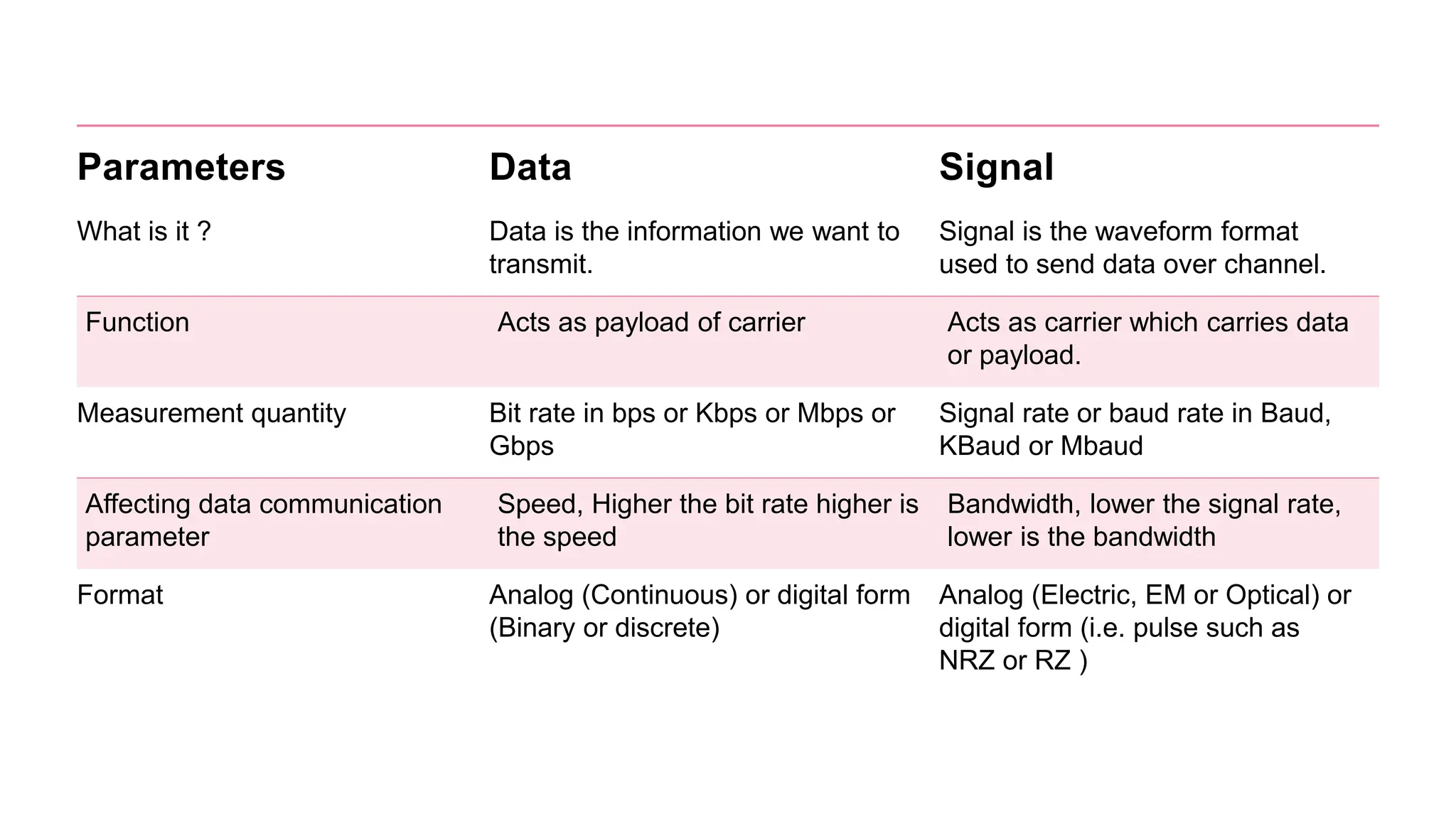
Parameters Data Signal
What is it ? Data is the information we want to
transmit.
Signal is the waveform format
used to send data over channel.
Function Acts as payload of carrier Acts as carrier which carries data
or payload.
Measurement quantity Bit rate in bps or Kbps or Mbps or
Gbps
Signal rate or baud rate in Baud,
KBaud or Mbaud
Affecting data communication
parameter
Speed, Higher the bit rate higher is
the speed
Bandwidth, lower the signal rate,
lower is the bandwidth
Format Analog (Continuous) or digital form
(Binary or discrete)
Analog (Electric, EM or Optical) or
digital form (i.e. pulse such as
NRZ or RZ )
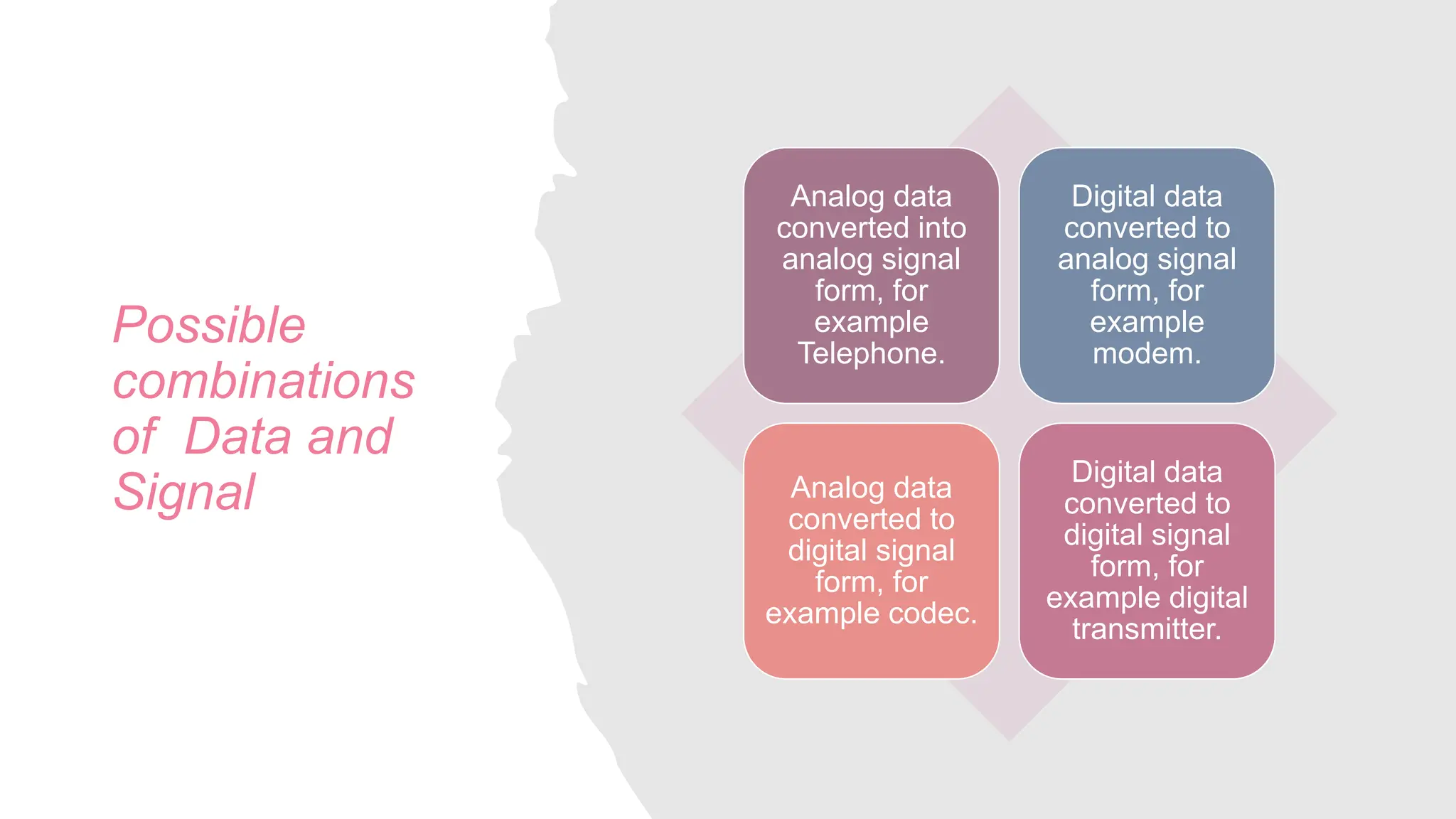
Possible
combinations
of Data and
Signal
Analog data
converted into
analog signal
form, for
example
Telephone.
Digital data
converted to
analog signal
form, for
example
modem.
Analog data
converted to
digital signal
form, for
example codec.
Digital data
converted to
digital signal
form, for
example digital
transmitter.
Transmission Media
Transmission media can be defined as
the pathway that can transfer
information from the sender to the
receiver. They are located under the
physical layer and are controlled by
them.
Transmission media is of two types:
1. Guided Transmission Medium
2. Unguided Transmission Medium
Guided Transmission Media
• Guided transmission media are also
called bounded media or wired
media. They comprise cables or
wires through which data is
transmitted. They are called guided
since they provide a physical
conduit from the sender device to
the receiver device. The signal
traveling through these media are
bounded by the physical limits of
the medium.
Unguided Transmission Media
• Unguided transmission media are
also called wireless media. They
transport data in the form of
electromagnetic waves that do not
require any cables for transmission.
These media are bounded by
geographical boundaries. These
type of communication is commonly
referred to as wireless
communications.
Common Examples
Guided Transmission
Medium
1. Twisted pair cable
2. Coaxial cable
3. Power lines
4. Fiber optics
Unguided Transmission
Medium
1. Radio transmission
2. Microwave transmission
3. Infrared transmission
4. Light transmission
Data Transfer Rate
• The data transfer rate (DTR) is the
amount of digital data that is moved
from one place to another in each
time. The data transfer rate can be
viewed as the speed of travel of a
given amount of data from one place to
another.
Thank You!

Computer Networks- A Presentation to Understand the Basics

  • 1.
  • 2.
    Data and Signals Dataare numbers, text, image, audio or video which is stored in a computer system. This information is stored in the computer in the form of 0s and 1s (binary) which has a special meaning to the computer system. When this data is transmitted from on place to another it is known as a signal. They have 4 basic parameters which is amplitude, frequency, bandwidth and phase. Signals can be in either electric, EM or optical form.
  • 3.
    Parameters Data Signal Whatis it ? Data is the information we want to transmit. Signal is the waveform format used to send data over channel. Function Acts as payload of carrier Acts as carrier which carries data or payload. Measurement quantity Bit rate in bps or Kbps or Mbps or Gbps Signal rate or baud rate in Baud, KBaud or Mbaud Affecting data communication parameter Speed, Higher the bit rate higher is the speed Bandwidth, lower the signal rate, lower is the bandwidth Format Analog (Continuous) or digital form (Binary or discrete) Analog (Electric, EM or Optical) or digital form (i.e. pulse such as NRZ or RZ )
  • 4.
    Possible combinations of Data and Signal Analogdata converted into analog signal form, for example Telephone. Digital data converted to analog signal form, for example modem. Analog data converted to digital signal form, for example codec. Digital data converted to digital signal form, for example digital transmitter.
  • 5.
    Transmission Media Transmission mediacan be defined as the pathway that can transfer information from the sender to the receiver. They are located under the physical layer and are controlled by them. Transmission media is of two types: 1. Guided Transmission Medium 2. Unguided Transmission Medium
  • 6.
    Guided Transmission Media •Guided transmission media are also called bounded media or wired media. They comprise cables or wires through which data is transmitted. They are called guided since they provide a physical conduit from the sender device to the receiver device. The signal traveling through these media are bounded by the physical limits of the medium.
  • 7.
    Unguided Transmission Media •Unguided transmission media are also called wireless media. They transport data in the form of electromagnetic waves that do not require any cables for transmission. These media are bounded by geographical boundaries. These type of communication is commonly referred to as wireless communications.
  • 8.
    Common Examples Guided Transmission Medium 1.Twisted pair cable 2. Coaxial cable 3. Power lines 4. Fiber optics Unguided Transmission Medium 1. Radio transmission 2. Microwave transmission 3. Infrared transmission 4. Light transmission
  • 9.
    Data Transfer Rate •The data transfer rate (DTR) is the amount of digital data that is moved from one place to another in each time. The data transfer rate can be viewed as the speed of travel of a given amount of data from one place to another.
  • 10.