3.1
Chapter 3
Data and Signals
Copyright © The McGraw-Hill Companies, Inc. Permission required for reproduction or display.
3.2
To be transmitted, data must be
transformed to electromagnetic signals.
Note
3.3
3-1 ANALOG AND DIGITAL
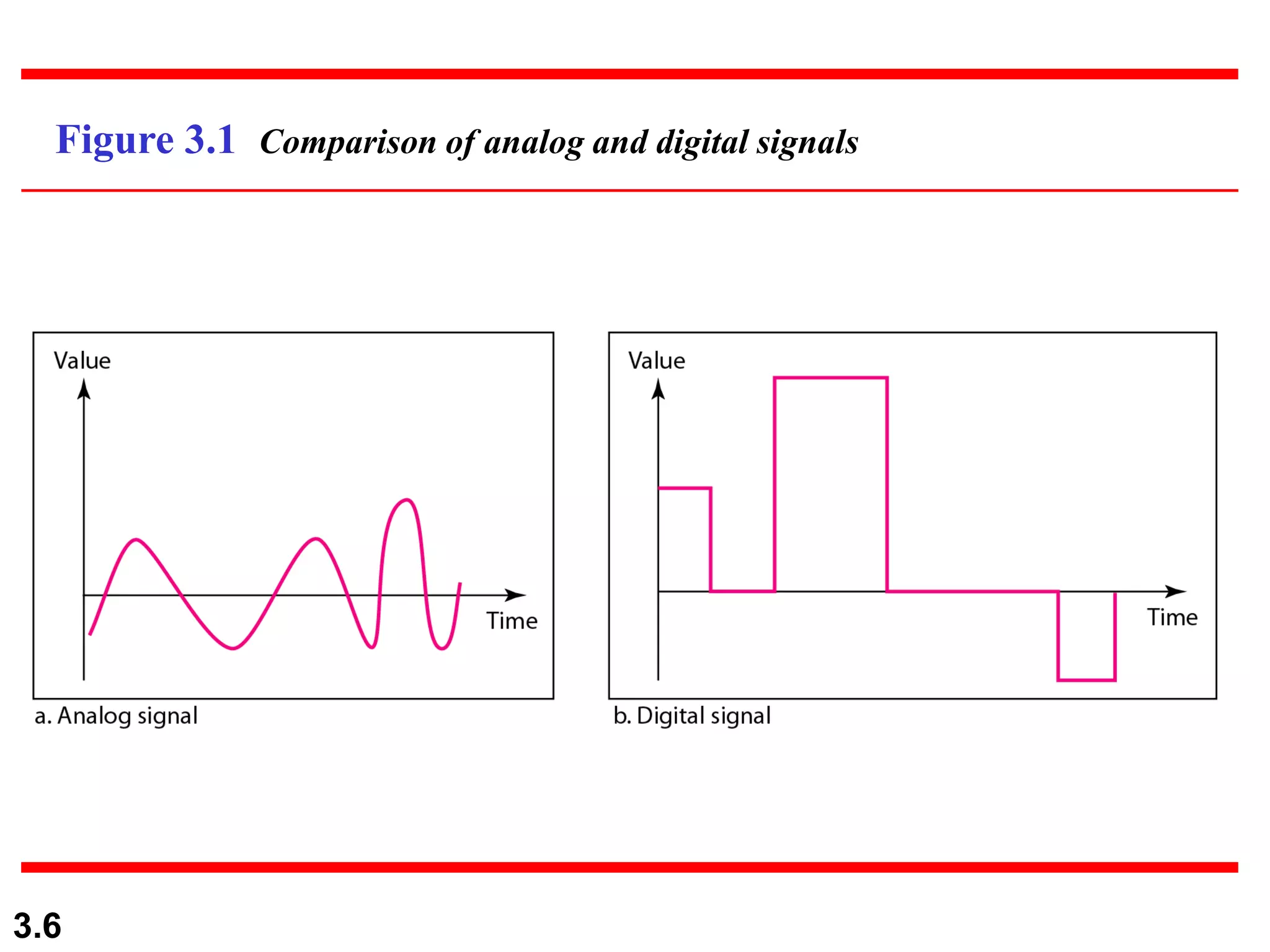
Data can be analog or digital. The term analog data refers
to information that is continuous; digital data refers to
information that has discrete states. Analog data take on
continuous values. Digital data take on discrete values.
 Analog and Digital Data
 Analog and Digital Signals
 Periodic and Nonperiodic Signals
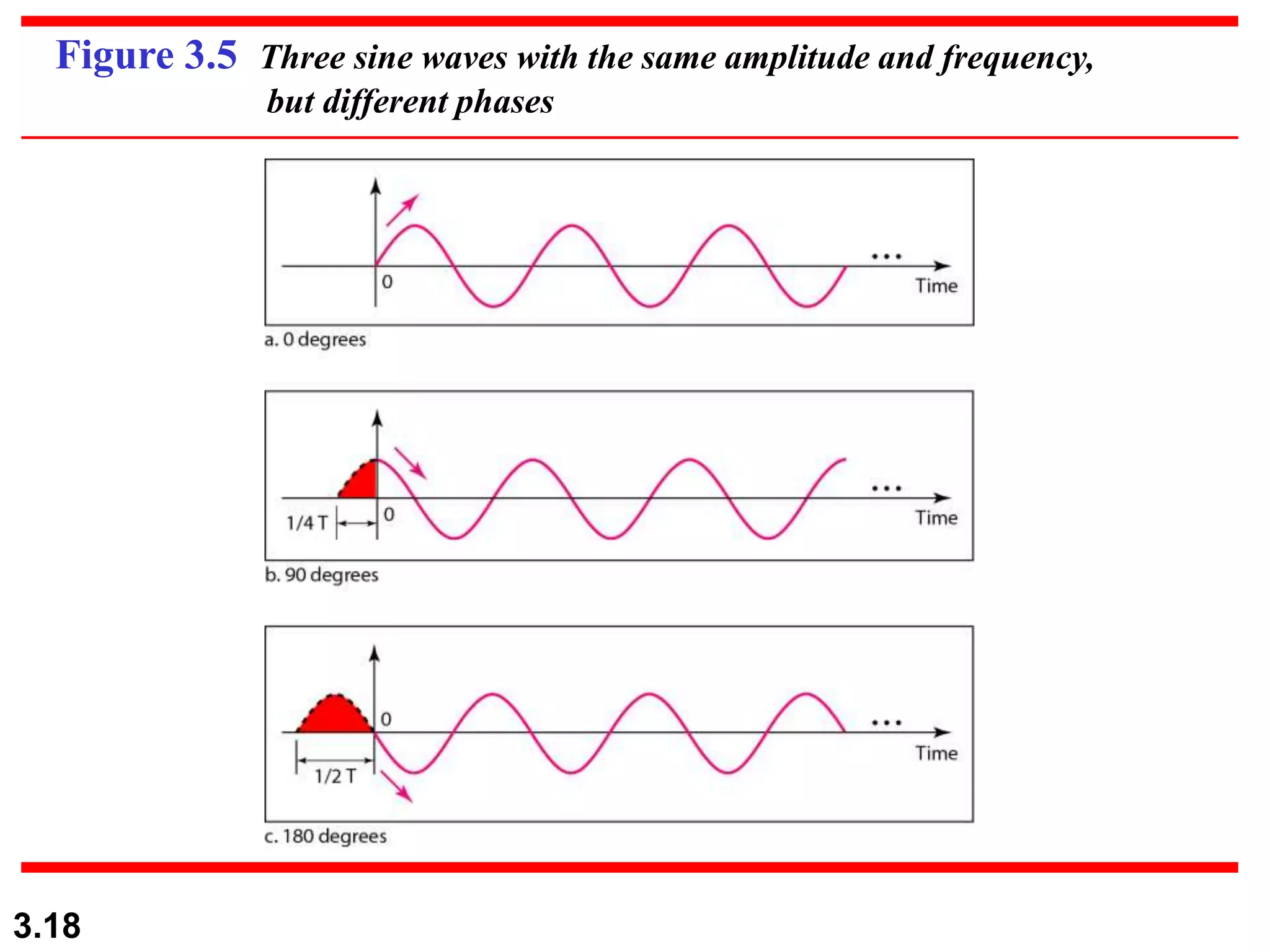
Topics discussed in this section:
3.4
Analog and Digital Data
 Data can be analog or digital.
 Analog data are continuous and take
continuous values.
 Digital data have discrete states and take
discrete values.
3.5
Analog and Digital Signals
• Signals can be analog or digital.
• Analog signals can have an infinite number
of values in a range.
• Digital signals can have only a limited
number of values.
3.6
Figure 3.1 Comparison of analog and digital signals
3.7
3-2 PERIODIC ANALOG SIGNALS
In data communications, we commonly use periodic
analog signals and nonperiodic digital signals.
Periodic analog signals can be classified as simple or
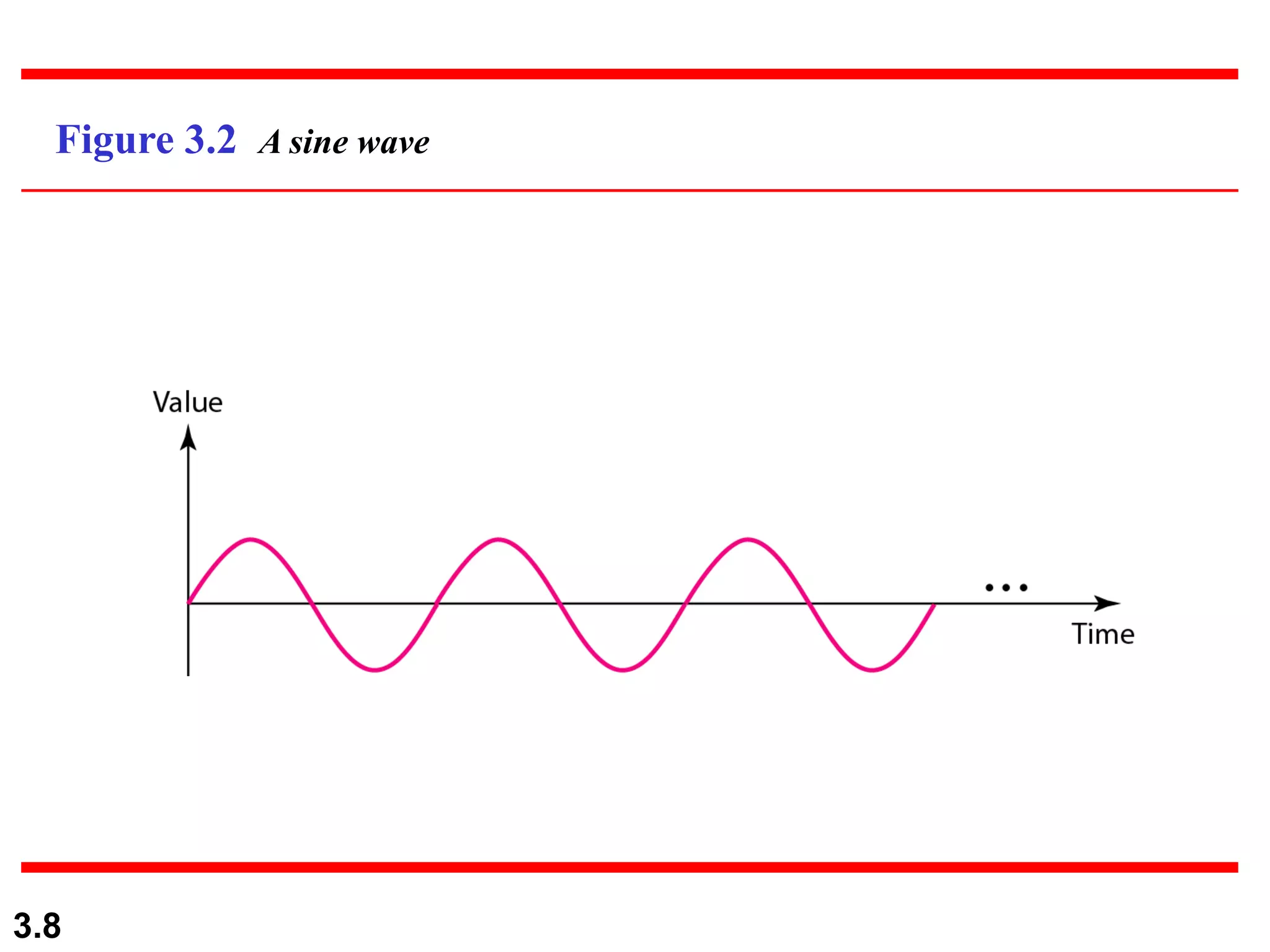
composite. A simple periodic analog signal, a sine wave,
cannot be decomposed into simpler signals. A composite
periodic analog signal is composed of multiple sine
waves.
 Sine Wave
 Wavelength
 Time and Frequency Domain
 Composite Signals
 Bandwidth
Topics discussed in this section:
3.8
Figure 3.2 A sine wave
3.9
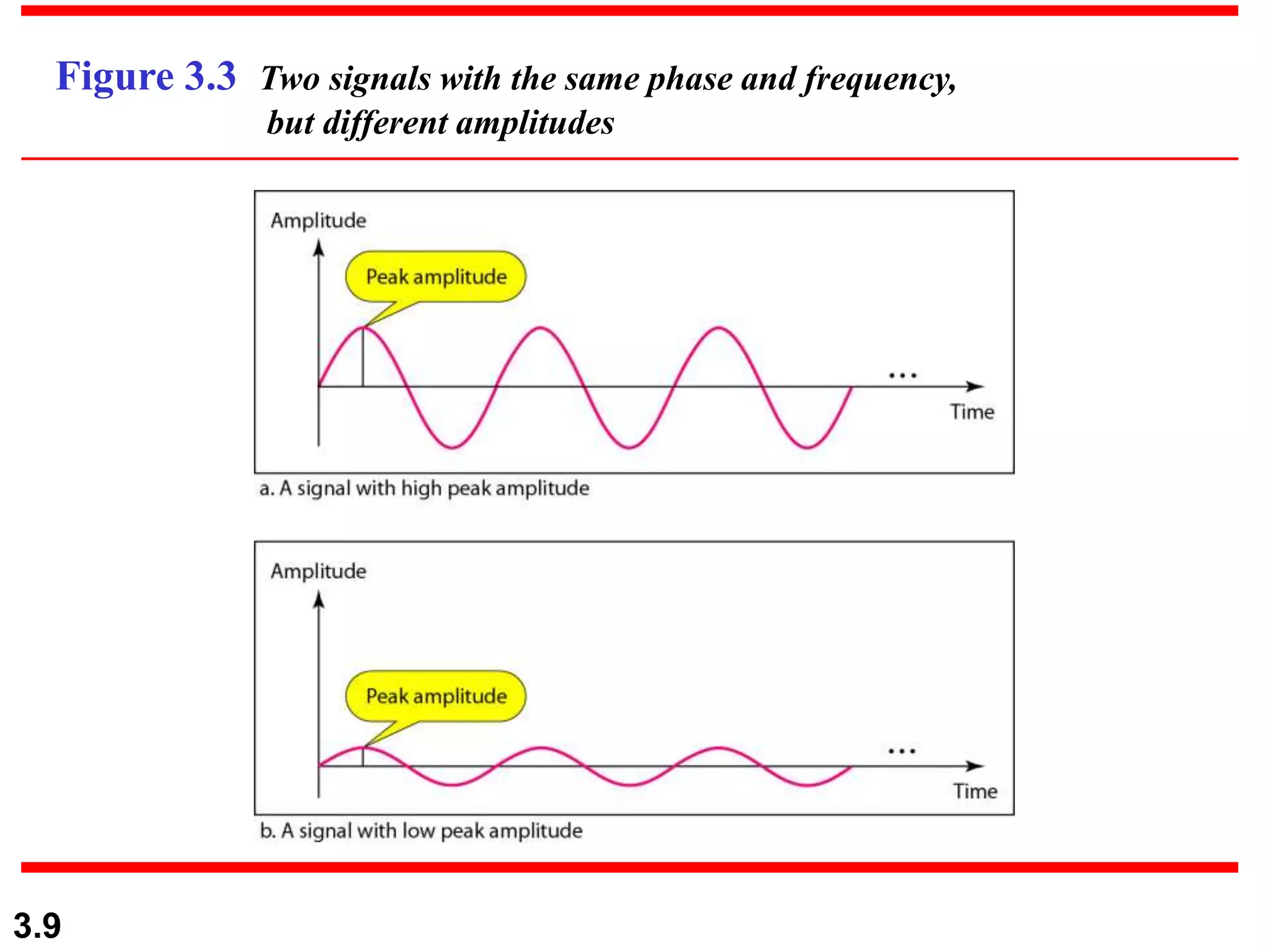
Figure 3.3 Two signals with the same phase and frequency,
but different amplitudes
3.10
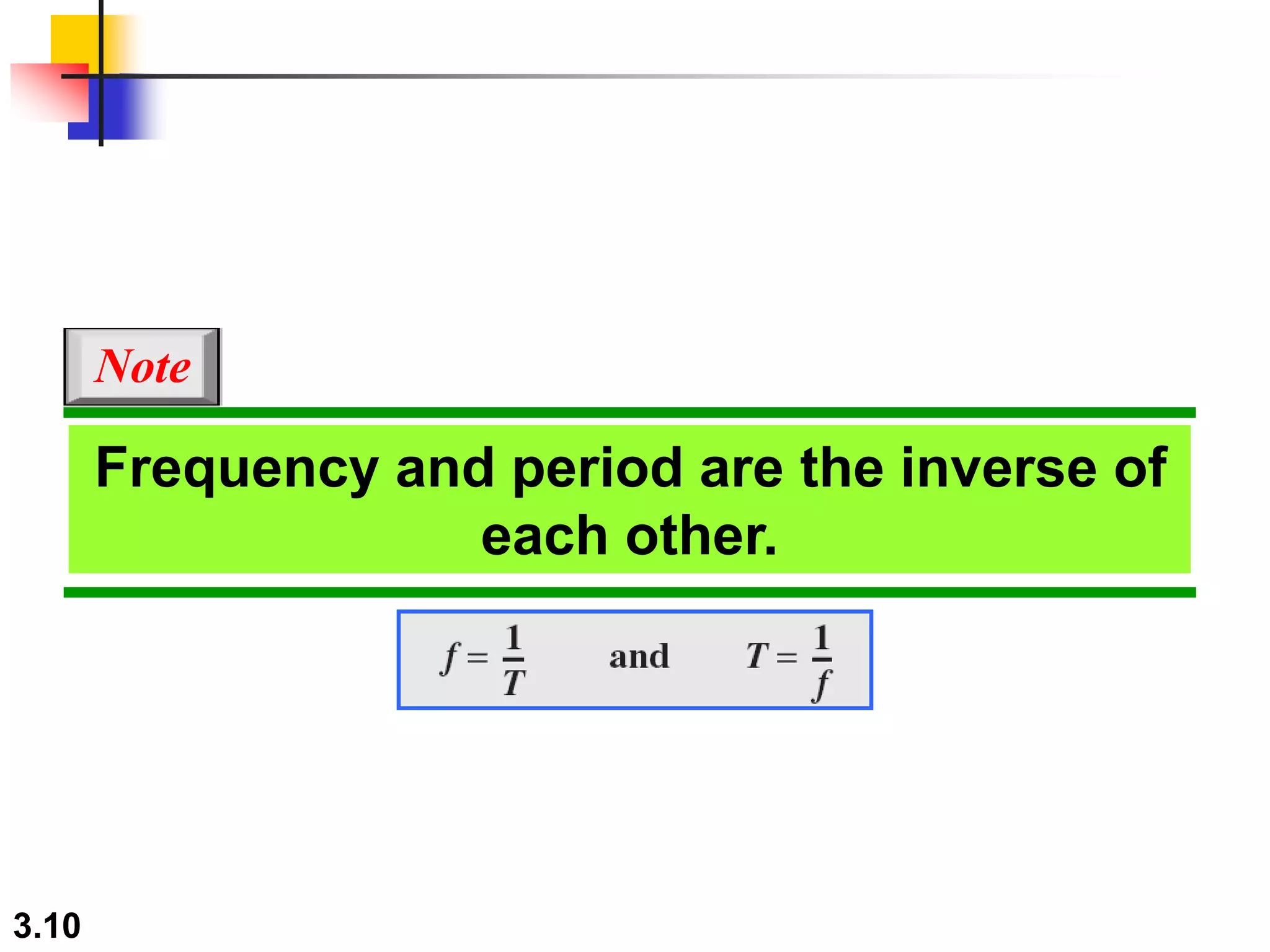
Frequency and period are the inverse of
each other.
Note
3.11
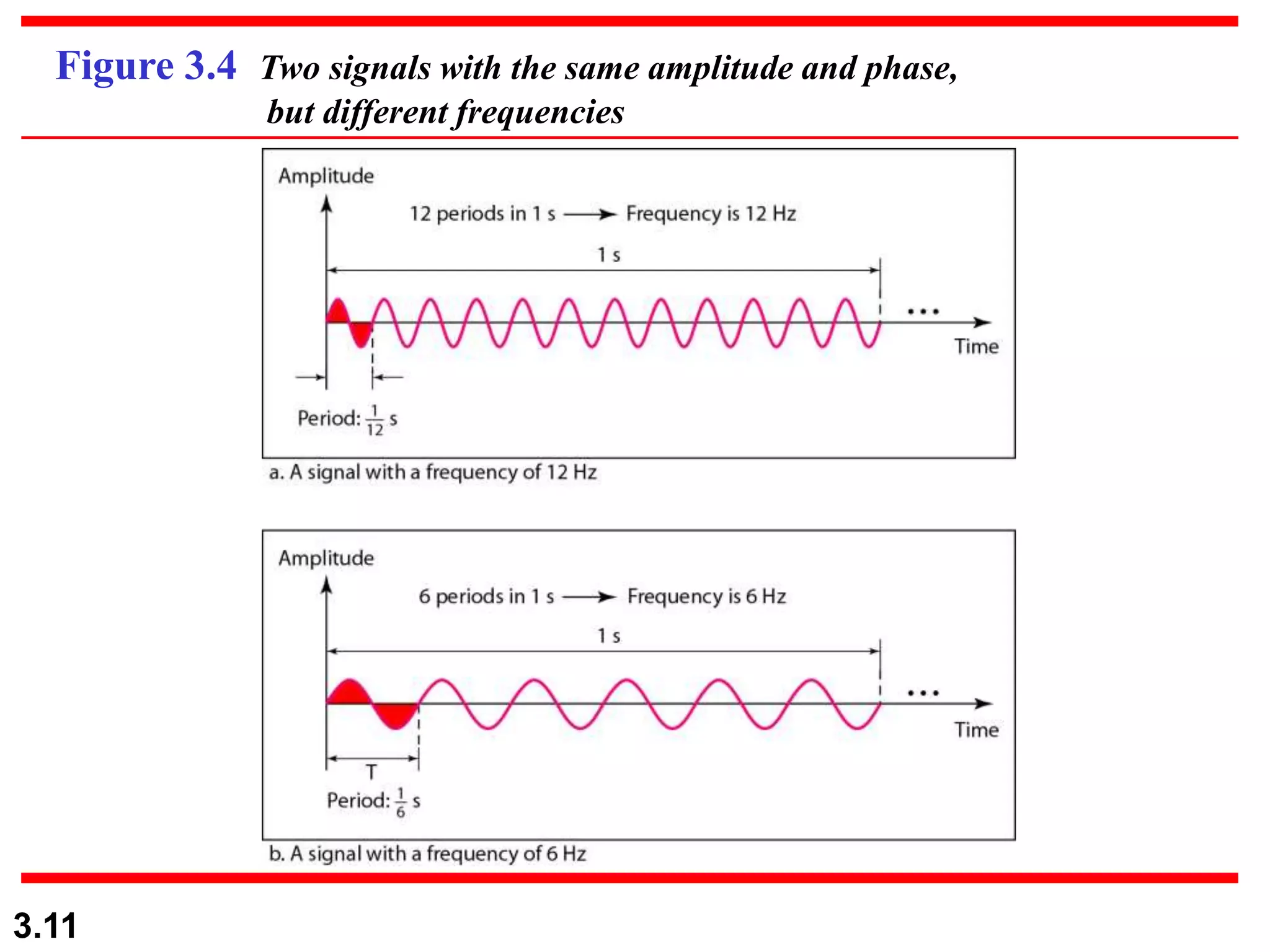
Figure 3.4 Two signals with the same amplitude and phase,
but different frequencies
3.12
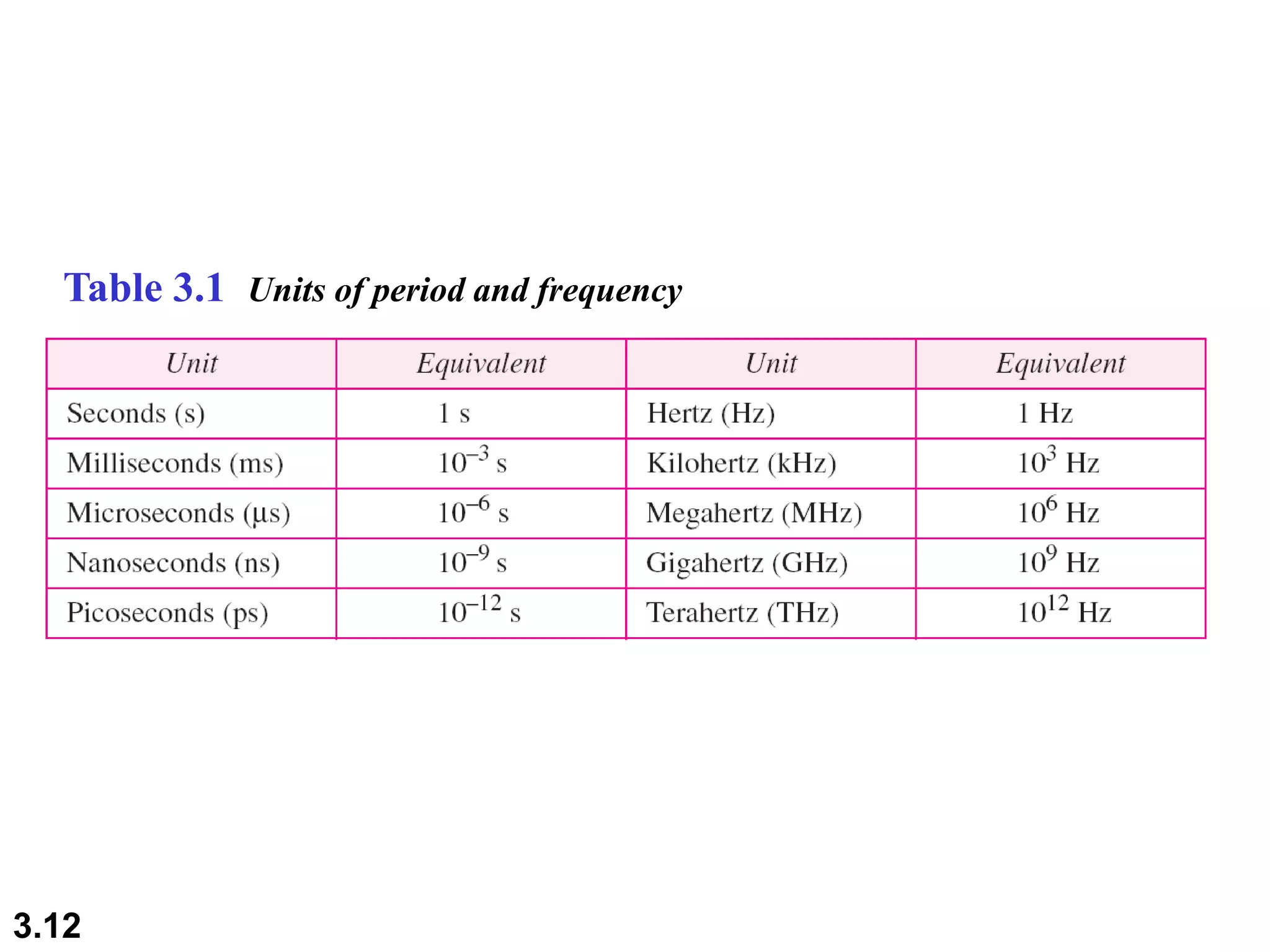
Table 3.1 Units of period and frequency
3.13
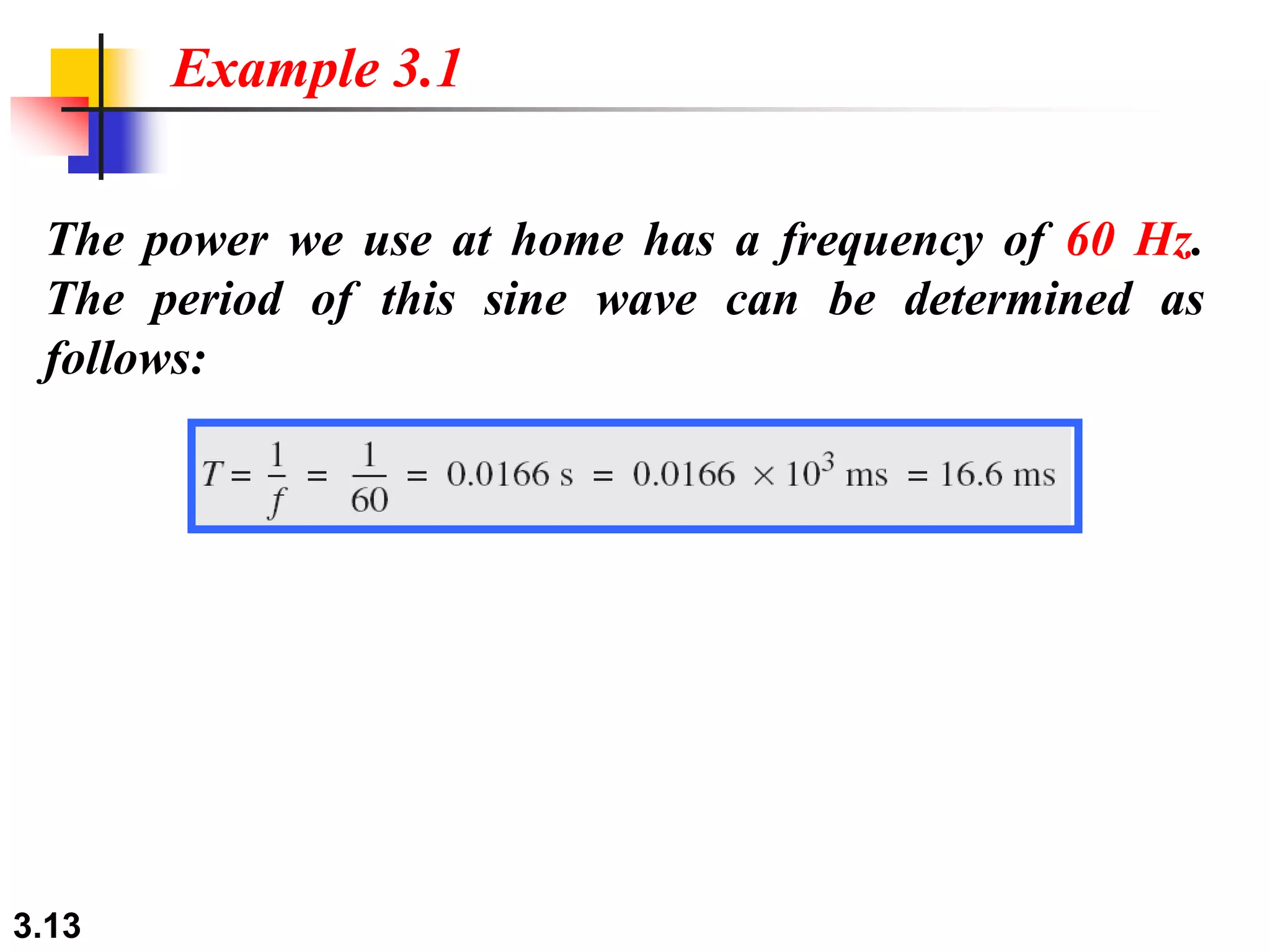
The power we use at home has a frequency of 60 Hz.
The period of this sine wave can be determined as
follows:
Example 3.1
3.14
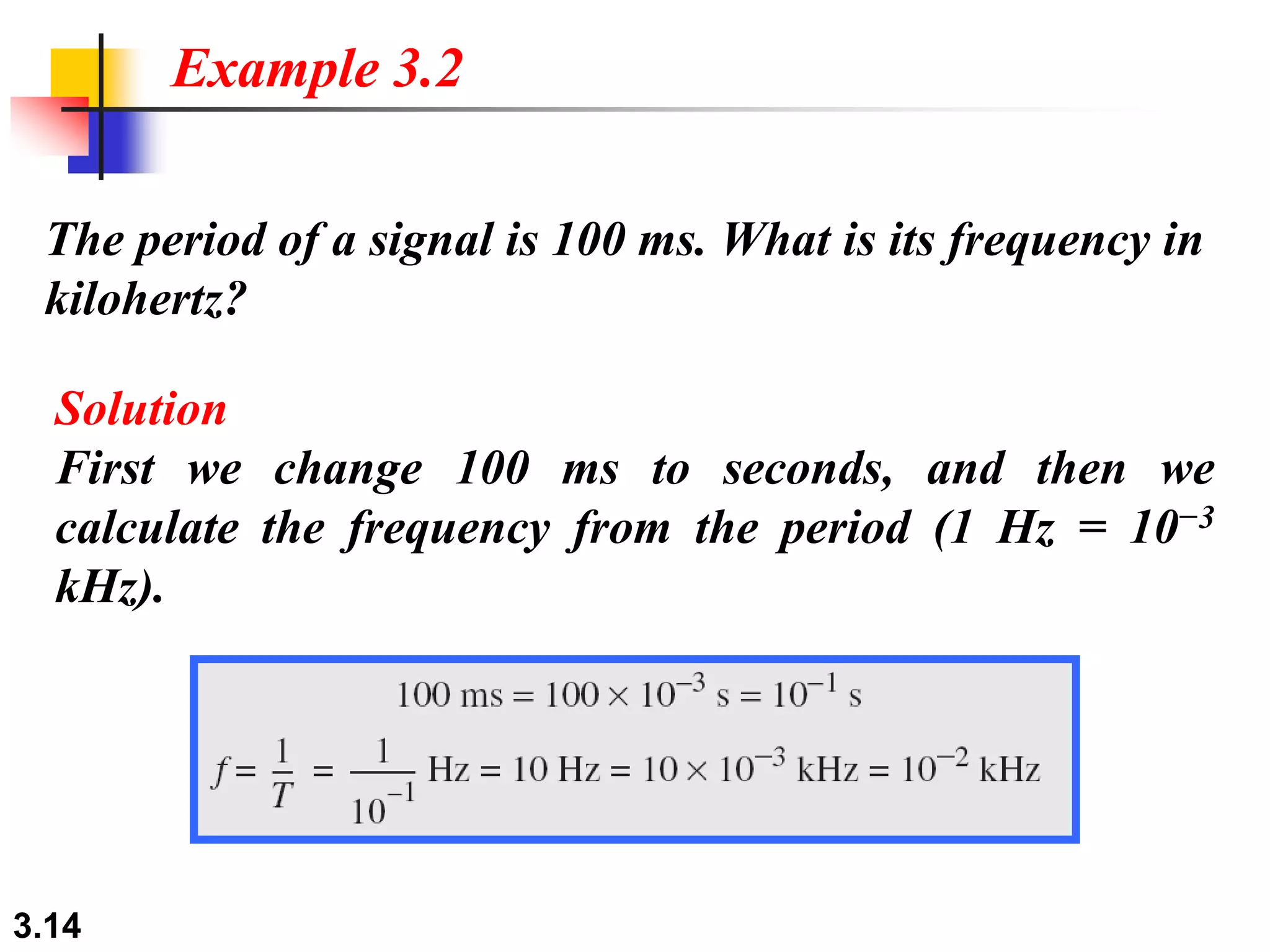
The period of a signal is 100 ms. What is its frequency in
kilohertz?
Example 3.2
Solution
First we change 100 ms to seconds, and then we
calculate the frequency from the period (1 Hz = 10−3
kHz).
3.15
Frequency
• Frequency is the rate of change with respect
to time.
• Change in a short span of time means high
frequency.
• Change over a long span of
time means low frequency.
3.16
If a signal does not change at all, its
frequency is zero.
If a signal changes instantaneously, its
frequency is infinite.
Note
3.17
Phase describes the position of the
waveform relative to time 0.
Note
3.18
Figure 3.5 Three sine waves with the same amplitude and frequency,
but different phases
3.19
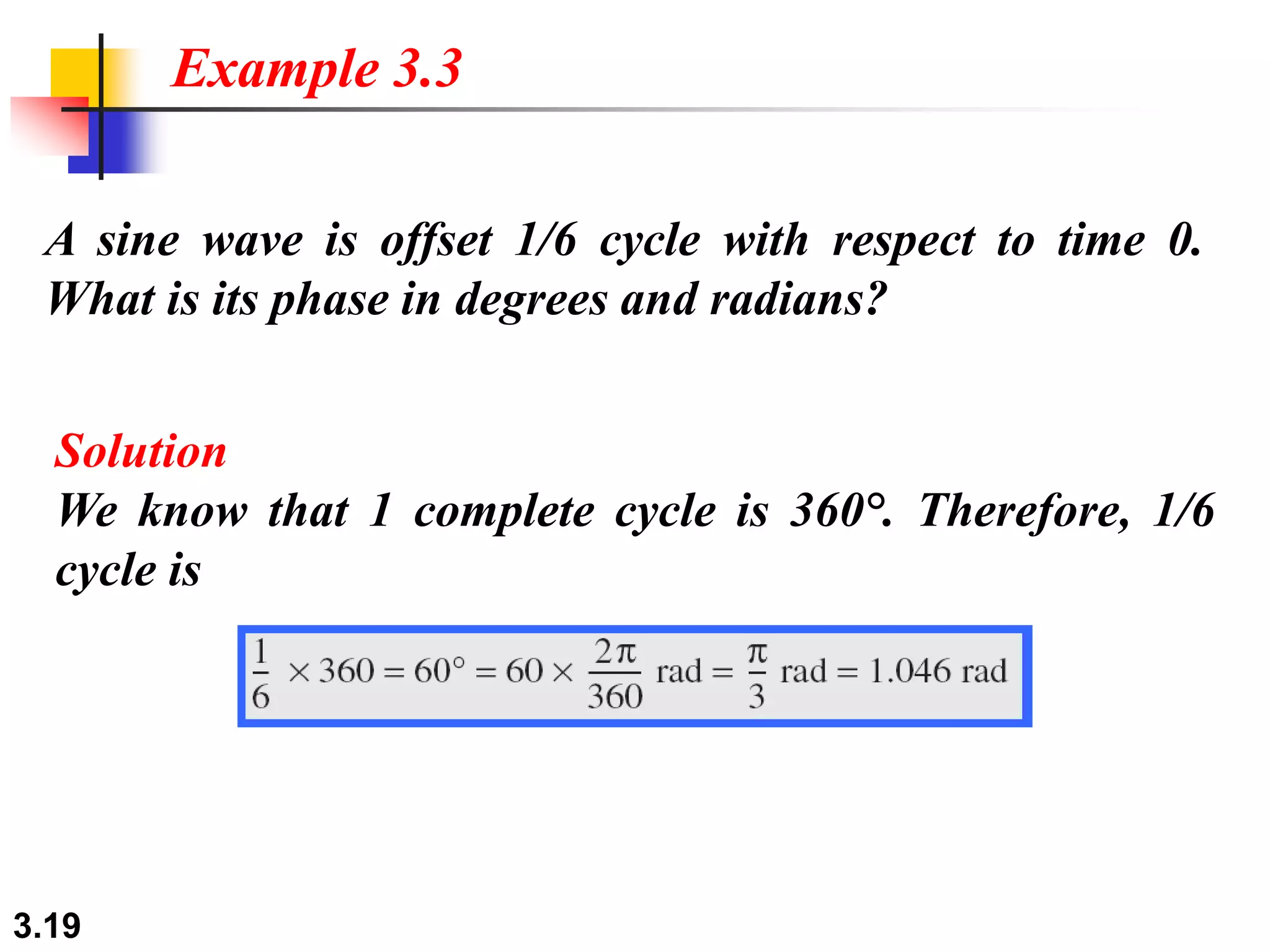
A sine wave is offset 1/6 cycle with respect to time 0.
What is its phase in degrees and radians?
Example 3.3
Solution
We know that 1 complete cycle is 360°. Therefore, 1/6
cycle is
3.20
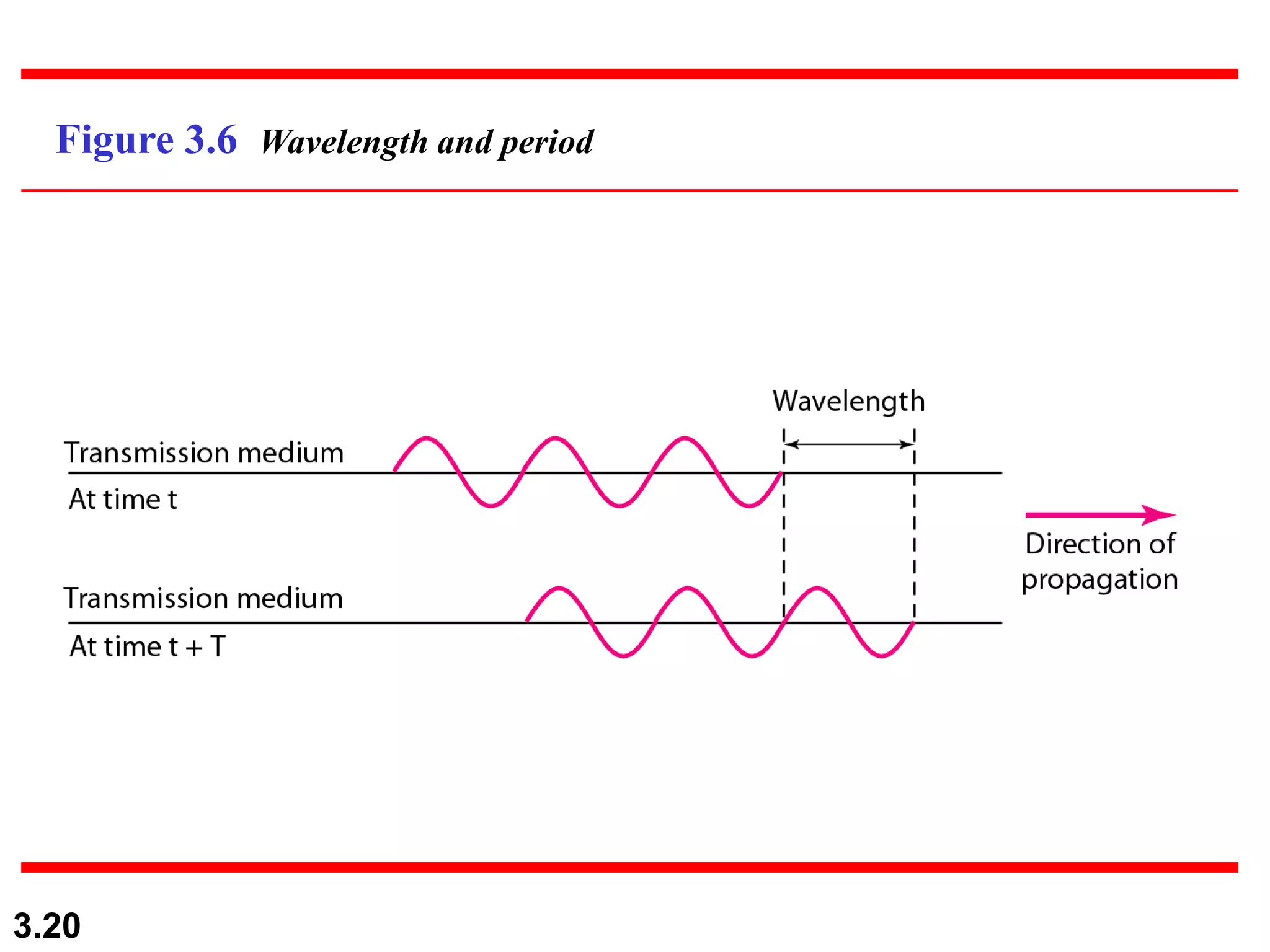
Figure 3.6 Wavelength and period
3.21
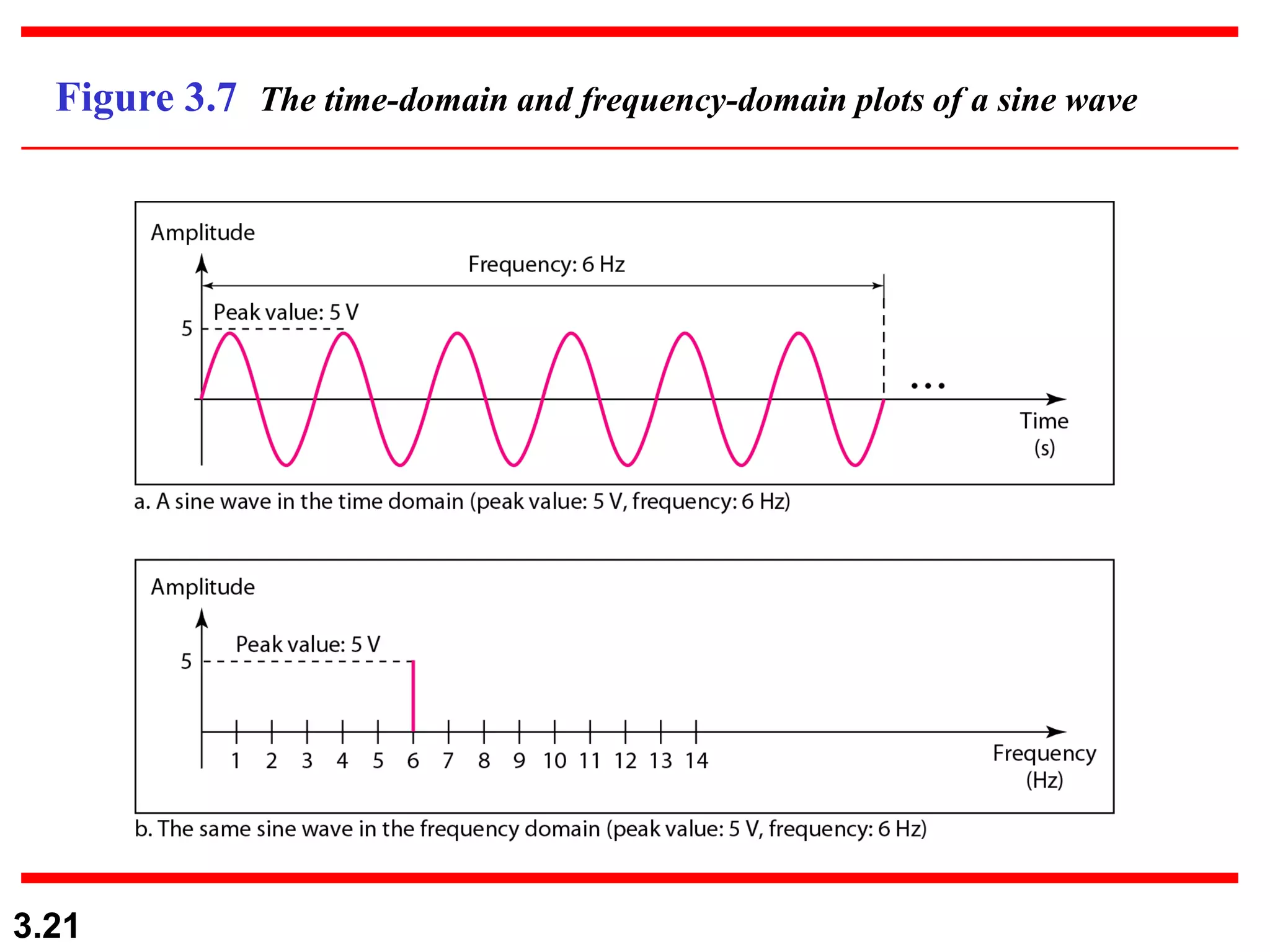
Figure 3.7 The time-domain and frequency-domain plots of a sine wave
3.22
A complete sine wave in the time
domain can be represented by one
single spike in the frequency domain.
Note
3.23
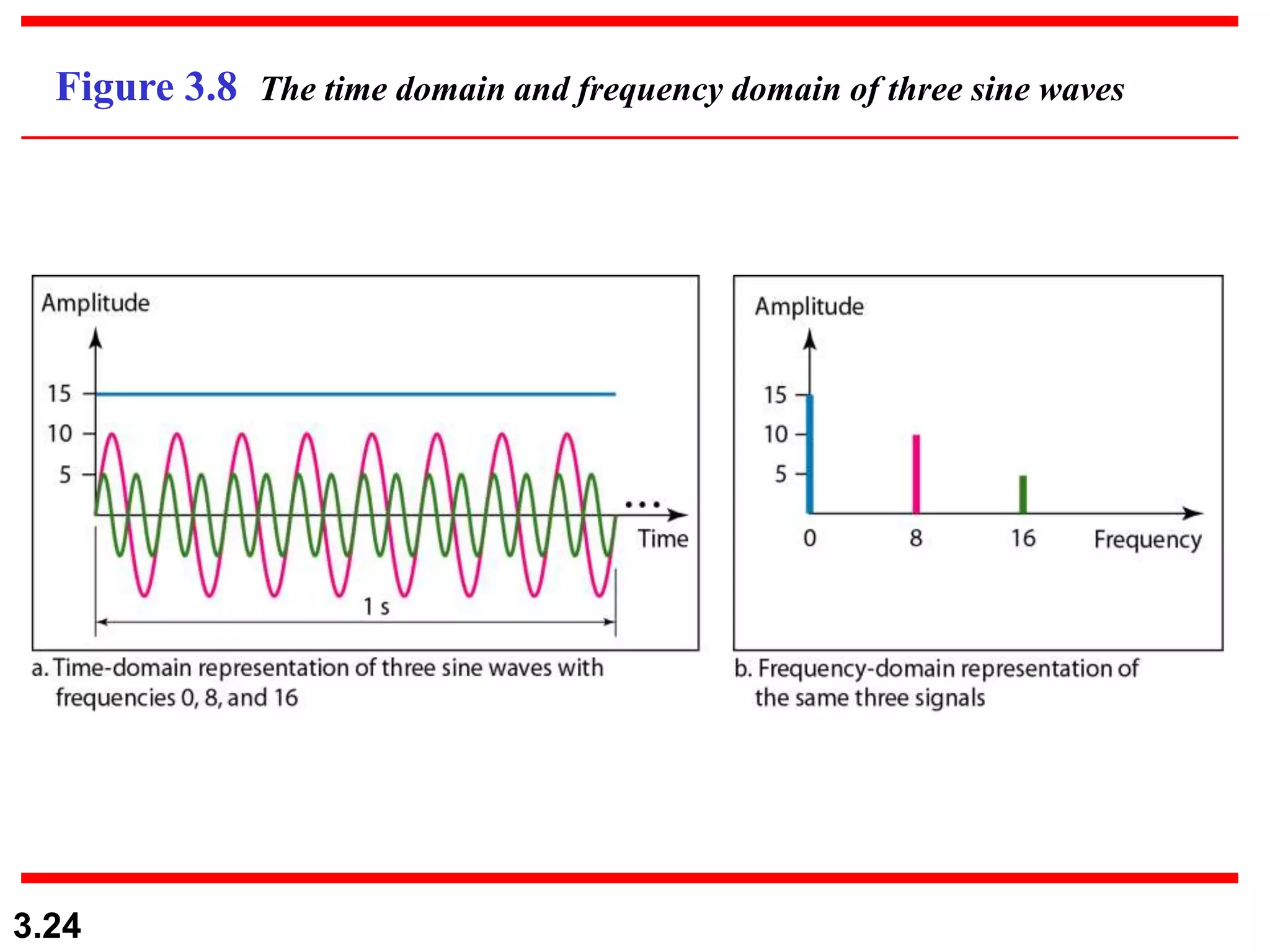
The frequency domain is more compact and
useful when we are dealing with more than one
sine wave. For example, Figure 3.8 shows three
sine waves, each with different amplitude and
frequency. All can be represented by three
spikes in the frequency domain.
Example 3.7
3.24
Figure 3.8 The time domain and frequency domain of three sine waves
3.25
Signals and Communication
 A single-frequency sine wave is not
useful in data communications
 We need to send a composite signal, a
signal made of many simple sine
waves.
 According to Fourier analysis, any
composite signal is a combination of
simple sine waves with different
frequencies, amplitudes, and phases.
3.26
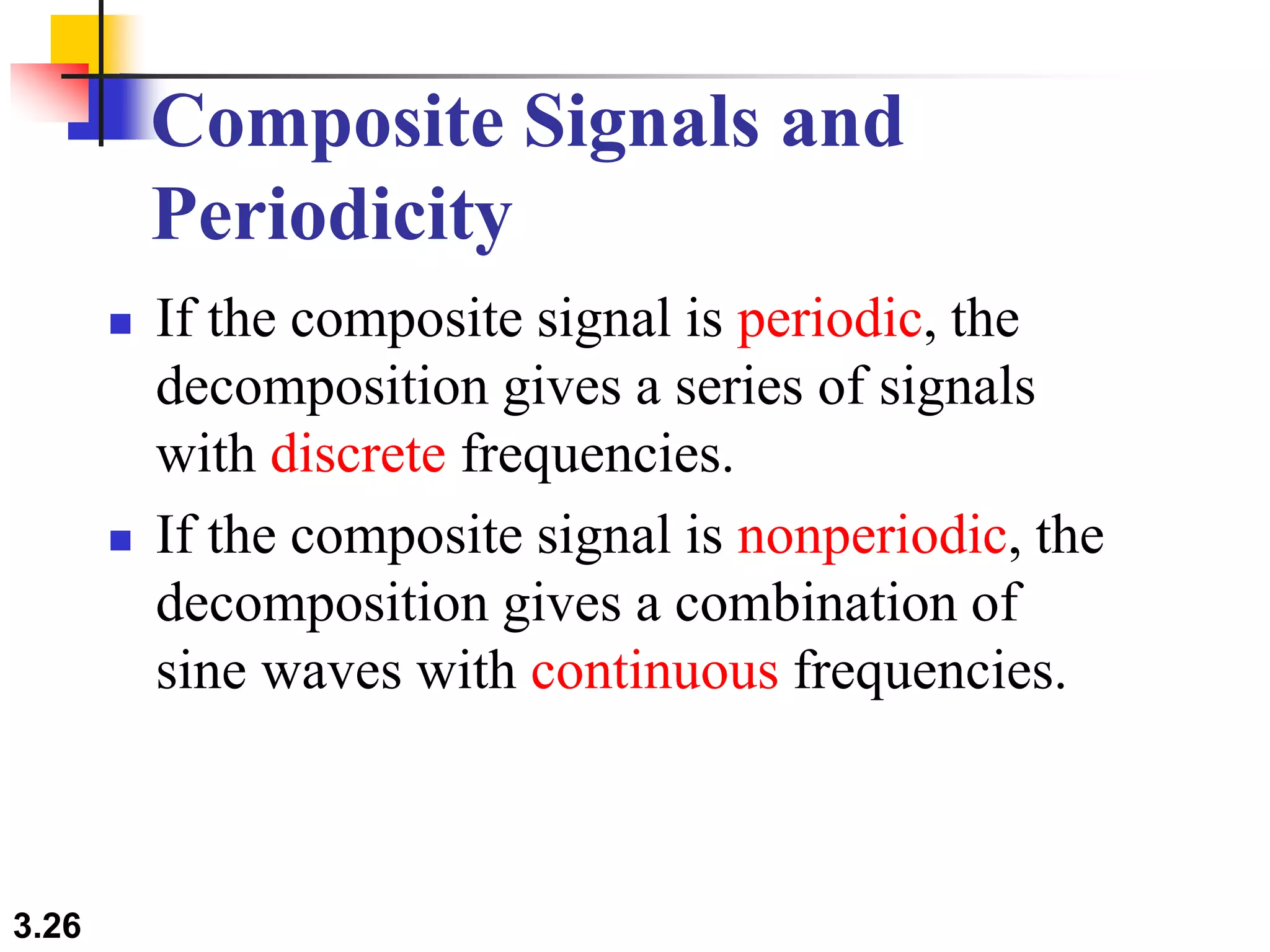
Composite Signals and
Periodicity
 If the composite signal is periodic, the
decomposition gives a series of signals
with discrete frequencies.
 If the composite signal is nonperiodic, the
decomposition gives a combination of
sine waves with continuous frequencies.
3.27
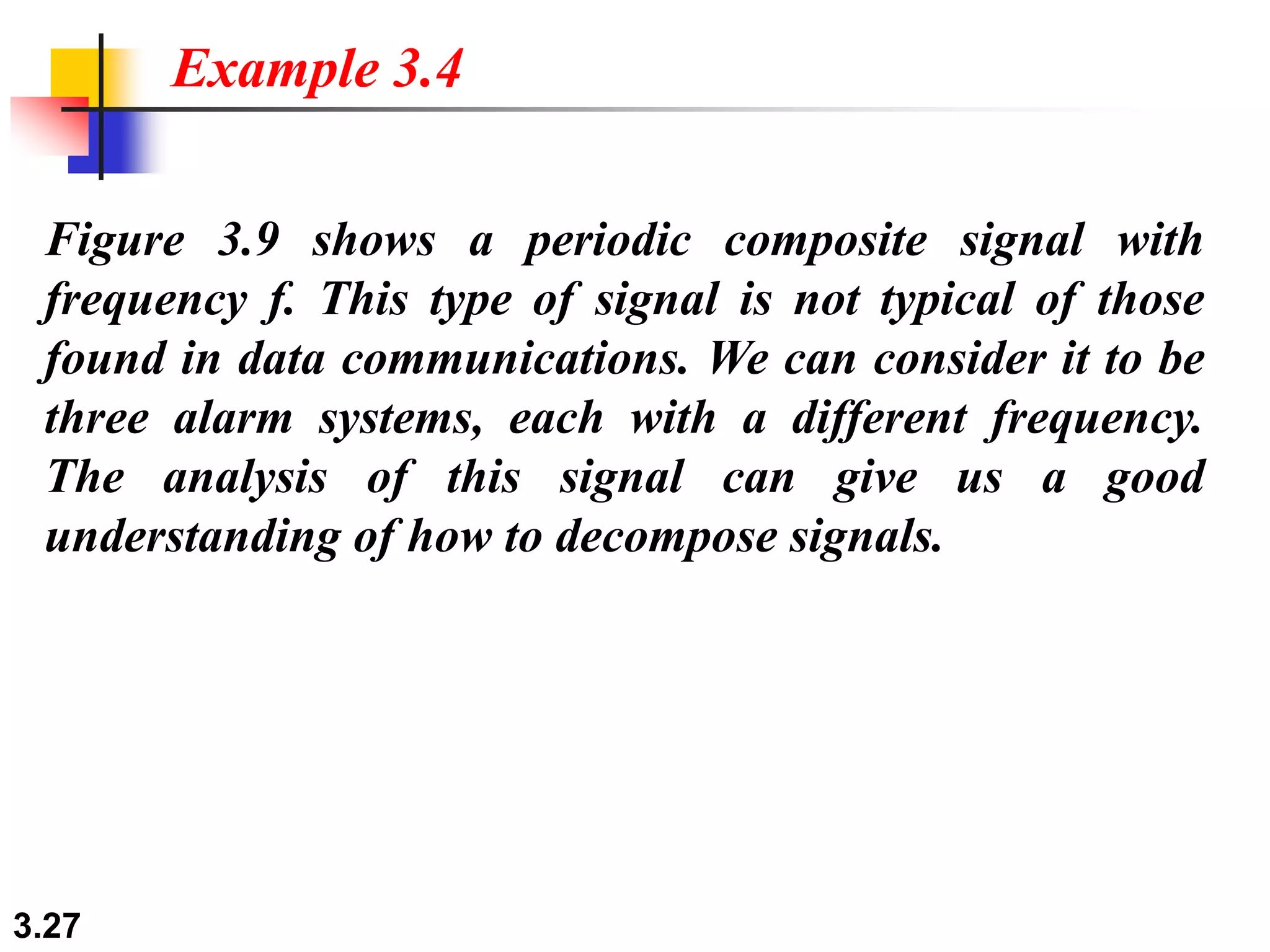
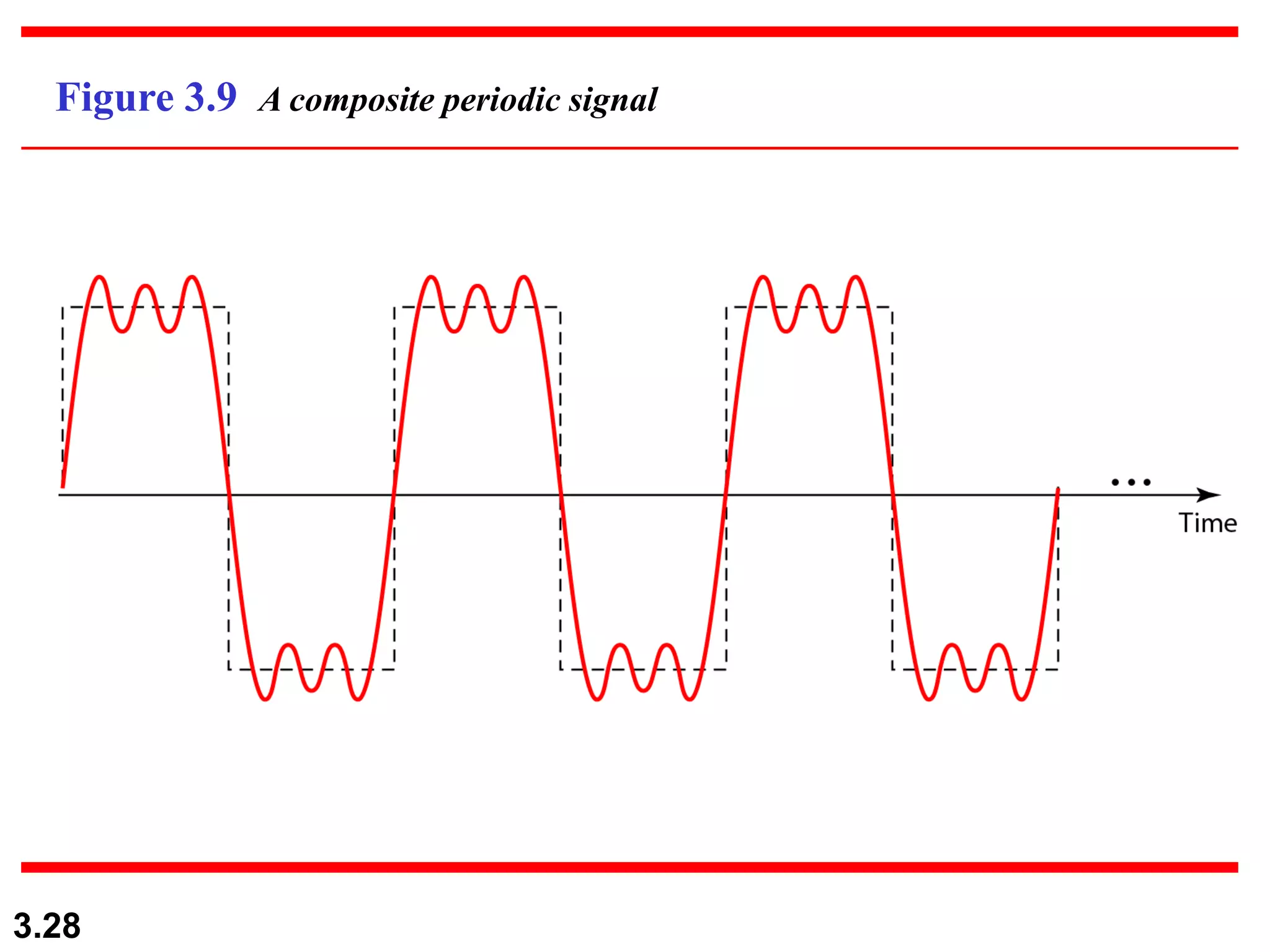
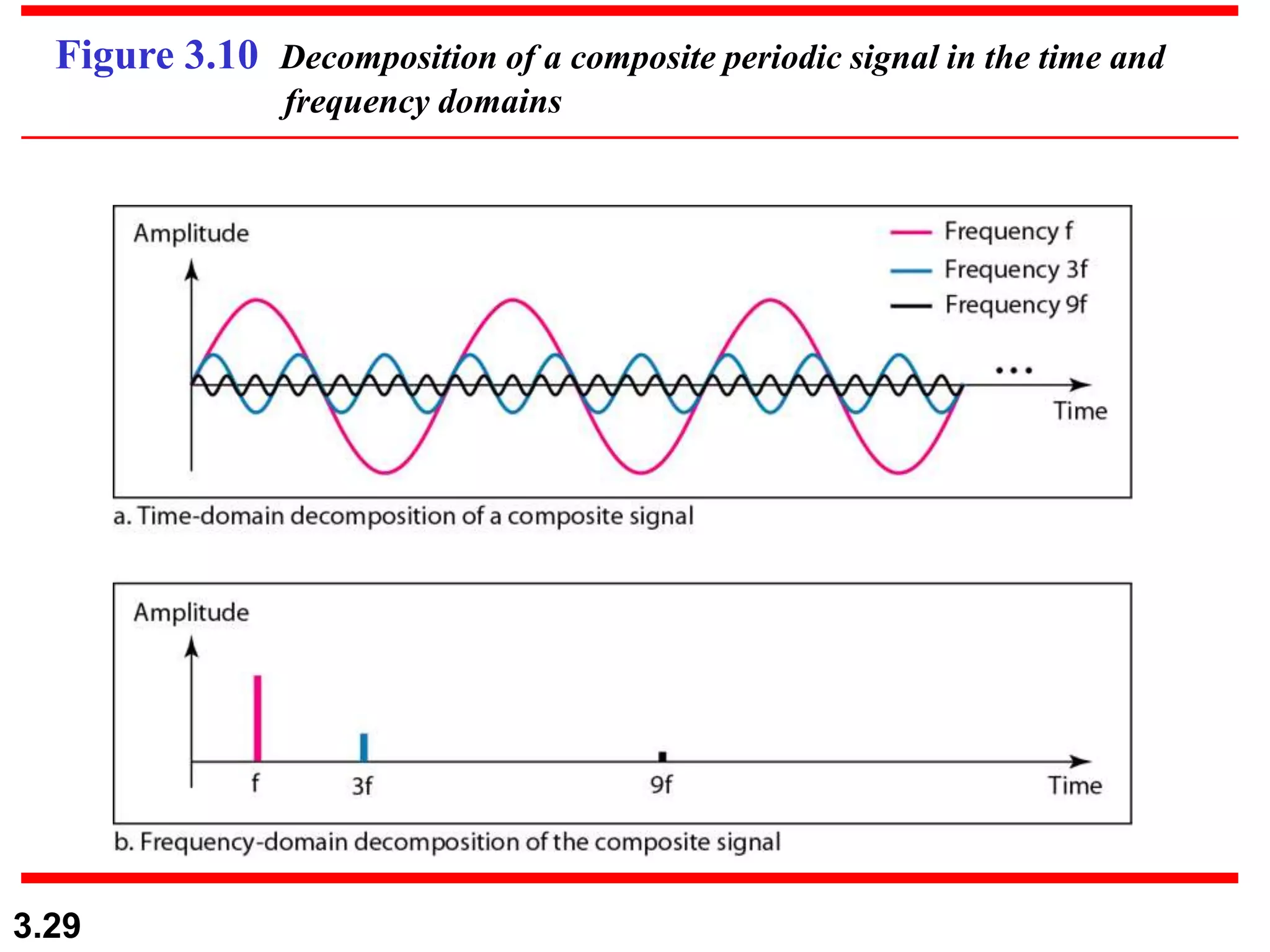
Figure 3.9 shows a periodic composite signal with
frequency f. This type of signal is not typical of those
found in data communications. We can consider it to be
three alarm systems, each with a different frequency.
The analysis of this signal can give us a good
understanding of how to decompose signals.
Example 3.4
3.28
Figure 3.9 A composite periodic signal
3.29
Figure 3.10 Decomposition of a composite periodic signal in the time and
frequency domains
3.30
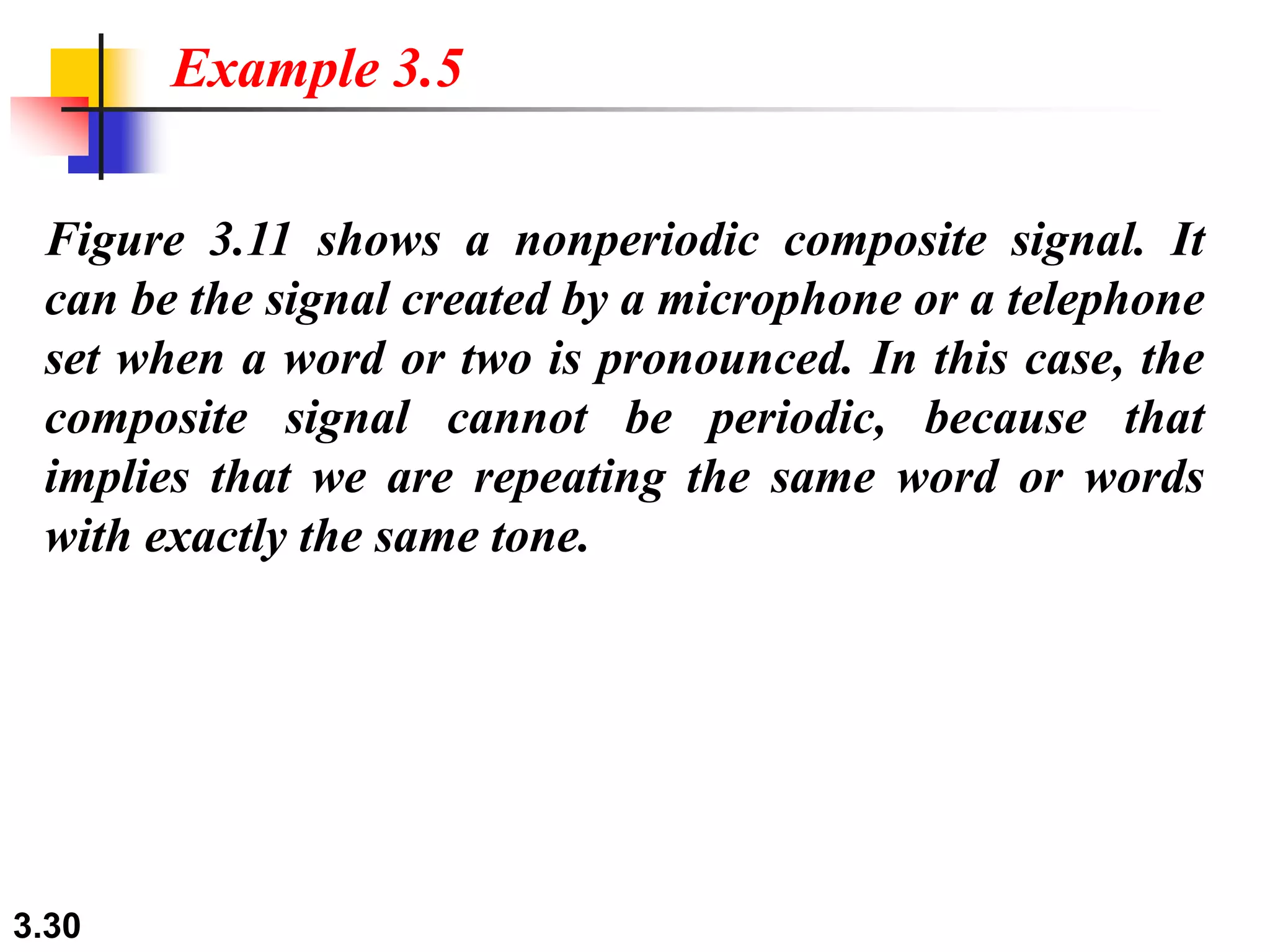
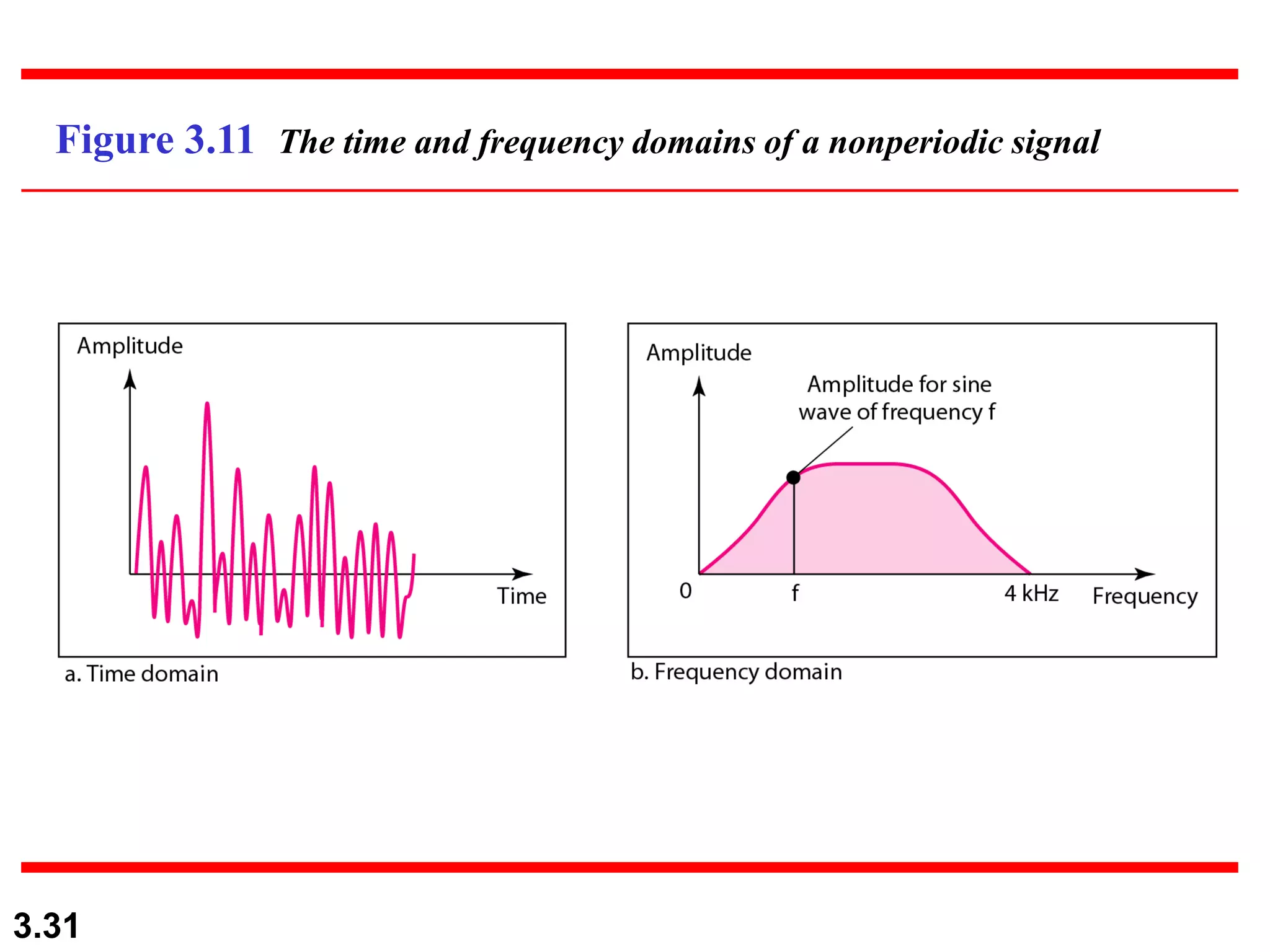
Figure 3.11 shows a nonperiodic composite signal. It
can be the signal created by a microphone or a telephone
set when a word or two is pronounced. In this case, the
composite signal cannot be periodic, because that
implies that we are repeating the same word or words
with exactly the same tone.
Example 3.5
3.31
Figure 3.11 The time and frequency domains of a nonperiodic signal
3.32
Bandwidth and Signal
Frequency
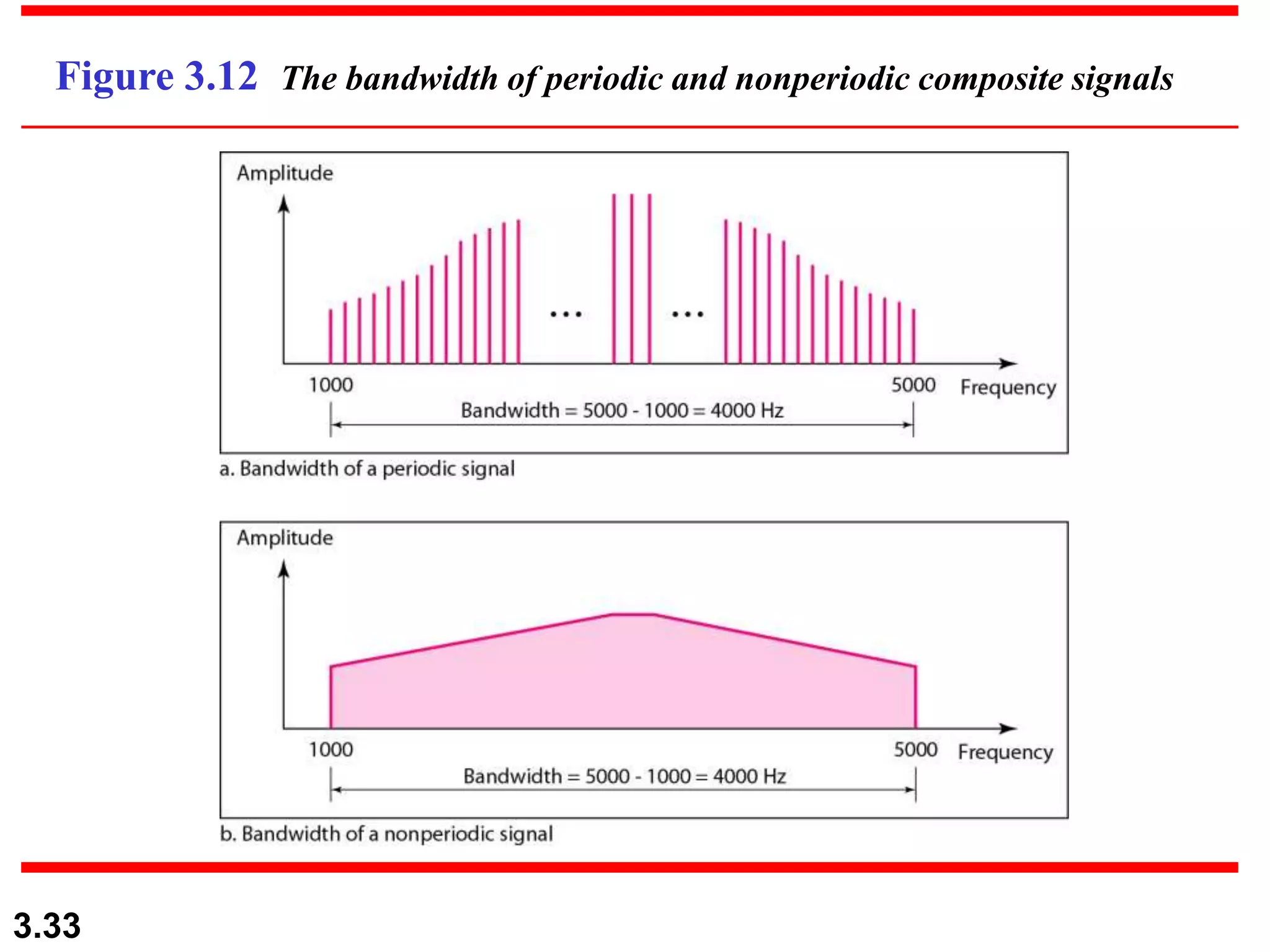
 The bandwidth of a composite signal is
the difference between the highest and the
lowest frequencies contained in that
signal.
3.33
Figure 3.12 The bandwidth of periodic and nonperiodic composite signals
3.34
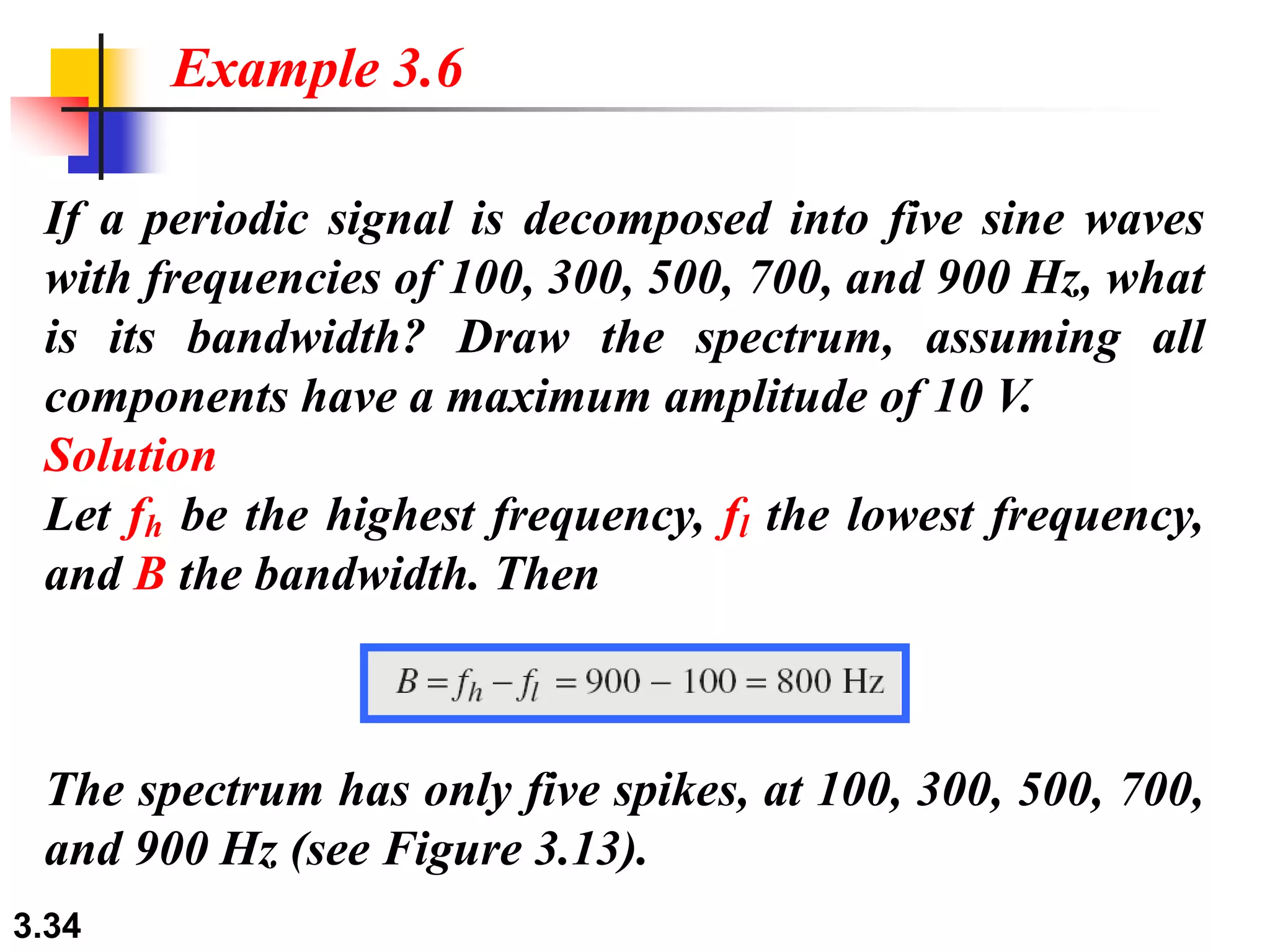
If a periodic signal is decomposed into five sine waves
with frequencies of 100, 300, 500, 700, and 900 Hz, what
is its bandwidth? Draw the spectrum, assuming all
components have a maximum amplitude of 10 V.
Solution
Let fh be the highest frequency, fl the lowest frequency,
and B the bandwidth. Then
Example 3.6
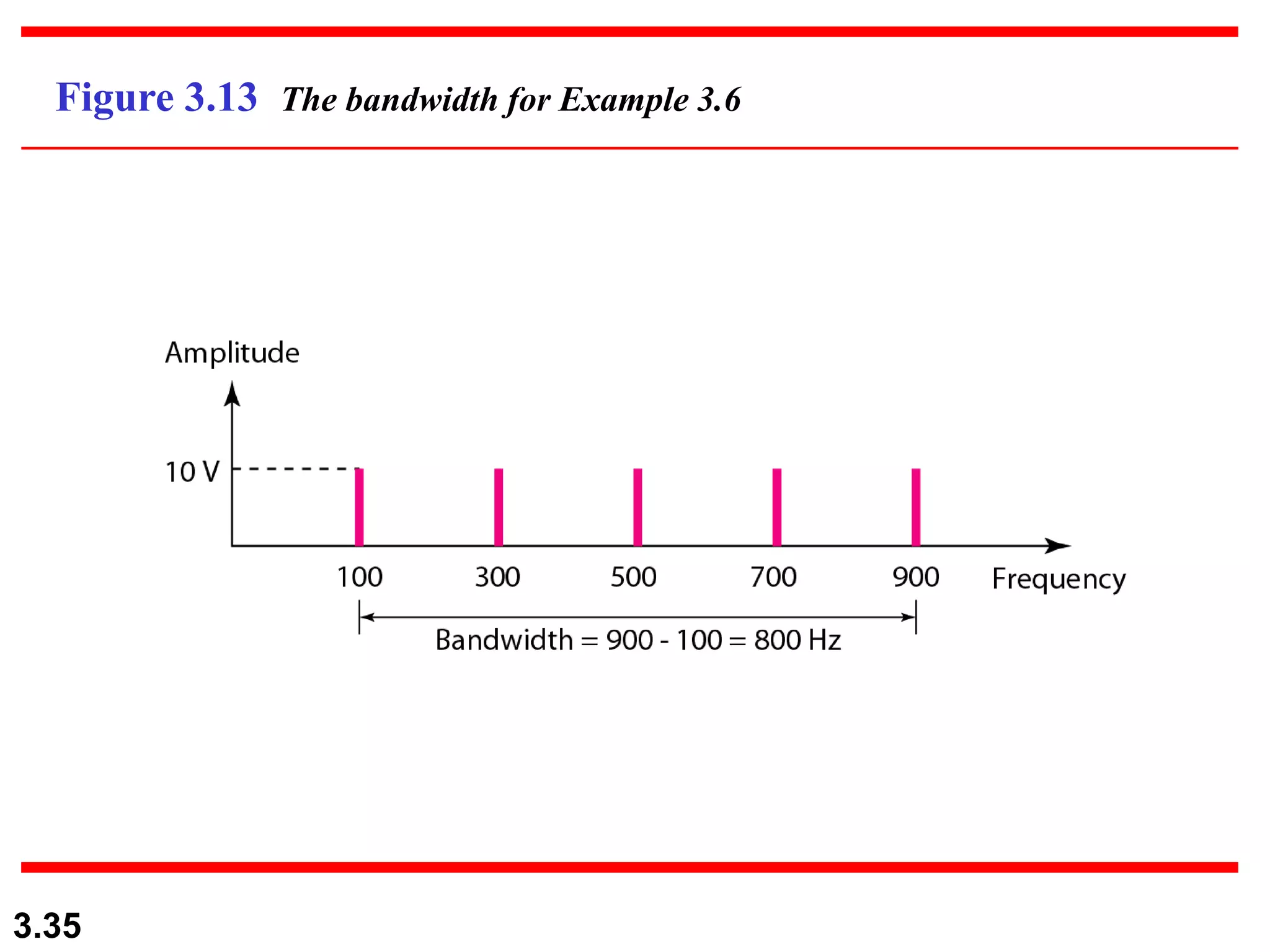
The spectrum has only five spikes, at 100, 300, 500, 700,
and 900 Hz (see Figure 3.13).
3.35
Figure 3.13 The bandwidth for Example 3.6
3.36
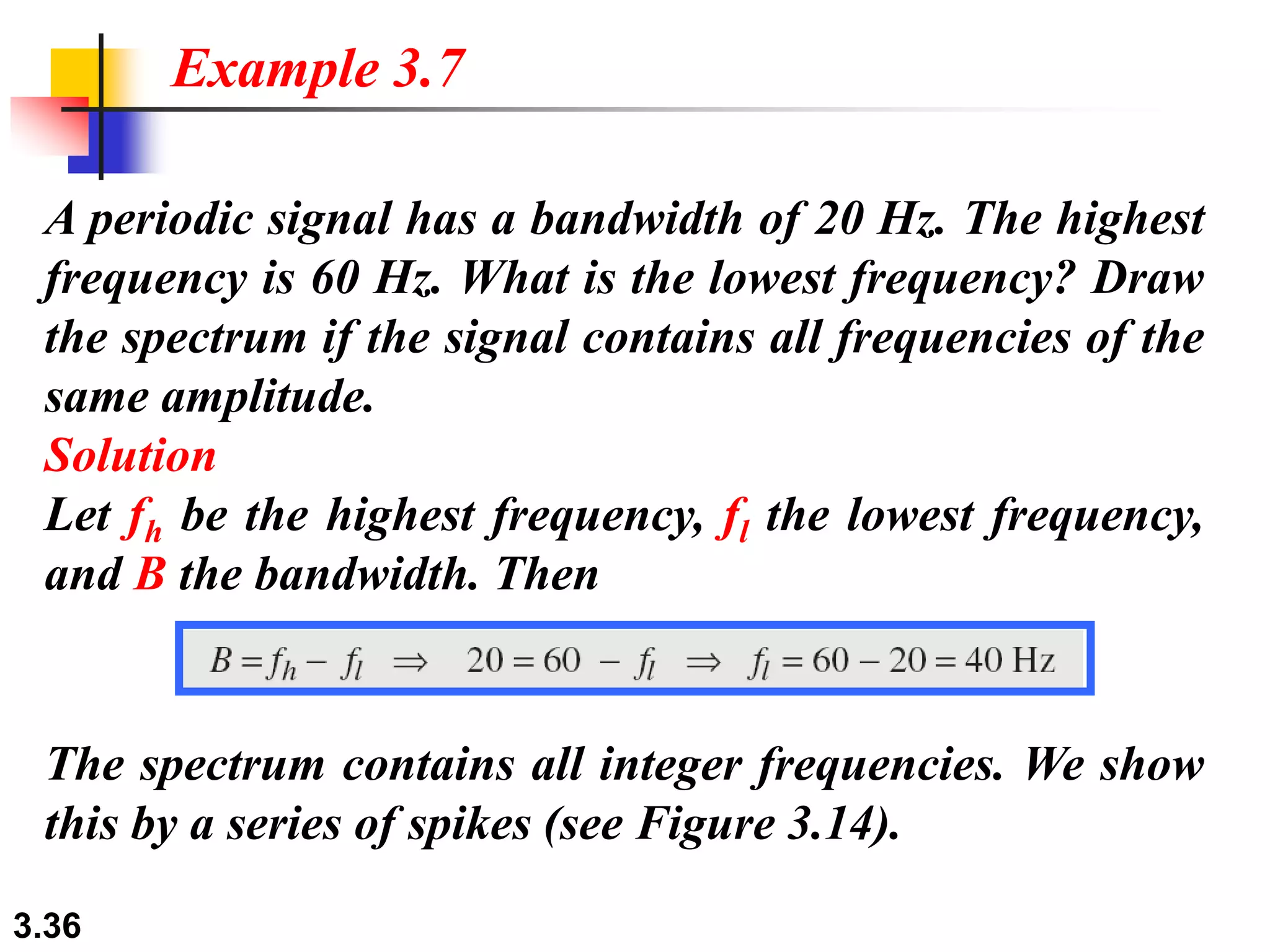
A periodic signal has a bandwidth of 20 Hz. The highest
frequency is 60 Hz. What is the lowest frequency? Draw
the spectrum if the signal contains all frequencies of the
same amplitude.
Solution
Let fh be the highest frequency, fl the lowest frequency,
and B the bandwidth. Then
Example 3.7
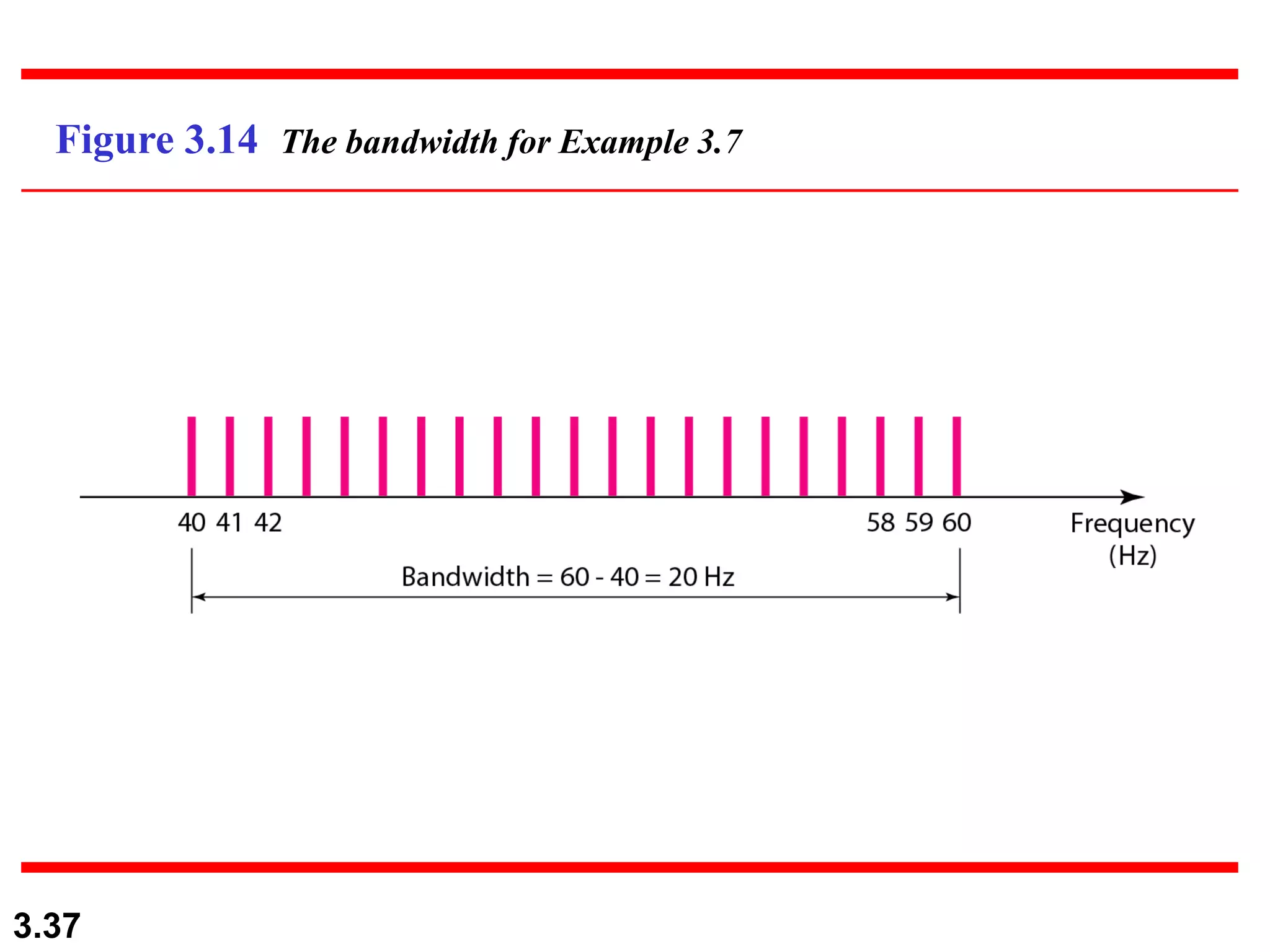
The spectrum contains all integer frequencies. We show
this by a series of spikes (see Figure 3.14).
3.37
Figure 3.14 The bandwidth for Example 3.7
3.38
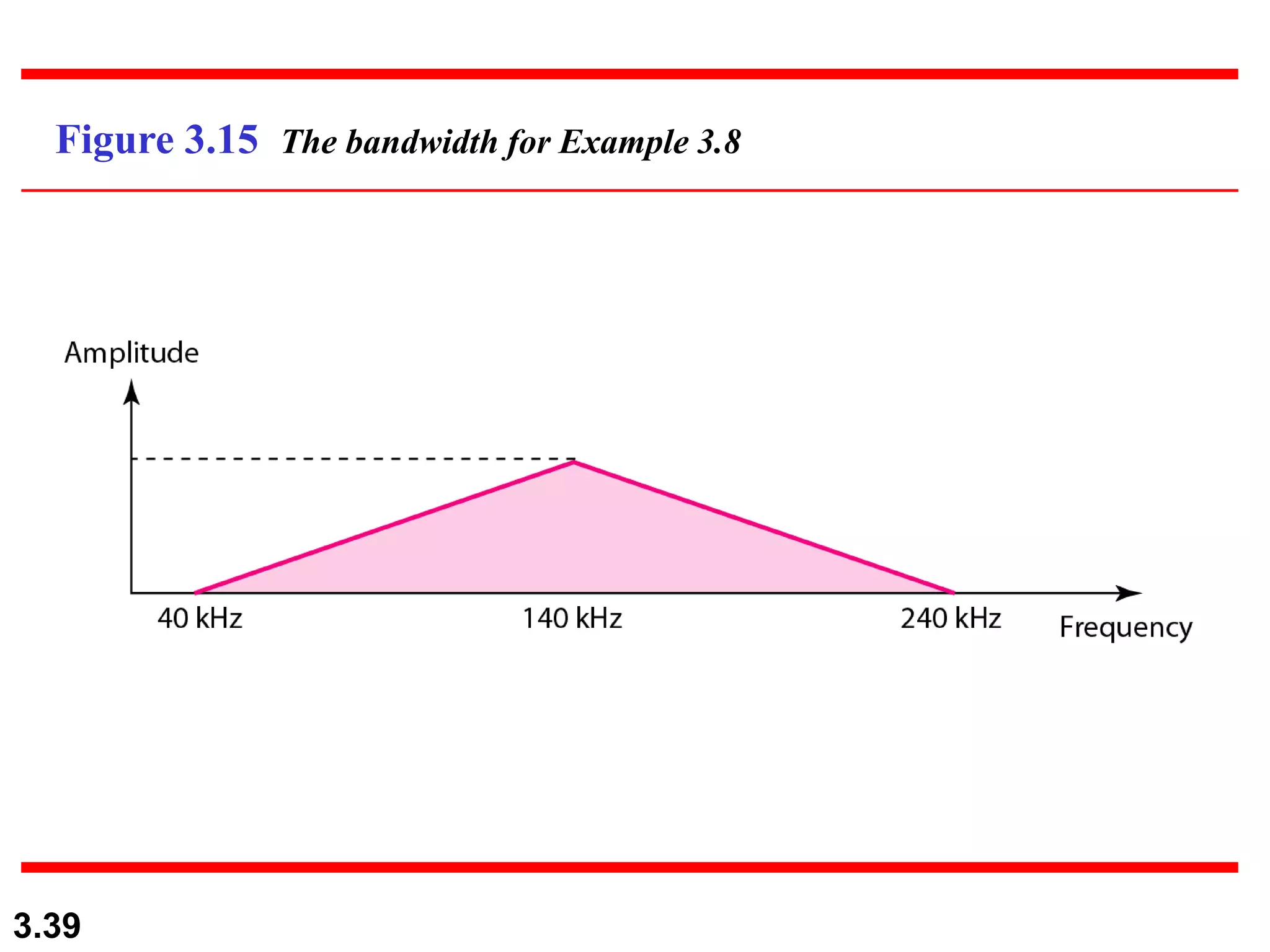
A nonperiodic composite signal has a bandwidth of 200
kHz, with a middle frequency of 140 kHz and peak
amplitude of 20 V. The two extreme frequencies have an
amplitude of 0. Draw the frequency domain of the
signal.
Solution
The lowest frequency must be at 40 kHz and the highest
at 240 kHz. Figure 3.15 shows the frequency domain
and the bandwidth.
Example 3.8
3.39
Figure 3.15 The bandwidth for Example 3.8
3.40
An example of a nonperiodic composite signal is the
signal propagated by an AM radio station. In the United
States, each AM radio station is assigned a 10-kHz
bandwidth. The total bandwidth dedicated to AM radio
ranges from 530 to 1700 kHz. We will show the rationale
behind this 10-kHz bandwidth in Chapter 5.
Example 3.9
3.41
Another example of a nonperiodic composite signal is
the signal propagated by an FM radio station. In the
United States, each FM radio station is assigned a 200-
kHz bandwidth. The total bandwidth dedicated to FM
radio ranges from 88 to 108 MHz. We will show the
rationale behind this 200-kHz bandwidth in Chapter 5.
Example 3.10
3.42
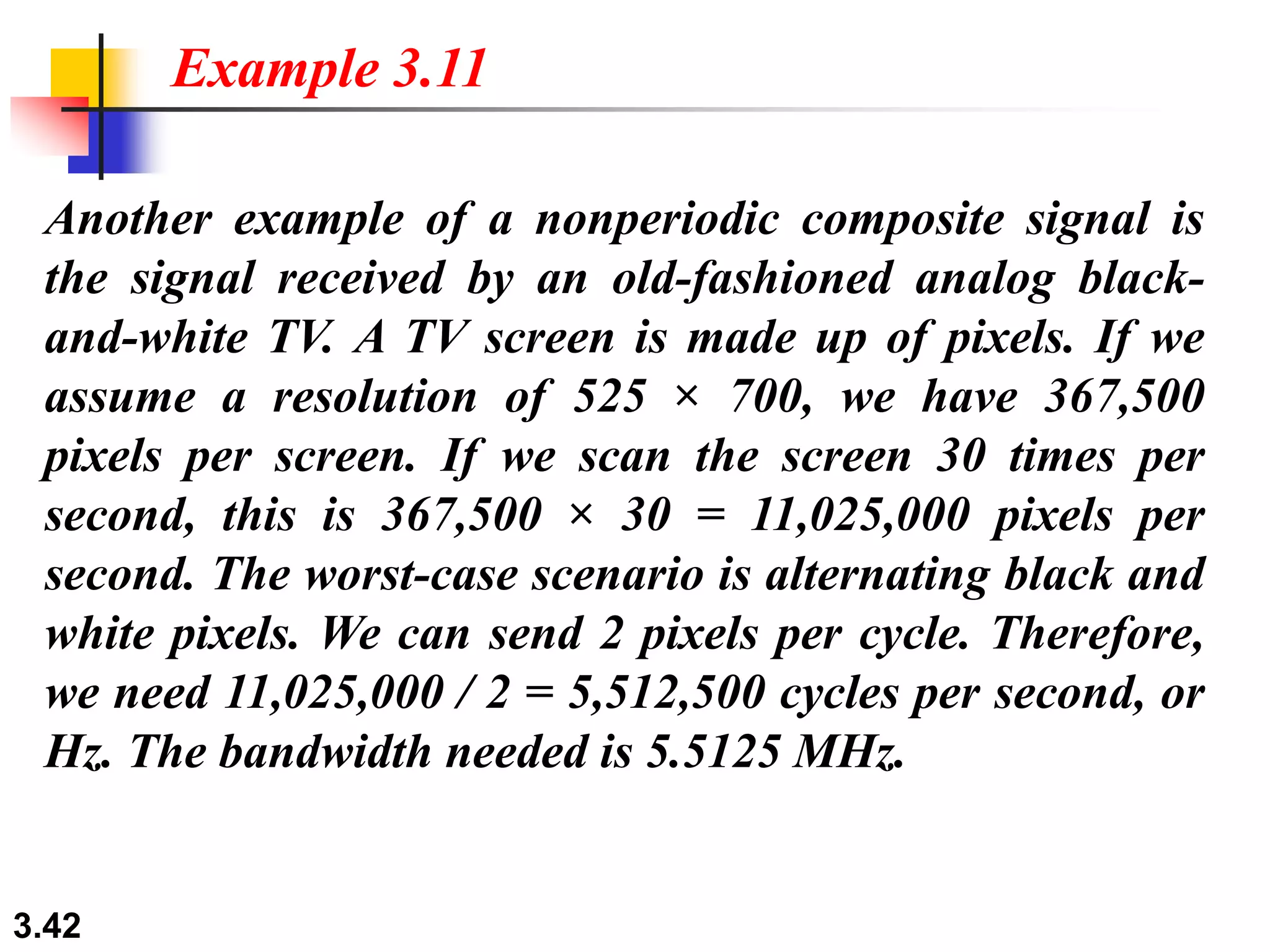
Another example of a nonperiodic composite signal is
the signal received by an old-fashioned analog black-
and-white TV. A TV screen is made up of pixels. If we
assume a resolution of 525 × 700, we have 367,500
pixels per screen. If we scan the screen 30 times per
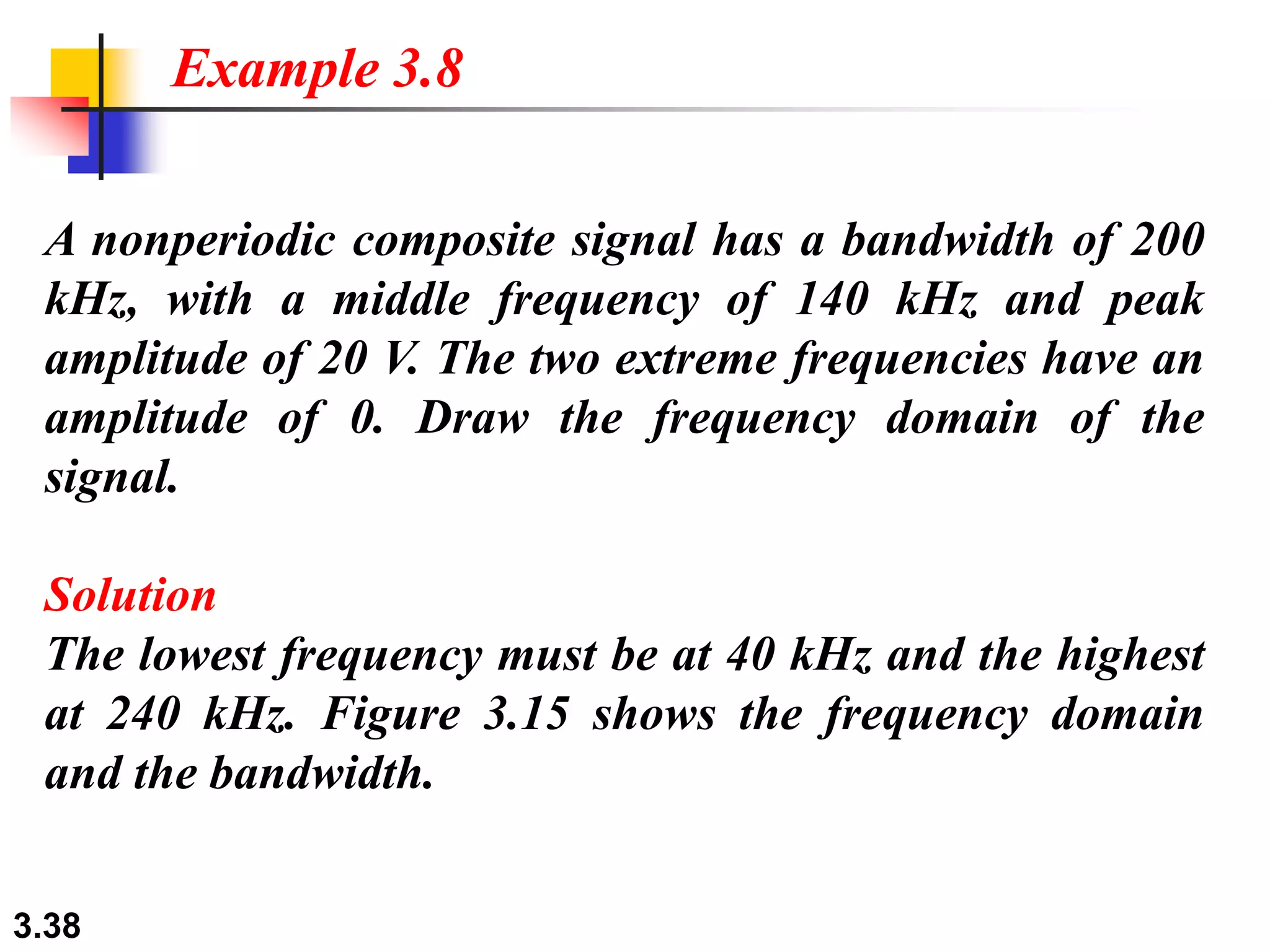
second, this is 367,500 × 30 = 11,025,000 pixels per
second. The worst-case scenario is alternating black and
white pixels. We can send 2 pixels per cycle. Therefore,
we need 11,025,000 / 2 = 5,512,500 cycles per second, or
Hz. The bandwidth needed is 5.5125 MHz.
Example 3.11
3.43
Fourier analysis is a tool that changes a
time domain signal to a frequency
domain signal and vice versa.
Note
Fourier Analysis
3.44
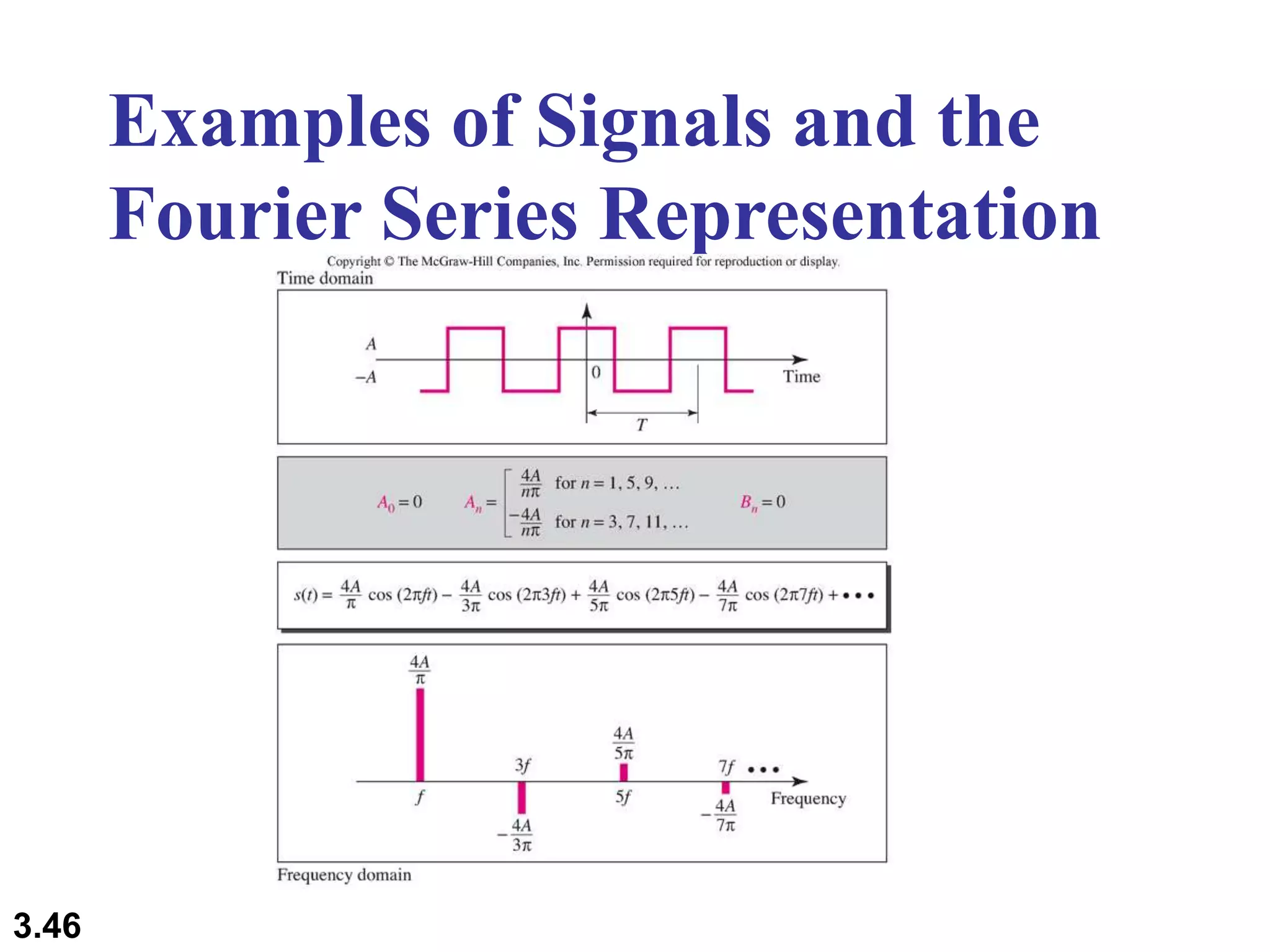
Fourier Series
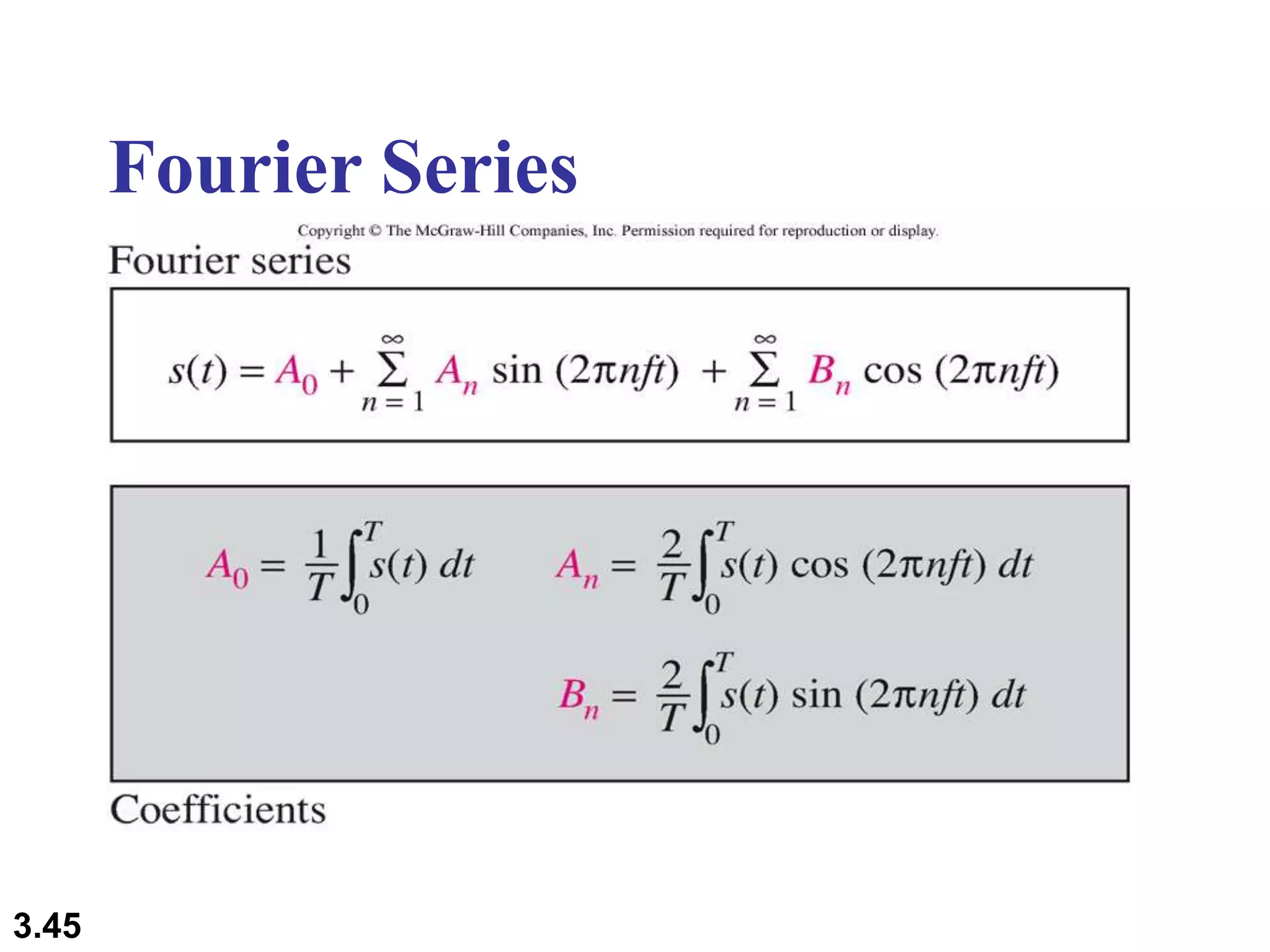
 Every composite periodic signal can be
represented with a series of sine and cosine
functions.
 The functions are integral harmonics of the
fundamental frequency “f” of the composite
signal.
 Using the series we can decompose any
periodic signal into its harmonics.
3.45
Fourier Series
3.46
Examples of Signals and the
Fourier Series Representation
3.47
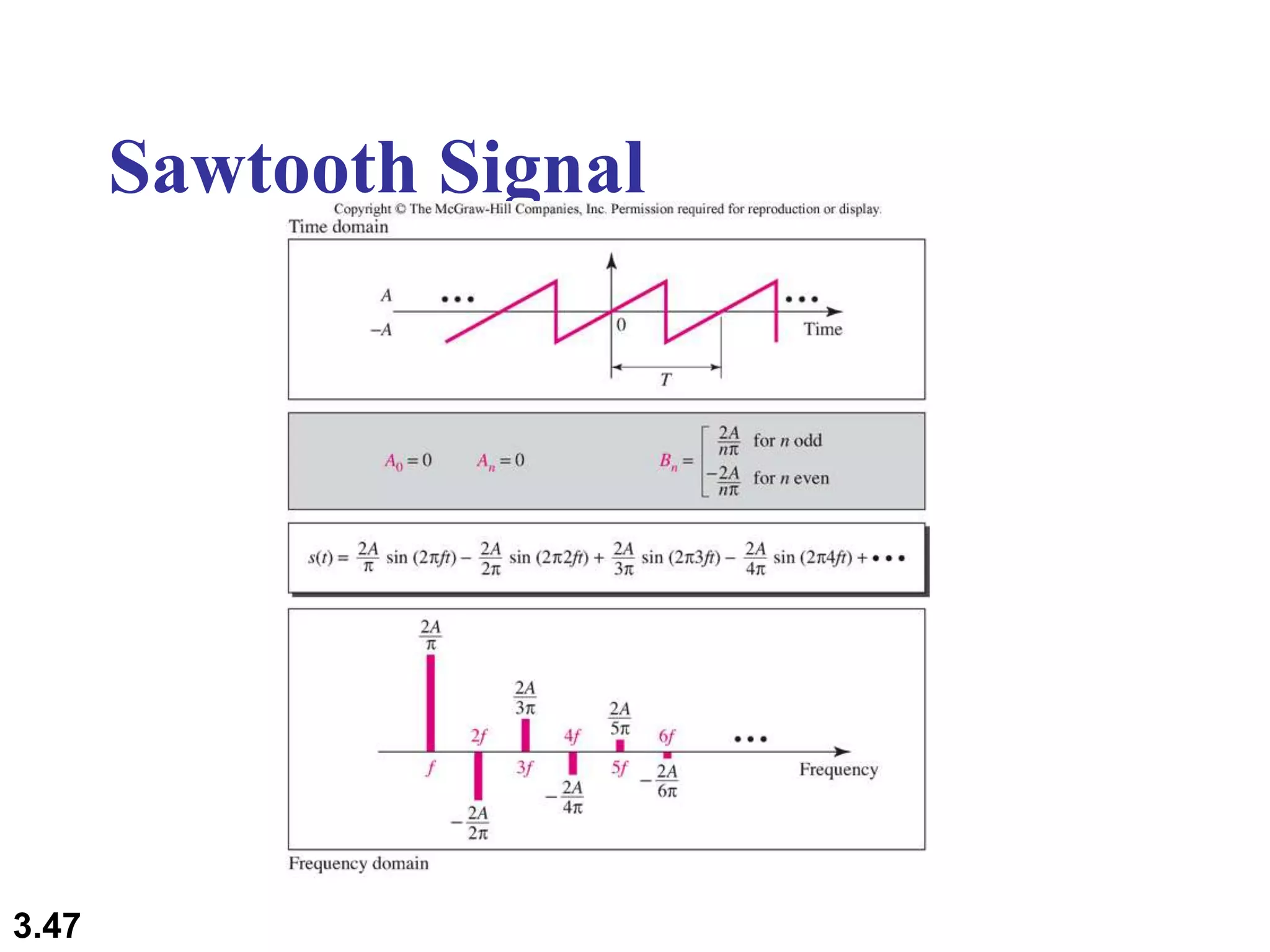
Sawtooth Signal
3.48
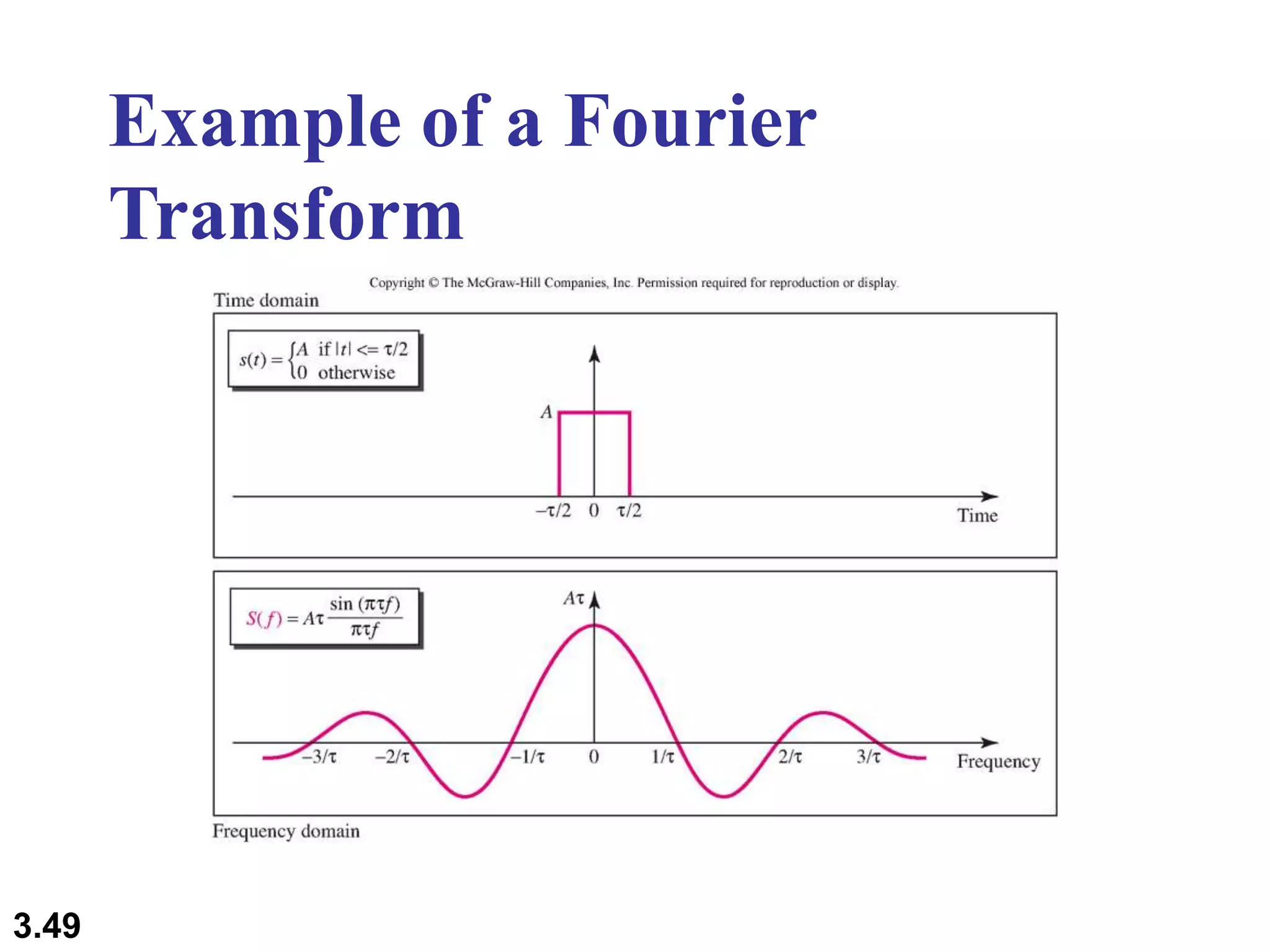
Fourier Transform
 Fourier Transform gives the frequency
domain of a nonperiodic time domain
signal.
3.49
Example of a Fourier
Transform
3.50
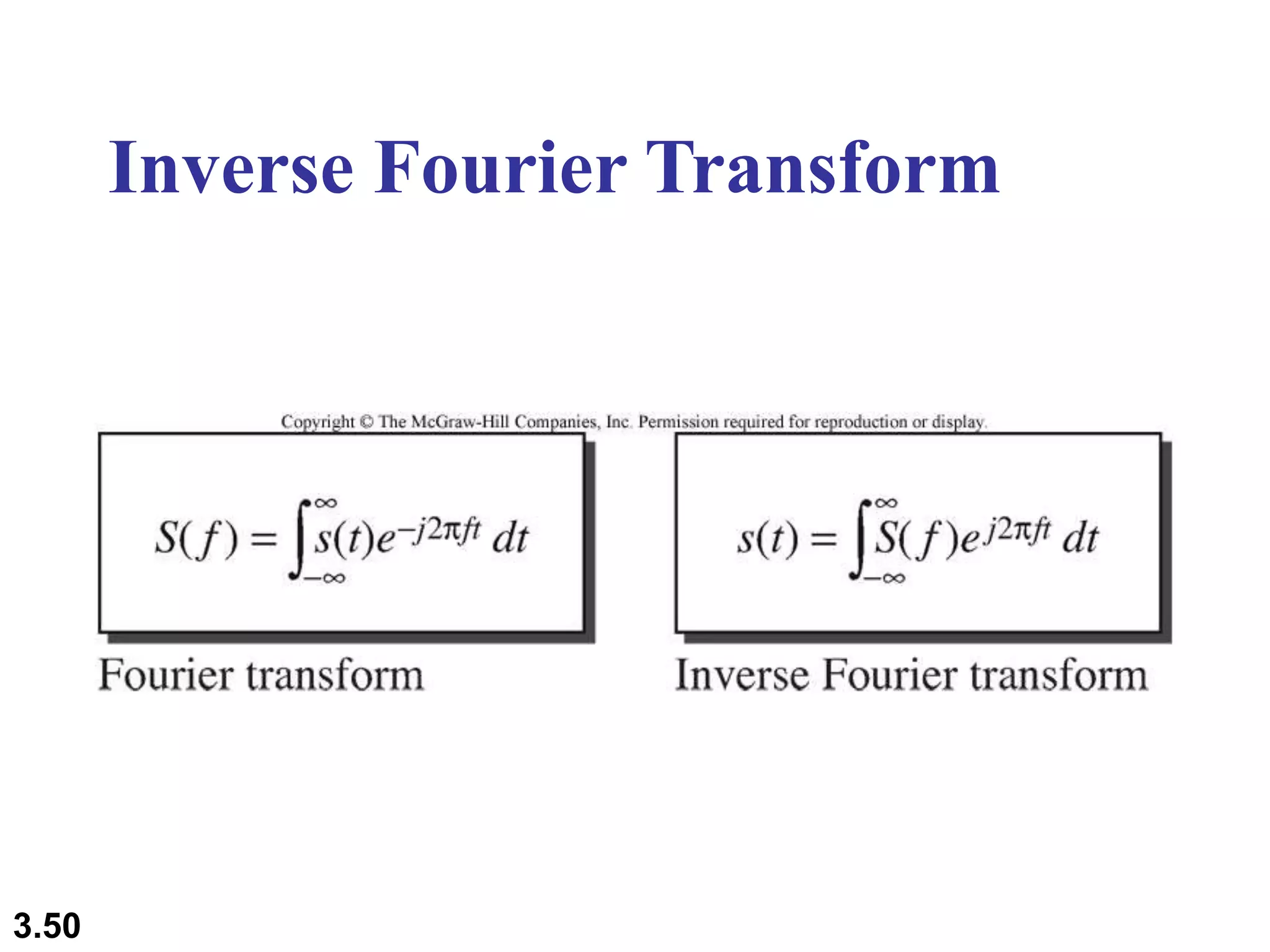
Inverse Fourier Transform
3.51
Time limited and Band limited
Signals
 A time limited signal is a signal for which
the amplitude s(t) = 0 for t > T1 and t < T2
 A band limited signal is a signal for which
the amplitude S(f) = 0 for f > F1 and f < F2

computer networks

  • 1.
    3.1 Chapter 3 Data andSignals Copyright © The McGraw-Hill Companies, Inc. Permission required for reproduction or display.
  • 2.
    3.2 To be transmitted,data must be transformed to electromagnetic signals. Note
  • 3.
    3.3 3-1 ANALOG ANDDIGITAL Data can be analog or digital. The term analog data refers to information that is continuous; digital data refers to information that has discrete states. Analog data take on continuous values. Digital data take on discrete values.  Analog and Digital Data  Analog and Digital Signals  Periodic and Nonperiodic Signals Topics discussed in this section:
  • 4.
    3.4 Analog and DigitalData  Data can be analog or digital.  Analog data are continuous and take continuous values.  Digital data have discrete states and take discrete values.
  • 5.
    3.5 Analog and DigitalSignals • Signals can be analog or digital. • Analog signals can have an infinite number of values in a range. • Digital signals can have only a limited number of values.
  • 6.
    3.6 Figure 3.1 Comparisonof analog and digital signals
  • 7.
    3.7 3-2 PERIODIC ANALOGSIGNALS In data communications, we commonly use periodic analog signals and nonperiodic digital signals. Periodic analog signals can be classified as simple or composite. A simple periodic analog signal, a sine wave, cannot be decomposed into simpler signals. A composite periodic analog signal is composed of multiple sine waves.  Sine Wave  Wavelength  Time and Frequency Domain  Composite Signals  Bandwidth Topics discussed in this section:
  • 8.
  • 9.
    3.9 Figure 3.3 Twosignals with the same phase and frequency, but different amplitudes
  • 10.
    3.10 Frequency and periodare the inverse of each other. Note
  • 11.
    3.11 Figure 3.4 Twosignals with the same amplitude and phase, but different frequencies
  • 12.
    3.12 Table 3.1 Unitsof period and frequency
  • 13.
    3.13 The power weuse at home has a frequency of 60 Hz. The period of this sine wave can be determined as follows: Example 3.1
  • 14.
    3.14 The period ofa signal is 100 ms. What is its frequency in kilohertz? Example 3.2 Solution First we change 100 ms to seconds, and then we calculate the frequency from the period (1 Hz = 10−3 kHz).
  • 15.
    3.15 Frequency • Frequency isthe rate of change with respect to time. • Change in a short span of time means high frequency. • Change over a long span of time means low frequency.
  • 16.
    3.16 If a signaldoes not change at all, its frequency is zero. If a signal changes instantaneously, its frequency is infinite. Note
  • 17.
    3.17 Phase describes theposition of the waveform relative to time 0. Note
  • 18.
    3.18 Figure 3.5 Threesine waves with the same amplitude and frequency, but different phases
  • 19.
    3.19 A sine waveis offset 1/6 cycle with respect to time 0. What is its phase in degrees and radians? Example 3.3 Solution We know that 1 complete cycle is 360°. Therefore, 1/6 cycle is
  • 20.
  • 21.
    3.21 Figure 3.7 Thetime-domain and frequency-domain plots of a sine wave
  • 22.
    3.22 A complete sinewave in the time domain can be represented by one single spike in the frequency domain. Note
  • 23.
    3.23 The frequency domainis more compact and useful when we are dealing with more than one sine wave. For example, Figure 3.8 shows three sine waves, each with different amplitude and frequency. All can be represented by three spikes in the frequency domain. Example 3.7
  • 24.
    3.24 Figure 3.8 Thetime domain and frequency domain of three sine waves
  • 25.
    3.25 Signals and Communication A single-frequency sine wave is not useful in data communications  We need to send a composite signal, a signal made of many simple sine waves.  According to Fourier analysis, any composite signal is a combination of simple sine waves with different frequencies, amplitudes, and phases.
  • 26.
    3.26 Composite Signals and Periodicity If the composite signal is periodic, the decomposition gives a series of signals with discrete frequencies.  If the composite signal is nonperiodic, the decomposition gives a combination of sine waves with continuous frequencies.
  • 27.
    3.27 Figure 3.9 showsa periodic composite signal with frequency f. This type of signal is not typical of those found in data communications. We can consider it to be three alarm systems, each with a different frequency. The analysis of this signal can give us a good understanding of how to decompose signals. Example 3.4
  • 28.
    3.28 Figure 3.9 Acomposite periodic signal
  • 29.
    3.29 Figure 3.10 Decompositionof a composite periodic signal in the time and frequency domains
  • 30.
    3.30 Figure 3.11 showsa nonperiodic composite signal. It can be the signal created by a microphone or a telephone set when a word or two is pronounced. In this case, the composite signal cannot be periodic, because that implies that we are repeating the same word or words with exactly the same tone. Example 3.5
  • 31.
    3.31 Figure 3.11 Thetime and frequency domains of a nonperiodic signal
  • 32.
    3.32 Bandwidth and Signal Frequency The bandwidth of a composite signal is the difference between the highest and the lowest frequencies contained in that signal.
  • 33.
    3.33 Figure 3.12 Thebandwidth of periodic and nonperiodic composite signals
  • 34.
    3.34 If a periodicsignal is decomposed into five sine waves with frequencies of 100, 300, 500, 700, and 900 Hz, what is its bandwidth? Draw the spectrum, assuming all components have a maximum amplitude of 10 V. Solution Let fh be the highest frequency, fl the lowest frequency, and B the bandwidth. Then Example 3.6 The spectrum has only five spikes, at 100, 300, 500, 700, and 900 Hz (see Figure 3.13).
  • 35.
    3.35 Figure 3.13 Thebandwidth for Example 3.6
  • 36.
    3.36 A periodic signalhas a bandwidth of 20 Hz. The highest frequency is 60 Hz. What is the lowest frequency? Draw the spectrum if the signal contains all frequencies of the same amplitude. Solution Let fh be the highest frequency, fl the lowest frequency, and B the bandwidth. Then Example 3.7 The spectrum contains all integer frequencies. We show this by a series of spikes (see Figure 3.14).
  • 37.
    3.37 Figure 3.14 Thebandwidth for Example 3.7
  • 38.
    3.38 A nonperiodic compositesignal has a bandwidth of 200 kHz, with a middle frequency of 140 kHz and peak amplitude of 20 V. The two extreme frequencies have an amplitude of 0. Draw the frequency domain of the signal. Solution The lowest frequency must be at 40 kHz and the highest at 240 kHz. Figure 3.15 shows the frequency domain and the bandwidth. Example 3.8
  • 39.
    3.39 Figure 3.15 Thebandwidth for Example 3.8
  • 40.
    3.40 An example ofa nonperiodic composite signal is the signal propagated by an AM radio station. In the United States, each AM radio station is assigned a 10-kHz bandwidth. The total bandwidth dedicated to AM radio ranges from 530 to 1700 kHz. We will show the rationale behind this 10-kHz bandwidth in Chapter 5. Example 3.9
  • 41.
    3.41 Another example ofa nonperiodic composite signal is the signal propagated by an FM radio station. In the United States, each FM radio station is assigned a 200- kHz bandwidth. The total bandwidth dedicated to FM radio ranges from 88 to 108 MHz. We will show the rationale behind this 200-kHz bandwidth in Chapter 5. Example 3.10
  • 42.
    3.42 Another example ofa nonperiodic composite signal is the signal received by an old-fashioned analog black- and-white TV. A TV screen is made up of pixels. If we assume a resolution of 525 × 700, we have 367,500 pixels per screen. If we scan the screen 30 times per second, this is 367,500 × 30 = 11,025,000 pixels per second. The worst-case scenario is alternating black and white pixels. We can send 2 pixels per cycle. Therefore, we need 11,025,000 / 2 = 5,512,500 cycles per second, or Hz. The bandwidth needed is 5.5125 MHz. Example 3.11
  • 43.
    3.43 Fourier analysis isa tool that changes a time domain signal to a frequency domain signal and vice versa. Note Fourier Analysis
  • 44.
    3.44 Fourier Series  Everycomposite periodic signal can be represented with a series of sine and cosine functions.  The functions are integral harmonics of the fundamental frequency “f” of the composite signal.  Using the series we can decompose any periodic signal into its harmonics.
  • 45.
  • 46.
    3.46 Examples of Signalsand the Fourier Series Representation
  • 47.
  • 48.
    3.48 Fourier Transform  FourierTransform gives the frequency domain of a nonperiodic time domain signal.
  • 49.
    3.49 Example of aFourier Transform
  • 50.
  • 51.
    3.51 Time limited andBand limited Signals  A time limited signal is a signal for which the amplitude s(t) = 0 for t > T1 and t < T2  A band limited signal is a signal for which the amplitude S(f) = 0 for f > F1 and f < F2