Co puter Networki g
Fu da e tal
Computer networking enables communication and data sharing
between devices, revolutionizing modern life and business.
Network Ba ic : Defi itio a d Purpo e
Defi itio
A network is a group of interconnected devices that
can communicate with each other, sharing
resources, information, and applications.
Purpo e
Networks enable information exchange,
collaboration, resource sharing, access to services,
and connectivity for individuals and organizations.
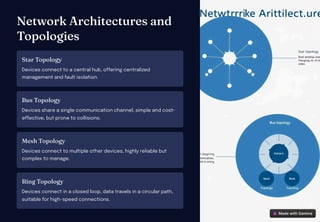
Network Arc itecture a d
Topologie
Star Topology
Devices connect to a central hub, offering centralized
management and fault isolation.
Bu Topology
Devices share a single communication channel, simple and cost-
effective, but prone to collisions.
Me Topology
Devices connect to multiple other devices, highly reliable but
complex to manage.
Ri g Topology
Devices connect in a closed loop, data travels in a circular path,
suitable for high-speed connections.
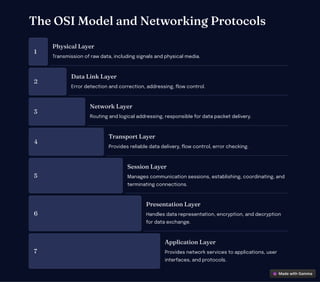
T e OSI Model a d Networki g Protocol
1
P y ical Layer
Transmission of raw data, including signals and physical media.
2
Data Li k Layer
Error detection and correction, addressing, flow control.
3
Network Layer
Routing and logical addressing, responsible for data packet delivery.
4
Tra port Layer
Provides reliable data delivery, flow control, error checking.
5
Se io Layer
Manages communication sessions, establishing, coordinating, and
terminating connections.
6
Pre e tatio Layer
Handles data representation, encryption, and decryption
for data exchange.
7
Applicatio Layer
Provides network services to applications, user
interfaces, and protocols.
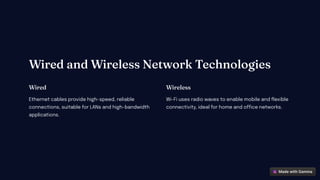
Wired a d Wirele Network Tec ologie
Wired
Ethernet cables provide high-speed, reliable
connections, suitable for LANs and high-bandwidth
applications.
Wirele
Wi-Fi uses radio waves to enable mobile and flexible
connectivity, ideal for home and office networks.
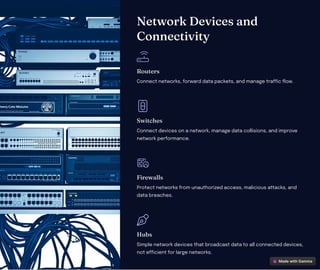
Network Device a d
Co ectivity
Router
Connect networks, forward data packets, and manage traffic flow.
Switc e
Connect devices on a network, manage data collisions, and improve
network performance.
Firewall
Protect networks from unauthorized access, malicious attacks, and
data breaches.
Hub
Simple network devices that broadcast data to all connected devices,
not efficient for large networks.
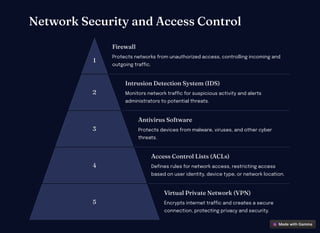
Network Security a d Acce Co trol
1
Firewall
Protects networks from unauthorized access, controlling incoming and
outgoing traffic.
2
I tru io Detectio Sy te (IDS)
Monitors network traffic for suspicious activity and alerts
administrators to potential threats.
3
A tiviru Software
Protects devices from malware, viruses, and other cyber
threats.
4
Acce Co trol Li t (ACL )
Defines rules for network access, restricting access
based on user identity, device type, or network location.
5
Virtual Private Network (VPN)
Encrypts internet traffic and creates a secure
connection, protecting privacy and security.
Tre d a d Future of
Co puter Networki g
5G
5G
Next-generation wireless technology with faster speeds, lower
latency, and increased capacity.
IoT
I ter et of T i g (IoT)
Interconnected devices and sensors, expanding network reach and
enabling automation.
Cloud Co puti g
Cloud Co puti g
Shifting computing resources and services to remote data centers,
enhancing scalability and flexibility.
AI
Artificial I tellige ce (AI)
AI-powered network optimization, automation, and security solutions
for intelligent networks.

Computer-Networking Fundamentals and information technology

  • 1.
    Co puter Networkig Fu da e tal Computer networking enables communication and data sharing between devices, revolutionizing modern life and business.
  • 2.
    Network Ba ic: Defi itio a d Purpo e Defi itio A network is a group of interconnected devices that can communicate with each other, sharing resources, information, and applications. Purpo e Networks enable information exchange, collaboration, resource sharing, access to services, and connectivity for individuals and organizations.
  • 3.
    Network Arc itecturea d Topologie Star Topology Devices connect to a central hub, offering centralized management and fault isolation. Bu Topology Devices share a single communication channel, simple and cost- effective, but prone to collisions. Me Topology Devices connect to multiple other devices, highly reliable but complex to manage. Ri g Topology Devices connect in a closed loop, data travels in a circular path, suitable for high-speed connections.
  • 4.
    T e OSIModel a d Networki g Protocol 1 P y ical Layer Transmission of raw data, including signals and physical media. 2 Data Li k Layer Error detection and correction, addressing, flow control. 3 Network Layer Routing and logical addressing, responsible for data packet delivery. 4 Tra port Layer Provides reliable data delivery, flow control, error checking. 5 Se io Layer Manages communication sessions, establishing, coordinating, and terminating connections. 6 Pre e tatio Layer Handles data representation, encryption, and decryption for data exchange. 7 Applicatio Layer Provides network services to applications, user interfaces, and protocols.
  • 5.
    Wired a dWirele Network Tec ologie Wired Ethernet cables provide high-speed, reliable connections, suitable for LANs and high-bandwidth applications. Wirele Wi-Fi uses radio waves to enable mobile and flexible connectivity, ideal for home and office networks.
  • 6.
    Network Device ad Co ectivity Router Connect networks, forward data packets, and manage traffic flow. Switc e Connect devices on a network, manage data collisions, and improve network performance. Firewall Protect networks from unauthorized access, malicious attacks, and data breaches. Hub Simple network devices that broadcast data to all connected devices, not efficient for large networks.
  • 7.
    Network Security ad Acce Co trol 1 Firewall Protects networks from unauthorized access, controlling incoming and outgoing traffic. 2 I tru io Detectio Sy te (IDS) Monitors network traffic for suspicious activity and alerts administrators to potential threats. 3 A tiviru Software Protects devices from malware, viruses, and other cyber threats. 4 Acce Co trol Li t (ACL ) Defines rules for network access, restricting access based on user identity, device type, or network location. 5 Virtual Private Network (VPN) Encrypts internet traffic and creates a secure connection, protecting privacy and security.
  • 8.
    Tre d ad Future of Co puter Networki g 5G 5G Next-generation wireless technology with faster speeds, lower latency, and increased capacity. IoT I ter et of T i g (IoT) Interconnected devices and sensors, expanding network reach and enabling automation. Cloud Co puti g Cloud Co puti g Shifting computing resources and services to remote data centers, enhancing scalability and flexibility. AI Artificial I tellige ce (AI) AI-powered network optimization, automation, and security solutions for intelligent networks.