COMPUTER-GENERATED
IMAGERY
Computer-generated imagery (CGI) is the use of computer
graphics to create or contribute to images in art, printed media,
video games, simulators, and visual effects in films, television
programs, shorts, commercials, and videos. The images may be
static or dynamic, in which case CGI is also called computer
animation. CGI may be two-dimensional (2D), although the term
"CGI" is most commonly used to refer to the 3-D computer
graphics used for creating characters, scenes and special effects
in films and television, which is described as "CGI animation".
The first feature film to make use of CGI was the 1973 film
Westworld. Other early films that incorporated CGI include Star
Wars (1977), Tron (1982), Golgo 13: The Professional (1983),
The Last Starfighter (1984), Young Sherlock Holmes (1985) and
Flight of the Navigator (1986). The first music video to use CGI
was Dire Straits' award-winning "Money for Nothing" (1985),
whose success was instrumental in giving the process
mainstream exposure.
The evolution of CGI led to the emergence of virtual
cinematography in the 1990s, where the vision of the simulated
camera is not constrained by the laws of physics. Availability of
CGI software and increased computer speeds have allowed
individual artists and small companies to produce professional-
grade films, games, and fine art from their home computers.
The term virtual world refers to agent-based, interactive
environments, which can be created with CGI.
CGI (Computer-Generated Imagery) is the creation of still or animated
visual content with imaging software. CGI is used to produce images for
many purposes including visual art, advertising, anatomical modeling,
architectural design, engineering, television shows, video game art and film
special effects, as well as Augmented Reality (AR) and Virtual Reality (VR)
applications.
CGI is accomplished through various methods. The use of algorithms to
generate fractals, for example, can produce complex visual patterns. Other
methods include painting in a 2D pixel-based image editor and creating
shapes to make images, as in a vector-based image editor.
CGI can also be made from 3D graphics, either with ray tracing or by
rasterized 3D graphics. Ray tracing simulates the way light acts upon
surfaces on the level of photons, simulated by shader programming
routines. Ray tracing can use complex methods to build shapes, such as
non-uniform b-spline (NURBS), 3D primitive shapes (such as cubes,
spheres, pyramids, etc.) or simple polygons (typically triangles or
quadrangles – which are often called quads). It may take seconds or even
minutes per frame to render in these complex methods but results can be
photorealistic.
Rasterized 3D, on the other hand, is specialized for real-time display of
animated imagery as in computer and console video games. Due to the
need to render multiple frames per second (ideally sixty or more), rasterized
3D uses simple polygons or quads to define shapes, with shaders more
often consisting of textures that define the color, specularity, surface texture,
glow and reflectivity.
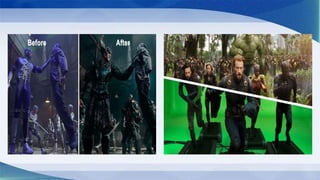
Complex visuals may be made by combining computer-generated images
into film in layers, a technique known as compositing. This technique is often
used in conjunction with actors on a green screen, to place them in a
simulated background.
CGI allows you to showcase products or
services in ways that traditional photography
can't. Whether an item is impossible to
photograph or you need to change certain aspects
of a product, CGI can create photographic quality
images that you can use to connect with your
consumers.
EXAMPLE OF CGI:
computer generated images.pptx

computer generated images.pptx

  • 1.
  • 2.
    Computer-generated imagery (CGI)is the use of computer graphics to create or contribute to images in art, printed media, video games, simulators, and visual effects in films, television programs, shorts, commercials, and videos. The images may be static or dynamic, in which case CGI is also called computer animation. CGI may be two-dimensional (2D), although the term "CGI" is most commonly used to refer to the 3-D computer graphics used for creating characters, scenes and special effects in films and television, which is described as "CGI animation".
  • 3.
    The first featurefilm to make use of CGI was the 1973 film Westworld. Other early films that incorporated CGI include Star Wars (1977), Tron (1982), Golgo 13: The Professional (1983), The Last Starfighter (1984), Young Sherlock Holmes (1985) and Flight of the Navigator (1986). The first music video to use CGI was Dire Straits' award-winning "Money for Nothing" (1985), whose success was instrumental in giving the process mainstream exposure.
  • 4.
    The evolution ofCGI led to the emergence of virtual cinematography in the 1990s, where the vision of the simulated camera is not constrained by the laws of physics. Availability of CGI software and increased computer speeds have allowed individual artists and small companies to produce professional- grade films, games, and fine art from their home computers. The term virtual world refers to agent-based, interactive environments, which can be created with CGI.
  • 5.
    CGI (Computer-Generated Imagery)is the creation of still or animated visual content with imaging software. CGI is used to produce images for many purposes including visual art, advertising, anatomical modeling, architectural design, engineering, television shows, video game art and film special effects, as well as Augmented Reality (AR) and Virtual Reality (VR) applications. CGI is accomplished through various methods. The use of algorithms to generate fractals, for example, can produce complex visual patterns. Other methods include painting in a 2D pixel-based image editor and creating shapes to make images, as in a vector-based image editor.
  • 6.
    CGI can alsobe made from 3D graphics, either with ray tracing or by rasterized 3D graphics. Ray tracing simulates the way light acts upon surfaces on the level of photons, simulated by shader programming routines. Ray tracing can use complex methods to build shapes, such as non-uniform b-spline (NURBS), 3D primitive shapes (such as cubes, spheres, pyramids, etc.) or simple polygons (typically triangles or quadrangles – which are often called quads). It may take seconds or even minutes per frame to render in these complex methods but results can be photorealistic.
  • 7.
    Rasterized 3D, onthe other hand, is specialized for real-time display of animated imagery as in computer and console video games. Due to the need to render multiple frames per second (ideally sixty or more), rasterized 3D uses simple polygons or quads to define shapes, with shaders more often consisting of textures that define the color, specularity, surface texture, glow and reflectivity. Complex visuals may be made by combining computer-generated images into film in layers, a technique known as compositing. This technique is often used in conjunction with actors on a green screen, to place them in a simulated background.
  • 8.
    CGI allows youto showcase products or services in ways that traditional photography can't. Whether an item is impossible to photograph or you need to change certain aspects of a product, CGI can create photographic quality images that you can use to connect with your consumers.
  • 9.