Compressor
Present by A.M.Raja
Need of compressor
• Air is the vital requirement for live
• In scientific world compressed air also vital
requirement for day to day life
What is Compressor ?
• Compress + Air = Compressor
• A compressor is a mechanical device that
increases the pressure of a gas by reducing its
volume
Compressed air usage in industry
• Nitrogen air generation
• Pneumatic cylinder operation
• Control valve operation
• AOD Pump operation
• Water treatment
• Pneumatic tools
• Pneumatic conveying
• Pneumatic leak test….
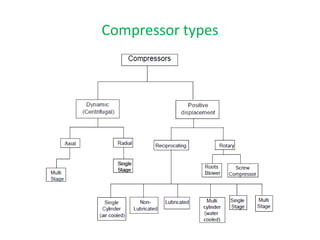
Compressor types
• According to prime mover
Electric motor drive or IC engine drive, Gas turbine
drives
• According to cooling medium
Air cooled, water cooled air compressors
Classification of air compressor
Reciprocating Compressor
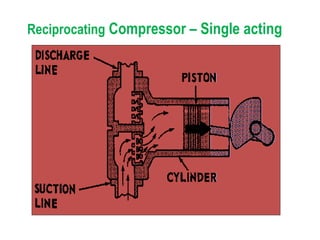
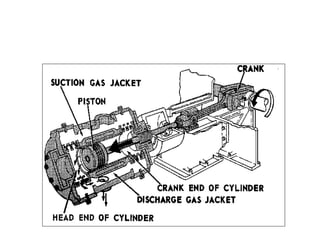
• In a reciprocating compressor, a volume of gas
is drawn into a cylinder, it is trapped, and
compressed by piston and then discharged
into the discharge line. The cylinder valves
control the flow of gas through the cylinder;
these valves act as check valves.
• Single – Acting compressor
–It is a compressor that has one discharge per
revolution of crankshaft.
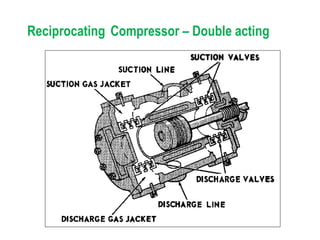
• Double – Acting Compressor
–It is a compressor that completes two discharge
strokes per revolutions of crankshaft. Most
heavy-duty compressors are double acting..
Reciprocating Compressor Types
Reciprocating Compressor – Single acting
Reciprocating Compressor – Double acting
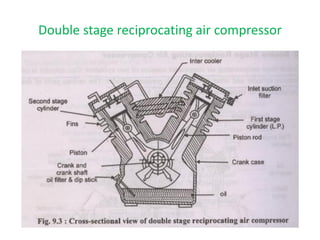
Double stage reciprocating air compressor
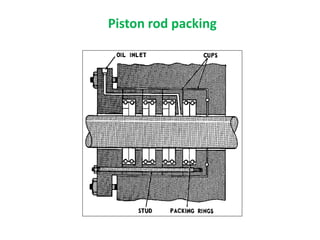
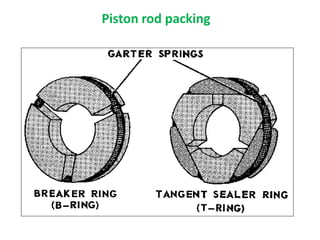
Piston rod packing
Piston rod packing
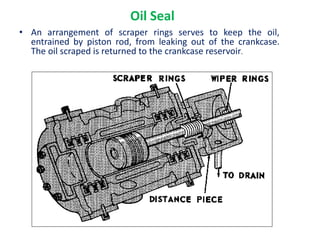
Oil Seal
• An arrangement of scraper rings serves to keep the oil,
entrained by piston rod, from leaking out of the crankcase.
The oil scraped is returned to the crankcase reservoir.
Piston Rings & Rider Ring
• Piston rings provide a seal that prevents or
minimizes leakage through piston and liner. piston
rings are made in one piece, with a gap or in
several segments. Gaps in the rings allow them to
move out or expand as the compressor reaches
operating temperature.
• Rider ring act as a guide during un loding cycle of
compressor
Crank Case
• Crank case supports the crankshaft. All
bearing supports are bored under setup
condition to ensure perfect alignment.
Crankcase is provided with easy removable
covers on the top for inspection and
maintenance. The bottom of the crankcase
serves as the oil reservoir. A main pump for
lubrication of the crank mechanism is placed
on the shield mounted on the side opposite
the coupling and is driven by compressor.
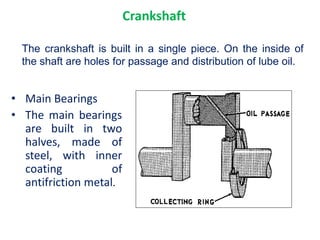
• Main Bearings
• The main bearings
are built in two
halves, made of
steel, with inner
coating of
antifriction metal.
The crankshaft is built in a single piece. On the inside of
the shaft are holes for passage and distribution of lube oil.
Crankshaft
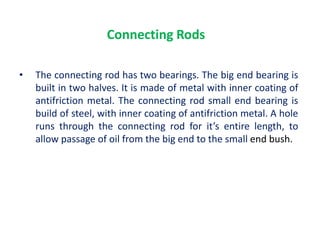
Connecting Rods
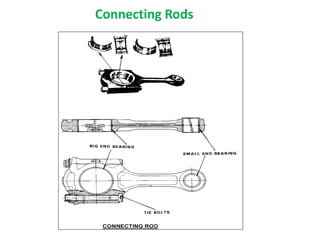
• The connecting rod has two bearings. The big end bearing is
built in two halves. It is made of metal with inner coating of
antifriction metal. The connecting rod small end bearing is
build of steel, with inner coating of antifriction metal. A hole
runs through the connecting rod for it’s entire length, to
allow passage of oil from the big end to the small end bush.
Connecting Rods
Crosshead
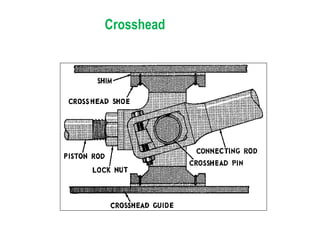
• Crosshead fastens piston rod to the connecting rod. The
sliding surfaces of crosshead are coated with antifriction
metal i.e. babbited shoes. These are of interchangeable type.
That permits it to slide back and forth within the crosshead
guides. The shoes have channels for the distribution of lube
oil. The lubrication is obtained under pressure; it comes out
from the two guides of the crosshead slide body.
• Connection between connecting rod and crosshead is realized
by means of a gudgeon pin. The piston rod is connected to
the crosshead by nut arrangement, tightened by means of
hydraulic device.
Crosshead
Lubrication Systems
Generally, two types of systems are uses to lubricate the positive
displacement compressors.
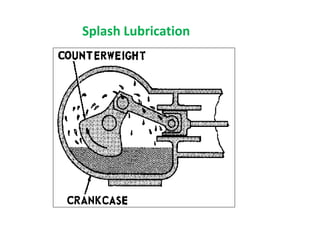
Splash system
It is used in older machines. A supply is maintained in the
crankcase. Oil is splashed up by the rotation of the crank and the
counter weight into the collecting ring. Centrifugal force throws
the oil outward through an oil passage to the crank pin.
Splash Lubrication
Forced Feed System
Oil is pumped under pressure to the required parts. Following are
the main parts of system:
STRAINER
Oil from the crankcase first passes through a coarse strainer. The
strainer is removable so that chips or broken off pieces can be
cleaned out of the strainer.
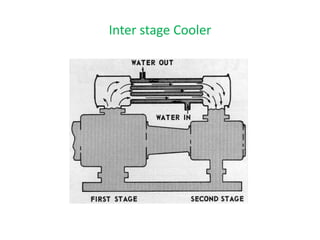
Inter stage Cooler
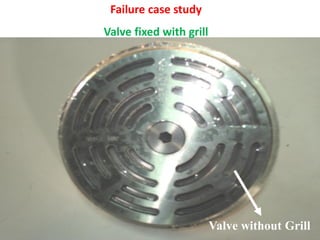
Valve without Grill
Failure case study
Valve fixed with grill
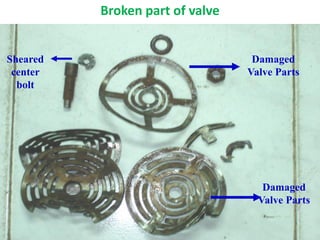
Sheared
center
bolt
Damaged
Valve Parts
Damaged
Valve Parts
Broken part of valve
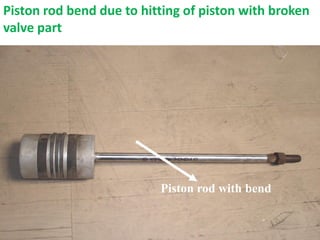
Piston rod with bend
Piston rod bend due to hitting of piston with broken
valve part
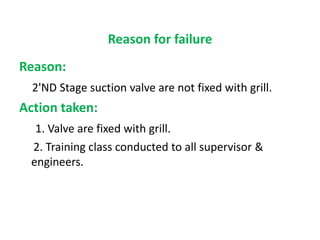
Reason for failure
Reason:
2'ND Stage suction valve are not fixed with grill.
Action taken:
1. Valve are fixed with grill.
2. Training class conducted to all supervisor &
engineers.
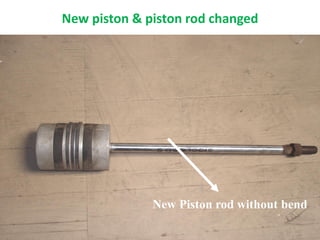
New Piston rod without bend
New piston & piston rod changed
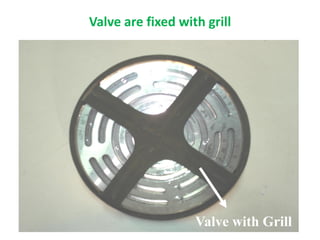
Valve with Grill
Valve are fixed with grill
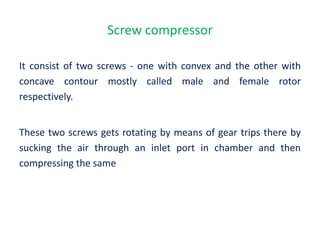
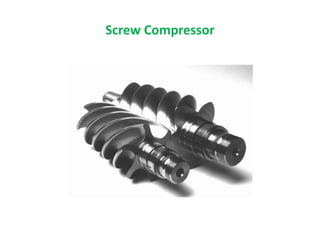
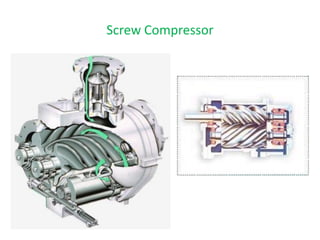
It consist of two screws - one with convex and the other with
concave contour mostly called male and female rotor
respectively.
These two screws gets rotating by means of gear trips there by
sucking the air through an inlet port in chamber and then
compressing the same
Screw compressor
Screw Compressor
Screw Compressor
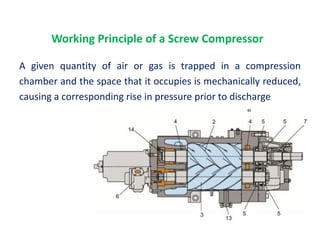
Working Principle of a Screw Compressor
A given quantity of air or gas is trapped in a compression
chamber and the space that it occupies is mechanically reduced,
causing a corresponding rise in pressure prior to discharge
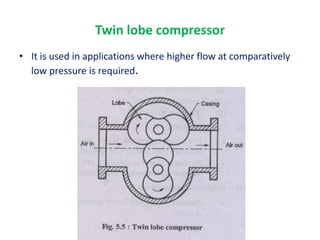
• It is used in applications where higher flow at comparatively
low pressure is required.
Twin lobe compressor
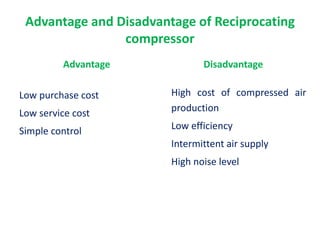
Advantage and Disadvantage of Reciprocating
compressor
Advantage
Low purchase cost
Low service cost
Simple control
Disadvantage
High cost of compressed air
production
Low efficiency
Intermittent air supply
High noise level
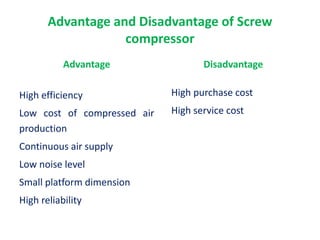
Advantage and Disadvantage of Screw
compressor
Advantage
High efficiency
Low cost of compressed air
production
Continuous air supply
Low noise level
Small platform dimension
High reliability
Disadvantage
High purchase cost
High service cost
Thank you

Compressor Presentation including all types

  • 1.
  • 2.
    Need of compressor •Air is the vital requirement for live • In scientific world compressed air also vital requirement for day to day life
  • 3.
    What is Compressor? • Compress + Air = Compressor • A compressor is a mechanical device that increases the pressure of a gas by reducing its volume
  • 4.
    Compressed air usagein industry • Nitrogen air generation • Pneumatic cylinder operation • Control valve operation • AOD Pump operation • Water treatment • Pneumatic tools • Pneumatic conveying • Pneumatic leak test….
  • 5.
  • 6.
    • According toprime mover Electric motor drive or IC engine drive, Gas turbine drives • According to cooling medium Air cooled, water cooled air compressors Classification of air compressor
  • 7.
    Reciprocating Compressor • Ina reciprocating compressor, a volume of gas is drawn into a cylinder, it is trapped, and compressed by piston and then discharged into the discharge line. The cylinder valves control the flow of gas through the cylinder; these valves act as check valves.
  • 8.
    • Single –Acting compressor –It is a compressor that has one discharge per revolution of crankshaft. • Double – Acting Compressor –It is a compressor that completes two discharge strokes per revolutions of crankshaft. Most heavy-duty compressors are double acting.. Reciprocating Compressor Types
  • 9.
  • 10.
  • 11.
  • 13.
  • 14.
  • 15.
    Oil Seal • Anarrangement of scraper rings serves to keep the oil, entrained by piston rod, from leaking out of the crankcase. The oil scraped is returned to the crankcase reservoir.
  • 16.
    Piston Rings &Rider Ring • Piston rings provide a seal that prevents or minimizes leakage through piston and liner. piston rings are made in one piece, with a gap or in several segments. Gaps in the rings allow them to move out or expand as the compressor reaches operating temperature. • Rider ring act as a guide during un loding cycle of compressor
  • 17.
    Crank Case • Crankcase supports the crankshaft. All bearing supports are bored under setup condition to ensure perfect alignment. Crankcase is provided with easy removable covers on the top for inspection and maintenance. The bottom of the crankcase serves as the oil reservoir. A main pump for lubrication of the crank mechanism is placed on the shield mounted on the side opposite the coupling and is driven by compressor.
  • 18.
    • Main Bearings •The main bearings are built in two halves, made of steel, with inner coating of antifriction metal. The crankshaft is built in a single piece. On the inside of the shaft are holes for passage and distribution of lube oil. Crankshaft
  • 19.
    Connecting Rods • Theconnecting rod has two bearings. The big end bearing is built in two halves. It is made of metal with inner coating of antifriction metal. The connecting rod small end bearing is build of steel, with inner coating of antifriction metal. A hole runs through the connecting rod for it’s entire length, to allow passage of oil from the big end to the small end bush.
  • 20.
  • 21.
    Crosshead • Crosshead fastenspiston rod to the connecting rod. The sliding surfaces of crosshead are coated with antifriction metal i.e. babbited shoes. These are of interchangeable type. That permits it to slide back and forth within the crosshead guides. The shoes have channels for the distribution of lube oil. The lubrication is obtained under pressure; it comes out from the two guides of the crosshead slide body. • Connection between connecting rod and crosshead is realized by means of a gudgeon pin. The piston rod is connected to the crosshead by nut arrangement, tightened by means of hydraulic device.
  • 22.
  • 23.
    Lubrication Systems Generally, twotypes of systems are uses to lubricate the positive displacement compressors. Splash system It is used in older machines. A supply is maintained in the crankcase. Oil is splashed up by the rotation of the crank and the counter weight into the collecting ring. Centrifugal force throws the oil outward through an oil passage to the crank pin.
  • 24.
  • 25.
    Forced Feed System Oilis pumped under pressure to the required parts. Following are the main parts of system: STRAINER Oil from the crankcase first passes through a coarse strainer. The strainer is removable so that chips or broken off pieces can be cleaned out of the strainer.
  • 26.
  • 27.
    Valve without Grill Failurecase study Valve fixed with grill
  • 28.
  • 29.
    Piston rod withbend Piston rod bend due to hitting of piston with broken valve part
  • 30.
    Reason for failure Reason: 2'NDStage suction valve are not fixed with grill. Action taken: 1. Valve are fixed with grill. 2. Training class conducted to all supervisor & engineers.
  • 31.
    New Piston rodwithout bend New piston & piston rod changed
  • 32.
    Valve with Grill Valveare fixed with grill
  • 33.
    It consist oftwo screws - one with convex and the other with concave contour mostly called male and female rotor respectively. These two screws gets rotating by means of gear trips there by sucking the air through an inlet port in chamber and then compressing the same Screw compressor
  • 34.
  • 35.
  • 36.
    Working Principle ofa Screw Compressor A given quantity of air or gas is trapped in a compression chamber and the space that it occupies is mechanically reduced, causing a corresponding rise in pressure prior to discharge
  • 38.
    • It isused in applications where higher flow at comparatively low pressure is required. Twin lobe compressor
  • 39.
    Advantage and Disadvantageof Reciprocating compressor Advantage Low purchase cost Low service cost Simple control Disadvantage High cost of compressed air production Low efficiency Intermittent air supply High noise level
  • 40.
    Advantage and Disadvantageof Screw compressor Advantage High efficiency Low cost of compressed air production Continuous air supply Low noise level Small platform dimension High reliability Disadvantage High purchase cost High service cost

  • 41.