COMPREHENSIVE EXAMINATION
Presented By:
Neetu Kumari
Roll No-195EC03
Supervisor: Co-Supervisor:
Prof. P. K. Jain Dr. Manpuran Mahto
Department of Electronics & Communication Engineering
National Institute of Technology Patna
Patna 800005
1
Content
2
 Course Work
 Course Content
 Space Charge
 Space Charge Limited Condition
 Cathode Emission
 Microwave Tubes
 Relativistic Devices
 HPM Sources
 References
Course Work
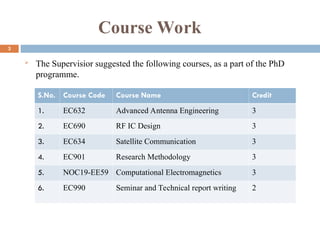
 The Supervisior suggested the following courses, as a part of the PhD
programme.
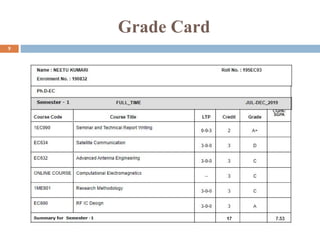
S.No. Course Code Course Name Credit
1. EC632 Advanced Antenna Engineering 3
2. EC690 RF IC Design 3
3. EC634 Satellite Communication 3
4. EC901 Research Methodology 3
5. NOC19-EE59 Computational Electromagnetics 3
6. EC990 Seminar and Technical report writing 2
3
Course Contents
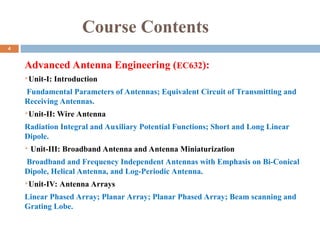
Advanced Antenna Engineering (EC632):
Unit-I: Introduction
Fundamental Parameters of Antennas; Equivalent Circuit of Transmitting and
Receiving Antennas.
Unit-II: Wire Antenna
Radiation Integral and Auxiliary Potential Functions; Short and Long Linear
Dipole.
 Unit-III: Broadband Antenna and Antenna Miniaturization
Broadband and Frequency Independent Antennas with Emphasis on Bi-Conical
Dipole, Helical Antenna, and Log-Periodic Antenna.
Unit-IV: Antenna Arrays
Linear Phased Array; Planar Array; Planar Phased Array; Beam scanning and
Grating Lobe.
4
Course Contents
Research Methodology(EC901):
Unit-I: Introduction to Research Methods Philosophy of Science, Types of
Research; Research Purposes - Research Design - Survey Research - Case Study
Research.
Unit-II: Data Collection and Sampling Design Sources of Data: Primary Data,
Secondary Data.
 Unit-III: Statistical Modelling and Analysis, Time Series Analysis Probability
Distributions, Fundamentals of Statistical Analysis and Inference, Multivariate
methods, Concepts of Correlation and Regression.
Unit-IV: ANOVA (Analysis of Variance)
Unit-V: Research Reports Structure and Components of Research Report,
Types of Report.
5
Course Contents
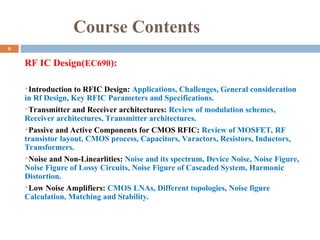
RF IC Design(EC690):
Introduction to RFIC Design: Applications, Challenges, General consideration
in Rf Design, Key RFIC Parameters and Specifications.
Transmitter and Receiver architectures: Review of modulation schemes,
Receiver architectures, Transmitter architectures.
Passive and Active Components for CMOS RFIC: Review of MOSFET, RF
transistor layout, CMOS process, Capacitors, Varactors, Resistors, Inductors,
Transformers.
Noise and Non-Linearlities: Noise and its spectrum, Device Noise, Noise Figure,
Noise Figure of Lossy Circuits, Noise Figure of Cascaded System, Harmonic
Distortion.
Low Noise Amplifiers: CMOS LNAs, Different topologies, Noise figure
Calculation, Matching and Stability.
6
Course Contents
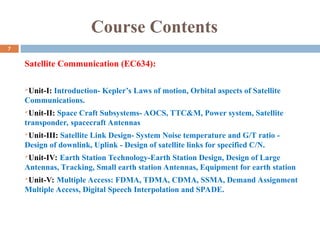
Satellite Communication (EC634):
Unit-I: Introduction- Kepler’s Laws of motion, Orbital aspects of Satellite
Communications.
Unit-II: Space Craft Subsystems- AOCS, TTC&M, Power system, Satellite
transponder, spacecraft Antennas
Unit-III: Satellite Link Design- System Noise temperature and G/T ratio -
Design of downlink, Uplink - Design of satellite links for specified C/N.
Unit-IV: Earth Station Technology-Earth Station Design, Design of Large
Antennas, Tracking, Small earth station Antennas, Equipment for earth station
Unit-V: Multiple Access: FDMA, TDMA, CDMA, SSMA, Demand Assignment
Multiple Access, Digital Speech Interpolation and SPADE.
7
Course Contents
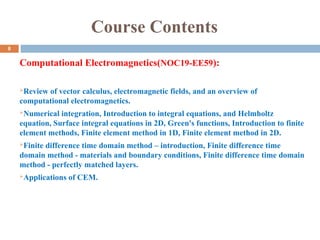
Computational Electromagnetics(NOC19-EE59):
Review of vector calculus, electromagnetic fields, and an overview of
computational electromagnetics.
Numerical integration, Introduction to integral equations, and Helmholtz
equation, Surface integral equations in 2D, Green's functions, Introduction to finite
element methods, Finite element method in 1D, Finite element method in 2D.
Finite difference time domain method – introduction, Finite difference time
domain method - materials and boundary conditions, Finite difference time domain
method - perfectly matched layers.
Applications of CEM.
8
Grade Card
9
Fundamentals of Microwave
Tubes
10
Space Charge Wave
 In the high current density electron beam; those electrons that do not get
neutralized make a bunch of electrons and called space charge.
 In the space charge a restoring force is developed and electron-electron
repulsion takes places and oscillation gets excited due to which two space
charge waves are generated.
 Fast Space Charge Wave ( )
 Slow Space charge Wave ( )
 To better understand the space-charge waves, we examine the
dispersion relation.
0
p
v v

0
p
v v

11
Cont….
(1)
Where, = Beam propagation constant
= Plasma propagation constant
The dispersion relation has been obtained with reference to a beam of infinite cross-section. There are two
space-charge waves corresponding to the plus and minus signs, respectively.
Fig.1.Dispersion diagram for space-charge waves[6]
0
p
e p
v
 
  
 


e

p

12
Space Charge Limited Condition
 In most of the Microwave tubes, the electron beam is realised under the space
charge limited condition.
 The operation under this condition can be understood with reference to a
simple planar diode.
 The operating regions of the planar diode are:
 Space- charge limited region
 Temperature-limited region
13
Cont…
Fig.4. Potential distribution in the anode cathode region[6]
14
The Child–Langmuir relation under the space-
charge-limited condition of emission
 A Child –Langmuir relation states that for a planar diode how the anode
current depends on the anode potential as well as on the separation between
the cathode and the anode[2].
 The Child –Langmuir relation is also known as the 3/2 power law.
[2]
Where,
= distance between the planar anode and cathode
= anode current
= anode potential
= current density
3/2
0 0
0 2
4 2
9
I V
J
A d
 
 
0
I
0
V
d
15
J
Cathode Emission
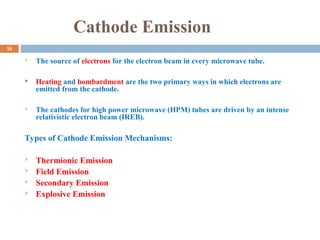
 The source of electrons for the electron beam in every microwave tube.
 Heating and bombardment are the two primary ways in which electrons are
emitted from the cathode.
 The cathodes for high power microwave (HPM) tubes are driven by an intense
relativistic electron beam (IREB).
Types of Cathode Emission Mechanisms:
 Thermionic Emission
 Field Emission
 Secondary Emission
 Explosive Emission
16
Thermionic Emission
The emission of electrons resulting from the heating of a surface is referred to as thermionic
emission.
The intensity of thermionic emission depends on the metal used for the emission as well as
the temperature of the metal.
Thermionic emission cathodes are used in linear beam tubes.
Fig.5.Energy level near the surface of a metal[2]
17
Field Emission
Field emission is formed by using a very high electric field.
This emission is also referred to as cold cathode emission.
The emission is a field emission if the energy responsible for it is in the form of
electric energy.
Fig.6. Energy profile with a very strong electric field[2]
18
Secondary Emission
 When electrons bombard a surface, they may cause other electrons to be emitted from
that surface. The bombarding electrons are called primary electrons and the emitted
electrons are called secondary electrons.
 Secondary emission is often used in conventional crossed-field microwave tubes to
decrease (or eliminate) the required heater power.
Fig.7. Secondary emission[2]
19
Explosive Emission
 The emission of electrons from a plasma created on the cathode surface by the application of a
strong electric field.
 Field-enhancement usually at the metallic surfaces tips of microprotrusions causes explosive
vaporization. This causes very high density metal plasma to form near the cathode surface.
 For large pulse power system (explosive electron emission) EEE methods are used to generate Giga-
watt power pulsed high current electron beams.
Fig.8. Microscopic view of the local electric field enhancement at the tip of a whisker-like protrusion on
the cathode surface[10]
20
Electron Gun
 It is used to generate, form and shape the electron beam prior to its use.
 The electron gun emits electrons and forms them into a beam by the help of a
heater, cathode, grid, pre-accelerating, accelerating and focusing anode.
 The two principal parameters of electron gun design are perveance and
convergence ratio.
Fig.8. Electron Gun
Fig.9. Eletron gun[5]
21
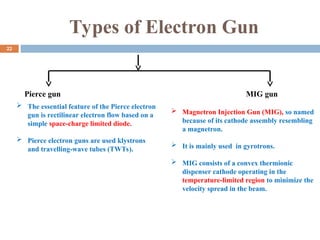
Types of Electron Gun
Pierce gun MIG gun
 Magnetron Injection Gun (MIG), so named
because of its cathode assembly resembling
a magnetron.
 It is mainly used in gyrotrons.
 MIG consists of a convex thermionic
dispenser cathode operating in the
temperature-limited region to minimize the
velocity spread in the beam.
 The essential feature of the Pierce electron
gun is rectilinear electron flow based on a
simple space-charge limited diode.
 Pierce electron guns are used klystrons
and travelling-wave tubes (TWTs).
22
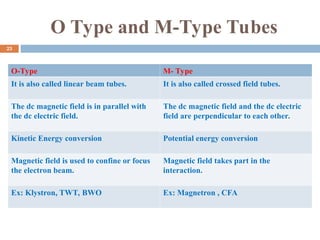
O Type and M-Type Tubes
O-Type M- Type
It is also called linear beam tubes. It is also called crossed field tubes.
The dc magnetic field is in parallel with
the dc electric field.
The dc magnetic field and the dc electric
field are perpendicular to each other.
Kinetic Energy conversion Potential energy conversion
Magnetic field is used to confine or focus
the electron beam.
Magnetic field takes part in the
interaction.
Ex: Klystron, TWT, BWO Ex: Magnetron , CFA
23
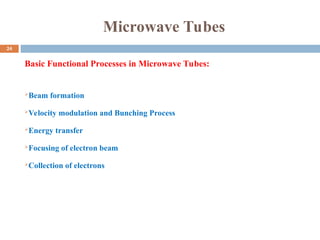
Microwave Tubes
Basic Functional Processes in Microwave Tubes:
Beam formation
Velocity modulation and Bunching Process
Energy transfer
Focusing of electron beam
Collection of electrons
24
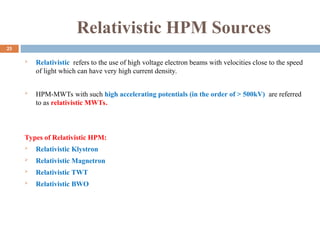
Relativistic HPM Sources
 Relativistic refers to the use of high voltage electron beams with velocities close to the speed
of light which can have very high current density.
 HPM-MWTs with such high accelerating potentials (in the order of > 500kV) are referred
to as relativistic MWTs.
Types of Relativistic HPM:
 Relativistic Klystron
 Relativistic Magnetron
 Relativistic TWT
 Relativistic BWO
25
Relativistic Klystron
 It is a relativistic version of conventional Klystron.
 It is widely used as high energy drivers for free electron lasers, directed energy weapons,
colliders and accelerators.
Features:
 Linear Beam Device
 Magnetic Field- Axial
 O-Type Devices
 Velocity Modulation for Electron Bunching
Fig.10.Schematic of relativistic klystron[7]
26
Relativistic Backward Wave
Oscillator
 It is the relativistic version, an O-type and Cherenkov radiation based device, operating at higher current and voltage.
 It is widely used to the high power microwave generation for the military applications.
 The reflector plays a vital role in the RBWO operation as it transforms the backward reflected waves into the forward propagating waves.
 The SWS structure is used to decrease the phase velocity of the RF wave in such a manner that the electron beam gets synchronized with
it.
Fig.11.Schematic of RBWO[7]
27
Relativistic Magnetron
 The relativistic magnetron is the relativistic version of the conventional magnetron
which is driven by DC pulsed power and cold cathode technology, and
fundamental difference is that it uses high voltage and current.
 The suitable operating voltages and the fields can be determined from the
mathematical relations known as Buneman-Hartree condition and the Hull cutoff
condition.
Fig.12. Schematic of Relativistic magnetron[7]
28
Cont…
The electron just gazes the anode as indicated in Figure (a), which is the Hull Cutoff condition.
 The electron strikes the anode as indicated in Figure (b).
 The electron returns to the cathode Figure (c).
Fig.13.Electron trajectories for various anode potential[2]
29
a
V
H
V
=Anode Voltage
= Hull cutoff voltage
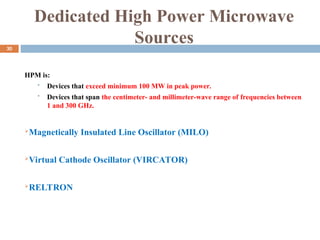
Dedicated High Power Microwave
Sources
HPM is:
 Devices that exceed minimum 100 MW in peak power.
 Devices that span the centimeter- and millimeter-wave range of frequencies between
1 and 300 GHz.
Magnetically Insulated Line Oscillator (MILO)
Virtual Cathode Oscillator (VIRCATOR)
RELTRON
30
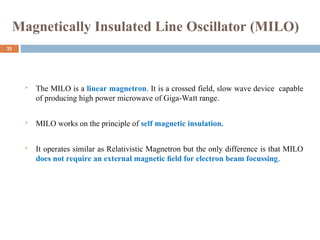
Magnetically Insulated Line Oscillator (MILO)
 The MILO is a linear magnetron. It is a crossed field, slow wave device capable
of producing high power microwave of Giga-Watt range.
 MILO works on the principle of self magnetic insulation.
 It operates similar as Relativistic Magnetron but the only difference is that MILO
does not require an external magnetic field for electron beam focussing.
31
Cont…
MILO consists of a coaxial loaded metal discs working as the slow wave structure
(SWS), explosive emission cathode, metal discs acting as a filter cum choke cavity,
extractor cavity, stub and the collector.
Features of MILO:
Self-Magnetic field generation
M-Type Microwave Tube (crossed-field device)
Slow-wave Device Fig.14. Schematic of MILO[8]
 π - mode of operation
32
Virtual Cathode Oscillator (VIRCATOR)
 It is a high power microwave oscillator, which are essentially based on bremsstrahlung
radiation in the magnetic field.
 Vircator differs from the rest HPM Devices in the way that microwave radiation is not
generated from the interaction of an electron beam and a cavity.
 Vircator depends on the phenomena of formation of virtual cathode.
Features:
 No external magnetic is required,
 Simple design
 Frequency tunability.
 Low efficiency.
Fig.15.Basic Vircator Geometry[7]
Insulator Anode
Virtual Cathode
Window
Cathode
33
Cont…
When a virtual cathode is formed , two things happen:
The location of the virtual cathode oscillates back and forth at roughly the beam plasma
frequency.
The oscillation of electrons between cathode and virtual cathode are known as reflexing.
Fig.16. Basic vircator geometries: (a) axial extraction and (b) side extraction.[1]
34
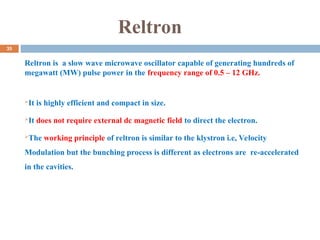
Reltron
Reltron is a slow wave microwave oscillator capable of generating hundreds of
megawatt (MW) pulse power in the frequency range of 0.5 – 12 GHz.
It is highly efficient and compact in size.
It does not require external dc magnetic field to direct the electron.
The working principle of reltron is similar to the klystron i.e, Velocity
Modulation but the bunching process is different as electrons are re-accelerated
in the cavities.
35
Features of Reltron
 Slow-wave Device
 Relativistic Device
 TM01 mode of operation
 /2 - mode of operation
 Self-Magnetic field generation
 No mode converter is required
36
Cont…
Elements of Reltron
 Power Modulator
 Electron Source
 Modulating Cavity
 Post acceleration Gap
 Extraction Cavity
 Beam Dump
Fig.17. Schematic of Reltron[7]
37
Cont…
Power Modulator: High voltage pulser used in Reltron is a Marx generator.
Electron Source: The injector consists of a velvet explosive emission type cathode. When the
voltage is applied to the cathode; explosive electron emission occurs in the cathode.
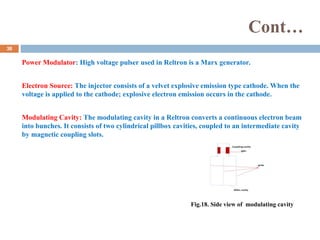
Modulating Cavity: The modulating cavity in a Reltron converts a continuous electron beam
into bunches. It consists of two cylindrical pillbox cavities, coupled to an intermediate cavity
by magnetic coupling slots.
Fig.18. Side view of modulating cavity
38
Cont…
Fig.19. The electric field amplitudes of the three resonant mode of the beam modulation structure[7]
The modulating cavity has three resonant modes that can exist inside the cavity, i.e. 0, π/2
and π modes.
The coupling cavity is adjusted with the main cavity in such a way that modulating cavity
resonate at desired π/2 mode and maximum RF energy transfer occurs through this mode.
39
Cont…
Accelerating Gap:
It is inserted immediately after the modulation cavity to reduce the energy spread.
The accelerating voltage causes all the electrons in bunches to move at nearly the speed of
light, thereby freezing the temporal bunch structure of the beam.
Extraction Cavity:
Microwave are extracted from the beam bunches as they enters the extraction cavity.
The RF output coupling delivers the power directly via the fundamental TE10 wave in
rectangular waveguide without a mode converter.
A multi-cavity output section is used that efficiently extracts power without RF
breakdown.
40
Reference
[1]J. Benford, J. A. Swegle and E. Schamilogdu, “High Power Microwave”, 2nd
Edition , Taylor & Francis,
2007.
[2] Gilmour A S 2011 Klystrons, Traveling Wave Tubes, Magnetrons Crossed-Field Amplifiers, and
Gyrotrons (Boston: Artech House)
[3] Collin R E 1992 Foundations for Microwave Engineering 2nd edn (New York: Wiley-IEEE Press)
[4] Basu B N 1996 Electromagnetic Theory and Applications in Beam-wave Electronics (Singapore: World
Scientific)
[5]Roy, Amitava Saxena, A.K., & Ray, A.K. (Eds.). (2010). Electronic emission and electron guns. India:
Bhabha Atomic Research Centre.
[6] Vishal Keshari, Basu B N High Power Microwave Tubes, Volume 1: Basics and Trends
[7] Vishal Keshari, Basu B N High Power Microwave Tubes, Volume 2: Basics and Trends
[8] Mahto,M and jain, P.K.,2017, “Analysis, Design and Simulation of the HPM source-Reltron,” Ph.D.
Thesis, IIT BHU, Varanasi, 2017.
[9] Gargi Dixit, Arjun Kumar, and P. K. Jain, “Design analysis and simulation study of an efficiency
enhanced L-band MILO,” Physics of Plasmas 24, 013113 (2017).
[10] R. B. Miller, “An Introduction to the Physics of Intense Charged Particle Beams”, Springer, 1982.
41
Thank You
42

Comprehensive Examination.ppt based on comprehensive viva for phd exam

  • 1.
    COMPREHENSIVE EXAMINATION Presented By: NeetuKumari Roll No-195EC03 Supervisor: Co-Supervisor: Prof. P. K. Jain Dr. Manpuran Mahto Department of Electronics & Communication Engineering National Institute of Technology Patna Patna 800005 1
  • 2.
    Content 2  Course Work Course Content  Space Charge  Space Charge Limited Condition  Cathode Emission  Microwave Tubes  Relativistic Devices  HPM Sources  References
  • 3.
    Course Work  TheSupervisior suggested the following courses, as a part of the PhD programme. S.No. Course Code Course Name Credit 1. EC632 Advanced Antenna Engineering 3 2. EC690 RF IC Design 3 3. EC634 Satellite Communication 3 4. EC901 Research Methodology 3 5. NOC19-EE59 Computational Electromagnetics 3 6. EC990 Seminar and Technical report writing 2 3
  • 4.
    Course Contents Advanced AntennaEngineering (EC632): Unit-I: Introduction Fundamental Parameters of Antennas; Equivalent Circuit of Transmitting and Receiving Antennas. Unit-II: Wire Antenna Radiation Integral and Auxiliary Potential Functions; Short and Long Linear Dipole.  Unit-III: Broadband Antenna and Antenna Miniaturization Broadband and Frequency Independent Antennas with Emphasis on Bi-Conical Dipole, Helical Antenna, and Log-Periodic Antenna. Unit-IV: Antenna Arrays Linear Phased Array; Planar Array; Planar Phased Array; Beam scanning and Grating Lobe. 4
  • 5.
    Course Contents Research Methodology(EC901): Unit-I:Introduction to Research Methods Philosophy of Science, Types of Research; Research Purposes - Research Design - Survey Research - Case Study Research. Unit-II: Data Collection and Sampling Design Sources of Data: Primary Data, Secondary Data.  Unit-III: Statistical Modelling and Analysis, Time Series Analysis Probability Distributions, Fundamentals of Statistical Analysis and Inference, Multivariate methods, Concepts of Correlation and Regression. Unit-IV: ANOVA (Analysis of Variance) Unit-V: Research Reports Structure and Components of Research Report, Types of Report. 5
  • 6.
    Course Contents RF ICDesign(EC690): Introduction to RFIC Design: Applications, Challenges, General consideration in Rf Design, Key RFIC Parameters and Specifications. Transmitter and Receiver architectures: Review of modulation schemes, Receiver architectures, Transmitter architectures. Passive and Active Components for CMOS RFIC: Review of MOSFET, RF transistor layout, CMOS process, Capacitors, Varactors, Resistors, Inductors, Transformers. Noise and Non-Linearlities: Noise and its spectrum, Device Noise, Noise Figure, Noise Figure of Lossy Circuits, Noise Figure of Cascaded System, Harmonic Distortion. Low Noise Amplifiers: CMOS LNAs, Different topologies, Noise figure Calculation, Matching and Stability. 6
  • 7.
    Course Contents Satellite Communication(EC634): Unit-I: Introduction- Kepler’s Laws of motion, Orbital aspects of Satellite Communications. Unit-II: Space Craft Subsystems- AOCS, TTC&M, Power system, Satellite transponder, spacecraft Antennas Unit-III: Satellite Link Design- System Noise temperature and G/T ratio - Design of downlink, Uplink - Design of satellite links for specified C/N. Unit-IV: Earth Station Technology-Earth Station Design, Design of Large Antennas, Tracking, Small earth station Antennas, Equipment for earth station Unit-V: Multiple Access: FDMA, TDMA, CDMA, SSMA, Demand Assignment Multiple Access, Digital Speech Interpolation and SPADE. 7
  • 8.
    Course Contents Computational Electromagnetics(NOC19-EE59): Reviewof vector calculus, electromagnetic fields, and an overview of computational electromagnetics. Numerical integration, Introduction to integral equations, and Helmholtz equation, Surface integral equations in 2D, Green's functions, Introduction to finite element methods, Finite element method in 1D, Finite element method in 2D. Finite difference time domain method – introduction, Finite difference time domain method - materials and boundary conditions, Finite difference time domain method - perfectly matched layers. Applications of CEM. 8
  • 9.
  • 10.
  • 11.
    Space Charge Wave In the high current density electron beam; those electrons that do not get neutralized make a bunch of electrons and called space charge.  In the space charge a restoring force is developed and electron-electron repulsion takes places and oscillation gets excited due to which two space charge waves are generated.  Fast Space Charge Wave ( )  Slow Space charge Wave ( )  To better understand the space-charge waves, we examine the dispersion relation. 0 p v v  0 p v v  11
  • 12.
    Cont…. (1) Where, = Beampropagation constant = Plasma propagation constant The dispersion relation has been obtained with reference to a beam of infinite cross-section. There are two space-charge waves corresponding to the plus and minus signs, respectively. Fig.1.Dispersion diagram for space-charge waves[6] 0 p e p v          e  p  12
  • 13.
    Space Charge LimitedCondition  In most of the Microwave tubes, the electron beam is realised under the space charge limited condition.  The operation under this condition can be understood with reference to a simple planar diode.  The operating regions of the planar diode are:  Space- charge limited region  Temperature-limited region 13
  • 14.
    Cont… Fig.4. Potential distributionin the anode cathode region[6] 14
  • 15.
    The Child–Langmuir relationunder the space- charge-limited condition of emission  A Child –Langmuir relation states that for a planar diode how the anode current depends on the anode potential as well as on the separation between the cathode and the anode[2].  The Child –Langmuir relation is also known as the 3/2 power law. [2] Where, = distance between the planar anode and cathode = anode current = anode potential = current density 3/2 0 0 0 2 4 2 9 I V J A d     0 I 0 V d 15 J
  • 16.
    Cathode Emission  Thesource of electrons for the electron beam in every microwave tube.  Heating and bombardment are the two primary ways in which electrons are emitted from the cathode.  The cathodes for high power microwave (HPM) tubes are driven by an intense relativistic electron beam (IREB). Types of Cathode Emission Mechanisms:  Thermionic Emission  Field Emission  Secondary Emission  Explosive Emission 16
  • 17.
    Thermionic Emission The emissionof electrons resulting from the heating of a surface is referred to as thermionic emission. The intensity of thermionic emission depends on the metal used for the emission as well as the temperature of the metal. Thermionic emission cathodes are used in linear beam tubes. Fig.5.Energy level near the surface of a metal[2] 17
  • 18.
    Field Emission Field emissionis formed by using a very high electric field. This emission is also referred to as cold cathode emission. The emission is a field emission if the energy responsible for it is in the form of electric energy. Fig.6. Energy profile with a very strong electric field[2] 18
  • 19.
    Secondary Emission  Whenelectrons bombard a surface, they may cause other electrons to be emitted from that surface. The bombarding electrons are called primary electrons and the emitted electrons are called secondary electrons.  Secondary emission is often used in conventional crossed-field microwave tubes to decrease (or eliminate) the required heater power. Fig.7. Secondary emission[2] 19
  • 20.
    Explosive Emission  Theemission of electrons from a plasma created on the cathode surface by the application of a strong electric field.  Field-enhancement usually at the metallic surfaces tips of microprotrusions causes explosive vaporization. This causes very high density metal plasma to form near the cathode surface.  For large pulse power system (explosive electron emission) EEE methods are used to generate Giga- watt power pulsed high current electron beams. Fig.8. Microscopic view of the local electric field enhancement at the tip of a whisker-like protrusion on the cathode surface[10] 20
  • 21.
    Electron Gun  Itis used to generate, form and shape the electron beam prior to its use.  The electron gun emits electrons and forms them into a beam by the help of a heater, cathode, grid, pre-accelerating, accelerating and focusing anode.  The two principal parameters of electron gun design are perveance and convergence ratio. Fig.8. Electron Gun Fig.9. Eletron gun[5] 21
  • 22.
    Types of ElectronGun Pierce gun MIG gun  Magnetron Injection Gun (MIG), so named because of its cathode assembly resembling a magnetron.  It is mainly used in gyrotrons.  MIG consists of a convex thermionic dispenser cathode operating in the temperature-limited region to minimize the velocity spread in the beam.  The essential feature of the Pierce electron gun is rectilinear electron flow based on a simple space-charge limited diode.  Pierce electron guns are used klystrons and travelling-wave tubes (TWTs). 22
  • 23.
    O Type andM-Type Tubes O-Type M- Type It is also called linear beam tubes. It is also called crossed field tubes. The dc magnetic field is in parallel with the dc electric field. The dc magnetic field and the dc electric field are perpendicular to each other. Kinetic Energy conversion Potential energy conversion Magnetic field is used to confine or focus the electron beam. Magnetic field takes part in the interaction. Ex: Klystron, TWT, BWO Ex: Magnetron , CFA 23
  • 24.
    Microwave Tubes Basic FunctionalProcesses in Microwave Tubes: Beam formation Velocity modulation and Bunching Process Energy transfer Focusing of electron beam Collection of electrons 24
  • 25.
    Relativistic HPM Sources Relativistic refers to the use of high voltage electron beams with velocities close to the speed of light which can have very high current density.  HPM-MWTs with such high accelerating potentials (in the order of > 500kV) are referred to as relativistic MWTs. Types of Relativistic HPM:  Relativistic Klystron  Relativistic Magnetron  Relativistic TWT  Relativistic BWO 25
  • 26.
    Relativistic Klystron  Itis a relativistic version of conventional Klystron.  It is widely used as high energy drivers for free electron lasers, directed energy weapons, colliders and accelerators. Features:  Linear Beam Device  Magnetic Field- Axial  O-Type Devices  Velocity Modulation for Electron Bunching Fig.10.Schematic of relativistic klystron[7] 26
  • 27.
    Relativistic Backward Wave Oscillator It is the relativistic version, an O-type and Cherenkov radiation based device, operating at higher current and voltage.  It is widely used to the high power microwave generation for the military applications.  The reflector plays a vital role in the RBWO operation as it transforms the backward reflected waves into the forward propagating waves.  The SWS structure is used to decrease the phase velocity of the RF wave in such a manner that the electron beam gets synchronized with it. Fig.11.Schematic of RBWO[7] 27
  • 28.
    Relativistic Magnetron  Therelativistic magnetron is the relativistic version of the conventional magnetron which is driven by DC pulsed power and cold cathode technology, and fundamental difference is that it uses high voltage and current.  The suitable operating voltages and the fields can be determined from the mathematical relations known as Buneman-Hartree condition and the Hull cutoff condition. Fig.12. Schematic of Relativistic magnetron[7] 28
  • 29.
    Cont… The electron justgazes the anode as indicated in Figure (a), which is the Hull Cutoff condition.  The electron strikes the anode as indicated in Figure (b).  The electron returns to the cathode Figure (c). Fig.13.Electron trajectories for various anode potential[2] 29 a V H V =Anode Voltage = Hull cutoff voltage
  • 30.
    Dedicated High PowerMicrowave Sources HPM is:  Devices that exceed minimum 100 MW in peak power.  Devices that span the centimeter- and millimeter-wave range of frequencies between 1 and 300 GHz. Magnetically Insulated Line Oscillator (MILO) Virtual Cathode Oscillator (VIRCATOR) RELTRON 30
  • 31.
    Magnetically Insulated LineOscillator (MILO)  The MILO is a linear magnetron. It is a crossed field, slow wave device capable of producing high power microwave of Giga-Watt range.  MILO works on the principle of self magnetic insulation.  It operates similar as Relativistic Magnetron but the only difference is that MILO does not require an external magnetic field for electron beam focussing. 31
  • 32.
    Cont… MILO consists ofa coaxial loaded metal discs working as the slow wave structure (SWS), explosive emission cathode, metal discs acting as a filter cum choke cavity, extractor cavity, stub and the collector. Features of MILO: Self-Magnetic field generation M-Type Microwave Tube (crossed-field device) Slow-wave Device Fig.14. Schematic of MILO[8]  π - mode of operation 32
  • 33.
    Virtual Cathode Oscillator(VIRCATOR)  It is a high power microwave oscillator, which are essentially based on bremsstrahlung radiation in the magnetic field.  Vircator differs from the rest HPM Devices in the way that microwave radiation is not generated from the interaction of an electron beam and a cavity.  Vircator depends on the phenomena of formation of virtual cathode. Features:  No external magnetic is required,  Simple design  Frequency tunability.  Low efficiency. Fig.15.Basic Vircator Geometry[7] Insulator Anode Virtual Cathode Window Cathode 33
  • 34.
    Cont… When a virtualcathode is formed , two things happen: The location of the virtual cathode oscillates back and forth at roughly the beam plasma frequency. The oscillation of electrons between cathode and virtual cathode are known as reflexing. Fig.16. Basic vircator geometries: (a) axial extraction and (b) side extraction.[1] 34
  • 35.
    Reltron Reltron is aslow wave microwave oscillator capable of generating hundreds of megawatt (MW) pulse power in the frequency range of 0.5 – 12 GHz. It is highly efficient and compact in size. It does not require external dc magnetic field to direct the electron. The working principle of reltron is similar to the klystron i.e, Velocity Modulation but the bunching process is different as electrons are re-accelerated in the cavities. 35
  • 36.
    Features of Reltron Slow-wave Device  Relativistic Device  TM01 mode of operation  /2 - mode of operation  Self-Magnetic field generation  No mode converter is required 36
  • 37.
    Cont… Elements of Reltron Power Modulator  Electron Source  Modulating Cavity  Post acceleration Gap  Extraction Cavity  Beam Dump Fig.17. Schematic of Reltron[7] 37
  • 38.
    Cont… Power Modulator: Highvoltage pulser used in Reltron is a Marx generator. Electron Source: The injector consists of a velvet explosive emission type cathode. When the voltage is applied to the cathode; explosive electron emission occurs in the cathode. Modulating Cavity: The modulating cavity in a Reltron converts a continuous electron beam into bunches. It consists of two cylindrical pillbox cavities, coupled to an intermediate cavity by magnetic coupling slots. Fig.18. Side view of modulating cavity 38
  • 39.
    Cont… Fig.19. The electricfield amplitudes of the three resonant mode of the beam modulation structure[7] The modulating cavity has three resonant modes that can exist inside the cavity, i.e. 0, π/2 and π modes. The coupling cavity is adjusted with the main cavity in such a way that modulating cavity resonate at desired π/2 mode and maximum RF energy transfer occurs through this mode. 39
  • 40.
    Cont… Accelerating Gap: It isinserted immediately after the modulation cavity to reduce the energy spread. The accelerating voltage causes all the electrons in bunches to move at nearly the speed of light, thereby freezing the temporal bunch structure of the beam. Extraction Cavity: Microwave are extracted from the beam bunches as they enters the extraction cavity. The RF output coupling delivers the power directly via the fundamental TE10 wave in rectangular waveguide without a mode converter. A multi-cavity output section is used that efficiently extracts power without RF breakdown. 40
  • 41.
    Reference [1]J. Benford, J.A. Swegle and E. Schamilogdu, “High Power Microwave”, 2nd Edition , Taylor & Francis, 2007. [2] Gilmour A S 2011 Klystrons, Traveling Wave Tubes, Magnetrons Crossed-Field Amplifiers, and Gyrotrons (Boston: Artech House) [3] Collin R E 1992 Foundations for Microwave Engineering 2nd edn (New York: Wiley-IEEE Press) [4] Basu B N 1996 Electromagnetic Theory and Applications in Beam-wave Electronics (Singapore: World Scientific) [5]Roy, Amitava Saxena, A.K., & Ray, A.K. (Eds.). (2010). Electronic emission and electron guns. India: Bhabha Atomic Research Centre. [6] Vishal Keshari, Basu B N High Power Microwave Tubes, Volume 1: Basics and Trends [7] Vishal Keshari, Basu B N High Power Microwave Tubes, Volume 2: Basics and Trends [8] Mahto,M and jain, P.K.,2017, “Analysis, Design and Simulation of the HPM source-Reltron,” Ph.D. Thesis, IIT BHU, Varanasi, 2017. [9] Gargi Dixit, Arjun Kumar, and P. K. Jain, “Design analysis and simulation study of an efficiency enhanced L-band MILO,” Physics of Plasmas 24, 013113 (2017). [10] R. B. Miller, “An Introduction to the Physics of Intense Charged Particle Beams”, Springer, 1982. 41
  • 42.

Editor's Notes

  • #12 [6]Vishal Keshari, Basu B N High Power Microwave Tubes, Volume 1: Basics and Trends 
  • #14 [6] Vishal Keshari, Basu B N High Power Microwave Tubes, Volume 1: Basics and Trends 
  • #15 [2] Gilmour A S 2011 Klystrons, Traveling Wave Tubes, Magnetrons Crossed-Field Amplifiers, and Gyrotrons (Boston: Artech House)
  • #17 [2] Gilmour A S 2011 Klystrons, Traveling Wave Tubes, Magnetrons Crossed-Field Amplifiers, and Gyrotrons (Boston: Artech House)
  • #18 [2] Gilmour A S 2011 Klystrons, Traveling Wave Tubes, Magnetrons Crossed-Field Amplifiers, and Gyrotrons (Boston: Artech House)
  • #19 [2] Gilmour A S 2011 Klystrons, Traveling Wave Tubes, Magnetrons Crossed-Field Amplifiers, and Gyrotrons (Boston: Artech House)
  • #20 [10] R. B. Miller, “An Introduction to the Physics of Intense Charged Particle Beams”, Springer, 1982.
  • #21 [5]Roy, Amitava Saxena, A.K., & Ray, A.K. (Eds.). (2010). Electronic emission and electron guns. India: Bhabha Atomic Research Centre.
  • #26 [7] Mahto,M and jain, P.K.,2017, “Analysis, Design and Simulation of the HPM source-Reltron,” Ph.D. Thesis, IIT BHU, Varanasi, 2017.
  • #27 [7] Mahto,M and jain, P.K.,2017, “Analysis, Design and Simulation of the HPM source-Reltron,” Ph.D. Thesis, IIT BHU, Varanasi, 2017.
  • #29 [2] Gilmour A S 2011 Klystrons, Traveling Wave Tubes, Magnetrons Crossed-Field Amplifiers,and Gyrotrons (Boston: Artech House)
  • #32 [8] Mahto,M and jain, P.K.,2017, “Analysis, Design and Simulation of the HPM source-Reltron,” Ph.D. Thesis, IIT BHU, Varanasi, 2017.
  • #33 [7] Mahto,M and jain, P.K.,2017, “Analysis, Design and Simulation of the HPM source-Reltron,” Ph.D. Thesis, IIT BHU, Varanasi, 2017.
  • #34 [1]J. Benford, J. A. Swegle and E. Schamilogdu, “High Power Microwave”, 2nd Edition , Taylor & Francis, 2007.
  • #37 [7] Mahto,M and jain, P.K.,2017, “Analysis, Design and Simulation of the HPM source-Reltron,” Ph.D. Thesis, IIT BHU, Varanasi, 2017.
  • #39 [7] Mahto,M and jain, P.K.,2017, “Analysis, Design and Simulation of the HPM source-Reltron,” Ph.D. Thesis, IIT BHU, Varanasi, 2017.