Examples
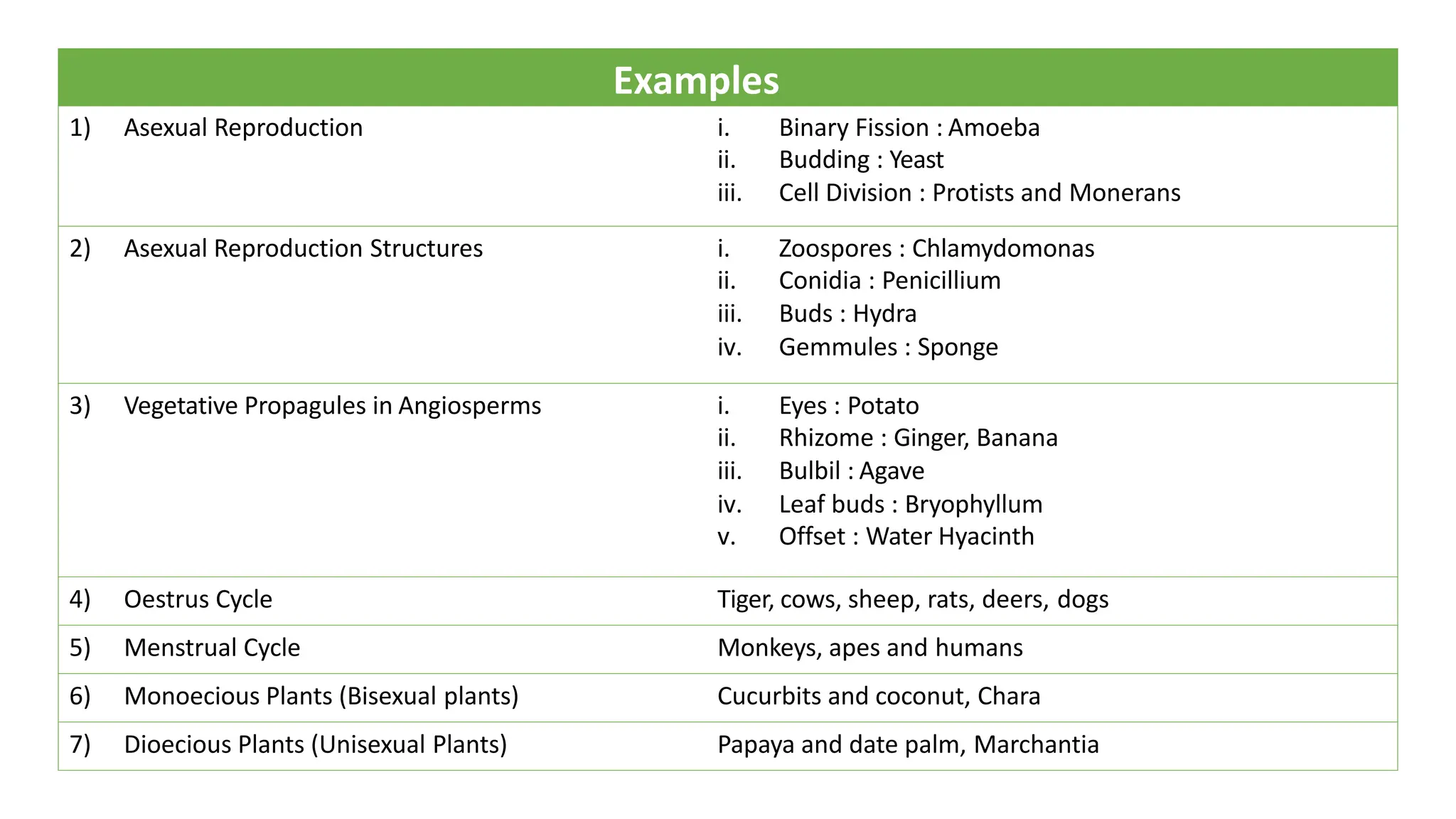
1) Asexual Reproduction i. Binary Fission : Amoeba
ii. Budding : Yeast
iii. Cell Division : Protists and Monerans
2) Asexual Reproduction Structures i. Zoospores : Chlamydomonas
ii. Conidia : Penicillium
iii. Buds : Hydra
iv. Gemmules : Sponge
3) Vegetative Propagules in Angiosperms i. Eyes : Potato
ii. Rhizome : Ginger, Banana
iii. Bulbil : Agave
iv. Leaf buds : Bryophyllum
v. Offset : Water Hyacinth
4) Oestrus Cycle Tiger, cows, sheep, rats, deers, dogs
5) Menstrual Cycle Monkeys, apes and humans
6) Monoecious Plants (Bisexual plants) Cucurbits and coconut, Chara
7) Dioecious Plants (Unisexual Plants) Papaya and date palm, Marchantia
Examples
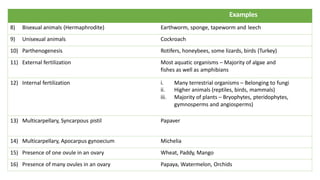
8) Bisexual animals (Hermaphrodite) Earthworm, sponge, tapeworm and leech
9) Unisexual animals Cockroach
10) Parthenogenesis Rotifers, honeybees, some lizards, birds (Turkey)
11) External fertilization Most aquatic organisms – Majority of algae and
fishes as well as amphibians
12) Internal fertilization i. Many terrestrial organisms – Belonging to fungi
ii. Higher animals (reptiles, birds, mammals)
iii. Majority of plants – Bryophytes, pteridophytes,
gymnosperms and angiosperms)
13) Multicarpellary, Syncarpous pistil Papaver
14) Multicarpellary, Apocarpus gynoecium Michelia
15) Presence of one ovule in an ovary Wheat, Paddy, Mango
16) Presence of many ovules in an ovary Papaya, Watermelon, Orchids
Examples
16) Autogamy Viola (common pansy), Oxalis and Commelina
17) Abiotic agents of pollination Wind and water
18) Biotic agents of pollination Animals [Bees, Butterflies, beetles, wasp, ants, moths,
birds (sunbird and humming birds), bats, some
primates(lemurs) and arboreal(tree-dwelling) rodents,
reptiles (gecko lizard and garden lizard)]
19) Wind pollination Grasses
20) Water pollination Algae, bryophytes, pteridophytes
§ Vallisneria and Hydrilla (grow in fresh water
§ Zostera (grow in marine water)
Insect or Wind pollination – Water hyacinth and water lily
21) Endosperms completely consumed by
developing embryo before seed maturation
Pea, groundnuts, beans
Examples
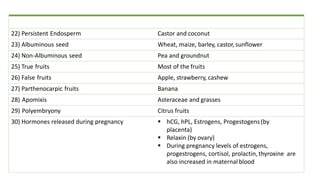
22) Persistent Endosperm Castor and coconut
23) Albuminous seed Wheat, maize, barley, castor,sunflower
24) Non-Albuminous seed Pea and groundnut
25) True fruits Most of the fruits
26) False fruits Apple, strawberry, cashew
27) Parthenocarpic fruits Banana
28) Apomixis Asteraceae and grasses
29) Polyembryony Citrus fruits
30) Hormones released during pregnancy § hCG, hPL, Estrogens, Progestogens(by
placenta)
§ Relaxin (by ovary)
§ During pregnancy levels of estrogens,
progestrogens, cortisol, prolactin, thyroxine are
also increased in maternal blood
Examples
31) Natural methods of contraception § Periodic abstinence
§ Withdrawal or coitus interrupts
§ Lactational amenorrhea
32) Barrier methods of contraception § Condoms, Diaphragms, cervical caps andvaults
33) IUDs § Non-medicated IUDs – Lippes loop
§ Copper releasing IUDs – CuT, Cu7, Multiload 375
§ Hormone releasing IUDs – Progestasert and LNG- 20
34) Incomplete Dominance Dog flower (snapdragon or Antirrhinumspecies)
35) Co-dominance ABO blood grouping
36) Multiple Allelism ABO blood grouping
37) Pleiotropy Phenylketonuria
Examples
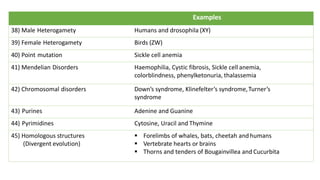
38) Male Heterogamety Humans and drosophila (XY)
39) Female Heterogamety Birds (ZW)
40) Point mutation Sickle cell anemia
41) Mendelian Disorders Haemophilia, Cystic fibrosis, Sickle cell anemia,
colorblindness, phenylketonuria, thalassemia
42) Chromosomal disorders Down’s syndrome, Klinefelter’s syndrome,Turner’s
syndrome
43) Purines Adenine and Guanine
44) Pyrimidines Cytosine, Uracil and Thymine
45) Homologous structures
(Divergent evolution)
§ Forelimbs of whales, bats, cheetah and humans
§ Vertebrate hearts or brains
§ Thorns and tenders of Bougainvillea and Cucurbita
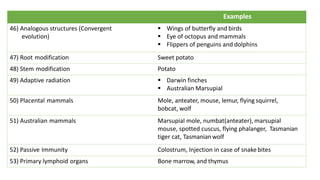
Examples
46) Analogous structures (Convergent
evolution)
§ Wings of butterfly and birds
§ Eye of octopus and mammals
§ Flippers of penguins and dolphins
47) Root modification Sweet potato
48) Stem modification Potato
49) Adaptive radiation § Darwin finches
§ Australian Marsupial
50) Placental mammals Mole, anteater, mouse, lemur, flying squirrel,
bobcat, wolf
51) Australian mammals Marsupial mole, numbat(anteater), marsupial
mouse, spotted cuscus, flying phalanger, Tasmanian
tiger cat, Tasmanianwolf
52) Passive Immunity Colostrum, Injection in case of snake bites
53) Primary lymphoid organs Bone marrow, and thymus
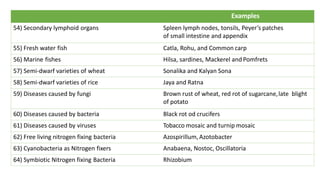
Examples
54) Secondary lymphoid organs Spleen lymph nodes, tonsils, Peyer’s patches
of small intestine and appendix
55) Fresh water fish Catla, Rohu, and Common carp
56) Marine fishes Hilsa, sardines, Mackerel and Pomfrets
57) Semi-dwarf varieties of wheat Sonalika and Kalyan Sona
58) Semi-dwarf varieties of rice Jaya and Ratna
59) Diseases caused by fungi Brown rust of wheat, red rot of sugarcane,late blight
of potato
60) Diseases caused by bacteria Black rot od crucifers
61) Diseases caused by viruses Tobacco mosaic and turnip mosaic
62) Free living nitrogen fixing bacteria Azospirillum,Azotobacter
63) Cyanobacteria as Nitrogen fixers Anabaena, Nostoc, Oscillatoria
64) Symbiotic Nitrogen fixing Bacteria Rhizobium
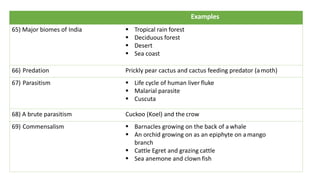
Examples
65) Major biomes of India § Tropical rain forest
§ Deciduous forest
§ Desert
§ Sea coast
66) Predation Prickly pear cactus and cactus feeding predator (amoth)
67) Parasitism § Life cycle of human liver fluke
§ Malarial parasite
§ Cuscuta
68) A brute parasitism Cuckoo (Koel) and the crow
69) Commensalism § Barnacles growing on the back of a whale
§ An orchid growing on as an epiphyte on amango
branch
§ Cattle Egret and grazing cattle
§ Sea anemone and clown fish
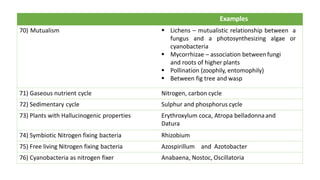
Examples
70) Mutualism § Lichens – mutualistic relationship between a
fungus and a photosynthesizing algae or
cyanobacteria
§ Mycorrhizae – association between fungi
and roots of higher plants
§ Pollination (zoophily, entomophily)
§ Between fig tree and wasp
71) Gaseous nutrient cycle Nitrogen, carbon cycle
72) Sedimentary cycle Sulphur and phosphorus cycle
73) Plants with Hallucinogenic properties Erythroxylum coca, Atropa belladonnaand
Datura
74) Symbiotic Nitrogen fixing bacteria Rhizobium
75) Free living Nitrogen fixing bacteria Azospirillum and Azotobacter
76) Cyanobacteria as nitrogen fixer Anabaena, Nostoc, Oscillatoria
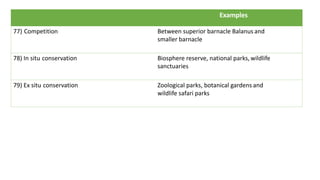
Examples
77) Competition Between superior barnacle Balanus and
smaller barnacle
78) In situ conservation Biosphere reserve, national parks, wildlife
sanctuaries
79) Ex situ conservation Zoological parks, botanical gardens and
wildlife safari parks
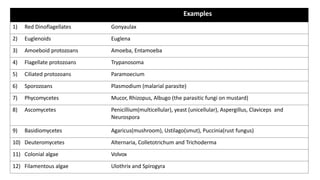
Examples
1) Red Dinoflagellates Gonyaulax
2) Euglenoids Euglena
3) Amoeboid protozoans Amoeba, Entamoeba
4) Flagellate protozoans Trypanosoma
5) Ciliated protozoans Paramoecium
6) Sporozoans Plasmodium (malarial parasite)
7) Phycomycetes Mucor, Rhizopus, Albugo (the parasitic fungi on mustard)
8) Ascomycetes Penicillium(multicellular), yeast (unicellular), Aspergillus, Claviceps and
Neurospora
9) Basidiomycetes Agaricus(mushroom), Ustilago(smut), Puccinia(rust fungus)
10) Deuteromycetes Alternaria, Colletotrichum and Trichoderma
11) Colonial algae Volvox
12) Filamentous algae Ulothrix and Spirogyra
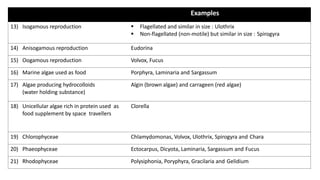
Examples
13) Isogamous reproduction § Flagellated and similar in size : Ulothrix
§ Non-flagellated (non-motile) but similar in size : Spirogyra
14) Anisogamous reproduction Eudorina
15) Oogamous reproduction Volvox, Fucus
16) Marine algae used as food Porphyra, Laminaria and Sargassum
17) Algae producing hydrocolloids
(water holding substance)
Algin (brown algae) and carrageen (red algae)
18) Unicellular algae rich in protein used as
food supplement by space travellers
Clorella
19) Chlorophyceae Chlamydomonas, Volvox, Ulothrix, Spirogyra and Chara
20) Phaeophyceae Ectocarpus, Dicyota, Laminaria, Sargassum and Fucus
21) Rhodophyceae Polysiphonia, Poryphyra, Gracilaria and Gelidium
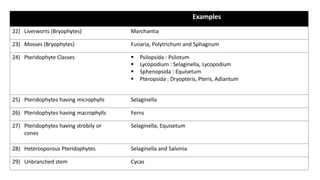
Examples
22) Liverworts (Bryophytes) Marchantia
23) Mosses (Bryophytes) Funaria, Polytrichum and Sphagnum
24) Pteridophyte Classes § Psilopsida : Psilotum
§ Lycopodium : Selaginella, Lycopodium
§ Sphenopsida : Equisetum
§ Pteropsida : Dryopteris, Pteris, Adiantum
25) Pteridophytes having microphylls Selaginella
26) Pteridophytes having macrophylls Ferns
27) Pteridophytes having strobily or
cones
Selaginella, Equisetum
28) Heterosporous Pteridophytes Selaginella and Salvinia
29) Unbranched stem Cycas
Examples
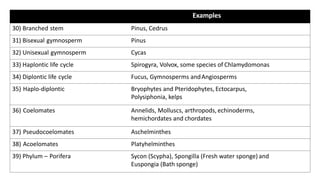
30) Branched stem Pinus, Cedrus
31) Bisexual gymnosperm Pinus
32) Unisexual gymnosperm Cycas
33) Haplontic life cycle Spirogyra, Volvox, some species of Chlamydomonas
34) Diplontic life cycle Fucus, Gymnosperms andAngiosperms
35) Haplo-diplontic Bryophytes and Pteridophytes, Ectocarpus,
Polysiphonia, kelps
36) Coelomates Annelids, Molluscs, arthropods, echinoderms,
hemichordates and chordates
37) Pseudocoelomates Aschelminthes
38) Acoelomates Platyhelminthes
39) Phylum – Porifera Sycon (Scypha), Spongilla (Fresh water sponge) and
Euspongia (Bath sponge)
Examples
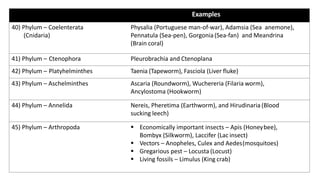
40) Phylum – Coelenterata
(Cnidaria)
Physalia (Portuguese man-of-war), Adamsia (Sea anemone),
Pennatula (Sea-pen), Gorgonia (Sea-fan) and Meandrina
(Brain coral)
41) Phylum – Ctenophora Pleurobrachia and Ctenoplana
42) Phylum – Platyhelminthes Taenia (Tapeworm), Fasciola (Liver fluke)
43) Phylum – Aschelminthes Ascaria (Roundworm), Wuchereria (Filaria worm),
Ancylostoma (Hookworm)
44) Phylum – Annelida Nereis, Pheretima (Earthworm), and Hirudinaria (Blood
sucking leech)
45) Phylum – Arthropoda § Economically important insects – Apis (Honeybee),
Bombyx (Silkworm), Laccifer (Lac insect)
§ Vectors – Anopheles, Culex and Aedes(mosquitoes)
§ Gregarious pest – Locusta (Locust)
§ Living fossils – Limulus (King crab)
Examples
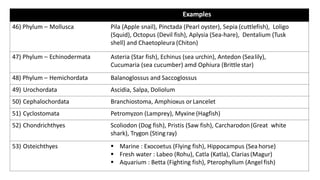
46) Phylum – Mollusca Pila (Apple snail), Pinctada (Pearl oyster), Sepia (cuttlefish), Loligo
(Squid), Octopus (Devil fish), Aplysia (Sea-hare), Dentalium (Tusk
shell) and Chaetopleura (Chiton)
47) Phylum – Echinodermata Asteria (Star fish), Echinus (sea urchin), Antedon (Sealily),
Cucumaria (sea cucumber) amd Ophiura (Brittlestar)
48) Phylum – Hemichordata Balanoglossus and Saccoglossus
49) Urochordata Ascidia, Salpa, Doliolum
50) Cephalochordata Branchiostoma, Amphioxus orLancelet
51) Cyclostomata Petromyzon (Lamprey), Myxine (Hagfish)
52) Chondrichthyes Scoliodon (Dog fish), Pristis (Saw fish), Carcharodon(Great white
shark), Trygon (Sting ray)
53) Osteichthyes § Marine : Exocoetus (Flying fish), Hippocampus (Sea horse)
§ Fresh water : Labeo (Rohu), Catla (Katla), Clarias(Magur)
§ Aquarium : Betta (Fighting fish), Pterophyllum (Angel fish)
Examples
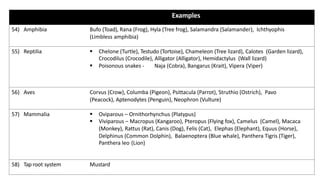
54) Amphibia Bufo (Toad), Rana (Frog), Hyla (Tree frog), Salamandra (Salamander), Ichthyophis
(Limbless amphibia)
55) Reptilia § Chelone (Turtle), Testudo (Tortoise), Chameleon (Tree lizard), Calotes (Garden lizard),
Crocodilus (Crocodile), Alligator (Alligator), Hemidactylus (Wall lizard)
§ Poisonous snakes - Naja (Cobra), Bangarus (Krait), Vipera (Viper)
56) Aves Corvus (Crow), Columba (Pigeon), Psittacula (Parrot), Struthio (Ostrich), Pavo
(Peacock), Aptenodytes (Penguin), Neophron (Vulture)
57) Mammalia § Oviparous – Ornithorhynchus (Platypus)
§ Viviparous – Macropus (Kangaroo), Pteropus (Flying fox), Camelus (Camel), Macaca
(Monkey), Rattus (Rat), Canis (Dog), Felis (Cat), Elephas (Elephant), Equus (Horse),
Delphinus (Common Dolphin), Balaenoptera (Blue whale), Panthera Tigris (Tiger),
Panthera leo (Lion)
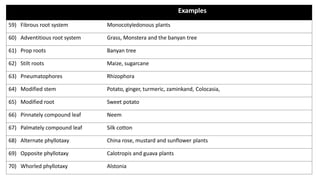
58) Tap root system Mustard
Examples
59) Fibrous root system Monocotyledonous plants
60) Adventitious root system Grass, Monstera and the banyan tree
61) Prop roots Banyan tree
62) Stilt roots Maize, sugarcane
63) Pneumatophores Rhizophora
64) Modified stem Potato, ginger, turmeric, zaminkand, Colocasia,
65) Modified root Sweet potato
66) Pinnately compound leaf Neem
67) Palmately compound leaf Silk cotton
68) Alternate phyllotaxy China rose, mustard and sunflower plants
69) Opposite phyllotaxy Calotropis and guava plants
70) Whorled phyllotaxy Alstonia
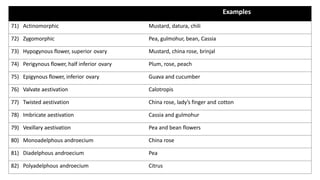
Examples
71) Actinomorphic Mustard, datura, chili
72) Zygomorphic Pea, gulmohur, bean, Cassia
73) Hypogynous flower, superior ovary Mustard, china rose, brinjal
74) Perigynous flower, half inferior ovary Plum, rose, peach
75) Epigynous flower, inferior ovary Guava and cucumber
76) Valvate aestivation Calotropis
77) Twisted aestivation China rose, lady’s finger and cotton
78) Imbricate aestivation Cassia and gulmohur
79) Vexillary aestivation Pea and bean flowers
80) Monoadelphous androecium China rose
81) Diadelphous androecium Pea
82) Polyadelphous androecium Citrus
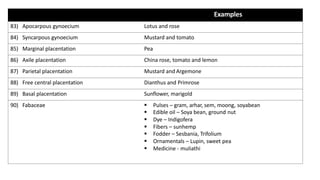
Examples
83) Apocarpous gynoecium Lotus and rose
84) Syncarpous gynoecium Mustard and tomato
85) Marginal placentation Pea
86) Axile placentation China rose, tomato and lemon
87) Parietal placentation Mustard and Argemone
88) Free central placentation Dianthus and Primrose
89) Basal placentation Sunflower, marigold
90) Fabaceae § Pulses – gram, arhar, sem, moong, soyabean
§ Edible oil – Soya bean, ground nut
§ Dye – Indigofera
§ Fibers – sunhemp
§ Fodder – Sesbania, Trifolium
§ Ornamentals – Lupin, sweet pea
§ Medicine - muliathi
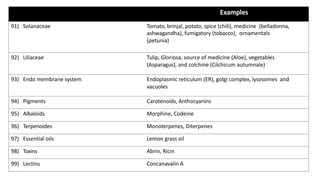
Examples
91) Solanaceae Tomato, brinjal, potato, spice (chili), medicine (belladonna,
ashwagandha), fumigatory (tobacco), ornamentals
(petunia)
92) Liliaceae Tulip, Gloriosa, source of medicine (Aloe), vegetables
(Asparagus), and colchine (Cilchicum autumnale)
93) Endo membrane system Endoplasmic reticulum (ER), golgi complex, lysosomes and
vacuoles
94) Pigments Carotenoids, Anthocyanins
95) Alkaloids Morphine, Codeine
96) Terpenoides Monoterpenes, Diterpenes
97) Essential oils Lemon grass oil
98) Toxins Abrin, Ricin
99) Lectins Concanavalin A
Examples
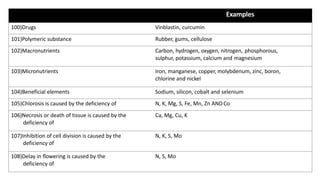
100)Drugs Vinblastin, curcumin
101)Polymeric substance Rubber, gums, cellulose
102)Macronutrients Carbon, hydrogen, oxygen, nitrogen, phosphorous,
sulphur, potassium, calcium and magnesium
103)Micronutrients Iron, manganese, copper, molybdenum, zinc, boron,
chlorine and nickel
104)Beneficial elements Sodium, silicon, cobalt and selenium
105)Chlorosis is caused by the deficiency of N, K, Mg, S, Fe, Mn, Zn ANDCo
106)Necrosis or death of tissue is caused by the
deficiency of
Ca, Mg, Cu, K
107)Inhibition of cell division is caused by the
deficiency of
N, K, S, Mo
108)Delay in flowering is caused by the
deficiency of
N, S, Mo
Examples
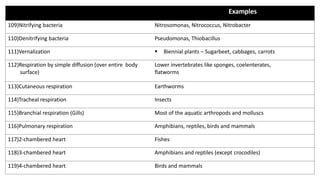
109)Nitrifying bacteria Nitrosomonas, Nitrococcus, Nitrobacter
110)Denitrifying bacteria Pseudomonas, Thiobacillus
111)Vernalization § Biennial plants – Sugarbeet, cabbages, carrots
112)Respiration by simple diffusion (over entire body
surface)
Lower invertebrates like sponges, coelenterates,
flatworms
113)Cutaneous respiration Earthworms
114)Tracheal respiration Insects
115)Branchial respiration (Gills) Most of the aquatic arthropods and molluscs
116)Pulmonary respiration Amphibians, reptiles, birds and mammals
117)2-chambered heart Fishes
118)3-chambered heart Amphibians and reptiles (except crocodiles)
119)4-chambered heart Birds and mammals
Examples
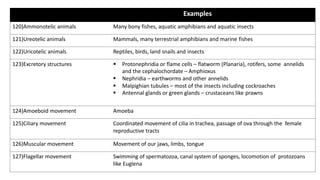
120)Ammonotelic animals Many bony fishes, aquatic amphibians and aquatic insects
121)Ureotelic animals Mammals, many terrestrial amphibians and marine fishes
122)Uricotelic animals Reptiles, birds, land snails and insects
123)Excretory structures § Protonephridia or flame cells – flatworm (Planaria), rotifers, some annelids
and the cephalochordate – Amphioxus
§ Nephridia – earthworms and other annelids
§ Malpighian tubules – most of the insects including cockroaches
§ Antennal glands or green glands – crustaceans like prawns
124)Amoeboid movement Amoeba
125)Ciliary movement Coordinated movement of cilia in trachea, passage of ova through the female
reproductive tracts
126)Muscular movement Movement of our jaws, limbs, tongue
127)Flagellar movement Swimming of spermatozoa, canal system of sponges, locomotion of protozoans
like Euglena
Examples
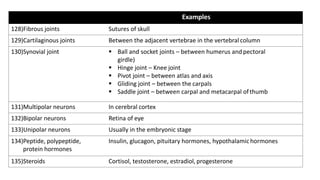
128)Fibrous joints Sutures of skull
129)Cartilaginous joints Between the adjacent vertebrae in the vertebral column
130)Synovial joint § Ball and socket joints – between humerus and pectoral
girdle)
§ Hinge joint – Knee joint
§ Pivot joint – between atlas and axis
§ Gliding joint – between the carpals
§ Saddle joint – between carpal and metacarpal ofthumb
131)Multipolar neurons In cerebral cortex
132)Bipolar neurons Retina of eye
133)Unipolar neurons Usually in the embryonic stage
134)Peptide, polypeptide,
protein hormones
Insulin, glucagon, pituitary hormones, hypothalamichormones
135)Steroids Cortisol, testosterone, estradiol, progesterone
Examples
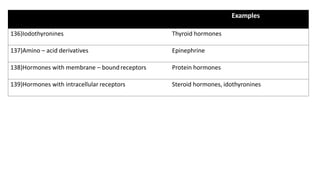
136)Iodothyronines Thyroid hormones
137)Amino – acid derivatives Epinephrine
138)Hormones with membrane – bound receptors Protein hormones
139)Hormones with intracellular receptors Steroid hormones, idothyronines

Comprehensive Biology ( EXAMPLE ) Notes (NCERT)

  • 1.
    Examples 1) Asexual Reproductioni. Binary Fission : Amoeba ii. Budding : Yeast iii. Cell Division : Protists and Monerans 2) Asexual Reproduction Structures i. Zoospores : Chlamydomonas ii. Conidia : Penicillium iii. Buds : Hydra iv. Gemmules : Sponge 3) Vegetative Propagules in Angiosperms i. Eyes : Potato ii. Rhizome : Ginger, Banana iii. Bulbil : Agave iv. Leaf buds : Bryophyllum v. Offset : Water Hyacinth 4) Oestrus Cycle Tiger, cows, sheep, rats, deers, dogs 5) Menstrual Cycle Monkeys, apes and humans 6) Monoecious Plants (Bisexual plants) Cucurbits and coconut, Chara 7) Dioecious Plants (Unisexual Plants) Papaya and date palm, Marchantia
  • 2.
    Examples 8) Bisexual animals(Hermaphrodite) Earthworm, sponge, tapeworm and leech 9) Unisexual animals Cockroach 10) Parthenogenesis Rotifers, honeybees, some lizards, birds (Turkey) 11) External fertilization Most aquatic organisms – Majority of algae and fishes as well as amphibians 12) Internal fertilization i. Many terrestrial organisms – Belonging to fungi ii. Higher animals (reptiles, birds, mammals) iii. Majority of plants – Bryophytes, pteridophytes, gymnosperms and angiosperms) 13) Multicarpellary, Syncarpous pistil Papaver 14) Multicarpellary, Apocarpus gynoecium Michelia 15) Presence of one ovule in an ovary Wheat, Paddy, Mango 16) Presence of many ovules in an ovary Papaya, Watermelon, Orchids
  • 3.
    Examples 16) Autogamy Viola(common pansy), Oxalis and Commelina 17) Abiotic agents of pollination Wind and water 18) Biotic agents of pollination Animals [Bees, Butterflies, beetles, wasp, ants, moths, birds (sunbird and humming birds), bats, some primates(lemurs) and arboreal(tree-dwelling) rodents, reptiles (gecko lizard and garden lizard)] 19) Wind pollination Grasses 20) Water pollination Algae, bryophytes, pteridophytes § Vallisneria and Hydrilla (grow in fresh water § Zostera (grow in marine water) Insect or Wind pollination – Water hyacinth and water lily 21) Endosperms completely consumed by developing embryo before seed maturation Pea, groundnuts, beans
  • 4.
    Examples 22) Persistent EndospermCastor and coconut 23) Albuminous seed Wheat, maize, barley, castor,sunflower 24) Non-Albuminous seed Pea and groundnut 25) True fruits Most of the fruits 26) False fruits Apple, strawberry, cashew 27) Parthenocarpic fruits Banana 28) Apomixis Asteraceae and grasses 29) Polyembryony Citrus fruits 30) Hormones released during pregnancy § hCG, hPL, Estrogens, Progestogens(by placenta) § Relaxin (by ovary) § During pregnancy levels of estrogens, progestrogens, cortisol, prolactin, thyroxine are also increased in maternal blood
  • 5.
    Examples 31) Natural methodsof contraception § Periodic abstinence § Withdrawal or coitus interrupts § Lactational amenorrhea 32) Barrier methods of contraception § Condoms, Diaphragms, cervical caps andvaults 33) IUDs § Non-medicated IUDs – Lippes loop § Copper releasing IUDs – CuT, Cu7, Multiload 375 § Hormone releasing IUDs – Progestasert and LNG- 20 34) Incomplete Dominance Dog flower (snapdragon or Antirrhinumspecies) 35) Co-dominance ABO blood grouping 36) Multiple Allelism ABO blood grouping 37) Pleiotropy Phenylketonuria
  • 6.
    Examples 38) Male HeterogametyHumans and drosophila (XY) 39) Female Heterogamety Birds (ZW) 40) Point mutation Sickle cell anemia 41) Mendelian Disorders Haemophilia, Cystic fibrosis, Sickle cell anemia, colorblindness, phenylketonuria, thalassemia 42) Chromosomal disorders Down’s syndrome, Klinefelter’s syndrome,Turner’s syndrome 43) Purines Adenine and Guanine 44) Pyrimidines Cytosine, Uracil and Thymine 45) Homologous structures (Divergent evolution) § Forelimbs of whales, bats, cheetah and humans § Vertebrate hearts or brains § Thorns and tenders of Bougainvillea and Cucurbita
  • 7.
    Examples 46) Analogous structures(Convergent evolution) § Wings of butterfly and birds § Eye of octopus and mammals § Flippers of penguins and dolphins 47) Root modification Sweet potato 48) Stem modification Potato 49) Adaptive radiation § Darwin finches § Australian Marsupial 50) Placental mammals Mole, anteater, mouse, lemur, flying squirrel, bobcat, wolf 51) Australian mammals Marsupial mole, numbat(anteater), marsupial mouse, spotted cuscus, flying phalanger, Tasmanian tiger cat, Tasmanianwolf 52) Passive Immunity Colostrum, Injection in case of snake bites 53) Primary lymphoid organs Bone marrow, and thymus
  • 8.
    Examples 54) Secondary lymphoidorgans Spleen lymph nodes, tonsils, Peyer’s patches of small intestine and appendix 55) Fresh water fish Catla, Rohu, and Common carp 56) Marine fishes Hilsa, sardines, Mackerel and Pomfrets 57) Semi-dwarf varieties of wheat Sonalika and Kalyan Sona 58) Semi-dwarf varieties of rice Jaya and Ratna 59) Diseases caused by fungi Brown rust of wheat, red rot of sugarcane,late blight of potato 60) Diseases caused by bacteria Black rot od crucifers 61) Diseases caused by viruses Tobacco mosaic and turnip mosaic 62) Free living nitrogen fixing bacteria Azospirillum,Azotobacter 63) Cyanobacteria as Nitrogen fixers Anabaena, Nostoc, Oscillatoria 64) Symbiotic Nitrogen fixing Bacteria Rhizobium
  • 9.
    Examples 65) Major biomesof India § Tropical rain forest § Deciduous forest § Desert § Sea coast 66) Predation Prickly pear cactus and cactus feeding predator (amoth) 67) Parasitism § Life cycle of human liver fluke § Malarial parasite § Cuscuta 68) A brute parasitism Cuckoo (Koel) and the crow 69) Commensalism § Barnacles growing on the back of a whale § An orchid growing on as an epiphyte on amango branch § Cattle Egret and grazing cattle § Sea anemone and clown fish
  • 10.
    Examples 70) Mutualism §Lichens – mutualistic relationship between a fungus and a photosynthesizing algae or cyanobacteria § Mycorrhizae – association between fungi and roots of higher plants § Pollination (zoophily, entomophily) § Between fig tree and wasp 71) Gaseous nutrient cycle Nitrogen, carbon cycle 72) Sedimentary cycle Sulphur and phosphorus cycle 73) Plants with Hallucinogenic properties Erythroxylum coca, Atropa belladonnaand Datura 74) Symbiotic Nitrogen fixing bacteria Rhizobium 75) Free living Nitrogen fixing bacteria Azospirillum and Azotobacter 76) Cyanobacteria as nitrogen fixer Anabaena, Nostoc, Oscillatoria
  • 11.
    Examples 77) Competition Betweensuperior barnacle Balanus and smaller barnacle 78) In situ conservation Biosphere reserve, national parks, wildlife sanctuaries 79) Ex situ conservation Zoological parks, botanical gardens and wildlife safari parks
  • 12.
    Examples 1) Red DinoflagellatesGonyaulax 2) Euglenoids Euglena 3) Amoeboid protozoans Amoeba, Entamoeba 4) Flagellate protozoans Trypanosoma 5) Ciliated protozoans Paramoecium 6) Sporozoans Plasmodium (malarial parasite) 7) Phycomycetes Mucor, Rhizopus, Albugo (the parasitic fungi on mustard) 8) Ascomycetes Penicillium(multicellular), yeast (unicellular), Aspergillus, Claviceps and Neurospora 9) Basidiomycetes Agaricus(mushroom), Ustilago(smut), Puccinia(rust fungus) 10) Deuteromycetes Alternaria, Colletotrichum and Trichoderma 11) Colonial algae Volvox 12) Filamentous algae Ulothrix and Spirogyra
  • 13.
    Examples 13) Isogamous reproduction§ Flagellated and similar in size : Ulothrix § Non-flagellated (non-motile) but similar in size : Spirogyra 14) Anisogamous reproduction Eudorina 15) Oogamous reproduction Volvox, Fucus 16) Marine algae used as food Porphyra, Laminaria and Sargassum 17) Algae producing hydrocolloids (water holding substance) Algin (brown algae) and carrageen (red algae) 18) Unicellular algae rich in protein used as food supplement by space travellers Clorella 19) Chlorophyceae Chlamydomonas, Volvox, Ulothrix, Spirogyra and Chara 20) Phaeophyceae Ectocarpus, Dicyota, Laminaria, Sargassum and Fucus 21) Rhodophyceae Polysiphonia, Poryphyra, Gracilaria and Gelidium
  • 14.
    Examples 22) Liverworts (Bryophytes)Marchantia 23) Mosses (Bryophytes) Funaria, Polytrichum and Sphagnum 24) Pteridophyte Classes § Psilopsida : Psilotum § Lycopodium : Selaginella, Lycopodium § Sphenopsida : Equisetum § Pteropsida : Dryopteris, Pteris, Adiantum 25) Pteridophytes having microphylls Selaginella 26) Pteridophytes having macrophylls Ferns 27) Pteridophytes having strobily or cones Selaginella, Equisetum 28) Heterosporous Pteridophytes Selaginella and Salvinia 29) Unbranched stem Cycas
  • 15.
    Examples 30) Branched stemPinus, Cedrus 31) Bisexual gymnosperm Pinus 32) Unisexual gymnosperm Cycas 33) Haplontic life cycle Spirogyra, Volvox, some species of Chlamydomonas 34) Diplontic life cycle Fucus, Gymnosperms andAngiosperms 35) Haplo-diplontic Bryophytes and Pteridophytes, Ectocarpus, Polysiphonia, kelps 36) Coelomates Annelids, Molluscs, arthropods, echinoderms, hemichordates and chordates 37) Pseudocoelomates Aschelminthes 38) Acoelomates Platyhelminthes 39) Phylum – Porifera Sycon (Scypha), Spongilla (Fresh water sponge) and Euspongia (Bath sponge)
  • 16.
    Examples 40) Phylum –Coelenterata (Cnidaria) Physalia (Portuguese man-of-war), Adamsia (Sea anemone), Pennatula (Sea-pen), Gorgonia (Sea-fan) and Meandrina (Brain coral) 41) Phylum – Ctenophora Pleurobrachia and Ctenoplana 42) Phylum – Platyhelminthes Taenia (Tapeworm), Fasciola (Liver fluke) 43) Phylum – Aschelminthes Ascaria (Roundworm), Wuchereria (Filaria worm), Ancylostoma (Hookworm) 44) Phylum – Annelida Nereis, Pheretima (Earthworm), and Hirudinaria (Blood sucking leech) 45) Phylum – Arthropoda § Economically important insects – Apis (Honeybee), Bombyx (Silkworm), Laccifer (Lac insect) § Vectors – Anopheles, Culex and Aedes(mosquitoes) § Gregarious pest – Locusta (Locust) § Living fossils – Limulus (King crab)
  • 17.
    Examples 46) Phylum –Mollusca Pila (Apple snail), Pinctada (Pearl oyster), Sepia (cuttlefish), Loligo (Squid), Octopus (Devil fish), Aplysia (Sea-hare), Dentalium (Tusk shell) and Chaetopleura (Chiton) 47) Phylum – Echinodermata Asteria (Star fish), Echinus (sea urchin), Antedon (Sealily), Cucumaria (sea cucumber) amd Ophiura (Brittlestar) 48) Phylum – Hemichordata Balanoglossus and Saccoglossus 49) Urochordata Ascidia, Salpa, Doliolum 50) Cephalochordata Branchiostoma, Amphioxus orLancelet 51) Cyclostomata Petromyzon (Lamprey), Myxine (Hagfish) 52) Chondrichthyes Scoliodon (Dog fish), Pristis (Saw fish), Carcharodon(Great white shark), Trygon (Sting ray) 53) Osteichthyes § Marine : Exocoetus (Flying fish), Hippocampus (Sea horse) § Fresh water : Labeo (Rohu), Catla (Katla), Clarias(Magur) § Aquarium : Betta (Fighting fish), Pterophyllum (Angel fish)
  • 18.
    Examples 54) Amphibia Bufo(Toad), Rana (Frog), Hyla (Tree frog), Salamandra (Salamander), Ichthyophis (Limbless amphibia) 55) Reptilia § Chelone (Turtle), Testudo (Tortoise), Chameleon (Tree lizard), Calotes (Garden lizard), Crocodilus (Crocodile), Alligator (Alligator), Hemidactylus (Wall lizard) § Poisonous snakes - Naja (Cobra), Bangarus (Krait), Vipera (Viper) 56) Aves Corvus (Crow), Columba (Pigeon), Psittacula (Parrot), Struthio (Ostrich), Pavo (Peacock), Aptenodytes (Penguin), Neophron (Vulture) 57) Mammalia § Oviparous – Ornithorhynchus (Platypus) § Viviparous – Macropus (Kangaroo), Pteropus (Flying fox), Camelus (Camel), Macaca (Monkey), Rattus (Rat), Canis (Dog), Felis (Cat), Elephas (Elephant), Equus (Horse), Delphinus (Common Dolphin), Balaenoptera (Blue whale), Panthera Tigris (Tiger), Panthera leo (Lion) 58) Tap root system Mustard
  • 19.
    Examples 59) Fibrous rootsystem Monocotyledonous plants 60) Adventitious root system Grass, Monstera and the banyan tree 61) Prop roots Banyan tree 62) Stilt roots Maize, sugarcane 63) Pneumatophores Rhizophora 64) Modified stem Potato, ginger, turmeric, zaminkand, Colocasia, 65) Modified root Sweet potato 66) Pinnately compound leaf Neem 67) Palmately compound leaf Silk cotton 68) Alternate phyllotaxy China rose, mustard and sunflower plants 69) Opposite phyllotaxy Calotropis and guava plants 70) Whorled phyllotaxy Alstonia
  • 20.
    Examples 71) Actinomorphic Mustard,datura, chili 72) Zygomorphic Pea, gulmohur, bean, Cassia 73) Hypogynous flower, superior ovary Mustard, china rose, brinjal 74) Perigynous flower, half inferior ovary Plum, rose, peach 75) Epigynous flower, inferior ovary Guava and cucumber 76) Valvate aestivation Calotropis 77) Twisted aestivation China rose, lady’s finger and cotton 78) Imbricate aestivation Cassia and gulmohur 79) Vexillary aestivation Pea and bean flowers 80) Monoadelphous androecium China rose 81) Diadelphous androecium Pea 82) Polyadelphous androecium Citrus
  • 21.
    Examples 83) Apocarpous gynoeciumLotus and rose 84) Syncarpous gynoecium Mustard and tomato 85) Marginal placentation Pea 86) Axile placentation China rose, tomato and lemon 87) Parietal placentation Mustard and Argemone 88) Free central placentation Dianthus and Primrose 89) Basal placentation Sunflower, marigold 90) Fabaceae § Pulses – gram, arhar, sem, moong, soyabean § Edible oil – Soya bean, ground nut § Dye – Indigofera § Fibers – sunhemp § Fodder – Sesbania, Trifolium § Ornamentals – Lupin, sweet pea § Medicine - muliathi
  • 22.
    Examples 91) Solanaceae Tomato,brinjal, potato, spice (chili), medicine (belladonna, ashwagandha), fumigatory (tobacco), ornamentals (petunia) 92) Liliaceae Tulip, Gloriosa, source of medicine (Aloe), vegetables (Asparagus), and colchine (Cilchicum autumnale) 93) Endo membrane system Endoplasmic reticulum (ER), golgi complex, lysosomes and vacuoles 94) Pigments Carotenoids, Anthocyanins 95) Alkaloids Morphine, Codeine 96) Terpenoides Monoterpenes, Diterpenes 97) Essential oils Lemon grass oil 98) Toxins Abrin, Ricin 99) Lectins Concanavalin A
  • 23.
    Examples 100)Drugs Vinblastin, curcumin 101)Polymericsubstance Rubber, gums, cellulose 102)Macronutrients Carbon, hydrogen, oxygen, nitrogen, phosphorous, sulphur, potassium, calcium and magnesium 103)Micronutrients Iron, manganese, copper, molybdenum, zinc, boron, chlorine and nickel 104)Beneficial elements Sodium, silicon, cobalt and selenium 105)Chlorosis is caused by the deficiency of N, K, Mg, S, Fe, Mn, Zn ANDCo 106)Necrosis or death of tissue is caused by the deficiency of Ca, Mg, Cu, K 107)Inhibition of cell division is caused by the deficiency of N, K, S, Mo 108)Delay in flowering is caused by the deficiency of N, S, Mo
  • 24.
    Examples 109)Nitrifying bacteria Nitrosomonas,Nitrococcus, Nitrobacter 110)Denitrifying bacteria Pseudomonas, Thiobacillus 111)Vernalization § Biennial plants – Sugarbeet, cabbages, carrots 112)Respiration by simple diffusion (over entire body surface) Lower invertebrates like sponges, coelenterates, flatworms 113)Cutaneous respiration Earthworms 114)Tracheal respiration Insects 115)Branchial respiration (Gills) Most of the aquatic arthropods and molluscs 116)Pulmonary respiration Amphibians, reptiles, birds and mammals 117)2-chambered heart Fishes 118)3-chambered heart Amphibians and reptiles (except crocodiles) 119)4-chambered heart Birds and mammals
  • 25.
    Examples 120)Ammonotelic animals Manybony fishes, aquatic amphibians and aquatic insects 121)Ureotelic animals Mammals, many terrestrial amphibians and marine fishes 122)Uricotelic animals Reptiles, birds, land snails and insects 123)Excretory structures § Protonephridia or flame cells – flatworm (Planaria), rotifers, some annelids and the cephalochordate – Amphioxus § Nephridia – earthworms and other annelids § Malpighian tubules – most of the insects including cockroaches § Antennal glands or green glands – crustaceans like prawns 124)Amoeboid movement Amoeba 125)Ciliary movement Coordinated movement of cilia in trachea, passage of ova through the female reproductive tracts 126)Muscular movement Movement of our jaws, limbs, tongue 127)Flagellar movement Swimming of spermatozoa, canal system of sponges, locomotion of protozoans like Euglena
  • 26.
    Examples 128)Fibrous joints Suturesof skull 129)Cartilaginous joints Between the adjacent vertebrae in the vertebral column 130)Synovial joint § Ball and socket joints – between humerus and pectoral girdle) § Hinge joint – Knee joint § Pivot joint – between atlas and axis § Gliding joint – between the carpals § Saddle joint – between carpal and metacarpal ofthumb 131)Multipolar neurons In cerebral cortex 132)Bipolar neurons Retina of eye 133)Unipolar neurons Usually in the embryonic stage 134)Peptide, polypeptide, protein hormones Insulin, glucagon, pituitary hormones, hypothalamichormones 135)Steroids Cortisol, testosterone, estradiol, progesterone
  • 27.
    Examples 136)Iodothyronines Thyroid hormones 137)Amino– acid derivatives Epinephrine 138)Hormones with membrane – bound receptors Protein hormones 139)Hormones with intracellular receptors Steroid hormones, idothyronines