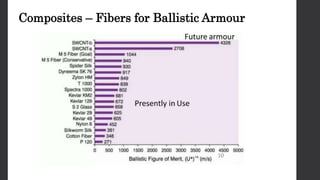
Composites – Fibers for Ballistic Armour
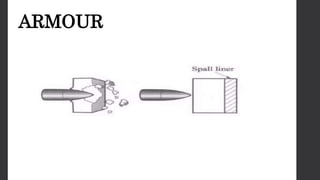
ARMOUR
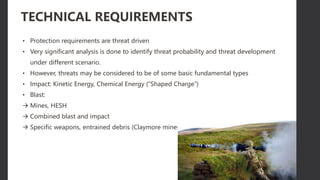
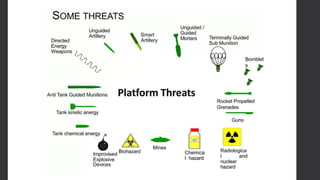
• Protection requirements are threat driven
• Very significant analysis is done to identify threat probability and threat development
under different scenario.
• However, threats may be considered to be of some basic fundamental types
• Impact: Kinetic Energy, Chemical Energy (“Shaped Charge”)
• Blast:
 Mines, HESH
 Combined blast and impact
 Specific weapons, entrained debris (Claymore mines)
TECHNICAL REQUIREMENTS
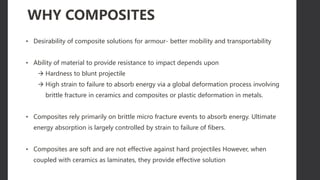
• Desirability of composite solutions for armour‐ better mobility and transportability
• Ability of material to provide resistance to impact depends upon
 Hardness to blunt projectile
 High strain to failure to absorb energy via a global deformation process involving
brittle fracture in ceramics and composites or plastic deformation in metals.
• Composites rely primarily on brittle micro fracture events to absorb energy. Ultimate
energy absorption is largely controlled by strain to failure of fibers.
• Composites are soft and are not effective against hard projectiles However, when
coupled with ceramics as laminates, they provide effective solution
WHY COMPOSITES
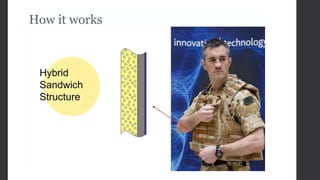
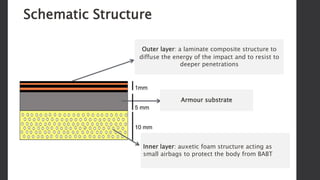
Outer layer: a laminate composite structure to
diffuse the energy of the impact and to resist to
deeper penetrations
Armour substrate
Inner layer: auxetic foam structure acting as
small airbags to protect the body from BABT
Schematic Structure
effect
composites in defense.pptx

composites in defense.pptx

  • 3.
    Composites – Fibersfor Ballistic Armour
  • 5.
  • 6.
    • Protection requirementsare threat driven • Very significant analysis is done to identify threat probability and threat development under different scenario. • However, threats may be considered to be of some basic fundamental types • Impact: Kinetic Energy, Chemical Energy (“Shaped Charge”) • Blast:  Mines, HESH  Combined blast and impact  Specific weapons, entrained debris (Claymore mines) TECHNICAL REQUIREMENTS
  • 8.
    • Desirability ofcomposite solutions for armour‐ better mobility and transportability • Ability of material to provide resistance to impact depends upon  Hardness to blunt projectile  High strain to failure to absorb energy via a global deformation process involving brittle fracture in ceramics and composites or plastic deformation in metals. • Composites rely primarily on brittle micro fracture events to absorb energy. Ultimate energy absorption is largely controlled by strain to failure of fibers. • Composites are soft and are not effective against hard projectiles However, when coupled with ceramics as laminates, they provide effective solution WHY COMPOSITES
  • 11.
    Outer layer: alaminate composite structure to diffuse the energy of the impact and to resist to deeper penetrations Armour substrate Inner layer: auxetic foam structure acting as small airbags to protect the body from BABT Schematic Structure
  • 13.

Editor's Notes

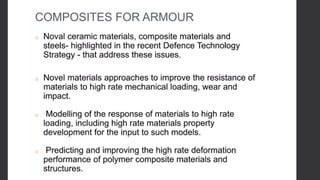
  • #3 In the recent defence technology the ceramic, composites and steels are most commonly used materials due to their properties Using novel materials, we can increase material resistance to high-rate mechanical loading, wear, and impact. For this we need to model the response of materials and develop high rate material properties as input. predicting and enhancing polymer composite materials' and structures’ towards high rate of deformation performance
  • #4 As we know that energy absorption in composites primarily occurs due to elongation and failure of fiber, fibres with high tensile strength and high strain to failure are the best candidates. In addition, high sonic velocity in the fibre (depending upon elastic modulus and density) can lead to enhanced ballistic performance due to its ability to spread out energy to larger areas.   o Kevlar (Aramid fiber), S2 Glass, and Dyneema (UHMPE) are already in use for ballistic applications o Future armour may use M5 fibre (PIPD) and SWCNT (single wall carbon nano tube) fibers.
  • #5 armor
  • #6 The role of armour is to protect a person , device, or structure. Achieved by absorbing the kinetic energy of a projectile. Energy dominantly absorbed by plastic deformation and/or fracture processes. Fragments as a result of the fracture process should not cause damage to what is being protected and should be arrested by another layer at the back. Armour plate may have to fulfil two roles: a protective role and a structural role. Both roles can be fulfilled by having sufficient strength at a high strain rate and an appropriate thickness to provide both protection and structural requirements of the platform.
  • #7 High explosive squash head
  • #12 Behind armour blunt truma
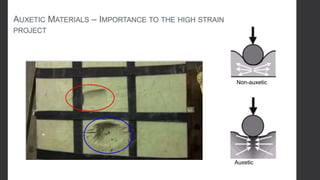
  • #13 Background: Auxetic materials have been known for approximately 100 years. The term auxetic was coined by Ken Evans—derived from the Greek a word  which means' that tends to increase’ Auxetic materials have a negative Poisson’s ratio—grows fatter when stretched