23DT651 – Advanced Lightweight and Composite Structures
Application of Composites in Armoured Vehicles
“Composite Armour: Lightweight defence, heavyweight protection”
Presented By : Sai Prajith G (CB.EN.P2DTA23006)
Agenda
• Introduction top Light weight composites
• Challenges involved in Armored Vehicle Design
• Advantages of light weight composites in armored vehicles
• Types of light weight composite
• Application in armored vehicles
• Manufacturing Techniques
• Challenges and opportunities
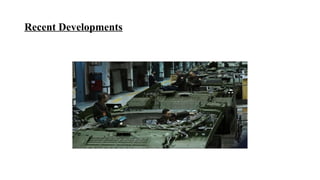
Recent Developments
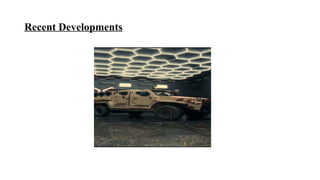
Recent Developments
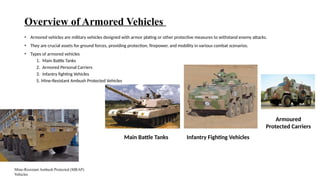
Overview of Armored Vehicles
• Armored vehicles are military vehicles designed with armor plating or other protective measures to withstand enemy attacks.
• They are crucial assets for ground forces, providing protection, firepower, and mobility in various combat scenarios.
• Types of armored vehicles
1. Main Battle Tanks
2. Armored Personal Carriers
3. Infantry fighting Vehicles
5. Mine-Resistant Ambush Protected Vehicles
Main Battle Tanks Infantry Fighting Vehicles
Mine-Resistant Ambush Protected (MRAP)
Vehicles
Armoured
Protected Carriers
Importance of protection and mobility in military operation
1. Protection
• Ensures the safety and survivability of military personnel and assets in hostile environments.
• Shields against enemy attacks, including small arms fire, artillery, explosives, and missiles.
• Protects critical infrastructure, such as command centers, logistics hubs, and communication nodes.
• Boosts troop morale and confidence, enabling effective execution of missions.
2. Mobility
• Facilitates rapid deployment and maneuverability of forces across diverse terrain.
• Enhances operational flexibility and adaptability to changing battlefield conditions.
• Enables surprise and flanking maneuvers, confounding enemy defenses.
• Allows for the exploitation of opportunities and the avoidance of enemy strongpoints
Light Weight Composites
• Lightweight composites are materials composed of two or more distinct
constituents, typically a matrix and reinforcement, engineered to achieve
superior performance characteristics.
• They offer a compelling alternative to traditional materials like steel and
aluminum, providing a combination of strength, durability, and reduced weight.
Significance of Lightweight Composites:
• High Strength-to-Weight Ratio: Offers comparable or superior strength to
traditional materials at a fraction of the weight.
• Enhanced Durability: Resistant to corrosion, fatigue, and environmental
degradation.
• Design Flexibility: Allows for complex geometries and tailored material
properties to meet specific performance requirements.
• Improved Fuel Efficiency: Reduces vehicle weight, leading to lower fuel
consumption and operational costs.
• Enhanced Performance: Provides superior ballistic protection, blast resistance,
and structural integrity.
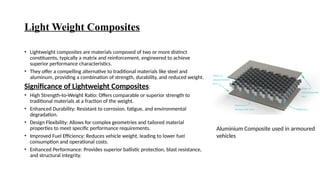
Aluminium Composite used in armoured
vehicles
Weight Constraints and Impact on Mobility
1. Factors Influencing Weight Constraints
• Structural Integrity: Ensuring the vehicle can withstand operational stresses and maintain functionality.
• Mobility Requirements: Balancing payload capacity with maneuverability across diverse terrain types.
• Transportability: Meeting size and weight limitations for air, sea, and land transport.
• Operational Environment: Adapting to varying climates, altitudes, and battlefield conditions
2. Impact on mobility
• Reduced Speed and Acceleration: Heavier vehicles require more power to move and accelerate, affecting
responsiveness.
• Decreased Manoeuvrability: Increased weight can hinder the vehicle's ability to navigate tight spaces, negotiate
obstacles, and perform evasive maneuvers.
• Longer Stopping Distances: Heavier vehicles require more time and distance to come to a stop, increasing
vulnerability to ambushes and collisions.
• Higher Fuel Consumption: Increased weight leads to higher fuel consumption, reducing operational range and
logistical flexibility.
• Elevated Wear and Tear: Heavier loads place greater strain on suspension, drivetrain components, and tires, leading
to increased maintenance requirements and downtime
Need for Increased Protection Against Modern Threats
• Evolution of Threats:
1. Advanced Ballistic Weapons: Increasing prevalence of high-velocity armor-piercing projectiles, shaped charges, and
tandem warheads.
2. Improvised Explosive Devices (IEDs): Widely employed by insurgents and non-state actors to target military convoys
and patrols.
3. Unconventional Warfare: Ambushes, roadside bombings, and urban guerrilla tactics pose significant challenges to
conventional military forces.
• Importance of Vehicle Protection:
1. Safeguarding Personnel: Ensuring survivability and reducing casualties among vehicle occupants during combat
operations.
2. Preserving Combat Effectiveness: Maintaining operational readiness and mission capability in the face of enemy attacks.
3. Enhancing Tactical Flexibility: Providing commanders with confidence to maneuver forces and execute missions in high-
threat environments.
4. Minimizing Strategic Impact: Mitigating the political, economic, and psychological ramifications of military casualties
and equipment losses
Need for Increased Protection Against Modern Threats
• Key Challenges:
1. Balancing Protection and Mobility: Striking a balance between survivability and mobility to avoid overburdening
vehicles and compromising agility.
2. Adaptability to Dynamic Threats: Anticipating and countering emerging threats through proactive measures and agile
response strategies.
3. Integration of Advanced Technologies: Leveraging innovations in materials science, active protection systems, and
situational awareness technologies to enhance vehicle protection capabilities
• Solutions and Innovations:
1. Composite Armor: Lightweight composite materials offer superior ballistic resistance while minimizing weight
penalties.
2. Active Protection Systems (APS): Intercept and neutralize incoming threats, including rockets, missiles, and kinetic
energy penetrators.
3. Modular Protection Kits: Configurable armor packages allow for tailored protection levels based on mission
requirements and threat assessments.
4. Integrated Survivability Suites: Holistic approach to vehicle protection, combining armor, countermeasures, and crew
safety features.
Advantages of light weight composite
• High strength-to-weight ratio.
• Reduced vehicle weight without compromising protection.
• Enhanced mobility and fuel efficiency.
• Improved resistance to ballistic threats and blast effects
Types of Lightweight Composites
• Carbon fiber reinforced polymers (CFRP).
• Aramid fiber composites (e.g., Kevlar).
• Glass fiber reinforced polymers (GFRP).
• Ceramic matrix composites (CMC).
Applications in Armoured Vehicles
Armor Panels for Protection Against Small Arms Fire and Shrapnel
• Armor panels play a crucial role in providing protection to military vehicles and personnel against small arms fire, shrapnel, and other ballistic threats.
• These panels are strategically integrated into vehicle designs to enhance survivability and minimize casualties in combat scenarios.
A. Threat Overview:
• Small Arms Fire: Includes rifles, machine guns, and handguns, capable of penetrating conventional vehicle materials and causing casualties.
• Shrapnel: Fragmentation from explosive devices, artillery shells, and improvised explosive devices (IEDs), posing lethal hazards to exposed personnel and
equipment.
B. Composition of Armor Panels:
• Composite Materials: Lightweight yet high-strength composites, such as ceramic-polymer hybrids or metal-ceramic laminates, are commonly used.
• Layered Construction: Multiple layers of different materials, each serving specific purposes such as energy absorption, deflection, and spall mitigation.
• Ballistic Fabric: Aramid fibers (e.g., Kevlar) or ultra-high molecular weight polyethylene (UHMWPE) provide flexibility and resistance to penetration
C. Performance Characteristics:
• Ballistic Resistance: Ability to withstand direct impacts from small arms projectiles and fragmentation without penetration.
• Spall Mitigation: Preventing secondary fragmentation and debris from penetrating the vehicle interior upon impact.
• Weight Efficiency: Achieving optimal protection-to-weight ratio to minimize added mass and maintain vehicle mobility.
• Thermal Insulation: Shielding against high temperatures generated by ballistic impacts and explosive blasts.
D. Integration into Vehicle Design:
• Modular Configurations: Armour panels are designed in modular formats to allow for easy installation, removal, and replacement based on mission
requirements.
• Structural Reinforcement: Panels are strategically positioned to reinforce vulnerable areas such as crew compartments, engine bays, and fuel tanks.
• Compatibility with Other Systems: Armour panels are integrated with complementary protection systems, including active defense measures and crew
survivability features)
Composite Components for Weight Reduction
1. Types of Composite Components:
• Body Panels: Exterior panels, including hoods, doors, fenders, and roofs, can be fabricated from
composite materials to reduce weight and improve aerodynamics.
• Interior Components: Dashboard assemblies, seats, consoles, and trim panels can benefit from
lightweight composite construction, enhancing comfort and ergonomics.
• Structural Elements: Load-bearing components such as chassis frames, suspension components,
and reinforcement beams can be reinforced with composite materials to enhance strength-to-
weight ratios.
• Accessory Housings: Enclosures for vehicle systems, electronics, and auxiliary equipment can be
manufactured from composites to reduce overall vehicle mass and improve packaging efficiency.
• Fuel Tanks and Storage Containers: Composite fuel tanks and storage containers offer weight
savings compared to traditional metal counterparts while maintaining durability and safety
standards.
Advantages of Composite Components
• Weight Reduction: Composite materials typically weigh less than metals, resulting in lower
overall vehicle mass and improved fuel efficiency.
• Strength and Stiffness: Despite their lightweight nature, composites offer excellent
strength-to-weight ratios and stiffness properties, enhancing structural integrity and
performance.
• Corrosion Resistance: Composites are inherently resistant to corrosion, reducing
maintenance requirements and extending vehicle service life in harsh operating
environments.
• Design Flexibility: Composite manufacturing processes allow for complex shapes, contours,
and integrated features, enabling innovative design solutions and streamlined production.
• Vibration Damping: Composite materials exhibit superior damping characteristics, reducing
noise, vibration, and harshness (NVH) levels for enhanced ride comfort and vehicle
refinement.
Manufacturing Processes
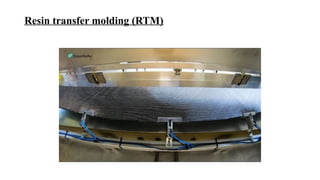
• Resin transfer molding (RTM).
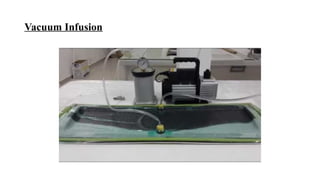
• Vacuum infusion.
• Autoclave molding.
Resin transfer molding (RTM)
Advantages of RTM
• Complex Geometry: RTM allows for the production of intricate shapes and
features, including undercuts and internal cavities, with minimal tooling
complexity.
• Surface Finish: RTM parts exhibit smooth, high-quality surface finishes with
minimal defects or imperfections, reducing post-processing requirements.
• Dimensional Accuracy: Tight tolerances and precise part dimensions can be
achieved with RTM, ensuring consistency and repeatability in part production.
• Fiber Orientation Control: RTM enables precise control over fiber orientation and
reinforcement distribution, optimizing mechanical properties and performance.
• Material Efficiency: RTM minimizes material waste by precisely controlling resin
flow and impregnation, resulting in efficient use of raw materials
Vacuum Infusion
Advantages of Vacuum Infusion
• Reduced Resin Waste: Vacuum infusion minimizes resin waste by precisely controlling
resin flow and saturation, resulting in efficient material usage.
• Improved Fiber Consolidation: Vacuum pressure helps ensure thorough impregnation
of reinforcement materials, leading to better fiber wet-out and consolidation.
• Enhanced Part Quality: Vacuum infusion produces parts with uniform resin
distribution, minimal voids, and excellent surface finish, resulting in high-quality
finished products.
• Design Flexibility: Complex geometries and integrated features can be achieved with
vacuum infusion, allowing for innovative and lightweight part designs.
• Environmental Benefits: Vacuum infusion is a relatively environmentally friendly
process, with reduced emissions and waste compared to other composite
manufacturing methods.
Challenges and Opportunities in Composite
Manufacturing
1. Challenges:
• Cost: Composite materials and manufacturing processes can be expensive compared to
traditional materials and methods, limiting widespread adoption.
• Process Complexity: Composite manufacturing processes often require specialized equipment,
expertise, and infrastructure, posing barriers to entry for some manufacturers.
• Quality Assurance: Ensuring consistent quality and performance of composite parts across
production batches can be challenging due to variations in material properties and process
parameters.
• Recycling and Sustainability: Composite materials are difficult to recycle and may pose
environmental challenges at end-of-life, requiring innovative recycling and disposal solutions.
• Certification and Regulation: Meeting industry standards, certifications, and regulatory
requirements for safety, performance, and environmental impact can be complex and time-
consuming.
Challenges and Opportunities in Composite
Manufacturing
2. Opportunities:
• Lightweighting: Composite materials offer significant weight savings compared to traditional materials
such as metals, leading to improved fuel efficiency, performance, and sustainability.
• Design Freedom: Composites enable the production of complex shapes, integrated features, and
customized solutions that are not feasible with conventional materials, unlocking new design possibilities.
• Advanced Manufacturing Technologies: Additive manufacturing, automation, and digitalization are
revolutionizing composite production, reducing lead times, increasing efficiency, and enabling mass
customization.
• Multifunctionality: Composites can be engineered with multifunctional properties, such as electrical
conductivity, thermal insulation, and self-healing capabilities, expanding their applications in diverse
industries.
• Sustainability and Circular Economy: Advances in bio-based resins, recyclable fibers, and closed-loop
recycling processes are driving the development of more sustainable composite materials and
manufacturing practices
Challenges and Opportunities in Composite
Manufacturing
3. Strategies for Success:
• Innovation and Collaboration: Investing in research and development, fostering
collaboration between industry, academia, and government, and promoting technology
transfer are essential for driving innovation and overcoming challenges.
• Education and Training: Providing workforce training, skill development programs, and
academic curricula focused on composite manufacturing technologies and best practices can
enhance industry capabilities and competitiveness.
• Standardization and Certification: Establishing industry standards, certification programs,
and regulatory frameworks for composite materials, processes, and products can ensure
consistency, quality, and safety across the supply chain.
• Sustainability and Environmental Stewardship: Embracing sustainable practices, developing
eco-friendly materials, and implementing circular economy principles are key to
minimizing the environmental impact of composite manufacturing
Challenges and Opportunities in Composite
Manufacturing
3. Strategies for Success:
• Innovation and Collaboration: Investing in research and development, fostering
collaboration between industry, academia, and government, and promoting technology
transfer are essential for driving innovation and overcoming challenges.
• Education and Training: Providing workforce training, skill development programs, and
academic curricula focused on composite manufacturing technologies and best practices can
enhance industry capabilities and competitiveness.
• Standardization and Certification: Establishing industry standards, certification programs,
and regulatory frameworks for composite materials, processes, and products can ensure
consistency, quality, and safety across the supply chain.
• Sustainability and Environmental Stewardship: Embracing sustainable practices, developing
eco-friendly materials, and implementing circular economy principles are key to
minimizing the environmental impact of composite manufacturing
Conclusion
• The integration of composites in armored vehicles revolutionizes
military technology, offering unparalleled protection and agility.
• Lightweight composite armor panels and suspension components
enhance survivability and mobility, while additive manufacturing
enables rapid customization.
• Challenges like cost and certification are offset by opportunities for
innovation and sustainability.
• With continuous advancement, composites redefine armored vehicles,
ensuring military forces maintain a strategic edge in modern warfare.
Composite Application in  Real Life and advanced applications

Composite Application in Real Life and advanced applications

  • 1.
    23DT651 – AdvancedLightweight and Composite Structures Application of Composites in Armoured Vehicles “Composite Armour: Lightweight defence, heavyweight protection” Presented By : Sai Prajith G (CB.EN.P2DTA23006)
  • 2.
    Agenda • Introduction topLight weight composites • Challenges involved in Armored Vehicle Design • Advantages of light weight composites in armored vehicles • Types of light weight composite • Application in armored vehicles • Manufacturing Techniques • Challenges and opportunities
  • 3.
  • 4.
  • 5.
    Overview of ArmoredVehicles • Armored vehicles are military vehicles designed with armor plating or other protective measures to withstand enemy attacks. • They are crucial assets for ground forces, providing protection, firepower, and mobility in various combat scenarios. • Types of armored vehicles 1. Main Battle Tanks 2. Armored Personal Carriers 3. Infantry fighting Vehicles 5. Mine-Resistant Ambush Protected Vehicles Main Battle Tanks Infantry Fighting Vehicles Mine-Resistant Ambush Protected (MRAP) Vehicles Armoured Protected Carriers
  • 6.
    Importance of protectionand mobility in military operation 1. Protection • Ensures the safety and survivability of military personnel and assets in hostile environments. • Shields against enemy attacks, including small arms fire, artillery, explosives, and missiles. • Protects critical infrastructure, such as command centers, logistics hubs, and communication nodes. • Boosts troop morale and confidence, enabling effective execution of missions. 2. Mobility • Facilitates rapid deployment and maneuverability of forces across diverse terrain. • Enhances operational flexibility and adaptability to changing battlefield conditions. • Enables surprise and flanking maneuvers, confounding enemy defenses. • Allows for the exploitation of opportunities and the avoidance of enemy strongpoints
  • 7.
    Light Weight Composites •Lightweight composites are materials composed of two or more distinct constituents, typically a matrix and reinforcement, engineered to achieve superior performance characteristics. • They offer a compelling alternative to traditional materials like steel and aluminum, providing a combination of strength, durability, and reduced weight. Significance of Lightweight Composites: • High Strength-to-Weight Ratio: Offers comparable or superior strength to traditional materials at a fraction of the weight. • Enhanced Durability: Resistant to corrosion, fatigue, and environmental degradation. • Design Flexibility: Allows for complex geometries and tailored material properties to meet specific performance requirements. • Improved Fuel Efficiency: Reduces vehicle weight, leading to lower fuel consumption and operational costs. • Enhanced Performance: Provides superior ballistic protection, blast resistance, and structural integrity. Aluminium Composite used in armoured vehicles
  • 8.
    Weight Constraints andImpact on Mobility 1. Factors Influencing Weight Constraints • Structural Integrity: Ensuring the vehicle can withstand operational stresses and maintain functionality. • Mobility Requirements: Balancing payload capacity with maneuverability across diverse terrain types. • Transportability: Meeting size and weight limitations for air, sea, and land transport. • Operational Environment: Adapting to varying climates, altitudes, and battlefield conditions 2. Impact on mobility • Reduced Speed and Acceleration: Heavier vehicles require more power to move and accelerate, affecting responsiveness. • Decreased Manoeuvrability: Increased weight can hinder the vehicle's ability to navigate tight spaces, negotiate obstacles, and perform evasive maneuvers. • Longer Stopping Distances: Heavier vehicles require more time and distance to come to a stop, increasing vulnerability to ambushes and collisions. • Higher Fuel Consumption: Increased weight leads to higher fuel consumption, reducing operational range and logistical flexibility. • Elevated Wear and Tear: Heavier loads place greater strain on suspension, drivetrain components, and tires, leading to increased maintenance requirements and downtime
  • 9.
    Need for IncreasedProtection Against Modern Threats • Evolution of Threats: 1. Advanced Ballistic Weapons: Increasing prevalence of high-velocity armor-piercing projectiles, shaped charges, and tandem warheads. 2. Improvised Explosive Devices (IEDs): Widely employed by insurgents and non-state actors to target military convoys and patrols. 3. Unconventional Warfare: Ambushes, roadside bombings, and urban guerrilla tactics pose significant challenges to conventional military forces. • Importance of Vehicle Protection: 1. Safeguarding Personnel: Ensuring survivability and reducing casualties among vehicle occupants during combat operations. 2. Preserving Combat Effectiveness: Maintaining operational readiness and mission capability in the face of enemy attacks. 3. Enhancing Tactical Flexibility: Providing commanders with confidence to maneuver forces and execute missions in high- threat environments. 4. Minimizing Strategic Impact: Mitigating the political, economic, and psychological ramifications of military casualties and equipment losses
  • 10.
    Need for IncreasedProtection Against Modern Threats • Key Challenges: 1. Balancing Protection and Mobility: Striking a balance between survivability and mobility to avoid overburdening vehicles and compromising agility. 2. Adaptability to Dynamic Threats: Anticipating and countering emerging threats through proactive measures and agile response strategies. 3. Integration of Advanced Technologies: Leveraging innovations in materials science, active protection systems, and situational awareness technologies to enhance vehicle protection capabilities • Solutions and Innovations: 1. Composite Armor: Lightweight composite materials offer superior ballistic resistance while minimizing weight penalties. 2. Active Protection Systems (APS): Intercept and neutralize incoming threats, including rockets, missiles, and kinetic energy penetrators. 3. Modular Protection Kits: Configurable armor packages allow for tailored protection levels based on mission requirements and threat assessments. 4. Integrated Survivability Suites: Holistic approach to vehicle protection, combining armor, countermeasures, and crew safety features.
  • 11.
    Advantages of lightweight composite • High strength-to-weight ratio. • Reduced vehicle weight without compromising protection. • Enhanced mobility and fuel efficiency. • Improved resistance to ballistic threats and blast effects
  • 12.
    Types of LightweightComposites • Carbon fiber reinforced polymers (CFRP). • Aramid fiber composites (e.g., Kevlar). • Glass fiber reinforced polymers (GFRP). • Ceramic matrix composites (CMC).
  • 13.
    Applications in ArmouredVehicles Armor Panels for Protection Against Small Arms Fire and Shrapnel • Armor panels play a crucial role in providing protection to military vehicles and personnel against small arms fire, shrapnel, and other ballistic threats. • These panels are strategically integrated into vehicle designs to enhance survivability and minimize casualties in combat scenarios. A. Threat Overview: • Small Arms Fire: Includes rifles, machine guns, and handguns, capable of penetrating conventional vehicle materials and causing casualties. • Shrapnel: Fragmentation from explosive devices, artillery shells, and improvised explosive devices (IEDs), posing lethal hazards to exposed personnel and equipment. B. Composition of Armor Panels: • Composite Materials: Lightweight yet high-strength composites, such as ceramic-polymer hybrids or metal-ceramic laminates, are commonly used. • Layered Construction: Multiple layers of different materials, each serving specific purposes such as energy absorption, deflection, and spall mitigation. • Ballistic Fabric: Aramid fibers (e.g., Kevlar) or ultra-high molecular weight polyethylene (UHMWPE) provide flexibility and resistance to penetration C. Performance Characteristics: • Ballistic Resistance: Ability to withstand direct impacts from small arms projectiles and fragmentation without penetration. • Spall Mitigation: Preventing secondary fragmentation and debris from penetrating the vehicle interior upon impact. • Weight Efficiency: Achieving optimal protection-to-weight ratio to minimize added mass and maintain vehicle mobility. • Thermal Insulation: Shielding against high temperatures generated by ballistic impacts and explosive blasts. D. Integration into Vehicle Design: • Modular Configurations: Armour panels are designed in modular formats to allow for easy installation, removal, and replacement based on mission requirements. • Structural Reinforcement: Panels are strategically positioned to reinforce vulnerable areas such as crew compartments, engine bays, and fuel tanks. • Compatibility with Other Systems: Armour panels are integrated with complementary protection systems, including active defense measures and crew survivability features)
  • 14.
    Composite Components forWeight Reduction 1. Types of Composite Components: • Body Panels: Exterior panels, including hoods, doors, fenders, and roofs, can be fabricated from composite materials to reduce weight and improve aerodynamics. • Interior Components: Dashboard assemblies, seats, consoles, and trim panels can benefit from lightweight composite construction, enhancing comfort and ergonomics. • Structural Elements: Load-bearing components such as chassis frames, suspension components, and reinforcement beams can be reinforced with composite materials to enhance strength-to- weight ratios. • Accessory Housings: Enclosures for vehicle systems, electronics, and auxiliary equipment can be manufactured from composites to reduce overall vehicle mass and improve packaging efficiency. • Fuel Tanks and Storage Containers: Composite fuel tanks and storage containers offer weight savings compared to traditional metal counterparts while maintaining durability and safety standards.
  • 15.
    Advantages of CompositeComponents • Weight Reduction: Composite materials typically weigh less than metals, resulting in lower overall vehicle mass and improved fuel efficiency. • Strength and Stiffness: Despite their lightweight nature, composites offer excellent strength-to-weight ratios and stiffness properties, enhancing structural integrity and performance. • Corrosion Resistance: Composites are inherently resistant to corrosion, reducing maintenance requirements and extending vehicle service life in harsh operating environments. • Design Flexibility: Composite manufacturing processes allow for complex shapes, contours, and integrated features, enabling innovative design solutions and streamlined production. • Vibration Damping: Composite materials exhibit superior damping characteristics, reducing noise, vibration, and harshness (NVH) levels for enhanced ride comfort and vehicle refinement.
  • 16.
    Manufacturing Processes • Resintransfer molding (RTM). • Vacuum infusion. • Autoclave molding.
  • 17.
  • 18.
    Advantages of RTM •Complex Geometry: RTM allows for the production of intricate shapes and features, including undercuts and internal cavities, with minimal tooling complexity. • Surface Finish: RTM parts exhibit smooth, high-quality surface finishes with minimal defects or imperfections, reducing post-processing requirements. • Dimensional Accuracy: Tight tolerances and precise part dimensions can be achieved with RTM, ensuring consistency and repeatability in part production. • Fiber Orientation Control: RTM enables precise control over fiber orientation and reinforcement distribution, optimizing mechanical properties and performance. • Material Efficiency: RTM minimizes material waste by precisely controlling resin flow and impregnation, resulting in efficient use of raw materials
  • 19.
  • 20.
    Advantages of VacuumInfusion • Reduced Resin Waste: Vacuum infusion minimizes resin waste by precisely controlling resin flow and saturation, resulting in efficient material usage. • Improved Fiber Consolidation: Vacuum pressure helps ensure thorough impregnation of reinforcement materials, leading to better fiber wet-out and consolidation. • Enhanced Part Quality: Vacuum infusion produces parts with uniform resin distribution, minimal voids, and excellent surface finish, resulting in high-quality finished products. • Design Flexibility: Complex geometries and integrated features can be achieved with vacuum infusion, allowing for innovative and lightweight part designs. • Environmental Benefits: Vacuum infusion is a relatively environmentally friendly process, with reduced emissions and waste compared to other composite manufacturing methods.
  • 21.
    Challenges and Opportunitiesin Composite Manufacturing 1. Challenges: • Cost: Composite materials and manufacturing processes can be expensive compared to traditional materials and methods, limiting widespread adoption. • Process Complexity: Composite manufacturing processes often require specialized equipment, expertise, and infrastructure, posing barriers to entry for some manufacturers. • Quality Assurance: Ensuring consistent quality and performance of composite parts across production batches can be challenging due to variations in material properties and process parameters. • Recycling and Sustainability: Composite materials are difficult to recycle and may pose environmental challenges at end-of-life, requiring innovative recycling and disposal solutions. • Certification and Regulation: Meeting industry standards, certifications, and regulatory requirements for safety, performance, and environmental impact can be complex and time- consuming.
  • 22.
    Challenges and Opportunitiesin Composite Manufacturing 2. Opportunities: • Lightweighting: Composite materials offer significant weight savings compared to traditional materials such as metals, leading to improved fuel efficiency, performance, and sustainability. • Design Freedom: Composites enable the production of complex shapes, integrated features, and customized solutions that are not feasible with conventional materials, unlocking new design possibilities. • Advanced Manufacturing Technologies: Additive manufacturing, automation, and digitalization are revolutionizing composite production, reducing lead times, increasing efficiency, and enabling mass customization. • Multifunctionality: Composites can be engineered with multifunctional properties, such as electrical conductivity, thermal insulation, and self-healing capabilities, expanding their applications in diverse industries. • Sustainability and Circular Economy: Advances in bio-based resins, recyclable fibers, and closed-loop recycling processes are driving the development of more sustainable composite materials and manufacturing practices
  • 23.
    Challenges and Opportunitiesin Composite Manufacturing 3. Strategies for Success: • Innovation and Collaboration: Investing in research and development, fostering collaboration between industry, academia, and government, and promoting technology transfer are essential for driving innovation and overcoming challenges. • Education and Training: Providing workforce training, skill development programs, and academic curricula focused on composite manufacturing technologies and best practices can enhance industry capabilities and competitiveness. • Standardization and Certification: Establishing industry standards, certification programs, and regulatory frameworks for composite materials, processes, and products can ensure consistency, quality, and safety across the supply chain. • Sustainability and Environmental Stewardship: Embracing sustainable practices, developing eco-friendly materials, and implementing circular economy principles are key to minimizing the environmental impact of composite manufacturing
  • 24.
    Challenges and Opportunitiesin Composite Manufacturing 3. Strategies for Success: • Innovation and Collaboration: Investing in research and development, fostering collaboration between industry, academia, and government, and promoting technology transfer are essential for driving innovation and overcoming challenges. • Education and Training: Providing workforce training, skill development programs, and academic curricula focused on composite manufacturing technologies and best practices can enhance industry capabilities and competitiveness. • Standardization and Certification: Establishing industry standards, certification programs, and regulatory frameworks for composite materials, processes, and products can ensure consistency, quality, and safety across the supply chain. • Sustainability and Environmental Stewardship: Embracing sustainable practices, developing eco-friendly materials, and implementing circular economy principles are key to minimizing the environmental impact of composite manufacturing
  • 25.
    Conclusion • The integrationof composites in armored vehicles revolutionizes military technology, offering unparalleled protection and agility. • Lightweight composite armor panels and suspension components enhance survivability and mobility, while additive manufacturing enables rapid customization. • Challenges like cost and certification are offset by opportunities for innovation and sustainability. • With continuous advancement, composites redefine armored vehicles, ensuring military forces maintain a strategic edge in modern warfare.