
2016 ICT WEEK
THURSDAY 19TH MAY 2016
LAICO REGENCY HOTEL NAIROBI
DERICK SIMIYU KHAMALI
khamali@ca.go.ke
TELECOM COMPLIANCE
REPORTING
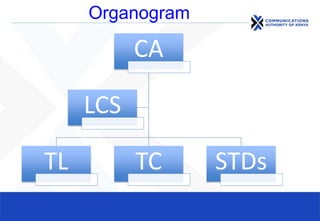
Organogram
CA
TL TC STDs
LCS
Legal Obligation
The Kenya Constitution
The KICA as amended
The Regulations 2010
The license conditions
International and National guidelines
Domesticated Best practices and Laws.
 Directives and Rulings
Statutory Compliance
Purpose
Statistical reporting for National statistics
To ensure level Playing field
To provide market entry guidelines.
To prevent interference
To enable interconnection and conformity
To ensure quality of service delivery.
To prevent illegal operations.
History
Changing license regime
Evolution in technology
Advanced/diverse revenue streams
Informed and Educated consumers
Decreasing cost of products/services and
increased purchasing power.
Responsive and reactive complaints
Increased competition and players.
Increased services/range of offers.
Roles of the Regulator
License and Plan resources
Monitor utilization of resources
Monitor quality of services delivery
Evaluate compliance and performance
Issue compliance reports and remedial acts
Compile and release statistics on market
development.
Enforce compliance to laws.
Roles of the Operator
Innovatively deliver services
Compliance to the license conditions/laws
Submit performance reports periodically.
Submit statutory documents and Pay relevant
fees.
Report any malpractices in the industry
Compete fairly and at market rates
Engage regularly on matters of the industry.
Roles of the Consumer
Consume and pay for the services
Observe the rules and buy genuine products.
Only engage with licensed entities/personnel
Report poor services or lack of service
Engage with licenses and regulator on ICTs
Attend training and consumer forums
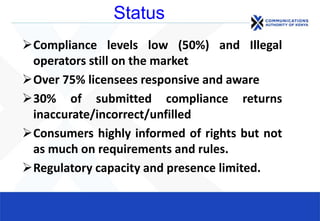
Status
Compliance levels low (50%) and Illegal
operators still on the market
Over 75% licensees responsive and aware
30% of submitted compliance returns
inaccurate/incorrect/unfilled
Consumers highly informed of rights but not
as much on requirements and rules.
Regulatory capacity and presence limited.
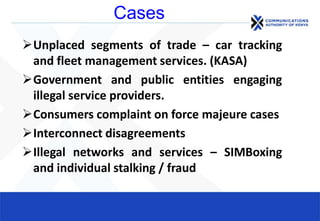
Cases
Unplaced segments of trade – car tracking
and fleet management services. (KASA)
Government and public entities engaging
illegal service providers.
Consumers complaint on force majeure cases
Interconnect disagreements
Illegal networks and services – SIMBoxing
and individual stalking / fraud
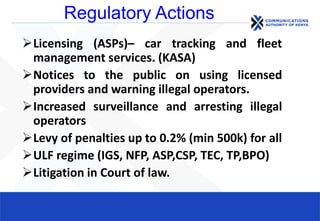
Regulatory Actions
Licensing (ASPs)– car tracking and fleet
management services. (KASA)
Notices to the public on using licensed
providers and warning illegal operators.
Increased surveillance and arresting illegal
operators
Levy of penalties up to 0.2% (min 500k) for all
ULF regime (IGS, NFP, ASP,CSP, TEC, TP,BPO)
Litigation in Court of law.
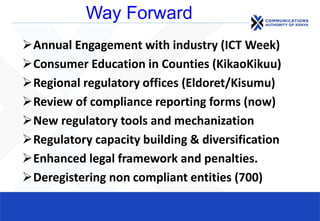
Way Forward
Annual Engagement with industry (ICT Week)
Consumer Education in Counties (KikaoKikuu)
Regional regulatory offices (Eldoret/Kisumu)
Review of compliance reporting forms (now)
New regulatory tools and mechanization
Regulatory capacity building & diversification
Enhanced legal framework and penalties.
Deregistering non compliant entities (700)
Expectations
Improved reporting forms and response
levels
Sustained inspections, monitoring and
surveillance for compliance
Enhanced consumer protection using HQ and
Regional Offices. (chukuahatua)
Fair competition and level playing field rid of
illegal networks.
Required
Commitment
Dedication
Transparency
Integrity
Result Focus
Team work
Accountability
Transforming lives by ICTs
Thank You

Compliance reporting-expectations

  • 1.
    2016 ICT WEEK THURSDAY19TH MAY 2016 LAICO REGENCY HOTEL NAIROBI DERICK SIMIYU KHAMALI khamali@ca.go.ke TELECOM COMPLIANCE REPORTING
  • 2.
  • 3.
    Legal Obligation The KenyaConstitution The KICA as amended The Regulations 2010 The license conditions International and National guidelines Domesticated Best practices and Laws.  Directives and Rulings Statutory Compliance
  • 4.
    Purpose Statistical reporting forNational statistics To ensure level Playing field To provide market entry guidelines. To prevent interference To enable interconnection and conformity To ensure quality of service delivery. To prevent illegal operations.
  • 5.
    History Changing license regime Evolutionin technology Advanced/diverse revenue streams Informed and Educated consumers Decreasing cost of products/services and increased purchasing power. Responsive and reactive complaints Increased competition and players. Increased services/range of offers.
  • 6.
    Roles of theRegulator License and Plan resources Monitor utilization of resources Monitor quality of services delivery Evaluate compliance and performance Issue compliance reports and remedial acts Compile and release statistics on market development. Enforce compliance to laws.
  • 7.
    Roles of theOperator Innovatively deliver services Compliance to the license conditions/laws Submit performance reports periodically. Submit statutory documents and Pay relevant fees. Report any malpractices in the industry Compete fairly and at market rates Engage regularly on matters of the industry.
  • 8.
    Roles of theConsumer Consume and pay for the services Observe the rules and buy genuine products. Only engage with licensed entities/personnel Report poor services or lack of service Engage with licenses and regulator on ICTs Attend training and consumer forums
  • 9.
    Status Compliance levels low(50%) and Illegal operators still on the market Over 75% licensees responsive and aware 30% of submitted compliance returns inaccurate/incorrect/unfilled Consumers highly informed of rights but not as much on requirements and rules. Regulatory capacity and presence limited.
  • 10.
    Cases Unplaced segments oftrade – car tracking and fleet management services. (KASA) Government and public entities engaging illegal service providers. Consumers complaint on force majeure cases Interconnect disagreements Illegal networks and services – SIMBoxing and individual stalking / fraud
  • 11.
    Regulatory Actions Licensing (ASPs)–car tracking and fleet management services. (KASA) Notices to the public on using licensed providers and warning illegal operators. Increased surveillance and arresting illegal operators Levy of penalties up to 0.2% (min 500k) for all ULF regime (IGS, NFP, ASP,CSP, TEC, TP,BPO) Litigation in Court of law.
  • 12.
    Way Forward Annual Engagementwith industry (ICT Week) Consumer Education in Counties (KikaoKikuu) Regional regulatory offices (Eldoret/Kisumu) Review of compliance reporting forms (now) New regulatory tools and mechanization Regulatory capacity building & diversification Enhanced legal framework and penalties. Deregistering non compliant entities (700)
  • 13.
    Expectations Improved reporting formsand response levels Sustained inspections, monitoring and surveillance for compliance Enhanced consumer protection using HQ and Regional Offices. (chukuahatua) Fair competition and level playing field rid of illegal networks.
  • 14.
  • 15.