LOCAL CONTENT
THE BROADCASTER PERSPECTIVE
REMARKS BY LYNETTE MWANGI
CHIEF EXECUTIVE OFFICER
THE MEDIA OWNERS ASSOCIATION
18TH MAY, 2016,
LAICO REGENCY HOTEL NAIROBI
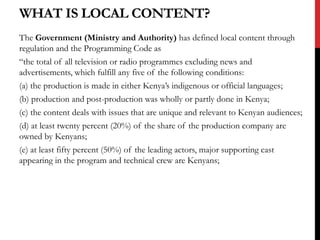
WHAT IS LOCAL CONTENT?
The Government (Ministry and Authority) has defined local content through
regulation and the Programming Code as
“the total of all television or radio programmes excluding news and
advertisements, which fulfill any five of the following conditions:
(a) the production is made in either Kenya’s indigenous or official languages;
(b) production and post-production was wholly or partly done in Kenya;
(c) the content deals with issues that are unique and relevant to Kenyan audiences;
(d) at least twenty percent (20%) of the share of the production company are
owned by Kenyans;
(e) at least fifty percent (50%) of the leading actors, major supporting cast
appearing in the program and technical crew are Kenyans;
WHAT IS LOCAL CONTENT?...Contd
(f) the location of shooting, in case of audiovisual programmes or performance was
wholly or partly in Kenya;
(g) the author(s) of the program are Kenyan (whether or not the program is
produced in conjunction with a co-producer, an executive producer or director who
is not Kenyan)
(h) Incase of an animated program, the program satisfies at least three of the
following requirements;
i. the production designer is Kenyan
ii. the character designer is Kenyan
iii. the supervising layout artist is Kenyan
iv. the supervising storyboard artist is Kenyan
v. The key background artist is Kenyan
vi. The director is Kenyan”
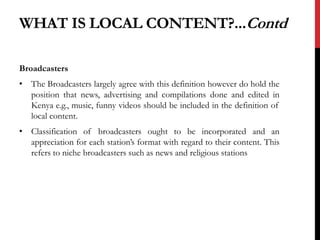
WHAT IS LOCAL CONTENT?...Contd
Broadcasters
• The Broadcasters largely agree with this definition however do hold the
position that news, advertising and compilations done and edited in
Kenya e.g., music, funny videos should be included in the definition of
local content.
• Classification of broadcasters ought to be incorporated and an
appreciation for each station’s format with regard to their content. This
refers to niche broadcasters such as news and religious stations
WHAT IS LOCAL CONTENT?...Contd
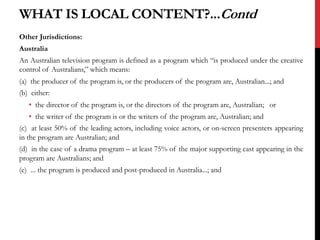
Other Jurisdictions:
Australia
An Australian television program is defined as a program which “is produced under the creative
control of Australians,” which means:
(a) the producer of the program is, or the producers of the program are, Australian...; and
(b) either:
• the director of the program is, or the directors of the program are, Australian; or
• the writer of the program is or the writers of the program are, Australian; and
(c) at least 50% of the leading actors, including voice actors, or on-screen presenters appearing
in the program are Australian; and
(d) in the case of a drama program – at least 75% of the major supporting cast appearing in the
program are Australians; and
(e) ... the program is produced and post-produced in Australia...; and
WHAT IS LOCAL CONTENT?...Contd
(f) in the case of an animated program – the program satisfies at least 3 of the
following requirements:
(i) the production designer is Australian;
(ii) the character designer is Australian;
(iii) the supervising layout artist is Australian;
(iv) the supervising storyboard artist is Australian; (v) the key background
artist is Australian
South Africa
Local content refers to “a television programme (excluding broadcasts of sports
events and compilations of them, teletext and continuity announcements) that is
produced by a South African broadcaster, or by South African people.”
WHY LOCAL CONTENT
• Local programmes are seen as essential to promote pluralism, and to
protect the identity, unity and sovereignty of the nation.
• Indeed many countries have local content rules in the broadcasting sector
to protect and promote local programming.
• It is opined that the local content rules are vital as international markets
favor countries with large and well-developed broadcasting and
production sectors such as the US, India and regionally Nigeria
whose programmes can easily displace local programmes in countries
with smaller, less developed sectors.
WHY LOCAL CONTENT…Contd
• Article 11 of the Constitution (2010) provides:
“This Constitution recognises culture as the foundation of the nation
and as the cumulative civilization of the Kenyan people and nation.”
And
“(2) The State shall—
(a) promote all forms of national and cultural expression through
literature, the arts, traditional celebrations, science,
communication, information, mass media, publications, libraries
and other cultural heritage;
(c) promote the intellectual property rights of the people of Kenya.”
It is also recognised at the international level that individuals have a right to take
part in, peoples have a right to develop, and States have an obligation to protect
and promote, local culture.
Article 1 of both the ICCPR and the International Covenant on Economic, Social
and Cultural Rights (ICESCR) recognise the right to cultural self-determination :
“All peoples have the right of self-determination. By virtue of that right they
freely determine their political status and freely pursue their economic,
social and cultural development.”
The UNESCO-sponsored Action Plan on Cultural Policies for Development
recognised the principle that local and regional cultures are threatened by cultures
with global reach and recommended that the Member States of UNESCO should:
“Provide communications networks, including radio, television and
information technologies which serve the cultural and educational need of
the public; encourage the commitment of radio, television, the press and
the other media to cultural development issues, such as the promotion of
local, regional and national cultures and languages, exploration and
preservation of the national heritage and promotion of the diversity of
cultural traditions and indigenous and national cultural identities, while
WHY LOCAL CONTENT…Contd
PROMOTING LOCAL CONTENT
• Kenya has adopted the content quotas measure to promote local
content by providing that:
• “Broadcasting stations shall ensure, within one year of award of
licence, not less than 40% of their station’s programming is local
content. Broadcasters’ local content programming should increase
to 60% within four years after receipt of licence. The local content
programming referred to in this paragraph excludes news, and
advertising.
• Any broadcaster that does not comply with the local content quota
shall be required to pay such an amount of money as may be
prescribed by the Authority for every year they are in
contravention.”
Other Jurisdictions
Countries with massive domestic markets like the United States and India
have considered there is no need to protect the output of their cultural
sectors and have not introduced content regulation.
Indeed, in the case of the United States, introducing content quotas
appears to offend the First Amendment of the US Constitution.
South Africa
Local content quotas were amended and increased in 2003 — 35% for
commercial television broadcasters, 55% for public service
broadcasters and subscription television at least 10%.
PROMOTING LOCAL CONTENT…Cont.
It is worthwhile to note that:
• If in practice local content rules:
• do not promote diversity;
• they are a restriction on freedom of expression;
• where they fail to take into account the type of programming a
broadcaster airs; and
• where they do not include phasing in periods for quotas.
• Local content quotas
• that are unreasonably high;
• do not distinguish between different types of broadcasters (e.g. national,
local, radio, television).
They may not only restrict foreign programming but actually undermine the
ability of local broadcasters to survive.
INGREDIENTS OF LOCAL CONTENT RULES
• Promote pluralism
Pluralism, including the right of a person to access a diversity of information, is an
important aspect of freedom of expression.
It has been recognised that States have a positive obligation to promote pluralism within,
and to ensure equal access of all to, the media.
• Implemented by appropriate legal means
Established either in legislation or regulations or as part of the licensing of broadcasters.
Second, a broadcast regulator, which is independent of government and fair and impartial,
should monitor and enforce compliance with local content rules.
• Implemented progressively.
Local content rules should be implemented progressively so as to give broadcasters
time to bring themselves into compliance with the rules.
They should also be subject to periodic reviews, where there is flexibility to make
amendments.
Local content requirements which are immediate and fixed, particularly if the quotas are
high, can undermine the rules themselves (if many broadcasters are simply unable to
comply with them) and the viability of the broadcasting sector.
LIMITATIONS
Breach of right to access to information by the flow of foreign
information into a country.
24. (1) A right or fundamental freedom in the Bill of Rights shall not be limited
except by law, and then only to the extent that the limitation is reasonable and
justifiable in an open and democratic society based on human dignity, equality
and freedom, taking into account all relevant factors, including––
(e) the relation between the limitation and its purpose and whether there are less
restrictive means to achieve the purpose.
Breach of the guarantee of freedom of expression
33. (1) Every person has the right to freedom of expression, which includes—
(a) freedom to seek, receive or impart information or ideas;
(b) freedom of artistic creativity; and
LIMITATIONS
Breach of freedom of the media
34. (1) Freedom and independence of electronic, print and all other types of
media is guaranteed, but does not extend to any expression specified in Article
33 (2). (propaganda for war; incitement to violence; hate speech; or advocacy
of hatred)
(2) The State shall not—
(a) exercise control over or interfere with any person engaged in broadcasting,
the production or circulation of any publication or the dissemination of
information by any medium; or
(b) penalise any person for any opinion or view or the content of any
broadcast, publication or dissemination.
(3) Broadcasting and other electronic media have freedom of establishment,
subject only to licensing procedures that—
(a) are necessary to regulate the airwaves and other forms of signal distribution;
and
(b) are independent of control by government, political interests or commercial
interests.
ALTERNATIVES TO LOCAL CONTENT
RULES
• Direct subsidy- support the production of local content through
direct subsidy – facilitate grants and investments into the film
industry – through measures such as taxation concessions, tax holidays.
• Indirect subsidy, utilizing income from spectrum auctions, levies
on broadcasters.
• The establishment of publicly funded broadcasters.
THE FUTURE OF LOCAL CONTENT
The industry needs to have a vision beyond local broadcasters and traditional media platforms
and look to the digital platforms to expand their viewership, market and reach to the regional
and international fronts.
To quote “Content is King” by Bill Gates (1996):
“Content is where I expect much of the real money will be made on the Internet, just
as it was in broadcasting. The television revolution that began half a century ago
spawned a number of industries, including the manufacturing of TV sets, but the long-
term winners were those who used the medium to deliver information and
entertainment.
When it comes to an interactive network such as the Internet, the definition of
“content” becomes very wide. For example, computer software is a form of content-an
extremely important one, and the one that for Microsoft will remain by far the most
important. But the broad opportunities for most companies involve supplying
information or entertainment. No company is too small to participate.
One of the exciting things about the Internet is that anyone with a PC and a modem
can publish whatever content they can create. In a sense, the Internet is the multimedia
equivalent of the photocopier. It allows material to be duplicated at low cost, no matter
the size of the audience. The Internet also allows information to be distributed
worldwide at basically zero marginal cost to the publisher. Opportunities are
remarkable, and many companies are laying plans to create content for the Internet.”
Asanteni Sana!

Broadcasters perspective

  • 1.
    LOCAL CONTENT THE BROADCASTERPERSPECTIVE REMARKS BY LYNETTE MWANGI CHIEF EXECUTIVE OFFICER THE MEDIA OWNERS ASSOCIATION 18TH MAY, 2016, LAICO REGENCY HOTEL NAIROBI
  • 2.
    WHAT IS LOCALCONTENT? The Government (Ministry and Authority) has defined local content through regulation and the Programming Code as “the total of all television or radio programmes excluding news and advertisements, which fulfill any five of the following conditions: (a) the production is made in either Kenya’s indigenous or official languages; (b) production and post-production was wholly or partly done in Kenya; (c) the content deals with issues that are unique and relevant to Kenyan audiences; (d) at least twenty percent (20%) of the share of the production company are owned by Kenyans; (e) at least fifty percent (50%) of the leading actors, major supporting cast appearing in the program and technical crew are Kenyans;
  • 3.
    WHAT IS LOCALCONTENT?...Contd (f) the location of shooting, in case of audiovisual programmes or performance was wholly or partly in Kenya; (g) the author(s) of the program are Kenyan (whether or not the program is produced in conjunction with a co-producer, an executive producer or director who is not Kenyan) (h) Incase of an animated program, the program satisfies at least three of the following requirements; i. the production designer is Kenyan ii. the character designer is Kenyan iii. the supervising layout artist is Kenyan iv. the supervising storyboard artist is Kenyan v. The key background artist is Kenyan vi. The director is Kenyan”
  • 4.
    WHAT IS LOCALCONTENT?...Contd Broadcasters • The Broadcasters largely agree with this definition however do hold the position that news, advertising and compilations done and edited in Kenya e.g., music, funny videos should be included in the definition of local content. • Classification of broadcasters ought to be incorporated and an appreciation for each station’s format with regard to their content. This refers to niche broadcasters such as news and religious stations
  • 5.
    WHAT IS LOCALCONTENT?...Contd Other Jurisdictions: Australia An Australian television program is defined as a program which “is produced under the creative control of Australians,” which means: (a) the producer of the program is, or the producers of the program are, Australian...; and (b) either: • the director of the program is, or the directors of the program are, Australian; or • the writer of the program is or the writers of the program are, Australian; and (c) at least 50% of the leading actors, including voice actors, or on-screen presenters appearing in the program are Australian; and (d) in the case of a drama program – at least 75% of the major supporting cast appearing in the program are Australians; and (e) ... the program is produced and post-produced in Australia...; and
  • 6.
    WHAT IS LOCALCONTENT?...Contd (f) in the case of an animated program – the program satisfies at least 3 of the following requirements: (i) the production designer is Australian; (ii) the character designer is Australian; (iii) the supervising layout artist is Australian; (iv) the supervising storyboard artist is Australian; (v) the key background artist is Australian South Africa Local content refers to “a television programme (excluding broadcasts of sports events and compilations of them, teletext and continuity announcements) that is produced by a South African broadcaster, or by South African people.”
  • 7.
    WHY LOCAL CONTENT •Local programmes are seen as essential to promote pluralism, and to protect the identity, unity and sovereignty of the nation. • Indeed many countries have local content rules in the broadcasting sector to protect and promote local programming. • It is opined that the local content rules are vital as international markets favor countries with large and well-developed broadcasting and production sectors such as the US, India and regionally Nigeria whose programmes can easily displace local programmes in countries with smaller, less developed sectors.
  • 8.
    WHY LOCAL CONTENT…Contd •Article 11 of the Constitution (2010) provides: “This Constitution recognises culture as the foundation of the nation and as the cumulative civilization of the Kenyan people and nation.” And “(2) The State shall— (a) promote all forms of national and cultural expression through literature, the arts, traditional celebrations, science, communication, information, mass media, publications, libraries and other cultural heritage; (c) promote the intellectual property rights of the people of Kenya.”
  • 9.
    It is alsorecognised at the international level that individuals have a right to take part in, peoples have a right to develop, and States have an obligation to protect and promote, local culture. Article 1 of both the ICCPR and the International Covenant on Economic, Social and Cultural Rights (ICESCR) recognise the right to cultural self-determination : “All peoples have the right of self-determination. By virtue of that right they freely determine their political status and freely pursue their economic, social and cultural development.” The UNESCO-sponsored Action Plan on Cultural Policies for Development recognised the principle that local and regional cultures are threatened by cultures with global reach and recommended that the Member States of UNESCO should: “Provide communications networks, including radio, television and information technologies which serve the cultural and educational need of the public; encourage the commitment of radio, television, the press and the other media to cultural development issues, such as the promotion of local, regional and national cultures and languages, exploration and preservation of the national heritage and promotion of the diversity of cultural traditions and indigenous and national cultural identities, while WHY LOCAL CONTENT…Contd
  • 10.
    PROMOTING LOCAL CONTENT •Kenya has adopted the content quotas measure to promote local content by providing that: • “Broadcasting stations shall ensure, within one year of award of licence, not less than 40% of their station’s programming is local content. Broadcasters’ local content programming should increase to 60% within four years after receipt of licence. The local content programming referred to in this paragraph excludes news, and advertising. • Any broadcaster that does not comply with the local content quota shall be required to pay such an amount of money as may be prescribed by the Authority for every year they are in contravention.”
  • 11.
    Other Jurisdictions Countries withmassive domestic markets like the United States and India have considered there is no need to protect the output of their cultural sectors and have not introduced content regulation. Indeed, in the case of the United States, introducing content quotas appears to offend the First Amendment of the US Constitution. South Africa Local content quotas were amended and increased in 2003 — 35% for commercial television broadcasters, 55% for public service broadcasters and subscription television at least 10%. PROMOTING LOCAL CONTENT…Cont.
  • 12.
    PROMOTING LOCAL CONTENT…Cont. Itis worthwhile to note that: • If in practice local content rules: • do not promote diversity; • they are a restriction on freedom of expression; • where they fail to take into account the type of programming a broadcaster airs; and • where they do not include phasing in periods for quotas. • Local content quotas • that are unreasonably high; • do not distinguish between different types of broadcasters (e.g. national, local, radio, television). They may not only restrict foreign programming but actually undermine the ability of local broadcasters to survive.
  • 13.
    INGREDIENTS OF LOCALCONTENT RULES • Promote pluralism Pluralism, including the right of a person to access a diversity of information, is an important aspect of freedom of expression. It has been recognised that States have a positive obligation to promote pluralism within, and to ensure equal access of all to, the media. • Implemented by appropriate legal means Established either in legislation or regulations or as part of the licensing of broadcasters. Second, a broadcast regulator, which is independent of government and fair and impartial, should monitor and enforce compliance with local content rules. • Implemented progressively. Local content rules should be implemented progressively so as to give broadcasters time to bring themselves into compliance with the rules. They should also be subject to periodic reviews, where there is flexibility to make amendments. Local content requirements which are immediate and fixed, particularly if the quotas are high, can undermine the rules themselves (if many broadcasters are simply unable to comply with them) and the viability of the broadcasting sector.
  • 14.
    LIMITATIONS Breach of rightto access to information by the flow of foreign information into a country. 24. (1) A right or fundamental freedom in the Bill of Rights shall not be limited except by law, and then only to the extent that the limitation is reasonable and justifiable in an open and democratic society based on human dignity, equality and freedom, taking into account all relevant factors, including–– (e) the relation between the limitation and its purpose and whether there are less restrictive means to achieve the purpose. Breach of the guarantee of freedom of expression 33. (1) Every person has the right to freedom of expression, which includes— (a) freedom to seek, receive or impart information or ideas; (b) freedom of artistic creativity; and
  • 15.
    LIMITATIONS Breach of freedomof the media 34. (1) Freedom and independence of electronic, print and all other types of media is guaranteed, but does not extend to any expression specified in Article 33 (2). (propaganda for war; incitement to violence; hate speech; or advocacy of hatred) (2) The State shall not— (a) exercise control over or interfere with any person engaged in broadcasting, the production or circulation of any publication or the dissemination of information by any medium; or (b) penalise any person for any opinion or view or the content of any broadcast, publication or dissemination. (3) Broadcasting and other electronic media have freedom of establishment, subject only to licensing procedures that— (a) are necessary to regulate the airwaves and other forms of signal distribution; and (b) are independent of control by government, political interests or commercial interests.
  • 16.
    ALTERNATIVES TO LOCALCONTENT RULES • Direct subsidy- support the production of local content through direct subsidy – facilitate grants and investments into the film industry – through measures such as taxation concessions, tax holidays. • Indirect subsidy, utilizing income from spectrum auctions, levies on broadcasters. • The establishment of publicly funded broadcasters.
  • 17.
    THE FUTURE OFLOCAL CONTENT The industry needs to have a vision beyond local broadcasters and traditional media platforms and look to the digital platforms to expand their viewership, market and reach to the regional and international fronts. To quote “Content is King” by Bill Gates (1996): “Content is where I expect much of the real money will be made on the Internet, just as it was in broadcasting. The television revolution that began half a century ago spawned a number of industries, including the manufacturing of TV sets, but the long- term winners were those who used the medium to deliver information and entertainment. When it comes to an interactive network such as the Internet, the definition of “content” becomes very wide. For example, computer software is a form of content-an extremely important one, and the one that for Microsoft will remain by far the most important. But the broad opportunities for most companies involve supplying information or entertainment. No company is too small to participate. One of the exciting things about the Internet is that anyone with a PC and a modem can publish whatever content they can create. In a sense, the Internet is the multimedia equivalent of the photocopier. It allows material to be duplicated at low cost, no matter the size of the audience. The Internet also allows information to be distributed worldwide at basically zero marginal cost to the publisher. Opportunities are remarkable, and many companies are laying plans to create content for the Internet.”
  • 18.