Complex plane, Modulus, Argument,
Graphical representation of a
complex number.
complex number.
P r e s e n t a t i o n
o n
Submitted To
Mr. Md. Mozammelul Haque
Lecturer
Department of Software Engineering
Daffodil International University
Section : A
ID : 232-35-016
Reduan Ahmad
Section : A
ID : 232-35-003
Abdullah Al Noman
Section : A
ID : 232-35-022
Mohammad Ali Nayeem
Section : A
ID : 222-35-1189
Sabbir Hossen
Section : A
ID : 232-35-001
Prionti Maliha
Learning Target:
Complex plane
Modulus
Argument
Graphical representation of
a complex number.
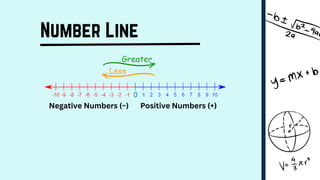
Number Line
Negative Numbers (−) Positive Numbers (+)
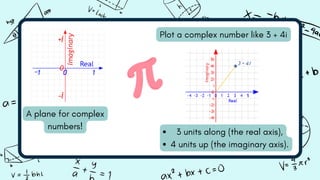
A plane for complex
numbers!
3 units along (the real axis),
4 units up (the imaginary axis).
Plot a complex number like 3 + 4i
Modulus
The modulus of a complex number is a fundamental concept in mathematics.
The modulus of a complex number is the distance of the complex number from the origin in
the the complex plane
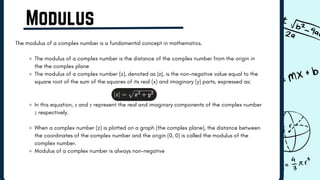
The modulus of a complex number (z), denoted as |z|, is the non-negative value equal to the
square root of the sum of the squares of its real (x) and imaginary (y) parts, expressed as:
In this equation, 𝑥 and 𝑦 represent the real and imaginary components of the complex number
𝑧 respectively.
When a complex number (z) is plotted on a graph (the complex plane), the distance between
the coordinates of the complex number and the origin (0, 0) is called the modulus of the
complex number.
Modulus of a complex number is always non-negative
Examples
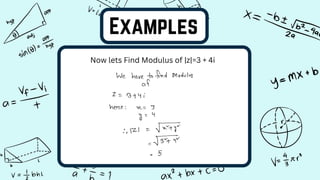
Now lets Find Modulus of |z|=3 + 4i
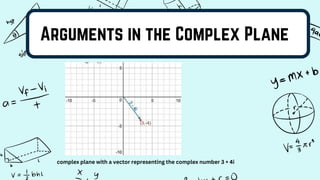
Arguments in the Complex Plane
complex plane with a vector representing the complex number 3 + 4i
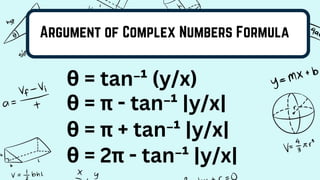
Argument of Complex Numbers Formula
θ = tan⁻¹ (y/x)
θ = π - tan⁻¹ |y/x|
θ = π + tan⁻¹ |y/x|
θ = 2π - tan⁻¹ |y/x|
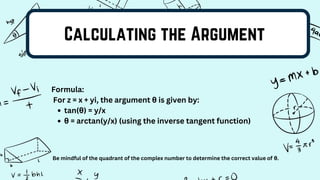
Calculating the Argument
Be mindful of the quadrant of the complex number to determine the correct value of θ.
Formula:
For z = x + yi, the argument θ is given by:
tan(θ) = y/x
θ = arctan(y/x) (using the inverse tangent function)
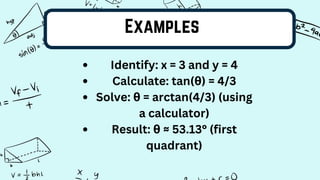
Examples
Identify: x = 3 and y = 4
Calculate: tan(θ) = 4/3
Solve: θ = arctan(4/3) (using
a calculator)
Result: θ ≈ 53.13° (first
quadrant)
Graphical
Representation of
Complex Numbers
We can represent complex numbers in the
complex plane.
We use the horizontal axis for the real part and
the vertical axis for the imaginary part.
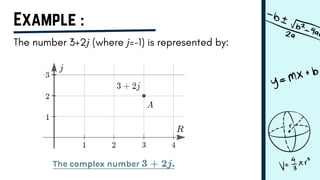
Example :
The number 3+2𝑗 (where 𝑗=−1​
) is represented by:
The point A is the representation of the
complex number 3+2𝑗.
The horizontal axis is marked R (for the "real"
numbered-component), and the vertical axis
is marked j (for the imaginary component of
the complex number).
THANK YOU!

Complex plane, Modulus, Argument, Graphical representation of a complex number - Math 102 - diu - swe

  • 1.
    Complex plane, Modulus,Argument, Complex plane, Modulus, Argument, Graphical representation of a Graphical representation of a complex number. complex number. P r e s e n t a t i o n o n Submitted To Mr. Md. Mozammelul Haque Lecturer Department of Software Engineering Daffodil International University
  • 2.
    Section : A ID: 232-35-016 Reduan Ahmad Section : A ID : 232-35-003 Abdullah Al Noman Section : A ID : 232-35-022 Mohammad Ali Nayeem Section : A ID : 222-35-1189 Sabbir Hossen Section : A ID : 232-35-001 Prionti Maliha
  • 3.
  • 4.
    Number Line Negative Numbers(−) Positive Numbers (+)
  • 5.
    A plane forcomplex numbers! 3 units along (the real axis), 4 units up (the imaginary axis). Plot a complex number like 3 + 4i
  • 6.
    Modulus The modulus ofa complex number is a fundamental concept in mathematics. The modulus of a complex number is the distance of the complex number from the origin in the the complex plane The modulus of a complex number (z), denoted as |z|, is the non-negative value equal to the square root of the sum of the squares of its real (x) and imaginary (y) parts, expressed as: In this equation, 𝑥 and 𝑦 represent the real and imaginary components of the complex number 𝑧 respectively. When a complex number (z) is plotted on a graph (the complex plane), the distance between the coordinates of the complex number and the origin (0, 0) is called the modulus of the complex number. Modulus of a complex number is always non-negative
  • 7.
    Examples Now lets FindModulus of |z|=3 + 4i
  • 8.
    Arguments in theComplex Plane complex plane with a vector representing the complex number 3 + 4i
  • 9.
    Argument of ComplexNumbers Formula θ = tan⁻¹ (y/x) θ = π - tan⁻¹ |y/x| θ = π + tan⁻¹ |y/x| θ = 2π - tan⁻¹ |y/x|
  • 10.
    Calculating the Argument Bemindful of the quadrant of the complex number to determine the correct value of θ. Formula: For z = x + yi, the argument θ is given by: tan(θ) = y/x θ = arctan(y/x) (using the inverse tangent function)
  • 11.
    Examples Identify: x =3 and y = 4 Calculate: tan(θ) = 4/3 Solve: θ = arctan(4/3) (using a calculator) Result: θ ≈ 53.13° (first quadrant)
  • 12.
  • 13.
    We can representcomplex numbers in the complex plane. We use the horizontal axis for the real part and the vertical axis for the imaginary part.
  • 14.
    Example : The number3+2𝑗 (where 𝑗=−1​ ) is represented by:
  • 15.
    The point Ais the representation of the complex number 3+2𝑗. The horizontal axis is marked R (for the "real" numbered-component), and the vertical axis is marked j (for the imaginary component of the complex number).
  • 16.