Demonstration Teaching
Basic Knowledge in Understanding Functions
Jayson G. Barsana
Demo Teacher
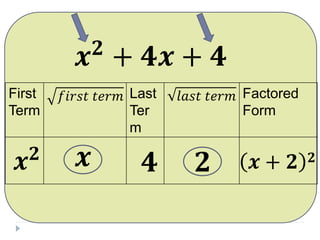
First
Term
𝑓𝑖𝑟𝑠𝑡 𝑡𝑒𝑟𝑚 Last
Ter
m
𝑙𝑎𝑠𝑡 𝑡𝑒𝑟𝑚 Factored
Form
𝒙 𝟐
+ 𝟒𝒙 + 𝟒
𝒙 𝟐 𝒙 𝟒 𝒙 + 𝟐 𝟐
𝟐
First
Term
𝑓𝑖𝑟𝑠𝑡 𝑡𝑒𝑟𝑚 Last
Ter
m
𝑙𝑎𝑠𝑡 𝑡𝑒𝑟𝑚 Factored
Form
𝒙 𝟐
+ 𝟐𝟎𝒙 + 𝟏𝟎𝟎
𝒙 𝟐 𝒙 𝟏𝟎𝟎 𝒙 + 𝟏𝟎 𝟐
1𝟎
First
Term
𝑓𝑖𝑟𝑠𝑡 𝑡𝑒𝑟𝑚 Last
Ter
m
𝑙𝑎𝑠𝑡 𝑡𝑒𝑟𝑚Factored
Form
𝟒𝒙 𝟐
+ 𝟏𝟐𝒙 + 𝟗
𝟒𝒙 𝟐 2𝒙 𝟗 𝟐𝒙 + 𝟑 𝟐
𝟑
First
Term
𝑓𝑖𝑟𝑠𝑡 𝑡𝑒𝑟𝑚 Last
Ter
m
𝑙𝑎𝑠𝑡 𝑡𝑒𝑟𝑚 Factored
Form
𝒙 𝟐
− 𝟏𝟒𝒙 + 𝟒𝟗
𝒙 𝟐 𝒙 𝟒𝟗 𝒙 − 𝟕 𝟐
𝟕
First
Term
𝑓𝑖𝑟𝑠𝑡 𝑡𝑒𝑟𝑚 Last
Ter
m
𝑙𝑎𝑠𝑡 𝑡𝑒𝑟𝑚 Factored
Form
𝒙 𝟐
+ 𝒙 +
𝟏
𝟒
𝒙 𝟐 𝒙 𝟏
𝟒
𝒙 +
𝟏
𝟐
𝟐𝟏
𝟐
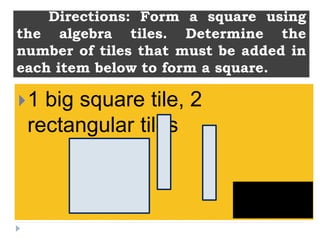
Directions: Form a square using
the algebra tiles. Determine the
number of tiles that must be added in
each item below to form a square.
1 big square tile, 2
rectangular tiles
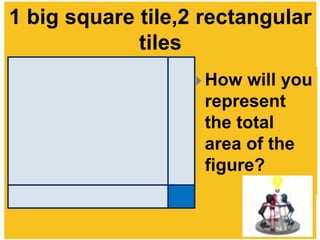
1 big square tile,2 rectangular
tiles
 How will you
represent
the total
area of the
figure?
Directions: Form a square using
the algebra tiles. Determine the
number of tiles that must be added in
each item below to form a square.
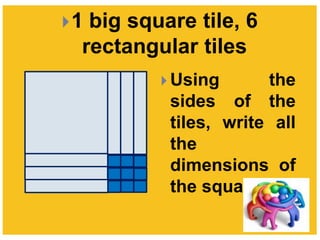
1 big square tile, 6
rectangular tiles
1 big square tile, 6
rectangular tiles
 Using the
sides of the
tiles, write all
the
dimensions of
the square.
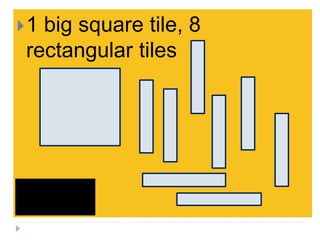
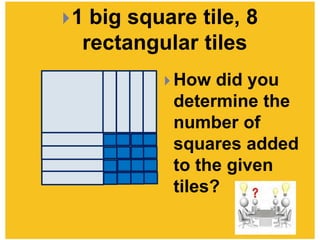
1 big square tile, 8
rectangular tiles
1 big square tile, 8
rectangular tiles
 How did you
determine the
number of
squares added
to the given
tiles?
Directions: Form a square using
the algebra tiles. Determine the
number of tiles that must be added in
each item below to form a square.
4 big square tile, 4
rectangular tiles
4 big square tile, 4
rectangular tiles
 How did you
determine the
number of
squares added
to the given
tiles?
Directions: Form a square using
the algebra tiles. Determine the
number of tiles that must be added in
each item below to form a square.
4 big square tile, 8
rectangular tiles
4 big square tile, 8
rectangular tiles
 Did you find
pattern in
completing the
square? If yes,
what is this?
Directions: The
shaded region of the
diagram at the right
shows the portion of a
square-shaped car park
that is already
cemented. The area of
the cemented part is
600m2. Use the
diagram to answer the
following questions.
10m
10m
How would you represent the length of the
side of the park? How about the width of
the cemented portion?
10m
10m
What equation would represent the area of
the cemented part of the car?
Using the equation formulated, how are you
going to find the length of a side of the
park?
Completing the Square
 Another method of solving Quadratic
Equation
 𝒂𝒙 𝟐 + 𝐛𝐱 + 𝐜 = 𝟎
(𝒙 − 𝒉) 𝟐= 𝐤
 𝐤 ≠ 𝟎
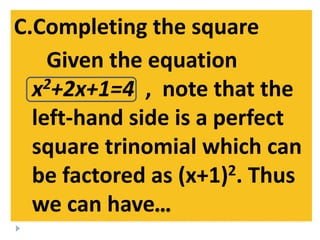
C.Completing the square
Given the equation
x2+2x+1=4 , note that the
left-hand side is a perfect
square trinomial which can
be factored as (x+1)2. Thus
we can have…
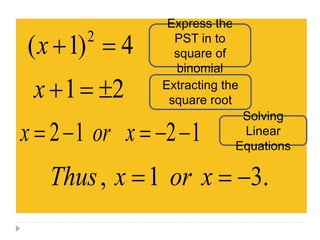
1212  xorx
Express the
PST in to
square of
binomial
Extracting the
square root
Solving
Linear
Equations
21 x
.31,  xorxThus
4)1( 2
x
Given the Quadratic equation
𝒙 𝟐
+ 𝟔𝒙 + 𝟗 = 𝟏
(𝒙 + 𝟑) 𝟐
= 𝟏
𝒙 + 𝟑 = ±𝟏
𝒙 = 𝟏 − 𝟑 𝒐𝒓 𝒙 = −𝟏 − 𝟑
𝑻𝒉𝒖𝒔, 𝒙 = −𝟐 𝒐𝒓 𝒙 = −𝟒
What if the left-hand side
of the quadratic equation
ax2+bx+c = 0 is not a perfect
square trinomial? Can we still
do the completing the
square? Let see!(Recall the
formula for squaring a
binomial)
𝑥2
+10𝑥+ ? = 9+ ?
𝑥 + 10 = ±3
𝑥2
+ 10𝑥 + 25 = 9 + 25
(𝑥 + 10)2
= 9𝟏𝟎
𝟐
𝟐 = 𝟓 𝟐 = 𝟐𝟓
𝑥 = 3 − 10 𝑜𝑟 𝑥 = −3 − 10
𝑇ℎ𝑢𝑠, 𝑥 = −2 𝑜𝑟 𝑥 = −4
𝑥2
+ 10𝑥 = 9
𝑥2
+3𝑥+ ? = 4+ ?
𝒙 +
𝟑
𝟐
= ±
𝟓
𝟐
(𝑥 +
3
2
)2 =
25
4
𝟑
𝟐
𝟐 =
𝟗
𝟒
=
𝟗
𝟒
𝑥 = 1 𝑜𝑟 𝑥 = −4
𝑇ℎ𝑢𝑠, 𝑥 = 1 𝑜𝑟 𝑥 = −4
3𝑥2
+ 9𝑥 = 12
4
9
4
4
9
32
 xx
Divide both sides of
equation by a then
simplify
Directions: Use each figure and
write the equation that represents
the area of the shaded region. Then
find the solutions to the equations
by completing the square.
Questions:
How did you come up
with the equation that
represents the shaded
region?
How did you find the
solution/s of each
equation
Do all solutions to
each equation
represent a particular
measure of each
figure? Explain your
answer.
Questions:
How did you come up
with the equation that
represents the shaded
region?
How did you find the
solution/s of each
equation
Do all solutions to each
equation represent a
particular measure of
each figure? Explain
your answer.
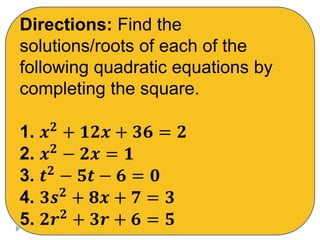
Directions: Find the
solutions/roots of each of the
following quadratic equations by
completing the square.
1. 𝒙 𝟐
+ 𝟏𝟐𝒙 + 𝟑𝟔 = 𝟐
2. 𝒙 𝟐
− 𝟐𝒙 = 𝟏
3. 𝒕 𝟐
− 𝟓𝒕 − 𝟔 = 𝟎
4. 𝟑𝒔 𝟐
+ 𝟖𝒙 + 𝟕 = 𝟑
5. 𝟐𝒓 𝟐
+ 𝟑𝒓 + 𝟔 = 𝟓
Assignment:
Directions: Find the solutions/roots
of each of the following quadratic
equations by completing the square.
1. 𝑥2
− 6𝑥 − 41 = 0
2. 4𝑥2
−32𝑥 = −28
3. 𝑤2
+6𝑤 − 11 = 0
Completing the square

Completing the square

  • 1.
    Demonstration Teaching Basic Knowledgein Understanding Functions Jayson G. Barsana Demo Teacher
  • 2.
    First Term 𝑓𝑖𝑟𝑠𝑡 𝑡𝑒𝑟𝑚 Last Ter m 𝑙𝑎𝑠𝑡𝑡𝑒𝑟𝑚 Factored Form 𝒙 𝟐 + 𝟒𝒙 + 𝟒 𝒙 𝟐 𝒙 𝟒 𝒙 + 𝟐 𝟐 𝟐
  • 3.
    First Term 𝑓𝑖𝑟𝑠𝑡 𝑡𝑒𝑟𝑚 Last Ter m 𝑙𝑎𝑠𝑡𝑡𝑒𝑟𝑚 Factored Form 𝒙 𝟐 + 𝟐𝟎𝒙 + 𝟏𝟎𝟎 𝒙 𝟐 𝒙 𝟏𝟎𝟎 𝒙 + 𝟏𝟎 𝟐 1𝟎
  • 4.
    First Term 𝑓𝑖𝑟𝑠𝑡 𝑡𝑒𝑟𝑚 Last Ter m 𝑙𝑎𝑠𝑡𝑡𝑒𝑟𝑚Factored Form 𝟒𝒙 𝟐 + 𝟏𝟐𝒙 + 𝟗 𝟒𝒙 𝟐 2𝒙 𝟗 𝟐𝒙 + 𝟑 𝟐 𝟑
  • 5.
    First Term 𝑓𝑖𝑟𝑠𝑡 𝑡𝑒𝑟𝑚 Last Ter m 𝑙𝑎𝑠𝑡𝑡𝑒𝑟𝑚 Factored Form 𝒙 𝟐 − 𝟏𝟒𝒙 + 𝟒𝟗 𝒙 𝟐 𝒙 𝟒𝟗 𝒙 − 𝟕 𝟐 𝟕
  • 6.
    First Term 𝑓𝑖𝑟𝑠𝑡 𝑡𝑒𝑟𝑚 Last Ter m 𝑙𝑎𝑠𝑡𝑡𝑒𝑟𝑚 Factored Form 𝒙 𝟐 + 𝒙 + 𝟏 𝟒 𝒙 𝟐 𝒙 𝟏 𝟒 𝒙 + 𝟏 𝟐 𝟐𝟏 𝟐
  • 7.
    Directions: Form asquare using the algebra tiles. Determine the number of tiles that must be added in each item below to form a square. 1 big square tile, 2 rectangular tiles
  • 8.
    1 big squaretile,2 rectangular tiles  How will you represent the total area of the figure?
  • 9.
    Directions: Form asquare using the algebra tiles. Determine the number of tiles that must be added in each item below to form a square. 1 big square tile, 6 rectangular tiles
  • 10.
    1 big squaretile, 6 rectangular tiles  Using the sides of the tiles, write all the dimensions of the square.
  • 11.
    1 big squaretile, 8 rectangular tiles
  • 12.
    1 big squaretile, 8 rectangular tiles  How did you determine the number of squares added to the given tiles?
  • 13.
    Directions: Form asquare using the algebra tiles. Determine the number of tiles that must be added in each item below to form a square. 4 big square tile, 4 rectangular tiles
  • 14.
    4 big squaretile, 4 rectangular tiles  How did you determine the number of squares added to the given tiles?
  • 15.
    Directions: Form asquare using the algebra tiles. Determine the number of tiles that must be added in each item below to form a square. 4 big square tile, 8 rectangular tiles
  • 16.
    4 big squaretile, 8 rectangular tiles  Did you find pattern in completing the square? If yes, what is this?
  • 17.
    Directions: The shaded regionof the diagram at the right shows the portion of a square-shaped car park that is already cemented. The area of the cemented part is 600m2. Use the diagram to answer the following questions. 10m 10m
  • 18.
    How would yourepresent the length of the side of the park? How about the width of the cemented portion? 10m 10m
  • 19.
    What equation wouldrepresent the area of the cemented part of the car?
  • 20.
    Using the equationformulated, how are you going to find the length of a side of the park?
  • 21.
    Completing the Square Another method of solving Quadratic Equation  𝒂𝒙 𝟐 + 𝐛𝐱 + 𝐜 = 𝟎 (𝒙 − 𝒉) 𝟐= 𝐤  𝐤 ≠ 𝟎
  • 22.
    C.Completing the square Giventhe equation x2+2x+1=4 , note that the left-hand side is a perfect square trinomial which can be factored as (x+1)2. Thus we can have…
  • 23.
    1212  xorx Expressthe PST in to square of binomial Extracting the square root Solving Linear Equations 21 x .31,  xorxThus 4)1( 2 x
  • 24.
    Given the Quadraticequation 𝒙 𝟐 + 𝟔𝒙 + 𝟗 = 𝟏 (𝒙 + 𝟑) 𝟐 = 𝟏 𝒙 + 𝟑 = ±𝟏 𝒙 = 𝟏 − 𝟑 𝒐𝒓 𝒙 = −𝟏 − 𝟑 𝑻𝒉𝒖𝒔, 𝒙 = −𝟐 𝒐𝒓 𝒙 = −𝟒
  • 25.
    What if theleft-hand side of the quadratic equation ax2+bx+c = 0 is not a perfect square trinomial? Can we still do the completing the square? Let see!(Recall the formula for squaring a binomial)
  • 26.
    𝑥2 +10𝑥+ ? =9+ ? 𝑥 + 10 = ±3 𝑥2 + 10𝑥 + 25 = 9 + 25 (𝑥 + 10)2 = 9𝟏𝟎 𝟐 𝟐 = 𝟓 𝟐 = 𝟐𝟓 𝑥 = 3 − 10 𝑜𝑟 𝑥 = −3 − 10 𝑇ℎ𝑢𝑠, 𝑥 = −2 𝑜𝑟 𝑥 = −4 𝑥2 + 10𝑥 = 9
  • 27.
    𝑥2 +3𝑥+ ? =4+ ? 𝒙 + 𝟑 𝟐 = ± 𝟓 𝟐 (𝑥 + 3 2 )2 = 25 4 𝟑 𝟐 𝟐 = 𝟗 𝟒 = 𝟗 𝟒 𝑥 = 1 𝑜𝑟 𝑥 = −4 𝑇ℎ𝑢𝑠, 𝑥 = 1 𝑜𝑟 𝑥 = −4 3𝑥2 + 9𝑥 = 12 4 9 4 4 9 32  xx Divide both sides of equation by a then simplify
  • 28.
    Directions: Use eachfigure and write the equation that represents the area of the shaded region. Then find the solutions to the equations by completing the square.
  • 29.
    Questions: How did youcome up with the equation that represents the shaded region? How did you find the solution/s of each equation Do all solutions to each equation represent a particular measure of each figure? Explain your answer.
  • 30.
    Questions: How did youcome up with the equation that represents the shaded region? How did you find the solution/s of each equation Do all solutions to each equation represent a particular measure of each figure? Explain your answer.
  • 31.
    Directions: Find the solutions/rootsof each of the following quadratic equations by completing the square. 1. 𝒙 𝟐 + 𝟏𝟐𝒙 + 𝟑𝟔 = 𝟐 2. 𝒙 𝟐 − 𝟐𝒙 = 𝟏 3. 𝒕 𝟐 − 𝟓𝒕 − 𝟔 = 𝟎 4. 𝟑𝒔 𝟐 + 𝟖𝒙 + 𝟕 = 𝟑 5. 𝟐𝒓 𝟐 + 𝟑𝒓 + 𝟔 = 𝟓
  • 32.
    Assignment: Directions: Find thesolutions/roots of each of the following quadratic equations by completing the square. 1. 𝑥2 − 6𝑥 − 41 = 0 2. 4𝑥2 −32𝑥 = −28 3. 𝑤2 +6𝑤 − 11 = 0