Complete Works Of Hippocrates Delphi Classics
Delphi Ancient Classics Book 42 Hippocrates Of
Kos download
https://ebookbell.com/product/complete-works-of-hippocrates-
delphi-classics-delphi-ancient-classics-book-42-hippocrates-of-
kos-33722552
Explore and download more ebooks at ebookbell.com
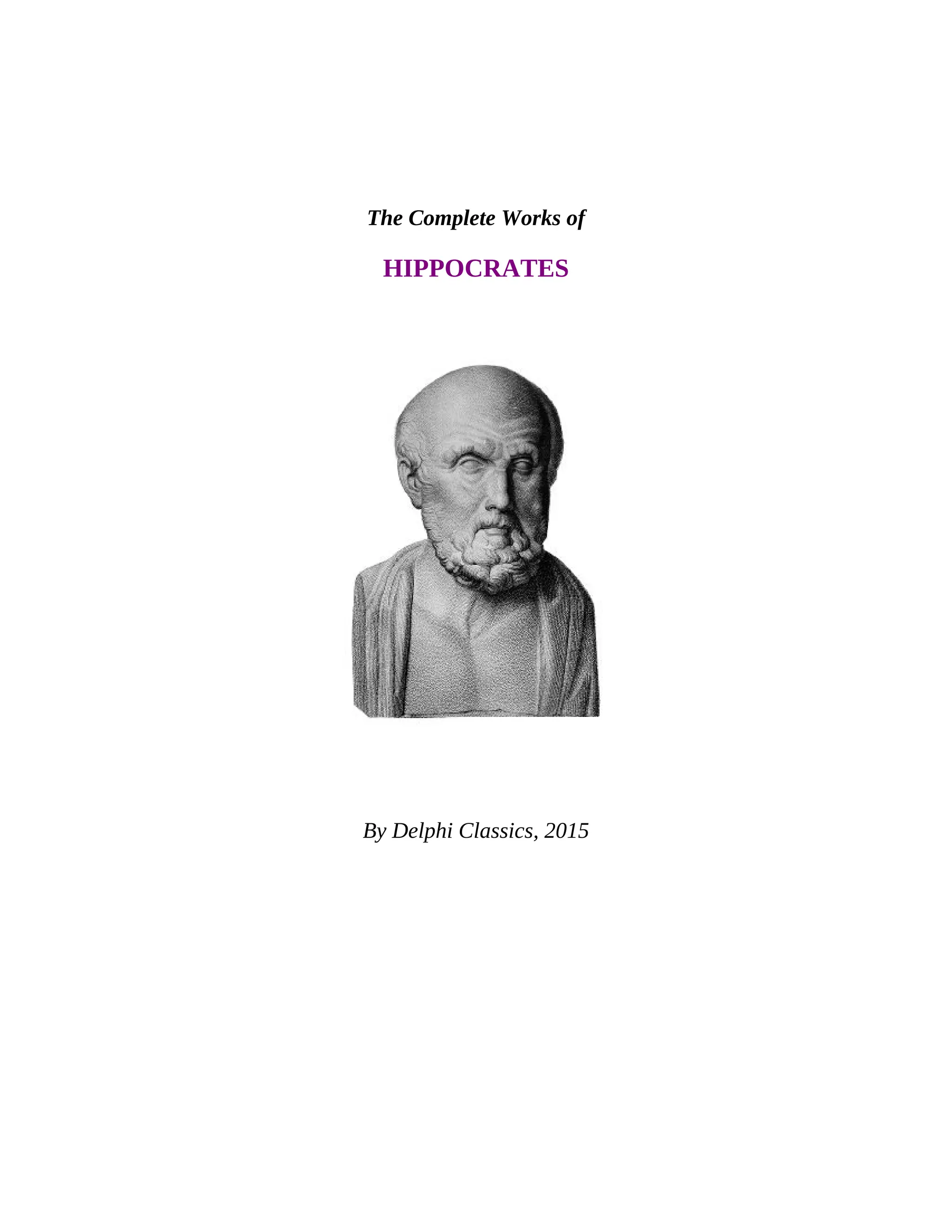
The Complete Works of
HIPPOCRATES
(c. 460 – c. 370 BC)
Contents
Works of Hippocrates
ON ANCIENT MEDICINE
PROGNOSTICS
APHORISMS
EPIDEMICS I AND III
ON REGIMEN IN ACUTE DISEASES
ON AIRS, WATERS, AND PLACES
ON THE ARTICULATIONS
ON FRACTURES
ON THE INSTRUMENTS OF REDUCTION
ON INJURIES OF THE HEAD
THE HIPPOCRATIC OATH
THE LAW
THE PHYSICIAN’S ESTABLISHMENT
Works of the Hippocratic Corpus
ON THE NATURE OF MAN
REGIMEN IN HEALTH
ON ULCERS
ON FISTULAE
ON HEMORRHOIDS
ON THE SACRED DISEASE
ON ALIMENT
THE PRECEPTS
HUMOURS
DREAMS
THE ART
BREATHS
DECORUM
THE PHYSICIAN
DENTITION
The Greek Texts
LIST OF GREEK TEXTS
The Dual Texts
DUAL GREEK AND ENGLISH TEXTS
The Biographies
GENERAL INTRODUCTION TO HIPPOCRATES by W. H. S. Jones
HIPPOCRATES by Charles McRae
The Delphi Classics Catalogue
© Delphi Classics 2015
Version 1
The Complete Works of
HIPPOCRATES
By Delphi Classics, 2015
COPYRIGHT
Complete Works of Hippocrates
First published in the United Kingdom in 2015 by Delphi Classics.
© Delphi Classics, 2015.
All rights reserved. No part of this publication may be reproduced, stored in a retrieval system, or
transmitted, in any form or by any means, without the prior permission in writing of the publisher, nor be
otherwise circulated in any form other than that in which it is published.
Delphi Classics
is an imprint of
Delphi Publishing Ltd
Hastings, East Sussex
United Kingdom
Contact: sales@delphiclassics.com
www.delphiclassics.com
Works of Hippocrates
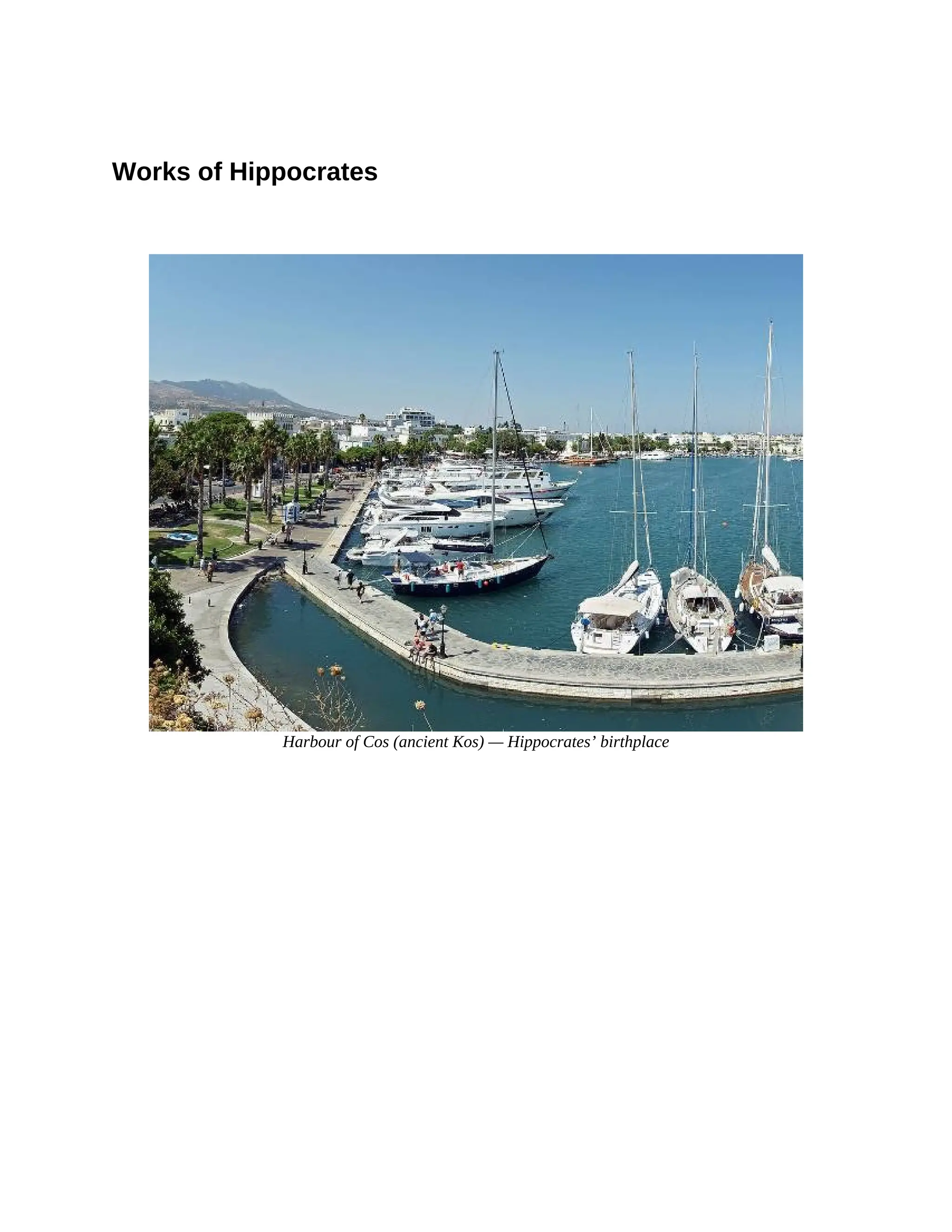
Harbour of Cos (ancient Kos) — Hippocrates’ birthplace
ON ANCIENT MEDICINE
OR, TRADITION IN MEDICINE
Translated by Charles Darwin Adams
This treatise is regarded as one of the most significant works of the Hippocratic
Corpus, the collection of approximately sixty writings covering all areas of
medical thought and practice, which are traditionally associated with
Hippocrates (c. 460 BC – c. 370 BC), the father of Western medicine. In more
recent times, thirteen of the works have been identified as being possibly by the
hand of Hippocrates, with On Ancient Medicine being a key text of this number.
The origins of the Hippocratic Corpus can be traced to the sixth and fifth
centuries BC in Italy.
There were two seminal schools of Western medical thought; Agrigentum on
the southern coast of Sicily and Croton on the west coast of the Gulf of Taranto.
Agrigentum was the home of Empedocles, while Croton belonged to the
Pythagorean sect of medical philosophy. The school of Agrigentum and
Empedocles placed great emphasis on cure by contraries, while the school of
Croton rejected this notion, championing the medical philosophy that perceived
the human organism consists of an infinite number of humours. The first medical
philosopher of the school of Croton was Alcmaeon, who argued that the
maintenance of good health required a balance of the powers of moist and dry,
cold and hot, bitter and sweet. He argued that sickness arises when there is an
imbalance within the human organism, caused by the predominance of one
power over another. In the Agrigentum school of thought Empedocles
hypothesised that the universe consisted of four elements: earth, water, air and
fire. On the basis of these four elements he sought to account for the origin of
matter. Matter or the universe was generated out of these four elements and their
mutual attraction and repulsion.
The conflict between these two schools of thought became manifest in their
medical philosophies. Whereas, Alcmaeon argued that there were indefinite
number of diverse qualities that made up the human organism, Empedocles
believed that there were four concrete or substantial elements. Although it is
Empedocles’ medical philosophy that ultimately inspires the humoral doctrine of
human nature, it is Alcmaeon’s theory that provides the backdrop to the medical
therapeutic doctrine proposed in On Ancient Medicine. Alcmaeon’s argument
that there are an infinite number of causes for disease that cannot be simply
organised into categories is the basic operating assumption of empirical
medicine. Therefore medical knowledge continuously expanded thorough a
firsthand experience and observation of the human organism within nature. It is
in this light that On Ancient Medicine should be seen as an attempt by
Alcmaeon’s followers and the empirical school of thought to respond to and
critique the Empedoclean or humoral theory of medicine.
On Ancient Medicine is formed of three parts. In chapters 1–19 the author
responds to the supporters of the hypothesis theory of medicine, arguing that the
exploration of medicine itself reveals the human organism as a blend of diverse
substances or humours. Having set forth this humoral theory, he then critiques
the hypothesis theory proposed by his opponents as being an oversimplified
conception of the cause of disease. He then discusses his own theory and method
employed in its discovery (chapters 20-24), before responding to the charge that
ancient medicine is not a genuine medical art because it has limited accuracy.
These arguments must be seen in the light of the author’s theory of human
physiology (chapters 9-12).
It is generally believed that On Ancient Medicine was written between 440
and 350 BC, with several hints suggesting a date in the late fifth century. In
particular, the author refers to Empedocles (490–430 B.C.) as the motivation of
the method he attacks, which would suggest a date not long after Empedocles’
peak of activity.
Since the work of Émile Littré in the nineteenth century, the treatise has been
scrutinised in thorough detail, in an attempt to determine which of the works in
the Hippocratic Corpus were composed by Hippocrates. Littré was the scholar
most associated with advocating that On Ancient Medicine was written by
Hippocrates, as he believed that it was the work to which Plato was referring to
in The Phaedrus. However, it is difficult to establish any certainty as to whether
the historical Hippocrates actually wrote the treatise On Ancient Medicine, due
to the scanty surviving evidence from references in Plato and Aristotle.
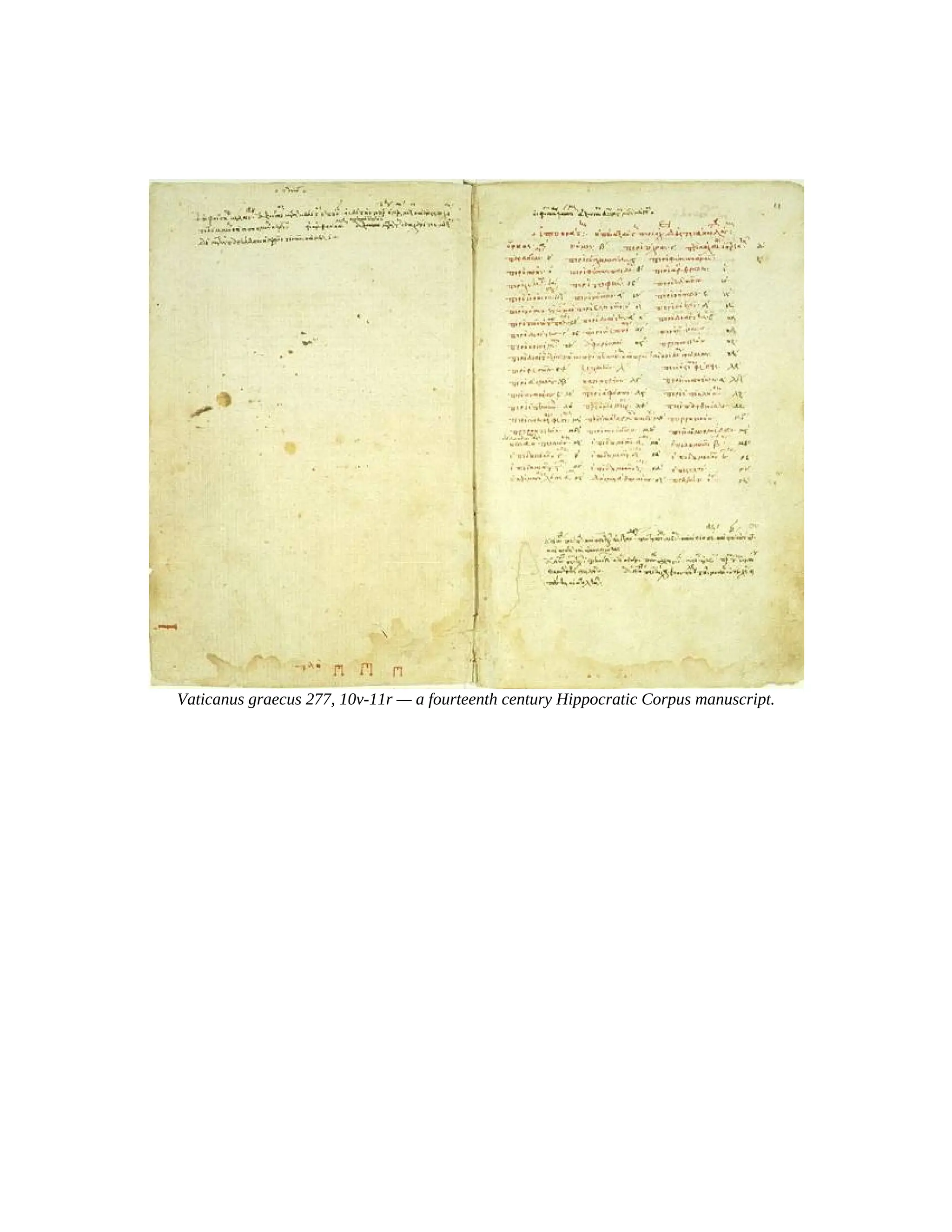
Vaticanus graecus 277, 10v-11r — a fourteenth century Hippocratic Corpus manuscript.
ON ANCIENT MEDICINE
1. Whoever having undertaken to speak or write on Medicine, have first laid
down for themselves some hypothesis to their argument, such as hot, or cold, or
moist, or dry, or whatever else they choose (thus reducing their subject within a
narrow compass, and supposing only one or two original causes of diseases or of
death among mankind), are all clearly mistaken in much that they say; and this is
the more reprehensible as relating to an art which all men avail themselves of on
the most important occasions, and the good operators and practitioners in which
they hold in especial honor. For there are practitioners, some bad and some far
otherwise, which, if there had been no such thing as Medicine, and if nothing
had been investigated or found out in it, would not have been the case, but all
would have been equally unskilled and ignorant of it, and everything concerning
the sick would have been directed by chance. But now it is not so; for, as in all
the other arts, those who practise them differ much from one another in dexterity
and knowledge, so is it in like manner with Medicine. Wherefore I have not
thought that it stood in need of an empty hypothesis, like those subjects which
are occult and dubious, in attempting to handle which it is necessary to use some
hypothesis; as, for example, with regard to things above us and things below the
earth; if any one should treat of these and undertake to declare how they are
constituted, the reader or hearer could not find out, whether what is delivered be
true or false; for there is nothing which can be referred to in order to discover the
truth.
2. But all these requisites belong of old to Medicine, and an origin and way
have been found out, by which many and elegant discoveries have been made,
during a length of time, and others will yet be found out, if a person possessed of
the proper ability, and knowing those discoveries which have been made, should
proceed from them to prosecute his investigations. But whoever, rejecting and
despising all these, attempts to pursue another course and form of inquiry, and
says he has discovered anything, is deceived himself and deceives others, for the
thing is impossible. And for what reason it is impossible, I will now endeavor to
explain, by stating and showing what the art really is. From this it will be
manifest that discoveries cannot possibly be made in any other way. And most
especially, it appears to me, that whoever treats of this art should treat of things
which are familiar to the common people. For of nothing else will such a one
have to inquire or treat, but of the diseases under which the common people have
labored, which diseases and the causes of their origin and departure, their
increase and decline, illiterate persons cannot easily find out themselves, but still
it is easy for them to understand these things when discovered and expounded by
others. For it is nothing more than that every one is put in mind of what had
occurred to himself. But whoever does not reach the capacity of the illiterate
vulgar and fails to make them listen to him, misses his mark. Wherefore, then,
there is no necessity for any hypothesis.
3. For the art of Medicine would not have been invented at first, nor would it
have been made a subject of investigation (for there would have been no need of
it), if when men are indisposed, the same food and other articles of regimen
which they eat and drink when in good health were proper for them, and if no
others were preferable to these. But now necessity itself made medicine to be
sought out and discovered by men, since the same things when administered to
the sick, which agreed with them when in good health, neither did nor do agree
with them. But to go still further back, I hold that the diet and food which people
in health now use would not have been discovered, provided it had suited with
man to eat and drink in like manner as the ox, the horse, and all other animals,
except man, do of the productions of the earth, such as fruits, weeds, and grass;
for from such things these animals grow, live free of disease, and require no
other kind of food. And, at first, I am of opinion that man used the same sort of
food, and that the present articles of diet had been discovered and invented only
after a long lapse of time, for when they suffered much and severely from strong
and brutish diet, swallowing things which were raw, unmixed, and possessing
great strength, they became exposed to strong pains and diseases, and to early
deaths. It is likely, indeed, that from habit they would suffer less from these
things then than we would now, but still they would suffer severely even then;
and it is likely that the greater number, and those who had weaker constitutions,
would all perish; whereas the stronger would hold out for a longer time, as even
nowadays some, in consequence of using strong articles of food, get off with
little trouble, but others with much pain and suffering. From this necessity it
appears to me that they would search out the food befitting their nature, and thus
discover that which we now use: and that from wheat, by macerating it, stripping
it of its hull, grinding it all down, sifting, toasting, and baking it, they formed
bread; and from barley they formed cake (maza), performing many operations in
regard to it; they boiled, they roasted, they mixed, they diluted those things
which are strong and of intense qualities with weaker things, fashioning them to
the nature and powers of man, and considering that the stronger things Nature
would not be able to manage if administered, and that from such things pains,
diseases, and death would arise, but such as Nature could manage, that from
them food, growth, and health, would arise. To such a discovery and
investigation what more suitable name could one give than that of Medicine?
since it was discovered for the health of man, for his nourishment and safety, as
a substitute for that kind of diet by which pains, diseases, and deaths were
occasioned.
4. And if this is not held to be an art, I do not object. For it is not suitable to
call any one an artist of that which no one is ignorant of, but which all know
from usage and necessity. But still the discovery is a great one, and requiring
much art and investigation. Wherefore those who devote themselves to
gymnastics and training, are always making some new discovery, by pursuing
the same line of inquiry, where, by eating and drinking certain things, they are
improved and grow stronger than they were.
5. Let us inquire then regarding what is admitted to be Medicine; namely, that
which was invented for the sake of the sick, which possesses a name and
practitioners, whether it also seeks to accomplish the same objects, and whence
it derived its origin. To me, then, it appears, as I said at the commencement, that
nobody would have sought for medicine at all, provided the same kinds of diet
had suited with men in sickness as in good health. Wherefore, even yet, such
races of men as make no use of medicine, namely, barbarians, and even certain
of the Greeks, live in the same way when sick as when in health; that is to say,
they take what suits their appetite, and neither abstain from, nor restrict
themselves in anything for which they have a desire. But those who have
cultivated and invented medicine, having the same object in view as those of
whom I formerly spoke, in the first place, I suppose, diminished the quantity of
the articles of food which they used, and this alone would be sufficient for
certain of the sick, and be manifestly beneficial to them, although not to all, for
there would be some so affected as not to be able to manage even small
quantities of their usual food, and as such persons would seem to require
something weaker, they invented soups, by mixing a few strong things with
much water, and thus abstracting that which was strong in them by dilution and
boiling. But such as could not manage even soups, laid them aside, and had
recourse to drinks, and so regulated them as to mixture and quantity, that they
were administered neither stronger nor weaker than what was required.
6. But this ought to be well known, that soups do not agree with certain
persons in their diseases, but, on the contrary, when administered both the fevers
and the pains are exacerbated, and it becomes obvious that what was given has
proved food and increase to the disease, but a wasting and weakness to the body.
But whatever persons so affected partook of solid food, or cake, or bread, even
in small quantity, would be ten times and more decidedly injured than those who
had taken soups, for no other reason than from the strength of the food in
reference to the affection; and to whomsoever it is proper to take soups and not
eat solid food, such a one will be much more injured if he eat much than if he eat
little, but even little food will be injurious to him. But all the causes of the
sufferance refer themselves to this rule, that the strongest things most especially
and decidedly hurt man, whether in health or in disease.
7. What other object, then, had he in view who is called a physician, and is
admitted to be a practitioner of the art, who found out the regimen and diet
befitting the sick, than he who originally found out and prepared for all mankind
that kind of food which we all now use, in place of the former savage and brutish
mode of living? To me it appears that the mode is the same, and the discovery of
a similar nature. The one sought to abstract those things which the constitution
of man cannot digest, because of their wildness and intemperature, and the other
those things which are beyond the powers of the affection in which any one may
happen to be laid up. Now, how does the one differ from the other, except that
the latter admits of greater variety, and requires more application, whereas the
former was the commencement of the process?
8. And if one would compare the diet of sick persons with that of persons in
health, he will find it not more injurious than that of healthy persons in
comparison with that of wild beasts and of other animals. For, suppose a man
laboring under one of those diseases which are neither serious and
unsupportable, nor yet altogether mild, but such as that, upon making any
mistake in diet, it will become apparent, as if he should eat bread and flesh, or
any other of those articles which prove beneficial to healthy persons, and that,
too, not in great quantity, but much less than he could have taken when in good
health; and that another man in good health, having a constitution neither very
feeble, nor yet strong, eats of those things which are wholesome and
strengthening to an ox or a horse, such as vetches, barley, and the like, and that,
too, not in great quantity, but much less than he could take; the healthy person
who did so would be subjected to no less disturbance and danger than the sick
person who took bread or cake unseasonably. All these things are proofs that
Medicine is to be prosecuted and discovered by the same method as the other.
9. And if it were simply, as is laid down, that such things as are stronger prove
injurious, but such as are weaker prove beneficial and nourishing, both to sick
and healthy persons, it were an easy matter, for then the safest rule would be to
circumscribe the diet to the lowest point. But then it is no less mistake, nor one
that injuries a man less, provided a deficient diet, or one consisting of weaker
things than what are proper, be administered. For, in the constitution of man,
abstinence may enervate, weaken, and kill. And there are many other ills,
different from those of repletion, but no less dreadful, arising from deficiency of
food; wherefore the practice in those cases is more varied, and requires greater
accuracy. For one must aim at attaining a certain measure, and yet this measure
admits neither weight nor calculation of any kind, by which it may be accurately
determined, unless it be the sensation of the body; wherefore it is a task to learn
this accurately, so as not to commit small blunders either on the one side or the
other, and in fact I would give great praise to the physician whose mistakes are
small, for perfect accuracy is seldom to be seen, since many physicians seem to
me to be in the same plight as bad pilots, who, if they commit mistakes while
conducting the ship in a calm do not expose themselves, but when a storm and
violent hurricane overtake them, they then, from their ignorance and mistakes,
are discovered to be what they are, by all men, namely, in losing their ship. And
thus bad and commonplace physicians, when they treat men who have no serious
illness, in which case one may commit great mistakes without producing any
formidable mischief (and such complaints occur much more frequently to men
than dangerous ones): under these circumstances, when they commit mistakes,
they do not expose themselves to ordinary men; but when they fall in with a
great, a strong, and a dangerous disease, then their mistakes and want of skill are
made apparent to all. Their punishment is not far off, but is swift in overtaking
both the one and the other.
10. And that no less mischief happens to a man from unseasonable depletion
than from repletion, may be clearly seen upon reverting to the consideration of
persons in health. For, to some, with whom it agrees to take only one meal in the
day, and they have arranged it so accordingly; whilst others, for the same reason,
also take dinner, and this they do because they find it good for them, and not like
those persons who, for pleasure or from any casual circumstance, adopt the one
or the other custom and to the bulk of mankind it is of little consequence which
of these rules they observe, that is to say, whether they make it a practice to take
one or two meals. But there are certain persons who cannot readily change their
diet with impunity; and if they make any alteration in it for one day, or even for
a part of a day, are greatly injured thereby. Such persons, provided they take
dinner when it is not their wont, immediately become heavy and inactive, both in
body and mind, and are weighed down with yawning, slumbering, and thirst; and
if they take supper in addition, they are seized with flatulence, tormina, and
diarrhea, and to many this has been the commencement of a serious disease,
when they have merely taken twice in a day the same food which they have been
in the custom of taking once. And thus, also, if one who has been accustomed to
dine, and this rule agrees with him, should not dine at the accustomed hour, he
will straightway feel great loss of strength, trembling, and want of spirits, the
eyes of such a person will become more pallid, his urine thick and hot, his mouth
bitter; his bowels will seem, as it were, to hang loose; he will suffer from
vertigo, lowness of spirit, and inactivity,- such are the effects; and if he should
attempt to take at supper the same food which he was wont to partake of at
dinner, it will appear insipid, and he will not be able to take it off; and these
things, passing downwards with tormina and rumbling, burn up his bowels; he
experiences insomnolency or troubled and disturbed dreams; and to many of
them these symptoms are the commencement of some disease.
11. But let us inquire what are the causes of these things which happened to
them. To him, then, who was accustomed to take only one meal in the day, they
happened because he did not wait the proper time, until his bowels had
completely derived benefit from and had digested the articles taken at the
preceding meal, and until his belly had become soft, and got into a state of rest,
but he gave it a new supply while in a state of heat and fermentation, for such
bellies digest much more slowly, and require more rest and ease. And as to him
who had been accustomed to dinner, since, as soon as the body required food,
and when the former meal was consumed, and he wanted refreshment, no new
supply was furnished to it, he wastes and is consumed from want of food. For all
the symptoms which I describe as befalling to this man I refer to want of food.
And I also say that all men who, when in a state of health, remain for two or
three days without food, experience the same unpleasant symptoms as those
which I described in the case of him who had omitted to take dinner.
12. Wherefore, I say, that such constitutions as suffer quickly and strongly
from errors in diet, are weaker than others that do not; and that a weak person is
in a state very nearly approaching to one in disease; but a person in disease is the
weaker, and it is, therefore, more likely that he should suffer if he encounters
anything that is unseasonable. It is difficult, seeing that there is no such accuracy
in the Art, to hit always upon what is most expedient, and yet many cases occur
in medicine which would require this accuracy, as we shall explain. But on that
account, I say, we ought not to reject the ancient Art, as if it were not, and had
not been properly founded, because it did not attain accuracy in all things, but
rather, since it is capable of reaching to the greatest exactitude by reasoning, to
receive it and admire its discoveries, made from a state of great ignorance, and
as having been well and properly made, and not from chance.
13. But I wish the discourse to revert to the new method of those who
prosecute their inquiries in the Art by hypothesis. For if hot, or cold, or moist, or
dry, be that which proves injurious to man, and if the person who would treat
him properly must apply cold to the hot, hot to the cold, moist to the dry, and dry
to the moist-let me be presented with a man, not indeed one of a strong
constitution, but one of the weaker, and let him eat wheat, such as it is supplied
from the thrashing-floor, raw and unprepared, with raw meat, and let him drink
water. By using such a diet I know that he will suffer much and severely, for he
will experience pains, his body will become weak, and his bowels deranged, and
he will not subsist long. What remedy, then, is to be provided for one so
situated? Hot? or cold? or moist? or dry? For it is clear that it must be one or
other of these. For, according to this principle, if it is one of the which is injuring
the patient, it is to be removed by its contrary. But the surest and most obvious
remedy is to change the diet which the person used, and instead of wheat to give
bread, and instead of raw flesh, boiled, and to drink wine in addition to these; for
by making these changes it is impossible but that he must get better, unless
completely disorganized by time and diet. What, then, shall we say? whether
that, as he suffered from cold, these hot things being applied were of use to him,
or the contrary? I should think this question must prove a puzzler to whomsoever
it is put. For whether did he who prepared bread out of wheat remove the hot, the
cold, the moist, or the dry principle in it?- for the bread is consigned both to fire
and to water, and is wrought with many things, each of which has its peculiar
property and nature, some of which it loses, and with others it is diluted and
mixed.
14. And this I know, moreover, that to the human body it makes a great
difference whether the bread be fine or coarse; of wheat with or without the hull,
whether mixed with much or little water, strongly wrought or scarcely at all,
baked or raw-and a multitude of similar differences; and so, in like manner, with
the cake (maza); the powers of each, too, are great, and the one nowise like the
other. Whoever pays no attention to these things, or, paying attention, does not
comprehend them, how can he understand the diseases which befall a man? For,
by every one of these things, a man is affected and changed this way or that, and
the whole of his life is subjected to them, whether in health, convalescence, or
disease. Nothing else, then, can be more important or more necessary to know
than these things. So that the first inventors, pursuing their investigations
properly, and by a suitable train of reasoning, according to the nature of man,
made their discoveries, and thought the Art worthy of being ascribed to a god, as
is the established belief. For they did not suppose that the dry or the moist, the
hot or the cold, or any of these are either injurious to man, or that man stands in
need of them, but whatever in each was strong, and more than a match for a
man’s constitution, whatever he could not manage, that they held to be hurtful,
and sought to remove. Now, of the sweet, the strongest is that which is intensely
sweet; of the bitter, that which is intensely bitter; of the acid, that which is
intensely acid; and of all things that which is extreme, for these things they saw
both existing in man, and proving injurious to him. For there is in man the bitter
and the salt, the sweet and the acid, the sour and the insipid, and a multitude of
other things having all sorts of powers both as regards quantity and strength.
These, when all mixed and mingled up with one another, are not apparent,
neither do they hurt a man; but when any of them is separate, and stands by
itself, then it becomes perceptible, and hurts a man. And thus, of articles of food,
those which are unsuitable and hurtful to man when administered, every one is
either bitter, or intensely so, or saltish or acid, or something else intense and
strong, and therefore we are disordered by them in like manner as we are by the
secretions in the body. But all those things which a man eats and drinks are
devoid of any such intense and well-marked quality, such as bread, cake, and
many other things of a similar nature which man is accustomed to use for food,
with the exception of condiments and confectioneries, which are made to gratify
the palate and for luxury. And from those things, when received into the body
abundantly, there is no disorder nor dissolution of the powers belonging to the
body; but strength, growth, and nourishment result from them, and this for no
other reason than because they are well mixed, have nothing in them of an
immoderate character, nor anything strong, but the whole forms one simple and
not strong substance.
15. I cannot think in what manner they who advance this doctrine, and transfer
Art from the cause I have described to hypothesis, will cure men according to
the principle which they have laid down. For, as far as I know, neither the hot
nor the cold, nor the dry, nor the moist, has ever been found unmixed with any
other quality; but I suppose they use the same articles of meat and drink as all we
other men do. But to this substance they give the attribute of being hot, to that
cold, to that dry, and to that moist. Since it would be absurd to advise the patient
to take something hot, for he would straightway ask what it is? so that he must
either play the fool, or have recourse to some one of the well known substances;
and if this hot thing happen to be sour, and that hot thing insipid, and this hot
thing has the power of raising a disturbance in the body (and there are many
other kinds of heat, possessing many opposite powers), he will be obliged to
administer some one of them, either the hot and the sour, or the hot and the
insipid, or that which, at the same time, is cold and sour (for there is such a
substance), or the cold and the insipid. For, as I think, the very opposite effects
will result from either of these, not only in man, but also in a bladder, a vessel of
wood, and in many other things possessed of far less sensibility than man; for it
is not the heat which is possessed of great efficacy, but the sour and the insipid,
and other qualities as described by me, both in man and out of man, and that
whether eaten or drunk, rubbed in externally, and otherwise applied.
16. But I think that of all the qualities heat and cold exercise the least operation
in the body, for these reasons: as long time as hot and cold are mixed up with
one another they do not give trouble, for the cold is attempered and rendered
more moderate by the hot, and the hot by the cold; but when the one is wholly
separate from the other, then it gives pain; and at that season when cold is
applied it creates some pain to a man, but quickly, for that very reason, heat
spontaneously arises in him without requiring any aid or preparation. And these
things operate thus both upon men in health and in disease. For example, if a
person in health wishes to cool his body during winter, and bathes either in cold
water or in any other way, the more he does this, unless his body be fairly
congealed, when he resumes his clothes and comes into a place of shelter, his
body becomes more heated than before. And thus, too, if a person wish to be
warmed thoroughly either by means of a hot bath or strong fire, and straightway
having the same clothing on, takes up his abode again in the place he was in
when he became congealed, he will appear much colder, and more disposed to
chills than before. And if a person fan himself on account of a suffocating heat,
and having procured refrigeration for himself in this manner, cease doing so, the
heat and suffocation will be ten times greater in his case than in that of a person
who does nothing of the kind. And, to give a more striking example, persons
travelling in the snow, or otherwise in rigorous weather, and contracting great
cold in their feet, their hands, or their head, what do they not suffer from
inflammation and tingling when they put on warm clothing and get into a hot
place? In some instances, blisters arise as if from burning with fire, and they do
not suffer from any of those unpleasant symptoms until they become heated. So
readily does either of these pass into the other; and I could mention many other
examples. And with regard to the sick, is it not in those who experience a rigor
that the most acute fever is apt to break out? And yet not so strongly neither, but
that it ceases in a short time, and, for the most part, without having occasioned
much mischief; and while it remains, it is hot, and passing over the whole body,
ends for the most part in the feet, where the chills and cold were most intense
and lasted longest; and, when sweat supervenes, and the fever passes off, the
patient is much colder than if he had not taken the fever at all. Why then should
that which so quickly passes into the opposite extreme, and loses its own powers
spontaneously, be reckoned a mighty and serious affair? And what necessity is
there for any great remedy for it?
17. One might here say-but persons in ardent fevers, pneumonia, and other
formidable diseases, do not quickly get rid of the heat, nor experience these
rapid alterations of heat and cold. And I reckon this very circumstance the
strongest proof that it is not from heat simply that men get into the febrile state,
neither is it the sole cause of the mischief, but that this species of heat is bitter,
and that acid, and the other saltish, and many other varieties; and again there is
cold combined with other qualities. These are what proves injurious; heat, it is
true, is present also, possessed of strength as being that which conducts, is
exacerbated and increased along with the other, but has no power greater than
what is peculiar to itself.
18. With regard to these symptoms, in the first place those are most obvious of
which we have all often had experience. Thus, then, in such of us as have a
coryza and defluxion from the nostrils, this discharge is much more acrid than
that which formerly was formed in and ran from them daily; and it occasions
swelling of the nose, and it inflames, being of a hot and extremely ardent nature,
as you may know, if you apply your hand to the place; and, if the disease
remains long, the part becomes ulcerated although destitute of flesh and hard;
and the heat in the nose ceases, not when the defluxion takes place and the
inflammation is present, but when the running becomes thicker and less acrid,
and more mixed with the former secretion, then it is that the heat ceases. But in
all those cases in which this decidedly proceeds from cold alone, without the
concourse of any other quality, there is a change from cold to hot, and from hot
to cold, and these quickly supervene, and require no coction. But all the others
being connected, as I have said, with acrimony and intemperance of humors,
pass off in this way by being mixed and concocted.
19. But such defluxions as are determined to the eyes being possessed of
strong and varied acrimonies, ulcerate the eyelids, and in some cases corrode the
and parts below the eyes upon which they flow, and even occasion rupture and
erosion of the tunic which surrounds the eyeball. But pain, heat, and extreme
burning prevail until the defluxions are concocted and become thicker, and
concretions form about the eyes, and the coction takes place from the fluids
being mixed up, diluted, and digested together. And in defluxions upon the
throat, from which are formed hoarseness, cynanche, crysipelas, and pneumonia,
all these have at first saltish, watery, and acrid discharges, and with these the
diseases gain strength. But when the discharges become thicker, more
concocted, and are freed from all acrimony, then, indeed, the fevers pass away,
and the other symptoms which annoyed the patient; for we must account those
things the cause of each complaint, which, being present in a certain fashion, the
complaint exists, but it ceases when they change to another combination. But
those which originate from pure heat or cold, and do not participate in any other
quality, will then cease when they undergo a change from cold to hot, and from
hot to cold; and they change in the manner I have described before. Wherefore,
all the other complaints to which man is subject arise from powers (qualities?).
Thus, when there is an overflow of the bitter principle, which we call yellow
bile, what anxiety, burning heat, and loss of strength prevail! but if relieved from
it, either by being purged spontaneously, or by means of a medicine seasonably
administered, the patient is decidedly relieved of the pains and heat; but while
these things float on the stomach, unconcocted and undigested, no contrivance
could make the pains and fever cease; and when there are acidities of an acrid
and aeruginous character, what varieties of frenzy, gnawing pains in the bowels
and chest, and inquietude, prevail! and these do not cease until the acidities be
purged away, or are calmed down and mixed with other fluids. The coction,
change, attenuation, and thickening into the form of humors, take place through
many and various forms; therefore the crises and calculations of time are of great
importance in such matters; but to all such changes hot and cold are but little
exposed, for these are neither liable to putrefaction nor thickening. What then
shall we say of the change? that it is a combination (crasis) of these humors
having different powers toward one another. But the hot does not loose its heat
when mixed with any other thing except the cold; nor again, the cold, except
when mixed with the hot. But all other things connected with man become the
more mild and better in proportion as they are mixed with the more things
besides. But a man is in the best possible state when they are concocted and at
rest, exhibiting no one peculiar quality; but I think I have said enough in
explanation of them.
20. Certain sophists and physicians say that it is not possible for any one to
know medicine who does not know what man is [and how he was made and how
constructed], and that whoever would cure men properly, must learn this in the
first place. But this saying rather appertains to philosophy, as Empedocles and
certain others have described what man in his origin is, and how he first was
made and constructed. But I think whatever such has been said or written by
sophist or physician concerning nature has less connection with the art of
medicine than with the art of painting. And I think that one cannot know
anything certain respecting nature from any other quarter than from medicine;
and that this knowledge is to be attained when one comprehends the whole
subject of medicine properly, but not until then; and I say that this history shows
what man is, by what causes he was made, and other things accurately.
Wherefore it appears to me necessary to every physician to be skilled in nature,
and strive to know, if he would wish to perform his duties, what man is in
relation to the articles of food and drink, and to his other occupations, and what
are the effects of each of them to every one. And it is not enough to know simply
that cheese is a bad article of food, as disagreeing with whoever eats of it to
satiety, but what sort of disturbance it creates, and wherefore, and with what
principle in man it disagrees; for there are many other articles of food and drink
naturally bad which affect man in a different manner. Thus, to illustrate my
meaning by an example, undiluted wine drunk in large quantity renders a man
feeble; and everybody seeing this knows that such is the power of wine, and the
cause thereof; and we know, moreover, on what parts of a man’s body it
principally exerts its action; and I wish the same certainty to appear in other
cases. For cheese (since we used it as an example) does not prove equally
injurious to all men, for there are some who can take it to satiety without being
hurt by it in the least, but, on the contrary, it is wonderful what strength it
imparts to those it agrees with; but there are some who do not bear it well, their
constitutions are different, and they differ in this respect, that what in their body
is incompatible with cheese, is roused and put in commotion by such a thing;
and those in whose bodies such a humor happens to prevail in greater quantity
and intensity, are likely to suffer the more from it. But if the thing had been
pernicious to of man, it would have hurt all. Whoever knows these things will
not suffer from it.
21. During convalescence from diseases, and also in protracted diseases, many
disorders occur, some spontaneously, and some from certain things accidentally
administered. I know that the common herd of physicians, like the vulgar, if
there happen to have been any innovation made about that day, such as the bath
being used, a walk taken, or any unusual food eaten, all which were better done
than otherwise, attribute notwithstanding the cause of these disorders, to some of
these things, being ignorant of the true cause but proscribing what may have
been very proper. Now this ought not to be so; but one should know the effects
of a bath or a walk unseasonably applied; for thus there will never be any
mischief from these things, nor from any other thing, nor from repletion, nor
from such and such an article of food. Whoever does not know what effect these
things produce upon a man, cannot know the consequences which result from
them, nor how to apply them.
22. And it appears to me that one ought also to know what diseases arise in
man from the powers, and what from the structures. What do I mean by this? By
powers, I mean intense and strong juices; and by structures, whatever
conformations there are in man. For some are hollow, and from broad contracted
into narrow; some expanded, some hard and round, some broad and suspended,
some stretched, some long, some dense, some rare and succulent, some spongy
and of loose texture. Now, then, which of these figures is the best calculated to
suck to itself and attract humidity from another body? Whether what is hollow
and expanded, or what is solid and round, or what is hollow, and from broad,
gradually turning narrow? I think such as from hollow and broad are contracted
into narrow: this may be ascertained otherwise from obvious facts: thus, if you
gape wide with the mouth you cannot draw in any liquid; but by protruding,
contracting, and compressing the lips, and still more by using a tube, you can
readily draw in whatever you wish. And thus, too, the instruments which are
used for cupping are broad below and gradually become narrow, and are so
constructed in order to suck and draw in from the fleshy parts. The nature and
construction of the parts within a man are of a like nature; the bladder, the head,
the uterus in woman; these parts clearly attract, and are always filled with a juice
which is foreign to them. Those parts which are hollow and expanded are most
likely to receive any humidity flowing into them, but cannot attract it in like
manner. Those parts which are solid and round could not attract a humidity, nor
receive it when it flows to them, for it would glide past, and find no place of rest
on them. But spongy and rare parts, such as the spleen, the lungs, and the
breasts, drink up especially the juices around them, and become hardened and
enlarged by the accession of juices. Such things happen to these organs
especially. For it is not with the spleen as with the stomach, in which there is a
liquid, which it contains and evacuates every day; but when it (the spleen) drinks
up and receives a fluid into itself, the hollow and lax parts of it are filled, even
the small interstices; and, instead of being rare and soft, it becomes hard and
dense, and it can neither digest nor discharge its contents: these things it suffers,
owing to the nature of its structure. Those things which engender flatulence or
tormina in the body, naturally do so in the hollow and broad parts of the body,
such as the stomach and chest, where they produce rumbling noises; for when
they do not fill the parts so as to be stationary, but have changes of place and
movements, there must necessarily be noise and apparent movements from them.
But such parts as are fleshy and soft, in these there occur torpor and obstructions,
such as happen in apoplexy. But when it (the flatus?) encounters a broad and
resisting structure, and rushes against such a part, and this happens when it is by
nature not strong so as to be able to withstand it without suffering injury; nor
soft and rare, so as to receive or yield to it, but tender, juicy, full of blood, and
dense, like the liver, owing to its density and broadness, it resists and does not
yield. But flatus, when it obtains admission, increases and becomes stronger, and
rushes toward any resisting object; but owing to its tenderness, and the quantity
of blood which it (the liver) contains, it cannot be without uneasiness; and for
these reasons the most acute and frequent pains occur in the region of it, along
with suppurations and chronic tumors (phymata). These symptoms also occur in
the site of the diaphragm, but much less frequently; for the diaphragm is a broad,
expanded, and resisting substance, of a nervous (tendinous?) and strong nature,
and therefore less susceptible of pain; and yet pains and chronic abscesses do
occur about it.
23. There are both within and without the body many other kinds of structure,
which differ much from one another as to sufferings both in health and disease;
such as whether the head be small or large; the neck slender or thick, long or
short; the belly long or round; the chest and ribs broad or narrow; and many
others besides, all which you ought to be acquainted with, and their differences;
so that knowing the causes of each, you may make the more accurate
observations.
24. And, as has been formerly stated, one ought to be acquainted with the
powers of juices, and what action each of them has upon man, and their alliances
towards one another. What I say is this: if a sweet juice change to another kind,
not from any admixture, but because it has undergone a mutation within itself;
what does it first become?- bitter? salt? austere? or acid? I think acid. And
hence, an acid juice is the most improper of all things that can be administered in
cases in which a sweet juice is the most proper. Thus, if one should succeed in
his investigations of external things, he would be the better able always to select
the best; for that is best which is farthest removed from that which is
unwholesome.
PROGNOSTICS
Translated by Charles Darwin Adams
1. It appears to me a most excellent thing for the physician to cultivate Prognosis;
for by foreseeing and foretelling, in the presence of the sick, the present, the
past, and the future, and explaining the omissions which patients have been
guilty of, he will be the more readily believed to be acquainted with the
circumstances of the sick; so that men will have confidence to intrust themselves
to such a physician. And he will manage the cure best who has foreseen what is
to happen from the present state of matters. For it is impossible to make all the
sick well; this, indeed, would have been better than to be able to foretell what is
going to happen; but since men die, some even before calling the physician,
from the violence of the disease, and some die immediately after calling him,
having lived, perhaps, only one day or a little longer, and before the physician
could bring his art to counteract the disease; it therefore becomes necessary to
know the nature of such affections, how far they are above the powers of the
constitution; and, moreover, if there be anything divine in the diseases, and to
learn a foreknowledge of this also. Thus a man will be the more esteemed to be a
good physician, for he will be the better able to treat those aright who can be
saved, having long anticipated everything; and by seeing and announcing
beforehand those who will live and those who will die, he will thus escape
censure.
2. He should observe thus in acute diseases: first, the countenance of the
patient, if it be like those of persons in health, and more so, if like itself, for this
is the best of all; whereas the most opposite to it is the worst, such as the
following; a sharp nose, hollow eyes, collapsed temples; the ears cold,
contracted, and their lobes turned out: the skin about the forehead being rough,
distended, and parched; the color of the whole face being green, black, livid, or
lead-colored. If the countenance be such at the commencement of the disease,
and if this cannot be accounted for from the other symptoms, inquiry must be
made whether the patient has long wanted sleep; whether his bowels have been
very loose; and whether he has suffered from want of food; and if any of these
causes be confessed to, the danger is to be reckoned so far less; and it becomes
obvious, in the course of a day and a night, whether or not the appearance of the
countenance proceeded from these causes. But if none of these be said to exist, if
the symptoms do not subside in the aforesaid time, it is to be known for certain
that death is at hand. And, also, if the disease be in a more advanced stage either
on the third or fourth day, and the countenance be such, the same inquiries as
formerly directed are to be made, and the other symptoms are to be noted, those
in the whole countenance, those on the body, and those in the eyes; for if they
shun the light, or weep involuntarily, or squint, or if the one be less than the
other, or if the white of them be red, livid, or has black veins in it; if there be a
gum upon the eyes, if they are restless, protruding, or are become very hollow;
and if the countenance be squalid and dark, or the color of the whole face be
changed-all these are to be reckoned bad and fatal symptoms. The physician
should also observe the appearance of the eyes from below the eyelids in sleep;
for when a portion of the white appears, owing to the eyelids not being closed
together, and when this is not connected with diarrhea or purgation from
medicine, or when the patient does not sleep thus from habit, it is to be reckoned
an unfavorable and very deadly symptom; but if the eyelid be contracted, livid,
or pale, or also the lip, or nose, along with some of the other symptoms, one may
know for certain that death is close at hand. It is a mortal symptom, also, when
the lips are relaxed, pendent, cold, and blanched.
3. It is well when the patient is found by his physician reclining upon either his
right or his left side, having his hands, neck, and legs slightly bent, and the
whole body lying in a relaxed state, for thus the most of persons in health
recline, and these are the best of postures which most resemble those of healthy
persons. But to lie upon one’s back, with the hands, neck, and the legs extended,
is far less favorable. And if the patient incline forward, and sink down to the foot
of the bed, it is a still more dangerous symptom; but if he be found with his feet
naked and not sufficiently warm, and the hands, neck, and legs tossed about in a
disorderly manner and naked, it is bad, for it indicates aberration of intellect. It is
a deadly symptom, also, when the patient sleeps constantly with his mouth open,
having his legs strongly bent and plaited together, while he lies upon his back;
and to lie upon one’s belly, when not habitual to the patient to sleep thus while
in good health, indicates delirium, or pain in the abdominal regions. And for the
patient to wish to sit erect at the acme of a disease is a bad symptom in all acute
diseases, but particularly so in pneumonia. To grind the teeth in fevers, when
such has not been the custom of the patient from childhood, indicates madness
and death, both which dangers are to be announced beforehand as likely to
happen; and if a person in delirium do this it is a very deadly symptom. And if
the patient had an ulcer previously, or if one has occurred in the course of the
disease, it is to be observed; for if the man be about to die the sore will become
livid and dry, or yellow and dry before death.
4. Respecting the movement of the hands I have these observations to make:
When in acute fevers, pneumonia, phrenitis, or headache, the hands are waved
before the face, hunting through empty space, as if gathering bits of straw,
picking the nap from the coverlet, or tearing chaff from the wall-all such
symptoms are bad and deadly.
5. Respiration, when frequent, indicates pain or inflanunation in the parts
above the diaphragm: a large respiration performed at a great interval announces
delirium; but a cold respiration at nose or mouth is a very fatal symptom. Free
respiration is to be looked upon as contributing much to the safety of the patient
in all acute diseases, such as fevers, and those complaints which come to a crisis
in forty days.
6. Those sweats are the best in all acute diseases which occur on the critical
days, and completely carry off the fever. Those are favorable, too, which taking
place over the whole body, show that the man is bearing the disease better. But
those that do not produce this effect are not beneficial. The worst are cold
sweats, confined to the head, face, and neck; these in an acute fever
prognosticate death, or in a milder one, a prolongation of the disease; and sweats
which occur over the whole body, with the characters of those confined to the
neck, are in like manner bad. Sweats attended with a miliary eruption, and taking
place about the neck, are bad; sweats in the form of drops and of vapour are
good. One ought to know the entire character of sweats, for some are connected
with prostration of strength in the body, and some with intensity of the
inflammation.
7. That state of the hypochondrium is best when it is free from pain, soft, and
of equal size on the right side and the left. But if inflamed, or painful, or
distended; or when the right and left sides are of disproportionate sizes;- all these
appearances are to be dreaded. And if there be also pulsation in the
hypochondrium, it indicates perturbation or delirium; and the physician should
examine the eyes of such persons; for if their pupils be in rapid motion, such
persons may be expected to go mad. A swelling in the hypochondrium, that is
hard and painful, is very bad, provided it occupy the whole hypochondrium; but
if it be on either side, it is less dangerous when on the left. Such swellings at the
commencement of the disease prognosticate speedy death; but if the fever has
passed twenty days, and the swelling has not subsided, it turns to a suppuration.
A discharge of blood from the nose occurs to such in the first period, and proves
very useful; but inquiry should be made if they have headache or indistinct
vision; for if there be such, the disease will be determined thither. The discharge
of blood is rather to be expected in those who are younger than thirty-five years.
Such swellings as are soft, free from pain, and yield to the finger, occasion more
protracted crises, and are less dangerous than the others. But if the fever
continue beyond sixty days, without any subsidence of the swelling, it indicates
that empyema is about to take place; and a swelling in any other part of the
cavity will terminate in like manner. Such, then, as are painful, hard, and large,
indicate danger of speedy death; but such as are soft, free of pain, and yield
when pressed with the finger, are more chronic than these. Swellings in the belly
less frequently form abscesses than those in the hypochondrium; and seldomest
of all, those below the navel are converted into suppuration; but you may rather
expect a hemorrhage from the upper parts. But the suppuration of all protracted
swellings about these parts is to be anticipated. The collections of matter there
are to be thus judged of: such as are determined outwards are the best when they
are small, when they protrude very much, and swell to a point; such as are large
and broad, and which do not swell out to a sharp point, are the worst. Of such as
break internally, the best are those which have no external communication, but
are covered and indolent; and when the whole place is free from discoloration.
That pus is best which is white, homogeneous, smooth, and not at all fetid; the
contrary to this is the worst.
8. All dropsies arising from acute diseases are bad; for they do not remove the
fever, and are very painful and fatal. The most of them commence from the
flanks and loins, but some from the liver; in those which derive their origin from
the flanks and loins the feet swell, protracted diarrhoeas supervene, which
neither remove the pains in the flanks and loins, nor soften the belly, but in
dropsies which are connected with the liver there is a tickling cough, with
scarcely any perceptible expectoration, and the feet swell; there are no
evacuations from the bowels, unless such as are hard and forced; and there are
swellings about the belly, sometimes on the one side and sometimes on the
other, and these increase and diminish by turns.
9. It is a bad symptom when the head, hands, and feet are cold, while the belly
and sides are hot; but it is a very good symptom when the whole body is equally
hot. The patient ought to be able to turn round easily, and to be agile when raised
up; but if he appear heavy in the rest of his body as well as in his hands and feet,
it is more dangerous; and if, in addition to the weight, his nails and fingers
become livid, immediate death may be anticipated; and if the hands and feet be
black it is less dangerous than if they be livid, but the other symptoms must be
attended, to; for if he appear to bear the illness well, and if certain of the salutary
symptoms appear along with these there may be hope that the disease will turn to
a deposition, so that the man may recover; but the blackened parts of the body
will drop off. When the testicles and members are retracted upwards, they
indicate strong pains and danger of death.
10. With regard to sleep-as is usual with us in health, the patient should wake
during the day and sleep during the night. If this rule be anywise altered it is so
far worse: but there will be little harm provided he sleep in the morning for the
third part of the day; such sleep as takes place after this time is more
unfavorable; but the worst of all is to get no sleep either night or day; for it
follows from this symptom that the insomnolency is connected with sorrow and
pains, or that he is about to become delirious.
11. The excrement is best which is soft and consistent, is passed at the hour
which was customary to the patient when in health, in quantity proportionate to
the ingests; for when the passages are such, the lower belly is in a healthy state.
But if the discharges be fluid, it is favorable that they are not accompanied with
a noise, nor are frequent, nor in great quantity; for the man being oppressed by
frequently getting up, must be deprived of sleep; and if the evacuations be both
frequent and large, there is danger of his falling into deliquium animi. But in
proportion to the ingesta he should have evacuations twice or thrice in the day,
once at night and more copiously in the morning, as is customary with a person
in health. The faeces should become thicker when the disease is tending to a
crisis; they ought to be yellowish and not very fetid. It is favorable that round
worms be passed with the discharges when the disease is tending to a crisis. The
belly, too, through the whole disease, should be soft and moderately distended;
but excrements that are very watery, or white, or green, or very red, or frothy,
are all bad. It is also bad when the discharge is small, and viscid, and white, and
greenish, and smooth; but still more deadly appearances are the black, or fatty,
or livid, or verdigris-green, or fetid. Such as are of varied characters indicate
greater duration of the complaint, but are no less dangerous; such as those which
resemble scrapings, those which are bilious, those resembling leeks, and the
black; these being sometimes passed together, and sometimes singly. It is best
when wind passes without noise, but it is better that flatulence should pass even
thus than that it should be retained; and when it does pass thus, it indicates either
that the man is in pain or in delirium, unless he gives vent to the wind
spontaneously. Pains in the hypochondria, and swellings, if recent, and not
accompanied with inflammation, are relieved by borborygmi supervening in the
hypochondrium, more especially if it pass off with faeces, urine, and wind; but
even although not, it will do good by passing along, and it also does good by
descending to the lower part of the belly.
12. The urine is best when the sediment is white, smooth, and consistent during
the whole time, until the disease come to a crisis, for it indicates freedom from
danger, and an illness of short duration; but if deficient, and if it be sometimes
passed clear, and sometimes with a white and smooth sediment, the disease will
be more protracted, and not so void of danger. But if the urine be reddish, and
the sediment consistent and smooth, the affection, in this case, will be more
protracted than the former, but still not fatal. But farinaceous sediments in the
urine are bad, and still worse are the leafy; the white and thin are very bad, but
the furfuraceous are still worse than these. Clouds carried about in the urine are
good when white, but bad if black. When the urine is yellow and thin, it
indicates that the disease is unconcocted; and if it (the disease) should be
protracted, there maybe danger lest the patient should not hold out until the urine
be concocted. But the most deadly of all kinds of urine are the fetid, watery,
black, and thick; in adult men and women the black is of all kinds of urine the
worst, but in children, the watery. In those who pass thin and crude urine for a
length of time, if they have otherwise symptoms of convalescence, an abscess
may be expected to form in the parts below the diaphragm. And fatty substances
floating on the surface are to be dreaded, for they are indications of melting. And
one should consider respecting the kinds of urine, which have clouds, whether
they tend upwards or downwards, and upwards or downwards, and the colors
which they have and such as fall downwards, with the colors as described, are to
be reckoned good and commended; but such as are carried upwards, with the
colors as described, are to be held as bad, and are to be distrusted. But you must
not allow yourself to be deceived if such urine be passed while the bladder is
diseased; for then it is a symptom of the state, not of the general system, but of a
particular viscus.
13. That vomiting is of most service which consists of phlegm and bile mixed
together, and neither very thick nor in great quantity; but those vomitings which
are more unmixed are worse. But if that which is vomited be of the color of
leeks or livid, or black, whatever of these colors it be, it is to be reckoned bad;
but if the same man vomit all these colors, it is to be reckoned a very fatal
symptom. But of all the vomitings, the livid indicates the danger of death,
provided it be of a fetid smell. But all the smells which are somewhat putrid and
fetid, are bad in all vomitings.
14. The expectoration in all pains about the lungs and sides, should be quickly
and easily brought up, and a certain degree of yellowness should appear strongly
mixed up with the sputum. But if brought up long after the commencement of
the pain, and of a yellow or ruddy color, or if it occasions much cough, or be not
strongly mixed, it is worse; for that which is intensely yellow is dangerous, but
the white, and viscid, and round, do no good. But that which is very green and
frothy is bad; but if so intense as to appear black, it is still more dangerous than
these; it is bad, if nothing is expectorated, and the lungs discharge nothing, but
are gorged with matters which boil (as it were) in the air-passages. It is bad when
coryza and sneezing either precede or follow affections of the lungs, but in all
other affections, even the most deadly, sneezing is a salutary symptom. A yellow
spittle mixed up with not much blood in cases of pneumonia, is salutary and very
beneficial if spit up at the commencement of the disease, but if on the seventh
day, or still later, it is less favorable. And all sputa are bad which do not remove
the pain. But the worst is the black, as has been described. Of all others the sputa
which remove the pain are the best.
15. When the pains in these regions do not cease, either with the discharge of
the sputa, nor with alvine evacuations, nor from venesection, purging with
medicine, nor a suitable regimen, it is to be held that they will terminate in
suppurations. Of empyemata such as are spit up while the sputum is still bilious,
are very fatal, whether the bilious portion be expectorated separate, or along with
the other; but more especially if the empyema begin to advance after this sputum
on the seventh day of the disease. It is to be expected that a person with such an
expectoration shall die on the fourteenth day, unless something favorable
supervene. The following are favorable symptoms: to support the disease easily,
to have free respiration, to be free from pain, to have the sputa readily brought
up, the whole body to appear equally warm and soft, to have no thirst, the urine,
and faeces, sleep, and sweats to be all favorable, as described before; when all
these symptoms concur, the patient certainly will not die; but if some of these be
present and some not, he will not survive longer than the fourteenth day. The bad
symptoms are the opposite of these, namely, to bear the disease with difficulty,
respiration large and dense, the pain not ceasing, the sputum scarcely coughed
up, strong thirst, to have the body unequally affected by the febrile heat, the
belly and sides intensely hot, the forehead, hands, and feet cold; the urine, and
excrements, the sleep, and sweats, all bad, agreeably to the characters described
above; if such a combination of symptoms accompany the expectoration, the
man will certainly die before the fourteenth day, and either on the ninth or
eleventh. Thus then one may conclude regarding this expectoration, that it is
very deadly, and that the patient will not survive until the fourteenth day. It is by
balancing the concomitant symptoms whether good or bad, that one is to form a
prognosis; for thus it will most probably prove to be a true one. Most other
suppurations burst, some on the twentieth, some on the thirtieth, some on the
fortieth, and some as late as the sixtieth day.
16. One should estimate when the commencement of the suppuration will take
place, by calculating from the day on which the patient was first seized with
fever, or if he had a rigor, and if he says, that there is a weight in the place where
he had pain formerly, for these symptoms occur in the commencement of
suppurations. One then may expect the rupture of the abscesses to take place
from these times according to the periods formerly stated. But if the empyema be
only on either side, one should turn him and inquire if he has pain on the other
side; and if the one side be hotter than the other, and when laid upon the sound
side, one should inquire if he has the feeling of a weight hanging from above, for
if so, the empyema will be upon the opposite side to that on which the weight
was felt.
17. Empyema may be recognized in all cases by the following symptoms: In
the first place, the fever does not go off, but is slight during the day, and
increases at night, and copious sweats supervene, there is a desire to cough, and
the patients expectorate nothing worth mentioning, the eyes become hollow, the
cheeks have red spots on them, the nails of the hands are bent, the fingers are hot
especially their extremities, there are swellings in the feet, they have no desire of
food, and small blisters (phlyctaenae) occur over the body. These symptoms
attend chronic empyemata, and may be much trusted to; and such as are of short
standing are indicated by the same, provided they be accompanied by those signs
which occur at the commencement, and if at the same time the patient has some
difficulty of breathing. Whether they will break earlier or later may be
determined by these symptoms; if there be pain at the commencement, and if the
dyspnoea, cough, and ptyalism be severe, the rupture may be expected in the
course of twenty days or still earlier; but if the pain be more mild, and all the
other symptoms in proportion, you may expect from these the rupture to be later;
but pain, dyspnoea, and ptyalism, must take place before the rupture of the
abscess. Those patients recover most readily whom the fever leaves the same
day that the abscess bursts,- when they recover their appetite speedily, and are
freed from the thirst,- when the alvine discharges are small and consistent, the
matter white, smooth, uniform in color, and free of phlegm, and if brought up
without pain or strong coughing. Those die whom the fever does not leave, or
when appearing to leave them it returns with an exacerbation; when they have
thirst, but no desire of food, and there are watery discharges from the bowels;
when the expectoration is green or livid, or pituitous and frothy; if all these
occur they die, but if certain of these symptoms supervene, and others not, some
patients die and some recover, after a long interval. But from all the symptoms
taken together one should form a judgment, and so in all other cases.
18. When abscesses form about the ears, after peripneumonic affections, or
depositions of matter take place in the inferior extremities and end in fistula,
such persons recover. The following observations are to be made upon them: if
the fever persist, and the pain do not cease, if the expectoration be not normal,
and if the alvine discharges be neither bilious, nor free and unmixed; and if the
urine be neither copious nor have its proper sediment, but if, on the other hand,
all the other salutary symptoms be present, in such cases abscesses may be
expected to take place. They form in the inferior parts when there is a collection
of phlegm about the hypochondria; and in the upper when the hypochondria
continue soft and free of pain, and when dyspnoea having been present for a
certain time, ceases without any obvious cause. All deposits which take place in
the legs after severe and dangerous attacks of pneumonia, are salutary, but the
best are those which occur at the time when the sputa undergo a change; for if
the swelling and pain take place while the sputa are changing from yellow and
becoming of a purulent character, and are expectorated freely, under these
circumstances the man will recover most favorably and the abscess becoming
free of pain, will soon cease; but if the expectoration is not free, and the urine
does not appear to have the proper sediment, there is danger lest the limb should
be maimed, or that the case otherwise should give trouble. But if the abscesses
disappear and go back, while expectoration does not take place, and fever
prevails, it is a bad symptom; for there is danger that the man may get into a
state of delirium and die. Of persons having empyema after peripneumonic
affections, those that are advanced in life run the greatest risk of dying; but in the
other kinds of empyema younger persons rather die. In cases of empyema treated
by the cautery or incision, when the matter is pure, white, and not fetid, the
patient recovers; but if of a bloody and dirty character, he dies.
19. Pains accompanied with fever which occur about the loins and lower parts,
if they attack the diaphragm, and leave the parts below, are very fatal. Wherefore
one ought to pay attention to the other symptoms, since if any unfavorable one
supervene, the case is hopeless; but if while the disease is determined to the
diaphragm, the other symptoms are not bad, there is great reason to expect that it
will end in empyema. When the bladder is hard and painful, it is an extremely
bad and mortal symptom, more especially in cases attended with continued
fever; for the pains proceeding from the bladder alone are to kill the patient; and
at such a time the bowels are not moved, or the discharges are hard and forced.
But urine of a purulent character, and having a white and smooth sediment,
relieves the patient. But if no amendment takes place in the characters of the
urine, nor the bladder become soft, and the fever is of the continual type, it may
be expected that the patient will die in the first stages of the complaint. This
form attacks children more especially, from their seventh to their fifteenth year.
20. Fevers come to a crisis on the same days as to number on which men
recover and die. For the mildest class of fevers, and those originating with the
most favorable symptoms, cease on the fourth day or earlier; and the most
malignant, and those setting in with the most dangerous symptoms, prove fatal
on the fourth day or earlier. The first class of them as to violence ends thus: the
second is protracted to the seventh day, the third to the eleventh, the fourth to the
fourteenth, the fifth to the seventeenth, and the sixth to the twentieth. Thus these
periods from the most acute disease ascend by fours up to twenty. But none of
these can be truly calculated by whole days, for neither the year nor the months
can be numbered by entire days. After these in the same manner, according to
the same progression, the first period is of thirty-four days, the second of forty
days, and the third of sixty days. In the commencement of these it is very
difficult to determine those which will come to a crisis after a long interval; for
these beginnings are very similar, but one should pay attention from the first
day, and observe further at every additional tetrad, and then one cannot miss
seeing how the disease will terminate. The constitution of quartans is agreeable
to the same order. Those which will come to a crisis in the shortest space of
time, are the easiest to be judged of; for the differences of them are greatest from
the commencement, thus those who are going to recover breathe freely, and do
not suffer pain, they sleep during the night, and have the other salutary
symptoms, whereas those that are to die have difficult respiration, are delirious,
troubled with insomnolency, and have other bad symptoms. Matters being thus,
one may conjecture, according to the time, and each additional period of the
diseases, as they proceed to a crisis. And in women, after parturition, the crises
proceed agreeably to the same ratio.
21. Strong and continued headaches with fever, if any of the deadly symptoms
be joined to them, are very fatal. But if without such symptoms the pain be
prolonged beyond twenty days, a discharge of blood from the nose or some
abscess in the inferior parts may be anticipated; but while the pain is recent, we
may expect in like manner a discharge of blood from the nose, or a suppuration,
especially if the pain be seated above the temples and forehead; but the
hemorrhage is rather to be looked for in persons younger than thirty years, and
the suppuration in more elderly persons.
22. Acute pain of the ear, with continual and strong fever, is to be dreaded; for
there is danger that the man may become delirious and die. Since, then, this is a
hazardous spot, one ought to pay particular attention to all these symptoms from
the commencement. Younger persons die of this disease on the seventh day, or
still earlier, but old persons much later; for the fevers and delirium less
frequently supervene upon them, and on that account the ears previously come to
a suppuration, but at these periods of life, relapses of the disease coming on
generally prove fatal. Younger persons die before the ear suppurates; only if
white matter run from the ear, there may be hope that a younger person will
recover, provided any other favorable symptom be combined.
23. Ulceration of the throat with fever, is a serious affection, and if any other of
the symptoms formerly described as being bad, be present, the physician ought
to announce that his patient is in danger. Those quinsies are most dangerous, and
most quickly prove fatal, which make no appearance in the fauces, nor in the
neck, but occasion very great pain and difficulty of breathing; these induce
suffocation on the first day, or on the second, the third, or the fourth. Such as, in
like manner, are attended with pain, are swelled up, and have redness (erythema)
in the throat, are indeed very fatal, but more protracted than the former, provided
the redness be great. Those cases in which both the throat and the neck are red,
are more protracted, and certain persons recover from them, especially if the
neck and breast be affected with erythema, and the erysipelas be not determined
inwardly. If neither the erysipelas disappear on the critical day, nor any abscess
form outwardly, nor any pus be spit up, and if the patient fancy himself well, and
be free from pain, death, or a relapse of the erythema is to be apprehended. It is
much less hazardous when the swelling and redness are determined outwardly;
but if determined to the lungs, they superinduce delirium, and frequently some of
these cases terminate in empyema. It is very dangerous to cut off or scarify
enlarged uvulae while they and red and large, for inflammations and
hemorrhages supervene; but one should try to reduce such swellings by some
other means at this season. When the whole of it is converted into an abscess,
which is called Uva, or when the extremity of the variety called Columella is
larger and round, but the upper part thinner, at this time it will be safe to operate.
But it will be better to open the bowels gently before proceeding to the
operation, if time will permit, and the patient be not in danger of being
suffocated.
24. When the fevers cease without any symptoms of resolution occurring, and
not on the critical days, in such cases a relapse may be anticipated. When any of
the fevers is protracted, although the man exhibits symptoms of recovery, and
there is no longer pain from any inflammation, nor from any other visible cause,
in such a case a deposit, with swelling and pain, may be expected in some one of
the joints, and not improbably in those below. Such deposits occur more readily
and in less time to persons under thirty years of age; and one should immediately
suspect the formation of such a deposit, if the fever be protracted beyond twenty
days; but to aged persons these less seldom happen, and not until the fever be
much longer protracted. Such a deposit may be expected, when the fever is of a
continual type, and that it will pass into a quartan, if it become intermittent, and
its paroxysms come on in an irregular manner, and if in this form it approach
autumn. As deposits form most readily in persons below thirty years of age, so
quartans most commonly occur to persons beyond that age. It is proper to know
that deposits occur most readily in winter, that then they are most protracted, but
are less given to return. Whoever, in a fever that is not of a fatal character, says
that he has pain in his head, and that something dark appears to be before his
eyes, and that he has pain at the stomach, will be seized with vomiting of bile;
but if rigor also attack him, and the inferior parts of the hypochondrium are cold,
vomiting is still nearer at hand; and if he eat or drink anything at such a season,
it will be quickly vomited. In these cases, when the pain commences on the first
day, they are particularly oppressed on the fourth and the fifth; and they are
relieved on the seventh, but the greater part of them begin to have pain on the
third day, and are most especially tossed on the fifth, but are relieved on the
ninth or eleventh; but in those who begin to have pains on the fifth day, and
other matters proceed properly with them, the disease comes to a crisis on the
fourteenth day. But when in such a fever persons affected with headache, instead
of having a dark appearance before their eyes, have dimness of vision, or flashes
of light appear before their eyes, and instead of pain at the pit of the stomach,
they have in their hypochondrium a fullness stretching either to the right or left
side, without either pain or inflammation, a hemorrhage from the nose is to be
expected in such a case, rather than a vomiting. But it is in young persons
particularly that the hemorrhage is to be expected, for in persons beyond the age
of thirty-five, vomitings are rather to be anticipated. Convulsions occur to
children if acute fever be present, and the belly be they cannot sleep, are
agitated, and moan, and change color, and become green, livid, or ruddy. These
complaints occur most readily to children which are very young up to their
seventh year; older children and adults are not equally liable to be seized with
convulsions in fevers, unless some of the strongest and worst symptoms precede,
such as those which occur in frenzy. One must judge of children as of others,
which will die and which recover, from the whole of the symptoms, as they have
been specially described. These things I say respecting acute diseases, and the
affections which spring from them.
25. He who would correctly beforehand those that will recover, and those that
will die, and in what cases the disease will be protracted for many days, and in
what cases for a shorter time, must be able to form a judgment from having
made himself acquainted with all the symptoms, and estimating their powers in
comparison with one another, as has been described, with regard to the others,
and the urine and sputa, as when the patient coughs up pus and bile together.
One ought also to consider promptly the influx of epidemical diseases and the
constitution of the season. One should likewise be well acquainted with the
particular signs and the other symptoms, and not be ignorant how that, in every
year, and at every season, bad symptoms prognosticate ill, and favorable
symptoms good, since the aforesaid symptoms appear to have held true in Libya,
in Delos, and in Scythia, from which it may be known that, in the same regions,
there is no difficulty in attaining a knowledge of many more things than these; if
having learned them, one knows also how to judge and reason correctly of them.
But you should not complain because the name of any disease may happen not to
be described here, for you may know all such as come to a crisis in the
aforementioned times, by the same symptoms.
APHORISMS
Translated by Charles Darwin Adams
CONTENTS
SECTION I.
SECTION II
SECTION III
SECTION IV
SECTION V
SECTION VI
SECTION VII
SECTION I.
1. Life is short, and Art long; the crisis fleeting; experience perilous, and decision
difficult. The physician must not only be prepared to do what is right himself,
but also to make the patient, the attendants, and externals cooperate.
2. In disorders of the bowels and vomitings, occurring spontaneously, if the
matters purged be such as ought to be purged, they do good, and are well borne;
but if not, the contrary. And so artificial evacuations, if they consist of such
matters as should be evacuated, do good, and are well borne; but if not, the
contrary. One, then, ought to look to the country, the season, the age, and the
diseases in which they are proper or not.
3. In the athletae, embonpoint, if carried to its utmost limit, is dangerous, for
they cannot remain in the same state nor be stationary; and since, then, they can
neither remain stationary nor improve, it only remains for them to get worse; for
these reasons the embonpoint should be reduced without delay, that the body
may again have a commencement of reparation. Neither should the evacuations,
in their case, be carried to an extreme, for this also is dangerous, but only to such
a point as the person’s constitution can endure. In like manner, medicinal
evacuations, if carried to an extreme, are dangerous; and again, a restorative
course, if in the extreme, is dangerous.
4. A slender restricted diet is always dangerous in chronic diseases, and also in
acute diseases, where it is not requisite. And again, a diet brought to the extreme
point of attenuation is dangerous; and repletion, when in the extreme, is also
dangerous.
5. In a restricted diet, patients who transgress are thereby more hurt (than in
any other?); for every such transgression, whatever it may be, is followed by
greater consequences than in a diet somewhat more generous. On this account, a
very slender, regulated, and restricted diet is dangerous to persons in health,
because they bear transgressions of it more difficultly. For this reason, a slender
and restricted diet is generally more dangerous than one a little more liberal.
6. For extreme diseases, extreme methods of cure, as to restriction, are most
suitable.
7. When the disease is very acute, it is attended with extremely severe
symptoms in its first stage; and therefore an extremely attenuating diet must be
used. When this is not the case, but it is allowable to give a more generous diet,
we may depart as far from the severity of regimen as the disease, by its mildness,
is removed from the extreme.
8. When the disease is at its height, it will then be necessary to use the most
slender diet.
9. We must form a particular judgment of the patient, whether he will support
the diet until the acme of the disease, and whether he will sink previously and
not support the diet, or the disease will give way previously, and become less
acute.
10. In those cases, then, which attain their acme speedily, a restricted diet
should be enjoined at first; but in those cases which reach their acme later, we
must retrench at that period or a little before it; but previously we must allow a
more generous diet to support the patient.
11. We must retrench during paroxysms, for to exhibit food would be
injurious. And in all diseases having periodical paroxysms, we must restrict
during the paroxysms.
12. The exacerbations and remissions will be indicated by the diseases, the
seasons of the year, the reciprocation of the periods, whether they occur every
day, every alternate day, or after a longer period, and by the supervening
symptoms; as, for example, in pleuritic cases, expectoration, if it occur at the
commencement, shortens the attack, but if it appear later, it prolongs the same;
and in the same manner the urine, and alvine discharges, and sweats, according
as they appear along with favorable or unfavorable symptoms, indicate diseases
of a short or long duration.
13. Old persons endure fasting most easily; next, adults; young persons not
nearly so well; and most especially infants, and of them such as are of a
particularly lively spirit.
14. Growing bodies have the most innate heat; they therefore require the most
food, for otherwise their bodies are wasted. In old persons the heat is feeble, and
therefore they require little fuel, as it were, to the flame, for it would be
extinguished by much. On this account, also, fevers in old persons are not
equally acute, because their bodies are cold.
15. In winter and spring the bowels are naturally the hottest, and the sleep most
prolonged; at these seasons, then, the most sustenance is to be administered; for
as the belly has then most innate heat, it stands in need of most food. The well-
known facts with regard to young persons and the athletae prove this.
16. A humid regimen is befitting in all febrile diseases, and particularly in
children, and others accustomed to live on such a diet.
17. We must consider, also, in which cases food is to be given once or twice a
day, and in greater or smaller quantities, and at intervals. Something must be
conceded to habit, to season, to country, and to age.
18. Invalids bear food worst during summer and autumn, most easily in winter,
and next in spring.
19. Neither give nor enjoin anything to persons during periodical paroxysms,
but abstract from the accustomed allowance before the crisis.
20. When things are at the crisis, or when they have just passed it, neither
move the bowels, nor make any innovation in the treatment, either as regards
purgatives or any other such stimulants, but let things alone.
21. Those things which require to be evacuated should be evacuated, wherever
they most tend, by the proper outlets.
22. We must purge and move such humors as are concocted, not such as are
unconcocted, unless they are struggling to get out, which is mostly not the case.
23. The evacuations are to be judged of not by their quantity, but whether they
be such as they should be, and how they are borne. And when proper to carry the
evacuation to deliquium animi, this also should be done, provided the patient can
support it.
24. Use purgative medicines sparingly in acute diseases, and at the
commencement, and not without proper circumspection.
25. If the matters which are purged be such as should be purged, the
evacuation is beneficial, and easily borne; but, not withstanding, if otherwise,
with difficulty.
SECTION II
1. In whatever disease sleep is laborious, it is a deadly symptom; but if sleep does
good, it is not deadly.
2. When sleep puts an end to delirium, it is a good symptom.
3. Both sleep and insomnolency, when immoderate, are bad.
4. Neither repletion, nor fasting, nor anything else, is good when more than
natural.
5. Spontaneous lassitude indicates disease.
6. Persons who have a painful affection in any part of the body, and are in a
great measure sensible of the pain, are disordered in intellect.
7. Those bodies which have been slowly emaciated should be slowly recruited;
and those which have been quickly emaciated should be quickly recruited.
8. When a person after a disease takes food, but does not improve in strength,
it indicates that the body uses more food than is proper; but if this happen when
he does not take food, it is to be understood evacuation is required.
9. When one wishes to purge, he should put the body into a fluent state.
10. Bodies not properly cleansed, the more you nourish the more you injure.
11. It is easier to fill up with drink than with food.
12. What remains in diseases after the crisis is apt to produce relapses.
13. Persons in whom a crisis takes place pass the night preceding the paroxysm
uncomfortably, but the succeeding night generally more comfortably.
14. In fluxes of the bowels, a change of the dejections does good, unless the
change be of a bad character.
15. When the throat is diseased, or tubercles (phymata) form on the body,
attention must paid to the secretions; for if they be bilious, the disease affects the
general system; but if they resemble those of a healthy person, it is safe to give
nourishing food.
16. When in a state of hunger, one ought not to undertake labor.
17. When more food than is proper has been taken, it occasions disease; this is
shown by the treatment.
18. From food which proves nourishing to the body either immediately or
shortly, the dejections also are immediate.
19. In acute diseases it is not quite safe to prognosticate either death or
recovery.
20. Those who have watery discharges from their bowels when young have dry
when they are old; and those who have dry discharges when they are young will
have watery when they are old.
21. Drinking strong wine cures hunger.
22. Diseases which arise from repletion are cured by depletion; and those that
arise from depletion are cured by repletion; and in general, diseases are cured by
their contraries.
23. Acute disease come to a crisis in fourteen days.
24. The fourth day is indicative of the seventh; the eighth is the
commencement of the second week; and hence, the eleventh being the fourth of
the second week, is also indicative; and again, the seventeenth is indicative, as
being the fourth from the fourteenth, and the seventh from the eleventh.
25. The summer quartans are, for the most part, of short duration; but the
autumnal are protracted, especially those occurring near the approach of winter.
26. It is better that a fever succeed to a convulsion, than a convulsion to a
fever.
27. We should not trust ameliorations in diseases when they are not regular,
nor be much afraid of bad symptoms which occur in an irregular form; for such
are commonly inconstant, and do not usually continue, nor have any duration.
28. In fevers which are not altogether slight, it is a bad symptom for the body
to remain without any diminution of bulk, or to be wasted beyond measure; for
the one state indicates a protracted disease, and the other weakness of body.
29. If it appear that evacuations are required, they should be made at the
commencement of diseases; at the acme it is better to be quiet.
30. Toward the commencement and end of diseases all the symptoms are
weaker, and toward the acme they are stronger.
31. When a person who is recovering from a disease has a good appetite, but
his body does not improve in condition, it is a bad symptom.
32. For the most part, all persons in ill health, who have a good appetite at the
commencement, but do not improve, have a bad appetite again toward the end;
whereas, those who have a very bad appetite at the commencement, and
afterward acquire a good appetite, get better off.
33. In every disease it is a good sign when the patient’s intellect is sound, and
he is disposed to take whatever food is offered to him; but the contrary is bad.
34. In diseases, there is less danger when the disease is one to which the
patient’s constitution, habit, age, and the season are allied, than when it is one to
which they are not allied.
35. In all diseases it is better that the umbilical and hypogastric regions
preserve their fullness; and it is a bad sign when they are very slender and
emaciated; in the latter case it is dangerous to administer purgatives.
36. Persons in good health quickly lose their strength by taking purgative
medicines, or using bad food.
37. Purgative medicines agree ill with persons in good health.
38. An article of food or drink which is slightly worse, but more palatable, is to
be preferred to such as are better but less palatable.
39. Old have fewer complaints than young; but those chronic diseases which
do befall them generally never leave them.
40. Catarrhs and coryza in very old people are not concocted.
41. Persons who have had frequent and severe attacks of swooning, without
any manifest cause, die suddenly.
42. It is impossible to remove a strong attack of apoplexy, and not easy to
remove a weak attack.
43. Of persons who have been suspended by the neck, and are in a state of
insensibility, but not quite dead, those do not recover who have foam at the
mouth.
44. Persons who are naturally very fat are apt to die earlier than those who are
slender.
45. Epilepsy in young persons is most frequently removed by changes of air, of
country, and of modes of life.
46. Of two pains occurring together, not in the same part of the body, the
stronger weakens the other.
47. Pains and fevers occur rather at the formation of pus than when it is already
formed.
48. In every movement of the body, whenever one begins to endure pain, it
will be relieved by rest.
49. Those who are accustomed to endure habitual labors, although they be
weak or old, bear them better than strong and young persons who have not been
so accustomed.
50. Those things which one has been accustomed to for a long time, although
worse than things which one is not accustomed to, usually give less disturbance;
but a change must sometimes be made to things one is not accustomed to.
51. To evacuate, fill up, heat, cool, or otherwise, move the body in any way
much and suddenly, is dangerous; and whatever is excessive is inimical to
nature; but whatever is done by little and little is safe, more especially when a
transition is made from one thing to another.
52. When doing everything according to indications, although things may not
turn out agreeably to indication, we should not change to another while the
original appearances remain.
53. Those persons who have watery discharges from the bowels when they are
young, come off better than those who have dry; but in old age they come off
worse, for the bowels in aged persons are usually dried up.
54. Largeness of person in youth is noble and not unbecoming; but in old age it
is inconvenient, and worse than a smaller structure.
SECTION III
1. The changes of the season mostly engender diseases, and in the seasons great
changes either of heat or of cold, and the rest agreeably to the same rule.
2. Of natures (temperaments?), some are well-or ill-adapted for summer, and
some for winter.
3. Of diseases and ages, certain of them are well-or ill-adapted to different
seasons, places, and kinds of diet.
4. In the seasons, when during the same day there is at one time heat and at
another time cold, the diseases of autumn may be expected.
5. South winds induce dullness of hearing, dimness of visions, heaviness of the
head, torpor, and languor; when these prevail, such symptoms occur in diseases.
But if the north wind prevail, coughs, affections of the throat, hardness of the
bowels, dysuria attended with rigors, and pains of the sides and breast occur.
When this wind prevails, all such symptoms may be expected in diseases.
6. When summer is like spring, much sweating may be expected in fevers.
7. Acute diseases occur in droughts; and if the summer be particularly such,
according to the constitution which it has given to the year, for the most part
such diseases maybe expected.
8. In seasons which are regular, and furnish the productions of the season at
the seasonable time, the diseases are regular, and come readily to a crisis; but in
inconstant seasons, the diseases are irregular, and come to a crisis with
difficulty.
9. In autumn, diseases are most acute, and most mortal, on the whole. The
spring is most healthy, and least mortal.
10. Autumn is a bad season for persons in consumption.
11. With regard to the seasons, if the winter be of a dry and northerly character,
and the spring rainy and southerly, in summer there will necessarily be acute
fevers, ophthalmies, and dysenteries, especially in women, and in men of a
humid temperament.
12. If the but the spring dry and northerly, women whose term of delivery
should be in spring, have abortions from any slight cause; and those who reach
their full time, bring forth children who are feeble, and diseased, so that they
either die presently, or, if they live, are puny and unhealthy. Other people are
subject to dysenteries and ophthalmies, and old men to catarrhs, which quickly
cut them off.
13. If the summer be dry and northerly and the autumn rainy and southerly,
headaches occur in winter, with coughs, hoarsenesses, coryzae, and in some
cases consumptions.
14. But if the autumn be northerly and dry, it agrees well with persons of a
humid temperament, and with women; but others will be subject to dry
ophthalmies, acute fevers, coryzae, and in some cases melancholy.
15. Of the constitutions of the year, the dry, upon the whole, are more healthy
than the rainy, and attended with less mortality.
16. The diseases which occur most frequently in rainy seasons are, protracted
fevers, fluxes of the bowels, mortifications, epilepsies, apoplexies, and quinsies;
and in dry, consumptive diseases, ophthalmies, arthritic diseases, stranguries,
and dysenteries.
17. With regard to the states of the weather which continue but for a day, that
which is northerly, braces the body, giving it tone, agility, and color, improves
the sense of hearing, dries up the bowels, pinches the eyes, and aggravates any
previous pain which may have been seated in the chest. But the southerly relaxes
the body, and renders it humid, brings on dullness of hearing, heaviness of the
head, and vertigo, impairs the movements of the eyes and the whole body, and
renders the alvine discharges watery.
18. With regard to the seasons, in spring and in the commencement of summer,
children and those next to them in age are most comfortable, and enjoy best
health; in summer and during a certain portion of autumn, old people; during the
remainder of the autumn and in winter, those of the intermediate ages.
19. All diseases occur at all seasons of the year, but certain of them are more
apt to occur and be exacerbated at certain seasons.
20. The diseases of spring are, maniacal, melancholic, and epileptic disorders,
bloody flux, quinsy, coryza, hoarseness, cough, leprosy, lichen alphos,
exanthemata mostly ending in ulcerations, tubercles, and arthritic diseases.
21. Of summer, certain of these, and continued, ardent, and tertian fevers, most
especially vomiting, diarrhoea, ophthalmy, pains of the ears, ulcerations of the
mouth, mortifications of the privy parts, and the sudamina.
22. Of autumn, most of the summer, quartan, and irregular fevers, enlarged
spleen, dropsy, phthisis, strangury, lientery, dysentery, sciatica, quinsy, asthma,
ileus, epilepsy, maniacal and melancholic disorders.
23. Of winter, pleurisy, pneumonia, coryza, hoarseness, cough, pains of the
chest, pains of the ribs and loins, headache, vertigo, and apoplexy.
24. In the different ages the following complaints occur: to little and new-born
children, aphthae, vomiting, coughs, sleeplessness, frights inflammation of the
navel, watery discharges from the ears.
25. At the approach of dentition, pruritus of the gums, fevers, convulsions,
diarrhoea, especially when cutting the canine teeth, and in those who are
particularly fat, and have constipated bowels.
26. To persons somewhat older, affections of the tonsils, incurvation of the
spine at the vertebra next the occiput, asthma, calculus, round worms, ascarides,
acrochordon, satyriasmus, struma, and other tubercles (phymata), but especially
the aforesaid.
27. To persons of a more advanced age, and now on the verge of manhood, the
most of these diseases, and, moreover, more chronic fevers, and epistaxis.
28. Young people for the most part have a crisis in their complaints, some in
forty days, some in seven months, some in seven years, some at the approach to
puberty; and such complaints of children as remain, and do not pass away about
puberty, or in females about the commencement of menstruation, usually
become chronic.
29. To persons past boyhood, haemoptysis, phthisis, acute fevers, epilepsy, and
other diseases, but especially the aforementioned.
30. To persons beyond that age, asthma, pleurisy, pneumonia, lethargy,
phrenitis, ardent fevers, chronic diarrhoea, cholera, dysentery, lientery,
hemorrhoids.
31. To old people dyspnoea, catarrhs accompanied with coughs, dysuria, pains
of the joints, nephritis, vertigo, apoplexy, cachexia, pruritus of the whole body,
insomnolency, defluxions of the bowels, of the eyes, and of the nose, dimness of
sight, cataract (glaucoma), and dullness of hearing.
SECTION IV
1. We must purge pregnant women, if matters be turgid (in a state of orgasm?),
from the fourth to the seventh month, but less freely in the latter; in the first and
last stages of pregnancy it should be avoided.
2. In purging we should bring away such matters from the body as it would be
advantageous had they come away spontaneously; but those of an opposite
character should be stopped.
3. If the matters which are purged be such as should be purged, it is beneficial
and well borne; but if the contrary, with difficulty.
4. We should rather purge upward in summer, and downward in winter.
5. About the time of the dog-days, and before it, the administration of
purgatives is unsuitable.
6. Lean persons who are easily made to vomit should be purged upward,
avoiding the winter season.
7. Persons who are difficult to vomit, and are moderately fat, should be purged
downward, avoiding the summer season.
8. We must be guarded in purging phthisical persons upward.
9. And from the same mode of reasoning, applying the opposite rule to
melancholic persons, we must purge them freely downward.
10. In very acute diseases, if matters be in a state of orgasm, we may purge on
the first day, for it is a bad thing to procrastinate in such cases.
11. Those cases in which there are tormina, pains about the umbilicus, and
pains about the loins, not removed either by purgative medicines or otherwise,
usually terminate in dry dropsy.
12. It is a bad thing to purge upward in winter persons whose bowels are in a
state of lientery.
13. Persons who are not easily purged upward by the hellebores, should have
their bodies moistened by plenty of food and rest before taking the draught.
14. When one takes a draught of hellebore, one should be made to move more
about, and indulge less in sleep and repose. Sailing on the sea shows that motion
disorders the body.
15. When you wish the hellebore to act more, move the body, and when to
stop, let the patient get sleep and rest.
16. Hellebore is dangerous to persons whose flesh is sound, for it induces
convulsion.
17. Anorexia, heartburn, vertigo, and a bitter taste of the mouth, in a person
free from fever, indicate the want of purging upward.
Discovering Diverse Content Through
Random Scribd Documents
begging him to return to
Siena
1508. Autumn. Short visit to Rome
1509. January 7. A son born at Siena:
Camillo Giuliano
1509. January 18. Receives of heirs of
Pius III., 15½ ducats, being
the last payment for the
Piccolomini frescoes
1509. Siena. Painting for Pandolfo
Petrucci
1509. October 8. Sells to Pandolfo
Petrucci and Paolo di
Vannoccio Biringucci, a
house in the third ward of
the city of Siena, for 420
florins
1509. Record of his inhabiting in the
ward of San Vincenzo in
Siena
1509. November 1. Makes first will
1510. January 27. A daughter born in
Siena: Faustina Girolama
1511. September 20. Sells land at
Chiugi to a lawyer named
Giulio Cesare, godfather to
his son
1511. November 21. Buys of Antonio
Primaticci, of Siena, a piece
of land called the Cloister,
at Pernina
1513. May 7. Being in corpore
languens, makes his last
will.
1513. September 13. A codicil
1513. October 14. A second codicil
1513. December 11. Dies in Siena,
and is buried in the church
of SS. Vincenzo and
Anastasia, now the oratory
of the ward of the Ostrich
1514. Sigismondo Tizio gives an
account of his last illness
and death
1516. Grania, his widow, sells to
Sigismondo Chigi two-thirds
of sundry pieces of land
1516. Grania petitions to sell part of
the land forming the
portion of her daughter
Faustina
1518. May 22. Grania makes her will
A daughter, Egidia (year not
known), marries Girolamo
di Paolo, a soldier of the
Piazza of Siena.
A daughter, Faustina,
marries Filippo of Deruta.
1519. A daughter, Adriana, dies. Had
married Guiseppe da
Giovanni of Perugia
INDEX
Adoration of the Magi, The (Borgia Apartments), 69, 70, 158
Adoration of the Shepherds, The (Spello). See Nativity
Alberti, Leo Battista, 24
Alexander VI., Pope, 6, 17, 66;
portrait of, 71, ill. 70, 72;
shuts himself in Castel Sant’ Angelo, 96, 97
Angelis, Abbé de, 15
Annunciation, The (Borgia Apartments), 69, 70, 158, ill. 68;
(Spello), 101, 103, 161, ill. 104;
(Perugia), 141, 157
Aringhieri, Alberto, Pintoricchio’s work for, 10, 109;
portraits of, 109, 110, 160, ill. 110
Arithmetic (Borgia Apartments), 90, 158, ill. 90
Ascension, The (Borgia Apartments), 69, 71, 158
Assumption, The (Borgia Apartments), 69, 72, 92, 158, ill. 74;
(Naples), 16 note, 144, 157;
(San Gemignano), 146, 160
Astrology (Borgia Apartments), 91
Baglioni, Cardinal, 17, 18, 145
Baglioni, Troilo, 100;
portrait of, 102
Balducci, Matteo, Assumption, The, in S. M. del Popolo
attributed to, 61;
pictures by, at Siena, 149
Baptism of Christ, The (Sixtine Chapel), 29, 36, 43, 79, 159, ill.
42
Barili, Antonio, 107
Basel, Journey to the Council of, 124, ill. 120;
(sketch for), 118, 119, 120
Basel, Conference at, 124;
(sketch for), 121
Behaim, Lorenzo, 98
Bellini, Gentile, Drawings attributed to, 79, 82
Bembo Romano, 134
Benedetto, father of Pintoricchio, 2
Berlin, Reliquary at, 147, 156, ill. 148
Bertucci, Giovanni, 150
Boccatis da Camerino, 25
Bonfigli, Benedetto, 4, 22, 25, 48, 69
Borgia, Device of the House of, 73, 74, 87
Borgia, Cæsar, 9, 64, 71, 84
Borgia, Francesco, 73
Borgia, Lucrezia, 80, 81
Borgia, Roderigo, 46, 59
Botticelli, Sandro, 37, 77
Bregno, Andrea, 67
Buffalini, Ludovico, 48;
portrait of, 51
Camerlengo, Cardinal, 8, 18
Carvajal, Cardinal, 63
Charles VIII., Invasion of Italy by, 96-99
Christ bearing the Cross (Milan), 14, 148, 157, ill. 150
Christ disputing with the Doctors (Spello), 101, 102, 161
Christ, The Dead (Spoleto), 105, 162
Cibo, Cardinal Innocenzio, 59
Coronation of the Virgin, The (S. M. del Popolo), 112;
(Vatican), 146, 159
Costa, Cardinal, 59
Cross, Finding of the True (S. Croce in Gerusalemme), 62
Crucifixion, The (Borghese Gallery), 26, 28, 158
Descent of the Holy Spirit, The (Borgia Apartments), 69, 72,
158
Dialectics (Borgia Apartments), 92
Djem, Prince, 83, 96, 97
Donatello, 119
Duccio, Agostino di, 25
Eusebio di San Giorgio, 115, 123, 133
Farnese, Giulia, 86
Fiorenzo di Lorenzo, his Miracle of San Bernardino, 25, 62, ill.
24;
his influence on Pintoricchio, 4, 17, 22-29, 41, 61, 69, 72,
75, 86, 90, 102, 103, 112, 140, 146
Francesca, Piero della, influence of, 21;
his Flagellation, 24
Frederick III. and Eleanora of Portugal, Meeting of, 128, 129;
(sketch for), 120
Frederick III. crowning Æneas Piccolomini as Poet-Laureate,
126, ill. 126;
(sketch for), 121
Frederick III. sending Æneas Piccolomini to Pope Eugenius IV.,
127, ill. 128
Fungai, Bernardino, 72
Gatta, Bartolommeo della, 38
Genga, Girolamo, 113
Gentile da Fabriano, 20
Geometry (Borgia Apartments), 90, 158
Gerino da Pistoia, 150
God the Father (Assisi), 148, 157;
(Spoleto), 105, 162
Gozzoli, Benozzo, 21, 30
Grammar (Borgia Apartments), 92, 158
Grotesque, The, first appearance of, in art, 68
Holy Family, The (Siena), 146, 151, 160
Innocent VIII., Pope, 5, 55, 56, 83
Julius II., Pope, 13, 64
Justice (Borgia Apartments), 92, 158
Leonardo, 119, 120
Leubin, Hans, 129
Lorenzo di Credi, 143
Lorenzo di Mariano, 107
Madonna and Child (Valencia), 46, 139, 162;
(Borgia Apartments), 86, 158, ill. 88;
(Perugia), 139-142, 157, ill. 140;
(National Gallery), 144, 155, ill. 146;
(S. M. Maggiore, Spello), 145, 161;
(San Andrea, Spello), 145, 161;
(Berlin), 147, 156;
(Buda-Pesth), 148, 155;
(Milan), 148, 157
Madonna and Saints (Spoleto), 105, 162;
(Louvre), 148, 156
Madonna in Glory, The (Naples), 144, 157;
(San Gemignano), 146, 160
Madonna della Pace (San Severino), 143, 160, ill. 142
Mantegna, his description of Prince Djem, 84;
painting of children at Padua by, 87
Mariotto, Bernardino, Pintoricchio confused with, 4, 112, 140,
142, 146
Masolino, 81
Matteo di Giovanni, 110
Melozzo da Forli, court painter to the Vatican, 36;
influence of on Pintoricchio, 53, 60, 71, 88
Morea, Christoforo, portrait of, 136
Morto da Feltre, 61
Moses, The Journey of (Sixtine Chapel), 36, 38, 41, 42, 151,
159, ill. 42
Music (Borgia Apartments), 90, 158, ill. 92
Nativity, The (S. M. del Popolo), compared with Fiorenzo’s
Adoration of the Child, 23, 61, 159;
(Borgia Apartments), 69, 70, 158;
(Spello, Baglioni Chapel), 101, 102, 161, ill. 102;
(San Girolamo, Spello), 104, 161
Niccolò da Foligno, 12
Nelli, Ottaviano, 21
Ormanni, Antonio, 107
Orvieto, Pintoricchio’s work at, 5, 6, 7
Osiris and Isis, The Story of (Borgia Apartments), 84
Pacchiarotto, 123
Paleologos, Andrea, 81, 83
Perino del Vaga, 66
Perugia, Polyptych at, 139-142, 157, ill. 140
Perugino, 13;
assisted by Pintoricchio, 17, 27, 36-40;
influence of on Pintoricchio, 42, 43, 44, 69, 72, 73, 91, 104,
120, 125, 144;
his painting of children, 87
Peruzzi, 94
Petrucci, Pandolfo, Pintoricchio’s paintings for, 14, 113
Piccolomini, Æneas Sylvius, 106, 115;
scenes from the life of, 115, 123-138, ill. 120, 126, 128, 132,
134, 136
Piccolomini, Cardinal Andrea, 10, 111
Piccolomini, Cardinal Francesco, summons Pintoricchio to
Siena, 9, 10, 106, 107;
death of, 108
Pietro d’Andrea, 94
Pietro di Domenico, 149
Pintoricchio, meagre history of his early life, 2;
his work in Rome, 4, 5;
at Orvieto, 5, 6, 7;
entrusted with the decoration of the Borgia Apartments, 6;
commutation of tax on his land, 7, 8;
his marriage, 8, 11;
in the service of Cæsar Borgia, 9;
elected a Decemvir of Perugia, 9;
called to Siena, 10;
his wife and children, 11, 16;
at Spello, 13;
last visit to Rome, 13;
his death, 14, 15;
reported neglect of his wife, 15;
portraits of himself, 16, 84, 104, ill. 104;
writing of his name, 18;
derivation of his art, 22;
influence of Fiorenzo di Lorenzo on, 23 et seq.;
influence of Perugino on, 27;
character of his art, 30-34;
his technique, 34;
his frescoes in the Sixtine Chapel, 36;
his greatness as a landscape painter, 43;
his decoration of the Buffalini Chapel in Ara Cœli, 47;
his work for Giuliano and Domenico della Rovere, 55, 57;
his decorations in S. M. del Popolo, 59, 112;
other work in Rome by, 62;
his decoration of the Borgia Apartments, 64-96;
drawings of Turks by, 82, 83;
his study of the antique, 85;
his painting of children, 87;
his merits and failings, 94, 95;
his painting in the Castel Sant’ Angelo, 98, 99;
his work at Spello, 100-105;
his frescoes at Spoleto, 105;
summoned to Siena by Francesco Piccolomini, 107, 108;
work in the Cathedral at Siena by, 109, 110;
his frescoes in the Library at Siena, 115-138;
evidence as to Raphael’s assistance of, 116-123;
his panel paintings, 139;
his polyptych at Perugia, 139-142;
other paintings by, 142-148;
his influence, 149
Pius II., Pope, see Piccolomini, Æneas Sylvius
Pius III., Pope, see Piccolomini, Francesco
Poet Crowned, The, 126, ill. 126;
(sketch for), 121
Pollaiuolo, influence of on Pintoricchio, 24
Portrait of a Boy (Dresden), 28, 156, ill. Front.;
(Oxford), 148, 156
Raphael, 13;
friendship of with Pintoricchio, 17;
helped Pintoricchio with the frescoes in the Siena Library,
116-123;
his Three Graces, 117;
his drawing of horses, 119;
the Battle of the Standard, 119, 120;
influenced by Pintoricchio, 150
Resurrection, The (Borgia Apartments), 69, 70
Rhetoric (Borgia Apartments), 89, 158
Rome, Pintoricchio’s work in, 4, 5, 158, 159;
in the Borgia Apartments, 6, 64-96;
in the Sixtine Chapel, 36-45;
in the Chapel of Ara Cœli, 39, 47-54;
in the Belvedere, 56;
in the Colonna Palace, 55;
in the Palazzo dei Penitenzieri, 57;
in Santa Maria del Popolo, 59, 60, 112;
in Castel Sant’ Angelo, 98, 99
Rome, The bambino of Ara Cœli at, 52
Rovere, Domenico della, 5, 57, 59
Rovere, Giovanni Basso della, 45, 59, 60
Rovere, Giuliano della, 37, 55, 72, 89, 90, 96
St. Anthony, Visit of, to St. Paul the Hermit (Borgia
Apartments), 76, 77, 158, ill. 76, 78
St. Augustine (Perugia), 148, 157
San Bernardino, 2, 48;
frescoes of the life of, by Fiorenzo di Lorenzo, 25, ill. 24;
frescoes of the life of, by Pintoricchio, 50-53, 102, 151, ill.
50, 54
Santa Barbara, Scenes from the Life of (Borgia Apartments),
76, 80, 102, 158
St. Catherine (National Gallery), 109, 144, 155
St. Catherine, The Canonisation of (Siena, Library), 16, 123,
136
St. Catherine, The Dispute of (Borgia Apartments), 16, 80,
125, 158, ill. 80, 82
St. Christopher (Borghese Gallery), 26, 27, 139, 158
San Gemignano, Madonna at, 146, 160
St. Jerome, Scenes from the Life of (S. M. del Popolo), 61
St. John, Birth of, 109
St. Louis of Toulouse, 53
St. Michael (Leipzig), 148, 156
St. Sebastian (Borgia Apartments), 78, 79, 82, ill. 78
San Severino, Altar-piece at, 142, 160, ill. 142
Seitz, Signor Lodovico, 65
Sforza, Giovanni, 80, 84
Sibyls, Paintings of (Borgia Apartments), 93, 94, 158;
(Spello), 101, 113
Siena, Pintoricchio at, 10, 13;
frescoes in the Chapel of St. John, 109, 160;
pavement of the Cathedral, 110, 161, ill. 110;
frescoes in the Library at, 107, 108, 111, 115-138, 160;
drawings for, 118;
study by Raphael for, ill. 118;
Holy Family at, 146, ill. 148
Signorelli, Luca, with Pintoricchio at Siena, 13, 14, 113;
sponsor to Pintoricchio’s child, 17;
influence of, on Fiorenzo, 29;
and on Pintoricchio, 30, 77;
the Journey of Moses, formerly attributed to, 38
Sixtus, Pope, 37, 45, 59
Sodoma, possibly helped Pintoricchio with the Siena frescoes,
123
Spello, Cardinal of, 9
Spello, Pintoricchio’s work at, 100-105, 161;
altar-pieces at, 145, 161
Spoleto, Frescoes at, 105, 162
Susanna and the Elders (Borgia Apartments), 74, 158, ill. 74
Symonds, J. A., on Pintoricchio, 30
Turks, Drawings of, 82
Ulysses, The Return of, 14, 113, 151, 155, ill. 114
Umbrian Art, 19, 20;
influenced by its scenery, 25
Venetian Sketch-Book, previously attributed to Raphael, 38,
39;
illustration from, 40
Verrocchio, influence of, on Fiorenzo, 24;
his Baptism, 44;
influence of on Pintoricchio, 74;
his drawing of horses, 119
Visitation, The (Borgia Apartments), 77
P
NOTICE
HOTOGRAPHS of most of the works mentioned in this volume
are to be obtained in various sizes from
W. A. MANSELL & Co.
Art Photograph
Publishers and
Dealers,
405, OXFORD STREET, LONDON, W.
16. PALL MALL EAST, S.W.
Permanent Carbon Prints, Permanent Prints, Photogravures, from most of
the Pictures in the
Galleries at
LONDON.
National Gallery.
Tate Gallery.
Dulwich Gallery.
EDINBURGH.
GLASGOW.
BRUSSELS.
MILAN.
VENICE.
MUNICH.
BERLIN.
DRESDEN.
VIENNA.
Liechtenstein.
Belvedere.
Czernin.
AMSTERDAM.
Hague, Haarlem.
CASSEL.
Etc., Etc.
Royal Collections at
BUCKINGHAM PALACE.
WINDSOR CASTLE.
Private Collections of
The Duke of Devonshire.
The Earl Spencer.
The Earl of Northbrook.
ART BOOKS—ART ALBUMS—ARTISTIC FRAMING.
FRANZ HANFSTÆNGL
16, PALL MALL EAST, S.W.
Lists and Prospectuses Free. Catalogues, One Shilling.
Transcriber’s Note:
Page 52
which saves from self-consciouness changed to
which saves from self-consciousness
Page 125
much more natural and easy atitude changed to
much more natural and easy attitude
Page 168
Funga, Bernardino, 72 changed to
Fungai, Bernardino, 72
Niccoló da Foligno, 12 changed to
Niccolò da Foligno, 12
*** END OF THE PROJECT GUTENBERG EBOOK PINTORICCHIO ***
Updated editions will replace the previous one—the old editions
will be renamed.
Creating the works from print editions not protected by U.S.
copyright law means that no one owns a United States
copyright in these works, so the Foundation (and you!) can copy
and distribute it in the United States without permission and
without paying copyright royalties. Special rules, set forth in the
General Terms of Use part of this license, apply to copying and
distributing Project Gutenberg™ electronic works to protect the
PROJECT GUTENBERG™ concept and trademark. Project
Gutenberg is a registered trademark, and may not be used if
you charge for an eBook, except by following the terms of the
trademark license, including paying royalties for use of the
Project Gutenberg trademark. If you do not charge anything for
copies of this eBook, complying with the trademark license is
very easy. You may use this eBook for nearly any purpose such
as creation of derivative works, reports, performances and
research. Project Gutenberg eBooks may be modified and
printed and given away—you may do practically ANYTHING in
the United States with eBooks not protected by U.S. copyright
law. Redistribution is subject to the trademark license, especially
commercial redistribution.
START: FULL LICENSE
THE FULL PROJECT GUTENBERG LICENSE
PLEASE READ THIS BEFORE YOU DISTRIBUTE OR USE THIS WORK
To protect the Project Gutenberg™ mission of promoting the
free distribution of electronic works, by using or distributing this
work (or any other work associated in any way with the phrase
“Project Gutenberg”), you agree to comply with all the terms of
the Full Project Gutenberg™ License available with this file or
online at www.gutenberg.org/license.
Section 1. General Terms of Use and
Redistributing Project Gutenberg™
electronic works
1.A. By reading or using any part of this Project Gutenberg™
electronic work, you indicate that you have read, understand,
agree to and accept all the terms of this license and intellectual
property (trademark/copyright) agreement. If you do not agree
to abide by all the terms of this agreement, you must cease
using and return or destroy all copies of Project Gutenberg™
electronic works in your possession. If you paid a fee for
obtaining a copy of or access to a Project Gutenberg™
electronic work and you do not agree to be bound by the terms
of this agreement, you may obtain a refund from the person or
entity to whom you paid the fee as set forth in paragraph 1.E.8.
1.B. “Project Gutenberg” is a registered trademark. It may only
be used on or associated in any way with an electronic work by
people who agree to be bound by the terms of this agreement.
There are a few things that you can do with most Project
Gutenberg™ electronic works even without complying with the
full terms of this agreement. See paragraph 1.C below. There
are a lot of things you can do with Project Gutenberg™
electronic works if you follow the terms of this agreement and
help preserve free future access to Project Gutenberg™
electronic works. See paragraph 1.E below.
1.C. The Project Gutenberg Literary Archive Foundation (“the
Foundation” or PGLAF), owns a compilation copyright in the
collection of Project Gutenberg™ electronic works. Nearly all the
individual works in the collection are in the public domain in the
United States. If an individual work is unprotected by copyright
law in the United States and you are located in the United
States, we do not claim a right to prevent you from copying,
distributing, performing, displaying or creating derivative works
based on the work as long as all references to Project
Gutenberg are removed. Of course, we hope that you will
support the Project Gutenberg™ mission of promoting free
access to electronic works by freely sharing Project Gutenberg™
works in compliance with the terms of this agreement for
keeping the Project Gutenberg™ name associated with the
work. You can easily comply with the terms of this agreement
by keeping this work in the same format with its attached full
Project Gutenberg™ License when you share it without charge
with others.
1.D. The copyright laws of the place where you are located also
govern what you can do with this work. Copyright laws in most
countries are in a constant state of change. If you are outside
the United States, check the laws of your country in addition to
the terms of this agreement before downloading, copying,
displaying, performing, distributing or creating derivative works
based on this work or any other Project Gutenberg™ work. The
Foundation makes no representations concerning the copyright
status of any work in any country other than the United States.
1.E. Unless you have removed all references to Project
Gutenberg:
1.E.1. The following sentence, with active links to, or other
immediate access to, the full Project Gutenberg™ License must
appear prominently whenever any copy of a Project
Gutenberg™ work (any work on which the phrase “Project
Gutenberg” appears, or with which the phrase “Project
Gutenberg” is associated) is accessed, displayed, performed,
viewed, copied or distributed:
This eBook is for the use of anyone anywhere in the United
States and most other parts of the world at no cost and
with almost no restrictions whatsoever. You may copy it,
give it away or re-use it under the terms of the Project
Gutenberg License included with this eBook or online at
www.gutenberg.org. If you are not located in the United
States, you will have to check the laws of the country
where you are located before using this eBook.
1.E.2. If an individual Project Gutenberg™ electronic work is
derived from texts not protected by U.S. copyright law (does not
contain a notice indicating that it is posted with permission of
the copyright holder), the work can be copied and distributed to
anyone in the United States without paying any fees or charges.
If you are redistributing or providing access to a work with the
phrase “Project Gutenberg” associated with or appearing on the
work, you must comply either with the requirements of
paragraphs 1.E.1 through 1.E.7 or obtain permission for the use
of the work and the Project Gutenberg™ trademark as set forth
in paragraphs 1.E.8 or 1.E.9.
1.E.3. If an individual Project Gutenberg™ electronic work is
posted with the permission of the copyright holder, your use and
distribution must comply with both paragraphs 1.E.1 through
1.E.7 and any additional terms imposed by the copyright holder.
Additional terms will be linked to the Project Gutenberg™
License for all works posted with the permission of the copyright
holder found at the beginning of this work.
1.E.4. Do not unlink or detach or remove the full Project
Gutenberg™ License terms from this work, or any files
containing a part of this work or any other work associated with
Project Gutenberg™.
1.E.5. Do not copy, display, perform, distribute or redistribute
this electronic work, or any part of this electronic work, without
prominently displaying the sentence set forth in paragraph 1.E.1
with active links or immediate access to the full terms of the
Project Gutenberg™ License.
1.E.6. You may convert to and distribute this work in any binary,
compressed, marked up, nonproprietary or proprietary form,
including any word processing or hypertext form. However, if
you provide access to or distribute copies of a Project
Gutenberg™ work in a format other than “Plain Vanilla ASCII” or
other format used in the official version posted on the official
Project Gutenberg™ website (www.gutenberg.org), you must,
at no additional cost, fee or expense to the user, provide a copy,
a means of exporting a copy, or a means of obtaining a copy
upon request, of the work in its original “Plain Vanilla ASCII” or
other form. Any alternate format must include the full Project
Gutenberg™ License as specified in paragraph 1.E.1.
1.E.7. Do not charge a fee for access to, viewing, displaying,
performing, copying or distributing any Project Gutenberg™
works unless you comply with paragraph 1.E.8 or 1.E.9.
1.E.8. You may charge a reasonable fee for copies of or
providing access to or distributing Project Gutenberg™
electronic works provided that:
• You pay a royalty fee of 20% of the gross profits you derive
from the use of Project Gutenberg™ works calculated using the
method you already use to calculate your applicable taxes. The
fee is owed to the owner of the Project Gutenberg™ trademark,
but he has agreed to donate royalties under this paragraph to
the Project Gutenberg Literary Archive Foundation. Royalty
payments must be paid within 60 days following each date on
which you prepare (or are legally required to prepare) your
periodic tax returns. Royalty payments should be clearly marked
as such and sent to the Project Gutenberg Literary Archive
Foundation at the address specified in Section 4, “Information
about donations to the Project Gutenberg Literary Archive
Foundation.”
• You provide a full refund of any money paid by a user who
notifies you in writing (or by e-mail) within 30 days of receipt
that s/he does not agree to the terms of the full Project
Gutenberg™ License. You must require such a user to return or
destroy all copies of the works possessed in a physical medium
and discontinue all use of and all access to other copies of
Project Gutenberg™ works.
• You provide, in accordance with paragraph 1.F.3, a full refund of
any money paid for a work or a replacement copy, if a defect in
the electronic work is discovered and reported to you within 90
days of receipt of the work.
• You comply with all other terms of this agreement for free
distribution of Project Gutenberg™ works.
1.E.9. If you wish to charge a fee or distribute a Project
Gutenberg™ electronic work or group of works on different
terms than are set forth in this agreement, you must obtain
permission in writing from the Project Gutenberg Literary
Archive Foundation, the manager of the Project Gutenberg™
trademark. Contact the Foundation as set forth in Section 3
below.
1.F.
1.F.1. Project Gutenberg volunteers and employees expend
considerable effort to identify, do copyright research on,
transcribe and proofread works not protected by U.S. copyright
law in creating the Project Gutenberg™ collection. Despite these
efforts, Project Gutenberg™ electronic works, and the medium
on which they may be stored, may contain “Defects,” such as,
but not limited to, incomplete, inaccurate or corrupt data,
transcription errors, a copyright or other intellectual property
infringement, a defective or damaged disk or other medium, a
computer virus, or computer codes that damage or cannot be
read by your equipment.
1.F.2. LIMITED WARRANTY, DISCLAIMER OF DAMAGES - Except
for the “Right of Replacement or Refund” described in
paragraph 1.F.3, the Project Gutenberg Literary Archive
Foundation, the owner of the Project Gutenberg™ trademark,
and any other party distributing a Project Gutenberg™ electronic
work under this agreement, disclaim all liability to you for
damages, costs and expenses, including legal fees. YOU AGREE
THAT YOU HAVE NO REMEDIES FOR NEGLIGENCE, STRICT
LIABILITY, BREACH OF WARRANTY OR BREACH OF CONTRACT
EXCEPT THOSE PROVIDED IN PARAGRAPH 1.F.3. YOU AGREE
THAT THE FOUNDATION, THE TRADEMARK OWNER, AND ANY
DISTRIBUTOR UNDER THIS AGREEMENT WILL NOT BE LIABLE
TO YOU FOR ACTUAL, DIRECT, INDIRECT, CONSEQUENTIAL,
PUNITIVE OR INCIDENTAL DAMAGES EVEN IF YOU GIVE
NOTICE OF THE POSSIBILITY OF SUCH DAMAGE.
1.F.3. LIMITED RIGHT OF REPLACEMENT OR REFUND - If you
discover a defect in this electronic work within 90 days of
receiving it, you can receive a refund of the money (if any) you
paid for it by sending a written explanation to the person you
received the work from. If you received the work on a physical
medium, you must return the medium with your written
explanation. The person or entity that provided you with the
defective work may elect to provide a replacement copy in lieu
of a refund. If you received the work electronically, the person
or entity providing it to you may choose to give you a second
opportunity to receive the work electronically in lieu of a refund.
If the second copy is also defective, you may demand a refund
in writing without further opportunities to fix the problem.
1.F.4. Except for the limited right of replacement or refund set
forth in paragraph 1.F.3, this work is provided to you ‘AS-IS’,
WITH NO OTHER WARRANTIES OF ANY KIND, EXPRESS OR
IMPLIED, INCLUDING BUT NOT LIMITED TO WARRANTIES OF
MERCHANTABILITY OR FITNESS FOR ANY PURPOSE.
1.F.5. Some states do not allow disclaimers of certain implied
warranties or the exclusion or limitation of certain types of
damages. If any disclaimer or limitation set forth in this
agreement violates the law of the state applicable to this
agreement, the agreement shall be interpreted to make the
maximum disclaimer or limitation permitted by the applicable
state law. The invalidity or unenforceability of any provision of
this agreement shall not void the remaining provisions.
1.F.6. INDEMNITY - You agree to indemnify and hold the
Foundation, the trademark owner, any agent or employee of the
Foundation, anyone providing copies of Project Gutenberg™
electronic works in accordance with this agreement, and any
volunteers associated with the production, promotion and
distribution of Project Gutenberg™ electronic works, harmless
from all liability, costs and expenses, including legal fees, that
arise directly or indirectly from any of the following which you
do or cause to occur: (a) distribution of this or any Project
Gutenberg™ work, (b) alteration, modification, or additions or
deletions to any Project Gutenberg™ work, and (c) any Defect
you cause.
Section 2. Information about the Mission
of Project Gutenberg™
Project Gutenberg™ is synonymous with the free distribution of
electronic works in formats readable by the widest variety of
computers including obsolete, old, middle-aged and new
computers. It exists because of the efforts of hundreds of
volunteers and donations from people in all walks of life.
Volunteers and financial support to provide volunteers with the
assistance they need are critical to reaching Project
Gutenberg™’s goals and ensuring that the Project Gutenberg™
collection will remain freely available for generations to come. In
2001, the Project Gutenberg Literary Archive Foundation was
created to provide a secure and permanent future for Project
Gutenberg™ and future generations. To learn more about the
Project Gutenberg Literary Archive Foundation and how your
efforts and donations can help, see Sections 3 and 4 and the
Foundation information page at www.gutenberg.org.
Section 3. Information about the Project
Gutenberg Literary Archive Foundation
The Project Gutenberg Literary Archive Foundation is a non-
profit 501(c)(3) educational corporation organized under the
laws of the state of Mississippi and granted tax exempt status
by the Internal Revenue Service. The Foundation’s EIN or
federal tax identification number is 64-6221541. Contributions
to the Project Gutenberg Literary Archive Foundation are tax
deductible to the full extent permitted by U.S. federal laws and
your state’s laws.
The Foundation’s business office is located at 809 North 1500
West, Salt Lake City, UT 84116, (801) 596-1887. Email contact
links and up to date contact information can be found at the
Foundation’s website and official page at
www.gutenberg.org/contact
Section 4. Information about Donations to
the Project Gutenberg Literary Archive
Foundation
Project Gutenberg™ depends upon and cannot survive without
widespread public support and donations to carry out its mission
of increasing the number of public domain and licensed works
that can be freely distributed in machine-readable form
accessible by the widest array of equipment including outdated
equipment. Many small donations ($1 to $5,000) are particularly
important to maintaining tax exempt status with the IRS.
The Foundation is committed to complying with the laws
regulating charities and charitable donations in all 50 states of
the United States. Compliance requirements are not uniform
and it takes a considerable effort, much paperwork and many
fees to meet and keep up with these requirements. We do not
solicit donations in locations where we have not received written
confirmation of compliance. To SEND DONATIONS or determine
the status of compliance for any particular state visit
www.gutenberg.org/donate.
While we cannot and do not solicit contributions from states
where we have not met the solicitation requirements, we know
of no prohibition against accepting unsolicited donations from
donors in such states who approach us with offers to donate.
International donations are gratefully accepted, but we cannot
make any statements concerning tax treatment of donations
received from outside the United States. U.S. laws alone swamp
our small staff.
Please check the Project Gutenberg web pages for current
donation methods and addresses. Donations are accepted in a
number of other ways including checks, online payments and
credit card donations. To donate, please visit:
www.gutenberg.org/donate.
Section 5. General Information About
Project Gutenberg™ electronic works
Professor Michael S. Hart was the originator of the Project
Gutenberg™ concept of a library of electronic works that could
be freely shared with anyone. For forty years, he produced and
distributed Project Gutenberg™ eBooks with only a loose
network of volunteer support.
Project Gutenberg™ eBooks are often created from several
printed editions, all of which are confirmed as not protected by
copyright in the U.S. unless a copyright notice is included. Thus,
we do not necessarily keep eBooks in compliance with any
particular paper edition.
Most people start at our website which has the main PG search
facility: www.gutenberg.org.
This website includes information about Project Gutenberg™,
including how to make donations to the Project Gutenberg
Literary Archive Foundation, how to help produce our new
eBooks, and how to subscribe to our email newsletter to hear
about new eBooks.
Welcome to our website – the perfect destination for book lovers and
knowledge seekers. We believe that every book holds a new world,
offering opportunities for learning, discovery, and personal growth.
That’s why we are dedicated to bringing you a diverse collection of
books, ranging from classic literature and specialized publications to
self-development guides and children's books.
More than just a book-buying platform, we strive to be a bridge
connecting you with timeless cultural and intellectual values. With an
elegant, user-friendly interface and a smart search system, you can
quickly find the books that best suit your interests. Additionally,
our special promotions and home delivery services help you save time
and fully enjoy the joy of reading.
Join us on a journey of knowledge exploration, passion nurturing, and
personal growth every day!
ebookbell.com

Complete Works Of Hippocrates Delphi Classics Delphi Ancient Classics Book 42 Hippocrates Of Kos
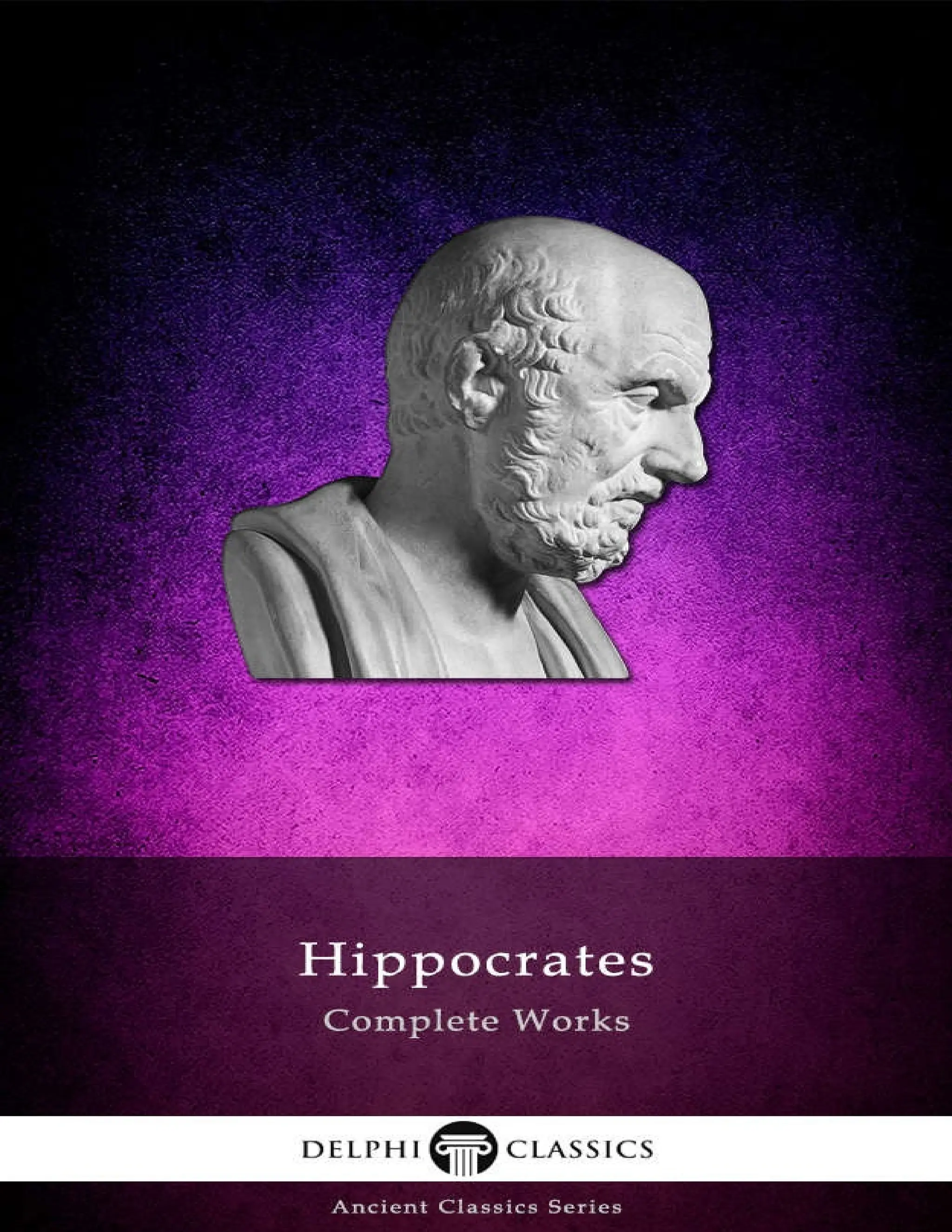
  • 1.
    Complete Works OfHippocrates Delphi Classics Delphi Ancient Classics Book 42 Hippocrates Of Kos download https://ebookbell.com/product/complete-works-of-hippocrates- delphi-classics-delphi-ancient-classics-book-42-hippocrates-of- kos-33722552 Explore and download more ebooks at ebookbell.com
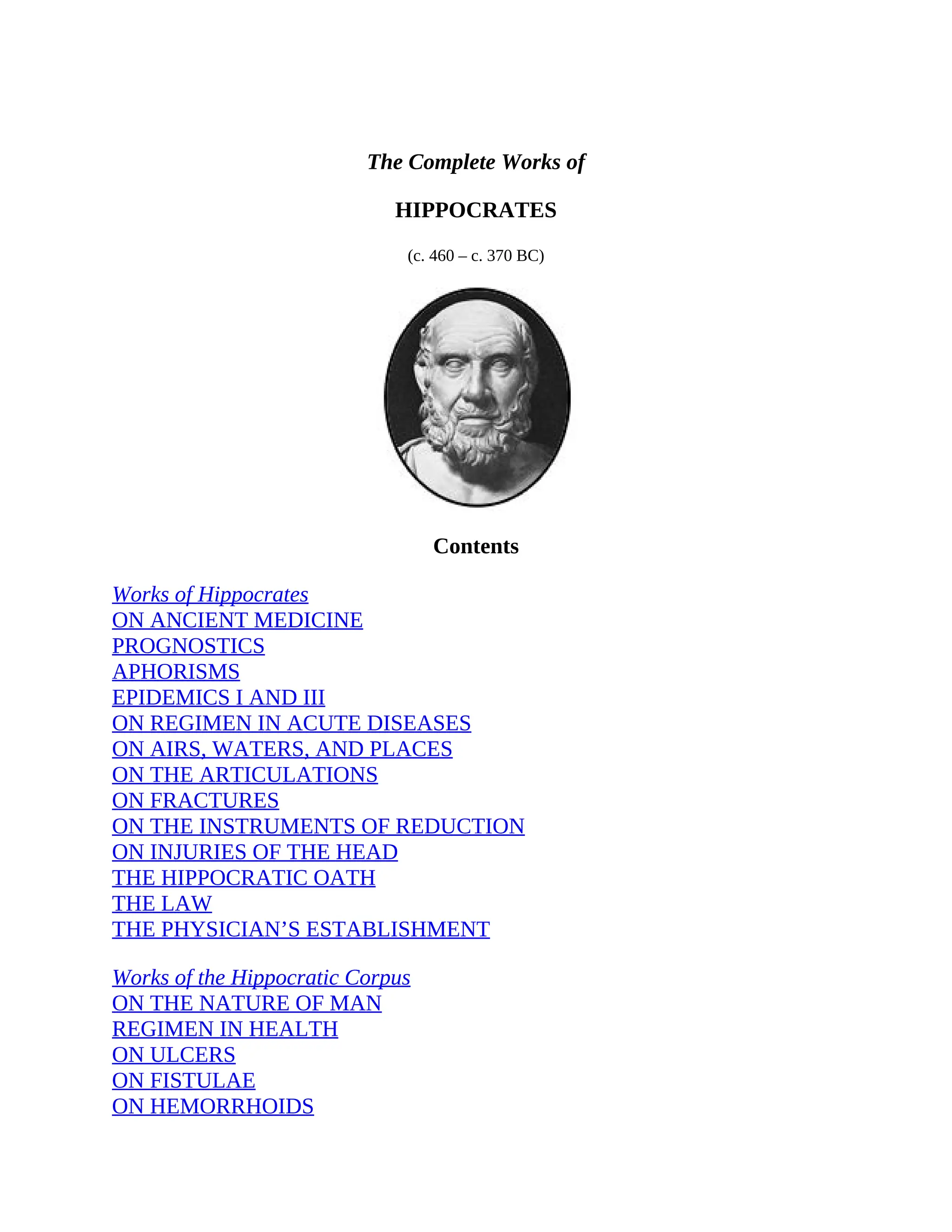
  • 3.
    The Complete Worksof HIPPOCRATES (c. 460 – c. 370 BC) Contents Works of Hippocrates ON ANCIENT MEDICINE PROGNOSTICS APHORISMS EPIDEMICS I AND III ON REGIMEN IN ACUTE DISEASES ON AIRS, WATERS, AND PLACES ON THE ARTICULATIONS ON FRACTURES ON THE INSTRUMENTS OF REDUCTION ON INJURIES OF THE HEAD THE HIPPOCRATIC OATH THE LAW THE PHYSICIAN’S ESTABLISHMENT Works of the Hippocratic Corpus ON THE NATURE OF MAN REGIMEN IN HEALTH ON ULCERS ON FISTULAE ON HEMORRHOIDS
  • 4.
    ON THE SACREDDISEASE ON ALIMENT THE PRECEPTS HUMOURS DREAMS THE ART BREATHS DECORUM THE PHYSICIAN DENTITION The Greek Texts LIST OF GREEK TEXTS The Dual Texts DUAL GREEK AND ENGLISH TEXTS The Biographies GENERAL INTRODUCTION TO HIPPOCRATES by W. H. S. Jones HIPPOCRATES by Charles McRae The Delphi Classics Catalogue © Delphi Classics 2015 Version 1
  • 6.
    The Complete Worksof HIPPOCRATES By Delphi Classics, 2015
  • 7.
    COPYRIGHT Complete Works ofHippocrates First published in the United Kingdom in 2015 by Delphi Classics. © Delphi Classics, 2015. All rights reserved. No part of this publication may be reproduced, stored in a retrieval system, or transmitted, in any form or by any means, without the prior permission in writing of the publisher, nor be otherwise circulated in any form other than that in which it is published. Delphi Classics is an imprint of Delphi Publishing Ltd Hastings, East Sussex United Kingdom Contact: sales@delphiclassics.com www.delphiclassics.com
  • 8.
    Works of Hippocrates Harbourof Cos (ancient Kos) — Hippocrates’ birthplace
  • 9.
    ON ANCIENT MEDICINE OR,TRADITION IN MEDICINE Translated by Charles Darwin Adams This treatise is regarded as one of the most significant works of the Hippocratic Corpus, the collection of approximately sixty writings covering all areas of medical thought and practice, which are traditionally associated with Hippocrates (c. 460 BC – c. 370 BC), the father of Western medicine. In more recent times, thirteen of the works have been identified as being possibly by the hand of Hippocrates, with On Ancient Medicine being a key text of this number. The origins of the Hippocratic Corpus can be traced to the sixth and fifth centuries BC in Italy. There were two seminal schools of Western medical thought; Agrigentum on the southern coast of Sicily and Croton on the west coast of the Gulf of Taranto. Agrigentum was the home of Empedocles, while Croton belonged to the Pythagorean sect of medical philosophy. The school of Agrigentum and Empedocles placed great emphasis on cure by contraries, while the school of Croton rejected this notion, championing the medical philosophy that perceived the human organism consists of an infinite number of humours. The first medical philosopher of the school of Croton was Alcmaeon, who argued that the maintenance of good health required a balance of the powers of moist and dry, cold and hot, bitter and sweet. He argued that sickness arises when there is an imbalance within the human organism, caused by the predominance of one power over another. In the Agrigentum school of thought Empedocles hypothesised that the universe consisted of four elements: earth, water, air and fire. On the basis of these four elements he sought to account for the origin of matter. Matter or the universe was generated out of these four elements and their mutual attraction and repulsion. The conflict between these two schools of thought became manifest in their medical philosophies. Whereas, Alcmaeon argued that there were indefinite number of diverse qualities that made up the human organism, Empedocles
  • 10.
    believed that therewere four concrete or substantial elements. Although it is Empedocles’ medical philosophy that ultimately inspires the humoral doctrine of human nature, it is Alcmaeon’s theory that provides the backdrop to the medical therapeutic doctrine proposed in On Ancient Medicine. Alcmaeon’s argument that there are an infinite number of causes for disease that cannot be simply organised into categories is the basic operating assumption of empirical medicine. Therefore medical knowledge continuously expanded thorough a firsthand experience and observation of the human organism within nature. It is in this light that On Ancient Medicine should be seen as an attempt by Alcmaeon’s followers and the empirical school of thought to respond to and critique the Empedoclean or humoral theory of medicine. On Ancient Medicine is formed of three parts. In chapters 1–19 the author responds to the supporters of the hypothesis theory of medicine, arguing that the exploration of medicine itself reveals the human organism as a blend of diverse substances or humours. Having set forth this humoral theory, he then critiques the hypothesis theory proposed by his opponents as being an oversimplified conception of the cause of disease. He then discusses his own theory and method employed in its discovery (chapters 20-24), before responding to the charge that ancient medicine is not a genuine medical art because it has limited accuracy. These arguments must be seen in the light of the author’s theory of human physiology (chapters 9-12). It is generally believed that On Ancient Medicine was written between 440 and 350 BC, with several hints suggesting a date in the late fifth century. In particular, the author refers to Empedocles (490–430 B.C.) as the motivation of the method he attacks, which would suggest a date not long after Empedocles’ peak of activity. Since the work of Émile Littré in the nineteenth century, the treatise has been scrutinised in thorough detail, in an attempt to determine which of the works in the Hippocratic Corpus were composed by Hippocrates. Littré was the scholar most associated with advocating that On Ancient Medicine was written by Hippocrates, as he believed that it was the work to which Plato was referring to in The Phaedrus. However, it is difficult to establish any certainty as to whether the historical Hippocrates actually wrote the treatise On Ancient Medicine, due to the scanty surviving evidence from references in Plato and Aristotle.
  • 11.
    Vaticanus graecus 277,10v-11r — a fourteenth century Hippocratic Corpus manuscript.
  • 12.
    ON ANCIENT MEDICINE 1.Whoever having undertaken to speak or write on Medicine, have first laid down for themselves some hypothesis to their argument, such as hot, or cold, or moist, or dry, or whatever else they choose (thus reducing their subject within a narrow compass, and supposing only one or two original causes of diseases or of death among mankind), are all clearly mistaken in much that they say; and this is the more reprehensible as relating to an art which all men avail themselves of on the most important occasions, and the good operators and practitioners in which they hold in especial honor. For there are practitioners, some bad and some far otherwise, which, if there had been no such thing as Medicine, and if nothing had been investigated or found out in it, would not have been the case, but all would have been equally unskilled and ignorant of it, and everything concerning the sick would have been directed by chance. But now it is not so; for, as in all the other arts, those who practise them differ much from one another in dexterity and knowledge, so is it in like manner with Medicine. Wherefore I have not thought that it stood in need of an empty hypothesis, like those subjects which are occult and dubious, in attempting to handle which it is necessary to use some hypothesis; as, for example, with regard to things above us and things below the earth; if any one should treat of these and undertake to declare how they are constituted, the reader or hearer could not find out, whether what is delivered be true or false; for there is nothing which can be referred to in order to discover the truth. 2. But all these requisites belong of old to Medicine, and an origin and way have been found out, by which many and elegant discoveries have been made, during a length of time, and others will yet be found out, if a person possessed of the proper ability, and knowing those discoveries which have been made, should proceed from them to prosecute his investigations. But whoever, rejecting and despising all these, attempts to pursue another course and form of inquiry, and says he has discovered anything, is deceived himself and deceives others, for the thing is impossible. And for what reason it is impossible, I will now endeavor to explain, by stating and showing what the art really is. From this it will be manifest that discoveries cannot possibly be made in any other way. And most especially, it appears to me, that whoever treats of this art should treat of things which are familiar to the common people. For of nothing else will such a one have to inquire or treat, but of the diseases under which the common people have labored, which diseases and the causes of their origin and departure, their increase and decline, illiterate persons cannot easily find out themselves, but still
  • 13.
    it is easyfor them to understand these things when discovered and expounded by others. For it is nothing more than that every one is put in mind of what had occurred to himself. But whoever does not reach the capacity of the illiterate vulgar and fails to make them listen to him, misses his mark. Wherefore, then, there is no necessity for any hypothesis. 3. For the art of Medicine would not have been invented at first, nor would it have been made a subject of investigation (for there would have been no need of it), if when men are indisposed, the same food and other articles of regimen which they eat and drink when in good health were proper for them, and if no others were preferable to these. But now necessity itself made medicine to be sought out and discovered by men, since the same things when administered to the sick, which agreed with them when in good health, neither did nor do agree with them. But to go still further back, I hold that the diet and food which people in health now use would not have been discovered, provided it had suited with man to eat and drink in like manner as the ox, the horse, and all other animals, except man, do of the productions of the earth, such as fruits, weeds, and grass; for from such things these animals grow, live free of disease, and require no other kind of food. And, at first, I am of opinion that man used the same sort of food, and that the present articles of diet had been discovered and invented only after a long lapse of time, for when they suffered much and severely from strong and brutish diet, swallowing things which were raw, unmixed, and possessing great strength, they became exposed to strong pains and diseases, and to early deaths. It is likely, indeed, that from habit they would suffer less from these things then than we would now, but still they would suffer severely even then; and it is likely that the greater number, and those who had weaker constitutions, would all perish; whereas the stronger would hold out for a longer time, as even nowadays some, in consequence of using strong articles of food, get off with little trouble, but others with much pain and suffering. From this necessity it appears to me that they would search out the food befitting their nature, and thus discover that which we now use: and that from wheat, by macerating it, stripping it of its hull, grinding it all down, sifting, toasting, and baking it, they formed bread; and from barley they formed cake (maza), performing many operations in regard to it; they boiled, they roasted, they mixed, they diluted those things which are strong and of intense qualities with weaker things, fashioning them to the nature and powers of man, and considering that the stronger things Nature would not be able to manage if administered, and that from such things pains, diseases, and death would arise, but such as Nature could manage, that from them food, growth, and health, would arise. To such a discovery and investigation what more suitable name could one give than that of Medicine?
  • 14.
    since it wasdiscovered for the health of man, for his nourishment and safety, as a substitute for that kind of diet by which pains, diseases, and deaths were occasioned. 4. And if this is not held to be an art, I do not object. For it is not suitable to call any one an artist of that which no one is ignorant of, but which all know from usage and necessity. But still the discovery is a great one, and requiring much art and investigation. Wherefore those who devote themselves to gymnastics and training, are always making some new discovery, by pursuing the same line of inquiry, where, by eating and drinking certain things, they are improved and grow stronger than they were. 5. Let us inquire then regarding what is admitted to be Medicine; namely, that which was invented for the sake of the sick, which possesses a name and practitioners, whether it also seeks to accomplish the same objects, and whence it derived its origin. To me, then, it appears, as I said at the commencement, that nobody would have sought for medicine at all, provided the same kinds of diet had suited with men in sickness as in good health. Wherefore, even yet, such races of men as make no use of medicine, namely, barbarians, and even certain of the Greeks, live in the same way when sick as when in health; that is to say, they take what suits their appetite, and neither abstain from, nor restrict themselves in anything for which they have a desire. But those who have cultivated and invented medicine, having the same object in view as those of whom I formerly spoke, in the first place, I suppose, diminished the quantity of the articles of food which they used, and this alone would be sufficient for certain of the sick, and be manifestly beneficial to them, although not to all, for there would be some so affected as not to be able to manage even small quantities of their usual food, and as such persons would seem to require something weaker, they invented soups, by mixing a few strong things with much water, and thus abstracting that which was strong in them by dilution and boiling. But such as could not manage even soups, laid them aside, and had recourse to drinks, and so regulated them as to mixture and quantity, that they were administered neither stronger nor weaker than what was required. 6. But this ought to be well known, that soups do not agree with certain persons in their diseases, but, on the contrary, when administered both the fevers and the pains are exacerbated, and it becomes obvious that what was given has proved food and increase to the disease, but a wasting and weakness to the body. But whatever persons so affected partook of solid food, or cake, or bread, even in small quantity, would be ten times and more decidedly injured than those who had taken soups, for no other reason than from the strength of the food in reference to the affection; and to whomsoever it is proper to take soups and not
  • 15.
    eat solid food,such a one will be much more injured if he eat much than if he eat little, but even little food will be injurious to him. But all the causes of the sufferance refer themselves to this rule, that the strongest things most especially and decidedly hurt man, whether in health or in disease. 7. What other object, then, had he in view who is called a physician, and is admitted to be a practitioner of the art, who found out the regimen and diet befitting the sick, than he who originally found out and prepared for all mankind that kind of food which we all now use, in place of the former savage and brutish mode of living? To me it appears that the mode is the same, and the discovery of a similar nature. The one sought to abstract those things which the constitution of man cannot digest, because of their wildness and intemperature, and the other those things which are beyond the powers of the affection in which any one may happen to be laid up. Now, how does the one differ from the other, except that the latter admits of greater variety, and requires more application, whereas the former was the commencement of the process? 8. And if one would compare the diet of sick persons with that of persons in health, he will find it not more injurious than that of healthy persons in comparison with that of wild beasts and of other animals. For, suppose a man laboring under one of those diseases which are neither serious and unsupportable, nor yet altogether mild, but such as that, upon making any mistake in diet, it will become apparent, as if he should eat bread and flesh, or any other of those articles which prove beneficial to healthy persons, and that, too, not in great quantity, but much less than he could have taken when in good health; and that another man in good health, having a constitution neither very feeble, nor yet strong, eats of those things which are wholesome and strengthening to an ox or a horse, such as vetches, barley, and the like, and that, too, not in great quantity, but much less than he could take; the healthy person who did so would be subjected to no less disturbance and danger than the sick person who took bread or cake unseasonably. All these things are proofs that Medicine is to be prosecuted and discovered by the same method as the other. 9. And if it were simply, as is laid down, that such things as are stronger prove injurious, but such as are weaker prove beneficial and nourishing, both to sick and healthy persons, it were an easy matter, for then the safest rule would be to circumscribe the diet to the lowest point. But then it is no less mistake, nor one that injuries a man less, provided a deficient diet, or one consisting of weaker things than what are proper, be administered. For, in the constitution of man, abstinence may enervate, weaken, and kill. And there are many other ills, different from those of repletion, but no less dreadful, arising from deficiency of food; wherefore the practice in those cases is more varied, and requires greater
  • 16.
    accuracy. For onemust aim at attaining a certain measure, and yet this measure admits neither weight nor calculation of any kind, by which it may be accurately determined, unless it be the sensation of the body; wherefore it is a task to learn this accurately, so as not to commit small blunders either on the one side or the other, and in fact I would give great praise to the physician whose mistakes are small, for perfect accuracy is seldom to be seen, since many physicians seem to me to be in the same plight as bad pilots, who, if they commit mistakes while conducting the ship in a calm do not expose themselves, but when a storm and violent hurricane overtake them, they then, from their ignorance and mistakes, are discovered to be what they are, by all men, namely, in losing their ship. And thus bad and commonplace physicians, when they treat men who have no serious illness, in which case one may commit great mistakes without producing any formidable mischief (and such complaints occur much more frequently to men than dangerous ones): under these circumstances, when they commit mistakes, they do not expose themselves to ordinary men; but when they fall in with a great, a strong, and a dangerous disease, then their mistakes and want of skill are made apparent to all. Their punishment is not far off, but is swift in overtaking both the one and the other. 10. And that no less mischief happens to a man from unseasonable depletion than from repletion, may be clearly seen upon reverting to the consideration of persons in health. For, to some, with whom it agrees to take only one meal in the day, and they have arranged it so accordingly; whilst others, for the same reason, also take dinner, and this they do because they find it good for them, and not like those persons who, for pleasure or from any casual circumstance, adopt the one or the other custom and to the bulk of mankind it is of little consequence which of these rules they observe, that is to say, whether they make it a practice to take one or two meals. But there are certain persons who cannot readily change their diet with impunity; and if they make any alteration in it for one day, or even for a part of a day, are greatly injured thereby. Such persons, provided they take dinner when it is not their wont, immediately become heavy and inactive, both in body and mind, and are weighed down with yawning, slumbering, and thirst; and if they take supper in addition, they are seized with flatulence, tormina, and diarrhea, and to many this has been the commencement of a serious disease, when they have merely taken twice in a day the same food which they have been in the custom of taking once. And thus, also, if one who has been accustomed to dine, and this rule agrees with him, should not dine at the accustomed hour, he will straightway feel great loss of strength, trembling, and want of spirits, the eyes of such a person will become more pallid, his urine thick and hot, his mouth bitter; his bowels will seem, as it were, to hang loose; he will suffer from
  • 17.
    vertigo, lowness ofspirit, and inactivity,- such are the effects; and if he should attempt to take at supper the same food which he was wont to partake of at dinner, it will appear insipid, and he will not be able to take it off; and these things, passing downwards with tormina and rumbling, burn up his bowels; he experiences insomnolency or troubled and disturbed dreams; and to many of them these symptoms are the commencement of some disease. 11. But let us inquire what are the causes of these things which happened to them. To him, then, who was accustomed to take only one meal in the day, they happened because he did not wait the proper time, until his bowels had completely derived benefit from and had digested the articles taken at the preceding meal, and until his belly had become soft, and got into a state of rest, but he gave it a new supply while in a state of heat and fermentation, for such bellies digest much more slowly, and require more rest and ease. And as to him who had been accustomed to dinner, since, as soon as the body required food, and when the former meal was consumed, and he wanted refreshment, no new supply was furnished to it, he wastes and is consumed from want of food. For all the symptoms which I describe as befalling to this man I refer to want of food. And I also say that all men who, when in a state of health, remain for two or three days without food, experience the same unpleasant symptoms as those which I described in the case of him who had omitted to take dinner. 12. Wherefore, I say, that such constitutions as suffer quickly and strongly from errors in diet, are weaker than others that do not; and that a weak person is in a state very nearly approaching to one in disease; but a person in disease is the weaker, and it is, therefore, more likely that he should suffer if he encounters anything that is unseasonable. It is difficult, seeing that there is no such accuracy in the Art, to hit always upon what is most expedient, and yet many cases occur in medicine which would require this accuracy, as we shall explain. But on that account, I say, we ought not to reject the ancient Art, as if it were not, and had not been properly founded, because it did not attain accuracy in all things, but rather, since it is capable of reaching to the greatest exactitude by reasoning, to receive it and admire its discoveries, made from a state of great ignorance, and as having been well and properly made, and not from chance. 13. But I wish the discourse to revert to the new method of those who prosecute their inquiries in the Art by hypothesis. For if hot, or cold, or moist, or dry, be that which proves injurious to man, and if the person who would treat him properly must apply cold to the hot, hot to the cold, moist to the dry, and dry to the moist-let me be presented with a man, not indeed one of a strong constitution, but one of the weaker, and let him eat wheat, such as it is supplied from the thrashing-floor, raw and unprepared, with raw meat, and let him drink
  • 18.
    water. By usingsuch a diet I know that he will suffer much and severely, for he will experience pains, his body will become weak, and his bowels deranged, and he will not subsist long. What remedy, then, is to be provided for one so situated? Hot? or cold? or moist? or dry? For it is clear that it must be one or other of these. For, according to this principle, if it is one of the which is injuring the patient, it is to be removed by its contrary. But the surest and most obvious remedy is to change the diet which the person used, and instead of wheat to give bread, and instead of raw flesh, boiled, and to drink wine in addition to these; for by making these changes it is impossible but that he must get better, unless completely disorganized by time and diet. What, then, shall we say? whether that, as he suffered from cold, these hot things being applied were of use to him, or the contrary? I should think this question must prove a puzzler to whomsoever it is put. For whether did he who prepared bread out of wheat remove the hot, the cold, the moist, or the dry principle in it?- for the bread is consigned both to fire and to water, and is wrought with many things, each of which has its peculiar property and nature, some of which it loses, and with others it is diluted and mixed. 14. And this I know, moreover, that to the human body it makes a great difference whether the bread be fine or coarse; of wheat with or without the hull, whether mixed with much or little water, strongly wrought or scarcely at all, baked or raw-and a multitude of similar differences; and so, in like manner, with the cake (maza); the powers of each, too, are great, and the one nowise like the other. Whoever pays no attention to these things, or, paying attention, does not comprehend them, how can he understand the diseases which befall a man? For, by every one of these things, a man is affected and changed this way or that, and the whole of his life is subjected to them, whether in health, convalescence, or disease. Nothing else, then, can be more important or more necessary to know than these things. So that the first inventors, pursuing their investigations properly, and by a suitable train of reasoning, according to the nature of man, made their discoveries, and thought the Art worthy of being ascribed to a god, as is the established belief. For they did not suppose that the dry or the moist, the hot or the cold, or any of these are either injurious to man, or that man stands in need of them, but whatever in each was strong, and more than a match for a man’s constitution, whatever he could not manage, that they held to be hurtful, and sought to remove. Now, of the sweet, the strongest is that which is intensely sweet; of the bitter, that which is intensely bitter; of the acid, that which is intensely acid; and of all things that which is extreme, for these things they saw both existing in man, and proving injurious to him. For there is in man the bitter and the salt, the sweet and the acid, the sour and the insipid, and a multitude of
  • 19.
    other things havingall sorts of powers both as regards quantity and strength. These, when all mixed and mingled up with one another, are not apparent, neither do they hurt a man; but when any of them is separate, and stands by itself, then it becomes perceptible, and hurts a man. And thus, of articles of food, those which are unsuitable and hurtful to man when administered, every one is either bitter, or intensely so, or saltish or acid, or something else intense and strong, and therefore we are disordered by them in like manner as we are by the secretions in the body. But all those things which a man eats and drinks are devoid of any such intense and well-marked quality, such as bread, cake, and many other things of a similar nature which man is accustomed to use for food, with the exception of condiments and confectioneries, which are made to gratify the palate and for luxury. And from those things, when received into the body abundantly, there is no disorder nor dissolution of the powers belonging to the body; but strength, growth, and nourishment result from them, and this for no other reason than because they are well mixed, have nothing in them of an immoderate character, nor anything strong, but the whole forms one simple and not strong substance. 15. I cannot think in what manner they who advance this doctrine, and transfer Art from the cause I have described to hypothesis, will cure men according to the principle which they have laid down. For, as far as I know, neither the hot nor the cold, nor the dry, nor the moist, has ever been found unmixed with any other quality; but I suppose they use the same articles of meat and drink as all we other men do. But to this substance they give the attribute of being hot, to that cold, to that dry, and to that moist. Since it would be absurd to advise the patient to take something hot, for he would straightway ask what it is? so that he must either play the fool, or have recourse to some one of the well known substances; and if this hot thing happen to be sour, and that hot thing insipid, and this hot thing has the power of raising a disturbance in the body (and there are many other kinds of heat, possessing many opposite powers), he will be obliged to administer some one of them, either the hot and the sour, or the hot and the insipid, or that which, at the same time, is cold and sour (for there is such a substance), or the cold and the insipid. For, as I think, the very opposite effects will result from either of these, not only in man, but also in a bladder, a vessel of wood, and in many other things possessed of far less sensibility than man; for it is not the heat which is possessed of great efficacy, but the sour and the insipid, and other qualities as described by me, both in man and out of man, and that whether eaten or drunk, rubbed in externally, and otherwise applied. 16. But I think that of all the qualities heat and cold exercise the least operation in the body, for these reasons: as long time as hot and cold are mixed up with
  • 20.
    one another theydo not give trouble, for the cold is attempered and rendered more moderate by the hot, and the hot by the cold; but when the one is wholly separate from the other, then it gives pain; and at that season when cold is applied it creates some pain to a man, but quickly, for that very reason, heat spontaneously arises in him without requiring any aid or preparation. And these things operate thus both upon men in health and in disease. For example, if a person in health wishes to cool his body during winter, and bathes either in cold water or in any other way, the more he does this, unless his body be fairly congealed, when he resumes his clothes and comes into a place of shelter, his body becomes more heated than before. And thus, too, if a person wish to be warmed thoroughly either by means of a hot bath or strong fire, and straightway having the same clothing on, takes up his abode again in the place he was in when he became congealed, he will appear much colder, and more disposed to chills than before. And if a person fan himself on account of a suffocating heat, and having procured refrigeration for himself in this manner, cease doing so, the heat and suffocation will be ten times greater in his case than in that of a person who does nothing of the kind. And, to give a more striking example, persons travelling in the snow, or otherwise in rigorous weather, and contracting great cold in their feet, their hands, or their head, what do they not suffer from inflammation and tingling when they put on warm clothing and get into a hot place? In some instances, blisters arise as if from burning with fire, and they do not suffer from any of those unpleasant symptoms until they become heated. So readily does either of these pass into the other; and I could mention many other examples. And with regard to the sick, is it not in those who experience a rigor that the most acute fever is apt to break out? And yet not so strongly neither, but that it ceases in a short time, and, for the most part, without having occasioned much mischief; and while it remains, it is hot, and passing over the whole body, ends for the most part in the feet, where the chills and cold were most intense and lasted longest; and, when sweat supervenes, and the fever passes off, the patient is much colder than if he had not taken the fever at all. Why then should that which so quickly passes into the opposite extreme, and loses its own powers spontaneously, be reckoned a mighty and serious affair? And what necessity is there for any great remedy for it? 17. One might here say-but persons in ardent fevers, pneumonia, and other formidable diseases, do not quickly get rid of the heat, nor experience these rapid alterations of heat and cold. And I reckon this very circumstance the strongest proof that it is not from heat simply that men get into the febrile state, neither is it the sole cause of the mischief, but that this species of heat is bitter, and that acid, and the other saltish, and many other varieties; and again there is
  • 21.
    cold combined withother qualities. These are what proves injurious; heat, it is true, is present also, possessed of strength as being that which conducts, is exacerbated and increased along with the other, but has no power greater than what is peculiar to itself. 18. With regard to these symptoms, in the first place those are most obvious of which we have all often had experience. Thus, then, in such of us as have a coryza and defluxion from the nostrils, this discharge is much more acrid than that which formerly was formed in and ran from them daily; and it occasions swelling of the nose, and it inflames, being of a hot and extremely ardent nature, as you may know, if you apply your hand to the place; and, if the disease remains long, the part becomes ulcerated although destitute of flesh and hard; and the heat in the nose ceases, not when the defluxion takes place and the inflammation is present, but when the running becomes thicker and less acrid, and more mixed with the former secretion, then it is that the heat ceases. But in all those cases in which this decidedly proceeds from cold alone, without the concourse of any other quality, there is a change from cold to hot, and from hot to cold, and these quickly supervene, and require no coction. But all the others being connected, as I have said, with acrimony and intemperance of humors, pass off in this way by being mixed and concocted. 19. But such defluxions as are determined to the eyes being possessed of strong and varied acrimonies, ulcerate the eyelids, and in some cases corrode the and parts below the eyes upon which they flow, and even occasion rupture and erosion of the tunic which surrounds the eyeball. But pain, heat, and extreme burning prevail until the defluxions are concocted and become thicker, and concretions form about the eyes, and the coction takes place from the fluids being mixed up, diluted, and digested together. And in defluxions upon the throat, from which are formed hoarseness, cynanche, crysipelas, and pneumonia, all these have at first saltish, watery, and acrid discharges, and with these the diseases gain strength. But when the discharges become thicker, more concocted, and are freed from all acrimony, then, indeed, the fevers pass away, and the other symptoms which annoyed the patient; for we must account those things the cause of each complaint, which, being present in a certain fashion, the complaint exists, but it ceases when they change to another combination. But those which originate from pure heat or cold, and do not participate in any other quality, will then cease when they undergo a change from cold to hot, and from hot to cold; and they change in the manner I have described before. Wherefore, all the other complaints to which man is subject arise from powers (qualities?). Thus, when there is an overflow of the bitter principle, which we call yellow bile, what anxiety, burning heat, and loss of strength prevail! but if relieved from
  • 22.
    it, either bybeing purged spontaneously, or by means of a medicine seasonably administered, the patient is decidedly relieved of the pains and heat; but while these things float on the stomach, unconcocted and undigested, no contrivance could make the pains and fever cease; and when there are acidities of an acrid and aeruginous character, what varieties of frenzy, gnawing pains in the bowels and chest, and inquietude, prevail! and these do not cease until the acidities be purged away, or are calmed down and mixed with other fluids. The coction, change, attenuation, and thickening into the form of humors, take place through many and various forms; therefore the crises and calculations of time are of great importance in such matters; but to all such changes hot and cold are but little exposed, for these are neither liable to putrefaction nor thickening. What then shall we say of the change? that it is a combination (crasis) of these humors having different powers toward one another. But the hot does not loose its heat when mixed with any other thing except the cold; nor again, the cold, except when mixed with the hot. But all other things connected with man become the more mild and better in proportion as they are mixed with the more things besides. But a man is in the best possible state when they are concocted and at rest, exhibiting no one peculiar quality; but I think I have said enough in explanation of them. 20. Certain sophists and physicians say that it is not possible for any one to know medicine who does not know what man is [and how he was made and how constructed], and that whoever would cure men properly, must learn this in the first place. But this saying rather appertains to philosophy, as Empedocles and certain others have described what man in his origin is, and how he first was made and constructed. But I think whatever such has been said or written by sophist or physician concerning nature has less connection with the art of medicine than with the art of painting. And I think that one cannot know anything certain respecting nature from any other quarter than from medicine; and that this knowledge is to be attained when one comprehends the whole subject of medicine properly, but not until then; and I say that this history shows what man is, by what causes he was made, and other things accurately. Wherefore it appears to me necessary to every physician to be skilled in nature, and strive to know, if he would wish to perform his duties, what man is in relation to the articles of food and drink, and to his other occupations, and what are the effects of each of them to every one. And it is not enough to know simply that cheese is a bad article of food, as disagreeing with whoever eats of it to satiety, but what sort of disturbance it creates, and wherefore, and with what principle in man it disagrees; for there are many other articles of food and drink naturally bad which affect man in a different manner. Thus, to illustrate my
  • 23.
    meaning by anexample, undiluted wine drunk in large quantity renders a man feeble; and everybody seeing this knows that such is the power of wine, and the cause thereof; and we know, moreover, on what parts of a man’s body it principally exerts its action; and I wish the same certainty to appear in other cases. For cheese (since we used it as an example) does not prove equally injurious to all men, for there are some who can take it to satiety without being hurt by it in the least, but, on the contrary, it is wonderful what strength it imparts to those it agrees with; but there are some who do not bear it well, their constitutions are different, and they differ in this respect, that what in their body is incompatible with cheese, is roused and put in commotion by such a thing; and those in whose bodies such a humor happens to prevail in greater quantity and intensity, are likely to suffer the more from it. But if the thing had been pernicious to of man, it would have hurt all. Whoever knows these things will not suffer from it. 21. During convalescence from diseases, and also in protracted diseases, many disorders occur, some spontaneously, and some from certain things accidentally administered. I know that the common herd of physicians, like the vulgar, if there happen to have been any innovation made about that day, such as the bath being used, a walk taken, or any unusual food eaten, all which were better done than otherwise, attribute notwithstanding the cause of these disorders, to some of these things, being ignorant of the true cause but proscribing what may have been very proper. Now this ought not to be so; but one should know the effects of a bath or a walk unseasonably applied; for thus there will never be any mischief from these things, nor from any other thing, nor from repletion, nor from such and such an article of food. Whoever does not know what effect these things produce upon a man, cannot know the consequences which result from them, nor how to apply them. 22. And it appears to me that one ought also to know what diseases arise in man from the powers, and what from the structures. What do I mean by this? By powers, I mean intense and strong juices; and by structures, whatever conformations there are in man. For some are hollow, and from broad contracted into narrow; some expanded, some hard and round, some broad and suspended, some stretched, some long, some dense, some rare and succulent, some spongy and of loose texture. Now, then, which of these figures is the best calculated to suck to itself and attract humidity from another body? Whether what is hollow and expanded, or what is solid and round, or what is hollow, and from broad, gradually turning narrow? I think such as from hollow and broad are contracted into narrow: this may be ascertained otherwise from obvious facts: thus, if you gape wide with the mouth you cannot draw in any liquid; but by protruding,
  • 24.
    contracting, and compressingthe lips, and still more by using a tube, you can readily draw in whatever you wish. And thus, too, the instruments which are used for cupping are broad below and gradually become narrow, and are so constructed in order to suck and draw in from the fleshy parts. The nature and construction of the parts within a man are of a like nature; the bladder, the head, the uterus in woman; these parts clearly attract, and are always filled with a juice which is foreign to them. Those parts which are hollow and expanded are most likely to receive any humidity flowing into them, but cannot attract it in like manner. Those parts which are solid and round could not attract a humidity, nor receive it when it flows to them, for it would glide past, and find no place of rest on them. But spongy and rare parts, such as the spleen, the lungs, and the breasts, drink up especially the juices around them, and become hardened and enlarged by the accession of juices. Such things happen to these organs especially. For it is not with the spleen as with the stomach, in which there is a liquid, which it contains and evacuates every day; but when it (the spleen) drinks up and receives a fluid into itself, the hollow and lax parts of it are filled, even the small interstices; and, instead of being rare and soft, it becomes hard and dense, and it can neither digest nor discharge its contents: these things it suffers, owing to the nature of its structure. Those things which engender flatulence or tormina in the body, naturally do so in the hollow and broad parts of the body, such as the stomach and chest, where they produce rumbling noises; for when they do not fill the parts so as to be stationary, but have changes of place and movements, there must necessarily be noise and apparent movements from them. But such parts as are fleshy and soft, in these there occur torpor and obstructions, such as happen in apoplexy. But when it (the flatus?) encounters a broad and resisting structure, and rushes against such a part, and this happens when it is by nature not strong so as to be able to withstand it without suffering injury; nor soft and rare, so as to receive or yield to it, but tender, juicy, full of blood, and dense, like the liver, owing to its density and broadness, it resists and does not yield. But flatus, when it obtains admission, increases and becomes stronger, and rushes toward any resisting object; but owing to its tenderness, and the quantity of blood which it (the liver) contains, it cannot be without uneasiness; and for these reasons the most acute and frequent pains occur in the region of it, along with suppurations and chronic tumors (phymata). These symptoms also occur in the site of the diaphragm, but much less frequently; for the diaphragm is a broad, expanded, and resisting substance, of a nervous (tendinous?) and strong nature, and therefore less susceptible of pain; and yet pains and chronic abscesses do occur about it. 23. There are both within and without the body many other kinds of structure,
  • 25.
    which differ muchfrom one another as to sufferings both in health and disease; such as whether the head be small or large; the neck slender or thick, long or short; the belly long or round; the chest and ribs broad or narrow; and many others besides, all which you ought to be acquainted with, and their differences; so that knowing the causes of each, you may make the more accurate observations. 24. And, as has been formerly stated, one ought to be acquainted with the powers of juices, and what action each of them has upon man, and their alliances towards one another. What I say is this: if a sweet juice change to another kind, not from any admixture, but because it has undergone a mutation within itself; what does it first become?- bitter? salt? austere? or acid? I think acid. And hence, an acid juice is the most improper of all things that can be administered in cases in which a sweet juice is the most proper. Thus, if one should succeed in his investigations of external things, he would be the better able always to select the best; for that is best which is farthest removed from that which is unwholesome.
  • 26.
    PROGNOSTICS Translated by CharlesDarwin Adams 1. It appears to me a most excellent thing for the physician to cultivate Prognosis; for by foreseeing and foretelling, in the presence of the sick, the present, the past, and the future, and explaining the omissions which patients have been guilty of, he will be the more readily believed to be acquainted with the circumstances of the sick; so that men will have confidence to intrust themselves to such a physician. And he will manage the cure best who has foreseen what is to happen from the present state of matters. For it is impossible to make all the sick well; this, indeed, would have been better than to be able to foretell what is going to happen; but since men die, some even before calling the physician, from the violence of the disease, and some die immediately after calling him, having lived, perhaps, only one day or a little longer, and before the physician could bring his art to counteract the disease; it therefore becomes necessary to know the nature of such affections, how far they are above the powers of the constitution; and, moreover, if there be anything divine in the diseases, and to learn a foreknowledge of this also. Thus a man will be the more esteemed to be a good physician, for he will be the better able to treat those aright who can be saved, having long anticipated everything; and by seeing and announcing beforehand those who will live and those who will die, he will thus escape censure. 2. He should observe thus in acute diseases: first, the countenance of the patient, if it be like those of persons in health, and more so, if like itself, for this is the best of all; whereas the most opposite to it is the worst, such as the following; a sharp nose, hollow eyes, collapsed temples; the ears cold, contracted, and their lobes turned out: the skin about the forehead being rough, distended, and parched; the color of the whole face being green, black, livid, or lead-colored. If the countenance be such at the commencement of the disease, and if this cannot be accounted for from the other symptoms, inquiry must be made whether the patient has long wanted sleep; whether his bowels have been very loose; and whether he has suffered from want of food; and if any of these
  • 27.
    causes be confessedto, the danger is to be reckoned so far less; and it becomes obvious, in the course of a day and a night, whether or not the appearance of the countenance proceeded from these causes. But if none of these be said to exist, if the symptoms do not subside in the aforesaid time, it is to be known for certain that death is at hand. And, also, if the disease be in a more advanced stage either on the third or fourth day, and the countenance be such, the same inquiries as formerly directed are to be made, and the other symptoms are to be noted, those in the whole countenance, those on the body, and those in the eyes; for if they shun the light, or weep involuntarily, or squint, or if the one be less than the other, or if the white of them be red, livid, or has black veins in it; if there be a gum upon the eyes, if they are restless, protruding, or are become very hollow; and if the countenance be squalid and dark, or the color of the whole face be changed-all these are to be reckoned bad and fatal symptoms. The physician should also observe the appearance of the eyes from below the eyelids in sleep; for when a portion of the white appears, owing to the eyelids not being closed together, and when this is not connected with diarrhea or purgation from medicine, or when the patient does not sleep thus from habit, it is to be reckoned an unfavorable and very deadly symptom; but if the eyelid be contracted, livid, or pale, or also the lip, or nose, along with some of the other symptoms, one may know for certain that death is close at hand. It is a mortal symptom, also, when the lips are relaxed, pendent, cold, and blanched. 3. It is well when the patient is found by his physician reclining upon either his right or his left side, having his hands, neck, and legs slightly bent, and the whole body lying in a relaxed state, for thus the most of persons in health recline, and these are the best of postures which most resemble those of healthy persons. But to lie upon one’s back, with the hands, neck, and the legs extended, is far less favorable. And if the patient incline forward, and sink down to the foot of the bed, it is a still more dangerous symptom; but if he be found with his feet naked and not sufficiently warm, and the hands, neck, and legs tossed about in a disorderly manner and naked, it is bad, for it indicates aberration of intellect. It is a deadly symptom, also, when the patient sleeps constantly with his mouth open, having his legs strongly bent and plaited together, while he lies upon his back; and to lie upon one’s belly, when not habitual to the patient to sleep thus while in good health, indicates delirium, or pain in the abdominal regions. And for the patient to wish to sit erect at the acme of a disease is a bad symptom in all acute diseases, but particularly so in pneumonia. To grind the teeth in fevers, when such has not been the custom of the patient from childhood, indicates madness and death, both which dangers are to be announced beforehand as likely to happen; and if a person in delirium do this it is a very deadly symptom. And if
  • 28.
    the patient hadan ulcer previously, or if one has occurred in the course of the disease, it is to be observed; for if the man be about to die the sore will become livid and dry, or yellow and dry before death. 4. Respecting the movement of the hands I have these observations to make: When in acute fevers, pneumonia, phrenitis, or headache, the hands are waved before the face, hunting through empty space, as if gathering bits of straw, picking the nap from the coverlet, or tearing chaff from the wall-all such symptoms are bad and deadly. 5. Respiration, when frequent, indicates pain or inflanunation in the parts above the diaphragm: a large respiration performed at a great interval announces delirium; but a cold respiration at nose or mouth is a very fatal symptom. Free respiration is to be looked upon as contributing much to the safety of the patient in all acute diseases, such as fevers, and those complaints which come to a crisis in forty days. 6. Those sweats are the best in all acute diseases which occur on the critical days, and completely carry off the fever. Those are favorable, too, which taking place over the whole body, show that the man is bearing the disease better. But those that do not produce this effect are not beneficial. The worst are cold sweats, confined to the head, face, and neck; these in an acute fever prognosticate death, or in a milder one, a prolongation of the disease; and sweats which occur over the whole body, with the characters of those confined to the neck, are in like manner bad. Sweats attended with a miliary eruption, and taking place about the neck, are bad; sweats in the form of drops and of vapour are good. One ought to know the entire character of sweats, for some are connected with prostration of strength in the body, and some with intensity of the inflammation. 7. That state of the hypochondrium is best when it is free from pain, soft, and of equal size on the right side and the left. But if inflamed, or painful, or distended; or when the right and left sides are of disproportionate sizes;- all these appearances are to be dreaded. And if there be also pulsation in the hypochondrium, it indicates perturbation or delirium; and the physician should examine the eyes of such persons; for if their pupils be in rapid motion, such persons may be expected to go mad. A swelling in the hypochondrium, that is hard and painful, is very bad, provided it occupy the whole hypochondrium; but if it be on either side, it is less dangerous when on the left. Such swellings at the commencement of the disease prognosticate speedy death; but if the fever has passed twenty days, and the swelling has not subsided, it turns to a suppuration. A discharge of blood from the nose occurs to such in the first period, and proves very useful; but inquiry should be made if they have headache or indistinct
  • 29.
    vision; for ifthere be such, the disease will be determined thither. The discharge of blood is rather to be expected in those who are younger than thirty-five years. Such swellings as are soft, free from pain, and yield to the finger, occasion more protracted crises, and are less dangerous than the others. But if the fever continue beyond sixty days, without any subsidence of the swelling, it indicates that empyema is about to take place; and a swelling in any other part of the cavity will terminate in like manner. Such, then, as are painful, hard, and large, indicate danger of speedy death; but such as are soft, free of pain, and yield when pressed with the finger, are more chronic than these. Swellings in the belly less frequently form abscesses than those in the hypochondrium; and seldomest of all, those below the navel are converted into suppuration; but you may rather expect a hemorrhage from the upper parts. But the suppuration of all protracted swellings about these parts is to be anticipated. The collections of matter there are to be thus judged of: such as are determined outwards are the best when they are small, when they protrude very much, and swell to a point; such as are large and broad, and which do not swell out to a sharp point, are the worst. Of such as break internally, the best are those which have no external communication, but are covered and indolent; and when the whole place is free from discoloration. That pus is best which is white, homogeneous, smooth, and not at all fetid; the contrary to this is the worst. 8. All dropsies arising from acute diseases are bad; for they do not remove the fever, and are very painful and fatal. The most of them commence from the flanks and loins, but some from the liver; in those which derive their origin from the flanks and loins the feet swell, protracted diarrhoeas supervene, which neither remove the pains in the flanks and loins, nor soften the belly, but in dropsies which are connected with the liver there is a tickling cough, with scarcely any perceptible expectoration, and the feet swell; there are no evacuations from the bowels, unless such as are hard and forced; and there are swellings about the belly, sometimes on the one side and sometimes on the other, and these increase and diminish by turns. 9. It is a bad symptom when the head, hands, and feet are cold, while the belly and sides are hot; but it is a very good symptom when the whole body is equally hot. The patient ought to be able to turn round easily, and to be agile when raised up; but if he appear heavy in the rest of his body as well as in his hands and feet, it is more dangerous; and if, in addition to the weight, his nails and fingers become livid, immediate death may be anticipated; and if the hands and feet be black it is less dangerous than if they be livid, but the other symptoms must be attended, to; for if he appear to bear the illness well, and if certain of the salutary symptoms appear along with these there may be hope that the disease will turn to
  • 30.
    a deposition, sothat the man may recover; but the blackened parts of the body will drop off. When the testicles and members are retracted upwards, they indicate strong pains and danger of death. 10. With regard to sleep-as is usual with us in health, the patient should wake during the day and sleep during the night. If this rule be anywise altered it is so far worse: but there will be little harm provided he sleep in the morning for the third part of the day; such sleep as takes place after this time is more unfavorable; but the worst of all is to get no sleep either night or day; for it follows from this symptom that the insomnolency is connected with sorrow and pains, or that he is about to become delirious. 11. The excrement is best which is soft and consistent, is passed at the hour which was customary to the patient when in health, in quantity proportionate to the ingests; for when the passages are such, the lower belly is in a healthy state. But if the discharges be fluid, it is favorable that they are not accompanied with a noise, nor are frequent, nor in great quantity; for the man being oppressed by frequently getting up, must be deprived of sleep; and if the evacuations be both frequent and large, there is danger of his falling into deliquium animi. But in proportion to the ingesta he should have evacuations twice or thrice in the day, once at night and more copiously in the morning, as is customary with a person in health. The faeces should become thicker when the disease is tending to a crisis; they ought to be yellowish and not very fetid. It is favorable that round worms be passed with the discharges when the disease is tending to a crisis. The belly, too, through the whole disease, should be soft and moderately distended; but excrements that are very watery, or white, or green, or very red, or frothy, are all bad. It is also bad when the discharge is small, and viscid, and white, and greenish, and smooth; but still more deadly appearances are the black, or fatty, or livid, or verdigris-green, or fetid. Such as are of varied characters indicate greater duration of the complaint, but are no less dangerous; such as those which resemble scrapings, those which are bilious, those resembling leeks, and the black; these being sometimes passed together, and sometimes singly. It is best when wind passes without noise, but it is better that flatulence should pass even thus than that it should be retained; and when it does pass thus, it indicates either that the man is in pain or in delirium, unless he gives vent to the wind spontaneously. Pains in the hypochondria, and swellings, if recent, and not accompanied with inflammation, are relieved by borborygmi supervening in the hypochondrium, more especially if it pass off with faeces, urine, and wind; but even although not, it will do good by passing along, and it also does good by descending to the lower part of the belly. 12. The urine is best when the sediment is white, smooth, and consistent during
  • 31.
    the whole time,until the disease come to a crisis, for it indicates freedom from danger, and an illness of short duration; but if deficient, and if it be sometimes passed clear, and sometimes with a white and smooth sediment, the disease will be more protracted, and not so void of danger. But if the urine be reddish, and the sediment consistent and smooth, the affection, in this case, will be more protracted than the former, but still not fatal. But farinaceous sediments in the urine are bad, and still worse are the leafy; the white and thin are very bad, but the furfuraceous are still worse than these. Clouds carried about in the urine are good when white, but bad if black. When the urine is yellow and thin, it indicates that the disease is unconcocted; and if it (the disease) should be protracted, there maybe danger lest the patient should not hold out until the urine be concocted. But the most deadly of all kinds of urine are the fetid, watery, black, and thick; in adult men and women the black is of all kinds of urine the worst, but in children, the watery. In those who pass thin and crude urine for a length of time, if they have otherwise symptoms of convalescence, an abscess may be expected to form in the parts below the diaphragm. And fatty substances floating on the surface are to be dreaded, for they are indications of melting. And one should consider respecting the kinds of urine, which have clouds, whether they tend upwards or downwards, and upwards or downwards, and the colors which they have and such as fall downwards, with the colors as described, are to be reckoned good and commended; but such as are carried upwards, with the colors as described, are to be held as bad, and are to be distrusted. But you must not allow yourself to be deceived if such urine be passed while the bladder is diseased; for then it is a symptom of the state, not of the general system, but of a particular viscus. 13. That vomiting is of most service which consists of phlegm and bile mixed together, and neither very thick nor in great quantity; but those vomitings which are more unmixed are worse. But if that which is vomited be of the color of leeks or livid, or black, whatever of these colors it be, it is to be reckoned bad; but if the same man vomit all these colors, it is to be reckoned a very fatal symptom. But of all the vomitings, the livid indicates the danger of death, provided it be of a fetid smell. But all the smells which are somewhat putrid and fetid, are bad in all vomitings. 14. The expectoration in all pains about the lungs and sides, should be quickly and easily brought up, and a certain degree of yellowness should appear strongly mixed up with the sputum. But if brought up long after the commencement of the pain, and of a yellow or ruddy color, or if it occasions much cough, or be not strongly mixed, it is worse; for that which is intensely yellow is dangerous, but the white, and viscid, and round, do no good. But that which is very green and
  • 32.
    frothy is bad;but if so intense as to appear black, it is still more dangerous than these; it is bad, if nothing is expectorated, and the lungs discharge nothing, but are gorged with matters which boil (as it were) in the air-passages. It is bad when coryza and sneezing either precede or follow affections of the lungs, but in all other affections, even the most deadly, sneezing is a salutary symptom. A yellow spittle mixed up with not much blood in cases of pneumonia, is salutary and very beneficial if spit up at the commencement of the disease, but if on the seventh day, or still later, it is less favorable. And all sputa are bad which do not remove the pain. But the worst is the black, as has been described. Of all others the sputa which remove the pain are the best. 15. When the pains in these regions do not cease, either with the discharge of the sputa, nor with alvine evacuations, nor from venesection, purging with medicine, nor a suitable regimen, it is to be held that they will terminate in suppurations. Of empyemata such as are spit up while the sputum is still bilious, are very fatal, whether the bilious portion be expectorated separate, or along with the other; but more especially if the empyema begin to advance after this sputum on the seventh day of the disease. It is to be expected that a person with such an expectoration shall die on the fourteenth day, unless something favorable supervene. The following are favorable symptoms: to support the disease easily, to have free respiration, to be free from pain, to have the sputa readily brought up, the whole body to appear equally warm and soft, to have no thirst, the urine, and faeces, sleep, and sweats to be all favorable, as described before; when all these symptoms concur, the patient certainly will not die; but if some of these be present and some not, he will not survive longer than the fourteenth day. The bad symptoms are the opposite of these, namely, to bear the disease with difficulty, respiration large and dense, the pain not ceasing, the sputum scarcely coughed up, strong thirst, to have the body unequally affected by the febrile heat, the belly and sides intensely hot, the forehead, hands, and feet cold; the urine, and excrements, the sleep, and sweats, all bad, agreeably to the characters described above; if such a combination of symptoms accompany the expectoration, the man will certainly die before the fourteenth day, and either on the ninth or eleventh. Thus then one may conclude regarding this expectoration, that it is very deadly, and that the patient will not survive until the fourteenth day. It is by balancing the concomitant symptoms whether good or bad, that one is to form a prognosis; for thus it will most probably prove to be a true one. Most other suppurations burst, some on the twentieth, some on the thirtieth, some on the fortieth, and some as late as the sixtieth day. 16. One should estimate when the commencement of the suppuration will take place, by calculating from the day on which the patient was first seized with
  • 33.
    fever, or ifhe had a rigor, and if he says, that there is a weight in the place where he had pain formerly, for these symptoms occur in the commencement of suppurations. One then may expect the rupture of the abscesses to take place from these times according to the periods formerly stated. But if the empyema be only on either side, one should turn him and inquire if he has pain on the other side; and if the one side be hotter than the other, and when laid upon the sound side, one should inquire if he has the feeling of a weight hanging from above, for if so, the empyema will be upon the opposite side to that on which the weight was felt. 17. Empyema may be recognized in all cases by the following symptoms: In the first place, the fever does not go off, but is slight during the day, and increases at night, and copious sweats supervene, there is a desire to cough, and the patients expectorate nothing worth mentioning, the eyes become hollow, the cheeks have red spots on them, the nails of the hands are bent, the fingers are hot especially their extremities, there are swellings in the feet, they have no desire of food, and small blisters (phlyctaenae) occur over the body. These symptoms attend chronic empyemata, and may be much trusted to; and such as are of short standing are indicated by the same, provided they be accompanied by those signs which occur at the commencement, and if at the same time the patient has some difficulty of breathing. Whether they will break earlier or later may be determined by these symptoms; if there be pain at the commencement, and if the dyspnoea, cough, and ptyalism be severe, the rupture may be expected in the course of twenty days or still earlier; but if the pain be more mild, and all the other symptoms in proportion, you may expect from these the rupture to be later; but pain, dyspnoea, and ptyalism, must take place before the rupture of the abscess. Those patients recover most readily whom the fever leaves the same day that the abscess bursts,- when they recover their appetite speedily, and are freed from the thirst,- when the alvine discharges are small and consistent, the matter white, smooth, uniform in color, and free of phlegm, and if brought up without pain or strong coughing. Those die whom the fever does not leave, or when appearing to leave them it returns with an exacerbation; when they have thirst, but no desire of food, and there are watery discharges from the bowels; when the expectoration is green or livid, or pituitous and frothy; if all these occur they die, but if certain of these symptoms supervene, and others not, some patients die and some recover, after a long interval. But from all the symptoms taken together one should form a judgment, and so in all other cases. 18. When abscesses form about the ears, after peripneumonic affections, or depositions of matter take place in the inferior extremities and end in fistula, such persons recover. The following observations are to be made upon them: if
  • 34.
    the fever persist,and the pain do not cease, if the expectoration be not normal, and if the alvine discharges be neither bilious, nor free and unmixed; and if the urine be neither copious nor have its proper sediment, but if, on the other hand, all the other salutary symptoms be present, in such cases abscesses may be expected to take place. They form in the inferior parts when there is a collection of phlegm about the hypochondria; and in the upper when the hypochondria continue soft and free of pain, and when dyspnoea having been present for a certain time, ceases without any obvious cause. All deposits which take place in the legs after severe and dangerous attacks of pneumonia, are salutary, but the best are those which occur at the time when the sputa undergo a change; for if the swelling and pain take place while the sputa are changing from yellow and becoming of a purulent character, and are expectorated freely, under these circumstances the man will recover most favorably and the abscess becoming free of pain, will soon cease; but if the expectoration is not free, and the urine does not appear to have the proper sediment, there is danger lest the limb should be maimed, or that the case otherwise should give trouble. But if the abscesses disappear and go back, while expectoration does not take place, and fever prevails, it is a bad symptom; for there is danger that the man may get into a state of delirium and die. Of persons having empyema after peripneumonic affections, those that are advanced in life run the greatest risk of dying; but in the other kinds of empyema younger persons rather die. In cases of empyema treated by the cautery or incision, when the matter is pure, white, and not fetid, the patient recovers; but if of a bloody and dirty character, he dies. 19. Pains accompanied with fever which occur about the loins and lower parts, if they attack the diaphragm, and leave the parts below, are very fatal. Wherefore one ought to pay attention to the other symptoms, since if any unfavorable one supervene, the case is hopeless; but if while the disease is determined to the diaphragm, the other symptoms are not bad, there is great reason to expect that it will end in empyema. When the bladder is hard and painful, it is an extremely bad and mortal symptom, more especially in cases attended with continued fever; for the pains proceeding from the bladder alone are to kill the patient; and at such a time the bowels are not moved, or the discharges are hard and forced. But urine of a purulent character, and having a white and smooth sediment, relieves the patient. But if no amendment takes place in the characters of the urine, nor the bladder become soft, and the fever is of the continual type, it may be expected that the patient will die in the first stages of the complaint. This form attacks children more especially, from their seventh to their fifteenth year. 20. Fevers come to a crisis on the same days as to number on which men recover and die. For the mildest class of fevers, and those originating with the
  • 35.
    most favorable symptoms,cease on the fourth day or earlier; and the most malignant, and those setting in with the most dangerous symptoms, prove fatal on the fourth day or earlier. The first class of them as to violence ends thus: the second is protracted to the seventh day, the third to the eleventh, the fourth to the fourteenth, the fifth to the seventeenth, and the sixth to the twentieth. Thus these periods from the most acute disease ascend by fours up to twenty. But none of these can be truly calculated by whole days, for neither the year nor the months can be numbered by entire days. After these in the same manner, according to the same progression, the first period is of thirty-four days, the second of forty days, and the third of sixty days. In the commencement of these it is very difficult to determine those which will come to a crisis after a long interval; for these beginnings are very similar, but one should pay attention from the first day, and observe further at every additional tetrad, and then one cannot miss seeing how the disease will terminate. The constitution of quartans is agreeable to the same order. Those which will come to a crisis in the shortest space of time, are the easiest to be judged of; for the differences of them are greatest from the commencement, thus those who are going to recover breathe freely, and do not suffer pain, they sleep during the night, and have the other salutary symptoms, whereas those that are to die have difficult respiration, are delirious, troubled with insomnolency, and have other bad symptoms. Matters being thus, one may conjecture, according to the time, and each additional period of the diseases, as they proceed to a crisis. And in women, after parturition, the crises proceed agreeably to the same ratio. 21. Strong and continued headaches with fever, if any of the deadly symptoms be joined to them, are very fatal. But if without such symptoms the pain be prolonged beyond twenty days, a discharge of blood from the nose or some abscess in the inferior parts may be anticipated; but while the pain is recent, we may expect in like manner a discharge of blood from the nose, or a suppuration, especially if the pain be seated above the temples and forehead; but the hemorrhage is rather to be looked for in persons younger than thirty years, and the suppuration in more elderly persons. 22. Acute pain of the ear, with continual and strong fever, is to be dreaded; for there is danger that the man may become delirious and die. Since, then, this is a hazardous spot, one ought to pay particular attention to all these symptoms from the commencement. Younger persons die of this disease on the seventh day, or still earlier, but old persons much later; for the fevers and delirium less frequently supervene upon them, and on that account the ears previously come to a suppuration, but at these periods of life, relapses of the disease coming on generally prove fatal. Younger persons die before the ear suppurates; only if
  • 36.
    white matter runfrom the ear, there may be hope that a younger person will recover, provided any other favorable symptom be combined. 23. Ulceration of the throat with fever, is a serious affection, and if any other of the symptoms formerly described as being bad, be present, the physician ought to announce that his patient is in danger. Those quinsies are most dangerous, and most quickly prove fatal, which make no appearance in the fauces, nor in the neck, but occasion very great pain and difficulty of breathing; these induce suffocation on the first day, or on the second, the third, or the fourth. Such as, in like manner, are attended with pain, are swelled up, and have redness (erythema) in the throat, are indeed very fatal, but more protracted than the former, provided the redness be great. Those cases in which both the throat and the neck are red, are more protracted, and certain persons recover from them, especially if the neck and breast be affected with erythema, and the erysipelas be not determined inwardly. If neither the erysipelas disappear on the critical day, nor any abscess form outwardly, nor any pus be spit up, and if the patient fancy himself well, and be free from pain, death, or a relapse of the erythema is to be apprehended. It is much less hazardous when the swelling and redness are determined outwardly; but if determined to the lungs, they superinduce delirium, and frequently some of these cases terminate in empyema. It is very dangerous to cut off or scarify enlarged uvulae while they and red and large, for inflammations and hemorrhages supervene; but one should try to reduce such swellings by some other means at this season. When the whole of it is converted into an abscess, which is called Uva, or when the extremity of the variety called Columella is larger and round, but the upper part thinner, at this time it will be safe to operate. But it will be better to open the bowels gently before proceeding to the operation, if time will permit, and the patient be not in danger of being suffocated. 24. When the fevers cease without any symptoms of resolution occurring, and not on the critical days, in such cases a relapse may be anticipated. When any of the fevers is protracted, although the man exhibits symptoms of recovery, and there is no longer pain from any inflammation, nor from any other visible cause, in such a case a deposit, with swelling and pain, may be expected in some one of the joints, and not improbably in those below. Such deposits occur more readily and in less time to persons under thirty years of age; and one should immediately suspect the formation of such a deposit, if the fever be protracted beyond twenty days; but to aged persons these less seldom happen, and not until the fever be much longer protracted. Such a deposit may be expected, when the fever is of a continual type, and that it will pass into a quartan, if it become intermittent, and its paroxysms come on in an irregular manner, and if in this form it approach
  • 37.
    autumn. As depositsform most readily in persons below thirty years of age, so quartans most commonly occur to persons beyond that age. It is proper to know that deposits occur most readily in winter, that then they are most protracted, but are less given to return. Whoever, in a fever that is not of a fatal character, says that he has pain in his head, and that something dark appears to be before his eyes, and that he has pain at the stomach, will be seized with vomiting of bile; but if rigor also attack him, and the inferior parts of the hypochondrium are cold, vomiting is still nearer at hand; and if he eat or drink anything at such a season, it will be quickly vomited. In these cases, when the pain commences on the first day, they are particularly oppressed on the fourth and the fifth; and they are relieved on the seventh, but the greater part of them begin to have pain on the third day, and are most especially tossed on the fifth, but are relieved on the ninth or eleventh; but in those who begin to have pains on the fifth day, and other matters proceed properly with them, the disease comes to a crisis on the fourteenth day. But when in such a fever persons affected with headache, instead of having a dark appearance before their eyes, have dimness of vision, or flashes of light appear before their eyes, and instead of pain at the pit of the stomach, they have in their hypochondrium a fullness stretching either to the right or left side, without either pain or inflammation, a hemorrhage from the nose is to be expected in such a case, rather than a vomiting. But it is in young persons particularly that the hemorrhage is to be expected, for in persons beyond the age of thirty-five, vomitings are rather to be anticipated. Convulsions occur to children if acute fever be present, and the belly be they cannot sleep, are agitated, and moan, and change color, and become green, livid, or ruddy. These complaints occur most readily to children which are very young up to their seventh year; older children and adults are not equally liable to be seized with convulsions in fevers, unless some of the strongest and worst symptoms precede, such as those which occur in frenzy. One must judge of children as of others, which will die and which recover, from the whole of the symptoms, as they have been specially described. These things I say respecting acute diseases, and the affections which spring from them. 25. He who would correctly beforehand those that will recover, and those that will die, and in what cases the disease will be protracted for many days, and in what cases for a shorter time, must be able to form a judgment from having made himself acquainted with all the symptoms, and estimating their powers in comparison with one another, as has been described, with regard to the others, and the urine and sputa, as when the patient coughs up pus and bile together. One ought also to consider promptly the influx of epidemical diseases and the constitution of the season. One should likewise be well acquainted with the
  • 38.
    particular signs andthe other symptoms, and not be ignorant how that, in every year, and at every season, bad symptoms prognosticate ill, and favorable symptoms good, since the aforesaid symptoms appear to have held true in Libya, in Delos, and in Scythia, from which it may be known that, in the same regions, there is no difficulty in attaining a knowledge of many more things than these; if having learned them, one knows also how to judge and reason correctly of them. But you should not complain because the name of any disease may happen not to be described here, for you may know all such as come to a crisis in the aforementioned times, by the same symptoms.
  • 39.
  • 40.
    CONTENTS SECTION I. SECTION II SECTIONIII SECTION IV SECTION V SECTION VI SECTION VII
  • 41.
    SECTION I. 1. Lifeis short, and Art long; the crisis fleeting; experience perilous, and decision difficult. The physician must not only be prepared to do what is right himself, but also to make the patient, the attendants, and externals cooperate. 2. In disorders of the bowels and vomitings, occurring spontaneously, if the matters purged be such as ought to be purged, they do good, and are well borne; but if not, the contrary. And so artificial evacuations, if they consist of such matters as should be evacuated, do good, and are well borne; but if not, the contrary. One, then, ought to look to the country, the season, the age, and the diseases in which they are proper or not. 3. In the athletae, embonpoint, if carried to its utmost limit, is dangerous, for they cannot remain in the same state nor be stationary; and since, then, they can neither remain stationary nor improve, it only remains for them to get worse; for these reasons the embonpoint should be reduced without delay, that the body may again have a commencement of reparation. Neither should the evacuations, in their case, be carried to an extreme, for this also is dangerous, but only to such a point as the person’s constitution can endure. In like manner, medicinal evacuations, if carried to an extreme, are dangerous; and again, a restorative course, if in the extreme, is dangerous. 4. A slender restricted diet is always dangerous in chronic diseases, and also in acute diseases, where it is not requisite. And again, a diet brought to the extreme point of attenuation is dangerous; and repletion, when in the extreme, is also dangerous. 5. In a restricted diet, patients who transgress are thereby more hurt (than in any other?); for every such transgression, whatever it may be, is followed by greater consequences than in a diet somewhat more generous. On this account, a very slender, regulated, and restricted diet is dangerous to persons in health, because they bear transgressions of it more difficultly. For this reason, a slender and restricted diet is generally more dangerous than one a little more liberal. 6. For extreme diseases, extreme methods of cure, as to restriction, are most suitable. 7. When the disease is very acute, it is attended with extremely severe symptoms in its first stage; and therefore an extremely attenuating diet must be used. When this is not the case, but it is allowable to give a more generous diet, we may depart as far from the severity of regimen as the disease, by its mildness, is removed from the extreme. 8. When the disease is at its height, it will then be necessary to use the most
  • 42.
    slender diet. 9. Wemust form a particular judgment of the patient, whether he will support the diet until the acme of the disease, and whether he will sink previously and not support the diet, or the disease will give way previously, and become less acute. 10. In those cases, then, which attain their acme speedily, a restricted diet should be enjoined at first; but in those cases which reach their acme later, we must retrench at that period or a little before it; but previously we must allow a more generous diet to support the patient. 11. We must retrench during paroxysms, for to exhibit food would be injurious. And in all diseases having periodical paroxysms, we must restrict during the paroxysms. 12. The exacerbations and remissions will be indicated by the diseases, the seasons of the year, the reciprocation of the periods, whether they occur every day, every alternate day, or after a longer period, and by the supervening symptoms; as, for example, in pleuritic cases, expectoration, if it occur at the commencement, shortens the attack, but if it appear later, it prolongs the same; and in the same manner the urine, and alvine discharges, and sweats, according as they appear along with favorable or unfavorable symptoms, indicate diseases of a short or long duration. 13. Old persons endure fasting most easily; next, adults; young persons not nearly so well; and most especially infants, and of them such as are of a particularly lively spirit. 14. Growing bodies have the most innate heat; they therefore require the most food, for otherwise their bodies are wasted. In old persons the heat is feeble, and therefore they require little fuel, as it were, to the flame, for it would be extinguished by much. On this account, also, fevers in old persons are not equally acute, because their bodies are cold. 15. In winter and spring the bowels are naturally the hottest, and the sleep most prolonged; at these seasons, then, the most sustenance is to be administered; for as the belly has then most innate heat, it stands in need of most food. The well- known facts with regard to young persons and the athletae prove this. 16. A humid regimen is befitting in all febrile diseases, and particularly in children, and others accustomed to live on such a diet. 17. We must consider, also, in which cases food is to be given once or twice a day, and in greater or smaller quantities, and at intervals. Something must be conceded to habit, to season, to country, and to age. 18. Invalids bear food worst during summer and autumn, most easily in winter, and next in spring.
  • 43.
    19. Neither givenor enjoin anything to persons during periodical paroxysms, but abstract from the accustomed allowance before the crisis. 20. When things are at the crisis, or when they have just passed it, neither move the bowels, nor make any innovation in the treatment, either as regards purgatives or any other such stimulants, but let things alone. 21. Those things which require to be evacuated should be evacuated, wherever they most tend, by the proper outlets. 22. We must purge and move such humors as are concocted, not such as are unconcocted, unless they are struggling to get out, which is mostly not the case. 23. The evacuations are to be judged of not by their quantity, but whether they be such as they should be, and how they are borne. And when proper to carry the evacuation to deliquium animi, this also should be done, provided the patient can support it. 24. Use purgative medicines sparingly in acute diseases, and at the commencement, and not without proper circumspection. 25. If the matters which are purged be such as should be purged, the evacuation is beneficial, and easily borne; but, not withstanding, if otherwise, with difficulty.
  • 44.
    SECTION II 1. Inwhatever disease sleep is laborious, it is a deadly symptom; but if sleep does good, it is not deadly. 2. When sleep puts an end to delirium, it is a good symptom. 3. Both sleep and insomnolency, when immoderate, are bad. 4. Neither repletion, nor fasting, nor anything else, is good when more than natural. 5. Spontaneous lassitude indicates disease. 6. Persons who have a painful affection in any part of the body, and are in a great measure sensible of the pain, are disordered in intellect. 7. Those bodies which have been slowly emaciated should be slowly recruited; and those which have been quickly emaciated should be quickly recruited. 8. When a person after a disease takes food, but does not improve in strength, it indicates that the body uses more food than is proper; but if this happen when he does not take food, it is to be understood evacuation is required. 9. When one wishes to purge, he should put the body into a fluent state. 10. Bodies not properly cleansed, the more you nourish the more you injure. 11. It is easier to fill up with drink than with food. 12. What remains in diseases after the crisis is apt to produce relapses. 13. Persons in whom a crisis takes place pass the night preceding the paroxysm uncomfortably, but the succeeding night generally more comfortably. 14. In fluxes of the bowels, a change of the dejections does good, unless the change be of a bad character. 15. When the throat is diseased, or tubercles (phymata) form on the body, attention must paid to the secretions; for if they be bilious, the disease affects the general system; but if they resemble those of a healthy person, it is safe to give nourishing food. 16. When in a state of hunger, one ought not to undertake labor. 17. When more food than is proper has been taken, it occasions disease; this is shown by the treatment. 18. From food which proves nourishing to the body either immediately or shortly, the dejections also are immediate. 19. In acute diseases it is not quite safe to prognosticate either death or recovery. 20. Those who have watery discharges from their bowels when young have dry when they are old; and those who have dry discharges when they are young will have watery when they are old.
  • 45.
    21. Drinking strongwine cures hunger. 22. Diseases which arise from repletion are cured by depletion; and those that arise from depletion are cured by repletion; and in general, diseases are cured by their contraries. 23. Acute disease come to a crisis in fourteen days. 24. The fourth day is indicative of the seventh; the eighth is the commencement of the second week; and hence, the eleventh being the fourth of the second week, is also indicative; and again, the seventeenth is indicative, as being the fourth from the fourteenth, and the seventh from the eleventh. 25. The summer quartans are, for the most part, of short duration; but the autumnal are protracted, especially those occurring near the approach of winter. 26. It is better that a fever succeed to a convulsion, than a convulsion to a fever. 27. We should not trust ameliorations in diseases when they are not regular, nor be much afraid of bad symptoms which occur in an irregular form; for such are commonly inconstant, and do not usually continue, nor have any duration. 28. In fevers which are not altogether slight, it is a bad symptom for the body to remain without any diminution of bulk, or to be wasted beyond measure; for the one state indicates a protracted disease, and the other weakness of body. 29. If it appear that evacuations are required, they should be made at the commencement of diseases; at the acme it is better to be quiet. 30. Toward the commencement and end of diseases all the symptoms are weaker, and toward the acme they are stronger. 31. When a person who is recovering from a disease has a good appetite, but his body does not improve in condition, it is a bad symptom. 32. For the most part, all persons in ill health, who have a good appetite at the commencement, but do not improve, have a bad appetite again toward the end; whereas, those who have a very bad appetite at the commencement, and afterward acquire a good appetite, get better off. 33. In every disease it is a good sign when the patient’s intellect is sound, and he is disposed to take whatever food is offered to him; but the contrary is bad. 34. In diseases, there is less danger when the disease is one to which the patient’s constitution, habit, age, and the season are allied, than when it is one to which they are not allied. 35. In all diseases it is better that the umbilical and hypogastric regions preserve their fullness; and it is a bad sign when they are very slender and emaciated; in the latter case it is dangerous to administer purgatives. 36. Persons in good health quickly lose their strength by taking purgative medicines, or using bad food.
  • 46.
    37. Purgative medicinesagree ill with persons in good health. 38. An article of food or drink which is slightly worse, but more palatable, is to be preferred to such as are better but less palatable. 39. Old have fewer complaints than young; but those chronic diseases which do befall them generally never leave them. 40. Catarrhs and coryza in very old people are not concocted. 41. Persons who have had frequent and severe attacks of swooning, without any manifest cause, die suddenly. 42. It is impossible to remove a strong attack of apoplexy, and not easy to remove a weak attack. 43. Of persons who have been suspended by the neck, and are in a state of insensibility, but not quite dead, those do not recover who have foam at the mouth. 44. Persons who are naturally very fat are apt to die earlier than those who are slender. 45. Epilepsy in young persons is most frequently removed by changes of air, of country, and of modes of life. 46. Of two pains occurring together, not in the same part of the body, the stronger weakens the other. 47. Pains and fevers occur rather at the formation of pus than when it is already formed. 48. In every movement of the body, whenever one begins to endure pain, it will be relieved by rest. 49. Those who are accustomed to endure habitual labors, although they be weak or old, bear them better than strong and young persons who have not been so accustomed. 50. Those things which one has been accustomed to for a long time, although worse than things which one is not accustomed to, usually give less disturbance; but a change must sometimes be made to things one is not accustomed to. 51. To evacuate, fill up, heat, cool, or otherwise, move the body in any way much and suddenly, is dangerous; and whatever is excessive is inimical to nature; but whatever is done by little and little is safe, more especially when a transition is made from one thing to another. 52. When doing everything according to indications, although things may not turn out agreeably to indication, we should not change to another while the original appearances remain. 53. Those persons who have watery discharges from the bowels when they are young, come off better than those who have dry; but in old age they come off worse, for the bowels in aged persons are usually dried up.
  • 47.
    54. Largeness ofperson in youth is noble and not unbecoming; but in old age it is inconvenient, and worse than a smaller structure.
  • 48.
    SECTION III 1. Thechanges of the season mostly engender diseases, and in the seasons great changes either of heat or of cold, and the rest agreeably to the same rule. 2. Of natures (temperaments?), some are well-or ill-adapted for summer, and some for winter. 3. Of diseases and ages, certain of them are well-or ill-adapted to different seasons, places, and kinds of diet. 4. In the seasons, when during the same day there is at one time heat and at another time cold, the diseases of autumn may be expected. 5. South winds induce dullness of hearing, dimness of visions, heaviness of the head, torpor, and languor; when these prevail, such symptoms occur in diseases. But if the north wind prevail, coughs, affections of the throat, hardness of the bowels, dysuria attended with rigors, and pains of the sides and breast occur. When this wind prevails, all such symptoms may be expected in diseases. 6. When summer is like spring, much sweating may be expected in fevers. 7. Acute diseases occur in droughts; and if the summer be particularly such, according to the constitution which it has given to the year, for the most part such diseases maybe expected. 8. In seasons which are regular, and furnish the productions of the season at the seasonable time, the diseases are regular, and come readily to a crisis; but in inconstant seasons, the diseases are irregular, and come to a crisis with difficulty. 9. In autumn, diseases are most acute, and most mortal, on the whole. The spring is most healthy, and least mortal. 10. Autumn is a bad season for persons in consumption. 11. With regard to the seasons, if the winter be of a dry and northerly character, and the spring rainy and southerly, in summer there will necessarily be acute fevers, ophthalmies, and dysenteries, especially in women, and in men of a humid temperament. 12. If the but the spring dry and northerly, women whose term of delivery should be in spring, have abortions from any slight cause; and those who reach their full time, bring forth children who are feeble, and diseased, so that they either die presently, or, if they live, are puny and unhealthy. Other people are subject to dysenteries and ophthalmies, and old men to catarrhs, which quickly cut them off. 13. If the summer be dry and northerly and the autumn rainy and southerly, headaches occur in winter, with coughs, hoarsenesses, coryzae, and in some
  • 49.
    cases consumptions. 14. Butif the autumn be northerly and dry, it agrees well with persons of a humid temperament, and with women; but others will be subject to dry ophthalmies, acute fevers, coryzae, and in some cases melancholy. 15. Of the constitutions of the year, the dry, upon the whole, are more healthy than the rainy, and attended with less mortality. 16. The diseases which occur most frequently in rainy seasons are, protracted fevers, fluxes of the bowels, mortifications, epilepsies, apoplexies, and quinsies; and in dry, consumptive diseases, ophthalmies, arthritic diseases, stranguries, and dysenteries. 17. With regard to the states of the weather which continue but for a day, that which is northerly, braces the body, giving it tone, agility, and color, improves the sense of hearing, dries up the bowels, pinches the eyes, and aggravates any previous pain which may have been seated in the chest. But the southerly relaxes the body, and renders it humid, brings on dullness of hearing, heaviness of the head, and vertigo, impairs the movements of the eyes and the whole body, and renders the alvine discharges watery. 18. With regard to the seasons, in spring and in the commencement of summer, children and those next to them in age are most comfortable, and enjoy best health; in summer and during a certain portion of autumn, old people; during the remainder of the autumn and in winter, those of the intermediate ages. 19. All diseases occur at all seasons of the year, but certain of them are more apt to occur and be exacerbated at certain seasons. 20. The diseases of spring are, maniacal, melancholic, and epileptic disorders, bloody flux, quinsy, coryza, hoarseness, cough, leprosy, lichen alphos, exanthemata mostly ending in ulcerations, tubercles, and arthritic diseases. 21. Of summer, certain of these, and continued, ardent, and tertian fevers, most especially vomiting, diarrhoea, ophthalmy, pains of the ears, ulcerations of the mouth, mortifications of the privy parts, and the sudamina. 22. Of autumn, most of the summer, quartan, and irregular fevers, enlarged spleen, dropsy, phthisis, strangury, lientery, dysentery, sciatica, quinsy, asthma, ileus, epilepsy, maniacal and melancholic disorders. 23. Of winter, pleurisy, pneumonia, coryza, hoarseness, cough, pains of the chest, pains of the ribs and loins, headache, vertigo, and apoplexy. 24. In the different ages the following complaints occur: to little and new-born children, aphthae, vomiting, coughs, sleeplessness, frights inflammation of the navel, watery discharges from the ears. 25. At the approach of dentition, pruritus of the gums, fevers, convulsions, diarrhoea, especially when cutting the canine teeth, and in those who are
  • 50.
    particularly fat, andhave constipated bowels. 26. To persons somewhat older, affections of the tonsils, incurvation of the spine at the vertebra next the occiput, asthma, calculus, round worms, ascarides, acrochordon, satyriasmus, struma, and other tubercles (phymata), but especially the aforesaid. 27. To persons of a more advanced age, and now on the verge of manhood, the most of these diseases, and, moreover, more chronic fevers, and epistaxis. 28. Young people for the most part have a crisis in their complaints, some in forty days, some in seven months, some in seven years, some at the approach to puberty; and such complaints of children as remain, and do not pass away about puberty, or in females about the commencement of menstruation, usually become chronic. 29. To persons past boyhood, haemoptysis, phthisis, acute fevers, epilepsy, and other diseases, but especially the aforementioned. 30. To persons beyond that age, asthma, pleurisy, pneumonia, lethargy, phrenitis, ardent fevers, chronic diarrhoea, cholera, dysentery, lientery, hemorrhoids. 31. To old people dyspnoea, catarrhs accompanied with coughs, dysuria, pains of the joints, nephritis, vertigo, apoplexy, cachexia, pruritus of the whole body, insomnolency, defluxions of the bowels, of the eyes, and of the nose, dimness of sight, cataract (glaucoma), and dullness of hearing.
  • 51.
    SECTION IV 1. Wemust purge pregnant women, if matters be turgid (in a state of orgasm?), from the fourth to the seventh month, but less freely in the latter; in the first and last stages of pregnancy it should be avoided. 2. In purging we should bring away such matters from the body as it would be advantageous had they come away spontaneously; but those of an opposite character should be stopped. 3. If the matters which are purged be such as should be purged, it is beneficial and well borne; but if the contrary, with difficulty. 4. We should rather purge upward in summer, and downward in winter. 5. About the time of the dog-days, and before it, the administration of purgatives is unsuitable. 6. Lean persons who are easily made to vomit should be purged upward, avoiding the winter season. 7. Persons who are difficult to vomit, and are moderately fat, should be purged downward, avoiding the summer season. 8. We must be guarded in purging phthisical persons upward. 9. And from the same mode of reasoning, applying the opposite rule to melancholic persons, we must purge them freely downward. 10. In very acute diseases, if matters be in a state of orgasm, we may purge on the first day, for it is a bad thing to procrastinate in such cases. 11. Those cases in which there are tormina, pains about the umbilicus, and pains about the loins, not removed either by purgative medicines or otherwise, usually terminate in dry dropsy. 12. It is a bad thing to purge upward in winter persons whose bowels are in a state of lientery. 13. Persons who are not easily purged upward by the hellebores, should have their bodies moistened by plenty of food and rest before taking the draught. 14. When one takes a draught of hellebore, one should be made to move more about, and indulge less in sleep and repose. Sailing on the sea shows that motion disorders the body. 15. When you wish the hellebore to act more, move the body, and when to stop, let the patient get sleep and rest. 16. Hellebore is dangerous to persons whose flesh is sound, for it induces convulsion. 17. Anorexia, heartburn, vertigo, and a bitter taste of the mouth, in a person free from fever, indicate the want of purging upward.
  • 52.
    Discovering Diverse ContentThrough Random Scribd Documents
  • 53.
    begging him toreturn to Siena 1508. Autumn. Short visit to Rome 1509. January 7. A son born at Siena: Camillo Giuliano 1509. January 18. Receives of heirs of Pius III., 15½ ducats, being the last payment for the Piccolomini frescoes 1509. Siena. Painting for Pandolfo Petrucci 1509. October 8. Sells to Pandolfo Petrucci and Paolo di Vannoccio Biringucci, a house in the third ward of the city of Siena, for 420 florins 1509. Record of his inhabiting in the ward of San Vincenzo in Siena 1509. November 1. Makes first will 1510. January 27. A daughter born in Siena: Faustina Girolama 1511. September 20. Sells land at Chiugi to a lawyer named Giulio Cesare, godfather to his son 1511. November 21. Buys of Antonio Primaticci, of Siena, a piece of land called the Cloister, at Pernina
  • 54.
    1513. May 7.Being in corpore languens, makes his last will. 1513. September 13. A codicil 1513. October 14. A second codicil 1513. December 11. Dies in Siena, and is buried in the church of SS. Vincenzo and Anastasia, now the oratory of the ward of the Ostrich 1514. Sigismondo Tizio gives an account of his last illness and death 1516. Grania, his widow, sells to Sigismondo Chigi two-thirds of sundry pieces of land 1516. Grania petitions to sell part of the land forming the portion of her daughter Faustina 1518. May 22. Grania makes her will A daughter, Egidia (year not known), marries Girolamo di Paolo, a soldier of the Piazza of Siena. A daughter, Faustina, marries Filippo of Deruta. 1519. A daughter, Adriana, dies. Had married Guiseppe da Giovanni of Perugia
  • 56.
    INDEX Adoration of theMagi, The (Borgia Apartments), 69, 70, 158 Adoration of the Shepherds, The (Spello). See Nativity Alberti, Leo Battista, 24 Alexander VI., Pope, 6, 17, 66; portrait of, 71, ill. 70, 72; shuts himself in Castel Sant’ Angelo, 96, 97 Angelis, Abbé de, 15 Annunciation, The (Borgia Apartments), 69, 70, 158, ill. 68; (Spello), 101, 103, 161, ill. 104; (Perugia), 141, 157 Aringhieri, Alberto, Pintoricchio’s work for, 10, 109; portraits of, 109, 110, 160, ill. 110 Arithmetic (Borgia Apartments), 90, 158, ill. 90 Ascension, The (Borgia Apartments), 69, 71, 158 Assumption, The (Borgia Apartments), 69, 72, 92, 158, ill. 74; (Naples), 16 note, 144, 157; (San Gemignano), 146, 160 Astrology (Borgia Apartments), 91 Baglioni, Cardinal, 17, 18, 145 Baglioni, Troilo, 100; portrait of, 102 Balducci, Matteo, Assumption, The, in S. M. del Popolo attributed to, 61; pictures by, at Siena, 149
  • 57.
    Baptism of Christ,The (Sixtine Chapel), 29, 36, 43, 79, 159, ill. 42 Barili, Antonio, 107 Basel, Journey to the Council of, 124, ill. 120; (sketch for), 118, 119, 120 Basel, Conference at, 124; (sketch for), 121 Behaim, Lorenzo, 98 Bellini, Gentile, Drawings attributed to, 79, 82 Bembo Romano, 134 Benedetto, father of Pintoricchio, 2 Berlin, Reliquary at, 147, 156, ill. 148 Bertucci, Giovanni, 150 Boccatis da Camerino, 25 Bonfigli, Benedetto, 4, 22, 25, 48, 69 Borgia, Device of the House of, 73, 74, 87 Borgia, Cæsar, 9, 64, 71, 84 Borgia, Francesco, 73 Borgia, Lucrezia, 80, 81 Borgia, Roderigo, 46, 59 Botticelli, Sandro, 37, 77 Bregno, Andrea, 67 Buffalini, Ludovico, 48; portrait of, 51 Camerlengo, Cardinal, 8, 18 Carvajal, Cardinal, 63
  • 58.
    Charles VIII., Invasionof Italy by, 96-99 Christ bearing the Cross (Milan), 14, 148, 157, ill. 150 Christ disputing with the Doctors (Spello), 101, 102, 161 Christ, The Dead (Spoleto), 105, 162 Cibo, Cardinal Innocenzio, 59 Coronation of the Virgin, The (S. M. del Popolo), 112; (Vatican), 146, 159 Costa, Cardinal, 59 Cross, Finding of the True (S. Croce in Gerusalemme), 62 Crucifixion, The (Borghese Gallery), 26, 28, 158 Descent of the Holy Spirit, The (Borgia Apartments), 69, 72, 158 Dialectics (Borgia Apartments), 92 Djem, Prince, 83, 96, 97 Donatello, 119 Duccio, Agostino di, 25 Eusebio di San Giorgio, 115, 123, 133 Farnese, Giulia, 86 Fiorenzo di Lorenzo, his Miracle of San Bernardino, 25, 62, ill. 24; his influence on Pintoricchio, 4, 17, 22-29, 41, 61, 69, 72, 75, 86, 90, 102, 103, 112, 140, 146 Francesca, Piero della, influence of, 21; his Flagellation, 24 Frederick III. and Eleanora of Portugal, Meeting of, 128, 129; (sketch for), 120
  • 59.
    Frederick III. crowningÆneas Piccolomini as Poet-Laureate, 126, ill. 126; (sketch for), 121 Frederick III. sending Æneas Piccolomini to Pope Eugenius IV., 127, ill. 128 Fungai, Bernardino, 72 Gatta, Bartolommeo della, 38 Genga, Girolamo, 113 Gentile da Fabriano, 20 Geometry (Borgia Apartments), 90, 158 Gerino da Pistoia, 150 God the Father (Assisi), 148, 157; (Spoleto), 105, 162 Gozzoli, Benozzo, 21, 30 Grammar (Borgia Apartments), 92, 158 Grotesque, The, first appearance of, in art, 68 Holy Family, The (Siena), 146, 151, 160 Innocent VIII., Pope, 5, 55, 56, 83 Julius II., Pope, 13, 64 Justice (Borgia Apartments), 92, 158 Leonardo, 119, 120 Leubin, Hans, 129 Lorenzo di Credi, 143 Lorenzo di Mariano, 107 Madonna and Child (Valencia), 46, 139, 162; (Borgia Apartments), 86, 158, ill. 88;
  • 60.
    (Perugia), 139-142, 157,ill. 140; (National Gallery), 144, 155, ill. 146; (S. M. Maggiore, Spello), 145, 161; (San Andrea, Spello), 145, 161; (Berlin), 147, 156; (Buda-Pesth), 148, 155; (Milan), 148, 157 Madonna and Saints (Spoleto), 105, 162; (Louvre), 148, 156 Madonna in Glory, The (Naples), 144, 157; (San Gemignano), 146, 160 Madonna della Pace (San Severino), 143, 160, ill. 142 Mantegna, his description of Prince Djem, 84; painting of children at Padua by, 87 Mariotto, Bernardino, Pintoricchio confused with, 4, 112, 140, 142, 146 Masolino, 81 Matteo di Giovanni, 110 Melozzo da Forli, court painter to the Vatican, 36; influence of on Pintoricchio, 53, 60, 71, 88 Morea, Christoforo, portrait of, 136 Morto da Feltre, 61 Moses, The Journey of (Sixtine Chapel), 36, 38, 41, 42, 151, 159, ill. 42 Music (Borgia Apartments), 90, 158, ill. 92 Nativity, The (S. M. del Popolo), compared with Fiorenzo’s Adoration of the Child, 23, 61, 159; (Borgia Apartments), 69, 70, 158; (Spello, Baglioni Chapel), 101, 102, 161, ill. 102; (San Girolamo, Spello), 104, 161
  • 61.
    Niccolò da Foligno,12 Nelli, Ottaviano, 21 Ormanni, Antonio, 107 Orvieto, Pintoricchio’s work at, 5, 6, 7 Osiris and Isis, The Story of (Borgia Apartments), 84 Pacchiarotto, 123 Paleologos, Andrea, 81, 83 Perino del Vaga, 66 Perugia, Polyptych at, 139-142, 157, ill. 140 Perugino, 13; assisted by Pintoricchio, 17, 27, 36-40; influence of on Pintoricchio, 42, 43, 44, 69, 72, 73, 91, 104, 120, 125, 144; his painting of children, 87 Peruzzi, 94 Petrucci, Pandolfo, Pintoricchio’s paintings for, 14, 113 Piccolomini, Æneas Sylvius, 106, 115; scenes from the life of, 115, 123-138, ill. 120, 126, 128, 132, 134, 136 Piccolomini, Cardinal Andrea, 10, 111 Piccolomini, Cardinal Francesco, summons Pintoricchio to Siena, 9, 10, 106, 107; death of, 108 Pietro d’Andrea, 94 Pietro di Domenico, 149 Pintoricchio, meagre history of his early life, 2; his work in Rome, 4, 5; at Orvieto, 5, 6, 7;
  • 62.
    entrusted with thedecoration of the Borgia Apartments, 6; commutation of tax on his land, 7, 8; his marriage, 8, 11; in the service of Cæsar Borgia, 9; elected a Decemvir of Perugia, 9; called to Siena, 10; his wife and children, 11, 16; at Spello, 13; last visit to Rome, 13; his death, 14, 15; reported neglect of his wife, 15; portraits of himself, 16, 84, 104, ill. 104; writing of his name, 18; derivation of his art, 22; influence of Fiorenzo di Lorenzo on, 23 et seq.; influence of Perugino on, 27; character of his art, 30-34; his technique, 34; his frescoes in the Sixtine Chapel, 36; his greatness as a landscape painter, 43; his decoration of the Buffalini Chapel in Ara Cœli, 47; his work for Giuliano and Domenico della Rovere, 55, 57; his decorations in S. M. del Popolo, 59, 112; other work in Rome by, 62; his decoration of the Borgia Apartments, 64-96; drawings of Turks by, 82, 83; his study of the antique, 85; his painting of children, 87; his merits and failings, 94, 95; his painting in the Castel Sant’ Angelo, 98, 99; his work at Spello, 100-105; his frescoes at Spoleto, 105; summoned to Siena by Francesco Piccolomini, 107, 108; work in the Cathedral at Siena by, 109, 110; his frescoes in the Library at Siena, 115-138; evidence as to Raphael’s assistance of, 116-123;
  • 63.
    his panel paintings,139; his polyptych at Perugia, 139-142; other paintings by, 142-148; his influence, 149 Pius II., Pope, see Piccolomini, Æneas Sylvius Pius III., Pope, see Piccolomini, Francesco Poet Crowned, The, 126, ill. 126; (sketch for), 121 Pollaiuolo, influence of on Pintoricchio, 24 Portrait of a Boy (Dresden), 28, 156, ill. Front.; (Oxford), 148, 156 Raphael, 13; friendship of with Pintoricchio, 17; helped Pintoricchio with the frescoes in the Siena Library, 116-123; his Three Graces, 117; his drawing of horses, 119; the Battle of the Standard, 119, 120; influenced by Pintoricchio, 150 Resurrection, The (Borgia Apartments), 69, 70 Rhetoric (Borgia Apartments), 89, 158 Rome, Pintoricchio’s work in, 4, 5, 158, 159; in the Borgia Apartments, 6, 64-96; in the Sixtine Chapel, 36-45; in the Chapel of Ara Cœli, 39, 47-54; in the Belvedere, 56; in the Colonna Palace, 55; in the Palazzo dei Penitenzieri, 57; in Santa Maria del Popolo, 59, 60, 112; in Castel Sant’ Angelo, 98, 99 Rome, The bambino of Ara Cœli at, 52
  • 64.
    Rovere, Domenico della,5, 57, 59 Rovere, Giovanni Basso della, 45, 59, 60 Rovere, Giuliano della, 37, 55, 72, 89, 90, 96 St. Anthony, Visit of, to St. Paul the Hermit (Borgia Apartments), 76, 77, 158, ill. 76, 78 St. Augustine (Perugia), 148, 157 San Bernardino, 2, 48; frescoes of the life of, by Fiorenzo di Lorenzo, 25, ill. 24; frescoes of the life of, by Pintoricchio, 50-53, 102, 151, ill. 50, 54 Santa Barbara, Scenes from the Life of (Borgia Apartments), 76, 80, 102, 158 St. Catherine (National Gallery), 109, 144, 155 St. Catherine, The Canonisation of (Siena, Library), 16, 123, 136 St. Catherine, The Dispute of (Borgia Apartments), 16, 80, 125, 158, ill. 80, 82 St. Christopher (Borghese Gallery), 26, 27, 139, 158 San Gemignano, Madonna at, 146, 160 St. Jerome, Scenes from the Life of (S. M. del Popolo), 61 St. John, Birth of, 109 St. Louis of Toulouse, 53 St. Michael (Leipzig), 148, 156 St. Sebastian (Borgia Apartments), 78, 79, 82, ill. 78 San Severino, Altar-piece at, 142, 160, ill. 142 Seitz, Signor Lodovico, 65 Sforza, Giovanni, 80, 84
  • 65.
    Sibyls, Paintings of(Borgia Apartments), 93, 94, 158; (Spello), 101, 113 Siena, Pintoricchio at, 10, 13; frescoes in the Chapel of St. John, 109, 160; pavement of the Cathedral, 110, 161, ill. 110; frescoes in the Library at, 107, 108, 111, 115-138, 160; drawings for, 118; study by Raphael for, ill. 118; Holy Family at, 146, ill. 148 Signorelli, Luca, with Pintoricchio at Siena, 13, 14, 113; sponsor to Pintoricchio’s child, 17; influence of, on Fiorenzo, 29; and on Pintoricchio, 30, 77; the Journey of Moses, formerly attributed to, 38 Sixtus, Pope, 37, 45, 59 Sodoma, possibly helped Pintoricchio with the Siena frescoes, 123 Spello, Cardinal of, 9 Spello, Pintoricchio’s work at, 100-105, 161; altar-pieces at, 145, 161 Spoleto, Frescoes at, 105, 162 Susanna and the Elders (Borgia Apartments), 74, 158, ill. 74 Symonds, J. A., on Pintoricchio, 30 Turks, Drawings of, 82 Ulysses, The Return of, 14, 113, 151, 155, ill. 114 Umbrian Art, 19, 20; influenced by its scenery, 25 Venetian Sketch-Book, previously attributed to Raphael, 38, 39;
  • 66.
    illustration from, 40 Verrocchio,influence of, on Fiorenzo, 24; his Baptism, 44; influence of on Pintoricchio, 74; his drawing of horses, 119 Visitation, The (Borgia Apartments), 77
  • 67.
    P NOTICE HOTOGRAPHS of mostof the works mentioned in this volume are to be obtained in various sizes from W. A. MANSELL & Co. Art Photograph Publishers and Dealers, 405, OXFORD STREET, LONDON, W. 16. PALL MALL EAST, S.W. Permanent Carbon Prints, Permanent Prints, Photogravures, from most of the Pictures in the Galleries at LONDON. National Gallery. Tate Gallery. Dulwich Gallery. EDINBURGH. GLASGOW. BRUSSELS. MILAN. VENICE. MUNICH.
  • 68.
    BERLIN. DRESDEN. VIENNA. Liechtenstein. Belvedere. Czernin. AMSTERDAM. Hague, Haarlem. CASSEL. Etc., Etc. RoyalCollections at BUCKINGHAM PALACE. WINDSOR CASTLE. Private Collections of The Duke of Devonshire. The Earl Spencer. The Earl of Northbrook. ART BOOKS—ART ALBUMS—ARTISTIC FRAMING. FRANZ HANFSTÆNGL 16, PALL MALL EAST, S.W. Lists and Prospectuses Free. Catalogues, One Shilling.
  • 69.
    Transcriber’s Note: Page 52 whichsaves from self-consciouness changed to which saves from self-consciousness Page 125 much more natural and easy atitude changed to much more natural and easy attitude Page 168 Funga, Bernardino, 72 changed to Fungai, Bernardino, 72 Niccoló da Foligno, 12 changed to Niccolò da Foligno, 12
  • 70.
    *** END OFTHE PROJECT GUTENBERG EBOOK PINTORICCHIO *** Updated editions will replace the previous one—the old editions will be renamed. Creating the works from print editions not protected by U.S. copyright law means that no one owns a United States copyright in these works, so the Foundation (and you!) can copy and distribute it in the United States without permission and without paying copyright royalties. Special rules, set forth in the General Terms of Use part of this license, apply to copying and distributing Project Gutenberg™ electronic works to protect the PROJECT GUTENBERG™ concept and trademark. Project Gutenberg is a registered trademark, and may not be used if you charge for an eBook, except by following the terms of the trademark license, including paying royalties for use of the Project Gutenberg trademark. If you do not charge anything for copies of this eBook, complying with the trademark license is very easy. You may use this eBook for nearly any purpose such as creation of derivative works, reports, performances and research. Project Gutenberg eBooks may be modified and printed and given away—you may do practically ANYTHING in the United States with eBooks not protected by U.S. copyright law. Redistribution is subject to the trademark license, especially commercial redistribution. START: FULL LICENSE
  • 71.
    THE FULL PROJECTGUTENBERG LICENSE
  • 72.
    PLEASE READ THISBEFORE YOU DISTRIBUTE OR USE THIS WORK To protect the Project Gutenberg™ mission of promoting the free distribution of electronic works, by using or distributing this work (or any other work associated in any way with the phrase “Project Gutenberg”), you agree to comply with all the terms of the Full Project Gutenberg™ License available with this file or online at www.gutenberg.org/license. Section 1. General Terms of Use and Redistributing Project Gutenberg™ electronic works 1.A. By reading or using any part of this Project Gutenberg™ electronic work, you indicate that you have read, understand, agree to and accept all the terms of this license and intellectual property (trademark/copyright) agreement. If you do not agree to abide by all the terms of this agreement, you must cease using and return or destroy all copies of Project Gutenberg™ electronic works in your possession. If you paid a fee for obtaining a copy of or access to a Project Gutenberg™ electronic work and you do not agree to be bound by the terms of this agreement, you may obtain a refund from the person or entity to whom you paid the fee as set forth in paragraph 1.E.8. 1.B. “Project Gutenberg” is a registered trademark. It may only be used on or associated in any way with an electronic work by people who agree to be bound by the terms of this agreement. There are a few things that you can do with most Project Gutenberg™ electronic works even without complying with the full terms of this agreement. See paragraph 1.C below. There are a lot of things you can do with Project Gutenberg™ electronic works if you follow the terms of this agreement and help preserve free future access to Project Gutenberg™ electronic works. See paragraph 1.E below.
  • 73.
    1.C. The ProjectGutenberg Literary Archive Foundation (“the Foundation” or PGLAF), owns a compilation copyright in the collection of Project Gutenberg™ electronic works. Nearly all the individual works in the collection are in the public domain in the United States. If an individual work is unprotected by copyright law in the United States and you are located in the United States, we do not claim a right to prevent you from copying, distributing, performing, displaying or creating derivative works based on the work as long as all references to Project Gutenberg are removed. Of course, we hope that you will support the Project Gutenberg™ mission of promoting free access to electronic works by freely sharing Project Gutenberg™ works in compliance with the terms of this agreement for keeping the Project Gutenberg™ name associated with the work. You can easily comply with the terms of this agreement by keeping this work in the same format with its attached full Project Gutenberg™ License when you share it without charge with others. 1.D. The copyright laws of the place where you are located also govern what you can do with this work. Copyright laws in most countries are in a constant state of change. If you are outside the United States, check the laws of your country in addition to the terms of this agreement before downloading, copying, displaying, performing, distributing or creating derivative works based on this work or any other Project Gutenberg™ work. The Foundation makes no representations concerning the copyright status of any work in any country other than the United States. 1.E. Unless you have removed all references to Project Gutenberg: 1.E.1. The following sentence, with active links to, or other immediate access to, the full Project Gutenberg™ License must appear prominently whenever any copy of a Project Gutenberg™ work (any work on which the phrase “Project
  • 74.
    Gutenberg” appears, orwith which the phrase “Project Gutenberg” is associated) is accessed, displayed, performed, viewed, copied or distributed: This eBook is for the use of anyone anywhere in the United States and most other parts of the world at no cost and with almost no restrictions whatsoever. You may copy it, give it away or re-use it under the terms of the Project Gutenberg License included with this eBook or online at www.gutenberg.org. If you are not located in the United States, you will have to check the laws of the country where you are located before using this eBook. 1.E.2. If an individual Project Gutenberg™ electronic work is derived from texts not protected by U.S. copyright law (does not contain a notice indicating that it is posted with permission of the copyright holder), the work can be copied and distributed to anyone in the United States without paying any fees or charges. If you are redistributing or providing access to a work with the phrase “Project Gutenberg” associated with or appearing on the work, you must comply either with the requirements of paragraphs 1.E.1 through 1.E.7 or obtain permission for the use of the work and the Project Gutenberg™ trademark as set forth in paragraphs 1.E.8 or 1.E.9. 1.E.3. If an individual Project Gutenberg™ electronic work is posted with the permission of the copyright holder, your use and distribution must comply with both paragraphs 1.E.1 through 1.E.7 and any additional terms imposed by the copyright holder. Additional terms will be linked to the Project Gutenberg™ License for all works posted with the permission of the copyright holder found at the beginning of this work. 1.E.4. Do not unlink or detach or remove the full Project Gutenberg™ License terms from this work, or any files
  • 75.
    containing a partof this work or any other work associated with Project Gutenberg™. 1.E.5. Do not copy, display, perform, distribute or redistribute this electronic work, or any part of this electronic work, without prominently displaying the sentence set forth in paragraph 1.E.1 with active links or immediate access to the full terms of the Project Gutenberg™ License. 1.E.6. You may convert to and distribute this work in any binary, compressed, marked up, nonproprietary or proprietary form, including any word processing or hypertext form. However, if you provide access to or distribute copies of a Project Gutenberg™ work in a format other than “Plain Vanilla ASCII” or other format used in the official version posted on the official Project Gutenberg™ website (www.gutenberg.org), you must, at no additional cost, fee or expense to the user, provide a copy, a means of exporting a copy, or a means of obtaining a copy upon request, of the work in its original “Plain Vanilla ASCII” or other form. Any alternate format must include the full Project Gutenberg™ License as specified in paragraph 1.E.1. 1.E.7. Do not charge a fee for access to, viewing, displaying, performing, copying or distributing any Project Gutenberg™ works unless you comply with paragraph 1.E.8 or 1.E.9. 1.E.8. You may charge a reasonable fee for copies of or providing access to or distributing Project Gutenberg™ electronic works provided that: • You pay a royalty fee of 20% of the gross profits you derive from the use of Project Gutenberg™ works calculated using the method you already use to calculate your applicable taxes. The fee is owed to the owner of the Project Gutenberg™ trademark, but he has agreed to donate royalties under this paragraph to the Project Gutenberg Literary Archive Foundation. Royalty
  • 76.
    payments must bepaid within 60 days following each date on which you prepare (or are legally required to prepare) your periodic tax returns. Royalty payments should be clearly marked as such and sent to the Project Gutenberg Literary Archive Foundation at the address specified in Section 4, “Information about donations to the Project Gutenberg Literary Archive Foundation.” • You provide a full refund of any money paid by a user who notifies you in writing (or by e-mail) within 30 days of receipt that s/he does not agree to the terms of the full Project Gutenberg™ License. You must require such a user to return or destroy all copies of the works possessed in a physical medium and discontinue all use of and all access to other copies of Project Gutenberg™ works. • You provide, in accordance with paragraph 1.F.3, a full refund of any money paid for a work or a replacement copy, if a defect in the electronic work is discovered and reported to you within 90 days of receipt of the work. • You comply with all other terms of this agreement for free distribution of Project Gutenberg™ works. 1.E.9. If you wish to charge a fee or distribute a Project Gutenberg™ electronic work or group of works on different terms than are set forth in this agreement, you must obtain permission in writing from the Project Gutenberg Literary Archive Foundation, the manager of the Project Gutenberg™ trademark. Contact the Foundation as set forth in Section 3 below. 1.F. 1.F.1. Project Gutenberg volunteers and employees expend considerable effort to identify, do copyright research on, transcribe and proofread works not protected by U.S. copyright
  • 77.
    law in creatingthe Project Gutenberg™ collection. Despite these efforts, Project Gutenberg™ electronic works, and the medium on which they may be stored, may contain “Defects,” such as, but not limited to, incomplete, inaccurate or corrupt data, transcription errors, a copyright or other intellectual property infringement, a defective or damaged disk or other medium, a computer virus, or computer codes that damage or cannot be read by your equipment. 1.F.2. LIMITED WARRANTY, DISCLAIMER OF DAMAGES - Except for the “Right of Replacement or Refund” described in paragraph 1.F.3, the Project Gutenberg Literary Archive Foundation, the owner of the Project Gutenberg™ trademark, and any other party distributing a Project Gutenberg™ electronic work under this agreement, disclaim all liability to you for damages, costs and expenses, including legal fees. YOU AGREE THAT YOU HAVE NO REMEDIES FOR NEGLIGENCE, STRICT LIABILITY, BREACH OF WARRANTY OR BREACH OF CONTRACT EXCEPT THOSE PROVIDED IN PARAGRAPH 1.F.3. YOU AGREE THAT THE FOUNDATION, THE TRADEMARK OWNER, AND ANY DISTRIBUTOR UNDER THIS AGREEMENT WILL NOT BE LIABLE TO YOU FOR ACTUAL, DIRECT, INDIRECT, CONSEQUENTIAL, PUNITIVE OR INCIDENTAL DAMAGES EVEN IF YOU GIVE NOTICE OF THE POSSIBILITY OF SUCH DAMAGE. 1.F.3. LIMITED RIGHT OF REPLACEMENT OR REFUND - If you discover a defect in this electronic work within 90 days of receiving it, you can receive a refund of the money (if any) you paid for it by sending a written explanation to the person you received the work from. If you received the work on a physical medium, you must return the medium with your written explanation. The person or entity that provided you with the defective work may elect to provide a replacement copy in lieu of a refund. If you received the work electronically, the person or entity providing it to you may choose to give you a second opportunity to receive the work electronically in lieu of a refund.
  • 78.
    If the secondcopy is also defective, you may demand a refund in writing without further opportunities to fix the problem. 1.F.4. Except for the limited right of replacement or refund set forth in paragraph 1.F.3, this work is provided to you ‘AS-IS’, WITH NO OTHER WARRANTIES OF ANY KIND, EXPRESS OR IMPLIED, INCLUDING BUT NOT LIMITED TO WARRANTIES OF MERCHANTABILITY OR FITNESS FOR ANY PURPOSE. 1.F.5. Some states do not allow disclaimers of certain implied warranties or the exclusion or limitation of certain types of damages. If any disclaimer or limitation set forth in this agreement violates the law of the state applicable to this agreement, the agreement shall be interpreted to make the maximum disclaimer or limitation permitted by the applicable state law. The invalidity or unenforceability of any provision of this agreement shall not void the remaining provisions. 1.F.6. INDEMNITY - You agree to indemnify and hold the Foundation, the trademark owner, any agent or employee of the Foundation, anyone providing copies of Project Gutenberg™ electronic works in accordance with this agreement, and any volunteers associated with the production, promotion and distribution of Project Gutenberg™ electronic works, harmless from all liability, costs and expenses, including legal fees, that arise directly or indirectly from any of the following which you do or cause to occur: (a) distribution of this or any Project Gutenberg™ work, (b) alteration, modification, or additions or deletions to any Project Gutenberg™ work, and (c) any Defect you cause. Section 2. Information about the Mission of Project Gutenberg™
  • 79.
    Project Gutenberg™ issynonymous with the free distribution of electronic works in formats readable by the widest variety of computers including obsolete, old, middle-aged and new computers. It exists because of the efforts of hundreds of volunteers and donations from people in all walks of life. Volunteers and financial support to provide volunteers with the assistance they need are critical to reaching Project Gutenberg™’s goals and ensuring that the Project Gutenberg™ collection will remain freely available for generations to come. In 2001, the Project Gutenberg Literary Archive Foundation was created to provide a secure and permanent future for Project Gutenberg™ and future generations. To learn more about the Project Gutenberg Literary Archive Foundation and how your efforts and donations can help, see Sections 3 and 4 and the Foundation information page at www.gutenberg.org. Section 3. Information about the Project Gutenberg Literary Archive Foundation The Project Gutenberg Literary Archive Foundation is a non- profit 501(c)(3) educational corporation organized under the laws of the state of Mississippi and granted tax exempt status by the Internal Revenue Service. The Foundation’s EIN or federal tax identification number is 64-6221541. Contributions to the Project Gutenberg Literary Archive Foundation are tax deductible to the full extent permitted by U.S. federal laws and your state’s laws. The Foundation’s business office is located at 809 North 1500 West, Salt Lake City, UT 84116, (801) 596-1887. Email contact links and up to date contact information can be found at the Foundation’s website and official page at www.gutenberg.org/contact
  • 80.
    Section 4. Informationabout Donations to the Project Gutenberg Literary Archive Foundation Project Gutenberg™ depends upon and cannot survive without widespread public support and donations to carry out its mission of increasing the number of public domain and licensed works that can be freely distributed in machine-readable form accessible by the widest array of equipment including outdated equipment. Many small donations ($1 to $5,000) are particularly important to maintaining tax exempt status with the IRS. The Foundation is committed to complying with the laws regulating charities and charitable donations in all 50 states of the United States. Compliance requirements are not uniform and it takes a considerable effort, much paperwork and many fees to meet and keep up with these requirements. We do not solicit donations in locations where we have not received written confirmation of compliance. To SEND DONATIONS or determine the status of compliance for any particular state visit www.gutenberg.org/donate. While we cannot and do not solicit contributions from states where we have not met the solicitation requirements, we know of no prohibition against accepting unsolicited donations from donors in such states who approach us with offers to donate. International donations are gratefully accepted, but we cannot make any statements concerning tax treatment of donations received from outside the United States. U.S. laws alone swamp our small staff. Please check the Project Gutenberg web pages for current donation methods and addresses. Donations are accepted in a number of other ways including checks, online payments and
  • 81.
    credit card donations.To donate, please visit: www.gutenberg.org/donate. Section 5. General Information About Project Gutenberg™ electronic works Professor Michael S. Hart was the originator of the Project Gutenberg™ concept of a library of electronic works that could be freely shared with anyone. For forty years, he produced and distributed Project Gutenberg™ eBooks with only a loose network of volunteer support. Project Gutenberg™ eBooks are often created from several printed editions, all of which are confirmed as not protected by copyright in the U.S. unless a copyright notice is included. Thus, we do not necessarily keep eBooks in compliance with any particular paper edition. Most people start at our website which has the main PG search facility: www.gutenberg.org. This website includes information about Project Gutenberg™, including how to make donations to the Project Gutenberg Literary Archive Foundation, how to help produce our new eBooks, and how to subscribe to our email newsletter to hear about new eBooks.
  • 82.
    Welcome to ourwebsite – the perfect destination for book lovers and knowledge seekers. We believe that every book holds a new world, offering opportunities for learning, discovery, and personal growth. That’s why we are dedicated to bringing you a diverse collection of books, ranging from classic literature and specialized publications to self-development guides and children's books. More than just a book-buying platform, we strive to be a bridge connecting you with timeless cultural and intellectual values. With an elegant, user-friendly interface and a smart search system, you can quickly find the books that best suit your interests. Additionally, our special promotions and home delivery services help you save time and fully enjoy the joy of reading. Join us on a journey of knowledge exploration, passion nurturing, and personal growth every day! ebookbell.com