Compiler 2016
What I learnt & What I implemented
during the period of the compiler course
Lequn Chen (abcdabcd987)
May 2016
https://github.com/abcdabcd987/compiler2016
Overview
Compiler
• Modularization
• Low coupling
• Multiple passes
• Back-end is much harder than front-end
ASTBuilder MIPSPrinter
TargetIRTransformer
RegisterInformationInjector
ANTLR4 CST
AST
AST with Symbol Info
IR
MIPS Assembly
IR under MIPS Constraint
IR with Physical Register
IR with Some Target Info
IR
IR
SemanticChecker
IRBuilder
IRTransformer
SSATransformer
RegisterAllocator
ASTBuilder
StructSymbolScanner
GlobalVariableInitializationHacker
StructFunctionDeclarator
SemanticChecker
IRBuilder
IRBuiltinFunctionInserter
FunctionInliner
GlobalVariableResolver SSATransformer::construct
SSATransformer::naivelyEliminateDeadCode
SSATransformer::simpleConstantPropagate
SSATransformer::destroy
MIPSPrinter
TargetIRTransformer
GraphColoringAllocator
InstructionLivenessAnalysis
RegisterInformationInjector
ANTLR4 CST
AST
AST
AST
AST
AST with Symbol Info
IR
IR
IR
MIPS Assembly
IR under MIPS Constraint
IR with Physical Register
IR with Some Target Info
IR
SSA IR
SSA IR
SSA IR
IR
Package Hierarchy
• FrontEnd: CST/AST related transforms
• BackEnd: IR and backend related transforms
• MIPS: MIPS related transforms
• AST: Data structures that hold AST
• IR: Data structures that hold IR
• Symbol: Data structures that hold symbol table
• Parser: ANTLR4 Generated Lexer/Parser
ANTLR 4
A Powerful Tool
• I wrote 2 articles about it
• https://abcdabcd987.com/notes-on-antlr4/
• https://abcdabcd987.com/using-antlr4/
• Reference:
• The Definitive ANTLR 4 Reference
Official Examples
• https://github.com/antlr/grammars-v4
• See how to write grammars
• Copy & Paste common parts (lexer fragments…)
• These two helped me a lot:
• https://github.com/antlr/grammars-v4/blob/master/c/C.g4
• https://github.com/antlr/grammars-v4/blob/master/java/Java.g4
Deal with Expression
expression
: expression op=('++' | '--') # PostfixIncDec // Precedence 1
| expression '(' parameterList? ')' # FunctionCall
| expression '[' expression ']' # Subscript
| expression '.' Identifier # MemberAccess
| <assoc=right> op=('++'|'--') expression # UnaryExpr // Precedence 2
| <assoc=right> op=('+' | '-') expression # UnaryExpr
| <assoc=right> op=('!' | '~') expression # UnaryExpr
| <assoc=right> 'new' creator # New
| expression op=('*' | '/' | '%') expression # BinaryExpr // Precedence 3
| expression op=('+' | '-') expression # BinaryExpr // Precedence 4
| expression op=('<<'|'>>') expression # BinaryExpr // Precedence 5
| expression op=('<' | '>') expression # BinaryExpr // Precedence 6
| expression op=('<='|'>=') expression # BinaryExpr
| expression op=('=='|'!=') expression # BinaryExpr // Precedence 7
| expression op='&' expression # BinaryExpr // Precedence 8
| expression op='^' expression # BinaryExpr // Precedence 9
| expression op='|' expression # BinaryExpr // Precedence 10
| expression op='&&' expression # BinaryExpr // Precedence 11
| expression op='||' expression # BinaryExpr // Precedence 12
| <assoc=right> expression op='=' expression # BinaryExpr // Precedence 14
| Identifier # Identifier
| constant # Literal
| '(' expression ')' # SubExpression
;
//------ Reference: http://en.cppreference.com/w/cpp/language/operator_precedence
Deal with Expression
@Override
public void exitBinaryExpr(MillParser.BinaryExprContext ctx) {
BinaryExpr.BinaryOp op;
switch (ctx.op.getType()) {
case MillParser.Star: op = BinaryExpr.BinaryOp.MUL; break;
case MillParser.Div: op = BinaryExpr.BinaryOp.DIV; break;
case MillParser.Mod: op = BinaryExpr.BinaryOp.MOD; break;
case MillParser.Plus: op = BinaryExpr.BinaryOp.ADD; break;
......
case MillParser.And: op = BinaryExpr.BinaryOp.BITWISE_AND; break;
case MillParser.Caret: op = BinaryExpr.BinaryOp.XOR; break;
case MillParser.Or: op = BinaryExpr.BinaryOp.BITWISE_OR; break;
case MillParser.AndAnd: op = BinaryExpr.BinaryOp.LOGICAL_AND; break;
case MillParser.OrOr: op = BinaryExpr.BinaryOp.LOGICAL_OR; break;
case MillParser.Assign: op = BinaryExpr.BinaryOp.ASSIGN; break;
default: throw new RuntimeException("Unknown binary operator.");
}
map.put(ctx, new BinaryExpr(
op,
(Expr)map.get(ctx.expression(0)),
(Expr)map.get(ctx.expression(1)),
new SourcePosition(ctx.op),
new SourcePosition(ctx.expression(0)),
new SourcePosition(ctx.expression(1))
));
}
Abstract Syntax Tree
AST Hierarchy
• (nothing special)
• Build via ANTLR4 ParseTreeListener
• Access via IASTVisitor
Semantic Check
• Done in 3 passes (since need to look afterward)
• StructSymbolScanner
• Scan class name
• StructFunctionDeclarator
• Scan function signature
• SemanticChecker
• Build symbol table
• Semantic Check
Symbol Table
Symbol Table
• Some good designs to refer to
• Terence Parr. Language Implementation Patterns: Create
Your Own Domain-Specific and General Programming
Languages.
• Chapter 6
• Chapter 7
Intermediate
Representation
What’s IR?
define i32 @arith(i32 %x, i32 %y, i32 %z) #0 {
entry:
%add = add nsw i32 %y, %x
%mul = mul nsw i32 %z, 48
%and = and i32 %add, 65535
%mul1 = mul nsw i32 %mul, %and
ret i32 %mul1
}
class BinaryOperation { … }
class Load { … }
…
myprog.bc
01010010101010101000100100001010110…
Is this IR?
Is this IR?
Is this IR?
What’s IR?
define i32 @arith(i32 %x, i32 %y, i32 %z) #0 {
entry:
%add = add nsw i32 %y, %x
%mul = mul nsw i32 %z, 48
%and = and i32 %add, 65535
%mul1 = mul nsw i32 %mul, %and
ret i32 %mul1
}
class BinaryOperation { … }
class Load { … }
…
myprog.bc
01010010101010101000100100001010110…
Text Form
Data Structures
in Memory
Binary Form
What’s IR?
• Data structure in memory (i.e. Java classes)
• Of course we need to focus on this
• Text form
• For debugging…
• Needed if IR flows through several different program (for
example, run on a virtual machine)
• Binary form
• (Though “What is IR?” seems a stupid question, it bothered me
a lot at first)
Where to Start?
• IR design is closely related to
• Source language
• Target machine
• Transforms / Analysis
• Though low coupling, IR designing deserves carefully
thinking
• I (not my compiler) was much influenced by LLVM
Type System
• Should IR contain type information? To what extent?
• LLVM
• int: i1, i8, i32, i65536, …, iN
• pointer: <type> *
• array: [3 x [4 x i32]]
• structure: { float, i32 (i32) * }
• getelementptr
• …
Type System
• LLVM: almost keep everything!
struct RT {
char A;
int B[10][20];
char C;
};
struct ST {
int X;
double Y;
struct RT Z;
};
int *foo(struct ST *s) {
return &s[1].Z.B[5][13];
}
%struct.RT = type { i8, [10 x [20 x i32]], i8 }
%struct.ST = type { i32, double, %struct.RT }
define i32* @foo(%struct.ST* %s) {
entry:
%arrayidx = getelementptr inbounds %struct.ST,
%struct.ST* %s, i64 1, i32 2, i32 1, i64 5, i64 13
ret i32* %arrayidx
}
Type System
• LLVM
• almost keep everything
• However, EAC, the Dragon Book and the Tiger Book
• They pretend that “Type System? WTF are you talking
about?”
• It seems that everything is of a general register’s size.
• What’s wrong here?
Multiple Level
• A compiler can use more than one IR, and of course, there
are more than one level.
• HIR/MIR: Carry more information. May have type system
similar to the source language. Higher level analysis &
transforms can be performed on. (Alias analysis works
better with type knowledge)
• point1.x => (LoadField point1 “x”)
• LIR: Closer to the target machine. Don’t have much type
information (General/FP Reg). Focus on code generation.
• point1.x => (LoadMem (Mem baseAddr 4))
Multiple Level
• A compiler can use more than one IR, and of course,
there are more than one level.
• LLVM: Low LevelVirtual Machine
• Actually, its level is not that low.
• And it happens that LLVM use a single representation.
• The more information you own, the more possible you
have to do analysis and transforms.
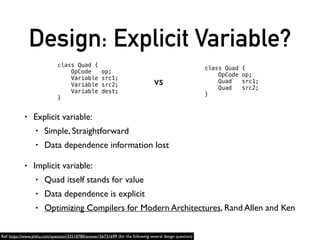
Design: Explicit Variable?
• Explicit variable:
• Simple, Straightforward
• Data dependence information lost
• Implicit variable:
• Quad itself stands for value
• Data dependence is explicit
• Optimizing Compilers for Modern Architectures, Rand Allen and Ken
class Quad {
OpCode op;
Variable src1;
Variable src2;
Variable dest;
}
class Quad {
OpCode op;
Quad src1;
Quad src2;
}
vs
Ref: https://www.zhihu.com/question/33518780/answer/56731699 (for the following several design question)
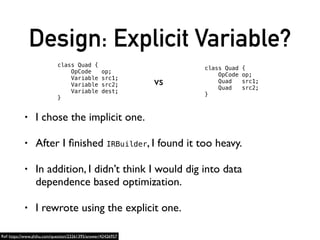
Design: Explicit Variable?
• I chose the implicit one.
• After I finished IRBuilder, I found it too heavy.
• In addition, I didn’t think I would dig into data
dependence based optimization.
• I rewrote using the explicit one.
class Quad {
OpCode op;
Variable src1;
Variable src2;
Variable dest;
}
class Quad {
OpCode op;
Quad src1;
Quad src2;
}
vs
Ref: https://www.zhihu.com/question/23261395/answer/42426957
Design:
Handwritten vs List<T>
• List<T>
• No need to write by yourself
• Hard to insert / remove / iterate
• Cannot modify while iterating
• Handwritten linked list
• Should not be a problem for a former OIer / present CS
student
• Transforms make modifications to IR so often!You’ll regret
it if you are lazy when building IR.
Design: Structure
• Tree (the Tiger Book)
• Linear (the Dragon Book)
• Control Flow Graph
• Nodes are basic blocks
• Linear inside each node (or DAG if explicit data
dependence)
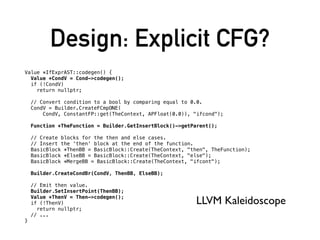
Design: Explicit CFG?
• Implicit CFG:
• Build up linear IR, with class Label { String name; … }
• Jump target is a label
• Scan IR and build CFG
• Explicit CFG:
• Construct CFG while building IR
• Jump target is class BasicBlock { Quad head; … }
• Fall-through is not permitted
• I preferred the second one. It seemed clearer for me. (I can’t understand
what the Tiger Book says.) I’m also influenced by the LLVM Kaleidoscope.
Ref: http://llvm.org/docs/tutorial/LangImpl5.html
Design: Explicit CFG?
Value *IfExprAST::codegen() {
Value *CondV = Cond->codegen();
if (!CondV)
return nullptr;
// Convert condition to a bool by comparing equal to 0.0.
CondV = Builder.CreateFCmpONE(
CondV, ConstantFP::get(TheContext, APFloat(0.0)), "ifcond");
Function *TheFunction = Builder.GetInsertBlock()->getParent();
// Create blocks for the then and else cases.
// Insert the 'then' block at the end of the function.
BasicBlock *ThenBB = BasicBlock::Create(TheContext, "then", TheFunction);
BasicBlock *ElseBB = BasicBlock::Create(TheContext, "else");
BasicBlock *MergeBB = BasicBlock::Create(TheContext, "ifcont");
Builder.CreateCondBr(CondV, ThenBB, ElseBB);
// Emit then value.
Builder.SetInsertPoint(ThenBB);
Value *ThenV = Then->codegen();
if (!ThenV)
return nullptr;
// ...
}
LLVM Kaleidoscope
Design: Explicit CFG?
@Override

public void visit(IfStmt node) {

BasicBlock BBTrue = new BasicBlock(curFunction, "if_true");

BasicBlock BBFalse = node.otherwise != null ? new BasicBlock(curFunction, "if_false") : null;

BasicBlock BBMerge = new BasicBlock(curFunction, "if_merge");


// branch instruction should be added by logical expression

node.cond.ifTrue = BBTrue;

node.cond.ifFalse = node.otherwise != null ? BBFalse : BBMerge;

visit(node.cond);


// generate then

curBB = BBTrue;

visit(node.then);

if (!curBB.isEnded()) curBB.end(new Jump(curBB, BBMerge));


// generate else

if (node.otherwise != null) {

curBB = BBFalse;

visit(node.otherwise);

}

if (BBFalse != null && !curBB.isEnded()) curBB.end(new Jump(curBB, BBMerge));


// merge

curBB = BBMerge;

}
My Compiler
I believe this is much more
easy to understand than the
Tiger Book’s solution
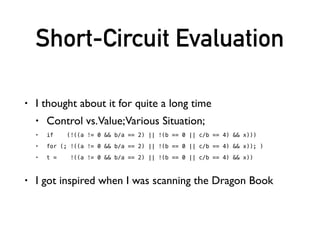
Short-Circuit Evaluation
• I thought about it for quite a long time
• Control vs.Value
• Various Situation
• if (!((a != 0 && b/a == 2) || !(b == 0 || c/b == 4) && x)))
• for (; !((a != 0 && b/a == 2) || !(b == 0 || c/b == 4) && x)); )
• t = !((a != 0 && b/a == 2) || !(b == 0 || c/b == 4) && x))
• I got inspired when I was riffling through the Dragon
Book
Short-Circuit Evaluation
• Push down information!
• If implemented correctly, this should be efficient!
• I have never struggled with Testcase expr
B -> B1 || B2 B1.ifTrue = B.ifTrue
B1.ifFalse = new BasicBlock(“lhsFalse”)
B2.ifTrue = B.ifTrue
B2.ifFalse = B.ifFalse
B -> !B1 B1.ifTrue = B.ifFalse
B1.ifFalse = B.ifTrue
S -> if (B) S1 B.ifTrue = new BasicBlock(“ifTrue”)
else S2 B.ifFalse = new BasicBlock(“ifFalse”)
Design: Memory Model?
• Memory-to-Memory
• Reg Alloc:What should be keep in registers?
• Register-to-Register:
• The target machine is MIPS, why not?
• Unlimited virtual register
• Easy to understand
• Reg Alloc:What should be spilled to memory?
Design: Stack, Heap?
• Since unlimited virtual register, keep most of things in
virtual register.
• For stack space, use class StackSlot { … }, which will be
replaced by $sp offset in TargetIRTransformer.
• For heap space, use class HeapAllocate { int size; … },
which will be replaced by MIPS system call sbrk in
RegisterInformationInjector.
• No explicit class FrameManager { … } or something
Design: Function?
• Should the “function” and “function call” concept
present in IR?
• I strongly support it
• Simplify things
• Function call doesn’t split basic block
• In optimization’s language,“global” means inside a
function, not the whole program.
• (Influenced by LLVM)
Debugging
• I printed my IR in LLVM’s format and run
• Painful!
• No direct memory arithmetic!
• I wrote my own interpreter
• https://github.com/abcdabcd987/LLIRInterpreter
• Life is much more easier!
LLIRInterpreterfunc main {
%main.entry:
$n.1 = move 10
$f0.1 = move 0
$f1.1 = move 1
$i.1 = move 1
jump %for_cond
%for_cond:
$f2.1 = phi %for_step $f2.2 %main.entry undef
$f1.2 = phi %for_step $f1.3 %main.entry $f1.1
$i.2 = phi %for_step $i.3 %main.entry $i.1
$f0.2 = phi %for_step $f0.3 %main.entry $f0.1
$t.1 = slt $i.2 $n.1
br $t.1 %for_loop %for_after
%for_loop:
$t_2.1 = add $f0.2 $f1.2
$f2.2 = move $t_2.1
$f0.3 = move $f1.2
$f1.3 = move $f2.2
jump %for_step
%for_step:
$i.3 = add $i.2 1
jump %for_cond
%for_after:
ret $f2.2
}
Calculate Fibonacci[n]
Global Variable
Global Variable
• Global variables are escaped variable
• They must be kept in memory
Initialization
• Int / String:
• store in .data segment
• Struct / Array:
• store pointer in .data segment
• do initialization before entering main
Read
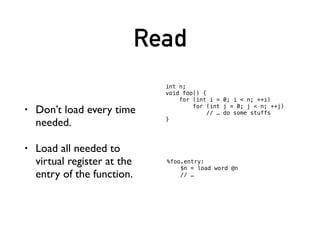
• Don’t load every time
needed.
• Load all needed to
virtual register at the
entry of the function.
int n;
void foo() {
for (int i = 0; i < n; ++i)
for (int j = 0; j < n; ++j)
// … do some stuffs
}
%foo.entry:
$n = load word @n
// …
Write
• Postpone until
• function call
• function exit
%foo.entry:
$n = load word @n
$n = add $n $n
store word @n $n
$t = add $n 1
store word @n $n
call bar
$n = move $t
store word @n $n
$n = mul $n 2
store word @n $n
$t = add $n 1
store word @n $n
ret
Single Static
Assignment Form
Why SSA?
• Single assignment: single def; clearer def-use chain;
• Simplify and strengthen analysis and transforms
Ref: Chapter 2.1,The SSABook
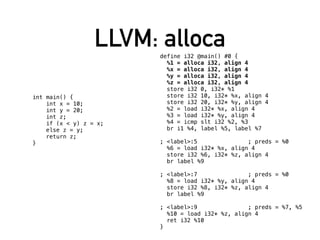
LLVM: allocadefine i32 @main() #0 {
%1 = alloca i32, align 4
%x = alloca i32, align 4
%y = alloca i32, align 4
%z = alloca i32, align 4
store i32 0, i32* %1
store i32 10, i32* %x, align 4
store i32 20, i32* %y, align 4
%2 = load i32* %x, align 4
%3 = load i32* %y, align 4
%4 = icmp slt i32 %2, %3
br i1 %4, label %5, label %7
; <label>:5 ; preds = %0
%6 = load i32* %x, align 4
store i32 %6, i32* %z, align 4
br label %9
; <label>:7 ; preds = %0
%8 = load i32* %y, align 4
store i32 %8, i32* %z, align 4
br label %9
; <label>:9 ; preds = %7, %5
%10 = load i32* %z, align 4
ret i32 %10
}
int main() {
int x = 10;
int y = 20;
int z;
if (x < y) z = x;
else z = y;
return z;
}
LLVM: alloca
• alloca: get space from
stack, return pointer
• store: initial value
• load: load to virtual reg
• This is not actually in SSA
form.
define i32 @main() #0 {
%1 = alloca i32, align 4
%x = alloca i32, align 4
%y = alloca i32, align 4
%z = alloca i32, align 4
store i32 0, i32* %1
store i32 10, i32* %x, align 4
store i32 20, i32* %y, align 4
%2 = load i32* %x, align 4
%3 = load i32* %y, align 4
%4 = icmp slt i32 %2, %3
br i1 %4, label %5, label %7
; <label>:5 ; preds = %0
%6 = load i32* %x, align 4
store i32 %6, i32* %z, align 4
br label %9
; <label>:7 ; preds = %0
%8 = load i32* %y, align 4
store i32 %8, i32* %z, align 4
br label %9
; <label>:9 ; preds = %7, %5
%10 = load i32* %z, align 4
ret i32 %10
}
LLVM: mem2reg Pass
• LLVM goes into SSA after
mem2reg pass
• alloca/load/store are replaced
define i32 @main() #0 {
%1 = icmp slt i32 10, 20
br i1 %1, label %2, label %3
; <label>:2 ; preds = %0
br label %4
; <label>:3 ; preds = %0
br label %4
; <label>:4 ; preds = %3, %2
%z.0 = phi i32 [ 10, %2 ], [ 20, %3 ]
ret i32 %z.0
}
define i32 @main() #0 {
%1 = alloca i32, align 4
%x = alloca i32, align 4
%y = alloca i32, align 4
%z = alloca i32, align 4
store i32 0, i32* %1
store i32 10, i32* %x, align 4
store i32 20, i32* %y, align 4
%2 = load i32* %x, align 4
%3 = load i32* %y, align 4
%4 = icmp slt i32 %2, %3
br i1 %4, label %5, label %7
; <label>:5 ; preds = %0
%6 = load i32* %x, align 4
store i32 %6, i32* %z, align 4
br label %9
; <label>:7 ; preds = %0
%8 = load i32* %y, align 4
store i32 %8, i32* %z, align 4
br label %9
; <label>:9 ; preds = %7, %5
%10 = load i32* %z, align 4
ret i32 %10
}
LLVM: mem2reg Pass
• alloca/load/store pattern: good for front-end author.
• They don’t need to generate SSA IR
• Variable usage wraps by load/store is quite easy to generate.
• See source code:
• http://llvm.org/docs/doxygen/html/Mem2Reg_8cpp_source.html
• http://llvm.org/docs/doxygen/html/PromoteMemoryToRegister_8cpp_source.html
• Play with LLVM:
• clang -emit-llvm -S tmp.c
• opt -mem2reg -S tmp.ll
Ref: https://www.zhihu.com/question/41999500
LLVM: mem2reg Pass
• I followed LLVM’s alloca/load/store pattern at first
• Few documents & references
• I gave it up and made virtual register writeable
• Then I went on the common road
Dominance Tree/Frontier
• Thomas Lengauer and Robert Endre Tarjan. A fast algorithm for finding
dominators in a flowgraph
• O(mα(m,n))
• EAC gives pseudocode. But I don’t see how to get IDom from Dom set??
• My savior: K.D. Cooper,T. J. Harvey and K.Kennedy. A simple, fast
dominance algorithm
• O(n^2) but usually not that bad
• Run faster than Lengauer-Tarjan’s algorithm (the authors claimed)
• Give pseudocode to calculate IDom set directly
• Iteration ends faster if run in reverse-post-order.
SSA Construction
• EAC gives good explanation and also pseudocode.
• Algorithm 9.9
• Algorithm 9.12
SSA Destruction
• The SSA Book gives good explanation and also pseudocode.
• phi => parallel copy
• Algorithm 3.5: Critical Edge Splitting Algorithm for making non-
conventional SSA form conventional.
• Algorithm 22.6: Parallel copy sequentialization algorithm.
• Also see: Benoit Boissinot,Alain Darte, Fabrice Rastello,
Benoît Dupont de Dinechin, Christophe Guillon. Revisiting Out-
of-SSATranslation for Correctness, Code Quality, and Efficiency.
Some SSA Optimizations
• Strong ones:
• GVN & GCM
• Sparse Conditional Constant Propagation
• …
• However, I only did trivial ones:
• Naive Dead Code Elimination
• Simple Constant Propagation
• To learn from big projects:
• LLVM Scalar Transforms
• QTDeclarative Compiler
• Android Dalvik SSA Transforms
Graph Coloring Reg Alloc
• Interference graph of live-ranges in SSA is chordal graph
• Perfect graph coloring in O(|V|+|E|)
• What about destruction phase?
• Naive trick: keep a register not allocated to break
parallel copy cycle
• Other…
Ref: Chapter 2.4,The SSABook
Linear Scan Reg Alloc
• M. Poletto andV. Sarkar. Linear scan register allocation.
• Simple, straightforward, fast, not so satisfactory result
• Based on life interval
• C.Wimmer and H. Mössenböck. Optimized interval splitting in a linear
scan register allocator.
• Add holes to interval, much better result (~75% graph coloring)
• No concrete tutorial for interval building and resolving phase
• C.Wimmer and M. Franz. Linear Scan Register Allocation on SSA Form.
• Pseudocode for interval building on SSA and SSA resolving
• The order of basic block still have huge influence on result
PS: I saw the last paper on http://c9x.me/compile/bib/, and then found the other two from its references
Linear Scan Reg Alloc
• I was following these papers at first (regalloc_on_ssa branch)
• Then, I found that block order matters.
• Basic Block Reschedule
• Loop Detection
• …
• So, I gave up again. Back to graph coloring in non-SSA
• BTW, QTDeclarative implemented these papers
• https://github.com/qtproject/qtdeclarative/blob/dev/src/qml/compiler/qv4ssa.cpp
PS: I searched “TryAllocateFreeReg” on Github and found QTDeclarative
Optimization
(Analysis & Transforms)
SSA
• Without strong optimization, the result is quite disappointing.
• Negative result sometimes shows up.
• -7% ~ +16%
bulgarian heapsort horse horse2 horse3 magic
Limit 1500000 20000000 25000000 15000000 25000000 2000000
Original 793272 8710389 13373269 9470959 15216222 1549065
Original % 52.88% 43.55% 53.49% 63.14% 60.86% 77.45%
SSA 818151 8541923 12217366 7203394 14099845 1549394
+DCE 775052 8756811 11726688 7114878 14586323 1531605
+SCP+DCE 737866 8237036 11897680 7122020 13973512 1473229
Optimized % 49.19% 41.19% 47.59% 47.48% 55.89% 73.66%
Function Inlining
• Highly Effective! up to ~ 40% improvement
• Can be extended to recursion unrolling.
hashmap horse horse3
Limit 550000 25000000 25000000
Original 248263 11911209 14027651
Original % 45.14% 47.64% 56.11%
Optimized 171953 3914219 4642421
Optimized % 31.26% 15.66% 18.57%
Optimization
(Code Generation)
Self Move
• move $reg, $reg
• cooperate with register allocation
• help to remove some moves caused by SSA destruction
• 1% ~ 2% overall improvement
Print / Println
• Reasonable and highly effective! up to ~50% improvement
• print(str1 + str2) => print(str1); print(str2);
• print(toString(ival)) => printInt(ival);
• Rewrite recursively when building IR
bulgarian hanoi hashmap spill2
Limit 1500000 450000 550000 100000
Original 1403790 401672 630450
Can’t Load
Original % 93.59% 89.26% 114.63%
Optimized 798373 73196 306164 18966
Optimized % 53.22% 16.27% 55.67% 18.97%
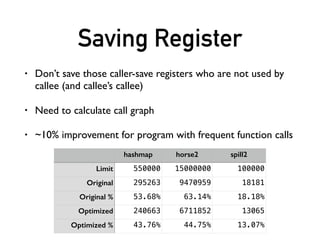
Saving Register
• Don’t save those caller-save registers who are not used by
callee (and callee’s callee)
• Need to calculate call graph
• ~10% improvement for program with frequent function calls
hashmap horse2 spill2
Limit 550000 15000000 100000
Original 295263 9470959 18181
Original % 53.68% 63.14% 18.18%
Optimized 240663 6711852 13065
Optimized % 43.76% 44.75% 13.07%
Code Generation
Register Allocation
• I had many questions about register allocation.
• If I want to do allocation on SSA form, should I use a IR
which is almost the same as the target? Remove
“function” concept; Use “jal” instead of “call”; Calculate
frame and stack address… If so,
• “Global” will mean the whole program! SLOW!
• A basic block will be spilt by “jal”
• New phi nodes will be inserted
• What about system call, which force pass value to $v0?
Register Allocation
• “Global” is definitely “function”.Always do allocation
within function or even smaller parts.
• Register allocation can be performed on SSA form or
out of SSA form
• Android runtime (ART) optimizing compiler do
allocation on SSA HIR
See: https://android.googlesource.com/platform/art/+/master/compiler/optimizing/register_allocator.cc
Register Allocation
• Register allocator should know ABI convention and target
machine constraint.
• HIR is okay.As long as it contains knowledge that allocator
should know
• general / float point register
• def / kill
• specified register
• …
• However, since it is HIGH LEVEL IR, how can it contain so much
information?
Register Allocation
• After high level transforms and before register allocation,
inject ABI & target register information
• After register allocation, transform IR to meet target
constraint
• In short, modify IR and insert information!
• pre-alloc
• post-alloc
Code Generation
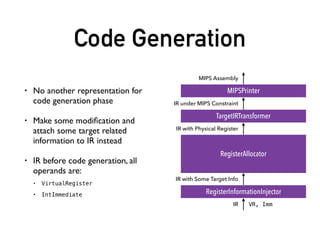
• No another representation for
code generation phase
• Make some modification and
attach some target related
information to IR instead
• IR before code generation, all
operands are:
• VirtualRegister
• IntImmediate
MIPSPrinter
TargetIRTransformer
RegisterInformationInjector
MIPS Assembly
IR under MIPS Constraint
IR with Physical Register
IR with Some Target Info
IR
RegisterAllocator
VR, Imm
Code Generation
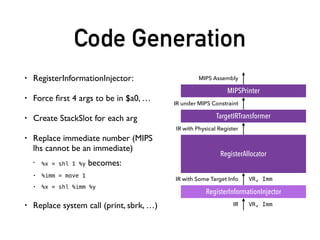
• RegisterInformationInjector:
• Force first 4 args to be in $a0, …
• Create StackSlot for each arg
• Replace immediate number (MIPS
lhs cannot be an immediate)
• %x = shl 1 %y becomes:
• %imm = move 1
• %x = shl %imm %y
• Replace system call (print, sbrk, …)
MIPSPrinter
TargetIRTransformer
RegisterInformationInjector
MIPS Assembly
IR under MIPS Constraint
IR with Physical Register
IR with Some Target Info
IR
RegisterAllocator
VR, Imm
VR, Imm
Code Generation
• RegisterAllocator:
• StupidAllocator
• Don’t allocate at all (used to ensure
correctness)
• LocalBottomUpAllocator
• GraphColoringAllocator
• RewriteVirtualRegister to either
• PhysicalRegister for lucky ones
• StackSlot for spilled ones
MIPSPrinter
TargetIRTransformer
RegisterInformationInjector
MIPS Assembly
IR under MIPS Constraint
IR with Physical Register
IR with Some Target Info
IR
RegisterAllocator
VR, Imm
VR, Imm
PR, SS, Imm
Code Generation
• TargetIRTransformer:
• Calculate stack frame
• Backup/Restore registers when
function entry and exit
• Replace function call
• Replace StackSlot ($sp + offset)
• Remove self move
MIPSPrinter
TargetIRTransformer
RegisterInformationInjector
MIPS Assembly
IR under MIPS Constraint
IR with Physical Register
IR with Some Target Info
IR
RegisterAllocator
VR, Imm
VR, Imm
PR, SS, Imm
PR, Imm
Code Generation
• MIPSPrinter:
• Print IR in MIPS assembly format
• Nothing special
MIPSPrinter
TargetIRTransformer
RegisterInformationInjector
MIPS Assembly
IR under MIPS Constraint
IR with Physical Register
IR with Some Target Info
IR
RegisterAllocator
VR, Imm
VR, Imm
PR, SS, Imm
PR, Imm
Graph Coloring Reg Alloc
• G. J. Chaitin. Register Allocation & Spilling via Graph Coloring
• P. Briggs. Register Allocation via Graph Coloring
• Allow forced allocation ($a0, …)
• Allow preferred allocation (%x = move %y)
• Don’t want to rebuild again after spilling?
• Trick: Keep 2 registers not allocated to load StackSlot
Builtin Function
Builtin Function
• There are two levels of builtin functions, I suppose
• Source Language Level (strcmp, …)
• Can be written in the source language.
• Cross platform & Benefit from optimizer
• Can also be written in the target assembly
• Sometimes handwritten ones are more efficient
• Target Machine Level (sbrk, print, syscall, …)
• Can only be written in the target assembly
• I have no good idea to handle builtin functions elegantly.
Unit Test
Unit Test
• Unit test is necessary for a project
• If your code quality is good, you’ll be able to write tests
easily and deeply
• If your project is protected by much tests, you’ll be able
to debug / refactor / write new code / etc. without fear
• I recommended classmates to do unit test in several
forum posts
LLVM: “use”
Data Structure
LLVM: Pass Manager
Thanks to
Books
• EAC: Engineering a Compiler, 2nd Edition
• This is really an awesome one!You’ll need it when writing
every phase!
• Tiger: Modern Compiler Implementation in Java
• Dragon: Compilers: Principles,Techniques, and Tools
• LIP: Language Implementation Patterns: CreateYour Own
Domain-Specific and General Programming Languages
• ANTLR4:The Definitive ANTLR 4 Reference
People & Projects
• @RednaxelaFX
• who wrote many answers and articles about compilers/VM on ZhiHu
and his blog
• and answered my questions patiently
• Upperclassmen:Yaoda Zhou, Junru Shao, Jian Weng
• LLVM
• QBE: http://c9x.me/compile/
• a modern compiler backend of small size
• maybe bad coding habit (no doc, too short variable name)
• but worth looking at what it’ve done, its ideas and bibliography

Compiler2016 by abcdabcd987

  • 1.
    Compiler 2016 What Ilearnt & What I implemented during the period of the compiler course Lequn Chen (abcdabcd987) May 2016 https://github.com/abcdabcd987/compiler2016
  • 2.
  • 3.
    Compiler • Modularization • Lowcoupling • Multiple passes • Back-end is much harder than front-end
  • 4.
    ASTBuilder MIPSPrinter TargetIRTransformer RegisterInformationInjector ANTLR4 CST AST ASTwith Symbol Info IR MIPS Assembly IR under MIPS Constraint IR with Physical Register IR with Some Target Info IR IR SemanticChecker IRBuilder IRTransformer SSATransformer RegisterAllocator
  • 5.
  • 6.
    Package Hierarchy • FrontEnd:CST/AST related transforms • BackEnd: IR and backend related transforms • MIPS: MIPS related transforms • AST: Data structures that hold AST • IR: Data structures that hold IR • Symbol: Data structures that hold symbol table • Parser: ANTLR4 Generated Lexer/Parser
  • 7.
  • 8.
    A Powerful Tool •I wrote 2 articles about it • https://abcdabcd987.com/notes-on-antlr4/ • https://abcdabcd987.com/using-antlr4/ • Reference: • The Definitive ANTLR 4 Reference
  • 9.
    Official Examples • https://github.com/antlr/grammars-v4 •See how to write grammars • Copy & Paste common parts (lexer fragments…) • These two helped me a lot: • https://github.com/antlr/grammars-v4/blob/master/c/C.g4 • https://github.com/antlr/grammars-v4/blob/master/java/Java.g4
  • 10.
    Deal with Expression expression :expression op=('++' | '--') # PostfixIncDec // Precedence 1 | expression '(' parameterList? ')' # FunctionCall | expression '[' expression ']' # Subscript | expression '.' Identifier # MemberAccess | <assoc=right> op=('++'|'--') expression # UnaryExpr // Precedence 2 | <assoc=right> op=('+' | '-') expression # UnaryExpr | <assoc=right> op=('!' | '~') expression # UnaryExpr | <assoc=right> 'new' creator # New | expression op=('*' | '/' | '%') expression # BinaryExpr // Precedence 3 | expression op=('+' | '-') expression # BinaryExpr // Precedence 4 | expression op=('<<'|'>>') expression # BinaryExpr // Precedence 5 | expression op=('<' | '>') expression # BinaryExpr // Precedence 6 | expression op=('<='|'>=') expression # BinaryExpr | expression op=('=='|'!=') expression # BinaryExpr // Precedence 7 | expression op='&' expression # BinaryExpr // Precedence 8 | expression op='^' expression # BinaryExpr // Precedence 9 | expression op='|' expression # BinaryExpr // Precedence 10 | expression op='&&' expression # BinaryExpr // Precedence 11 | expression op='||' expression # BinaryExpr // Precedence 12 | <assoc=right> expression op='=' expression # BinaryExpr // Precedence 14 | Identifier # Identifier | constant # Literal | '(' expression ')' # SubExpression ; //------ Reference: http://en.cppreference.com/w/cpp/language/operator_precedence
  • 11.
    Deal with Expression @Override publicvoid exitBinaryExpr(MillParser.BinaryExprContext ctx) { BinaryExpr.BinaryOp op; switch (ctx.op.getType()) { case MillParser.Star: op = BinaryExpr.BinaryOp.MUL; break; case MillParser.Div: op = BinaryExpr.BinaryOp.DIV; break; case MillParser.Mod: op = BinaryExpr.BinaryOp.MOD; break; case MillParser.Plus: op = BinaryExpr.BinaryOp.ADD; break; ...... case MillParser.And: op = BinaryExpr.BinaryOp.BITWISE_AND; break; case MillParser.Caret: op = BinaryExpr.BinaryOp.XOR; break; case MillParser.Or: op = BinaryExpr.BinaryOp.BITWISE_OR; break; case MillParser.AndAnd: op = BinaryExpr.BinaryOp.LOGICAL_AND; break; case MillParser.OrOr: op = BinaryExpr.BinaryOp.LOGICAL_OR; break; case MillParser.Assign: op = BinaryExpr.BinaryOp.ASSIGN; break; default: throw new RuntimeException("Unknown binary operator."); } map.put(ctx, new BinaryExpr( op, (Expr)map.get(ctx.expression(0)), (Expr)map.get(ctx.expression(1)), new SourcePosition(ctx.op), new SourcePosition(ctx.expression(0)), new SourcePosition(ctx.expression(1)) )); }
  • 12.
  • 13.
    AST Hierarchy • (nothingspecial) • Build via ANTLR4 ParseTreeListener • Access via IASTVisitor
  • 14.
    Semantic Check • Donein 3 passes (since need to look afterward) • StructSymbolScanner • Scan class name • StructFunctionDeclarator • Scan function signature • SemanticChecker • Build symbol table • Semantic Check
  • 15.
  • 16.
    Symbol Table • Somegood designs to refer to • Terence Parr. Language Implementation Patterns: Create Your Own Domain-Specific and General Programming Languages. • Chapter 6 • Chapter 7
  • 17.
  • 18.
    What’s IR? define i32@arith(i32 %x, i32 %y, i32 %z) #0 { entry: %add = add nsw i32 %y, %x %mul = mul nsw i32 %z, 48 %and = and i32 %add, 65535 %mul1 = mul nsw i32 %mul, %and ret i32 %mul1 } class BinaryOperation { … } class Load { … } … myprog.bc 01010010101010101000100100001010110… Is this IR? Is this IR? Is this IR?
  • 19.
    What’s IR? define i32@arith(i32 %x, i32 %y, i32 %z) #0 { entry: %add = add nsw i32 %y, %x %mul = mul nsw i32 %z, 48 %and = and i32 %add, 65535 %mul1 = mul nsw i32 %mul, %and ret i32 %mul1 } class BinaryOperation { … } class Load { … } … myprog.bc 01010010101010101000100100001010110… Text Form Data Structures in Memory Binary Form
  • 20.
    What’s IR? • Datastructure in memory (i.e. Java classes) • Of course we need to focus on this • Text form • For debugging… • Needed if IR flows through several different program (for example, run on a virtual machine) • Binary form • (Though “What is IR?” seems a stupid question, it bothered me a lot at first)
  • 21.
    Where to Start? •IR design is closely related to • Source language • Target machine • Transforms / Analysis • Though low coupling, IR designing deserves carefully thinking • I (not my compiler) was much influenced by LLVM
  • 22.
    Type System • ShouldIR contain type information? To what extent? • LLVM • int: i1, i8, i32, i65536, …, iN • pointer: <type> * • array: [3 x [4 x i32]] • structure: { float, i32 (i32) * } • getelementptr • …
  • 23.
    Type System • LLVM:almost keep everything! struct RT { char A; int B[10][20]; char C; }; struct ST { int X; double Y; struct RT Z; }; int *foo(struct ST *s) { return &s[1].Z.B[5][13]; } %struct.RT = type { i8, [10 x [20 x i32]], i8 } %struct.ST = type { i32, double, %struct.RT } define i32* @foo(%struct.ST* %s) { entry: %arrayidx = getelementptr inbounds %struct.ST, %struct.ST* %s, i64 1, i32 2, i32 1, i64 5, i64 13 ret i32* %arrayidx }
  • 24.
    Type System • LLVM •almost keep everything • However, EAC, the Dragon Book and the Tiger Book • They pretend that “Type System? WTF are you talking about?” • It seems that everything is of a general register’s size. • What’s wrong here?
  • 25.
    Multiple Level • Acompiler can use more than one IR, and of course, there are more than one level. • HIR/MIR: Carry more information. May have type system similar to the source language. Higher level analysis & transforms can be performed on. (Alias analysis works better with type knowledge) • point1.x => (LoadField point1 “x”) • LIR: Closer to the target machine. Don’t have much type information (General/FP Reg). Focus on code generation. • point1.x => (LoadMem (Mem baseAddr 4))
  • 26.
    Multiple Level • Acompiler can use more than one IR, and of course, there are more than one level. • LLVM: Low LevelVirtual Machine • Actually, its level is not that low. • And it happens that LLVM use a single representation. • The more information you own, the more possible you have to do analysis and transforms.
  • 27.
    Design: Explicit Variable? •Explicit variable: • Simple, Straightforward • Data dependence information lost • Implicit variable: • Quad itself stands for value • Data dependence is explicit • Optimizing Compilers for Modern Architectures, Rand Allen and Ken class Quad { OpCode op; Variable src1; Variable src2; Variable dest; } class Quad { OpCode op; Quad src1; Quad src2; } vs Ref: https://www.zhihu.com/question/33518780/answer/56731699 (for the following several design question)
  • 28.
    Design: Explicit Variable? •I chose the implicit one. • After I finished IRBuilder, I found it too heavy. • In addition, I didn’t think I would dig into data dependence based optimization. • I rewrote using the explicit one. class Quad { OpCode op; Variable src1; Variable src2; Variable dest; } class Quad { OpCode op; Quad src1; Quad src2; } vs Ref: https://www.zhihu.com/question/23261395/answer/42426957
  • 29.
    Design: Handwritten vs List<T> •List<T> • No need to write by yourself • Hard to insert / remove / iterate • Cannot modify while iterating • Handwritten linked list • Should not be a problem for a former OIer / present CS student • Transforms make modifications to IR so often!You’ll regret it if you are lazy when building IR.
  • 30.
    Design: Structure • Tree(the Tiger Book) • Linear (the Dragon Book) • Control Flow Graph • Nodes are basic blocks • Linear inside each node (or DAG if explicit data dependence)
  • 31.
    Design: Explicit CFG? •Implicit CFG: • Build up linear IR, with class Label { String name; … } • Jump target is a label • Scan IR and build CFG • Explicit CFG: • Construct CFG while building IR • Jump target is class BasicBlock { Quad head; … } • Fall-through is not permitted • I preferred the second one. It seemed clearer for me. (I can’t understand what the Tiger Book says.) I’m also influenced by the LLVM Kaleidoscope. Ref: http://llvm.org/docs/tutorial/LangImpl5.html
  • 32.
    Design: Explicit CFG? Value*IfExprAST::codegen() { Value *CondV = Cond->codegen(); if (!CondV) return nullptr; // Convert condition to a bool by comparing equal to 0.0. CondV = Builder.CreateFCmpONE( CondV, ConstantFP::get(TheContext, APFloat(0.0)), "ifcond"); Function *TheFunction = Builder.GetInsertBlock()->getParent(); // Create blocks for the then and else cases. // Insert the 'then' block at the end of the function. BasicBlock *ThenBB = BasicBlock::Create(TheContext, "then", TheFunction); BasicBlock *ElseBB = BasicBlock::Create(TheContext, "else"); BasicBlock *MergeBB = BasicBlock::Create(TheContext, "ifcont"); Builder.CreateCondBr(CondV, ThenBB, ElseBB); // Emit then value. Builder.SetInsertPoint(ThenBB); Value *ThenV = Then->codegen(); if (!ThenV) return nullptr; // ... } LLVM Kaleidoscope
  • 33.
    Design: Explicit CFG? @Override
 publicvoid visit(IfStmt node) {
 BasicBlock BBTrue = new BasicBlock(curFunction, "if_true");
 BasicBlock BBFalse = node.otherwise != null ? new BasicBlock(curFunction, "if_false") : null;
 BasicBlock BBMerge = new BasicBlock(curFunction, "if_merge");
 
 // branch instruction should be added by logical expression
 node.cond.ifTrue = BBTrue;
 node.cond.ifFalse = node.otherwise != null ? BBFalse : BBMerge;
 visit(node.cond);
 
 // generate then
 curBB = BBTrue;
 visit(node.then);
 if (!curBB.isEnded()) curBB.end(new Jump(curBB, BBMerge));
 
 // generate else
 if (node.otherwise != null) {
 curBB = BBFalse;
 visit(node.otherwise);
 }
 if (BBFalse != null && !curBB.isEnded()) curBB.end(new Jump(curBB, BBMerge));
 
 // merge
 curBB = BBMerge;
 } My Compiler I believe this is much more easy to understand than the Tiger Book’s solution
  • 34.
    Short-Circuit Evaluation • Ithought about it for quite a long time • Control vs.Value • Various Situation • if (!((a != 0 && b/a == 2) || !(b == 0 || c/b == 4) && x))) • for (; !((a != 0 && b/a == 2) || !(b == 0 || c/b == 4) && x)); ) • t = !((a != 0 && b/a == 2) || !(b == 0 || c/b == 4) && x)) • I got inspired when I was riffling through the Dragon Book
  • 35.
    Short-Circuit Evaluation • Pushdown information! • If implemented correctly, this should be efficient! • I have never struggled with Testcase expr B -> B1 || B2 B1.ifTrue = B.ifTrue B1.ifFalse = new BasicBlock(“lhsFalse”) B2.ifTrue = B.ifTrue B2.ifFalse = B.ifFalse B -> !B1 B1.ifTrue = B.ifFalse B1.ifFalse = B.ifTrue S -> if (B) S1 B.ifTrue = new BasicBlock(“ifTrue”) else S2 B.ifFalse = new BasicBlock(“ifFalse”)
  • 36.
    Design: Memory Model? •Memory-to-Memory • Reg Alloc:What should be keep in registers? • Register-to-Register: • The target machine is MIPS, why not? • Unlimited virtual register • Easy to understand • Reg Alloc:What should be spilled to memory?
  • 37.
    Design: Stack, Heap? •Since unlimited virtual register, keep most of things in virtual register. • For stack space, use class StackSlot { … }, which will be replaced by $sp offset in TargetIRTransformer. • For heap space, use class HeapAllocate { int size; … }, which will be replaced by MIPS system call sbrk in RegisterInformationInjector. • No explicit class FrameManager { … } or something
  • 38.
    Design: Function? • Shouldthe “function” and “function call” concept present in IR? • I strongly support it • Simplify things • Function call doesn’t split basic block • In optimization’s language,“global” means inside a function, not the whole program. • (Influenced by LLVM)
  • 39.
    Debugging • I printedmy IR in LLVM’s format and run • Painful! • No direct memory arithmetic! • I wrote my own interpreter • https://github.com/abcdabcd987/LLIRInterpreter • Life is much more easier!
  • 40.
    LLIRInterpreterfunc main { %main.entry: $n.1= move 10 $f0.1 = move 0 $f1.1 = move 1 $i.1 = move 1 jump %for_cond %for_cond: $f2.1 = phi %for_step $f2.2 %main.entry undef $f1.2 = phi %for_step $f1.3 %main.entry $f1.1 $i.2 = phi %for_step $i.3 %main.entry $i.1 $f0.2 = phi %for_step $f0.3 %main.entry $f0.1 $t.1 = slt $i.2 $n.1 br $t.1 %for_loop %for_after %for_loop: $t_2.1 = add $f0.2 $f1.2 $f2.2 = move $t_2.1 $f0.3 = move $f1.2 $f1.3 = move $f2.2 jump %for_step %for_step: $i.3 = add $i.2 1 jump %for_cond %for_after: ret $f2.2 } Calculate Fibonacci[n]
  • 41.
  • 42.
    Global Variable • Globalvariables are escaped variable • They must be kept in memory
  • 43.
    Initialization • Int /String: • store in .data segment • Struct / Array: • store pointer in .data segment • do initialization before entering main
  • 44.
    Read • Don’t loadevery time needed. • Load all needed to virtual register at the entry of the function. int n; void foo() { for (int i = 0; i < n; ++i) for (int j = 0; j < n; ++j) // … do some stuffs } %foo.entry: $n = load word @n // …
  • 45.
    Write • Postpone until •function call • function exit %foo.entry: $n = load word @n $n = add $n $n store word @n $n $t = add $n 1 store word @n $n call bar $n = move $t store word @n $n $n = mul $n 2 store word @n $n $t = add $n 1 store word @n $n ret
  • 46.
  • 47.
    Why SSA? • Singleassignment: single def; clearer def-use chain; • Simplify and strengthen analysis and transforms Ref: Chapter 2.1,The SSABook
  • 48.
    LLVM: allocadefine i32@main() #0 { %1 = alloca i32, align 4 %x = alloca i32, align 4 %y = alloca i32, align 4 %z = alloca i32, align 4 store i32 0, i32* %1 store i32 10, i32* %x, align 4 store i32 20, i32* %y, align 4 %2 = load i32* %x, align 4 %3 = load i32* %y, align 4 %4 = icmp slt i32 %2, %3 br i1 %4, label %5, label %7 ; <label>:5 ; preds = %0 %6 = load i32* %x, align 4 store i32 %6, i32* %z, align 4 br label %9 ; <label>:7 ; preds = %0 %8 = load i32* %y, align 4 store i32 %8, i32* %z, align 4 br label %9 ; <label>:9 ; preds = %7, %5 %10 = load i32* %z, align 4 ret i32 %10 } int main() { int x = 10; int y = 20; int z; if (x < y) z = x; else z = y; return z; }
  • 49.
    LLVM: alloca • alloca:get space from stack, return pointer • store: initial value • load: load to virtual reg • This is not actually in SSA form. define i32 @main() #0 { %1 = alloca i32, align 4 %x = alloca i32, align 4 %y = alloca i32, align 4 %z = alloca i32, align 4 store i32 0, i32* %1 store i32 10, i32* %x, align 4 store i32 20, i32* %y, align 4 %2 = load i32* %x, align 4 %3 = load i32* %y, align 4 %4 = icmp slt i32 %2, %3 br i1 %4, label %5, label %7 ; <label>:5 ; preds = %0 %6 = load i32* %x, align 4 store i32 %6, i32* %z, align 4 br label %9 ; <label>:7 ; preds = %0 %8 = load i32* %y, align 4 store i32 %8, i32* %z, align 4 br label %9 ; <label>:9 ; preds = %7, %5 %10 = load i32* %z, align 4 ret i32 %10 }
  • 50.
    LLVM: mem2reg Pass •LLVM goes into SSA after mem2reg pass • alloca/load/store are replaced define i32 @main() #0 { %1 = icmp slt i32 10, 20 br i1 %1, label %2, label %3 ; <label>:2 ; preds = %0 br label %4 ; <label>:3 ; preds = %0 br label %4 ; <label>:4 ; preds = %3, %2 %z.0 = phi i32 [ 10, %2 ], [ 20, %3 ] ret i32 %z.0 } define i32 @main() #0 { %1 = alloca i32, align 4 %x = alloca i32, align 4 %y = alloca i32, align 4 %z = alloca i32, align 4 store i32 0, i32* %1 store i32 10, i32* %x, align 4 store i32 20, i32* %y, align 4 %2 = load i32* %x, align 4 %3 = load i32* %y, align 4 %4 = icmp slt i32 %2, %3 br i1 %4, label %5, label %7 ; <label>:5 ; preds = %0 %6 = load i32* %x, align 4 store i32 %6, i32* %z, align 4 br label %9 ; <label>:7 ; preds = %0 %8 = load i32* %y, align 4 store i32 %8, i32* %z, align 4 br label %9 ; <label>:9 ; preds = %7, %5 %10 = load i32* %z, align 4 ret i32 %10 }
  • 51.
    LLVM: mem2reg Pass •alloca/load/store pattern: good for front-end author. • They don’t need to generate SSA IR • Variable usage wraps by load/store is quite easy to generate. • See source code: • http://llvm.org/docs/doxygen/html/Mem2Reg_8cpp_source.html • http://llvm.org/docs/doxygen/html/PromoteMemoryToRegister_8cpp_source.html • Play with LLVM: • clang -emit-llvm -S tmp.c • opt -mem2reg -S tmp.ll Ref: https://www.zhihu.com/question/41999500
  • 52.
    LLVM: mem2reg Pass •I followed LLVM’s alloca/load/store pattern at first • Few documents & references • I gave it up and made virtual register writeable • Then I went on the common road
  • 53.
    Dominance Tree/Frontier • ThomasLengauer and Robert Endre Tarjan. A fast algorithm for finding dominators in a flowgraph • O(mα(m,n)) • EAC gives pseudocode. But I don’t see how to get IDom from Dom set?? • My savior: K.D. Cooper,T. J. Harvey and K.Kennedy. A simple, fast dominance algorithm • O(n^2) but usually not that bad • Run faster than Lengauer-Tarjan’s algorithm (the authors claimed) • Give pseudocode to calculate IDom set directly • Iteration ends faster if run in reverse-post-order.
  • 54.
    SSA Construction • EACgives good explanation and also pseudocode. • Algorithm 9.9 • Algorithm 9.12
  • 55.
    SSA Destruction • TheSSA Book gives good explanation and also pseudocode. • phi => parallel copy • Algorithm 3.5: Critical Edge Splitting Algorithm for making non- conventional SSA form conventional. • Algorithm 22.6: Parallel copy sequentialization algorithm. • Also see: Benoit Boissinot,Alain Darte, Fabrice Rastello, Benoît Dupont de Dinechin, Christophe Guillon. Revisiting Out- of-SSATranslation for Correctness, Code Quality, and Efficiency.
  • 56.
    Some SSA Optimizations •Strong ones: • GVN & GCM • Sparse Conditional Constant Propagation • … • However, I only did trivial ones: • Naive Dead Code Elimination • Simple Constant Propagation • To learn from big projects: • LLVM Scalar Transforms • QTDeclarative Compiler • Android Dalvik SSA Transforms
  • 57.
    Graph Coloring RegAlloc • Interference graph of live-ranges in SSA is chordal graph • Perfect graph coloring in O(|V|+|E|) • What about destruction phase? • Naive trick: keep a register not allocated to break parallel copy cycle • Other… Ref: Chapter 2.4,The SSABook
  • 58.
    Linear Scan RegAlloc • M. Poletto andV. Sarkar. Linear scan register allocation. • Simple, straightforward, fast, not so satisfactory result • Based on life interval • C.Wimmer and H. Mössenböck. Optimized interval splitting in a linear scan register allocator. • Add holes to interval, much better result (~75% graph coloring) • No concrete tutorial for interval building and resolving phase • C.Wimmer and M. Franz. Linear Scan Register Allocation on SSA Form. • Pseudocode for interval building on SSA and SSA resolving • The order of basic block still have huge influence on result PS: I saw the last paper on http://c9x.me/compile/bib/, and then found the other two from its references
  • 59.
    Linear Scan RegAlloc • I was following these papers at first (regalloc_on_ssa branch) • Then, I found that block order matters. • Basic Block Reschedule • Loop Detection • … • So, I gave up again. Back to graph coloring in non-SSA • BTW, QTDeclarative implemented these papers • https://github.com/qtproject/qtdeclarative/blob/dev/src/qml/compiler/qv4ssa.cpp PS: I searched “TryAllocateFreeReg” on Github and found QTDeclarative
  • 60.
  • 61.
    SSA • Without strongoptimization, the result is quite disappointing. • Negative result sometimes shows up. • -7% ~ +16% bulgarian heapsort horse horse2 horse3 magic Limit 1500000 20000000 25000000 15000000 25000000 2000000 Original 793272 8710389 13373269 9470959 15216222 1549065 Original % 52.88% 43.55% 53.49% 63.14% 60.86% 77.45% SSA 818151 8541923 12217366 7203394 14099845 1549394 +DCE 775052 8756811 11726688 7114878 14586323 1531605 +SCP+DCE 737866 8237036 11897680 7122020 13973512 1473229 Optimized % 49.19% 41.19% 47.59% 47.48% 55.89% 73.66%
  • 62.
    Function Inlining • HighlyEffective! up to ~ 40% improvement • Can be extended to recursion unrolling. hashmap horse horse3 Limit 550000 25000000 25000000 Original 248263 11911209 14027651 Original % 45.14% 47.64% 56.11% Optimized 171953 3914219 4642421 Optimized % 31.26% 15.66% 18.57%
  • 63.
  • 64.
    Self Move • move$reg, $reg • cooperate with register allocation • help to remove some moves caused by SSA destruction • 1% ~ 2% overall improvement
  • 65.
    Print / Println •Reasonable and highly effective! up to ~50% improvement • print(str1 + str2) => print(str1); print(str2); • print(toString(ival)) => printInt(ival); • Rewrite recursively when building IR bulgarian hanoi hashmap spill2 Limit 1500000 450000 550000 100000 Original 1403790 401672 630450 Can’t Load Original % 93.59% 89.26% 114.63% Optimized 798373 73196 306164 18966 Optimized % 53.22% 16.27% 55.67% 18.97%
  • 66.
    Saving Register • Don’tsave those caller-save registers who are not used by callee (and callee’s callee) • Need to calculate call graph • ~10% improvement for program with frequent function calls hashmap horse2 spill2 Limit 550000 15000000 100000 Original 295263 9470959 18181 Original % 53.68% 63.14% 18.18% Optimized 240663 6711852 13065 Optimized % 43.76% 44.75% 13.07%
  • 67.
  • 68.
    Register Allocation • Ihad many questions about register allocation. • If I want to do allocation on SSA form, should I use a IR which is almost the same as the target? Remove “function” concept; Use “jal” instead of “call”; Calculate frame and stack address… If so, • “Global” will mean the whole program! SLOW! • A basic block will be spilt by “jal” • New phi nodes will be inserted • What about system call, which force pass value to $v0?
  • 69.
    Register Allocation • “Global”is definitely “function”.Always do allocation within function or even smaller parts. • Register allocation can be performed on SSA form or out of SSA form • Android runtime (ART) optimizing compiler do allocation on SSA HIR See: https://android.googlesource.com/platform/art/+/master/compiler/optimizing/register_allocator.cc
  • 70.
    Register Allocation • Registerallocator should know ABI convention and target machine constraint. • HIR is okay.As long as it contains knowledge that allocator should know • general / float point register • def / kill • specified register • … • However, since it is HIGH LEVEL IR, how can it contain so much information?
  • 71.
    Register Allocation • Afterhigh level transforms and before register allocation, inject ABI & target register information • After register allocation, transform IR to meet target constraint • In short, modify IR and insert information! • pre-alloc • post-alloc
  • 72.
    Code Generation • Noanother representation for code generation phase • Make some modification and attach some target related information to IR instead • IR before code generation, all operands are: • VirtualRegister • IntImmediate MIPSPrinter TargetIRTransformer RegisterInformationInjector MIPS Assembly IR under MIPS Constraint IR with Physical Register IR with Some Target Info IR RegisterAllocator VR, Imm
  • 73.
    Code Generation • RegisterInformationInjector: •Force first 4 args to be in $a0, … • Create StackSlot for each arg • Replace immediate number (MIPS lhs cannot be an immediate) • %x = shl 1 %y becomes: • %imm = move 1 • %x = shl %imm %y • Replace system call (print, sbrk, …) MIPSPrinter TargetIRTransformer RegisterInformationInjector MIPS Assembly IR under MIPS Constraint IR with Physical Register IR with Some Target Info IR RegisterAllocator VR, Imm VR, Imm
  • 74.
    Code Generation • RegisterAllocator: •StupidAllocator • Don’t allocate at all (used to ensure correctness) • LocalBottomUpAllocator • GraphColoringAllocator • RewriteVirtualRegister to either • PhysicalRegister for lucky ones • StackSlot for spilled ones MIPSPrinter TargetIRTransformer RegisterInformationInjector MIPS Assembly IR under MIPS Constraint IR with Physical Register IR with Some Target Info IR RegisterAllocator VR, Imm VR, Imm PR, SS, Imm
  • 75.
    Code Generation • TargetIRTransformer: •Calculate stack frame • Backup/Restore registers when function entry and exit • Replace function call • Replace StackSlot ($sp + offset) • Remove self move MIPSPrinter TargetIRTransformer RegisterInformationInjector MIPS Assembly IR under MIPS Constraint IR with Physical Register IR with Some Target Info IR RegisterAllocator VR, Imm VR, Imm PR, SS, Imm PR, Imm
  • 76.
    Code Generation • MIPSPrinter: •Print IR in MIPS assembly format • Nothing special MIPSPrinter TargetIRTransformer RegisterInformationInjector MIPS Assembly IR under MIPS Constraint IR with Physical Register IR with Some Target Info IR RegisterAllocator VR, Imm VR, Imm PR, SS, Imm PR, Imm
  • 77.
    Graph Coloring RegAlloc • G. J. Chaitin. Register Allocation & Spilling via Graph Coloring • P. Briggs. Register Allocation via Graph Coloring • Allow forced allocation ($a0, …) • Allow preferred allocation (%x = move %y) • Don’t want to rebuild again after spilling? • Trick: Keep 2 registers not allocated to load StackSlot
  • 78.
  • 79.
    Builtin Function • Thereare two levels of builtin functions, I suppose • Source Language Level (strcmp, …) • Can be written in the source language. • Cross platform & Benefit from optimizer • Can also be written in the target assembly • Sometimes handwritten ones are more efficient • Target Machine Level (sbrk, print, syscall, …) • Can only be written in the target assembly • I have no good idea to handle builtin functions elegantly.
  • 80.
  • 81.
    Unit Test • Unittest is necessary for a project • If your code quality is good, you’ll be able to write tests easily and deeply • If your project is protected by much tests, you’ll be able to debug / refactor / write new code / etc. without fear • I recommended classmates to do unit test in several forum posts
  • 82.
  • 83.
  • 84.
  • 85.
    Books • EAC: Engineeringa Compiler, 2nd Edition • This is really an awesome one!You’ll need it when writing every phase! • Tiger: Modern Compiler Implementation in Java • Dragon: Compilers: Principles,Techniques, and Tools • LIP: Language Implementation Patterns: CreateYour Own Domain-Specific and General Programming Languages • ANTLR4:The Definitive ANTLR 4 Reference
  • 86.
    People & Projects •@RednaxelaFX • who wrote many answers and articles about compilers/VM on ZhiHu and his blog • and answered my questions patiently • Upperclassmen:Yaoda Zhou, Junru Shao, Jian Weng • LLVM • QBE: http://c9x.me/compile/ • a modern compiler backend of small size • maybe bad coding habit (no doc, too short variable name) • but worth looking at what it’ve done, its ideas and bibliography