HUMAN VALUES
CSE 3
UNIT 1
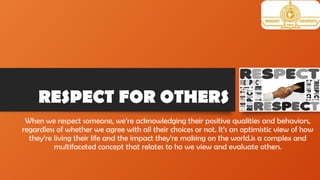
RESPECT FOR OTHERS
When we respect someone, we’re acknowledging their positive qualities and behaviors,
regardless of whether we agree with all their choices or not. It’s an optimistic view of how
they’re living their life and the impact they’re making on the world.is a complex and
multifaceted concept that relates to ho we view and evaluate others.
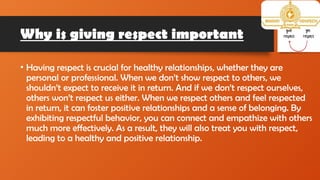
Why is giving respect important
• Having respect is crucial for healthy relationships, whether they are
personal or professional. When we don’t show respect to others, we
shouldn’t expect to receive it in return. And if we don’t respect ourselves,
others won’t respect us either. When we respect others and feel respected
in return, it can foster positive relationships and a sense of belonging. By
exhibiting respectful behavior, you can connect and empathize with others
much more effectively. As a result, they will also treat you with respect,
leading to a healthy and positive relationship.
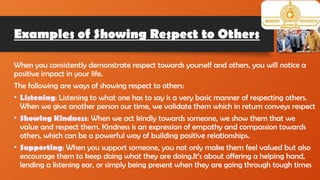
Examples of Showing Respect to Others
When you consistently demonstrate respect towards yourself and others, you will notice a
positive impact in your life.
The following are ways of showing respect to others:
• Listening: Listening to what one has to say is a very basic manner of respecting others.
When we give another person our time, we validate them which in return conveys respect
• Showing Kindness: When we act kindly towards someone, we show them that we
value and respect them. Kindness is an expression of empathy and compassion towards
others, which can be a powerful way of building positive relationships.
• Supporting: When you support someone, you not only make them feel valued but also
encourage them to keep doing what they are doing.It’s about offering a helping hand,
lending a listening ear, or simply being present when they are going through tough times
Effects of Giving Respect to Others
• When you consistently demonstrate respect towards
yourself and others, you will notice a positive impact in
your life. The people you interact with will respond to
you with a peaceful and respectful attitude. You will
also gain a deeper understanding of yourself and the
people around you. Respect in your relationships
builds feelings of trust, safety, and wellbeing.
ona
grit
io
ty
thical
onal
g
nsible
ing
pecting
m
it
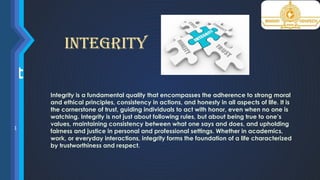
Integrity
Integrity is a fundamental quality that encompasses the adherence to strong moral
and ethical principles, consistency in actions, and honesty in all aspects of life. It is
the cornerstone of trust, guiding individuals to act with honor, even when no one is
watching. Integrity is not just about following rules, but about being true to one’s
values, maintaining consistency between what one says and does, and upholding
fairness and justice in personal and professional settings. Whether in academics,
work, or everyday interactions, integrity forms the foundation of a life characterized
by trustworthiness and respect.
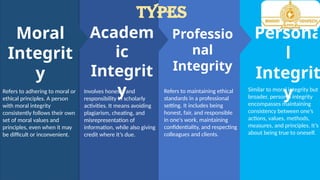
Persona
l
Integrit
y
Similar to moral integrity but
broader, personal integrity
encompasses maintaining
consistency between one’s
actions, values, methods,
measures, and principles. It’s
about being true to oneself.
Professio
nal
Integrity
Refers to maintaining ethical
standards in a professional
setting. It includes being
honest, fair, and responsible
in one's work, maintaining
confidentiality, and respecting
colleagues and clients.
Academ
ic
Integrit
y
Involves honesty and
responsibility in scholarly
activities. It means avoiding
plagiarism, cheating, and
misrepresentation of
information, while also giving
credit where it’s due.
Refers to adhering to moral or
ethical principles. A person
with moral integrity
consistently follows their own
set of moral values and
principles, even when it may
be difficult or inconvenient.
Moral
Integrit
y
TYPES
rm
te
ancial
other
rners or
behavior.
s
mes,
p, or
ad
onestly
alues.
s
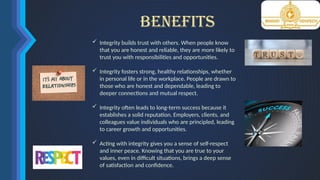
Benefits
 Integrity builds trust with others. When people know
that you are honest and reliable, they are more likely to
trust you with responsibilities and opportunities.
 Integrity fosters strong, healthy relationships, whether
in personal life or in the workplace. People are drawn to
those who are honest and dependable, leading to
deeper connections and mutual respect.
 Integrity often leads to long-term success because it
establishes a solid reputation. Employers, clients, and
colleagues value individuals who are principled, leading
to career growth and opportunities.
 Acting with integrity gives you a sense of self-respect
and inner peace. Knowing that you are true to your
values, even in difficult situations, brings a deep sense
of satisfaction and confidence.
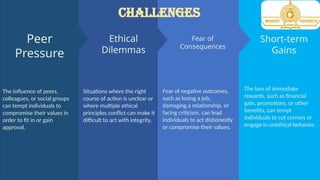
Short-term
Gains
The lure of immediate
rewards, such as financial
gain, promotions, or other
benefits, can tempt
individuals to cut corners or
engage in unethical behavior.
Fear of
Consequences
Fear of negative outcomes,
such as losing a job,
damaging a relationship, or
facing criticism, can lead
individuals to act dishonestly
or compromise their values.
Ethical
Dilemmas
Situations where the right
course of action is unclear or
where multiple ethical
principles conflict can make it
difficult to act with integrity.
The influence of peers,
colleagues, or social groups
can tempt individuals to
compromise their values in
order to fit in or gain
approval.
Peer
Pressure
CHALLENGES
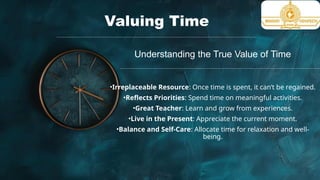
Valuing Time
Understanding the True Value of Time
•Irreplaceable Resource: Once time is spent, it can’t be regained.
•Reflects Priorities: Spend time on meaningful activities.
•Great Teacher: Learn and grow from experiences.
•Live in the Present: Appreciate the current moment.
•Balance and Self-Care: Allocate time for relaxation and well-
being.
The Importance of Time
• Time is a finite resource. Every minute lost is a minute that cannot be
reclaimed. Effective time management leads to better productivity,
reduced stress, and increased success. For example, a project manager
who plans their day effectively can meet deadlines more consistently and
avoid last-minute stress.
• Time helps us organize our daily activities and milestones, such as
birthdays and anniversaries, making life more structured and meaningful.
Strategies for Effective Time
Management
• 1. Prioritize Tasks: Use the Eisenhower Matrix to focus on what's urgent and important.
For instance, a student should prioritize studying for an exam over browsing social media.
• 2. Set SMART Goals: Ensure your goals are Specific, Measurable, Achievable, Relevant,
and Time-bound. For example, setting a goal to 'complete a report by Friday' is more
effective than 'finish work soon.'
• 3. Avoid Multitasking: Focus on one task at a time for better efficiency. A writer will
produce higher quality content by focusing solely on writing rather than switching
between writing and editing.
• 4. Use Time Blocks: Allocate specific times for focused work and breaks. A software
developer might use 90-minute blocks for coding, followed by a 15-minute break.
Conclusion
Time management is essential for achieving both personal
and professional goals. By implementing effective
strategies, such as prioritizing tasks and setting SMART
goals, you can enhance productivity, reduce stress, and
lead a more balanced life. Start applying these techniques
today to see a tangible improvement in your time
management.
SELF
CONFIDENCE
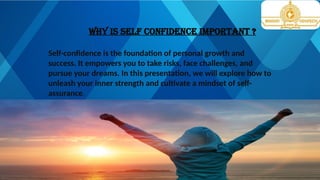
WHY IS SELF CONFIDENCE IMPORTANT ?
Self-confidence is the foundation of personal growth and
success. It empowers you to take risks, face challenges, and
pursue your dreams. In this presentation, we will explore how to
unleash your inner strength and cultivate a mindset of self-
assurance.
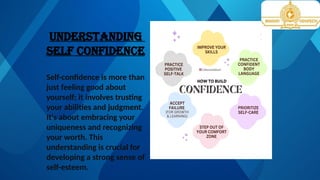
UNDERSTANDING
SELF CONFIDENCE
Self-confidence is more than
just feeling good about
yourself; it involves trusting
your abilities and judgment.
It's about embracing your
uniqueness and recognizing
your worth. This
understanding is crucial for
developing a strong sense of
self-esteem.
CONCLUSION
In conclusion, self-confidence
is a powerful ally in your
journey towards success. By
embracing your inner strength
and practicing the strategies
discussed, you can enhance
your self-belief and achieve
your aspirations. Remember,
confidence is a skill that can
be developed.
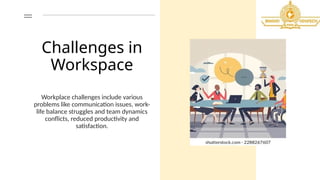
Challenges in
Workspace
Workplace challenges include various
problems like communication issues, work-
life balance struggles and team dynamics
conflicts, reduced productivity and
satisfaction.
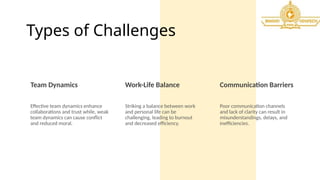
Types of Challenges
Team Dynamics Work-Life Balance Communication Barriers
Effective team dynamics enhance
collaborations and trust while, weak
team dynamics can cause conflict
and reduced moral.
Striking a balance between work
and personal life can be
challenging, leading to burnout
and decreased efficiency.
Poor communication channels
and lack of clarity can result in
misunderstandings, delays, and
inefficiencies.
Impact on Employees
How These Challenges Affect Us All
Workspace challenges directly impact productivity and
efficiency. Addressing these challenges is crucial for
optimal work outcomes.
When these challenges pile up, it’s not just about work but
about how we feel about coming into office each day.
Increased workloads and emotional exhaustion can cause
fatigue, reduced productivity, and lower job satisfaction,
impacting overall well-being.
Photos provided by Unsplash
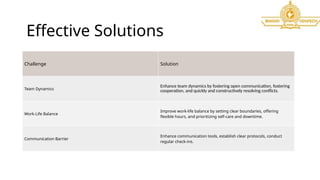
Challenge Solution
Team Dynamics
Enhance team dynamics by fostering open communication, fostering
cooperation, and quickly and constructively resolving conflicts.
Work-Life Balance
Improve work-life balance by setting clear boundaries, offering
flexible hours, and prioritizing self-care and downtime.
Communication Barrier
Enhance communication tools, establish clear protocols, conduct
regular check-ins.
Effective Solutions
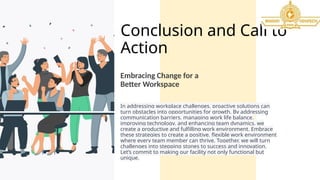
Conclusion and Call to
Action
In addressing workplace challenges, proactive solutions can
turn obstacles into opportunities for growth. By addressing
communication barriers, managing work life balance,
improving technology, and enhancing team dynamics, we
create a productive and fulfilling work environment. Embrace
these strategies to create a positive, flexible work environment
where every team member can thrive. Together, we will turn
challenges into stepping stones to success and innovation.
Let’s commit to making our facility not only functional but
unique.
Embracing Change for a
Better Workspace
SPIRITUALITY
Spirituality involves the recognition of a feeling or sense or belief that
there is something greater than myself, something more to being human
than sensory experience, and that the greater whole of which we are
part is cosmic or divine in nature
Traditionally, spirituality referred to a religious process of re-formation
which "aims to recover the original shape of man", oriented at
"the image of God" as exemplified by the founders and sacred texts of
the religions of the world
Meaning of
spirituality in
different religions
•JAINISM
It is an Indian religion teaching a path to
spiritual purity and enlightenment through
disciplined nonviolence (ahimsa, literally
“non-injury”) to all living creatures
The name Jainism derives from
the Sanskrit verb ji “to conquer.” It refers to
the ascetic battle that, it is believed, Jain
renunciants (monks and nuns) must fight
against the passions and bodily senses to
gain enlightenment, or omniscience and
purity of soul.
Buddhism
• Buddhists believe in reincarnation of the soul,
and that, by following the teachings of
Buddha, or dharma, people can reach an
enlightened state called nirvana and stop
the cycle of reincarnation.
• Buddhism, religion and philosophy that
developed from the teachings of
the Buddha (Sanskrit: “Awakened One”), a
teacher who lived in northern India between
the mid-6th and mid-4th centuries BCE .
Spreading
from India to Central and Southeast
Asia, China, Korea, and Japan, Buddhism has
played a central role in the spiritual, cultural,
and social life of Asia, and, beginning in the
20th century, it spread to the West.
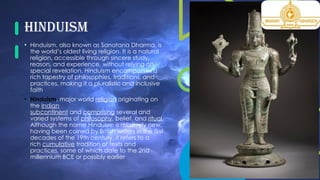
Hinduism
• Hinduism, also known as Sanatana Dharma, is
the world’s oldest living religion. It is a natural
religion, accessible through sincere study,
reason, and experience, without relying on
special revelation. Hinduism encompasses a
rich tapestry of philosophies, traditions, and
practices, making it a pluralistic and inclusive
faith.
• Hinduism, major world religion originating on
the Indian
subcontinent and comprising several and
varied systems of philosophy, belief, and ritual.
Although the name Hinduism is relatively new,
having been coined by British writers in the first
decades of the 19th century, it refers to a
rich cumulative tradition of texts and
practices, some of which date to the 2nd
millennium BCE or possibly earlier
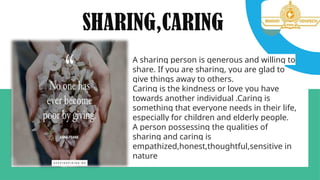
SHARING,CARING
A sharing person is generous and willing to
share. If you are sharing, you are glad to
give things away to others.
Caring is the kindness or love you have
towards another individual .Caring is
something that everyone needs in their life,
especially for children and elderly people.
A person possessing the qualities of
sharing and caring is
empathized,honest,thoughtful,sensitive in
nature
HOW SHARING MAKES US HAPPY?
• Sharing is Fundamental to Human Relationships
• It Releases Oxytocin, the Wellness Hormone
• Sharing Helps Build You a Social Network and improves
social life
• Sharing Encourages Cooperation
• Sharing Inspires Gratitude Which Translates to Happiness
• Sharing Helps Build Trust
28
BENEFITS OF CARING
29
• Helps Strengthens Relationships
• It Enhances Personal Well-Being
• Helps in Fostering Community and Social
Harmony
• Promotes Cooperation and Teamwork
• Encourages Positive Behavioural Changes
• Builds Resilience
Charitable organizations should extend their
activities to any nation and people in need. These
trusts helps people in need and pass down values of
generosity and community service to future
generations. Moreover, by providing aid, these
organizations can expand their wings towards the
most needed ones. For instance, after the
devastating earthquake, India helped Nepal by
distributing 22 tones of relief, food packets in the
affected area.
The act of giving and receiving both invokes
gratitude in the participants. It involves sharing
embraces, smiles, task, responsibilities etc.
SHARING IN ACTION
Cooperation
Co-operation is activity between two persons or sectors that aims at integration of
operations (synergy), while not sacrificing the autonomy of either party.
Cooperation is the process of working together to achieve a common goal or mutual benefit.
Benefits of Cooperation
•1. Enhanced Problem-Solving: Diverse perspectives lead to more effective
solutions.
•2. Improved Efficiency: Shared responsibilities can reduce workload and
increase productivity.
•3. Strengthened Relationships: Cooperation fosters trust and mutual respect.
•4. Collective Achievement: Many goals can only be achieved through
combined efforts.
•Key Point: Cooperation is not just about achieving tasks but also about building
and maintaining strong relationships.
Strategies for Effective Cooperation
•1. Clear Communication: Ensure everyone understands their roles and
the common goal.
•2. Mutual Respect: Recognize and value each person’s contribution.
•3. Shared Leadership: Distribute responsibilities and encourage
initiative.
•4. Conflict Resolution: Address disagreements promptly and
constructively.
hinderance to successful cooperation
1. Clash of ego of individuals.
2. Lack of leadership and motivation.
3. Conflicts of interests, based on region, religion, language, and caste.
4. Ignorance and lack of interest.
How to overcome these shortcomings?
By careful planning, motivation, leadership, fostering and rewarding team
work, professionalism and humanism beyond the ‘divides’, training on
appreciation to different cultures, mutual understanding ‘cooperation’ can be
developed and also sustained
WORK ETHICS
Work Ethics is a set of moral principles
and values which guide a person’s
performance at their place of work. It
is very necessary for a good work
environment and it helps shape
productivity , commitment, and
performance at work.
134
Vikhyat Bansal
CULTIVATING AND
MAINTAINING WORK
ETHICS
Incorporating Work
Ethics in Educational
Curricula
Doing this can prepare
students for the professional
world by Imparting
foundational knowledge,
skills, and values. Teachers
and guardians can
emphasize the importance of
punctuality , diligence,
honesty, and accountability.
This can also be achieved by
assigning projects that
reflect skills and work
values.
Mentorship and Role
Models in Work Ethics
Mentorship and role
models can support an
employee's development of
work ethics by providing
them with guidance,
feedback, and support. A
person no matter in what
profession they are can get
immensely benefited from
the experiences of their
seniors and collegues
CHALLENGES AND ETHICAL
DILEMMAS AT WORKPLACE
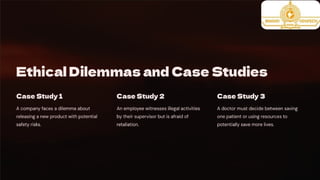
• In many professions, individuals often face situations where their
personal interests may conflict with their professional
responsibilities. Like if you have to conduct job interviews and
someone you know asks for a favour but is not so skilled for the job .
• These conflicts of interest can pose ethical challenges that require
careful consideration and decision making.
• With the Increasing reliance on technology and rapid innovation,
vario us ethical considerations arise. These include issues related to
privacy data security, Intellectual property rights, and the
responsible use of emerging technologies.
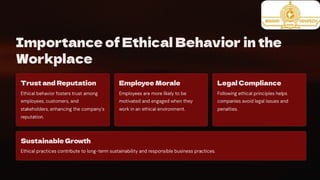
CONCLUSION AND
FUTURE OUTLOOK
• Embracing Ethical
Challenges as
Opportunities for
Growth.
• Adapting Work Ethics
to Changing Societal
and Cultural Norms.
• Promoting Ethical
Leadership and
Organizational Culture
• Ethical consideration
around privacy, data
protection, and fair
use of technology.
• Organizations and
individuals must stay
updated with evolving
technologies and pro
actively address the
ethical implications
HONESTY
AND
COURAGE
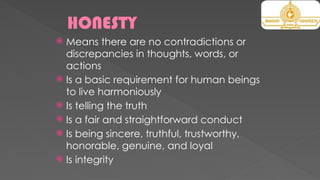
HONESTY
 Means there are no contradictions or
discrepancies in thoughts, words, or
actions
 Is a basic requirement for human beings
to live harmoniously
 Is telling the truth
 Is a fair and straightforward conduct
 Is being sincere, truthful, trustworthy,
honorable, genuine, and loyal
 Is integrity
Truth exists; only
falsehood has to be
invented.
-George Braque
Courage is…
 Courage is more than being brave or not being afraid
of snakes or heights.
 It is also about being able to face uncomfortable
situations.
 Challenging yourself to try something new.
Morals & Values
MORALS
» Morals are the fundamental principles or standards that guide
individuals in determining what is right and wrong.
» Moral values are understood to be those that make a person good
purely and simply as a person.
» They are essential for shaping behavior, influencing decision-
making, and maintaining social harmony.
» Morals provide a framework for ethical conduct, helping people
navigate complex social interactions by adhering to a set of
commonly accepted norms.
» Morals are often seen as universal or relative depending on cultural
and individual perspectives.
Purpose and Function
1.Guidance: Morals offer a moral compass, guiding individuals in making decisions that align with ethical
standards. They help people determine the right course of action in challenging situations, such as whether to tell
the truth or protect someone’s feelings.
2.Consistency: By establishing clear norms, morals promote consistency in behavior. They ensure that individuals
act in a manner that aligns with societal expectations, fostering predictability and stability within communities.
3.Social Cohesion: Shared moral principles contribute to social cohesion by aligning individuals’ actions with the
collective values of a society. This alignment helps maintain harmony and reduces conflicts within communities.
Sources of Morals
1.Cultural Norms: Different cultures have distinct moral codes based on historical traditions, customs, and societal
practices. These norms shape how individuals within a culture perceive right and wrong.
2. Religious Teachings: Many moral principles are derived from religious doctrines. Different religions provide
ethical guidelines and moral codes that shape the behavior of their adherents.
VALUES
• Values are deeply held beliefs or ideals that guide individuals in their
decisions, actions, and interactions.
• Unlike morals, which are often seen as rules about right and wrong, values are
personal or collective priorities that shape one’s behavior and life goals.
• They reflect what is considered important or worthwhile by a person or group,
shaping behavior and influencing priorities.
• Values play a crucial role in personal development, social relationships, and
societal structures.
• Values directly influence how individuals act and make choices. For instance, a
person who values environmental sustainability may engage in eco-friendly
practices and advocate for green policies.
Guidance: Values provide direction and purpose in life by helping
individuals set goals and make choices that align with their core beliefs.
Decision-Making: They influence how people approach decisions and
resolve conflicts by prioritizing certain principles over others.
Identity Formation: Values contribute to personal and collective identity by
defining what individuals and groups stand for and aspire to achieve.
Sources of Values
Family: Early family experiences and teachings often play a significant role in shaping
personal values.
Education: Educational institutions and experiences contribute to the development of
values by promoting certain ideals and ethics.
Religion and Philosophy: Religious beliefs and philosophical theories provide frameworks
for understanding and prioritizing values.
Societal Influences: Media, culture, and social interactions also impact the development
and evolution of values.
Purpose and Function:
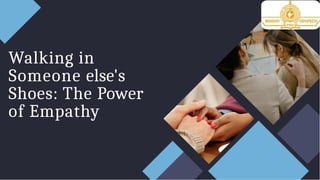
Walking in
Someone else's
Shoes: The Power
of Empathy
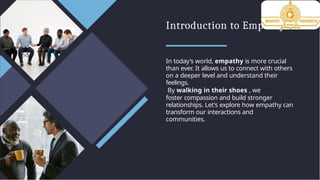
Introduction to Empathy
In today's world, empathy is more crucial
than ever. It allows us to connect with others
on a deeper level and understand their
feelings.
By walking in their shoes , we
foster compassion and build stronger
relationships. Let's explore how empathy can
transform our interactions and
communities.
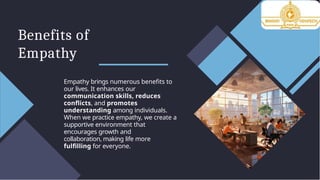
Benefits of
Empathy
Empathy brings numerous benefits to
our lives. It enhances our
communication skills, reduces
conflicts, and promotes
understanding among individuals.
When we practice empathy, we create a
supportive environment that
encourages growth and
collaboration, making life more
fulfilling for everyone.
In conclusion, embracing empathy can
significantly enhance our lives and relationships.
By understanding and valuing others'
experiences, we foster a more inclusive and
compassionate world. Let's commit
to making empathy a priority in our
daily interactions.
Conclusion: Embrace
Empathy
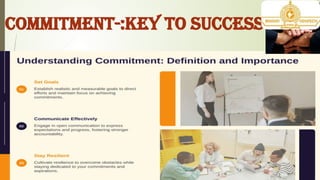
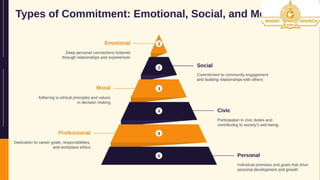
COMMITMENT-:KEY TO SUCCESS
Benefits Of Commitment in work
 When you commit to your work, you reap the rewards of a
fulfilling career and a positive impact on your team and
organization. Work in commitment can lead to greater
productivity, improved morale, and stronger relationships
 Increased Productivity
 When you're fully engaged in your work, you're more likely to be productive and achieve
your goals.
 Improved Morale
 Work in commitment can lead to greater job satisfaction and a sense of fulfillment.
 Stronger Relationships
 When you're committed to your work, you're more likely to build strong relationships with your
colleagues and supervisors.
 Enhanced Creativity
 Work in commitment often fosters a sense of ownership and allows for more creativity and
innovation in your work
Strategies for Cultivating Work in
Commitment
 Goal Setting
 Set clear and achievable goals that align with your
values and interests.
 Skill Development
 Continuously invest in developing your skills and
seeking new challenges.
 Relationship Building
 Cultivate strong relationships with colleagues and
mentors to foster a supportive environment.
 Feedback & Reflection
 Actively seek feedback and reflect on your
progress to identify areas for growth and
improvement
Thank you
Made by:
Avika Singh
Hanuansh Sharma
Kush Kaushik
Pranaya
Raghav Panvanda
Japneet Singh Mongia
Anush Singla
Shaurya Saxena
Ayush Ramola
Rakshit Negi
Gaurav Karakoti
Gauri Jain
Vikhyat Bansal
Akshita Saxena

Compiled pptfffffffffffffffffffffffffffffffffffffffffff.pptx

  • 1.
  • 2.
    RESPECT FOR OTHERS Whenwe respect someone, we’re acknowledging their positive qualities and behaviors, regardless of whether we agree with all their choices or not. It’s an optimistic view of how they’re living their life and the impact they’re making on the world.is a complex and multifaceted concept that relates to ho we view and evaluate others.
  • 3.
    Why is givingrespect important • Having respect is crucial for healthy relationships, whether they are personal or professional. When we don’t show respect to others, we shouldn’t expect to receive it in return. And if we don’t respect ourselves, others won’t respect us either. When we respect others and feel respected in return, it can foster positive relationships and a sense of belonging. By exhibiting respectful behavior, you can connect and empathize with others much more effectively. As a result, they will also treat you with respect, leading to a healthy and positive relationship.
  • 4.
    Examples of ShowingRespect to Others When you consistently demonstrate respect towards yourself and others, you will notice a positive impact in your life. The following are ways of showing respect to others: • Listening: Listening to what one has to say is a very basic manner of respecting others. When we give another person our time, we validate them which in return conveys respect • Showing Kindness: When we act kindly towards someone, we show them that we value and respect them. Kindness is an expression of empathy and compassion towards others, which can be a powerful way of building positive relationships. • Supporting: When you support someone, you not only make them feel valued but also encourage them to keep doing what they are doing.It’s about offering a helping hand, lending a listening ear, or simply being present when they are going through tough times
  • 5.
    Effects of GivingRespect to Others • When you consistently demonstrate respect towards yourself and others, you will notice a positive impact in your life. The people you interact with will respond to you with a peaceful and respectful attitude. You will also gain a deeper understanding of yourself and the people around you. Respect in your relationships builds feelings of trust, safety, and wellbeing.
  • 6.
    ona grit io ty thical onal g nsible ing pecting m it Integrity Integrity is afundamental quality that encompasses the adherence to strong moral and ethical principles, consistency in actions, and honesty in all aspects of life. It is the cornerstone of trust, guiding individuals to act with honor, even when no one is watching. Integrity is not just about following rules, but about being true to one’s values, maintaining consistency between what one says and does, and upholding fairness and justice in personal and professional settings. Whether in academics, work, or everyday interactions, integrity forms the foundation of a life characterized by trustworthiness and respect.
  • 7.
    Persona l Integrit y Similar to moralintegrity but broader, personal integrity encompasses maintaining consistency between one’s actions, values, methods, measures, and principles. It’s about being true to oneself. Professio nal Integrity Refers to maintaining ethical standards in a professional setting. It includes being honest, fair, and responsible in one's work, maintaining confidentiality, and respecting colleagues and clients. Academ ic Integrit y Involves honesty and responsibility in scholarly activities. It means avoiding plagiarism, cheating, and misrepresentation of information, while also giving credit where it’s due. Refers to adhering to moral or ethical principles. A person with moral integrity consistently follows their own set of moral values and principles, even when it may be difficult or inconvenient. Moral Integrit y TYPES
  • 8.
    rm te ancial other rners or behavior. s mes, p, or ad onestly alues. s Benefits Integrity builds trust with others. When people know that you are honest and reliable, they are more likely to trust you with responsibilities and opportunities.  Integrity fosters strong, healthy relationships, whether in personal life or in the workplace. People are drawn to those who are honest and dependable, leading to deeper connections and mutual respect.  Integrity often leads to long-term success because it establishes a solid reputation. Employers, clients, and colleagues value individuals who are principled, leading to career growth and opportunities.  Acting with integrity gives you a sense of self-respect and inner peace. Knowing that you are true to your values, even in difficult situations, brings a deep sense of satisfaction and confidence.
  • 9.
    Short-term Gains The lure ofimmediate rewards, such as financial gain, promotions, or other benefits, can tempt individuals to cut corners or engage in unethical behavior. Fear of Consequences Fear of negative outcomes, such as losing a job, damaging a relationship, or facing criticism, can lead individuals to act dishonestly or compromise their values. Ethical Dilemmas Situations where the right course of action is unclear or where multiple ethical principles conflict can make it difficult to act with integrity. The influence of peers, colleagues, or social groups can tempt individuals to compromise their values in order to fit in or gain approval. Peer Pressure CHALLENGES
  • 10.
    Valuing Time Understanding theTrue Value of Time •Irreplaceable Resource: Once time is spent, it can’t be regained. •Reflects Priorities: Spend time on meaningful activities. •Great Teacher: Learn and grow from experiences. •Live in the Present: Appreciate the current moment. •Balance and Self-Care: Allocate time for relaxation and well- being.
  • 11.
    The Importance ofTime • Time is a finite resource. Every minute lost is a minute that cannot be reclaimed. Effective time management leads to better productivity, reduced stress, and increased success. For example, a project manager who plans their day effectively can meet deadlines more consistently and avoid last-minute stress. • Time helps us organize our daily activities and milestones, such as birthdays and anniversaries, making life more structured and meaningful.
  • 12.
    Strategies for EffectiveTime Management • 1. Prioritize Tasks: Use the Eisenhower Matrix to focus on what's urgent and important. For instance, a student should prioritize studying for an exam over browsing social media. • 2. Set SMART Goals: Ensure your goals are Specific, Measurable, Achievable, Relevant, and Time-bound. For example, setting a goal to 'complete a report by Friday' is more effective than 'finish work soon.' • 3. Avoid Multitasking: Focus on one task at a time for better efficiency. A writer will produce higher quality content by focusing solely on writing rather than switching between writing and editing. • 4. Use Time Blocks: Allocate specific times for focused work and breaks. A software developer might use 90-minute blocks for coding, followed by a 15-minute break.
  • 13.
    Conclusion Time management isessential for achieving both personal and professional goals. By implementing effective strategies, such as prioritizing tasks and setting SMART goals, you can enhance productivity, reduce stress, and lead a more balanced life. Start applying these techniques today to see a tangible improvement in your time management.
  • 14.
  • 15.
    WHY IS SELFCONFIDENCE IMPORTANT ? Self-confidence is the foundation of personal growth and success. It empowers you to take risks, face challenges, and pursue your dreams. In this presentation, we will explore how to unleash your inner strength and cultivate a mindset of self- assurance.
  • 16.
    UNDERSTANDING SELF CONFIDENCE Self-confidence ismore than just feeling good about yourself; it involves trusting your abilities and judgment. It's about embracing your uniqueness and recognizing your worth. This understanding is crucial for developing a strong sense of self-esteem.
  • 17.
    CONCLUSION In conclusion, self-confidence isa powerful ally in your journey towards success. By embracing your inner strength and practicing the strategies discussed, you can enhance your self-belief and achieve your aspirations. Remember, confidence is a skill that can be developed.
  • 18.
    Challenges in Workspace Workplace challengesinclude various problems like communication issues, work- life balance struggles and team dynamics conflicts, reduced productivity and satisfaction.
  • 19.
    Types of Challenges TeamDynamics Work-Life Balance Communication Barriers Effective team dynamics enhance collaborations and trust while, weak team dynamics can cause conflict and reduced moral. Striking a balance between work and personal life can be challenging, leading to burnout and decreased efficiency. Poor communication channels and lack of clarity can result in misunderstandings, delays, and inefficiencies.
  • 20.
    Impact on Employees HowThese Challenges Affect Us All Workspace challenges directly impact productivity and efficiency. Addressing these challenges is crucial for optimal work outcomes. When these challenges pile up, it’s not just about work but about how we feel about coming into office each day. Increased workloads and emotional exhaustion can cause fatigue, reduced productivity, and lower job satisfaction, impacting overall well-being. Photos provided by Unsplash
  • 21.
    Challenge Solution Team Dynamics Enhanceteam dynamics by fostering open communication, fostering cooperation, and quickly and constructively resolving conflicts. Work-Life Balance Improve work-life balance by setting clear boundaries, offering flexible hours, and prioritizing self-care and downtime. Communication Barrier Enhance communication tools, establish clear protocols, conduct regular check-ins. Effective Solutions
  • 22.
    Conclusion and Callto Action In addressing workplace challenges, proactive solutions can turn obstacles into opportunities for growth. By addressing communication barriers, managing work life balance, improving technology, and enhancing team dynamics, we create a productive and fulfilling work environment. Embrace these strategies to create a positive, flexible work environment where every team member can thrive. Together, we will turn challenges into stepping stones to success and innovation. Let’s commit to making our facility not only functional but unique. Embracing Change for a Better Workspace
  • 23.
    SPIRITUALITY Spirituality involves therecognition of a feeling or sense or belief that there is something greater than myself, something more to being human than sensory experience, and that the greater whole of which we are part is cosmic or divine in nature Traditionally, spirituality referred to a religious process of re-formation which "aims to recover the original shape of man", oriented at "the image of God" as exemplified by the founders and sacred texts of the religions of the world
  • 24.
    Meaning of spirituality in differentreligions •JAINISM It is an Indian religion teaching a path to spiritual purity and enlightenment through disciplined nonviolence (ahimsa, literally “non-injury”) to all living creatures The name Jainism derives from the Sanskrit verb ji “to conquer.” It refers to the ascetic battle that, it is believed, Jain renunciants (monks and nuns) must fight against the passions and bodily senses to gain enlightenment, or omniscience and purity of soul.
  • 25.
    Buddhism • Buddhists believein reincarnation of the soul, and that, by following the teachings of Buddha, or dharma, people can reach an enlightened state called nirvana and stop the cycle of reincarnation. • Buddhism, religion and philosophy that developed from the teachings of the Buddha (Sanskrit: “Awakened One”), a teacher who lived in northern India between the mid-6th and mid-4th centuries BCE . Spreading from India to Central and Southeast Asia, China, Korea, and Japan, Buddhism has played a central role in the spiritual, cultural, and social life of Asia, and, beginning in the 20th century, it spread to the West.
  • 26.
    Hinduism • Hinduism, alsoknown as Sanatana Dharma, is the world’s oldest living religion. It is a natural religion, accessible through sincere study, reason, and experience, without relying on special revelation. Hinduism encompasses a rich tapestry of philosophies, traditions, and practices, making it a pluralistic and inclusive faith. • Hinduism, major world religion originating on the Indian subcontinent and comprising several and varied systems of philosophy, belief, and ritual. Although the name Hinduism is relatively new, having been coined by British writers in the first decades of the 19th century, it refers to a rich cumulative tradition of texts and practices, some of which date to the 2nd millennium BCE or possibly earlier
  • 27.
    SHARING,CARING A sharing personis generous and willing to share. If you are sharing, you are glad to give things away to others. Caring is the kindness or love you have towards another individual .Caring is something that everyone needs in their life, especially for children and elderly people. A person possessing the qualities of sharing and caring is empathized,honest,thoughtful,sensitive in nature
  • 28.
    HOW SHARING MAKESUS HAPPY? • Sharing is Fundamental to Human Relationships • It Releases Oxytocin, the Wellness Hormone • Sharing Helps Build You a Social Network and improves social life • Sharing Encourages Cooperation • Sharing Inspires Gratitude Which Translates to Happiness • Sharing Helps Build Trust 28
  • 29.
    BENEFITS OF CARING 29 •Helps Strengthens Relationships • It Enhances Personal Well-Being • Helps in Fostering Community and Social Harmony • Promotes Cooperation and Teamwork • Encourages Positive Behavioural Changes • Builds Resilience
  • 30.
    Charitable organizations shouldextend their activities to any nation and people in need. These trusts helps people in need and pass down values of generosity and community service to future generations. Moreover, by providing aid, these organizations can expand their wings towards the most needed ones. For instance, after the devastating earthquake, India helped Nepal by distributing 22 tones of relief, food packets in the affected area. The act of giving and receiving both invokes gratitude in the participants. It involves sharing embraces, smiles, task, responsibilities etc. SHARING IN ACTION
  • 36.
    Cooperation Co-operation is activitybetween two persons or sectors that aims at integration of operations (synergy), while not sacrificing the autonomy of either party. Cooperation is the process of working together to achieve a common goal or mutual benefit.
  • 37.
    Benefits of Cooperation •1.Enhanced Problem-Solving: Diverse perspectives lead to more effective solutions. •2. Improved Efficiency: Shared responsibilities can reduce workload and increase productivity. •3. Strengthened Relationships: Cooperation fosters trust and mutual respect. •4. Collective Achievement: Many goals can only be achieved through combined efforts. •Key Point: Cooperation is not just about achieving tasks but also about building and maintaining strong relationships.
  • 38.
    Strategies for EffectiveCooperation •1. Clear Communication: Ensure everyone understands their roles and the common goal. •2. Mutual Respect: Recognize and value each person’s contribution. •3. Shared Leadership: Distribute responsibilities and encourage initiative. •4. Conflict Resolution: Address disagreements promptly and constructively.
  • 39.
    hinderance to successfulcooperation 1. Clash of ego of individuals. 2. Lack of leadership and motivation. 3. Conflicts of interests, based on region, religion, language, and caste. 4. Ignorance and lack of interest. How to overcome these shortcomings? By careful planning, motivation, leadership, fostering and rewarding team work, professionalism and humanism beyond the ‘divides’, training on appreciation to different cultures, mutual understanding ‘cooperation’ can be developed and also sustained
  • 40.
    WORK ETHICS Work Ethicsis a set of moral principles and values which guide a person’s performance at their place of work. It is very necessary for a good work environment and it helps shape productivity , commitment, and performance at work. 134 Vikhyat Bansal
  • 41.
    CULTIVATING AND MAINTAINING WORK ETHICS IncorporatingWork Ethics in Educational Curricula Doing this can prepare students for the professional world by Imparting foundational knowledge, skills, and values. Teachers and guardians can emphasize the importance of punctuality , diligence, honesty, and accountability. This can also be achieved by assigning projects that reflect skills and work values. Mentorship and Role Models in Work Ethics Mentorship and role models can support an employee's development of work ethics by providing them with guidance, feedback, and support. A person no matter in what profession they are can get immensely benefited from the experiences of their seniors and collegues
  • 42.
    CHALLENGES AND ETHICAL DILEMMASAT WORKPLACE • In many professions, individuals often face situations where their personal interests may conflict with their professional responsibilities. Like if you have to conduct job interviews and someone you know asks for a favour but is not so skilled for the job . • These conflicts of interest can pose ethical challenges that require careful consideration and decision making. • With the Increasing reliance on technology and rapid innovation, vario us ethical considerations arise. These include issues related to privacy data security, Intellectual property rights, and the responsible use of emerging technologies.
  • 43.
    CONCLUSION AND FUTURE OUTLOOK •Embracing Ethical Challenges as Opportunities for Growth. • Adapting Work Ethics to Changing Societal and Cultural Norms. • Promoting Ethical Leadership and Organizational Culture • Ethical consideration around privacy, data protection, and fair use of technology. • Organizations and individuals must stay updated with evolving technologies and pro actively address the ethical implications
  • 44.
  • 45.
    HONESTY  Means thereare no contradictions or discrepancies in thoughts, words, or actions  Is a basic requirement for human beings to live harmoniously  Is telling the truth  Is a fair and straightforward conduct  Is being sincere, truthful, trustworthy, honorable, genuine, and loyal  Is integrity
  • 46.
    Truth exists; only falsehoodhas to be invented. -George Braque
  • 47.
    Courage is…  Courageis more than being brave or not being afraid of snakes or heights.  It is also about being able to face uncomfortable situations.  Challenging yourself to try something new.
  • 48.
  • 49.
    MORALS » Morals arethe fundamental principles or standards that guide individuals in determining what is right and wrong. » Moral values are understood to be those that make a person good purely and simply as a person. » They are essential for shaping behavior, influencing decision- making, and maintaining social harmony. » Morals provide a framework for ethical conduct, helping people navigate complex social interactions by adhering to a set of commonly accepted norms. » Morals are often seen as universal or relative depending on cultural and individual perspectives.
  • 50.
    Purpose and Function 1.Guidance:Morals offer a moral compass, guiding individuals in making decisions that align with ethical standards. They help people determine the right course of action in challenging situations, such as whether to tell the truth or protect someone’s feelings. 2.Consistency: By establishing clear norms, morals promote consistency in behavior. They ensure that individuals act in a manner that aligns with societal expectations, fostering predictability and stability within communities. 3.Social Cohesion: Shared moral principles contribute to social cohesion by aligning individuals’ actions with the collective values of a society. This alignment helps maintain harmony and reduces conflicts within communities. Sources of Morals 1.Cultural Norms: Different cultures have distinct moral codes based on historical traditions, customs, and societal practices. These norms shape how individuals within a culture perceive right and wrong. 2. Religious Teachings: Many moral principles are derived from religious doctrines. Different religions provide ethical guidelines and moral codes that shape the behavior of their adherents.
  • 51.
    VALUES • Values aredeeply held beliefs or ideals that guide individuals in their decisions, actions, and interactions. • Unlike morals, which are often seen as rules about right and wrong, values are personal or collective priorities that shape one’s behavior and life goals. • They reflect what is considered important or worthwhile by a person or group, shaping behavior and influencing priorities. • Values play a crucial role in personal development, social relationships, and societal structures. • Values directly influence how individuals act and make choices. For instance, a person who values environmental sustainability may engage in eco-friendly practices and advocate for green policies.
  • 52.
    Guidance: Values providedirection and purpose in life by helping individuals set goals and make choices that align with their core beliefs. Decision-Making: They influence how people approach decisions and resolve conflicts by prioritizing certain principles over others. Identity Formation: Values contribute to personal and collective identity by defining what individuals and groups stand for and aspire to achieve. Sources of Values Family: Early family experiences and teachings often play a significant role in shaping personal values. Education: Educational institutions and experiences contribute to the development of values by promoting certain ideals and ethics. Religion and Philosophy: Religious beliefs and philosophical theories provide frameworks for understanding and prioritizing values. Societal Influences: Media, culture, and social interactions also impact the development and evolution of values. Purpose and Function:
  • 53.
  • 54.
    Introduction to Empathy Intoday's world, empathy is more crucial than ever. It allows us to connect with others on a deeper level and understand their feelings. By walking in their shoes , we foster compassion and build stronger relationships. Let's explore how empathy can transform our interactions and communities.
  • 55.
    Benefits of Empathy Empathy bringsnumerous benefits to our lives. It enhances our communication skills, reduces conflicts, and promotes understanding among individuals. When we practice empathy, we create a supportive environment that encourages growth and collaboration, making life more fulfilling for everyone.
  • 56.
    In conclusion, embracingempathy can significantly enhance our lives and relationships. By understanding and valuing others' experiences, we foster a more inclusive and compassionate world. Let's commit to making empathy a priority in our daily interactions. Conclusion: Embrace Empathy
  • 57.
  • 59.
    Benefits Of Commitmentin work  When you commit to your work, you reap the rewards of a fulfilling career and a positive impact on your team and organization. Work in commitment can lead to greater productivity, improved morale, and stronger relationships  Increased Productivity  When you're fully engaged in your work, you're more likely to be productive and achieve your goals.  Improved Morale  Work in commitment can lead to greater job satisfaction and a sense of fulfillment.  Stronger Relationships  When you're committed to your work, you're more likely to build strong relationships with your colleagues and supervisors.  Enhanced Creativity  Work in commitment often fosters a sense of ownership and allows for more creativity and innovation in your work
  • 60.
    Strategies for CultivatingWork in Commitment  Goal Setting  Set clear and achievable goals that align with your values and interests.  Skill Development  Continuously invest in developing your skills and seeking new challenges.  Relationship Building  Cultivate strong relationships with colleagues and mentors to foster a supportive environment.  Feedback & Reflection  Actively seek feedback and reflect on your progress to identify areas for growth and improvement
  • 61.
    Thank you Made by: AvikaSingh Hanuansh Sharma Kush Kaushik Pranaya Raghav Panvanda Japneet Singh Mongia Anush Singla Shaurya Saxena Ayush Ramola Rakshit Negi Gaurav Karakoti Gauri Jain Vikhyat Bansal Akshita Saxena