Respiration in Reptiles
• All reptiles breathe using lungs.
• Lung ventilation is a complished differently in each main reptile group.
• In squamates (scaled reptiles the largest group) ,the lungs are ventilated almost
exclusively by the axial musculature.
• This is also the same musculature that is used During locomotion . Because of this
constraint, most squamates are forced to hold their breath during intense runs.
• Other reptiles have other adaptations for breathing (for example, crocodiles use a
diaphragm that is analogous to the diaphragm in human while turtles antortices
use other muscles to allow breathing with a rigid shell).
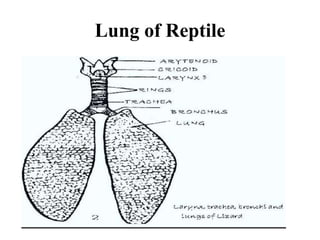
Lung of Reptile
Respiration in Aves
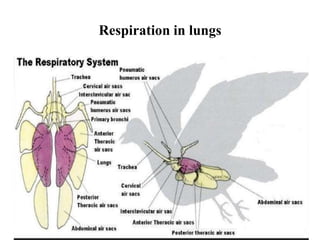
• Air Sacs:-When birds inhale , the air first travels to the posterior air
sacs.
• Next, it travels to the lungs through a series of breathing tubes.
• Stale air travels to the anterior air sacs, which is then exhaled.
• This system of air sacs and breathing tubes allows air to flow through the
lungs in a single direction enable birds to remove oxygen from the air when
they inhale AND when they exhale.
• This is different from most vertebrates that have air traveling through the
lungs in two directions (in and out).
• This system is highly efficient and enables birds to maintain a high metabolic
rate.
Respiration in lungs
Respiration in Mammals
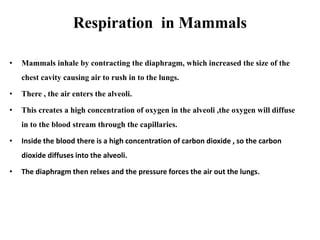
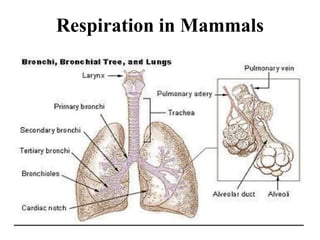
• Mammals inhale by contracting the diaphragm, which increased the size of the
chest cavity causing air to rush in to the lungs.
• There , the air enters the alveoli.
• This creates a high concentration of oxygen in the alveoli ,the oxygen will diffuse
in to the blood stream through the capillaries.
• Inside the blood there is a high concentration of carbon dioxide , so the carbon
dioxide diffuses into the alveoli.
• The diaphragm then relxes and the pressure forces the air out the lungs.
Respiration in Mammals

comperative respiration (2).pptx

  • 1.
    Respiration in Reptiles •All reptiles breathe using lungs. • Lung ventilation is a complished differently in each main reptile group. • In squamates (scaled reptiles the largest group) ,the lungs are ventilated almost exclusively by the axial musculature. • This is also the same musculature that is used During locomotion . Because of this constraint, most squamates are forced to hold their breath during intense runs. • Other reptiles have other adaptations for breathing (for example, crocodiles use a diaphragm that is analogous to the diaphragm in human while turtles antortices use other muscles to allow breathing with a rigid shell).
  • 2.
  • 3.
    Respiration in Aves •Air Sacs:-When birds inhale , the air first travels to the posterior air sacs. • Next, it travels to the lungs through a series of breathing tubes. • Stale air travels to the anterior air sacs, which is then exhaled. • This system of air sacs and breathing tubes allows air to flow through the lungs in a single direction enable birds to remove oxygen from the air when they inhale AND when they exhale. • This is different from most vertebrates that have air traveling through the lungs in two directions (in and out). • This system is highly efficient and enables birds to maintain a high metabolic rate.
  • 4.
  • 5.
    Respiration in Mammals •Mammals inhale by contracting the diaphragm, which increased the size of the chest cavity causing air to rush in to the lungs. • There , the air enters the alveoli. • This creates a high concentration of oxygen in the alveoli ,the oxygen will diffuse in to the blood stream through the capillaries. • Inside the blood there is a high concentration of carbon dioxide , so the carbon dioxide diffuses into the alveoli. • The diaphragm then relxes and the pressure forces the air out the lungs.
  • 6.