


COMMUNICATION 
FOR 
ENGINEERING 
TECHNICIANS 
Unit 2: Assignment 2 
PRESENTED BY: 
OTUTU OGHENEOVIE RALPH 
ND ENGINEERING 
EDXCEL
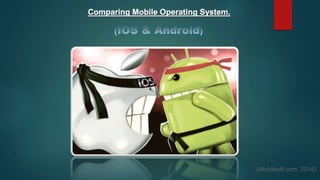
(Mobileutil.com, 2014)
Table Of Contents 
 Chapter 1 Table of contents 
 Chapter 2 Introduction. 
 Chapter 3 What is Android Operating SYSTEM (AOP) 
 Chapter 4 what is Iphone Operating System (iOs) 
 Chapter 5 Comparison Chart 
 Chapter 6 Interface 
 Chapter 7 User Interface
Google's Android and Apple’s iOS are operating systems used primarily in mobile technology, such as 
smartphones and tablets. Android, which is Linux-based and partly open source, is more PC-like than iOS, in 
that its interface and basic features are generally more customizable from top to bottom. However, iOS' 
uniform design elements are sometimes seen as being more user-friendly. 
You should choose your smartphone and tablet systems carefully, as switching from iOS to Android or 
vice versa will require you to buy apps again in the Google Play or Apple App Store. Android is now the 
world’s most commonly used smartphone platform and is used by many different phone manufacturers. iOS is 
only used on Apple devices, such as the iPhone. 
(Diffen.com, 2014) 
Chapter 2 :INTROUCTION.
CHAPTER 3: WHAT IS ANDROID OPERATING SYSTEM (OS) 
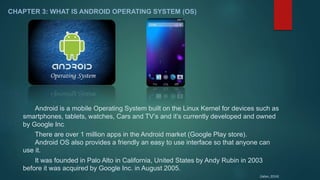
Android is a mobile Operating System built on the Linux Kernel for devices such as 
smartphones, tablets, watches, Cars and TV’s and it’s currently developed and owned 
by Google Inc. 
There are over 1 million apps in the Android market (Google Play store). 
Android OS also provides a friendly an easy to use interface so that anyone can 
use it. 
It was founded in Palo Alto in California, United States by Andy Rubin in 2003 
before it was acquired by Google Inc. in August 2005. 
(Jalan, 2014)
CHAPTER 4: WHAT IS IPHONE OPERATING SYSTEM (IOS) 
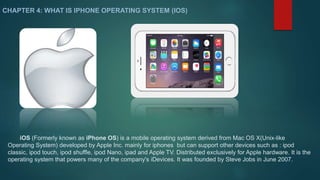
iOS (Formerly known as iPhone OS) is a mobile operating system derived from Mac OS X(Unix-like 
Operating System) developed by Apple Inc. mainly for iphones but can support other devices such as : ipod 
classic, ipod touch, ipod shuffle, ipod Nano, ipad and Apple TV. Distributed exclusively for Apple hardware. It is the 
operating system that powers many of the company's iDevices. It was founded by Steve Jobs in June 2007.
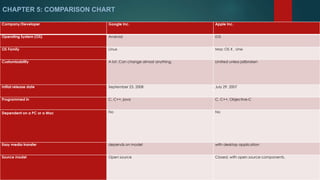
CHAPTER 5: COMPARISON CHART 
Company/Developer Google Inc. Apple Inc. 
Operating System (OS) Android iOS 
OS Family Linux Mac OS X , Unix 
Customizability A lot. Can change almost anything. Limited unless jailbroken 
Initial release date September 23, 2008 July 29, 2007 
Programmed in C, C++, java C, C++, Objective-C 
Dependent on a PC or a Mac No No 
Easy media transfer depends on model with desktop application 
Source model Open source Closed, with open source components.
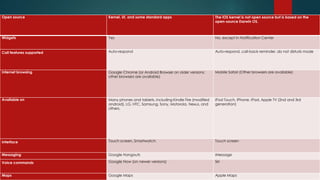
Open source Kernel, UI, and some standard apps The iOS kernel is not open source but is based on the 
open-source Darwin OS. 
Widgets Yes No, except in Notification Center 
Call features supported Auto-respond Auto-respond, call-back reminder, do not disturb mode 
Internet browsing Google Chrome (or Android Browser on older versions; 
other browsers are available) 
Mobile Safari (Other browsers are available) 
Available on Many phones and tablets, including Kindle Fire (modified 
android), LG, HTC, Samsung, Sony, Motorola, Nexus, and 
others. 
iPod Touch, iPhone, iPad, Apple TV (2nd and 3rd 
generation) 
Interface Touch screen, Smartwatch Touch screen 
Messaging Google Hangouts iMessage 
Voice commands Google Now (on newer versions) Siri 
Maps Google Maps Apple Maps
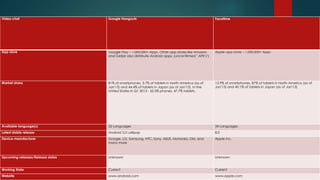
Video chat Google Hangouts Facetime 
App store Google Play – 1,000,000+ Apps. Other app stores like Amazon 
and Getjar also distribute Android apps. (unconfirmed ".APK's") 
Apple app store – 1,000,000+ Apps 
Market share 81% of smartphones, 3.7% of tablets in North America (as of 
Jan'13) and 44.4% of tablets in Japan (as of Jan'13). In the 
United States in Q1 2013 - 52.3% phones, 47.7% tablets. 
12.9% of smartphones, 87% of tablets in North America (as of 
Jan'13) and 40.1% of tablets in Japan (as of Jan'13) 
Available language(s) 32 Languages 34 Languages 
Latest stable release Android 5.0 Lollipop 8.0 
Device manufacturer Google, LG, Samsung, HTC, Sony, ASUS, Motorola, Obi, and 
many more 
Apple Inc. 
Upcoming releases/Release dates Unknown Unknown 
Working State Current Current 
Website www.android.com www.apple.com
CHAPTER 6: INTERFACE 
iOS and Android both use touch interfaces that have a lot in common - swiping, 
tapping and pinch-and-zoom. Both operating systems boot to a home screen, which 
is similar to a computer desktop. While an iOS home screen only contains rows of 
app icons, Android allows the use of widgets, which display auto-updating 
information such as weather and email. The iOS user interface features a dock 
where users can pin their most frequently used applications. 
A status bar runs across the top on both iOS and Android, offering information such 
the time, Wi-Fi or cell signal, and battery life; on Android the status bar also shows 
the number of newly received emails, messages and reminders. Many different 
manufacturers make Android phones and they often include some customization 
over the vanilla Android experience. E.g. HTC Sense or Samsung TouchWiz. 
Depending upon your device and carrier, there may be pre-installed apps that are 
bundled with your Android device. 
(Diffen.com, 2014)
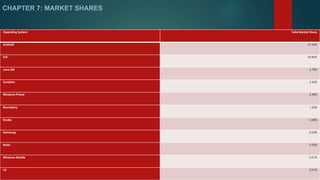
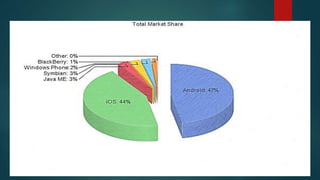
CHAPTER 7: MARKET SHARES 
Operating System Total Market Share 
Android 47.06% 
iOS 43.86% 
Java ME 2.78% 
Symbian 2.56% 
Windows Phone 2.38% 
BlackBerry 1.22% 
Kindle 0.08% 
Samsung 0.03% 
Bada 0.03% 
Windows Mobile 0.01% 
LG 0.01%
To summarize the key pros and cons of Android and iOS: 
⦁ IOS FACTORS 
Massive app ecosystem: distinct advantage for tablet apps while on 
smartphones popular apps are usually available for both platforms 
 Deeper integration with Facebook and Twitter: it is easier to post updates 
and share on social networks using iOS than Android because of how deeply 
integrated these platforms are with iOS. 
 iOS-only apps like Passbook, FaceTime, and mobile payments app Square 
(available on iOS 3GS,4,4S,5 and up, nut only for a limited Android phones) 
 Interface is locked down: Limited customization options for the home 
screens; only rows of app icons are allowed. No third-party apps are pre-installed 
by the wireless carrier. Users can only install apps from the App 
Store 
 Software upgrades: Apple offers software upgrades to all devices that have 
the hardware capable of handling the new software.
 ANDROID FACTORS 
Massive hardware selection: A large number of Android devices 
are available at various price points, with varying hardware 
capabilities, screen sizes and features. 
Highly customizable user experience: The home screen can be 
customized with not just app icons but widgets that allow the user 
to stay connected or informed. Other examples include Swift Key, 
which modifies your Android smartphone’s keyboard, and apps 
that emulate older gaming consoles. Google has fewer restrictions 
than Apple on what kinds of apps it allows in its Play store. 
Moreover, you can choose to install Android apps from places 
other than the Google Play store.
Several prominent 
people have shifted from iPhone to 
Android. Android's connection to 
the Google ecosystem of services 
is strong and arguably more useful 
compared with Apple's cloud 
services suite.
Thank You.

ComparingTwo major mobile operating system

  • 1.
    COMMUNICATION FOR ENGINEERING TECHNICIANS Unit 2: Assignment 2 PRESENTED BY: OTUTU OGHENEOVIE RALPH ND ENGINEERING EDXCEL
  • 2.
  • 3.
    Table Of Contents  Chapter 1 Table of contents  Chapter 2 Introduction.  Chapter 3 What is Android Operating SYSTEM (AOP)  Chapter 4 what is Iphone Operating System (iOs)  Chapter 5 Comparison Chart  Chapter 6 Interface  Chapter 7 User Interface
  • 4.
    Google's Android andApple’s iOS are operating systems used primarily in mobile technology, such as smartphones and tablets. Android, which is Linux-based and partly open source, is more PC-like than iOS, in that its interface and basic features are generally more customizable from top to bottom. However, iOS' uniform design elements are sometimes seen as being more user-friendly. You should choose your smartphone and tablet systems carefully, as switching from iOS to Android or vice versa will require you to buy apps again in the Google Play or Apple App Store. Android is now the world’s most commonly used smartphone platform and is used by many different phone manufacturers. iOS is only used on Apple devices, such as the iPhone. (Diffen.com, 2014) Chapter 2 :INTROUCTION.
  • 5.
    CHAPTER 3: WHATIS ANDROID OPERATING SYSTEM (OS) Android is a mobile Operating System built on the Linux Kernel for devices such as smartphones, tablets, watches, Cars and TV’s and it’s currently developed and owned by Google Inc. There are over 1 million apps in the Android market (Google Play store). Android OS also provides a friendly an easy to use interface so that anyone can use it. It was founded in Palo Alto in California, United States by Andy Rubin in 2003 before it was acquired by Google Inc. in August 2005. (Jalan, 2014)
  • 6.
    CHAPTER 4: WHATIS IPHONE OPERATING SYSTEM (IOS) iOS (Formerly known as iPhone OS) is a mobile operating system derived from Mac OS X(Unix-like Operating System) developed by Apple Inc. mainly for iphones but can support other devices such as : ipod classic, ipod touch, ipod shuffle, ipod Nano, ipad and Apple TV. Distributed exclusively for Apple hardware. It is the operating system that powers many of the company's iDevices. It was founded by Steve Jobs in June 2007.
  • 7.
    CHAPTER 5: COMPARISONCHART Company/Developer Google Inc. Apple Inc. Operating System (OS) Android iOS OS Family Linux Mac OS X , Unix Customizability A lot. Can change almost anything. Limited unless jailbroken Initial release date September 23, 2008 July 29, 2007 Programmed in C, C++, java C, C++, Objective-C Dependent on a PC or a Mac No No Easy media transfer depends on model with desktop application Source model Open source Closed, with open source components.
  • 8.
    Open source Kernel,UI, and some standard apps The iOS kernel is not open source but is based on the open-source Darwin OS. Widgets Yes No, except in Notification Center Call features supported Auto-respond Auto-respond, call-back reminder, do not disturb mode Internet browsing Google Chrome (or Android Browser on older versions; other browsers are available) Mobile Safari (Other browsers are available) Available on Many phones and tablets, including Kindle Fire (modified android), LG, HTC, Samsung, Sony, Motorola, Nexus, and others. iPod Touch, iPhone, iPad, Apple TV (2nd and 3rd generation) Interface Touch screen, Smartwatch Touch screen Messaging Google Hangouts iMessage Voice commands Google Now (on newer versions) Siri Maps Google Maps Apple Maps
  • 9.
    Video chat GoogleHangouts Facetime App store Google Play – 1,000,000+ Apps. Other app stores like Amazon and Getjar also distribute Android apps. (unconfirmed ".APK's") Apple app store – 1,000,000+ Apps Market share 81% of smartphones, 3.7% of tablets in North America (as of Jan'13) and 44.4% of tablets in Japan (as of Jan'13). In the United States in Q1 2013 - 52.3% phones, 47.7% tablets. 12.9% of smartphones, 87% of tablets in North America (as of Jan'13) and 40.1% of tablets in Japan (as of Jan'13) Available language(s) 32 Languages 34 Languages Latest stable release Android 5.0 Lollipop 8.0 Device manufacturer Google, LG, Samsung, HTC, Sony, ASUS, Motorola, Obi, and many more Apple Inc. Upcoming releases/Release dates Unknown Unknown Working State Current Current Website www.android.com www.apple.com
  • 10.
    CHAPTER 6: INTERFACE iOS and Android both use touch interfaces that have a lot in common - swiping, tapping and pinch-and-zoom. Both operating systems boot to a home screen, which is similar to a computer desktop. While an iOS home screen only contains rows of app icons, Android allows the use of widgets, which display auto-updating information such as weather and email. The iOS user interface features a dock where users can pin their most frequently used applications. A status bar runs across the top on both iOS and Android, offering information such the time, Wi-Fi or cell signal, and battery life; on Android the status bar also shows the number of newly received emails, messages and reminders. Many different manufacturers make Android phones and they often include some customization over the vanilla Android experience. E.g. HTC Sense or Samsung TouchWiz. Depending upon your device and carrier, there may be pre-installed apps that are bundled with your Android device. (Diffen.com, 2014)
  • 11.
    CHAPTER 7: MARKETSHARES Operating System Total Market Share Android 47.06% iOS 43.86% Java ME 2.78% Symbian 2.56% Windows Phone 2.38% BlackBerry 1.22% Kindle 0.08% Samsung 0.03% Bada 0.03% Windows Mobile 0.01% LG 0.01%
  • 13.
    To summarize thekey pros and cons of Android and iOS: ⦁ IOS FACTORS Massive app ecosystem: distinct advantage for tablet apps while on smartphones popular apps are usually available for both platforms  Deeper integration with Facebook and Twitter: it is easier to post updates and share on social networks using iOS than Android because of how deeply integrated these platforms are with iOS.  iOS-only apps like Passbook, FaceTime, and mobile payments app Square (available on iOS 3GS,4,4S,5 and up, nut only for a limited Android phones)  Interface is locked down: Limited customization options for the home screens; only rows of app icons are allowed. No third-party apps are pre-installed by the wireless carrier. Users can only install apps from the App Store  Software upgrades: Apple offers software upgrades to all devices that have the hardware capable of handling the new software.
  • 14.
     ANDROID FACTORS Massive hardware selection: A large number of Android devices are available at various price points, with varying hardware capabilities, screen sizes and features. Highly customizable user experience: The home screen can be customized with not just app icons but widgets that allow the user to stay connected or informed. Other examples include Swift Key, which modifies your Android smartphone’s keyboard, and apps that emulate older gaming consoles. Google has fewer restrictions than Apple on what kinds of apps it allows in its Play store. Moreover, you can choose to install Android apps from places other than the Google Play store.
  • 15.
    Several prominent peoplehave shifted from iPhone to Android. Android's connection to the Google ecosystem of services is strong and arguably more useful compared with Apple's cloud services suite.
  • 16.