Object Oriented
Programming
Lecture 1-2
Aim of the course
 This course provides
 motivation of object oriented programming language
 in depth knowledge of the various concepts of object
oriented programming and its implementation in C++
Course book
 Text book
 C++ How to program by Deitel and Deitel
 Reference books
 Waite Group’s Object oriented programming in C++, Robert
Lafore
 The C++ Programming Language
By Bjarne Stroustrup
 Object-Oriented Software Engineering
By Jacobson, Christerson, Jonsson, Overgaard
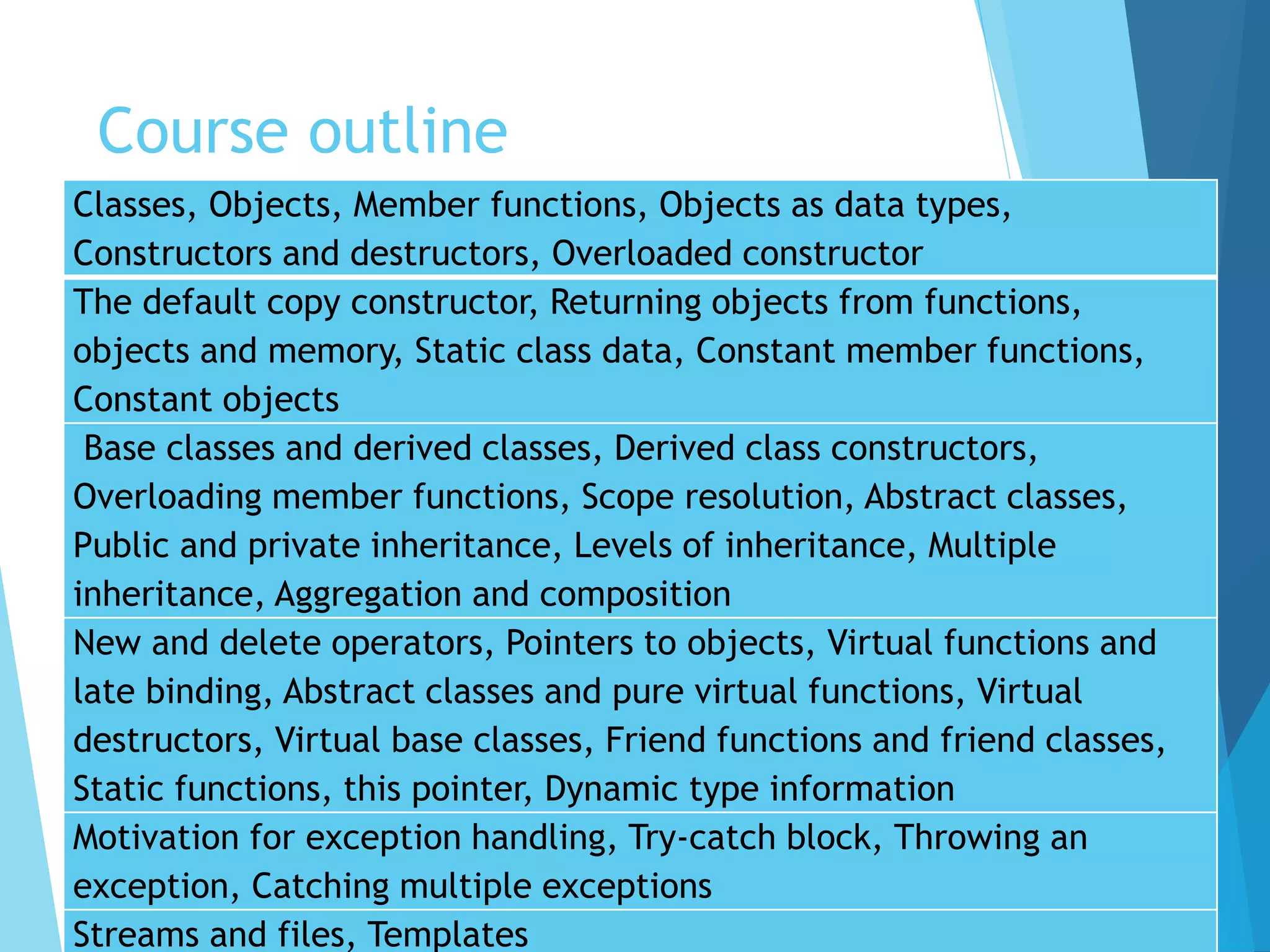
Course outline
Classes, Objects, Member functions, Objects as data types,
Constructors and destructors, Overloaded constructor
The default copy constructor, Returning objects from functions,
objects and memory, Static class data, Constant member functions,
Constant objects
Base classes and derived classes, Derived class constructors,
Overloading member functions, Scope resolution, Abstract classes,
Public and private inheritance, Levels of inheritance, Multiple
inheritance, Aggregation and composition
New and delete operators, Pointers to objects, Virtual functions and
late binding, Abstract classes and pure virtual functions, Virtual
destructors, Virtual base classes, Friend functions and friend classes,
Static functions, this pointer, Dynamic type information
Motivation for exception handling, Try-catch block, Throwing an
exception, Catching multiple exceptions
Streams and files, Templates
Marks distribution
 Assignments/Project: 10%
 Quizzes/Project: 10%
 Attendance: 5%
 Mid Term: 25%
 Final Exam: 50%
What is Object-Orientation?
 A technique for system modeling
 OO model consists of several interacting objects
What is a Model?
 A model is an abstraction of something
 Purpose is to understand the product before developing
it
Examples – Model
 Highway maps
 Architectural models
 Mechanical models
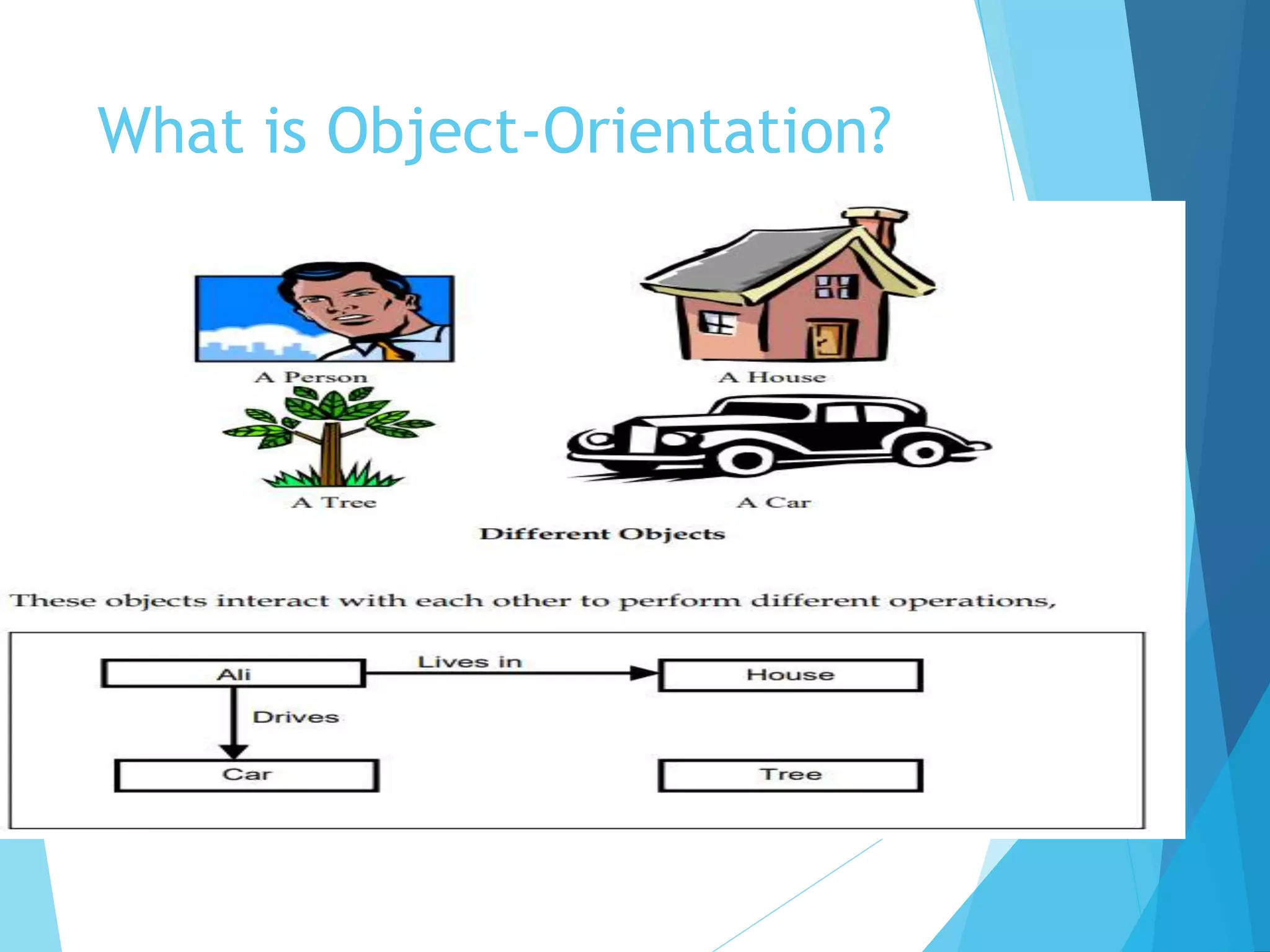
What is Object-Orientation?
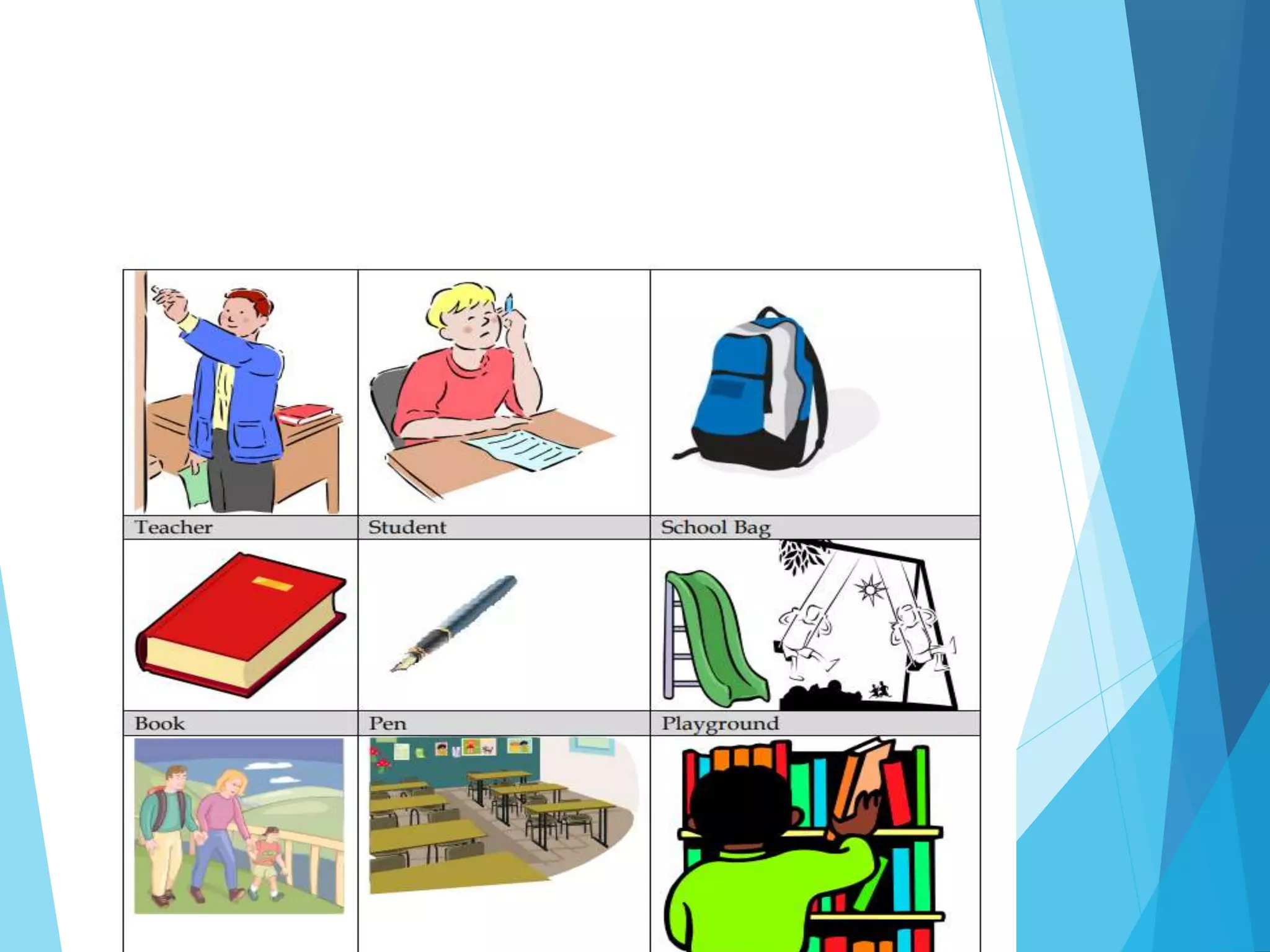
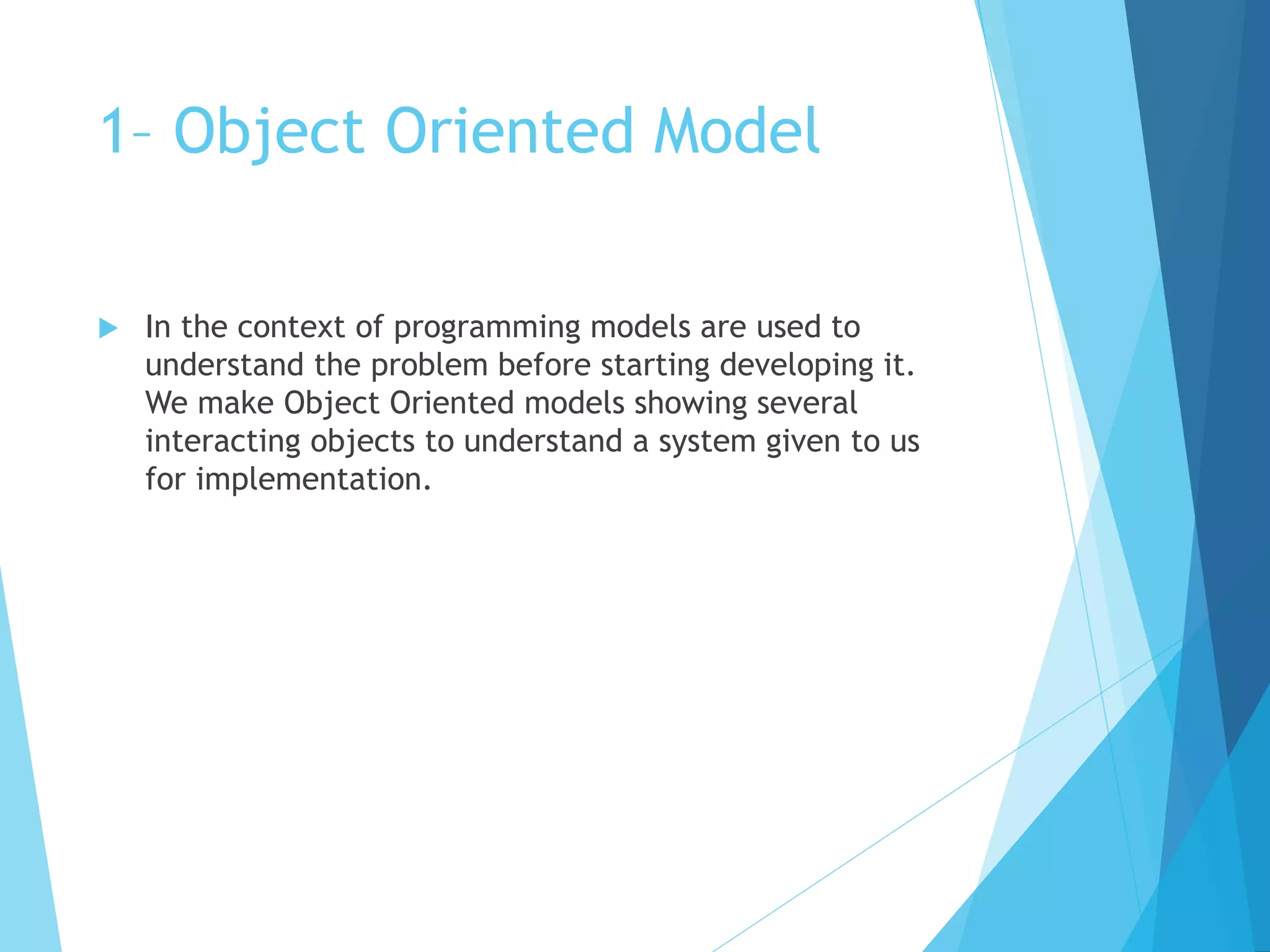
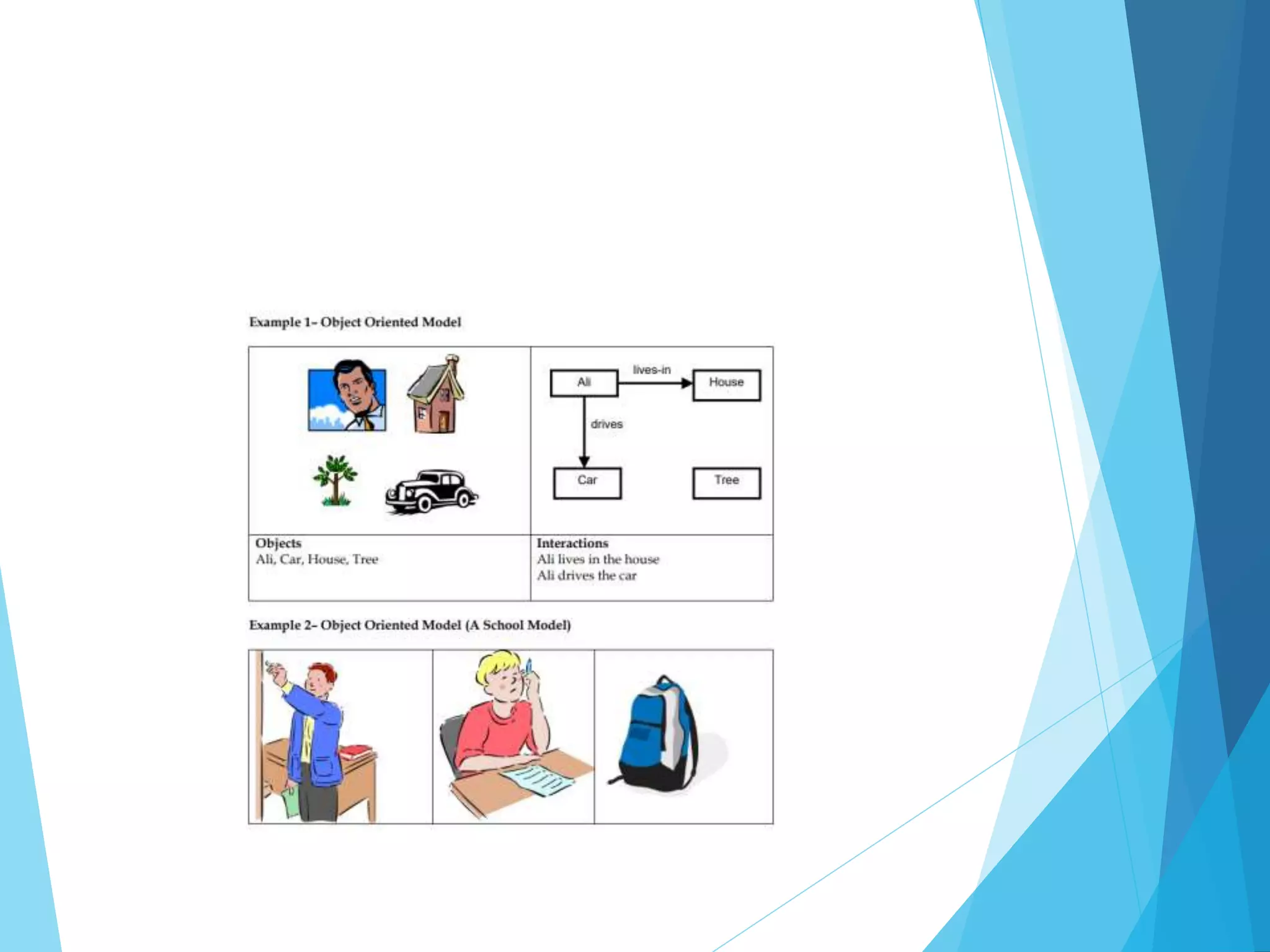
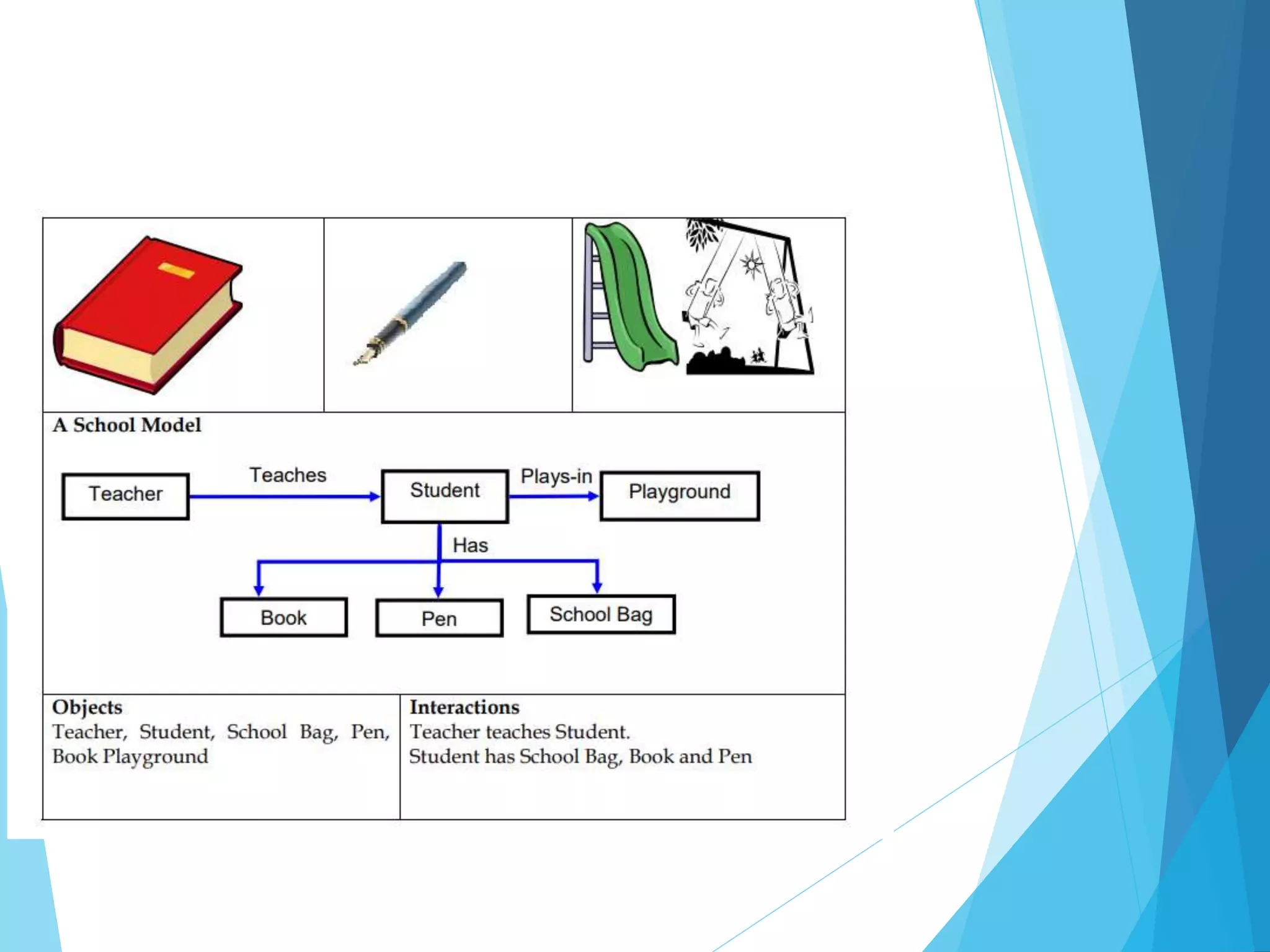
1– Object Oriented Model
 In the context of programming models are used to
understand the problem before starting developing it.
We make Object Oriented models showing several
interacting objects to understand a system given to us
for implementation.
Object-Orientation -
Advantages
 As Object Oriented Models map directly to reality as we
have seen in examples above therefore, We can easily
develop an object oriented model for a problem.
Everyone can easily understand an object oriented
model. We can easily implement an object oriented
model for a problem using any object oriented language
like c++ using its features1 like classes, inheritance,
virtual functions and so on…
What is an Object?
An object is,
 1. Something tangible (Ali, School, House, Car).
 2. Something conceptual (that can be apprehended
intellectually for example time, date and so on…).
An object has,
 1. State (attributes)
 2. Well-defined behavior (operations)
 3. Unique identity
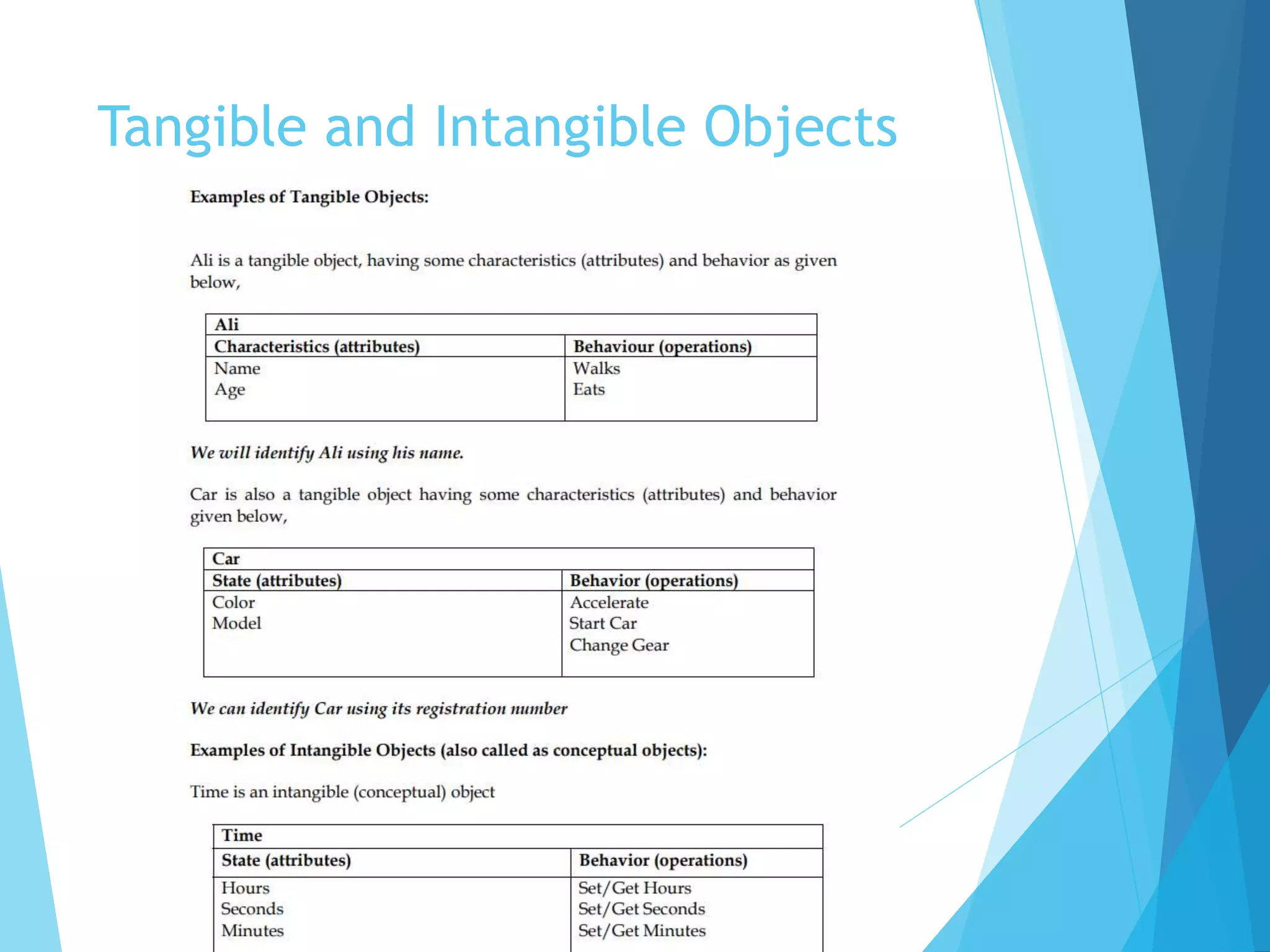
Tangible and Intangible Objects
Introduction
 Five concepts in object oriented programming are:
 Object
 Classes
 Encapsulation
 Inheritance
 Polymorphism
Simple analogy
 You are driving a car
 You are pressing accelerator pedal
 Someone has design it and built it
 Engineering drawings  car
 Drawings also includes design for accelerator pedal to
make car go faster
 We can say, pedal “hides” complex mechanism that
make the car go faster
Cont.
 Brake pedal “hides” the mechanism that slow the car
 Steering wheel “hides” the mechanism that turn the car
and so on
 Simple “interfaces” like accelerator and brake pedal,
steering wheel, transmission shift and etc. allow driver
to interact car’s complex internal mechanisms
Points to be noted
 You cannot drive the engineering design of a car
 Before you can drive a car, it must be built according to
engineering design
 The car will not accelerator on its own, a driver must
press the accelerator pedal
Object oriented programming
concepts
 Function hides from user the complex task it performs
 Same as accelerator pedal hides complex mechanism of
making the car go faster
 C++ makes a program unit called class that houses
various functions
 Same as car engineering design houses the mechanism
of accelerator pedal
Cont.
 In C++, a class can have various functions that are
design to perform a class tasks
 For example, a class representing bank account might
contain functions
 Deposit money
 Withdraw money
 Current balance
Car example
Real world
 Engineering drawing cannot be
drive
 A car is build from that drawing
 Pressing accelerator pedal sends
a message to car to perform task
(go faster)
C++ programming
• An object of a class
must be created to get
a program to perform
the tasks the class
describes
• Message can be sent to
object by calling a
member functions
Cont.
 Car analogy is used to introduce
 Class
 Objects
 Member functions
 In addition to capabilities of car, it has many attributes
 Color, No. of doors, amount of
gas in tank, total miles driven
and etc
 Attributes are part of car engineering drawing
Cont.
 These attribute are always associated with the car
 Every car maintains its own attribute
 Example 1: each car knows how much gas in its own
tank but do not know how much is in the tanks of other
cars
 Example 2: a bank account object has a balance
attribute. Each bank account object knows the balance
in its account not the others
Object
 Look around right now and you'll find many examples of
real-world objects:
 your dog, your desk, your television set, your bicycle.
 Real-world objects share two characteristics: They all
have
 State and
 Behavior
Object example
 A dog x has state (name, color, breed, hungry) and
behavior (barking, fetching, wagging tail).
 Your bicycle also have state (current gear, current pedal
cadence, current speed) and behavior (changing gear,
changing pedal cadence, applying brakes).
Cont.
 For each object that you see, ask yourself two
questions:
 "What possible states can this object be in?" and
 "What possible behavior can this object perform?"
Real world objects
 Real-world objects vary in complexity
your desktop lamp may have only two
possible states (on and off) and two
possible behaviors (turn on, turn off),
but your desktop radio might have
additional states (on, off, current
volume, current station) and behavior
(turn on, turn off, increase volume,
decrease volume, seek, scan, and
tune).
Cont..
 You may also notice that some objects, in turn, will also
contain other objects.
 These real-world observations all translate into the
world of object-oriented programming
Class
 In the real world, you'll often find many individual
objects all of the same kind
 There may be thousands of other bicycles in existence,
all of the same make and model.
 Each bicycle was built from the same engineering design
and contains the same components.
 In object-oriented terms, we say that your bicycle is
an instance of the class of objects known as bicycles.
Software Object
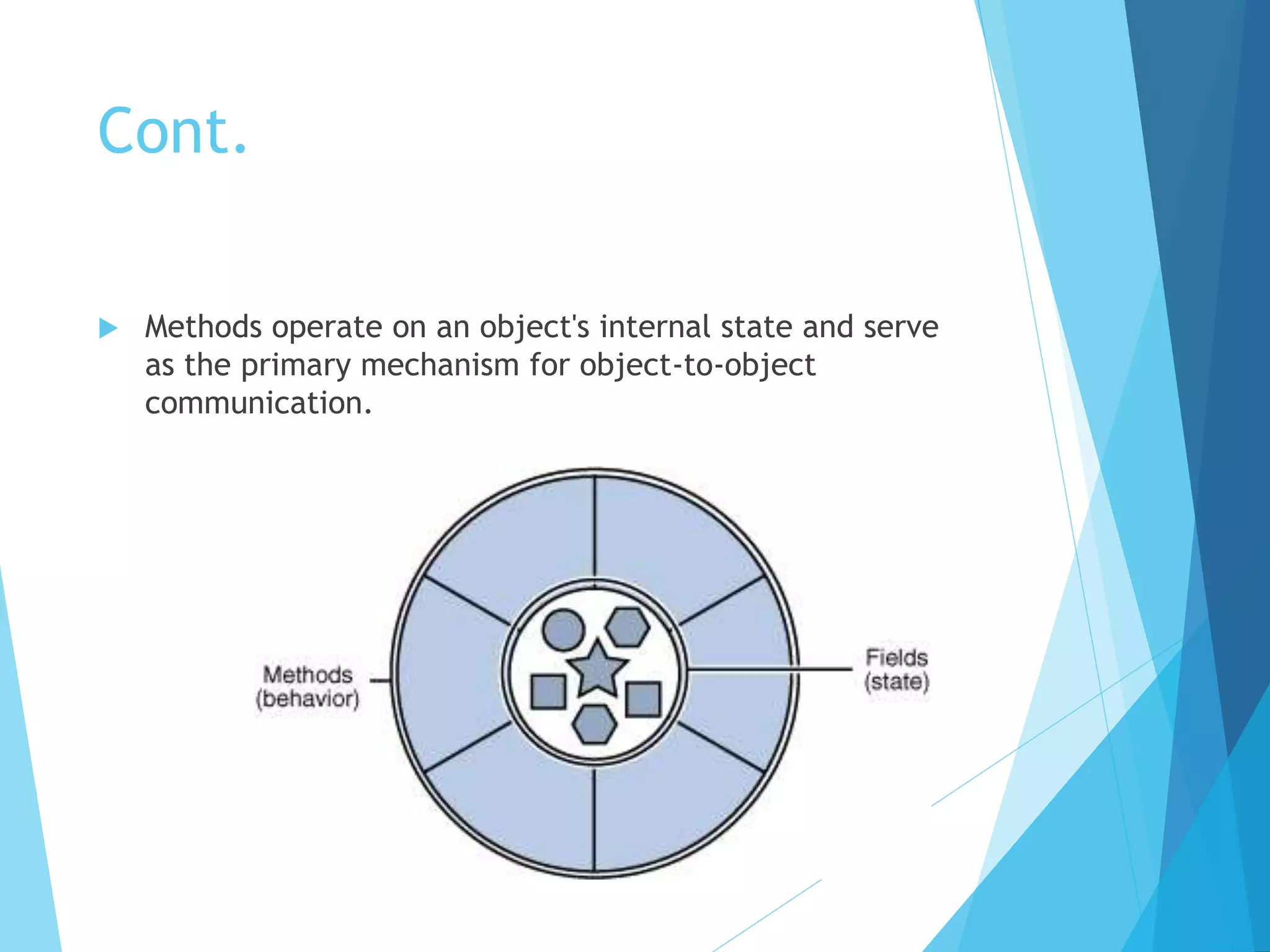
 Software objects are conceptually similar to real-world
objects: they too consist of state and related behavior.
An object stores its state in
 fields (variables in some programming languages)
and exposes its behavior through
 methods (functions in some programming languages). A
Software Object
Cont.
 Methods operate on an object's internal state and serve
as the primary mechanism for object-to-object
communication.
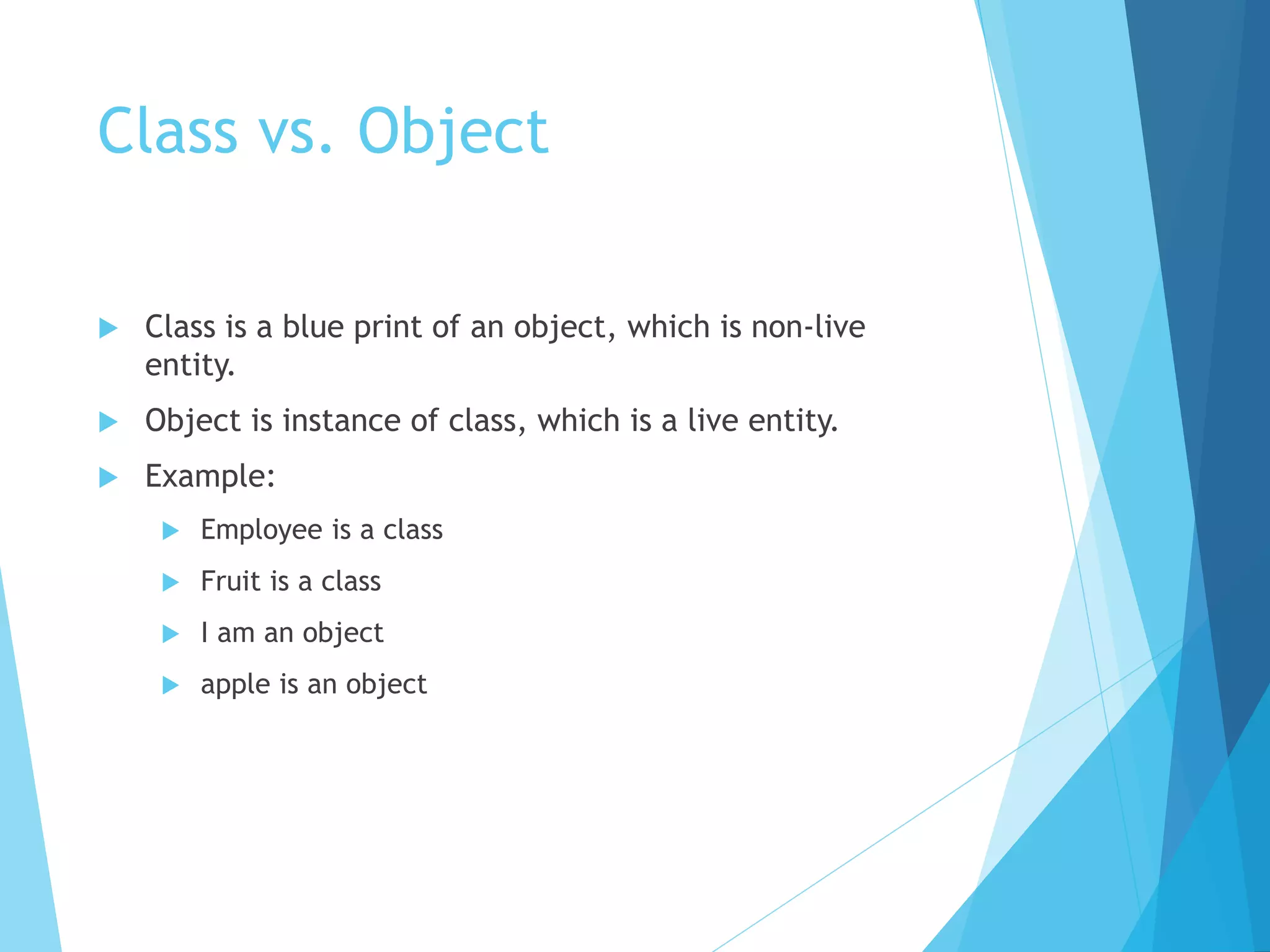
Class vs. Object
 Class is a blue print of an object, which is non-live
entity.
 Object is instance of class, which is a live entity.
 Example:
 Employee is a class
 Fruit is a class
 I am an object
 apple is an object
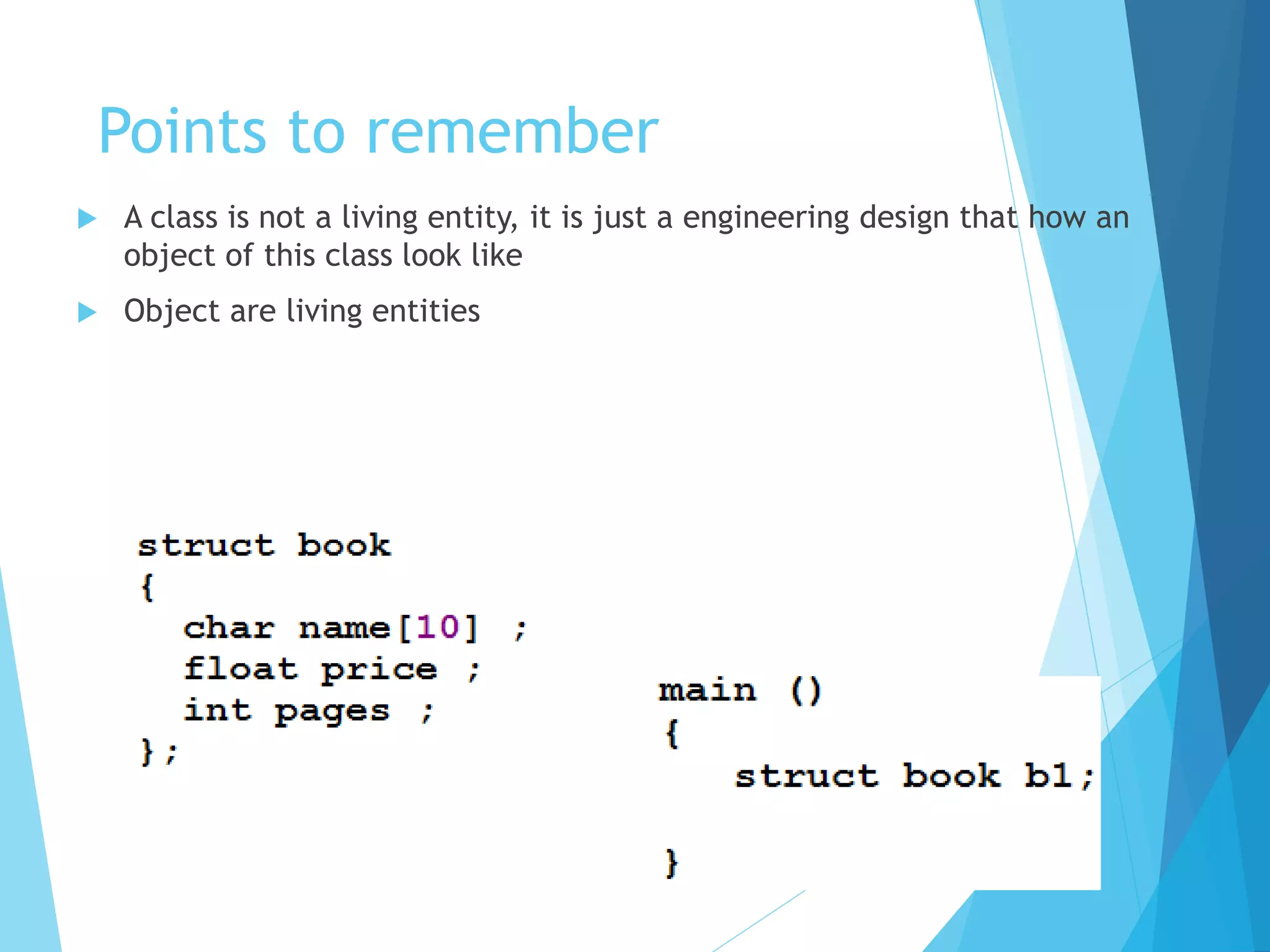
Points to remember
 A class is not a living entity, it is just a engineering design that how an
object of this class look like
 Object are living entities
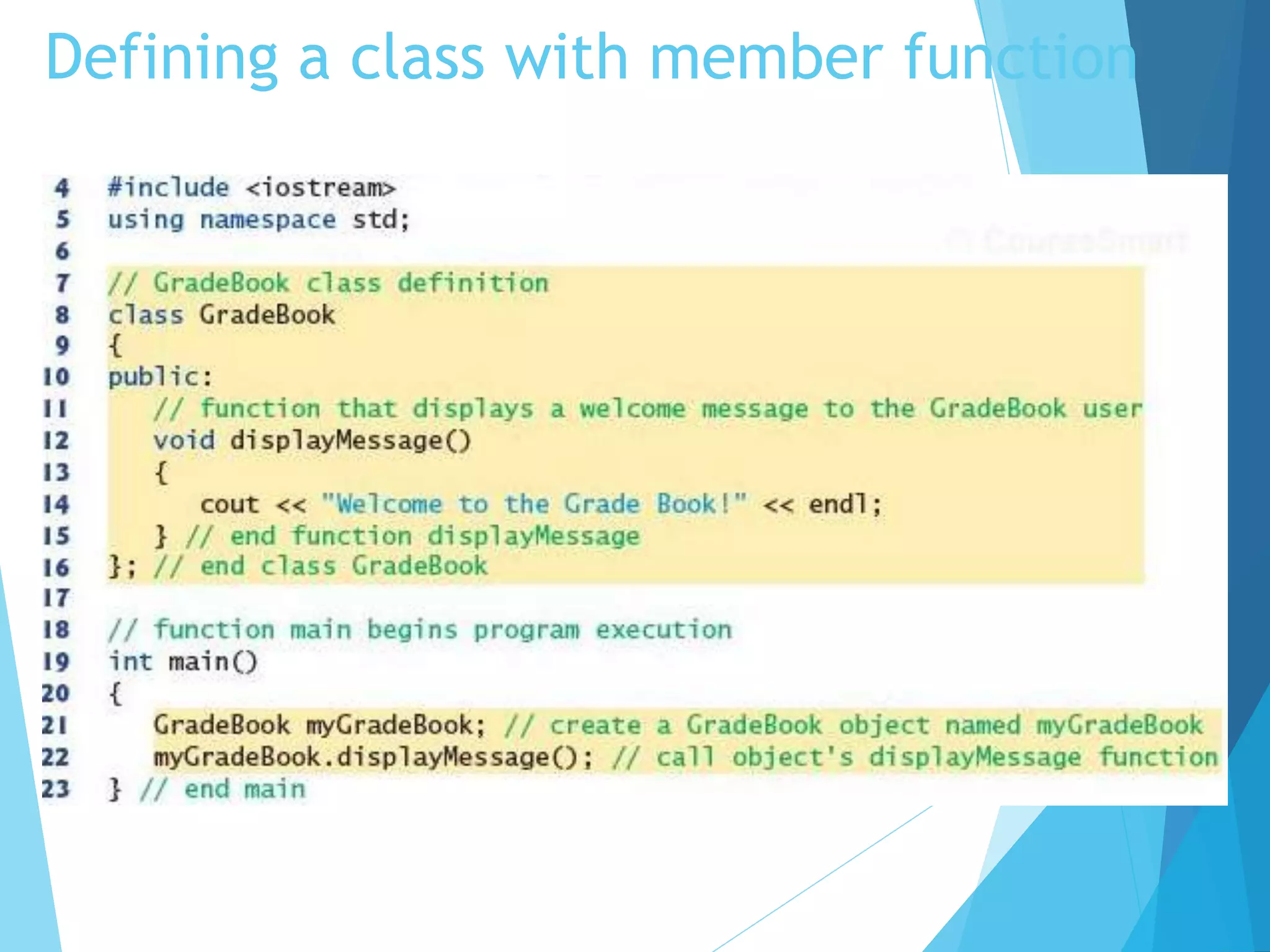
Defining a class with member function
Cont.
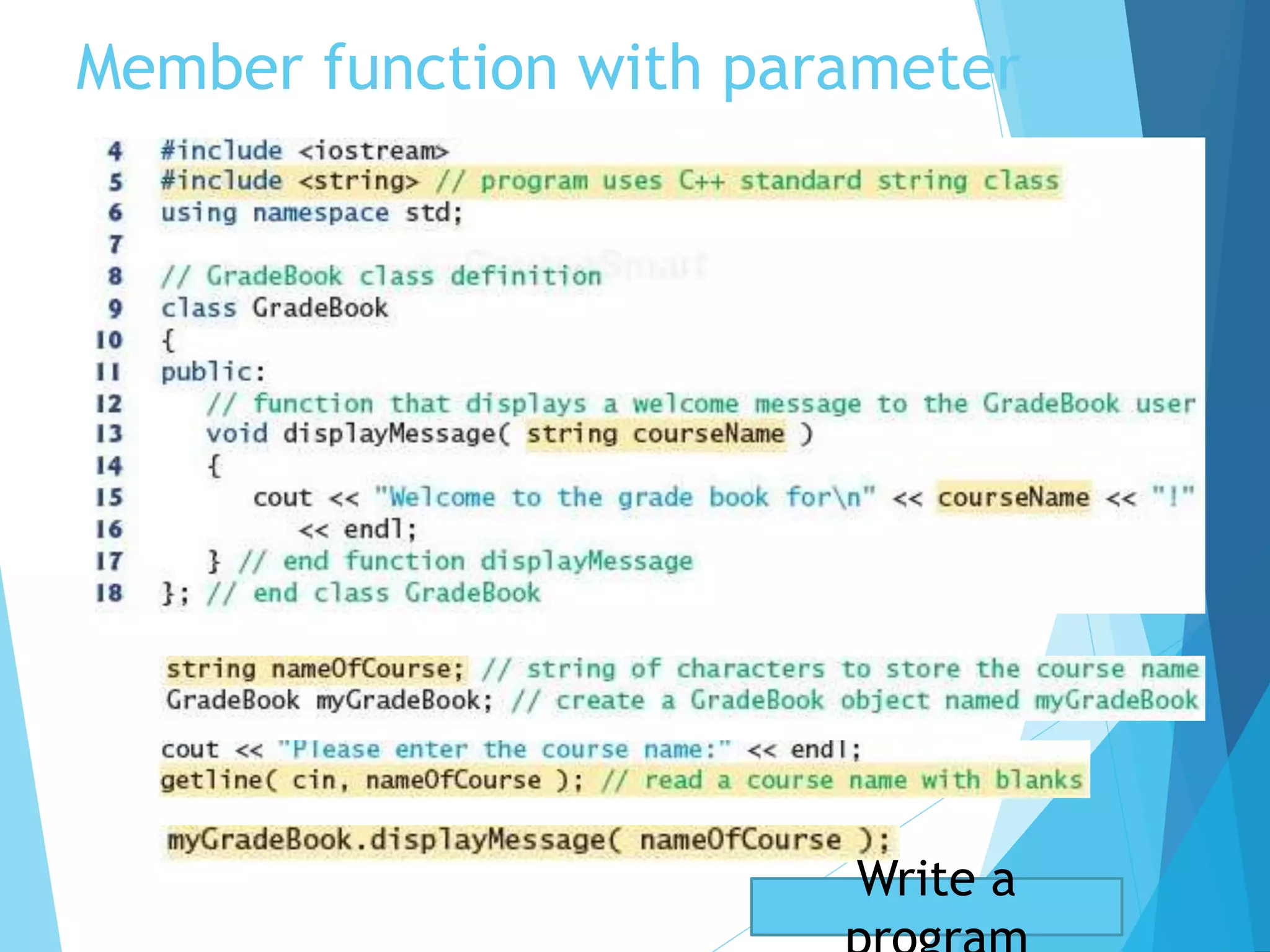
 Class definition
 Access specifier – Public
 Class’s body is enclosed in a pair of { }
 Class definition ends at semi colon
 Member function
 Class object
 Dot operator
Member function with parameter
Write a
#include <iostream.h>
#include <string.h>
class book{
private:
char name[25];
int pages;
float price;
public:
void changeName(char *n){
strcpy(name, n);
}
void changePages(int p){
pages = p;
}
void changePrice(float p){
price = p;
}
void display(){
cout<<"name = "<<name<<" pages = "<<pages<<" price = "<<price<<endl;
}
};
Book Class
Simple
program
Class data
 The class book contain three data items
 char name[15];
 int pages;
 float price;
 There can be any number of data members in a class
just as in structure
 There data member lie under keyword private, so they
can be accessed from within the class, but not outside
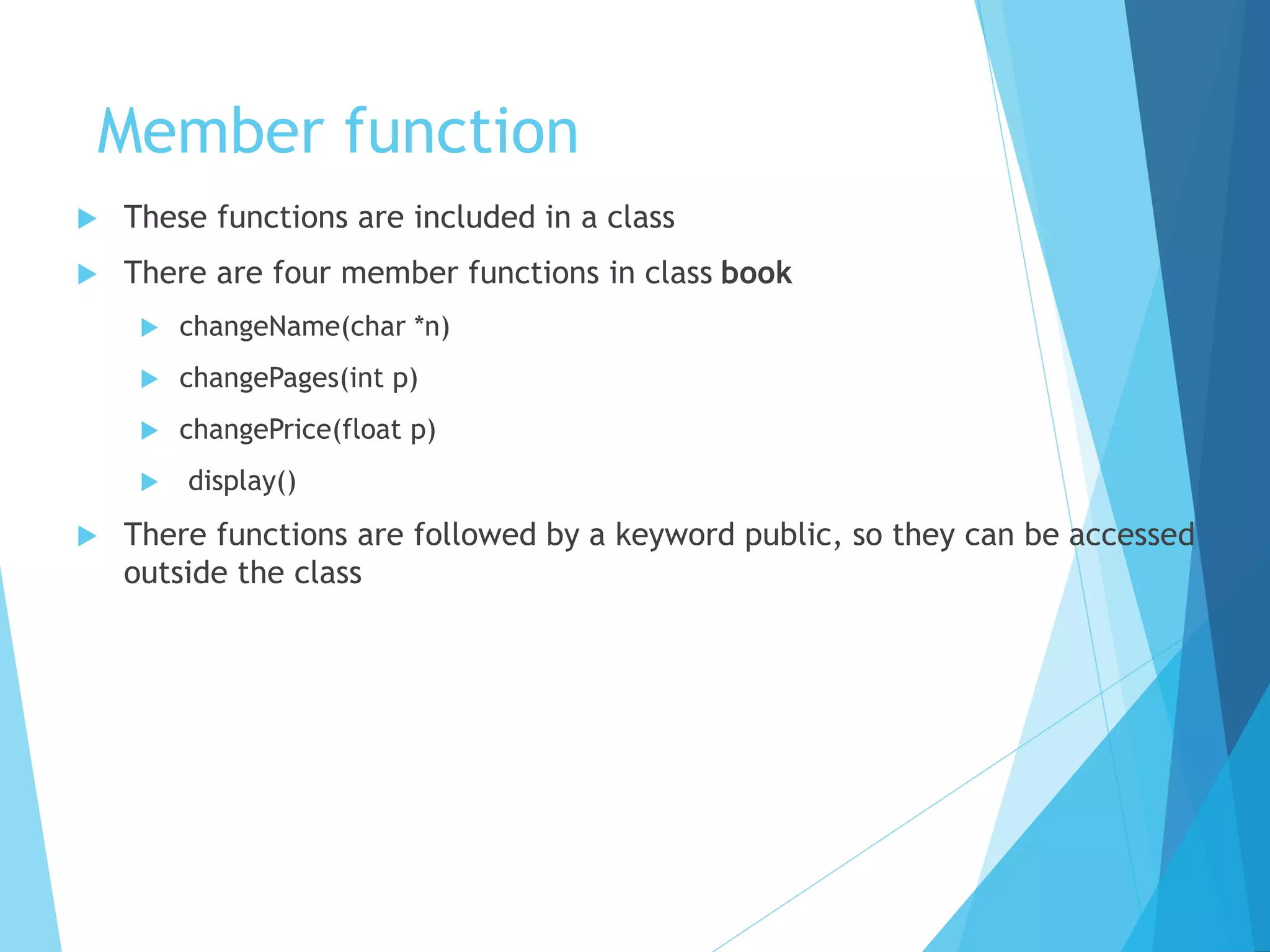
Member function
 These functions are included in a class
 There are four member functions in class book
 changeName(char *n)
 changePages(int p)
 changePrice(float p)
 display()
 There functions are followed by a keyword public, so they can be accessed
outside the class
Class data and member
function
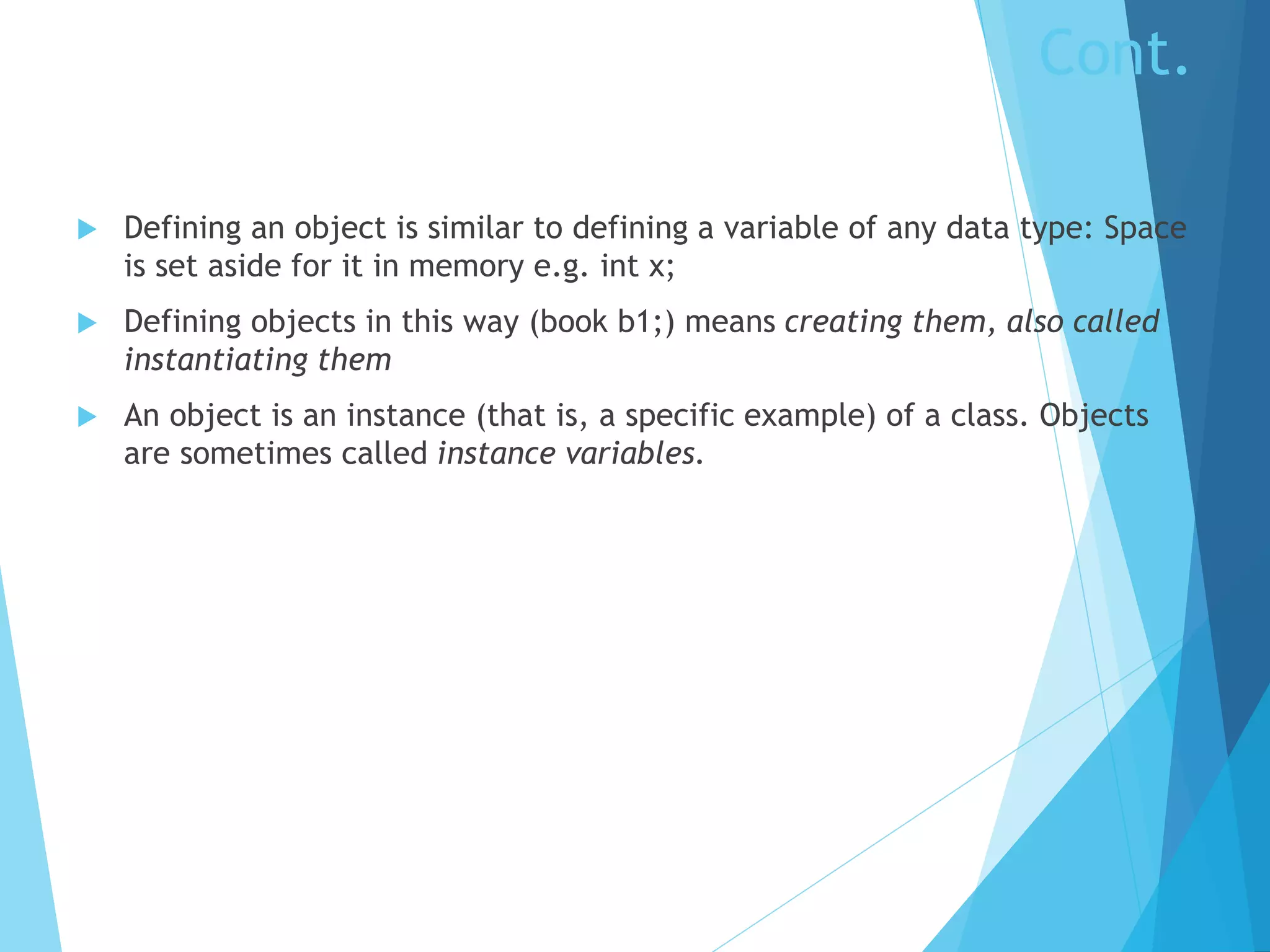
 Access specifier label public and private
 Function are public and data is private
 Data is hidden so that it can be safe from accidental manipulation
 Functions operates on data are public so they can be accessed from
outside the class
Cont.
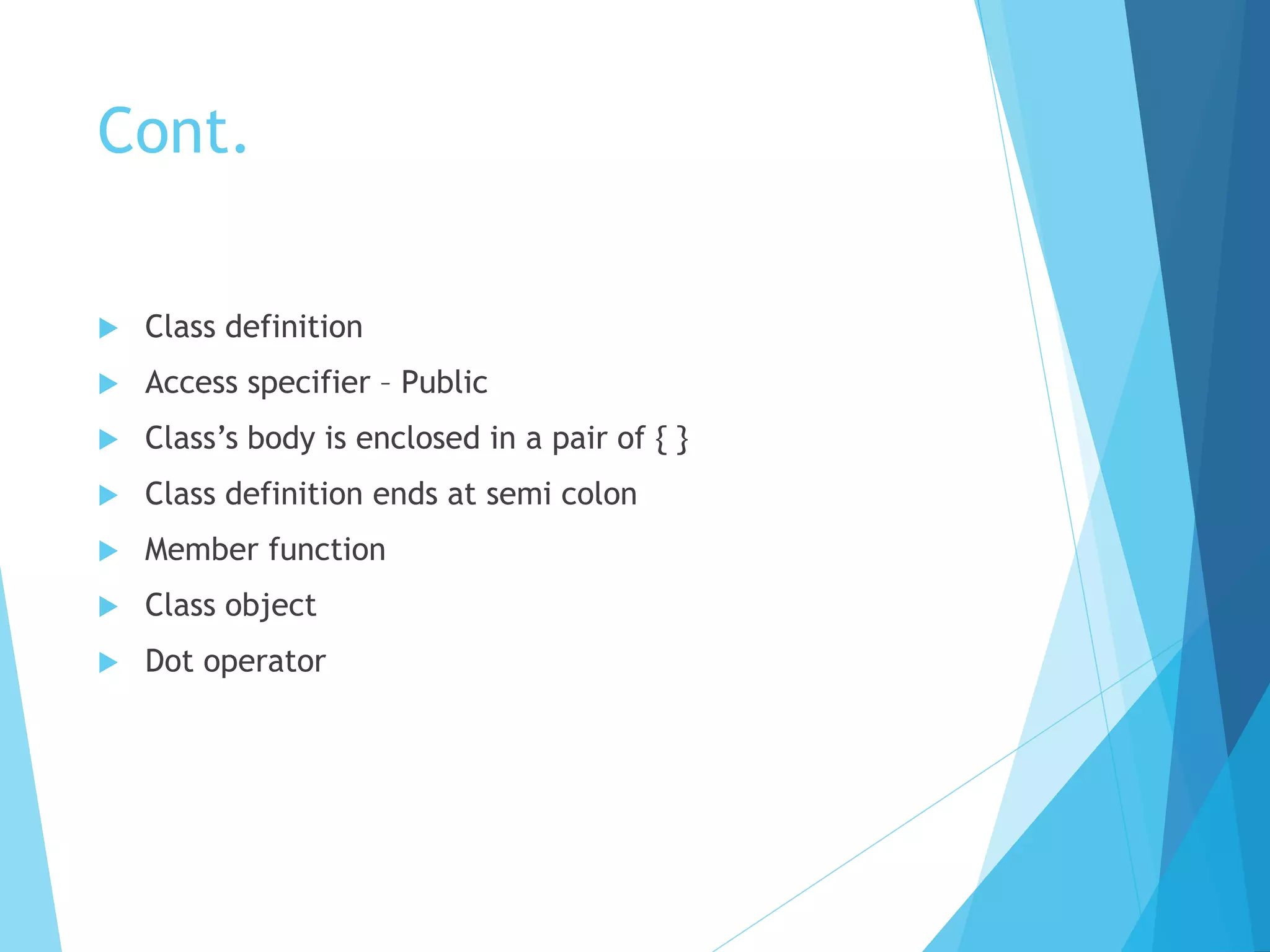
 Defining an object is similar to defining a variable of any data type: Space
is set aside for it in memory e.g. int x;
 Defining objects in this way (book b1;) means creating them, also called
instantiating them
 An object is an instance (that is, a specific example) of a class. Objects
are sometimes called instance variables.

COMP111-Week-1_138439.pptx

  • 1.
  • 2.
    Aim of thecourse  This course provides  motivation of object oriented programming language  in depth knowledge of the various concepts of object oriented programming and its implementation in C++
  • 3.
    Course book  Textbook  C++ How to program by Deitel and Deitel  Reference books  Waite Group’s Object oriented programming in C++, Robert Lafore  The C++ Programming Language By Bjarne Stroustrup  Object-Oriented Software Engineering By Jacobson, Christerson, Jonsson, Overgaard
  • 4.
    Course outline Classes, Objects,Member functions, Objects as data types, Constructors and destructors, Overloaded constructor The default copy constructor, Returning objects from functions, objects and memory, Static class data, Constant member functions, Constant objects Base classes and derived classes, Derived class constructors, Overloading member functions, Scope resolution, Abstract classes, Public and private inheritance, Levels of inheritance, Multiple inheritance, Aggregation and composition New and delete operators, Pointers to objects, Virtual functions and late binding, Abstract classes and pure virtual functions, Virtual destructors, Virtual base classes, Friend functions and friend classes, Static functions, this pointer, Dynamic type information Motivation for exception handling, Try-catch block, Throwing an exception, Catching multiple exceptions Streams and files, Templates
  • 5.
    Marks distribution  Assignments/Project:10%  Quizzes/Project: 10%  Attendance: 5%  Mid Term: 25%  Final Exam: 50%
  • 6.
    What is Object-Orientation? A technique for system modeling  OO model consists of several interacting objects
  • 7.
    What is aModel?  A model is an abstraction of something  Purpose is to understand the product before developing it
  • 8.
    Examples – Model Highway maps  Architectural models  Mechanical models
  • 9.
  • 11.
    1– Object OrientedModel  In the context of programming models are used to understand the problem before starting developing it. We make Object Oriented models showing several interacting objects to understand a system given to us for implementation.
  • 14.
    Object-Orientation - Advantages  AsObject Oriented Models map directly to reality as we have seen in examples above therefore, We can easily develop an object oriented model for a problem. Everyone can easily understand an object oriented model. We can easily implement an object oriented model for a problem using any object oriented language like c++ using its features1 like classes, inheritance, virtual functions and so on…
  • 15.
    What is anObject? An object is,  1. Something tangible (Ali, School, House, Car).  2. Something conceptual (that can be apprehended intellectually for example time, date and so on…). An object has,  1. State (attributes)  2. Well-defined behavior (operations)  3. Unique identity
  • 16.
  • 17.
    Introduction  Five conceptsin object oriented programming are:  Object  Classes  Encapsulation  Inheritance  Polymorphism
  • 18.
    Simple analogy  Youare driving a car  You are pressing accelerator pedal  Someone has design it and built it  Engineering drawings  car  Drawings also includes design for accelerator pedal to make car go faster  We can say, pedal “hides” complex mechanism that make the car go faster
  • 19.
    Cont.  Brake pedal“hides” the mechanism that slow the car  Steering wheel “hides” the mechanism that turn the car and so on  Simple “interfaces” like accelerator and brake pedal, steering wheel, transmission shift and etc. allow driver to interact car’s complex internal mechanisms
  • 20.
    Points to benoted  You cannot drive the engineering design of a car  Before you can drive a car, it must be built according to engineering design  The car will not accelerator on its own, a driver must press the accelerator pedal
  • 21.
    Object oriented programming concepts Function hides from user the complex task it performs  Same as accelerator pedal hides complex mechanism of making the car go faster  C++ makes a program unit called class that houses various functions  Same as car engineering design houses the mechanism of accelerator pedal
  • 22.
    Cont.  In C++,a class can have various functions that are design to perform a class tasks  For example, a class representing bank account might contain functions  Deposit money  Withdraw money  Current balance
  • 23.
    Car example Real world Engineering drawing cannot be drive  A car is build from that drawing  Pressing accelerator pedal sends a message to car to perform task (go faster) C++ programming • An object of a class must be created to get a program to perform the tasks the class describes • Message can be sent to object by calling a member functions
  • 24.
    Cont.  Car analogyis used to introduce  Class  Objects  Member functions  In addition to capabilities of car, it has many attributes  Color, No. of doors, amount of gas in tank, total miles driven and etc  Attributes are part of car engineering drawing
  • 25.
    Cont.  These attributeare always associated with the car  Every car maintains its own attribute  Example 1: each car knows how much gas in its own tank but do not know how much is in the tanks of other cars  Example 2: a bank account object has a balance attribute. Each bank account object knows the balance in its account not the others
  • 26.
    Object  Look aroundright now and you'll find many examples of real-world objects:  your dog, your desk, your television set, your bicycle.  Real-world objects share two characteristics: They all have  State and  Behavior
  • 27.
    Object example  Adog x has state (name, color, breed, hungry) and behavior (barking, fetching, wagging tail).  Your bicycle also have state (current gear, current pedal cadence, current speed) and behavior (changing gear, changing pedal cadence, applying brakes).
  • 28.
    Cont.  For eachobject that you see, ask yourself two questions:  "What possible states can this object be in?" and  "What possible behavior can this object perform?"
  • 29.
    Real world objects Real-world objects vary in complexity your desktop lamp may have only two possible states (on and off) and two possible behaviors (turn on, turn off), but your desktop radio might have additional states (on, off, current volume, current station) and behavior (turn on, turn off, increase volume, decrease volume, seek, scan, and tune).
  • 30.
    Cont..  You mayalso notice that some objects, in turn, will also contain other objects.  These real-world observations all translate into the world of object-oriented programming
  • 31.
    Class  In thereal world, you'll often find many individual objects all of the same kind  There may be thousands of other bicycles in existence, all of the same make and model.  Each bicycle was built from the same engineering design and contains the same components.  In object-oriented terms, we say that your bicycle is an instance of the class of objects known as bicycles.
  • 32.
    Software Object  Softwareobjects are conceptually similar to real-world objects: they too consist of state and related behavior. An object stores its state in  fields (variables in some programming languages) and exposes its behavior through  methods (functions in some programming languages). A Software Object
  • 33.
    Cont.  Methods operateon an object's internal state and serve as the primary mechanism for object-to-object communication.
  • 34.
    Class vs. Object Class is a blue print of an object, which is non-live entity.  Object is instance of class, which is a live entity.  Example:  Employee is a class  Fruit is a class  I am an object  apple is an object
  • 35.
    Points to remember A class is not a living entity, it is just a engineering design that how an object of this class look like  Object are living entities
  • 36.
    Defining a classwith member function
  • 37.
    Cont.  Class definition Access specifier – Public  Class’s body is enclosed in a pair of { }  Class definition ends at semi colon  Member function  Class object  Dot operator
  • 38.
    Member function withparameter Write a
  • 39.
    #include <iostream.h> #include <string.h> classbook{ private: char name[25]; int pages; float price; public: void changeName(char *n){ strcpy(name, n); } void changePages(int p){ pages = p; } void changePrice(float p){ price = p; } void display(){ cout<<"name = "<<name<<" pages = "<<pages<<" price = "<<price<<endl; } }; Book Class Simple program
  • 40.
    Class data  Theclass book contain three data items  char name[15];  int pages;  float price;  There can be any number of data members in a class just as in structure  There data member lie under keyword private, so they can be accessed from within the class, but not outside
  • 41.
    Member function  Thesefunctions are included in a class  There are four member functions in class book  changeName(char *n)  changePages(int p)  changePrice(float p)  display()  There functions are followed by a keyword public, so they can be accessed outside the class
  • 42.
    Class data andmember function  Access specifier label public and private  Function are public and data is private  Data is hidden so that it can be safe from accidental manipulation  Functions operates on data are public so they can be accessed from outside the class
  • 43.
    Cont.  Defining anobject is similar to defining a variable of any data type: Space is set aside for it in memory e.g. int x;  Defining objects in this way (book b1;) means creating them, also called instantiating them  An object is an instance (that is, a specific example) of a class. Objects are sometimes called instance variables.