Certification Exam 
Objectives: N10-005 
INTRODUCTION 
The CompTIA Network+ certification is an internationally recognized validation of the technical 
knowledge required of foundation-level IT network practitioners. 
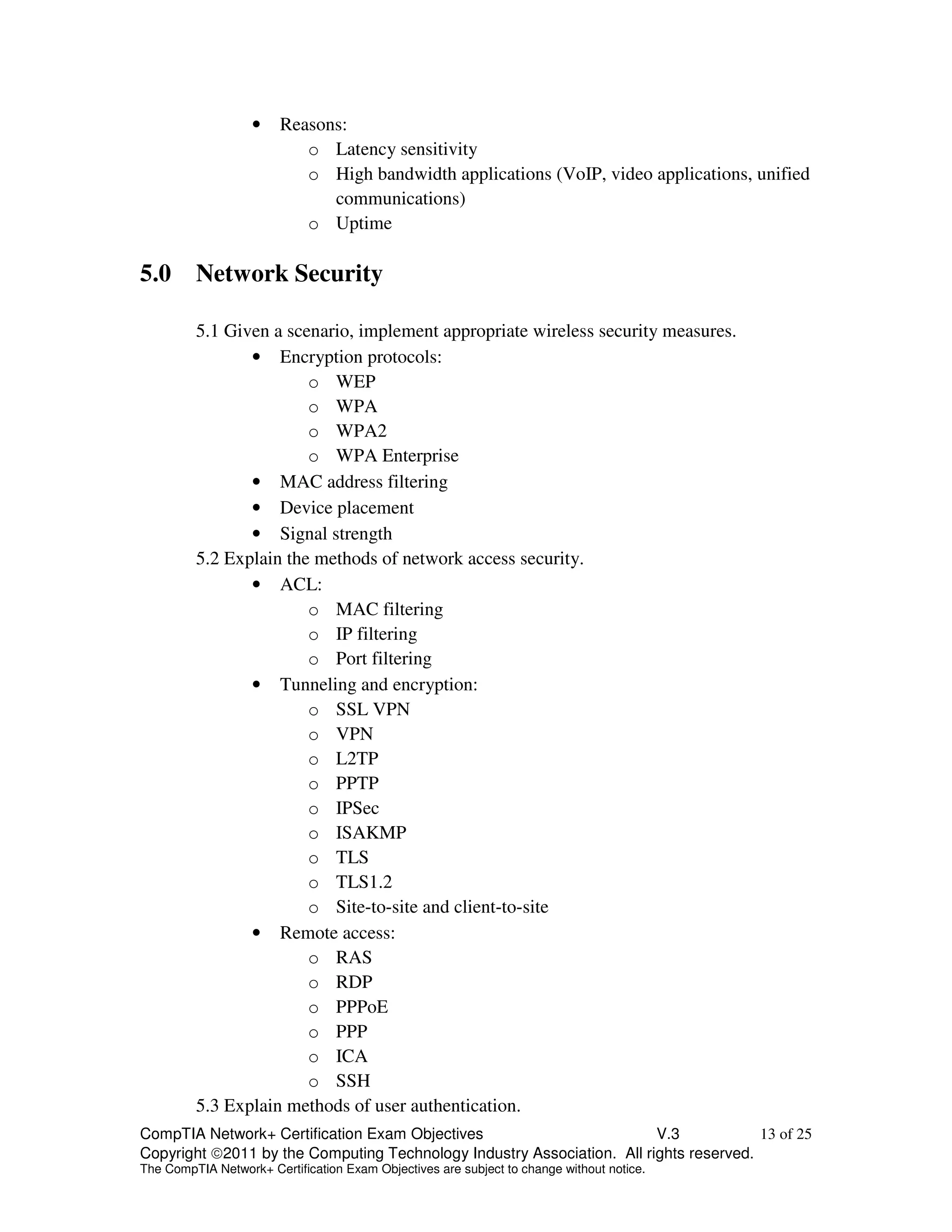
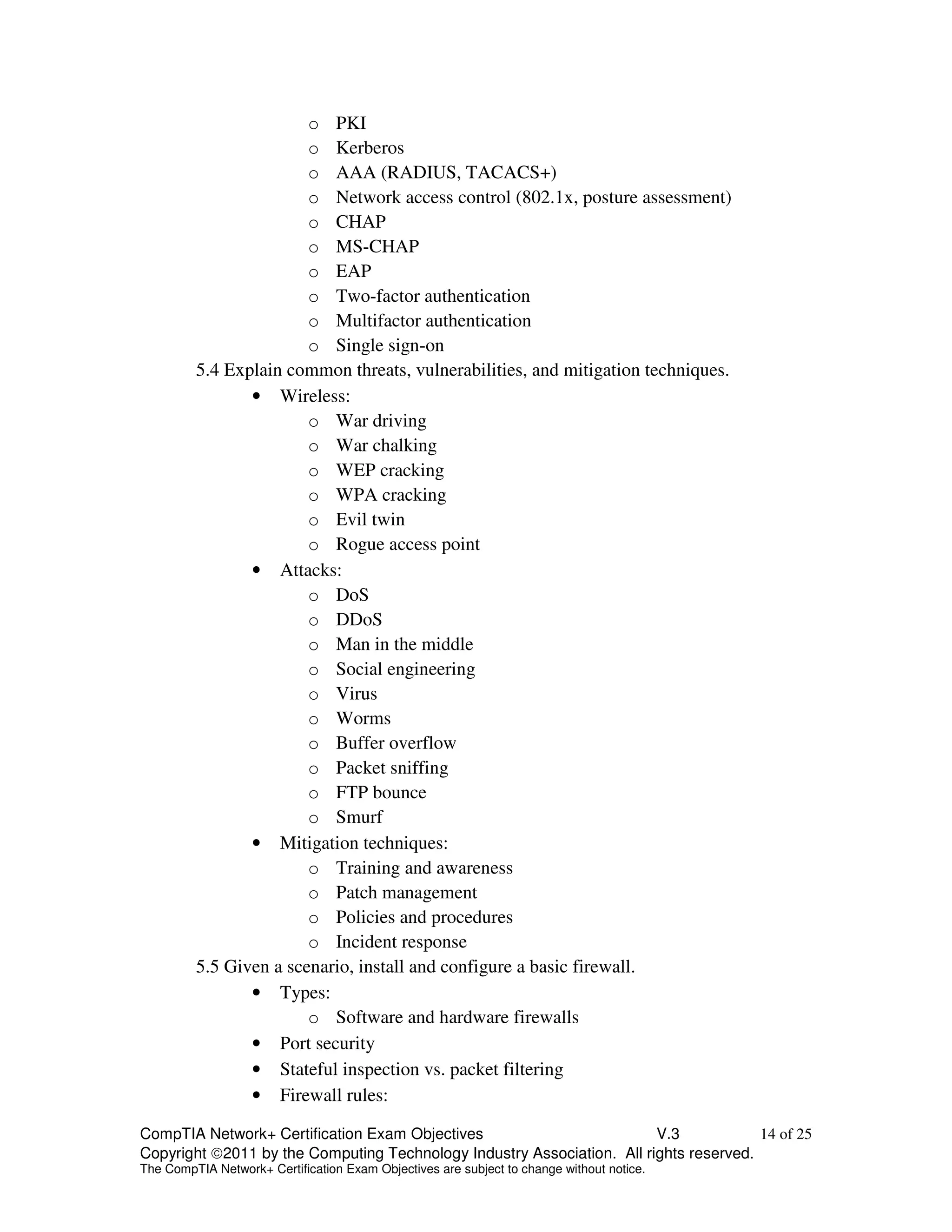
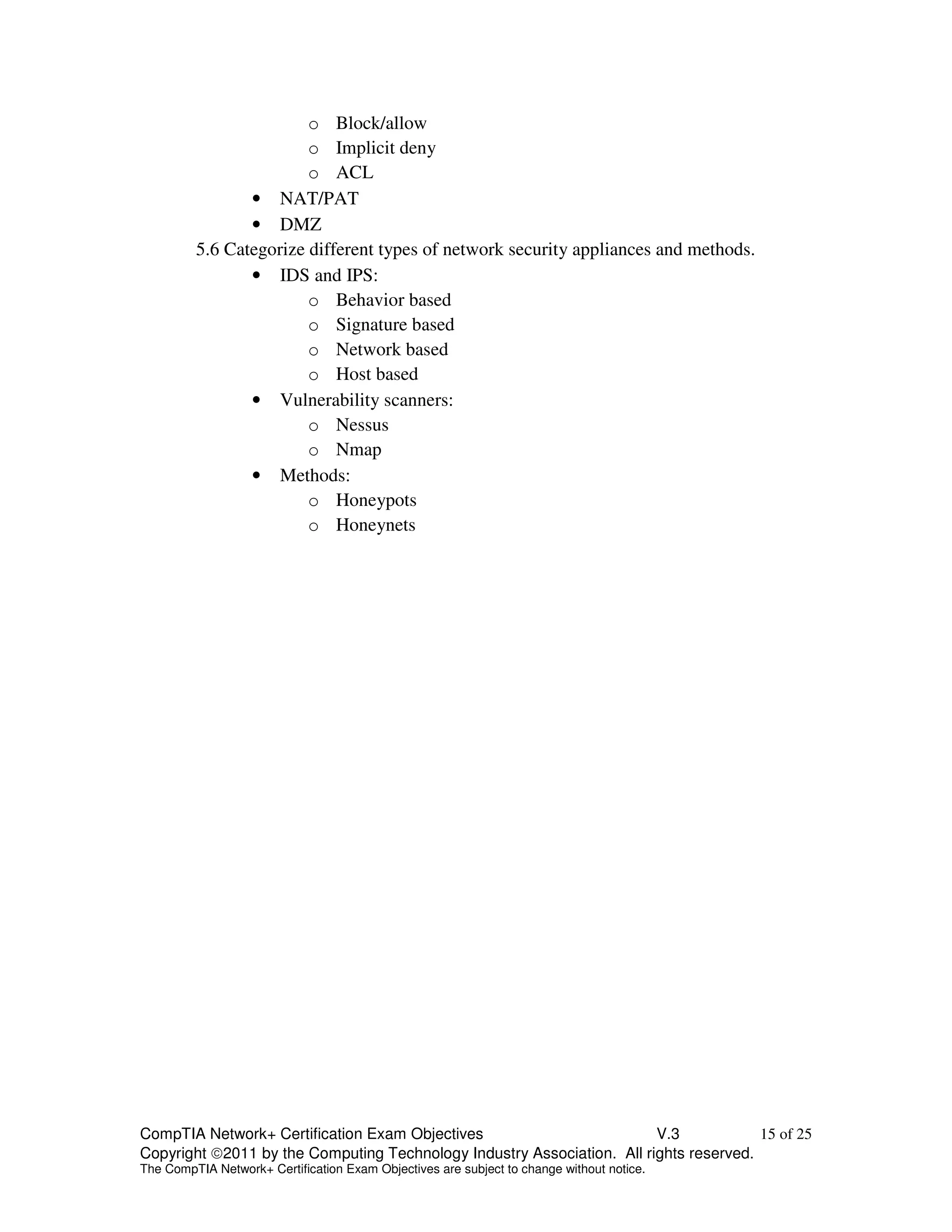
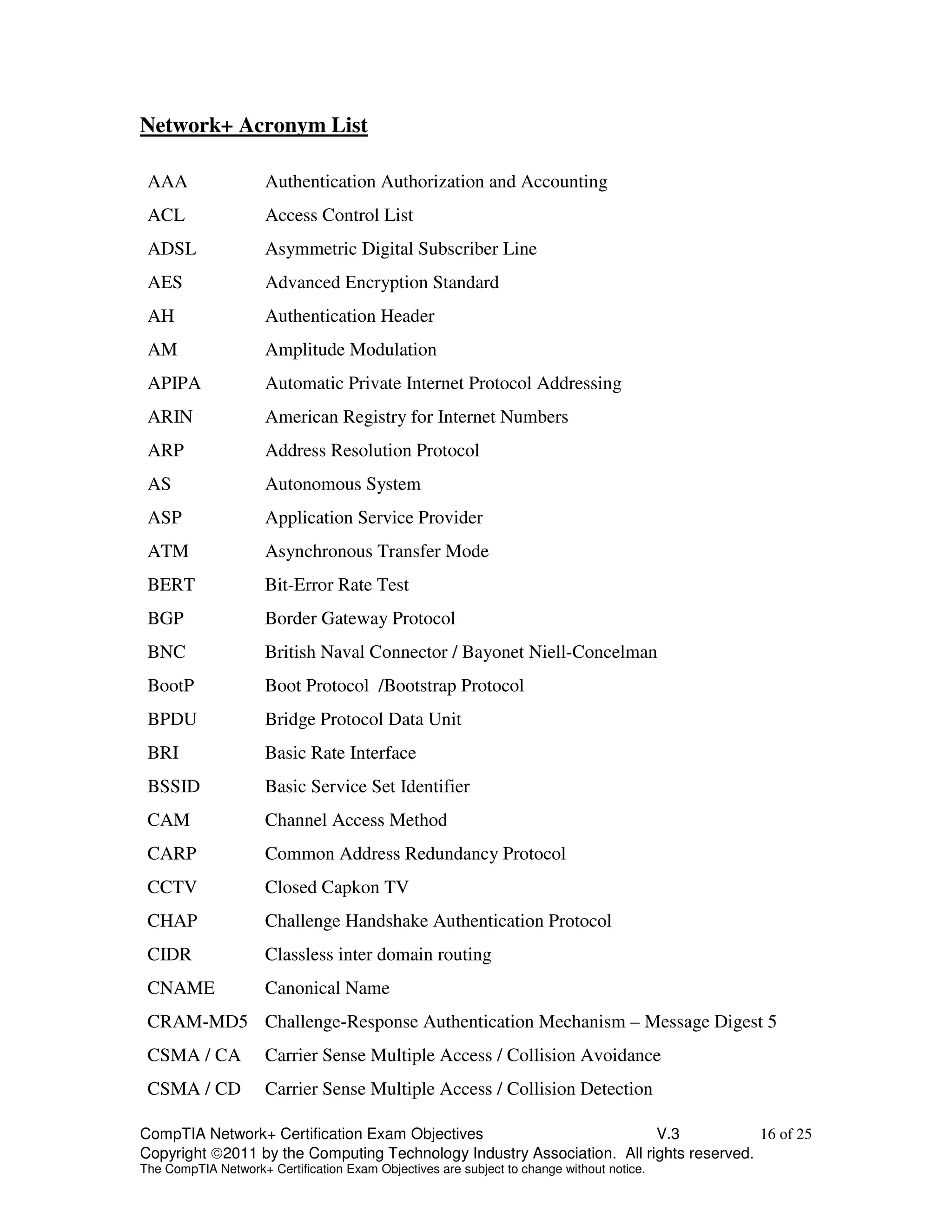
Test Purpose: This exam will certify that the successful candidate has the knowledge and skills 
required to implement a defined network architecture with basic network security. Furthermore, a 
successful candidate will be able to configure, maintain, and troubleshoot network devices using 
appropriate network tools and understand the features and purpose of network technologies. 
Candidates will be able to make basic solution recommendations, analyze network traffic, and be 
familiar with common protocols and media types. 
CompTIA Network+ is accredited by ANSI to show compliance with the ISO 17024 Standard and, 
as such, undergoes regular reviews and updates to the exam objectives. 
It is recommended for CompTIA Network+ candidates to have the following: 
• CompTIA A+ certification or equivalent knowledge, though CompTIA A+ 
certification is not required. 
• Have at least 9 to 12 months of work experience in IT networking. 
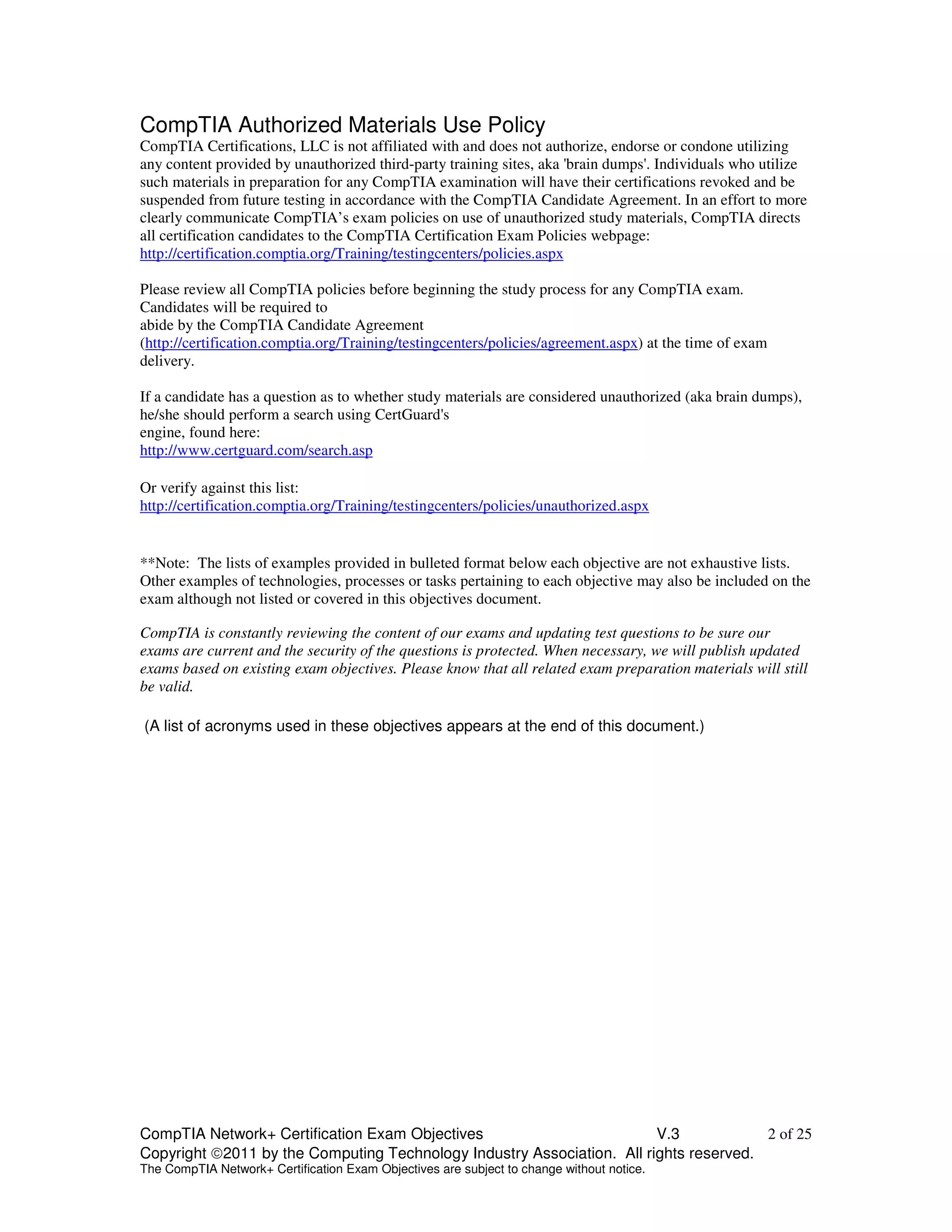
The table below lists the domains measured by this examination and the extent to which 
they are represented. CompTIA Network+ exams are based on these objectives. 
Domain % of Examination 
1.0 Network Concepts 21% 
2.0 Network Installation and Configuration 23% 
3.0 Network Media and Topologies 17% 
4.0 Network Management 20% 
5.0 Network Security 19% 
Total 100% 
CompTIA Network+ Certification Exam Objectives V.3 1 of 25 
Copyright 2011 by the Computing Technology Industry Association. All rights reserved. 
The CompTIA Network+ Certification Exam Objectives are subject to change without notice.
CompTIA Authorized Materials Use Policy 
CompTIA Certifications, LLC is not affiliated with and does not authorize, endorse or condone utilizing 
any content provided by unauthorized third-party training sites, aka 'brain dumps'. Individuals who utilize 
such materials in preparation for any CompTIA examination will have their certifications revoked and be 
suspended from future testing in accordance with the CompTIA Candidate Agreement. In an effort to more 
clearly communicate CompTIA’s exam policies on use of unauthorized study materials, CompTIA directs 
all certification candidates to the CompTIA Certification Exam Policies webpage: 
http://certification.comptia.org/Training/testingcenters/policies.aspx 
Please review all CompTIA policies before beginning the study process for any CompTIA exam. 
Candidates will be required to 
abide by the CompTIA Candidate Agreement 
(http://certification.comptia.org/Training/testingcenters/policies/agreement.aspx) at the time of exam 
delivery. 
If a candidate has a question as to whether study materials are considered unauthorized (aka brain dumps), 
he/she should perform a search using CertGuard's 
engine, found here: 
http://www.certguard.com/search.asp 
Or verify against this list: 
http://certification.comptia.org/Training/testingcenters/policies/unauthorized.aspx 
**Note: The lists of examples provided in bulleted format below each objective are not exhaustive lists. 
Other examples of technologies, processes or tasks pertaining to each objective may also be included on the 
exam although not listed or covered in this objectives document. 
CompTIA is constantly reviewing the content of our exams and updating test questions to be sure our 
exams are current and the security of the questions is protected. When necessary, we will publish updated 
exams based on existing exam objectives. Please know that all related exam preparation materials will still 
be valid. 
(A list of acronyms used in these objectives appears at the end of this document.) 
CompTIA Network+ Certification Exam Objectives V.3 2 of 25 
Copyright 2011 by the Computing Technology Industry Association. All rights reserved. 
The CompTIA Network+ Certification Exam Objectives are subject to change without notice.
Networking Concepts 
1.1 Compare the layers of the OSI and TCP/IP models. 
• OSI model: 
o Layer 1 – Physical 
o Layer 2 – Data link 
o Layer 3 – Network 
o Layer 4 – Transport 
o Layer 5 – Session 
o Layer 6 – Presentation 
o Layer 7 – Application 
• TCP/IP model: 
o Network Interface Layer 
o Internet Layer 
o Transport Layer 
o Application Layer 
 (Also described as: Link Layer, Internet Layer, 
Transport Layer, Application Layer) 
1.2 Classify how applications, devices, and protocols relate to the OSI model 
layers. 
• MAC address 
• IP address 
• EUI-64 
• Frames 
• Packets 
• Switch 
• Router 
• Multilayer switch 
• Hub 
• Encryption devices 
• Cable 
• NIC 
• Bridge 
1.3 Explain the purpose and properties of IP addressing. 
• Classes of addresses 
o A, B, C and D 
o Public vs. Private 
• Classless (CIDR) 
• IPv4 vs. IPv6 (formatting) 
CompTIA Network+ Certification Exam Objectives V.3 3 of 25 
Copyright 2011 by the Computing Technology Industry Association. All rights reserved. 
The CompTIA Network+ Certification Exam Objectives are subject to change without notice.
• MAC address format 
• Subnetting 
• Multicast vs. unicast vs. broadcast 
• APIPA 
1.4 Explain the purpose and properties of routing and switching. 
• EIGRP 
• OSPF 
• RIP 
• Link state vs. distance vector vs. hybrid 
• Static vs. dynamic 
• Routing metrics 
o Hop counts 
o MTU, bandwidth 
o Costs 
o Latency 
• Next hop 
• Spanning Tree Protocol 
• VLAN (802.1q) 
• Port mirroring 
• Broadcast domain vs. collision domain 
• IGP vs. EGP 
• Routing tables 
• Convergence (steady state) 
1.5 Identify common TCP and UDP default ports. 
• SMTP – 25 
• HTTP – 80 
• HTTPS – 443 
• FTP – 20, 21 
• TELNET – 23 
• IMAP – 143 
• RDP – 3389 
• SSH – 22 
• DNS – 53 
• DHCP – 67, 68 
• POP3-110 
1.6 Explain the function of common networking protocols. 
• TCP 
• FTP 
• UDP 
CompTIA Network+ Certification Exam Objectives V.3 4 of 25 
Copyright 2011 by the Computing Technology Industry Association. All rights reserved. 
The CompTIA Network+ Certification Exam Objectives are subject to change without notice.
• TCP/IP suite 
• DHCP 
• TFTP 
• DNS 
• HTTPS 
• HTTP 
• ARP 
• SIP (VoIP) 
• RTP (VoIP) 
• SSH 
• POP3 
• NTP 
• IMAP4 
• Telnet 
• SMTP 
• SNMP2/3 
• ICMP 
• IGMP 
• TLS 
1.7 Summarize DNS concepts and its components. 
• DNS servers 
• DNS records (A, MX, AAAA, CNAME, PTR) 
• Dynamic DNS 
1.8 Given a scenario, implement the following network troubleshooting 
methodology: 
• Identify the problem: 
o Information gathering 
o Identify symptoms 
o Question users 
o Determine if anything has changed 
• Establish a theory of probable cause 
o Question the obvious 
• Test the theory to determine cause: 
o Once theory is confirmed determine next steps to resolve 
problem. 
o If theory is not confirmed, re-establish new theory or escalate. 
• Establish a plan of action to resolve the problem and identify potential 
effects 
• Implement the solution or escalate as necessary 
CompTIA Network+ Certification Exam Objectives V.3 5 of 25 
Copyright 2011 by the Computing Technology Industry Association. All rights reserved. 
The CompTIA Network+ Certification Exam Objectives are subject to change without notice.
• Verify full system functionality and if applicable implement 
preventative measures 
• Document findings, actions and outcomes 
1.9 Identify virtual network components. 
• Virtual switches 
• Virtual desktops 
• Virtual servers 
• Virtual PBX 
• Onsite vs. offsite 
• Network as a Service (NaaS) 
2.0 Network Installation and Configuration 
2.1 Given a scenario, install and configure routers and switches. 
• Routing tables 
• NAT 
• PAT 
• VLAN (trunking) 
• Managed vs. unmanaged 
• Interface configurations 
o Full duplex 
o Half duplex 
o Port speeds 
o IP addressing 
o MAC filtering 
• PoE 
• Traffic filtering 
• Diagnostics 
• VTP configuration 
• QoS 
• Port mirroring 
2.2 Given a scenario, install and configure a wireless network. 
• WAP placement 
• Antenna types 
• Interference 
• Frequencies 
• Channels 
• Wireless standards 
• SSID (enable/disable) 
CompTIA Network+ Certification Exam Objectives V.3 6 of 25 
Copyright 2011 by the Computing Technology Industry Association. All rights reserved. 
The CompTIA Network+ Certification Exam Objectives are subject to change without notice.
• Compatibility (802.11 a/b/g/n) 
2.3 Explain the purpose and properties of DHCP. 
• Static vs. dynamic IP addressing 
• Reservations 
• Scopes 
• Leases 
• Options (DNS servers, suffixes) 
2.4 Given a scenario, troubleshoot common wireless problems. 
• Interference 
• Signal strength 
• Configurations 
• Incompatibilities 
• Incorrect channel 
• Latency 
• Encryption type 
• Bounce 
• SSID mismatch 
• Incorrect switch placement 
2.5 Given a scenario, troubleshoot common router and switch problems. 
• Switching loop 
• Bad cables/improper cable types 
• Port configuration 
• VLAN assignment 
• Mismatched MTU/MUT black hole 
• Power failure 
• Bad/missing routes 
• Bad modules (SFPs, GBICs) 
• Wrong subnet mask 
• Wrong gateway 
• Duplicate IP address 
• Wrong DNS 
2.6 Given a set of requirements, plan and implement a basic SOHO network. 
• List of requirements 
• Cable length 
• Device types/requirements 
• Environment limitations 
• Equipment limitations 
• Compatibility requirements 
CompTIA Network+ Certification Exam Objectives V.3 7 of 25 
Copyright 2011 by the Computing Technology Industry Association. All rights reserved. 
The CompTIA Network+ Certification Exam Objectives are subject to change without notice.
3.0 Network Media and Topologies 
3.1 Categorize standard media types and associated properties. 
• Fiber: 
o Multimode 
o Singlemode 
• Copper: 
o UTP 
o STP 
o CAT3 
o CAT5 
o CAT5e 
o CAT6 
o CAT6a 
o Coaxial 
o Crossover 
o T1 Crossover 
o Straight-through 
• Plenum vs. non-plenum 
• Media converters: 
o Singlemode fiber to Ethernet 
o Multimode fiber to Ethernet 
o Fiber to Coaxial 
o Singlemode to multimode fiber 
• Distance limitations and speed limitations 
• Broadband over powerline 
3.2 Categorize standard connector types based on network media. 
• Fiber: 
o ST 
o SC 
o LC 
o MTRJ 
• Copper: 
o RJ-45 
o RJ-11 
o BNC 
o F-connector 
o DB-9 (RS-232) 
CompTIA Network+ Certification Exam Objectives V.3 8 of 25 
Copyright 2011 by the Computing Technology Industry Association. All rights reserved. 
The CompTIA Network+ Certification Exam Objectives are subject to change without notice.
o Patch panel 
o 110 block (T568A, T568B) 
3.3 Compare and contrast different wireless standards. 
• 802.11 a/b/g/n standards 
o Distance 
o Speed 
o Latency 
o Frequency 
o Channels 
o MIMO 
o Channel bonding 
3.4 Categorize WAN technology types and properties. 
• Types: 
o T1/E1 
o T3/E3 
o DS3 
o OCx 
o SONET 
o SDH 
o DWDM 
o Satellite 
o ISDN 
o Cable 
o DSL 
o Cellular 
o WiMAX 
o LTE 
o HSPA+ 
o Fiber 
o Dialup 
o PON 
o Frame relay 
o ATMs 
• Properties: 
o Circuit switch 
o Packet switch 
o Speed 
o Transmission media 
o Distance 
3.5 Describe different network topologies. 
CompTIA Network+ Certification Exam Objectives V.3 9 of 25 
Copyright 2011 by the Computing Technology Industry Association. All rights reserved. 
The CompTIA Network+ Certification Exam Objectives are subject to change without notice.
• MPLS 
• Point-to-point 
• Point-to-multipoint 
• Ring 
• Star 
• Mesh 
• Bus 
• Peer-to-peer 
• Client-server 
• Hybrid 
3.6 Given a scenario, troubleshoot common physical connectivity problems. 
• Cable problems: 
o Bad connectors 
o Bad wiring 
o Open, short 
o Split cables 
o dB loss 
o TXRX reversed 
o Cable placement 
o EMI/Interference 
o Distance 
o Cross-talk 
3.7 Compare and contrast different LAN technologies. 
• Types: 
o Ethernet 
o 10BaseT 
o 100BaseT 
o 1000BaseT 
o 100BaseTX 
o 100BaseFX 
o 1000BaseX 
o 10GBaseSR 
o 10GBaseLR 
o 10GBaseER 
o 10GBaseSW 
o 10GBaseLW 
o 10GBaseEW 
o 10GBaseT 
• Properties: 
o CSMA/CD 
CompTIA Network+ Certification Exam Objectives V.3 10 of 25 
Copyright 2011 by the Computing Technology Industry Association. All rights reserved. 
The CompTIA Network+ Certification Exam Objectives are subject to change without notice.
o CSMA/CA 
o Broadcast 
o Collision 
o Bonding 
o Speed 
o Distance 
3.8 Identify components of wiring distribution. 
• IDF 
• MDF 
• Demarc 
• Demarc extension 
• Smart jack 
• CSU/DSU 
4.0 Network Management 
4.1 Explain the purpose and features of various network appliances. 
• Load balancer 
• Proxy server 
• Content filter 
• VPN concentrator 
4.2 Given a scenario, use appropriate hardware tools to troubleshoot connectivity 
issues. 
• Cable tester 
• Cable certifier 
• Crimper 
• Butt set 
• Toner probe 
• Punch down tool 
• Protocol analyzer 
• Loop back plug 
• TDR 
• OTDR 
• Multimeter 
• Environmental monitor 
4.3 Given a scenario, use appropriate software tools to troubleshoot connectivity 
issues. 
• Protocol analyzer 
• Throughput testers 
CompTIA Network+ Certification Exam Objectives V.3 11 of 25 
Copyright 2011 by the Computing Technology Industry Association. All rights reserved. 
The CompTIA Network+ Certification Exam Objectives are subject to change without notice.
• Connectivity software 
• Ping 
• Tracert/traceroute 
• Dig 
• Ipconfig/ifconfig 
• Nslookup 
• Arp 
• Nbtstat 
• Netstat 
• Route 
4.4 Given a scenario, use the appropriate network monitoring resource to analyze 
traffic. 
• SNMP 
• SNMPv2 
• SNMPv3 
• Syslog 
• System logs 
• History logs 
• General logs 
• Traffic analysis 
• Protocol Analyzer 
4.5 Describe the purpose of configuration management documentation. 
• Wire schemes 
• Network maps 
• Documentation 
• Cable management 
• Asset management 
• Baselines 
• Change management 
4.6 Explain different methods and rationales for network performance 
optimization. 
• Methods: 
o QoS 
o Traffic shaping 
o Load balancing 
o High availability 
o Caching engines 
o Fault tolerance 
o CARP 
CompTIA Network+ Certification Exam Objectives V.3 12 of 25 
Copyright 2011 by the Computing Technology Industry Association. All rights reserved. 
The CompTIA Network+ Certification Exam Objectives are subject to change without notice.
• Reasons: 
o Latency sensitivity 
o High bandwidth applications (VoIP, video applications, unified 
communications) 
o Uptime 
5.0 Network Security 
5.1 Given a scenario, implement appropriate wireless security measures. 
• Encryption protocols: 
o WEP 
o WPA 
o WPA2 
o WPA Enterprise 
• MAC address filtering 
• Device placement 
• Signal strength 
5.2 Explain the methods of network access security. 
• ACL: 
o MAC filtering 
o IP filtering 
o Port filtering 
• Tunneling and encryption: 
o SSL VPN 
o VPN 
o L2TP 
o PPTP 
o IPSec 
o ISAKMP 
o TLS 
o TLS1.2 
o Site-to-site and client-to-site 
• Remote access: 
o RAS 
o RDP 
o PPPoE 
o PPP 
o ICA 
o SSH 
5.3 Explain methods of user authentication. 
CompTIA Network+ Certification Exam Objectives V.3 13 of 25 
Copyright 2011 by the Computing Technology Industry Association. All rights reserved. 
The CompTIA Network+ Certification Exam Objectives are subject to change without notice.
o PKI 
o Kerberos 
o AAA (RADIUS, TACACS+) 
o Network access control (802.1x, posture assessment) 
o CHAP 
o MS-CHAP 
o EAP 
o Two-factor authentication 
o Multifactor authentication 
o Single sign-on 
5.4 Explain common threats, vulnerabilities, and mitigation techniques. 
• Wireless: 
o War driving 
o War chalking 
o WEP cracking 
o WPA cracking 
o Evil twin 
o Rogue access point 
• Attacks: 
o DoS 
o DDoS 
o Man in the middle 
o Social engineering 
o Virus 
o Worms 
o Buffer overflow 
o Packet sniffing 
o FTP bounce 
o Smurf 
• Mitigation techniques: 
o Training and awareness 
o Patch management 
o Policies and procedures 
o Incident response 
5.5 Given a scenario, install and configure a basic firewall. 
• Types: 
o Software and hardware firewalls 
• Port security 
• Stateful inspection vs. packet filtering 
• Firewall rules: 
CompTIA Network+ Certification Exam Objectives V.3 14 of 25 
Copyright 2011 by the Computing Technology Industry Association. All rights reserved. 
The CompTIA Network+ Certification Exam Objectives are subject to change without notice.
o Block/allow 
o Implicit deny 
o ACL 
• NAT/PAT 
• DMZ 
5.6 Categorize different types of network security appliances and methods. 
• IDS and IPS: 
o Behavior based 
o Signature based 
o Network based 
o Host based 
• Vulnerability scanners: 
o Nessus 
o Nmap 
• Methods: 
o Honeypots 
o Honeynets 
CompTIA Network+ Certification Exam Objectives V.3 15 of 25 
Copyright 2011 by the Computing Technology Industry Association. All rights reserved. 
The CompTIA Network+ Certification Exam Objectives are subject to change without notice.
Network+ Acronym List 
AAA Authentication Authorization and Accounting 
ACL Access Control List 
ADSL Asymmetric Digital Subscriber Line 
AES Advanced Encryption Standard 
AH Authentication Header 
AM Amplitude Modulation 
APIPA Automatic Private Internet Protocol Addressing 
ARIN American Registry for Internet Numbers 
ARP Address Resolution Protocol 
AS Autonomous System 
ASP Application Service Provider 
ATM Asynchronous Transfer Mode 
BERT Bit-Error Rate Test 
BGP Border Gateway Protocol 
BNC British Naval Connector / Bayonet Niell-Concelman 
BootP Boot Protocol /Bootstrap Protocol 
BPDU Bridge Protocol Data Unit 
BRI Basic Rate Interface 
BSSID Basic Service Set Identifier 
CAM Channel Access Method 
CARP Common Address Redundancy Protocol 
CCTV Closed Capkon TV 
CHAP Challenge Handshake Authentication Protocol 
CIDR Classless inter domain routing 
CNAME Canonical Name 
CRAM-MD5 Challenge-Response Authentication Mechanism – Message Digest 5 
CSMA / CA Carrier Sense Multiple Access / Collision Avoidance 
CSMA / CD Carrier Sense Multiple Access / Collision Detection 
CompTIA Network+ Certification Exam Objectives V.3 16 of 25 
Copyright 2011 by the Computing Technology Industry Association. All rights reserved. 
The CompTIA Network+ Certification Exam Objectives are subject to change without notice.
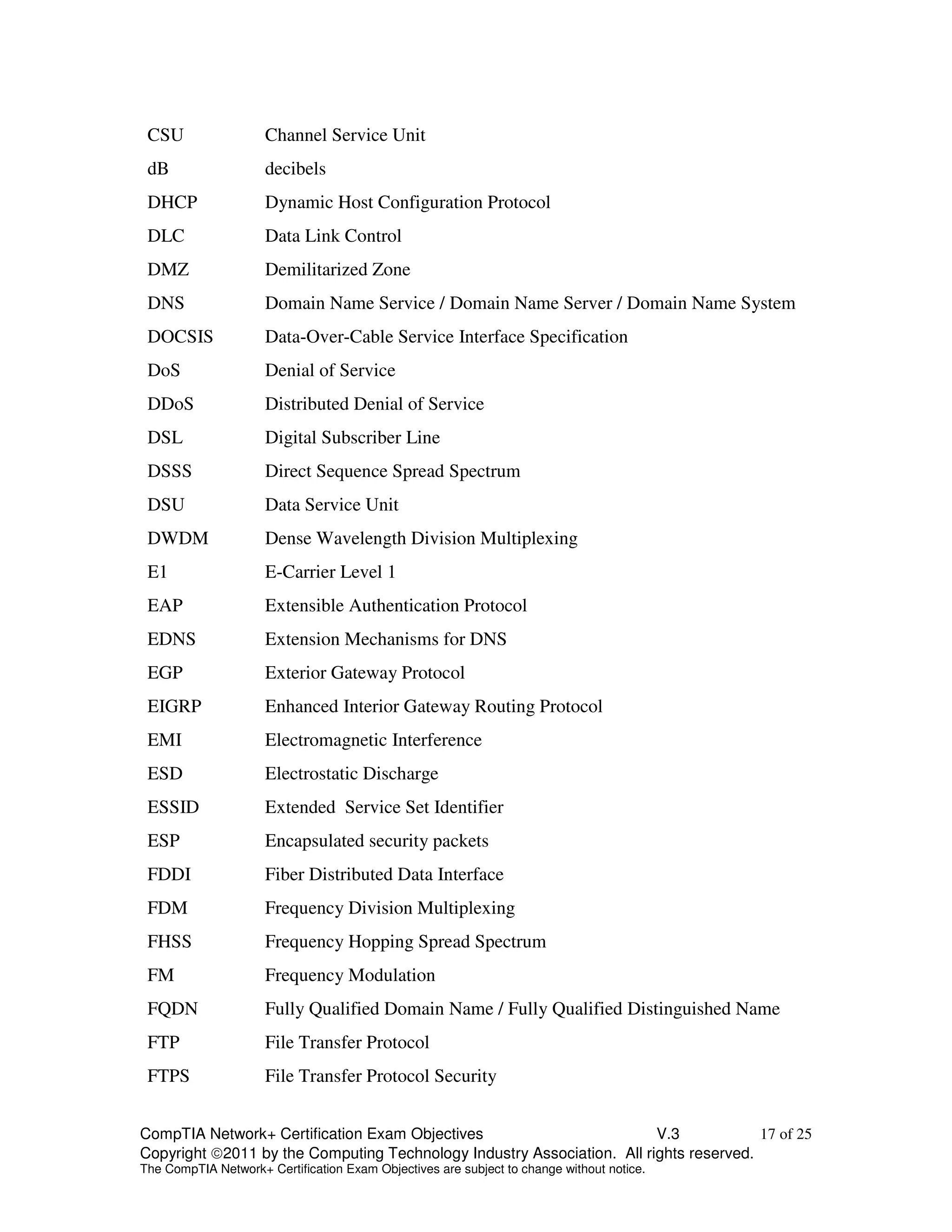
CSU Channel Service Unit 
dB decibels 
DHCP Dynamic Host Configuration Protocol 
DLC Data Link Control 
DMZ Demilitarized Zone 
DNS Domain Name Service / Domain Name Server / Domain Name System 
DOCSIS Data-Over-Cable Service Interface Specification 
DoS Denial of Service 
DDoS Distributed Denial of Service 
DSL Digital Subscriber Line 
DSSS Direct Sequence Spread Spectrum 
DSU Data Service Unit 
DWDM Dense Wavelength Division Multiplexing 
E1 E-Carrier Level 1 
EAP Extensible Authentication Protocol 
EDNS Extension Mechanisms for DNS 
EGP Exterior Gateway Protocol 
EIGRP Enhanced Interior Gateway Routing Protocol 
EMI Electromagnetic Interference 
ESD Electrostatic Discharge 
ESSID Extended Service Set Identifier 
ESP Encapsulated security packets 
FDDI Fiber Distributed Data Interface 
FDM Frequency Division Multiplexing 
FHSS Frequency Hopping Spread Spectrum 
FM Frequency Modulation 
FQDN Fully Qualified Domain Name / Fully Qualified Distinguished Name 
FTP File Transfer Protocol 
FTPS File Transfer Protocol Security 
CompTIA Network+ Certification Exam Objectives V.3 17 of 25 
Copyright 2011 by the Computing Technology Industry Association. All rights reserved. 
The CompTIA Network+ Certification Exam Objectives are subject to change without notice.
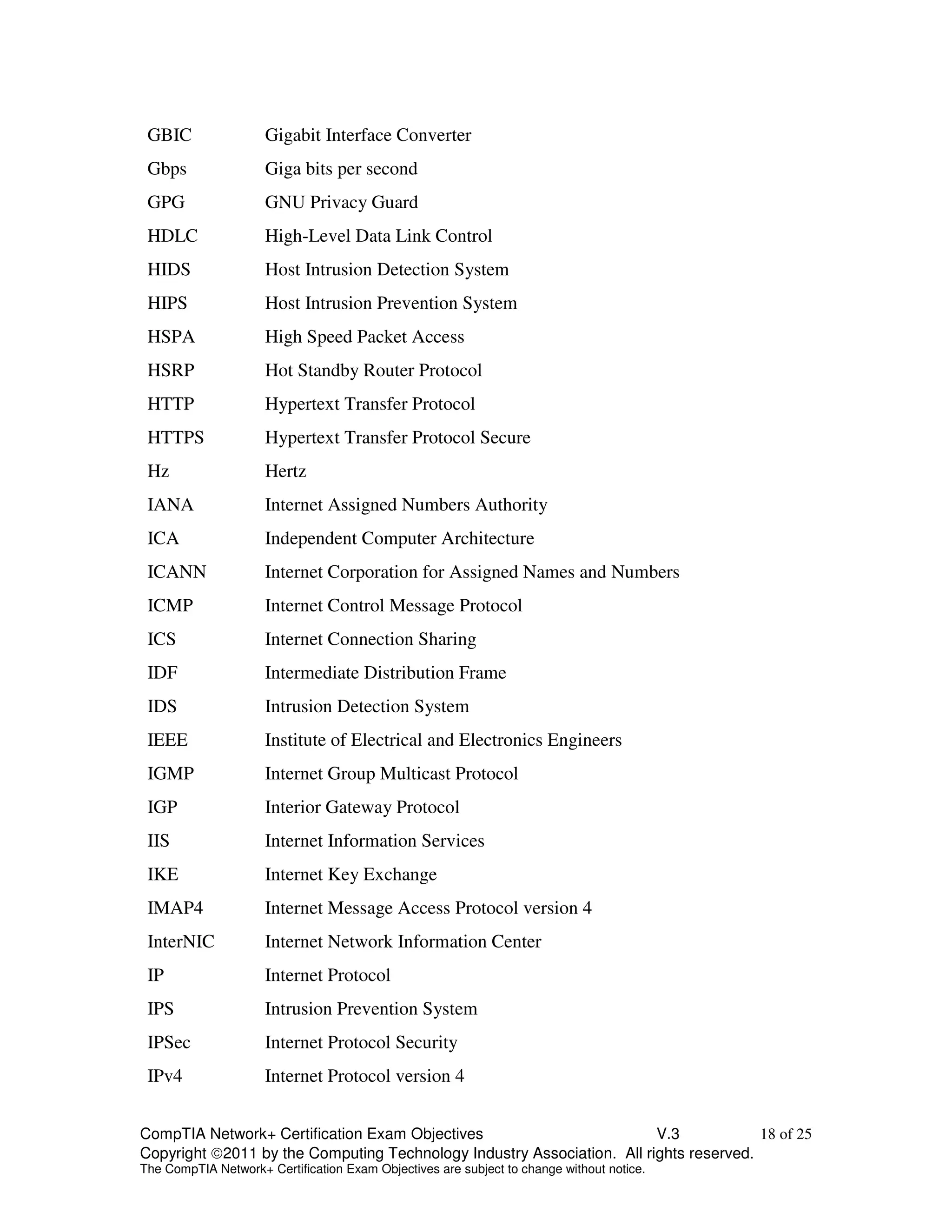
GBIC Gigabit Interface Converter 
Gbps Giga bits per second 
GPG GNU Privacy Guard 
HDLC High-Level Data Link Control 
HIDS Host Intrusion Detection System 
HIPS Host Intrusion Prevention System 
HSPA High Speed Packet Access 
HSRP Hot Standby Router Protocol 
HTTP Hypertext Transfer Protocol 
HTTPS Hypertext Transfer Protocol Secure 
Hz Hertz 
IANA Internet Assigned Numbers Authority 
ICA Independent Computer Architecture 
ICANN Internet Corporation for Assigned Names and Numbers 
ICMP Internet Control Message Protocol 
ICS Internet Connection Sharing 
IDF Intermediate Distribution Frame 
IDS Intrusion Detection System 
IEEE Institute of Electrical and Electronics Engineers 
IGMP Internet Group Multicast Protocol 
IGP Interior Gateway Protocol 
IIS Internet Information Services 
IKE Internet Key Exchange 
IMAP4 Internet Message Access Protocol version 4 
InterNIC Internet Network Information Center 
IP Internet Protocol 
IPS Intrusion Prevention System 
IPSec Internet Protocol Security 
IPv4 Internet Protocol version 4 
CompTIA Network+ Certification Exam Objectives V.3 18 of 25 
Copyright 2011 by the Computing Technology Industry Association. All rights reserved. 
The CompTIA Network+ Certification Exam Objectives are subject to change without notice.
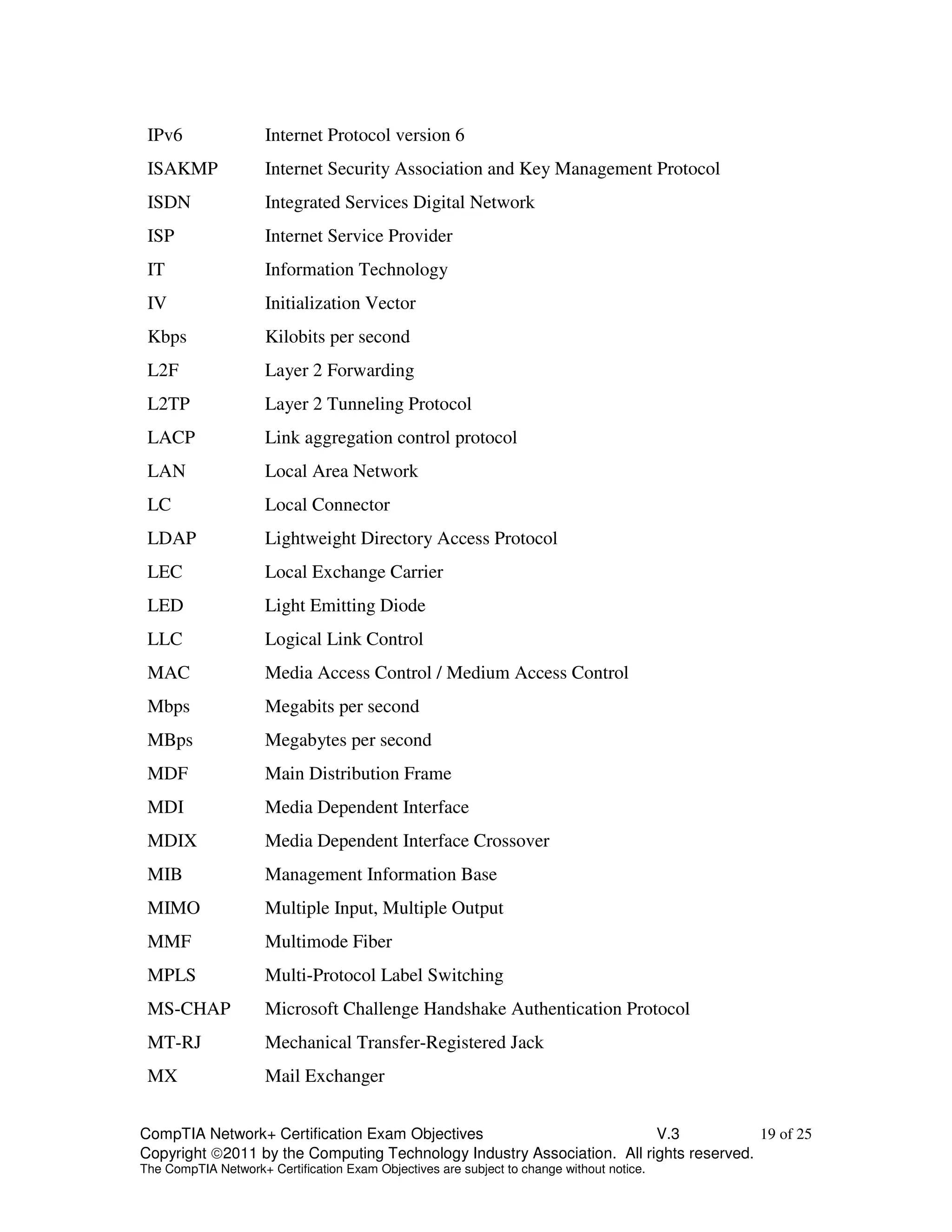
IPv6 Internet Protocol version 6 
ISAKMP Internet Security Association and Key Management Protocol 
ISDN Integrated Services Digital Network 
ISP Internet Service Provider 
IT Information Technology 
IV Initialization Vector 
Kbps Kilobits per second 
L2F Layer 2 Forwarding 
L2TP Layer 2 Tunneling Protocol 
LACP Link aggregation control protocol 
LAN Local Area Network 
LC Local Connector 
LDAP Lightweight Directory Access Protocol 
LEC Local Exchange Carrier 
LED Light Emitting Diode 
LLC Logical Link Control 
MAC Media Access Control / Medium Access Control 
Mbps Megabits per second 
MBps Megabytes per second 
MDF Main Distribution Frame 
MDI Media Dependent Interface 
MDIX Media Dependent Interface Crossover 
MIB Management Information Base 
MIMO Multiple Input, Multiple Output 
MMF Multimode Fiber 
MPLS Multi-Protocol Label Switching 
MS-CHAP Microsoft Challenge Handshake Authentication Protocol 
MT-RJ Mechanical Transfer-Registered Jack 
MX Mail Exchanger 
CompTIA Network+ Certification Exam Objectives V.3 19 of 25 
Copyright 2011 by the Computing Technology Industry Association. All rights reserved. 
The CompTIA Network+ Certification Exam Objectives are subject to change without notice.
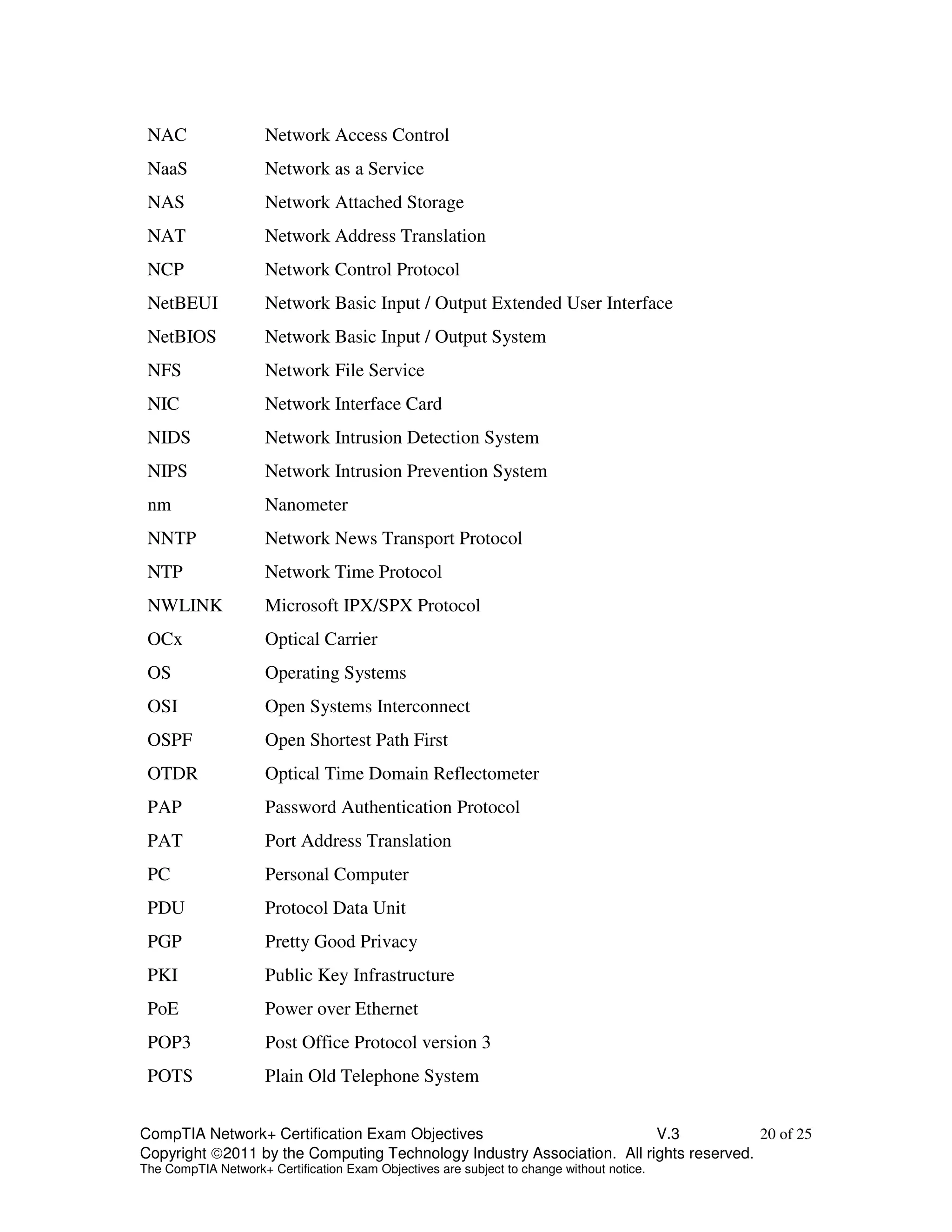
NAC Network Access Control 
NaaS Network as a Service 
NAS Network Attached Storage 
NAT Network Address Translation 
NCP Network Control Protocol 
NetBEUI Network Basic Input / Output Extended User Interface 
NetBIOS Network Basic Input / Output System 
NFS Network File Service 
NIC Network Interface Card 
NIDS Network Intrusion Detection System 
NIPS Network Intrusion Prevention System 
nm Nanometer 
NNTP Network News Transport Protocol 
NTP Network Time Protocol 
NWLINK Microsoft IPX/SPX Protocol 
OCx Optical Carrier 
OS Operating Systems 
OSI Open Systems Interconnect 
OSPF Open Shortest Path First 
OTDR Optical Time Domain Reflectometer 
PAP Password Authentication Protocol 
PAT Port Address Translation 
PC Personal Computer 
PDU Protocol Data Unit 
PGP Pretty Good Privacy 
PKI Public Key Infrastructure 
PoE Power over Ethernet 
POP3 Post Office Protocol version 3 
POTS Plain Old Telephone System 
CompTIA Network+ Certification Exam Objectives V.3 20 of 25 
Copyright 2011 by the Computing Technology Industry Association. All rights reserved. 
The CompTIA Network+ Certification Exam Objectives are subject to change without notice.
PPP Point-to-Point Protocol 
PPPoE Point-to-Point Protocol over Ethernet 
PPTP Point-to-Point Tunneling Protocol 
PRI Primary Rate Interface 
PSTN Public Switched Telephone Network 
PVC Permanent Virtual Circuit 
QoS Quality of Service 
RADIUS Remote Authentication Dial-In User Service 
RARP Reverse Address Resolution Protocol 
RAS Remote Access Service 
RDP Remote Desktop Protocol 
RFI Radio Frequency Interface 
RG Radio Guide 
RIP Routing Internet Protocol 
RJ Registered Jack 
RSA Rivest, Shamir, Adelman 
RSH Remote Shell 
RTP Real Time Protocol 
RTSP Real Time Streaming Protocol 
RTT Round Trip Time or Real Transfer Time 
SA Security Association 
SC Standard Connector / Subscriber Connector 
SCP Secure Copy Protocol 
SDSL Symmetrical Digital Subscriber Line 
SFTP Secure File Transfer Protocol 
SFP Small Form-factor Pluggable 
SIP Session Initiation Protocol 
SLIP Serial Line Internet Protocol 
SMF Single Mode Fiber 
CompTIA Network+ Certification Exam Objectives V.3 21 of 25 
Copyright 2011 by the Computing Technology Industry Association. All rights reserved. 
The CompTIA Network+ Certification Exam Objectives are subject to change without notice.
SMTP Simple Mail Transfer Protocol 
SNAT Static Network Address Translation 
SNMP Simple Network Management Protocol 
SNTP Simple Network Time Protocol 
SOA Start of Authority 
SOHO Small Office / Home Office 
SONET Synchronous Optical Network 
SPS Standby Power Supply 
SSH Secure Shell 
SSID Service Set Identifier 
SSL Secure Sockets Layer 
ST Straight Tip or Snap Twist 
STP Spanning Tree Protocol 
STP Shielded Twisted Pair 
SVC Switched Virtual Connection 
T1 T-Carrier Level 1 
TA Terminal Adaptor 
TACACS+ Terminal Access Control Access Control System+ 
TCP Transmission Control Protocol 
TCP / IP Transmission Control Protocol / Internet Protocol 
TDM Time Division Multiplexing 
TDR Time Domain Reflectometer 
Telco Telephone Company 
TFTP Trivial File Transfer Protocol 
TKIP Temporal Key Integrity Protocol 
TLS Transport Layer Security 
TTL Time to Live 
UDP User Datagram Protocol 
UNC Universal Naming Convention 
CompTIA Network+ Certification Exam Objectives V.3 22 of 25 
Copyright 2011 by the Computing Technology Industry Association. All rights reserved. 
The CompTIA Network+ Certification Exam Objectives are subject to change without notice.
UPS Uninterruptible Power Supply 
URL Uniform Resource Locator 
USB Universal Serial Bus 
UTP Unshielded Twisted Pair 
VDSL Variable Digital Subscriber Line 
VLAN Virtual Local Area Network 
VNC Virtual Network Connection 
VoIP Voice over IP 
VPN Virtual Private Network 
VRRP Virtual Router Redundancy Protocol 
VTC Video Teleconference 
VTP VLAN Trunk Protocol 
WAN Wide Area Network 
WAP Wireless Application Protocol / Wireless Access Point 
WEP Wired Equivalent Privacy 
WINS Window Internet Name Service 
WLAN Wireless Local Area Network 
WPA Wi-Fi Protected Access 
www World Wide Web 
X.25 CCITT Packet Switching Protocol 
XML eXtensible Markup Language 
XDSL Extended Digital Subscriber Line 
Zeroconf Zero Configuration 
Network+ Proposed Hardware and Software List 
CompTIA Network+ Certification Exam Objectives V.3 23 of 25 
Copyright 2011 by the Computing Technology Industry Association. All rights reserved. 
The CompTIA Network+ Certification Exam Objectives are subject to change without notice.
** CompTIA has included this sample list of hardware and software to assist candidates 
as they prepare for the Network+ exam. This list may also be helpful for training 
companies who wish to create a lab component to their training offering. The bulleted 
lists below each topic are a sample list and not exhaustive. 
Equipment 
• Patch Panels 
• Punch downs blocks 
• Layer 3 Switch 
• Router 
• Firewall 
• Two basic PCs 
• Access point 
• Media converters 
• Configuration terminal (with telnet and SSH) 
Spare hardware 
• NICs 
• Power supplies 
• GBICs 
• SFPs 
Spare parts 
• Patch cables 
• RJ-45 connectors, modular jacks 
• RJ-11 connectors 
• Cable spool 
• Coaxial cable spool 
• F-connectors 
Tools 
• Telco/network crimper 
• Cable tester 
• Punch down tool 
• Cable striper 
• Coaxial crimper 
• Wire cutter 
• Tone generator 
Software 
• Packet Sniffer 
• Protocol Analyzer 
CompTIA Network+ Certification Exam Objectives V.3 24 of 25 
Copyright 2011 by the Computing Technology Industry Association. All rights reserved. 
The CompTIA Network+ Certification Exam Objectives are subject to change without notice.
• Terminal Emulation Software 
• Linux/Windows OSs 
• Software Firewall 
• Software IDS / IPS 
• Network mapper 
• Virtual network environment 
Other 
• Sample network documentation 
• Sample logs 
• Defective cables 
CompTIA Network+ Certification Exam Objectives V.3 25 of 25 
Copyright 2011 by the Computing Technology Industry Association. All rights reserved. 
The CompTIA Network+ Certification Exam Objectives are subject to change without notice.

Comp tia network_n10-005

  • 1.
    Certification Exam Objectives:N10-005 INTRODUCTION The CompTIA Network+ certification is an internationally recognized validation of the technical knowledge required of foundation-level IT network practitioners. Test Purpose: This exam will certify that the successful candidate has the knowledge and skills required to implement a defined network architecture with basic network security. Furthermore, a successful candidate will be able to configure, maintain, and troubleshoot network devices using appropriate network tools and understand the features and purpose of network technologies. Candidates will be able to make basic solution recommendations, analyze network traffic, and be familiar with common protocols and media types. CompTIA Network+ is accredited by ANSI to show compliance with the ISO 17024 Standard and, as such, undergoes regular reviews and updates to the exam objectives. It is recommended for CompTIA Network+ candidates to have the following: • CompTIA A+ certification or equivalent knowledge, though CompTIA A+ certification is not required. • Have at least 9 to 12 months of work experience in IT networking. The table below lists the domains measured by this examination and the extent to which they are represented. CompTIA Network+ exams are based on these objectives. Domain % of Examination 1.0 Network Concepts 21% 2.0 Network Installation and Configuration 23% 3.0 Network Media and Topologies 17% 4.0 Network Management 20% 5.0 Network Security 19% Total 100% CompTIA Network+ Certification Exam Objectives V.3 1 of 25 Copyright 2011 by the Computing Technology Industry Association. All rights reserved. The CompTIA Network+ Certification Exam Objectives are subject to change without notice.
  • 2.
    CompTIA Authorized MaterialsUse Policy CompTIA Certifications, LLC is not affiliated with and does not authorize, endorse or condone utilizing any content provided by unauthorized third-party training sites, aka 'brain dumps'. Individuals who utilize such materials in preparation for any CompTIA examination will have their certifications revoked and be suspended from future testing in accordance with the CompTIA Candidate Agreement. In an effort to more clearly communicate CompTIA’s exam policies on use of unauthorized study materials, CompTIA directs all certification candidates to the CompTIA Certification Exam Policies webpage: http://certification.comptia.org/Training/testingcenters/policies.aspx Please review all CompTIA policies before beginning the study process for any CompTIA exam. Candidates will be required to abide by the CompTIA Candidate Agreement (http://certification.comptia.org/Training/testingcenters/policies/agreement.aspx) at the time of exam delivery. If a candidate has a question as to whether study materials are considered unauthorized (aka brain dumps), he/she should perform a search using CertGuard's engine, found here: http://www.certguard.com/search.asp Or verify against this list: http://certification.comptia.org/Training/testingcenters/policies/unauthorized.aspx **Note: The lists of examples provided in bulleted format below each objective are not exhaustive lists. Other examples of technologies, processes or tasks pertaining to each objective may also be included on the exam although not listed or covered in this objectives document. CompTIA is constantly reviewing the content of our exams and updating test questions to be sure our exams are current and the security of the questions is protected. When necessary, we will publish updated exams based on existing exam objectives. Please know that all related exam preparation materials will still be valid. (A list of acronyms used in these objectives appears at the end of this document.) CompTIA Network+ Certification Exam Objectives V.3 2 of 25 Copyright 2011 by the Computing Technology Industry Association. All rights reserved. The CompTIA Network+ Certification Exam Objectives are subject to change without notice.
  • 3.
    Networking Concepts 1.1Compare the layers of the OSI and TCP/IP models. • OSI model: o Layer 1 – Physical o Layer 2 – Data link o Layer 3 – Network o Layer 4 – Transport o Layer 5 – Session o Layer 6 – Presentation o Layer 7 – Application • TCP/IP model: o Network Interface Layer o Internet Layer o Transport Layer o Application Layer (Also described as: Link Layer, Internet Layer, Transport Layer, Application Layer) 1.2 Classify how applications, devices, and protocols relate to the OSI model layers. • MAC address • IP address • EUI-64 • Frames • Packets • Switch • Router • Multilayer switch • Hub • Encryption devices • Cable • NIC • Bridge 1.3 Explain the purpose and properties of IP addressing. • Classes of addresses o A, B, C and D o Public vs. Private • Classless (CIDR) • IPv4 vs. IPv6 (formatting) CompTIA Network+ Certification Exam Objectives V.3 3 of 25 Copyright 2011 by the Computing Technology Industry Association. All rights reserved. The CompTIA Network+ Certification Exam Objectives are subject to change without notice.
  • 4.
    • MAC addressformat • Subnetting • Multicast vs. unicast vs. broadcast • APIPA 1.4 Explain the purpose and properties of routing and switching. • EIGRP • OSPF • RIP • Link state vs. distance vector vs. hybrid • Static vs. dynamic • Routing metrics o Hop counts o MTU, bandwidth o Costs o Latency • Next hop • Spanning Tree Protocol • VLAN (802.1q) • Port mirroring • Broadcast domain vs. collision domain • IGP vs. EGP • Routing tables • Convergence (steady state) 1.5 Identify common TCP and UDP default ports. • SMTP – 25 • HTTP – 80 • HTTPS – 443 • FTP – 20, 21 • TELNET – 23 • IMAP – 143 • RDP – 3389 • SSH – 22 • DNS – 53 • DHCP – 67, 68 • POP3-110 1.6 Explain the function of common networking protocols. • TCP • FTP • UDP CompTIA Network+ Certification Exam Objectives V.3 4 of 25 Copyright 2011 by the Computing Technology Industry Association. All rights reserved. The CompTIA Network+ Certification Exam Objectives are subject to change without notice.
  • 5.
    • TCP/IP suite • DHCP • TFTP • DNS • HTTPS • HTTP • ARP • SIP (VoIP) • RTP (VoIP) • SSH • POP3 • NTP • IMAP4 • Telnet • SMTP • SNMP2/3 • ICMP • IGMP • TLS 1.7 Summarize DNS concepts and its components. • DNS servers • DNS records (A, MX, AAAA, CNAME, PTR) • Dynamic DNS 1.8 Given a scenario, implement the following network troubleshooting methodology: • Identify the problem: o Information gathering o Identify symptoms o Question users o Determine if anything has changed • Establish a theory of probable cause o Question the obvious • Test the theory to determine cause: o Once theory is confirmed determine next steps to resolve problem. o If theory is not confirmed, re-establish new theory or escalate. • Establish a plan of action to resolve the problem and identify potential effects • Implement the solution or escalate as necessary CompTIA Network+ Certification Exam Objectives V.3 5 of 25 Copyright 2011 by the Computing Technology Industry Association. All rights reserved. The CompTIA Network+ Certification Exam Objectives are subject to change without notice.
  • 6.
    • Verify fullsystem functionality and if applicable implement preventative measures • Document findings, actions and outcomes 1.9 Identify virtual network components. • Virtual switches • Virtual desktops • Virtual servers • Virtual PBX • Onsite vs. offsite • Network as a Service (NaaS) 2.0 Network Installation and Configuration 2.1 Given a scenario, install and configure routers and switches. • Routing tables • NAT • PAT • VLAN (trunking) • Managed vs. unmanaged • Interface configurations o Full duplex o Half duplex o Port speeds o IP addressing o MAC filtering • PoE • Traffic filtering • Diagnostics • VTP configuration • QoS • Port mirroring 2.2 Given a scenario, install and configure a wireless network. • WAP placement • Antenna types • Interference • Frequencies • Channels • Wireless standards • SSID (enable/disable) CompTIA Network+ Certification Exam Objectives V.3 6 of 25 Copyright 2011 by the Computing Technology Industry Association. All rights reserved. The CompTIA Network+ Certification Exam Objectives are subject to change without notice.
  • 7.
    • Compatibility (802.11a/b/g/n) 2.3 Explain the purpose and properties of DHCP. • Static vs. dynamic IP addressing • Reservations • Scopes • Leases • Options (DNS servers, suffixes) 2.4 Given a scenario, troubleshoot common wireless problems. • Interference • Signal strength • Configurations • Incompatibilities • Incorrect channel • Latency • Encryption type • Bounce • SSID mismatch • Incorrect switch placement 2.5 Given a scenario, troubleshoot common router and switch problems. • Switching loop • Bad cables/improper cable types • Port configuration • VLAN assignment • Mismatched MTU/MUT black hole • Power failure • Bad/missing routes • Bad modules (SFPs, GBICs) • Wrong subnet mask • Wrong gateway • Duplicate IP address • Wrong DNS 2.6 Given a set of requirements, plan and implement a basic SOHO network. • List of requirements • Cable length • Device types/requirements • Environment limitations • Equipment limitations • Compatibility requirements CompTIA Network+ Certification Exam Objectives V.3 7 of 25 Copyright 2011 by the Computing Technology Industry Association. All rights reserved. The CompTIA Network+ Certification Exam Objectives are subject to change without notice.
  • 8.
    3.0 Network Mediaand Topologies 3.1 Categorize standard media types and associated properties. • Fiber: o Multimode o Singlemode • Copper: o UTP o STP o CAT3 o CAT5 o CAT5e o CAT6 o CAT6a o Coaxial o Crossover o T1 Crossover o Straight-through • Plenum vs. non-plenum • Media converters: o Singlemode fiber to Ethernet o Multimode fiber to Ethernet o Fiber to Coaxial o Singlemode to multimode fiber • Distance limitations and speed limitations • Broadband over powerline 3.2 Categorize standard connector types based on network media. • Fiber: o ST o SC o LC o MTRJ • Copper: o RJ-45 o RJ-11 o BNC o F-connector o DB-9 (RS-232) CompTIA Network+ Certification Exam Objectives V.3 8 of 25 Copyright 2011 by the Computing Technology Industry Association. All rights reserved. The CompTIA Network+ Certification Exam Objectives are subject to change without notice.
  • 9.
    o Patch panel o 110 block (T568A, T568B) 3.3 Compare and contrast different wireless standards. • 802.11 a/b/g/n standards o Distance o Speed o Latency o Frequency o Channels o MIMO o Channel bonding 3.4 Categorize WAN technology types and properties. • Types: o T1/E1 o T3/E3 o DS3 o OCx o SONET o SDH o DWDM o Satellite o ISDN o Cable o DSL o Cellular o WiMAX o LTE o HSPA+ o Fiber o Dialup o PON o Frame relay o ATMs • Properties: o Circuit switch o Packet switch o Speed o Transmission media o Distance 3.5 Describe different network topologies. CompTIA Network+ Certification Exam Objectives V.3 9 of 25 Copyright 2011 by the Computing Technology Industry Association. All rights reserved. The CompTIA Network+ Certification Exam Objectives are subject to change without notice.
  • 10.
    • MPLS •Point-to-point • Point-to-multipoint • Ring • Star • Mesh • Bus • Peer-to-peer • Client-server • Hybrid 3.6 Given a scenario, troubleshoot common physical connectivity problems. • Cable problems: o Bad connectors o Bad wiring o Open, short o Split cables o dB loss o TXRX reversed o Cable placement o EMI/Interference o Distance o Cross-talk 3.7 Compare and contrast different LAN technologies. • Types: o Ethernet o 10BaseT o 100BaseT o 1000BaseT o 100BaseTX o 100BaseFX o 1000BaseX o 10GBaseSR o 10GBaseLR o 10GBaseER o 10GBaseSW o 10GBaseLW o 10GBaseEW o 10GBaseT • Properties: o CSMA/CD CompTIA Network+ Certification Exam Objectives V.3 10 of 25 Copyright 2011 by the Computing Technology Industry Association. All rights reserved. The CompTIA Network+ Certification Exam Objectives are subject to change without notice.
  • 11.
    o CSMA/CA oBroadcast o Collision o Bonding o Speed o Distance 3.8 Identify components of wiring distribution. • IDF • MDF • Demarc • Demarc extension • Smart jack • CSU/DSU 4.0 Network Management 4.1 Explain the purpose and features of various network appliances. • Load balancer • Proxy server • Content filter • VPN concentrator 4.2 Given a scenario, use appropriate hardware tools to troubleshoot connectivity issues. • Cable tester • Cable certifier • Crimper • Butt set • Toner probe • Punch down tool • Protocol analyzer • Loop back plug • TDR • OTDR • Multimeter • Environmental monitor 4.3 Given a scenario, use appropriate software tools to troubleshoot connectivity issues. • Protocol analyzer • Throughput testers CompTIA Network+ Certification Exam Objectives V.3 11 of 25 Copyright 2011 by the Computing Technology Industry Association. All rights reserved. The CompTIA Network+ Certification Exam Objectives are subject to change without notice.
  • 12.
    • Connectivity software • Ping • Tracert/traceroute • Dig • Ipconfig/ifconfig • Nslookup • Arp • Nbtstat • Netstat • Route 4.4 Given a scenario, use the appropriate network monitoring resource to analyze traffic. • SNMP • SNMPv2 • SNMPv3 • Syslog • System logs • History logs • General logs • Traffic analysis • Protocol Analyzer 4.5 Describe the purpose of configuration management documentation. • Wire schemes • Network maps • Documentation • Cable management • Asset management • Baselines • Change management 4.6 Explain different methods and rationales for network performance optimization. • Methods: o QoS o Traffic shaping o Load balancing o High availability o Caching engines o Fault tolerance o CARP CompTIA Network+ Certification Exam Objectives V.3 12 of 25 Copyright 2011 by the Computing Technology Industry Association. All rights reserved. The CompTIA Network+ Certification Exam Objectives are subject to change without notice.
  • 13.
    • Reasons: oLatency sensitivity o High bandwidth applications (VoIP, video applications, unified communications) o Uptime 5.0 Network Security 5.1 Given a scenario, implement appropriate wireless security measures. • Encryption protocols: o WEP o WPA o WPA2 o WPA Enterprise • MAC address filtering • Device placement • Signal strength 5.2 Explain the methods of network access security. • ACL: o MAC filtering o IP filtering o Port filtering • Tunneling and encryption: o SSL VPN o VPN o L2TP o PPTP o IPSec o ISAKMP o TLS o TLS1.2 o Site-to-site and client-to-site • Remote access: o RAS o RDP o PPPoE o PPP o ICA o SSH 5.3 Explain methods of user authentication. CompTIA Network+ Certification Exam Objectives V.3 13 of 25 Copyright 2011 by the Computing Technology Industry Association. All rights reserved. The CompTIA Network+ Certification Exam Objectives are subject to change without notice.
  • 14.
    o PKI oKerberos o AAA (RADIUS, TACACS+) o Network access control (802.1x, posture assessment) o CHAP o MS-CHAP o EAP o Two-factor authentication o Multifactor authentication o Single sign-on 5.4 Explain common threats, vulnerabilities, and mitigation techniques. • Wireless: o War driving o War chalking o WEP cracking o WPA cracking o Evil twin o Rogue access point • Attacks: o DoS o DDoS o Man in the middle o Social engineering o Virus o Worms o Buffer overflow o Packet sniffing o FTP bounce o Smurf • Mitigation techniques: o Training and awareness o Patch management o Policies and procedures o Incident response 5.5 Given a scenario, install and configure a basic firewall. • Types: o Software and hardware firewalls • Port security • Stateful inspection vs. packet filtering • Firewall rules: CompTIA Network+ Certification Exam Objectives V.3 14 of 25 Copyright 2011 by the Computing Technology Industry Association. All rights reserved. The CompTIA Network+ Certification Exam Objectives are subject to change without notice.
  • 15.
    o Block/allow oImplicit deny o ACL • NAT/PAT • DMZ 5.6 Categorize different types of network security appliances and methods. • IDS and IPS: o Behavior based o Signature based o Network based o Host based • Vulnerability scanners: o Nessus o Nmap • Methods: o Honeypots o Honeynets CompTIA Network+ Certification Exam Objectives V.3 15 of 25 Copyright 2011 by the Computing Technology Industry Association. All rights reserved. The CompTIA Network+ Certification Exam Objectives are subject to change without notice.
  • 16.
    Network+ Acronym List AAA Authentication Authorization and Accounting ACL Access Control List ADSL Asymmetric Digital Subscriber Line AES Advanced Encryption Standard AH Authentication Header AM Amplitude Modulation APIPA Automatic Private Internet Protocol Addressing ARIN American Registry for Internet Numbers ARP Address Resolution Protocol AS Autonomous System ASP Application Service Provider ATM Asynchronous Transfer Mode BERT Bit-Error Rate Test BGP Border Gateway Protocol BNC British Naval Connector / Bayonet Niell-Concelman BootP Boot Protocol /Bootstrap Protocol BPDU Bridge Protocol Data Unit BRI Basic Rate Interface BSSID Basic Service Set Identifier CAM Channel Access Method CARP Common Address Redundancy Protocol CCTV Closed Capkon TV CHAP Challenge Handshake Authentication Protocol CIDR Classless inter domain routing CNAME Canonical Name CRAM-MD5 Challenge-Response Authentication Mechanism – Message Digest 5 CSMA / CA Carrier Sense Multiple Access / Collision Avoidance CSMA / CD Carrier Sense Multiple Access / Collision Detection CompTIA Network+ Certification Exam Objectives V.3 16 of 25 Copyright 2011 by the Computing Technology Industry Association. All rights reserved. The CompTIA Network+ Certification Exam Objectives are subject to change without notice.
  • 17.
    CSU Channel ServiceUnit dB decibels DHCP Dynamic Host Configuration Protocol DLC Data Link Control DMZ Demilitarized Zone DNS Domain Name Service / Domain Name Server / Domain Name System DOCSIS Data-Over-Cable Service Interface Specification DoS Denial of Service DDoS Distributed Denial of Service DSL Digital Subscriber Line DSSS Direct Sequence Spread Spectrum DSU Data Service Unit DWDM Dense Wavelength Division Multiplexing E1 E-Carrier Level 1 EAP Extensible Authentication Protocol EDNS Extension Mechanisms for DNS EGP Exterior Gateway Protocol EIGRP Enhanced Interior Gateway Routing Protocol EMI Electromagnetic Interference ESD Electrostatic Discharge ESSID Extended Service Set Identifier ESP Encapsulated security packets FDDI Fiber Distributed Data Interface FDM Frequency Division Multiplexing FHSS Frequency Hopping Spread Spectrum FM Frequency Modulation FQDN Fully Qualified Domain Name / Fully Qualified Distinguished Name FTP File Transfer Protocol FTPS File Transfer Protocol Security CompTIA Network+ Certification Exam Objectives V.3 17 of 25 Copyright 2011 by the Computing Technology Industry Association. All rights reserved. The CompTIA Network+ Certification Exam Objectives are subject to change without notice.
  • 18.
    GBIC Gigabit InterfaceConverter Gbps Giga bits per second GPG GNU Privacy Guard HDLC High-Level Data Link Control HIDS Host Intrusion Detection System HIPS Host Intrusion Prevention System HSPA High Speed Packet Access HSRP Hot Standby Router Protocol HTTP Hypertext Transfer Protocol HTTPS Hypertext Transfer Protocol Secure Hz Hertz IANA Internet Assigned Numbers Authority ICA Independent Computer Architecture ICANN Internet Corporation for Assigned Names and Numbers ICMP Internet Control Message Protocol ICS Internet Connection Sharing IDF Intermediate Distribution Frame IDS Intrusion Detection System IEEE Institute of Electrical and Electronics Engineers IGMP Internet Group Multicast Protocol IGP Interior Gateway Protocol IIS Internet Information Services IKE Internet Key Exchange IMAP4 Internet Message Access Protocol version 4 InterNIC Internet Network Information Center IP Internet Protocol IPS Intrusion Prevention System IPSec Internet Protocol Security IPv4 Internet Protocol version 4 CompTIA Network+ Certification Exam Objectives V.3 18 of 25 Copyright 2011 by the Computing Technology Industry Association. All rights reserved. The CompTIA Network+ Certification Exam Objectives are subject to change without notice.
  • 19.
    IPv6 Internet Protocolversion 6 ISAKMP Internet Security Association and Key Management Protocol ISDN Integrated Services Digital Network ISP Internet Service Provider IT Information Technology IV Initialization Vector Kbps Kilobits per second L2F Layer 2 Forwarding L2TP Layer 2 Tunneling Protocol LACP Link aggregation control protocol LAN Local Area Network LC Local Connector LDAP Lightweight Directory Access Protocol LEC Local Exchange Carrier LED Light Emitting Diode LLC Logical Link Control MAC Media Access Control / Medium Access Control Mbps Megabits per second MBps Megabytes per second MDF Main Distribution Frame MDI Media Dependent Interface MDIX Media Dependent Interface Crossover MIB Management Information Base MIMO Multiple Input, Multiple Output MMF Multimode Fiber MPLS Multi-Protocol Label Switching MS-CHAP Microsoft Challenge Handshake Authentication Protocol MT-RJ Mechanical Transfer-Registered Jack MX Mail Exchanger CompTIA Network+ Certification Exam Objectives V.3 19 of 25 Copyright 2011 by the Computing Technology Industry Association. All rights reserved. The CompTIA Network+ Certification Exam Objectives are subject to change without notice.
  • 20.
    NAC Network AccessControl NaaS Network as a Service NAS Network Attached Storage NAT Network Address Translation NCP Network Control Protocol NetBEUI Network Basic Input / Output Extended User Interface NetBIOS Network Basic Input / Output System NFS Network File Service NIC Network Interface Card NIDS Network Intrusion Detection System NIPS Network Intrusion Prevention System nm Nanometer NNTP Network News Transport Protocol NTP Network Time Protocol NWLINK Microsoft IPX/SPX Protocol OCx Optical Carrier OS Operating Systems OSI Open Systems Interconnect OSPF Open Shortest Path First OTDR Optical Time Domain Reflectometer PAP Password Authentication Protocol PAT Port Address Translation PC Personal Computer PDU Protocol Data Unit PGP Pretty Good Privacy PKI Public Key Infrastructure PoE Power over Ethernet POP3 Post Office Protocol version 3 POTS Plain Old Telephone System CompTIA Network+ Certification Exam Objectives V.3 20 of 25 Copyright 2011 by the Computing Technology Industry Association. All rights reserved. The CompTIA Network+ Certification Exam Objectives are subject to change without notice.
  • 21.
    PPP Point-to-Point Protocol PPPoE Point-to-Point Protocol over Ethernet PPTP Point-to-Point Tunneling Protocol PRI Primary Rate Interface PSTN Public Switched Telephone Network PVC Permanent Virtual Circuit QoS Quality of Service RADIUS Remote Authentication Dial-In User Service RARP Reverse Address Resolution Protocol RAS Remote Access Service RDP Remote Desktop Protocol RFI Radio Frequency Interface RG Radio Guide RIP Routing Internet Protocol RJ Registered Jack RSA Rivest, Shamir, Adelman RSH Remote Shell RTP Real Time Protocol RTSP Real Time Streaming Protocol RTT Round Trip Time or Real Transfer Time SA Security Association SC Standard Connector / Subscriber Connector SCP Secure Copy Protocol SDSL Symmetrical Digital Subscriber Line SFTP Secure File Transfer Protocol SFP Small Form-factor Pluggable SIP Session Initiation Protocol SLIP Serial Line Internet Protocol SMF Single Mode Fiber CompTIA Network+ Certification Exam Objectives V.3 21 of 25 Copyright 2011 by the Computing Technology Industry Association. All rights reserved. The CompTIA Network+ Certification Exam Objectives are subject to change without notice.
  • 22.
    SMTP Simple MailTransfer Protocol SNAT Static Network Address Translation SNMP Simple Network Management Protocol SNTP Simple Network Time Protocol SOA Start of Authority SOHO Small Office / Home Office SONET Synchronous Optical Network SPS Standby Power Supply SSH Secure Shell SSID Service Set Identifier SSL Secure Sockets Layer ST Straight Tip or Snap Twist STP Spanning Tree Protocol STP Shielded Twisted Pair SVC Switched Virtual Connection T1 T-Carrier Level 1 TA Terminal Adaptor TACACS+ Terminal Access Control Access Control System+ TCP Transmission Control Protocol TCP / IP Transmission Control Protocol / Internet Protocol TDM Time Division Multiplexing TDR Time Domain Reflectometer Telco Telephone Company TFTP Trivial File Transfer Protocol TKIP Temporal Key Integrity Protocol TLS Transport Layer Security TTL Time to Live UDP User Datagram Protocol UNC Universal Naming Convention CompTIA Network+ Certification Exam Objectives V.3 22 of 25 Copyright 2011 by the Computing Technology Industry Association. All rights reserved. The CompTIA Network+ Certification Exam Objectives are subject to change without notice.
  • 23.
    UPS Uninterruptible PowerSupply URL Uniform Resource Locator USB Universal Serial Bus UTP Unshielded Twisted Pair VDSL Variable Digital Subscriber Line VLAN Virtual Local Area Network VNC Virtual Network Connection VoIP Voice over IP VPN Virtual Private Network VRRP Virtual Router Redundancy Protocol VTC Video Teleconference VTP VLAN Trunk Protocol WAN Wide Area Network WAP Wireless Application Protocol / Wireless Access Point WEP Wired Equivalent Privacy WINS Window Internet Name Service WLAN Wireless Local Area Network WPA Wi-Fi Protected Access www World Wide Web X.25 CCITT Packet Switching Protocol XML eXtensible Markup Language XDSL Extended Digital Subscriber Line Zeroconf Zero Configuration Network+ Proposed Hardware and Software List CompTIA Network+ Certification Exam Objectives V.3 23 of 25 Copyright 2011 by the Computing Technology Industry Association. All rights reserved. The CompTIA Network+ Certification Exam Objectives are subject to change without notice.
  • 24.
    ** CompTIA hasincluded this sample list of hardware and software to assist candidates as they prepare for the Network+ exam. This list may also be helpful for training companies who wish to create a lab component to their training offering. The bulleted lists below each topic are a sample list and not exhaustive. Equipment • Patch Panels • Punch downs blocks • Layer 3 Switch • Router • Firewall • Two basic PCs • Access point • Media converters • Configuration terminal (with telnet and SSH) Spare hardware • NICs • Power supplies • GBICs • SFPs Spare parts • Patch cables • RJ-45 connectors, modular jacks • RJ-11 connectors • Cable spool • Coaxial cable spool • F-connectors Tools • Telco/network crimper • Cable tester • Punch down tool • Cable striper • Coaxial crimper • Wire cutter • Tone generator Software • Packet Sniffer • Protocol Analyzer CompTIA Network+ Certification Exam Objectives V.3 24 of 25 Copyright 2011 by the Computing Technology Industry Association. All rights reserved. The CompTIA Network+ Certification Exam Objectives are subject to change without notice.
  • 25.
    • Terminal EmulationSoftware • Linux/Windows OSs • Software Firewall • Software IDS / IPS • Network mapper • Virtual network environment Other • Sample network documentation • Sample logs • Defective cables CompTIA Network+ Certification Exam Objectives V.3 25 of 25 Copyright 2011 by the Computing Technology Industry Association. All rights reserved. The CompTIA Network+ Certification Exam Objectives are subject to change without notice.