Social and Economic
Network Analysis
UNIT – III
SOCIAL NETWORK ANALYSIS
Overview
Strength of Weak
Ties
Community
Detection
20-04-2021 VANI KANDHASAMY, PSGTECH 2
Summary
20-04-2021 VANI KANDHASAMY, PSGTECH 3
Strength of Weak Ties
NETWORKS, CROWDS AND MARKETS - CHAPTER 3
20-04-2021 VANI KANDHASAMY, PSGTECH 4
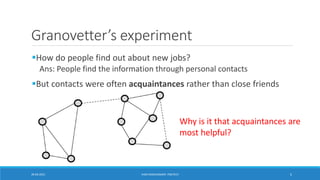
Granovetter’s experiment
▪How do people find out about new jobs?
Ans: People find the information through personal contacts
▪But contacts were often acquaintances rather than close friends
Why is it that acquaintances are
most helpful?
20-04-2021 VANI KANDHASAMY, PSGTECH 5
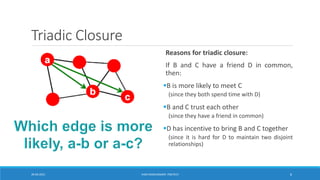
Triadic Closure
Reasons for triadic closure:
If B and C have a friend D in common,
then:
▪B is more likely to meet C
(since they both spend time with D)
▪B and C trust each other
(since they have a friend in common)
▪D has incentive to bring B and C together
(since it is hard for D to maintain two disjoint
relationships)
20-04-2021 VANI KANDHASAMY, PSGTECH 6
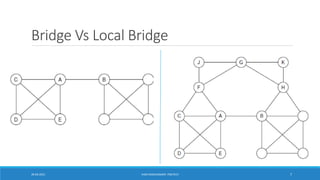
Bridge Vs Local Bridge
20-04-2021 VANI KANDHASAMY, PSGTECH 7
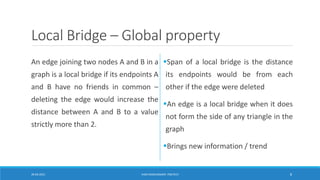
Local Bridge – Global property
An edge joining two nodes A and B in a
graph is a local bridge if its endpoints A
and B have no friends in common –
deleting the edge would increase the
distance between A and B to a value
strictly more than 2.
▪Span of a local bridge is the distance
its endpoints would be from each
other if the edge were deleted
▪An edge is a local bridge when it does
not form the side of any triangle in the
graph
▪Brings new information / trend
20-04-2021 VANI KANDHASAMY, PSGTECH 8
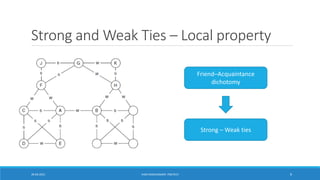
Strong and Weak Ties – Local property
Friend–Acquaintance
dichotomy
Strong – Weak ties
20-04-2021 VANI KANDHASAMY, PSGTECH 9
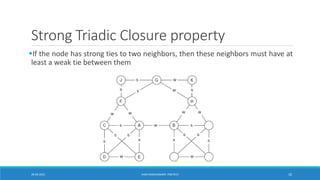
Strong Triadic Closure property
▪If the node has strong ties to two neighbors, then these neighbors must have at
least a weak tie between them
20-04-2021 VANI KANDHASAMY, PSGTECH 10
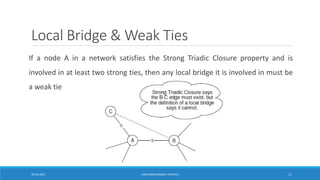
Local Bridge & Weak Ties
If a node A in a network satisfies the Strong Triadic Closure property and is
involved in at least two strong ties, then any local bridge it is involved in must be
a weak tie
20-04-2021 VANI KANDHASAMY, PSGTECH 11
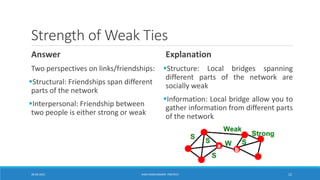
Strength of Weak Ties
Answer
Two perspectives on links/friendships:
▪Structural: Friendships span different
parts of the network
▪Interpersonal: Friendship between
two people is either strong or weak
Explanation
▪Structure: Local bridges spanning
different parts of the network are
socially weak
▪Information: Local bridge allow you to
gather information from different parts
of the network
20-04-2021 VANI KANDHASAMY, PSGTECH 12
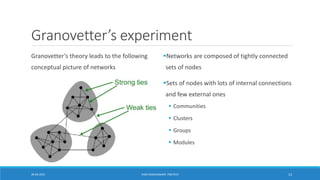
Granovetter’s experiment
Granovetter’s theory leads to the following
conceptual picture of networks
▪Networks are composed of tightly connected
sets of nodes
▪Sets of nodes with lots of internal connections
and few external ones
▪ Communities
▪ Clusters
▪ Groups
▪ Modules
20-04-2021 VANI KANDHASAMY, PSGTECH 13
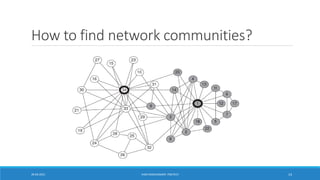
How to find network communities?
20-04-2021 VANI KANDHASAMY, PSGTECH 14
Community Detection
NETWORKS, CROWDS AND MARKETS - CHAPTER 3
20-04-2021 VANI KANDHASAMY, PSGTECH 15
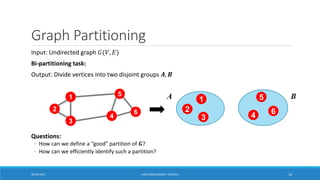
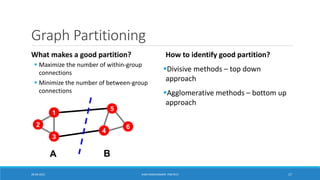
Graph Partitioning
Input: Undirected graph 𝐺(𝑉, 𝐸)
Bi-partitioning task:
Output: Divide vertices into two disjoint groups 𝑨, 𝑩
Questions:
◦ How can we define a “good” partition of 𝑮?
◦ How can we efficiently identify such a partition?
1
3
2
5
4 6
A B
1
3
2
5
4
6
20-04-2021 VANI KANDHASAMY, PSGTECH 16
Graph Partitioning
What makes a good partition?
▪ Maximize the number of within-group
connections
▪ Minimize the number of between-group
connections
How to identify good partition?
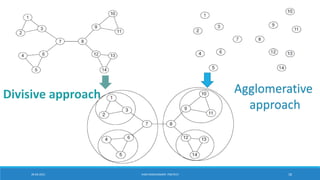
▪Divisive methods – top down
approach
▪Agglomerative methods – bottom up
approach
17
1
3
2
5
4
6
A B
20-04-2021 VANI KANDHASAMY, PSGTECH
20-04-2021 VANI KANDHASAMY, PSGTECH 18
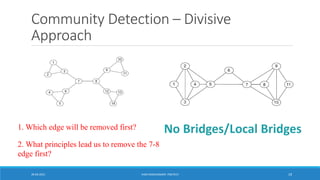
Community Detection – Divisive
Approach
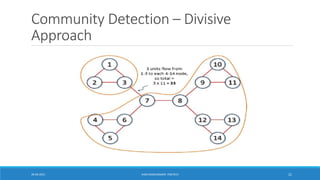
2. What principles lead us to remove the 7-8
edge first?
1. Which edge will be removed first?
20-04-2021 VANI KANDHASAMY, PSGTECH 19
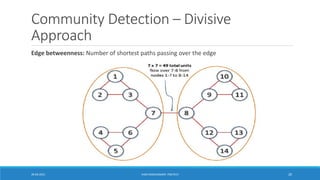
Community Detection – Divisive
Approach
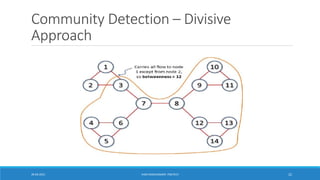
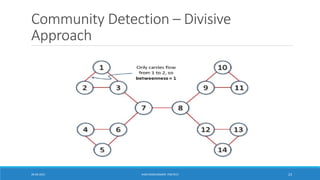
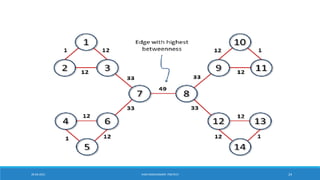
Edge betweenness: Number of shortest paths passing over the edge
20-04-2021 VANI KANDHASAMY, PSGTECH 20
Community Detection – Divisive
Approach
20-04-2021 VANI KANDHASAMY, PSGTECH 21
Community Detection – Divisive
Approach
20-04-2021 VANI KANDHASAMY, PSGTECH 22
Community Detection – Divisive
Approach
20-04-2021 VANI KANDHASAMY, PSGTECH 23
20-04-2021 VANI KANDHASAMY, PSGTECH 24
Girvan-Newman Algorithm
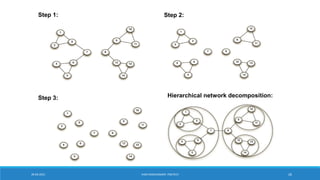
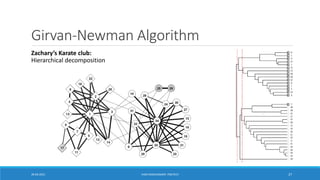
▪Divisive hierarchical clustering based on the notion of edge betweenness
▪Undirected unweighted networks
▪Algorithm:
• Repeat until no edges are left:
o Calculate betweenness of edges
o Remove edges with highest betweenness
▪ Connected components are communities
▪ Gives a hierarchical decomposition of the network
[Girvan-Newman ‘02]
20-04-2021 VANI KANDHASAMY, PSGTECH 25
Step 1: Step 2:
Step 3: Hierarchical network decomposition:
20-04-2021 VANI KANDHASAMY, PSGTECH 26
Girvan-Newman Algorithm
Zachary’s Karate club:
Hierarchical decomposition
20-04-2021 VANI KANDHASAMY, PSGTECH 27
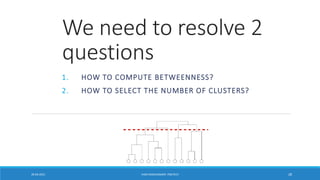
We need to resolve 2
questions
1. HOW TO COMPUTE BETWEENNESS?
2. HOW TO SELECT THE NUMBER OF CLUSTERS?
20-04-2021 VANI KANDHASAMY, PSGTECH 28
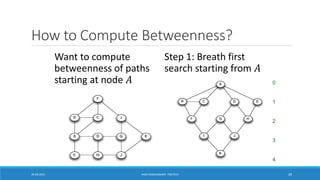
How to Compute Betweenness?
Want to compute
betweenness of paths
starting at node 𝐴
Step 1: Breath first
search starting from 𝐴
0
1
2
3
4
20-04-2021 VANI KANDHASAMY, PSGTECH 29
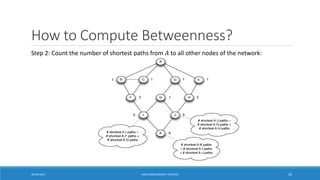
How to Compute Betweenness?
Step 2: Count the number of shortest paths from 𝐴 to all other nodes of the network:
20-04-2021 VANI KANDHASAMY, PSGTECH 30
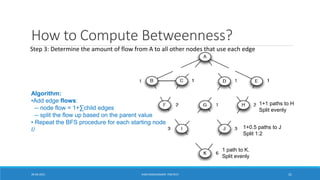
How to Compute Betweenness?
1 path to K.
Split evenly
1+0.5 paths to J
Split 1:2
1+1 paths to H
Split evenly
Algorithm:
•Add edge flows:
-- node flow = 1+∑child edges
-- split the flow up based on the parent value
• Repeat the BFS procedure for each starting node
𝑈
Step 3: Determine the amount of flow from A to all other nodes that use each edge
20-04-2021 VANI KANDHASAMY, PSGTECH 31
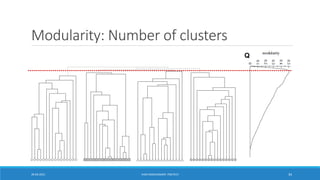
How to select the number of clusters?
Define: Modularity 𝑸
A measure of how well a network is partitioned into communities
Given a partitioning of the network into groups 𝒔  𝑺:
Q  ∑s S [ (# edges within group s) – (expected # edges within group s) ]
Null / Erdos-Renyi model
20-04-2021 VANI KANDHASAMY, PSGTECH 32
Modularity values take range [−1,1]
0.3-0.7<Q means significant community structure
20-04-2021 VANI KANDHASAMY, PSGTECH 33
Modularity: Number of clusters
Q
20-04-2021 VANI KANDHASAMY, PSGTECH 34
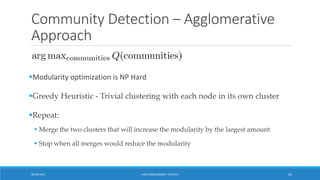
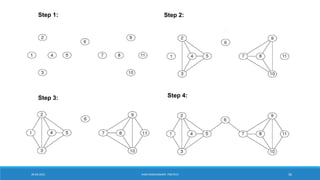
Community Detection – Agglomerative
Approach
▪Modularity optimization is NP Hard
▪Greedy Heuristic - Trivial clustering with each node in its own cluster
▪Repeat:
▪ Merge the two clusters that will increase the modularity by the largest amount
▪ Stop when all merges would reduce the modularity
20-04-2021 VANI KANDHASAMY, PSGTECH 35
Step 1: Step 2:
Step 3: Step 4:
20-04-2021 VANI KANDHASAMY, PSGTECH 36

Community detection-Part1

  • 1.
    Social and Economic NetworkAnalysis UNIT – III SOCIAL NETWORK ANALYSIS
  • 2.
  • 3.
  • 4.
    Strength of WeakTies NETWORKS, CROWDS AND MARKETS - CHAPTER 3 20-04-2021 VANI KANDHASAMY, PSGTECH 4
  • 5.
    Granovetter’s experiment ▪How dopeople find out about new jobs? Ans: People find the information through personal contacts ▪But contacts were often acquaintances rather than close friends Why is it that acquaintances are most helpful? 20-04-2021 VANI KANDHASAMY, PSGTECH 5
  • 6.
    Triadic Closure Reasons fortriadic closure: If B and C have a friend D in common, then: ▪B is more likely to meet C (since they both spend time with D) ▪B and C trust each other (since they have a friend in common) ▪D has incentive to bring B and C together (since it is hard for D to maintain two disjoint relationships) 20-04-2021 VANI KANDHASAMY, PSGTECH 6
  • 7.
    Bridge Vs LocalBridge 20-04-2021 VANI KANDHASAMY, PSGTECH 7
  • 8.
    Local Bridge –Global property An edge joining two nodes A and B in a graph is a local bridge if its endpoints A and B have no friends in common – deleting the edge would increase the distance between A and B to a value strictly more than 2. ▪Span of a local bridge is the distance its endpoints would be from each other if the edge were deleted ▪An edge is a local bridge when it does not form the side of any triangle in the graph ▪Brings new information / trend 20-04-2021 VANI KANDHASAMY, PSGTECH 8
  • 9.
    Strong and WeakTies – Local property Friend–Acquaintance dichotomy Strong – Weak ties 20-04-2021 VANI KANDHASAMY, PSGTECH 9
  • 10.
    Strong Triadic Closureproperty ▪If the node has strong ties to two neighbors, then these neighbors must have at least a weak tie between them 20-04-2021 VANI KANDHASAMY, PSGTECH 10
  • 11.
    Local Bridge &Weak Ties If a node A in a network satisfies the Strong Triadic Closure property and is involved in at least two strong ties, then any local bridge it is involved in must be a weak tie 20-04-2021 VANI KANDHASAMY, PSGTECH 11
  • 12.
    Strength of WeakTies Answer Two perspectives on links/friendships: ▪Structural: Friendships span different parts of the network ▪Interpersonal: Friendship between two people is either strong or weak Explanation ▪Structure: Local bridges spanning different parts of the network are socially weak ▪Information: Local bridge allow you to gather information from different parts of the network 20-04-2021 VANI KANDHASAMY, PSGTECH 12
  • 13.
    Granovetter’s experiment Granovetter’s theoryleads to the following conceptual picture of networks ▪Networks are composed of tightly connected sets of nodes ▪Sets of nodes with lots of internal connections and few external ones ▪ Communities ▪ Clusters ▪ Groups ▪ Modules 20-04-2021 VANI KANDHASAMY, PSGTECH 13
  • 14.
    How to findnetwork communities? 20-04-2021 VANI KANDHASAMY, PSGTECH 14
  • 15.
    Community Detection NETWORKS, CROWDSAND MARKETS - CHAPTER 3 20-04-2021 VANI KANDHASAMY, PSGTECH 15
  • 16.
    Graph Partitioning Input: Undirectedgraph 𝐺(𝑉, 𝐸) Bi-partitioning task: Output: Divide vertices into two disjoint groups 𝑨, 𝑩 Questions: ◦ How can we define a “good” partition of 𝑮? ◦ How can we efficiently identify such a partition? 1 3 2 5 4 6 A B 1 3 2 5 4 6 20-04-2021 VANI KANDHASAMY, PSGTECH 16
  • 17.
    Graph Partitioning What makesa good partition? ▪ Maximize the number of within-group connections ▪ Minimize the number of between-group connections How to identify good partition? ▪Divisive methods – top down approach ▪Agglomerative methods – bottom up approach 17 1 3 2 5 4 6 A B 20-04-2021 VANI KANDHASAMY, PSGTECH
  • 18.
  • 19.
    Community Detection –Divisive Approach 2. What principles lead us to remove the 7-8 edge first? 1. Which edge will be removed first? 20-04-2021 VANI KANDHASAMY, PSGTECH 19
  • 20.
    Community Detection –Divisive Approach Edge betweenness: Number of shortest paths passing over the edge 20-04-2021 VANI KANDHASAMY, PSGTECH 20
  • 21.
    Community Detection –Divisive Approach 20-04-2021 VANI KANDHASAMY, PSGTECH 21
  • 22.
    Community Detection –Divisive Approach 20-04-2021 VANI KANDHASAMY, PSGTECH 22
  • 23.
    Community Detection –Divisive Approach 20-04-2021 VANI KANDHASAMY, PSGTECH 23
  • 24.
  • 25.
    Girvan-Newman Algorithm ▪Divisive hierarchicalclustering based on the notion of edge betweenness ▪Undirected unweighted networks ▪Algorithm: • Repeat until no edges are left: o Calculate betweenness of edges o Remove edges with highest betweenness ▪ Connected components are communities ▪ Gives a hierarchical decomposition of the network [Girvan-Newman ‘02] 20-04-2021 VANI KANDHASAMY, PSGTECH 25
  • 26.
    Step 1: Step2: Step 3: Hierarchical network decomposition: 20-04-2021 VANI KANDHASAMY, PSGTECH 26
  • 27.
    Girvan-Newman Algorithm Zachary’s Karateclub: Hierarchical decomposition 20-04-2021 VANI KANDHASAMY, PSGTECH 27
  • 28.
    We need toresolve 2 questions 1. HOW TO COMPUTE BETWEENNESS? 2. HOW TO SELECT THE NUMBER OF CLUSTERS? 20-04-2021 VANI KANDHASAMY, PSGTECH 28
  • 29.
    How to ComputeBetweenness? Want to compute betweenness of paths starting at node 𝐴 Step 1: Breath first search starting from 𝐴 0 1 2 3 4 20-04-2021 VANI KANDHASAMY, PSGTECH 29
  • 30.
    How to ComputeBetweenness? Step 2: Count the number of shortest paths from 𝐴 to all other nodes of the network: 20-04-2021 VANI KANDHASAMY, PSGTECH 30
  • 31.
    How to ComputeBetweenness? 1 path to K. Split evenly 1+0.5 paths to J Split 1:2 1+1 paths to H Split evenly Algorithm: •Add edge flows: -- node flow = 1+∑child edges -- split the flow up based on the parent value • Repeat the BFS procedure for each starting node 𝑈 Step 3: Determine the amount of flow from A to all other nodes that use each edge 20-04-2021 VANI KANDHASAMY, PSGTECH 31
  • 32.
    How to selectthe number of clusters? Define: Modularity 𝑸 A measure of how well a network is partitioned into communities Given a partitioning of the network into groups 𝒔  𝑺: Q  ∑s S [ (# edges within group s) – (expected # edges within group s) ] Null / Erdos-Renyi model 20-04-2021 VANI KANDHASAMY, PSGTECH 32
  • 33.
    Modularity values takerange [−1,1] 0.3-0.7<Q means significant community structure 20-04-2021 VANI KANDHASAMY, PSGTECH 33
  • 34.
    Modularity: Number ofclusters Q 20-04-2021 VANI KANDHASAMY, PSGTECH 34
  • 35.
    Community Detection –Agglomerative Approach ▪Modularity optimization is NP Hard ▪Greedy Heuristic - Trivial clustering with each node in its own cluster ▪Repeat: ▪ Merge the two clusters that will increase the modularity by the largest amount ▪ Stop when all merges would reduce the modularity 20-04-2021 VANI KANDHASAMY, PSGTECH 35
  • 36.
    Step 1: Step2: Step 3: Step 4: 20-04-2021 VANI KANDHASAMY, PSGTECH 36